Questions · Page 1 of 3

5 Marks Questions

🎯

Test yourself on this topic

50 questions · timed · auto-graded

Question 15 Marks
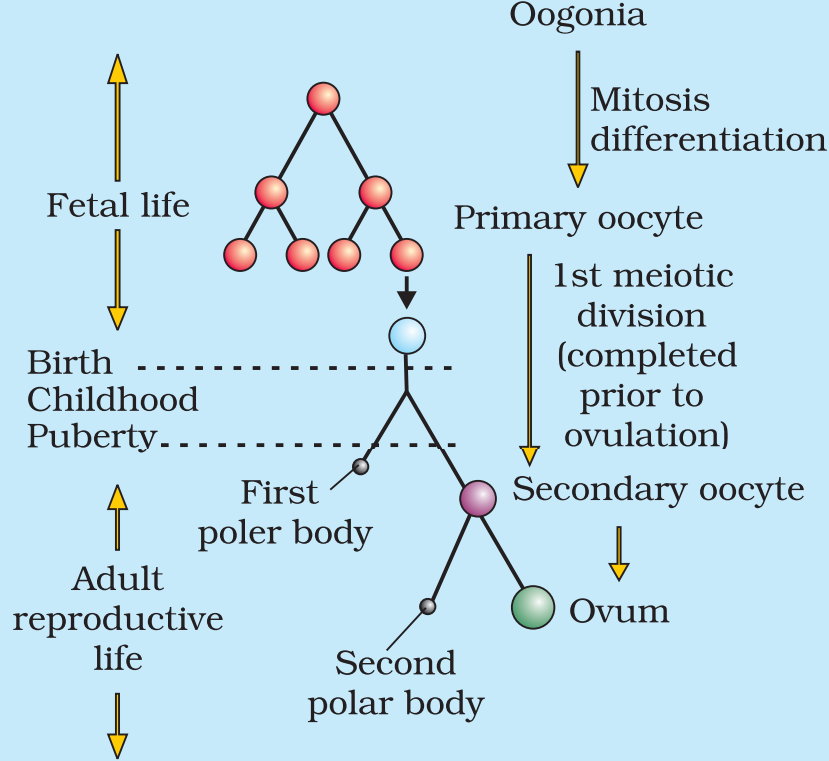
What is oogenesis? Give a brief account of oogenesis.
Answer
The process of the formation of a mature ovum in the ovary from the oogonia in females is known as oogenesis.
Germ cell of the female foetus divide to produce oogonia (gamete mother cell). No more oogonia are formed or added after birth. A diploid oogonium or egg mother cell increases in size and gets transformed into a diploid primary oocyte. This diploid primary oocyte undergoes meiosis or reductional division to form two unequal haploid cells. The smaller cell is known as the first polar body, while the larger cell is known as the secondary oocyte. This secondary oocyte undergoes meiosis II or equational division and gives rise to a second polar body and an ovum. Hence, in the process of oogenesis, a diploid oogonium produces a single haploid ovum while two or three polar bodies are produced.
View full question & answer
Question 25 Marks
What is menstrual cycle? Which hormones regulate menstrual cycle?
Answer
Menstrual cycle is the cyclic change (itf' the reproductive tract of primate female. This period is marked by a characteristic event repeated almost every month (28 days with minor variation) in the form of a menstrual flow (i.e shedding of the endometrium of the uterus with bleeding). It may be temporarily stopped only in pregnancy.
The hormones that regulates menstrual cycles are:
  1. FSH (Follicle stimulating hormone).
  2. LH (Luteinizing hormone).
  3. Oestrogens.
  4. Progesterone.
View full question & answer
Question 35 Marks
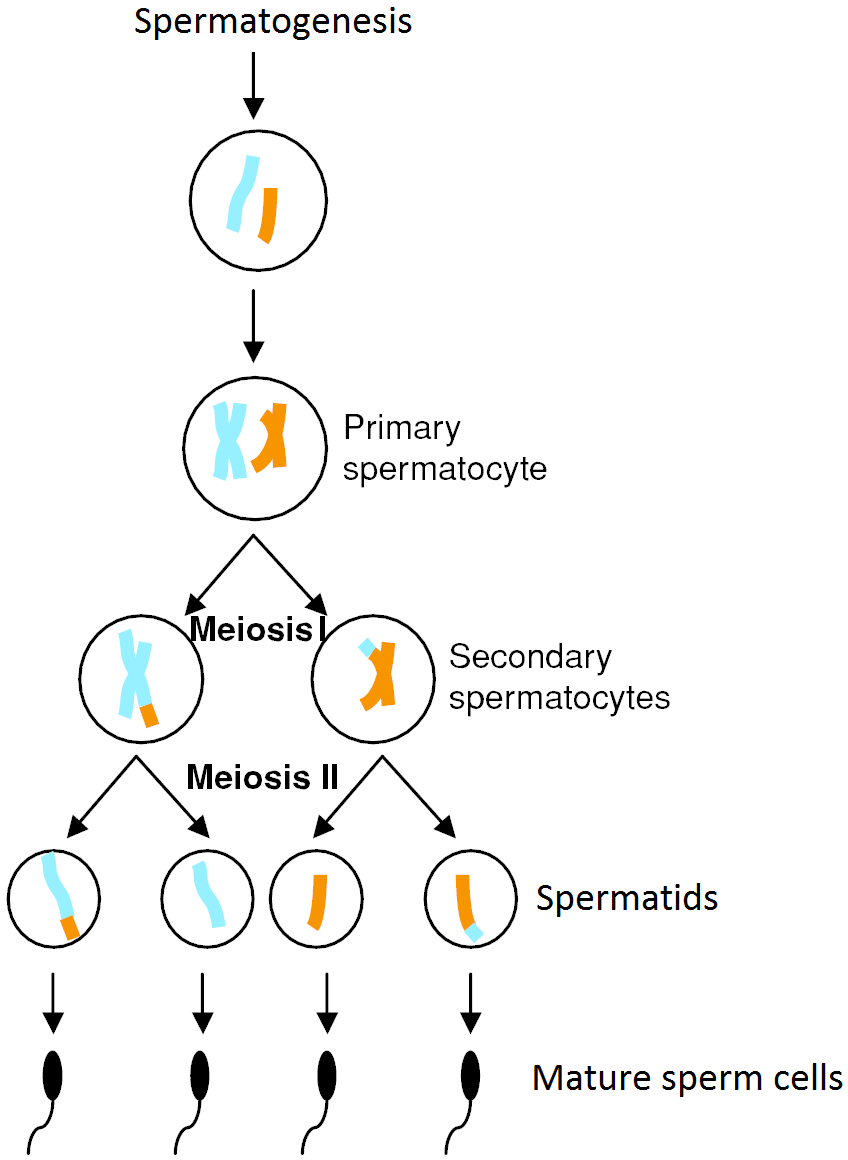
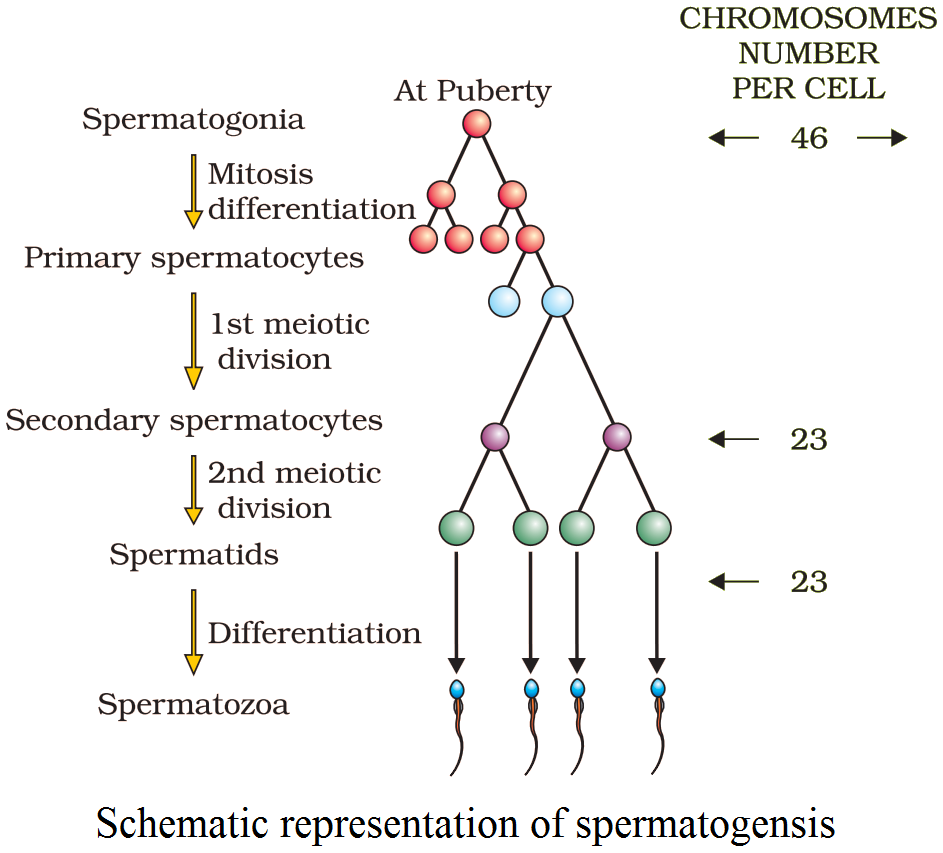
What is spermatogenesis? Briefly describe the process of spermatogenesis.
Answer
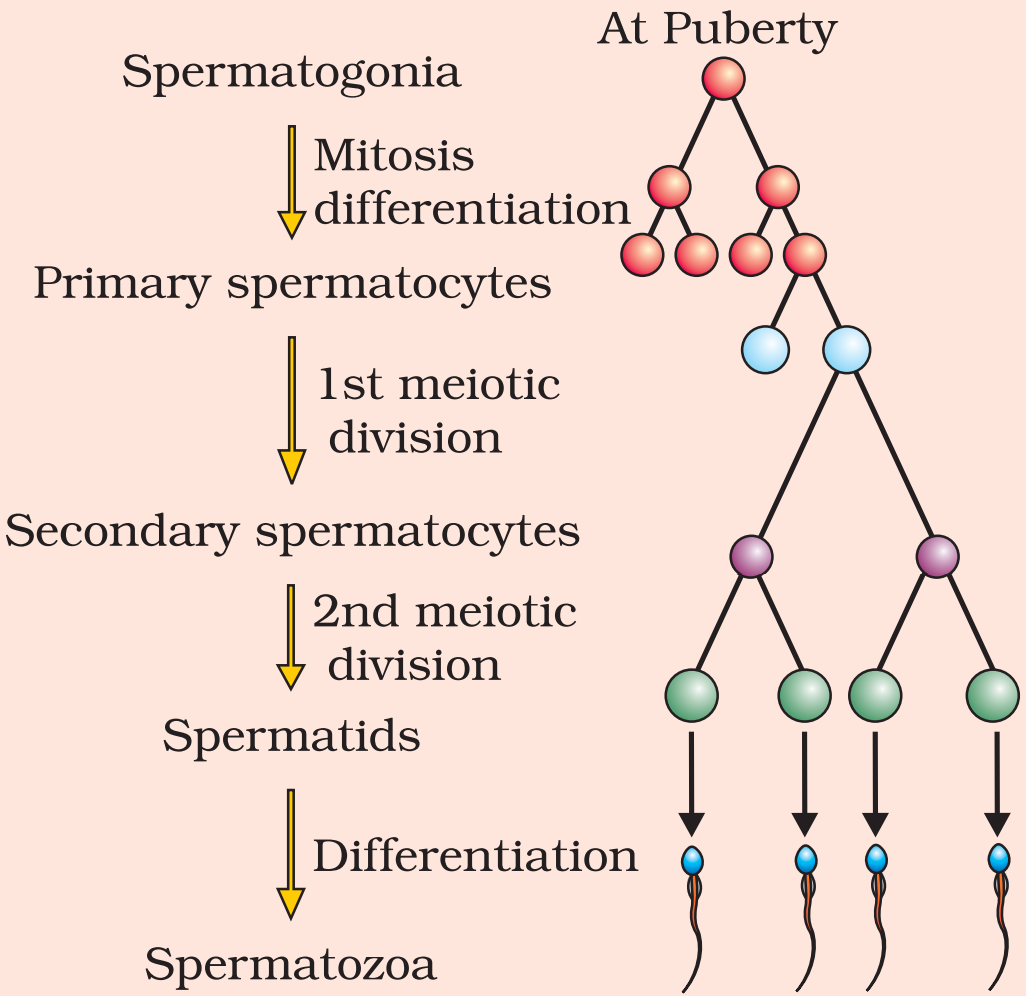
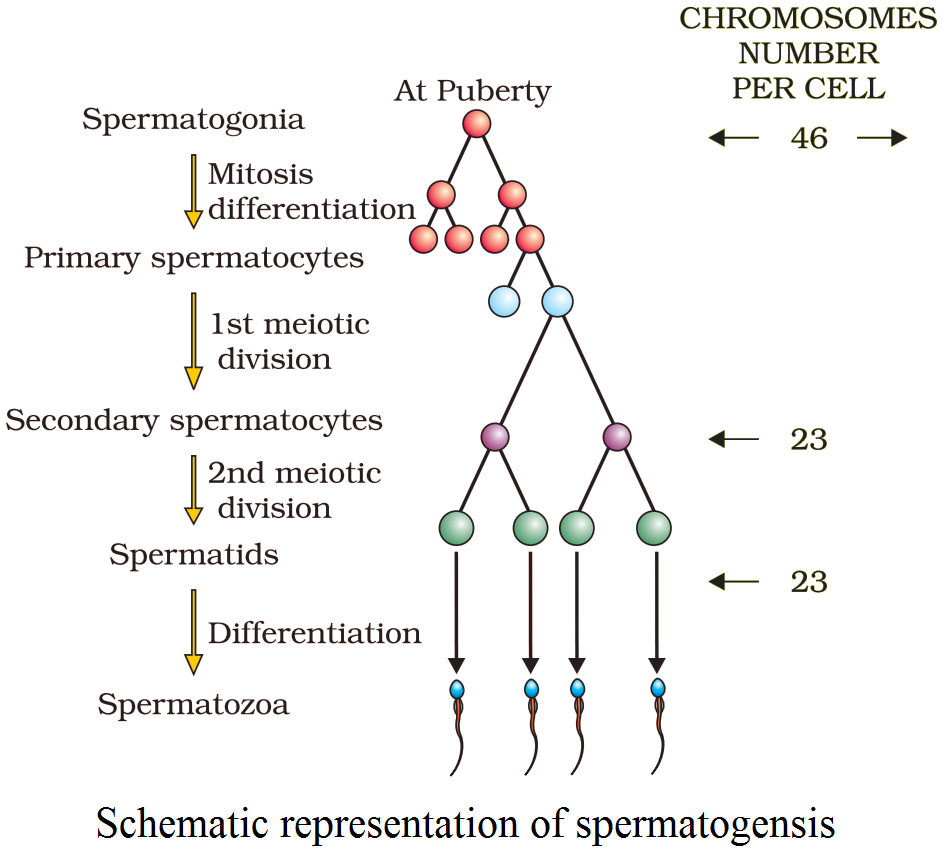
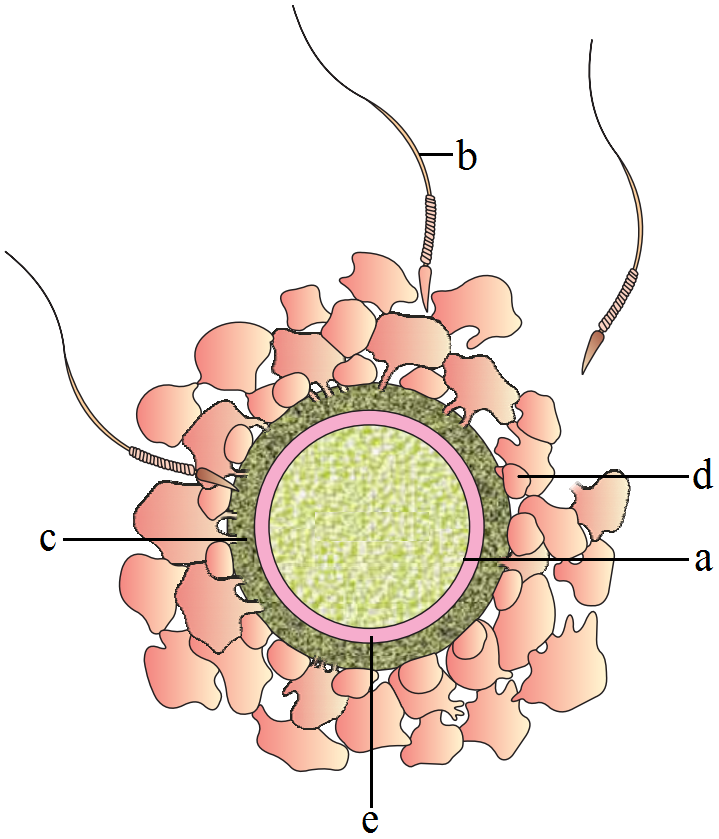
The process of the production of sperms from the immature germ cells in males is called spermatogenesis. The male germ cell of seminiferous tubules multiply mitotically to increase in numbers. Each spermatogonium is diploid and contains 46 chromosomes. Some of the spermatogonia called primary spermatocytes periodically undergo meiosis. A primary spermatocyte completes the first meiotic division (reduction division) leading to formation of two equal, haploid cells called secondary spermatocytes, which have only 23 chromosomes each. The secondary spermatocytes undergo the second meiotic division to produce four equal, haploid spermatids. The spermatids are transformed into spermatozoa (sperms) by the process called spermiogenesis.
View full question & answer
Question 45 Marks
Name the functions of the following:
  1. Corpus luteum.
  2. Endometrium.
  3. Acrosome.
  4. Sperm tail.
  5. Fimbriae.
Answer
  1. Corpus luteum:
It acts as an endocrine gland and secretes progesterone hormone which is essential for endometrium of uterus.
  1. Endometrium:
It is innermost layer of uterus responsible for nutrition and development of the foetus. It undergoes cyclic changes during menstrual cycle and prepares itself for implantation of blastocyst and placentation.
  1. Acrosome:
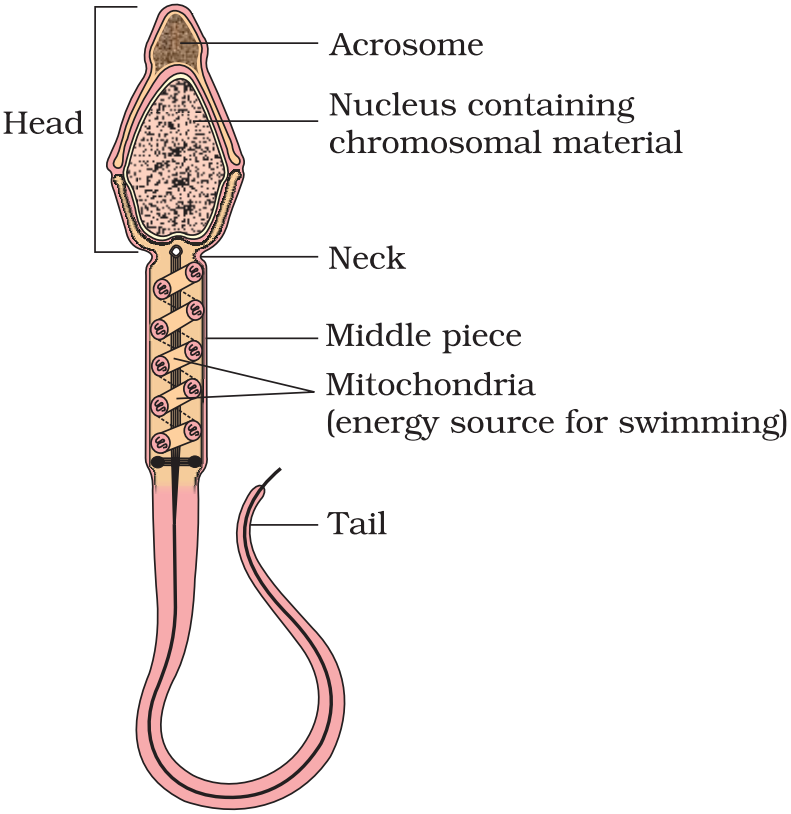
Acrosome of sperm head contains hydrolytic enzymes that help in dissolving membranes of the ovum for fertilization.
  1. Sperm tail:
It helps in the movement of sperm essential for fertilisation.
  1. Fimbriae:
It help in collection of the ovum after ovulation.
View full question & answer
Question 55 Marks
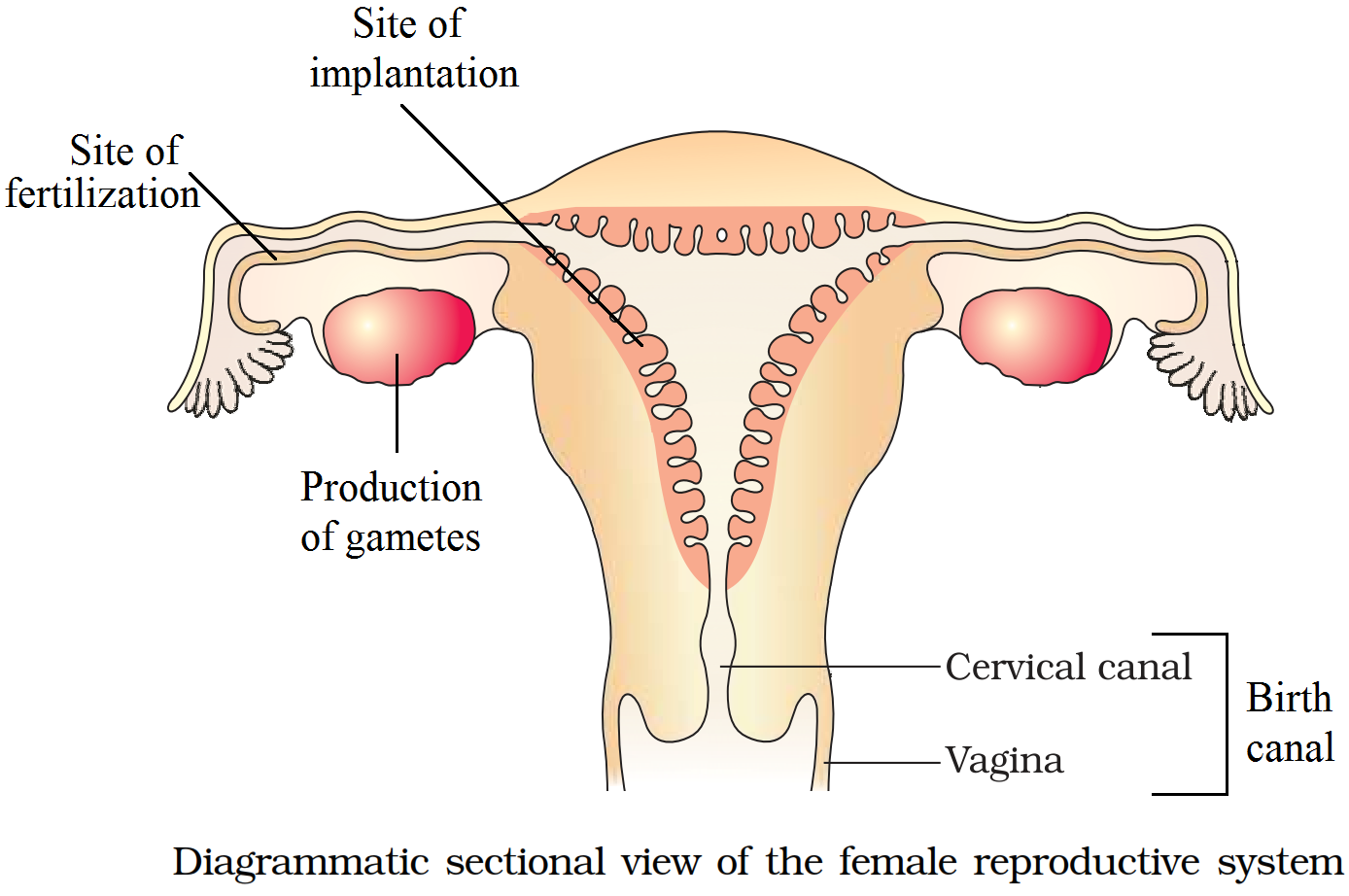
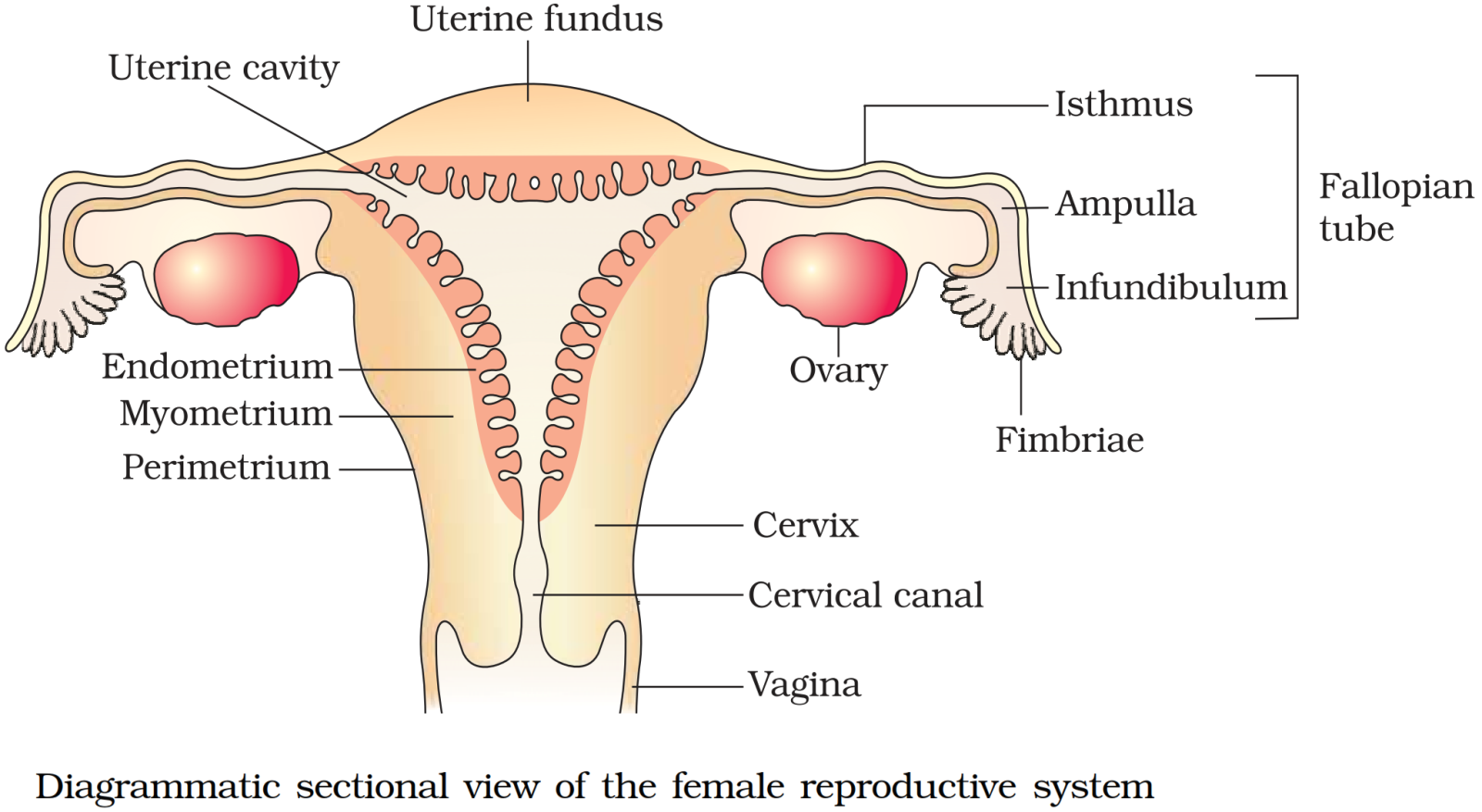
Draw a neat diagram of the female reproductive system and label the parts associated with the following (a) production of gamete, (b) site of fertilisation (c) site of implantation and, (d) birth canal.
View full question & answer
Question 65 Marks
What is foetal ejection reflex? Explain how it leads to parturition?
Answer
Vigorous contraction of the uterus at the end of the pregnancy causes expulsion/ delivery of the foetus. This process of delivery of the foetus (childbirth) is called parturition.
Parturition is induced by a complex neuroendocrine mechanism. The signals for parturition originate from the fully developed foetus and the placenta which induce mild uterine contractions called foetal ejection reflex. This triggers release of oxytocin from the maternal pituitary. Oxytocin acts on the uterine muscle and causes stronger uterine contractions, which in turn stimulates further secretion of oxytocin.
The stimulatory reflex between the uterine contraction and oxytocin secretion continues resulting in stronger and stronger contractions. This leads to expulsion of the baby out of the uterus through the birth canal-parturition. Soon after the infant is delivered, the placenta is also expelled out of the uterus.
View full question & answer
Question 75 Marks
The zygote passes through several developmental stages till implantation, Describe each stage briefly with suitable diagrams.
Answer
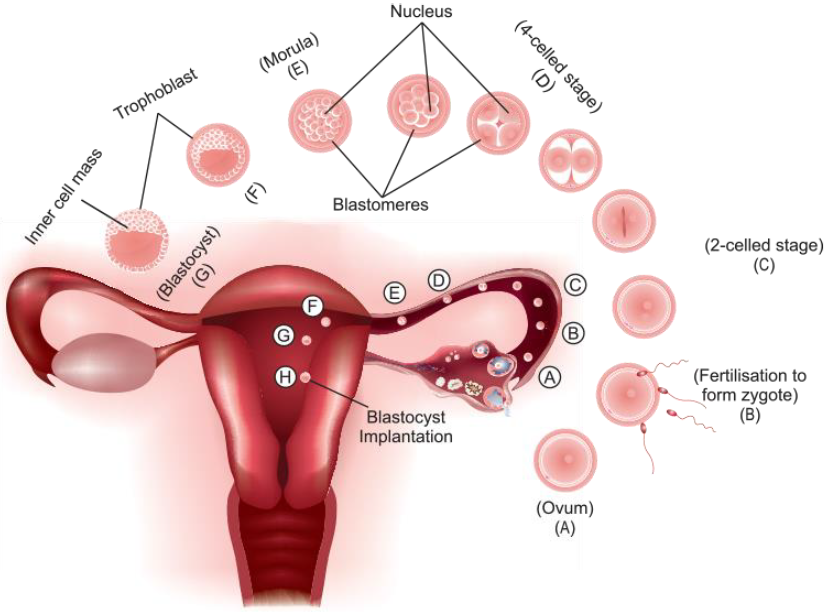
Following figure shows various stages of zygote development till implantation:
  1. The zygote divides into two-cell stage called cleavage. This development takes place when the zygote is still in the isthmus.
  2. The cleavage undergoes further rounds of mitosis to form 2, 4, 8 and finally 16-celled stage. These daughter cells are called blastomere.
  3. The 16-celled stage is called morula.
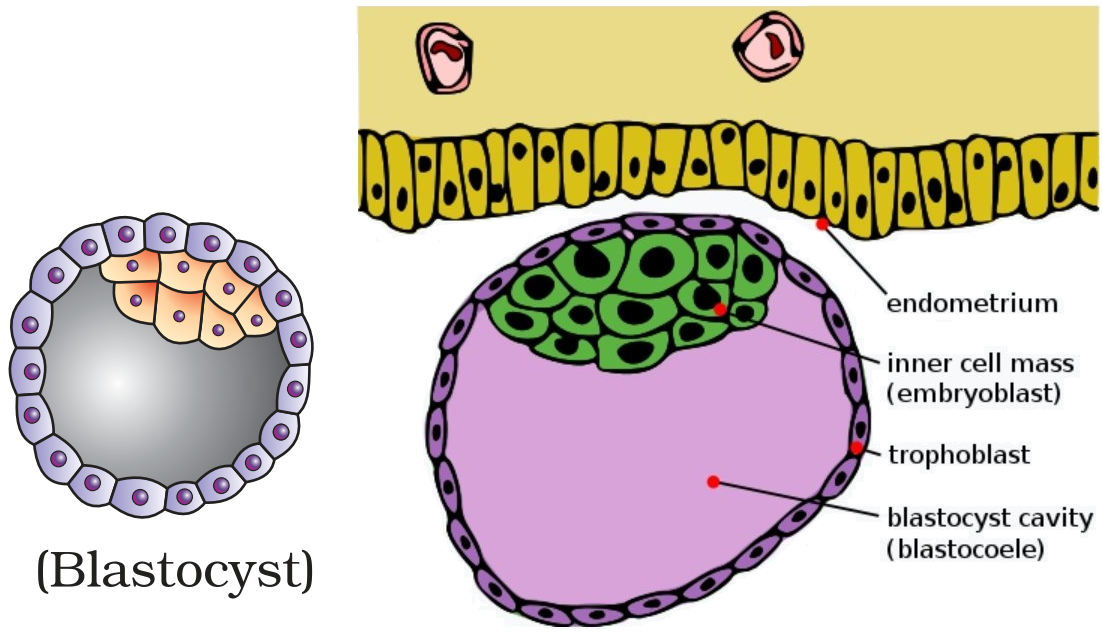
  4. The morula changes into blastocyst; with more rounds of meiosis. At this stage, the blastomeres are arranged in an outer layer of cells; called trophoblast and an inner mass of cells.
  5. Implantation to uterine wall happens at the blastocyst stage.
View full question & answer
Question 85 Marks
The following is the illustration of the sequence of ovarian events (a – i) in a human female.
Identify the figure that illustrates corpus luteum and name the pituitary hormone that influences its formation.
Answer
Corpus luteum is illustrated by ‘g’ and the hormone influencing its formation is luteinising hormone (LH).
View full question & answer
Question 95 Marks
Answer the following question.
Draw a diagrammatic sectional view of human ovary showing different stages of oogenesis along with corpus luteum.
View full question & answer
Question 115 Marks
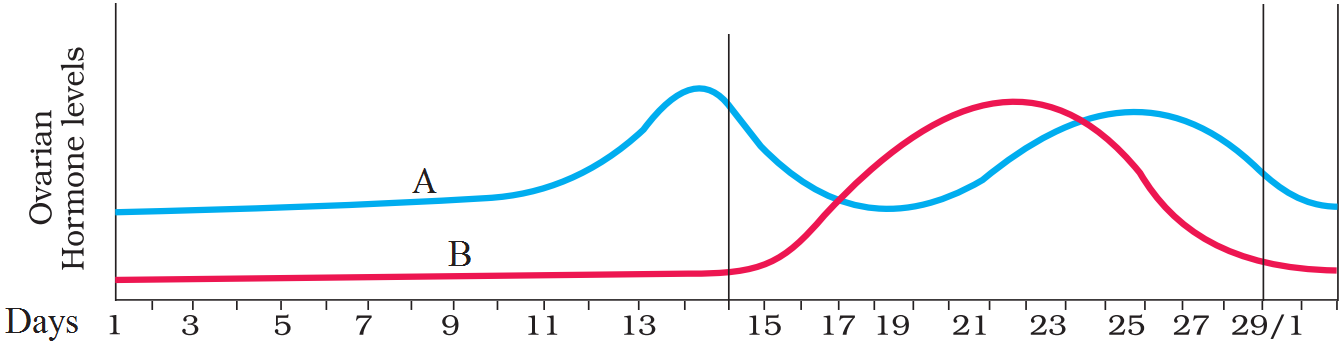
The graph given below shows the variation in the levels of ovarian hormones during various phases of menstrual cycle:
Compare the role of A and B.
Answer
Role of A (Estrogen): Leads to changes in the ovary and uterus / regeneration of endometrium through proliferation.
Role of B (Progesterone): Maintenance of endometrium for implantation of the fertilized ovum/ maintenance of other events of pregnancy.
View full question & answer
Question 125 Marks
Answer the following questions:
Why is follicular phase in the menstrual cycle also referred as proliferative phase? Explain.
Answer
Primary follicle grows into Graafian follicle under the influence of LH and FSH leading to regeneration of endometrium (under the influence of estrogen).
View full question & answer
Question 135 Marks
Answer the following questions:
How is ‘oogenesis’ markedly different from ‘spermatogenesis’ with respect to the growth till puberty in the humans?
Answer
Oogenesis is initiated at the embryonic stage whereas spermatogenesis begins only at puberty.
View full question & answer
Question 145 Marks
Answer the following questions:
At which stage of life does gametogenesis begin in human male and female respectively?
Answer
Gametogenesis, i.e., spermatogenesis in males starts at puberty and oogenesis in females, start during embryonic development at foetal stage.
View full question & answer
Question 155 Marks
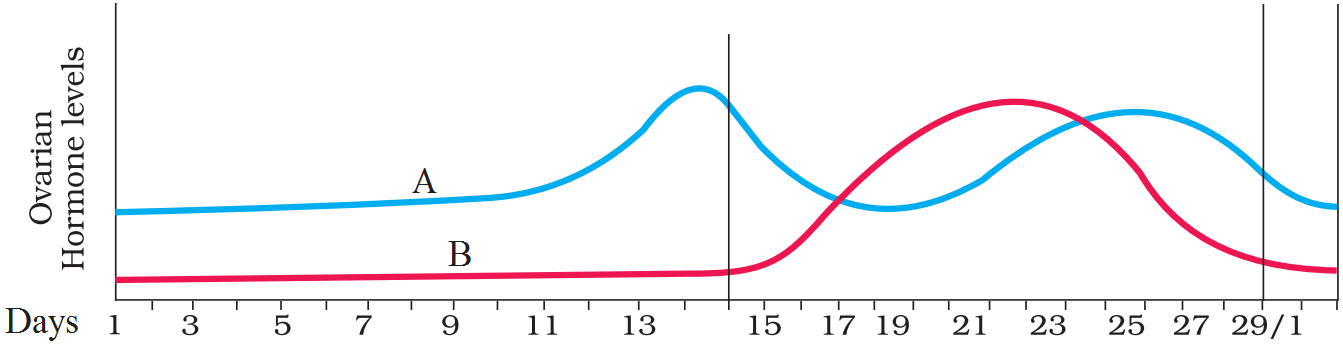
The graph given below shows the variation in the levels of ovarian hormones during various phases of menstrual cycle:
Reason out why A peaks before B.
Answer
Formation of Graaffian follicle (releases estrogen) is followed by the formation of corpus luteum (releases progesterone).
View full question & answer
Question 165 Marks
Answer the following questions:
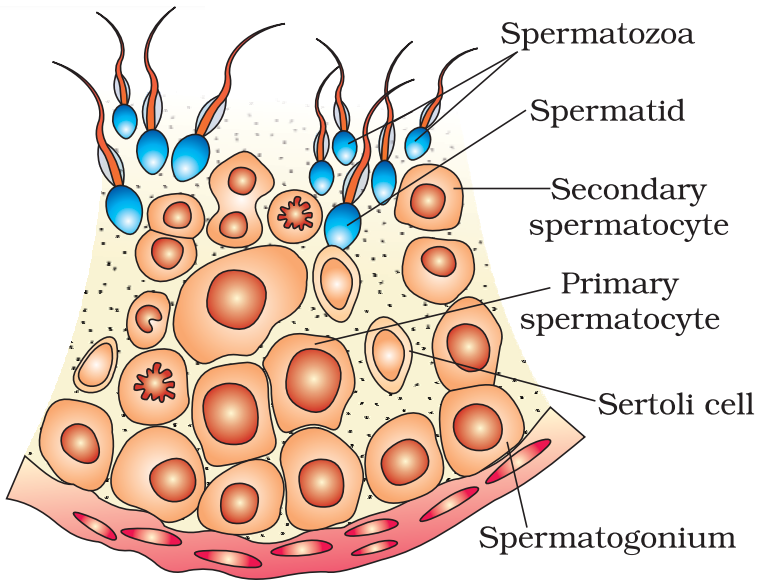
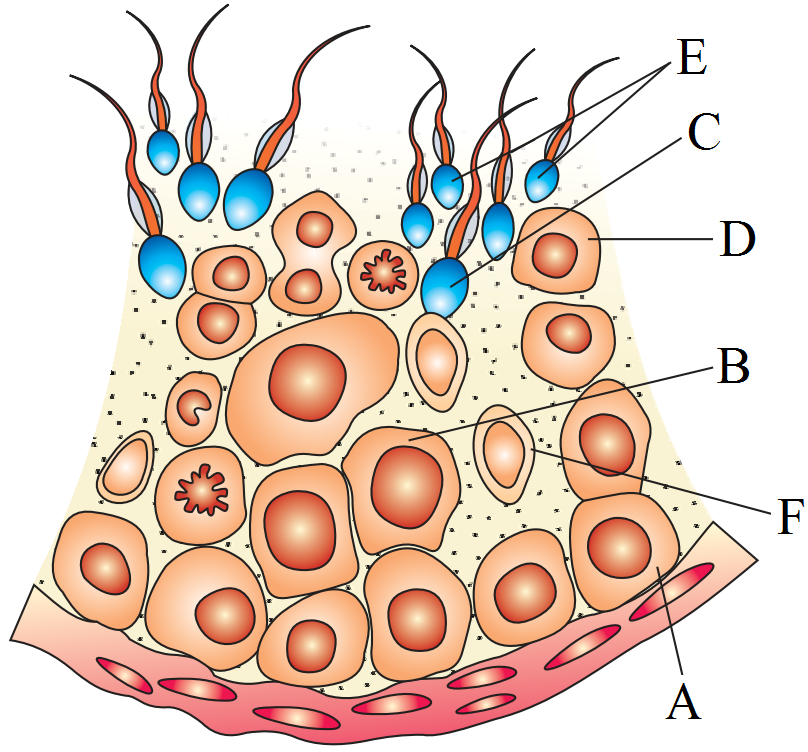
Draw a diagrammatic sectional view of a human seminiferous tubule, and label Sertoli cells, primary spermatocyte, spermatogonium and spermatozoa in it.
Answer

Diagrammatic sectional view of a seminiferous tubule (enlarged). Hormonal control of spermatogenesis.
View full question & answer
Question 175 Marks
Answer the following questions:
Give a schematic representation of spermatogenesis in humans.
Answer

Schematic representation of spermatogensis.
View full question & answer
Question 185 Marks
Describe the functions of the following:
Vas deferens.
Answer
Vas deferens: It stores and transports the sperms from the testes to the outside through urethra.
View full question & answer
Question 195 Marks
Trace the path of spermatozoa from the testes upto the ejaculatory duct only.
OR
Schematically represent and explain the events of spermatogenesis in humans.
Answer
Seminiferous tubules → Rete testis → Vasa efferentia → Epididymis → Vas deferens → Ejaculatory duct.
OR


Schematic representation of spermatogensis.
View full question & answer
Question 205 Marks

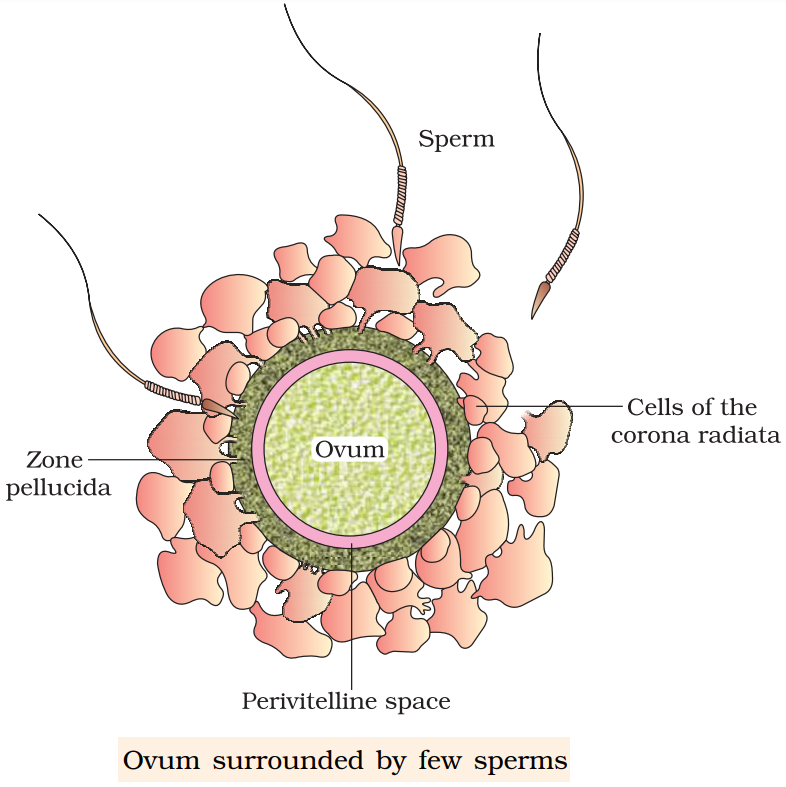
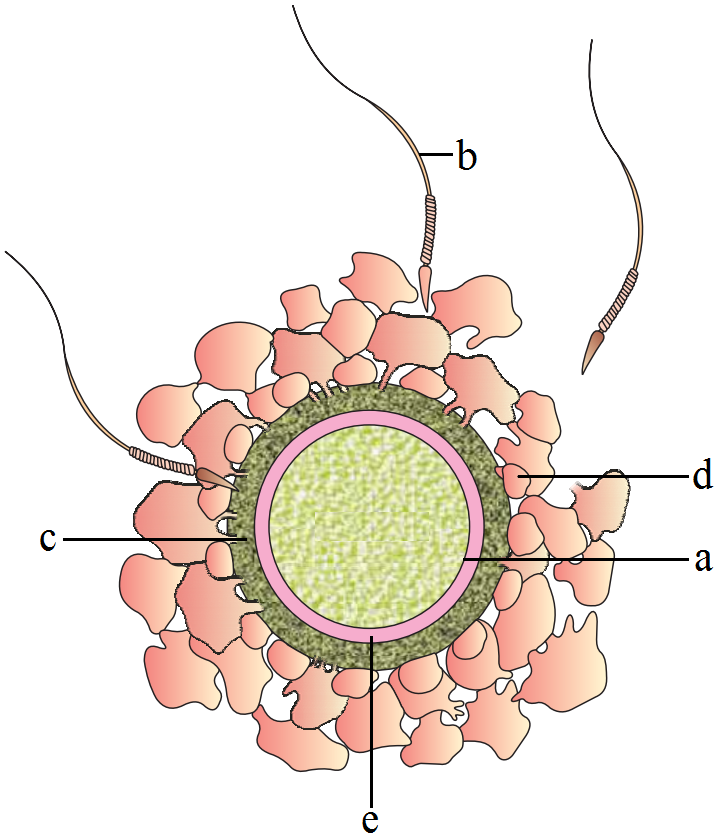
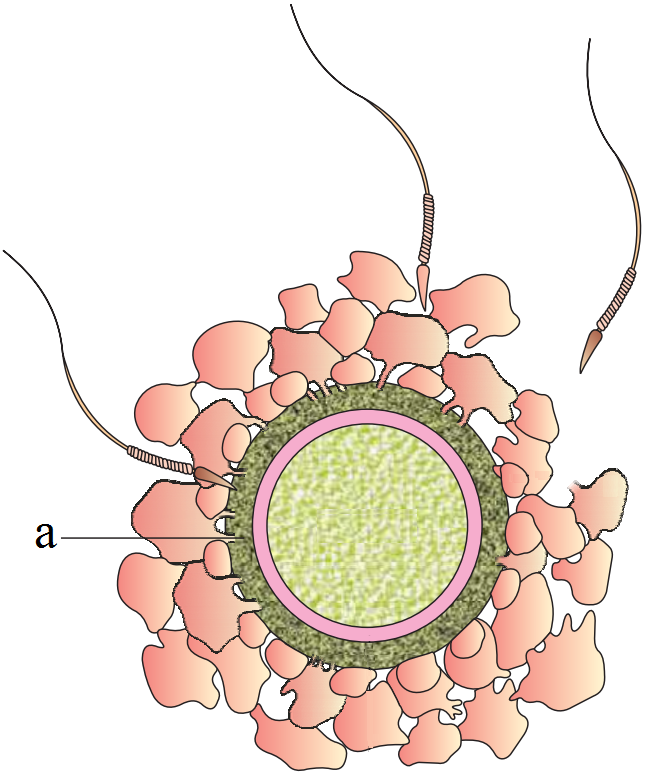
  1. One of the sperms is observed to penetrate 'a' of the ovum, as shown in the above diagram. Name 'a'.
  2. How is the sperm able to do so?
  3. Where exactly in the fallopian tube does this occur?
  4. Explain the events thereafter up to morula stage.
Answer
  1. Zona pellucida.
  2. The acrosome releases enzymes that dissolve the zona pellucida and plasma membrane of the ovum for the sperm to enter the cytoplasm of the ovum.
  3. Ampullary-isthmic junction of fallopian tube.
  4.  
  • The zygote undergoes mitosis in quick succession (cleavage) as it moves through the isthmus towards the uterus and forms 2, 4, 8 and 16 daughter cells, called blastomeres.
  • The embryo with 8-16 blastomeres, is called a morula.
View full question & answer
Question 215 Marks
Write a short note on uterus.
Answer
Uterus (Womb):
  • It is a single, hollow, muscular, pear-shaped structure supported by ligaments and attached to the pelvic wall.
  • It is present between the urinary bladder and the rectum.
  • The lower part of the uterus is very narrow and is called cervix. The cavity of the cervix is called cervical canal, which forms the birth canal along with vagina.
  • The wall of the uterus has three layers of tissue:
  • Perimetrium: Outer, thin covering of the uterus wall.
  • Myometrium: Middle, thick layer of smooth muscle fibres which contracts strongly during delivery of the baby.
  • Endometrium: Inner layer, that contains glands and many blood vessels. It undergoes cyclical changes during the menstrual cycle.
View full question & answer
Question 225 Marks
Study the illustration given and answer the questions that follow:
Explain the role of hormones in the formation and release of ‘a’.
Answer
Follicular stimulating hormone (FSH) stimulate follicular development. Luteinising hormone (LH) ruptures Graafian follicle and thereby release ovum.
View full question & answer
Question 235 Marks
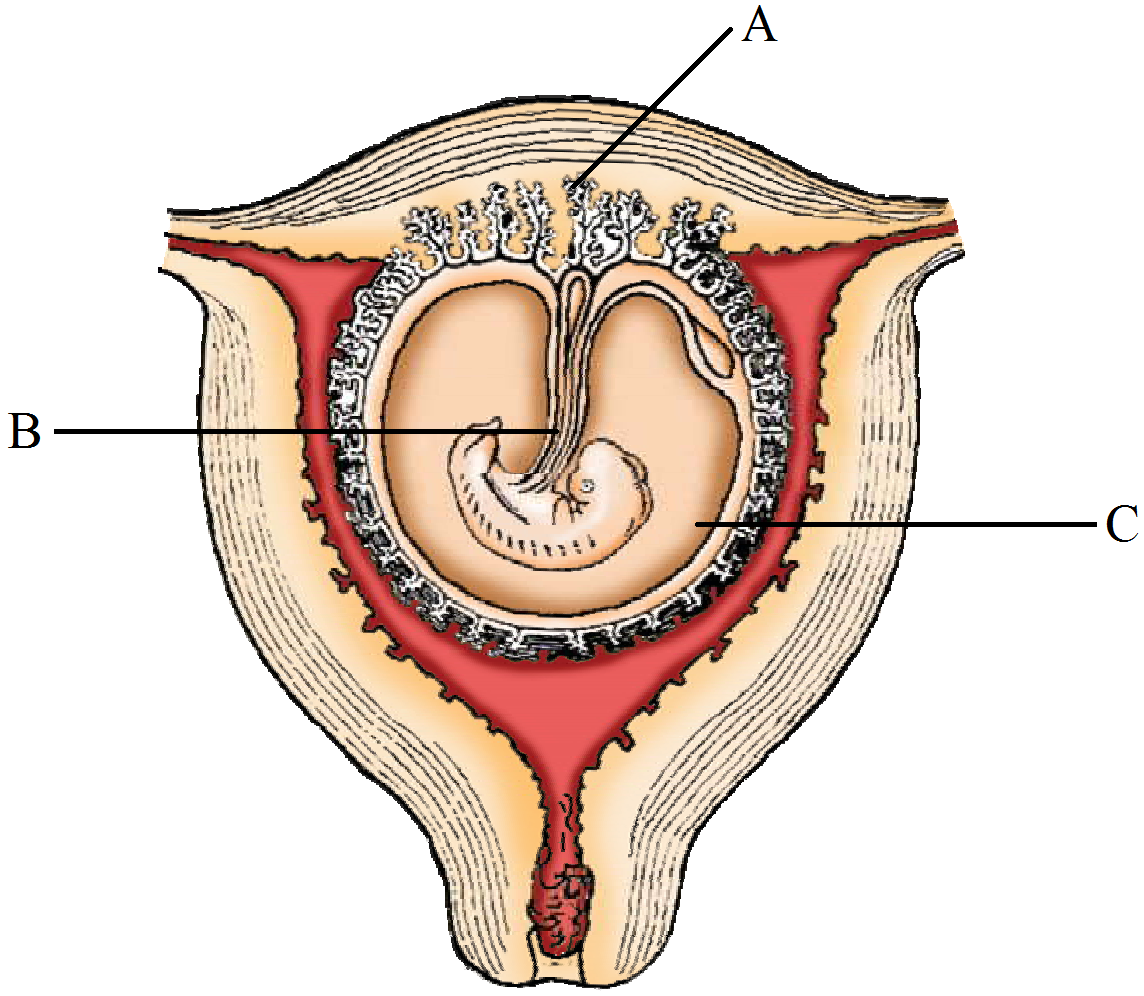
  1. Identify the parts labelled A, B and C in the diagram given.
  1. Draw a labelled diagram of a human blastocyst.
  2. What is parturition and is it induced at the end of pregnancy in a human female?
Answer
  1.  
A. Placental villi.

B. Umbilical cord with its vessels.

C. Embryo.
  1.  
  1. Vigorous contraction of the uterus at the end of pregnancy causes delivery of the foetus. by the process known as parturition. It is induced by a complex neuroendocrine mechanism. The signals originate from the fully developed foetus and the placenta which induces uterine contractions known as foetal ejection reflex. This triggers release of oxytocin from the maternal pituitary which acts on the uterine muscle and causes stronger uterine contractions, that in turn stimulates further secretion of oxytocin. The stimulatory reflex continues causing stronger contractions which leads to the expulsion of the baby out of the uterus through the birth canal known as parturition.
View full question & answer
Question 245 Marks
Answer the following questions:
Draw a diagrammatic sectional view of the female reproductive system of human and label the parts:
  1. Where the secondary oocytes develop.
  2. Which helps in collection of ovum after ovulation.
  3. Where fertilisation occurs.
  4. Here implantation of embryo occurs.
View full question & answer
Question 265 Marks
Describe the post-zygotic events leading to implantation and placenta formation in humans. Mention any two functions of placenta.
OR
  1. Briefly explain the events of fertilisation and implantation in an adult human female.
  2. Comment on the role of placenta as an endocrine gland.
Answer
Fertilisation:
  • During coitus, semen is released by the penis into the vagina (insemination).
  • The motile sperms swim rapidly through the cervix, enter into the uterus and reach the ampullary-isthmic junction of the oviduct.
  • A sperm comes in contact with the zona pellucida layer of the ovum and induces changes in the membrane to block the entry of additional sperms.
  • The enzymes of the acrosome of sperm help to dissolve zona pellucida and plasma membrane of the ovum and sperm head is allowed to enter into the cytoplasm of the ovum, i.e., secondary oocyte.
  • Ultimately diploid zygote is produced by the fusion of a sperm and an ovum.

Ovum surrounded by few sperms.Implantation:
  • Zygote divides rapidly by mitotic division as it moves through isthmus of oviduct towards uterus. This is called cleavage. As a result 2, 4, 8, 16 daughter cells are produced which are termed as blastomeres.
  • Embryo with 8-16 blastomeres is called a morula.
  • The morula continues to divide and transforms into a large mass of cells called blastocyst, which passes further into the uterus.
  • Blastomeres in the blastocyst are arranged into an outer layer called trophoblast and an inner group of cells attached to trophoblast called inner cell mass.
  • Transport of ovum, fertilisation and passage of growing embryo through fallopian tube.
  • The trophoblast layer gets attached to the cells of the endometrium and the inner cell mass gives rise to the embryo.
  • After attachement, the cells of endometrium divide rapidly and cover the blastocyst.
  • So, the blastocyst gets embedded in the endometrium of the uterus. This is called implantation, which leads to pregnancy.
Functions of placenta:
  1. Transports substances like nutrients, $O_2$ and $CO_2$ to and from the embryo.
  2. Acts as an endocrine tissue and produces hormones like human chorionic gonadotropin (hCG), human placental lactogen (hPL), estrogens and progesterones to maintain pregnancy.
View full question & answer
Question 285 Marks
The zygote passes through several development stages till implantation. Describe each stage briefly with suitable diagrams.
Answer
The mitotic division starts as the zygote moves through the isthmus of the oviduct called cleavage towards the uterus and forms 2, 4, 8, 16 daughter cells called blastomeres. The embryo with 8 to 16 blastomeres is called a morula. The morula continues to divide and transforms into blastocysts, it moves further into the uterus.
  1. The blastomeres in the blastocyst are arranged into an outer layer called trophoblast and an inner group of cells attached to trophoblast called the inner cell mass. The trophoblast layer then gets attached to the endometrium and the inner cell mass gets differentiated as the embryo.
  2. After attachment, the uterine cells divide rapidly and covers the blastocyst. As a result the blastocyst becomes embedded in the endometrium of the uterus. This is called implantation and it leads to pregnancy.
View full question & answer
Question 305 Marks
Answer the following questions:
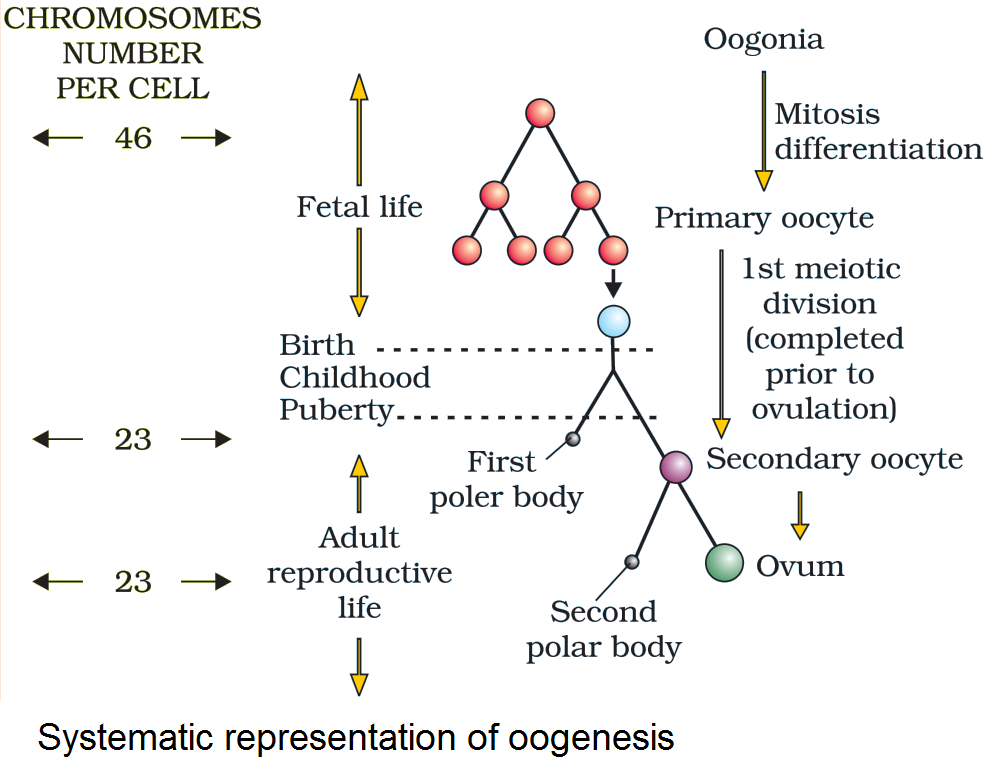
Give a schematic representation of oogenesis in human female indicating the chromosomal number at each step. Mention at what stage of female life does each phase occur.
Answer
Schematic representation of oogenesis:
Systematic representation of oogenesis.
View full question & answer
Question 315 Marks
The following is the illustration of the sequence of ovarian events (a – i) in a human female.
What is the difference between “d” and “e” ?
Answer
“d” is the developing tertiary follicle.
“e” is the Graafian follicle.
View full question & answer
Question 325 Marks
Describe the roles of pituitary and ovarian hormones during the menstrual cycle in a human female.
Answer
Pituitary hormones: FSH: Secreted by the anterior lobe of pituitary gland, it stimulates follicular development as well as secretion of estrogens by the growing follicles.LH:
  1. It induces rupture of Graafian follicle and thereby release of ovum (ovulation).
  2. Its secretion also stimulates follicular development along with FSH.
Ovarian hormones: Estrogen: It stimulates the proliferation of the endometrium of the uterine wall. Progesterone: It is essential for maintenance of the endometrium for implantation of fertilised ovum and other events of pregnancy. It is secreted by corpus luteum.
View full question & answer
Question 335 Marks
  1. Draw a sectional view of a seminiferous tubule of human. Label Sertoli cell, spermatogonia and Leydig cell on it and write their functions.
  2. Explain the role of pituitary and sex hormones in the process of spermatogenesis.
Answer
  1.  
  • Sertoli cells: Secrete factors which help in the process of spermiogenesis/ provide nutrition to germ cells.
  • Spermatogonia: Divide to produce spermatids/ sperms.
  • Leydig cells: systhesis or section of androgens/ testosterone.
  1. The role of pituitary and sex hormones in the process of spermatogenesis is as follows:
  • Pituitary hormones: LH/ luteinizing hormone – acts on leydig cell and arouses synthesis and secretion of androgens, FSH/ follicle stimulating hormone- acts on sertoli cells and arouses secretion of some factor that help in spermiogenesis.
  • Sex hormone: (Androgen/ testosterone) arouse process of spermatogenesis.
View full question & answer
Question 345 Marks
Explain the process of fertilisation in human female, and trace the postfertilisation events in a sequential order up to implantation of the embryo.
OR
Explain the process of fertilisation and implantation in humans.
Answer
Fertilisation:
  • The process of fusion of a sperm (male gamete) with an ovum (female gamete) is called fertilisation.
  • During coitus, semen is released by the penis into the vagina (insemination).
  • The motile sperms swim rapidly through the cervix, enter into the uterus and reach the ampullary – isthmic junction of the oviduct.
  • A sperm comes in contact with the zona pellucida layer of the ovum and induces changes in the membrane to block the entry of additional sperms.
  • The enzymes of the acrosome of sperm help to dissolve zona pellucida and plasma membrane of the ovum and sperm head is allowed to enter into the cytoplasm of the ovum, i.e., secondary oocyte.
  • Ultimately diploid zygote is produced by the fusion of a sperm and an ovum.
Implantation:
  • Zygote divides rapidly by mitotic division as it moves through isthmus of oviduct towards uterus. This is called cleavage. As a result 2, 4, 8, 16 daughter cells are produced which are termed as blastomeres.
  • Embryo with 8–16 blastomeres is called a morula.
  • The morula continues to divide and transforms into a large mass of cells called blastocyst, which passes further into the uterus.
  • Blastomeres in the blastocyst are arranged into an outer layer called trophoblast and an inner group of cells attached to trophoblast called inner cell mass.
  • Transport of ovum, fertilisation and passage of growing embryo through fallopian tube.
  • The trophoblast layer gets attached to the cells of the endometrium and the inner cell mass gives rise to the embryo.
  • After attachement, the cells of endometrium divide rapidly and cover the blastocyst.
  • So, the blastocyst gets embedded in the endometrium of the uterus. This is called implantation, which leads to pregnancy.
View full question & answer
Question 355 Marks
Describe the functions of the following:
Epididymis.
Answer
Epididymis: Maturation of spermatids to functional spermatozoa takes place here and the sperms are stored temporarily till ejaculation.
View full question & answer
Question 365 Marks
Answer the following questions:
Name the hormones secreted and write their functions:
  1. By corpus luteum and placenta (any two) .
  2. During Follicular phase and parturition.
Answer
S. No.
Hormones Secreted
Their functions
(i) By corpus luteum
1. Progesterone
2. Estradiol
Essential for maintaining endometrium for implantations of fertilised ovum. Also inhibits release of FSH.
By placenta
1. Human Placental lactogen
Ensures supply of energy to foetus. It has anti-insulin property.
 
2. hCG (Human chorionic gonadotropin)
Maintains corpus luteum in pregnancy and stimulates release of progesterone.
(ii) During Follicular Phase
1. LH
2. FSH
Stimulates follicular development as well as secretion of estrogen by growing follicles.
During parturition
Oxytocin
Leads to contraction of smooth muscles of myometrium of the uterus during child birth.
View full question & answer
Question 375 Marks
When and how does placenta develop in human female?
Answer
Placenta develops after implantation of embryo in human female in the uterus. After implantation, finger-like projections called chorionic villi are surrounded by the uterine tissue and maternal blood. The chorionic villi and uterine tissue become interdigitated with each other and together form a structural and functional unit between developing embryo and maternal body called placenta.
View full question & answer
Question 385 Marks
Describe in sequence the process of spermatogenesis in humans.
Answer
Spermatogenesis:The process of formation of spermatozoa (sperms) from diploid spermatogonia is called spermatogenesis.
It includes the following phases:
Multiplication phase: The male germ cells (spermatogonia) present on the inside wall of seminiferous tubules multiply by mitotic division and increase in numbers.
Growth phase: Spermatogonia grow and increase in size and form primary spermatocytes. Each spermatogonium is diploid and contains 46 chromosomes.
Maturation phase or formation of spermatids: Some of the spermatogonia called primary spermatocytes periodically undergo meiosis. A primary spermatocyte completes the first meiotic division (reduction division) leading to formation of two equal haploid cells called secondary spermatocytes, which have only 23 chromosomes each. The secondary spermatocytes undergo the second meiotic division to produce four equal haploid spermatids.
Differentiation phase: The spermatids are transformed into spermatozoa (sperms) by the process of spermiogenesis. The sperm’s head gets attached to Sertoli cells to draw nourishment and are finally released from the seminiferous tubules by the process called spermiation.
View full question & answer
Question 395 Marks
Answer the following questions:
Explain the role of any two accessory glands in human male reproductive system.
Answer
The two accessory glands are:
  1. Prostate gland: It surrounds the urethra and produces a milky secretion which forms a considerable part of semen. This secretion contains citric acid, lipids and enzymes. The secretion nourishes and activates the spermatozoa to swim.
  2. Seminal vesicles: These secrete mucous and a watery alkaline fluid that contains fructose which provides energy to the sperms.
View full question & answer
Question 405 Marks
Answer the following questions:
When and where does spermatogenesis occur in a human male?
Answer
Spermatogenesis occurs at puberty in testes.
View full question & answer
Question 415 Marks
Write two differences between spermatogenesis and oogenesis.
Answer
S. No. Spermatogenesis Oogenesis
(i)
It is the process of formation of haploid spermatozoa from diploid male germ cells of the testes.
It is the process of formation of haploid ova from the gamete mother cells (oogonia) in the ovary.
(ii)
It occurs in testes.
It occurs in ovaries.
(iii)
A primary spermatocyte divides to form two secondary spermatocytes by meiosis I.
A primary oocyte divides by meiosis I to form one secondary oocyte and a polar body.
(iv)
Spermatogonia changes to primary spermatocyte.
Oogonia changes to primary oocyte.
(v)
A secondary spermatocyte divides to form two spermatids by meiosis II.
A secondary oocyte divides by meiosis II to form ovum and a polar body.
(vi)
No polar body is formed.
Polar bodies are formed.
(vii)
Four spermatozoa are produced from one primary spermatocyte.
One ovum/ egg is produced from one primary oocyte.
View full question & answer
Question 425 Marks
Answer the following questions:
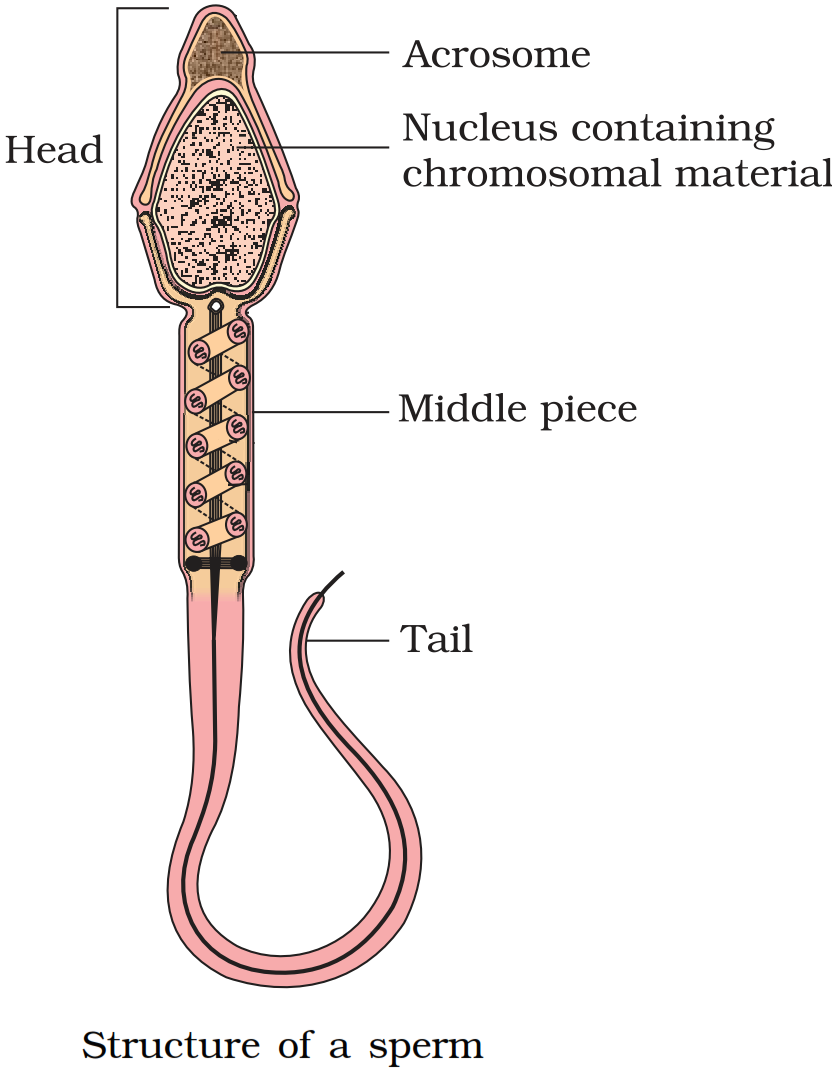
Draw a diagram of a mature human male gamete. Label the following parts: Acrosome, nucleus, middle piece and tail.
Answer

Structure of a sperm.
View full question & answer
Question 435 Marks
What functions do the female reproductive system perform?
Answer
The female reproductive system perform the following functions:
  1. It forms the female gamete, i.e., the egg.
  2. It receives the male gamete, i.e., sperm, for fertilisation.
  3. It provides the site for fertilisation.
  4. It provides suitable conditions for the development of foetus.
  5. It produces hormones that control the stages of ovulation and maintain pregnancy.
View full question & answer
Question 445 Marks
Draw a neat diagram of the female reproductive system and label the parts associated with the following.
  1. Production of gamete.
  2. Site of fertilisation.
  3. Site of implantation.
  4. Birth canal.
Answer
The female reproductive system consists of a pair of ovaries along with a pair of oviducts,uterus, cervix, vagina and the external genitalia located in pelvic region. These parts are integrated structurally and functionally to support the processes ofovulation, fertilization, pregnancy and birth.
Labels:
  1. Ovary (production of gamete).
  2. Isthmus-ampullary junction(site of fertilization).
  3. Uterine endometrium (site of implantation).
  4. Cervix and vagina (birth canal).
View full question & answer
Question 455 Marks
When does oogenesis start in humans? Name the three hormones and their source, linked with oogenesis. How do they influence the process of oogenesis? Explain.
Answer
Oogenesis starts during the embryonic developmental stages in the female foetus.The hormones involved are:
  1. Follicle stimulating hormone (FSH)
  2. Luteinising hormone (LH).
  3. Progesterone.
  1. Follicle stimulating hormone (FSH):
  • FSH stimulates the growth and development of ovarian follicles into a mature Graafian follicle.
  • It also stimulates the secretion of estrogen from the follicle cells.
  1. Luteinising hormone (LH):
  • LH stimulates the rupture of mature follicle and ovulation.
  • It also stimulates the formation of corpus luteum from the ruptured follicle and secretion of progesterone from it.
  1. Progesterone:
  • Progesterone is necessary to maintain the endometrium and implantation.
  • In the absence of fertilisation, the corpus luteum degenerates and consequently the endometrium also degenerates leading to menstruation.
View full question & answer
Question 465 Marks
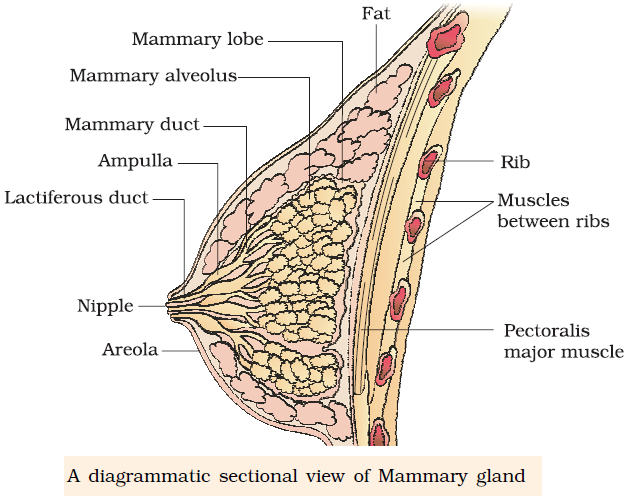
With a suitable diagram, describe the organisation of mammary gland.
Answer
Mammary glands are paired structures which contain glandular tissue and variable amount of fat.
  • In each breast, glandular tissue is divided into 15 – 20 mammary lobes. These lobes have clusters of cells called alveoli.
  • The cells of alveoli secrete milk, which is stored in the cavities (lumens) of alveoli. The alveoli open in mammary tubules.
  • Tubules from each lobe join to form a mammary duct.
  • Many mammary ducts join to form a wider mammary ampulla.
  • A mammary ampulla is connected to the lactiferous duct. Milk is sucked out through the lactiferous duct.
View full question & answer
Question 475 Marks
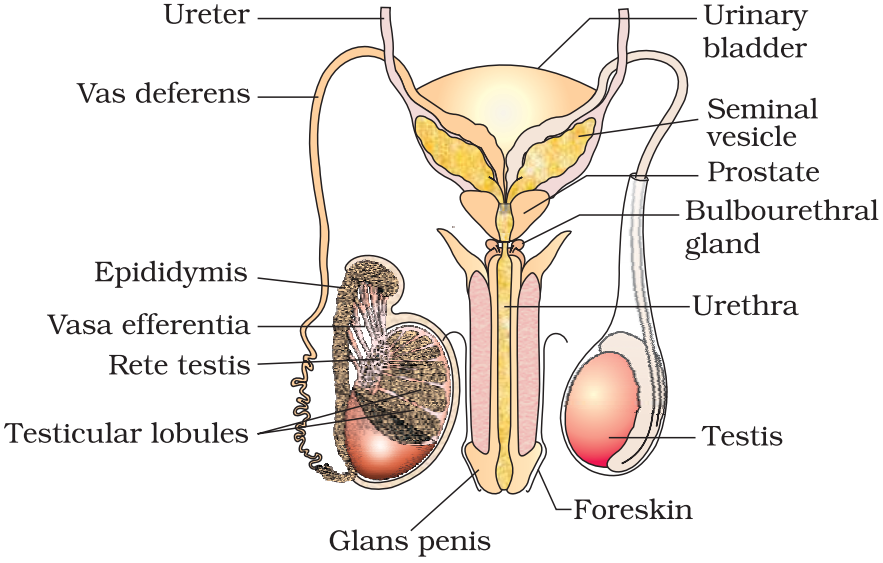
  1. Draw a labelled diagrammatic view of human male reproductive system.
  2. Differentiate between:
  • Vas deferens and Vasa efferentia.
  • Spermatogenesis and spermiogenesis.
Answer
  1.  
  1.  
  1.  
S. No.
Vas deferens
Vasa efferentia
1.
Vas deferens arises from epididymis and opens into urethra.
Vasa efferentia arise from rete testis and open into epididymis.
2.
This conducts the sperm to the urethra and then to outside.
They conduct the sperms out of the testes.
3.
It receives ducts of the associated glands.
They do not receive ducts of any associated glands.
4.
It ascends into the abdominal cavity.
They remain inside the scrotum (extra abdominal).
  1.  
S. No.
Spermatogenesis
Spermiogenesis
1.
It is the process of formation of spermatozoa in the testes.
It is the process of transformation of spermatids into spermatozoa.
2.
It involves cell divisions.
It does not involve any cell division.
3.
Spermatogonia of the seminiferous tubules are involved.
Sertoli cells of the seminiferous tubules are involved.
View full question & answer
Question 485 Marks
How is the placenta connected to the embryo?
Answer
An umbilical cord connects placenta with the embryo.
View full question & answer
Question 495 Marks
Answer the following questions:
Differentiate between gametogenesis in human males and females on the basis of:
  1. Time of initiation of the process.
  2. Products formed at the end of the process.
Answer
S. No
Process of gametogenesis
Males
Females
(i)
Time of initiation of the process.
Puberty.
Embryonic development at foetal stage.
(ii)
Products formed at the end of the process.
Four spermatozoa are produced from one primary spermatocyte.
One ovum and two polar bodies are produced from one primary oocyte.
View full question & answer
Question 505 Marks
  1. Explain the process of spermatogenesis in humans.
  2. Draw a human sperm and label acrosome and middle piece. Mention their functions.
Answer
  1. Spermatogenesis is the process of the production of sperms from the immature germ cells in males. It takes place in seminiferous tubules present inside the testes. During spermatogenesis, a diploid spermatogonium (male germ cell) increases its size to form a diploid primary spermatocyte. This diploid primary spermatocyte undergoes first meiotic division (meiosis I), which is a reductional division to form two equal haploid secondary spermatocytes. Each secondary spermatocyte then undergoes second meiotic division (meiosis II) to form two equal haploid spermatids. Hence, a diploid spermatogonium produces four haploid spermatids. These spermatids are transformed into spermatozoa (sperm) by the process called spermiogenesis.
  1.  
  • Acrosome: It is flat, oval in shape and composed of a large haploid nucleus and a small anterior cap-like structure, called acrosome. The acrosome lies at the tip of the nucleus and is formed from the Golgi complex. It contains hydrolytic enzymes and is used to contact and penetrate the egg (ovum) during fertilisation.
  • Middle piece: It is cylindrical in shape and known as powerhouse of the sperm. It possesses many mitochondria to produce energy for the movement of the tail that facilitates sperm motility essential for fertilization.
View full question & answer