Question 515 Marks
find the area of the region enclosed by the parbola $x^2 = y$ and the line $y = x + 2$.
Answer
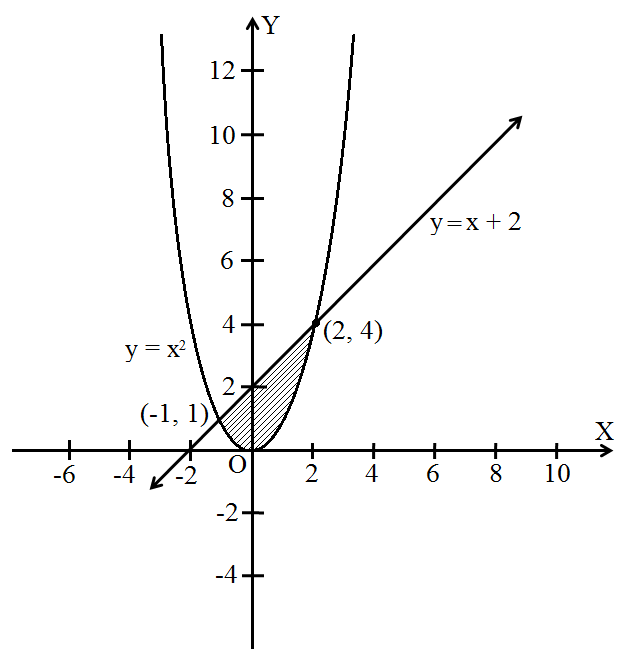
Area of the bounded region,
$=\int\limits_{-1}^{2}\text{x}+2-\text{x}^{2}\text{ dx} $
$=\Big[\frac{\text{x}^{2}}{2}+2\text{x}-\frac{\text{x}^{3}}{3}\Big]^{2}_{-1}$
$=\frac{4}{2}+4-\frac{8}{}3-\frac{1}{2}+2-\frac{1}{3}$
$=\frac{9}{2}\ \text{sq.}\ \text{units}$ View full question & answer→Question 525 Marks
Find the area of the region enclosed between the two curve $x^2 + y^2 = 9$ and $(x - 3)^2 + y^2 = 9$.
Answer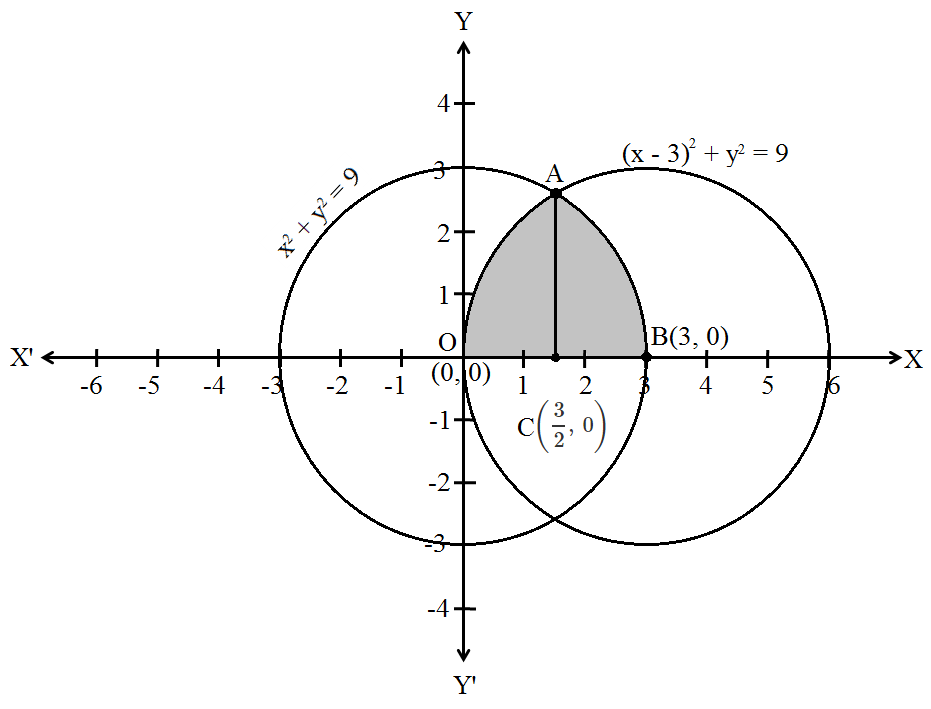
Let the two curve be nambed as $y_1$ and $y_2$ where
$y_1: (x - 3)^2 + y^2 = 9$ ....(i)
$y_2 : x^2+ y^2= 9$ .....(ii)
The curve $x^2+ y^2= 9$ represents a circle with centre (0, 0) and the radius is 3.
The curve $(x - 3)^2 + y^2 = 9$ represents a circle with centre (3, 0) and has a radius 3.
The find the intersection points of two curve equate them.
On sloving (i) and (ii) we get
$\text{x}=\frac{3}{2}$ and $\text{y}=\pm\frac{3\sqrt{3}}{2}$
Therefore, intersection points are $\Big(\frac{3}{2},\frac{3\sqrt{3}}{2}\Big)$ and $\Big(\frac{3}{2},\frac{3\sqrt{3}}{2}\Big)$
Now, the required area (OABO)
= 2[area(OACO) + area(CABC)]
Here,
$\text{Area(OACO)}=\int\limits^{\frac{3}{2}}_0\text{y}_1\text{dx}=\int\limits^{\frac{3}{2}}_0\sqrt{9-(\text{x}-3)^2}\text{dx}$
$\text{Area(CABC)=}\int\limits_{\frac{3}{2}}^3|\text{Y}_2|\text{dx}=\int\limits_{\frac{3}{2}}^3\sqrt{9-\text{x}^2}\text{dx}$
Thus the required area is given by,
A = = 2[area(OACO) + area(CABC)]
$=2\Bigg(\int\limits^{{3}/{2}}_0\sqrt{9-(\text{x}-3)^2}\text{ dx}+\int\limits^3_{{3}/{2}}\sqrt{9-\text{x}^2}\text{ dx}\Bigg)$
$=2\bigg[\frac{(\text{x}-3)}{2}\sqrt{9-(\text{x}-3)^2}+\frac{9}{2}\sin^{-1}\Big(\frac{\text{x}-3}{3}\Big)\bigg]^{\frac{3}{2}}_0+2\bigg[\frac{\text{x}}{2}\sqrt{9-\text{x}^2}+\frac{9}{2}\sin^{-1}\Big(\frac{\text{x}}{3}\Big)\bigg]^3_{\frac{3}{2}}$
$=2\Bigg[\frac{\frac{3}{2}-3}{2}\sqrt{9-\Big(\frac{3}{3}-3\Big)^2}+\frac{9}{2}\sin^{-1}\bigg(\frac{\frac{3}{2}-3}{3}\bigg)-\frac{0-3}{2}-\sqrt{9-(0-3)^2}-\frac{9}{2}\sin6{-1}\Big(\frac{0-3}{3}\Big)\Bigg]\\+2\Bigg[\frac{3}{2}\sqrt{9-3^2}+\frac{9}{2}\sin^{-1}\Big(\frac{3}{3}\Big)-\Big(\frac{3}{4}]\sqrt{9-\frac{9}{4}}\Big)-\frac{9}{2}\sin^{-1}\bigg(\frac{\frac{3}{2}}{3}\bigg)\Bigg]$
$=2\Big[-\frac{9\sqrt{3}}{8}-\frac{9\pi}{12}+\frac{9\pi}{4}\Big]+2\Big[\frac{9\pi}{4}-\frac{9\sqrt{3}}{8}-\frac{9\pi}{12}\Big]$
$=-\frac{18\sqrt{3}}{8}-\frac{18\pi}{12}+\frac{18\pi}{4}+\frac{18\pi}{4}-\frac{18\sqrt{3}}{8}-\frac{18\pi}{12}$
$=\frac{-36\sqrt{3}}{8}-\frac{36\pi}{12}+\frac{36\pi}{4}$
$=-\frac{9\sqrt{3}}{2}-3\pi+9\pi$
$=6\pi-\frac{9\sqrt{3}}{2}$
Hence, the required area is $6\pi-\frac{9\sqrt{3}}{2}\text{ square units}$ View full question & answer→Question 535 Marks
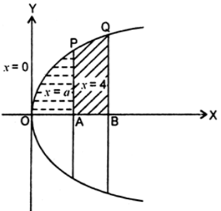
The area between $x = y^2$ and $x = 4$ is divided into two equal parts by the line $x = a$, find the value of $a$.
AnswerThe equation of parabola is $y^2 = x$
From the given condition, area OAP under $y^2 = x$ between $x = 0$ and $x = a$ = area ABQP under $y^2 = x$ between $x = a$ and $x = 4$.
$\therefore\int\limits^\text{a}_{0}\text{y dx}=\int\limits^{4}_{\text{a}}\text{y dx}$
$\Rightarrow\int\limits^\text{a}_{0}\sqrt{\text{x}}\text{ dx}=\int\limits^{4}_{\text{a}}\sqrt{\text{x}}\text{ dx}$
$\Rightarrow\int\limits^{\text{a}}_0\text{x}^{\frac12}\text{dx}=\int\limits^{\text{4}}_\text{a}\text{x}^{\frac12}\text{dx}$
$\Rightarrow\Bigg[\frac{\text{x}^{\frac32}}{\frac32}\Bigg]^\text{a}_0=\Bigg[\frac{\text{x}^{\frac32}}{\frac32}\Bigg]^\text{4}_\text{a}$ $\Rightarrow\Big[\text{x}^{\frac32}\Big]^{\text{a}}_0=\Big[\text{x}^{\frac32}\Big]^{\text{4}}_\text{a}$
$\Rightarrow\text{a}^{\frac32}-0=4^{\frac32}-\text{a}^{\frac32}$ $\Rightarrow2\text{a}^{\frac32}=8\Rightarrow\text{a}^{\frac32}=4\Rightarrow\text{a}=4^{\frac43}$
View full question & answer→Question 545 Marks
Using definite intergeals, find the area of the circle $x^2+ y^2 = a^2$.
Answer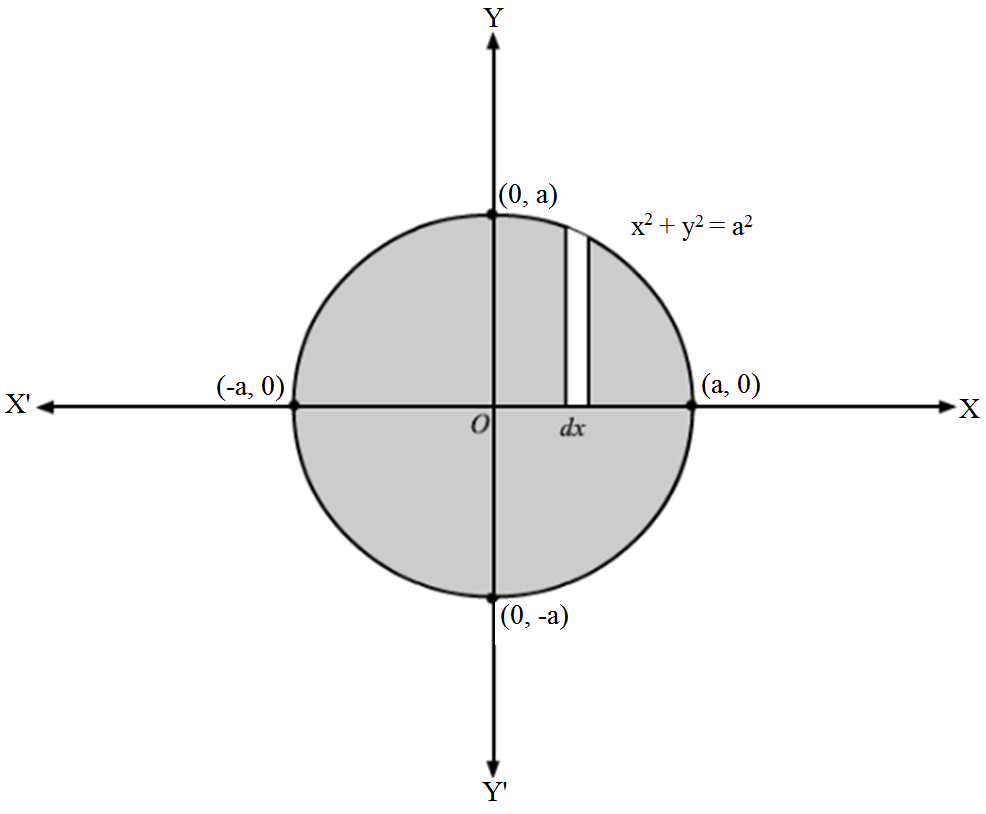
Area of the circle $x^2+ y^2 = a^2$ will be thr $4$ times the area enclosed between $x = 0$ and $x = a$ in the first quadrant which is shaded.
$\text{A}=4\int\limits_{0}^{a}|\text{y}|\text{dx} $
$=4\int\limits_{0}^{a}\Big(\sqrt{\text{a}^{2}-\text{x}^{2}}\Big)\text{dx}$
$=4\Big[\frac{1}{2}\text{x}\sqrt{\text{a}^{2}-\text{x}^{2}}+\frac{1}{2}\text{a}^{2}\sin^{-1}\frac{\text{x}}{\text{a}}\Big]^{\text{a}}_{0}$
$=4\big[0+\frac{1}{2}\text{a}^{2}\sin^{-1}1\big] $
$=4\Big[\frac{1}{2}\text{a}^{2}\frac{\pi}{2}\Big] $
$=\text{a}^{2}\pi\ \text{sq.}\ \text{units}$ View full question & answer→Question 555 Marks
find the area of the region bound by the curve $x = at^2, y = 2$ at between the ordinatrs corresponding $t = 1$ and $t = 2$.
Answer
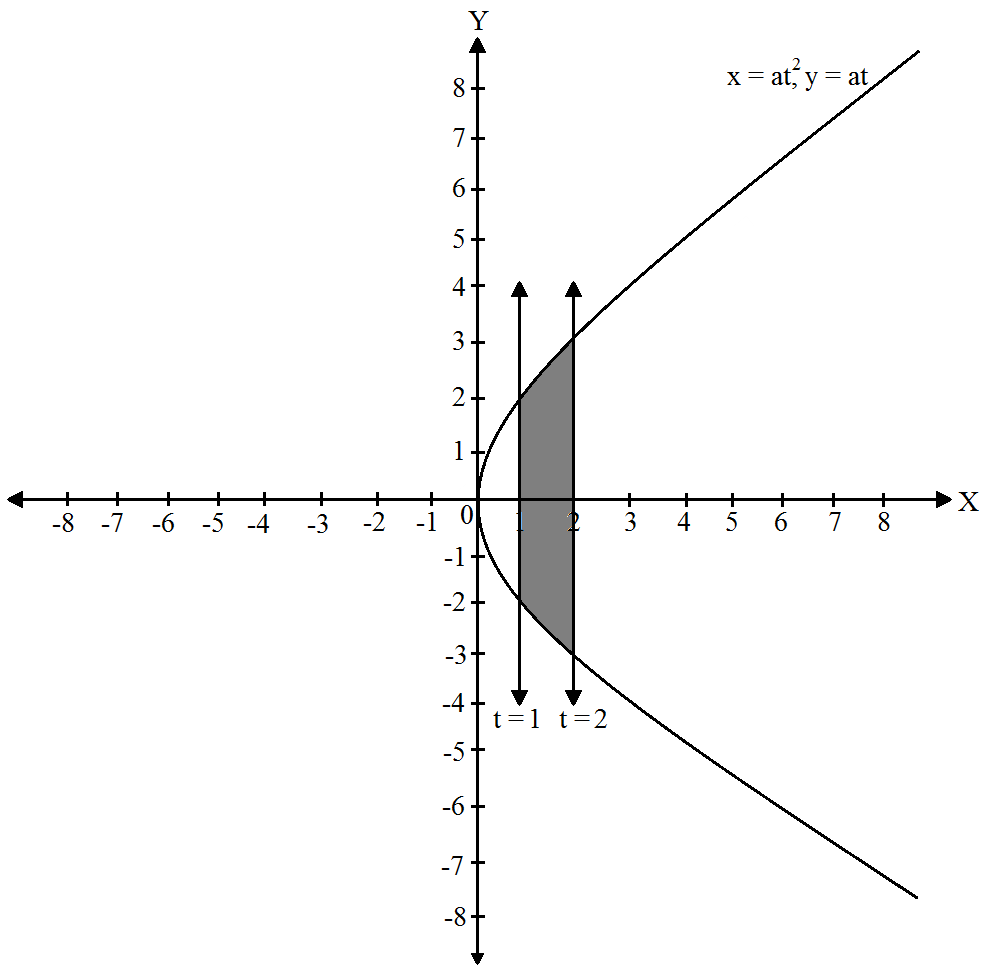
Area of the bound region
$=2\int\limits_{1}^{2}\text{y}\ \frac{\text{dx}}{\text{dt}}\text{dt} $
$=2\int\limits_{1}^{2}(2\text{at})(2\text{at})\text{dt}$
$=8\text{a}^{2}\int\limits_{1}^{2}\text{t}^{2}\text{dt} $
$=8\text{a}^{2}\Big[\frac{\text{t}^{3}}{3}\Big]^{2}_{1}$
$=8\text{a}^{2}\Big[\frac{8}{3}-\frac{1}{3}\Big]$
$=\frac{56\text{a}^{2}}{3}\ \text{sq.}\ \text{units}$ View full question & answer→Question 565 Marks
Sketch the graph of $\text{y}=|\text{x}+3|$ and evaluate $\int\limits^0_{-6}|\text{x}+3|\text{ dx}.$
AnswerThe given equation is $\text{y}=|\text{x}+3|$ The corresponding values of x and y are given in the following table.
| x |
-6 |
-5 |
-4 |
-3 |
-2 |
-1 |
0 |
| y |
3 |
2 |
1 |
0 |
1 |
2 |
3 |
On plotting these points, we obtain the graph of $\text{y}=|\text{x}+3|$ as follows.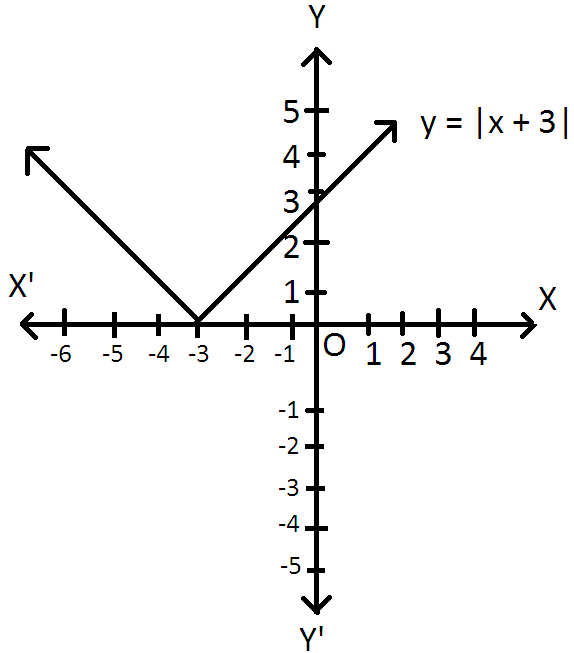
It is known that, $(\text{x}+3)\leq0\text{ for }-6\leq\text{x}\leq-3$ $\text{ and }(\text{x}+3)\geq0\text{ for }-3\leq\text{x}\leq0$ $\therefore\int\limits^0_{-6}|\text{(x}+3)|\text{dx}=-\int\limits^{-3}_{-6}(\text{x}+3)\text{dx}+\int\limits^0_{-3}(\text{x}+3)\text{dx}$ $=-\Big[\frac{\text{x}^2}{2}+3\text{x}\Big]^{-3}_{-6}+\Big[\frac{\text{x}^2}{2}+3\text{x}\Big]^{0}_{-3}$ $=-\bigg[\Big(\frac{(-3)^2}{2}+3(-3)\Big)-\Big(\frac{(-6)^2}{2}+3(-6)\Big)\bigg]$ $+\bigg[0-\Big(\frac{(-3)^2}{2}+3(-3)\Big)\bigg]$ $=-\Big[-\frac92\Big]-\Big[-\frac92\Big]$ $=9$ View full question & answer→Question 575 Marks
If the area bounded by the parabola $y^2 = 4ax$ and the line y = mx is $\frac{\text{a}^2}{12}\text{ sq.}$ units, then using integration, find the value of m.
AnswerThe parabola $y^2= 4ax$ opens towards the positive x-axis and its fucus is (a, 0)
The line y = mx passes through the origin (0, 0)
Solving $y^2 = 4ax$ and y = mx we get
$m^2x^2 = 4ax$
$\Rightarrow m^2x^2 - 4ax = 0$
$\Rightarrow x(m^2x - 4a) = 0$
$\Rightarrow\text{x}=0\text{ or}\text{ x}=\frac{4\text{a}}{\text{m}^2}$
So, the points of intersection of the given parabola and line are O(0, 0) and $\text{A}\Big(\frac{4\text{a}}{\text{m}^2},\frac{4\text{a}}{\text{m}}\Big)$
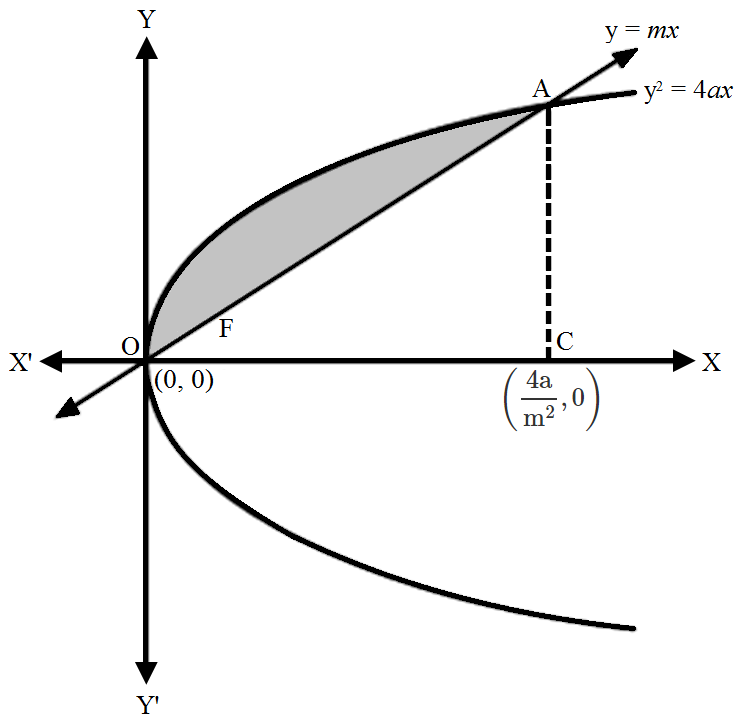
$\therefore$ Area bounded by the given parabola and line
= Area of the shaded region
$=\int\limits^{\frac{4\text{a}}{\text{m}^2}}_0\text{y}_{\text{parabola}}\text{dx}-\int\limits^{\frac{4\text{a}}{\text{m}^2}}_0\text{y}_{\text{line}}\text{dx}$
$=\int\limits^{\frac{4\text{a}}{\text{m}^2}}_0\sqrt{\text{4}\text{ax}}\text{ dx}-\int\limits^{\frac{4\text{a}}{\text{m}^2}}_0\text{mx dx}$
$=\Bigg[2\sqrt{\text{a}}\times\frac{\text{x}^{\frac{3}{2}}}{\frac{3}{2}}\Bigg]^{\frac{4\text{a}}{\text{m}^2}}_0-\Bigg[\text{m}\times\frac{\text{x}^2}{2}\Bigg]^{\frac{4\text{a}}{\text{m}^2}}_0$
$=\frac{4\sqrt{\text{a}}}{3}\bigg[\Big(\frac{4\text{a}}{\text{m}^2}\Big)^{\frac{3}{2}}-0\bigg]-\frac{\text{m}}{2}\bigg[\Big(\frac{4\text{a}}{\text{m}^2}\Big)^{{2}}-0\bigg]$
$=\frac{4\sqrt{\text{a}}}{3}\times\frac{8\text{a}\sqrt{\text{a}}}{\text{m}^3}-\frac{\text{m}}{2}\times\frac{16\text{a}^2}{\text{m}^4}$
$=\frac{32\text{a}^2}{3\text{m}^3}-\frac{8\text{a}^2}{\text{m}^3}$
$=\frac{8\text{a}^2}{3\text{m}^3}\text{ square units}$
But,
Area bounded by the given parabola and line $=\frac{\text{a}^2}{12}\text{ sq. units}$
Given,
$\therefore\ \frac{8\text{a}^2}{3\text{m}^3}=\frac{\text{a}^2}{12}$
$\Rightarrow\text{m}^3=32$
$\Rightarrow\text{m}=\sqrt[3]{32}$
Thus, the value of m is $\sqrt[3]{32}$ View full question & answer→Question 585 Marks
If the area enclosed by the parabolas $y^2 - 16ax$ and $x^2 = 16ay, a > 0$ is $\frac{1024}{3}$ square units, find the value of a.
AnswerThe parabola $y^2 - 16ax$ opens towards the positive x-axis and its focus is $(4a, 0)$
The parabola $x^2 - 16ax$ opens towards the positive y-axis and its facus is $(0, 4a)$
Solving $y^2 - 16ax$ and $x^2 - 16ax$ we get
$\Big(\frac{\text{x}^2}{16\text{a}}\Big)^2=16\text{ax}$
$\Rightarrow\text{x}^4=(16\text{a})^3\text{x}$
$\Rightarrow\text{x}^4-(16\text{a})^3\text{x}=0$
$\Rightarrow\text{x}\Big[\text{x}^3-(16\text{a})^3\Big]=0$
$\Rightarrow\text{x}=0\text{ or x}=16\text{a}$
So, the points of intersection of the given parabolas are O(0, 0) and A(16a, 16a)
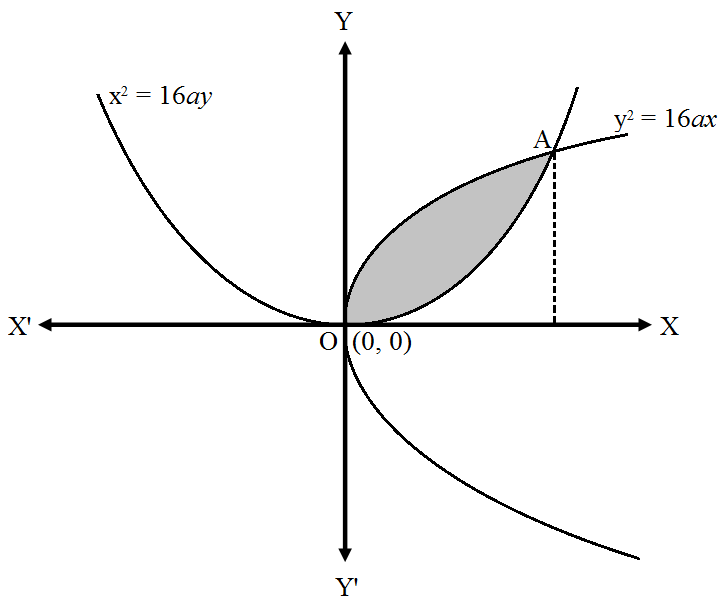
Area enclosed by the given parabolas
= Area of the shaded region
$=\int\limits^{16\text{a}}_0\sqrt{16\text{ax}}\text{ dx}-\int\limits^{16\text{a}}_0\frac{\text{x}^2}{16\text{a}}\text{ dx}$
$=4\sqrt{\text{a}}\times\Bigg[\frac{\text{x}^{\frac{3}{2}}}{\frac{3}{2}}\Bigg]^{16\text{a}}_0-\frac{1}{16\text{a}}\times\Big[\frac{\text{x}^3}{3}\Big]^{16\text{a}}_0$
$=\frac{8\sqrt{\text{a}}}{3}\Big[(16\text{a})^{\frac{3}{2}}-0\Big]-\frac{1}{48\text{a}}\Big[(16\text{a})^3-0\Big]$
$=\frac{8\sqrt{\text{a}}}{3}\times64\text{a}\sqrt{\text{a}}-\frac{256\text{a}^2}{3}$
$=\frac{512\text{a}^2}{3}-\frac{256\text{a}^2}{3}$
$=\frac{256\text{a}^2}{3}\text{ square units}$
But,
Area enclosed by the given parabolas $=\frac{1024}{3}\text{ square units}$
$\therefore\ \frac{256\text{a}^2}{3}=\frac{1024}{3}$
$\Rightarrow\text{a}^2=\frac{1024}{256}=4$
$\Rightarrow\text{a}=2$ $(\text{a}>0)$
Thus, the value of a is 2 View full question & answer→Question 595 Marks
Find the area of the region enclosed by the parabola $x^2 = y$, the line $y = x + 2$ and x-axis.
AnswerThe area of the region enclosed by the parabola, $x^2 = y$, the line, $y = x + 2$, and x-axis is represented by the shaded region OABCO as
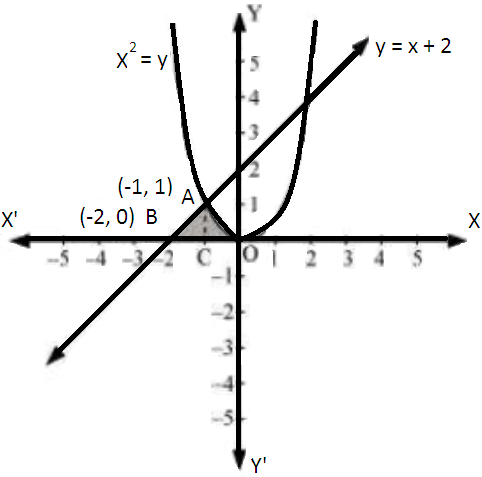
The point of intersection of the parabola, $x^2 = y$, and the line, $y = x + 2$, is $A(-1, 1)$.
$\therefore$ Area OABCO = Area (BCA) + Area COAC
$=\int\limits^{-1}_{-2}(\text{x}+2)\text{dx}+\int\limits^{0}_{-1}\text{x}^2\text{dx}$
$=\Big[\frac{\text{x}^2}{2}+2\text{x}\Big]^{-1}_{-2}+\Big[\frac{\text{x}^3}{3}\Big]^0_{-1}$
$=\Big[\frac{(-1)^2}{2}+2(-1)-\frac{(-2)^2}{2}-2(-2)\Big]+\Big[-\frac{(-1)^3}{3}\Big]$
$=\Big[\frac12-2-2+4+\frac13\Big]$
$=\frac56\text{ units}.$ View full question & answer→Question 605 Marks
Determine the area under the curve $\text{y}=\sqrt{\text{a}^2-\text{x}^2}$ included between the lines x = 0 and x = a.
AnswerWe have $\text{y}=\sqrt{\text{a}^2-\text{x}^2}$ $\Rightarrow\ \text{y}^2=\text{a}^2-\text{x}^2$ $\Rightarrow\ \text{x}^2+\text{y}^2=\text{a}^2$ Graph of above function is a semi-circle lying above x-axis. The graph is as shown is the following figure.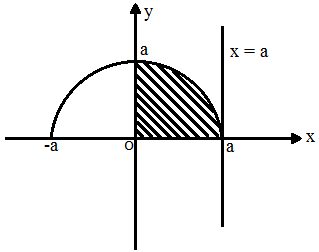
From the figure, are of shaded region, $\text{A}=\int\limits^\text{a}_0\sqrt{\text{a}^2-\text{x}^2}\text{ dx}$ $=\bigg[\frac{\text{x}}{2}\sqrt{\text{a}^2-\text{x}^2}+\frac{\text{a}^2}{2}\sin^{-1}\frac{\text{x}}{\text{a}}\bigg]^\text{a}_0$ $=\bigg[0+\frac{\text{a}^2}{2}\sin^{-1}1-0\frac{\text{a}^2}{2}\sin^{-1}0\bigg]$ $=\frac{\text{a}^2}{2}\cdot\frac{\pi}{2}=\frac{\pi\text{a}^2}{4}\text{ sq. units}$ View full question & answer→Question 615 Marks
Using integration, find the area of the following region:
$\Big\{(\text{x},\text{y}):\frac{\text{x}^2}{9}+\frac{\text{y}^2}{4}\leq1\leq\frac{\text{x}}{3}+\frac{\text{y}}{2}\Big\}$
AnswerTo find area of region,
$\Big\{(\text{x},\text{y}):\frac{\text{x}^2}{9}+\frac{\text{y}^2}{4}\leq1\leq\frac{\text{x}}{3}+\frac{\text{y}}{2}\Big\}$
Here,
$\frac{\text{x}^2}{9}+\frac{\text{y}^2}{4}-1\ ....(\text{i})$
$\frac{\text{x}}{3}+\frac{\text{y}}{2}=1\ ....(\text{ii})$
Equation (i) represents an ellipes with centre at origin and meets axes at $(\pm3,0),(0,\pm2)$ Equation (ii) is a line that meets axes at $(3, 0), (0, 2).$
A rough sketch is as under:
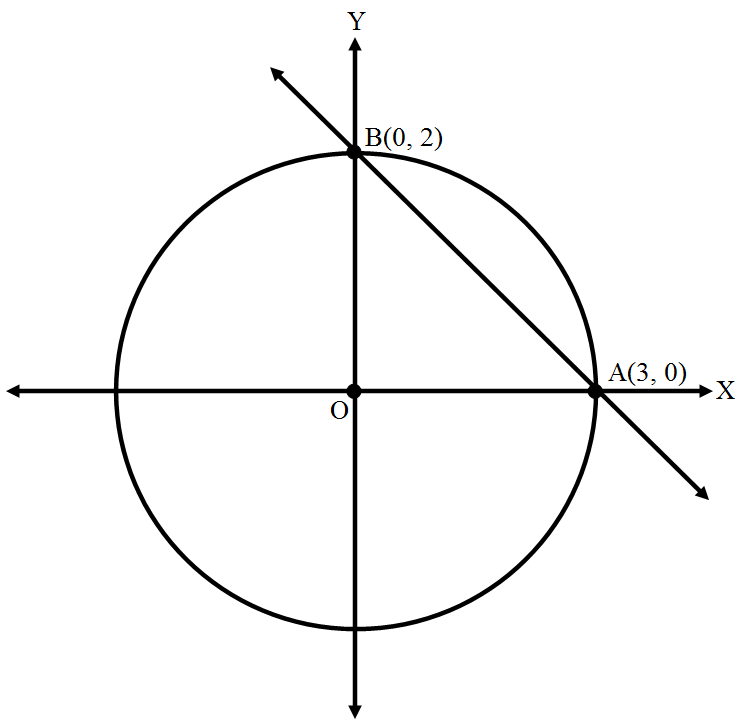
Shaded region represents area. This is sliced into rectangles with area $(y_1 - y_2)$x which slides from $x - 0$ to $x - 3,$ so
Required area $=$ Region on APBQA
$\text{A}=\int\limits^3_0(\text{y}_1-\text{y}_2)\text{dx}$
$=\int\limits^3_0\Big[\frac{2}{3}\sqrt{9-\text{x}^2}\text{ dx}-\frac{2}{3}(3-\text{x})\text{dx}\Big]$
$=\frac{2}{3}\Big[\frac{\text{x}}{2}\sqrt{9-\text{x}^2}+\frac{9}{2}\sin^{-1}\Big(\frac{\text{x}}{3}\Big)-3\text{x}+\frac{\text{x}^2}{2}\Big]^3_0$
$=\frac{2}{3}\bigg[\Big\{0+\frac{9}{2}\cdot\frac{\pi}{2}-9+\frac{9}{2}\Big\}-\{0\}\bigg]$
$=\frac{2}{3}\Big[\frac{9\pi}{4}-\frac{9}{2}\Big]$
$\text{A}=\Big(\frac{3\pi}{2}-3\Big)\text{sq. units}$ View full question & answer→Question 625 Marks
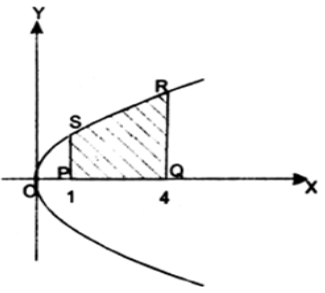
Find the area of the region bounded by the curve $y^2 = x$ and the lines $x = 1, x = 4$ and the x-axis.
AnswerThe equation of curve is $y^2 = x$
$\text{Required area}=\int\limits_{1}^{4}\text{ydx}=\int\limits_{1}^{4}\sqrt{\text{x}}\text{dx}=\int\limits_{1}^{4}\text{x}^{\frac12}\text{dx}$
$=\Bigg[\frac{\text{x}^\frac{3}{2}}{\frac32}\Bigg]^4_1=\frac23\Big[\text{x}^{\frac32}\Big]^4_1=\frac23\Big[(4)^{\frac32-1}\Big]$
$=\frac23(8-1)=\frac23\times7=\frac{14}{3}\text{ sq. units.}$
View full question & answer→Question 635 Marks
Draw the rough sketch of $y^2 + 1 = x, x < 2$. Find the area enclosed by the curve and the line $x = 2$.
AnswerWe have to find area enclosed by $y^2 = x - 1$ .....(1) and $x = 2$ .....(2) Equation (1) is a parabola with vertex at (1, 0) and axis as x-axis. Equation (2) represents a line parallel to y-axis passing through (2, 0) A rough sketch of curves is as below: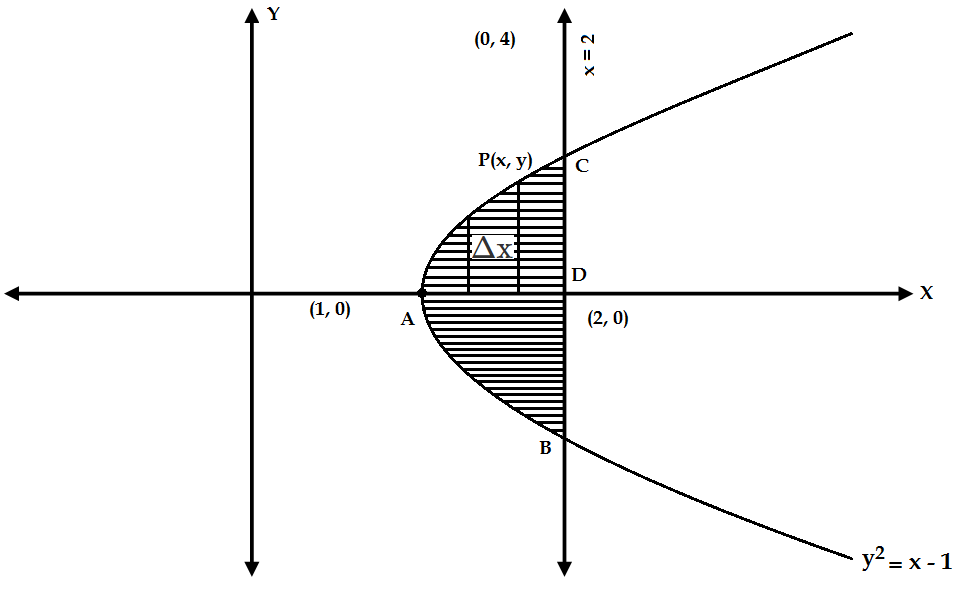
Shaded region show the required area. We slice it in approxim rectangle with its width $=\triangle \text{x}$ and length = y - 0 = y. Area of te rectangle $=\text{y}\triangle \text{x}$ This rectangle can slide from x = 1 to x = 2, So Requied area = Region ABCA $ =2 (\text{Region AOCA)}$
$= 2\int\limits ^{2}_{1}\text{ydx}$
$= 2\int\limits^{2}_{1} \sqrt{\text{x} - 1\text{dx}}$
$= \Big(\frac{2}{3}(\text{x} - 1)\sqrt{\text{x} - 1}\Big)^{2}_{1}$
$= \frac{4}{3} \Big[\Big((2 - 1) \sqrt{2 - 1}\Big) - \Big((1 - 1) \sqrt{1 =- 1}\Big)\Big]$
$= \frac{4}{3}(1 - 0)$ Required area $= \frac{4}{3}$ square units. View full question & answer→Question 645 Marks
Using integration, find the area of the region bounded by the line 2y = 5x + 7, x-axis and the lines x = 2 and x = 8.
AnswerWe have 2y = 5x + 7 $\Rightarrow\ \text{y}=\frac{5\text{x}}{2}+\frac{7}{2}$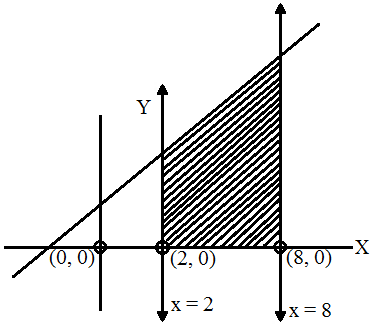
$\therefore$ Area of shaded region $=\frac{1}{2}\int\limits^8_2(5\text{x}+7)\text{dx}=\frac{1}{2}\Big[5\cdot\frac{\text{x}^2}{2}+7\text{x}\Big]^8_2$ $=\frac{1}{2}\big[2\cdot32+7\cdot8-10-14\big]$ $=\frac{1}{2}\big[160+56-24\big]$ $=\frac{192}{2}=96\text{ sq. units}$ View full question & answer→Question 655 Marks
Find the area of the region $\Bigg\{(\text{x},\text{y}): \frac{\text{x}^{2}}{\text{a}^{2}}+\frac{\text{y}^{2}}{\text{b}^{2}}<1< \frac{\text{x}}{\text{a}}+\frac{\text{y}}{\text{b}}\bigg\}$
AnswerHere to fine area $\Bigg\{(\text{x},\text{y}): \frac{\text{x}^{2}}{\text{a}^{2}}+\frac{\text{y}^{2}}{\text{b}^{2}}<1< \frac{\text{x}}{\text{a}}+\frac{\text{y}}{\text{b}}\bigg\}$
$\frac{\text{x}^{2}}{\text{a}^{2}}+\frac{\text{y}^{2}}{\text{b}^{2}}=1\ ...(\text{i})$
$\frac{\text{x}}{\text{a}}+\frac{\text{y}}{\text{b}}=1\ ...(\text{ii})$ Equation (i) represents a parabola with vertex at origin and axis as x-axis and equation (ii) represents a line parallel to y-axis. A rough sketch of the equations is as below: Shaded region is the (0, 0) in $\frac{\text{x}^{2}}{\text{a}^{2}}+\frac{\text{y}^{2}}{\text{b}^{2}}<1$ given a true and ny (0, 0) in $1<\frac{\text{x}^{2}}{\text{a}^{2}}+\frac{\text{y}^{2}}{\text{b}^{2}}$ given also statement. Area of the rectangle = $(y_1 - y_2)$ The approximation can from x = 0 to x = a Reqired area = $=\int\limits_{0}^{\text{a}}\Big[\frac{\text{b}}{\text{a}}\sqrt{\text{a}^{2}-\text{x}^{2}}-\frac{\text{b}}{\text{a}}(\text{a}-\text{x})\Big]\text{dx} $
$=\frac{\text{b}}{\text{a}}\int\limits_{0}^{\text{a}}\Big[\sqrt{\text{a}^{2}-\text{x}^{2}}-\frac{\text{b}}{\text{a}}(\text{a}-\text{x})\Big]\text{dx} $
$=\frac{\text{b}}{\text{a}}\int\limits_{0}^{\text{a}}\frac{\text{x}}{2}\Big[\sqrt{\text{a}^{2}-\text{x}^{2}}-\frac{\text{a}^{2}}{\text{2}}\sin^{-1}(\frac{\text{x}}{\text{a}})-\text{ax}+\frac{\text{x}^{2}}{2}\Big]^{\text{a}}_{0}$
$=\frac{\text{b}}{\text{a}}\Bigg[\frac{\text{a}}{2}\Big(\sqrt{\text{a}^{2}-\text{x}^{2}}-\frac{\text{a}^{2}}{\text{2}}\sin^{-1}(1)\Big)-\text{a}^{2}+\frac{\text{a}^{2}}{2}\Big)-(0+0+0+0)\Bigg]$
$=\frac{\text{b}}{\text{a}}\big[\frac{\text{a}^{2}}{2}.\frac{\pi}{2}-\frac{\text{a}^{2}}{2}\big]$
$=\frac{\text{b}}{\text{a}}\frac{\text{a}^{2}}{2}\Big(\frac{\pi-2}{2}\Big)$
$=\frac{\text{ab}}{4}(\pi-2)\ \text{sq.}\ \text{units}$
View full question & answer→Question 665 Marks
Find the area of the figure bounded by the curves y = |x - 1| and y = 3 - |x|.
Answer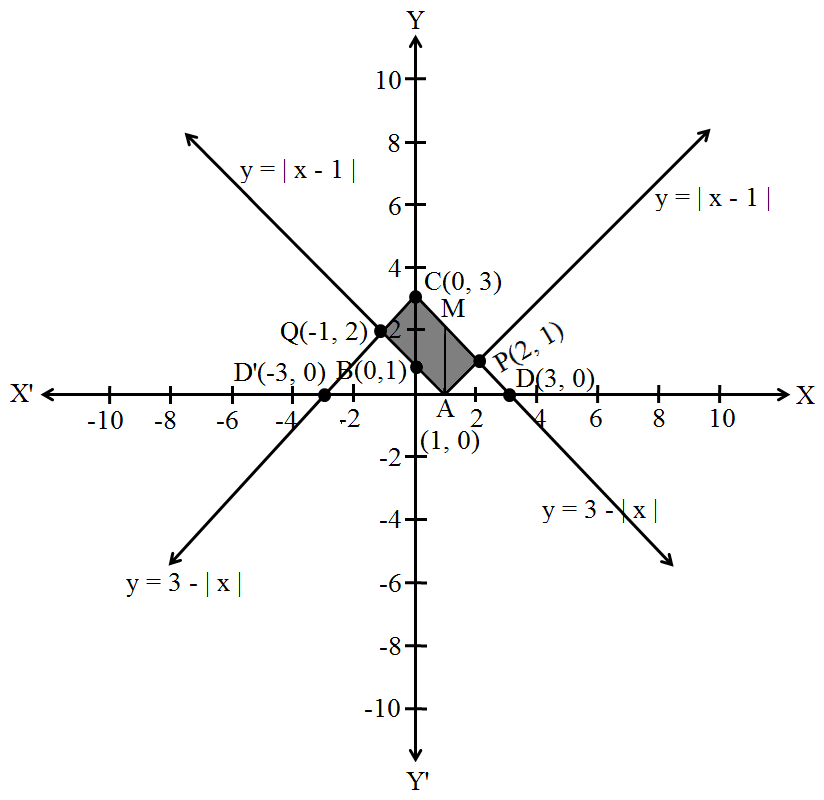
We have
y = |x - 1|
$\Rightarrow\text{y}=\begin{cases}\text{x}-1,&\text{for x}\geq1\\1-\text{x},&\text{ for x}<1\end{cases}$
y = x - 1 is a straight line passing through A(1, 0)
y = 1 - x is straight line passing through A(1, 0) and cutting y-axis at B(0, 1)
y = 3 - |x|
$\Rightarrow\text{y}=\begin{cases}3-\text{x},&\text{for x}\geq0\\3-(-\text{x})=3+\text{x},&\text{ for x}<0\end{cases}$
y = 3 - x is straight line passing through C(0, 3) and D(3, 0)
y = 3 + x is straight line passing through C(0, 3) and D(-3, 0)
The point of intersection is obtained by solving the simultaneous equations
y = x - 1
and y = 3 - x
We get
⇒ x - 1 = 3 - x
⇒ 2x - 4 = 0
⇒ x = 2
⇒ y = 2 - 1 = 1
Thus P(2, 1) is point of intersection of y = x - 1 and y = 3 - x
Point of intersection for
y = 1 - x
y = 3 + x
⇒ 1 - x = 3 + x
⇒ 2x - 2
⇒ x = -1
⇒ y = 1 - (-1) = 2
Thus Q(-1, 2) is point of intersection of y = 1 - x and y = 3 + x
Since the character of function changes at C(0, 3) and A(1, 0), draw AM perpendicular to x-axis
Required area = Shaded area (QCPAQ)
= area (QCB) + area (BCMAB) + area(AMPA) .....(i)
$\text{Area}(\text{QCB})=\int\limits^0_{-1}\big[(3+\text{x})-(1-\text{x})\big]\text{dx}$
$=\int\limits^0_{-1}(2+2\text{x})\text{dx}$
$=\big[2\text{x}+\text{x}^2\big]^0_{-1}$
$=0-(-2+1)$
$=1\text{ sq. units}\ ....(\text{ii})$
$\text{Area}(\text{BCMA})=\int\limits^0_{-1}\big[(3+\text{x})-(1-\text{x})\big]\text{dx}$
$=\int\limits^1_02\text{ dx}$
$=\big[2\text{x}\big]^1_0=2\text{ sq. units}\ ....(\text{iii})$
$\text{Area}(\text{AMPA})=\int\limits^2_{1}\big[(3+\text{x})-(1-\text{x})\big]\text{dx}$
$=\int\limits_1^2(4-2\text{x})\text{dx}$
$=\big[4\text{x}-\text{x}^2\big]^2_1$
$=(8-4)-(4-1)$
$=1\text{ sq. units}\ ....(\text{iv})$
From (i), (ii), (iii) and (iv)
Shaded area = 1 + 2 + 1
= 4 sq. units View full question & answer→Question 675 Marks
Find the area of the region bounded by $y^2 = 9x, x = 2, x = 4$ and the x-axis in the first quadrant.
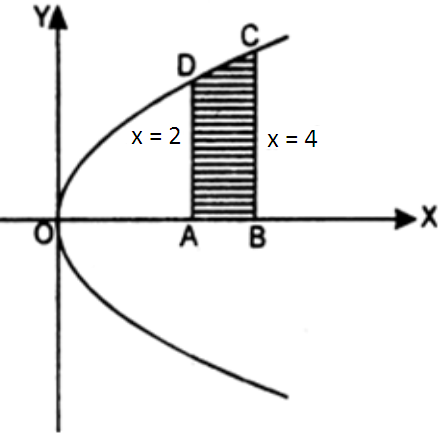
AnswerThe equation of curve is $y^2 = 9x$, which is right handed parabola.
Two lines are $x = 2, x = 4.$
Required area = Area ABCD
$=\int\limits_2^4\text{ydx}=\int\limits_2^43\sqrt{\text{x}}\text{dx}=3\int\limits_2^4\text{x}^{\frac12}\text{dx}$
$=3\Bigg[\frac{\text{x}^\frac32}{\frac32}\Bigg]^4_2=3\times\frac23\Big[\text{x}^{\frac32}\Big]^4_2$
$=2.\Big[(4)^{\frac32}-(2)^{\frac32}\Big]=2[8-\sqrt8]=2(8-2\sqrt2)$
$=(16-4\sqrt2)\text{ sq. units.}$
View full question & answer→Question 685 Marks
Find the area of the region bounded by the curve $y^2 = 4x$ and the line $x = 3.$
AnswerThe equation of parabola is $y^2 = 4x$
The equation of line is $x = 3$
Also, we know that parabola is symmetric about x-axis
$\therefore$ required area $= 2 ($area ORPO$)$
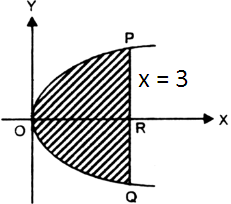
$=2\int\limits^3_02\sqrt{\text{x}}\text{ dx}=4\int\limits^3_0\text{x}^{\frac12}\text{dx}$
$=4\Bigg[\frac{\text{x}^{\frac32}}{\frac32}\Bigg]^3_0=\frac83\Big[\text{x}^{\frac32}\Big]^3_0=\frac83\Big[3^{\frac32}-0\Big]=\frac83\times\sqrt{27}$
$=\frac{8}{3}\times3\sqrt3$
$=8\sqrt3\text{ sq. units.}$ View full question & answer→Question 695 Marks
Prove that the area the region bounded by $\text{y}=\sqrt{\text{x}}, $and x = 2y + 3 in the first and x-asis.
Answer
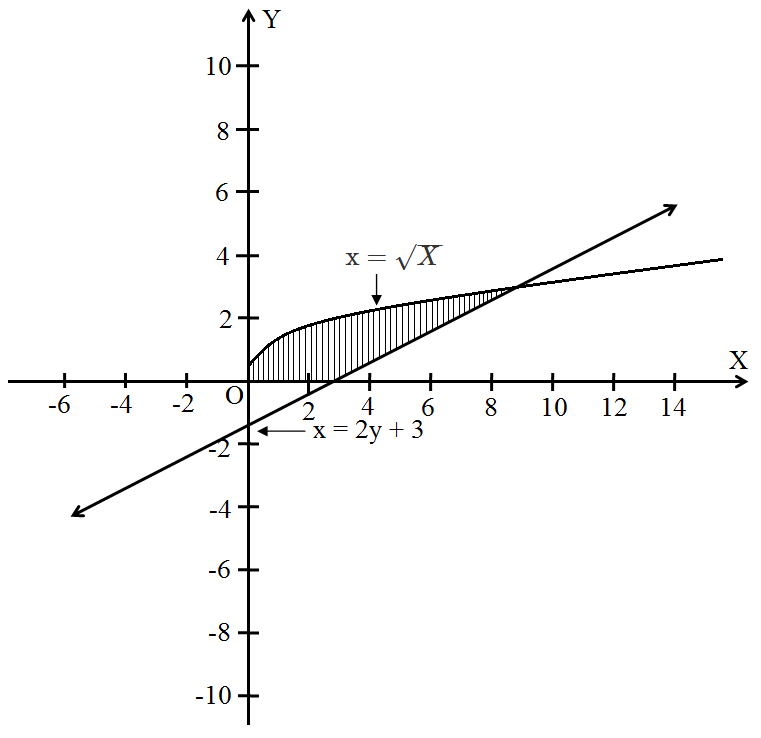 Area of the bounded region
$=\int\limits_{0}^{3}\sqrt{\text{x}}\ \text{dx}+ \int\limits_{3}^{9}\sqrt{\text{x}}\Big(\frac{\text{x}-3}{2}\Big)\text{dx}$
$=\bigg[\frac{\text{x}^\frac{3}{2}}{\frac{3}{2}}\bigg]^{3}_{0}+\bigg[\frac{\text{x}^\frac{3}{2}}{\frac{3}{2}}-\frac{\text{x}^{4}}{4}+\frac{3\text{x}}{2}\bigg]^{9}_{3} $
$=\bigg[\frac{\text{3}^\frac{3}{2}}{\frac{3}{2}}\bigg]^{3}_{0}+\bigg[\frac{\text{9}^\frac{3}{2}}{\frac{3}{2}}-\frac{\text{9}^{4}}{4}+\frac{\text{9}}{2}\bigg]$
$=9\ \text{sq.}\ \text{units}$ View full question & answer→Question 705 Marks
Find the area enclosed by the curve $y = -x^2$ and the straight lilne $x + y + 2 = 0.$
AnswerWe have, $y = -x^2$ and $x + y + 2 = 0$
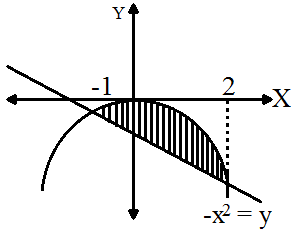
$\Rightarrow -x - 2 = -x^2$
$\Rightarrow x^2 - x - 2 = 0$
$\Rightarrow x^2 + x - 2x - 2 = 0$
$\Rightarrow x(x + 1) -2(x + 1) = 0$
$\Rightarrow (x - 2)(x + 1) = 0$
$\Rightarrow x = 2, -1$
$\therefore$ Area of shaded region, $\text{A}=\Bigg|\int\limits^2_{-1}(-\text{x}-2+\text{x}^2)\text{dx}\bigg|$
$=\bigg|\int\limits^2_{-1}(\text{x}^2-\text{x}-2)\text{dx}\bigg|$
$=\Bigg|\bigg[\frac{\text{x}^3}{3}-\frac{\text{x}^2}{2}-2\text{x}\bigg]\Bigg|^2_{-1}$
$=\Bigg|\bigg[\frac{8}{3}-\frac{4}{2}-4+\frac{1}{3}+\frac{1}{2}-2\bigg]\Bigg|$
$\bigg|\frac{16-12-24+2+3-12}{6}\bigg|$
$=\bigg|-\frac{27}{6}\bigg|=\frac{9}{2}\text{ sq. units}$ View full question & answer→Question 715 Marks
Find the area of the region bounded by $\text{y}=\sqrt{\text{x}}$ and y = x.
AnswerGiven equation of are $\text{y}=\sqrt{\text{x}}$ and y = x $\Rightarrow\text{x}=\sqrt{\text{x}}\Rightarrow\text{x}^2=\text{x}$ $\Rightarrow\text{x}^2-\text{x}=0\Rightarrow\text{x}(\text{x}-1)=0$ $\Rightarrow\text{x}=0,1$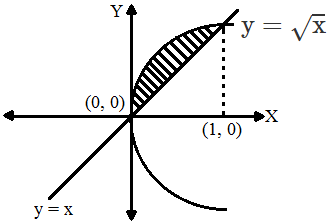
$\therefore$ Required area of shaded region, $\text{A}=\int\limits^1_0\big(\sqrt{\text{x}}\big)\text{dx}-\int\limits^1_0\text{x dx}$ $=\bigg[2\cdot\frac{\text{x}^{\frac{3}{2}}}{3}\bigg]^1_0-\bigg[\frac{\text{x}^2}{2}\bigg]^1_0$ $=\frac{2}{3}\cdot1-\frac{1}{2}=\frac{2}{3}-\frac{1}{2}$ $=\frac{1}{6}\text{ sq. units}$ View full question & answer→Question 725 Marks
Find the area of the ragion bounded by $x^2 = 4$ay and its latusrectum.
Answer
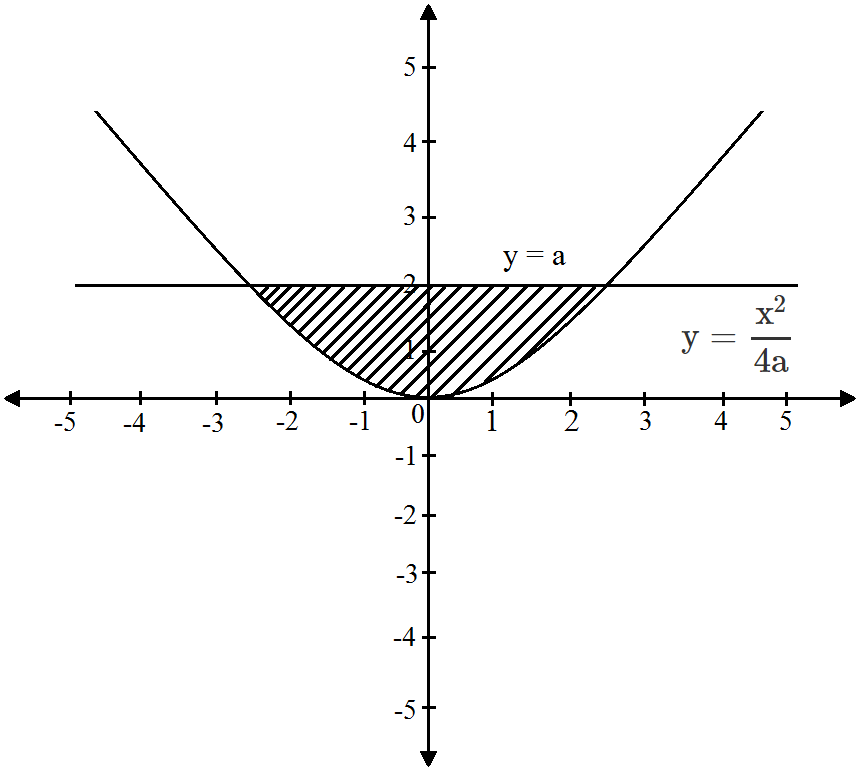
Area of the aegion $=2\times \int\limits_{0}^{2\text{a}}\Big[\text{a}-\frac{\text{x}^{3}}{4\text{a}}\Big]\text{dx} $
$=2\times \Big[\text{ax}-\frac{\text{x}^{3}}{12\text{a}}\Big]^{2\text{a}}_{0}$
$=2 \Big[\text{a}(2\text{a}-0)-\frac{(2\text{a}^{2})-0^{3}}{12\text{a}}\Big]$
$=2 \Big[2\text{a}^{2}-\frac{8\text{a}^{3}}{12\text{a}}\Big] $
$=2\Big[\frac{16\text{a}^{3}}{12\text{a}}\Big]$
$=\frac{8}{3}\text{a}^{2}\ \text{sq.}\ \text{units}$ View full question & answer→Question 735 Marks
Using integration, Find the area bounded by the the triangle whose vartices are $(2, 1), (3, 4)$ and $(5, 2)$.
Answer
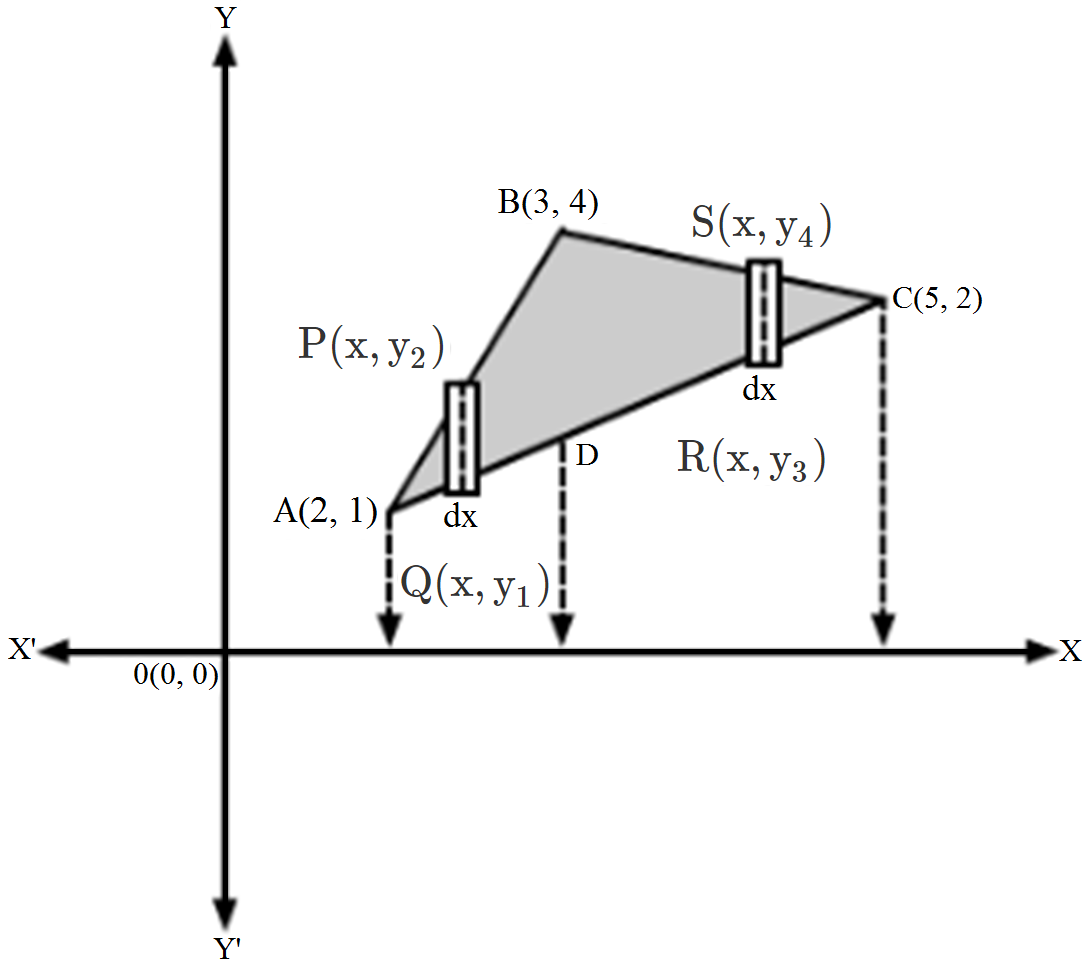
Consider the points A(2, 1), B(3, 4) and C(5, 2)
We need to find area of shaded triangle ABC
Equation of AB is
$\text{y}-1=\Big(\frac{4-3}{3-2}\Big)(\text{x}-2)$
$\Rightarrow\text{x}-3\text{y}-5=0\ ...(\text{i})$
Equation of BC is
$\text{y}-4=\Big(\frac{2-4}{5-3}\Big)(\text{x}-3)$
$\Rightarrow\text{x}=\text{y}-7=0\ ...(\text{ii})$
Equation of CA is
$\text{y}-2=\Big(\frac{2-1}{5-2}\Big)(\text{x}-5)$
$\Rightarrow\text{x}-3\text{y}+2=0\ ...(\text{iii})$
Area of $\triangle\text{ABC}= \text{Area of}\ \triangle\text{ABC}+ \text{Area of }\triangle\text{ABC}$ in the,
Consided point $P(x_1, y_2)$ on $AB$ and $Q(x_1, y_1)$ on $AD$
Thus, the area of appoximating with length $= |y_2 - y_1|$ from $x = 2$, to $x = 3$
$\therefore$ Area of $\triangle\text{ABC}=\int\limits_{2}^{3}|\text{y}_{2}-\text{y}_{1}|\text{dx} $
$\Rightarrow\text{A}=\int\limits_{2}^{3}(\text{y}_{2}-\text{y}_{1})\text{dx} $
$\Rightarrow\text{A}=\int\limits_{2}^{3}(3\text{x}-5)-\Big(\frac{\text{x}-1}{3}\Big)\text{dx}$
$\Rightarrow\text{A}=\int\limits_{2}^{3}\frac{(9\text{x}-15-\text{x}-1)}{3}\text{dx}$
$\Rightarrow\text{A}=\int\limits_{2}^{3}\frac{(8\text{x}-16)}{3}\text{dx}$
$\Rightarrow\text{A}=\frac{1}{3}\Big[8\text{x}^{2}-16\text{x}\Big]\text{dx}$
$\Rightarrow\text{A}=\frac{1}{3}(68-64)$
$\Rightarrow\text{A}=\frac{4}{3}\ \text{sq.}\ \text{units}$ View full question & answer→Question 745 Marks
Find the area bounded by the cutve $y = 4 - x^2$ and the line $y = 0, y = 3$.
Answer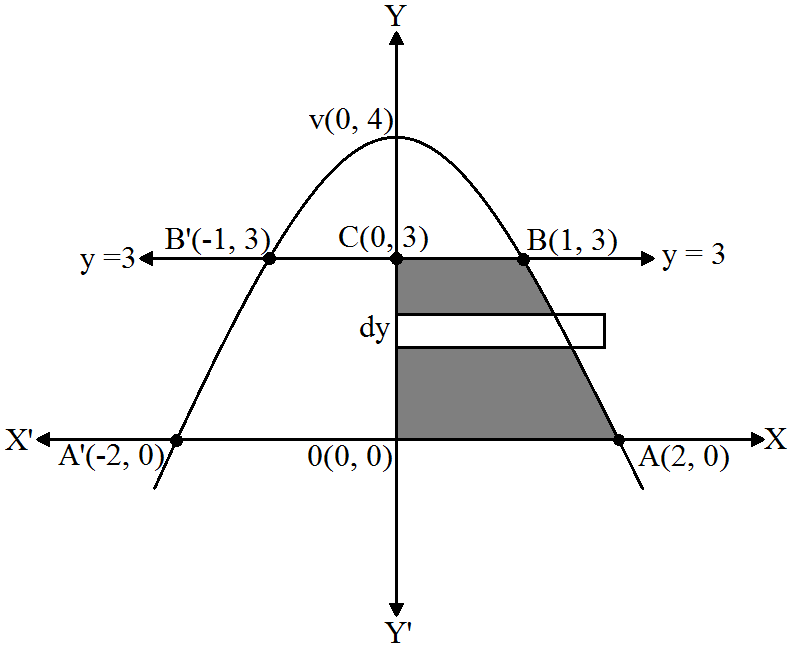
$= 4 - x^2$ a parabola, openeing upward, symmectrical about +ve y-axis and having y = 0 is a line parallel to x-axis, cutting parabola at (2, 0) and (-2, 0)y = 3 is a line parllel to x-axis, cutting parabola at (1, 3) and (-1, 3) and (0, 3)
Consider a horizontal rectangle $= |x_2 - x_1|dy$
Area of approxinating rectangle moves from y = 0 to y = 3
Area of the shaded in he first enclsoed y = 1 and y = 4 is the area of the shaded region.
$\therefore$ Area of the curve in the first region $=2\int\limits_{3}^{0}|\text{x}_{2}-\text{x}_{1}| \ \text{dy}$
$\Rightarrow\text{A}=2\int\limits_{3}^{0}(\text{x}_{2}-\text{x}_{1})\text{dy} $
$\Rightarrow\text{A}=2\int\limits_{1}^{3}\big(\sqrt{4-\text{y}}-0\big) \text{dy}$
$\Rightarrow\text{A}=-2\Bigg[ \frac{(4-\text{y})^\frac{3}{2}}{\frac{3}{2}}\Bigg]^{3}_{0}$
$\Rightarrow\text{A}=2\times\frac{2}{3}\Big[4^\frac{3}{2}-1^\frac{3}{2}\Big]$
$\Rightarrow\text{A}=\frac{4}{3}\times{7}$
$\Rightarrow\text{A}=\frac{28}{3}\ \text{sq.}\ \text{units}$ View full question & answer→Question 755 Marks
Using integration find the area of the region bounded by the curve $\text{y}=\sqrt{4-\text{x}^2},\text{ x}^2+\text{y}^2-4\text{x}=0$ and the x-axis.
AnswerThe given curves are $\text{y}=\sqrt{4-\text{x}^2}$ and $x^2+ y^2 - 4x = 0$
$\text{y}=\sqrt{4-\text{x}^2}$
$\Rightarrow x^2 + y^2 = 4 ....(i)$
This respresents a circle with centre O(0, 0) and redius = 2 units.
Also,
$x^2 + y^2 - 4x = 0$
$\Rightarrow (x - 2)^2 + y^2 = 4 .....(ii)$
This represents a circle with centre B(2, 0) and redius = 2 units.
Sloving (i) and (ii) we get
$(x - 2)^2 = a2$
$\Rightarrow x^2 - 4x + 4 = x^2$
$\Rightarrow x = 1$
$\therefore\ \text{y}^2=3$
$\Rightarrow\text{y}=\pm\sqrt{3}$
Thus, the given circles intersect At $\text{A}(1,\sqrt{3})$ and $(1,-\sqrt{3})$
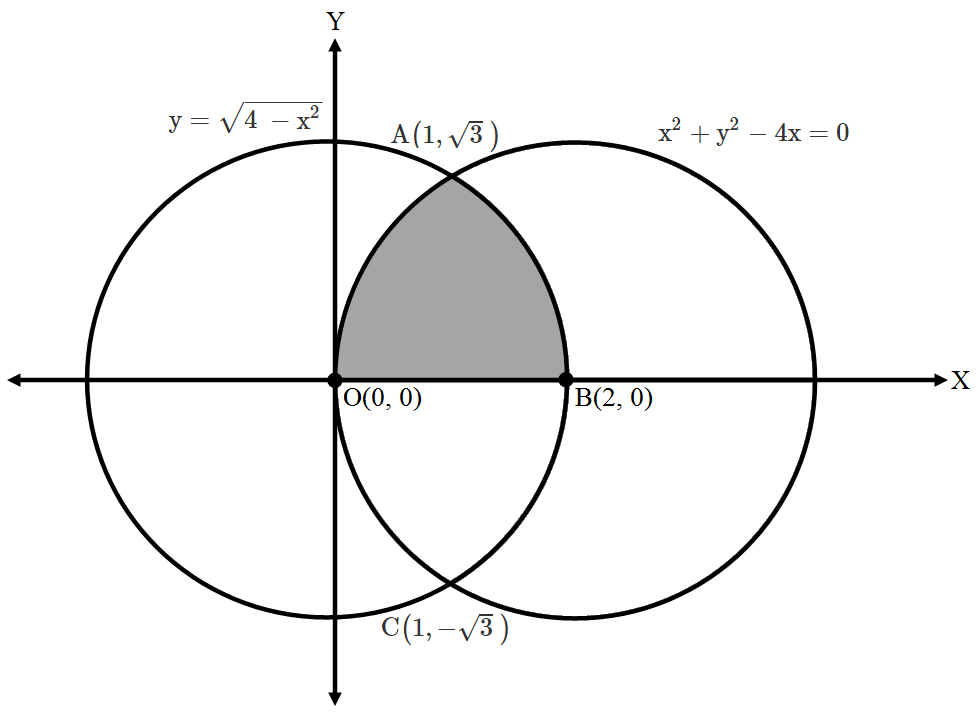
$\therefore$ Requred area
= Area of the shaded region OABO
$=\int\limits^1_0\sqrt{4-(\text{x}-2)^2}\text{ dx}+\int\limits^2_1\sqrt{4-\text{x}^2}\text{ dx}$
$=\Big[\frac{1}{2}(\text{x}-2)\sqrt{4-(\text{x}-2)^2}+\frac{4}{2}\sin^{-1}\Big(\frac{\text{x}-2}{2}\Big)\Big]^1_0\\+\Big[\frac{1}{2}\text{x}\sqrt{4-\text{x}^2}+\frac{4}{2}\sin^{-1}\Big(\frac{\text{x}}{2}\Big)\Big]^2_1$
$=-\frac{\sqrt{3}}{2}-2\times\frac{\pi}{6}+2\times\frac{\pi}{2}-\frac{\sqrt{3}}{2}+2\times\frac{\pi}{2}-2\times\frac{\pi}{6}$
$=-\sqrt{3}+2\pi-\frac{2\pi}{3}$
$=\Big(\frac{4\pi}{3}-\sqrt{3}\Big)\text{square units}$ View full question & answer→Question 765 Marks
Find the area of region bounded by the line $x = 2$ and the parabola $y^2 = 8x$.
AnswerWe have, $y^2 = 8x$ and $x = 2$
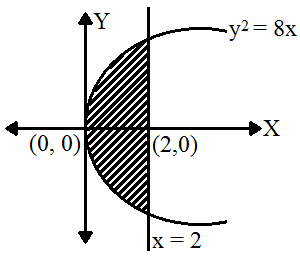
$\therefore$ Area of shaded region, $\text{A}=2\int\limits^2_0\sqrt{8\text{x}}\text{ dx}=2\cdot2\sqrt{2}\int\limits^2_0\text{x}^{\frac{1}{2}}\text{dx}$
$=4\cdot\sqrt{2}\cdot\Big[2\cdot\frac{\text{x}^{\frac{3}{2}}}{3}\Big]^2_0=4\sqrt{2}\Big[\frac{2}{3}\cdot\sqrt{2}-0\Big]$
$=\frac{32}{3}\text{ sq. units}$ View full question & answer→Question 775 Marks
Find the area of the bounded by the curve xy - 3x - 2y = 0, x-axis and the lins x = 3, x = 4.
Answerwe have,
xy - 3x - 2y - 10 = 0
⇒ xy - 2y = 3x + 10
⇒ y(x - 2) = 3x + 10
$\Rightarrow\text{y}=\frac{3\text{x}+10}{\text{x}-2} $
Let A represent the required area:
$\Rightarrow\text{A}=\int\limits_{3}^{4}|\text{x}|\text{dx} $
$=\int\limits_{3}^{4}\frac{3\text{x}+10}{\text{x}-2}\text{dx} $
$=\int\limits_{3}^{4}\Big(3+\frac{16}{\text{x}-2}\Big)\text{dx}$
$=\Big[3\text{x}+16\log|\text{x}-2|\Big]^{4}_{3}$
$=\Big[12+16\log|2|-9-16\log|1|\Big]$
$=3+16\log2 \ \ \text{sq.}\ \text{units}$
View full question & answer→Question 785 Marks
Find the area, lying above x-axis and included between the circle $x^2 + y^2 = 8x$ and the parabola $y^2 = 4x.$
Answer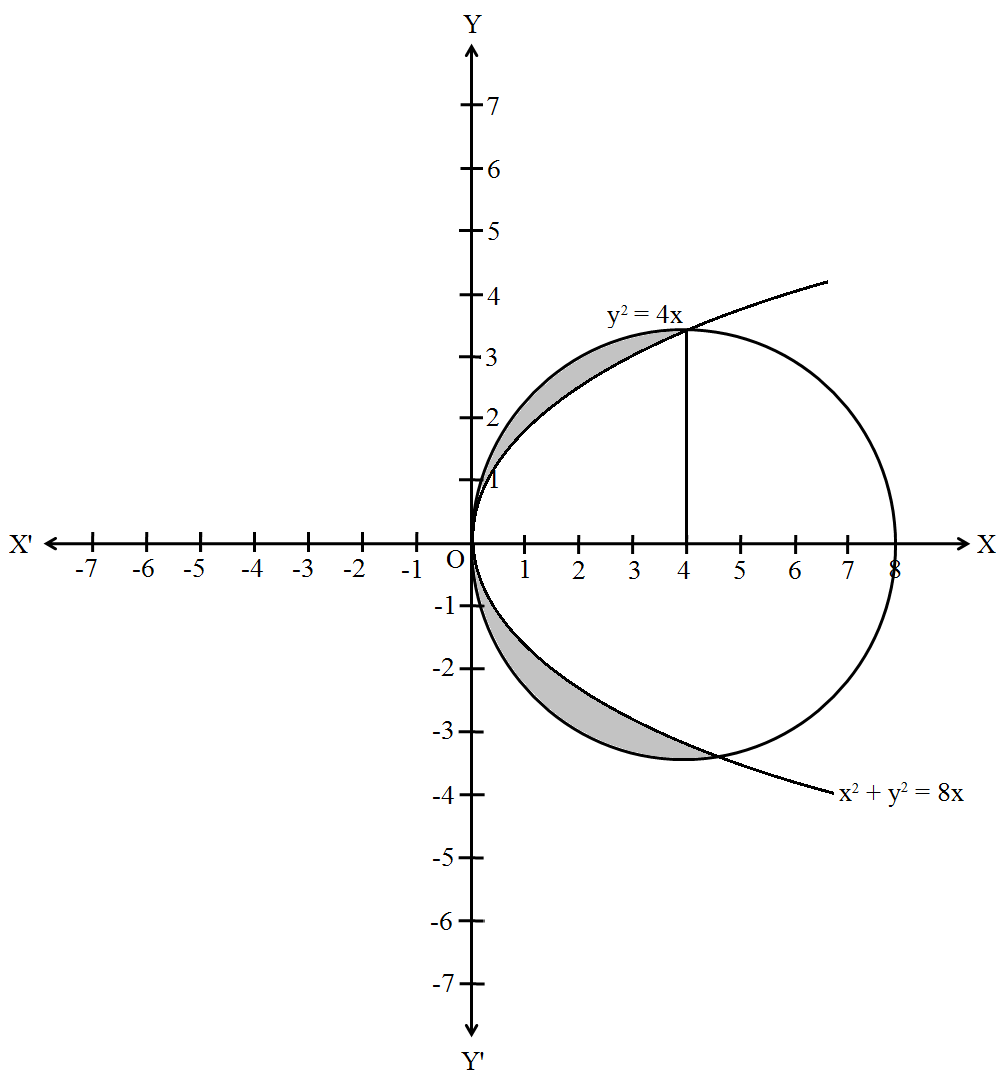
The given equations are $x^2 + y^2 = 8x ...(i)$
and $y^2 = 4x ...(ii)$
Clearly the equations $x^2 + y^2 = 8x$ is a circle with center $(4, 0)$ and has a radius 4. Also $y^2 = 4x$ is a parabola with vertex at origin and the points of the curve, we solve both the eqution.
$\therefore$ $x^2 + y^2 = 8x$
$\Rightarrow x^2 - 4x = 0$
$\Rightarrow x(x - 4) = 0$
$\Rightarrow x = 0$ and $x = 4$
When $x = 0, y = 0$
When x = 4, $\text{y}=\pm4$
To approximate the area of shade region the length $= |y_2 - y_1| $and the with = dx
$\text{A}=\int\limits_{0}^{4}|\text{y}_{2}-\text{y}_{1}|\text{dx} $
$=\int\limits_{0}^{4}(\text{y}_{2}-\text{y}_{1})\text{dx} $
$=\int\limits_{0}^{4}\bigg[\sqrt{\Big(16-(\text{x}-4)^{2}}\Big)-\sqrt{4\text{x}}\bigg]\text{dx}$
$=\int\limits_{0}^{4}\sqrt{16-(\text{x}-4)^{2}}\text{ dx}-\int\limits_{0}^{4}\sqrt{4\text{x}}\text{ dx}$
$=\bigg[\frac{(\text{x}-4)}{2}\sqrt{16-(\text{x}-4)^{2}}+\frac{16}{2}\sin^{-1}\Big(\frac{\text{x}-4}{4}\Big)\bigg]^{4}_{0}-\Big[\frac{4\text{x}^\frac{3}{2}}{3}\Big]^{4}_{0}$
$=\Big[0+0-0-8\sin^{-1}\Big(\frac{-4}{4}\Big)\Big]-\frac{4}{3}\times4^\frac{3}{2}$
$=\frac{8\pi}{2}-\frac{32}{3}$
$=4\pi-\frac{32}{3}\ \text{sq.}\ \text{units}$ View full question & answer→Question 795 Marks
Sketch the graph y = |x + 1|. Evaluate $\int\limits_{-4}^{2}|\text{x}+1|\text{dx} $ . What does this value of the integral represent on the graph.
Answer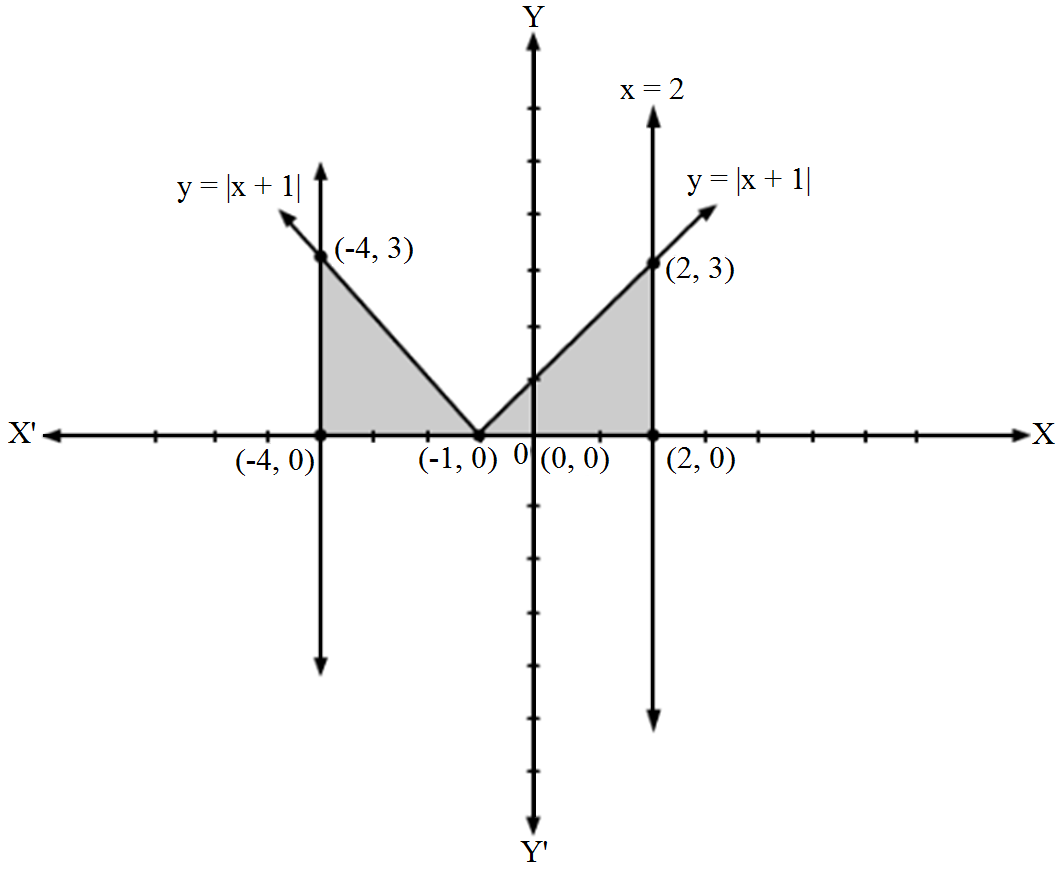 we have,
y = |x + 1| intesect x = -4 and x = 2 at (-4, 3) and (2, 3)
Now,
y = |x + 1|
$=\begin{cases}(\text{x}+1) & \text{x} > -1\\-(\text{x}+1) &\text{ x} < -1\end{cases}$
integration represents the area enclosded by the graph from x = -4 to x = 2
$\text{A}=\int\limits_{-4}^{-2}|\text{y}|\text{dx} $
$=\int\limits_{-4}^{-1}|\text{y}|\text{dx}+\int\limits_{-1}^{2}|\text{y}|\text{dx} $
$=\int\limits_{-4}^{-1}-(\text{x}+1)\text{dx}+\int\limits_{-1}^{2}(\text{x}+1)\text{dx} $
$=-\Big[\frac{\text{x}^{2}}{2}+\text{x}\Big]^{-1}_{-4}+\Big[\frac{\text{x}^{2}}{2}+\text{x}\Big]^{2}_{-1}$
$=-\Big[ \frac{1}{2}-1-\frac{16}{2}+4\Big]+\Big[\frac{4}{2}+2-\frac{1}{2}+1\Big]$
$=-\big[3-\frac{15}{2}\big]+\big[5-\frac{1}{2}\big] $
$=-3+\frac{15}{2}+5-\frac{1}{2}$
$=9 \ \text{sq.}\ \text{units}$ View full question & answer→Question 805 Marks
Using integeation, find ate area of the region bounded by the 2y = 5x + 7. x-axis and the lines x = 2 and x = 8.
Answer
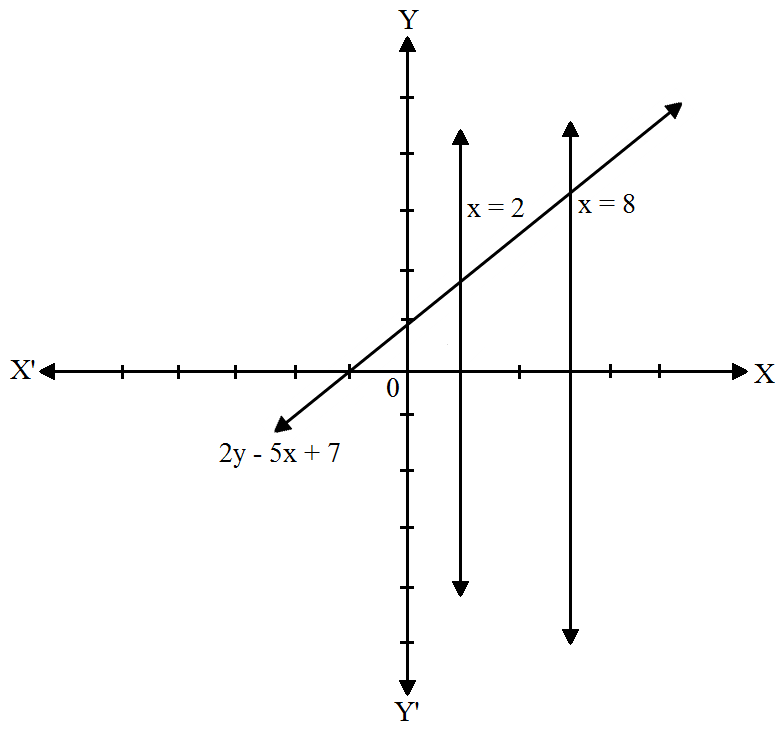 We have,
Straight line 2y = 5x + 7 interset x-axis and y-axis at (-1.4, 0) and (0, 3.5) respectively.
Also x = 2 and x = 8 are straight lines as shown in the figure.
The shaded region is oue requied whose area has to be found.
when we slice the shaded region into vertical strips,
we find that each vertical end on x-axis, and upper end on the line 2y = 5x + 7
So, approximating rectangle shown in figure has length = y and width = dx and area = y dx.
The approximating rectangle can move from x = 2 to x = 8
So, requided is given by,
$\text{A}=\int\limits_{2}^{8}\text{y}\text{dx} $
$=\int\limits_{2}^{8}\Big(\frac{5\text{x}+7}{2}\Big)\text{dx}$
$=\frac{1}{2}\int\limits_{2}^{8}\Big({5\text{x}+7}\Big)\text{dx}$
$=\frac{1}{2}\Big[\frac{5}{2}\text{x}^{2}+7\text{x}\Big]^{8}_{2} $
$=\frac{1}{2}\Big[\frac{5}{2}\times64+56-\frac{5}{2}\times4-14\Big]$
$=\frac{1}{2}\times192$
$=96\ \text{sq}.\ \text{units}$ View full question & answer→Question 815 Marks
Find the area enclosed by the curve $\text{x}=3\cos\text{t}, \text{y}=2\sin\text{t}.$
AnswerThe given curve $\text{x}=3\cos\text{t}, \text{y}=2\sin\text{t}$in t respesent the parmetric of the elipse. Eliminating the t, we get $\frac{\text{x}^{2}}{9}+\frac{\text{y}^{2}}{4}=\cos^{2}\text{t}+\sin^{2}\text{t}=1$ This represents the cartesion eqution of the elioes with center (0, 0). The coordinates of the vertics are (3, 0) and (0, 2)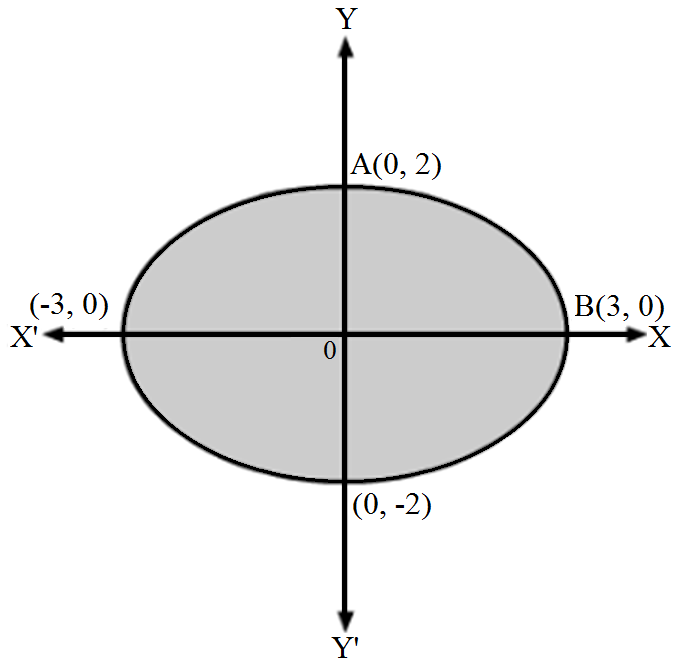
Required area = Area of the shaded region = 4 × Area of the region OABO $=4\times \int\limits_{0}^{3}\text{y}\text{dx} $ $=4\times \int\limits_{0}^{3}\sqrt{4(1-\frac{\text{x}^{2}}{9})}\text{dx}$ $=4\times \frac{2}{3}\int\limits_{0}^{3}\sqrt{9-\text{x}^{2}}{})\text{dx}$ $=\frac{8}{3}\Big[(0+\frac{9}{2}\sin^{-1}1)-(0+0)\Big] $ $=\frac{8}{3}\times\frac{9}{2}\times\frac{\pi}{2}$ $=6\pi\ \text{sq.}\ \text{units}$ View full question & answer→Question 825 Marks
Find the area of the ragion bounded by the curve $ay^2= x^3$ the y-axis and the line $y = a$ and $y = 2a$.
Answer$=\int\limits_{\text{a}}^{2\text{a}}\text{x}\ \text{dy} $
$=\int\limits_{\text{a}}^{2\text{a}}(\text{ay}^{2})^\frac{1}{3}\text{dy}$
$=\text{a}^\frac{1}{3}\int\limits_{\text{a}}^{2\text{a}}\text{y}^\frac{2}{3}\text{dy}$
$=\text{a}^\frac{1}{3}\times\Big[\frac{\text{y}^\frac{5}{3}}{\frac{5}{3}}\Big]^{2\text{a}}_{\text{a}}$
$=\frac{3}{5}\text{a}^\frac{1}{3}\Big[(2\text{a})^\frac{5}{3}-\text{a}^\frac{5}{3}\Big]$
$=\frac{3}{5}\Big[2^\frac{5}{3}\text{a}^{2}-\text{a}^{2}\Big] $
$=\frac{3}{5}\Big[2^\frac{5}{3}-1\Big]\text{a}^{2}\ \text{sq.}\ \text{units} $
View full question & answer→Question 835 Marks
Find the area of the region bounded by the curve $y^2 = 4x, x^2 = 4y$.
AnswerSolving the given curves $y^2 = 4x$ and $x^2 = 4y$, we get:
$(x^2)^2 = 16y^2$
$\Rightarrow x^4 = 16(4x)$
$\Rightarrow x^4 = 64x$
$\Rightarrow x^4 - 64x = 0$
$\Rightarrow x(x^3 - 4^3) = 0$
$\Rightarrow x = 4, 0$
When $x = 0, y = 0$ and when $x = 4, y = 4$
So, the points of intersection are $(0, 0)$ and $(4, 4)$ Now the graphs of the curves $y^2 = 4x$ and $x^2 = 4y$, are as shown below:
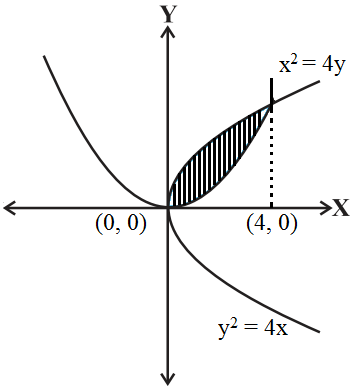
$\therefore$ Required areas = Area of shaded region, A
$\text{A}=\int\limits^4_0\Big(\sqrt{4\text{x}}\frac{\text{x}^2}{4}\Big)\text{dx}$
$=\int\limits^4_0\Big(2\sqrt{\text{x}}\frac{\text{x}^2}{4}\Big)\text{dx}\bigg[\frac{2\text{x}^{\frac{3}{2}}\cdot2}{3}\frac{1}{2}\cdot\frac{\text{x}^3}{3}\bigg]^4_0$
$=\frac{2\cdot2}{3}\cdot\frac{1}{4}\cdot\frac{64}{3}=0$ $=\frac{32}{3}\frac{16}{3}=\frac{16}{3}\text{ sq. units}$ View full question & answer→Question 845 Marks
Find the area of the minor segment of the circle $x^2+ y^2 = a^2$ cut off by the line $\text{x}=\frac{\text{a}}{2}.$
Answer$=2\int\limits_{\frac{\text{a}}{2}}^{\text{a}}\text{y}\ \text{dx} $
$=2\int\limits_{\frac{\text{a}}{2}}^{\text{a}}\sqrt{\text{a}^{2}-\text{x}^{2}}\text{dx}$
$=2\bigg[\frac{\text{x}}{2}\sqrt{\text{a}^{2}-\text{x}^{2}}\text{dx}\bigg]^{\text{a}}_{\frac{\text{x}}{2}}$
$=2\bigg[\Big(0+\frac{\text{a}^{2}}{2}\sin^{-1}1\big)-\Big(\frac{\text{a}}{4}\times\sqrt{\text{a}^{2}-\frac{\text{a}^{2}}{4}}+\frac{\text{a}^{2}}{2}\sin^{-1}\frac{1}{2}\Big)\bigg]$
$=\frac{\text{a}^{2}\pi}{2}-\frac{\sqrt{3}\text{a}^{2}}{4}-\frac{\text{a}^{2}\pi}{6}$
$=\frac{6\text{a}^{2}\pi-3\sqrt{3\text{a}^{2}}-2\text{a}^{2}\pi}{12}$
$=\frac{\text{a}^{2}}{12}\big(4\pi-3\sqrt{3}\big)\ \text{sq.}\ \text{units}$
View full question & answer→Question 855 Marks
Draw a rough sketch of the given curve y = 1 + |x + 1|, x = -3, x = 3, y = 0 and find the area of the region bounded by them, using integration.
AnswerWe have, y = 1 + |x + 1|, x = -3, x = 3 and y = 0 Now, $|\text{x}+1|=\begin{cases}-\text{x}-1,&\text{x}<-1\\\text{x}+1,&\text{x}\geq-1\end{cases}$ $\therefore\ \text{y}=1+|\text{x}+1|=\begin{cases}-\text{x},&\text{x}<-1\\\text{x}+2,&\text{x}\geq-1\end{cases}$ Graph of the above function with x = -3, x = 3 as shown in the following figure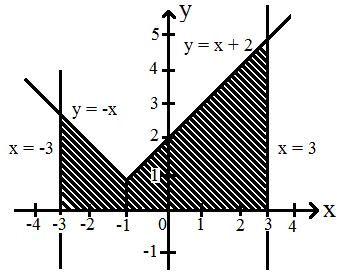
From the figure, Area of shaded region $\text{A}=\int\limits^{-1}_{-3}-\text{x dx}+\int\limits^3_{-1}(\text{x}+2)\text{dx}$ $=-\Big[\frac{\text{x}^2}{2}\Big]^{-1}_{-3}+\Big[\frac{\text{x}^2}{2}+2\text{x}\Big]^3_{-1}$ $=-\Big[\frac{1}{2}-\frac{9}{2}\Big]+\Big[\frac{9}{2}+6-\frac{1}{2}+2\Big]$ $=4+12=16\text{ sq. units}$ View full question & answer→Question 865 Marks
Find the area of the region bounded by the curve $\text{y}=\sqrt{1-\text{x}^2},$ line y = x and the positive x-axis.
AnswerTo find area bounded by positive x-axis and corve
$\text{y}=\sqrt{1-\text{x}^2}$
$\text{x}^2+\text{y}^2=1\ ...(\text{i})$
$\text{x}=\text{y}\ ...(\text{ii})$
Equation (i) respresents a circle with centre (0, 0) and meets axes at $(\pm1,0),(0,\pm1)$
Equation (ii) respresents a line passing through $\Big(\frac{1}{\sqrt{2}},\frac{1}{\sqrt{2}}\Big)$ and $\Big(-\frac{1}{\sqrt{2}},\frac{1}{\sqrt{2}}\Big)$and they are also points of intersection A rough sketch of the curve is as under,
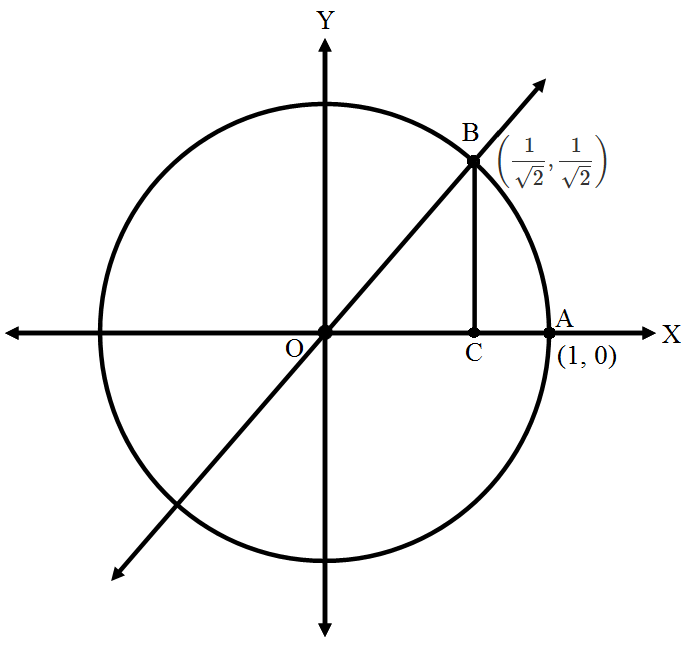
Required area = Region OABO
A = Region OCBO + Region CABC
$=\int\limits^{\frac{1}{\sqrt{2}}}_0\text{y}_1\text{ dx}+\int\limits_{\frac{1}{\sqrt{2}}}^1\text{y}_2\text{ dx}$
$=\int\limits^{\frac{1}{\sqrt{2}}}_0\text{x dx}+\int\limits_{\frac{1}{\sqrt{2}}}^1\sqrt{1-\text{x}^2}\text{ dx}$
$=\Big[\frac{\text{x}^2}{2}\Big]^{\frac{1}{\sqrt{2}}}_0+\Big[\frac{\text{x}}{2}\sqrt{1-\text{x}^2}+\frac{1}{2}\sin^{-1}\text{x}\Big]^1_{\frac{1}{\sqrt{2}}}$
$=\Big[\frac{1}{4}-0\Big]+\Big[\Big(0+\frac{1}{2}\cdot\frac{\pi}{2}\Big)-\Big(\frac{1}{2\sqrt{2}}\cdot\frac{1}{\sqrt{2}}+\frac{1}{2}\cdot\frac{\pi}{4}\Big)\Big]$
$=\frac{1}{4}+\frac{\pi}{4}-\frac{1}{4}-\frac{\pi}{8}$
$\text{A}=\frac{\pi}{8}\text{ sq. units}$ View full question & answer→Question 875 Marks
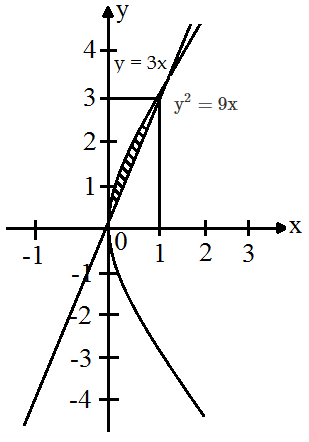
Find the area of the region bounded by the curves $y^2 = 9x, y = 3x$.
AnswerWe have, $y^2 = 9x$ and $y = 3x$ Solving $y^2 = 3(3x) = 3y \Rightarrow y = 0$ or $3$ When $y = 0, x = 0$ and when $y = 3, x = 1$ So points of intersection are $(0, 0)$ and $(1, 3)$ Graphs of parabola $y^2 = 9x$ and line $y = 3x$ are as shown in the adjacent figure. From the figure, Area of shaded region
$\text{A}=\int\limits^1_0(\sqrt{9\text{x}}-3\text{x})\text{dx}$
$=3\int\limits^1_0\text{x}^\frac{1}{2}\text{dx}-3\int\limits^1_0\text{x dx}$
$=3\bigg[\frac{\text{x}^\frac{3}{2}}{\frac{3}{2}}\bigg]_0^1-3\bigg[\frac{\text{x}^2}{2}\bigg]_0^1$
$=3\Big(\frac{2}{3}-0\Big)-3\Big(\frac{1}{2}-0\Big)$
$=2-\frac{3}{2}=\frac{1}{2}\text{ sq. units}$ View full question & answer→Question 885 Marks
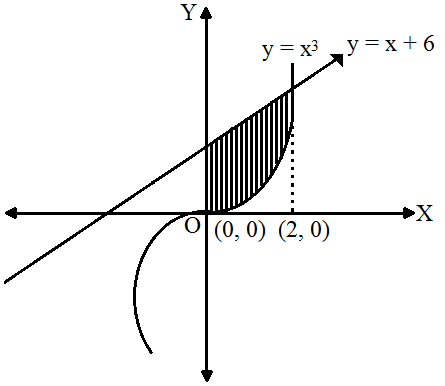
Find the area of the region bounded by the curve $y = x^3$ and $y = x + 6$ and $x = 0.$
AnswerWe have,$ y = x^3, y = x + 6$ and $x = 0$
$\therefore$ $x^3 = x + 6 $
$\Rightarrow x^3 - x = 6 $
$\Rightarrow x^3 - x - 6 = 0 $
$\Rightarrow x^2(x - 2) + 2x(x - 2) + 3(x - 2) = 0 $
$\Rightarrow (x - 2)(x^2 + 2x + 3) = 0 $
$\Rightarrow x = 2,$
with two imaginary points $\therefore$ Required area of shaded region
$=\int\limits^2_0(\text{x}+6-\text{x}^3)\text{dx}$
$=\Big[\frac{\text{x}^2}{2}+6\text{x}-\frac{\text{x}^4}{4}\Big]^2_0$
$=\Big[\frac{4}{2}+12-\frac{16}{4}-0\Big]$
$=[2+12-4]=10\text{ sq. units}$ View full question & answer→Question 895 Marks
Find the area of the ragion bounded by $x^2+ 16y = 0$ and its latusrectum.
Answer
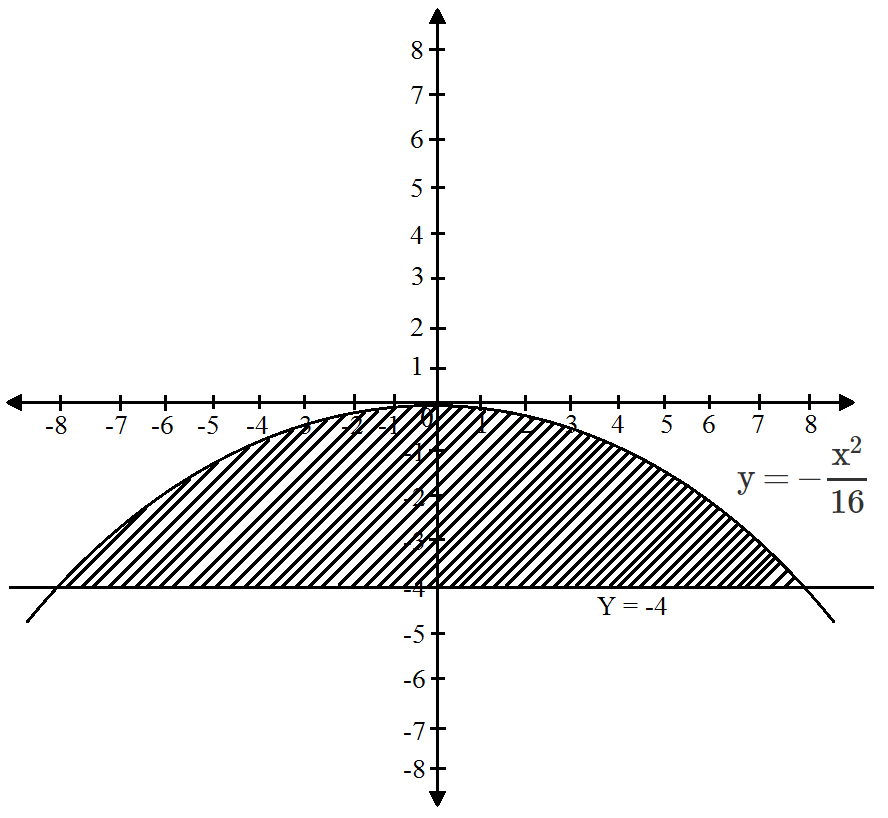
Area of the aegion $=2\times \int\limits_{0}^{8}\Big[-\frac{\text{x}^{2}}{16}-(-4)\Big]\text{dx}$
$=2\times \Big[-\frac{\text{x}^{3}}{48}+4\text{x}\Big]^{8}_{0}$
$=2\times\Big[4\text{x}-\frac{\text{x}^{3}}{48}\Big]^{8}_{0}$
$=2 \times\Big[\text{4}(8-0)-\frac{(8)^{3}-0^{3}}{48}\Big]$
$=2 \times\Big[32-\frac{512}{48}\Big]$
$=2\times\Big[32-\frac{32}{3}\Big]$
$=2\times\Big[\frac{96-32}{3}\Big]$
$=2\times \frac{64}{3}$
$=\frac{128}{3}\text{sq.}\ \text{units}$ View full question & answer→Question 905 Marks
Find the area bounded by the curve $\text{y}=\sqrt{\text{x}},$ x = 2y + 3 in the first quadrant and x-axis.
AnswerWe have $\text{y}=\sqrt{\text{x}}$ and x = 2y + 3 $\text{y}=\sqrt{{2\text{y}+3}},\text{ y}\geq0$ $\Rightarrow\ \text{y}^2=2\text{y}+3,\text{ y}\geq0$ $\Rightarrow\ \text{y}^2+2\text{y}-3=0,\text{ y}\geq0$ $\Rightarrow\ (\text{y}-3)(\text{y}+1)=0,\text{ y}\geq0$ $\Rightarrow\ \text{y}=3$ The graph of function $\text{y}=\sqrt{\text{x}}$ is part of parabola $\text{y}^2 = \text{x}$ lying above x-axis. The grapha is as shown in the following figure.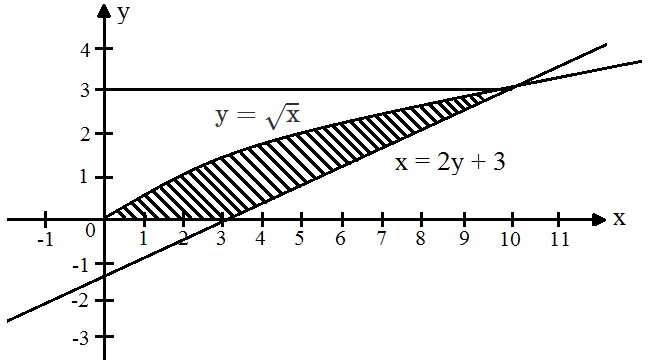 From the figure area of shaded region,
$\text{A}=\int\limits^3_0(2\text{y}+3-\text{y}^2)\text{dy}$ $=\Big[\frac{2\text{y}^2}{2}+3\text{y}-\frac{\text{y}^3}{3}\Big]^3_0=\Big[\frac{18}{2}+9-9-0\Big]$ $=9\text{ sq. units}$ View full question & answer→Question 915 Marks
Find the area of the region included between $y^2 = 9x$ and $y = x$.
AnswerWe have, $y^2 = 9x$ and $y = x$ Solving $y^2 = 9y \Rightarrow y = 0$ or $9$ When $y = 0, x = 0$ and when $y = 9, x = 9$ So, points of intersection are (0, 0) and (9, 9) Graphs of parbola $y^2 = 9x$ and $y = x$ are as shown in the following figure.
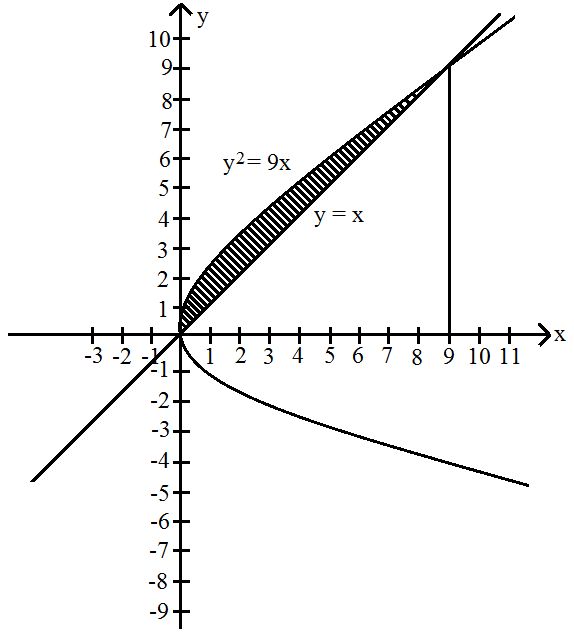
From the figure, are of shaded region $\text{A}=\int\limits^9_0\big(\sqrt{9\text{x}}-\text{x}\big)\text{dx}$
$=3\int\limits^9_0\text{x}^{\frac{1}{2}}\text{dx}-\int\limits^9_0\text{x dx}$
$=3\bigg[\frac{\text{x}^{\frac{3}{2}}}{\frac{3}{2}}\bigg]^9_0-\Big[\frac{\text{x}^2}{2}\Big]^9_0$
$=3\Big(\frac{2}{3}\cdot27-0\Big)-\Big(\frac{81}{2}-0\Big)$
$=54-\frac{81}{2}=\frac{27}{2}\text{ sq. units}$ View full question & answer→Question 925 Marks
Sketch the graph y = |x - 5|. Evaluate $\int\limits_{0}^{1}|\text{x}-5|\text{dx} $ . What does this value of the integral represent on the graph.
Answer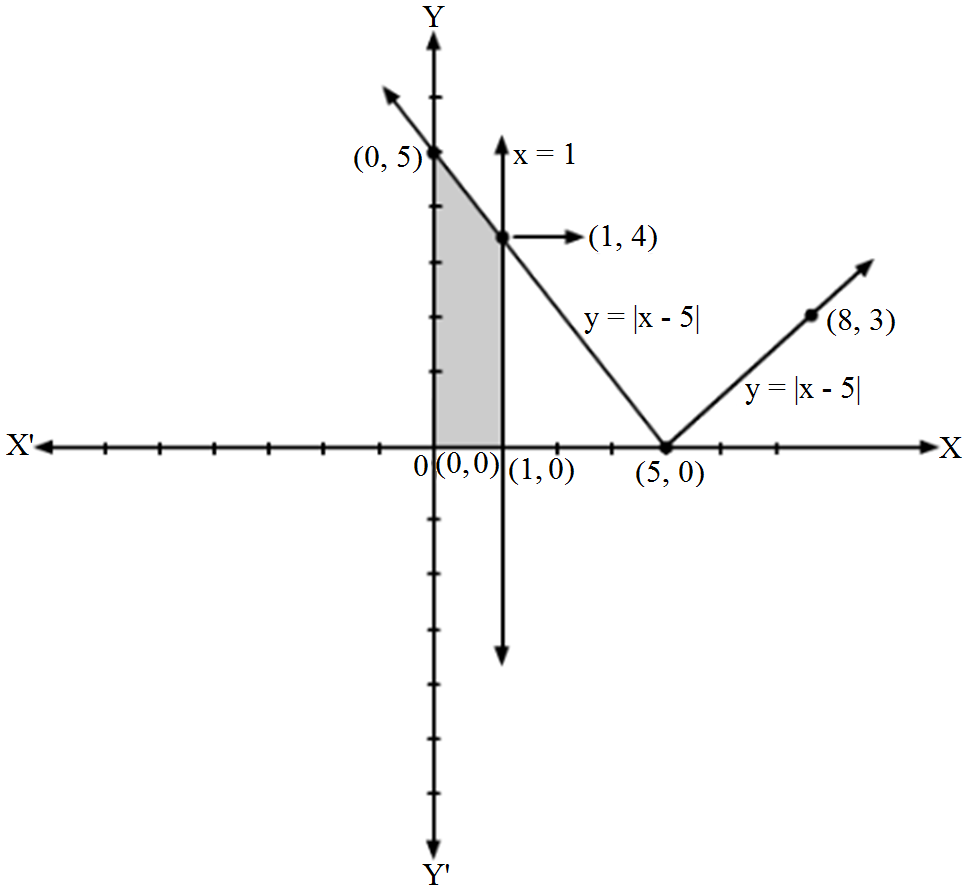 we have,
y = |x - 5| intesect x = 0 and x = 1 at (0, 5) and (1, 4)
Now,
y = |x - 5|
= -(x - 5)
integration represents the area enclosded by the graph from x = 0 to x = 1
$\text{A}=\int\limits_{0}^{1}|\text{y}|\text{dx} $
$=\int\limits_{0}^{1}|\text{x}-5|\text{dx} $
$=\int\limits_{0}^{1}-(\text{x}-5)\text{dx} $
$=-\int\limits_{0}^{1}(\text{x}-5)\text{dx} $
$=-\Big[\frac{\text{x}^{2}}{2}-5\text{x}\Big]^{1}_{0}$
$=-\Big[\Big(\frac{1}{2}-5\Big)-(0-0)\Big]$
$=-\Big(-\frac{9}{2}\Big)$
$=\frac{9}{2}\ \text{sq.}\ \text{units}$ View full question & answer→Question 935 Marks
Find the area of the region bounded by the parabola $y^2 = 2x + 1$ and the line $x - y - 1 = 0.$
Answer
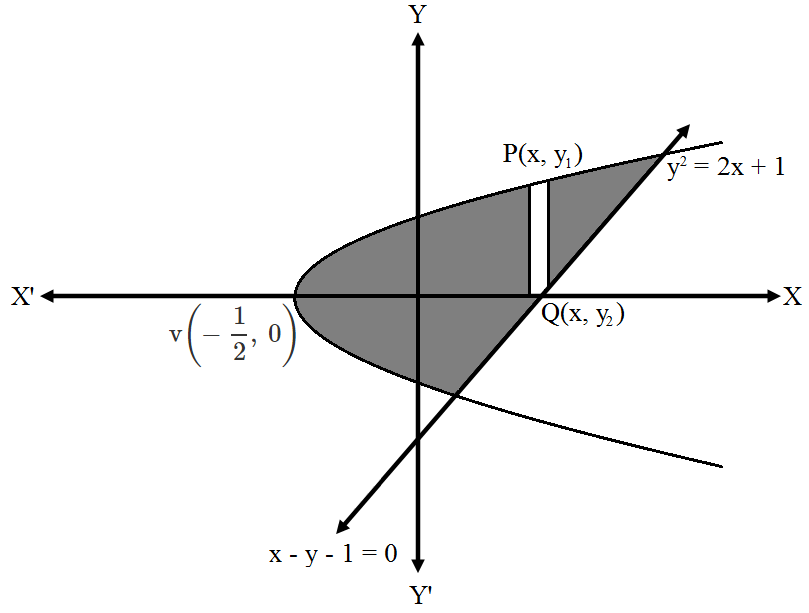
We have to find area enclosed by x-axis
$y^2 = 2x + 1$
and $x - y - 1 = 0$
To find the intersecting points of the curves, we solved both the eq.
$y^2= 2(1 + y) + 1$
$\Rightarrow y^2- 2 - 2y - 1 = 0$
$\Rightarrow y^2 - 2y - 3 = 0$
$\Rightarrow (y - 3)(y + 1) = 0$
$\Rightarrow y = 3$ or $y = -1$
$x = 4$
Consider a horizantal strip of length $\left| x _2- x _1\right|$ and width by where $Px ^2 y$ line on straigth kine and $\left( x _1, y _1\right)$ lies on the parbola.
Area of approximationg rectangle $=\left|x_2-x_1\right| d y$
Required area = area (OADO) $=\int\limits_{-1}^{3}|\text{x}_{2}-\text{x}_{1}|\text{ dy} $
$=\int\limits_{-1}^{3}\Big[({1+\text{y}})-\frac{1}{2}(\text{y}^{2}-1)\Big]\text{ dy}$
$=\int\limits_{-1}^{3}\Big[1+\text{y}-\frac{1}{2}\text{y}^{2}+\frac{1}{2}\Big]\text{ dy}$
$=\int\limits_{-1}^{3}\Big[\frac{3}{2}+\text{y}-\frac{1}{2}\text{y}^{2}\Big]\text{ dy}$
$=\Big[\frac{3}{2}\text{y}+\frac{\text{y}^{2}}{2}-\frac{1}{6}\text{y}^{3}\Big]^{-1}_{3}$
$=\Big[\frac{9}{2}+\frac{9}{2}-\frac{27}{6}\Big]-\Big[\frac{-3}{2}+\frac{1}{2}+\frac{1}{6}\Big]$
$=\Big[\frac{9}{2}\Big] +\Big[\frac{5}{6}\Big] $
$=\frac{16}{3}\ \text{sq.}\ \text{units}$ View full question & answer→Question 945 Marks
Find the area of the region $\{(\text{x},\text{y}):\text{x}^2+\text{y}^2\leq4,\text{x}+\text{y}\geq2\}$
AnswerThe equation of the given curve are,
$x^2+ y^2 = 4$ ....(i)
$x + y = 2$ .....(ii)
Clearly $x^2 + y^2= 4$ represents a circle and $x + y = 2$ is the equation of a straight line cutting x and y area at $(0, 2)$ and $(2, 0)$ respectively.
The smaller region bounded by these two curve is shaded in the following figure.
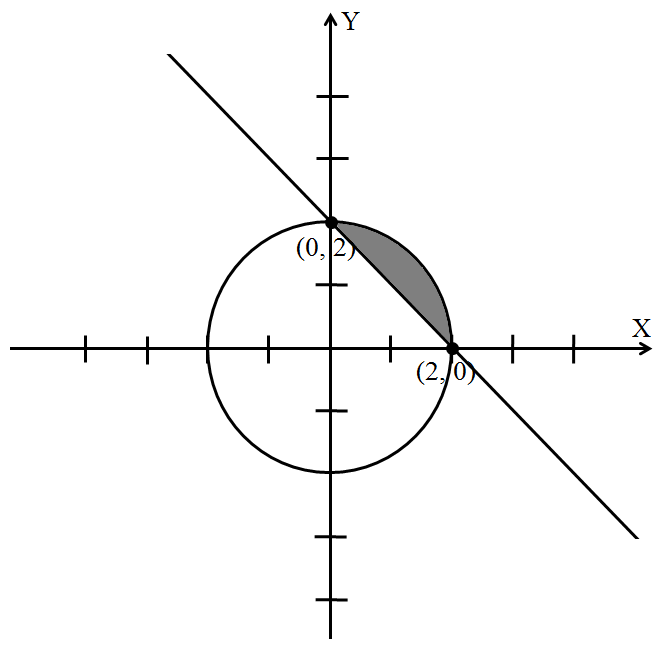
Length = $y_2 - y_1$
$\text{Width}=\triangle\text{x and}$
$=\text{Area}=(\text{y}_2-\text{y}_1)\text{dx}$
Since the appoximating rectangle can move from x = 0 to x = 2, the
required area is given by
$\text{A}=\int\limits^2_0(\text{y}_2-\text{y}_1)\text{dx}$
We have $y_1= 2 - x$ and $\text{y}_2=\sqrt{4-\text{x}^2}$
Thus,
$\text{A}=\int\limits^2_0\Big(\sqrt{4-\text{x}^2}-2+\text{x}\Big)\text{dx}$
$\Rightarrow\text{A}=\int\limits^2_0\Big(\sqrt{4-\text{x}^2}\Big)\text{dx}-2\int\limits^2_0\text{dx}+\int\limits^2_0\text{x dx}$
$\Rightarrow\text{A}=\bigg[\frac{\text{x}\sqrt{4-\text{x}^2}}{2}+\frac{\text{a}^2}{2}\sin^{-1}\Big(\frac{\text{x}}{2}\Big)\bigg]^2_0-2\big(\text{x}\big)^2_0+\Big(\frac{\text{x}^2}{2}\Big)^2_0$
$\Rightarrow\text{A}=\frac{4}{2}\sin^{-1}\Big(\frac{2}{2}\Big)-4+2$
$\Rightarrow\text{A}=2\sin^{-1}(1)-2$
$\Rightarrow\text{A}=2\times\frac{\pi}{2}-2$
$\Rightarrow\text{A}=\pi-2\text{ sq. units}$ View full question & answer→Question 955 Marks
Find the area of the region bounded by the paraola $y^2 = 4ax$ and line $x = a$.
Answer
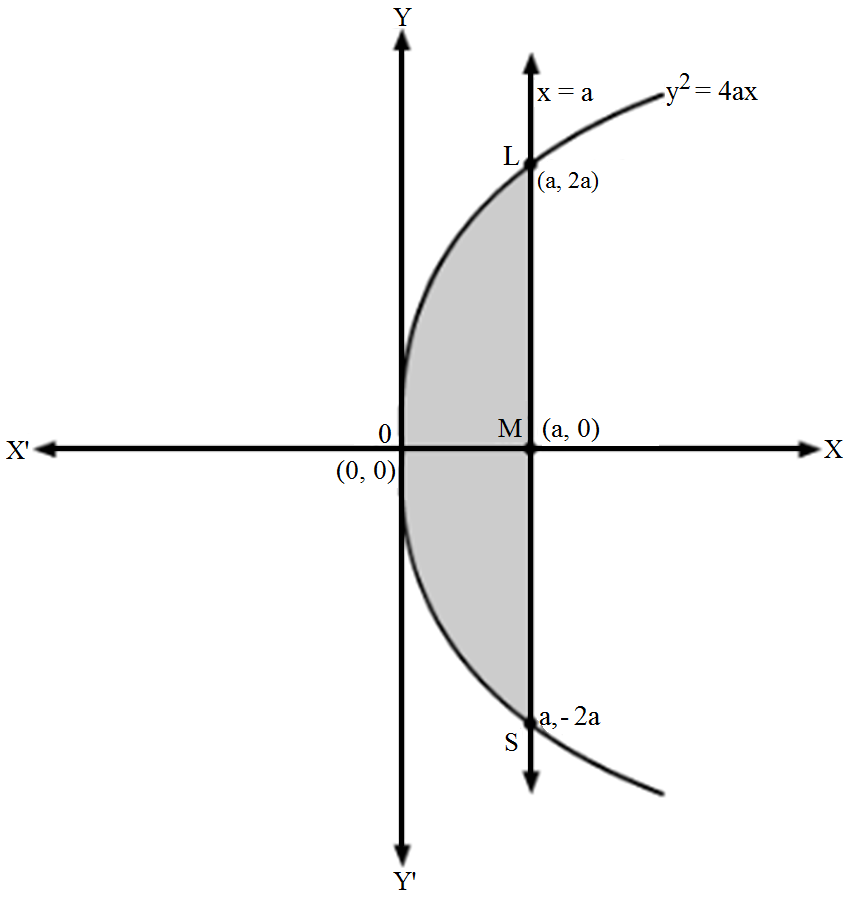
The equation $y^2= 4ax$ represents a parabola, with vertex at $\big(0, 0\big)$ and symmetric about positive side of x-axis
x = a is a line parallel to y-axis, and cutting x-axis at $\big(\text{a}, 0\big)$
Making vertical strips of length = |y| and width = dx in the quadrant OLSO. Area of approximating rectangle = |y|dx.
Since the approximating rectangle can move between x = 0 and x = a, and as the parabola is symmetric about x-axis,
Required shaded area OLSO = A = 2 × Area OLMO
$\text{A}=2\int\limits_{0}^{\text{a}}|\text{y}|\text{dx}$
$= 2\int\limits_{0}^{\text{a}}\text{y}\text{ dx}$
$\Rightarrow\text{A}=2\int\limits_{0}^{\text{a}}\sqrt{4\text{ax}}\text{ dx}$
$\Rightarrow\text{A}=4\int\limits_{0}^{\text{a}}\sqrt{\text{ax}}\text{ dx}$
$\Rightarrow\text{A}=4\sqrt{\text{a}}\int\limits_{0}^{\text{a}}\sqrt{\text{x}}\text{ dx}$
$\Rightarrow\text{A}=4\sqrt{\text{a}}\Bigg[\frac{\text{x}^\frac{3}{2}}{\frac{3}{2}}\Bigg]^{\text{a}}_{0}$
$\Rightarrow\text{A}=\frac{8}{3}\sqrt{\text{a}}\Big[\text{a}^\frac{3}{2}-0\Big]$
$\Rightarrow\text{A}=\frac{8}{3}\text{a}^{2}\ \text{sq.}\ \text{units}$ View full question & answer→Question 965 Marks
Find the area bounded by the lines y = 4x + 5, y = 5 - x and 4y = x + 5.
Answer
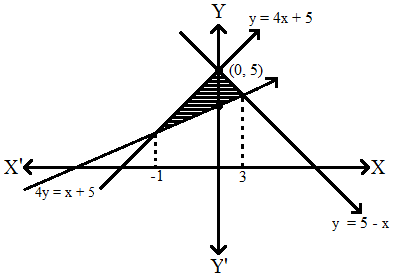 Given equations of lines are
y = 4x + 5 ...(i)
y = 5 - x ...(ii) and
4y = x + 5 ...(iii)
On solving Eqs. (i) and (ii), we get
4x + 5 = 5 - x
⇒ x = 0
On solving Eqs. (i) and (iii)
4(4x + 5) = x + 5
⇒ 16x + 20 = x + 5
⇒ 15x = -15
⇒ x = -1
On solving Eqs. (ii) and (iii), we get
4(5 - x) = x + 5
⇒ 20 - 4x = x + 5
⇒ x = 3
$\therefore$ Required area $=\int\limits^0_{-1}(4\text{x}+5)\text{dx}+\int\limits^3_0(5-\text{x})\text{dx}-\frac{1}{4}\int\limits^3_{-1}(\text{x}+5)\text{dx}$
$=\bigg[\frac{4\text{x}^2}{2}+5\text{x}\bigg]^0_{-1}+\bigg[5\text{x}-\frac{\text{x}^2}{2}\bigg]^3_0-\frac{1}{4}\bigg[\frac{\text{x}^2}{2}+5\text{x}\bigg]^3 _{-1}$
$=[0-2+5]+\Big[15-\frac{9}{2}-0\Big]-\frac{1}{4}\Big[\frac{9}{2}+15-\frac{1}{2}+5\Big]$
$=3+\frac{21}{2}-\frac{1}{4}\cdot24$
$=-3+\frac{21}{2}=\frac{15}{2}\text{ sq. units}$ View full question & answer→Question 975 Marks
Draw a rough sketch of the graph of the function $\text{y}=2\sqrt{1-\text{x}^{2}}, \text{x}\in [0, 1] $ and evaluate the area enclosed between the curve and the x-axis.
AnswerWe have to find area enclosed between the curve and x-axis,
$\text{y}=2\sqrt{1-\text{x}^{2}}, \text{x}\in [0, 1] $
$\Rightarrow \text{y}^{2}+4\text{x}^{2}=4, \text{x}\in[0, 1]$
$\Rightarrow\frac{\text{x}^{2}}{1}+\frac{\text{y}^{2}}{4}=1, \text{x}\in [0, 1]\ ...(\text{i})$
Equation (i) represents a parabola with vertex at origin and passes through $(\pm1,0)$ and $(0,\pm2)$ and $\text{x}\in[0, 1]$ as represents by region between y-axis and line x = 1.
A rough sketch of curves is as below:
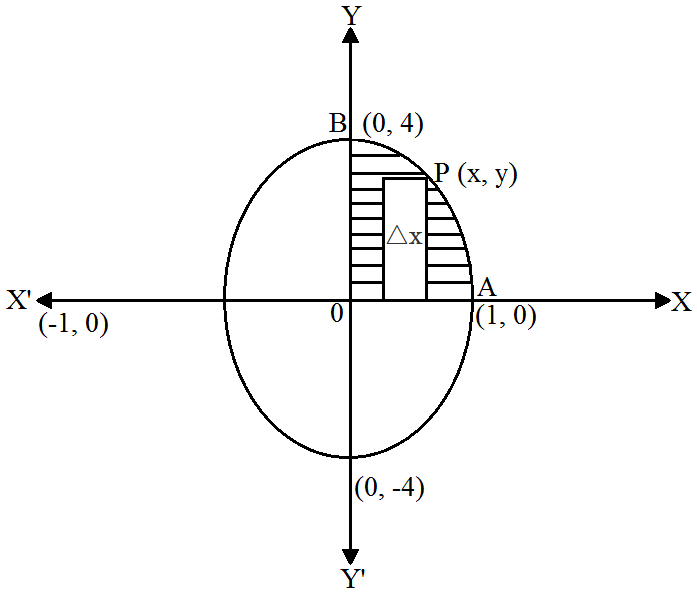
Shadod region respresents the roquired area we slice this area with approximation rectangles with width = x, length = y
Area of rectangle = x
This approximation rectangle can slide from x = 0 to x = 1, so
Required area = Region OAPBO
$=\int\limits_{0}^{1}\text{y}\text{dx} $
$=\int\limits_{0}^{1}2\sqrt{1-\text{x}^{2}}\text{dx} $
$=2\Big[\frac{\text{x}}{2}\sqrt{1-\text{x}^{2}}+\frac{1}{2}\sin^{-1}(\text{x})\Big]^{1}_{0}$
$=2\Big[\Big(\frac{\text{1}}{2}\sqrt{1-\text{1}}+\frac{1}{2}\sin^{-1}(\text{1})\Big)-(0+0)\Big]$
$=2\Big[0+\frac{1}{2}.\frac{\pi}{2}\Big]$
$\text{Required area}=\frac{\pi}{2}\ \text{sq.}\ \text{units}$ View full question & answer→Question 985 Marks
Find the area of the region bounded by the parabola $y = x^2$ and $y = |x|.$
AnswerThe given region is $\left\{(\text{x, y}):\text{x}^2\leq\text{y}\leq|\text{x}|\right\}$
This region is the intersection of the following regions
$\text{R}_1=\left\{(\text{x, y}):\text{x}^2\leq\text{y}\right\}\\\text{R}_2=\left\{(\text{x, y}):\text{y}\leq\text{|x|}\right\}$
Consider the equations
$y = x^2 ...(1)$
$y = x ...(2)$
and $y = -x ...(3)$
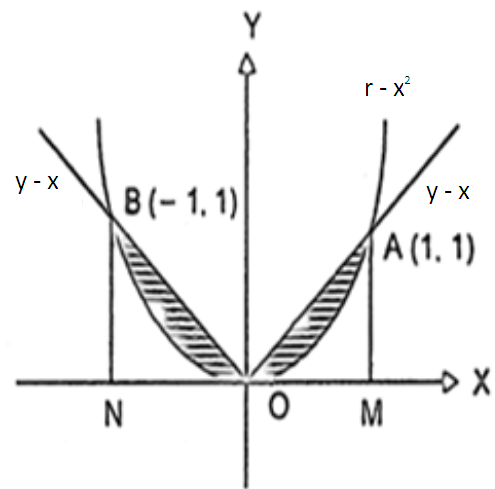
From (1) ans (2), we get,
$x = x^2$
$\Rightarrow x^2 - x = 0$
$\Rightarrow x(x - 1)$
$\Rightarrow x = 0, 1$
From $(2), y = 0, 1$
$\therefore$ curve (1) and (2) intersect in the points O(0, 0) and A(1, 1).
similarly, curve (1) and (3) intersect in the points O(0, 0) and B(-1, 1) Required area = area of shaded region = 2 (area of region OAO)
$=2\bigg[\int\limits^1_0\text{x dx}-\int\limits^1_0\text{x}^2\text{dx}\bigg]=2\left\{\Big[\frac{\text{x}^2}{2}\Big]^1_0-\Big[\frac{\text{x}^3}{3}\Big]^1_0\right\}$
$=2\left\{\Big(\frac12-0\Big)-\Big(\frac13-0\Big)\right\}$ $=2\Big(\frac12-\frac13\Big)=2\times\frac16=\frac13\text{ sq. units.}$ View full question & answer→Question 995 Marks
Sketch the region bounded by the curves $y = x^2 + 2, y = x, x = 0$ and $x = 1$. Also find the area of this region.
Answer
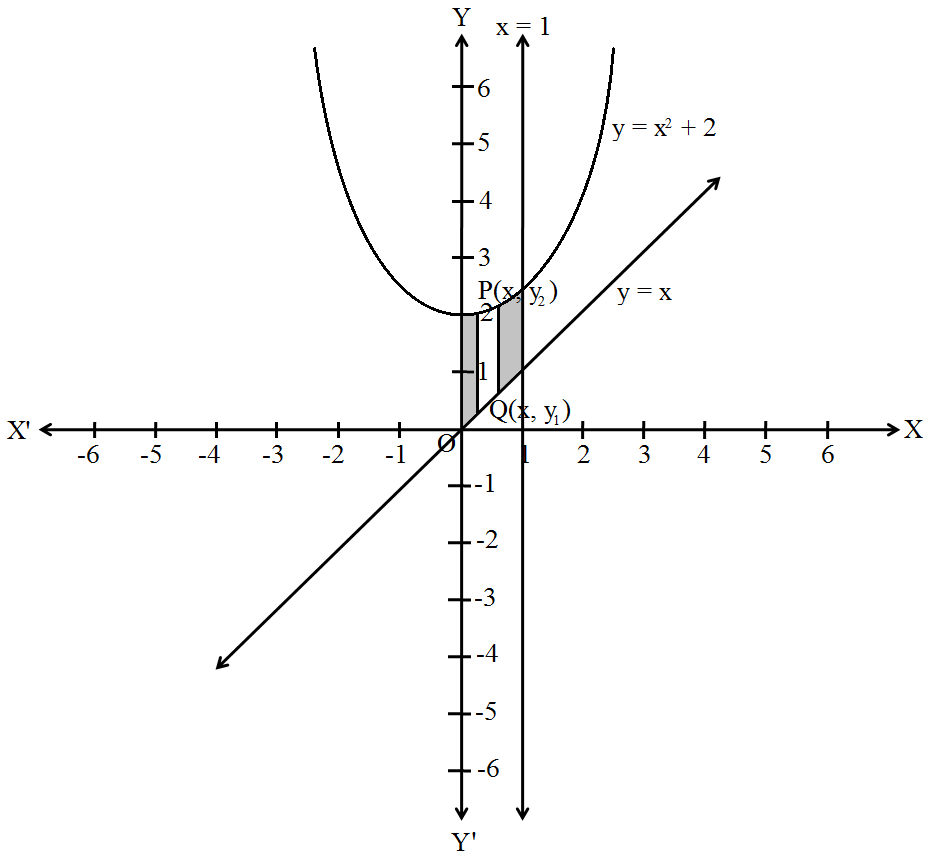
We have, $y = x^2 + 2$ and $y = 2$
We see that parabola and the line y = x do not intersect x = 1 is a line parallel to y-axis. points of between parbola and x = 1
Putting $x = 1$ in $y = x^2 + 2$, we get,
$y = 1 + 2 = 3$
Points of two lines is given by putting x = 1 in $y = x$, we get, $y = 1$
Comsider a vetical strip of length $\left|y_2-y_1\right|$ and width $=d x$, such that $P\left(x, y_2\right)$ lies on and $Q\left(x, y_1\right)$ lies on $y=x$.
Shaded area $=\int\limits_{0}^{1}|(\text{y}_{2}-\text{y}_{1})|\text{ dx} $
$=\int\limits_{0}^{1}\text{y}_{2}-\text{y}_{1}\text{ dx} $
$=\int\limits_{0}^{1}\Big[(\text{x}^{2}+2)-\text{x}\Big]\text{ dx}$
$=\int\limits_{0}^{1}\Big(\text{x}^{2}+2-\text{x}\Big)\text{ dx}$
$=\Big[\frac{\text{x}^{3}}{3}-\frac{\text{x}^{2}}{2}+2\text{x}\Big]^{1}_{0} $
$=\frac{2-3+12}{6}$
$=\frac{11}{6}\ \text{sq.}\ \text{units}$ View full question & answer→Question 1005 Marks
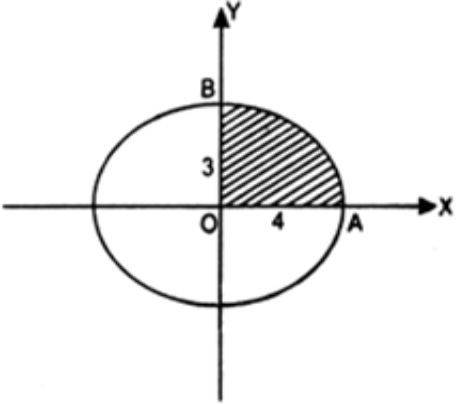
Find the area of the region bounded by the ellipse $\frac{\text{x}^2}{16}+\frac{\text{y}^2}{9}=1.$
AnswerThe equation of ellipse is
$\frac{\text{x}^2}{16}+\frac{\text{y}^2}{9}=1$
$\text{or }\ \ \frac{\text{y}^2}{9}=1-\frac{\text{x}^2}{16}$
$\text{or }\ \ \text{y}^2=\frac{9}{16}(16-\text{x}^2)$
$\therefore\ \ \text{y}=\frac34\sqrt{16-\text{x}^2}...(1)$
(in the first quadrant)
The ellipse is symmetrical about both the axes.
$\therefore$ required area = 4 (area AOB)
$=4\int\limits^4_0\text{y dx}=4\int\limits^4_0\frac34\sqrt{16-\text{x}^2}\text{dx}\ \ \ \ \ [\therefore\text{of (1)}]$
$=3\int\limits^4_0\sqrt{(4)^2-\text{x}^2}\text{dx}=3\Bigg[\frac{\text{x}\sqrt{16-\text{x}^2}}{2}+\frac{(4)^2}{2}\sin^{-1}\bigg(\frac{\text{x}}{4}\bigg)\Bigg]^4_0$
$=3\Bigg[\left\{\frac{4\sqrt{16-16}}{2}+8\sin^{-1}(1)\right\}-\left\{0+8\sin^{-1}0\right\}\Bigg]$
$=3\bigg[\Big(0+8\times\frac{\pi}{2}\Big)-(0+8\times0)\bigg]=3\times8\times\frac{\pi}{2}=12\ \pi\text{ sq. units.}$
View full question & answer→