Question 1015 Marks
Find the area bounded by the parabola $y^2 = 4x$ and the line $y = 2x - 4$:
By using horizontal strips.
Answer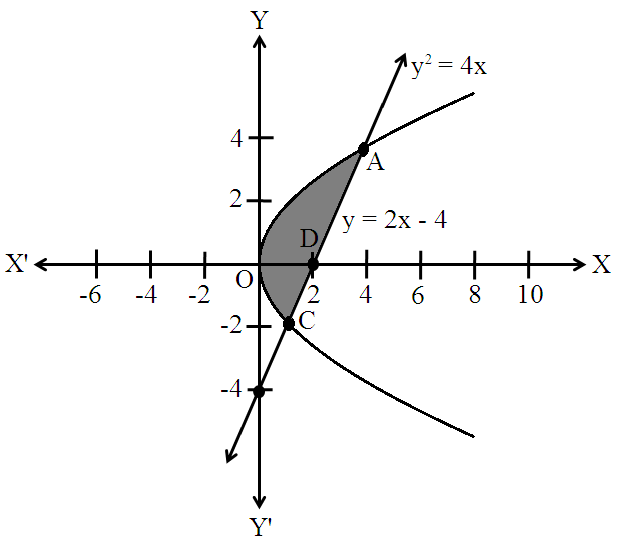
To find the points of intersection between the parabola and the line let us substitute $y = 2x - 4$ in $y^2 = 4x$
$(2x - 4)^2 = 4x$
$\Rightarrow 4x^2+ 16 - 16x = 4x$
$\Rightarrow 4x^2- 20x + 16 = 0$
$\Rightarrow x^2 - 5x + 4 = 0$
$\Rightarrow (x - 1)(x - 4) = 0$
$\Rightarrow x = 1, 4$
$\Rightarrow y = -2, 4$
Therefore, the points of intersection are C(1, -2) and A(4, 4)
Using Horizontal strips:
The area of the required region ABCD
$\text{A}=\int\limits^4_{-2}(\text{x}_1-\text{x}_2)\text{dy}$ $\Big(\text{where, x}_1=\frac{\text{y}+4}{2}\text{ and x}_2=\frac{\text{y}_2}{4}\Big)$
$=\int\limits^4_{-2}\Big[\Big(\frac{\text{y}+4}{2}\Big)-\Big(\frac{\text{y}^2}{4}\Big)\Big]\text{dy}$
$=\Big[\frac{\text{y}^2}{4}+2\text{y}-\frac{\text{y}^3}{12}\Big]^4_{-2}$
$=\Big(\frac{\text{4}^2}{4}+2\times4-\frac{\text{4}^3}{12}\Big)-\bigg[\frac{(-2)^3}{4}+2(-2)-\frac{(-2)^3}{12}\bigg]$
$=\Big(4+8-\frac{16}{3}\Big)-\Big[1-4+\frac{2}{3}\Big]$
$=12-\frac{16}{3}+3-\frac{2}{3}$
$=15-\frac{18}{3}$
$=15-6$
$=9\text{ sq. units}$ View full question & answer→Question 1025 Marks
Find the area of the ragion in the first quadrant bounded by the parabola $y = 4x^2$ and the lines $x = 0, y = 1$ and $y = 4$.
Answer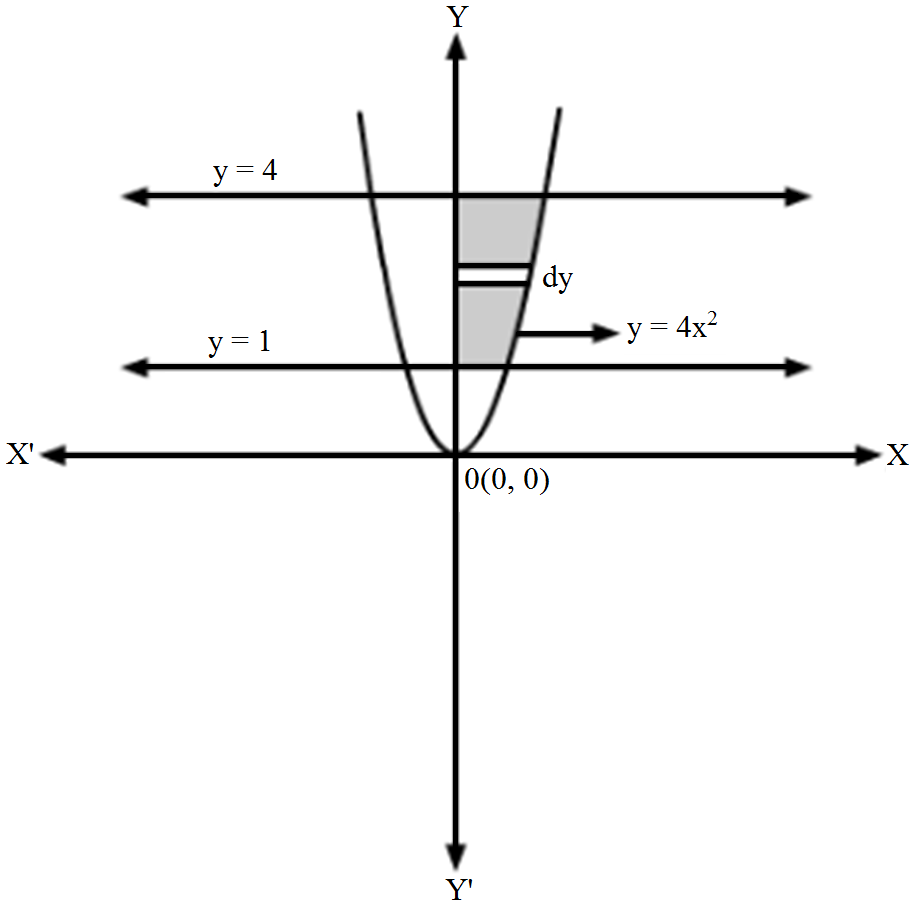
$y = 4x^2$ a parabola, openeing upward, symmctrical about +ve y-axis and having
y = 1 is a line parallel to x-acis, cutting parabola at $\Big(-\frac{1}{2}, 1\Big)$ and $\Big(\frac{1}{2}, 1\Big)$
y = 4 is a line parllel to x-axis, cutting parabola at $(-1, 1)$ and $(1, 1)$
x = 0 is the y-axis
Consider a horizontal rectangle = |x| dy
Area of approxinating rectanglr moves from y = 1 to y = 4
Area of the shaded in he first enclsoed y = 1 and y = 4 is the area of the shaded region.
$\therefore$ Area of the curve in the first region $=\int\limits_{1}^{4}|\text{x}|\text{dy} $
$\Rightarrow\text{A}=\int\limits_{1}^{4}\text{x}\text{dy} $
$\Rightarrow\text{A}=\int\limits_{1}^{4}\sqrt{\frac{\text{y}}{4}}\text{dy}$
$\Rightarrow\text{A}=\frac{1}{2}\int\limits_{1}^{4}\sqrt{\text{y}}\ \text{dy}$
$\Rightarrow\text{A}=\frac{1}{2}\Bigg[ \frac{\text{y}^\frac{3}{2}}{\frac{3}{2}}\Bigg]^{4}_{1}$
$\Rightarrow\text{A}=\frac{1}{2}\times\frac{2}{3}\Big[4^\frac{3}{2}-1^\frac{3}{2}\Big]$
$\Rightarrow\text{A}=\frac{1}{3}[8-1]$
$\Rightarrow\text{A}=\frac{7}{3}\ \text{sq.}\ \text{units}$ View full question & answer→Question 1035 Marks
Find the area bounded by the parabola $x = 8 + 2y - y^2$, the y-axis and the line $y = -1$ and $y = 3$
Answer
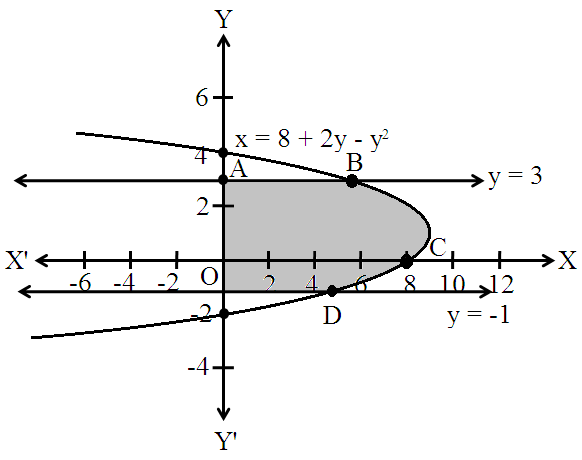
The parabola cuts y-axis at (0, 4) and (0, -2)
Alos, the points of intersection of the parabola and the lines
y = 3 and y = -1 are B(5, 3) and D(5, -1) respectively.
Therefore, the area of the required ABCDEA
$\text{A}=\int\limits^3_1\text{x dy}$
$=\int\limits^{3}_1(8+2\text{y}-\text{y}^2)\text{dy}$
$=\Big[8\text{y}+\text{y}^2-\frac{\text{y}^3}{3}\Big]^3_{-1}$
$=\bigg\{8(3)+(3)^2-\frac{(3)^3}{3}\bigg\}-\bigg\{8(-1)+(-1)^2-\frac{(-1)^3}{3}\bigg\}$
$=\big\{24+9-9\big\}-\Big\{-8+1+\frac{1}{3}\Big\}$
$=(24)-\Big\{-7+\frac{1}{3}\Big\}$
$=24+7-\frac{1}{3}$
$=31-\frac{1}{3}$
$=\frac{92}{3}\text{ sq. units}$ View full question & answer→Question 1045 Marks
Find the area bounded by the curve y = sin x between x = 0 and x = 2n.
AnswerThe graph of y = sin x can be drawn as
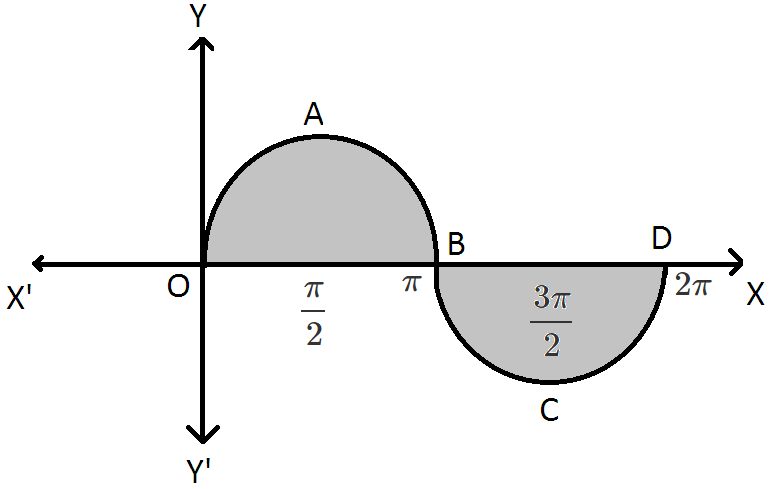
$\therefore$ Required area = Area OABO + Area BCDB
$=\int\limits^{\pi}_{0}\sin\text{x dx}+\Bigg|\int\limits^{2\pi}_{\pi}\sin\text{x dx}\Bigg|$
$=\Big[-\cos\text{x}\Big]^{\pi}_0+\Bigg|\Big[-\cos\text{x}\Big]^{2\pi}_\pi\Bigg|$
$=\Big[-\cos\pi+\cos0\Big]+\Big|-\cos2\pi+\cos\pi\Big|$
$=1+1+\Big|(-1-1)\Big|$
$=2+|-2|$
$=2+2=4\text{ units}$ View full question & answer→Question 1055 Marks
Find the area common to the circle $x^2 - y^2 = 16 a^2$ and the parabola $y^2 = 6x$.
Answer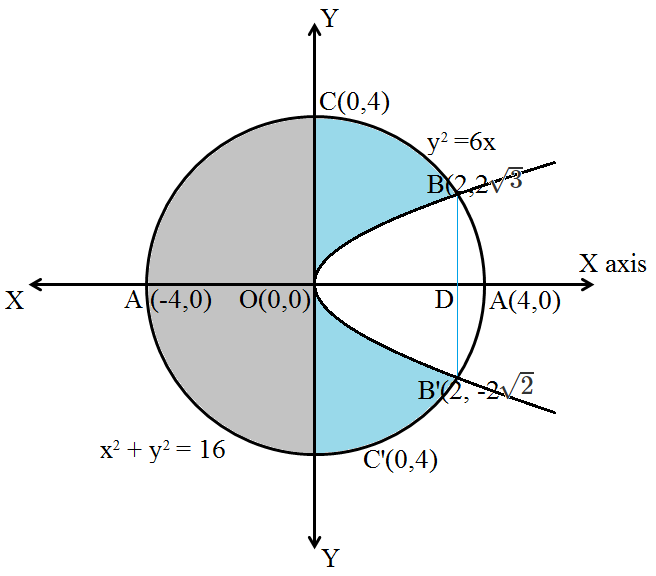
points of intersection of the and the circle is by solving the slimultineous eq.
$x^2 + y^2 = 16a^2$ and $y^2 = 6ax$
$\Rightarrow x^2 + 6ax = 16a^2$
$\Rightarrow x^2 + 6ax - 16a^2 = 0$
$\Rightarrow (x + 8a)(x - 2a) = 0$
$\Rightarrow x = 2a$ or $x = -8a,$
When $x = 2a$,
$\text{y}=\pm\sqrt{6\text{a}}\times2\text{a}=\pm\sqrt{12\text{a}}$
$=\pm2\sqrt{3}\text{a}$
Now, Requrided area = area (OBABO)
$=2\times\Bigg[\int\limits_{0}^{2\text{a}}\sqrt{6}\text{ax} \text{dx}+\int\limits_{2\text{a}}^{4\text{b}}\sqrt{16\text{a}^{2}-\text{x}^{2}\text{dx}}\Bigg] $
$=2\times\left\{\Bigg[\sqrt{6\text{a}\frac{\text{x}^\frac{3}{2}}{\frac{3}{2}}}\Bigg]^{2\text{a}}_{0}+\big[\frac{1}{2}\text{x}\sqrt{16\text{a}^{2}-\text{x}^{2}}+\frac{1}{2}\times16\text{a}^{2}\sin^{-1}\Big(\frac{\text{x}}{4\text{a}}\Big)\Big]^{4\text{a}}_{2\text{a}}\right\}$
$=2\times\left\{\big(\sqrt{6\text{a}}\times\frac{2}{3}\times(2\text{a}^\frac{3}{2}-0\big)+\big(\frac{1}{2}\times4\text{a}\sqrt{16\text{a}^{2}-\text{a}^{2}}+\frac{1}{2}\times16\text{a}^{2}\sin^{-1}\frac{4\text{a}}{4\text{a}}\Big)\right\}$
$=2\times\Big[\frac{8\text{a}^{2}\sqrt{3}}{3}+8\text{a}^{2}\times\frac{\pi}{2}-2\sqrt{3\text{a}^{2}}-8\text{a}^{2}\frac{\pi}{2}\Big]$
$=2\times\Big[\Big(\frac{8\text{a}^{2}\sqrt{3}-6\sqrt{3}}{3}\Big)\text{a}^{2}+8\Big(\frac{\pi}{2}-\frac{\pi}{6}\Big)\text{a}^{2}\Big]$
$=2\Big[\frac{2\sqrt{3}}{3}\text{a}^{2}+8\text{a}^{2}\Big(\frac{2\pi}{6}\Big)\Big]$
$=\frac{4\text{a}^{2}}{3}\Big(4\pi+\sqrt{3}\Big)$ View full question & answer→Question 1065 Marks
Compare the area under the curve $\text{y}=\cos^2\text{x}\text{ and }\text{y}=\sin^2\text{x}$ between x = 0 and $\text{x}=\pi.$
Answer
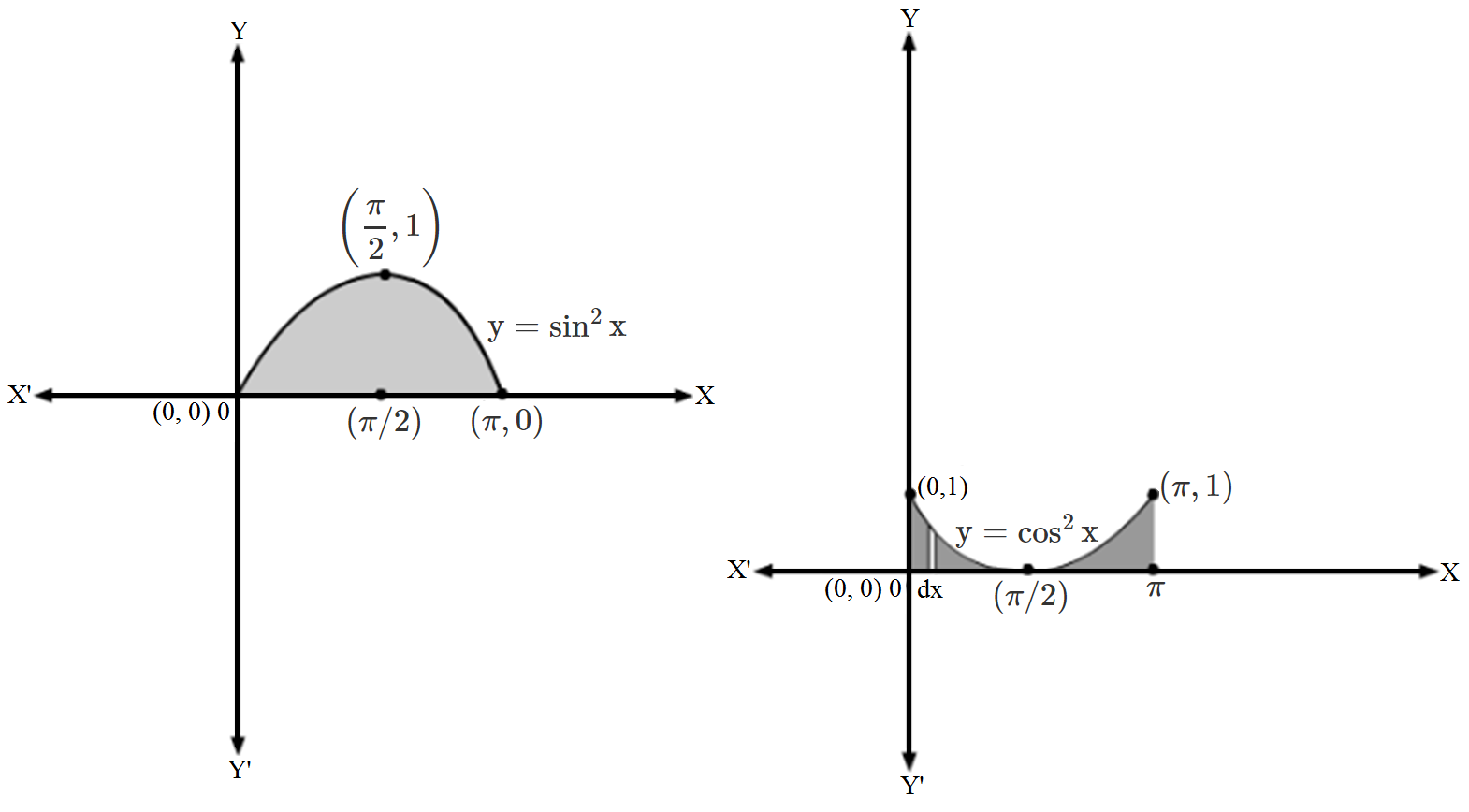
Consider the value of y for different values of x
| $\text{x}$ |
$0$ |
$\frac{\pi}{4}$ |
$\frac{\pi}{3}$ |
$\frac{\pi}{2}$ |
$\frac{2\pi}{3}$ |
$\frac{5\pi}{6}$ |
$\pi$ |
| $\text{y}=\cos^2\text{x}$ |
$1$ |
$0.5$ |
$ 0.25$ |
$0$ |
$ 0.25$ |
$ 0.75$ |
$1$ |
| $\text{y}=\sin^2\text{x}$ |
$0$ |
$0.5$ |
$ 0.75$ |
$1$ |
$ 0.75$ |
$0.25$ |
$0$ |
Let $A_1$ be the area of curve $\text{y}=\cos^2\text{x}$ between x = 0 and $\text{x}=\pi$
Let $A_2$ be the area of curve $\text{y}=\sin^2\text{x}$ between x = 0 and $\text{x}=\pi$
Consider, a vertical strip of lenght = |y| and width = $\text{dx}$ in the shaded region of both the curves The area of approximating $=|\text{y}|\text{dx}$
The approximating rectangle moves from x = 0 to $\text{x}=\pi$
$\text{A}_1=\int\limits^\pi_0\text{|y| dx}$
$[0\leq\text{x}\leq\pi,\text{ y}>0\Rightarrow|\text{y}|=\text{y}]$
$\Rightarrow\text{A}_1=\int\limits^\pi_0\cos^2\text{x dx}$
$\Rightarrow\text{A}_1=\int\limits^\pi_0\text{y dx}$
$\Rightarrow\text{A}_1=\int\limits^\pi_0(1+\cos2\text{x})\text{dx}$
$\Rightarrow\text{A}_1=\frac{1}{2}\big[\text{x}+\frac{\sin2\text{x}}{2}\big]^\pi_0$
$\Rightarrow\text{A}_1=\frac{1}{2}\big[\text{x}+\frac{\sin2\text{x}}{2}-0\big]$
$\Rightarrow\text{A}_1=\frac{\pi}{2}\text{sq. units}$
Also,
$\text{A}_2=\int\limits^\pi_0\text{|y| dx}$
$\Rightarrow\text{A}_2=\int\limits^\pi_0\text{y dx}$
$\Rightarrow\text{A}_2=\int\limits^\pi_0\sin^2\text{x dx}$
$\Rightarrow\text{A}_2=\bigg[\frac{x}{2}-\frac{1}{2}\frac{\sin2\text{}x}{2}\bigg]^\pi_0$
$\Rightarrow\text{A}_2=\frac{x}{2}-\bigg(\frac{1}{2}\frac{\sin2\pi}{2}\bigg)$
$\Rightarrow\text{A}_2=\frac{\pi}{2}\text{sq. units}$
$\therefore$ Area of curves $\text{y}=\cos^2\text{x}$ and area of curve $\text{y}=\sin^2\text{x}$ are both equal to $\frac{\pi}{2}\text{sq. units}$ View full question & answer→Question 1075 Marks
Find the area of the region between the parabola $x = 4y - y^2$ and the line $x = 2y - 3$
Answer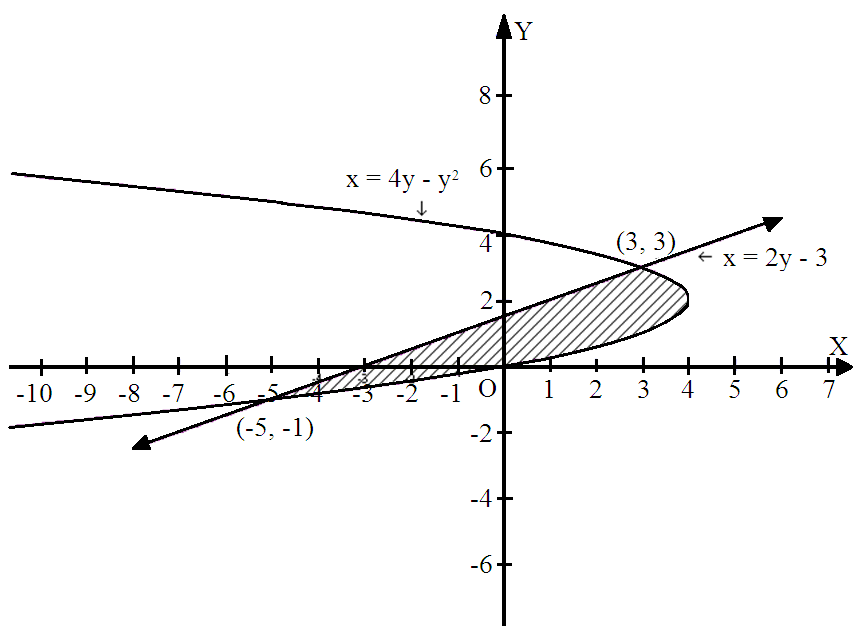
Area of the bounded region,
$=\int\limits^3_1(4\text{y}-\text{y}^2-2\text{y}+3)\text{dy}$
$=\Big[2\frac{\text{y}^2}{2}-\frac{\text{y}^3}{3}+3\text{y}\Big]^3_{-1}$
$=9-9+9-1-\frac{1}{3}+3-\frac{(16\text{a})^3}{48\text{a}}$
$=\frac{32}{3}\text{ sq. units}$ View full question & answer→Question 1085 Marks
Find the area of the region bounded by $\text{y}=\sqrt{\text{x}}$ and $y = x$.
AnswerWe have to find area of region bounded by
$y^2 = x$ ...(i)
and $y = x$ ...(ii)
Equation (i) represents a parabola with vertex (0, 0) at origin and axis as x-axis and equation (ii) represents a line parallel (0, 0) to and (1, 1)
A rough sketch of the equations is as below:
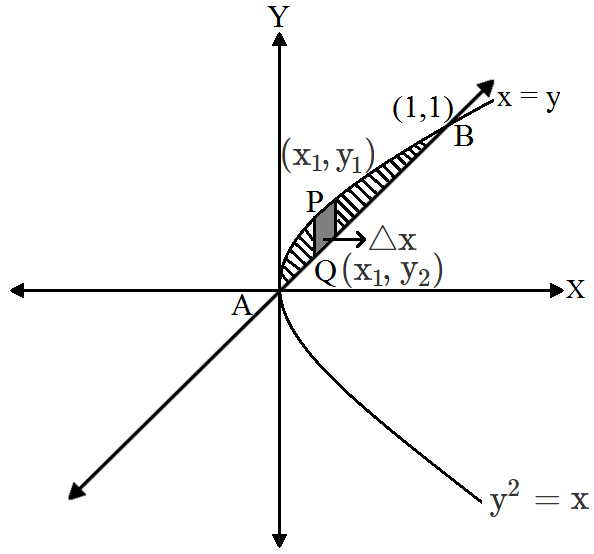
Shaded region reprsents the area. we slice it in rectangle with width = x length = $y_1 - y_2$
The appromation triangle can slide from x = 0 to x = 1
Reqired area = Region AOBPA
$=\int\limits_{0}^{1}(\text{y}_{1}-\text{y}_{2})\text{dx}$
$=\int\limits_{0}^{1}(\sqrt{\text{x}}-\text{x})\text{dx}$
$=\Big[\frac{2}{3}\times\sqrt{\text{x}}-\frac{\text{x}^{2}}{2}\Big]^{1}_{0}$
$=\Big[\frac{2}{3}.1\sqrt{\text{1}}-\frac{\text{(1)}^{2}}{2}\Big]-[0]$
$=\big[\frac{2}{3}-\frac{1}{2}\big]$
$=\frac{1}{6}\ \text{sq.}\ \text{units}$ View full question & answer→Question 1095 Marks
Find the area of the smaller part of the circle $x^2 + y^2 = a^2$ cut off by the line $\text{x}=\frac{\text{a}}{\sqrt2}.$
Answer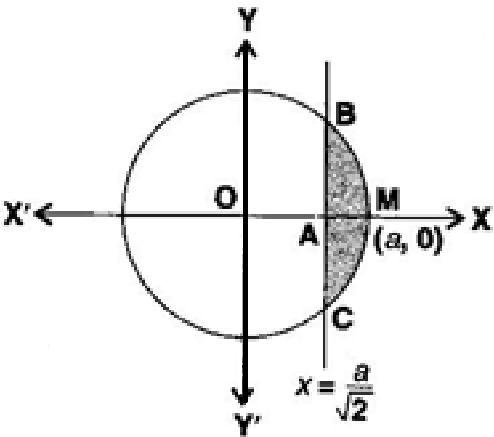
Equation of the circle is $x^2 + y^2 = a^2$ ...(i)
$\therefore y^2 = a^2 - x^2$
$\Rightarrow\text{y}=\sqrt{\text{a}^2-\text{x}^2}\dots(\text{ii})$
Here Area of smaller part of the circle $x^2 + y^2 = a^2$ cut off by the line $\text{x}=\frac{\text{a}}{\sqrt2}$ = Area of ABMC = $2 \times$ Area of ABM
$=2\begin{vmatrix}\int\limits^\text{a}_{\frac{\text{a}}{\sqrt2}}\text{y dx} \end{vmatrix}=2\begin{vmatrix}\int\limits^\text{a}_{\frac{\text{a}}{\sqrt2}}\sqrt{\text{a}^2-\text{x}^2}\text{dx} \end{vmatrix}$
$[\text{From eq.(ii)}]$
$=2\bigg[\frac{\text{x}}{2}\sqrt{\text{a}^2-\text{x}^2}+\frac{\text{a}^2}{2}\sin^{-1}\frac{\text{x}}{\text{a}}\bigg]^{\text{a}}_{\frac{\text{a}}{\sqrt2}}$
$=2\Bigg[\frac{\text{a}}{2}\sqrt{\text{a}^2-\text{a}^2}+\frac{\text{a}^2}{2}\sin^{-1}1-\Bigg(\frac{\frac{\text{a}}{\sqrt2}}{2}\sqrt{\text{a}^2-\frac{\text{a}^2}{2}}+\frac{\text{a}^2}{2}\sin^{-1}\frac{\frac{\text{a}}{\sqrt2}}{\text{a}}\Bigg)\Bigg]$
$=2\bigg[0+\frac{\text{a}^2}{2}\cdot\frac{\pi}{2}-\frac{\text{a}}{2\sqrt2}\sqrt{\frac{\text{a}^2}{2}}-\frac{\text{a}^2}{2}\sin^{-1}\frac{1}{\sqrt2}\bigg]$
$=2\bigg[\frac{\pi\text{a}^2}{4}-\frac{\text{a}}{2\sqrt2}\frac{\text{a}}{\sqrt2}-\frac{\text{a}^2}{2}\frac{\pi}{4}\bigg]$
$=2\bigg[\frac{\pi\text{a}^2}{4}-\frac{\pi\text{a}^2}{8}-\frac{\text{a}^2}{4}\bigg]$
$=2\text{a}^2\bigg[\frac{\pi}{4}-\frac{\pi}{8}-\frac{1}{4}\bigg]=2\text{a}^2\bigg[\frac{2\pi-\pi-2}{8}\bigg]$
$=\frac{\text{a}^2}{4}(\pi-2)=\frac{\text{a}^2}{4}\Big(\frac{\pi}{2}-1\Big)\text{sq. units}$ View full question & answer→Question 1105 Marks
Find the area enclosed by the curve $3x^2 + 5y = 32$ and $y = |x - 2|$
AnswerTo find area endosed by
$3x^2 + 5y = 32$
$3\text{x}^2=-5\Big(\text{y}-\frac{32}{5}\Big)\ ....(\text{i})$
And $\text{y}=|\text{x}-2|$
$\Rightarrow\text{y}=\begin{cases}-(\text{x}-2),&\text{ if x}-2<1\$\text{x}-2),&\text{if x }-2\geq1\end{cases}$
$\Rightarrow\text{y}=\begin{cases}2-\text{x},&\text{ if x}<2\\\text{x}-2,&\text{if x }\geq2\end{cases}\ ....(\text{ii})$
Equation (i) represents a downward parabola with vertex $\Big(0,\frac{32}{5}\Big)$ and equation (ii) represents lines. A rough sketch of curves is given as,
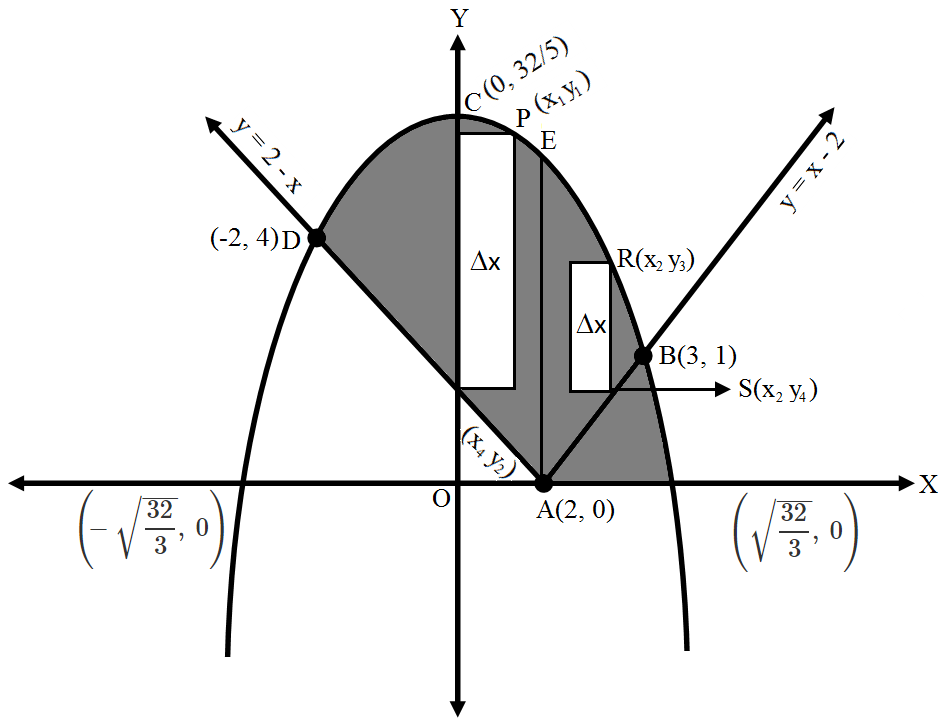
Required area = Region ABECDA
A = Region ABEA + Region AECDA
$=\int\limits^3_2(\text{y}_3-\text{y}_4)\text{dx}+\int\limits^2_{-2}(\text{y}_1-\text{y}_2)\text{dx}$
$=\int\limits^3_2\Big(\frac{32-3\text{x}^2}{5}-\text{x}+2\Big)\text{dx}+\int\limits^2_{-2}\Big(\frac{32-3\text{x}^2}{5}-2+\text{x}\Big)\text{dx}$
$=\int\limits^3_2\Big(\frac{32-3\text{x}^2-5\text{x}+10}{5}\Big)\text{dx}+\int\limits^2_{-2}\Big(\frac{32-3\text{x}^2-10+5\text{x}}{5}\Big)\text{dx}$
$=\frac{1}{5}\Bigg[\int\limits^3_2\big(42-3\text{x}^2-5\text{x}\big)+\int\limits^2_{-2}\big(22-3\text{x}^2+5\text{x})\text{dx}\Bigg]$
$\text{A}=\frac{1}{5}\Bigg[\Big(42\text{x}-\text{x}^3-\frac{5\text{x}^2}{2}\Big)^3_2+\Big(22\text{x}-\text{x}^3+\frac{5\text{x}^2}{2}\Big)^2_{-2}\Bigg]$
$=\frac{1}{5}\Bigg[\bigg\{\Big(126-27-\frac{45}{2}\Big)-\big(84-8+10\big)\bigg\}\\+\Big\{\big(44-\text{8}+10\big)-\big(-44+8+10\big)\Big\}\Bigg]$
$=\frac{1}{5}\bigg[\Big\{\frac{153}{2}-66\Big\}+\big\{46+26\big\}\bigg]$
$=\frac{1}{5}\Big[\frac{21}{2}+72\Big]$
$\text{A}=\frac{33}{2}\text{ sq. units}$ View full question & answer→Question 1115 Marks
Find tha area bounded by the curves $x = y^2$ and $x = 3 - 2y^2$.
AnswerTo find area bounded by
$x = y^2$ ...(i)
and $x = 3 - 2y^2$
$2y^2= -(x - 3)$ ...(ii)
Equation (i) represents a parabola with vertex (0, 0) at origin and axis as x-axis and equation (ii) represents a line vertex (3, 0) parallel to y-axis.
A rough sketch of the equations is as below:
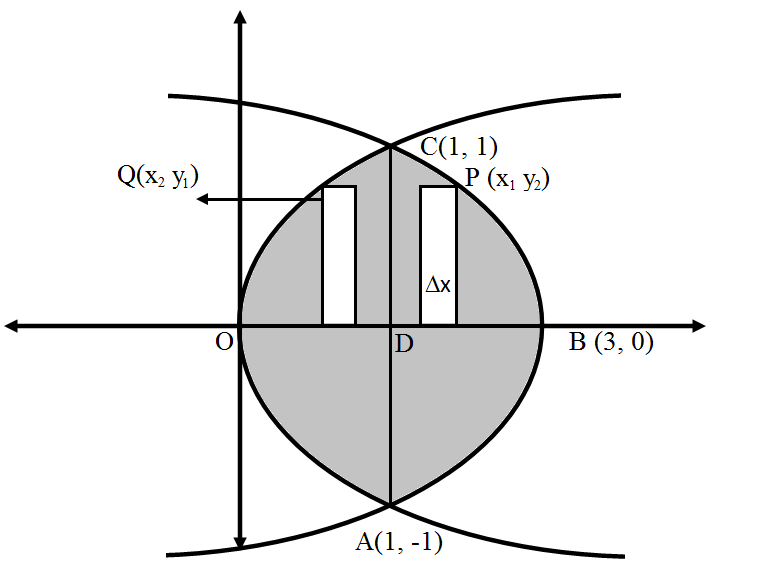
Requried area = Region OABCO
$=2\Big[\int\limits_{0}^{1}\text{y}_{1}\text{ dx}+\int\limits_{1}^{3}\text{y}_{2}\text{ dx}\Big]$
$=2\bigg[\int\limits_{0}^{1}\sqrt{\text{x}}\text{ dx}+\int\limits_{1}^{3}\sqrt{\frac{3-\text{x}}{2}}\text{ dx}\bigg]$
$=2\Big[\frac{2}{3}\text{x}\sqrt{\text{x}}\Big]^{1}_{0}+\Big[\frac{2}{3}.\Big(\frac{3-\text{x}}{2}\Big)\sqrt{\frac{3-\text{x}}{2}}(-2)\Big]^{3}_{1} $
$=2\Big[\big(\frac{2}{3}-0\big)+(0)-\frac{2}{3}.1.1.(-2)\Big]$
$=2[\frac{2}{3}+\frac{4}{3}]$
$\text{A}=4\ \text{sq.}\ \text{units}$ View full question & answer→Question 1125 Marks
Make a sketch of the recion ${(x, y) : 0 < y < x^2 + 3 : 0 < y < 2x + 3 : 0 < x < 3}$ and find using interation.
Answer
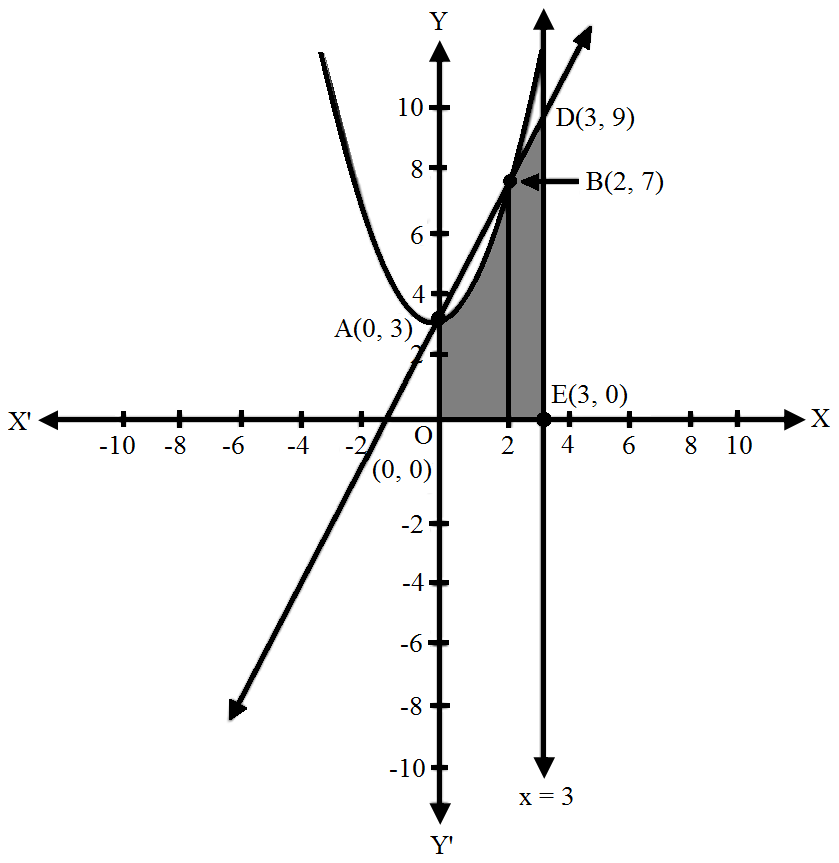
$R = {(x, y) : 0 < y < x^2 + 3, 0 < y < 2x + 3 : 0 < x < 3}$
$R_1 = {(x, y) : 0 < y < x^2 + 3}$
$R_2 = {(x, y) : 0 < y < 2x + 3}$
$R_3= {(x, y) : 0 < x < 3}$
$y = x^2 + 3$ is a upward opening parbola with vertex $A(0, 3).$
Thus $R_1$ is the region above x-axis and below the parbola $y = 2x + 3$ is a straight line passing through A(0, 3) and cuts y-axis on $(-3, 0).$
Hence $R_3$ is the linr parbola to y-axis, cutting x-axis line $x = 3.$
Point of the parbola and $y = 2x + 3$ is given by the two equation
$y = x^2 + 3$
$y = 2x + 3$
$\Rightarrow x^2 + 3 = 2x + 3$
$\Rightarrow x^2 - 2x = 0$
$\Rightarrow x(x - 2) = 0$
$\Rightarrow x = 0$ or $x = 2$
$\Rightarrow y = 3$ or $y = 7$
$\Rightarrow A(0, 3)$ and $B(2, 7)$ are points of intersection
Also, $x = 3$ cuts the parbola at $C(3, 12)$
and $x = 3$ cuts $y = 2x + 3$ at $D(3, 9)$
We requrid thearea of shaded region.
Total shaded area $=\int\limits_{0}^{2}(\text{x}^{2}+3)\text{ dx}+\int\limits_{2}^{3}(2\text{x}+3)\ \text{dx} $
$=\Big[\frac{\text{x}^{3}}{3}+3\text{x}\Big]^{2}_{0}+\Big[\text{x}^{2}+3\text{x}\Big]^{2}_{3}$
$=\Big[\frac{8}{3}+6\Big]+\Big[9+9-4-6\Big]$
$=\frac{8+42}{3}$
$=\frac{50}{3}\ \text{sq.}\ \text{units}$ View full question & answer→Question 1135 Marks
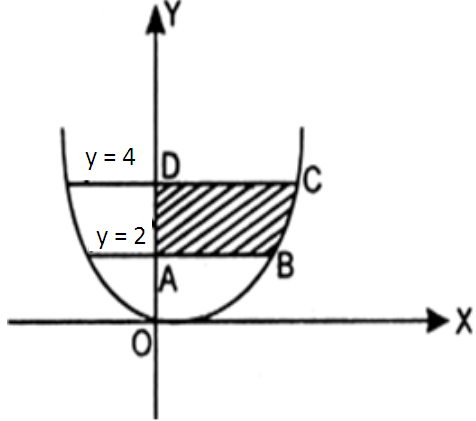
Find the area of the region bounded by $x^2 = 4y, y = 2, y = 4$ and the y-axis in the first quadrant.
AnswerThe equation of curve is $x^2 = 4y$, which is an upward parabola.
Lines are $y = 2$ and $y = 4$
Required area = Area ABCD
$=\int\limits^4_2\text{x dy}=\int\limits^4_22\sqrt{\text{y}}\text{ dy}$
$=2\int\limits^4_2\text{y}^{\frac12}\text{dy}=2\Bigg[\frac{\text{y}^{\frac32}}{\frac32}\Bigg]^4_2$
$=\frac43\Big[\text{y}^{\frac32}\Big]^4_2=\frac43\Bigg[(4)^{\frac32}-(2)^{\frac32}\Bigg]$
$=\frac43(8-2\sqrt2)=\frac{32-8\sqrt2}{3}\text{sq. units.}$
View full question & answer→Question 1145 Marks
Prove that the area the first quadeant enclosed by the x-axis, the line $\text{x}=\sqrt{3}\text{y}$ and the circle is $\frac{\pi}{3}$ .
Answer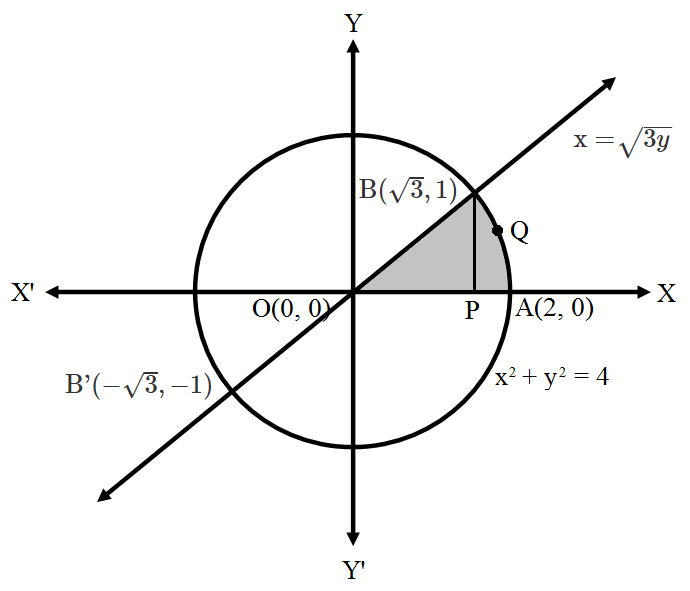
$x^2 + y^2 = 4$ represents a circle $(0, 0)$ and radius $2$, cutting x-axis at $(2, 0)$ and $(-2, 0)$
$\text{x}=\sqrt{3}\text{y}$ represents a circle (0, 0)
Solving the two we get,
$x^2 + y^2= 4$ and $\text{x}=\sqrt{3}\text{y}$
$\Rightarrow(\sqrt{3}\text{y})^{2}+\text{y}^{2}=4$
$\Rightarrow 4\text{y}^{2}=4$
$\Rightarrow\text{y}=\pm1$
$\Rightarrow\text{x}=\pm\sqrt{3}$
shaded area (OBQAO) = area (OBPO) + area (BAPB)
$=\frac{1}{\sqrt{3}}\int\limits_{0}^{\sqrt{3}}\text{x}\text{dx}+\int\limits_{\sqrt{2}}^{{2}}\sqrt{4-\text{x}^{2}}\text{dx} $
$=\frac{1}{\sqrt{3}}\Big[\frac{\text{x}^{2}}{2}\Big]^{\sqrt{3}}_{0}\text{dx}+\Big[\frac{1}{2}\text{x}\sqrt{4-\text{x}^{2}}+\frac{4}{2}\sin^{-1}\Big(\frac{\text{x}}{2}\Big)\Big]^{2}_{\sqrt{3}}$
$=\frac{\sqrt{3}}{2}+0-\frac{\sqrt{3}}{2}+2\Big(\sin^{-1}1-\sin^{-1}\frac{\sqrt{3}}{2}\Big)$
$=\frac{\sqrt{3}}{2}-\frac{\sqrt{3}}{2}+2\Big(\frac{\pi}{2}-\frac{\pi}{3}\Big)$
$=\frac{\pi}{3}\ \text{sq.}\ \text{units}$ View full question & answer→Question 1155 Marks
Compute the area bounded by the lines x + 2y = 2, y - x = 1 and 2x + y = 7.
AnswerWe have, x + 2y = 2 ...(i) y - x = 1 ...(ii) And 2x + y = 7 ...(iii) On solving equations (i) and (ii), we get y - (2 - 2y) = 1 ⇒ 3y - 2 = 1 ⇒ y = 1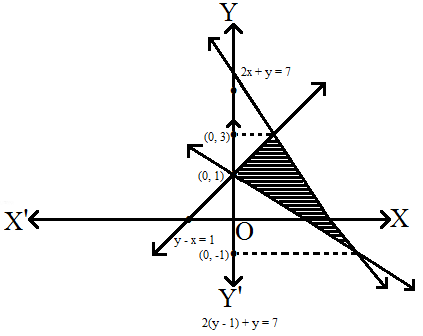
On solving equations (ii) and (iii), we get 2y - 2 + y = 7 ⇒ y = 3 On solving equations (i) and (iii), we get 2(2 - 2y) + y = 7 ⇒ 4 - 4y + y = 7 ⇒ -3y = 3 ⇒ y = -1 $\therefore$ Required area of shaded region $=\int\limits^1_{-1}(2-2\text{y})\text{dy}+\int\limits^3_{-1}\frac{(7-\text{y})}{2}\text{dy}-\int\limits^3_1(\text{y}-1)\text{dx}$ $=\bigg[-2\text{y}+\frac{2\text{y}^2}{2}\bigg]^1_{-1}+\bigg[\frac{7\text{y}}{2}\frac{\text{y}^2}{2\cdot2}\bigg]^3_{-1}-\bigg[\frac{\text{y}^2}{2}-\text{y}\bigg]^3_1$ $=\bigg[-2+\frac{2}{2}-2\frac{2}{2}\bigg]+\bigg[\frac{21}{2}-\frac{9}{4}+\frac{7}{4}+\frac{1}{4}\bigg]-\bigg[\frac{9}{2}-3\frac{1}{2}+1\bigg]$ $=[-4]+\bigg[\frac{42-9+14+1}{4}\bigg]-\bigg[\frac{9-6-1+2}{2}\bigg]$ $=-4+12-2=6\text{ sq. units}$ View full question & answer→Question 1165 Marks
Find the area enclosed by the curve $y = |x - 1|$ and $y = -|x - 1 | + 1$.
Answer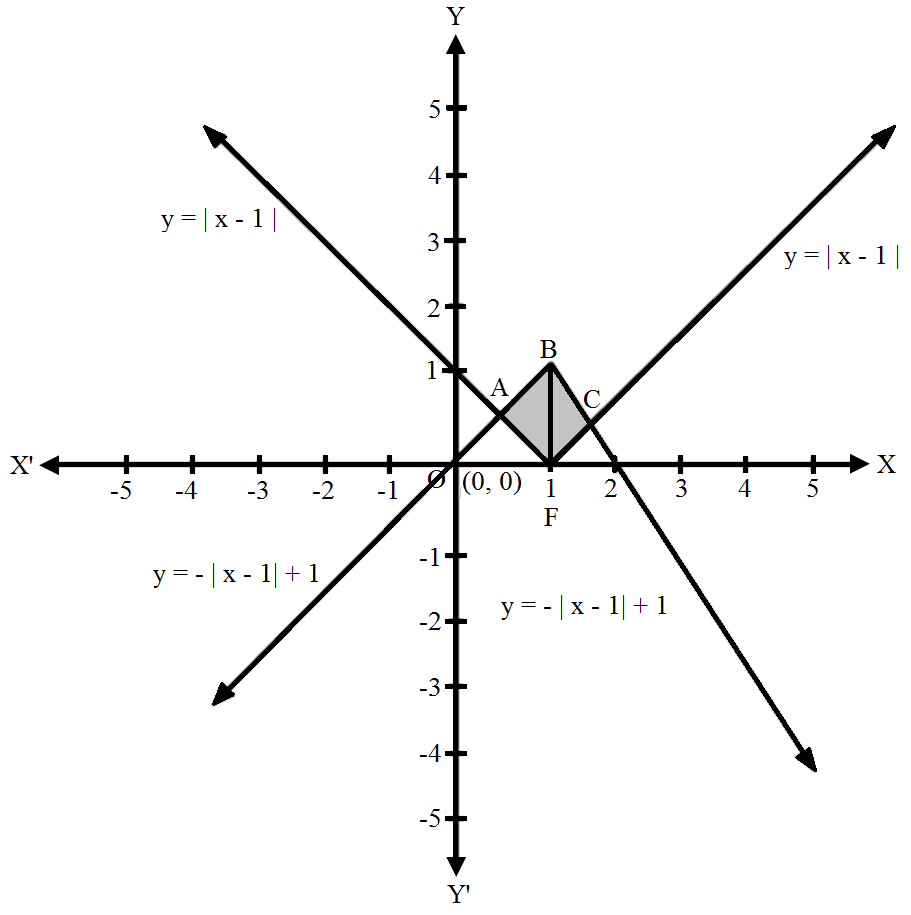
The given curve are
y = |x - 1| .....(i)
y = -|x - 1| + 1 .....(ii)
Clearly y = |x - 1| is cutting the x-axis at (1, 0) and y-axis at (0, 1) respectively.
Also y = -|x - 1| + 1 is cutting both the axes at (0, 0) and x-axis at (2, 0)
We have
y = |x - 1|
$\text{y}=\begin{cases}\text{x}-1,&\text{x}\geq1\\1-\text{x},&\text{x}<1\end{cases}$
And y = -|x - 1| + 1
$\text{y}=\begin{cases}2-\text{x},&\text{x}\geq1\\\text{x},&\text{x}<1\end{cases}$
Solving both the equation for x < 1
y = 1 - x and y = x
We get $\text{x}=\frac{1}{2}$ and $\text{y}=\frac{1}{2}$
Thus the intersecting points are $\Big(\frac{1}{2},\frac{1}{2}\Big)$ and $\Big(\frac{3}{2},\frac{1}{2}\Big)$
The required area A = (Area of ABFA + Area of BCFB)
Now, approximating the area of ABFA the length = $|y_1|$ and width = dx
Area of ABFA
$=\int\limits^1_{\frac{1}{2}}\big[\text{x}-(1-\text{x})\big]\text{dx}$
$=\int\limits^{1}_{\frac{1}{2}}(2\text{x}-1)\text{dx}$
$=\big[\text{x}^2-\text{x}\big]^1_{\frac{1}{2}}$
$=\frac{1}{4}$
Similarly appoximating the area of BCFB the length = $|y_2|$ and width = dx
Area of BCFB
$=\int\limits^{\frac{3}{2}}_1\big[(2-\text{x})-(\text{x}-1)\big]\text{dx}$
$=\int\limits^{\frac{3}{2}}_1(3-2\text{x})\text{dx}$
$=\big[3\text{x}-\text{x}^2\big]^{\frac{3}{2}}_1$
$=\frac{1}{4}$
Thus the required area A = (Area of ABFA + Area of BCFB)
$=\frac{1}{4}+\frac{1}{4}=\frac{1}{2}$
Hence the required area is $\frac{1}{2}\text{ square units}$ View full question & answer→Question 1175 Marks
Find the area enclosed by the curve $y=-x^2$ and the strainght line $x+y+2=0$.
AnswerThe curve $y=-x^2$ represents a parabola opening towards the negative $y$-axis.
The straight line $x+y+2=0$ passes thought $(-2,0)$ and $(0,-2)$.
Solving $y=-x^2$ and $x+y+2=0$, we get
$x - x^2 + 2 = 0$
$\Rightarrow x^2 - x - 2 = 0$
$\Rightarrow (x - 2) (x + 1) = 0$
$\Rightarrow x = 2$ or $x = -1$
Thus, the parbola $y = -x^2$ and the line $x + y + 2 = 0$ at $(-1, -1)$ and $(2, -4).$
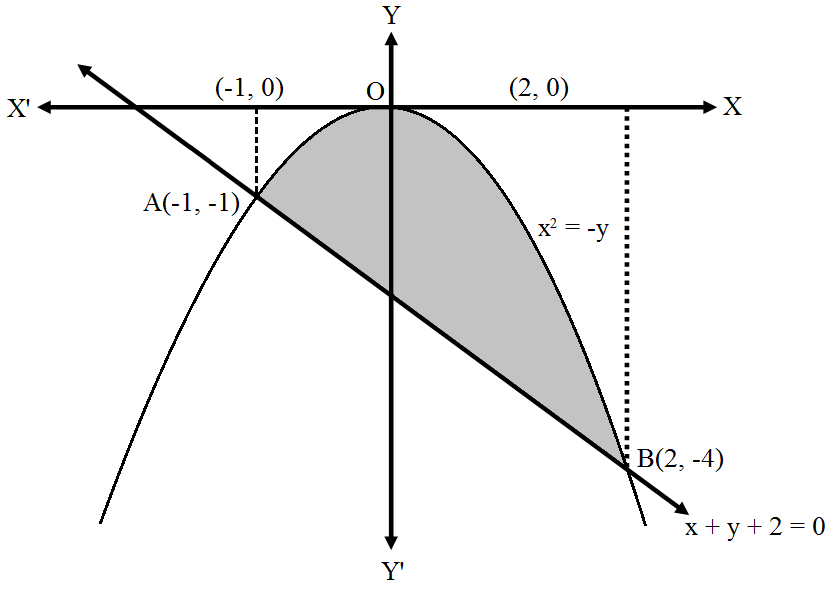
Requried area = Area of the shaded region $OABO$
$=\int\limits_{-1}^{2}\text{y}\text{ dx}- \int\limits_{-1}^{2}\text{y}\text{ dx}$
$=\int\limits_{-1}^{2}(\text{-x}+2)\text{ dx}- \int\limits_{-1}^{2}-\text{x}^{2}\text{ dx}$
$=\int\limits_{-1}^{2}-\frac{(\text{x}+2)}{2}\text{ dx}+ \int\limits_{-1}^{2}\frac{\text{x}^{3}}{3}\text{ dx}$
$=-\frac{1}{2}(16-1)+\frac{1}{2}\Big[8-(-1)\Big]$
$=\frac{9}{2}\ \text{sq.}\ \text{units}$ View full question & answer→Question 1185 Marks
Draw a rough sketch of the region bounded by the parabola $y^2 = 4x$ and $x^2 = 4y$ by using methods of integration.
AnswerTo find the points of intersection between two parabola let us substitule $\text{x}=\frac{\text{y}^{2}}{4}$ in $x^2 = 4y$.
$\Big(\frac{\text{y}^{2}}{4}\Big)^{2}=4\text{y}$
$\Rightarrow y^4- 64y = 0$
$\Rightarrow y^4- 64 y = 0$
$\Rightarrow y(y^3- 64) = 0$
$\Rightarrow y = 0, 4$
$\Rightarrow x = 0, 4$
Threrfore, the points of intersection are A(4, 4) and C(0, 0)
Threrfore, the area of the ragion $=\int\limits_{0}^{4}\text{y}_{1}\text{dx}-\int\limits_{0}^{4}\text{y}_{2}\text{dx} $ where $\text{y}_{1} =2\sqrt{\text{x}}$ and $\text{y}_{2}=\frac{\text{x}^{2}}{4}$
Required Area
$=\int\limits_{0}^{4}(2\sqrt{\text{x}})\text{dx}-\int\limits_{0}^{4}\Big(\frac{\text{x}^{2}}{4}\Big)\text{dx} $
$=\bigg[2\times\frac{2\text{x}^\frac{3}{2}}{3}-\frac{\text{x}^{3}}{12}\bigg]^{4}_{0}$
$=\bigg[\Big(2\times\frac{2\text{(4)}^\frac{3}{2}}{3}-\frac{\text{(4)}^{3}}{12}\Big)-\Big(2\times\frac{2\text{(0)}^\frac{3}{2}}{3}-\frac{\text{(0)}^{3}}{12}\Big)\bigg]$
After simplifying we get,
$=\frac{32}{3}-\frac{16}{3}$
$=\frac{16}{3}\ \text{sq.}\ \text{units}$
View full question & answer→Question 1195 Marks
Find the area bounded by curves $\left\{(\text{x, y}):\text{y}\geq\text{x}^2 \text{ and y}=|\text{x}|\right\}.$
AnswerThe area bounded by the curves, $\left\{(\text{x, y}):\text{y}\geq\text{x}^2 \text{ and y}=|\text{x}|\right\},$ is represented by the shaded region as
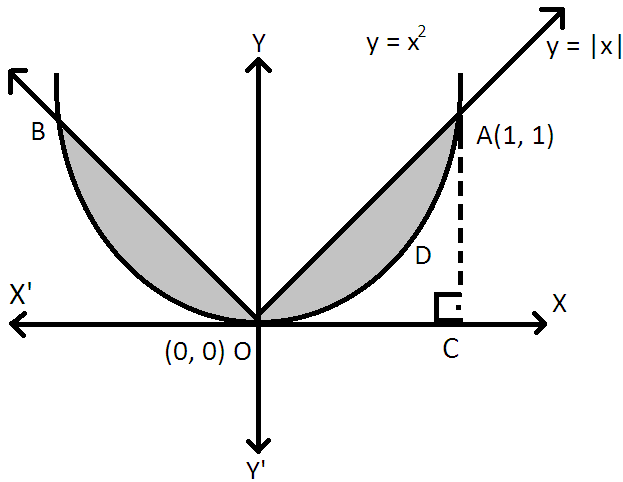
It can be observed that the required area is symmetrical about y-axis.
Required area = 2[Area(OCAO) - Area(OCADO)]
$=2\Bigg[\int\limits^1_0\text{x dx}-\int\limits^1_0\text{x}^2\text{dx}\Bigg]$
$=2\bigg[\Big[\frac{\text{x}^2}{2}\Big]^1_0-\Big[\frac{\text{x}^3}{3}\Big]^1_0\bigg]$
$=2\Big[\frac12-\frac13\Big]$
$=2\Big[\frac16\Big]=\frac13\text{units}$ View full question & answer→Question 1205 Marks
Find the area bounded by the parbola $y = 2 - x^2$ and the strainght line $y + x = 0$.
AnswerTo find area bounded by
$y = 2 - x^2$ ...(i)
and $y + x = 0$ ...(ii)
Equation (i) represents a parabola with vertex (0, 2) at origin and axis at $(\pm\sqrt{2}, 0)$ x-axis and equation (ii) represents a (0, 0) and (2, -2) line parallel to y-axis.
A rough sketch of the equations is as below:
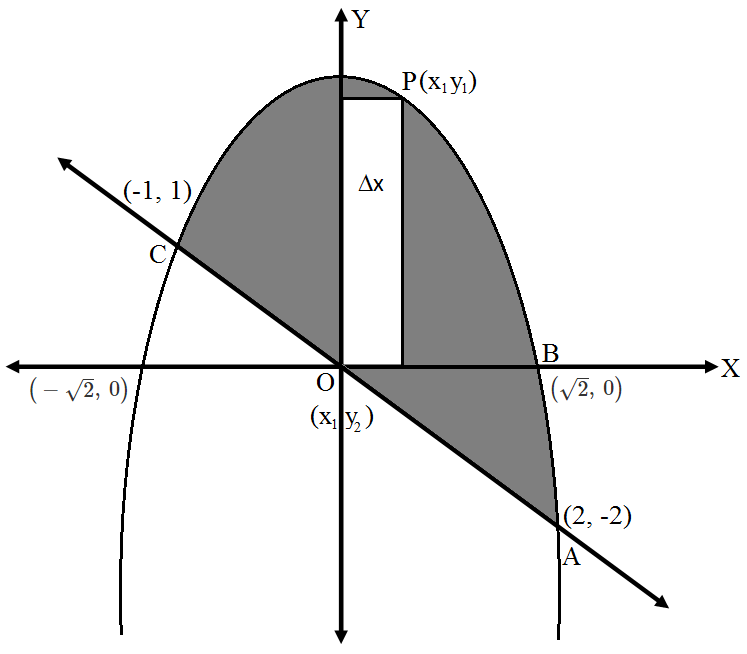
Shaded region is sliced into with area $= (y_1- y_2)$. It slide from x = 1 to x = 2 , so
Requried area = Region ABPCOA
$\text{A}=\int\limits_{-1}^{2}(\text{y}_{1}-\text{y}_{2})\text{ dx} $
$=\int\limits_{-1}^{2}({2}-\text{x}^{2}+\text{x})\text{ dx} $
$=\Big[2\text{x}-\frac{\text{x}^{3}}{3}+\frac{\text{x}^{2}}{2}\Big]^{2}_{-1}$
$=\Big[\Big(4-\frac{8}{3}+2\Big)-\Big(-2+\frac{1}{3}+\frac{1}{3}\Big)\Big]$
$=\Big[\frac{10}{3}+\frac{7}{6}\Big]$
$=\frac{27}{6}$
$=\frac{9}{2}\ \text{sq.}\ \text{units}$ View full question & answer→Question 1215 Marks
Find the area of the region bounded by the curve $y^2 = 2x$ and $x^2 + y^2 = 4x.$
AnswerWe have, $y^2 = 2x$ and $x^2 + y^2 = 4x$
Here, $y^2 = 2x$ is a parabola opening towards the positive direction of $x-$axis.
Now solving $y^2 = 2x$ and $x^2 + y^2 = 4x$
$\Rightarrow x^2 + 2x = 4x$
$\Rightarrow x^2 - 2x = 0$
$\Rightarrow x(x - 2) = 0$
$\Rightarrow x = 0, 2$
When $x = 0, y = 0$ and when $x = 2,$
$\text{y}=\pm2$ Therefore $(0, 0)$ and $(2, 2) $ and $(2, -2)$are the points of intersection.
Thus, the graphs of $y^2 = 2x$ and $x^2 + y^2 = 4x$ are as shown below:
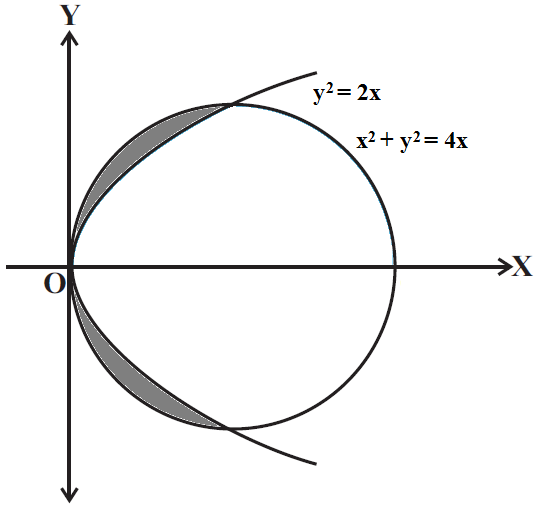
Also, $x^2 + y^2 = 4x$
$\Rightarrow x^2 - 4x = -y^2$
$\Rightarrow x^2 - 4x + 4 = -y^2 + 4$
$\Rightarrow (x - 2)^2 - 2^2 = -y^2$
$\therefore$ Required area of shaded region,
$\text{A}=2\cdot\int\limits^2_0\bigg[\sqrt{2^2-(\text{x}-2)^2}-\sqrt{2\text{x}}\bigg]\text{dx}$
$=2\Bigg[\bigg[\frac{\text{x}-2}{2}\cdot\sqrt{2^2-(\text{x}-2)^2}+\frac{2^2}{2}\sin^{-1}\Big(\frac{\text{x}-2}{2}\Big)\bigg]^2_0-\bigg[\sqrt{2}\cdot\frac{\text{x}^{\frac{3}{2}}}{\frac{3}{2}}\bigg]^2_0\Bigg]$
$=2\bigg[\Big(0+0-1\cdot0+2\cdot\frac{\pi}{2}\Big)\frac{2\sqrt{2}}{3}\Big(2^{\frac{3}{2}}-0\Big)\bigg]$
$=2\pi-\frac{16}{3}=2\Big(\pi-\frac{8}{3}\Big)\text{ sq. units}$ View full question & answer→Question 1225 Marks
Using integration, find the area of the region: $\left\{(\text{x},\text{y}) : |\text{x}-1|<\text{y}<\sqrt{5-\text{x}^{2}}\right\}$.
Answer
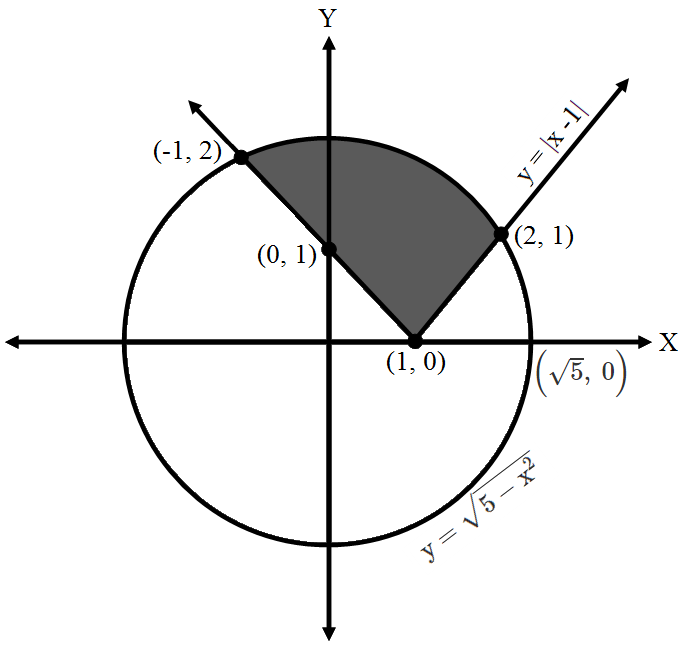 $|\text{x}-1|<\text{y}<\sqrt{5-\text{x}^{2}}$
$|\text{x}-1|=\sqrt{5-\text{x}^{2}}$
$\text{x}=2, -1$
$\text{A}=\int\limits_{-1}^{2} \Big(\sqrt{5-\text{x}^{2}}-|\text{x}-1|\Big)\text{ dx}$
$=\int\limits_{-1}^{2} \sqrt{5-\text{x}^{2}}+\int\limits_{-1}^{2}|\text{x}-1|\text{ dx}+\int\limits_{-1}^{2}(1-\text{x})\text{ dx}$
$=\Big[\frac{\text{x}}{2} \sqrt{5-\text{x}^{2}}+\frac{5}{2}\sin^{-1}\Big(\frac{\text{x}}{5}\Big)\Big]^{2}_{-1}+\Big[\frac{\text{x}^{2}}{2}-\text{x}\Big]^{1}_{-1}+\Big[\text{x}-\frac{\text{x}^{2}}{2}\Big]^{2}_{1}$
$=\frac{5}{2}\sin^{-1}\Big(\frac{\text{2}}{\sqrt5}\Big)+\sin^{-1}\Big(\frac{\text{1}}{\sqrt5}\Big)+\frac{1}{2}$ View full question & answer→Question 1235 Marks
Find the area bounded by the curve $\text{y}=\cos\text{x}$, x-axis and the ordinates $\text{x}=0, \text{x}=2\pi$.
Answer
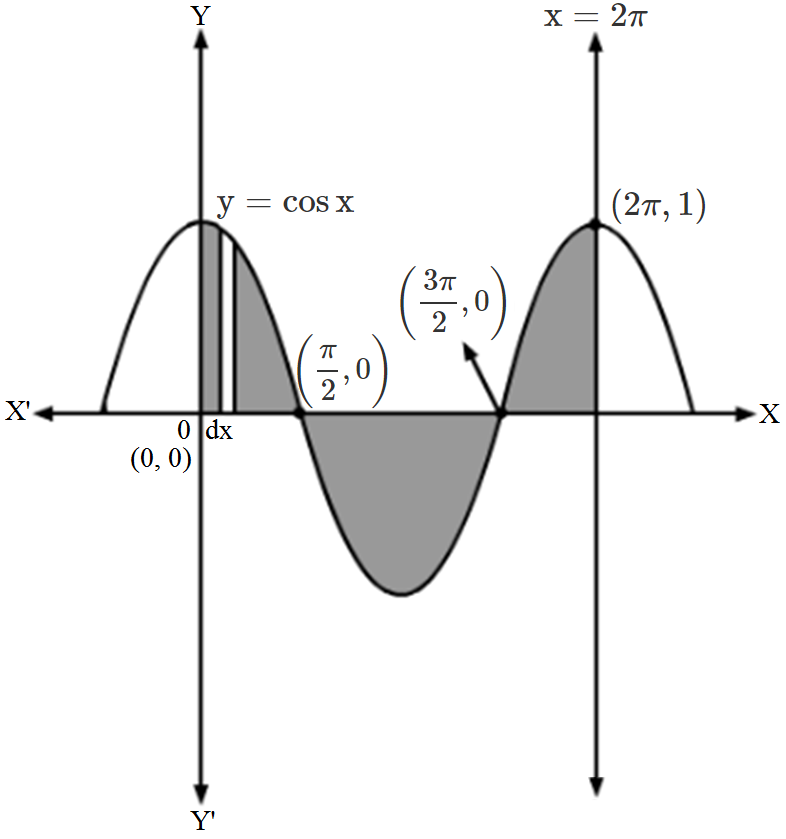 The shaded region is the required area bound by the curve $\text{y}=\cos\text{x}$ x-axis and $\text{x}=0, \text{x}=2\pi$
Consider a vertical strip of length = |y| and with = dx in the first area.
Area of the approximating rectangle = |y| dx
The approximating rectangle from $\text{x}=0, \text{x}=2\pi$
Now, Area of the shaded region $= \int\limits_{0}^{2\pi}|\text{y}|\text{dx} $
$\Rightarrow\text{A}= \int\limits_{0}^{\frac{\pi}{2}}|\text{y}|\text{dx}+\int\limits_{\frac{\pi}{2}}^{\frac{\pi}{2}}|\text{y}|\text{dx}\int\limits_{\frac{3\pi}{2}}^{2\pi}|\text{y}|\text{dx} $
$\Rightarrow\text{A}= \int\limits_{0}^{\frac{\pi}{2}}\text{y}\text{dx}+\int\limits_{\frac{\pi}{2}}^{\frac{\pi}{2}}-\text{y}\text{dx}\int\limits_{\frac{3\pi}{2}}^{2\pi}\text{y}\text{dx} $
$\Rightarrow\text{A}= \int\limits_{0}^{\frac{\pi}{2}}\cos\text{x}\text{dx}+\int\limits_{\frac{\pi}{2}}^{\frac{\pi}{2}}-\cos{\text{x}}\text{dx}\int\limits_{\frac{3\pi}{2}}^{2\pi}\cos\text{x}\text{dx} $
$\Rightarrow\text{A}= \Big[\sin\text{x}\Big]^\frac{\pi}{2}_{0}+\Big[-\sin\text{x}\Big] ^\frac{3\pi}{2}_\frac{\pi}{2}+\Big[-\sin\Big]^\frac{3\pi}{2}_{2\pi}$
$\Rightarrow\text{A}= 1+(1+1)+(0-(-1))$
$\Rightarrow\text{A}=4\ \text{sq.}\ \text{units}$ View full question & answer→Question 1245 Marks
Find the area of the region enclosed by the parabola $x^2 = y$ and the line $y = x + 2.$
AnswerSolving $x^2 = y$ and $y = x + 2,$
we get: $\Rightarrow x^2 = x + 2 $
$\Rightarrow x^2 - x - 2 = 0$
$ \Rightarrow x^2 - 2x + x - 2 = 0$
$ \Rightarrow x(x - 2) + 1(x - 2) = 0 $
$\Rightarrow (x + 1)(x - 2) = 0$
$ \Rightarrow x = -1, 2$
When $x = -1, y = 1$ and when $x = 2, y = 4$
So, the graphs of parabola $x^2 = y$ and the line $y = x + 2,$
are as shown below:
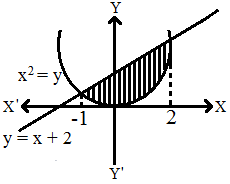
$\therefore$ Required area of shaded region
$=\int\limits^2_{-1}(\text{x}+2-\text{x}^2)\text{dx}=\Big[\frac{\text{x}^2}{2}+2\text{x}\frac{\text{x}^3}{3}\Big]^2_{-1}$
$=\Big[\frac{4}{2}+4\frac{8}{3}\frac{1}{2}+2\frac{1}{3}\Big]$
$=6+\frac{3}{2}-\frac{9}{3}=\frac{36+9-18}{6}$
$=\frac{27}{6}=\frac{9}{2}\text{ sq. units}$ View full question & answer→Question 1255 Marks
find the area of the region in the first quadrant by the x-axis, the line $y = x$ and circle $x^2+ y^2 = 32$.
AnswerTo find area bounded by y = 1 and
$x^2 + y^2 = 32$ ...(i)
Equation (i) represents a parabola with vertex $(\pm4\sqrt{2}, 0)$ at origin and axis as x-axis and equation (ii) represents a line (4, 4) parallel to y-axis.
A rough sketch of curve is as under:
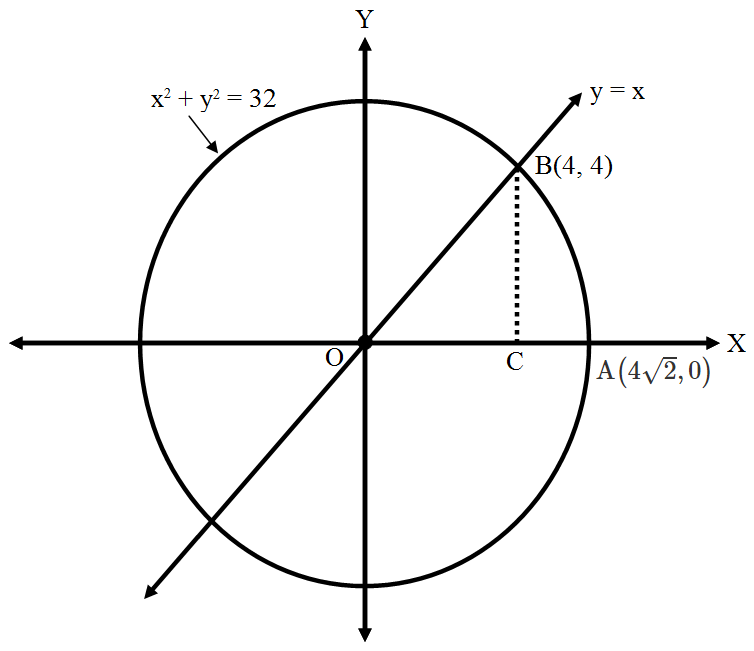
Requried area = Region ABCA
$=\int\limits_{0}^{4}\text{y}_{1}\text{dx}+\int\limits_{4}^{4\sqrt{2}}\text{y}_{2}\text{ dy} $
$=\int\limits_{0}^{4}\text{x}\text{ dx}+ \int\limits_{4}^{4\sqrt{2}}(\sqrt{32- \text{x}^{2}}\ \text{dx}$
$=(8-0)+(0+16.\frac{\pi}{2})-\Big(8+16.\frac{\pi}{4}\Big)$
$=8+8\pi-8-4\pi$
$\text{A}=4\pi\ \text{sq.}\ \text{units}$ View full question & answer→Question 1265 Marks
Sketch the region $\{(x, y): 9x^2+ 4y^2 = 36\}$ and find the area of the enclosed by it, using integration.
Answer
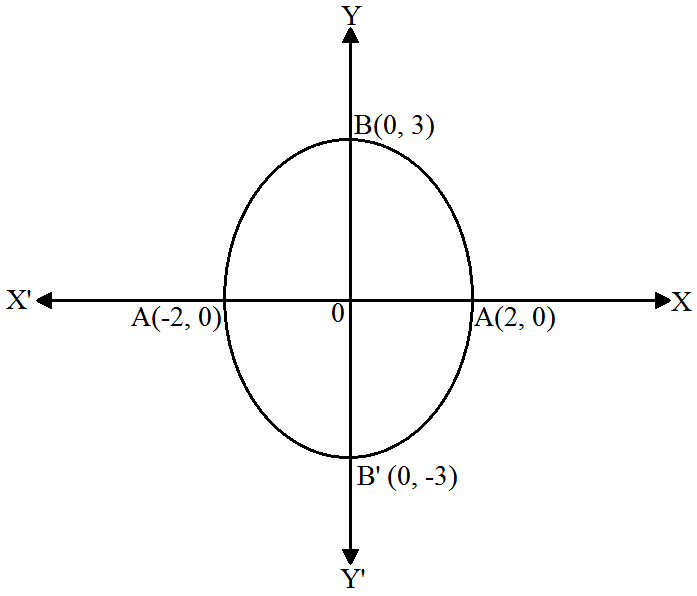
We have,
$9\text{x}^{2}+4\text{y}^{2}=36\ ...(\text{i})$
$\Rightarrow 4\text{y}^{2}=36-9\text{x}^{2} $
$\Rightarrow\text{y}^{2}=\frac{9}{4}(4-\text{x}^{2})$
$\Rightarrow\text{y}=\frac{3}{2}\sqrt{(4-\text{x}^{2})}\ ...(\text{ii})$
From (i) we get
$\Rightarrow\frac{\text{x}^{2}}{4}+\frac{\text{y}^{2}}{9}=1$
Since in the given equation $\frac{\text{x}^{2}}{4}+\frac{\text{y}^{2}}{9}=1$
all the powers of both x and y are even, the curve is symmetrical about both the axis.
$\therefore$ Area encloed by the curve and above x-axis = area A'BA = 2 × area enclosed by ellipse and x-axis in first quadrant
(2, 0), (-2, 0) are the points of intersection of curve and x-axis
(0, 3), (0, -3) are the points of intersection of curve and x-axis
Slicling the area in the first quadrant into vertical stripes of height = |y| and width = dx
$\therefore$ Area of approximating rectangle = |y| dx
Appoximating rectangle can move between x = 0 and x = 2
A = Area of enclosed curve above x-axis $=4\int\limits_{0}^{2}|\text{y}|\text{dx} $
$\Rightarrow \text{A}=4\int\limits_{0}^{2}\frac{3}{2}\sqrt{4-\text{x}^{2}}\text{dx}$
$\Rightarrow \text{A}=\frac{3}{2}\int\limits_{0}^{2}\sqrt{4-\text{x}^{2}}\text{dx}$
$ =4\times\frac{3}{2}\int\limits_{0}^{2}\sqrt{4-\text{x}^{2}}\text{dx}$
$=6\int\limits_{0}^{2}\sqrt{2^{2}-\text{x}^{2}}\text{dx} $
$=6\Big[\frac{\text{x}}{2}\sqrt{2^{2}-\text{x}^{2}}+\frac{1}{2}2^{2}\sin^{-1}\frac{\text{x}}{2}\Big]^{2}_{0}$
$=6\{0+ \frac{1}{2}4\sin^{-1}1\}$
$=6\{ \frac{1}{2}\times4(\frac{\pi}{2})\}$
$\Rightarrow \text{A}=6\pi\ \text{sq.} \ \text{units}$
$\therefore$ Area of enclosed region above x-axis $=6\pi\ \text{sq.}\ \text{units}$ View full question & answer→Question 1275 Marks
Find the area under the curve $\text{y}=\sqrt{6\text{x}+4}$ above x-axis from $x = 0$ to $x = 2$. Draw a sketch of curve also.
AnswerWe have to find area enclosed by x-axis
$x = 0, x = 2$...(i)
and $y^2= 6x + 4$ ...(ii)
Equation (i) represents y-axis and a line parallel to y-axis passing through $(2, 0)$ respectively. Equation (ii) represents a parabola with vertex at $\Big(-\frac{2}{3}, 0\Big)$ and passes through the points $(0, 2),(0, -2)$, so rough sketch of the curves is as below:
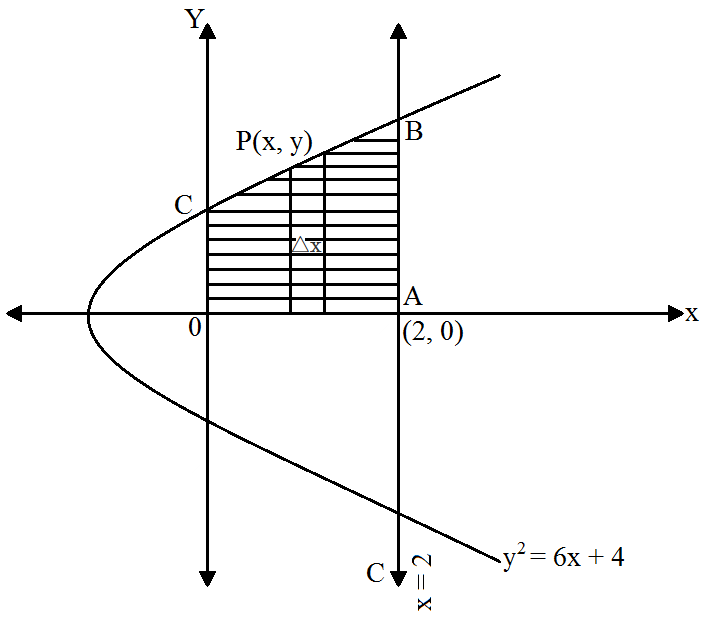
Shaded region represents the required area. It is sliced in approximation rectangle with its Width = x, and length = (y - 0) = y
Area of rectangle y = x
This approxim ation rectangle slide from x = 0 to x = 2,
Required area = Region OABCO
$=\int\limits_{0}^{2}\sqrt{6\text{x}+4\text{x}}\text{dx} $
$=\frac{2}{3}\Bigg[\frac{(6\text{x}+4)\sqrt{6\text{x}+4}}{6}\Bigg]^{2}_{0}$
$=\frac{1}{9}\Big[\Big((12+4)\sqrt{12+4}\Big)-\Big((0+4)\sqrt{0+4}\Big)\Big]$
$=\frac{1}{9}\Big[16\sqrt{16}-4\sqrt{4}\Big]$
$=\frac{1}{9}(64-8)$
Required area $=\frac{59}{9}\ \text{sq.} \ \text{units}$ View full question & answer→Question 1285 Marks
Find the area bounded by the lines y = 4x + 5, y 5 - x and 4y = x + 5.
AnswerTo find area bounded by lines
y = 4x + 5(Say AB) ......(i)
y - 5 - x (Say BC) ......(ii)
4y - x + 5 (Say AC) ....(iii)
By solving equation (i) and (ii) we get B(0, 5)
By solving equation (ii) and (iii) we get C(3, 2)
By solving equation (i) and (iii) we get A(-1, 1)
A rough sketch of the curve is as under,
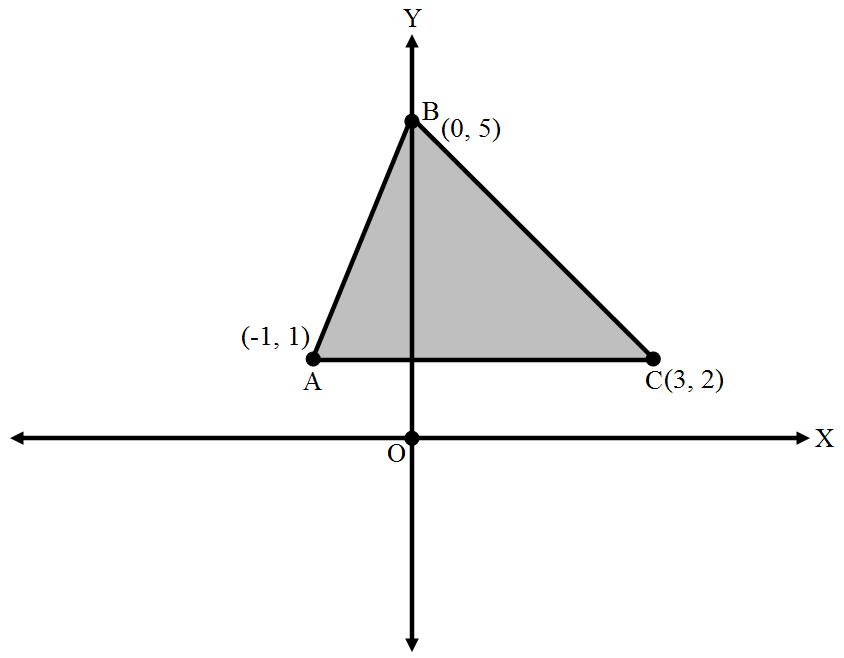
Shaded area $\triangle\text{ABC}$ is the required area.
$\text{Required area}=\text{ar}(\triangle\text{ABD})+\text{ar}(\triangle\text{BDC})\ ...(\text{i})$
$\text{ar}(\triangle\text{ABD})=\int\limits^0_{-1}(\text{y}_1-\text{y}_3)\text{dx}$
$=\int\limits^0_{-1}\Big(4\text{x}+5-\frac{\text{x}}{4}-\frac{5}{4}\Big)\text{dx}$
$=\int\limits^0_{-1}\Big(\frac{15\text{x}}{4}+\frac{15}{4}\big)\text{dx}$
$=\frac{15}{4}\Big(\frac{\text{x}^2}{2}+\text{x}\Big)^0_{-1}$
$=\frac{15}{4}\Big[(0)-\Big(\frac{1}{2}-1\Big)\Big]$
$=\frac{15}4{\times}\frac{1}{2}$
$\text{ar}(\triangle\text{ABD})=\frac{15}{8}\text{ sq.units}\ ...(\text{ii})$
$\text{ar}(\triangle\text{BDC})=\int\limits^3_0(\text{y}_2-\text{y}_3)\text{dx}$
$=\int\limits^3_0\Big[(5-\text{x})-\Big(\frac{\text{x}}{4}+\frac{5}{4}\Big)\Big]\text{dx}$
$=\int\limits^3_0\Big[5-\text{x}-\frac{\text{x}}{4}-\frac{5}{4}\Big]\text{dx}$
$=\int\limits^3_0\Big(\frac{-5\text{x}}{4}+\frac{15}{4}\Big)\text{dx}$
$=\frac{5}{4}\Big(3\text{x}-\frac{\text{x}^2}{2}\Big) $
$=\frac{5}{4}\Big(9-\frac{9}{2}\Big)$
$\text{ar}(\triangle\text{BDC})=\frac{45}{8}\text{ sq.units}\ ...(\text{iii})$
Using equatiuon (i), (ii) and (iii),
$\text{ar}(\triangle\text{ABC})=\frac{15}{8}+\frac{45}{8}$
$=\frac{60}{8}$
$\text{ar}(\triangle\text{ABC})=\frac{15}{2}\text{ sq.units}$ View full question & answer→Question 1295 Marks
Find the area bounded by the ellipse $\frac{\text{x}^{2}}{\text{a}^{2}}+\frac{\text{y}^{2}}{\text{b}^{2}}=1$ and the ordinated $x = ae$ and $x = 0$, where $b^2= a^2(1 - e^2)$ and $e < 1$.
Answer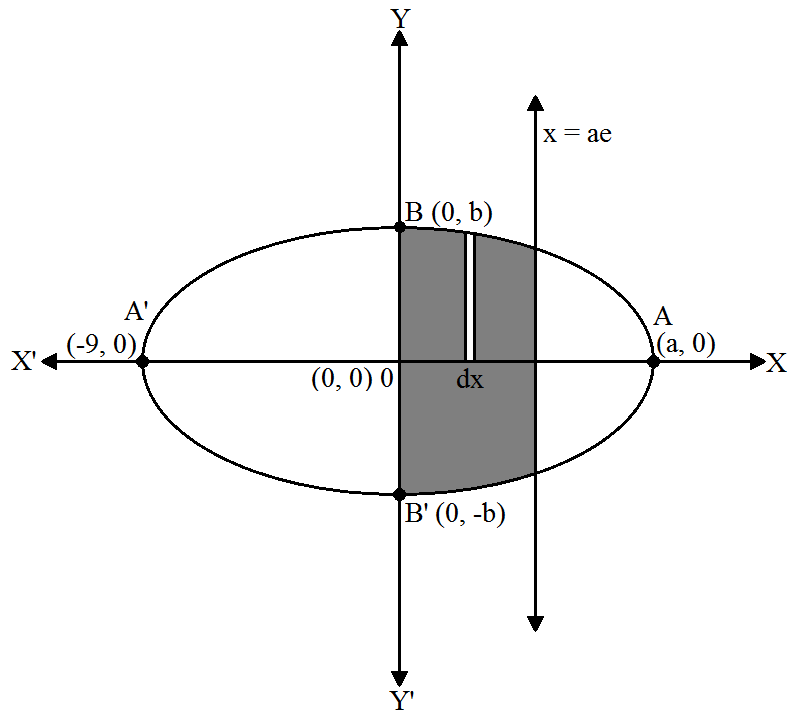
$\frac{\text{x}^{2}}{\text{a}^{2}}+\frac{\text{y}^{2}}{\text{b}^{2}}=1$ represents a parabola, symmetrical about both the acis.
It cuts a x-axis at A(a, 0) and A'(-a, 0)
It cuts a y-axis at B(0, b) and B'(0, -b)
x = ae is a line parallel to y-axis
Consider a vertical strip of length = |y| and width = dx, in the first
Area of approximating rectangle in the first = |y|dx
Area of thr shaded region = 2 area in the first quadrant
$\Rightarrow \text{A}=2\int\limits_{0}^{\text{ae}}|\text{y}|\text{dx} $
$\Rightarrow\text{A}=2\int\limits_{0}^{\text{ae}}\text{y}\text{dx} $
$\Rightarrow \text{A}=2\int\limits_{0}^{\text{ae}}\frac{\text{b}}{\text{a}}\sqrt{\text{a}^{2}-\text{x}^{2}}\text{dx}$
$\Rightarrow \text{A}=\frac{2\text{b}}{\text{a}}\int\limits_{0}^{\text{ae}}\sqrt{\text{a}^{2}-\text{x}^{2}}\text{dx}$
$\Rightarrow \text{A}=\frac{2\text{b}}{\text{a}}\int\limits_{0}^{\text{ae}}\bigg[\frac{1}{2}\text{x}\sqrt{\text{a}^{2}-\text{x}^{2}}+\frac{1}{2}\text{a}^{2}\sin^{-1}\frac{\text{ae}}{\text{a}}-0\bigg]$
$\Rightarrow \text{A}=\frac{\text{b}}{\text{a}}\text{a}^{2}\Big[\text{e}\sqrt{1-\text{e}^{2}}+\frac{1}{2}\sin^{-1}\text{e}\Big]$
$\Rightarrow \text{A}=\text{ab}\Big[\text{e}\sqrt{1-\text{e}^{2}}+\frac{1}{2}\sin^{-1}\text{e}\Big]\ \text{sq.}\ \text{units}$ View full question & answer→Question 1305 Marks
find the area of the circle $x^2 + y^2 = 16$ which is exterior to the parabola $y^2 = 6x$.
Answer
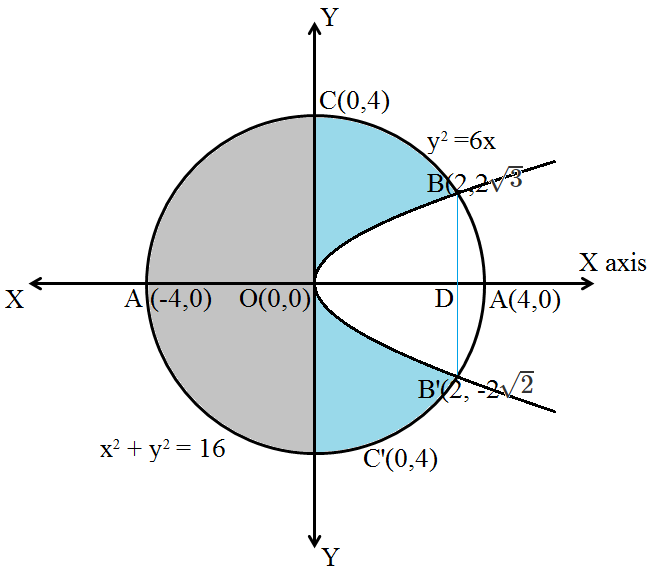
Opints of intersection of the parbola and the circle is obtained by solving the simultaneous qeuations.
$x^2 + y^2 = 16$ and $y^2 = 6x$
$\Rightarrow x^2 + 6x - 16 = 0$
$\Rightarrow x^2 + 6x - 16 = 0$
$\Rightarrow (x + 8)(x - 2) = 0$
$\Rightarrow x = 2$ or$ x = 8$,
When x = 2, $\text{y}=\pm\sqrt{6\times2}=\pm\sqrt{12}=\pm{2\sqrt{3}}$
$\therefore \text{B}=(2, 2\sqrt{3})$ and points of the parbola and circle.
Requried area = Region ABCA
$=2\times\Big[\int\limits_{0}^{6}\sqrt{6}\text{x}\text{ dx}+\int\limits_{2}^{4}\sqrt{16-\text{x}^{2}}\text{ dx} $
$=2\times\bigg[\frac{\text{x}^\frac{3}{2}}{\frac{3}{2}}\bigg]^{2}_{0}+\Big[\frac{1}{2}\sqrt{16-\text{x}^{2}}+\frac{1}{2}\times16\sin^{-1}\Big(\frac{\text{x}}{\text{a}}\Big)\Big]^{4}_{2}$
$=2\times\left\{\Big[\sqrt{6}\times\frac{2}{3}\times2\sqrt{2}\Big]+0+8\sin^{-1}1-\sqrt{12}-8\sin^{-1}\Big(\frac{1}{2}\Big)\right\}$
$=2\times\Big[\frac{8\sqrt{3}}{3}+8\times\frac{\pi}{2}-2\sqrt{3}-8\frac{\pi}{6}\Big]$
$=2\times\Big[\frac{8\sqrt{3}-6\sqrt{3}}{3}+8\Big(\frac{\pi}{2}-\frac{\pi}{6}\Big)\Big]$
$=2\times\Big[\frac{2\sqrt{3}}{3}+8\Big(\frac{2\pi}{6}\Big)\Big]$
$=\frac{4\sqrt{3}}{3}+\frac{16\pi}{3}$
Shaded area $=16\pi-\frac{4\sqrt{3}}{3}+\frac{16\pi}{3}$
$=\frac{48\pi-16\pi}{3}-\frac{4\sqrt{3}}{3}$
$=\frac{32\pi}{3}-\frac{4\sqrt{3}}{3}$
$=\frac{4}{3}(8\pi-\sqrt{3})\ \text{sq.}\ \text{units}$ View full question & answer→Question 1315 Marks
Find the area between the curves $y = x$ and $y = x^2$.
AnswerThe required area is represented by the shaded area OBAO as
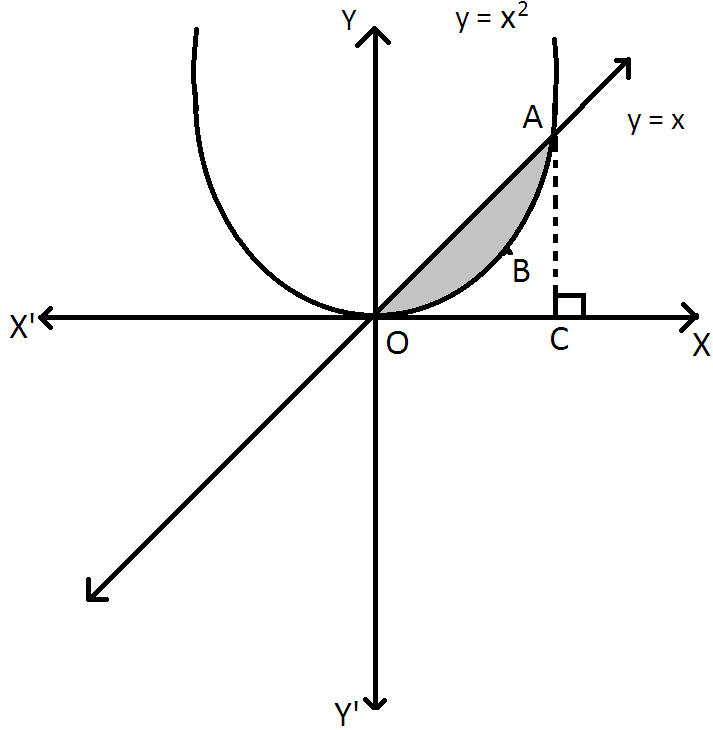
The points of intersection of the curves, $y = x$ and $y = x^2$, is $A(1, 1)$.
We draw AC perpendicular to x-axis.
$\therefore$ Area (OBAO) = Area $(\Delta\text{ OCA})$ - Area (OCABO) ...(i)
$=\int\limits^1_0\text{x dx}-\int\limits^1_0\text{x}^2\text{dx}$
$=\Big[\frac{\text{x}^2}{2}\Big]^1_0-\Big[\frac{\text{x}^3}{3}\Big]^1_0$
$=\frac12-\frac13$
$=\frac16\text{ units}$ View full question & answer→Question 1325 Marks
Draw a rough sketch of the region $\{(x, y) : y^2 < 5x, 5x^2 + < 36\}$ and find the area by the region using mwthod of integration.
Answer
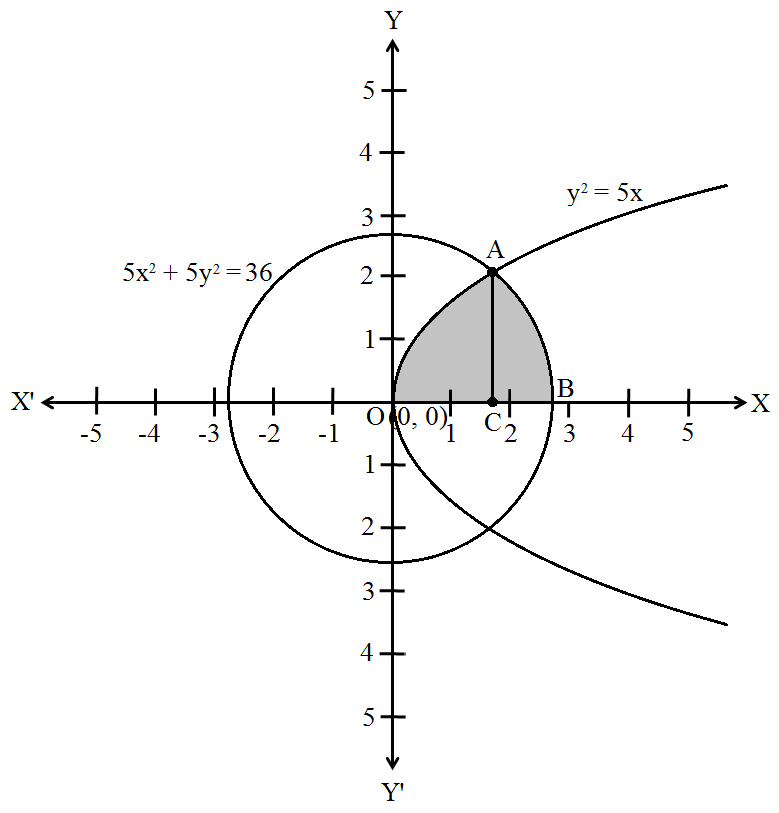
The given region is intersection of $y^2< 5x$ and $5x^2 + 5y^2 < 36$
Clearly, $y^2 < 5x$ is a parbola with vertex at origin the axis is along the x-axis opening $5x^2 + 5y^2 < 36$ the origin and has a radius $\sqrt{\frac{36}{5}} $ or $\frac{6}{\sqrt{5}}$
Corresponding equation of given by
$y^2= 5x ...(i)$
$5x^2+ 5y^2= 36 ...(ii)$
Substituting the value of $y^2$ from (i) into (ii), we get,
$\Rightarrow5\text{x}^{2}+25\text{x}=36$
$\Rightarrow5\text{x}^{2}+25\text{x}-36=0$
$\Rightarrow\text{x}=\frac{-25\pm\sqrt{625+720}}{10}$
$\Rightarrow\text{x}=\frac{-25\pm\sqrt{1345}}{10}$
From the figure we see that x-coordinate points can not be negative.
$\Rightarrow\text{x}=\frac{-25\pm\sqrt{1345}}{10}$
Now assume that x-coording of intersecting point can not be negative.
$\therefore\text{x}=\frac{-25\pm\sqrt{1345}}{10}$
Area of OACO $=\int\limits_{0}^{\text{a}}|\text{y}_{1}|\text{dx} $
$=\int\limits_{0}^{\text{a}}\text{y}_{1}\text{dx} $
$=\int\limits_{0}^{\text{a}}\sqrt{5\text{x}}\ \text{dx}$
$=\sqrt{5}\Big[\frac{2\text{x}^\frac{3}{2}}{3}\Big]^{\text{a}}_{0}$
$=\frac{2\sqrt{5\text{a}}^\frac{3}{2}}{3}$
Area of CABC $=\int\limits_{\text{a}}^{\frac{6}{\sqrt{3}}}|\text{y}_{2}|\ \text{dx} $
$=\int\limits_{\text{a}}^{\frac{6}{\sqrt{3}}}\text{y}_{2}\ \text{dx} $
$=\int\limits_{\text{a}}^{\frac{6}{\sqrt{3}}}\sqrt{\frac{36}{5}-\text{x}^{2}}\ \text{dx}$
$=\bigg[\frac{\text{x}}{2}\sqrt{\frac{36}{5}-\text{x}^{2}}+\frac{18}{5}\sin^{-1}\Big(\frac{\text{x}\sqrt{5}}{6}\Big)\bigg]^\frac{6}{\sqrt{3}}_{\text{a}}$
$=\frac{6}{2\sqrt{5}}\sqrt{\frac{36}{5}-\frac{36}{5}}+\frac{18}{5}\sin^{-1}(1)-\frac{\text{a}}{2}\sqrt{\frac{36}{5}-\text{a}^{2}}-\frac{18}{5}\sin^{-1}\Big(\frac{\text{a}\sqrt{5}}{6}\Big)$
$=0+\frac{18}{5}\sin^{-1}(1)-\frac{\text{a}}{2}\sqrt{\frac{36}{5}-\text{a}^{2}}-\frac{18}{5}\sin^{-1}\Big(\frac{\text{a}\sqrt{5}}{6}\Big)$
$=\frac{18}{5}\times\frac{\pi}{2}-\frac{\text{a}}{2}\sqrt{\frac{36}{5}-\text{a}^{2}}-\frac{18}{5}\sin^{-1}\Big(\frac{\text{a}\sqrt{5}}{6}\Big)$
$=\frac{19\pi}{5}-\frac{\text{a}}{2}\sqrt{\frac{36}{5}-\text{a}^{2}}-\frac{18}{5}\sin^{-1}\Big(\frac{\text{a}\sqrt{5}}{6}\Big)$
Thus, the Required area, A = 2( Area of OACO + Area of CABC)
$\text{A}=2\Bigg[\frac{2\sqrt{5}\text{a}^\frac{3}{2}}{3}+\frac{9\pi}{5}-\frac{\text{a}}{2}\sqrt{\frac{36}{5}-\text{a}^{2}}-\frac{18}{5}\sin^{-1}\Big(\frac{\text{a}\sqrt{5}}{6}\Bigg]$
$\text{A}=\Bigg[\frac{4\sqrt{5}\text{a}^\frac{3}{2}}{3}+\frac{18\pi}{5}-\frac{\text{a}}{2}\sqrt{\frac{36}{5}-\text{a}^{2}}-\frac{36}{5}\sin^{-1}\Big(\frac{\text{a}\sqrt{5}}{6}\Bigg]$
Where, $\text{a}=\frac{-25\pm\sqrt{1345}}{10}$ View full question & answer→Question 1335 Marks
Find the area of the bounded by the curve $\text{y}=\frac{\pi}{2}+2\sin^{2}\text{x}$ x-axis and the area between x-axis, the curve and the ordinates $\text{x}=0, \text{x}=\pi$.
AnswerTo find area bound by $\text{y}=\frac{\pi}{2}+2\sin^{2}\text{x}$ x-axis, $\text{x}=0, \text{x}=\pi$ A table for values for $\text{y}=\frac{\pi}{2}+2\sin^{2}\text{x}$ is
|
$\text{x}$
|
$0$
|
$\frac{\pi}{6}$
|
$\frac{\pi}{4}$
|
$\frac{\pi}{2}$
|
$\frac{2\pi}{3}$
|
$\frac{5\pi}{2}$
|
$\pi$
|
|
$\frac{\pi}{2}+2\sin^{2}\text{x}$
|
$1.57$
|
$2.07$
|
$2.57$
|
$3.07$
|
$3.07$
|
$2.07$
|
$1.57$
|
A rough aketch of the curves is gives below :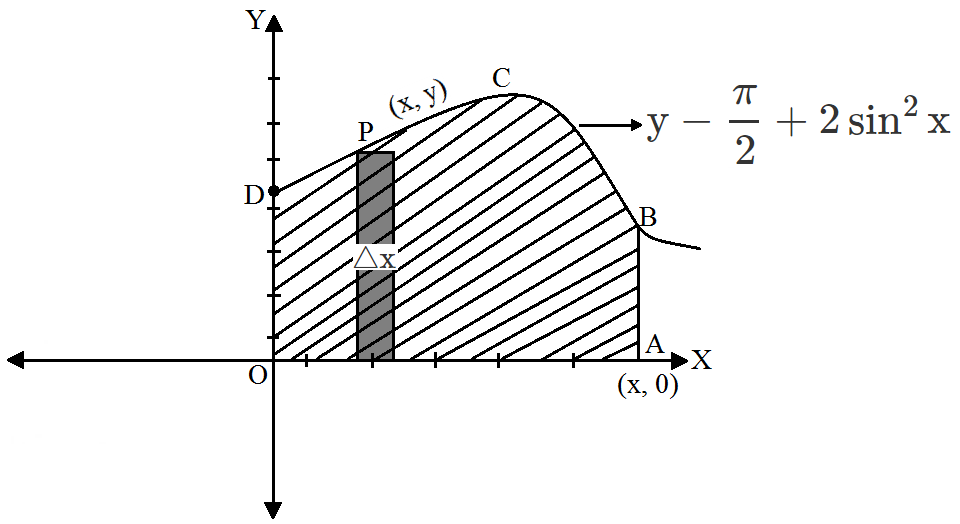
Shaded region represents required area. we slics it into rectangles of width and length = yThe approximation rectangle slides from $\text{x}=0, \text{x}=\pi$
Required area = (Region ABCDO) $=\int\limits_{0}^{\pi} \text{y}\text{dx}$ $=\int\limits_{0}^{\pi}\Big[\frac{\pi}{2}+2\sin^{-1}\text{x}\Big]\text{dx} $ $=\int\limits_{0}^{\pi}\Big[\frac{\pi}{2}+1-\cos2\text{x}\Big]\text{dx} $ $=\int\limits_{0}^{\pi}\Big[\frac{\pi^{2}}{2}+\pi-\frac{\sin2\text{x}}{2}\Big] -(0)$ $=\frac{\pi^{2}}{2}+\pi$ Required area $=\frac{\pi^{2}}{2}+\pi\ \text{sq.}\ \text{units}$ View full question & answer→Question 1345 Marks
using interation, find the area of the region bounded by the triangle ragion, the euations of whose sides are $y = 2x + 1, y = 3x + 1$ and $x = 4$.
AnswerTo find area of triangular region bounded by
$y = 2x + 1$ ...(i)
$y = 3x + 1$ ...(ii)
$y = 4$ ...(iii)
Equation (i) represents a parabola with vertex points(0, 1) and $\Big(-\frac{1}{2}, 0\Big)$ at origin and axis as x-axis and equation (ii) represents points (0, 1) and $\Big(\frac{1}{3}, 0\Big)$ a line parallel to y-axis.
Solving quation (i) and (ii) gives points B(0, 1)
Solving quation (ii) and (iii) gives points C(4, 13)
Solving quation (i) and (iii) gives points B(4, 9)
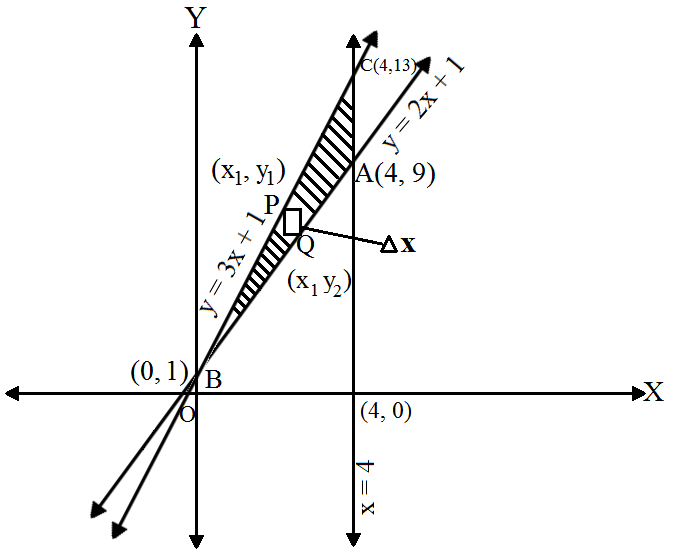
Area of rectargle $= (y_1 - y_2)x$
This apprectximating from x = 0, x = 4
Required area = Redion ABCA
$=\int\limits_{0}^{4}(\text{y}_{1}-\text{y}_{2})\text{dx} $
$=\int\limits_{0}^{4}\Big[3(\text{x}+1)-(2\text{x}+1)\Big]\text{dx} $
$=\int\limits_{0}^{4}\text{x}\text{dx}$
$=\Big[\frac{\text{x}^{2}}{2}\Big]^{4}_{0}$
$=8\ \text{sq.}\ \text{units}$ View full question & answer→Question 1355 Marks
Find the area of the region lying in the first quadrant and bounded by $y = 4x^2, x = 0, y = 1$ and $y = 4$.
AnswerThe area in the first quadrant bounded by $y = 4x^2, x = 0, y = 1$, and $y = 4$ is represented by the shaded area ABCDA as
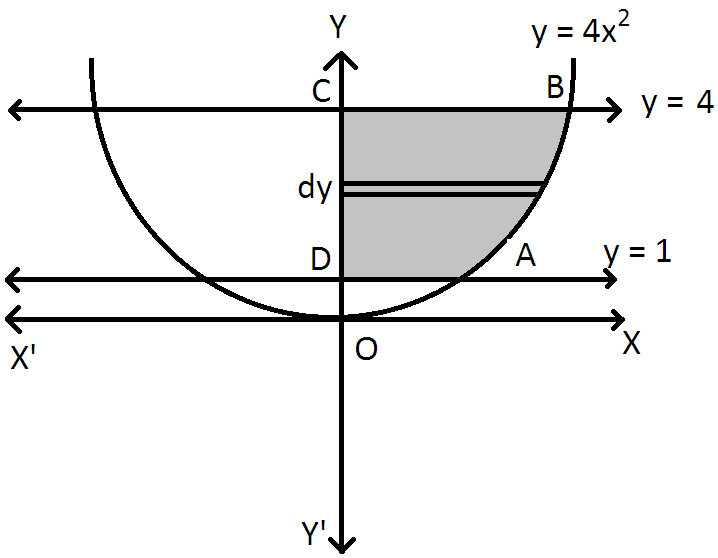
$\therefore\text{Area ABCD}=\int\limits^4_1\text{x dx}$
$=\int\limits^4_1\frac{\sqrt{\text{y}}}{2}\text{dx}$
$=\frac12\Bigg[\frac{\text{y}^{\frac32}}{\frac32}\Bigg]^4_1$
$=\frac13\Big[(4)^{\frac32}-1\Big]$
$=\frac13[8-1]$
$=\frac73\text{ units}.$ View full question & answer→Question 1365 Marks
Find the area enclosed by the parabolas $y= 4x - x^2 $ and $y = x^2 - x.$
Answer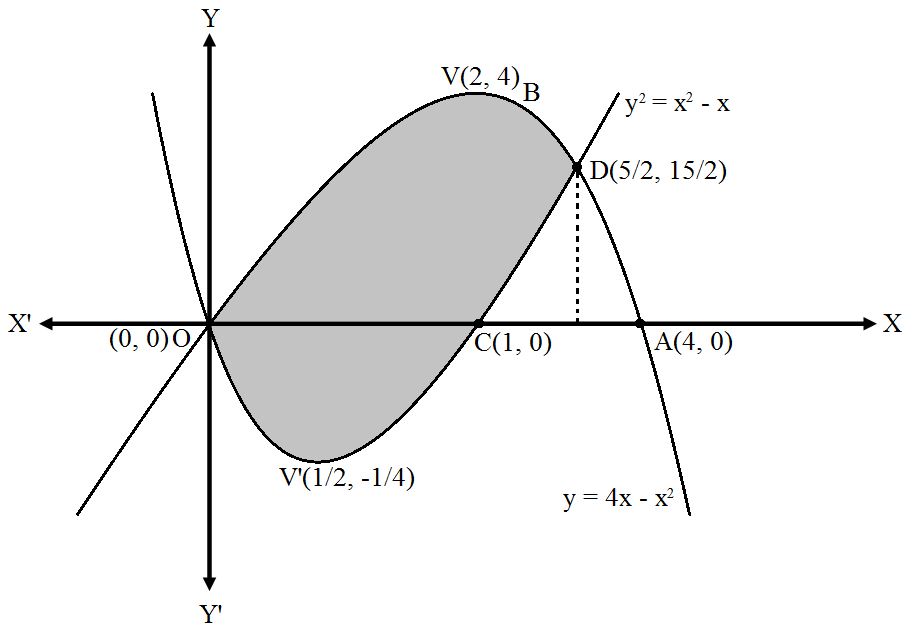
We have, $y = 4x - x^2$ and $y = x^2 - x$
The points intersection of two curve is obtained by solving the simulaneous equations
$\therefore\ \text{x}^2-\text{x}=4\text{x}-\text{x}^2$
$\Rightarrow 2x^2 - 5x = 0$
$\Rightarrow\text{x}=0\text{ or x}=\frac{5}{2}$
$\Rightarrow\text{y}=0\text{ or y}=\frac{15}{4}$
$\Rightarrow O(0, 0)$ and $\text{D}\Big(\frac{5}{2},\frac{15}{4}\Big)$ are points of intersection of two parabolas.
In the shaded area CBDC, consider $P(x, y_2) $ on $y = 4x - x^2$ and $Q(x, y_1)$ on $x^2 - x$
We need to find ratio of area (OBDCO) and area (OCV' O)
Area(OBDCO) = area(OBCO) + area(CBDC)
$=\int\limits^1_0|\text{y}|\text{dx}+\int\limits^{\frac{5}{2}}_1|\text{y}_2-\text{y}_1|\text{dx}$
$=\int\limits^1_0\text{y}\text{ dx}+\int\limits^{\frac{5}{2}}_1(\text{y}_2-\text{y}_1)\text{dx}$
$\{\because\text{y}>0\Rightarrow|\text{y}|=\text{y}\text{ and }|\text{y}_2-\text{y}_1|\Rightarrow\text{y}_2-\text{y}_1\text{ as y}_2>\text{y}_1\}$
$=\int\limits^1_0(4\text{x}-\text{x}^2)\text{dx}+\int\limits^{\frac{5}{2}}_1\big\{\big(4\text{x}-\text{x}^2\big)-\big(\text{x}^2-\text{x}\big)\big\}\text{dx}$
$=\Big[\frac{4\text{x}^2}{2}-\frac{\text{x}^3}{3}\Big]^1_0+\int\limits^{\frac{5}{2}}_1(5\text{x}-2\text{x}^2)\text{dx}$
$=\Big[2\text{x}^2-\frac{\text{x}^3}{3}\Big]^1_0+\Big[\frac{5\text{x}^2}{2}-\frac{2\text{x}^3}{3}\Big]^{\frac{5}{2}}_1$
$=\Big(2-\frac{1}{3}\Big)+\bigg[\frac{5}{2}\Big(\frac{5}{2}\Big)^2-\frac{2}{3}\Big(\frac{5}{2}\Big)^3-\frac{5}{2}+\frac{2}{3}\bigg]$
$=\Big(\frac{5}{3}\Big)+\bigg[\Big(\frac{5}{2}\Big)^3\Big(1-\frac{2}{3}\Big)-\frac{11}{6}\bigg]$
$=\frac{5}{3}+\Big(\frac{5}{2}\Big)^3\frac{1}{3}-\frac{11}{6}$
$=\frac{10-11}{6}+\frac{125}{24}$
$=\frac{121}{24}\text{ sq. units}\ ...(\text{i})$
$\text{Area}(\text{OCV}'\text{O})=\int\limits^1_0|\text{y}|\text{dx}-\int\limits^1_0-\text{y dx}$ $\{\because\text{y}<0\Rightarrow|\text{y}|=-\text{y}\}$
$=\int\limits^1_0-(\text{x}^2-\text{x})\text{dx}$
$=\int\limits^1_0(\text{x}-\text{x}^2)\text{dx}$
$=\Big[\frac{\text{x}^2}{2}-\frac{\text{x}^3}{3}\Big]^1_0$
$=\frac{1}{2}-\frac{1}{3}$
$=\frac{1}{6}\text{ sq. units}\ ...(\text{ii})$
From (i) and (ii)
$\text{Shaded area}=\text{area}(\text{OBDCO})\text{ and area}(\text{OC}\text{V}'\text{O})$
$=\frac{121}{24}+\frac{1}{6}$
$=\frac{125}{24}\text{ sq. units}$ View full question & answer→Question 1375 Marks
Using the method of integration find the area of the triangle ABC, coordinates of whose vertices are A(2, 0), B(4, 5) and C(6, 3).
AnswerThe vertices of $\Delta\text{ ABC}$ are A(2, 0), B(4, 5), and C(6, 3).
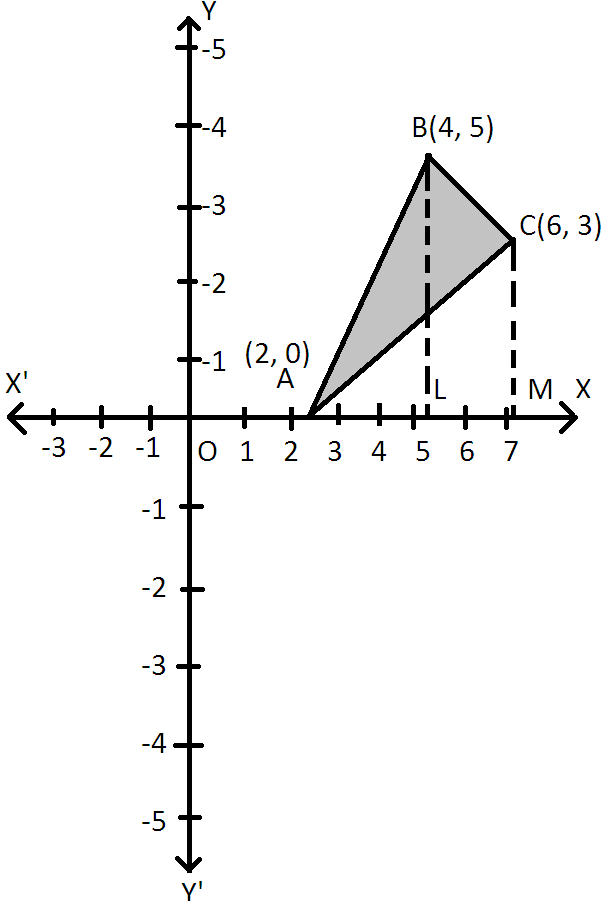
Equation of line segment AB is
$\text{y}-0=\frac{5-0}{4-2}(\text{x}-2)$
$2\text{y}=5\text{x}-10$
$\text{y}=\frac52(\text{x}-2)...(1)$
Equation of line segment BC is
$\text{y}-5=\frac{3-5}{6-4}(\text{x}-4)$
$2\text{y}-10=-2\text{x}+8$
$2\text{y}=-2\text{x}+18$
$\text{y}=-\text{x}+9\dots(2)$
Equation of line segment CA is
$\text{y}-3=\frac{0-3}{2-6}(\text{x}-6)$
$-4\text{y}+12=-3\text{x}+18$
$4\text{y}=3\text{x}-6$
$\text{y}=\frac34(\text{x}-2)\dots(3)$
Area $(\Delta\text{ ABC})$ = Area (ABLA) + Area (BLMCB) - (ACMA)
$=\int\limits^4_2\frac52(\text{x}-2)\text{ dx}+\int\limits^6_4(-\text{x}+9)\text{dx}-\int\limits^6_2\frac34(\text{x}-2)\text{ dx}$
$=\frac52\Big[\frac{\text{x}^2}{2}-2\text{x}\Big]^4_2+\Big[\frac{-\text{x}^2}{2}+9\text{x}\Big]^6_2-\frac34\Big[\frac{\text{x}^2}{2}-2\text{x}\Big]^6_2$
$=\frac52[8-8-2+4]+[-18+54+8-36]$ $-\frac34[18-12-2+4]$
$=5+8-\frac34(8)$
$=13-6\\=7\text{ units}$ View full question & answer→Question 1385 Marks
Find the area under the given curves and given lines:
- $y = x^2, x = 1, x = 2$ and x-axis
- $y = x^4, x = 1, x = 5$ and x-axis.
Answer
- The required area is represented by the shaded area ADCBA as
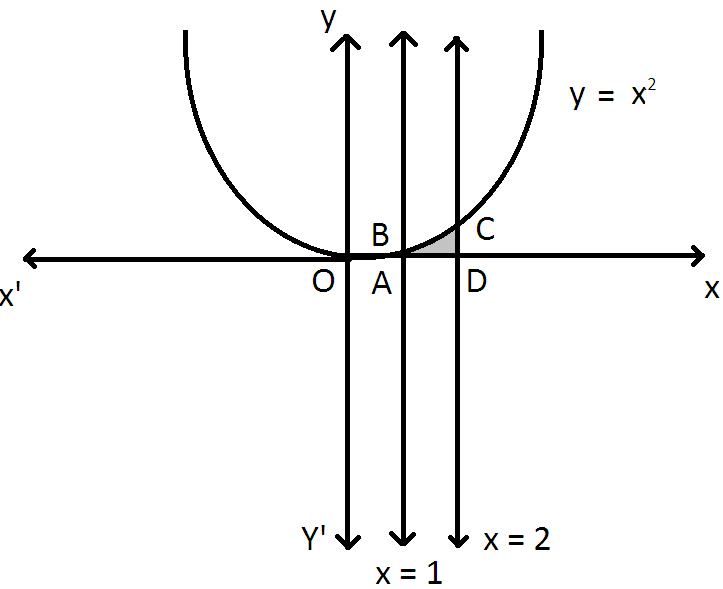
$\text{Area ADCBA}=\int\limits^2_1\text{y dx}$
$=\int\limits^2_1\text{x}^2\text{dx}$
$=\Big[\frac{\text{x}^3}{3}\Big]^2_1$
$=\frac83-\frac13$
$=\frac73\text{ units}$
- The required area is represented by the shaded area ADCBA as
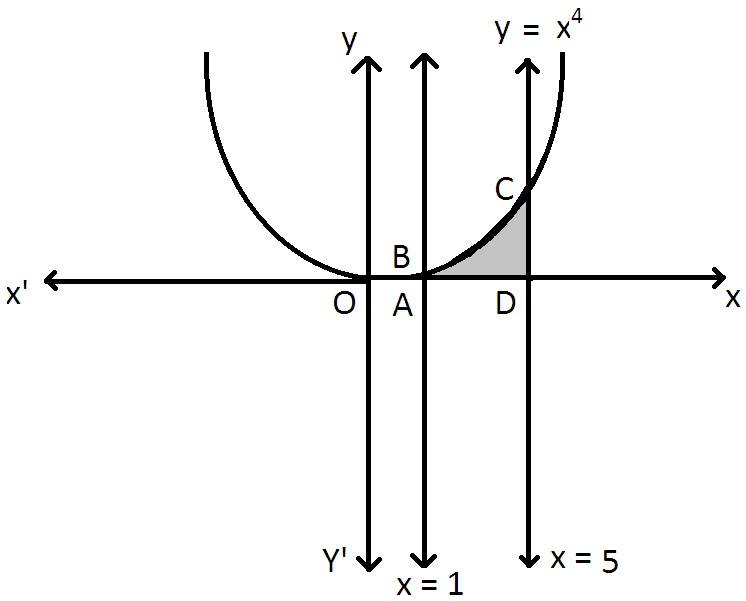
$\text{Area ADCBA}=\int\limits^5_1\text{x}^4\text{dx}$
$=\Big[\frac{\text{x}^5}{5}\Big]^5_1$
$=\frac{(5)^5}{5}-\frac15$
$=(5)^4-\frac15$
$=625-\frac15$
$=624.8\text{ units}$ View full question & answer→Question 1395 Marks
Find the area of the ragion bounded by $x^2 = 16y, y = 1, y = 4$ and the parabola y-axis and the first quadrant.
Answer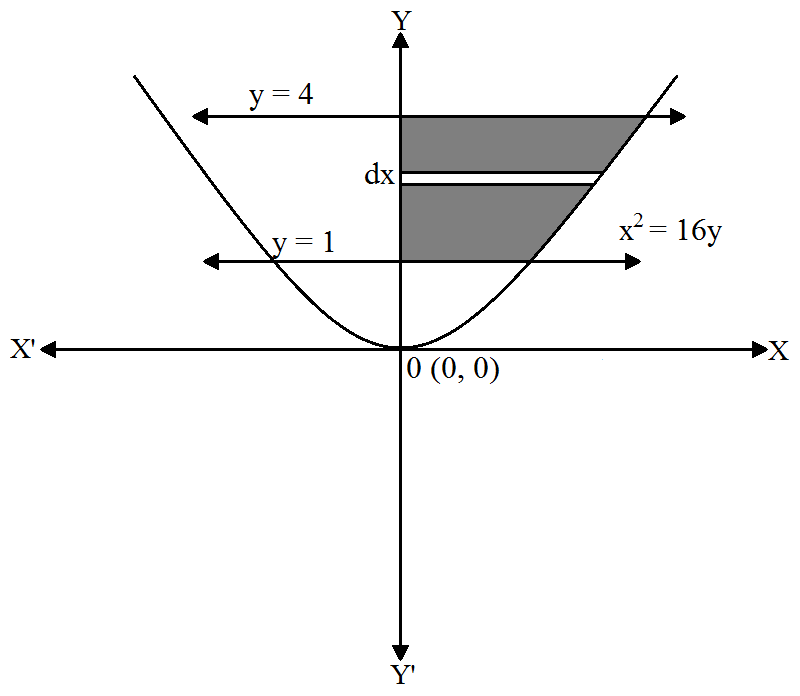
$x^3 = 16 y$ is a paebola, with vertex at $O(0, 0)$
and symmetrical about +ve y-axis
y = 1 is a line parallel to x-acis, cutting parabola at (-4, 1) and (4, 1)
y = 4 is a line parllel to x-axis, cutting parabola at (-8,1 ) and (8, 1 )
Consider a horizontal rectangle = |x| dy
Area of approxinating rectanglr moves from y = 1 to y = 4
Area of the shaded in he first enclsoed y = 1 and y = 4 is the area of the shaded region.
$\therefore$ Area of the curve in the first region $=\int\limits_{1}^{4}|\text{x}|\text{dy} $
$\Rightarrow\text{A}=\int\limits_{1}^{4}\text{x}\text{dy} $
$\Rightarrow\text{A}=\int\limits_{1}^{4}\sqrt{16}\text{y} \ \text{dy}$
$\Rightarrow\text{A}=4\int\limits_{1}^{4}\sqrt{\text{y}}\ \text{dy}$
$\Rightarrow\text{A}=4\Bigg[ \frac{\text{y}^\frac{3}{2}}{\frac{3}{2}}\Bigg]^{4}_{1}$
$\Rightarrow\text{A}=\frac{8}{3}\Big[4^\frac{3}{2}-1^\frac{3}{2}\Big]$
$\Rightarrow\text{A}=\frac{8}{3}\times7$
$\Rightarrow\text{A}=\frac{56}{3}\ \text{sq.}\ \text{units}$ View full question & answer→Question 1405 Marks
Find the area enclosed by the parabola $y = 5x^2$ and $y = 2x^2 + 9$.
Answer
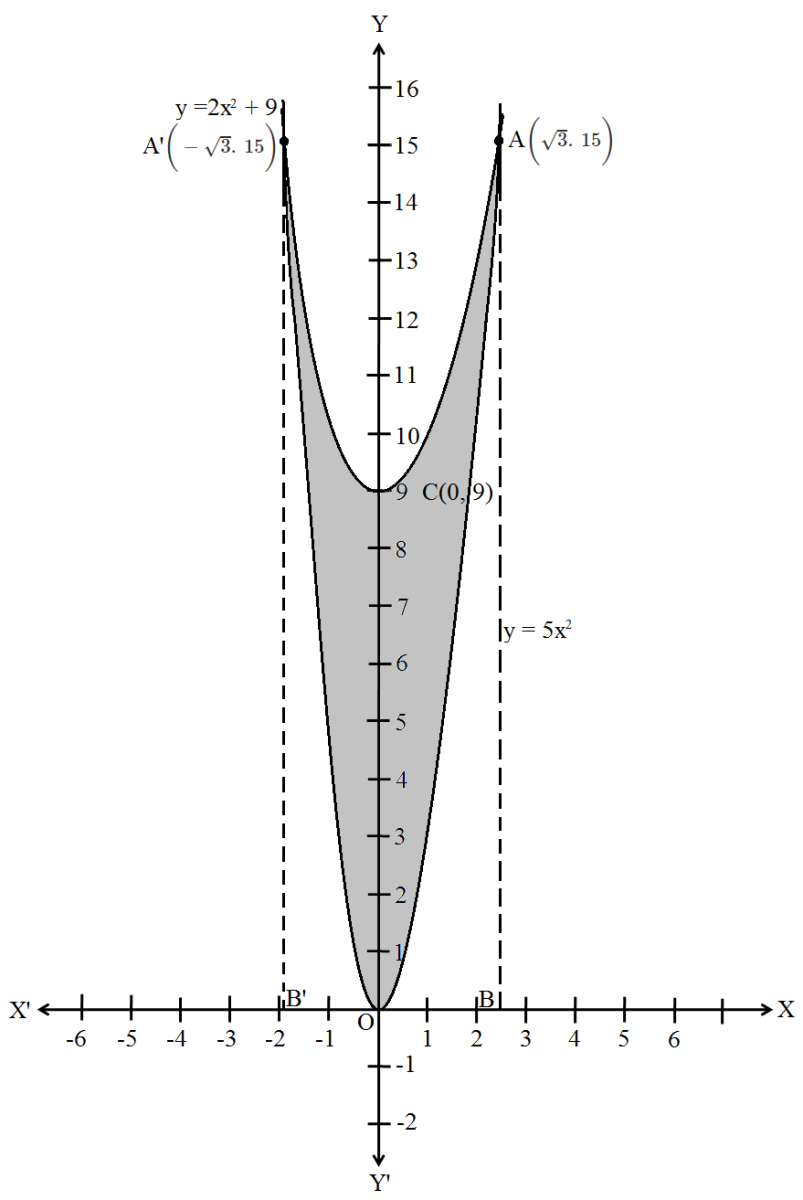
$y = 5x^2$ represents a parabola with vertex at $(0, 0)$ and opiening upward, about +ve y-axis
$y = 2x^2 + 9$ the wider parabola, with vertex at $(0, 9)$
To find points of intersection, solve the two equations
$5\text{x}^{2}=2\text{x}^{2}+9$
$\Rightarrow 3\text{x}^{2}=9$
$\Rightarrow\text{x}=\pm\sqrt{3}$
$\Rightarrow\text{y}=15$
Thus, $\text{A}(\sqrt{3}, 15)$ and $\text'{A}=(-\sqrt{3}, 15)$ are points of the two parbolas.
Shaded area A' OA = 2 × area (OCAO)
Consider a vertical stip of length = $|y_2 - y_1|$ and width = dx
Area of approximating = $|y_2 - y_1| dx$
x = 0, to $\text{x}=\sqrt{3}$
Area (OCAO) = $=\int\limits_{0}^{\sqrt{3}}|\text{y}_{2}-\text{y}_{1}|\text{ dx} =\int\limits_{0}^{\sqrt{3}}(\text{y}_{2}-\text{y}_{1})\text{ dx} $
$=\int\limits_{0}^{\sqrt{3}}(2\text{x}^{2}+9-5\text{x}^{2})\text{ dx}$
$=\int\limits_{0}^{\sqrt{3}}(9-3\text{x}^{2})\text{ dx}$
$=\bigg[\bigg(9\text{x}-3\frac{\text{x}^{3}}{3}\bigg)\text{x}^{2}\text{ dx}\bigg]^{\sqrt{3}}_{0}$
$=9\sqrt{3}-3\sqrt{3}$
$=6 \text{ sq.}\ \text{units}$
Shaded area B' A' AB = 2 area OCAO
$=2\times6\sqrt{3}$
$=12 \sqrt{3}\text{ sq.}\ \text{units} $ View full question & answer→Question 1415 Marks
Find the area enclosed between the parabola $y^2 = 4ax$ and the line $y = mx$.
AnswerThe area enclosed between the parabola, $y^2 = 4ax$, and the, $y = mx$, is represented by the shaded area $OABO$ as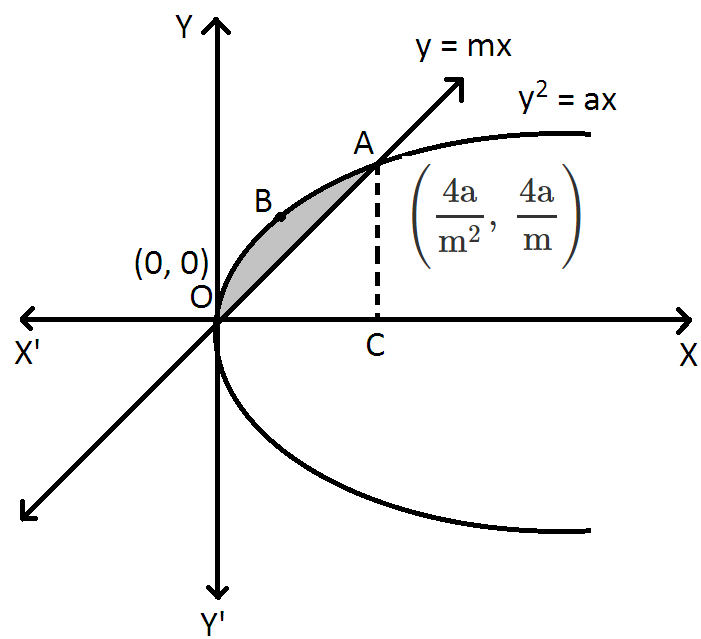
The points of intersection of both the curves are (0, 0) and $\Big(\frac{4\text{a}}{\text{m}^2},\frac{4\text{a}}{\text{m}}\Big).$ We draw AC perpendicular to x-axis. $\therefore$ Area OABO = Area OCABO - Area $(\Delta\text{ OCA})$
$=\int\limits^{\frac{4\text{a}}{\text{m}^2}}_02\sqrt{\text{ax}}\text{ dx}-\int\limits^{\frac{4\text{a}}{\text{m}^2}}_0\text{mx dx}$
$=2\sqrt{\text{a}}\Bigg[\frac{\text{x}^{\frac32}}{\frac32}\Bigg]^{\frac{4\text{a}}{\text{m}^2}}_0-\text{m}\bigg[\frac{\text{x}^2}{2}\bigg]^{\frac{4\text{a}}{\text{m}^2}}_0$
$=\frac43\sqrt{\text{a}}\Big(\frac{4\text{a}}{\text{m}^2}\Big)^{\frac32}-\frac{\text{m}}{2}\bigg[\Big(\frac{4\text{a}}{\text{m}^2}\Big)^2\bigg]$
$=\frac{32\text{a}^2}{3\text{m}^3}-\frac{\text{m}}{2}\Big(\frac{16\text{a}^2}{\text{m}^4}\Big)$
$=\frac{32\text{a}^2}{3\text{m}^3}-\frac{8\text{a}^2}{\text{m}^3}$
$=\frac{8\text{a}^2}{3\text{m}^3}\text{ units}.$ View full question & answer→Question 1425 Marks
find the area of the region ${(x, y) : y^2 < 8x, x^2 + y^2 < 9}.$
Answer
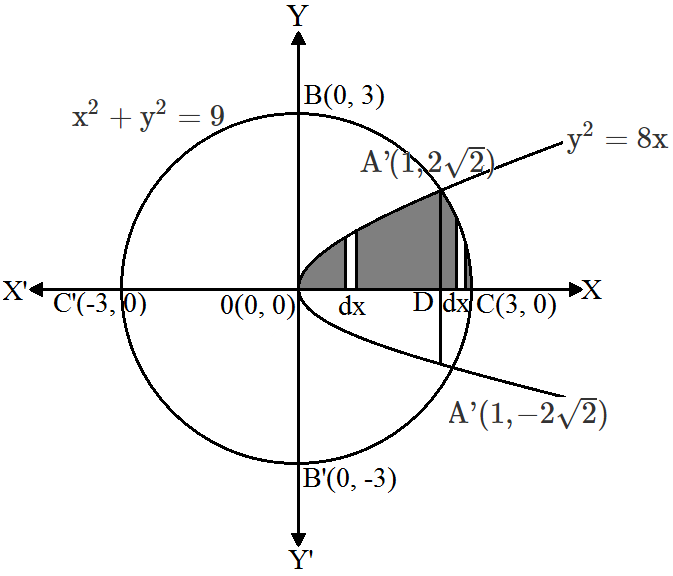
Let$ R = {(x, y) : y^2 < 8x, x^2 + y^2 < 9}.$
$R_1= {(x, y) : y^2 < 8x}$
$R_2 = {(x, y) : x^2 + y^2 < 9}$
Thus, $R = R_1 = R_2$_
Now, $y^2 = 8 $represents a parabolo with vertex $O(0, 0)$ and symmetrical about x-axis
Thus,$ R_1$_such thet $y^2 < 8$ is the circle inside the parabola.
Also,$ x^2 + y^2 = 9$ with center $O(0, 0)$ and radius $3$ units.
The circle cuts at $(3, 0)$ and $(-3, 0)$ and $(0, 3)$
Thus, R2, such that $x^2+ y^2 = 9$ is the area inside the circle
$\Rightarrow \text{R}=\text{R}_{1}\cap\text{R}_{2}\ ... (\text{i})$
$y^2 = 8x$ and $x^2 + y^2 = 9$
$\Rightarrow x^2 + 8x = 9$
$\Rightarrow x^2 + 8x - 9 = 0$
$\Rightarrow (x + 9)(x - 1) = 0$
$\Rightarrow x = -9$ or $x = 1$
Since,
$\Rightarrow y^2 = 8$
Area, $OACO =$ area $OADO +$ area $DACD ...(ii)$
Area $OACO =\int\limits_{0}^{1}\sqrt{8\text{x}}\text{dx} $
$=2\sqrt{2}\bigg[\frac{\text{x}^\frac{3}{2}}{\frac{3}{2}}\bigg]^{1}_{0}$
⇒ Area OADO $=\frac{4\sqrt{2}}{3}\ ... (\text{iii})$
$\therefore$ Area OADO = area bound by x = 1 to x = 3
$\Rightarrow \text{A}=\int\limits_{1}^{3}\sqrt{9-\text{x}}\ \text{dx} $
$=\bigg[\frac{1}{2}\text{x}\sqrt{9-\text{x}^{2}}+\frac{1}{2}9\sin^{-1}\Big(\frac{\text{x}}{3}\Big)\bigg]^{3}_{1}$
$=0+\frac{9}{2}\sin^{-1}\Big(\frac{3}{3}\Big)-\frac{1}{2}\sqrt{9-1^{2}}-\frac{9}{2}\sin^{-1}\Big(\frac{1}{3}\Big)$
$=\frac{9}{2}\sin^{-1}(1)-\frac{1}{2}\sqrt{8}-\frac{9}{2}\sin^{-1}\Big(\frac{1}{3}\Big)$
$=\frac{9}{2}\frac{\pi}{2}-\frac{1}{2}2\sqrt{2}-\frac{9}{2}\sin^{-1}\Big(\frac{1}{3}\Big)$
$={9}\frac{\pi}{2}-\sqrt{2}-\frac{9}{2}\sin^{-1}\Big(\frac{1}{3}\Big)\ ... (\text{iv})$
From eq. (i), (ii), (iii) and (iv)
$=2\bigg[\frac{4\sqrt{2}}{3}+9\frac{\pi}{4}-\sqrt{2}-\frac{9}{2}\sin^{-1}\Big(\frac{1}{3}\Big)\bigg]$
$=2\bigg[\frac{4\sqrt{2}}{3}-\sqrt{2}-9\frac{\pi}{4}-\frac{9}{2}\sin^{-1}\Big(\frac{1}{3}\Big)\bigg]$
$=2\bigg(\frac{\sqrt{2}}{3}+\frac{9\pi}{4}-\frac{9}{2}\sin^{-1}\Big(\frac{1}{3}\Big)\bigg)\ \text{sq.}\ \text{units}$ View full question & answer→Question 1435 Marks
Draw a rough sketch of the region $\big\{(\text{x, y}):\text{y}^2\leq6\text{ax and x}^2+\text{y}^2\leq16\text{a}^2\big\}.$Also find the area of the region sketched using method of integration.
AnswerWe have, $\text{y}^2\leq6\text{ax},$ which represents the region interior to parabola $y^2 = 6ax$ And $\text{x}^2+\text{y}^2\leq16\text{a}^2,$
whic represents the region interior to circle $x^2 + y^2 = 16a^2.$
Solving circle and parabola,
we $get x^2 + 6ax = 16a^2$
$\Rightarrow x^2 + 6ax - 16a^2 = 0$
$\Rightarrow x^2 + 8ax - 2ax - 16a^2 = 0$
$\Rightarrow x(x + 8a) - 2a(x + 8a) = 0$
$\Rightarrow (x - 2a)(x + 8a) = 0$
$\Rightarrow x = 2a, - 8a (as x = -8a$ is not possible)
Putting $x = 2a$ in parabola, we get
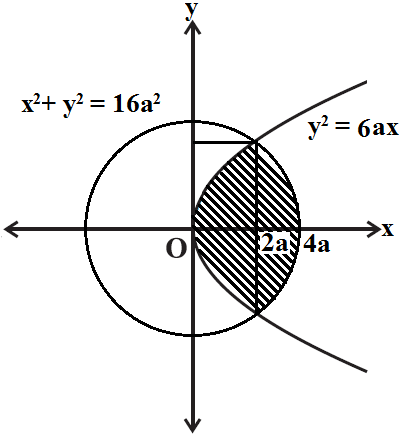
The graph of functions are as shown in the adjacent figure. From the figure, are of the shaded region $\text{A}=2\Bigg[\int\limits^{2\text{a}}_0\sqrt{6\text{a}}\text{x}^{\frac{1}{2}}\text{ dx}+\int\limits^{4\text{a}}_{2\text{a}}\sqrt{(4\text{a}^2)-\text{x}^2}\text{dx}\Bigg]$
$=2\Bigg[\sqrt{6\text{a}}\bigg[\frac{\text{x}^{\frac{3}{2}}}{\frac{3}{2}}\bigg]^{2\text{a}}_0+\bigg(\frac{\text{x}}{2}\sqrt{(4\text{a})^2-\text{x}^2}+\frac{(4\text{a})^2}{2}\sin^{-1}\frac{\text{x}}{4\text{a}}\bigg)^{4\text{a}}_{2\text{a}}\Bigg]$
$=2\Bigg[\sqrt{6\text{a}}\frac{2}{3}((2\text{a})^{\frac{3}{2}}-0)+\frac{4\text{a}}{2}\cdot0+\frac{16\text{a}^2}{2}\cdot\frac{\pi}{2}-\frac{2\text{a}}{2}\sqrt{16\text{a}^2-4\text{a}^2}-\frac{16\text{a}^2}{2}\cdot\sin^{-1}\frac{2\text{a}}{4\text{a}}\Bigg]$
$=2\Bigg[\sqrt{6\text{a}}\frac{2}{3}\cdot2\sqrt{2\text{a}}^{\frac{3}{2}}+0+4\pi\text{a}^2-\frac{2\text{a}}{2}\cdot2\sqrt{3}\text{a}-8\text{a}^2\cdot\frac{\pi}{6}\Bigg]$
$=2\Bigg[\sqrt{12}\cdot\frac{4}{3}\text{a}^2+4\pi\text{a}^2-2\sqrt{3}\text{a}^2-\frac{4\text{a}^2\pi}{3}\Bigg]$
$=2\Bigg[\frac{8\sqrt{3}\text{a}^2+4\pi\text{a}^2-6\sqrt{3}\text{a}^2-4\text{a}^2\pi}{3}\Bigg]$
$=\frac{2}{3}\text{a}^2[8\sqrt{3}+12\pi-6\sqrt{3}-4\pi]$
$=\frac{2}{3}\text{a}^2[2\sqrt{3}+8\pi]=\frac{4}{3}\text{a}^2[\sqrt{3}+4\pi]$ View full question & answer→Question 1445 Marks
Using integration, find the area of the region bounded by the triangle whose vertices are (-1, 0), (1, 3) and (3, 2).
AnswerHere, Vertices of triangle are A(-1, 0), B(1, 3) and C(3, 2).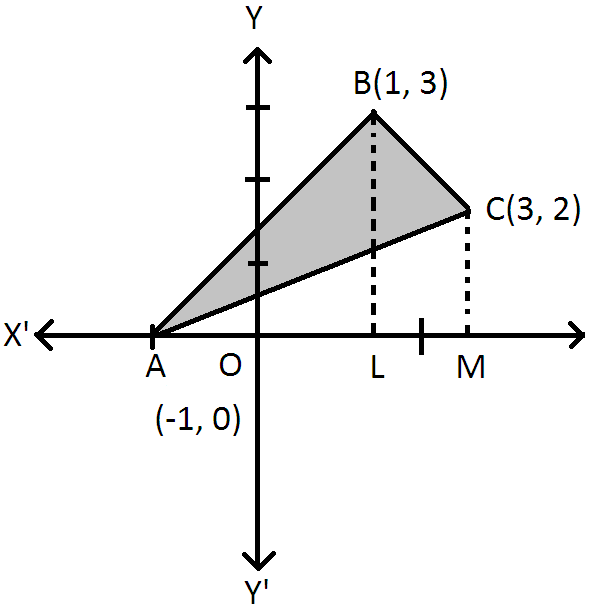
$\therefore$ Equation of the line is $\text{y}-0=\frac{3-0}{1-(-1)}(\text{x}-(-1))$ $\bigg[\therefore\text{y}-\text{y}_1=\frac{\text{y}_2-\text{y}_1}{\text{x}_2-\text{x}_1}(\text{x}-\text{x}_1)\bigg]$ $\Rightarrow\text{y}=\frac32(\text{x}+1)$ $\therefore\text{Area of }\Delta\text{ABL}$ = Area bounded by line AB and x-axis $=\begin{vmatrix}\int\limits^1_{-1}\text{y dx} \end{vmatrix}\Big[\therefore\text{At A, x}=-1\text{ and at B},\text{ x}=1\Big]$ $=\begin{vmatrix}\int\limits^1_{-1}\frac32(\text{x}+1)\text{dx} \end{vmatrix}$ $=\frac32\begin{vmatrix}\int\limits^1_{-1}(\text{x}+1)\text{dx} \end{vmatrix}=\frac32\begin{vmatrix}\bigg(\frac{\text{x}^2}{2}+\text{x}\bigg)^1_{-1} \end{vmatrix}$ $=\frac32\begin{vmatrix}\bigg(\frac{1}{2}+\text{1}\bigg)-\bigg(\frac{1}{2}-\text{1}\bigg)\end{vmatrix}$ $=\frac32\bigg(\frac32+\frac12\bigg)=\frac32.\frac42=3\dots(\text{i})$ Again equation of line BC is $\text{y}-3=\frac{2-3}{3-1}(\text{x}-1)\Rightarrow\text{y}=\frac12(7-\text{x})$ $\therefore$ Area of trapezium BLMC = Area bounded by line BC and x-axis $=\begin{vmatrix}\int\limits^3_{1}\text{y dx} \end{vmatrix}=\begin{vmatrix}\int\limits^3_{1}\frac12(7-\text{x})\text{dx} \end{vmatrix}$ $=\frac12\begin{vmatrix}\bigg(7\text{x}-\frac{\text{x}^2}{2}\bigg)^3_1 \end{vmatrix}$ $=\frac12\begin{vmatrix}\bigg(21-\frac{\text{9}}{2}\bigg)-\bigg(7-\frac{\text{1}}{2}\bigg)\end{vmatrix}$ $=\frac12\bigg(21-\frac{\text{9}}{2}-7+\frac12\bigg)=\frac12\Big(\frac{42-9-14+1}{2}\Big)$ $=\frac14\times20=5\dots(\text{ii})$ Again equation of line AC is $\text{y}-0=\frac{2-0}{3-(-1)}(\text{x}-(-1))\Rightarrow\text{y}=\frac12(\text{x}+1)$ $\therefore$ Area of triangle ACM = Area bounded by line AC and x-axis $=\begin{vmatrix}\int\limits^3_{-1}\text{y dx} \end{vmatrix}=\begin{vmatrix}\int\limits^3_{-1}\frac12(\text{x}+1)\text{dx} \end{vmatrix}=\frac12\begin{vmatrix}\Big(\frac{\text{x}^2}{2}+\text{x}\Big)^3_{-1} \end{vmatrix}$ $=\frac12\begin{vmatrix}\Big(\frac92+3\Big)-\Big(\frac12-1\Big)\end{vmatrix}$ $=\frac12\Big(\frac92+3-\frac12+1\Big)$ $=\frac12\Big(\frac{9+6-1+2}{2}\Big)$ $=\frac14\times16=4\dots(\text{iii})$ $\therefore$ Required area = Area of $\Delta\text{ABL}$ + Area of Trapezium BLMC - Area of $\Delta\text{ACM}$ = 3 + 5 - 4 = 4 sq. units View full question & answer→Question 1455 Marks
Find the area of the bounded by $\text{y}=\sqrt{\text{x}}$ and $y^2 = x$.
AnswerThe curve $\text{y}=\sqrt{\text{x}}$ and $y^2 = x$ represents a parbola poening toward the positive x-axis.
The curve y = x a line passing throught the origin.
Solving $y^2 = x$ and $y = x$, we get
$x^2= x$
$\Rightarrow x^2 - x = 0$
$\Rightarrow x(x - 1) = 0$
$\Rightarrow x = 0 or x = 1$
Thus, the given curve at $(0, 0)$ and $(1, 1)$
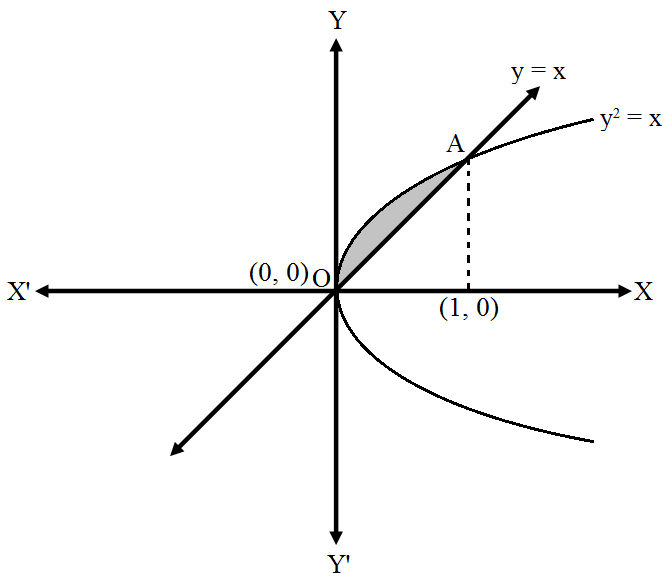
Requried area = Area of the shaded region OAO
$=\int\limits_{0}^{1}\sqrt{\text{x}}\text{ dx}- \int\limits_{0}^{1}\text{x}\text{ dx}$
$=\frac{\text{x}^\frac{3}{2}}{\frac{3}{2}}\Big[-\frac{-\text{x}^{2}}{2}\Big]^{1}_{0}$
$=\frac{2}{3}(1-0)-\frac{1}{2}(1-0)$
$=\frac{2}{3}-\frac{1}{2}$
$=\frac{1}{6}\ \text{sq.}\ \text{units}$ View full question & answer→Question 1465 Marks
Prove that the area common to tha two parabola $y = 2x^2$ and $y = x^2 + 4$ is $323$ sq. units.
Answer
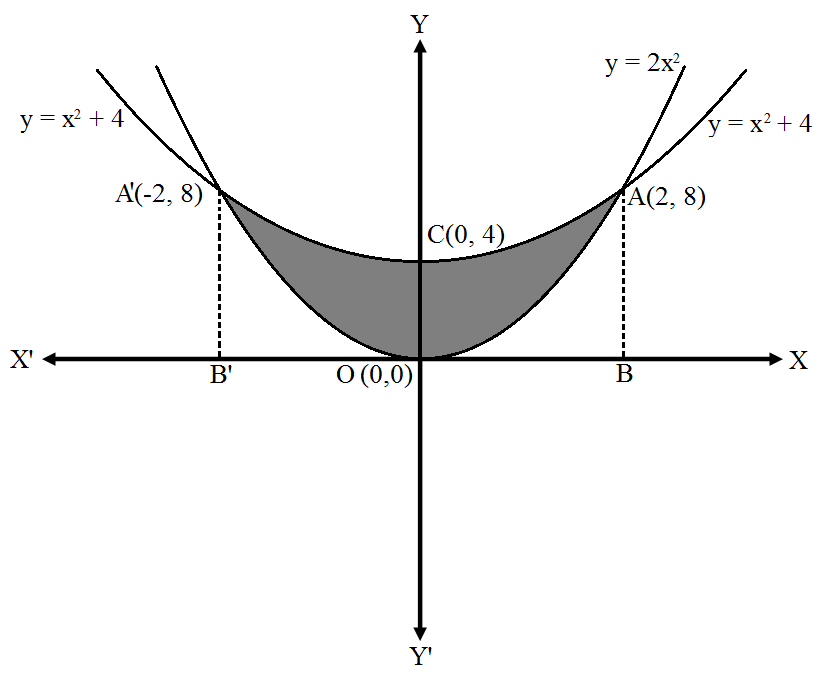
We have, two parabola $y = 2x^2$ and $y = x^2 + 4$
To find points of intersection, solve the two equations
$2\text{x}^{2}=\text{x}^{2}+4$
$\Rightarrow \text{x}^{2}=4$
$\Rightarrow\text{x}=\pm2$
$\Rightarrow\text{y}=4$
Thus, A(2, 4) and A'(-2, 4) are points of the two parbolas.
Shaded area A' OA = 2 × area (OCAO)
Consider a vertical stip of length = $|y_2 - y_1|$ and width = $dx$
Area of approximating = $|y_2 - y_1| ~dx$
$x = 0$, to $\text{x}=\sqrt{3}$
Area (OCAO) $=\int\limits_{0}^{2}|\text{y}_{2}-\text{y}_{1}|\text{ dx} =\int\limits_{0}^{2}(\text{y}_{2}-\text{y}_{1})\text{ dx} $
$=\int\limits_{0}^{2}(\text{x}^{2}+4-2\text{x}^{2})\text{ dx}$
$=\int\limits_{0}^{2}(4-\text{x}^{2})\text{ dx}$
$=\bigg[\bigg(4\text{x}-\frac{\text{x}^{3}}{3}\bigg)\text{ dx}\bigg]^{2}_{0}$
$=8-\frac{8}{2}$
$=\frac{16}{3} \text{ sq.}\ \text{units}$
Shaded area B'A'AB = 2 area OCAO
$=2\times\frac{16}{3}$
$= \frac{32}{3} \text{ sq.}\ \text{units} $ View full question & answer→Question 1475 Marks
Using the method of interation, find the area of the region bounded by the following lines:
3x - y - 3 = 0, 2x + y - 12 = 0, x - 2y - 1 = 0.
Answer
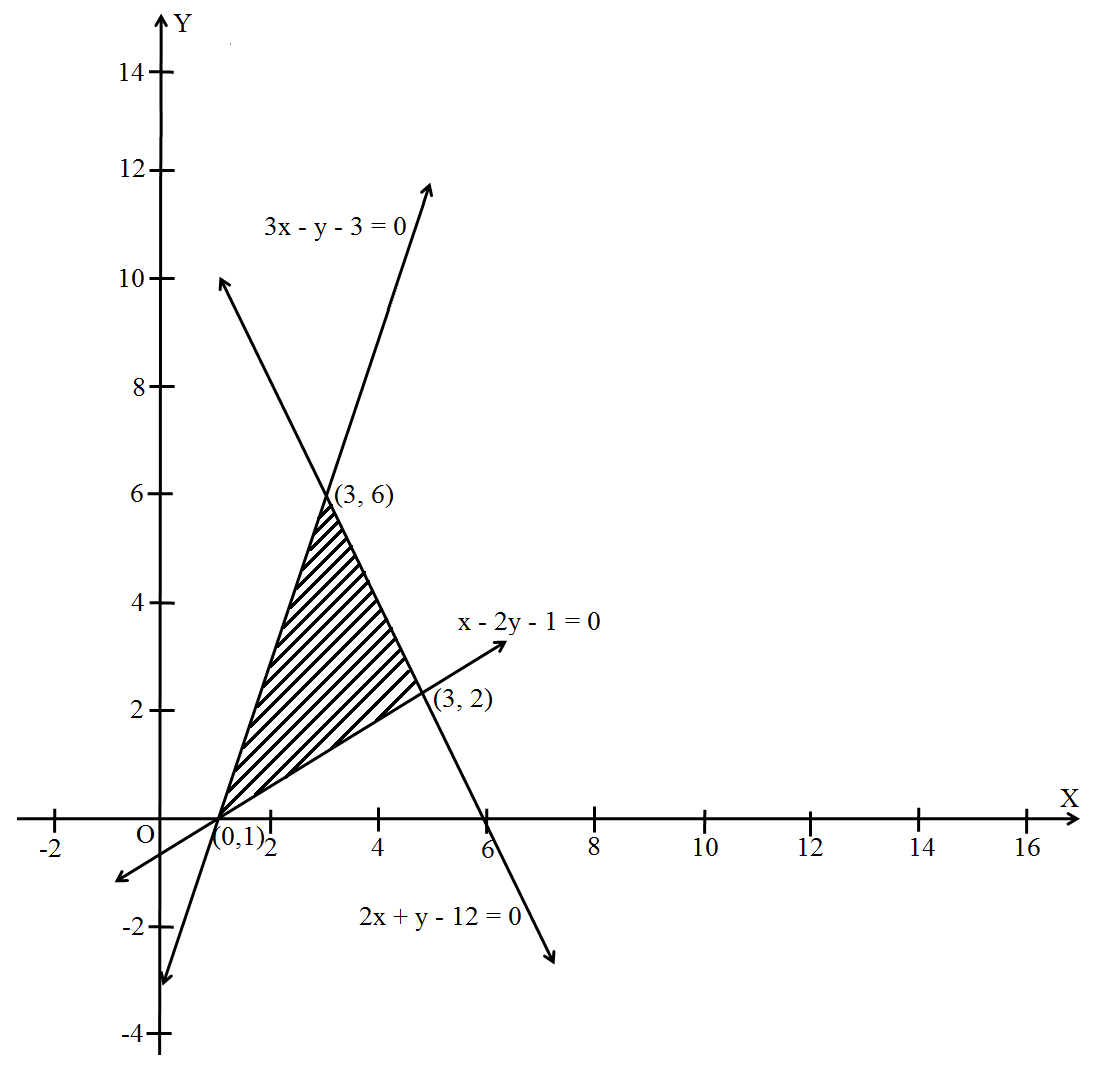 Area of the bounded region
$=\int\limits_{0}^{3}3\text{x}-3-\Big(\frac{\text{x}-1}{2}\Big)\text{ dx}+\int\limits_{2}^{5}12-2\text{x}-\Big(\frac{\text{x}-1}{2}\Big)\text{ dx} $
$=\Big[\frac{3\text{x}^{2}}{2}-3\text{x}-\frac{\text{x}^{2}}{4}+\frac{1}{2}\text{x}\Big]^{0}_{3}+\Big[12\text{x}-2\frac{\text{x}^{2}}{2}-\frac{\text{x}^{4}}{4}+\frac{1}{2}\text{x}\Big]^{5}_{2}$
$=\Big[\frac{27}{2}-9-\frac{9}{4}+\frac{3}{2}\Big]+\Big[60-25-\frac{25}{4}+\frac{5}{2}-36+9+\frac{9}{2}-\frac{3}{2}\Big]$
$=11\ \text{sq.}\ \text{units}$ View full question & answer→Question 1485 Marks
Determine the area under the cutve $\text{y}=\sqrt{\text{x}^{2}-\text{x}^{2}}$ included between the lines $x = 0$ and $x = a$.
Answer
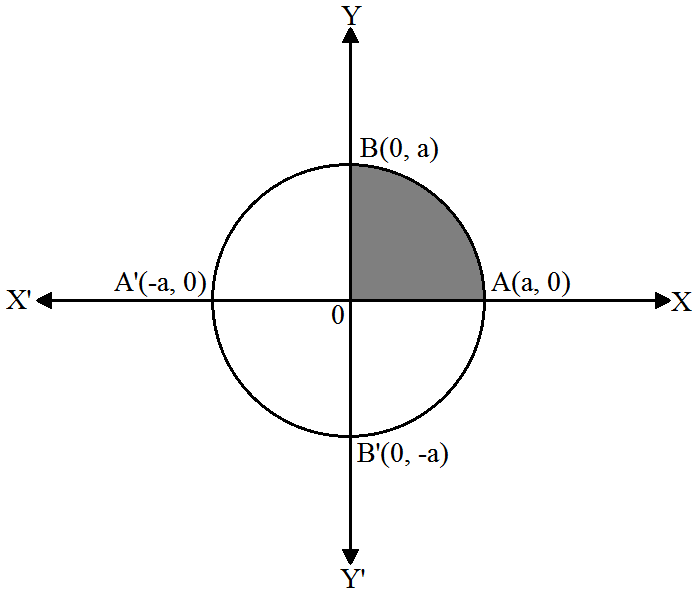
We have,
$\text{y}=\sqrt{\text{a}^{2}-\text{x}^{2}}$
$\Rightarrow \text{y}^{2}={\text{a}^{2}-\text{x}^{2}}$
$\Rightarrow \text{x}^{2}+\text{y}^{2}=\text{a}^{2}$
Since in the given equation $x^2 + y^2 = a^2$
all the powers of both x and y are even, the curve is symmetrical about both the axis.
$\therefore$ Area encloed by the curve and above x-axis = area A'BA = 2 × area enclosed by ellipse and x-axis in first quadrant
(a, 0), (-a, 0) are the points of intersection of curve and x-axis
(0, a), (0, a) are the points of intersection of curve and x-axis
Slicling the area in the first quadrant into vertical stripes of height = |y| and width = dx
$\therefore$ Area of approximating rectangle = |y| dx
Appoximating rectangle can move between x = 0 and x = a
A = Area of enclosed curve in the first $=\int\limits_{0}^{a}|\text{y}|\text{dx} $
$\Rightarrow \text{A}=\int\limits_{0}^{a}\sqrt{\text{a}^{2}-\text{x}^{2}}\text{dx}$
$\Rightarrow \Bigg[\frac{1}{2}\text{x}\sqrt{\text{a}^{2}-\text{x}^{2}}+\frac{1}{2}\text{a}^{2}\sin^{-1}\frac{\text{x}}{\text{a}}\Bigg]^{\text{a}}_{0}$
$=\frac{1}{2}\text{a}^{2}\sin^{-1}1$
$=\frac{1}{2}\text{a}^{2}\frac{\pi}{2}$
$=\frac{\text{a}^{2}\pi}{4}\ \text{sq.}\ \text{units}$ View full question & answer→Question 1495 Marks
Find the area of the region bounded by the parabola $y^2 = 2px, x^2 = 2py$.
AnswerSolving $y^2 = 2px$ and $x^2 = 2py$, we get $\therefore\ \text{y}=\sqrt{2\text{px}}$
$\Rightarrow\ \text{x}^2=2\text{p}\cdot\sqrt{2\text{px}}$
$\Rightarrow\ \text{x}^4=4\text{p}^2\cdot(2\text{px})$
$\Rightarrow\ \text{x}^4=8\text{p}^3\text{x}$
$\Rightarrow\ \text{x}^4-8\text{p}^3\text{x}=0$
$\Rightarrow\ \text{x}(\text{x}^3-8\text{p}^3)=0$
$\Rightarrow\ \text{x}=0\text{ and x}^3=8\text{p}^3$
$\Rightarrow\ \text{x}=0,2\text{p}$ When x = 0, y = 0 and when x = 2p, y = 2p So, the points of intersection are (0, 0) and (2p, 2p) Now the graph of the parabola $y^2 = 2px, x^2 = 2py$ is as shown below:
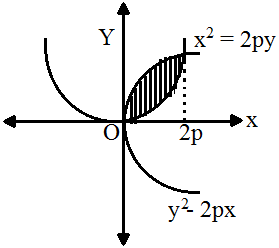
Thus, the required area = Area of the shaded region, $\text{A}=\int\limits^{2\text{p}}_0\Big(\sqrt{2\text{px}}-\frac{\text{x}^2}{2\text{p}}\Big)\text{dx}$
$=\int\limits^{2\text{p}}_0\sqrt{2\text{px}}\text{ dx}-\int\limits^{2\text{p}}_0\frac{\text{x}^2}{2\text{p}}\text{dx}$
$=\sqrt{2\text{p}}\int\limits^{2\text{p}}_0\text{x}^{\frac{1}{2}}\text{dx}-\frac{1}{\text{p}}\int\limits^{2\text{p}}_0\text{x}^2\text{dx}$
$=\sqrt{2\text{p}}\bigg[\frac{2(\text{x})^{\frac{3}{2}}}{3}\bigg]^{2\text{p}}_0-\frac{1}{2\text{p}}\Big[\frac{\text{x}^3}{3}\Big]^{2\text{p}}_0$
$=\sqrt{2\text{p}}\Big[\frac{2}{3}\cdot(2\text{p})^{\frac{3}{2}}-0\Big]-\frac{1}{2\text{p}}\Big[\frac{1}{3}(2\text{p})^3-0\Big]$
$=\sqrt{2\text{p}}\Big(\frac{2}{3}\cdot2\sqrt{2}\text{ p}^{\frac{3}{2}}\Big)-\frac{1}{2\text{p}}\Big[\frac{1}{3}8\text{p}^3\Big]$
$=\sqrt{2\text{p}}\Big(\frac{4\sqrt{2}}{3}\text{p}^{\frac{3}{2}}\Big)\frac{1}{2\text{p}}\Big(\frac{8}{3}\text{p}^3\Big)$
$=\frac{4\sqrt{2}}{3}\cdot\sqrt{2}\text{ p}^2\frac{8}{6}\text{p}^2$
$=\frac{(16-8)\text{p}^2}{6}=\frac{8}{6}\text{p}^2$
$=\frac{4\text{p}^2}{3}\text{ sq. units}$ View full question & answer→Question 1505 Marks
Find the area of the region $\left\{(\text{x},\ \text{y}):\text{y}^2\leq4\text{x},\ 4\text{x}^2+4\text{x}^2\leq9\right\}.$
AnswerThe area bounded by the curves $\left\{(\text{x},\ \text{y}):\text{y}^2\leq4\text{x},\ 4\text{x}^2+4\text{x}^2\leq9\right\}.$ is represented as.
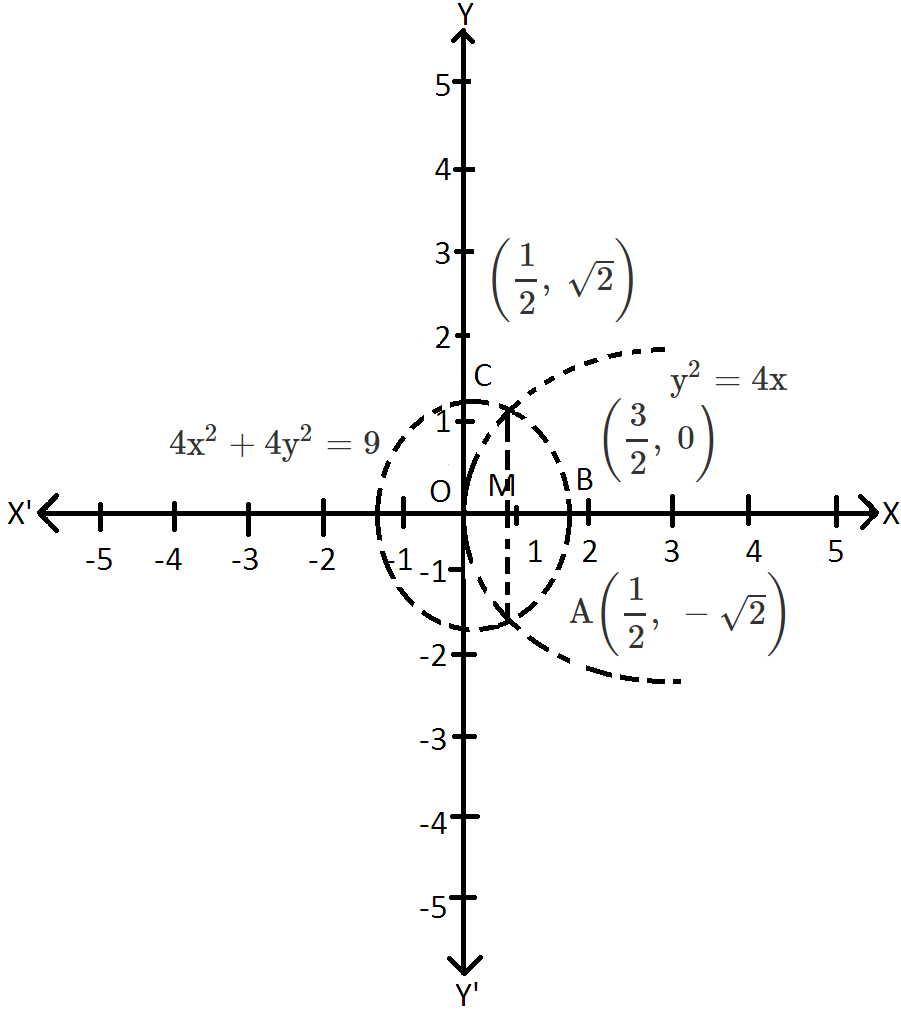
The points of intersection of both the curves are $\Big(\frac12,\ \sqrt2\Big)\text{ and }\Big(\frac12,\ -\sqrt2\Big).$
The required area is given by OABCO.
It can be observed that area OABCO is symmetrical about x-axis.
$\therefore$ Area OABCO = 2 × Area OBC
Area OBCO = Area OMC + Area MBC
$=\int\limits^{\frac12}_02\sqrt{\text{x}}\text{ dx}+\int\limits^{\frac32}_{\frac12}\frac12\sqrt{9-4\text{x}^2}\text{ dx}$
$=\int\limits^{\frac12}_02\sqrt{\text{x}}\text{ dx}+\int\limits^{\frac32}_{\frac12}\frac12\sqrt{(3)^2-(2\text{x})^2}\text{ dx}$ View full question & answer→