Questions · Page 1 of 11

M.C.Q (1 Marks)

🎯

Test yourself on this topic

50 questions · timed · auto-graded

MCQ 11 Mark
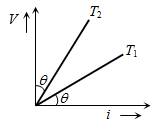
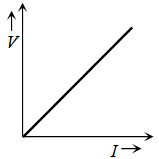
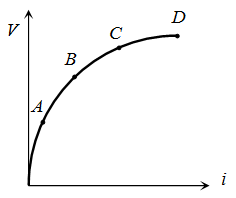
The V-i graph for a conductor makes an angle θ with V-axis. Here V denotes the voltage and i denotes current. The resistance of conductor is given by
  • A
    sin θ
  • B
    cos θ
  • C
    tan θ
  • cot θ
Answer
Correct option: D.
cot θ
cot θ
View full question & answer
MCQ 21 Mark
Assertion : A person touching a high power line gets stuck with the line.
Reason : The current carrying wires attract the man towards it.
  • A
     If both assertion and reason are true and the reason is the correct explanation of the assertion.
  • B
     If both assertion and reason are true but reason is not the correct explanation of the assertion.
  • C
     If assertion is true but reason is false.
  •  If the assertion and reason both are false.
Answer
Correct option: D.
 If the assertion and reason both are false.
If the assertion and reason both are false.
View full question & answer
MCQ 31 Mark
Assertion : A potentiometer of longer length is used for accurate measurement.
Reason : The potential gradient for a potentiometer of longer length with a given source of e.m.f. becomes small.
  • If both assertion and reason are true and the reason is the correct explanation of the assertion.
  • B
    If both assertion and reason are true but reason is not the correct explanation of the assertion.
  • C
    If assertion is true but reason is false.
  • D
    If the assertion and reason both are false.
Answer
Correct option: A.
If both assertion and reason are true and the reason is the correct explanation of the assertion.
View full question & answer
MCQ 41 Mark
Assertion : The resistance of super-conductor is zero.
Reason : The super-conductors are used for the transmission of electric power.
  • A
     If both assertion and reason are true and the reason is the correct explanation of the assertion.
  •  If both assertion and reason are true but reason is not the correct explanation of the assertion.
  • C
     If assertion is true but reason is false.
  • D
    If the assertion and reason both are false.
Answer
Correct option: B.
 If both assertion and reason are true but reason is not the correct explanation of the assertion.
 If both assertion and reason are true but reason is not the correct explanation of the assertion.
View full question & answer
MCQ 51 Mark
Assertion : Electric field outside the conducting wire which carries a constant current is zero.
Reason : Net charge on conducting wire is zero.
  • If both assertion and reason are true and the reason is the correct explanation of the assertion.
  • B
    If both assertion and reason are true but reason is not the correct explanation of the assertion.
  • C
    If assertion is true but reason is false.
  • D
    If the assertion and reason both are false.
Answer
Correct option: A.
If both assertion and reason are true and the reason is the correct explanation of the assertion.
View full question & answer
MCQ 61 Mark
Assertion : In meter bridge experiment, a high resistance is always connected in series with a galvanometer.
Reason : As resistance increases current through the circuit increases.
  • A
     If both assertion and reason are true and the reason is the correct explanation of the assertion.
  • B
    If both assertion and reason are true but reason is not the correct explanation of the assertion.
  • If assertion is true but reason is false.
  • D
     If the assertion and reason both are false.
Answer
Correct option: C.
If assertion is true but reason is false.
View full question & answer
MCQ 71 Mark
Assertion : Bending a wire does not effect electrical resistance.
Reason : Resistance of wire is proportional to resistivity of material.
  • If both assertion and reason are true and the reason is the correct explanation of the assertion.
  • B
     If both assertion and reason are true but reason is not the correct explanation of the assertion.
  • C
    If assertion is true but reason is false.
  • D
     If the assertion and reason both are false.
Answer
Correct option: A.
If both assertion and reason are true and the reason is the correct explanation of the assertion.
 If both assertion and reason are true and the reason is the correct explanation of the assertion.
View full question & answer
MCQ 81 Mark
Assertion : The electric bulbs glows immediately when switch is on.
Reason : The drift velocity of electrons in a metallic wire is very high.
  • A
     If both assertion and reason are true and the reason is the correct explanation of the assertion.
  • B
    If both assertion and reason are true but reason is not the correct explanation of the assertion.
  • If assertion is true but reason is false.
  • D
    If the assertion and reason both are false.
Answer
Correct option: C.
If assertion is true but reason is false.
 If assertion is true but reason is false.
View full question & answer
MCQ 91 Mark
Assertion : The drift velocity of electrons in a metallic wire will decrease, if the temperature of the wire is increased.
Reason : On increasing temperature, conductivity of metallic wire decreases.
  • A
    If both assertion and reason are true and the reason is the correct explanation of the assertion.
  • If both assertion and reason are true but reason is not the correct explanation of the assertion.
  • C
    If assertion is true but reason is false.
  • D
    If the assertion and reason both are false.
Answer
Correct option: B.
If both assertion and reason are true but reason is not the correct explanation of the assertion.
 If both assertion and reason are true but reason is not the correct explanation of the assertion.
View full question & answer
MCQ 101 Mark
Assertion : Electric appliances with metallic body have three connections, whereas an electric bulb has a two pin connection.
Reason : Three pin connections reduce heating of connecting wires.
  • A
    If both assertion and reason are true and the reason is the correct explanation of the assertion.
  • B
    If both assertion and reason are true but reason is not the correct explanation of the assertion.
  • If assertion is true but reason is false.
  • D
    If the assertion and reason both are false.
Answer
Correct option: C.
If assertion is true but reason is false.
 If assertion is true but reason is false.
View full question & answer
MCQ 111 Mark
Assertion : In a simple battery circuit the point of lowest potential is positive terminal of the battery
Reason : The current flows towards the point of the higher potential as it flows in such a circuit from the negative to the positive terminal.
  • A
    If both assertion and reason are true and the reason is the correct explanation of the assertion.
  • B
    If both assertion and reason are true but reason is not the correct explanation of the assertion.
  • C
     If assertion is true but reason is false.
  •  If the assertion and reason both are false.
Answer
Correct option: D.
 If the assertion and reason both are false.
 If the assertion and reason both are false.
View full question & answer
MCQ 121 Mark
Assertion : The temperature coefficient of resistance is positive for metals and negative for p-type semiconductor.
Reason : The effective charge carriers in metals are negatively charged whereas in p-type semiconductor they are positively charged.
  • A
    If both assertion and reason are true and the reason is the correct explanation of the assertion.
  •  If both assertion and reason are true but reason is not the correct explanation of the assertion.
  • C
    If assertion is true but reason is false.
  • D
     If the assertion and reason both are false.
Answer
Correct option: B.
 If both assertion and reason are true but reason is not the correct explanation of the assertion.
 If both assertion and reason are true but reason is not the correct explanation of the assertion.
View full question & answer
MCQ 131 Mark
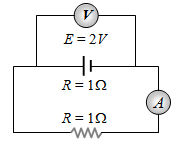
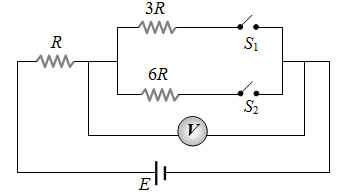
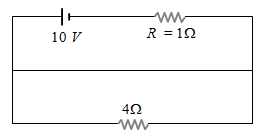
Assertion : In the following circuit emf is 2V and internal resistance of the cell is 1$\Omega$ and R = 1$\Omega$, then reading of the voltmeter is 1V.


Reason : V = E - ir where E = 2V, i = $\frac{2}{2}=1 \mathrm{~A}$ and R = 1 $\Omega$
  • If both assertion and reason are true and the reason is the correct explanation of the assertion.
  • B
    If both assertion and reason are true but reason is not the correct explanation of the assertion.
  • C
    If assertion is true but reason is false.
  • D
    If the assertion and reason both are false.
Answer
Correct option: A.
If both assertion and reason are true and the reason is the correct explanation of the assertion.
(a) If both assertion and reason are true and the reason is the correct explanation of the assertion.
View full question & answer
MCQ 141 Mark
Assertion : There is no current in the metals in the absence of electric field.
Reason : Motion of free electron are randomly.
  •  If both assertion and reason are true and the reason is the correct explanation of the assertion.
  • B
     If both assertion and reason are true but reason is not the correct explanation of the assertion.
  • C
     If assertion is true but reason is false.
  • D
    If the assertion and reason both are false.
Answer
Correct option: A.
 If both assertion and reason are true and the reason is the correct explanation of the assertion.
If both assertion and reason are true and the reason is the correct explanation of the assertion.
View full question & answer
MCQ 151 Mark
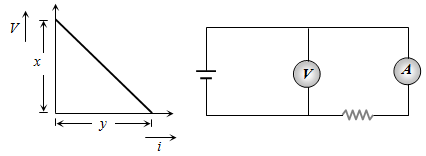
In an experiment, a graph was plotted of the potential difference V between the terminals of a cell against the circuit current i by varying load rheostat. Internal conductance of the cell is given by
  • A
    xy
  • $\frac {y}{x}$
  • C
    $\frac {x}{y}$
  • D
    (x – y)
Answer
Correct option: B.
$\frac {y}{x}$
(b) $\frac {y}{x}$
View full question & answer
MCQ 161 Mark
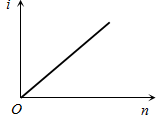
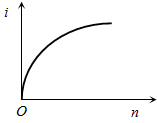
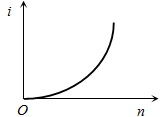
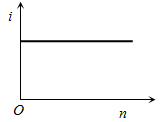
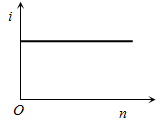
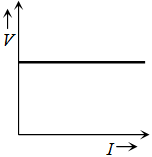
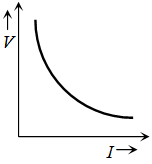
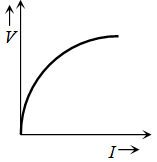
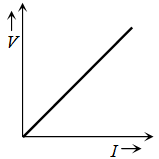
A battery consists of a variable number 'n' of identical cells having internal resistances connected in series. The terminals of battery are short circuited and the current i is measured. Which of the graph below shows the relation ship between i and n
  • A
  • B
  • C
Answer
Correct option: D.
(d)
View full question & answer
MCQ 171 Mark
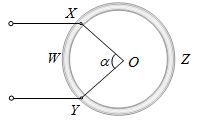
A wire of resistor R is bent into a circular ring of radius r. Equivalent resistance between two points X and Y on its circumference, when angle XOY is a, can be given by
  • $\frac{R \alpha}{4 \pi^2}(2 \pi-\alpha)$
  • B
    $\frac{R}{2 \pi}(2 \pi-\alpha)$
  • C
    $R(2 \pi-\alpha)$
  • D
    $\frac{4 \pi}{\mathrm{R} \alpha}(2 \pi-\alpha)$
Answer
Correct option: A.
$\frac{R \alpha}{4 \pi^2}(2 \pi-\alpha)$
(a) $\frac{R \alpha}{4 \pi^2}(2 \pi-\alpha)$
View full question & answer
MCQ 181 Mark
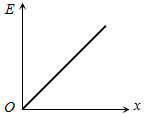
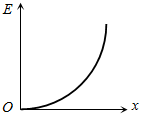
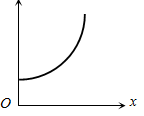
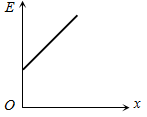
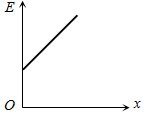
A cylindrical conductor has uniform cross-section. Resistivity of its material increase linearly from left end to right end. If a constant current is flowing through it and at a section distance x from left end, magnitude of electric field intensity is E, which of the following graphs is correct
  • A
  • C
  • D
Answer
Correct option: B.
(b)
View full question & answer
MCQ 191 Mark
The V-i graph for a conductor at temperature $T_1$ and $T_2$ are as shown in the figure. $(T_1-T_2)$ is proportional to

  • A
    cos2θ
  • B
    sin θ
  • cot 2θ
  • D
    tan θ
Answer
Correct option: C.
cot 2θ
(c) cot 2θ
View full question & answer
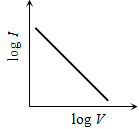
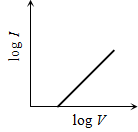
MCQ 201 Mark
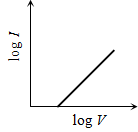
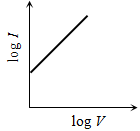
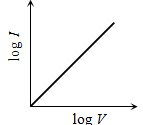
When a current I is passed through a wire of constant resistance, it produces a potential difference V across its ends. The graph drawn between log I and log V will be
  • B
  • C
  • D
Answer
Correct option: A.
(a)
View full question & answer
MCQ 211 Mark
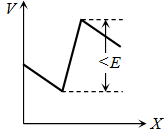
The graph which represents the relation between the total resistance R of a multi range moving coil voltmeter and its full scale deflection V is
  • A
    (i)
  • B
    (ii)
  • C
    (iii)
  • (iv)
Answer
Correct option: D.
(iv)
(d) (iv)
View full question & answer
MCQ 221 Mark
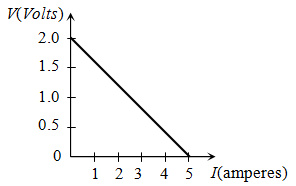
For a cell, the graph between the potential difference (V) across the terminals of the cell and the current (I) drawn from the cell is shown in the figure. The e.m.f. and the internal resistance of the cell are
  • A
    2V, 0.5Ω
  • 2V, 0.4 Ω
  • C
    >2V, 0.5 Ω
  • D
    > 2V, 0.4 Ω
Answer
Correct option: B.
2V, 0.4 Ω
(b) 2V, 0.4 Ω
View full question & answer
MCQ 241 Mark
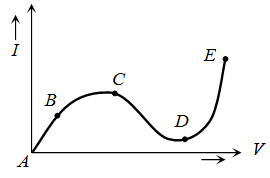
Variation of current passing through a conductor as the voltage applied across its ends as varied is shown in the adjoining diagram. If the resistance (R) is determined at the points A, B, C and D, we will find that
  • A
    $R_C = R_D$
  • B
    $R_B > R_A$
  • C
    $R_C > R_B$
  • None of these
Answer
Correct option: D.
None of these
(d) None of these
View full question & answer
MCQ 251 Mark
The voltage V and current I graph for a conductor at two different temperatures $\mathrm T_1$ and $\mathrm T_2$ are shown in the figure. The relation between $\mathrm T_1$ and $\mathrm T_2$ is
  • $\mathrm{T}_1>\mathrm{T}_2$
  • B
    $\mathrm{T}_1 \approx \mathrm{T}_2$
  • C
    $\mathrm{T}_1=\mathrm{T}_2$
  • D
    $\mathrm{T}_1<\mathrm{T}_2$
Answer
Correct option: A.
$\mathrm{T}_1>\mathrm{T}_2$
(a) $\mathrm{T}_1>\mathrm{T}_2$
View full question & answer
MCQ 261 Mark
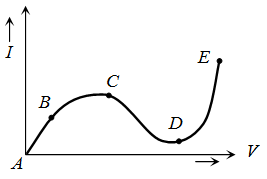
From the graph between current I and voltage V shown below, identify the portion corresponding to negative resistance
  • A
    AB
  • B
    BC
  • CD
  • D
    DE
Answer
Correct option: C.
CD
(c) CD
View full question & answer
MCQ 271 Mark
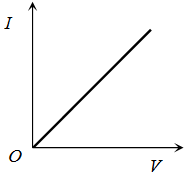
I-V characteristic of a copper wire of length L and area of cross-section A is shown in figure. The slope of the curve becomes

  • A
     More if the experiment is performed at higher temperature
  • B
     More if a wire of steel of same dimension is used
  • C
    More if the length of the wire is increased
  • Less if the length of the wire is increased
Answer
Correct option: D.
Less if the length of the wire is increased
(d) Less if the length of the wire is increased
View full question & answer
MCQ 281 Mark
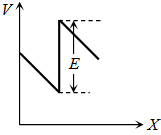
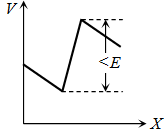
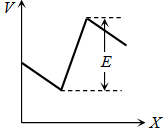
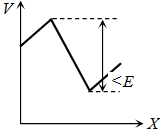
The two ends of a uniform conductor are joined to a cell of e.m.f. E and some internal resistance. Starting from the midpoint P of the conductor, we move in the direction of current and return to P. The potential V at every point on the path is plotted against the distance covered (x). Which of the following graphs best represents the resulting curve
 
  • A
  • C
  • D
Answer
Correct option: B.
(b)
View full question & answer
MCQ 291 Mark
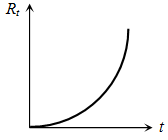
The resistance $R_t$ of a conductor varies with temperature t as shown in the figure. If the variation is represented by$R_t=R_0\left[1+\alpha t+\beta t^2\right]$, then

  • A
    α and β are both negative
  • α and β are both positive
  • C
    α is positive and β is negative
  • D
    α is negative and β are positive
Answer
Correct option: B.
α and β are both positive
(b) α and β are both positive
View full question & answer
MCQ 301 Mark
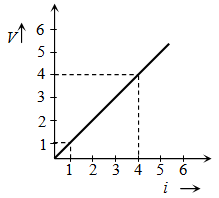
Variation of current and voltage in a conductor has been shown in the diagram below. The resistance of the conductor is
  • A
    4 ohm
  • B
    2 ohm
  • C
    3 ohm
  • 1 ohm
Answer
Correct option: D.
1 ohm
(d) 1 ohm
View full question & answer
MCQ 311 Mark
A moving coil galvanometer has 150 equal divisions. Its current sensitivity is 10 divisions per milliampere and voltage sensitivity is 2 divisions per millivolt. In order that each division reads 1 volt, the resistance in ohms needed to be connected in series with the coil will be
  • A
    99995
  • 9995
  • C
    $10^3$
  • D
    $10^5$
Answer
Correct option: B.
9995
(b) 9995
View full question & answer
MCQ 321 Mark
The resistance of the series combination of two resistance is S. When they are joined in parallel the total resistance is P. If S = nP, then the minimum possible value of n is
  •  4
  • B
     3
  • C
     2
  • D
     1
Answer
Correct option: A.
 4
4
View full question & answer
MCQ 331 Mark
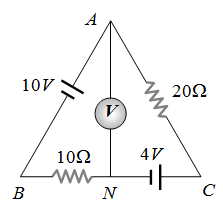
The reading of the ideal voltmeter in the adjoining diagram will be
  • A
    4 V
  • 8 V
  • C
    12 V
  • D
    14 V
Answer
Correct option: B.
8 V
(b) 8 V
View full question & answer
MCQ 341 Mark
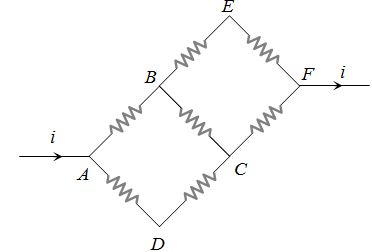
In the adjoining circuit diagram each resistance is of 10 W. The current in the arm AD will be
  • $\frac{2 i}{5}$
  • B
    $\frac{3 i}{5}$
  • C
    $\frac{4 i}{5}$
  • D
    $\frac{i}{5}$
Answer
Correct option: A.
$\frac{2 i}{5}$
(a) $\frac{2 i}{5}$
View full question & answer
MCQ 351 Mark
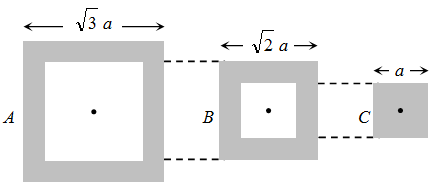
Following figure shows cross-sections through three long conductors of the same length and material, with square cross-section of edge lengths as shown. Conductor B will fit snugly within conductor A, and conductor C will fit snugly within conductor B. Relationship between their end to end resistance is
  • $R_A = R_B = R_C$
  • B
    $R_A > R_B > R_C$
  • C
    $R_A < R_B < R$
  • D
    Information is not sufficient
Answer
Correct option: A.
$R_A = R_B = R_C$
(a) $R_A = R_B = R_C$
View full question & answer
MCQ 361 Mark
12 cells each having same emf are connected in series with some cells wrongly connected. The arrangement is connected in series with an ammeter and two cells which are in series. Current is 3 A when cells and battery aid each other and is 2 A when cells and battery oppose each other. The number of cells wrongly connected is
  • A
     4
  •  1
  • C
     3
  • D
     2
Answer
Correct option: B.
 1
1
View full question & answer
MCQ 371 Mark
In the circuit shown in figure reading of voltmeter is $V_1$ when only $S_1$ is closed, reading of voltmeter is $V_2$ when only $\mathrm{S}_2$ is closed and reading of voltmeter is $\mathrm{V}_3$ when both $\mathrm{S}_1$ and $\mathrm{S}_2$ are closed. Then
  • A
    $V_3>V_2>V_1$
  • $V_2>V_1>V_3$
  • C
    $V_3>V_1>V_2$
  • D
    $V_1>V_2>V_3$
Answer
Correct option: B.
$V_2>V_1>V_3$
(b) $V_2>V_1>V_3$
View full question & answer
MCQ 381 Mark
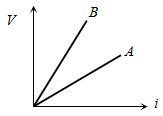
V-i graphs for parallel and series combination of two identical resistors are as shown in figure. Which graph represents parallel combination

  • A
  • B
    B
  • C
    A and B both
  • D
    Neither A nor B
Answer
Correct option: A.
A
(a) A
View full question & answer
MCQ 391 Mark
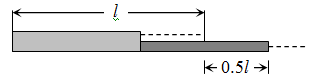
In order to quadruple the resistance of a uniform wire, a part of its length was uniformly stretched till the final length of the entire wire was 1.5 times the original length, the part of the wire was fraction equal to
  • 1 / 8
  • B
    1 / 6
  • C
    1 / 10
  • D
    1 / 4
Answer
Correct option: A.
1 / 8
(a) 1 / 8
View full question & answer
MCQ 401 Mark
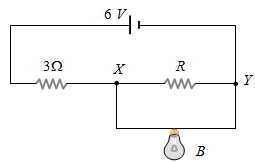
In the following circuit, bulb rated as 1.5 V, 0.45 W. If bulbs glows with full intensity then what will be the equivalent resistance between X and Y
  • A
    0.45 $\Omega$
  • 1 $\Omega$
  • C
    3 $\Omega$
  • D
    5 $\Omega$
Answer
Correct option: B.
1 $\Omega$
(b) 1 $\Omega$
View full question & answer
MCQ 411 Mark
Potential difference across the terminals of the battery shown in figure is (r = internal resistance of battery)
  • A
    8 V
  • B
    10 V
  • C
    6 V
  • Zero
Answer
Correct option: D.
Zero
(d) Zero
View full question & answer
MCQ 421 Mark
Two cells of equal e.m.f. and of internal resistances $\mathrm{r}_1$ and $\mathrm{r}_2\left(\mathrm{r}_1>\mathrm{r}_2\right)$ are connected in series. On connecting this combination to an external resistance R, it is observed that the potential difference across the first cell becomes zero. The value of R will be
  • A
    $r_1+r_2$
  • $r_1-r_2$
  • C
    $\frac{r_1+r_2}{2}$
  • D
    $\frac{r_1-r_2}{2}$
Answer
Correct option: B.
$r_1-r_2$
(b) $r_1-r_2$
View full question & answer
MCQ 431 Mark
Length of a hollow tube is 5m, it’s outer diameter is 10 cm and thickness of it’s wall is 5 mm. If resistivity of the material of the tube is $1.7 \times 10^{-8} \Omega \times \mathrm{m}$ then resistance of tube will be 
  • $5.6 \times 10^{-5} \Omega$
  • B
    $2 \times 10^{-5} \Omega$
  • C
    $4 \times 10^{-5} \Omega$
  • D
    None of these
Answer
Correct option: A.
$5.6 \times 10^{-5} \Omega$
(a) $5.6 \times 10^{-5} \Omega$
View full question & answer
MCQ 441 Mark
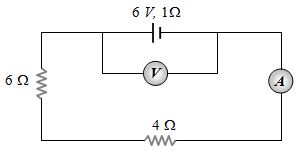
In the circuit shown here, the readings of the ammeter and voltmeter are
  • A
    6 A, 60 V
  • B
    0.6 A, 6 V
  • 6/11 A, 60/11 V
  • D
    11/6 A, 11/60 V
Answer
Correct option: C.
6/11 A, 60/11 V
(c) 6/11 A, 60/11 V
View full question & answer
MCQ 451 Mark
A battery of internal resistance 4W is connected to the network of resistances as shown. In order to give the maximum power to the network, the value of R (in Ω) should be
  • A
    4/9
  • B
    8/9
  • 2
  • D
    18
Answer
Correct option: C.
2
(c) 2
View full question & answer
MCQ 461 Mark
Two wires of resistance $\mathrm{R}_1$ and $\mathrm{R}_2$ have temperature coefficient of resistance $\alpha_1$ and $\alpha_2$, respectively. These are joined in series. The effective temperature coefficient of resistance is
  • A
    $\frac{\alpha_1+\alpha_2}{2}$
  • B
    $\sqrt{\alpha_1 \alpha_2}$
  • $\frac{\alpha_1 R_1+\alpha_2 R_2}{R_1+R_2}$
  • D
    $\frac{\sqrt{R_1 R_2 \alpha_1 \alpha_2}}{\sqrt{R_1{ }^2+R_2{ }^2}}$
Answer
Correct option: C.
$\frac{\alpha_1 R_1+\alpha_2 R_2}{R_1+R_2}$
(c) $\frac{\alpha_1 R_1+\alpha_2 R_2}{R_1+R_2}$
View full question & answer
MCQ 471 Mark
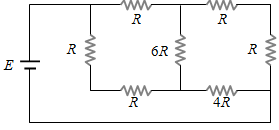
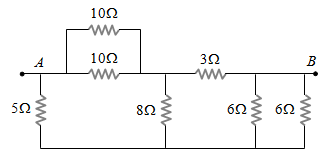
Seven resistances are connected as shown in the figure. The equivalent resistance between A and B is
  • A
    3 W
  • 4 W
  • C
    4.5 W
  • D
    5 W
Answer
Correct option: B.
4 W
(b) 4 W
View full question & answer
MCQ 481 Mark
The resistance of a wire of iron is 10 ohms and temp. coefficient of resistivity is $5^{\times 10^{-3} /{ }^{\circ} \mathrm{C}}$ . At $20^{\circ} \mathrm{C}$ it carries 30 milliamperes of current. Keeping constant potential difference between its ends, the temperature of the wire is raised to $120^{\circ} \mathrm{C}$. The current in milliamperes that flows in the wire is
  • 20
  • B
    15
  • C
    10
  • D
    40
Answer
Correct option: A.
20
(a) 20
View full question & answer
MCQ 491 Mark
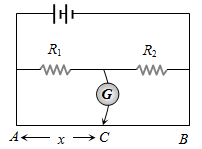
In the shown arrangement of the experiment of the meter bridge if AC corresponding to null deflection of galvanometer is x, what would be its value if the radius of the wire AB is doubled
  • A
    x
  • x/4
  • C
    4x
  • D
    2x
Answer
Correct option: B.
x/4
(b) x/4
View full question & answer
MCQ 501 Mark
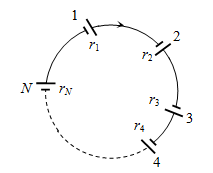
A group of N cells whose emf varies directly with the internal resistance as per the equation $E_N=1.5 r_N$ are connected as shown in the figure below. The current I in the circuit is
  • A
    0.51 amp
  • B
    5.1 amp
  • C
    0.15 amp
  • 1.5 amp
Answer
Correct option: D.
1.5 amp
(d) 1.5 amp
View full question & answer
M.C.Q (1 Marks) - Physics STD 12 Science Questions - Vidyadip