MCQ 511 Mark
The quantisation of charge indicates that:
- ✓
Charge, which is a fraction of charge on an electron, is not possible.
- B
A charge cannot be destroyed.
- C
Charge exists on particles.
- D
There exists a minimum permissible charge on a particle.
AnswerCorrect option: A. Charge, which is a fraction of charge on an electron, is not possible.
The quantisation of charge means that when we say something has some charge, we mean by that that how many times the charge of electrons it has. Because the whole charge is associated with an electron.
View full question & answer→MCQ 521 Mark
A charged body has an electric flux $F$ associated with it. Now if the body is place inside a conducting shell then the electric flux outside the shell is:
- ✓
- B
Greater than $F$
- C
Less than $F$
- D
Equal to $F$
AnswerA conducting shell does not allow to escape any flux outside, thus confining all fluxes within it.so,flux outside the shell will be zero.
$[$this happens due to electrostatic sheilding by the conducting shell$]$
View full question & answer→MCQ 531 Mark
Which of the following materials has a negative temperature coefficient of resistance?
AnswerCarbon has a negative temperature coefficient of resistance.
View full question & answer→MCQ 541 Mark
The direction of electric field is from:
- ✓
Positive to negative plate.
- B
Negative to positive plate.
- C
Both $a$ and $b.$
- D
AnswerCorrect option: A. Positive to negative plate.
View full question & answer→MCQ 551 Mark
Two small balls having the same mass and charge and located on the same vertical at heights $h_1$ and $h_2$ are thrown in the same direction along the horizontal at the same velocity $v$ . The first ball touches the ground at a distance $I$ from the initial vertical. At what height $H _2$ will the second ball be at this instant ? The air drag and the effect of the charges induced on the ground should be neglected.
- ✓
$\text{h}_1+\text{h}_2-\text{g}\Big(\frac{\ell}{\text{V}}\Big)^2$
- B
$\text{h}_1-\text{h}_2-\text{g}\Big(\frac{\ell}{\text{V}}\Big)^2$
- C
$\text{h}_1+\text{h}_2-\text{g}\Big(\frac{\ell}{\text{V}}\Big)^\frac{1}{2}$
- D
$\frac{\text{h}_1+\text{h}_2}{-\text{g}}-\text{g}\Big(\frac{\ell}{\text{V}}\Big)^2$
AnswerCorrect option: A. $\text{h}_1+\text{h}_2-\text{g}\Big(\frac{\ell}{\text{V}}\Big)^2$
View full question & answer→MCQ 561 Mark
Two point charges $2 C$ and $-6 C$ attract each other with a force of $12 N$. A negative charge of $2 C$ is added to each of the above charges, now the force between them is:
AnswerWhen $-2C$ is added to $2C$ and $-6C$, they become $0C$ and $-8C$ respectively. Since one of the charges is now zero, the force between them is zero.
View full question & answer→MCQ 571 Mark
How many number of electrons are present in $-1C$ of charge:
AnswerCorrect option: B. $6 \times 1018$ electrons.
View full question & answer→MCQ 581 Mark
Two identical thin rings, each of radius a meter, are coaxially placed at a distance $R$ meter apart. If $Q_1$ coulomb and $Q _2$ coulomb are respectively the charges uniformly spread on the two rings, the work done in moving a charge q coulomb from the centre of one ring to that of the other is:
- A
$\text{Zero}$
- ✓
$\frac{\text{q}(\text{Q_1 - Q_2)}(\sqrt{2}-1)}{4\sqrt{2}\pi\in_0\text{a}}$
- C
$\frac{\text{q}\sqrt{2}(\text{Q_1 + Q_2)}}{4\pi\in_0\text{a}}$
- D
$\frac{\text{q}(\text{Q_1 + Q_2)}(\sqrt{2} + 1)}{4\sqrt{2}\pi\in_0\text{a}}$
AnswerCorrect option: B. $\frac{\text{q}(\text{Q_1 - Q_2)}(\sqrt{2}-1)}{4\sqrt{2}\pi\in_0\text{a}}$
View full question & answer→MCQ 591 Mark
Electric flux per unit solid angle is defined as:
AnswerElectric field intensity is the strength of an electric field at any point. It is equal to the electric force per unit charge experienced by a test charge placed at that point.
View full question & answer→MCQ 601 Mark
Figure shows a closed surface which intersects a conducting sphere. If a positive charged is placed at the point P, the flux of the electic field through the closed surface:
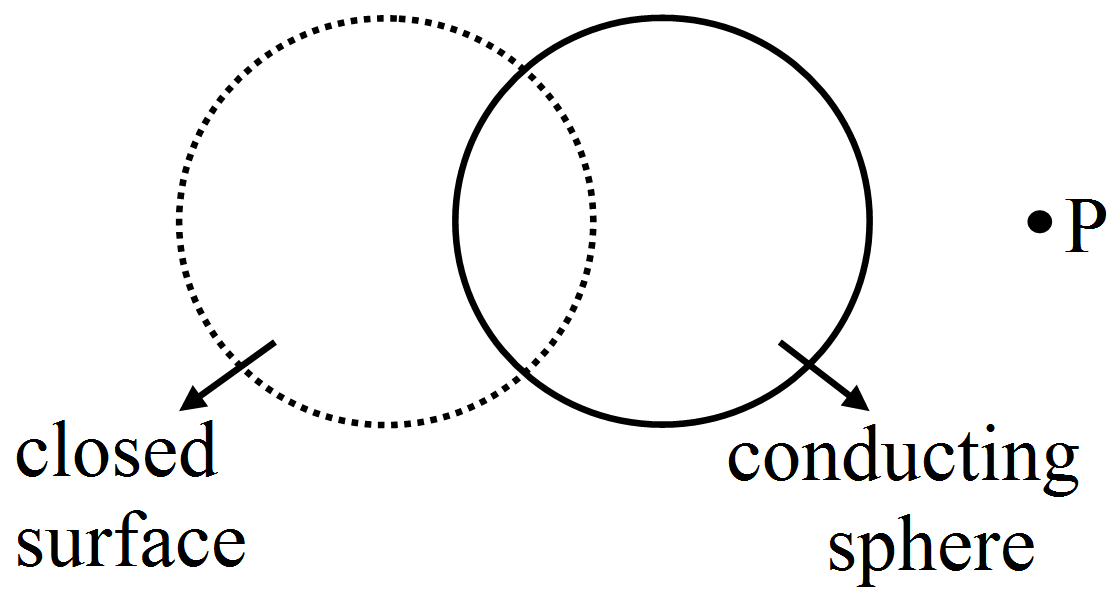
AnswerCharge distribution:
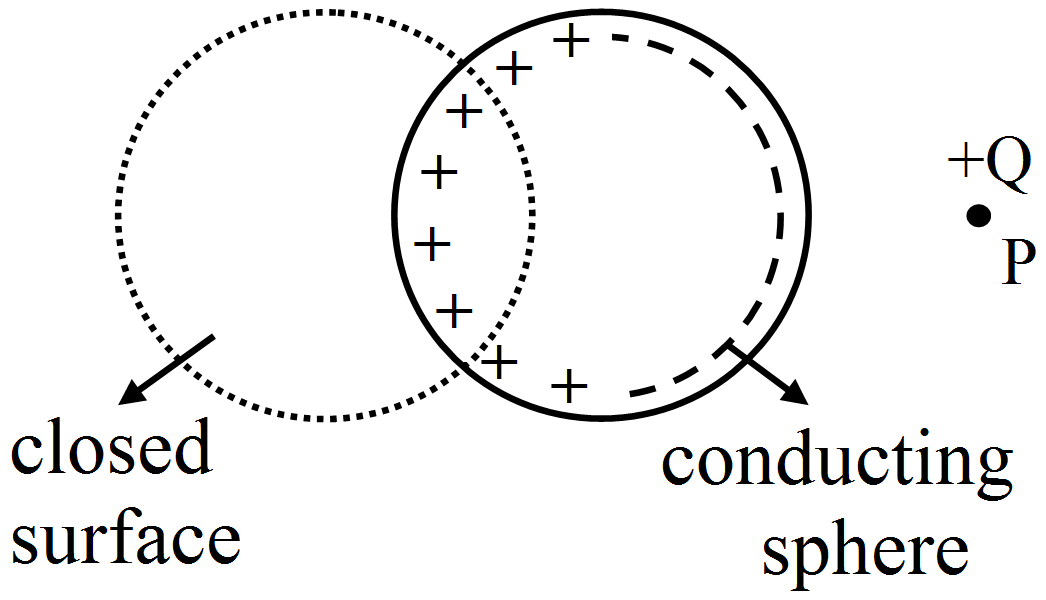
Due to charge distribution, intersection by the closed surface of conducting sphere containing the positive charge. So we can say that the flux of the electric field through the closed surface will become positive.
$\therefore\phi=\frac{\text{q}_{\text{in}}}{\in_0}\Rightarrow+\text{ve}$ View full question & answer→MCQ 611 Mark
$1$ milli coulomb $=$
- A
$103C$
- B
$10C$
- C
$10 - 2C$
- ✓
$10 - 3C$
AnswerCorrect option: D. $10 - 3C$
View full question & answer→MCQ 621 Mark
What happens to the plates of the apparatus if we measure alternating charge using a Gold-leaf oscilloscope?
- A
It doesn’t diverge at all.
- B
- ✓
The plates give a proper divergence.
- D
The degree of divergence increases and decreases repeatedly.
AnswerCorrect option: C. The plates give a proper divergence.
The divergence of the plates of the Gold-leaf oscilloscope depends only on the presence of a charge, not on the quality of charge i.e. positive or negative. So, if the charge changes from positive to negative and vice versa the degree of divergence of the plates remains the same.
View full question & answer→MCQ 631 Mark
If the flux of the electric field through a closed surface is zero, then:
- A
The electric field must be zero everywhere on the surface.
- B
The electric field may not be zero everywhere on the surface.
- ✓
The charge inside the surface must be zero.
- D
The charge in the vicinity of the surface must be zero.
AnswerCorrect option: C. The charge inside the surface must be zero.
View full question & answer→MCQ 641 Mark
The electric field inside a conductor.
MCQ 651 Mark
When we remove polyester or woollen clothes in dark, we can see a spark and hear a crackling sound. Which of the following is responsible for it?
MCQ 661 Mark
The fact that electric charge is always an integral multiple of e is termed as:
MCQ 671 Mark
In the diagram, three point charges $($labeled $1, 2$ and $3)$ are shown, along with the electric field around them. Which charge$(s)$ is/ are positive?
- A
$2$ only
- B
$1$ and $2$
- ✓
$1$ and $3$
- D
$1, 2$ and $3$
AnswerCorrect option: C. $1$ and $3$
The electric field always originate at the positive charge and terminate at the negative charge.
From figure, the electric field lines originate at the points $1$ and $3$ but ends at point $2.$
Thus points $1$ and $3$ represent positive charge and $2$ represents the negative charge.
View full question & answer→MCQ 681 Mark
$1$ Coulomb $=$ ________ Electro Static Unit.
- ✓
$3 \times 10^9$
- B
$3 \times 10^8$
- C
$1.602 \times 10^{-19}$
- D
$2 \times 10^9$
AnswerCorrect option: A. $3 \times 10^9$
a. $3 \times 10^9$
Explanation:
$1$ Coulomb means $3 \times 10^9$ Electro Static Unit of charge. Coulomb and $ESU$ are two different units of charge and their conversion formula is necessary. Coulomb is the unit of charge in the SI system and esu is the unit of charge in the $CGS$ system.
View full question & answer→MCQ 691 Mark
The value of the basic unit of the charge is:
- A
$1.6 \times 10 + 19C.$
- ✓
$1.6 \times 10 - 19C.$
- C
$1.6 \times 10 - 20C.$
- D
AnswerCorrect option: B. $1.6 \times 10 - 19C.$
View full question & answer→MCQ 701 Mark
View full question & answer→MCQ 711 Mark
Earth is the source of $........$?
- ✓
An infinite positive and negative charge.
- B
- C
- D
AnswerCorrect option: A. An infinite positive and negative charge.
Earth can be considered as an infinite source of positive and negative charges.
This can be justified by the fact that if we connect any positive or negatively charged body to the ground, all of its charges will go to earth.
View full question & answer→MCQ 721 Mark
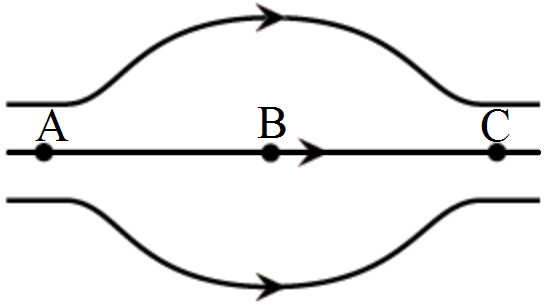
Figure, shows some of the electric field lines corresponding to an electric field. The figure suggests that,
- A
$E_A > E_8 > E_e$
- B
$E_A=E_B=E_e$
- ✓
$E_A=E_C > E_B$
- D
$E_A=E_C < E_B$
AnswerCorrect option: C. $E_A=E_C > E_B$
Higher separation, Lower electric field. Because Electric field inversly proportional the square of separation.
$E_A=E_c > E_B$
View full question & answer→MCQ 731 Mark
- A
- B
Exist only in the immediate vicinity of electric charges.
- C
Exist only when both positive and negative charges are near one another.
- ✓
View full question & answer→MCQ 741 Mark
The molecules having centres of positive charges and negative charges at same place, has the dipole moment as:
MCQ 751 Mark
An electric dipole is kept in a non$-$uniform electric field. It experiences.
- ✓
- B
A force but not a torque.
- C
- D
Neither a force nor a torque.
View full question & answer→MCQ 761 Mark
$1C$ is the charge which is placed at a distance of 1m from the another charge of same magnitude in vacuum experiences an electrical force of repulsion of magnitude:
- A
$9 \times 10^{-9} N$
- ✓
$9 \times 10^9 N$
- C
$10^9 N$
- D
$10^{-9} N$
AnswerCorrect option: B. $9 \times 10^9 N$
b. $9 \times 10^9 N$
View full question & answer→MCQ 771 Mark
Identify the wrong statement in the following. Coulomb's law correctly describes the electric force that:
- A
Binds the electrons of an atom to its nucleus.
- ✓
Binds the protons and neutrons in the nucleus of an atom.
- C
Binds atoms together to form molecules.
- D
Binds atoms and molecules together to form solids.
AnswerCorrect option: B. Binds the protons and neutrons in the nucleus of an atom.
Nuclear force binds the protons and neutrons in the nucleus of an atom.
View full question & answer→MCQ 781 Mark
The SI unit of an electric charge is:
- A
- B
$C.$
- ✓
Both $a$ and $b.$
- D
$A.$
AnswerCorrect option: C. Both $a$ and $b.$
View full question & answer→MCQ 791 Mark
Gauss’s law is true only if force due to a charge varies as:
- A
$r^{-1}$
- ✓
$r^{-2}$
- C
$r^{-3}$
- D
$r^{-4}$
AnswerCorrect option: B. $r^{-2}$
b. $r^{-2}$
View full question & answer→MCQ 801 Mark
Two unlike charges attract each other with a force of $10N.$ If the distance between them is doubled, the force between them is:
AnswerCorrect option: D. $2.5N$
We know $\text{F}=\frac{1}{4\pi\in_0}\frac{\text{q}_1\text{q}_2}{\text{r}^2}=10\text{N}$
if distance is doubled.
$\text{F}_{\text{new}}=\frac{1}{4\pi\in_0}.\frac{\text{q}_1\text{q}_2}{(2\text{r)}^2}=\frac{10}{4}$
$= 2.5N$
View full question & answer→MCQ 811 Mark
$6$ A particle of charge q and mass m moves rectilinearly under the action of electric field $E = A – Bx$, where $A$ and $B$ are positive constants and $x$ is distance from the point where particle was initially at rest then the distance travelled by the particle before coming to rest and acceleration of particle at that moment are respectively:
- A
$\frac{2\text{A}}{\text{B}},0$
- B
$0,-\frac{\text{qA}}{\text{m}}$
- ✓
$\frac{2\text{A}}{\text{B}},-\frac{\text{qA}}{\text{m}}$
- D
$\frac{-2\text{A}}{\text{B}},-\frac{\text{qA}}{\text{m}}$
AnswerCorrect option: C. $\frac{2\text{A}}{\text{B}},-\frac{\text{qA}}{\text{m}}$
View full question & answer→MCQ 821 Mark
If $\int_\text{S}\text{E.dS}=0$ over a surface, then:
- A
The electric field inside the surface and on it is zero.
- B
All charges must necessarily be outside the surface.
- C
The number of flux lines entering the surface must be equal to the number of flux lines leaving it.
- ✓
AnswerGiven,
$\int_\text{s}\text{E.dS}=0$
It means the algebraic sum of number of flux lines entering the surface and number of flux lines leaving the surface.
Now, from Gauss' law,
$\int_\text{S}\text{E.dS}=\frac{\text{q}}{\in_0}$
Where q is charge enclosed by the surface.
Now,
$\int_\text{s}\text{E.dS}=0$
q = 0 i.e., net charge enclosed by the surface must be zero.
Hence, all other charges must necessarily be outside the surface.
View full question & answer→MCQ 831 Mark
The Electric field at a point is:
- ✓
- B
Continuous if there is no charge at that point.
- C
- D
Discontinuous if there is a charge at that point.
Answer We cannot define electric field at the position of a charge, so we cannot say that electric field is always continuous.
Hence option (a) is ruled out and option (d) is the correct choice.
The electric field due to any charge will be continuous, if there is no other charge in the medium. It will be discontinuous if there is a charge at the point under consideration, hence option (b) is correct.
View full question & answer→MCQ 841 Mark
Gauss's law is valid for:
- ✓
- B
Only regular close surfaces.
- C
- D
Only irregular open surfaces.
View full question & answer→MCQ 851 Mark
Charge is the property associated with matter due to which it produces and experiences.
- A
- B
- ✓
Both electric and magnetic effects.
- D
AnswerCorrect option: C. Both electric and magnetic effects.
View full question & answer→MCQ 861 Mark
The band gap between the valence band and conduction band is the measure of $........$?
- ✓
The conductivity of the material.
- B
The resistivity of the material.
- C
- D
AnswerCorrect option: A. The conductivity of the material.
The more the band gap between the valence band and conduction band, the worse is the conductivity of the material. For conductors, there are overlapping bands. So, conductors can carry electricity.
View full question & answer→MCQ 871 Mark
The force per unit charge is known as $........$.
AnswerThe force per unit charge is known as the electric field.
View full question & answer→MCQ 881 Mark
In a region of space having a uniform electric field $E$, a hemispherical bowl of radius r is placed. The electric flux $\phi$ through the bowl is:
- A
$2\pi\text{R}\text{E}$
- B
$4\pi\text{R}^2\text{E}$
- ✓
$2\pi\text{R}^2\text{E}$
- D
$\pi\text{R}^2\text{E}$
AnswerCorrect option: C. $2\pi\text{R}^2\text{E}$
$\phi=\text{E}(\text{ds})\cos\theta=\text{E}(2\pi\text{r}^2)\cos0^{\circ}=2\pi\text{r}^2\text{E}$
View full question & answer→MCQ 891 Mark
Which of the following are conductors.
MCQ 901 Mark
n figure two positive charges, $q_2$ and $q_3$ fixed along the $y$-axis, exert a net electric force in the $+x$ direction on a charge $q_1$ fixed along the $x$-axis. If a positive charge $Q$ is added at $(x, 0)$, the force on $q_1$
AnswerCorrect option: A. Shall increase along the positive x-axis.
a. Shall increase along the positive x -axis.
Explanation:
Since positive charge $q _2$ and $q _3$ exert a net force in the $+X$ direction on the charge $Q _1$ fixed along the $X$ -axis, the charge $q _1$ is negative as shown in figure. Obviously, due to addition of positive charge $Q$ ad $( x , 0)$ the force on - $q$ shall increase along the positive $X$ -axis.
View full question & answer→MCQ 911 Mark
Which is not an electrostatic phenomenon:
- A
Comb rubbed with hair attracts paper bits.
- B
A blanket in winters in dark when scrambled gives electrical sparks.
- C
Two people shaking hands feel a small spark in winters.
- ✓
Heat is generated in a resistor carrying current.
AnswerCorrect option: D. Heat is generated in a resistor carrying current.
based on Joule's Law.
Rest are electrostatic phenomenon.
View full question & answer→MCQ 921 Mark
An electron falls from rest through a vertical distance h in a uniform and vertically upward directed electric field E. The direction of electric field is now reversed, keeping its magnitude the same. A proton is allowed to fall from rest in it through the same vertical distance h. The time of fall of the electron, in comparison to the time of fall of the proton is:
- ✓
- B
$5$ times greater.
- C
- D
$10$ times greater.
View full question & answer→MCQ 931 Mark
Two identical blocks are kept on a frictionless horizontal table connected by a spring of stiffness $K$ and of original length $\ell_0$ A total charge $Q$ is distributed on the block such that maximum elongation of sparing at equilibrium is equal to $x$ value of q is:
- A
$2\ell_0\sqrt{4\pi\in_0(\ell_0+\text{x})}$
- B
$2\text{x}\sqrt{4\pi\in_0\text{k}(\ell_0+\text{x})}$
- ✓
$2(\ell_0+\text{x})\sqrt{4\pi\in_0\text{kx}}$
- D
$(\ell_0+\text{x})\sqrt{4\pi\in_0\text{kx}}$
AnswerCorrect option: C. $2(\ell_0+\text{x})\sqrt{4\pi\in_0\text{kx}}$
View full question & answer→MCQ 941 Mark
Two lithium nuclei in lithium vapour at room temperature do not combine to form a carbon nucleus because:
- A
Carbon nucleus is an unstable particle.
- B
It is not energetically favourable particle.
- ✓
Nuclei do not come very close due to Coulombic repulsion.
- D
Lithium nucleus is more tightly bound than a carbon nucleus.
AnswerCorrect option: C. Nuclei do not come very close due to Coulombic repulsion.
Due to Coulombic repulsion $($i.e. nuclei are having same charge$)$ these do not combine at room temperature.
View full question & answer→MCQ 951 Mark
The net electric flux through a closed surface is:
MCQ 961 Mark
The term on the $\text{RHS}$ of the Gauss’s law shows the:
- A
Charges enclosed by the surface.
- ✓
Sum of charges enclosed by the surface.
- C
Both $a$ and $b.$
- D
AnswerCorrect option: B. Sum of charges enclosed by the surface.
View full question & answer→MCQ 971 Mark
If one penetrates a uniformly charged spherical cloud, electric field strength:
- ✓
Decreases directly as the distance from the centre.
- B
Increases directly as the distance from the centre.
- C
- D
AnswerCorrect option: A. Decreases directly as the distance from the centre.
View full question & answer→MCQ 981 Mark
If two charges of $1$ coulomb each are placed $1\ km$ apart in vacuum, the force between them will be:
- ✓
$9 \times 10^3 N$
- B
$9 \times 10^{-3} N$
- C
$1.1 \times 10^{-4} N$
- D
$10^{-6} N$
AnswerCorrect option: A. $9 \times 10^3 N$
a. $9 \times 10^3 N$
Explanation:
$Q =1 Cr =1000 m$
$F =\frac{ KQQ }{ r ^2}=\frac{9 \times 10^3}{\left((10)^3\right)^2}=9 \times 10^3 N$
View full question & answer→MCQ 991 Mark
The adjoining figure shows a negatively charged electroscope. If a negatively charged rod is brought close to, but not touching, the knob, the two leaves will:
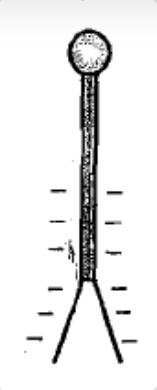
AnswerIn this case, the given electroscope is negatively charged. If a negatively charged rod is brought close to, but not touching, the knob, the two leaves will move far apart as the like charges repel each other.
View full question & answer→MCQ 1001 Mark
An electric line of force in the $x y^{-}$plane is given by equation $x^2+y^2=1$. A particle with unit positive charge, initially at rest at the point $x=1, y=0$ in the $x y^{-}$plane.
- A
- B
Will move along straight line.
- ✓
Will move along the circular line of force.
- D
Information is insufficient to draw any conclusion.
AnswerCorrect option: C. Will move along the circular line of force.
c. Will move along the circular line of force.
Explanation:
Charge will move along the circular line of force because $x^2+y^2=1$ is the equation of circle in $x y^{-}$plane.
View full question & answer→