Questions · Page 3 of 7

M.C.Q (1 Marks)

MCQ 1011 Mark
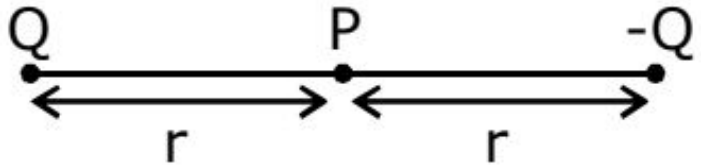
The total charge of the electric dipole is:
  • A
    Negative.
  • B
    Positive.
  • C
    Infinity.
  • Zero.
Answer
Correct option: D.
Zero.
View full question & answer
MCQ 1021 Mark
Quantisation of charge implies:
  • A
    Charge cannot be destroyed.
  • B
    Charge exists on particles.
  • C
    There is a minimum permissible charge on a particle.
  • Charge, which is a fraction of a coulomb is not possible.
Answer
Correct option: D.
Charge, which is a fraction of a coulomb is not possible.
View full question & answer
MCQ 1031 Mark
The ampere-sec stands for the unit of:
  • A
    Power
  • B
    Current
  • C
    Energy
  • Charge
Answer
Correct option: D.
Charge

Charge is given by the relation, $q = I \times t$
so its unit is ampere $-$ sec

View full question & answer
MCQ 1041 Mark
Choose the correct answer.$\text{F}=\frac{\text{K.}(\text{q}_1\times\text{q}_2)}{\text{r}^2}$ This is given by which law?
  • A
    Faraday’s law
  • B
    Newton’s law
  • Coulomb’s law
  • D
    Fleming’s law
Answer
Correct option: C.
Coulomb’s law

$\text{F}=\frac{\text{K.}(\text{q}_1\times\text{q}_2)}{\text{r}^2}$
is given by Coulomb’s Law.
View full question & answer
MCQ 1051 Mark
If two charged particles of same mass and charge are projected in a uniform electric field with the same speed, then?
  • A
    Both have same momentum at any instant.
  • B
    Both have same kinetic energy at any instant.
  • C
    Both have same magnitude of momentum at any instant.
  • They may move on a straight line.
Answer
Correct option: D.
They may move on a straight line.
View full question & answer
MCQ 1061 Mark
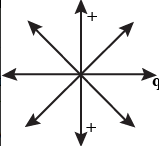
Electric lines of force about a positive point charge are:
  • Radially outwards.
  • B
    Circular clockwise.
  • C
    Radially inwards.
  • D
    Parallel straight lines.
Answer
Correct option: A.
Radially outwards.
Electric lines of force about a positive point charge are always radially outwards.
View full question & answer
MCQ 1071 Mark
Which of the following quantities do not depend on the choice of zero potential or zero potential energy?
  • A
    Potential at a point.
  • B
    Potential difference between two pointsChange in potential energy of a two-charge system.
  • C
    Potential energy of a two-charge system.
  • B and C both
Answer
Correct option: D.
B and C both
Explanation:

$\text{V}_\text{p}=\frac{\text{KQ}}{\text{r}}-\frac{\text{KQ}}{\text{r}}=0$
View full question & answer
MCQ 1081 Mark
When we rub our comb with hair and then take near to the paper pieces, all pieces get stuck to the comb. This happens due tyo which phenomena?
  • Electrostatic Induction.
  • B
    Magnetic effect.
  • C
    Potential effect.
  • D
    Kinetic effect.
Answer
Correct option: A.
Electrostatic Induction.

When negative charges is created in the comb by rubbing it with hair and pieces of paper are exposed to the electric field created by the charge, the part of paper closer to the comb will be positively charged due to electromagnetic induction, and the farther would be negatively charged, causing the paper to be attracted to the comb.

View full question & answer
MCQ 1091 Mark
If a body is negatively charged, then it has.
  • Excess of electrons.
  • B
    Excess of protons.
  • C
    Deficiency of electrons.
  • D
    Deficiency of neutrons
Answer
Correct option: A.
Excess of electrons.
View full question & answer
MCQ 1101 Mark
Two charges $q_1, q_2$ exert some amount of force on each other. What will happen to the force on $q_1$ if another charge q3 is brought close to them?
  • A
    The force will increase.
  • B
    The force will decrease.
  • C
    The force remains the same.
  • The force may increase or decrease depending on whether $q _3$ is positive or negative.
Answer
Correct option: D.
The force may increase or decrease depending on whether $q _3$ is positive or negative.
d. The force may increase or decrease depending on whether $q _3$ is positive or negative.
Explanation:
If both the charges $q_1$ and $q_2$ are positive then they will repel each other. Now if the third charge $q_3$ is also positive, the repulsive force will increase. But if $q _3$ is negative, the repulsive force will be reduced by some amount due to the attractive force between $q _1$ and $q _3$.
View full question & answer
MCQ 1111 Mark
In case of Coulomb’s law, the value of k is given by:
  • A
    $9 \times 10^{-9} Nm ^2 / C ^2$
  • $9 \times 10^9 Nm ^2 / C ^2$
  • C
    $10^9 Nm ^2 / C ^2$
  • D
    $10^{-9} Nm ^2 / C ^2$
Answer
Correct option: B.
$9 \times 10^9 Nm ^2 / C ^2$
b. $9 \times 10^9 Nm ^2 / C ^2$​​​​​​​
View full question & answer
MCQ 1121 Mark
What happens when a glass rod is rubbed with silk?
  • Gains protons from silk.
  • B
    Gains electrons from silk.
  • C
    Gives electrons to silk.
  • D
    Gives protons to silk.
Answer
Correct option: A.
Gains protons from silk.

Excess electrons are transferred from glass to silk when a glass rod is rubbed with silk. Hence, the glass rod becomes positive, and silk becomes negative.

View full question & answer
MCQ 1131 Mark
Additivity of the electric charges means that the total charge of a system is the $........$ of all individual charges in the system.
  • A
    Vector sum.
  • Algebraic sum.
  • C
    Vector difference.
  • D
    None.
Answer
Correct option: B.
Algebraic sum.
View full question & answer
MCQ 1141 Mark
If an object possesses an electric charge, it is said to be electrified or $... A ...$ When it has no charge, it is said to be $... B ...$ Here, $A$ and $B$ refer to:
  • Charged, neutral.
  • B
    Neutral, charged.
  • C
    Discharged, charged.
  • D
    Active, reactive.
Answer
Correct option: A.
Charged, neutral.
View full question & answer
MCQ 1151 Mark
$........$ Property develops in comb due to friction.
  • Attractive
  • B
    Repulsive
  • C
    Both
  • D
    None
Answer
Correct option: A.
Attractive

An attractive property is develop in the comb due to friction. The comb on rubbing over dry hairs is aid to be charged.

View full question & answer
MCQ 1161 Mark
Electric field is a $........$?
  • A
    Scalar quantity
  • Vector quantity
  • C
    Tensor quantity
  • D
    Quantity that has properties of both scalar and vector
Answer
Correct option: B.
Vector quantity

A scalar quantity is a quantity with magnitude only but no direction. But a vector quantity possesses both magnitude and direction. An electric field has a very specific direction $($away from a positive charge or towards a negative charge$)$. Hence electric field is a vector quantity. Moreover, we have to use a vector addition for adding two electric fields.
View full question & answer
MCQ 1171 Mark
What happens when some charge is placed on a soap bubble?
  • A
    Its radius decreases.
  • Its radius increases.
  • C
    The bubble collapses.
  • D
    None of these.
Answer
Correct option: B.
Its radius increases.
View full question & answer
MCQ 1181 Mark
When a glass rod is rubbed with a piece of silk cloth the rod ?
  • A
    And the cloth both acquire positive charge.
  • Becomes positively charged while the cloth has a negative charge.
  • C
    And the cloth both acquire negative charge.
  • D
    Becomes negatively charged while the cloth has a positive charge.
Answer
Correct option: B.
Becomes positively charged while the cloth has a negative charge.
It is a convention to call the charge acquired by a glass rod when it is rubbed with silk as positive. The other kind of charge is said to be negative.
View full question & answer
MCQ 1191 Mark
A Solid sphare of radius $R$ has a charge $Q$ distributed in its Volume with a charge density $P=K r^a$ Where $K$ and a are constants and $r$ is the distance from its centre from its centre. if the electric filed at $r=\frac{R}{2}$ is $\frac{1}{8}$ times that at $r=R$, the value of $a$ is.
  • A
    $3$
  • B
    $5$
  • $2$
  • D
    $7$
Answer
Correct option: C.
$2$
View full question & answer
MCQ 1201 Mark
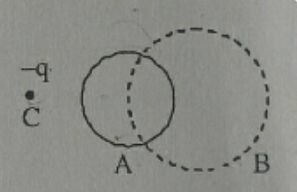
In the figure shown here, A is a conducting sphere and $B$ is a closed spherical surface. If a-q change is placed at $C$ near $A$, then the electric flux through the closed surface is -
  • A
    Zero
  • B
    Positive
  • Negative
  • D
    None of the above can be predicted
Answer
Correct option: C.
Negative

As the electric field inside the spherical conductor has to be zero the equal and opposite charges will be distributed on the conductor surface such that the induced electric field counters the electric field due to negative charge. For negative charges will be distributed on right and positive on left side
As the spherical region is on right side q inside $< 0.$
View full question & answer
MCQ 1211 Mark
The solid angle subtended by the total surface area of a sphere at the centre is:
  • $4\pi$
  • B
    $2\pi$
  • C
    $\pi$
  • D
    $3\pi$
Answer
Correct option: A.
$4\pi$
A steradian is the solid angle subtended at the center of a sphere of radius $r$ by a section of its surface area of magnitude equal to $r^2$. Since the surface area is $4 \pi r^2$, there are $4 \pi$ steradians surrounding a point in space.
View full question & answer
MCQ 1221 Mark
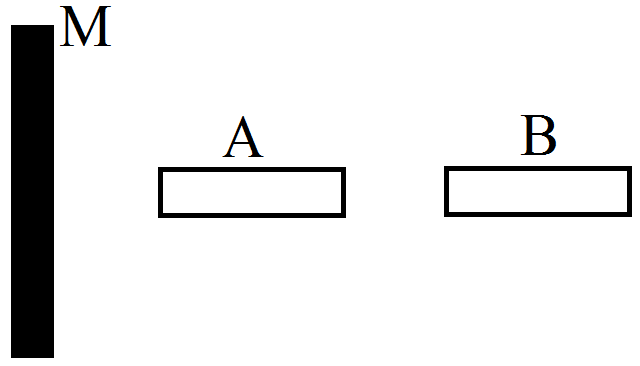
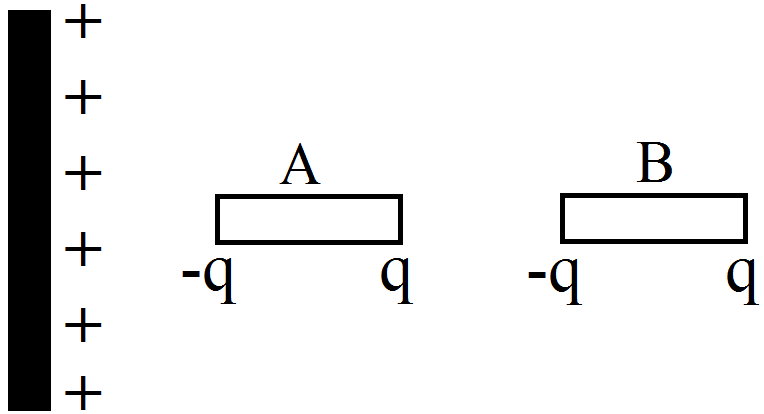
A large nonconducting sheet $M$ is given a uniform charge density. Two uncharged small metal rods $A$ and $B$ are placed near the sheet as shown in figure:
  • A
    $M$ attracts $A.$
  • B
    $M$ attracts $B.$
  • C
    $A$ attracts $B.$
  • $B$ attracts $A$.
Answer
Correct option: D.
$B$ attracts $A$.

Charge distribution or $M, A\ \&\ B$
So, we can say that $M$ attracts $A, M$ attracts $B, A$ attracts $B$ and $'B'$ attracts $A$.
View full question & answer
MCQ 1241 Mark
The electric field inside a hollow conducting sphere:
  • A
    Increases towards the centre.
  • B
    Decreases towards the centre.
  • C
    Is finite and constant throughout.
  • Is zero.
Answer
Correct option: D.
Is zero.

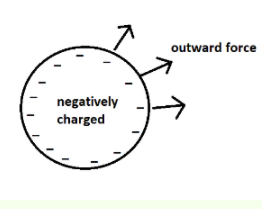
As there are no charges inside the hollow conducting sphere, as all charges reside on it surface. So, electric field inside the hollow conducting sphere is zero.
View full question & answer
MCQ 1251 Mark
A soap bubble is given negative charge, its radius will:
  • Increase
  • B
    Decrease
  • C
    Remain unchanged
  • D
    Fluctuate
Answer
Correct option: A.
Increase


The charge will be distributed uniformly over the surface of the bubble by symmetry.
As we know, they want to step much farther apart, as charges repel, the only path outward, taking with them the soap surface.
At the same point, the rise in the restored force of the soap film $($surface tension$)$ would be equal and contrary to the electrostatic force, which will result in a new $($larger$)$ radius of equilibrium.
Because of the ionic similarities, this can happen to both positive and negatively charged bubbles.Therefore, when a negative charge is given to the soap bubble, then its radius will increase.
View full question & answer
MCQ 1261 Mark
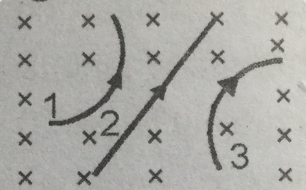
The charges $1, 2, 3$ are moving in uniform transverse magnetic field then:
  • Particle $1$ positive and particle $3$ negative.
  • B
    Particle $1$ negative and particle $3$ positive.
  • C
    Particle $1$ negative and particle $2$ neutral.
  • D
    Particle $1$ and $3$ are positive and particle $2$ neutral.
Answer
Correct option: A.
Particle $1$ positive and particle $3$ negative.
View full question & answer
MCQ 1271 Mark
Two files lines can $........$
  • Never cross each other.
  • B
    May cross each other.
  • C
    Both $a$ and $b.$
  • D
    None.
Answer
Correct option: A.
Never cross each other.
View full question & answer
MCQ 1281 Mark
The amount of charge flowing through the wire in $1s$ if the current flowing $1$ A then the charge flowing will be:
  • One coulomb.
  • B
    $2$ coulomb.
  • C
    $3$ coulomb.
  • D
    None.
Answer
Correct option: A.
One coulomb.
View full question & answer
MCQ 1291 Mark
An electric filament bulb can be worked from:
  • A
    DC supply only.
  • B
    AC supply only.
  • C
    Battery supply only.
  • All above.
Answer
Correct option: D.
All above.
An electric filament bulb can be worked from
View full question & answer
MCQ 1301 Mark
For two statements are given-one labelled Assertion $(A)$ and the other labelled Reason $(R)$. Select the correct answer to these questions from the codes $(a), (b), (c)$ and $(d)$ as given below.
Assertion $(A)$: If a point charge q is placed in front of an infinite grounded conducting plane surface, the point charge will experience a force.
Reason $(R)$: This force is due to the induced charge on the conducting surface which is at zero potential.
  • Both $A$ and $R$ are true, and $R$ is the correct explanation of $A$.
  • B
    Both $A$ and $R$ are true, but $R$ is not the correct explanation of $A.$
  • C
    $A$ is true but $R$ is false.
  • D
    $A$ is false and $R$ is also false.
Answer
Correct option: A.
Both $A$ and $R$ are true, and $R$ is the correct explanation of $A$.
View full question & answer
MCQ 1311 Mark
The concept of solid angle is a natural extension of a angle to dimensions.
  • A
    plane, two
  • B
    line, three
  • plane, three
  • D
    line, two
Answer
Correct option: C.
plane, three

The concept of solid angle is a natural extension of two$-$dimensional plane angle to three$-$dimensional. It is measured in terms of the unit called steradian, abbreviated as sr.

View full question & answer
MCQ 1321 Mark
Electric field lines cannot forms the:
  • A
    Open loops.
  • Closed loops.
  • C
    Both $a$ and $b.$
  • D
    None.
Answer
Correct option: B.
Closed loops.
View full question & answer
MCQ 1331 Mark
Gauss’s law is true for.
  • Any closed surface.
  • B
    For particular surfaces
  • C
    Both $a$ and $b.$
  • D
    None.
Answer
Correct option: A.
Any closed surface.
View full question & answer
MCQ 1341 Mark
The unit of electric field is not equivalent to:
  • A
    $N/C.$
  • $J/C.$
  • C
    $V/m.$
  • D
    $J/Cm.$
Answer
Correct option: B.
$J/C.$
View full question & answer
MCQ 1351 Mark
Which of the following is the best insulator?
  • A
    Carbon.
  • B
    Paper.
  • C
    Graphite.
  • Ebonite.
Answer
Correct option: D.
Ebonite.
View full question & answer
MCQ 1361 Mark
An inflated balloon was pressed against a wall after it has been rubbed with a piece of synthetic cloth. It was found that the balloon sticks to the wall. What force might be responsible for the attraction between the balloon and the wall?
  • A
    Gravitational
  • B
    Magnetic
  • Electrostatic
  • D
    Adhesive
Answer
Correct option: C.
Electrostatic

Electrostatic force is the phenomenon that results from slow$-$moving or stationary electrical charges. Specifically, electrostatic force is the physical reaction that holds together the electromagnetic field created by subatomic particles, such as electrons and protons. In order for electrostatic forces to remain cohesive, these particles need to independently maintain both positive and negative charges and react to each other accordingly.
When a balloon is rubbed with a cloth, the electrons from the atoms of the cloth enter the atoms of the balloon and the number of electrons in the atoms of balloon becomes more than the number of protons. Because of that, there is a negative charge in the balloon, and in the cloth the number of electrons in its atoms become less than the number of protons, so it's positively charged.
Therefore, due to this electrostatic force, the balloon sticks to the wall.

View full question & answer
MCQ 1371 Mark
In annihilation process, in which an electron and a positron transform into two gamma rays, which property of electric charge is displayed?
  • A
    Additivity of charge.
  • B
    Quantisation of charge.
  • Conservation of charge.
  • D
    Attraction and repulsion.
Answer
Correct option: C.
Conservation of charge.
View full question & answer
MCQ 1381 Mark
The laws of forces that govern the force between two electric charges were discovered by:
  • A
    Faraday
  • B
    Ampere
  • C
    Ohm
  • Coulumb
Answer
Correct option: D.
Coulumb

Coulomb stated that the force $(F)$ of attraction or repulsion between two points charges $q_1$​ and $q_2$ separated by a distance $r$ is proportional to the product of the magnitude of the two charges, and inversely proportional to the square of the distance of separation between them. i.e., $\text{F}\propto\frac{\text{q}_1\text{q}_2}{\text{r}^2}$

View full question & answer
MCQ 1391 Mark
The ratio of electric force between two electrons to two protons separated by the same distance in air is:
  • $10^0$
  • B
    $10^6$
  • C
    $10^4$
  • D
    None of these
Answer
Correct option: A.
$10^0$
a. $10^0$​​​​​​​
View full question & answer
MCQ 1401 Mark
Two charges are placed at certain distance apart. A metallic sheet is placed between them. What will happen to the force between the charges?
  • A
    Increases
  • Decreases
  • C
    Remains the same
  • D
    May increase or decrease depending upon the shape of the metallic sheet
Answer
Correct option: B.
Decreases

Force will decreases because when medium is inserted between then it will reduces the forces by its permitivity. the force becomes
$\text{Fe}_\text{m}=\frac{\text{Fe}}{\in_\text{r}}$

View full question & answer
MCQ 1411 Mark
For distance far away from centre of dipole the change in magnitude of electric field with change in distance from the centre of dipole is:
  • A
    Zero.
  • B
    Same in equatorial plane as well as axis of dipole.
  • C
    More in case of equatorial plane of dipole as compared to axis of dipole.
  • More in case of axis of dipole as compared to equatorial plane.
Answer
Correct option: D.
More in case of axis of dipole as compared to equatorial plane.
View full question & answer
MCQ 1421 Mark
An attractive force of $9 N$ acts between $+5 C$ and $-5 C$ at some distance. These charges are allowed to touch each other and are then again placed at their initial position. The force acting between them will be:
  • A
    infinite
  • B
    $9 \times 10^9 N$
  • C
    $1N$
  • zero
Answer
Correct option: D.
zero
d. zero
Explanation:
According to the question
$F =\frac{1}{4 \pi \epsilon_0} \frac{\left(5 \times 10^{-6}\right) \times\left(-5 \times 10^{-6}\right)}{ r ^2}$
On touching them the charge on each will be zero.
$\therefore F =\frac{1}{4 \pi \in_0} \frac{(0)}{ r ^2}=0$
View full question & answer
MCQ 1431 Mark
A girl brings a positively charged rod near a thin neutral stream of water flowing from a tap. She observes, that the water stream, bends towards her. Instead, if she is to bring a negativity charged rod near to the stream, it will:
  • Bend in the same direction.
  • B
    Bend in the opposite direction.
  • C
    Not bend at all.
  • D
    Bend in the opposite direction above and below the rod.
Answer
Correct option: A.
Bend in the same direction.

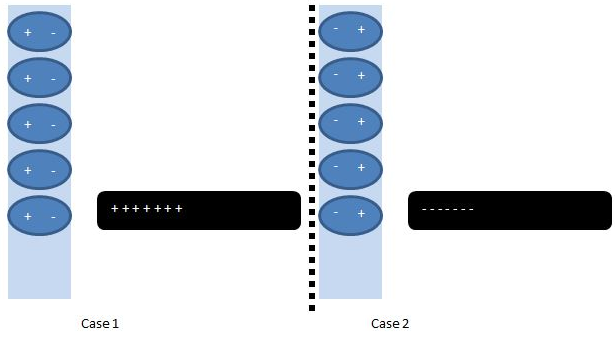
Water is dipolar in nature. Hence when water enters an electric field, the molecules rearrange themselves.
The case $1$ in the figure, where a positively charged rod is brought near the water, the negative charge moves towards the rod and positive charge moves away from the rod.
Hence, the attractive force is greater than the repulsive force and as a result, the water stream bends towards the rod.
To the contrast, in case $2$, when a negatively charged rod is brought near the water, the molecules rearrange such that positive charge moves towards the rod and the negative charge moves away from it as shown in the figure.
In this case also, the attractive forces dominate the repulsive forces, and hence, the stream still bends towards the rod.
View full question & answer
MCQ 1441 Mark
Two identically charged spheres when suspended by strings of equal lengths make an angle of $30^{\circ}$ with each other. The angle remains the same when they are immersed in a liquid of density less than the density of the material of the spheres. Choose the correct option
  • A
    The electric force between them increases.
  • The electric force between them decreases.
  • C
    The net downward force will increase.
  • D
    The net downward force will remain unchanged.
Answer
Correct option: B.
The electric force between them decreases.
View full question & answer
MCQ 1451 Mark
Two point charges $q_1$ and $q_2$ are situated at a distance $d$. There is no such point in between them where the electric field is zero. What can we deduce?
  • A
    There is no such point.
  • B
    The charges are of the same polarity.
  • The charges are of opposite polarity.
  • D
    The charges must be unequal.
Answer
Correct option: C.
The charges are of opposite polarity.

If both the charges are of the same polarity $($maybe of unequal magnitude$)$, there must be a point in between them where the electric field intensities of the charges are of equal magnitude and in opposite direction. Hence they balance each other and the net field intensity must be zero. But if the charges are of opposite polarities their field intensities aid each other and net field intensity can never be zero.
View full question & answer
MCQ 1461 Mark
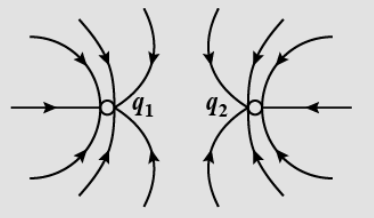
Identify the correct statement about the charges $q _1$ and $q _2$
  • A
    $q _1$ and $q _2$​, both are positive.
  • $q _1$ and $q _2$​, both are negative.
  • C
    $q _1$ is positive and $q _2$​ is negative.
  • D
    $q _2$ is positive and $q _1$​ is negative.
Answer
Correct option: B.
$q _1$ and $q _2$​, both are negative.
$q _1$ and $q _2$​, both are negative.$q _1$ and $q _2$​, both are negative.
Explanation:
The filed of lines is outward from the positive charge and inward to the negative charge.
Here the field of lines is towards the charges $q _1$ and $q _2$. Thus, both charges are negative.
View full question & answer
MCQ 1471 Mark
The constant $k$ in Coulomb's law depends upon:
  • Nature of medium
  • B
    System of units
  • C
    Intensity of charge
  • D
    Both $(a)$ and $(b)$
Answer
Correct option: A.
Nature of medium

The value of $\text{K}=\frac{1}{4\pi\in_0}=8.854\times10^{-12}\text{C}^2\text{N}^{-1}\text{m}^{-2}$
Where $ε0​$ is permittivity of free space.

View full question & answer
MCQ 1481 Mark
On rubbing, when one body gets positively charged and other negatively charged, the electrons transferred from positively charged body to negatively charged body are:
  • Valence electrons only.
  • B
    Electrons of inner shells.
  • C
    Both valence electrons and electrons of inner shell.
  • D
    Yet to be established.
Answer
Correct option: A.
Valence electrons only.
View full question & answer
MCQ 1491 Mark
A force $‘F’$ is acting between two charges in air. If the space between them be completely filled with a medium $K = 4$, the force will be:
  • A
    $F$
  • B
    $4F$
  • $\frac{\text{F}}{4}$
  • D
    $2F$
Answer
Correct option: C.
$\frac{\text{F}}{4}$
C. $\frac{ F }{4}$
Explanation:
By Coulomb's law, the force between two charges $\left(q_1, q_2\right)$ in air is given by
$F =\frac{ q _1 q _2}{4 \pi \epsilon_0 r ^2}$
where $r =$ distance between two charges.
Now the force between two charges $\left(q_1, q_2\right)$ in medium with dielectric constant $K =4$ becomes, $F =\frac{ q _1 q _2}{4 \pi K \epsilon_0 r ^2}$
So, $F=\frac{ F }{ K }=\frac{ F }{4}$
View full question & answer
MCQ 1501 Mark
An electron and a proton are both released from rest $1$ meter from a large stationary negative charge, considering only the force from the large stationary negative charge on the proton and electron. Which of the following is true?
  • A
    Neither the proton nor the electron will accelerate.
  • B
    The initial acceleration of the proton is greater.
  • C
    Both the electron and proton have the same non$-$zero initial acceleration.
  • The initial acceleration of the electron is greater.
Answer
Correct option: D.
The initial acceleration of the electron is greater.

The magnitude of electric force between electron and proton is given by $\text{F}=\frac{1}{4\pi\in_0}\frac{\text{e(-e)}}{\text{d}^2}$
The force on each of them is equal in magnitude and is attractive.
The acceleration of a species is given by $\text{a}=\frac{\text{F}}{\text{m}}$

View full question & answer
M.C.Q (1 Marks) - Page 3 - Physics STD 12 Science Questions - Vidyadip