Questions · Page 3 of 3

3 Marks Question

Question 1013 Marks
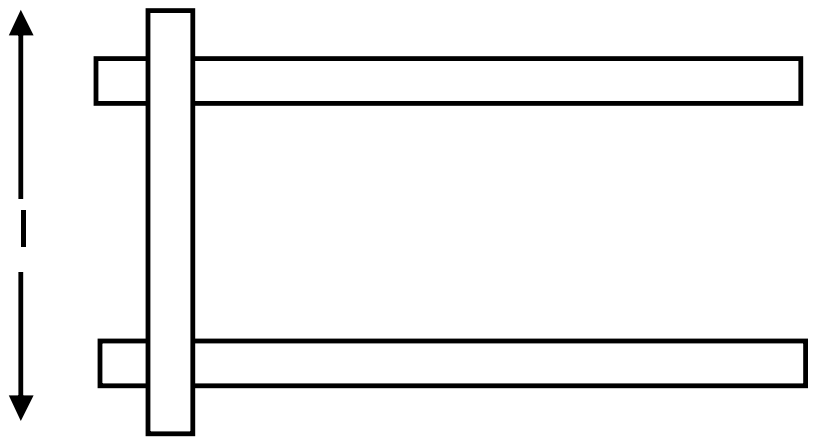
A straight wire of length l can slide on two parallel plastic rails kept in a horizontal plane with a separation d. The coefficient of friction between the wire and the rails is $\mu.$ If the wire carries a current i, what minimum magnetic field should exist in the space in order to slide the wire on the rails?
Answer

Mass = m
length = l
Current = i
Magnetic field = B = ?
$\text{iBl}=\mu\text{mg}$
$\Rightarrow\text{B}=\frac{\mu\text{gm}}{\text{il}}$
View full question & answer
Question 1023 Marks
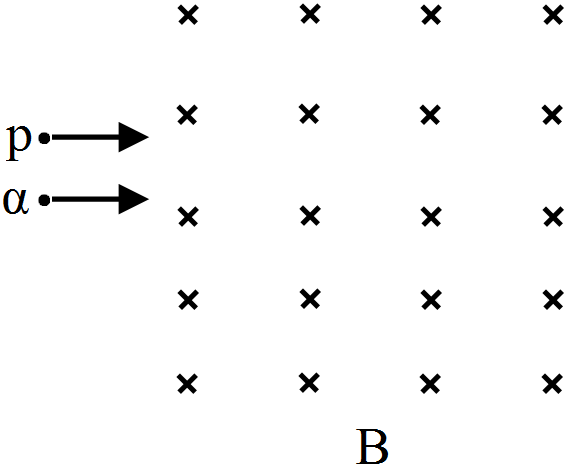
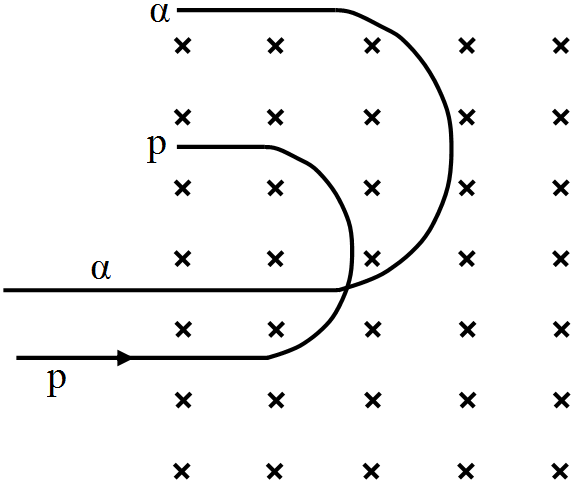
An $\alpha$-particle and a proton moving with the same speed enter the same magnetic field region at right angles to the direction of the field. Show the trajectories followed by the two particles in the region of the magnetic field. Find the ratio of the radii of the circular paths which the two particles may describe.
Answer
Radius of charged particle in magnetic field.
$\text{r}=\frac{\text{mv}}{\text{qB}}$
$\text{r}\propto\frac{\text{m}}{q}$ for same $\upsilon$ and B.
$\frac{\text{r}_\text{p}}{\text{r}_\alpha}=\frac{(\text{m/q})_\text{p}}{(\text{m/q})_\alpha}$
$=\frac{(\text{m}_p/e)}{((4\text{m}_\text{p})/2\text{e})}=\frac{1}{2}$
View full question & answer
Question 1033 Marks
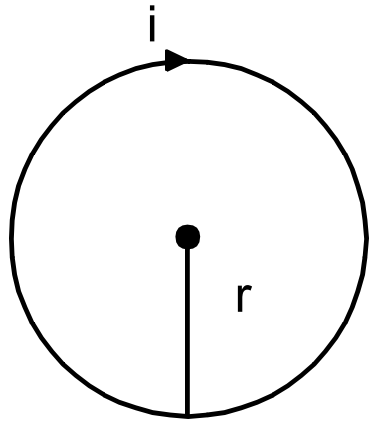
A circular loop of radius r carries a current i. How should a long, straight wire carrying a current 4i be placed in the plane of the circle so that the magnetic field at the centre becomes zero?
Answer

$\overrightarrow{\text{B}}$ due to loop $\frac{\mu_0\text{i}}{2\text{r}}$
Let the straight current carrying wire be kept at a distance R from centre. Given I = 4i
$\overrightarrow{\text{B}}$ due to wire $\frac{\mu_0\text{i}}{2\pi\text{R}}=\frac{\mu_0\times4\text{i}}{2\pi\text{R}}$
Now, the $\overrightarrow{\text{B}}$ due to both will balance each other
Hence $\frac{\mu_0\text{i}}{2\text{r}}=\frac{\mu_04\text{i}}{2\pi\text{R}}\Rightarrow\text{R}=\frac{4\text{r}}{\pi}$
Hence the straight wire should be kept at a distance $\frac{4\pi}{\text{r}}$ from centre in such a way that the direction of current in it is opposite to that in the nearest part of circular wire. As a result the direction will $\overrightarrow{\text{B}}$ will be oppose.
View full question & answer
Question 1043 Marks
The magnetic field due to a long straight wire has been derived in terms of $\mu_0,$ i and d. Express this in terms of $\in_0,$ C, i and d.
Answer
The magnetic field due to a long, straight wire is given by
$\text{B}=\frac{\mu_0\text{i}}{2\pi\text{d}}$
$\because$ Speed of light, $\text{c}=\frac{1}{\sqrt{\mu_0\in_0}}$
$\Rightarrow\mu_0=\frac{1}{\text{c}^2\in_0}$
$\Rightarrow\text{B}=\frac{\text{i}}{2\pi\text{c}^2\in_0\text{d}}$
(In terms of $\in_0,$ c, i and d)
View full question & answer
Question 1053 Marks
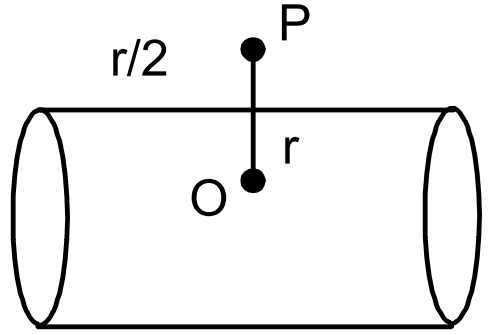
A thin but long, hollow, cylindrical tube of radius r carries a current i along its length. Find the magnitude of the magnetic field at a distance $\frac{\text{r}}{2}$ from the surface (a) inside the tube (b) outside the tube.
Answer

  1. For inside the tube $\overrightarrow{\text{B}}=0$
As, $\overrightarrow{\text{B}}$ inside the conducting tube = o
  1. For $\overrightarrow{\text{B}}$ outside the tube
$\text{d}=\frac{3\text{r}}{2}$

$\overrightarrow{\text{B}}=\frac{\mu_0\text{i}}{2\pi\text{d}}=\frac{\mu_0\text{i}\times2}{2\pi3\text{r}}=\frac{\mu_0\text{i}}{2\pi\text{r}}$
View full question & answer
Question 1063 Marks
A circular loop of radius 20cm carries a current of 10A. An electron crosses the plane of the loop with a speed of $2.0 \times 10^6m/s$. The direction of motion makes an angle of 30° with the axis of the circle and passes through its centre. Find the magnitude of the magnetic force on the electron at the instant it crosses the plane.
Answer
$\text{r}=20\text{cm},\ \text{i}=10\text{A},$
$\text{V}=2\times10^6\text{m/s}, \theta=30^\circ$
$\text{F}=\text{e}(\overrightarrow{\text{V}}\times\overrightarrow{\text{B}})=\text{eVB}\sin\theta$
$=1.6\times10^{-19}\times2\times10^6\times\frac{\mu_0\text{i}}{2\text{r}}\sin30^\circ$
$=\frac{1.6\times10^{-19}\times2\times10^6\times4\pi\times10^{-7}\times10}{2\times2\times20\times10^{-2}}=16\pi\times10^{-19}\text{N}$
View full question & answer
Question 1073 Marks
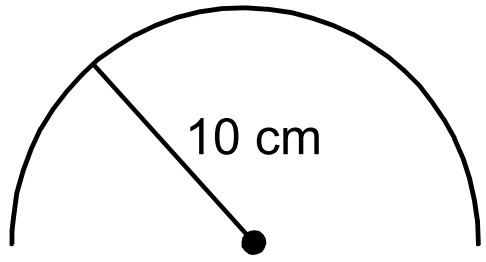
Find the magnetic field B due to a semicircular wire of radius 10.0cm carrying a current of 5.0A at its centre of curvature.
Answer
i = 5 Ampere,
r = 10cm = 0.1m

As the semicircular wire forms half of a circular wire,
So, $\overrightarrow{\text{B}}=\frac{1}{2}\frac{\mu_0\text{i}}{2\text{r}}=\frac{1}{2}\times\frac{4\pi\times10^{-7}\times5}{2\times0.1}$
$=15.7\times10^{-6}\text{T}\approx16\times10^{-6}\text{T}=1.6\times10^{-5}\text{T}$
View full question & answer
Question 1083 Marks
A straight horizontal wire of mass 10mg and length 1.0m carries a current of 2.0A. What minimum magnetic field B should be applied in the region, so that the magnetic force on the wire may balance its weight?
Answer
Mass $=10\text{mg}=10^{-5}\text{kg}$
Lenght $=1\text{m}$
$\text{I}=2\text{A}$
Now, $\text{Mg}=\text{ilB}$
$\Rightarrow\text{B}=\frac{\text{mg}}{\text{il}}=\frac{10^{-5}\times9.8}{2\times1}$
$=4.9\times10^{-5}\text{T}$
View full question & answer
Question 1093 Marks
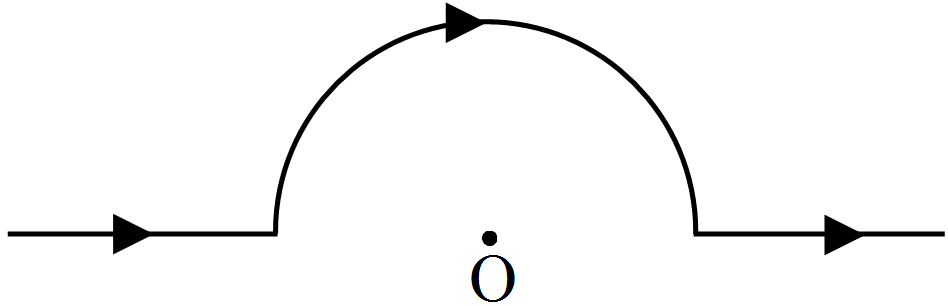
A straight wire carrying a current of 12A is bent into a semi-circular arc of radius 2.0cm as shown. What is the magnetic field at O due to:
  1. Straight segments.
  2. The semi-circular arc?
Answer
Magnetic field due to a current carrying element.
$\text{d}\vec{\text{B}}=\frac{\mu_0}{4\pi}\frac{\text{I}\vec{\delta\text{l}}\times\text{r}}{\text{r}^3}$
  1. For straight segment $\text{}\ \theta=0\ \text{or}\ \pi\Rightarrow\vec{\delta\text{l}}\times\vec{\text{r}}=\delta\text{l}\ \text{r}\sin0\ \hat{\text{n}}=0\ \therefore\text{B}_1=0$
  2. For semicircular arc $\sum\text{dl}=\pi\text{r},\theta=\frac{\pi}{2}$
$\therefore\vec{\text{B}_2}=\frac{\mu_0}{4\pi}\frac{\sum\text{I}\vec{\delta\text{l}}\times\vec{\text{r}}}{\text{r}^3}=\frac{\mu _0}{4\pi}\frac{\text{I}\sum\delta\text{l}\sin\frac{\pi}{2}}{\text{r}^2}\hat{\widehat{n}}$

$=\frac{\mu_0}{4\pi}\frac{\text{I}\pi\text{r}}{\text{r}^2}\widehat{n}=\frac{\mu_0\text{I}}{4\text{r}}, $

directed perpendicular to plane of paper downward.
View full question & answer
Question 1103 Marks
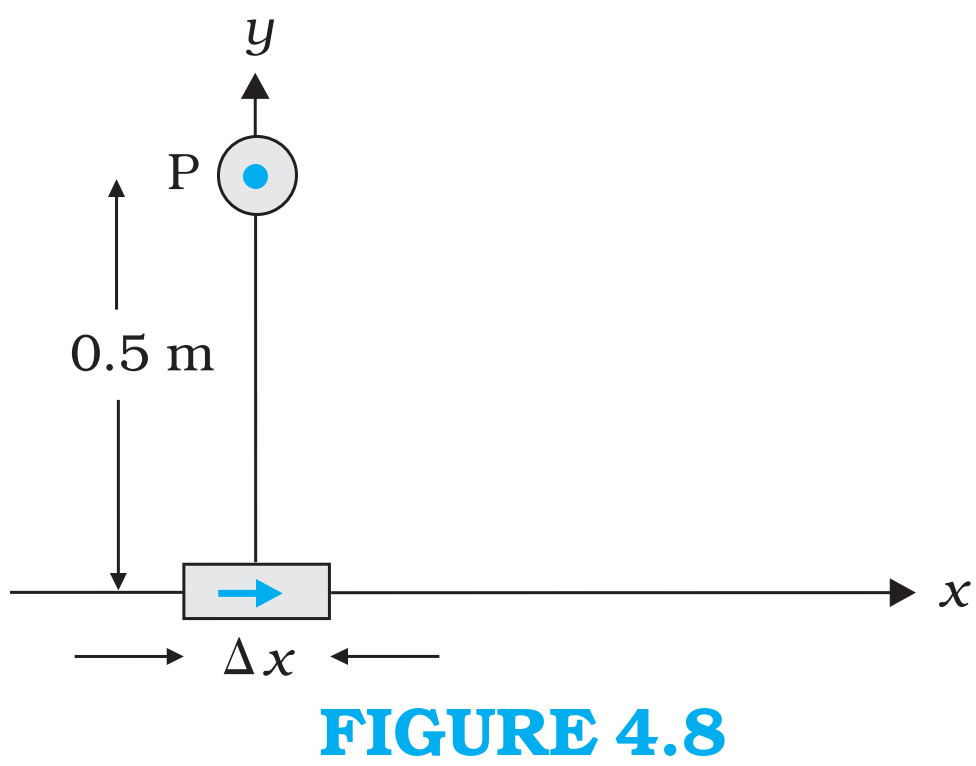
An element $\Delta l =\Delta x \hat{ i }$ is placed at the origin and carries a large current $I=10$ A $($Fig. $4.8)$. What is the magnetic field on the $y$ axis at a distance of $0.5 m . \Delta x=1 cm$.
Image
Answer
$| d B |=\frac{\mu_0}{4 \pi} \frac{I d l \sin \theta}{r^2} \text { [using Eq. (4.11)] }$
$d l=\Delta x=10^{-2} m , I=10 \text { A, } r=0.5 m =y, \mu_0 / 4 \pi=10^{-7} \frac{ Tm }{ A }$
$\theta=90^{\circ} ; \sin \theta=1$
$| d B |=\frac{10^{-7} \times 10 \times 10^{-2}}{25 \times 10^{-2}}=4 \times 10^{-8} T$
The direction of the field is in the $+z-$direction. This is so since,
$d l \times r =\Delta x \hat{ i } \times y \hat{ j }=y \Delta x(\hat{ i } \times \hat{ j })=y \Delta x \hat{ k }$
We remind you of the following cyclic property of cross-products,
$\hat{ i } \times \hat{ j }=\hat{ k } ; \hat{ j } \times \hat{ k }=\hat{ i } ; \hat{ k } \times \hat{ i }=\hat{ j }$
Note that the field is small in magnitude.
View full question & answer
Question 1113 Marks
(a) A current-carrying circular loop lies on a smooth horizontal plane. Can a uniform magnetic field be set up in such a manner that the loop turns around itself (i.e., turns about the vertical axis).
(b) A current-carrying circular loop is located in a uniform external magnetic field. If the loop is free to turn, what is its orientation of stable equilibrium? Show that in this orientation, the flux of the total field (external field + field produced by the loop) is maximum.
(c) A loop of irregular shape carrying current is located in an external magnetic field. If the wire is flexible, why does it change to a circular shape?
Answer
(a) No, because that would require $\tau$ to be in the vertical direction. But $\tau=I A \times B$, and since $A$ of the horizontal loop is in the vertical direction, $\tau$ would be in the plane of the loop for any $B$.
(b) Orientation of stable equilibrium is one where the area vector $A$ of the loop is in the direction of external magnetic field. In this orientation, the magnetic field produced by the loop is in the same direction as external field, both normal to the plane of the loop, thus giving rise to maximum flux of the total field.
(c) It assumes circular shape with its plane normal to the field to maximise flux, since for a given perimeter, a circle encloses greater area than any other shape.
View full question & answer
Question 1123 Marks
The horizontal component of the earth's magnetic field at a certain place is $3.0 \times 10^{-5} T$ and the direction of the field is from the geographic south to the geographic north. A very long straight conductor is carrying a steady current of $1 A$. What is the force per unit length on it when it is placed on a horizontal table and the direction of the current is $(a)$ east to west; $(b)$ south to north?
Answer
$F =I l \times B$
$F=I l B \sin \theta$
The force per unit length is
$f=F / l=I B \sin \theta$
$(a)$ When the current is flowing from east to west,
$\theta=90^{\circ}$
Hence,
$f =I B$
$ =1 \times 3 \times 10^{-5}=3 \times 10^{-5} N m ^{-1}$
This is larger than the value $2 \times 10^{-7} Nm ^{-1}$ quoted in the definition of the ampere.
Hence it is important to eliminate the effect of the earth's magnetic field and other stray fields while standardising the ampere.
The direction of the force is downwards.
This direction may be obtained by the directional property of cross product of vectors.
$(b)$ When the current is flowing from south to north,
$\theta=0^{\circ}$
$f=0$
Hence there is no force on the conductor.
View full question & answer
3 Marks Question - Page 3 - Physics STD 12 Science Questions - Vidyadip