MCQ 1011 Mark
The value of $1$ amu is equal to:
- A
$ 1.66 \times 10^{-8} \mathrm{~g} $
- B
$ 1.66 \times 10^{-4} \mathrm{~g} $
- C
$ 1.66 \times 10^{-16} \mathrm{~g} $
- ✓
$ 1.66 \times 10^{-24} \mathrm{~g} $
AnswerCorrect option: D. $ 1.66 \times 10^{-24} \mathrm{~g} $
One an amu is $\frac{1}{10}$ of the mass of one carbon$-12$ atom.
It is equal to $\frac{1}{\text{NA}}$
$\frac{1}{6.022\times10^{23}}$
$= 1.66 \times 10^{-24} \mathrm{~g} $
View full question & answer→MCQ 1021 Mark
The antiparticle of electron is:
MCQ 1031 Mark
As the mass number $A$ increases, the binding energy per nucleon in a nucleus:
AnswerCorrect option: D. Varies in a way that depends on the actual value of $A.$
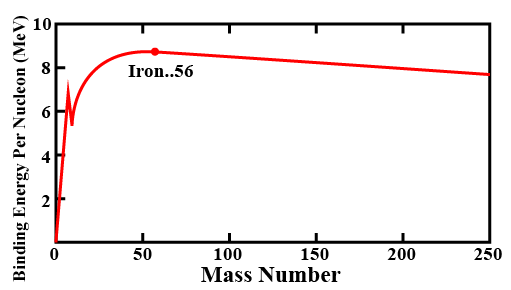
Binding energy per nucleon in a nucleus first increases with increasing mass number $(A)$ and reaches a maximum of $8.7\ MeV$ for A $(50 - 80)$. Then, again it slowly starts decreasing with the increase in $A$ and drops to the value of $7.5\ MeV.$
View full question & answer→MCQ 1041 Mark
What describe the Einsteins equation for the relativity of mass and energy?
- ✓
A small amount of mass contains a lot of energy.
- B
A small amount of energy can be converted into a large amount of mass.
- C
Mass can be converted into energy, but energy cannot be converted mass.
- D
Energy can be converted into mass, but mass cannot be converted into energy.
AnswerCorrect option: A. A small amount of mass contains a lot of energy.
Sir Einstein's mass$-$energy equation states that mass and energy can be converted into each other by the following relation.
$\mathrm{E}=\mathrm{mc}^2,(\mathrm{c}=\text { speed of light })$
This implies that a small amount of mass contains a lot of energy, which can be proved with an example.
Let we have a mass of $1 \mathrm{~g}=10^{-3} \mathrm{~kg}$, therefore energy produced by it will be:
$E=10^{-3} \times\left(3 \times 10^8\right) 2=9 \times 10^{13} \mathrm{~J}$ which is a vast amount energy produced by only one gram $($small mass$)$ of mass.
Whereas a small amount of energy doesn't give a large amount of mass because for that we have to divide the energy by $\mathrm{c}^2$, which gives a small mass.
View full question & answer→MCQ 1051 Mark
In a nuclear reactor, moderators slow down the neutrons which come out in a fission process. The moderator used have light nuclei. Heavy nuclei will not serve the purpose because:
- A
- ✓
Elastic collision of neutrons with heavy nuclei will not slow them down.
- C
The net weight of the reactor would be unbearably high.
- D
Substances with heavy nuclei do not occur in liquid or gaseous state at room temperature.
AnswerCorrect option: B. Elastic collision of neutrons with heavy nuclei will not slow them down.
The moderator used have light nuclei like proton. When protons undergo perfectly elastic collision with the neutron emitted their velocities are exchanged, it means, neutrons come to rest and protons move with the velocity of neutrons.
View full question & answer→MCQ 1061 Mark
Free $^{238}U$ nuclei kept in a train emit alpha particles. When the train is stationary and a uranium nucleus decays, a passenger measures that the separation between the alpha particle and the recoiling nucleus becomes $x$ in time $t$ after the decay. If a decay takes place when the train is moving at a uniform speed $v$, the distance between the alpha particle and the recoiling nucleus at a time $t$ after the decay, as measured by the passenger will be:
- A
$x + vt$
- B
$x - vt$
- ✓
$x$
- D
depends on the direction of the train.
AnswerWhen the train is stationary, the separation between the alpha particle and recoiling uranium nucleus is $x$ in time $t$ after the decay. Even if the decay is taking place in a moving train and the separation is measured by the passenger sitting in it, the separation between the alpha particle and nucleus will be $x$. This is because the observer is also moving with the same speed with which the alpha particle and recoiling nucleus are moving, i.e. they all are in the same frame that is moving at a uniform speed.
View full question & answer→MCQ 1071 Mark
If a radioactive element is placed in an evacuated chamber, then the rate of radioactive decay will:
MCQ 1081 Mark
The heavier nuclei tend to have larger $\frac{\text{N}}{\text{Z}}$ ratio because:
- A
A neutron is heavier than a proton.
- B
Coulomb forces have longer range compared to the nuclear forces.
- C
A neutron does not exert electric repulsion.
- ✓
AnswerExplanation:
This is because in heavy nuclei, the $\frac{\text{N}}{\text{Z}}$ ratio becomes larger in order to maintain their stability and reduce instability caused due to the repulsion among the protons. The neutrons exert only attractive short-range nuclear forces on each other as well as on the neighbouring protons, whereas the protons exert attractive short-range nuclear forces on each other as well as the electrostatic repulsive force. Thus, the nuclei with high mass number, in order to be stable, have large neutron to proton ratio $\frac{\text{N}}{\text{Z}}.$
View full question & answer→MCQ 1091 Mark
As the mass number A increases, which of the following quantities related to a nucleus do not change?
AnswerRadius of a nucleus with mass number $A$ is given as
$\text{R}=\text{R}_{\text{0}}\text{A}^{\frac{1}{3}}$
Here, $\text{R}_0=1.2\text{fm}$
$\therefore$ Volume of the nucleus $=\frac{4\pi\text{R}^3}{3}=\frac{4\pi\text{R}^3\text{A}}{3}$
This depends on $A.$ With an increase in $A, V$ increases proportionally.
Mass of the nucleus $\simeq\text{Am}_{\text{N}}$
Here, $m_N <$ is the mass of a nucleon.
Therefore, mass of the nucleus also increases with the increasing mass number. Binding energy also depends on mass number $($number of nucleons$)$ as it is the difference between the total mass of the constituent nucleons and the nucleus. Therefore, it also varies with the changing mass number.
On the other hand,
$\text{Density}=\frac{\text{Mass}}{\text{Volume}}$
$=\frac{\text{Am}_{\text{N}}}{\frac{4\pi\text{R}3}{3}}=\frac{\text{Am}_{\text{N}}}{\frac{4\pi\text{R}_0^3\text{A}}{3}}=\frac{\text{m}_{\text{N}}}{\frac{4\pi\text{R}_0^3}{3}}=\frac{3\text{m}_{\text{N}}}{4\pi\text{R}_{0}^3}$
This is independent of $A$ and hence does not change as mass number increases.
View full question & answer→MCQ 1101 Mark
Which of the following is not a mode of radioactive decay?
MCQ 1111 Mark
For a fast chain reaction, the size of $U^{235}$ block, as compared to its critical size, must be:
AnswerIn fast chain reaction neutron released in previous fission again strikes $^{235}U$, So size of $^{235}U$ block should be greater than it's critical size.
View full question & answer→MCQ 1121 Mark
Which of the following is used as standard for determination of atomic mass unit?
- A
$ \mathrm{O}^{16} $
- ✓
$ \mathrm{C}^{12} $
- C
$ \mathrm{H}^1 $
- D
$ \mathrm{O}^{17} $
AnswerCorrect option: B. $ \mathrm{C}^{12} $
Atomic mass of a compound is measured in atomic mass units abbreviated as amu or $u.$ One atomic mass unit is defined as $\frac{1}{12}$th of mass of a single carbon$-12$ atom.
View full question & answer→MCQ 1131 Mark
In which of the following decays the atomic number decreases?
- A
$\alpha-\text{decay}$
- B
$\beta^+-\text{decay}$
- ✓
- D
$\gamma-\text{decay}$
AnswerExplanation:
In alpha particle decay, the unstable nucleus emits an alpha particle reducing its proton number (atomic number) Z as well as neutron number N by 2.
$\text{ }^{\text{A}}_{\text{Z}}\text{X}\rightarrow\text{ }^{\text{A}-4}_{\text{Z}-2}\text{Y}+\text{ }^4_2\text{He}$
During $\beta^--\text{decay},$ a neutron is converted to a proton, an electron and an antineutrino. Thus, there is an increase in the atomic number.
$\text{ }^{\text{A}}_{\text{Z}}\text{X}\rightarrow\text{ }^{\text{A}}_{\text{Z}+1}\text{Y}+\text{e}^-+\bar{\text{v}}$
During $\beta^+-\text{decay},$ a proton in the nucleus is converted to a neutron, a positron and a neutrino in order to maintain the stability of the nucleus. Thus, there is a decrease in the atomic number.
$\text{ }^{\text{A}}_{\text{Z}}\text{X}\rightarrow\text{ }^{\text{A}}_{\text{Z}-1}\text{Y}+\beta^++\text{v}$
When a nucleus is in higher excited state or has excess of energy, it comes to the lower state in order to become stable and release energy in the form of electromagnetic radiation called gamma ray. The element in the gamma decay doesn't change.
Therefore, alpha and beta plus decay suffer decrease in atomic number.
View full question & answer→MCQ 1141 Mark
Radioactive substance emits:
- A
$\alpha - \text{rays} $
- B
$\beta - \text{rays}$
- C
$\gamma - \text{rays}$
- ✓
View full question & answer→MCQ 1151 Mark
Joining of light nuclei of elements to form a heavy nucleus with the release of energy is called:
AnswerIn nuclear physics, nuclear fusion is a nuclear reaction in which two or more atomic nuclei collide at a very high speed and join to form a new type of atomic nucleus. During this process, matter is not conserved because some of the matter of the fusing nuclei is converted to photons $($energy$).$
View full question & answer→MCQ 1161 Mark
Mass energy equation was propounded by:
MCQ 1171 Mark
Nucleus of an atom whose atomic mass is $24$ consists of:
- A
$11$ Electrons, $11$ protons and $13$ neutrons.
- B
$11$ Electrons, $13$ protons and $11$ neutrons.
- ✓
$11$ Protons and $13$ neutrons.
- D
$11$ Protons and $13$ electrons.
AnswerCorrect option: C. $11$ Protons and $13$ neutrons.
View full question & answer→MCQ 1181 Mark
Which of the following is the radio isotope in this pair?$30\text{P}\\ \ 15$,$32\text{P}\\ \ 15$
- ✓
$32\text{P}\\ \ 15$
- B
$30\text{P}\\ \ 15$
- C
- D
AnswerCorrect option: A. $32\text{P}\\ \ 15$
$32\text{P}\\ \ 15$ is the radioactive isotope of phosphorous element.
As it has more number of neutrons than number of protons.
View full question & answer→MCQ 1191 Mark
Consider a sample of a pure beta$-$active material:
- A
All the beta particles emitted have the same energy.
- B
The beta particles originally exist inside the nucleus and are ejected at the time of beta decay.
- C
The antineutrino emitted in a beta decay has zero mass and hence zero momentum.
- ✓
The active nucleus changes to one of its isobars after the beta decay.
AnswerCorrect option: D. The active nucleus changes to one of its isobars after the beta decay.
In a beta decay, either a neutron is converted to a proton or a proton is converted to a neutron such that the mass number does not change. Also, the number of the nucleons present in the nucleus remains the same. Thus, the active nucleus gets converted to one of its isobars after beta decay.
View full question & answer→MCQ 1201 Mark
For the nuclie with mass number $> 100:$
- ✓
Binding energy of the nucleus decreases on an average as A increases.
- B
Binding energy of the nucleus increases on an average as A increases.
- C
The two nuclei fuse to form a bigger nuclide releasing energy.
- D
The nucleus essentially breaks up into two nuclides of equal mass releasing energy.
AnswerCorrect option: A. Binding energy of the nucleus decreases on an average as A increases.
From the above figure it is clearly visible that the binding energy of the nucleus decreases on an average as A increases
View full question & answer→MCQ 1211 Mark
$Q$ value for neutron decay is:
- ✓
$0.782\ MeV$
- B
$0.782\ eV$
- C
$78.2\ MeV$
- D
$0$
AnswerCorrect option: A. $0.782\ MeV$
For neutron decay, some mass disappears as neutrons convert to a proton, electron and antineutrino.
$Q=\left(m_n-m_p-m{_v}^--m_e\right) c^2=0.782 \mathrm{MeV}$
View full question & answer→MCQ 1221 Mark
$\mathrm{M}_{\mathrm{x}}$ and $\mathrm{M}_{\mathrm{y}}$ denote the atomic masses of the parent and the daughter nuclei respectively in a radioactive decay. The $Q -$value for a $\beta^{-}$decay is $Q_1$ and that for a $\beta^{+}$decay is $Q_2$. If me denotes the mass of an electron, then which of the following statements is correct?
- ✓
$ Q_1=\left(M_x-M_y\right) c_2 \text { and } Q_2=\left(M_x-M_y-2 m_e\right) c^2 $
- B
$ Q_1=\left(M_x-M_y\right) c_2 \text { and } Q_2=\left(M_x-M_y\right) c_2 $
- C
$ Q_1=\left(M_x-M_y-2 m_e\right) c^2 \text { and } Q_2=\left(M_x-M_y+2 m_e\right) c^2 $
- D
$ Q_1=\left(M_x-M_y+2 m_e\right) c^2 \text { and } Q_2=\left(M_x-M_y+2 m_e\right) c^2 $
AnswerCorrect option: A. $ Q_1=\left(M_x-M_y\right) c_2 \text { and } Q_2=\left(M_x-M_y-2 m_e\right) c^2 $
Key concept: $Q$ value or energy of nuclear reaction: The energy absorbed or released during a nuclear reaction is known as $Q-$value of nuclear reaction.
$Q-$value $= ($Mass of reactants $–$ mass of products$)c^2$ Joules $= ($Mass of reactants $–$ mass of products$)$ amu
If $Q < 0$, the nuclear reaction is known as endothermic. $($The energy is absorbed in the reaction$).$
If $Q > 0$, the nuclear reaction is known as exothermic. $($The energy is released in the reaction$).$
Let the nucleus be $_ZX^A$.
$\beta$ decay is respresented as: $_\text{Z}\text{X}^\text{A}\rightarrow_{\text{z}+1}\text{Y}^{\text{A}}+_{-1}\text{e}^0+\overline{\text{v}}+\text{Q}_2$
$ Q_1=\left[m_n\left(z X^A\right)-m_n\left(_{z+1} Y^A\right)-m_e\right] c^2 $
$ =\left[m_n\left(z X^A\right)+Z m_e-m_n\left(_{z+1} Y^A\right)-(Z+1) m_e\right] c^2 $
$ =\left[m\left(z X^A\right)-m\left(_{z-1} Y^A\right)\right] c^2 $
$ \Rightarrow Q_1=\left(M_x-M_y\right) c^2 $
$\beta^+$ decay is represented as; $_\text{Z}\text{X}^\text{A}\rightarrow_{\text{z}-1}\text{Y}^{\text{A}}+_{+1}\text{e}^0+{\text{v}}+\text{Q}_2$
$ Q_2=\left[m_n\left(_z X^A\right)-m_n\left(_{z-1} Y^A\right)-m_e\right] c^2 $
$ =\left[m_n\left(z X^A\right)+Z m_e-M_n\left(_{z-1} Y^A\right)-(Z-1) m_e-2 m_e\right] c^2 $
$ =\left[m\left(z X^A\right)^{\prime}-m\left(_{z-1} Y^A\right)-2 m_e\right] c^2 $
$ \Rightarrow Q 2=\left(M_X-M_y-2 m_e\right) c^2 $
View full question & answer→MCQ 1231 Mark
What is the atomic mass $(u)$ of calcium?
AnswerAtomic mass $(u)$ of Calcium is $40 u.$
View full question & answer→MCQ 1241 Mark
In an endothermic reaction the binding energies of reactants and products are $e_1 , e_2$ respectively, then:
- A
$ e_1 < e_2 $
- B
$ e_1=e_2 $
- ✓
$ e_1 > e_2 $
- D
$ e_1 \geq e_2 $
AnswerCorrect option: C. $ e_1 > e_2 $
In endothermic reaction the binding energy of reactants is more than the binding energy of products.
View full question & answer→MCQ 1251 Mark
Sun maintains its shining because of:
- A
- B
- ✓
Fusion of hydrogen nuclei
- D
AnswerCorrect option: C. Fusion of hydrogen nuclei
The Sun produces energy by the nuclear fusion of hydrogen into helium in its core.
View full question & answer→MCQ 1261 Mark
Which of the following are electromagnetic waves?
- A
$\alpha-\text{decay}$
- B
$\beta^+-\text{decay}$
- C
$\beta^--\text{decay}$
- ✓
$\gamma-\text{decay}$
AnswerCorrect option: D. $\gamma-\text{decay}$
Alpha rays, beta$-$plus and beta$-$minus rays carry charged particles that show particle behaviour. On the other hand, gamma rays carry photons that show particle as well as wave behaviour. Hence, only gamma rays are electromagnetic waves.
View full question & answer→MCQ 1271 Mark
Statement$-I :$ Energy is released when heavy nuclei undergo fission or light nuclei undergo fusion and Statement$-II:$ For heavy nuclei, binding energy per nucleon increases with increasing $Z$. while for light nuclei it decreases with increasing $Z$.
- A
Both the statements are true and Statement $2$ is the correct explanation for Statement $1.$
- B
Both the statements are true but Statement $2$ is not the correct explanation for Statement $1.$
- ✓
Statement $1$ is true but Statement $2$ is false.
- D
Statement $1$ is false but Statement $2$ is true.
AnswerCorrect option: C. Statement $1$ is true but Statement $2$ is false.
Statement$-I:$ Both, heavy nuclei and light nuclei have low value of binding energy per nucleon. Heavy nuclei splits $($fission$)$ into light nuclei and light nuclei combine $($fusion$)$ to attain the stability i.e. higher value of binding energy per nucleon. In both processes, some mass is disappeared which is converted into energy i.e. release of energy. $($statement is $TRUE).$
Statement$-II:$ For heavy nuclei the binding energy decreases with increasing $Z$ and for light nuclei binding energy per nucleon increases with increasing $Z.$
View full question & answer→MCQ 1281 Mark
What is the atomic mass $(u)$ of sodium?
AnswerSodium is a chemical element with the symbol $Na$ and atomic number $11.$
Atomic mass $(u)$ of sodium $= 23u$.
It is a soft, silvery$-$white, highly reactive metal.
View full question & answer→MCQ 1291 Mark
A free neutron decays to a proton but a free proton does not decay to a neutron. This is because:
- A
Neutron is a composite particle made of a proton and an electron whereas proton is a fundamental particle.
- B
Neutron is an uncharged particle whereas proton is a charged particle.
- ✓
Neutron has large rest mass than the proton.
- D
Weak forces can operate in a neutron but not in a proton.
AnswerCorrect option: C. Neutron has large rest mass than the proton.
A nucleus is made up of two fundamental particles$-$neutrons and protons. If a nucleus has more number of neutrons than what is needed to have stability, then neutrons decay into protons and if there's an excess of protons, then they decay to form neutrons. Since a neutron has larger rest mass than a proton, the $Q-$value of its decay reaction is positive and a free neutron decays to a proton, while an isolated proton cannot decay to a neutron as the $Q-$value of its decay reaction is negative. Hence, it is physically not possible.
View full question & answer→MCQ 1301 Mark
The neutron was discovered by:
AnswerJames Chadwick discovered the neutron.
View full question & answer→MCQ 1311 Mark
Nuclear forces exists between:
- A
Neutron $-$ neutron.
- B
Proton $-$ proton.
- C
Neutron $-$ proton.
- ✓
View full question & answer→MCQ 1321 Mark
The 'rad' is the correct unit used to report the measurement of:
- A
The ability of a beam of gamma ray photons to produce ions in a target.
- B
The energy delivered by radiation to a target.
- ✓
The biological effect of radiation.
- D
The rate of decay of a radioactive source.
AnswerCorrect option: C. The biological effect of radiation.
View full question & answer→MCQ 1331 Mark
Half life of radioactive element depends upon:
- A
Amount of element present.
- B
- C
- ✓
View full question & answer→MCQ 1341 Mark
Complete the reaction: ${ }_{86} \mathrm{Rn}^{220} \rightarrow{ }_{84} \mathrm{Po}^{216}+ ......$
- A
$\beta$
- B
$\gamma$
- ✓
$\alpha$
- D
$\text{H}^1_1$
AnswerCorrect option: C. $\alpha$
${ }_{86} \mathrm{Rn}^{220} \rightarrow{ }_{84} \mathrm{Po}^{216}+z \mathrm{X}^A$
$Z + 84 = 86$ and $220 = 216 + A$
So, $Z = 2$ and $A = 4$
$2\alpha^4$
So, it is $\alpha$ particle.
View full question & answer→MCQ 1351 Mark
Two lithium nuclei in a lithium vapour at room temperature do not combine to form a carbon nucleus because:
- A
A lithium nucleus is more tightly bound than a carbon nucleus.
- B
Carbon nucleus is an unstable particle.
- C
It is not energetically favourable.
- ✓
Coulomb repulsion does not allow the nuclei to come very close.
AnswerCorrect option: D. Coulomb repulsion does not allow the nuclei to come very close.
Lithium atom contains $3$ protons and $3$ neutrons in the nucleus and $3$ valence electrons. When two lithium nuclei are brought together, they repel each other. The attractive nuclear forces being short$-$range are insignificant as compared to the electrostatic repulsion. Thus, the nuclei do not combine to form carbon atom because of coulomb repulsion.
View full question & answer→MCQ 1361 Mark
Radioactive samples are stored in lead boxes because it is:
MCQ 1371 Mark
Identify the similarity between isotopes of the same element.
- A
They have the same particles in the nucleus.
- B
They are equally abundant in nature.
- C
They have the same number of protons
- ✓
AnswerIsotopes of the same element must have same number of protons but different number of neutrons and hence they have different mass.
Also the isotopes of same element are not equally abundant in nature.
View full question & answer→MCQ 1381 Mark
The critical mass of a fissionable material is:
AnswerCorrect option: B. The minimum mass needed for chain reaction.
If the mass of fissionable material exceeds a critical value, chain reaction or self propagating fission reaction or self propagating fission reaction takes place.
View full question & answer→MCQ 1391 Mark
What is the average binding energy per nucleon over a wide range?
- ✓
$8\ MeV$
- B
$8.8\ MeV$
- C
$7.6\ MeV$
- D
$1.1\ MeV$
AnswerCorrect option: A. $8\ MeV$
The average binding energy per nucleon is just the total binding energy divided by the number of nucleons. If we consider Na atom, its binding energy is $194\ MeV.$
Its binding energy per nucleon is given by $\frac{194\text{MeV}}{24}$
$= 8.08\ MeV$
View full question & answer→MCQ 1401 Mark
When a nucleus in an atom undergoes a radioactive decay, the electronic energy levels of the atom:
- A
Do not change for any type of radioactivity.
- ✓
Change for $\alpha $ and $\beta$ radioactivity but not for $γ-$radioactivity.
- C
Change for $\alpha -$radioactivity but not for others.
- D
Change for $\beta-$radioactivity but not for others.
AnswerCorrect option: B. Change for $\alpha $ and $\beta$ radioactivity but not for $γ-$radioactivity.
Key Concept:
|
Features
|
$\alpha - $particles |
$\beta-$ particles |
$β-$ particles
|
$γ-$rays
|
| $1.$ |
Identity
|
Helium nucleus or doubly ionised helium atom ($_2{He}^4$)
|
Fast moving electron $(-\beta^0\text{ or }\beta^-)$
|
Photons $(E.M.$ waves$)$
|
| $2.$ |
Charge
|
+2e
|
$-e$
|
Zero
|
| $3.$ |
Mass
|
$4 m_p$ ($m_p =$ mass of proton$) = 1.87 \times 10^{-27}$
|
$m_e$
|
Massless
|
| $4.$ |
Equation of decay
|
$_\text{Z}\text{X}^\text{A} \xrightarrow{\alpha-\text{decay}}\ _{\text{z}-2}\text{Y}^{\text{A}-4}+_2\text{He}^4$
$\text{n}_\alpha=\frac{\text{A}-\text{A}'}{4}$
|
$_\text{Z}\text{X}^\text{A}\rightarrow_{\text{z}-2}\text{Y}^{\text{A}}+_{-1}\text{e}^0+\overline{\text{v}}$
$_\text{Z}\text{Y}^\text{A}\xrightarrow{^\text{n}\beta}\ _{\text{z}'}\text{Y}^{\text{A}}$
$\Rightarrow\ \text{n}_\beta=(2\text{n}_\alpha-\text{Z}+\text{Z}')$
|
$_\text{Z}\text{X}^\text{A}\rightarrow\ _\text{Z}\text{X}^\text{a}+\gamma$
|
$A/3-$particle carries one unit of negative charge $(-e),$ an $\alpha -$particle carries $2$ units of positive charge $(+2e )$ and $γ ($particle$)$ carries no charge. Hence electronic energy levels of the atom charges for $\alpha $ and $\beta$ decay, but not for $γ-$decay. View full question & answer→MCQ 1411 Mark
The binding energies of a deutron and an $\alpha-$particle are $1.125, 7.2\ MeV$ nucleon respectively. Which is more stable of the two?
AnswerCorrect option: B. $\alpha-$practicle
The binding energy is a energy that holds the nucleus together.
Thus, more binding energy will give more stable nuclei. Here alpha particle has more binding energy so it will be more stable than deutron.
View full question & answer→MCQ 1421 Mark
The difference between the mass of a nucleus and the combined mass of its nucleons is:
- A
- B
- ✓
- D
Zero, positive or negative
AnswerWe know that mass defect $=$ combined mass of nucleons $−$ mass of the nucleus.
Since mass defect is always positive quantity so the difference of nucleus and the combined mass of its nucleons will be negative. The combined mass is greater than the mass of nucleus.
View full question & answer→MCQ 1431 Mark
Particles which can be added to the nucleus of an atom without changing its chemical properties are called:
MCQ 1441 Mark
Isotopes of an element contain:
- ✓
The same number of protons but different number of neutrons.
- B
The same number of neutrons but different number of protons.
- C
Equal number of protons and electrons.
- D
Equal number of nucleons.
AnswerCorrect option: A. The same number of protons but different number of neutrons.
Isotopes of an element must have same atomic number $(Z)$ but different mass number $A.$
Number of protons is equal to the atomic number.
So, isotopes of an element have same number of protons.
Mass number is equal to the sum of number of protons and neutrons i.e. $A = p + n$
As isotopes of an element have different mass number but same number of protons, thus they must have different number of neutrons.
View full question & answer→MCQ 1451 Mark
The curve of binding energy per nucleon as a function of atomic mass number has a sharp peak for helium nucleus. This implies that helium?
- A
- ✓
- C
Can be used as fissionable meterial.
- D
View full question & answer→MCQ 1461 Mark
Which of the following is the radio$-$isotope?
$^{39}_{19}{\text{K}}$, $^{40}_{19}{\text{K}}$
AnswerCorrect option: B. $^{40}_{19}{\text{K}}$
$^{40}_{19}{\text{K}}$ is the radioactive isotope of Potassium element.
As it has more number of neutrons than number of protons.
View full question & answer→MCQ 1471 Mark
Let $\mathrm{F}_{\mathrm{pp}}, \mathrm{F}_{\mathrm{pn}}$ and $\mathrm{F}_{\mathrm{nn}}$ fill denote the magnitudes of the nuclear force by a proton on a proton, by a proton on a neutron and by a neutron on a neutron respectively. When the separation is $1fm:$
- A
$\mathrm{F}_{\mathrm{pp}}>\mathrm{F}_{\mathrm{pn}}=\mathrm{F}_{\mathrm{nn}}$
- B
$\mathrm{F}_{\mathrm{pp}}=\mathrm{F}_{\mathrm{pn}}=\mathrm{F}_{\mathrm{nn}}$
- C
$\mathrm{F}_{\mathrm{pp}}>\mathrm{F}_{\mathrm{pn}}>\mathrm{F}_{\mathrm{nn}}$
- ✓
$\mathrm{F}_{\mathrm{pp}}<\mathrm{F}_{\mathrm{pn}}=\mathrm{F}_{\mathrm{nn}}$
AnswerCorrect option: D. $\mathrm{F}_{\mathrm{pp}}<\mathrm{F}_{\mathrm{pn}}=\mathrm{F}_{\mathrm{nn}}$
Protons and neutrons are present inside the nucleus and they exert strong attractive nuclear forces on each other, which are equal in magnitude. Due to their positive charge, protons repel each other. Hence the net attractive force between two protons gets reduced, but the nuclear force is stronger than the electrostatic force at a separation of 1fm.
View full question & answer→MCQ 1481 Mark
The same radioactive nucleus may emit?
- A
All the three $\alpha,\ \beta$ and $\gamma$ one after another.
- B
All the three $\alpha,\ \beta$ and $\gamma$ radiations simultaneously.
- C
Only $\alpha$ and $\beta$ simultaneously.
- ✓
Only one $\alpha,\ \beta$ and $\gamma$ at a time.
AnswerCorrect option: D. Only one $\alpha,\ \beta$ and $\gamma$ at a time.
View full question & answer→MCQ 1491 Mark
When the nucleus of a radioactive element emits an alpha particle, the atomic number is decreased by:
AnswerWhen an alpha particle is emitted from the nucleus the nucleus losses two protons and two neutrons. This means that the atomic number is decreased by $2.$
View full question & answer→MCQ 1501 Mark
The nuclear radius is of the order of?
- A
$10^{-10} \mathrm{m}$
- B
$10^{-6} \mathrm{~m}$
- C
$10^{-15} \mathrm{~m}$
- ✓
$10^{-14} \mathrm{m}$
AnswerCorrect option: D. $10^{-14} \mathrm{m}$
View full question & answer→