Questions · Page 4 of 4

M.C.Q (1 Marks)

MCQ 1511 Mark
A normal eye is not able to see objects closer than $25\ cm$ because:
  • A
    The focal length of the eye is $25\ cm.$
  • B
    The distance of the retina from the eye$-$lens is $25\ cm.$
  • C
    The eye is not able to decrease the distance between the eye$-$lens and the retina beyond a limit.
  • The eye is not able to decrease the focal length beyond a limit.
Answer
Correct option: D.
The eye is not able to decrease the focal length beyond a limit.

The ciliary muscles adjust the focal length to form an image on the retina, but the muscles cannot be strained beyond a limit. Hence, if the object is brought too close to the eye, the focal length cannot be adjusted to form the image on the retina.
View full question & answer
MCQ 1521 Mark
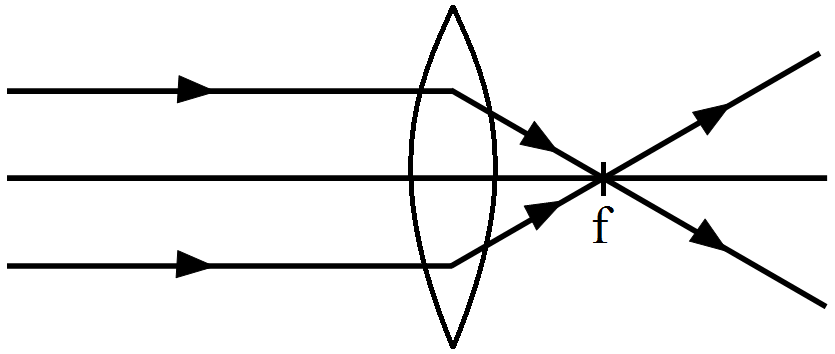
A parallel beam of light is incident on a converging lens parallel to its principal axis. As one moves away from the lens on the other side on its principal axis, the intensity of light:
  • A
    Remains, constant.
  • B
    Continuously increases.
  • C
    Continuously decreases.
  • First increases then decreases.
Answer
Correct option: D.
First increases then decreases.

The intensity o light is first increases then decreases.
View full question & answer
MCQ 1531 Mark
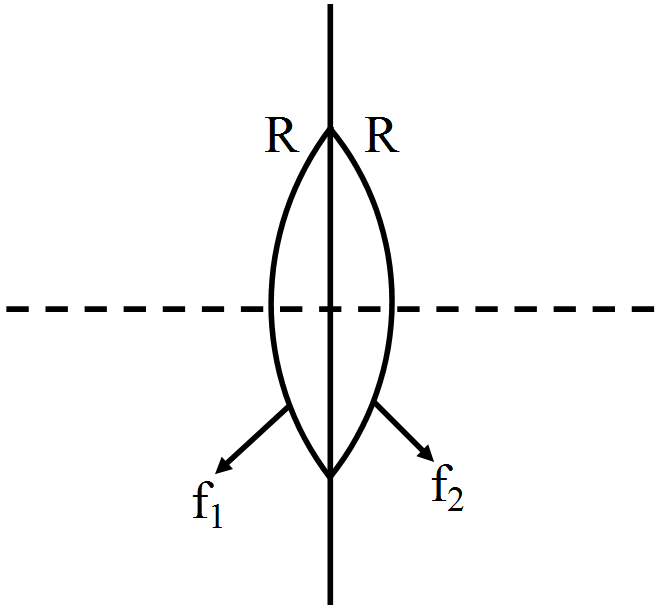
A symmetric double convex lens is cut in two equal parts by a plane perpendicular to the principal axis. If the power of the original lens was $4D$, the power of a cutlens will be:
  • $2D$
  • B
    $3D$
  • C
    $4D$
  • D
    $5D.$
Answer
Correct option: A.
$2D$


Before cut
$\frac{1}{\text{f}}=(\mu-1)\Big(\frac{2}{\text{R}}\Big)=4\text{D} \ ...(1)$
After cut
$\frac{1}{\text{f}_1}=(\mu-1)\Big(\frac{1}{\text{R}}\Big)+\frac{1}{\text{f}_2}=(\mu-1)\Big(\frac{1}{2}\Big) \ ...(2)$
From eq. $(1)$ we get Power of $f_1$ = power of $f_2$
$\text{P}=\frac{1}{\text{f}_1}=\frac{1}{\text{f}_2}=2\text{D}$

View full question & answer
MCQ 1541 Mark
If a drop of water is introduced between the glass plate and a convex lens in a Newton's ring system, the ring system:
  • A
    Expands
  • Contracts
  • C
    Remains same
  • D
    First expands then contracts
Answer
Correct option: B.
Contracts

When a drop of water is introduced between the glass plate and a convex lens then the refractive index of the medium between them increases. So the ring system contracts in Newton's ring system.

View full question & answer
MCQ 1551 Mark
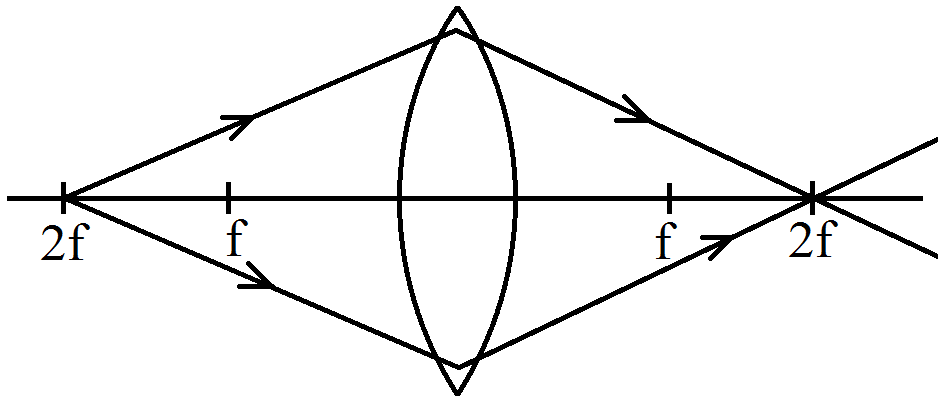
A point source of light is placed at a distance, of $2f$ from a converging lens of focal length $f$. The intensity on the other side of the lens is maximum at a distance:
  • A
    $f$
  • B
    between $f$ and $2$
  • $2f$
  • D
    more than $2f.$
Answer
Correct option: C.
$2f$


The Intensity on the other side of the lans is maximum at a distance $2f.$

View full question & answer
MCQ 1561 Mark
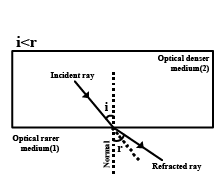
Whenever light travels from denser medium to a rarer medium:
  • It bends away from the normal
  • B
    It bends towards the normal
  • C
    It passes undeviated
  • D
    It always reflects back
Answer
Correct option: A.
It bends away from the normal

Whenever light travels from a denser medium to a rarer medium, it bends away from the normal due to refraction.

View full question & answer
MCQ 1571 Mark
Red light is used as danger signal because it is:
  • A
    Accepted as symbol
  • B
    Pleasing to the eye
  • C
    Sensitive to the eye
  • Has high wavelength
Answer
Correct option: D.
Has high wavelength
Red light is used as danger signal because it is having high wavelength, less scattering ,hence can travel larger distances.
View full question & answer
MCQ 1581 Mark
When the length of a microscope tube increases, its magnifying power:
  • Decreases
  • B
    Increases
  • C
    Does not change
  • D
    May decrease or increase depending on observer and place of observation.
Answer
Correct option: A.
Decreases
View full question & answer
MCQ 1591 Mark
A simple microscope has:
  • A
    $2$ convex lens
  • B
    $2$ concave lens
  • $1$ convex lens
  • D
    $1$ concave lens
Answer
Correct option: C.
$1$ convex lens

A simple microscope is made up of a single convex lens fitted in a round metallic frame with a handle.

View full question & answer
MCQ 1601 Mark
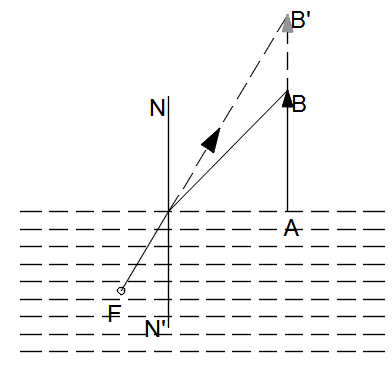
A fisherman is standing on the bank of a lake. To a fish underwater viewing obliquely the man looks:
  • Taller than what he actually is
  • B
    Shorter than what he actually is
  • C
    The same height as he actually is
  • D
    Depends on the obliquity
Answer
Correct option: A.
Taller than what he actually is

As shown in the diagram,
The due to the refraction of the light, the light will move away from the normal $(NN')$ and consequently, the fish $($denoted as $F)$ will see a longer image of the fisherman $(AB)$ as $AB\ '.$

View full question & answer
MCQ 1611 Mark
The muscles of a normal eye are least strained when the eye is focused on an object:
  • Far away from the eye.
  • B
    Very close to the eye.
  • C
    At about $25\ cm$ from the eye.
  • D
    At about $1m$ from the eye.
Answer
Correct option: A.
Far away from the eye.
A normal eye can see from $25\ cm$ to infinity, it faces least difficulty and strain focusing on the object as far as it could be.
View full question & answer
MCQ 1621 Mark
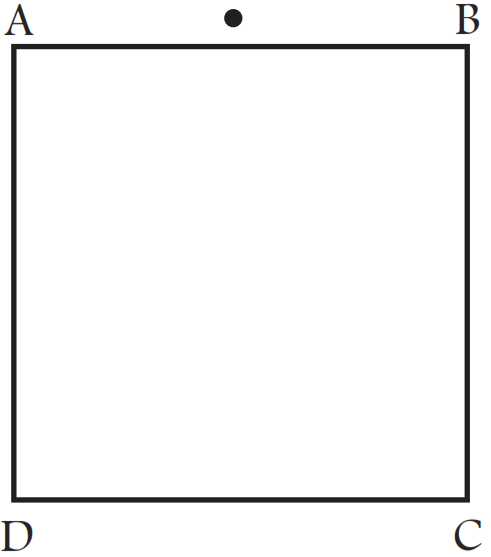
A rectangular block of glass $\text{ABCD}$ has a refractive index $1.6.$ A pin is placed midway on the face $AB ($Fig$)$. When observed from the face $AD$, the pin shall:
  • A
    Appear to be near $A.$
  • B
    Appear to be near $D.$
  • C
    Appear to be at the centre of $AD.$
  • Not be seen at all.
Answer
Correct option: D.
Not be seen at all.
We know that, $\Box=\frac{1}{\sin\text{C}}$ Substituting $\Box=1.6$, we get $C = 38.7^\circ$ As long as angle of incidence on $AD$ of the ray emanating from pin is greater than the critical angle, the light suffers from total internal reflection and the pin cannot be seen through $AD.$
View full question & answer
MCQ 1631 Mark
The clear sky appears blue because:
  • A
    Blue light gets absorbed in the atmosphere.
  • B
    Ultraviolet radiations are absorbed in the atmosphere.
  • Violet and blue lights get scattered more than lights of all other colours by the atmosphere.
  • D
    Light of all other colours is scattered more than the violet and blue colour lights by the atmosphere.
Answer
Correct option: C.
Violet and blue lights get scattered more than lights of all other colours by the atmosphere.

The scattering of light depends on the size of the dust particles and the wavelength of the light. The amount of scattering is inversely proportional to the fourth power of wavelength.
Since, violet and blue lights get scattered more than lights of all other colours by the atmosphere the sky appears blue.

View full question & answer
MCQ 1641 Mark
The rays of different colours fail to converge at a point after going through a converging lens. This defect is called:
  • A
    Spherical aberration
  • B
    Distortion
  • C
    Coma
  • Chromatic aberration
Answer
Correct option: D.
Chromatic aberration

By definition, chromatic aberration is the inability of a converging lens to converge rays of different colour at a point after passing through it.

View full question & answer
MCQ 1651 Mark
The rays of different colours fail to converge at a point after going through a converging lens. This defect is called:
  • A
    Spherical aberration.
  • B
    Distortion.
  • C
    Coma.
  • Chromatic aberration.
Answer
Correct option: D.
Chromatic aberration.

The rays of different colours fail to converge at a Point after going through a converging Lens. This defect is called chromatic oberration.

View full question & answer
MCQ 1661 Mark
Finger prints are observed by the use of:
  • A
    Telescope
  • Microscope
  • C
    Gallilean telescope
  • D
    Concave lens
Answer
Correct option: B.
Microscope

Microscope is used for enlarging tiny objects or details which our eyes cannot detect. It is used to highly magnify the patterns and design of Finger prints and is widely used for Fingerprint tracing.

View full question & answer
M.C.Q (1 Marks) - Page 4 - Physics STD 12 Science Questions - Vidyadip