- A$0^\circ$
- ✓$90^\circ$
- C$180^\circ$
- D$360^\circ$
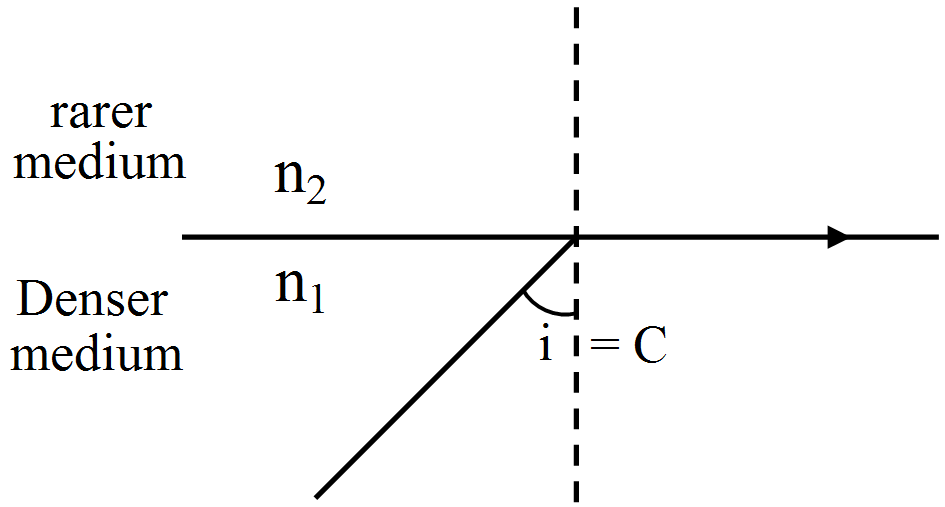
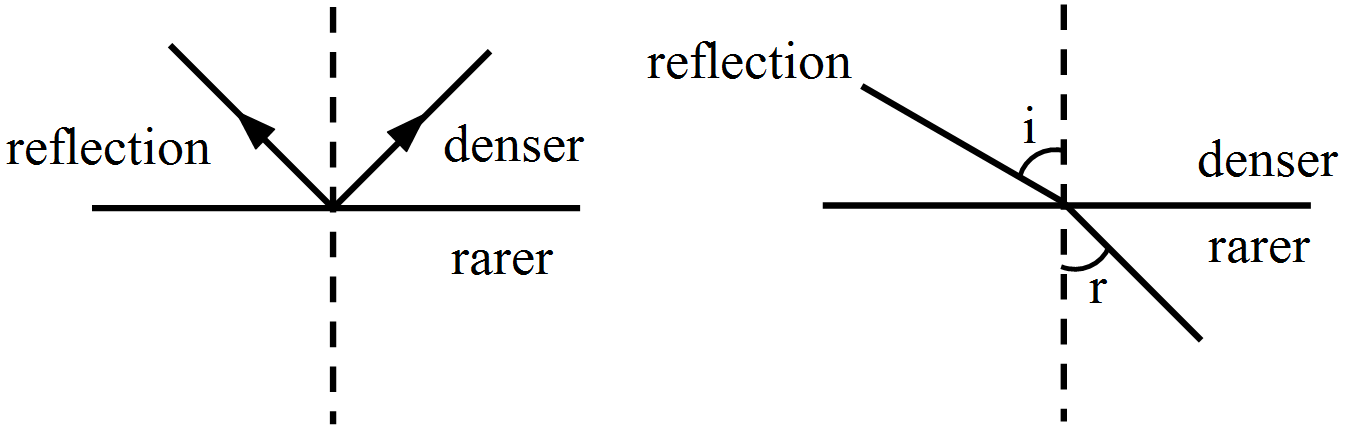
critical angle: It is the angle of incidence for which angle of refraction is $90^\circ . $
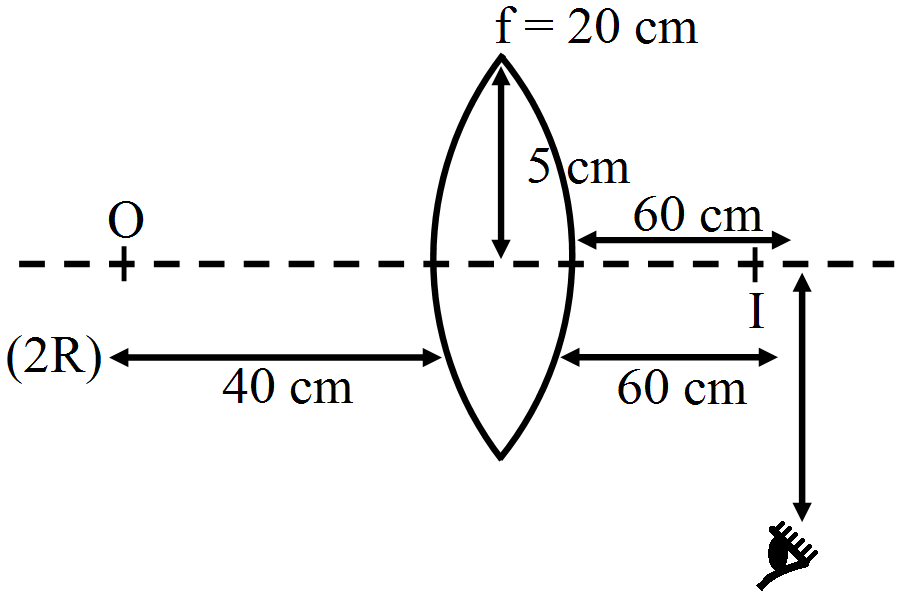
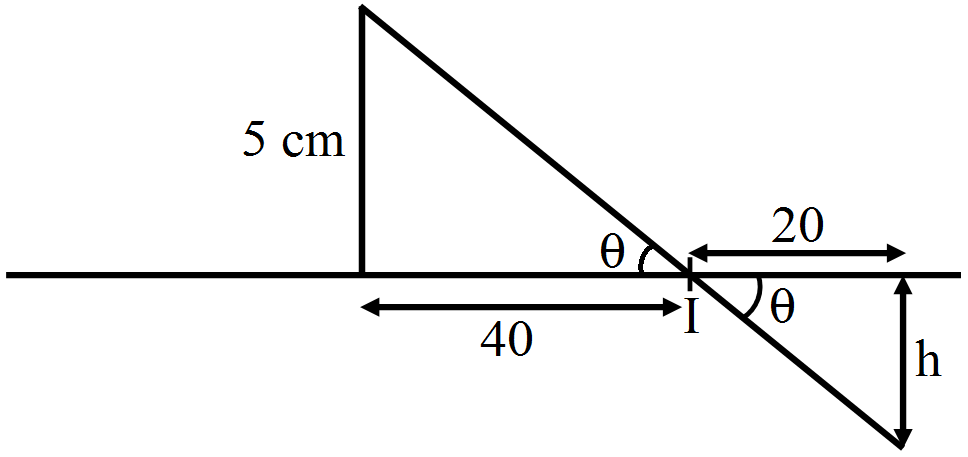
In the human eye, the image is formed on the retina, which is at a fixed distance from the eye lens.


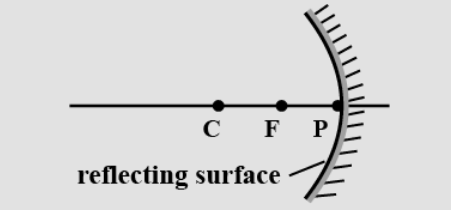
The imaginary line passing through the pole and the center of curvature of the curved mirror is called its principal axis.
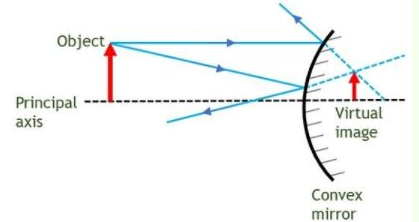
The image which can not be taken on the screen is called a virtual image.
A lens may be considered as made up of a number of prisms placed one above the other. In a thick lens, the angles of prisms are larger than those in a thin lens. Since, angular dispersion produced by a prism is directly proportional to the angle of prism, a thick lens suffers from greater chromatic aberration.
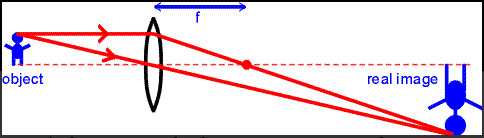
Real image formed when the rays of light after reflection or refraction actually converge at some point and when objects are placed outside the focal length of a converging lens or outside the focal length of a converging mirror.


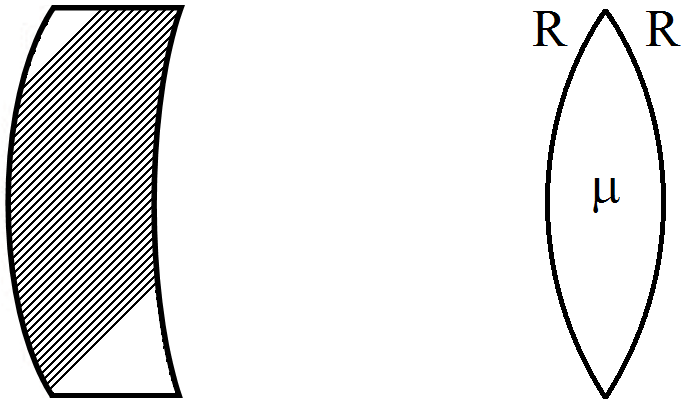
$\Rightarrow\frac{1}{\text{f}}=(\mu-1)\Big(\frac{1}{\text{R}_1}-\frac{1}{\text{R}_2}\Big)$
$\Rightarrow\frac{1}{\text{f}}=\Big(\frac{3}{2}-1\Big)\Big(\frac{1}{\text{R}}-\Big(-\frac{1}{\text{R}}\Big)\Big)$
$\frac{1}{\text{f}}=\frac{1}{\text{R}}$
$\text{f}=\text{R}$
The distance between the focus and the pole of the mirror is called focal length.

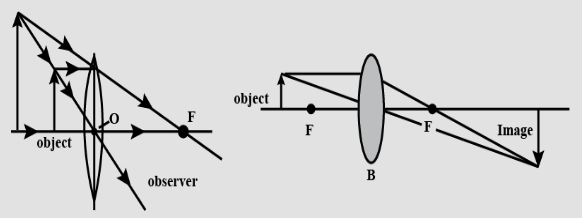
As shown in figure $A$, a virtual image is formed because refracted rays only appear to meet at the image.
As shown in figure $B$, a real image is formed because refracted rays actually meet at the image.


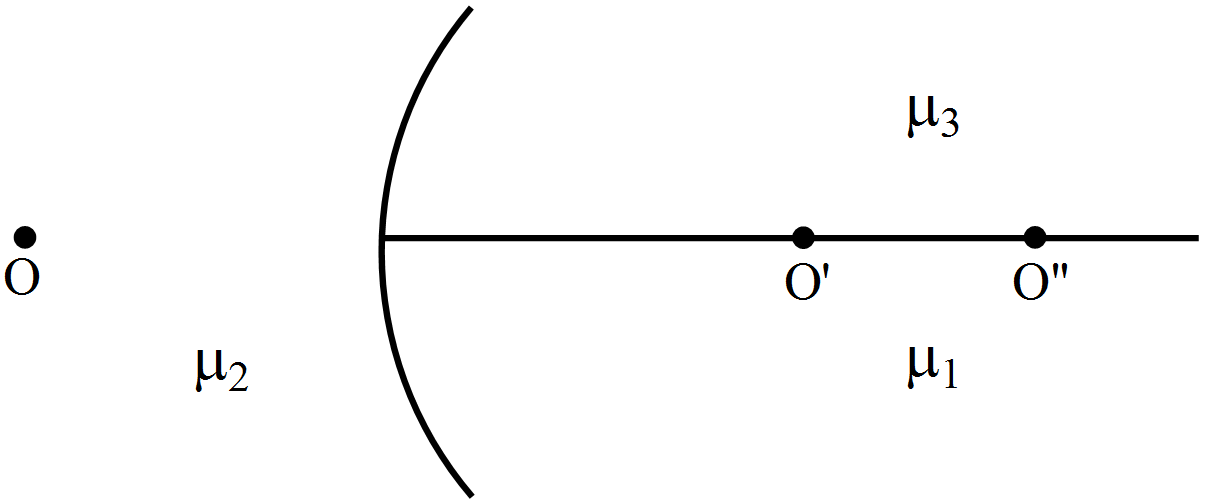
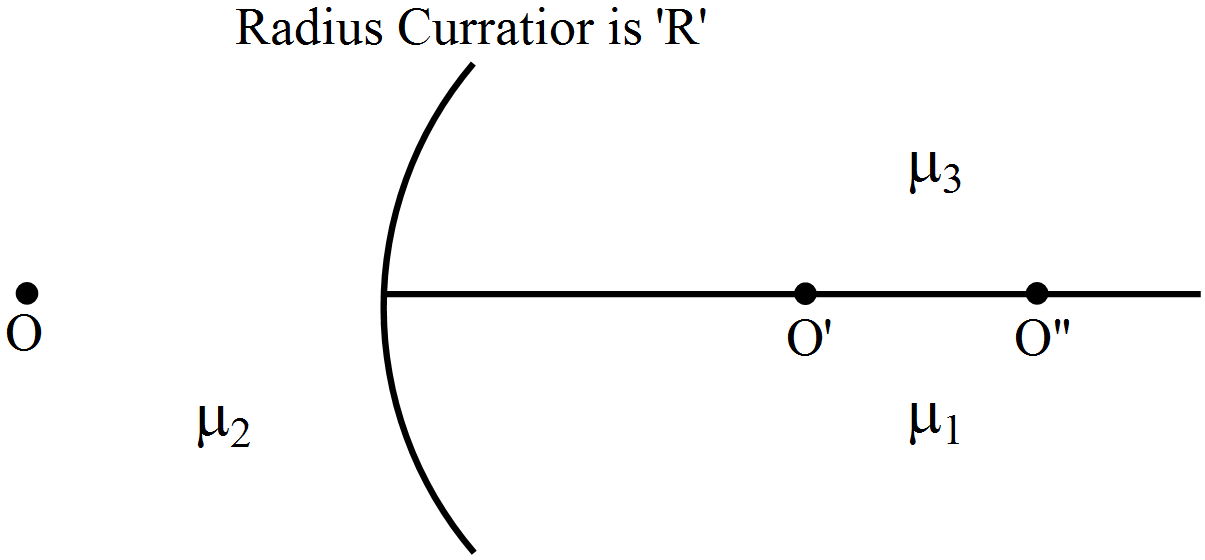
$m_1$, Image is $O^1$
$m_3$, Image is $O^{11}$
Spherical Surface formula
$\frac{\mu^{11}}{\text{v}}-\frac{\mu_1}{\mu}=\frac{\mu^{11}-\mu^1}{\text{R}}$
If ray goes to $m^2$ to $m^1$ than Image is formed at $O^1$ and if ray goes to $m_2$ to $m_3$ than Image is formed at $O^{11}$.


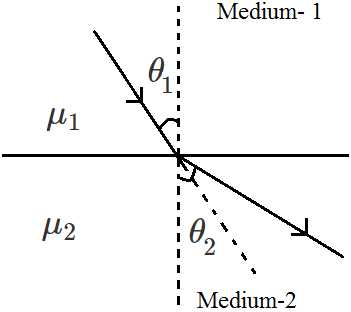
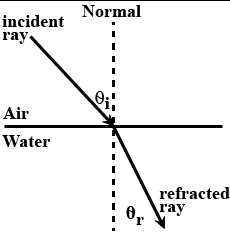
Key concept: The Snell's law describes the relation between angle of incidence $\theta_1$ and angle of refraction $\theta_2$:
$\mu\sin\theta_1=\mu_2\sin\theta_2=\text{constant}\ .....(\text{i})$
where $\mu_1$ and $\mu_1$ are refractive indices of the two media.

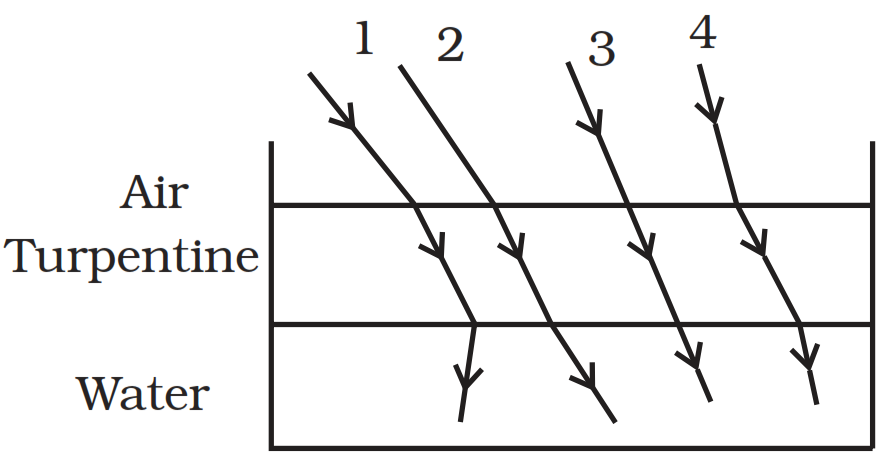
When a light ray goes from $($optically$)$ denser medium to $($optically$)$ rarer medium, then it bends away the normal, i.e., $\theta_1<\theta_2$ and vice-versa.
Here, light ray goes from $($optically$)$ rarer medium air to optically denser medium turpentine, then it bends towards the normal, i.e., $\theta_1>\theta_2$ whereas when it goes from to optically denser medium turpentine to rarer medium water, then it bends away the normal.
The shift increase with the increase in the thickness of the denser medium, but the shift decrease with the increase in wavelength of light used.
A magnifying lens is simply a convex lens and forms a magnified erect virtual image of objects.
When the image is formed at infinity
$m = Df = DPm = Df = DP$
when the image is formed at the near point
$m = (1+Df) = 1 + DP$
When the refracting or reflecting rays actually intersect, rather than pretending to be meeting at a point, a real image is formed. A real image hence can be obtained on a screen.
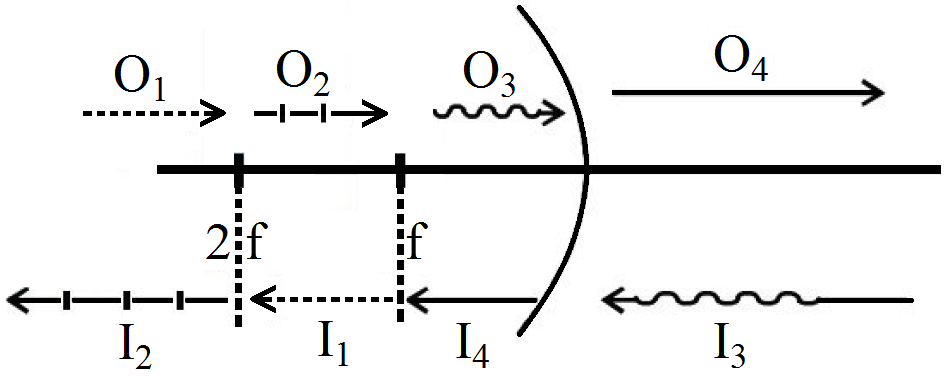
|
Object
|
Image
|
|
$O_1$
|
$I_1$
|
|
$O_2$
|
$I_2$
|
|
$O_3$
|
$I_3$
|
|
$O_4$
|
$I_4$
|

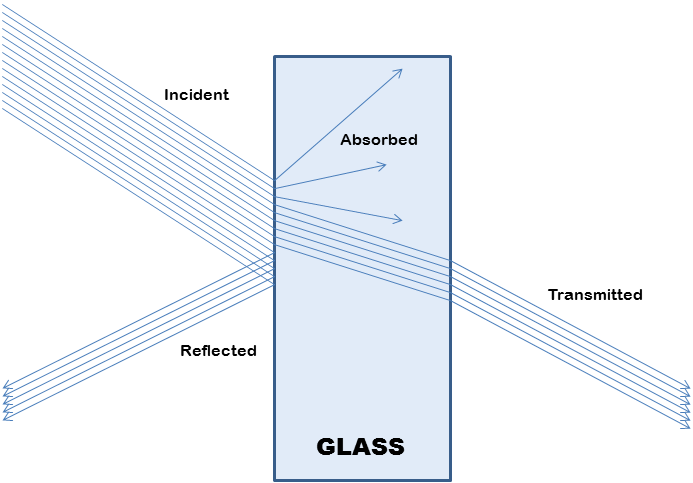
Lateral displacement produced by a glass slab of thickness $t$, incident on it at angle of incidence i is
Lateral displacement $ \delta=\frac{\text{t}}{\text{cosr}}\text{sin}(\text{i - r})$
Because water is an optically denser medium than air. So these rays bend away from the normal at the surface of separation.
The apparent depth of an object lying in a dense need always less than its real depth for all angles of observation in a rarer medium.
Focal length is inversely proportional to refractive index and refractive index is inversely proportional to $\lambda^2.$
So, keeping other parameters the same, we can say:
$\text{f}\propto\frac{1}{\lambda^2}\ \ (\because\lambda_\text{r}<\lambda_\upsilon)$
$\therefore\text{f}_\text{v}<\text{f}_\text{r}$
A lens is a piece of glass $($plastic$)$ with two refracting surfaces, which are either curved $($e.g., a segment of a sphere$)$ or plain.
Lenses are used to form images by refraction in optical instruments $($microscopes, telescopes, cameras, etc.$)$
There are two types of lenses: converging $($thickest in the middle$)$ and diverging $($thickest at the edges$)$.

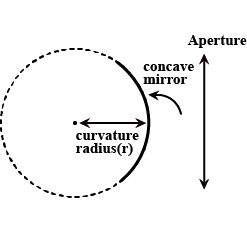
The distance $CP$ is the radius of curvature.

When the actual rays diverge then they can never meet to form an image. Therefore the rays are assumed to meet in the backward direction of their propagation.
As the imaginary light rays meet and form the image, therefore the image can not be caught on a screen.
Refraction is a phenomenon in which a light ray incident on a surface separating two transparent media bends at the change of medium.
Snell's law gives the relation between angle of incidence and refraction and the Refractive index of the respective medium.
$\mu_1 \sin (i) = \mu_2 \sin(r)$
where, i, r are the angles of incidence and refraction respectively.
We know among the seven colours of white light, red colour has maximum wavelength. That is why red colour is least scattered by atmospheric dust and other particles. Hence red colour is used to indicated any danger sign.
Real images can be obtained on a screen. On$-$screen rays meet in real.
Virtual images can not be obtained on a screen. Because there is no meaning of screen for the virtual image.
The phenomena when light passes through the object $($a medium$)$ is known as refraction. Refraction is defined as the bending of light ray when it passes from one medium to another.

At noon because the sun is overhead, the light is scattered the least and hence appears white. When it is overhead, it has lesser air to travel through and the scattering from dust and other particles is reduced if the distance to be travelled in air is reduced.

The image which can be obtained on a screen is called a real image.
Chromatic aberration occurs when a lens is either unable to bring all wavelengths of color to the same focal plane and/or wavelengths of color are focused at different positions in the focal plane.
We know that, the image formed by convex mirror does not depend on the relative position of object wit mirror. Therefore, the speed of the approaching car would appear to increase as the distance between the cars decreases in the side mirror.

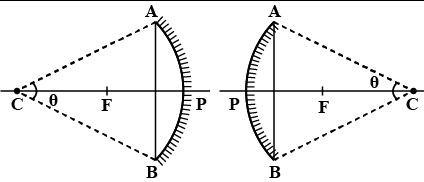
distance between extreme points on the periphery of the spherical mirror is called linear aperture and the angle which the periphery of the spherical mirror subtends at the centre of curvature is called angular aperture.

If operators using a microscope usually wear spectacles $($glasses$)$ for activities such as working at their $PC$, they often need to remove them when looking through a microscope so they can align their eyes correctly with the eyepieces.
$\frac{1}{\text{v}}+\frac{1}{\text{u}}=\frac{1}{\text{f}}$
Step $1:$ Virtual Image
It is formed when ray of light appear to meet at a point.
Step $2:$ Ray Diagram

Only in simple microscope the image formed is erect, while it is inverted in compound microscope and astronomical telescope.
The angular magnification is the ratio of the angle subtended by the image to the angle subtended by the object on an unaided eye.
In a simple microscope,
$\text{m}=\frac{\frac{\text{h}}{\text{x}}}{\frac{\text{h}}{\text{D}}}$
Here,
$u =$ Object distance from the lems
$D =$ Image distance form the lens
$h =$ Height of the object
In normal adjustment, the object is placed at a distance equal to focal length $(f)$ from the lens and then magnification is given by m
$=\frac{\text{D}}{\text{f}}$
for $\text{u}<\text{f},\text{ m}=\frac{\text{D}}{\text{f}}+1$
The angle formed between the normal and refracted ray at the point of refraction is called angle of refraction.

Given:
Near point of the human eye, $u = -25\ cm$
Distance between the retina and the eye lens, $v = 2\ cm ($approximately$)$
thus, we have the focal length, $f.$
$\frac{1}{\text{f}}=\frac{1}{\text{v}}-\frac{1}{\text{u}}$
$\Rightarrow\frac{1}{\text{f}}\cong\frac{1}{2}-\frac{1}{-25}$
$\Rightarrow\frac{1}{\text{f}}\cong\frac{27}{50}$
$\Rightarrow\text{x}\cong2\text{cm}$
We see red colour of the sun at sunrise or sunset as the sun at horizon and light rays need to travel a greater distance. In the process of scattering, violet, blue and green rays in the original sunlight are removed and the transmitted beam has yellow and red dominant.