Questions · Page 1 of 11

M.C.Q (1 Marks)

🎯

Test yourself on this topic

50 questions · timed · auto-graded

MCQ 11 Mark
A hollow double concave lens is made of very thin transparent material. It can be filled with air or either of two liquids $L_1$ and $L_2$ having refractive indices $n_1$ and $n_2$ respectively $\left(n_2>n_1>1\right)$. The lens will diverge a parallel beam of light if it is filled with
  • A
    Air and placed in air
  • B
    Air and immersed in $L_1$
  • C
    $L_1$ and immersed in $L_2$
  • $\mathrm{L}_2$ and immersed in $\mathrm{L}_1$
Answer
Correct option: D.
$\mathrm{L}_2$ and immersed in $\mathrm{L}_1$
View full question & answer
MCQ 21 Mark
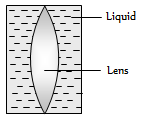
Shown in the figure here is a convergent lens placed inside a cell filled with a liquid. The lens has focal length + 20 cm when in air and its material has refractive index 1.50. If the liquid has refractive index 1.60, the focal length of the system is
  • A
     + 80 cm
  • B
     – 80 cm
  • C
    – 24 cm
  • –100 cm
Answer
Correct option: D.
–100 cm
 –100 cm
View full question & answer
MCQ 31 Mark
Diameter of a plano $–$ convex lens is $6 \ cm$ and thickness at the centre is $3 \ mm$. If the speed of light in the material of the lens is $2 \times 10^8 m/\sec,$ the focal length of the lens is
  • A
    $15 \ cm$
  • B
    $ 20 \ cm$
  • $30 \ cm$
  • D
    $10 \ cm$
Answer
Correct option: C.
$30 \ cm$
$30 \ cm$
View full question & answer
MCQ 41 Mark
A convex lens A of focal length 20 cm and a concave lens B of focal length 5 cm are kept along the same axis with the distance d between them. If a parallel beam of light falling on A leaves B as a parallel beam, then distance d in cm will be
  • A
     25
  • 15
  • C
     30
  • D
     50
Answer
Correct option: B.
15
15
View full question & answer
MCQ 51 Mark
Assertion : The cloud in sky generally appear to be whitish.
Reason : Diffraction due to cloud is efficient in equal measure at all wavelengths.
  • A
     If both assertion and reason are true and the reason is the correct explanation of the assertion.
  • B
     If both assertion and reason are true but reason is not the correct explanation of the assertion.
  •  If assertion is true but reason is false.
  • D
     If the assertion and reason both are false.
Answer
Correct option: C.
 If assertion is true but reason is false.
If assertion is true but reason is false.
View full question & answer
MCQ 61 Mark
Assertion : Diamond glitters brilliantly.
Reason : Diamond does not absorb sunlight.
  • A
    If both assertion and reason are true and the reason is the correct explanation of the assertion.
  •  If both assertion and reason are true but reason is not the correct explanation of the assertion.
  • C
    If assertion is true but reason is false.
  • D
     If the assertion and reason both are false.
Answer
Correct option: B.
 If both assertion and reason are true but reason is not the correct explanation of the assertion.
If both assertion and reason are true but reason is not the correct explanation of the assertion.
View full question & answer
MCQ 71 Mark
Assertion : The speed of light in a rarer medium is greater than that in a denser medium
Reason : One light year equals to $9.5 \times 10^{12} \ km$
  • A
    If both assertion and reason are true and the reason is the correct explanation of the assertion.
     
  • If both assertion and reason are true but reason is not the correct explanation of the assertion.
     
  • C
    If assertion is true but reason is false.
     
  • D
    If the assertion and reason both are false.
Answer
Correct option: B.
If both assertion and reason are true but reason is not the correct explanation of the assertion.
 
If both assertion and reason are true but reason is not the correct explanation of the assertion.
View full question & answer
MCQ 81 Mark
Assertion : The focal length of the mirror is f and distance of the object from the focus is u, the magnification of the mirror is f / u.
Reason : Magnification $=\frac{\text { Size of image }}{\text { Size of object }}$
  •  If both assertion and reason are true and the reason is the correct explanation of the assertion.
  • B
    If both assertion and reason are true but reason is not the correct explanation of the assertion.
  • C
    If assertion is true but reason is false.
  • D
     If the assertion and reason both are false.
Answer
Correct option: A.
 If both assertion and reason are true and the reason is the correct explanation of the assertion.
If both assertion and reason are true and the reason is the correct explanation of the assertion.
View full question & answer
MCQ 91 Mark
Assertion : The colour of the green flower seen through red glass appears to be dark.
Reason : Red glass transmits only red light.
  • If both assertion and reason are true and the reason is the correct explanation of the assertion.
  • B
    If both assertion and reason are true but reason is not the correct explanation of the assertion.
  • C
    If assertion is true but reason is false.
  • D
    If the assertion and reason both are false.
Answer
Correct option: A.
If both assertion and reason are true and the reason is the correct explanation of the assertion.
View full question & answer
MCQ 101 Mark
Assertion : Different colours travel with different speed in vacuum.
Reason : Wavelength of light depends on refractive index of medium.
  • A
     If both assertion and reason are true and the reason is the correct explanation of the assertion.
  • B
     If both assertion and reason are true but reason is not the correct explanation of the assertion.
  • C
     If assertion is true but reason is false.
  •  If assertion is false but reason is true.
Answer
Correct option: D.
 If assertion is false but reason is true.
 If assertion is false but reason is true.
View full question & answer
MCQ 111 Mark
Assertion: A double convex lens $(m=1.5)$ has focal length $10 \ cm$ . When the lens is immersed in water $(m=4 / 3)$ its focal length becomes $40 \ cm$ .Reason: $\frac{1}{ f }=\frac{\mu_1-\mu_{ m }}{\mu_{ m }}\left(\frac{1}{R_1}-\frac{1}{R_2}\right)$
  •  If both assertion and reason are true and the reason is the correct explanation of the assertion.
  • B
    If both assertion and reason are true but reason is not the correct explanation of the assertion.
  • C
    If assertion is true but reason is false.
  • D
    If the assertion and reason both are false.
Answer
Correct option: A.
 If both assertion and reason are true and the reason is the correct explanation of the assertion.
If both assertion and reason are true and the reason is the correct explanation of the assertion.
View full question & answer
MCQ 121 Mark
Assertion : The setting sun appears to be red.
Reason : Scattering of light is directly proportional to the wavelength.
  • A
     If both assertion and reason are true and the reason is the correct explanation of the assertion.
  • B
    If both assertion and reason are true but reason is not the correct explanation of the assertion.
  •  If assertion is true but reason is false.
  • D
     If the assertion and reason both are false.
Answer
Correct option: C.
 If assertion is true but reason is false.
 If assertion is true but reason is false.
View full question & answer
MCQ 131 Mark
Assertion : Blue colour of sky appears due to scattering of blue colour.
Reason : Blue colour has shortest wave length in visible spectrum.
  •  If both assertion and reason are true and the reason is the correct explanation of the assertion.
  • B
     If both assertion and reason are true but reason is not the correct explanation of the assertion.
  • C
     If assertion is true but reason is false.
  • D
     If the assertion and reason both are false.
Answer
Correct option: A.
 If both assertion and reason are true and the reason is the correct explanation of the assertion.
 If both assertion and reason are true and the reason is the correct explanation of the assertion.
View full question & answer
MCQ 141 Mark
Assertion : In a movie, ordinarily 24 frames are projected per second from one end to the other of the complete film.
Reason : The image formed on retina of eye is sustained upto 1/10 second after the removal of stimulus.
  • A
     If both assertion and reason are true and the reason is the correct explanation of the assertion.
  • B
     If both assertion and reason are true but reason is not the correct explanation of the assertion.
  •  If assertion is true but reason is false.
  • D
     If the assertion and reason both are false.
Answer
Correct option: C.
 If assertion is true but reason is false.
If assertion is true but reason is false.
View full question & answer
MCQ 151 Mark
Assertion : The air bubble shines in water.
Reason : Air bubble in water shines due to refraction of light
  • A
     If both assertion and reason are true and the reason is the correct explanation of the assertion.
  • B
     If both assertion and reason are true but reason is not the correct explanation of the assertion.
  •  If assertion is true but reason is false.
  • D
     If the assertion and reason both are false.
Answer
Correct option: C.
 If assertion is true but reason is false.
 If assertion is true but reason is false.
View full question & answer
MCQ 161 Mark
Assertion : Owls can move freely during night.
Reason : They have large number of rods on their retina.
  • A
     If both assertion and reason are true and the reason is the correct explanation of the assertion.
  • B
     If both assertion and reason are true but reason is not the correct explanation of the assertion.
  •  If assertion is true but reason is false.
  • D
    If the assertion and reason both are false.
Answer
Correct option: C.
 If assertion is true but reason is false.
If assertion is true but reason is false.
View full question & answer
MCQ 171 Mark
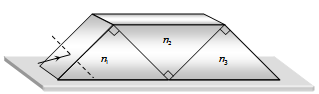
Three right angled prisms of refractive indices $n _1, n _2$ and $n _3$ are fixed together using an optical glue as shown in figure. If a ray passes through the prisms without suffering any deviation, then
  • A
     $n _1= n _2= n _3$
  • B
     $n _1= n _2 \neq n _3$
  • C
     $1+ n _1= n _2+ n _3$
  • $1+ n _2^2= n _1^2+ n _3^2$
Answer
Correct option: D.
$1+ n _2^2= n _1^2+ n _3^2$
View full question & answer
MCQ 181 Mark
A spherical surface of radius of curvature R separates air (refractive index 1.0) from glass (refractive index 1.5). The centre of curvature is in the glass. A point object P placed in air is found to have a real image Q in the glass. The line PQ cuts the surface at a point O, and PO = OQ. The distance PO is equal to
  •  5 R
  • B
     3 R
  • C
    2 R
  • D
    1.5 R
Answer
Correct option: A.
 5 R
5 R
View full question & answer
MCQ 191 Mark
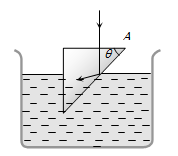
The refractive index of the material of the prism and liquid are 1.56 and 1.32 respectively. What will be the value of q for the following refraction
  • A
     $\sin \theta \geq \frac{13}{11}$
  •  $\sin \theta \geq \frac{11}{13}$
  • C
     $\sin \theta \geq \frac{\sqrt{3}}{2}$
  • D
     $\sin \theta \geq \frac{1}{\sqrt{2}}$
Answer
Correct option: B.
 $\sin \theta \geq \frac{11}{13}$
$\sin \theta \geq \frac{11}{13}$
View full question & answer
MCQ 201 Mark
An electric bulb illuminates a plane surface. The intensity of illumination on the surface at a point $2$ m away from the bulb is $5 \times 10^{-4}$ phot (lumen/ $cm ^2$ ). The line joining the bulb to the point makes an angle of $60^{\circ}$ with the normal to the surface. The intensity of the bulb in candela is
  • A
    $40 \sqrt{3}$
  • $40$
  • C
    $20$
  • D
    $40 \times 10^{-4}$
Answer
Correct option: B.
$40$
$40$
View full question & answer
MCQ 211 Mark
If luminous efficiency of a lamp is 2 lumen/watt and its luminous intensity is 42 candela, then power of the lamp is
  • A
    62 W
  • B
    76 W
  • C
    138 W
  • 264 W
Answer
Correct option: D.
264 W
 264 W
View full question & answer
MCQ 221 Mark
To produce magnified erect image of a far object, we will be required along with a convex lens, is
  • A
     Another convex lens
  •  Concave lens
  • C
    A plane mirror
  • D
     A concave mirror
Answer
Correct option: B.
 Concave lens
Concave lens
View full question & answer
MCQ 231 Mark
The power of two convex lenses A and B are 8 diopters and 4 diopters respectively. If they are to be used as a simple microscope, the magnification of
  • A
     B will be greater than A
  •  A will be greater than B
  • C
     The information is incomplete
  • D
     None of the above
Answer
Correct option: B.
 A will be greater than B
A will be greater than B
View full question & answer
MCQ 241 Mark
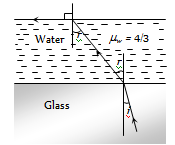
A ray of light is incident at the glass–water interface at an angle i, it emerges finally parallel to the surface of water, then the value of $\mu_{ g }$ would be
  • A
    (4/3) sin i
  • 1/sin i
  • C
    4/3
  • D
    1
Answer
Correct option: B.
1/sin i
(b) 1/sin i
View full question & answer
MCQ 251 Mark
An air bubble in sphere having $4 \ cm$ diameter appears $1 \ cm$ from surface nearest to eye when looked along diameter. If $_am_g= 1.5,$ the distance of bubble from refracting surface is
  • $1.2 \ cm$
  • B
    $3.2 \ cm$
  • C
    $2.8 \ cm$
  • D
    $1.6 \ cm$
Answer
Correct option: A.
$1.2 \ cm$
$1.2 \ cm$
View full question & answer
MCQ 261 Mark
A glass hemisphere of radius 0.04 m and R.I. of the material 1.6 is placed centrally over a cross mark on a paper
(i) with the flat face;
(ii) with the curved face in contact with the paper. In each case the cross mark is viewed directly from above. The position of the images will be
  • A
     (i) 0.04 m from the flat face; (ii) 0.025 m from the flat face
  •  (i) At the same position of the cross mark; (ii) 0.025 m below the flat face
  • C
     (i) 0.025 m from the flat face; (ii) 0.04 m from the flat face
  • D
     For both (i) and (ii) 0.025 m from the highest point of the hemisphere
Answer
Correct option: B.
 (i) At the same position of the cross mark; (ii) 0.025 m below the flat face
(i) At the same position of the cross mark; (ii) 0.025 m below the flat face
View full question & answer
MCQ 271 Mark
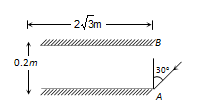
Two plane mirrors. A and B are aligned parallel to each other, as shown in the figure. A light ray is incident at an angle of 30° at a point just inside one end of A. The plane of incidence coincides with the plane of the figure. The maximum number of times the ray undergoes reflections (including the first one) before it emerges out is
  • A
     $28$
  •  $30$
  • C
    $32$
  • D
     $34$
Answer
Correct option: B.
 $30$
$30$
View full question & answer
MCQ 281 Mark
A lamp rated at 100 cd hangs over the middle of a round table with diameter 3 m at a height of 2 m. It is replaced by a lamp of 25 cd and the distance to the table is changed so that the illumination at the centre of the table remains as before. The illumination at edge of the table becomes X times the original. Then X is
  • $\frac{1}{3}$
  • B
    $\frac{16}{27}$
  • C
    $\frac{1}{4}$
  • D
    $\frac{1}{9}$
Answer
Correct option: A.
$\frac{1}{3}$
$\frac{1}{3}$
View full question & answer
MCQ 291 Mark
Five lumen/watt is the luminous efficiency of a lamp and its luminous intensity is 35 candela. The power of the lamp is
  • A
    80 W
  • B
    176 W
  • 88 W
  • D
    36 W
Answer
Correct option: C.
88 W
88 W
View full question & answer
MCQ 301 Mark
Lux is equal to
  • A
    $1$ Iumen $/ \mathrm{m}^2$
  • B
    $1$ lumen $/ \mathrm{ cm}^2$
  • $1$ candela $/ \mathrm{m}^2$
  • D
    $1$ candela $/ \mathrm{ cm}^2$
Answer
Correct option: C.
$1$ candela $/ \mathrm{m}^2$
View full question & answer
MCQ 311 Mark
A small lamp is hung at a height of 8 feet above the centre of a round table of diameter 16 feet. The ratio of intensities of illumination at the centre and at points on the circumference of the table will be
  • A
     $1 : 1$
  • B
    $2 : 1$
  • $2 \sqrt{2}: 1$
  • D
    $3 : 2$
Answer
Correct option: C.
$2 \sqrt{2}: 1$
$2 \sqrt{2}: 1$
View full question & answer
MCQ 321 Mark
The maximum illumination on a screen at a distance of 2 m from a lamp is 25 lux. The value of total luminous flux emitted by the lamp is
  • 1256 lumen
  • B
    1600 lumen
  • C
    100 candela
  • D
    400 lumen
Answer
Correct option: A.
1256 lumen
1256 lumen
View full question & answer
MCQ 331 Mark
Assertion: The refractive index of diamond is $\sqrt{6}$ and that of liquid is $\sqrt{3}$. If the light travels from diamond to the liquid, it will totally reflected when the angle of incidence is $30^{\circ}$.
Reason : $\mu=\frac{1}{\sin C^{\prime}}$ where $m$ is the refractive index of diamond with respect to liquid.
  • A
    If both assertion and reason are true and the reason is the correct explanation of the assertion.
  • B
     If both assertion and reason are true but reason is not the correct explanation of the assertion.
  • C
     If assertion is true but reason is false.
  •  If assertion is false but reason is true.
Answer
Correct option: D.
 If assertion is false but reason is true.
If assertion is false but reason is true.
View full question & answer
MCQ 341 Mark
If the luminous intensity of a 100 W unidirectional bulb is 100 candela, then total luminous flux emitted from the bulb is
  • A
     861 lumen
  • B
    986 lumen
  •  1256 lumen
  • D
     1561 lumen
Answer
Correct option: C.
 1256 lumen
1256 lumen
View full question & answer
MCQ 351 Mark
Total flux produced by a source of 1 cd is
  • A
     $\frac{1}{4 \pi}$
  • B
     $8 \pi$
  •  $4 \pi$
  • D
     $\frac{1}{8 \pi}$
Answer
Correct option: C.
 $4 \pi$
$4 \pi$
View full question & answer
MCQ 361 Mark
"Lux" is a unit of
  • A
    Luminous intensity of a source
  • Illuminance on a surface
  • C
    Transmission coefficient of a surface
  • D
    Luminous efficiency of source of light
Answer
Correct option: B.
Illuminance on a surface
View full question & answer
MCQ 371 Mark
A 60 watt bulb is hung over the center of a table $4 m \times 4 m$ at a height of 3 m . The ratio of the intensities of illumination at a point on the centre of the edge and on the corner of the table is
  • $(17 / 13)^{3 / 2}$
  • B
     $2 / 1$
  • C
    $17 / 13$
  • D
    $5 / 4$
Answer
Correct option: A.
$(17 / 13)^{3 / 2}$
 $(17 / 13)^{3 / 2}$
View full question & answer
MCQ 381 Mark
Assertion : The stars twinkle while the planets do not.
Reason : The stars are much bigger in size than the planets.
  • A
     If both assertion and reason are true and the reason is the correct explanation of the assertion.
  •  If both assertion and reason are true but reason is not the correct explanation of the assertion.
  • C
    If assertion is true but reason is false.
  • D
     If the assertion and reason both are false.
Answer
Correct option: B.
 If both assertion and reason are true but reason is not the correct explanation of the assertion.
 If both assertion and reason are true but reason is not the correct explanation of the assertion.
View full question & answer
MCQ 391 Mark
Assertion : A red object appears dark in the yellow light
Reason : A red colour is scattered less
  • A
     If both assertion and reason are true and the reason is the correct explanation of the assertion.
  •  If both assertion and reason are true but reason is not the correct explanation of the assertion.
  • C
     If assertion is true but reason is false.
  • D
     If the assertion and reason both are false.
Answer
Correct option: B.
 If both assertion and reason are true but reason is not the correct explanation of the assertion.
If both assertion and reason are true but reason is not the correct explanation of the assertion.
View full question & answer
MCQ 401 Mark
A movie projector forms an image $3.5m$ long of an object $35 \ mm.$ Supposing there is negligible absorption of light by aperture then illuminance on slide and screen will be in the ratio of
  • A
    $100 : 1$
  • $10^4: 1$
  • C
    $1 : 100$
  • D
    $1 : 10^4$
Answer
Correct option: B.
$10^4: 1$
$10^4: 1$
View full question & answer
MCQ 411 Mark
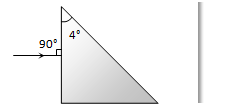
A prism having an apex angle $4^{\circ}$ and refraction index 1.5 is located in front of a vertical plane mirror as shown in figure. Through what total angle is the ray deviated after reflection from the mirror
  • A
    $176^{\circ}$
  • B
    $4^{\circ}$
  • $178^{\circ}$
  • D
    $2^{\circ}$
Answer
Correct option: C.
$178^{\circ}$
(c) $178^{\circ}$
View full question & answer
MCQ 421 Mark
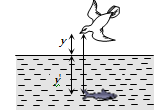
A fish rising vertically up towards the surface of water with speed $3 \mathrm{~ms}^{-1}$ observes a bird diving vertically down towards it with speed $9 \mathrm{~ms}^{-1}$. The actual velocity of bird is
  • $4.5 \mathrm{~ms}^{-1}$
  • B
    5. $\mathrm{ms}^{-1}$
  • C
    $3.0 \mathrm{~ms}^{-1}$
  • D
    $3.4 \mathrm{~ms}^{-1}$
Answer
Correct option: A.
$4.5 \mathrm{~ms}^{-1}$
(a) $4.5 \mathrm{~ms}^{-1}$
View full question & answer
MCQ 431 Mark
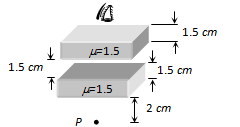
The image of point P when viewed from top of the slabs will be
  • A
    2.0 cm above P
  • B
    1.5 cm above P
  • C
     2.0 cm below P
  • 1 cm above P
Answer
Correct option: D.
1 cm above P
1 cm above P
View full question & answer
MCQ 441 Mark
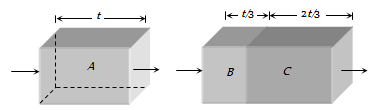
Two transparent slabs have the same thickness as shown. One is made of material A of refractive index 1.5. The other is made of two materials B and C with thickness in the ratio 1 : 2. The refractive index of C is 1.6. If a monochromatic parallel beam passing through the slabs has the same number of waves inside both, the refractive index of B is
  • A
     1.1
  • B
     1.2
  •  1.3
  • D
    1.4
Answer
Correct option: C.
 1.3
1.3
View full question & answer
MCQ 451 Mark
A plano-convex lens when silvered in the plane side behaves like a concave mirror of focal length 30cm. However, when silvered on the convex side it behaves like a concave mirror of focal length 10 cm. Then the refractive index of its material will be
  • A
     3.0
  • B
    2.0
  • C
    2.5
  • 1.5
Answer
Correct option: D.
1.5
1.5
View full question & answer
MCQ 461 Mark
A bulb of 100 watt is hanging at a height of one meter above the centre of a circular table of diameter 4 m . If the intensity at a point on its rim is $I_0$, then the intensity at the centre of the table will be
  • A
    $I_0$
  • B
    $2 \sqrt{5 I _0}$
  • C
    $2 I _0$
  • $5 \sqrt{5} I_0$
Answer
Correct option: D.
$5 \sqrt{5} I_0$
(d) $5 \sqrt{5} I_0$
View full question & answer
MCQ 471 Mark
Correct exposure for a photographic print is 10 seconds at a distance of one metre from a point source of 20 candela. For an equal fogging of the print placed at a distance of 2 m from a 16 candela source, the necessary time for exposure is
  • A
    100 sec
  • B
    25 sec
  • 50 sec
  • D
    75 sec
Answer
Correct option: C.
50 sec
50 sec
View full question & answer
MCQ 481 Mark
In a movie hall, the distance between the projector and the screen is increased by 1% illumination on the screen is
  • A
     Increased by 1%
  • B
     Decreased by 1%
  • C
     Increased by 2%
  •  Decreased by 2%
Answer
Correct option: D.
 Decreased by 2%
Decreased by 2%
View full question & answer
MCQ 491 Mark
The focal length of objective and eye lens of a microscope are 4 cm and 8 cm respectively. If the least distance of distinct vision is 24 cm and object distance is 4.5 cm from the objective lens, then the magnifying power of the microscope will be
  • A
     18
  •  32
  • C
     64
  • D
     20
Answer
Correct option: B.
 32
 32
View full question & answer
MCQ 501 Mark
A luminous object is placed at a distance of 30 cm from the convex lens of focal length 20 cm. On the other side of the lens, at what distance from the lens a convex mirror of radius of curvature 10 cm be placed in order to have an upright image of the object coincident with it
  • A
    12 cm
  • B
    30 cm
  •  50 cm
  • D
     60 cm
Answer
Correct option: C.
 50 cm
50 cm
View full question & answer
M.C.Q (1 Marks) - Physics STD 12 Science Questions - Vidyadip