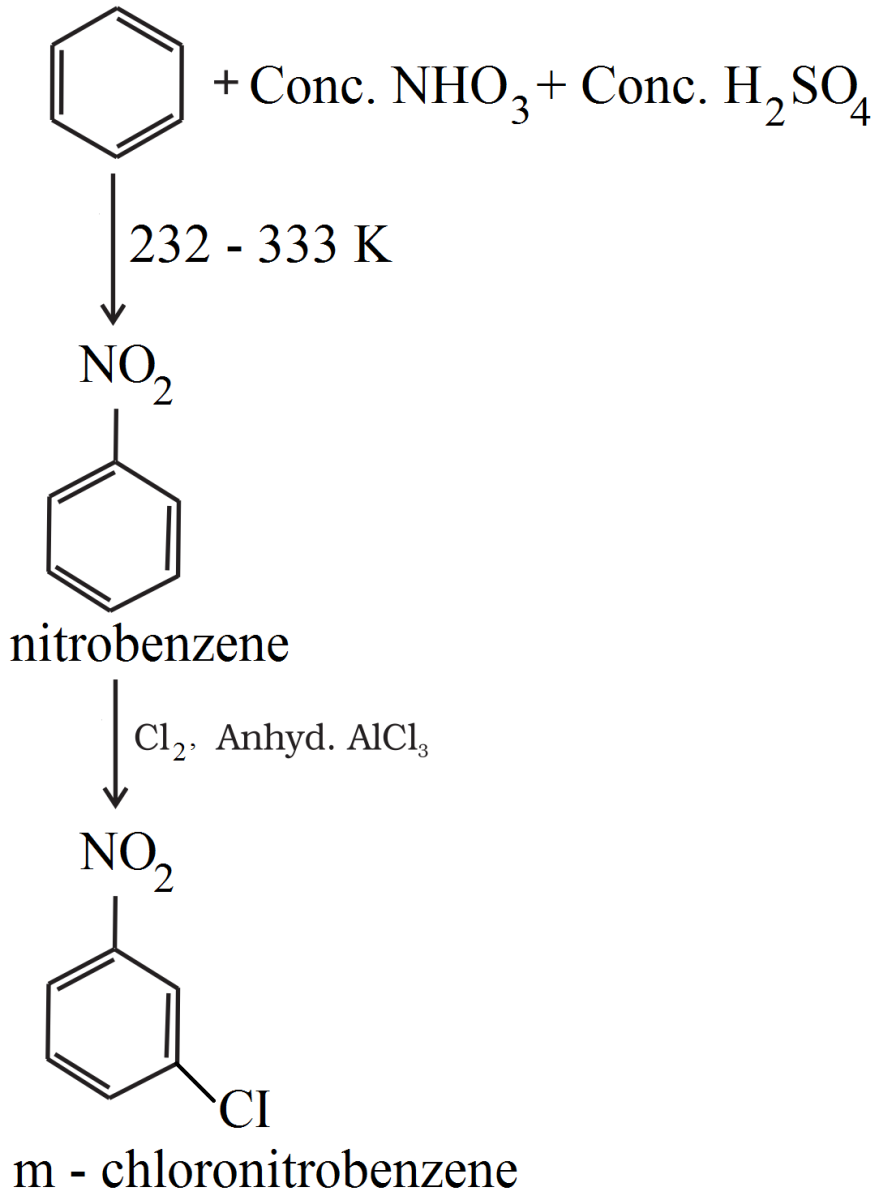
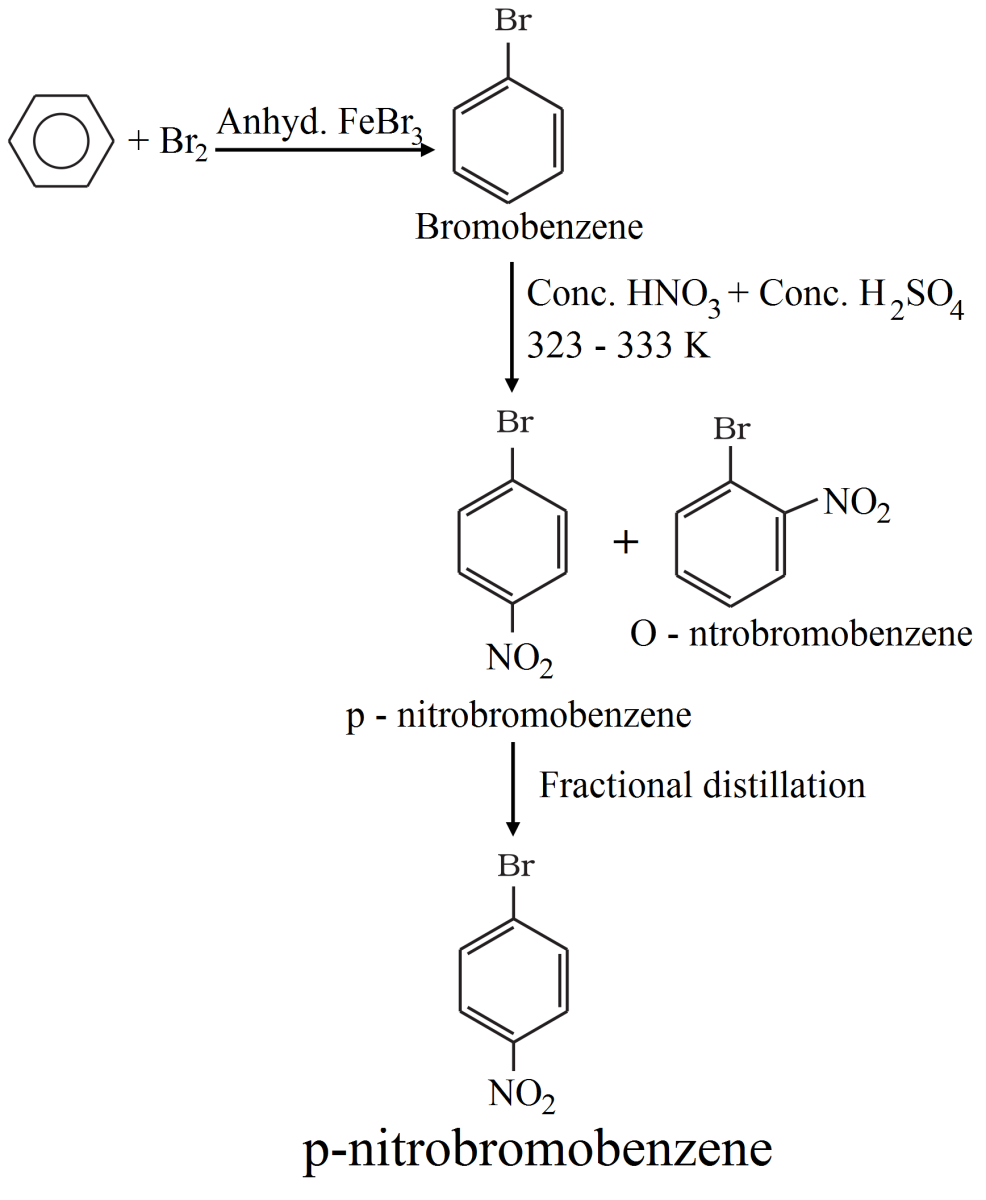
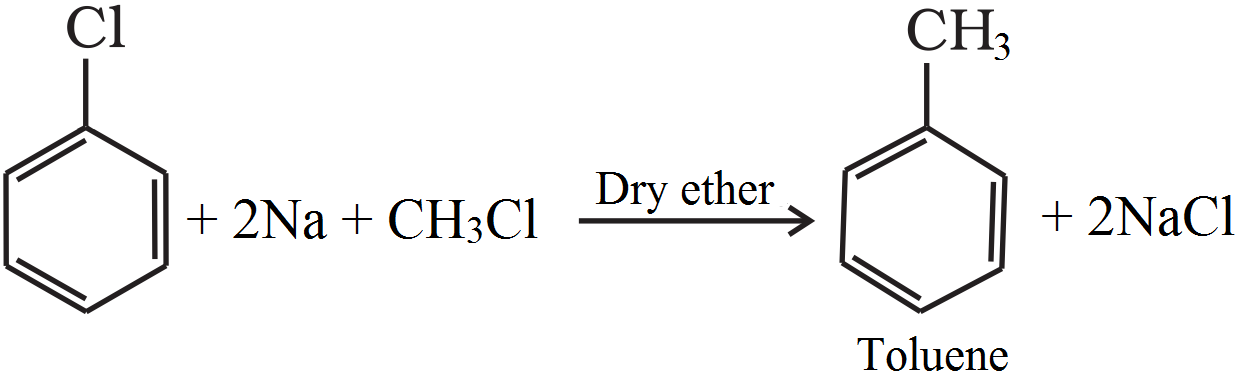
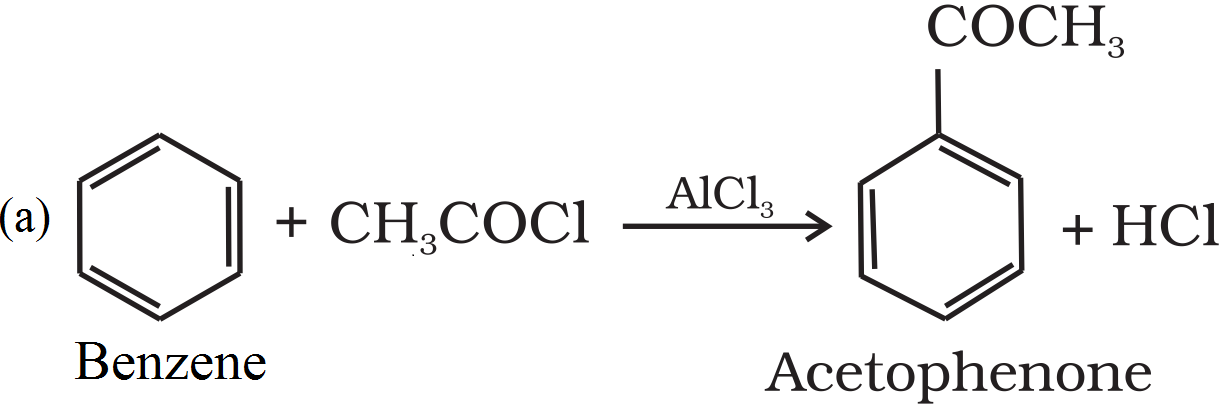
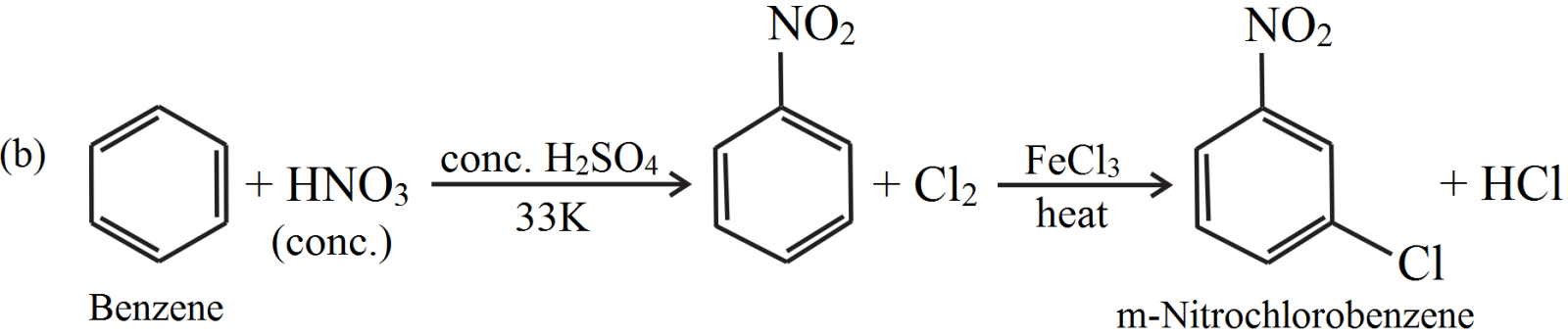
Therefore, it undergoes electrophilic substitution reactions very easily. Nucleophiles are electron-rich. Hence, they are repelled by benzene. Hence, benzene undergoes nucleophilic substitutions with difficulty.
31 questions · self-marked practice — reveal the answer and mark yourself.


$\text{CH}_3-\text{CH}=\text{CH}_2$
$\text{CH}_3-\text{CH}_2-\text{CH}_2\text{Cl}$
$\text{CH}_3\text{CH}_2\text{CH}_2\text{COO}^-\text{Na}^+$
$\text{CH}_3-\text{CH}=\text{CH}_2+\text{H}_2\xrightarrow{\text{Pd/pt/Ni}}\text{CH}_3-\text{CH}_2-\text{CH}_3\\ \ \ \ \ \ \ \ \ \ \ \ _{\text{Propene}} \ \ \ \ \ \ \ \ \ \ \ \ \ \ \ \ \ \ \ \ \ \ \ \ \ \ \ \ \ \ \ \ \ \ \ \ \ \ \ \ \ \ \ \ _{\text{Propane}}$
$\text{CH}_3-\text{CH}_2-\text{CH}_2-\text{Cl}+2[\text{H}]\xrightarrow{\text{Zn/HCl}}\text{CH}_3\text{CH}_2\text{CH}_3+\text{HCl}$
$\text{CH}_3-\text{CH}_2-\text{CH}_2-\text{COO}^-\text{Na}^++\text{NaOH(CaO)}\\\xrightarrow{\text{heat}}\text{CH}_3-\text{CH}_2-\text{CH}_3+\text{Na}_2\text{CO}_3$
$\text{CH}_3-\text{CH}_2-\text{CH}_2\text{Br}+\text{KOH(alc.)}\overrightarrow{\ \ \ \ \ \ }$
$\text{CH}_3-\text{CH}-\text{CH}_3+\text{KOH(aq)}\overrightarrow{ \ \ \ \ \ \ }\\ \ \ \ \ \ \ \ \ \ \ \ \ \ |\\ \ \ \ \ \ \ \ \ \ \ \ \ \text{Br}$

$\text{CH}_3\text{CH}_2\text{CH}_2\text{Br}+\text{KOH(alc.)}\overrightarrow{\ \ \ \ \ \ }\\\text{CH}_3-\text{CH}=\text{CH}_2+\text{KBr}+\text{H}_2\text{O}$
Nucleophilic Elimination is taking place.
Nucleophilic substitution reaction is taking place.

Addition reaction is taking place.

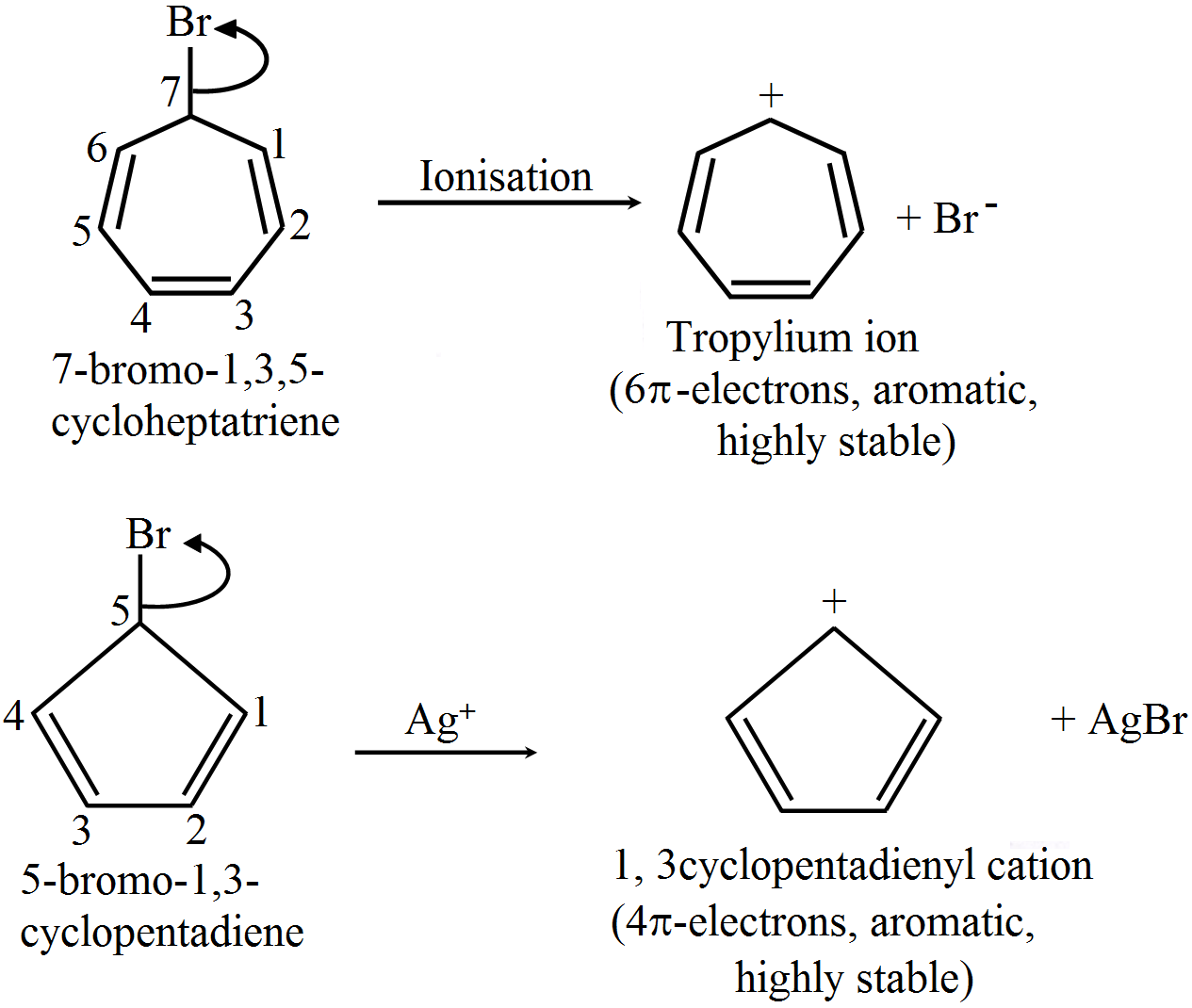
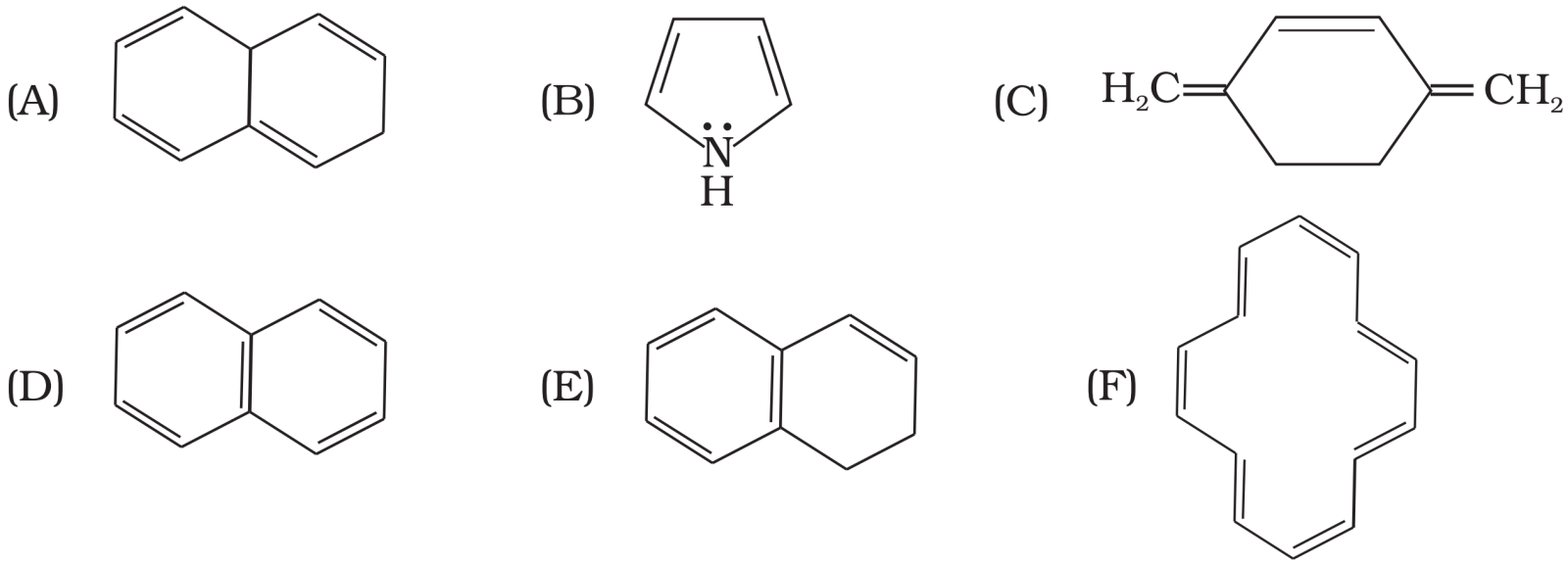
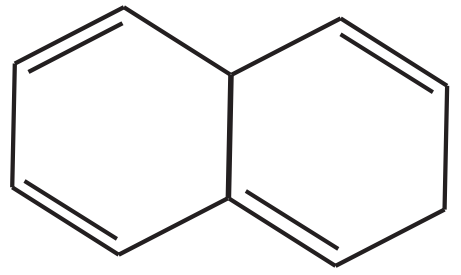
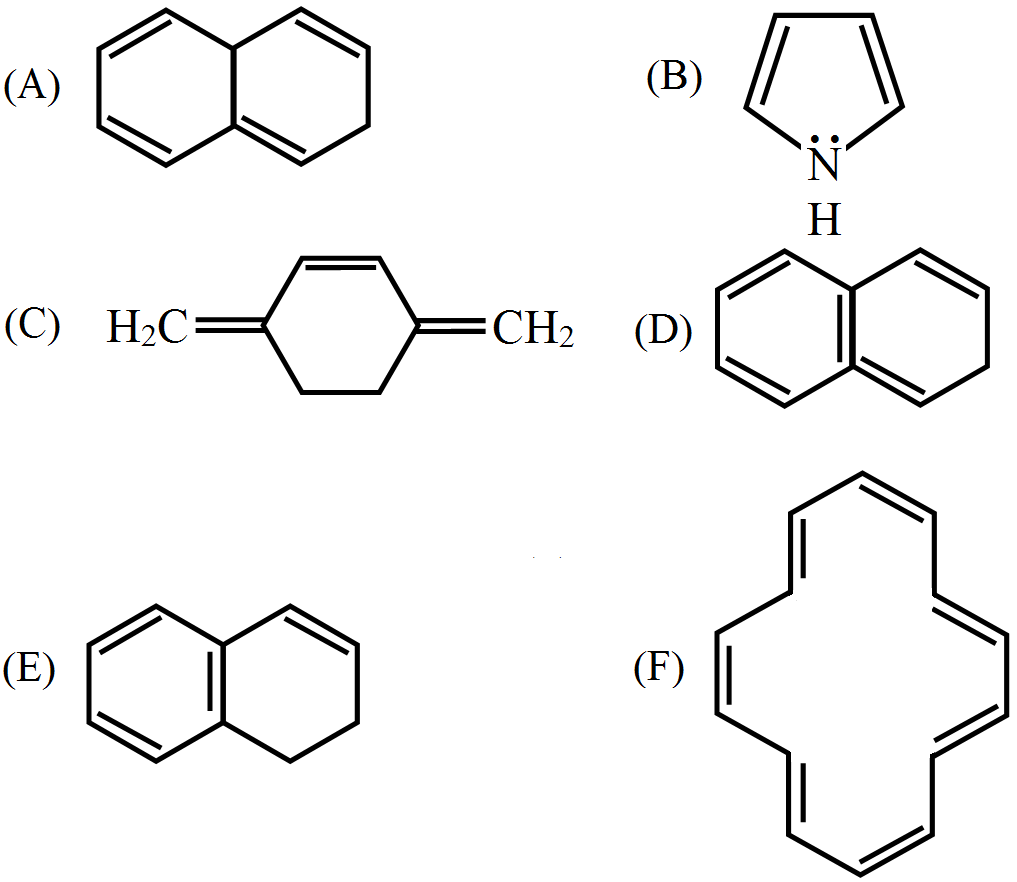
| (A) | ![]() | The compound has $8\pi$ electrons. It is non aromatic. |
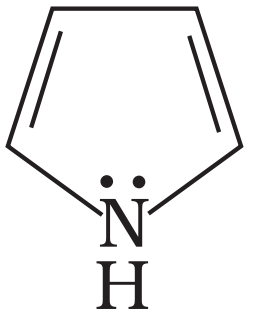
| (B) | ![]() | This compound has delocalised $6\pi$ electrons, follows Huckel rule. It is aromatic. |
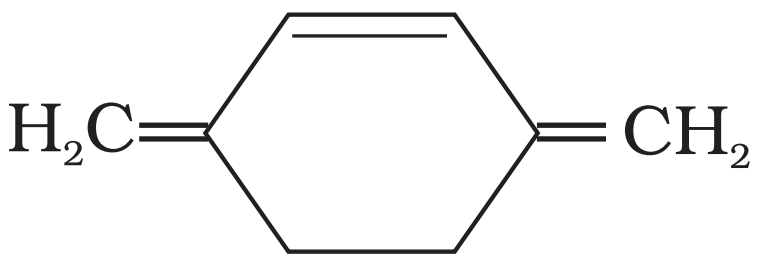
| (C) | ![]() | In this compound $6\pi$ electrons are not present in the ring hence nonaromatic. |
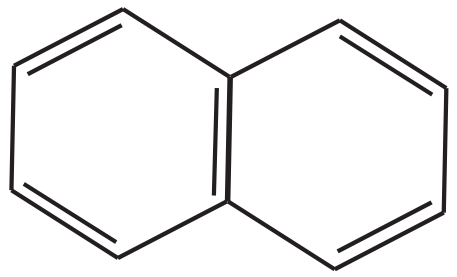
| (D) | ![]() | It is aromatic obeying Huckel's rule. It has 10 delocalised $\pi$-electrons. |
| (E) | It has $8\pi$-electrons, out of which $6\pi$-electrons are delocalised. Follows Huckel rule. It is aromatic. | |
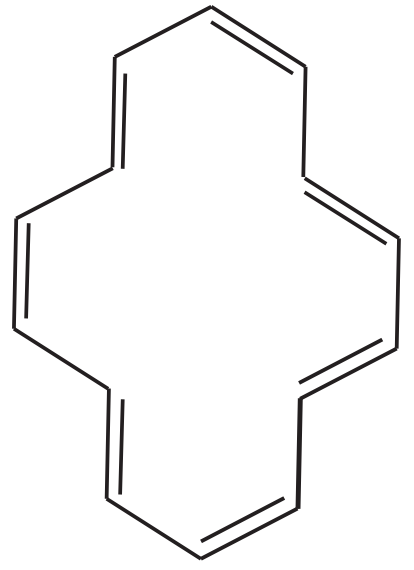
| (F) | ![]() | In this compound $14\pi$ electrons are in conjugation and in the planar ring. It is also aromatic, It follows Huckel's rule. |

$\text{CH}_3\text{CH}_2\text{CH}_3+\text{HNO}_3\xrightarrow{\text{Vapour phase}}\\\text{CH}_3\text{CH}_2\text{NO}_2+\text{CH}_3\text{CH}_2\text{CH}_2\text{NO}_2+\text{CH}_3\text{NO}_2+\text{H}_2\text{O}\\ \ \ \ _{\text{Nitroethane}} \ \ \ \ \ \ \ \ \ \ \ \ \ \ _{\text{Nitropropane}} \ \ \ \ \ \ \ \ \ \ \ \ \ \ _{\text{Nitromethane}}$
$\text{CH}_4+\text{O}_2\xrightarrow[723-773\text{K}]{\text{Copper tube}}2\text{CH}_3\text{OH}\\ \ \ \ \ \ \ \ \ \ \ \ \ \ \ \ \ \ \ \ \ \ \ \ \ \ \ \ \ \ \ \ \ \ \ \ \ \ _{\text{Methanol}}$
$\text{C}_2\text{H}_5\text{COONa}+\text{NaOH}\xrightarrow{\text{CaO}}\text{C}_2\text{H}_6+\text{Na}_2\text{CO}_3\\ \ \ \ \ \ \ \ \ \ \ \ \ \ \ \ \ \ \ \ \ \ \ \ \ \ \ \ \ \ \ \ \ \ \ \ \ \ \ \ \ \ \ \ \ \ \ \ \ \ \ \ _{\text{Ethane}}$
$\text{CH}_3-\text{CH}=\text{CH}_2+\text{HBr}\xrightarrow{\text{Peroxide}}\\\text{CH}_3-\text{CH}_2-\text{CH}_2\text{Br}$
$\text{CH}_3-\text{Cl}+\text{Na}\xrightarrow{\text{Dry ether}}\text{CH}_3-\text{CH}_3+2\text{NaCl}$
$\text{CH}_3-\text{CH}-\text{CH}_2-\text{CH}_3\xrightarrow[\Delta]{\text{alc. KOH}}\\ \ \ \ \ \ \ \ \ \ \ \ \ \ |\\ \ \ \ \ \ \ \ \ \ \ \ \ \text{Cl}\\\text{CH}_3-\text{CH}=\text{CH}-\text{CH}_3+\text{KCl}+\text{H}_2\text{O}$
$ \ \ \ \ \ \ \ \ \ \ \ \ \text{CH}_3 \ \text{CH}_3 \ \ \ \ \ \ \ \ \ \ \ \ \ \ \ \ \ \ \ \ \ \ \ \ \ \text{CH}_3 \ \text{CH}_3\\ \ \ \ \ \ \ \ \ \ \ \ \ \ | \ \ \ \ \ \ \ | \ \ \ \ \ \ \ \ \ \ \ \ \ \ \ \ \ \ \ \ \ \ \ \ \ \ \ \ \ \ \ \ | \ \ \ \ \ \ \ |\\\text{CH}_3-\text{C}=\text{C}-\text{CH}_3+\text{CH}_2=\text{C}-\text{C}-\text{CH}_3\\_\text{2,3-dimethyl but-2-ene} \ \ \ \ \ \ \ \ \ \ \ \ \ \ \ \ \ \ \ \ \ \ \ \ \ \ \ \ \ \ \ \ \ \ |\\\ \ \ \ \ \ \ \ \ \ \ \ \ \ \ \ \ \ \ \ \ \ \ \ \ \ \ \ \ \ \ \ \ \ \ \ \ \ \ \ \ \ \ \ \ \ \ \ \ \ \ \ \ \ \ \ \ \ \ \ \ \text{H}\\ \ \ \ \ \ \ \ \ \ \ \ \ \ \ \ \ \ \ \ \ \ \ \ \ \ \ \ \ \ \ \ \ \ \ \ \ \ \ \ \ \ \ _{2,3-\text{dimethyl-1-butene}}\\ \ \ \ \ \ \ \ \ \ \ \ \ \ \ \ \ \ \ \ \ \ \ \ \ \ \ \ \ \ \ \ \ \ \ \ \ \ \ \ \ \ \ \ \ \ \ \ \ \ \ \ \ \ \ \ (\text{Z})$
Identify A, B and C compounds and give their reactions.
$\text{CH}_3-\text{C}=\text{CH}_2+\text{H}_2\text{O}\xrightarrow{\text{H}^+}\\ \ \ \ \ \ \ \ \ \ \ \ \ \ |\\ \ \ \ \ \ \ \ \ \ \ \ \ \text{CH}_3$

Arrange the following in increasing order of acidic character.
$\ \ \ \ \ \ \ \ \ \ \ \ \text{CH}_3\ \text{O} \ \ \ \ \ \ \ \ \ \ \ \ \ \ \ \ \ \ \ \ \ \ \ \ \ \ \text{O}\\ \ \ \ \ \ \ \ \ \ \ \ \ \ | \ \ \ \ \ \ \ || \ \ \ \ \ \ \ \ \ \ \ \ \ \ \ \ \ \ \ \ \ \ \ \ \ \ \ ||\\\text{CH}_3-\text{C}-\text{C}-\text{OH},\ \text{CH}_3-\text{C}-\text{OH},\\ \ \ \ \ \ \ \ \ \ \ \ \ \ |\\ \ \ \ \ \ \ \ \ \ \ \ \ \text{CH}_3$ $ \ \ \ \ \ \ \ \ \ \ \ \ \ \ \ \ \ \ \ \ \ \ \ \ \ \text{O}\ \ \ \ \ \ \ \ \ \ \ \ \ \ \ \ \ \ \ \ \ \ \ \ \ \ \text{O}\\ \ \ \ \ \ \ \ \ \ \ \ \ \ \ \ \ \ \ \ \ \ \ \ \ \ || \ \ \ \ \ \ \ \ \ \ \ \ \ \ \ \ \ \ \ \ \ \ \ \ \ \ \ ||\\\text{CH}_3-\text{CH}_2-\text{C}-\text{OH},\ \text{CH}_3-\text{C}-\text{COOH}$

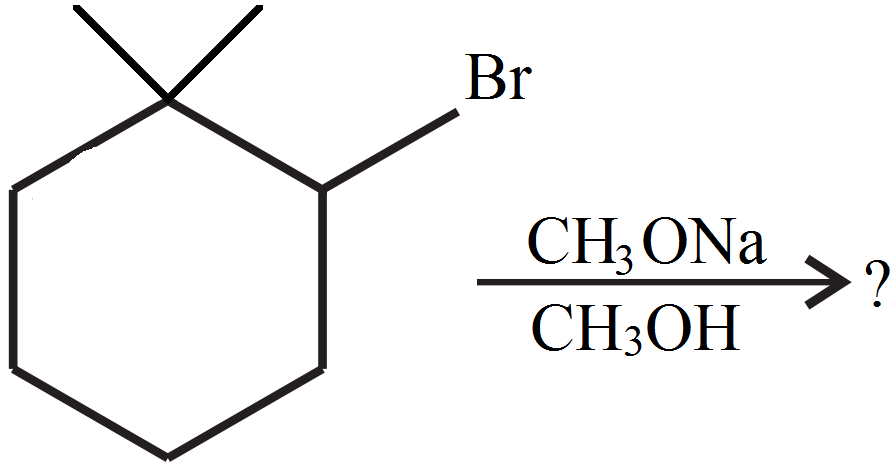
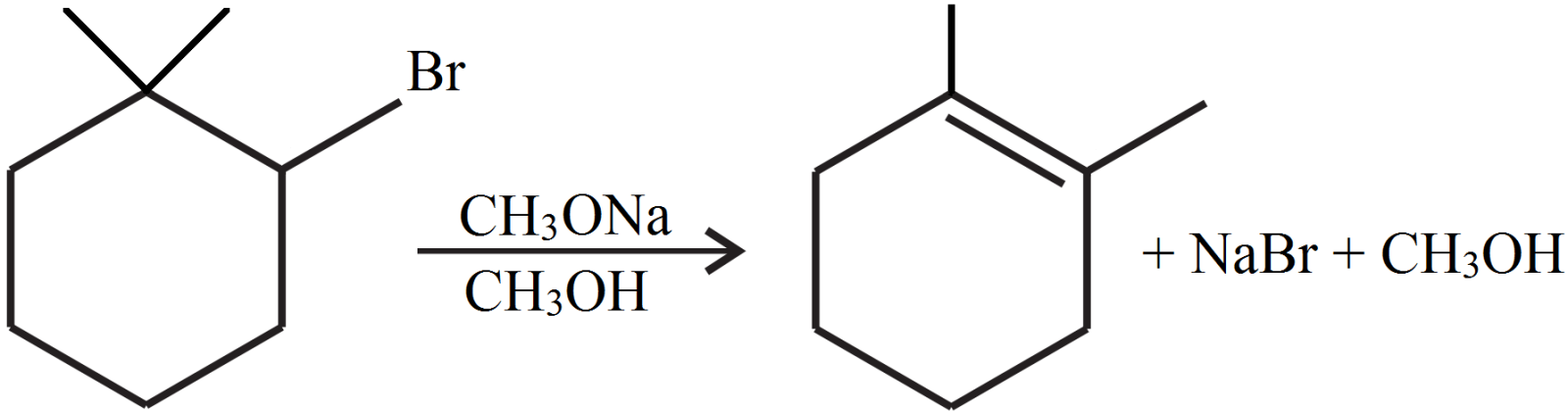
CH3ONa will carry out nucleophilic elimination reaction like KOH (alc) and will give more alkyl substituted alkene will be major product.
Because CH3- groups are electron releasing, will destabilise carboxylate ion whereas $ \ \ \ \ \text{O}\\ \ \ \ \ ||\\-\text{C}-$ group is electron withdrawing, will stabilise the carboxylate ion.
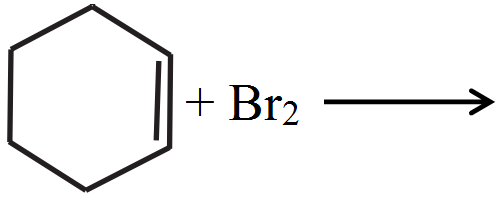
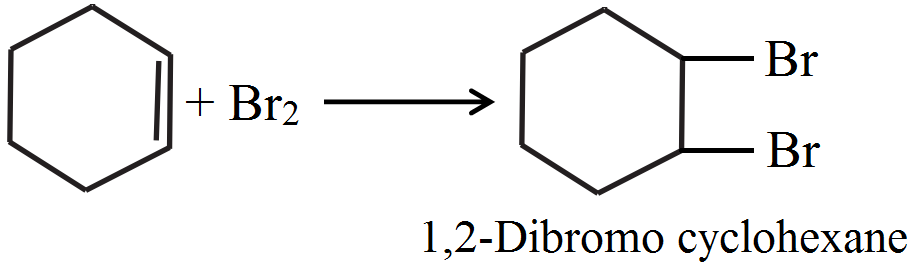
But-2-ene will undergo addition reaction to form 2, 3-Dibromo butane.

$\ \ \ \ \ \ \ \ \ \ \ \ \ \ \ \ \ \ \ \ \text{H}\\ \ \ \ \ \ \ \ \ \ \ \ \ \ \ \ \ \ \ \ \ \ |\\\text{CH}_3\text{CH}_2-\text{C}=\text{O}+\text{O}=\text{C}-\text{CH}_3\rightarrow\\ \ \ \ \ \ \ \ \ \ \ \ \ \ \ \ \ \ \ \ \ \ \ \ \ \ \ \ \ \ \ \ \ \ \ \ \ \ \ \ \ \ \ \ \ \ \ |\\ \ \ \ \ \ \ \ \ \ \ \ \ \ \ \ \ \ \ \ \ \ \ \ \ \ \ \ \ \ \ \ \ \ \ \ \ \ \ \ \ \ \ \ \ \ \text{CH}_3\\ \ \ \ \ \ \ \ \ \ \ \ \ \ \ \ \ \ \ \ \ \ \ \ \ \ \ \text{CH}_3\\ \ \ \ \ \ \ \ \ \ \ \ \ \ \ \ \ \ \ \ \ \ \ \ \ \ \ \ |\\\text{CH}_3\text{CH}_2\text{CH}=\text{C}-\text{CH}_3\\ \ \ \ \ _{2-\text{methyl pent-2ene}}$
$ \ \ \ \ \ \ \ \ \ \ \ \ \ \ \ \ \ \ \ \ \ \ \ \ \ \ \ \ \ \ \ \ \ \ \ \ \ \ \ \ \ \ \ \ \ \ \ \ \ \ \ \ \ \ \ \ \ \ \ \ \ \ \ \ \ \ \ \ \ \ \ \ \ \ \ \ \ \ \ \ \ \ \ \ \ \ \ \ \ \ \ \ \ \text{CH}_3\\ \ \ \ \ \ \ \ \ \ \ \ \ \ \ \ \ \ \ \ \ \ \ \ \ \ \ \ \ \ \ \ \ \ \ \ \ \ \ \ \ \ \ \ \ \ \ \ \ \ \ \ \ \ \ \ \ \ \ \ \ \ \ \ \ \ \ \ \ \ \ \ \ \ \ \ \ \ \ \ \ \ \ \ \ \ \ \ \ \ \ \ \ \ \ |\\\text{CH}_3\text{CH}_2\text{CHO}+\text{CH}_3\text{COCH}_3\xleftarrow{\text{Ozonolysis}}\text{CH}_3\text{CH}_2\text{CH}=\text{C}-\text{CH}_3\\ \ \ \ \ \ \ \ \ (\text{B}) \ \ \ \ \ \ \ \ \ \ \ \ \ \ \ \ \ \ \ \ \ \ \ (\text{C}) \ \ \ \ \ \ \ \ \ \ \ \ \ \ \ \ \ \ \ \ \ \ \ \ \ \ \ \ \ \ \ \ \ (\text{A})$
$ \ \ \ \ \ \ \ \ \ \ \ \ \ \ \ \ \ \ \ \ \ \ \ \ \ \ \text{CH}_3\\ \ \ \ \ \ \ \ \ \ \ \ \ \ \ \ \ \ \ \ \ \ \ \ \ \ \ \ |\\\text{CH}_3\text{CH}_2\text{CH}=\text{C}-\text{CH}_3\xrightarrow{\text{Hot KMnO}_4}\\ \ \ \ \ \ (\text{A})\\ \ \ \ \ \ \ \ \ \ \ \ \ \ \ \ \ \ \ \ \ \ \ \ \ \ \ \ \ \ \ \ \ \ \ \ \ \ \ \ \ \ \ \ \ \text{CH}_3\\ \ \ \ \ \ \ \ \ \ \ \ \ \ \ \ \ \ \ \ \ \ \ \ \ \ \ \ \ \ \ \ \ \ \ \ \ \ \ \ \ \ \ \ \ \ |\\\text{CH}_3\text{CH}_2\text{COOH}+\text{CH}_3-\text{C}=\text{O}\\ \ \ \ \ \ \ \ \ \ (\text{D}) \ \ \ \ \ \ \ \ \ \ \ \ \ \ \ \ \ \ \ \ \ \ \ \ \ \ \ (\text{C})$