Question
How will you convert benzene into:
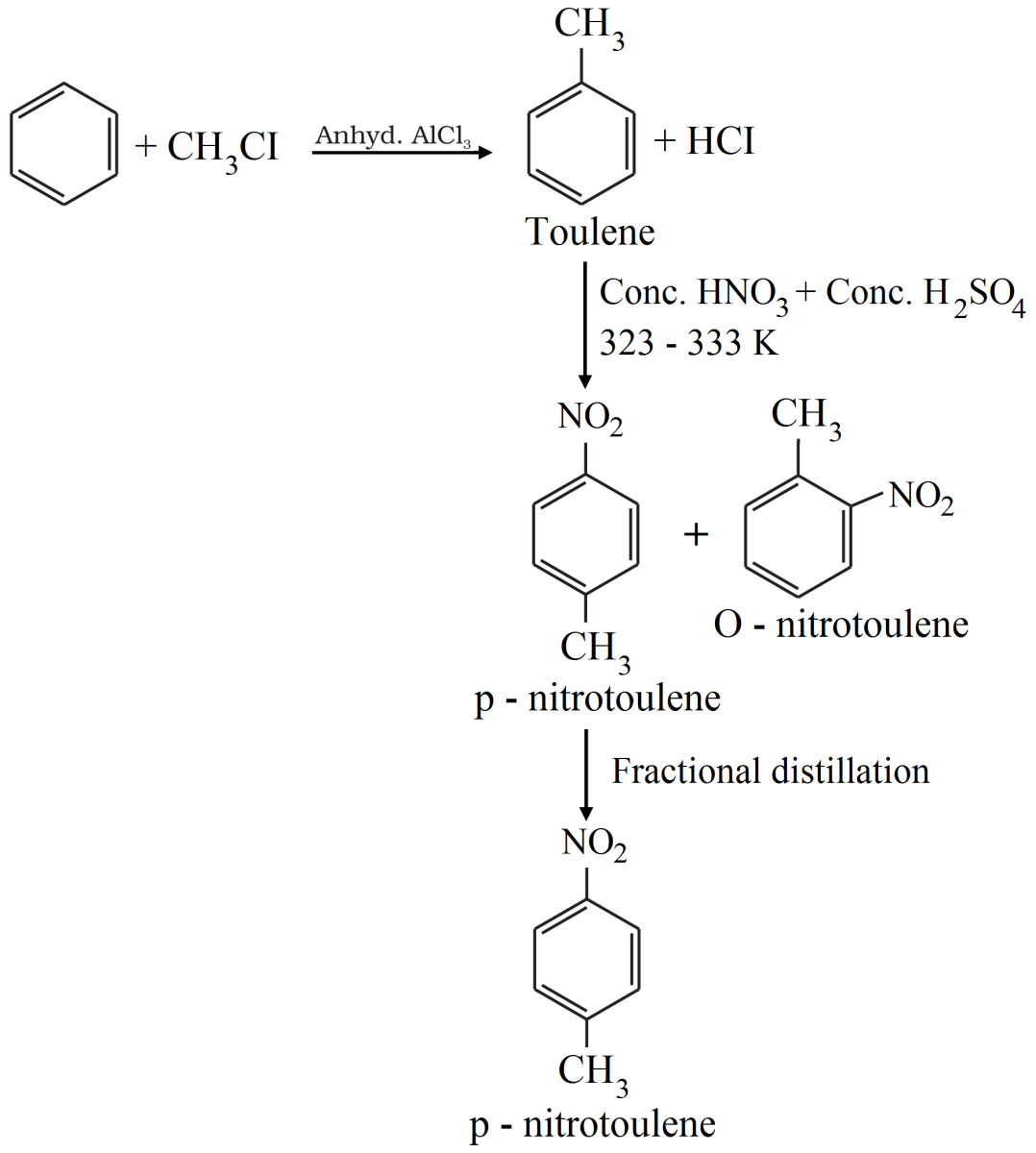
p-nitrotoluene.

Answer

Benzene can be converted into p-nitrotoulene as:

Need a full question paper?

Generate a complete, print-ready paper with questions like this in minutes — across 16+ boards, with answer keys.

Start Generating Free

Similar questions

Balance the following ionic equations.
$\text{MnO}^-_4+\text{H}^++\text{Br}^-\xrightarrow{ \ \ \ \ \ \ \ \ }\text{Mn}^{2+}+\text{Br}_2+\text{H}_2\text{O}$
Balance the following redox reactions by ion-electron method:
$\text{Cr}_2\text{O}_7^{2-}+\text{SO}_2(\text{g})\rightarrow\text{Cr}^{3+}(\text{aq})+\text{SO}^{2-}_4(\text{aq})$ (in acidic solution).
Solid Ba(NO3), is gradually dissolved in a 1.0 × 10⁻⁴ M Na2CO3 solution. At what concentration of Ba2+ will a precipitate begin to form.(Ksp for BaCO3 = 5.1 × 10⁻⁹)
Describe the change in hybridisation (if any) of the Al atom in the following reaction.
$\text{AlCl}_3\text{Cl}^-\rightarrow\text{AlCl}^-_4$
Commercially available concentrated hydrochloric acid contains 38% HCl by mass.
  1. What is the molarity of the solution (density of solution = 1.19g mL- 1)?
  2. What volume of the above concentrated HCl is required to make 1.0L of 0.10M HCl?
Write the anode reaction, the cathode reaction and the net cell reaction in the following cells. Which electrode would be positive terminal in each cell?
  1. $\text{Zn}\text{(s)}|\text{Zn}^{2+}||\text{Br}_2|\text{Br}^-|\text{Pt}\text{(s)}$
  2. $\text{Cr}\text{(s)}|\text{Cr}^{3+}||\text{I}_2|\text{I}^-|\text{Pt}\text{(s)}$
  3. $\text{Pt}\text{(s)}|\text{H}_2\text{(g)}||\text{H}^+\text{(aq)}||\text{Cu}^{2+}|\text{Cu}\text{(s)}$
Predict the dipole moment of
i. a molecule of the type $AX _2$ having a linear geometry.
ii. a molecule of the type $AX _4$ having tetrahedral geometry.
iii. a molecule of the type $AX _2$ having angular geometry.
iv. a molecule of the type $AX _4$ having square planar geometry.
  1. How bond energy varies from $\text{N}^-_2$ to $\text{N}^+_2$ and why?
  2. On the basis of molecular orbital theory what is similarly between,
  1. $\text{F}_2\text{0}^{2-}_2$

  2. $\text{CO},\text{N}_2,\text{NO}^+?$

1. Define intensive properties.
2. One mole of acetone requires less heat to vaporise than 1 mole of water. Which of the two liquids has the higher enthalpy of vaporisation?
3. Define standard enthalpy.
What is the equilibrium concentration of each of the substances in the equilibrium when the initial concentration of ICl was 0.78 M ?
$2 ICl ( g ) \rightleftharpoons I _2(g)+ Cl _2(g) ; \quad K _{ c }=0.14$