Questions

1 Marks Question

Take a timed test

75 questions · 1 auto-graded MCQ + 74 self-marked written.
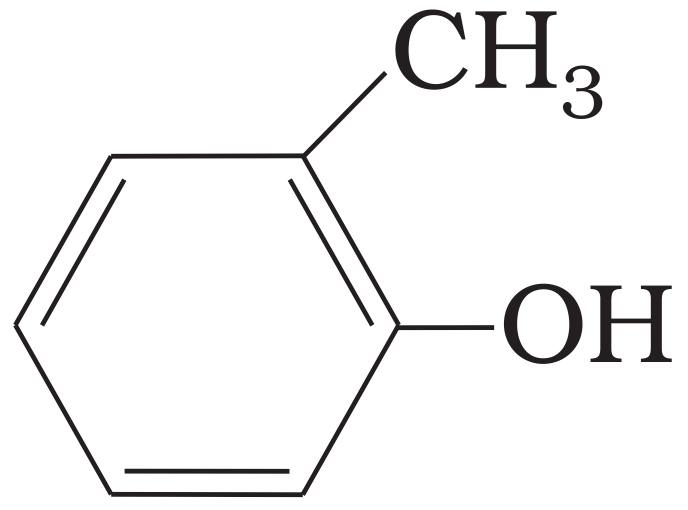
Question 21 Mark
Write IUPAC names of the products obtained by the ozonolysis of the following compound:
3,4-Dimethylhept-3-ene.
Answer
$\ \ \ \ \ \ \ \ \ \ \ \ \ \ \ \ \ \ \ \ \ \ \ \ \ \ \ \ \ \ \ \ \ \ \ \ \ \ \ \ \ \ \ \ \ \ \text{CH}_3\\\ \ \ \ \ \ \ \ \ \ \ \ \ \ \ \ \ \ \ \ \ \ \ \ \ \ \ \ \ \ \ \ \ \ \ \ \ \ \ \ \ \ \ \ \ \ \ |\\\text{H}_3\text{C}-\text{H}_2\text{C}-\text{H}_2\text{C}-\text{C}=\text{C}-\text{CH}_2-\text{CH}_3\xrightarrow{\text{ozonolysis}\ \ }\text{H}_3\text{C}-\text{CH}_2-\text{CH}_2-\text{C}=\text{O}+\text{CH}_3-\text{CH}_2-\text{C}=\text{O}\\\ \ \ \ \ \ \ \ \ \ \ \ \ \ \ \ \ \ \ \ \ \ \ \ \ \ \ \ \ \ \ \ \ \ \ \ \ \ |\ \ \ \ \ \ \ \ \ \ \ \ \ \ \ \ \ \ \ \ \ \ \ \ \ \ \ \ \ \ \ \ \ \ \ \ \ \ \ \ \ \ \ \ \ \ \ \ \ \ \ \ \ \ \ \ \ \ \ \ \ \ \ \ \ \ \ \ \ \ \ \ \ \ \ \ \ \ \ \ \ \ \ \ \ \ \ \ \ \ \ |\ \ \ \ \ \ \ \ \ \ \ \ \ \ \ \ \ \ \ \ \ \ \ \ \ \ \ \ \ \ \ \ \ \ \ \ \ \ \ \ \ |\\\ \ \ \ \ \ \ \ \ \ \ \ \ \ \ \ \ \ \ \ \ \ \ \ \ \ \ \ \ \ \ \ \ \ \ \ \ \text{CH}3\ \ \ \ \ \ \ \ \ \ \ \ \ \ \ \ \ \ \ \ \ \ \ \ \ \ \ \ \ \ \ \ \ \ \ \ \ \ \ \ \ \ \ \ \ \ \ \ \ \ \ \ \ \ \ \ \ \ \ \ \ \ \ \ \ \ \ \ \ \ \ \ \ \ \ \ \ \ \ \ \ \ \ \ \text{CH}3\ \ \ \ \ \ \ \ \ \ \ \ \ \ \ \ \ \ \ \ \ \ \ \ \ \ \ \ \ \ \ \ \ \text{CH}3\\\ \ \ \ \ \ \ \ \ \ \ \ \ \ \ \ \ \ \ \ \ \ \ \ \ \ \ \ \ \ \ \ \ \ \ \ \ \ \ \ \ \ \ \ \ \ \ \ \ \ \ \ \ \ \ \ \ \ \ \ \ \ \ \ \ \ \ \ \ \ \ \ \ \ \ \ \ \ \ \ \ \ \ \ \ \ \ \ \ \ \ \ \ \ \ \ \ \ \ \ \ \ \ \ \ \ \ \text{Pentan-2-one}\ \ \ \ \ \ \ \ \ \ \ \ \ \ \ \ \ \ \ \ \ \ \ \ \text{Butan-2-one}$
View full question & answer
Question 31 Mark
Write IUPAC names of the products obtained by the ozonolysis of the following compound:
Pent-2-ene.
Answer
$\text{CH}_3-\text{CH}_2-\text{HC}=\text{CH}-\text{CH}_3\xrightarrow{\ \text{ozonolysis}\ \ }\text{CH}_3-\text{CH}_2-\text{CHO}+\text{CH}_3\text{CHO}\\\ \ \ \ \ \ \ \ \ \ \ \ \ \ \ \ \ \ \ \ \ \ \ \ \ \ \ \ \ \ \ \ \ \ \ \ \ \ \ \ \ \ \ \ \ \ \ \ \ \ \ \ \ \ \ \ \ \ \ \ \ \ \ \ \ \ \ \ \ \ \ \ \ \ \ \ \ \ \ \ \ \ \text{Propanal}\ \ \ \ \ \ \ \ \ \ \ \ \ \ \ \text{Ethanal}$
View full question & answer
Question 41 Mark
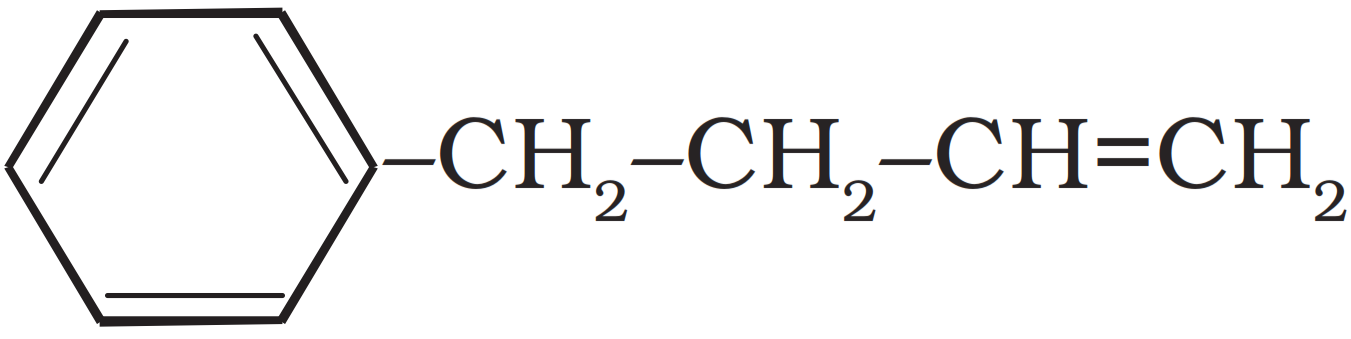
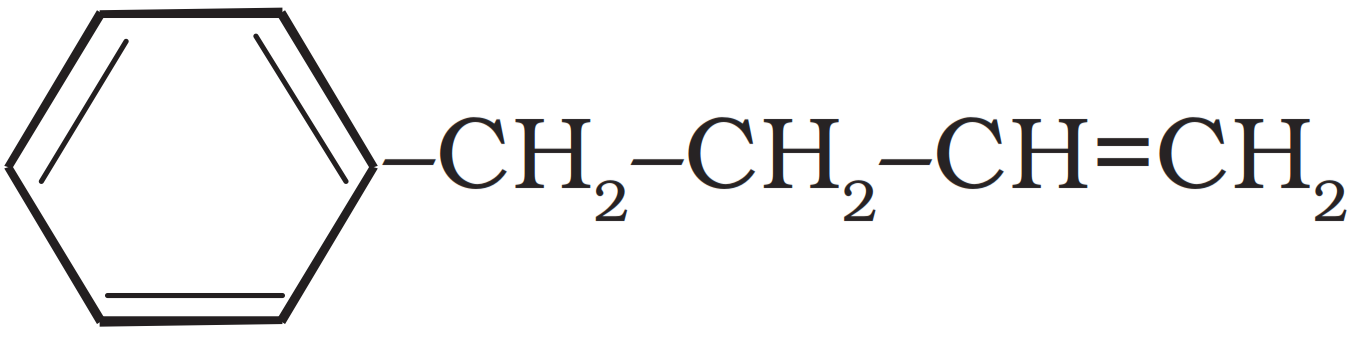
Write IUPAC names of the products obtained by the ozonolysis of the following compound:
1-Phenylbut-1-ene.
View full question & answer
Question 61 Mark
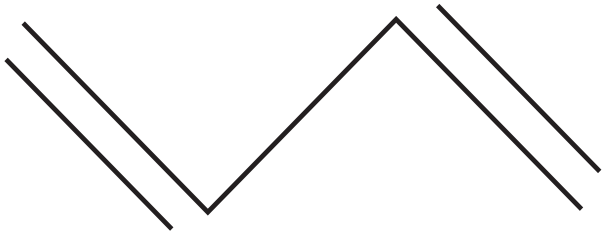
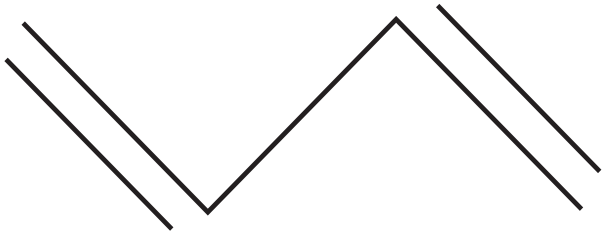
Write IUPAC names of the following compound:
Answer

can be written as:$\text{H}_2\stackrel{1}{\hbox{C}}=\stackrel{2}{\hbox{C}}\text{H}-\stackrel{3}{\hbox{C}}\text{H}=\stackrel{4}{\hbox{C}}\text{H}_2$
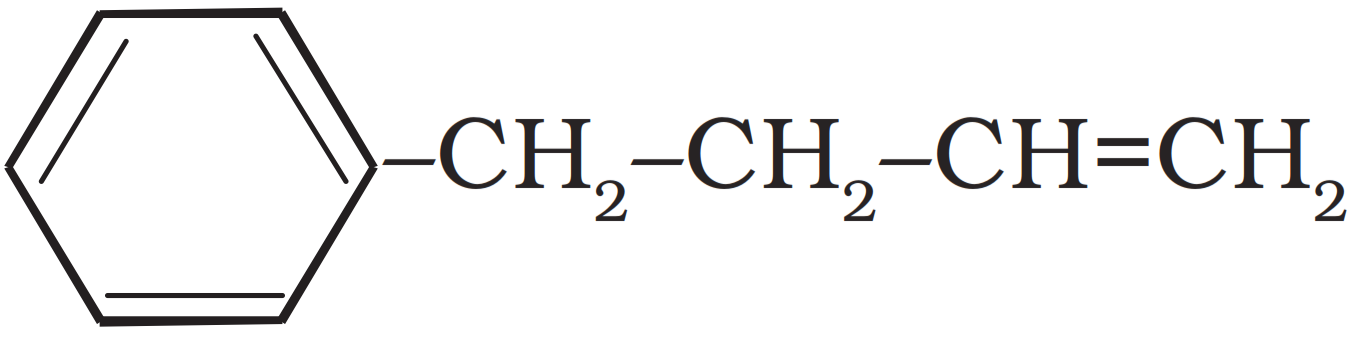
IUPAC name: 1, 3-Butadiene or Buta-1, 3-diene.
View full question & answer
Question 81 Mark
Write IUPAC names of the products obtained by the ozonolysis of the following compound:
2-Ethylbut-1-ene.
Answer
$\ \ \ \ \ \ \ \ \ \ \ \ \ \ \ \ \ \ \ \ \ \ \ \ \text{C}_2\text{H}_5\ \ \ \ \ \ \ \ \ \ \ \ \ \ \ \ \ \ \ \ \ \ \ \ \ \ \ \ \ \ \ \ \ \ \ \ \ \ \ \ \ \ \ \ \ \ \ \ \ \ \ \ \ \ \ \ \ \ \ \ \ \ \ \ \ \ \ \ \ \ \ \ \ \text{C}_2\text{H}_5\\\ \ \ \ \ \ \ \ \ \ \ \ \ \ \ \ \ \ \ \ \ \ \ \ \ \ |\ \ \ \ \ \ \ \ \ \ \ \ \ \ \ \ \ \ \ \ \ \ \ \ \ \ \ \ \ \ \ \ \ \ \ \ \ \ \ \ \ \ \ \ \ \ \ \ \ \ \ \ \ \ \ \ \ \ \ \ \ \ \ \ \ \ \ \ \ \ \ \ \ \ \ \ \ \ \ \ |\\\text{H}_3\text{C}-\text{H}_2\text{C}-\text{C}=\text{CH}_2\xrightarrow{\ \text{ozonolysis}\ }\text{CH}_2=\text{O}+\text{CH}_3-\text{CH}_2-\text{C}=\text{O}\\\\ \ \ \ \ \ \ \ \ \ \ \ \text{Methanal}\ \ \ \ \ \ \ \ \ \ \ \ \ \ \ \ \ \ \ \ \ \ \ \ \ \ \ \ \ \ \ \ \ \ \ \ \ \ \ \ \ \ \ \ \ \ \ \ \ \ \ \ \ \ \ \ \ \text{Pentan}-3-\text{one}$
View full question & answer
Question 91 Mark
Write IUPAC names of the following compound:
$\text{CH}_3\text{CH}=\text{C}(\text{CH}_3)_2$
Answer
$\text{H}_3\stackrel{4}{\hbox{C}}-\stackrel{3}{\hbox{C}}\text{H}=\stackrel{{2}}{\hbox{C}}-\stackrel{1}{\hbox{C}}\text{H}_3\\\ \ \ \ \ \ \ \ \ \ \ \ \ \ \ \ \ \ \ \ \ \ \ \ \ \ |\\\ \ \ \ \ \ \ \ \ \ \ \ \ \ \ \ \ \ \ \ \ \ \ \text{CH}_3$
IUPAC name: 2-Methylbut-2-ene.
View full question & answer
Question 101 Mark
Write IUPAC names of the following compound:
$\text{CH}_3-\text{CH}=\text{CH}-\text{CH}_2-\text{CH}=\text{CH}-\text{CH}-\text{CH}_2-\text{CH}=\text{CH}_2\\\ \ \ \ \ \ \ \ \ \ \ \ \ \ \ \ \ \ \ \ \ \ \ \ \ \ \ \ \ \ \ \ \ \ \ \ \ \ \ \ \ \ \ \ \ \ \ \ \ \ \ \ \ \ \ \ \ \ \ \ \ \ \ \ \ \ \ \ \ \ \ |\\\ \ \ \ \ \ \ \ \ \ \ \ \ \ \ \ \ \ \ \ \ \ \ \ \ \ \ \ \ \ \ \ \ \ \ \ \ \ \ \ \ \ \ \ \ \ \ \ \ \ \ \ \ \ \ \ \ \ \ \ \ \ \ \ \ \ \ \ \ \text{C}_2\text{H}_5$
Answer
$\stackrel{10}{\hbox{C}}\text{H}_3-\stackrel{9}{\hbox{C}}\text{H}=\stackrel{8}{\hbox{C}}\text{H}-\stackrel{7}{\hbox{C}}\text{H}_2-\stackrel{6}{\hbox{C}}\text{H}=\stackrel{5}{\hbox{C}}\text{H}-\stackrel{4}{\hbox{C}}\text{H}-\stackrel{3}{\hbox{C}}\text{H}_2-\stackrel{2}{\hbox{C}}\text{H}-\stackrel{1}{\hbox{C}}\text{H}_2\\\ \ \ \ \ \ \ \ \ \ \ \ \ \ \ \ \ \ \ \ \ \ \ \ \ \ \ \ \ \ \ \ \ \ \ \ \ \ \ \ \ \ \ \ \ \ \ \ \ \ \ \ \ \ \ \ \ \ \ \ \ \ \ \ \ \ \ \ \ \ \ \ \ |\\\ \ \ \ \ \ \ \ \ \ \ \ \ \ \ \ \ \ \ \ \ \ \ \ \ \ \ \ \ \ \ \ \ \ \ \ \ \ \ \ \ \ \ \ \ \ \ \ \ \ \ \ \ \ \ \ \ \ \ \ \ \ \ \ \ \ \ \ \ \ \ \ \text{C}_2\text{H}_5$
IUPAC name: 4-Ethyldeca-1, 5, 8-triene.
View full question & answer
Question 111 Mark
Write IUPAC names of the following compound:
$\text{CH}_2=\text{CH}-\text{C}\equiv\text{C}-\text{CH}_3$
Answer
$\stackrel{1}{\hbox{C}}\text{H}_2=\stackrel{2}{\hbox{C}}\text{H}-\stackrel{3}{\hbox{C}}\equiv\stackrel{4}{\hbox{C}}-\stackrel{5}{\hbox{C}}\text{H}_3$
IUPAC name: Pen-1-ene-3-yne.
View full question & answer
Question 131 Mark
What is decarboxylation? Give an example.
Answer
The process of removing carbon dioxide from sodium salt of acid with the help of soda lime is called decarboxylation, e.g.
$\text{CH}_3\text{COONa}+\text{NaOH(CaO)}\xrightarrow{\text{heat}}\text{CH}_4+\text{Na}_2\text{CO}_3\\ _\text{Sodium ethanaste}\ \ \ \ \ \ \ \ \ _\text{Soda lime}\ \ \ \ \ \ \ \ \ \ \ \ \ \ _\text{Methane}\ \ _\text{Sodium carbonate}$
View full question & answer
Question 141 Mark
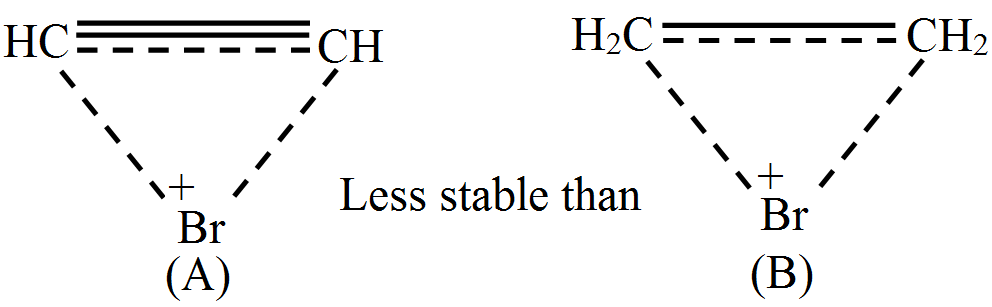
Explain why alkynes are less reactive than alkenes toward addition of $\text{Br}_2$.
Answer
The three-membered ring bromonium ion formed from the alkyne (A) has a full double bond causing it to be more strained and less stable than the one from the alkene (B),

Also, the carbon's of (A) that are part of the bromonium ion have more s-character than (B), further making (A) less stable than (B).
View full question & answer
Question 161 Mark
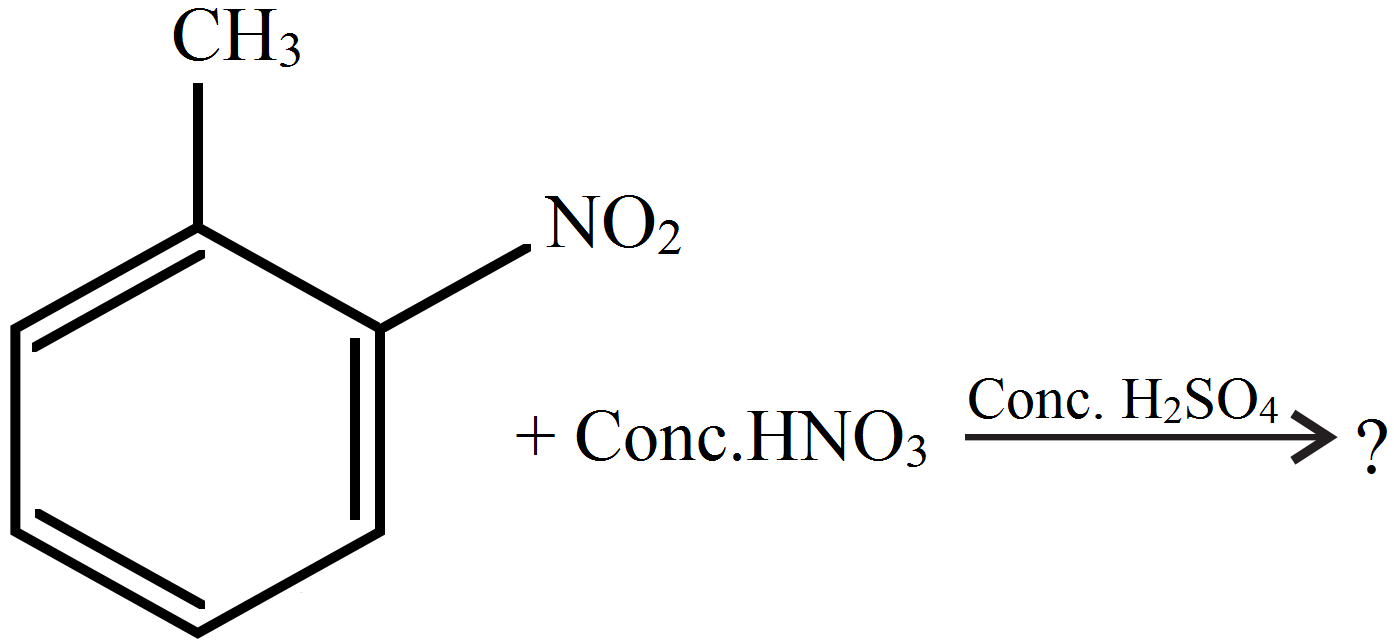
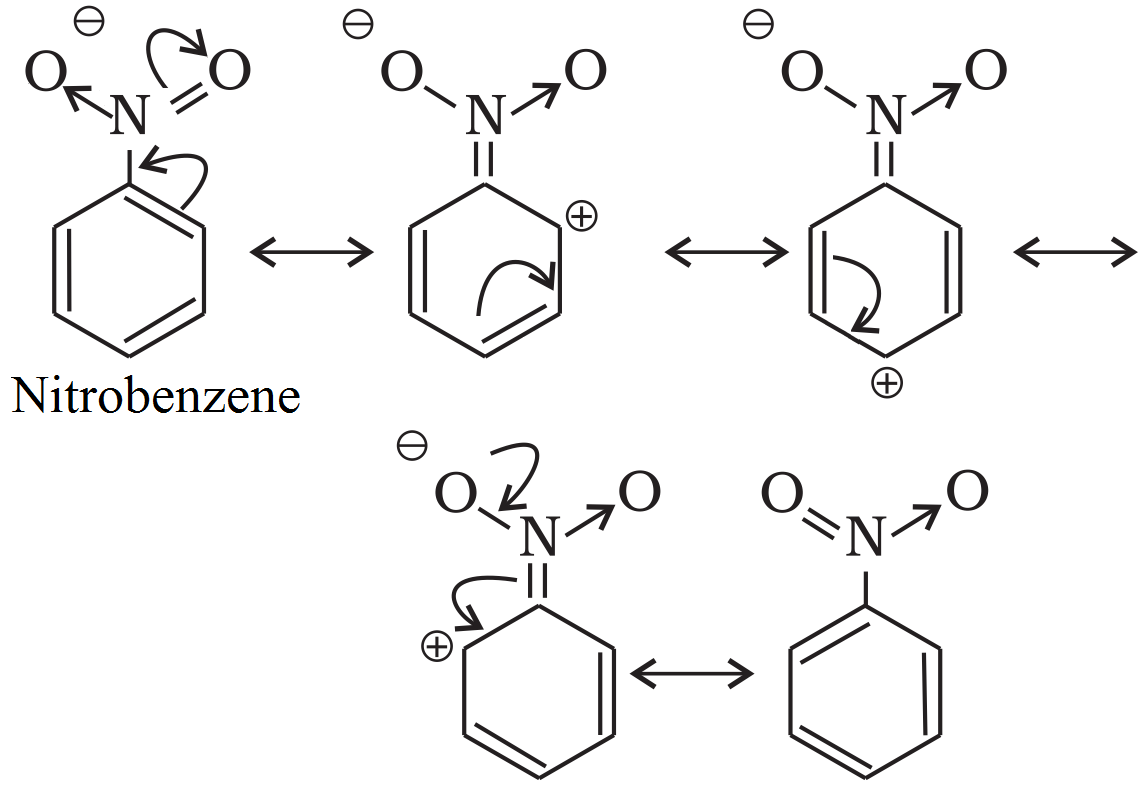
Why does presence of a nitro group make the benzene ring less reactive in comparison to the unsubstituted benzene ring. Explain.
Answer
Nitro group is an electron withdrawing group (-R and -I effects). It deactivates the ring by decreasing nucleophilicity for further substitution.
View full question & answer
Question 171 Mark
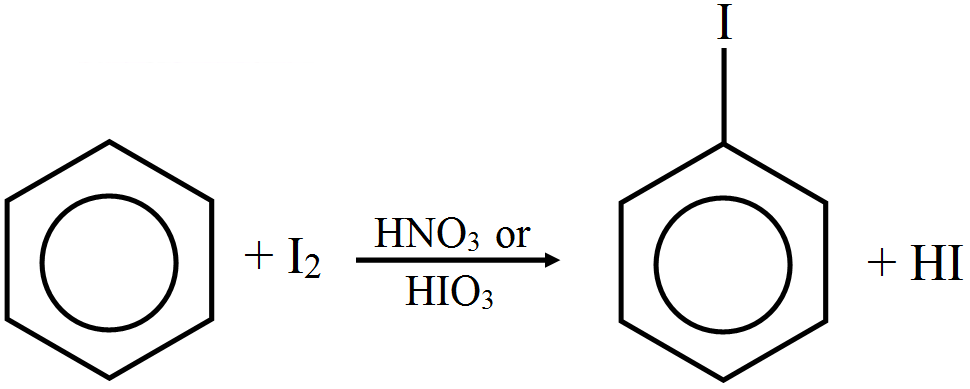
Why iodination of benzene is carried out in the presence of nitric acid or iodic acid?
Answer
The iodination of benzene is usually brought about by refluxing benzene with iodine and conc. $\mathrm{HNO}_3$ or $\mathrm{HIO}_3$.
​​​​​​​
$\mathrm{HNO}_3$ or $\mathrm{HIO}_3$ oxidises HI to $\mathrm{I}_2$ and plevents the backward reaction to occur.
View full question & answer
Question 181 Mark
Explain the reason for extra ordinary stability of benzene in spite of presence of three double bonds in it.
Answer
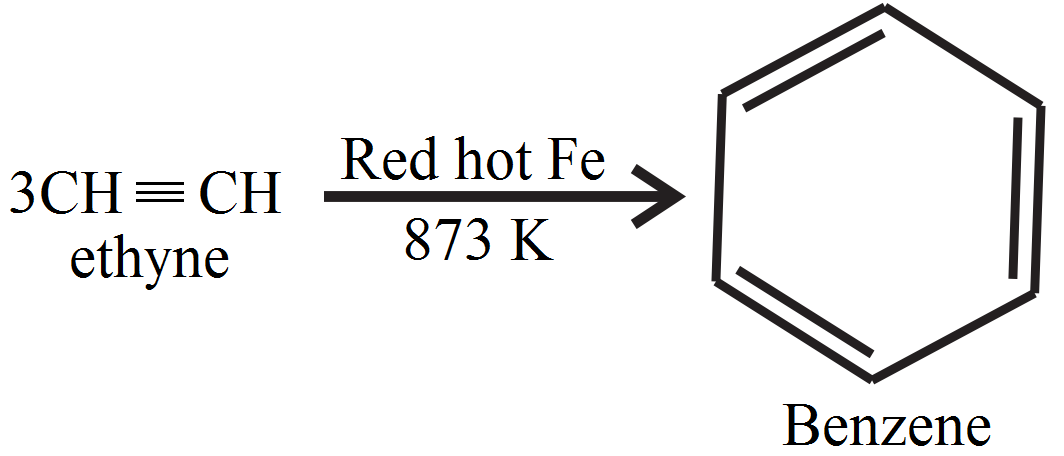
It is due to resonance, $6\pi-$electrons are delocalised.
View full question & answer
Question 191 Mark
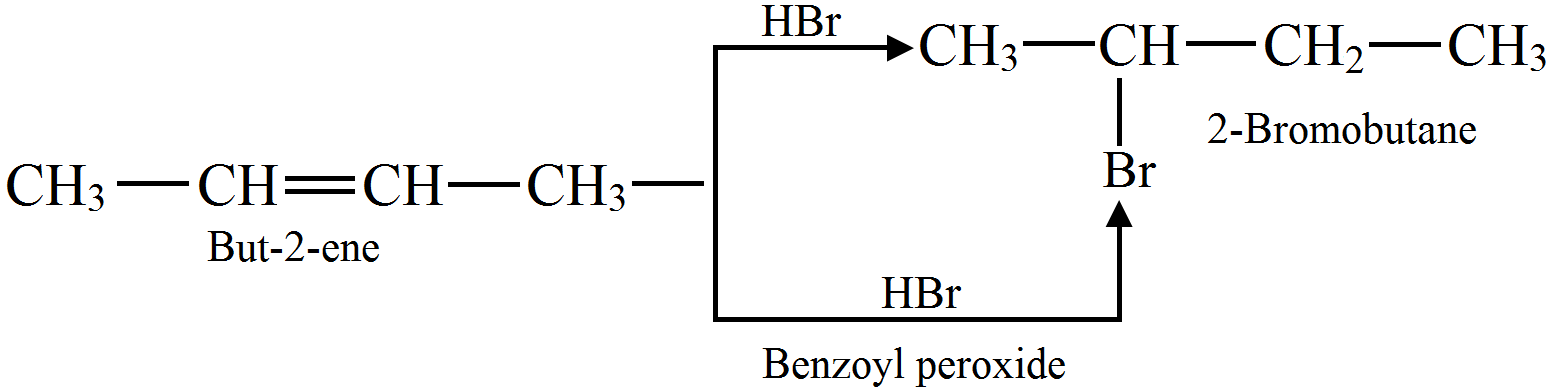
Give the structure of the alkene $\left(\mathrm{C}_4 \mathrm{H}_8\right)$ which adds on HBr in the presence and in absence of peroxide to give the same product, $\mathrm{C}_4 \mathrm{H}_9 \mathrm{Br}$.
Answer


But-2-ene is symmetric alkene, therefore, it gives 2-Bromobutane in presence as well as in absence of peroxide.
View full question & answer
Question 201 Mark
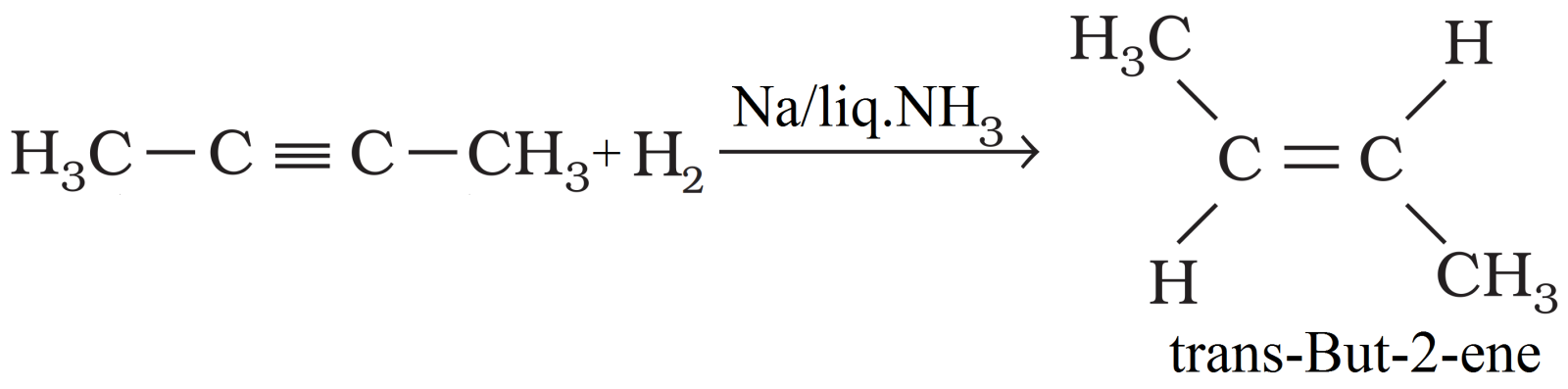
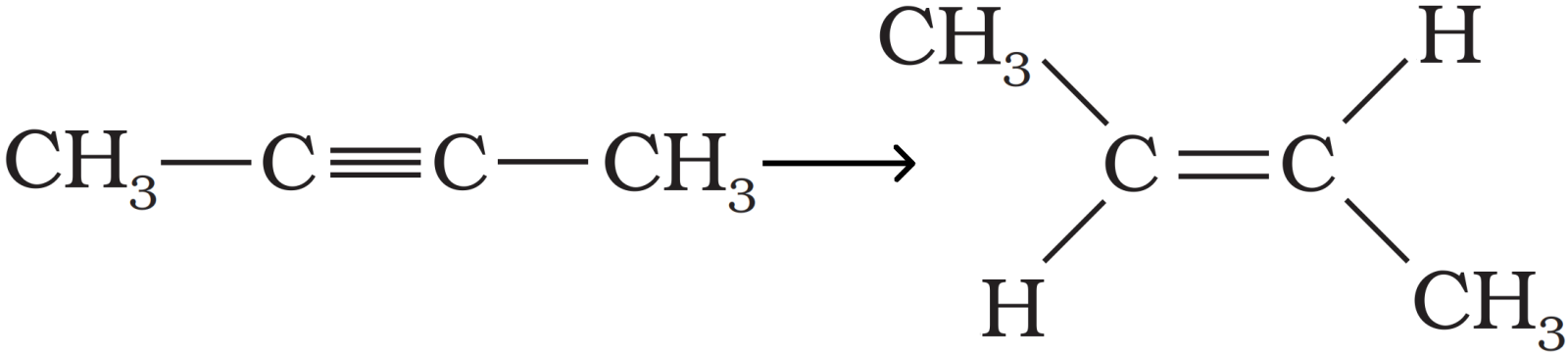
Alkynes on reduction with sodium in liquid ammonia form trans alkenes. Will the butene thus formed on reduction of 2-butyne show the geometrical isomerism?
Answer


Thus, but-2-ene is capable of showing geometrical isomerism.
View full question & answer
Question 211 Mark
Why do alkenes prefer to undergo electrophilic addition reaction while arenes prefer electrophilic substitution reactions? Explain.
Answer
Alkenes and arenes both are unsaturated and electron rich. Olefins or alkenes undergo addition reaction to give more stable saturated product; in this reaction hybridization changes from $\text{sp}^2$ to $\text{sp}^3$. Arenes are stabilised by resonance w delocalization of $\pi$-electrons. On addition reaction to the double bond of arene, we get a product which is not resonance stabilised. Thus, arenes prefer to undergo substitution reaction while alkenes prefer to undergo addition reaction.

$\text{CH}_2=\text{CH}_2+\text{H}_2\xrightarrow{\text{Ni/573K}}\text{CH}_3-\text{CH}_3\$\text{less stable})\ \ \ \ \ \ \ \ \ \ \ \ \ \ \ \ \ \ \ \ \ \ \ \ \ (\text{more stable})$
View full question & answer
Question 221 Mark
Convert 1-bromopropane to 2-bromopropane.
Answer
$\text{CH}_3\text{CH}_2\text{CH}_2\text{Br}\xrightarrow{\text{KOH(alc)}}\text{CH}_3-\text{CH}=\text{CH}_2\\ \ \ \ _{1-\text{bromopropane}} \ \ \ \ \ \ \ \ \ \ \ \ \ \ \ \ \ \ \ \ \ \ \ \ \ \ \ \ _{\text{Propene}}\\ \ \ \ \ \ \ \ \ \ \ \ \ \ \ \ \ \ \ \ \ \ \ \ \ \ \ \ \ \ \ \ \ \ \ \ \ \ \ \ \ \ \ \ \ \text{Br}\\ \ \ \ \ \ \ \ \ \ \ \ \ \ \ \ \ \ \ \ \ \ \ \ \ \ \ \ \ \ \ \ \ \ \ \ \ \ \ \ \ \ \ \ \ |\\\xrightarrow[\text{Markownikoff addition}]{\text{HBr}}\text{CH}_3-\text{CH}-\text{CH}_3\\ \ \ \ \ \ \ \ \ \ \ \ \ \ \ \ \ \ \ \ \ \ \ \ \ \ \ \ \ \ \ \ \ \ \ \ \ \ _{2-\text{bromopropane}}$
View full question & answer
Question 231 Mark
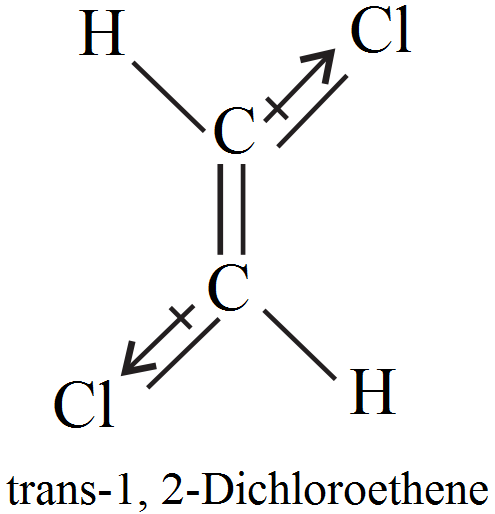
Why is dipole moment of trans-1, 2-dichloroethene zero?
Answer

It is because individual dipoles are equal and opposite such that net dipole moment is zero.
View full question & answer
Question 241 Mark
Write an equation of the reaction of propyne with water in the presence of $\mathrm{H}_2 \mathrm{SO}_4$ and $\mathrm{HgSO}_4$. Show the intermediate.
Answer
$\text{CH}_3-\text{C}\equiv\text{CH}+\text{H}_2\text{O}\xrightarrow{\text{HgSO}_4/\text{H}_2\text{SO}_4}$$\begin{bmatrix}\\\\\text{CH}-\text{C}=\text{CH}_2\\ |\\\ \ \text{OH}\\ _\text{(Enol) unstable}\end{bmatrix}{\xrightarrow{\text{Tautomerism}}\text{CH}_3-\text{C}-\text{CH}_3\\ \ \ \ \ \ \ \ \ \ \ \ \ \ \ \ \ \ \ \ \ \ \ \ \ \ \ \ \ \ \ \ \ \|\\ \ \ \ \ \ \ \ \ \ \ \ \ \ \ \ \ \ \ \ \ \ \ \ \ \ \ \ \ \ \ \ \ \text{O}\\ \ \ \ \ \ \ \ \ \ \ \ \ \ \ \ \ \ \ \ \ \ \ \ \ \ \ \ _{\text{Acetone}}\\ \ \ \ \ \ \ \ \ \ \ \ \ \ \ \ \ \ \ \ \ \ \ _{(\text{a ketone stable})}}$
The Markownikoff's addition of $\mathrm{H}_2\mathrm{O}$ gives an unstable enol form that rearranges to the more stable ketone.
View full question & answer
Question 251 Mark
Convert methane to ethane.
Answer
$\ \text{CH}_4+\text{Cl}_2\xrightarrow{\text{sunlight}}\text{CH}_3\text{Cl}+2\text{Na}+\text{ClCH}_3\\_\text{Methane}\ \ \ \ \ \ \ \ \ \ \ \ \ \ \ \ \ \ _\text{Chloromethane}\ _\text{Sodium}\ \ _\text{Chloromethane}\\\xrightarrow[\text{Ether}]{\text{Dry}}\text{CH}_3-\text{CH}_3+2\text{NaCl}\\\ \ \ \ \ \ \ \ \ \ \ \ \ \ \ \ \ _\text{Ethane}$
View full question & answer
Question 271 Mark
How will you separate propene from propyne?
Answer
On passing the mixture through ammoniacal $\mathrm{AgNO}_3$ solution or ammoniacal $\mathrm{CuCl}_2$ solution when propyne reacts while propene passes over.
View full question & answer
Question 281 Mark
How will you distinguish the following pair of organic compounds by giving chemical tests? Propane and propene.
Answer
Propane and propene can be distinguished by bromine water test and alkaline $\mathrm{KMnO}_4$ test.
$\mathrm{CH}_3 \mathrm{CH}_2 \mathrm{CH}_3+\mathrm{Br}_2 / \mathrm{H}_2 \mathrm{O} \rightarrow \text { No change }$
$\text{CH}_3-\text{CH}=\text{CH}_2+\text{Br}_2/\text{H}_2\text{O}\overrightarrow{\ \ \ \ \ }\ \text{CH}_3-\text{CH}-\text{CH}_2\\ \ \ \ \ \ \ \ \ \ _\text{Propene} \ \ \ \ \ \ \ \ \ \ \ \ \ \ \ \ \ \ \ _\text{Brown}\ \ \ \ \ \ \ \ \ \ \ \ \ \ \ \ \ \ \ \ \ \ \ \ \ \ | \ \ \ \ \ \ \ \ \ \ |\\ \ \ \ \ \ \ \ \ \ \ \ \ \ \ \ \ \ \ \ \ \ \ \ \ \ \ \ \ \ \ \ \ \ \ \ \ \ \ \ \ \ \ \ \ \ \ \ \ \ \ \ \ \ \ \ \ \ \ \ \ \ \ \ \ \ \ \ \ \ \ \ \ \text{Br} \ \ \ \ \ \ \ \text{Br}\\ \ \ \ \ \ \ \ \ \ \ \ \ \ \ \ \ \ \ \ \ \ \ \ \ \ \ \ \ \ \ \ \ \ \ \ \ \ \ \ \ \ \ \ \ \ \ \ \ \ \ \ \ \ \ \ \ \ \ \ \ \ \ \ \ \ \ \ \ \ \ \ \ _{(\text{Colourless})}$
Pink colour of alkaline $\mathrm{KMnO}_4$ turns colourless in the presence of unsaturated compound.
View full question & answer
Question 291 Mark
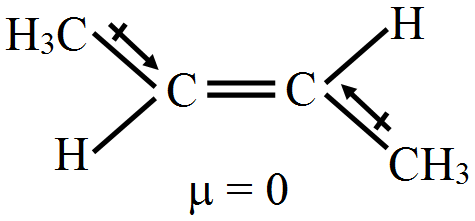
Which of the two trans-but-2-ene or trans-pent-2-ene is non-polar?
Answer
In trans-but-2-ene, the dipole moments of the two $\mathrm{C}-\mathrm{CH}_3$ bonds are equal and opposite. Therefore, they cancel out each other. Hence, trans but-2-ene is non-polar.
View full question & answer
Question 301 Mark
Explain why n-pentane has higher boiling point than neo-pentane.
Answer
n-Pentane has more surface area than neo-pentane, therefore, has more van der Waals' forces of attraction hence has higher boiling point.
View full question & answer
Question 311 Mark
Why do the $\mathrm{C}-\mathrm{C}$ bonds rather than $\mathrm{C}-\mathrm{H}$ bonds break during cracking of alkanes?
Answer
Since the bond dissociation energy of $\mathrm{C}-\mathrm{C}$ bonds $\left(348 \mathrm{~kJ} \mathrm{~mol}^{-1}\right)$ is lower than bond dissociation energy of $\mathrm{C}-\mathrm{H}$ bonds ( $414 \mathrm{~kJ} \mathrm{~mol}^{-1}$ ), therefore, during cracking of alkanes, $\mathrm{C}-\mathrm{C}$ bonds break more easily than C-H bonds.
View full question & answer
Question 321 Mark
What happens when 2-bromobutane is being treated with KOH (alcoholic)?
Answer
$\text{CH}_3-\text{CH}-\text{CH}_2-\text{CH}_3+\text{KOH(alc.)}\\ \ \ \ \ \ \ \ \ \ \ \ \ \ \ |\\ \ \ \ \ \ \ \ \ \ \ \ \ \ \text{Br}\\ \ \ \ _{2-\text{bromobutane}}\\\overrightarrow{\ \ \ \ \ \ \ }\text{ CH}_3-\text{CH}=\text{CH}-\text{CH}_3+\text{KBr}+\text{H}_2\text{O}\\ \ \ \ \ \ \ \ \ \ \ \ \ \ \ \ \ \ \ \ \ \ \ _{\text{But-2-ene}}\\ \ \ \ \ \ \ \ \ \ \ \ \ \ _{\text{But-2-ene will be formed.}}$
View full question & answer
Question 331 Mark
Which alkyne would you start with to Prepare $\text{CH}_3-\text{CH}_2-\text{CH}_2-\text{CO}-\text{CH}_3?$
Answer
$\text{HC}\equiv\text{C}-\text{CH}_2-\text{CH}_2-\text{CH}_3+\text{H}_2\text{O}\xrightarrow[\text{HgSO}_4]{\text{H}_2\text{SO}_4}\\ \ \ \ \ \ \ \ \ \ _\text{Pent-1-yne}$$\ \ \ \ \ \ \ \ \ \ \ \ \ \text{OH}\\ \ \ \ \ \ \ \ \ \ \ \ \ \ \ |\\\text{H}_2\text{C}=\text{C}-\text{CH}_2-\text{CH}_2-\text{CH}_3\\ \ \ \ \ \ \ \ \ \ \ \ \ \ \ \ \ \ \ \text{O}\\ \ \ \ \ \ \ \ \ \ \ \ \ \ \ \ \ \ \ ||\\\rightleftharpoons\text{CH}_3-\text{C}-\text{CH}_2-\text{CH}_2-\text{CH}_3\\ \ \ \ \ \ \ \ \ \ \ \ \ \ \ \ \ \ \ \ \ \ \ \ _{\text{Pentan-2-one}}$
View full question & answer
Question 341 Mark
Explain why p-xylene has higher melting point than the corresponding ortho or meta-isomers.
Answer
The para-isomer has a more symmetrical structure, allowing it to fit better into the crystal lattice than the other or meta-isomer.
View full question & answer
Question 351 Mark
Identify the structure of A and B;
$\text{CH}_3-\text{CH}_2\text{COOH}\xrightarrow{\text{KOH}}\text{A}\xrightarrow{\text{Kolbe's electrolysis}}\text{B}$
$\text{CH}_3-\text{CH}_2\text{COOH}\xrightarrow{\text{KOH}}\text{CH}_3\text{CH}_2\text{COO}^-\text{K}^+\\ \ \ \ \ \ \ \ \ \ \ \ \ \ \ \ \ \ \ \ \ \ \ \ \ \ \ \ \ \ \ \ \ \ \ \ \ \ \ \ \ \ \ \ \ \ \ \ \ \ \ \ \ \ \text{A}\\\xrightarrow{\text{Kolbe's electrolysis}}\text{CH}_3\text{CH}_2\text{CH}_2\text{CH}_3\\ \ \ \ \ \ \ \ \ \ \ \ \ \ \ \ \ \ \ \ \ \ \ \ \ \ \ \ \ \ \ \ \ \ \ \ \ \ \ \ \ \text{B}$
Answer
$\text{A}\overrightarrow{\ \ \ \ }\text{CH}_3-\text{CH}_2\text{COO}^--\text{K}^+;$$\text{B}\overrightarrow{\ \ \ \ \ \ }\text{CH}_3-\text{CH}_2-\text{CH}_2-\text{CH}_3\\ \ \ \ \ \ \ \ \ \ \ \ \ \ \ \ \ \ \ \ \ \ \ \ \ \ \ \ \ \ \ \ \text{Butane}$
View full question & answer
Question 361 Mark
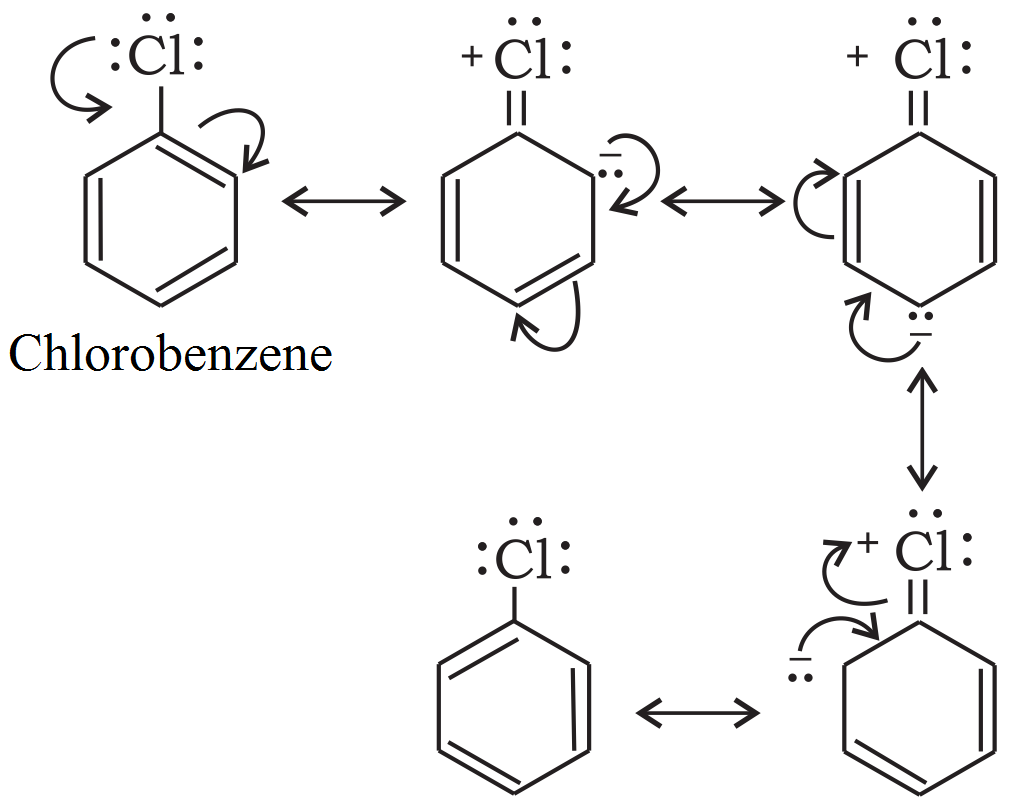
Despite their -I effect, halogens are o- and p-directing in haloarenes. Explain.
Answer
In case of aryl halides, halogens are little deactivating because of their strong -I effect. Therefore, overall electron density on the benzene ring decreases. In other words, halogens are deactivating due to -I effect. However, because of the +R-effect, i.e., participation of lone pairs of electrons on the halogen atom with the π-electrons of the benzene ring, the electron density increases more at o- and p-positions than at m-positions.

As a result, halogens are o-, p-directing. The combined result of +R-effect and -I-effect of halogens is that halogens are deactivating but o, p-directing.
View full question & answer
Question 371 Mark
Arrange the three isomers of pentane in increasing order of their boiling points.
Answer
2, 2-Dimethylpropane < 2-Methylbutane < Pentane because surface area increases, van der Waal's forces of attraction increases, hence boiling point decreases.
View full question & answer
Question 381 Mark
Name the reagent to convert
Answer
Li/ liq $\mathrm{NH}_3$ is used to prepare trans-2-butene to But-2-yne.
View full question & answer
Question 391 Mark
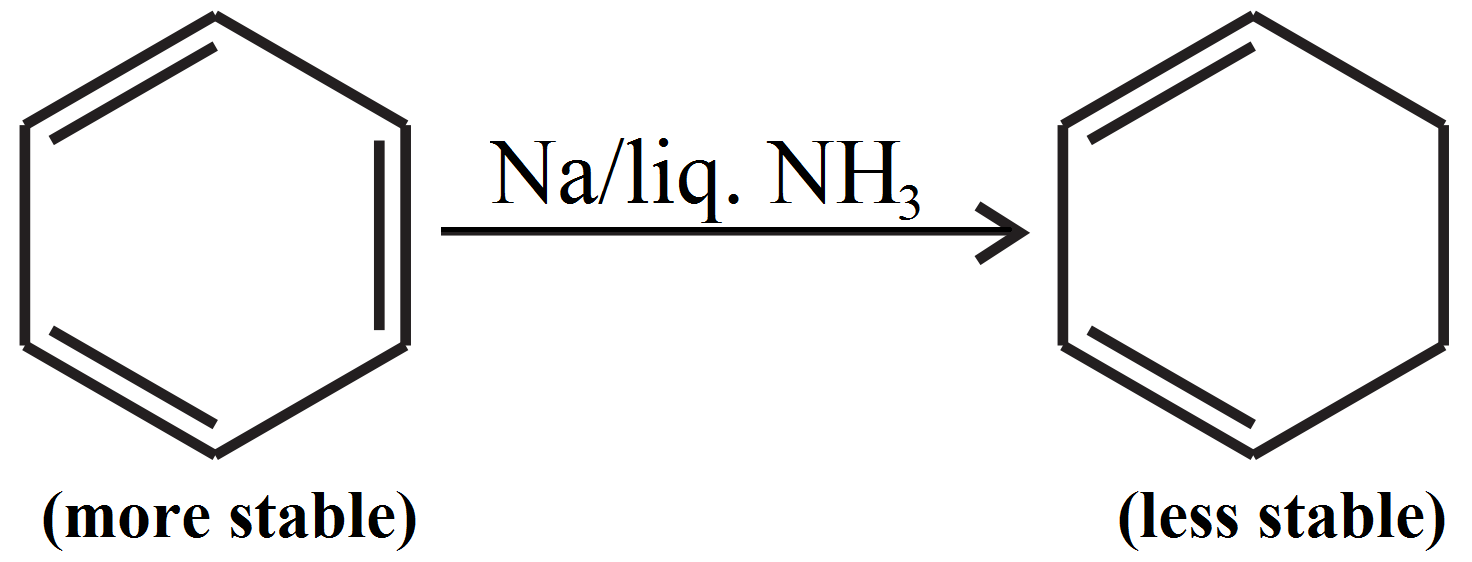
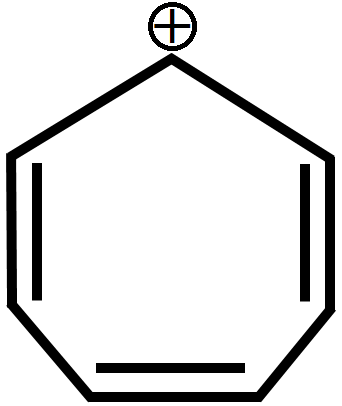
Give reason whether is aromatic or not?
Answer
It is aromatic because:
  1. It is planar.
  2. It has $6\pi-$electrons or $(4\text{n}+2)\pi$ electrons.
  3. $6\pi$ electrons are delocalised.
View full question & answer
Question 421 Mark

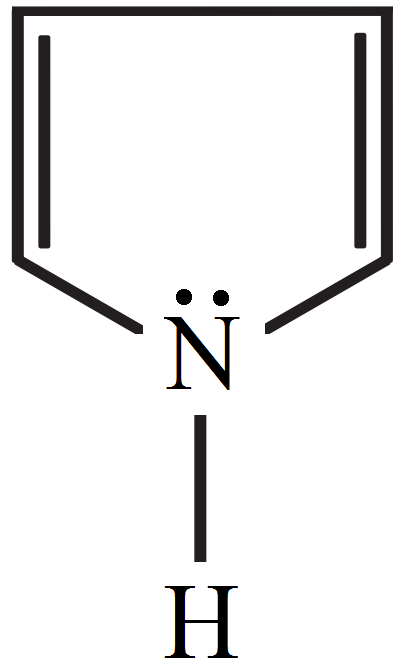
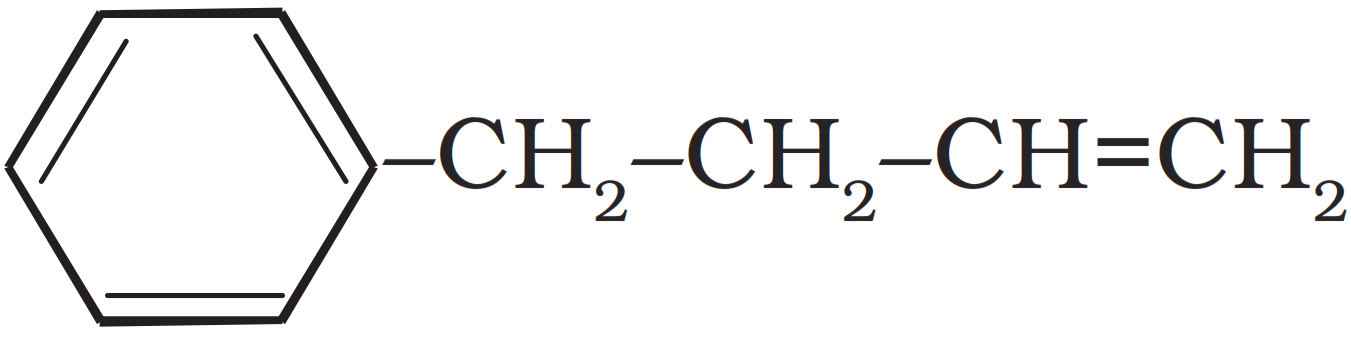
Is pyrolle aromatic compound or not? Give reason.
Answer
It is aromatic because it has 6 electrons ($2\pi$ bonds + llone pair) which are delocalised and it is planar molecule.
View full question & answer
Question 431 Mark
Name the rule which decide stability of alkene. State the rule.
Answer
Saytzeff Rule: It states ‘More alkyl substituted alkenes are more stable’.
View full question & answer
Question 461 Mark
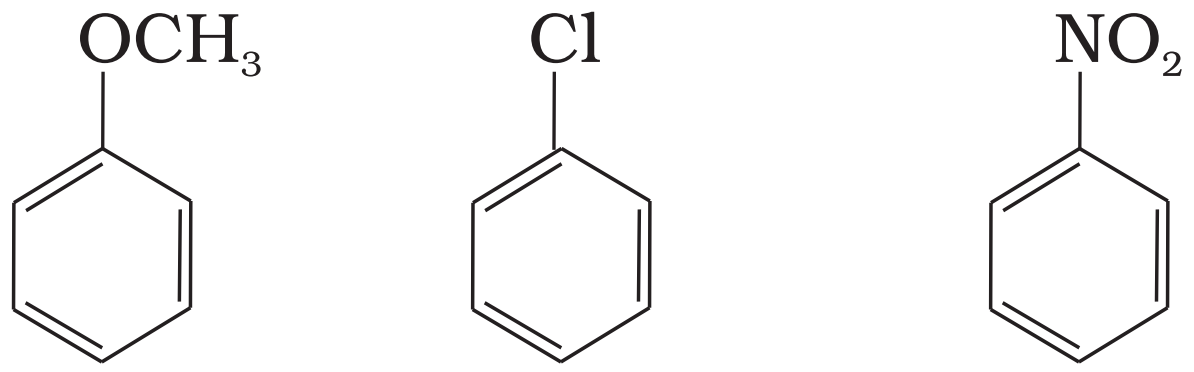
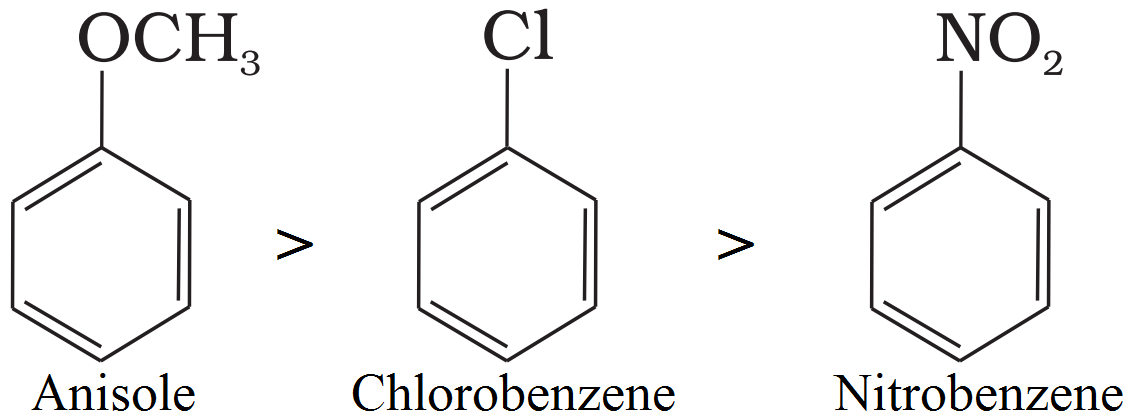
Arrange the following set of compounds in the order of their decreasing relative reactivity with an electrophile.Give reason.
Answer
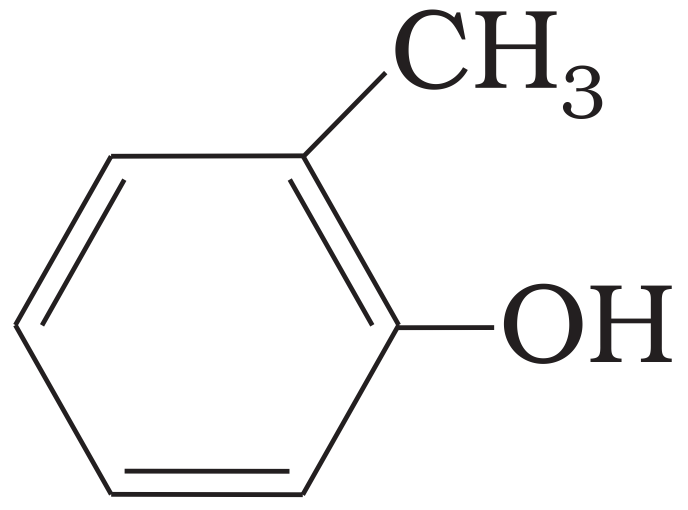
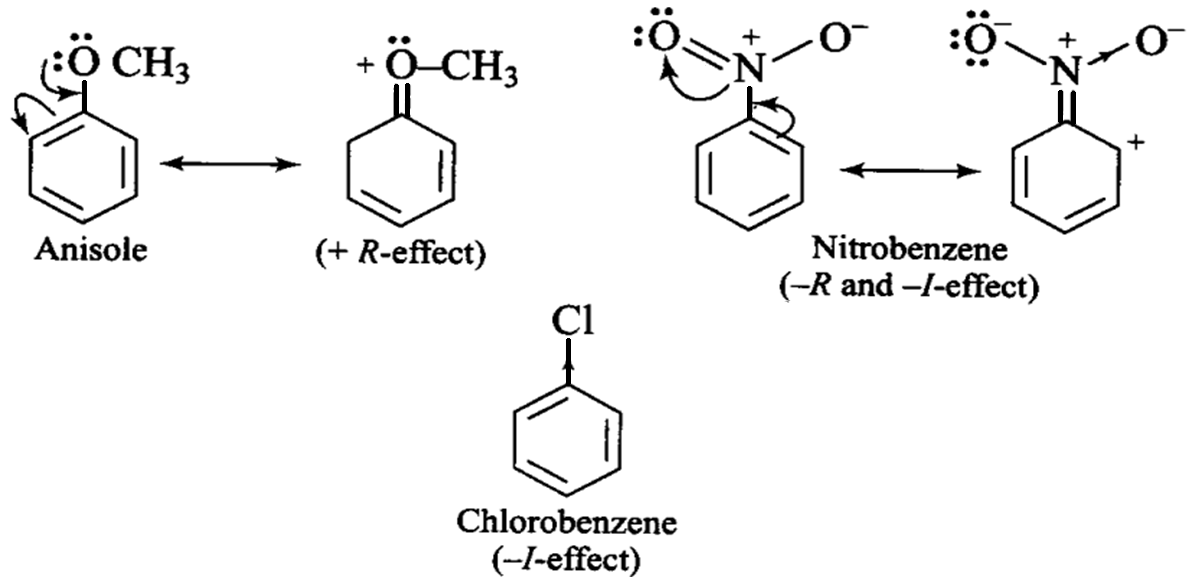
The methoxy group $\left(-\mathrm{OCH}_3\right)$ is electron releasing group. It increases the electron density in beniene nucleus due to resonance effect (+R-effect). Hence, it makes anisole more reactive than benzene towards the electrophile.+

In case of alkyl halides, the electron density increases at ortho and para positions due to +R effect. However, the halogen atom also withdraws electrons from the ring because of its -1 effect. Since the -1 effect is stronger than the +R effect, the halogens are moderately deactivating. Thus, overall electron density on benzene ring decreases, which makes further substitution difficult. $-\mathrm{NO}_2$ group is electron withdrawing group. It decreases the electron density in benzene nucleus due to its strong-R-effect and strong-I-effect. Hence, it makes nitrobenzene less reactive. Therefore, overall reactivity of these three compounds towards electrophiles decreases in the following order:
View full question & answer
Question 471 Mark
Arrange the following alkenes in the decreasing order of stability.
  1. $\ \ \ \ \ \ \ \ \text{CH}_3\\ \ \ \ \ \ \ \ \ |\\\text{CH}_3\text{C}=\text{CHCH}_3$
  2. $ \ \ \ \ \ \ \ \ \text{CH}_3\\ \ \ \ \ \ \ \ \ \ |\\\text{CH}_3\text{CHCH}=\text{CH}_2$
  3. $ \ \ \ \ \ \ \ \ \ \ \ \ \ \text{CH}_3\\ \ \ \ \ \ \ \ \ \ \ \ \ \ \ |\\\text{CH}_2=\text{CCH}_2\text{CH}_3$
Answer
Stability of an alkene increases with increase in the number of electron donating substituent at the double bonded carbon atom. Thus, $\text{(i) > (iii) > (ii)}$.
View full question & answer
Question 481 Mark
What is Lindlar's catalyst? Give its use.
Answer
Lindlar's catalyst is $\mathrm{Pd} / \mathrm{BaSO}_4$. It is used to convert alkynes to alkenes with the help of H , e.g., But-2yne, on reduction with $\mathrm{Pd}-\mathrm{BaSO}_4$ forms cis-2-butene.
View full question & answer
MCQ 501 Mark
In which of the following pair both angle strain and torsional strain is present?
  • Cyclopropane, Cyclobutane
  • B
    Cyclopropane, Cyclohexane
  • C
    Cyclobutane, Cyclohexane
  • D
    Cyclohexane, Cyclopentane
Answer
Correct option: A.
Cyclopropane, Cyclobutane
$3-$ Membered and $4-$ membered cycloalkane rings are the least stable containing angle strain $($due to large deviation from tetrahedral angle$)$ as well as torsional strain $($due to electronic repulsions between the bonds$),$ lying close to each other.
View full question & answer
Question 511 Mark
Name the reagent used in the following changes
$\text{CH}_3-\text{CH}_2-\text{CH}_2-\text{CH}_2-\text{C}\equiv\text{C}-\text{CH}_2-\text{CH}_2-\text{CH}_2\\-\text{CH}_3\xrightarrow{?}\text{CH}_3-\text{CH}_2-\text{CH}_2-\text{CH}_2-\\\text{C}=\text{C}-\text{CH}_2-\text{CH}_2-\text{CH}_2-\text{CH}_3\\ \ | \ \ \ \ \ \ \ |\\ \text{H} \ \ \ \ \ \text{H}$
Answer
$\mathrm{H}_2 / \mathrm{Pd}-\mathrm{BaSO}_4$ is used. It is called Lindlar's catalyst. Syn addition takes place i.e., both hydrogen atom attack from same side.
View full question & answer
Question 521 Mark
Why eclipsed and staggered forms of ethane cannot be isolated at room temperature?
Answer
It is because the difference in their energy is less. They can interchange into each other easily, therefore, their isolation (separation) is not possible.
View full question & answer
Question 531 Mark
The intermediate carbocation formed in the reactions of $\mathrm{HI}, \mathrm{HBr}$ and HCl with propene is the same and the bond energy of $\mathrm{HCl}, \mathrm{HBr}$ and HI is $430.5 \mathrm{~kJ} \mathrm{~mol}^{-1}, 363.7 \mathrm{~kJ} \mathrm{~mol}^{-1}$ and $296.8 \mathrm{~kJ} \mathrm{~mol}^{-1}$ respectively. What will be the order of reactivity of these halogen acids?
Answer
Hydrogen halides $(\mathrm{HCl}, \mathrm{HBr}, \mathrm{HI})$ add up to a alkanes to form alkyl halides. The order of reactivity of the hydrogen halides is $\mathrm{HI}>\mathrm{HBr}>\mathrm{HCl}$. Reactivity of HX depends on bond dissociation enthalpy of HX . Bond enthalpy of HI ( $\left.296.8 \mathrm{kj} \mathrm{~mol}^{-1}\right)<\mathrm{HBr}\left(363.7 \mathrm{kj} \mathrm{~mol}^{-1}\right)<\mathrm{HCl}\left(430 \mathrm{kj} \mathrm{~mol}^{-1}\right)$ is in this order hence the reactivity is in reverse order:
$\text{HCl} < \text{HBr} < \text{HI}$
$\text{CH}_3-\text{CH}=\text{CH}_2+\text{H}^+$ slow step $\rightarrow\text{CH}_{3^-}\ ^+\text{CH}-\text{CH}_3+\text{X}^-\text{fast}\ \rightarrow\text{H}_3-\text{CHX}-\text{CH}_3$
Slow step is rate determining step and it depends on the availability of $\mathrm{H}^{+}$. Availability of $\mathrm{H}^{+}$depends on bond dissociation enthalpy of HX .
View full question & answer
Question 551 Mark
Bring out the following conversion ethane to ethene.
Answer
$\text{CH}_3\text{CH}_3\xrightarrow[-\text{HI}]{\text{I}_2/\text{HNO}_3}\text{CH}_3\text{CH}_2\text{I}\xrightarrow{\text{KOH(alc.)}}\text{CH}_2=\text{CH}_2\\ \ \ _{\text{Ethane}} \ \ \ \ \ \ \ \ \ \ \ \ \ \ \ \ \ \ \ \ _{\text{Ethyl iodide}} \ \ \ \ \ \ \ \ \ \ \ \ \ \ \ \ \ \ \ \ \ \ \ \ \ \ _{\text{Ethene}}$
View full question & answer
Question 571 Mark
Why is addition reaction of bromine to benzene difficult?
Answer
Addition reaction of bromine to benzene is difficult due to delocalisation of $\pi-$electrons. It does not have pure double bonds and does not give test for unsaturation.
View full question & answer
Question 581 Mark
Convert methane into ethane.
Answer
$\text{CH}_4\xrightarrow[\text{UV light}]{\text{Cl}_2}\text{CH}_3\text{Cl}\xrightarrow[\text{Dry ether}]{2\text{Na}}\text{CH}_3-\text{CH}_3\\ \ \ \ \ \ \ \ \ \ \ \ \ \ \ \ \ \ \ \ \ \ \ \ \ \ \ \ \ \ \ \ \ \ \ \ \ \ \ \ \ \ \ \ \ \ \ \ \ \ \ \ \ \ \ \ _{\text{Ethane}}$
View full question & answer
Question 591 Mark
Why has trans-isomer higher melting point than cis-isomer?
Answer
Trans-isomer, being symmetrical, can fit into crystal lattice more readily than cis-form, therefore, it has higher melting point due to stronger forces of attraction.
View full question & answer
Question 611 Mark
n-propylmagnesium bromide on hydrolysis gives propane. Is there any other Grignard reagent which also gives propane? If so, give its name, structure and equation for the reaction.
Answer
Iso-propylmagnesium bromide, $\left(\mathrm{CH}_3\right)_2 \mathrm{CHMgBr}_{,}\left(\mathrm{CH}_3\right)_2 \mathrm{CHMgBr}+\mathrm{H}_2 \mathrm{O} \rightarrow \mathrm{CH}_3 \mathrm{CH}_2 \mathrm{CH}_3+\mathrm{Mg}(\mathrm{OH}) \mathrm{Br}$
View full question & answer
Question 621 Mark
How would you distinguish between:
  1. But$-1-$yne and but$-2-$yne.
  2. Propene and propyne.
Answer
  1. Upon treatment with ammoniacal solution of $\mathrm{AgNO}_3$. But$-1-$yne would give white ppt whereas but$-2-$yne does not react.
  2. Upon treatment with ammoniacal solution of $\mathrm{AgNO}_3$. propyne would give white ppt. whereas propene does not react.
View full question & answer
Question 641 Mark
Give an alkyne which produces acetic acid and propanoic acid on treatment with alkaline $\mathrm{KMnO}_4$ at $100^{\circ} \mathrm{C}$.
Answer
$\text{CH}_3-\text{C}\equiv\text{C}-\text{CH}_2-\text{CH}_3\xrightarrow[100^\circ]{\text{KMnO}_4/\text{KOH}}\\\ \ \ \ \ _\text{Pent-2-yne}\\ \ \ \ \ \ \ \ \ \ \ \ \ \ \text{O}\\ \ \ \ \ \ \ \ \ \ \ \ \ \ ||\\\text{CH}_3-\text{C}-\text{OH}\\ \ \ \ \ _{\text{Ethanoic acid}}\\\text{CH}_3\text{CH}_2\text{COOH}\\ \ \ \ \ _{\text{Propanoic acid}}$
View full question & answer
Question 651 Mark
Complete the reaction $\text{CH}_3-\text{CH}=\text{CH}_2+\text{HCl}\xrightarrow{\text{Peroxide}}$
Answer
$\text{CH}_3-\text{CH}=\text{CH}_2+\text{HCl}\xrightarrow{\text{Peroxide}}\text{CH}_3-\text{CH}-\text{CH}_3\\ \ \ \ \ \ \ \ \ \ \ \ \ \ \ \ \ \ \ \ \ \ \ \ \ \ \ \ \ \ \ \ \ \ \ \ \ \ \ \ \ \ \ \ \ \ \ \ \ \ \ \ \ \ \ \ \ \ \ \ \ \ \ \ \ \ \ \ \ \ \ \ \ |\\ \ \ \ \ \ \ \ \ \ \ \ \ \ \ \ \ \ \ \ \ \ \ \ \ \ \ \ \ \ \ \ \ \ \ \ \ \ \ \ \ \ \ \ \ \ \ \ \ \ \ \ \ \ \ \ \ \ \ \ \ \ \ \ \ \ \ \ \ \ \ \ \text{Cl}$
View full question & answer
Question 661 Mark
Which type of isomerism is present in $\mathrm{CH}_3 \mathrm{CH}_2 \mathrm{OH}$ and $\mathrm{CH}_3 \mathrm{OCH}_3$?
Answer
Functional isomerism because they have same molecular formula but different functional groups.
View full question & answer
Question 681 Mark
Why do hydrocarbon molecules with an odd number of carbon atoms have lower melting points than those with an even number of carbon atoms?
Answer
Molecules with odd number of carbon atoms have lower melting points because they do not fit into crystal lattice easily whereas, hydrocarbons with even number of carbon atoms can fit into crystal lattice easily and more energy is needed to melt them, hence, have higher melting point.
View full question & answer
Question 691 Mark
How many secondary carbons are there in 2, 2-dimethylbutane?
Answer
$\ \ \ \ \ \ \ \ \ \ \ \ \ \text{CH}_3\\ \ \ \ \ \ \ \ \ \ \ \ \ \ \ |\\\stackrel{{1^\circ}}{\hbox{ CH}}_3-\stackrel{{4^\circ}}{\hbox{C}}-\stackrel{{2^\circ}}{\hbox{ CH}}_2-\stackrel{{1^\circ}}{\hbox{ CH}}_3\\ \ \ \ \ \ \ \ \ \ \ \ \ \ \ |\\ \ \ \ \ \ \ \ \ \ \ \ \ \ \text{CH}_3$ has one 2° (secondary)carbon.There are four primary carbon, one 4° carbon.
View full question & answer
Question 701 Mark
Give the structural formula of 5-sec butyl-4-iso propyl decane.
Answer
$\ \ \ \ \ \ \ \ \ \ \ \ \ \ \ \ \ \ \ \ \ \ \ \ \ \ \ \ \ \ \ \ \ \ \text{CH}-\text{CH}-\text{CH}_3\\ \ \ \ \ \ \ \ \ \ \ \ \ \ \ \ \ \ \ \ \ \ \ \ \ \ \ \ \ \ \ \ \ \ \ \ \ \ \ \ \ \ \ \ \ \ \ |\\\stackrel{{1}}{ \ \hbox{ CH}}_3-\stackrel{{2}}{ \ \hbox{ CH}}_2-\stackrel{{3}}{ \ \hbox{ CH}}_2-\stackrel{{4}}{ \ \hbox{ CH}}-\stackrel{{5}}{ \ \hbox{ CH}}-\stackrel{{6}}{ \ \hbox{ CH}}_2-\stackrel{{7}}{ \ \hbox{ CH}}_2-\stackrel{{8}}{ \ \hbox{ CH}}_2-\stackrel{{9}}{ \ \hbox{ CH}}_2-\stackrel{{10}}{ \ \hbox{ CH}}_3\\ \ \ \ \ \ \ \ \ \ \ \ \ \ \ \ \ \ \ \ \ \ \ \ \ \ \ \ \ \ \ \ \ \ \ \ \ \ \ \ \ \ \ \ \ \ \ \ \ \ \ \ \ \ \ \ \ \ \ \ |\\ \ \ \ \ \ \ \ \ \ \ \ \ \ \ \ \ \ \ \ \ \ \ \ \ \ \ \ \ \ \ \ \ \ \ \ \ \ \ \ \ \ \ \ \ \ \text{CH}_3-\text{CH}-\text{CH}_2-\text{CH}_3$
View full question & answer
Question 721 Mark
How can we obtain isobutane from n-butane?
Answer
Isobutane can be obtained by heating n-butane with $\mathrm{AlCl}_3$ by isomerisation reaction. $\text{CH}_3-\text{CH}_2-\text{CH}_2-\text{CH}_3\xrightarrow[\text{heat}]{\text{AlCl}_3}\text{CH}_3-\text{CH}-\text{CH}_3\\\ \ \ \ \ \ \ \ \ \ _\text{n-Butane} \ \ \ \ \ \ \ \ \ \ \ \ \ \ \ \ \ \ \ \ \ \ \ \ \ \ \ \ \ \ \ \ \ \ \ \ \ \ \ \ \ \ \ \ \ \ \ \ |\\ \ \ \ \ \ \ \ \ \ \ \ \ \ \ \ \ \ \ \ \ \ \ \ \ \ \ \ \ \ \ \ \ \ \ \ \ \ \ \ \ \ \ \ \ \ \ \ \ \ \ \ \ \ \ \ \ \ \ \ \ \ \ \ \ \ \ \ \ \text{CH}_3\\\ \ \ \ \ \ \ \ \ \ \ \ \ \ \ \ \ \ \ \ \ \ \ \ \ \ \ \ \ \ \ \ \ \ \ \ \ \ \ \ \ \ \ \ \ \ \ \ \ \ \ \ \ \ \ \ \ \ \ \ \ \ \ \ \ \ _\text{Isobutane}$
View full question & answer
Question 741 Mark
Why does cis-2-butene have a higher boiling point than trans-2-butene?
Answer
cis-2-Butene is more polar than trans-2-butene, therefore, it has more van der Waals’ forces of attraction, hence higher boiling point due to higher dipole moment, whereas trans-2-butene has zero dipole moment.
View full question & answer
Question 751 Mark
How will you detect the presence of unsaturation in an organic compound?
Answer
Add bromine water. If it gets decolourised, compound is unsaturated. e.g., Ethene and Ethyne decolourise bromine water because these are unsaturated having double and triple bond respectively.
View full question & answer