Question 11 Mark
Complete the following reactions:
$\text{H}_2(\text{g})+\text{M}{\text{n}}\text{O}_\text{3}(\text{s})\xrightarrow{\ \ \ \ \ {\Delta}\ \ \ \ \ }$
Answer$3\text{H}_2(\text{g})+\text{M}{\text{n}}\text{O}_\text{3}(\text{s})\xrightarrow{\ \ \ \ \ {\text{heat}}\ \ \ \ \ }\text{Mn(s)}+3\text{H}_2\text{O}$
View full question & answer→Question 21 Mark
Complete the following chemical reactions:
$\text{CaO}(\text{s})+\text{H}_2\text{O}(\text{g})\xrightarrow{\ \ \ \ \ \ \ \ \ \ \ \ \ }$
Classify the above into (a) hydrolysis, (b) redox and (c) hydration reactions.
Answer$\text{CaO}(\text{s})+\text{H}_2\text{O}(\text{g})\xrightarrow{\ \ \ \ \ \ \ \ \ \ \ \ \ }\text{Ca(OH)}_2(\text{aq})$
- Hydrolysis reactions, (iii) (iv) and (v)
- Redox reactions (i) and (ii)
View full question & answer→Question 31 Mark
Describe the structure of the common form of ice.
AnswerIce is the crystalline form of water. It takes a hexagonal form if crystallized at atmospheric pressure, but condenses to cubic form if the temperature is very low. The three-dimensional structure of ice is represented as,
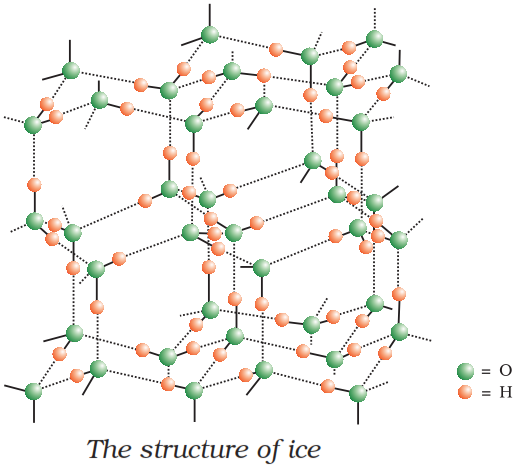
The structure is highly ordered and has hydrogen bonding. Each oxygen atom is surrounded tetrahedrally by four other oxygen atoms at a distance of 276 pm. The structure also contains wide holes that can hold molecules of appropriate sizes interstitially.
View full question & answer→Question 41 Mark
Complete the following reactions:
$\text{CO}(\text{g})+\text{H}_2(\text{g})\xrightarrow[\text{catalyst}]{\ \ \ \ \ \ \ {\Delta}\ \ \ \ \ \ \ \ \ \ \ }$
Answer$\text{CO}(\text{g})+2\text{H}_2(\text{g})\xrightarrow[\text{catalyst}]{\ \ \ \ \ \ \ {\Delta}\ \ \ \ \ \ \ \ \ \ \ }\text{CH}_3\text{OH}(\text{I})$
View full question & answer→Question 51 Mark
Complete the following reactions:
$\text{Z}\text{n}(\text{s})+\text{NaOH}(\text{aq})\xrightarrow{\ \ \ \ \ {\text{heat}}\ \ \ \ \ \ \ \ }$
Answer$\text{Z}\text{n}(\text{s})+2\text{NaOH}(\text{aq})\xrightarrow{\ \ \ \ \ {\Delta}\ \ \ \ \ \ \ \ }\text{Na}_2\text{ZnO}_2(\text{s})+\text{H}_2(\text{g})\\ \ \ \ \ \ \ \ \ \ \ \ \ \ \ \ \ \ \ \ \ \ \ \ \ \ \ \ \ \ \ \ \ \ \ \ \ \ \ \ \ \ \ \ \ \ \ \ \ \ \ \ \ {\text{sodium Zincate}}$
View full question & answer→Question 61 Mark
Complete the following chemical reactions:
$\text{MnO}^-_4(\text{aq})+\text{H}_2\text{O}_2(\text{aq})\xrightarrow{\ \ \ \ \ \ \ \ \ \ \ \ \ }$
Classify the above into (a) hydrolysis, (b) redox and (c) hydration reactions.
Answer$2\text{MnO}^-_4(\text{aq})+\text{H}_2\text{O}_2(\text{aq})+6\text{H}^+(\text{aq})\xrightarrow{\ \ \ \ \ \ \ \ \ \ \ \ \ }2\text{Mn(aq)}+8\text{H}_2\text{O}(\text{l})+5\text{O}_2(\text{g})$
- Hydrolysis reactions, (iii) (iv) and (v)
- Redox reactions (i) and (ii)
View full question & answer→Question 71 Mark
Complete the following chemical reactions : $\text{PbS(s)}+\text{H}_2\text{O}_2(\text{aq})\xrightarrow{\ \ \ \ \ \ \ \ \ \ \ \ \ }$ Classify the above into $(a)$ hydrolysis, $(b)$ redox and $(c)$ hydration reactions.
Answer$\text{PbS(s)}+4\text{H}_2\text{O}_2(\text{aq})\xrightarrow{\ \ \ \ \ \ \ \ \ \ \ \ \ }\text{PbSO}_4(\text{s})+4\text{H}_2\text{O}(\text{I})$
- Hydrolysis reactions, $(iii) (iv)$ and $(v)$
- Redox reactions $(i)$ and $(ii)$
View full question & answer→Question 81 Mark
Arrange the following:
$\mathrm{CaH}_2, \mathrm{BeH}_2$ and $\mathrm{TiH}_2$ in order of increasing electrical conductance.
Answer$\mathrm{BeH}_2$ is significantly covalent, $\mathrm{CaH}_2$ is ionic and $\mathrm{TiH}_2$ is metallic hydride. Hence, increasing electrical conductance, $\mathrm{BeH}_2<\mathrm{CaH}_2<\mathrm{TiH}_2$
View full question & answer→Question 91 Mark
Arrange the following:
H–H, D–D and F–F in order of increasing bond dissociation enthalpy.
AnswerDue to lone pairs of F, bond pairs experience repulsion, hence, F-F has low bond dissociation energy. In D-D, due to higher nuclear attraction bond dissociation energy is geater than H- H. Increasing bond dissociation enthalpy, F-F < H-H < D-D.
View full question & answer→Question 101 Mark
Arrange the following:
$\mathrm{NaH}, \mathrm{MgH}_2$ and $\mathrm{H}_2 \mathrm{O}$ in order of increasing reducing property.
AnswerNaH is ionic hydride. $\mathrm{MgH}_2$ and $\mathrm{H}_2 \mathrm{O}$ are covalent hydrides but OH bond in $\mathrm{H}_2 \mathrm{O}$ is more stronger. Hence, increasing reducing power, $\mathrm{H}_2 \mathrm{O}<\mathrm{MgH}_2<\mathrm{NaH}$.
View full question & answer→Question 111 Mark
Complete the following reactions:
$\text{C}_3\text{H}_8(\text{g})+3\text{H}_2\text{O}(\text{g})\xrightarrow[\text{catalyst}]{\ \ \ \ \ \ \ {\Delta}\ \ \ \ \ \ \ \ \ \ \ }$
Answer$\text{C}_3\text{H}_8(\text{g})+3\text{H}_2\text{O}(\text{g})\xrightarrow[\text{catalyst}]{\ \ \ \ \ \ \ {1270\text{K}}\ \ \ \ \ \ \ \ \ \ \ }\ 3\text{C}\text{O}(\text{g})+7\text{H}_2(\text{g})$
View full question & answer→Question 121 Mark
Complete the following chemical reactions : $\text{AlCl}_3(\text{g})+\text{H}_2\text{O}(\text{l})\xrightarrow{\ \ \ \ \ \ \ \ \ \ \ \ \ }$ Classify the above into $(a)$ hydrolysis, $(b)$ redox and $(c)$ hydration reactions.
Answer$\text{AlCl}_3(\text{g})+\text{H}_2\text{O}(\text{l})\xrightarrow{\ \ \ \ \ \ \ \ \ \ \ \ \ }\text{Al(OH)}_3(\text{S})+3\text{HCl}(\text{aq})$
- Hydrolysis reactions, $(iii) (iv)$ and $(v)$
- Redox reactions $(i)$ and $(ii)$
View full question & answer→Question 131 Mark
Arrange the following:
LiH, NaH and CsH in order of increasing ionic character.
AnswerElectronegativity decreases as Li > Na > Cs. Thus, increasing ionic character, LiH < NaH < CsH.
View full question & answer→Question 141 Mark
Complete the following chemical reactions : $\text{Ca}_3\text{N}_2(\text{s})+\text{H}_2\text{O}(\text{l})\xrightarrow{\ \ \ \ \ \ \ \ \ \ \ \ \ }$ Classify the above into $(a)$ hydrolysis, $(b)$ redox and $(c)$ hydration reactions.
Answer$\text{Ca}_3\text{N}_2(\text{s})+\text{H}_2\text{O}(\text{l})\xrightarrow{\ \ \ \ \ \ \ \ \ \ \ \ \ }3\text{Ca(OH)}_2(\text{aq})+2\text{NH}_3(\text{aq})$
- Hydrolysis reactions, $(iii) (iv)$ and $(v)$
- Redox reactions $(i)$ and $(ii)$
View full question & answer→Question 151 Mark
Give two examples of interstitial hydrides.
AnswerCuH, FeH are examples of interstitial hydrides.
View full question & answer→Question 161 Mark
10 mL of a given solution of $\mathrm{H}_2 \mathrm{O}_2$ contains 0.91 g of $\mathrm{H}_2 \mathrm{O}_2$. Express its strength in volume.
Answer68 g of $\mathrm{H}_2 \mathrm{O}_2$ produce $\mathrm{O}_2=22700 \mathrm{ml}$ at NTP
$\therefore 0.91 \mathrm{~g}$ of $\mathrm{H}_2 \mathrm{O}_2$ will produce $\mathrm{O}_2=\frac{22700 \times 0.91}{68}$
$=303 \mathrm{ml}$ at NTP
$\therefore$ Volume strength $=303 / 10=30$
View full question & answer→Question 171 Mark
Why is $\mathrm{H}_2$ more reactive than $ \mathrm{D}_2$?
AnswerH-H has less bond dissociation enthalpy than D-D due to longer bond length.
View full question & answer→Question 181 Mark
Name the compound whose electrolysis in aqueous state, gives high purity (99.95%) dihydrogen.
AnswerAq. $\mathrm{Ba}(\mathrm{OH})_2$ solution.
View full question & answer→Question 191 Mark
How would you prepare a sample of deuterated ammonia ($\mathrm{ND}_3$)?
Answer$\text{Mg}_3\text{N}_2+6\text{D}_2\text{O}\xrightarrow{\ \ \ \ }3\text{Mg(OD)}_2+2\text{ND}_3$
View full question & answer→Question 201 Mark
An ionic hydride of an alkali metal has significant covalent character and is almost unreactive towards oxygen and chlorine. This is used in the synthesis of other useful hydrides. Write the formula of this hydride. Write its reaction with $\text{Al}_2\text{Cl}_6$.
AnswerThe ionic hydride which has significant covalent character is LiH (lithium hydride).
$8\text{LiH}+\text{Al}_2\text{Cl}_6\xrightarrow{\ \ \ \ \ \ \ \ \ }2\text{LiAlH}_4+\text{6LiCl}$
View full question & answer→Question 211 Mark
In ice structure:
i. how many H -bonds are dformed by each H2O molecule and
ii. how many $\mathrm{H}_2 \mathrm{O}$ molecules surround each $\mathrm{H}_2 \mathrm{O}$ unit.
Answeri. In ice structure, each $\mathrm{H}_2 \mathrm{O}$ molecule forms four H -bonds, two H -bonds with O -atoms and two H -bonds with hydrogen atom.
ii. Each $\mathrm{H}_2 \mathrm{O}$ molecule is tetrahedrally surrounded with four $\mathrm{H}_2 \mathrm{O}$ molecule.
View full question & answer→Question 221 Mark
Name the isotope of hydrogen which contains equal number of protons and neutrons.
AnswerDeuterium $(^2_1\text{H})$
No. of protons (p) = no. of electrons
= atomic no. = 1
No. of neutrons (n) = mass no. - atomic no.
= 2 - 1 = 1
p = 1, n=1
View full question & answer→Question 231 Mark
Which isotope of hydrogen is radioactive?
AnswerTritium $(^3_1\text{H})$ is radioactive because neutron/ proton ratio is more than 1.5.
View full question & answer→Question 241 Mark
Which isotope of hydrogen has two neutrons?
Question 251 Mark
Name the most abundant element in the Universe.
Question 261 Mark
Name the type of hydrides formed by f-block elements.
AnswerInterstitial hydrides with no fixed composition (non stoichiometric hydrides).
View full question & answer→Question 271 Mark
Why is the Ionisation enthalpy of hydrogen higher than that of sodium?
AnswerIonisation enthalpy of hydrogen is higher than that of sodium as the atomic size of hydrogen is smaller than that of sodium atom.
View full question & answer→Question 281 Mark
Name two compounds which retard decomposition of $\mathrm{H}_2 \mathrm{O}_2$.
AnswerGlycerol and acetanilide retard decomposition of $\mathrm{H}_2 \mathrm{O}_2$.
View full question & answer→Question 291 Mark
Name the isotope of hydrogen which finds use in nuclear reactor.
Answer$^2_1\text{H}$ (deuterium) is used in nuclear reactor in form of heavy water.
View full question & answer→Question 301 Mark
Write the Lewis structure of hydrogen peroxide.
Question 311 Mark
Complete the following equations:
$\text{CO(g)}+2\text{H}_2\text{(g)}\xrightarrow[\text{Catalyst}]{\text{Cobalt}}$
Answer$\text{CO}+2\text{H}_2\xrightarrow[700\text{k},\ 200\text{atm}\ ]{\text{Co}}\text{CH}_3\text{OH}$
View full question & answer→Question 321 Mark
Which of the two is heavier, $1 \mathrm{~cm}^3$ of ice or $1 \mathrm{~cm}^3$ of water?
Answer$1 \mathrm{~cm}^3$ of water is heavier than $1 \mathrm{~cm}^3$ of ice. Because density of ice is less than that of water due to formation of cage like structures in ice crystal.
View full question & answer→Question 331 Mark
Why does water has high boiling point as compared to $\mathrm{H}_2 \mathrm{S}$? Give reasons for your answer.
AnswerWater molecular are associated with intermolecular H-bonding, whereas $\mathrm{H}_2 \mathrm{S}$ is not. It is because oxygen is smaller in size and more electronegative than 'S'.
$\therefore$ can from H - bord.
View full question & answer→Question 341 Mark
Arrange $\mathrm{H}_2, \mathrm{D}_2$ and $\mathrm{T}_2$ in the decreasing order of their.
- Boiling points.
- Beat of fusion.
Answer
- $\text{T}_2>\text{D}_2>\text{H}_2$
- $\text{T}>\text{D}_2>\text{H}_2$
View full question & answer→Question 351 Mark
Name a metal which liberates $\mathrm{H}_2$ on treatment with $5 \% \mathrm{~HNO}_3$.
AnswerMg and Mn,
$2\text{Al}+2\text{NaOH +2}\text{H}_2\text{O}\xrightarrow{\ \ \ \ \ }2\text{NaALO}_2+\text{H}_2$
$\text{Be}+2\text{NaOH}\xrightarrow{\ \ \ \ }\text{Na}_2\text{BeO}_2+\text{H}_2$.
View full question & answer→Question 361 Mark
Concentrated sulphuric acid is an excellent dehydrating agent and is widely used for drying the gases but it cannot be used for drying hydrogen gas. Why?
AnswerConc. $\mathrm{H}_2 \mathrm{SO}_4$ on absorbing $\mathrm{H}_2 \mathrm{O}$ from moist $\mathrm{H}_2$ produces so much heat that hydrogen catches fire.
View full question & answer→Question 371 Mark
A mixture of hydrazine and $\mathrm{H}_2 \mathrm{O}_2$ with $\mathrm{Cu}(\mathrm{II})$ catalyst is used as a rocket propellant. Why?
AnswerThe reaction between hydrazine and $\mathrm{H}_2 \mathrm{O}_2$, is highly exothermic and is accompanied by a large increase in the volume of the products and hence, this mixture is used as a rocket propellant.
$\text{NH}_2\text{NH}_2(\text{l})+2\text{H}_2\text{O}_2(\text{l})\xrightarrow{\text{Cu(II)}}\text{Na}(\text{g})\uparrow+4\text{H}_2\text{O}(\text{g})\uparrow$
View full question & answer→Question 381 Mark
Explain why $\mathrm{H}_2 \mathrm{O}_2$ cannot be stored for prolonged periods.
AnswerIt is because it decomposes to form $\mathrm{H}_2 \mathrm{O}$ and $\mathrm{O}_2$.
View full question & answer→Question 391 Mark
What is volume strength of 30% solution of $\mathrm{H}_2 \mathrm{O}_2$ which is marketed?
View full question & answer→Question 401 Mark
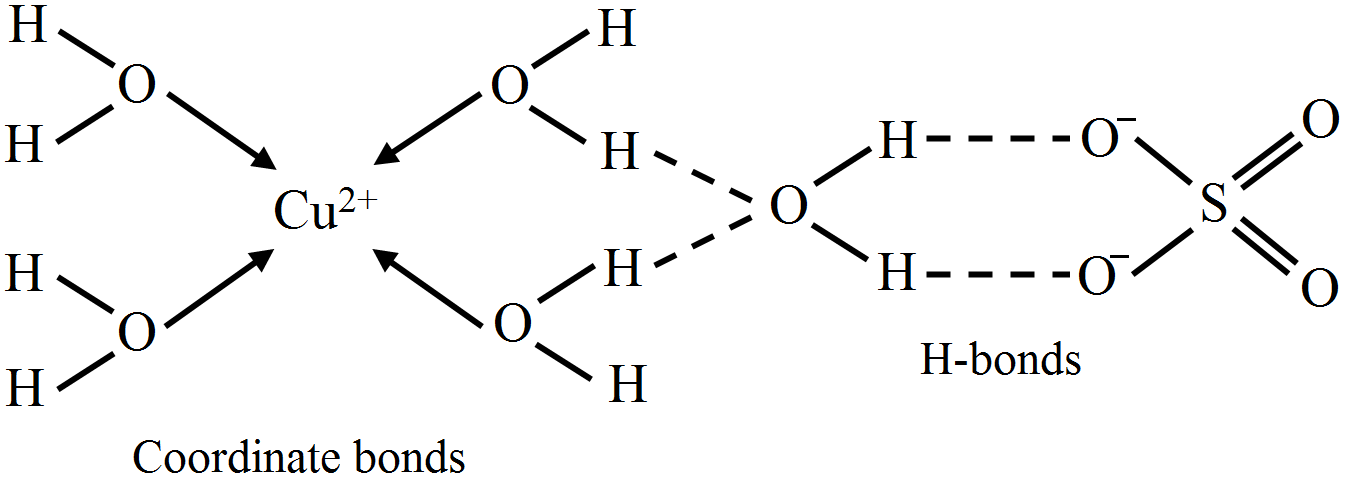
What are the ways in which water molecules are bonded to an anhydrous salt to form a hydrate?
AnswerCoordinate bond and H -bond, e.g. $\mathrm{CuSO}_4 .5 \mathrm{H}_2 \mathrm{O}$ has $4 \mathrm{H}_2 \mathrm{O}$ forming coordinate bond, one $\mathrm{H}_2 \mathrm{O}$ molecule forms H -bond.
View full question & answer→Question 411 Mark
Why $\mathrm{NH}_3$ has a higher boiling point than $\mathrm{PH}_3$?
Answer$\mathrm{NH}_3$ is associated with intermolecular H -bonding, $\mathrm{PH}_3$ is not associated with intermolecular H -bonding. ' $N$ ' is more electron negative and smaller in size than ' P '.
View full question & answer→Question 421 Mark
How will you account for 104.5° bond angle in water?
AnswerIt is due to presence of two lone pair of electrons which repel each other and bond angle reduce to 104.5°
View full question & answer→Question 431 Mark
Phosphoric acid is preferred over sulphuric acid in preparation of $\mathrm{H}_2 \mathrm{O}_2$ from peroxide, why?
AnswerIt is because $\mathrm{H}_2 \mathrm{SO}_4$ is stronger acid and oxidizing agent than $\mathrm{H}_3 \mathrm{PO}_4$, therefore, $\mathrm{H}_3 \mathrm{PO}_4$, is preferred.
View full question & answer→Question 441 Mark
What is the shape of crystals of ice at atmospheric pressure and what change occurs at low temperature?
AnswerIce crystals are hexagonal at atmospheric pressure. At low temperature, it changes into cubic form.
View full question & answer→Question 451 Mark
Complete the following equations:
$\text{PbS (s)} +\text{H}_2\text{O}_{2\text{(aq)}}\xrightarrow{\ \ \ \ \ \ \ }$
Answer$\text{PbS}+4\text{H}_2\text{O}_2\xrightarrow{\ \ \ \ \ }\text{PbSO}_4+4\text{H}_2\text{O}$
View full question & answer→Question 461 Mark
How many hydrogen bonded water molecules are associated in $\mathrm{CuSO}_4 \cdot 5 \mathrm{H}_2 \mathrm{O}$?
AnswerThere is one hydrogen bonded water molecule in $\mathrm{CuSO}_4 \cdot 5 \mathrm{H}_2 \mathrm{O}$
View full question & answer→Question 471 Mark
Write one chemical reaction for the preparation of $\mathrm{D}_2 \mathrm{O}_2$.
Answer$\mathrm{D}_2 \mathrm{O}_2$ can be prepared by the reaction of $\mathrm{D}_2 \mathrm{SO}_4$ dissolved in water over $\mathrm{BaO}_2$.
$\mathrm{BaO}_2+\mathrm{D}_2 \mathrm{SO}_4 \rightarrow \mathrm{BaSO}_4+\mathrm{D}_2 \mathrm{O}_2$
View full question & answer→Question 481 Mark
A sample of hard water is allowed to pass through an anion exchanger. Will it produce lather will soap easily?
AnswerNo $\mathrm{Ca}^{2+}$ and $\mathrm{Mg}^{2+}$ ions are still present and these will interact with soap to form curdy white precipitate. Therefore, it will not produce lather with soap easily.
View full question & answer→Question 491 Mark
Why is position of hydrogen in periodic table not justified?
AnswerIt resembles both alkali metals and halogens but it is placed with alkali metals, therefore, its position is not justified.
View full question & answer→Question 501 Mark
$\mathrm{H}^{+}$ ions does not exist freely and is always associated with other atoms or moleucle. Explain.
Answer$\mathrm{H}^{+}$ is not stable because it is positively charge. It combines with $\mathrm{H}_2 \mathrm{O}$ and exists as $\mathrm{H}_3 \mathrm{O}^{+}$. (Hydronium ion) $\mathrm{H}_2 \mathrm{O}+\mathrm{H}^{+} \longrightarrow \mathrm{H}_3 \mathrm{O}^{+}$
View full question & answer→Question 511 Mark
What is the nature of $\mathrm{H}_2 \mathrm{O}_2$? Give chemical reaction to show its nature.
Answer$\mathrm{H}_2 \mathrm{O}_2$ is acidic in nature.
$\text{H}_2\text{O}_2+2\text{NaOH}\xrightarrow{\ \ \ \ }\text{Na}_2\text{O}_2+2\text{H}_2\text{O}$
View full question & answer→Question 521 Mark
What is the hybrid orbital of oxygen atom and shape of $\mathrm{H}_3 \mathrm{O}$ ?
Answer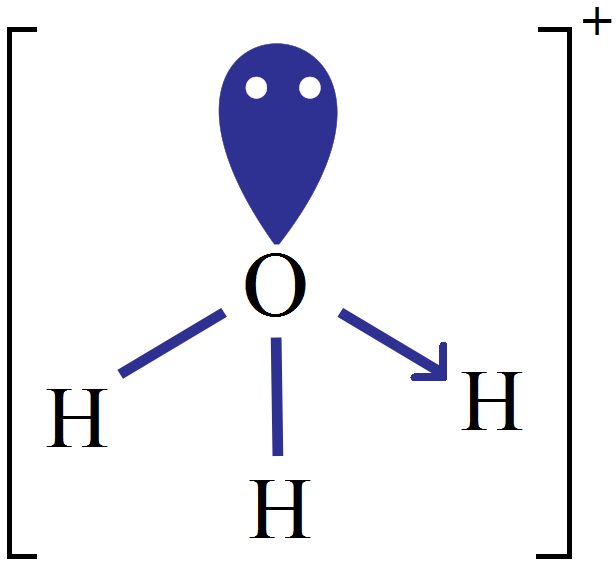
$\mathrm{Sp}^3$, Pyramidal shape There is coordinate bond in which lone pair of oxygen is shared by $\mathrm{H}^{+}$ion. It is denoted by $\rightarrow$. View full question & answer→Question 531 Mark
In reaction of $\mathrm{F}_2$ and $\mathrm{H}_2 \mathrm{O}$, what is the role of water?
Answer$2\text{F}_2+2\text{H}_2\text{O}\xrightarrow{\ \ \ \ }4\text{H}^++4\text{F}^-+\text{O}_2.$
Water is acting as reducing agent because $\mathrm{F}_2$ is best oxidising agent.
View full question & answer→Question 541 Mark
What is the molar mass of heavy water?
AnswerMolar mass of heavy water is $20\text{g}{~mol}^{-1}$,
$[\because\text{D}_2\text{O}=2\text{D}+10\\=2\times2+1\times16=4+16=20]$
View full question & answer→Question 551 Mark
Name the isotope of hydrogen which is commonly used as a tracer in organic reactions.
AnswerMost commonly deuterium is used as tracers in organic reactions. (Tritium can be used as tracers but it is radioactive in nature and least abundant hydrogen isotope, therefore deuterium is commonly used).
View full question & answer→Question 561 Mark
What do you mean by 15 volume $\mathrm{H}_2 \mathrm{O}_2$ solution?
Answer15 volume $\mathrm{H}_2 \mathrm{O}_2$' means 1ml of a 15 volume $\mathrm{H}_2 \mathrm{O}_2$ solution gives 15ml of $\mathrm{O}_2$ at NTP.
View full question & answer→Question 571 Mark
- Name the constituents of water gas.
- Which gaseous compound on treatment with dihydrogen produces methanol?
- Name one industrial method for the preparation of dihydrogen.
Answer
- Carbon monoxide and hydrogen.
- Carbon monoxide.
- Bosch process.
View full question & answer→Question 581 Mark
Acetanilide prevents the decomposition of $\mathrm{H}_2 \mathrm{O}_2$. What is this compound called?
AnswerAcetanilide is a neutral compound which suppresses the decomposition of $\mathrm{H}_2 \mathrm{O}_2$ into $\mathrm{H}_2 \mathrm{O}$ and $\mathrm{O}_2$. Thus, it is called stabiliser (or negative catalyst).
View full question & answer→Question 591 Mark
Give reasons:
Ice floats on water.
AnswerDensity of ice is less than water due to presence of empty spaces created because of H-bonding between $\text{H}_2\text{O}$ molecules. Hence, ice floats on water.
View full question & answer→Question 601 Mark
When sodium hydride is electrolysed, hydrogen is liberated at which electrode?
Answer$\text{NaH}\xrightarrow{\text{electrolysis}\ \ }\text{Na}^++\text{H}^-,$
At anode: $\text{2}\text{H}^--2\text{e}^-\xrightarrow{\ \ \ \ }\text{H}_2(\text{g})$ [Loss electrons, oxidation]
View full question & answer→Question 611 Mark
Name the compound each in which hydrogen exists in :
- negative oxidation state.
- positive oxidation state.
Answer
- Nah, here oxidation state of hydrogen is $- 1.$
- $\text{HCI}$, here oxidation state of hydrogen is $+1.$
View full question & answer→Question 621 Mark
Why is water molecules polar?
AnswerIt is bent molecule, has high dipole moment due to difference in electronegativity of 'H' and oxygen, it is polar molecule.
View full question & answer→Question 631 Mark
What happens when $\mathrm{O}_3$, is passed through $\mathrm{H}_2 \mathrm{O}_2$? $\mathrm{H}_2 \mathrm{O}_2$ is oxidising or reducing agent in the reaction.
Answer$\mathrm{H}_2 \mathrm{O}$ and $\mathrm{O}_2$ is formed. $\mathrm{H}_2 \mathrm{O}_2$ acts as reducing agent.
$\text{H}_2\text{O}_2+\text{O}_3\xrightarrow{\ \ \ \ \ \ \ \ \ \ } \text{H}_2\text{O}+2\text{O}_2$
View full question & answer→Question 641 Mark
Suggest a method to show the electronegative nature of hydrogen.
AnswerWhen sodium hydride is electrolysed, hydrogen is evolved at anode, which shows its electronegative nature.
View full question & answer→Question 651 Mark
Describe the bulk preparation of hydrogen by electrolytic method. What is the role of an electrolyte in this process?
AnswerElectrolysis of acidified water using platinum electrodes gives hydrogen.
$2\text{H}_2\text{O}(\text{l})\xrightarrow[\text{Traces of acide/ base}]{\text{Electrolysis}}2\text{H}_2(\text{g})+\text{O}_2(\text{g})$
Here, the role of an electrolyte is to make water conducting.
View full question & answer→Question 661 Mark
Which gas is evolved when $\mathrm{Mg}_3 \mathrm{N}_2$ (magnesium nitride) is treated with $\mathrm{H}_2 \mathrm{O}$ ? Give chemical reaction.
Answer$\text{NH}_3$ gas is evolved.
$\text{Mg}_3\text{N}_2+6\text{H}_2\text{O}\xrightarrow{\ \ \ \ }3\text{Mg}(\text{OH})_2+2\text{NH}_2$
View full question & answer→Question 671 Mark
Name one metal which liberates $\text{H}_2$ when treated with NaOH.
AnswerAl (Aluminium) and Be (Beryllium)
$2\text{Al}+2\text{NaOH}+2\text{H}_2\text{O}\xrightarrow{\ \ \ \ }2\text{NaAlO}_2+\text{H}_2$
$\text{Be}+\text{2NaOH}\xrightarrow{\ \ \ \ \ \ \ \ \ \ \ \ }\text{Na}_2\text{BeO}_2+\text{H}_2$
View full question & answer→Question 681 Mark
What is the trade name of sodium hexa metaphosphate? Give its use.
AnswerCalgon. It is used to remove hardness of water.
View full question & answer→Question 691 Mark
Dihydrogen forms interstitial hydrides with which type of elements?
AnswerTransition metals form interstitial hydrides due to presence of voids in which hydrogen can fit into.
View full question & answer→Question 701 Mark
Why does chlorine water loses its colour if kept for long time?
Answer$\text{Cl}_2+\text{H}_2\text{O}\xrightarrow{\ \ \ \ }\text{HCl}+\text{HOCl}$
$\text{HOCl}\xrightarrow{\ \ \ \ }\text{HCl}+[\text{O}]$
HCl is colourless, therefore, chlorine water loses its colour.
View full question & answer→Question 711 Mark
What type of bonds are broken when water evaporates.
AnswerIntermolecular hydrogen bonds are broken when water evaporates.
View full question & answer→Question 721 Mark
Explain why beryllium forms a covalent hydride while calcium forms an ionic hydride.
AnswerBecause of higher electronegativity, Be (EN = 1.5) forms a covalent hydride while due to lower electronegativity Ca (EN = 1.0 ) forms an ionic hydride.
View full question & answer→Question 731 Mark
Write redox reaction between fluorine and water.
Answer$2\text{F}_2(\text{g})+2\text{H}_2\text{O}\xrightarrow{\ \ \ \ }4\text{H}^+(\text{aq})+4\text{F}^-(\text{aq})+\text{O}_2(\text{g})$
View full question & answer→Question 741 Mark
Which out of nascent hydrogen and dihydrogen, is more reactive?
AnswerNascent hydrogen (newly born hydrogen) [H] is more reactive
than molecular hydrogen because energy is needed to break bond in $\text{H}_2$.
View full question & answer→Question 751 Mark
Why does elemental hydrogen react with other substances slowly at room temperature?
AnswerIt is because it has high bond dissociation energy $\left(436 \mathrm{~kJ} \mathrm{~mol}^{-1}\right)$ due to smaller bond length.
View full question & answer→Question 761 Mark
How does heavy water react with $\text{Al}_4\text{C}_3$?
Answer$\text{Al}_4\text{C}_3+12\text{D}_2\text{O}\xrightarrow{\ \ \ \ }4\text{Al}(\text{OD})_3+3\text{CD}_4$
View full question & answer→Question 771 Mark
How does $\text{CaC}_2$ react with heavy water?
Answer$\text{CaC}_2+2\text{D}_2\text{O}\xrightarrow{\ \ \ \ \ }\text{Ca}(\text{OD})_2+\text{C}_2\text{D}_2$
View full question & answer→Question 781 Mark
Complete the following reaction.
$\text{CO}(\text{g})+2\text{H}_2()\text{g}\xrightarrow[\text{CAtalyst}]{\text{Cobalt}}$
Answer$\text{CO}(\text{g})+2\text{H}_2(\text{g})\xrightarrow[\text{Cataiyst}]{\text{Cobalt}}\text{CH}_3\text{OH}_2(\text{l})$
View full question & answer→Question 791 Mark
Write the name of that isotope of hydrogen which has no neutron.
AnswerProtium or ordinary hydrogen.
View full question & answer→Question 801 Mark
|
S. No.
|
Column I
|
S. No.
|
Column II
|
|
a.
|
Synthesis gas
|
i.
|
$Na_2[Na_4(PO_3)_6]$
|
|
b.
|
Dihydrogen
|
ii.
|
Oxidising agent
|
|
c.
|
Heavy water
|
iii.
|
Softening of water
|
|
d.
|
Calgon
|
iv.
|
Reducing agent
|
|
e.
|
Hydrogen peroxide
|
v.
|
Stoichiometric compounds of s-block elements
|
|
f.
|
Salt like hydrides
|
vi.
|
Prolonged electrolysis of water
|
|
|
|
vii.
|
$Zn + NaOH$
|
|
|
|
viii.
|
$Zn + dil. H_2SO_4$
|
|
|
|
ix.
|
Synthesis of methanol
|
|
|
|
x.
|
Mixture of CO and $H_2$
|
Answer
|
S. No.
|
Column I
|
S. No.
|
Column II
|
|
a.
|
Synthesis gas
|
(ix)
|
Synthesis of methanol
|
|
(x)
|
Mixture of CO and $H_2$
|
|
b.
|
Dihydrogen
|
(iv)
|
Reducing agent
|
|
(v)
|
Stoichiometric compounds of s-block elements
|
|
(vii)
|
$Zn + NaOH$
|
|
(viii)
|
Zn + dil. $H_2SO_4$
|
|
(ix)
|
Synthesis of methanol
|
|
c.
|
Heavy water
|
(vi)
|
Prolonged electrolysis of water
|
|
d.
|
Calgon
|
(i)
|
$Na_2[Na_4(PO_3)_6]$
|
|
(iii)
|
Softening of water
|
|
e.
|
Hydrogen peroxide
|
(ii)
|
Oxidising agent
|
|
(iv)
|
Reducing agent
|
|
f.
|
Salt like hydrides
|
(v)
|
Stoichiometric compounds of s-block elements
|
View full question & answer→Question 811 Mark
Give an example of reaction in which $\text{H}_2$ acts as oxidising agent.
Answer$2\text{Na}+\text{H}_2\xrightarrow{\ \ \ \ }2\text{NaH}$ (sodium hydride)
In this reaction, $\text{H}_2$ acts as oxidising agent because it can gain electron to form $\text{H}^-$ ion.
View full question & answer→Question 821 Mark
Classify the following as covalent, ionic or interstitial hydrides.
$\mathrm{CaH}_2, \mathrm{LaH}_2, \mathrm{RbH}, \mathrm{GeH}_2, \mathrm{TiH}_2, \mathrm{NaH}, \mathrm{NH}_3$.
AnswerCovalent hydrides $\mathrm{GeH}_2, \mathrm{NH}_3$.
Ionic hydrides $\mathrm{CaH}_2, \mathrm{RbH}, \mathrm{NaH}$.
Interstitial hydrides $\mathrm{TiH}_2, \mathrm{LaH}_2$.
View full question & answer→Question 831 Mark
Why is dihydrogen not preferred in balloons these days?
AnswerDihydrogen is highly combustible and hence, is likely to catch fire in the presence of excess of air. That's why it is not preferred in balloons now a days.
View full question & answer→Question 841 Mark
Sodium forms a crystalline ionic solid with dihydrogen. The solid is non-volatile and non-conducting in nature. It reacts violently with water to produce dihydrogen gas. Write the formula of this compound and its reaction with water. What will happen on electrolysis of the melt of this solid?
AnswerThe compound is NaH (sodium hydride)
$2\text{Na}+\text{H}_2\xrightarrow{\ \ \ \ \ \ \ \ \ }2\text{NaH} $
$\text{NaH}+\text{H}_2\text{O}\xrightarrow{\ \ \ \ \ \ \ \ }\text{NaOH}+\text{H}_2\text{(g)}$
When molten sodium hydride is electrolysed, Na will be formed at cathode and dihydrogen will be liberated at anode.
$2\text{NaH}\xrightarrow{\text{electrolysis}}2\text{Na}\ \ \ +\ \ \ \ \ \text{H}_2(\text{g})\\ \ \ \ \ \ \ \ \ \ \ \ \ \ \ \ \ \ \ \ \ \ \ \ \ \ ^\text{At cathode}\ \ \ \ \ \ \ \ \ ^\text{At anode}$
View full question & answer→