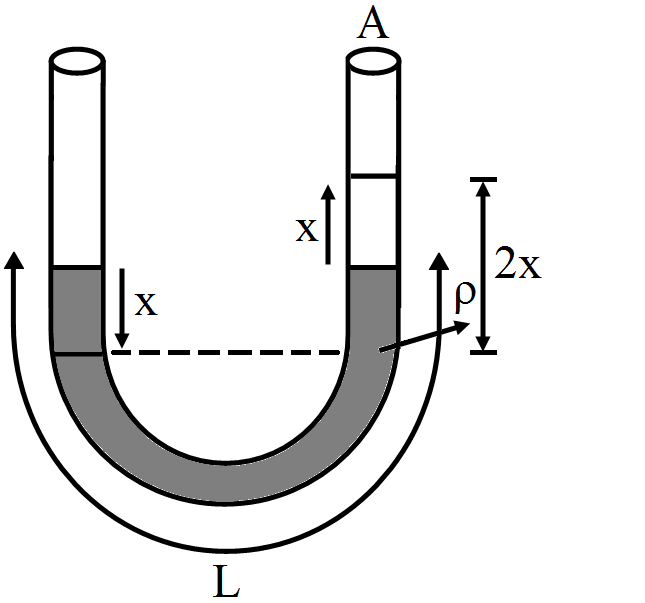
$=-2\text{x}\rho\text{gA = AL}\rho\text{a,a}=-\frac{2\text{gx}}{\text{L}}$
The frequency $=\text{f}=\frac{1}{2\pi}\sqrt{\frac{\text{acceleration}}{\text{displacement}}}$$=\frac{1}{2\pi}\sqrt{\frac{2\text{g}}{\text{L}}}$
$=-2\text{x}\rho\text{gA = AL}\rho\text{a,a}=-\frac{2\text{gx}}{\text{L}}$
The frequency $=\text{f}=\frac{1}{2\pi}\sqrt{\frac{\text{acceleration}}{\text{displacement}}}$$=\frac{1}{2\pi}\sqrt{\frac{2\text{g}}{\text{L}}}$
$\omega^2_\text{max}\text{A}=\text{g}$
$\omega_\text{max}=\sqrt{\frac{\text{g}}{\text{A}}}$
$\text{T}_\text{min}=\frac{2\pi}{\omega_\text{max}}$
$=2\pi\sqrt{\frac{\text{A}}{\text{g}}}$
Now $\text{A}=2.5\text{cm}$$=2.5\times10^{-2}\text{m}$
$\text{g}=10\text{ms}^{-2}$
Substituting thesa values we get$\text{T}_\text{min}=\frac{\pi}{10}$

$=\frac{2\pi}{20}=\frac{\pi}{10}\text{sec}.$
$\text{v}=\omega\text{A}=20\times5\times10^{-2}=1\text{ms}^{-1}$
$=\frac{1}{2}\text{m}\omega^2\text{A}^2$
$=\frac{1}{2}\times3\times20^2\times25\times10^{-4}$
$=600\times25\times10^{-4}$
$=150\times10^{-2}\text{Joule}$
$=1.5\text{ Jule}$
$\text{F}=\frac{-\text{dU}}{\text{dx}}=\frac{-\text{d}}{\text{dx}}(500\text{x}^2+1000)$
$=-1000\text{x}$
But $\text{F = m}\frac{\text{d}^2\text{x}}{\text{dt}^2}$$\therefore\text{m}\frac{\text{d}^2\text{x}}{\text{dt}^2}=-1000\text{x}$
$\frac{\text{d}^2\text{x}}{\text{dt}^2}=\frac{-1000\text{x}}{\text{m}}=\frac{-1000\text{x}}{10}$
$=-100\text{x}$
As $\frac{\text{d}^2\text{x}}{\text{dt}^2}=\omega^2\text{x};$ so $\omega^2=100$$\omega=\sqrt{100}=10$
Frequency of oscillation,$\text{v}=\frac{\omega}{2\pi}=\frac{\sqrt{100}}{2\pi}=1.58\text{s}^{-1}$

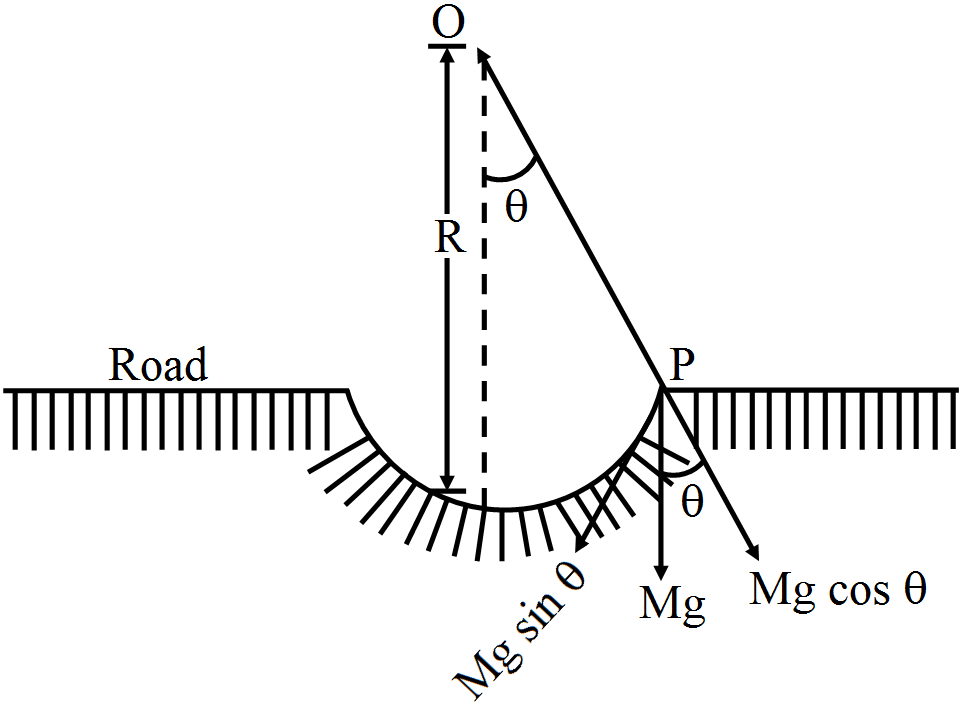
$\therefore\text{F}=-\text{Mg}\theta$ ($\because$ force acts to reduce $\theta$)
Displacement of the rickshaw OP $=\text{y}=\text{R}\theta$$\therefore$ Force constant,
$\text{k}=\frac{-\text{Force}}{\text{Displacement}}$
$=-\Big(\frac{-\text{Mg}\theta}{\text{R}\theta}\Big)=\frac{\text{Mg}}{\text{R}}$
$\therefore$ Time period, $\text{T}=2\pi\sqrt{\frac{\text{Inertial factor}}{\text{Spring factor}}}$
$=2\pi\sqrt{\frac{\text{MR}}{\text{Mg}}}=2\pi\sqrt{\frac{\text{R}}{\text{g}}}$
$\therefore\text{T}=2\pi\sqrt{\frac{\text{R}}{\text{g}}}$
$\text{v}=\frac{1}{2\pi}\sqrt{\frac{\text{Spring factor}}{\text{Inertial factor}}}$
$=\frac{10}{\pi}\text{Hz}$
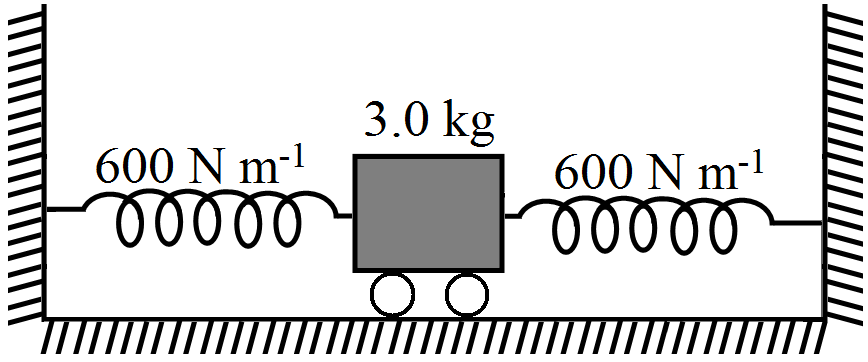
Let v1 be the velocity ofthe mass (m + m1) after collision. According to law of conservation of linear momentum, we have$\text{m}_1\text{v}=(\text{m + m}_1)\text{v}_1$
$\text{v}_1=\frac{\text{m}_1\text{v}}{\text{m + m}_1}$
$\frac{\text{m}_1\text{v}}{\text{m + m}_1}=\frac{0.5\times3}{1+0.5}=1\text{ms}^{-1}$
Here the collision is inelastic. According to the law of conservation of mechanical energy, we have$(\text{K.E}.)_{\text{max}}=(\text{P.E.})_{\text{max}}$
i.e., $\frac{1}{2}(\text{m + m}_1)\text{v}^2_1=\frac{1}{2}\text{kA}^2$$\text{A}=\text{v}_1\sqrt{\frac{\text{m + m}_1}{\text{k}}}$
$=\sqrt{\frac{1.5}{600}}=\frac{1}{20}=5\text{cm}$
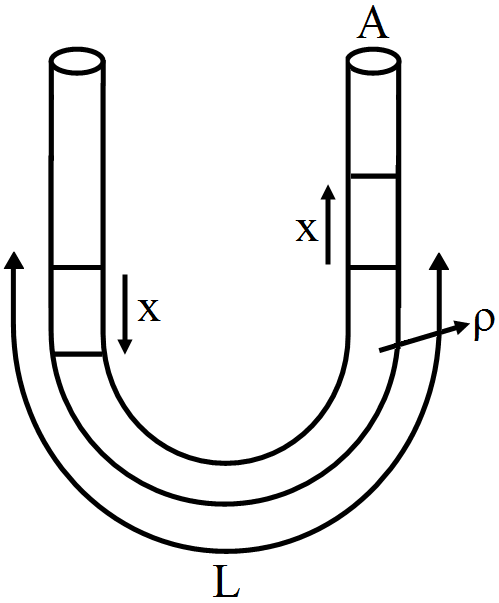
$\Rightarrow\text{F}=-(\text{volume})\times\text{density}\times\text{g}$
$=-(\text{A}\times-2\text{y}.\rho\text{g})$
$\Rightarrow\text{F}=-2\text{A}\rho\text{g.y} \ ...(\text{i})$
where A = Area of cross-section of the tube
$\rho$ = density of mercury
$\text{k}=-\frac{\text{F}}{\text{y}}=2\text{A}\rho.\text{g}$
Time period$\text{T}=2\pi\sqrt{\frac{\text{m}}{\text{k}}}$
$=2\pi\sqrt{\frac{\text{m}}{2\text{A}\rho.\text{g}}}$
Let L = length of the whole mercury column therefore, mass of mercury$\text{m}=\text{volume}\times\text{density}=\text{A.L.}\rho.$
$\text{T}=2\pi\sqrt{\frac{\text{m}}{\text{k}}}=2\pi\sqrt{\frac{\text{A.L.}\rho}{2\text{A}\rho\text{g}}}=2\pi\sqrt{\frac{\text{L}}{2\text{g}}}$ where L is the totat length of mercury column of L = 2h.
Where h is the height of mercury column in U-tube. It shows that mercury column executes S.H.M. Frequency, $\text{v}=\frac{1}{\text{T}}=\frac{1}{2\pi}\sqrt{\frac{2\text{g}}{\text{L}}}$ So, angular frequency$\omega=2\pi\text{v}=2\pi\times\frac{1}{2\pi}\sqrt{\frac{2\text{g}}{\text{L}}}=\sqrt{\frac{2\text{g}}{\text{L}}}$

$\text{a}_\text{max}=\omega^2\text{A}$
$=(2\pi\text{v}^2)\text{A}=4\pi^2\text{v}^2\text{A}$
$=4\times\Big(\frac{22}{7}\Big)^2\times(2)^2\times0.05$
$=7.9\text{cm}^{-2}$
$\therefore$ Maximum force felt by the man $=\text{m}(\text{g}+\text{a}_\text{max})$
$=50(10+7.9)$
$=895.0\text{N}$
$=89.5\text{kgf}$
Minimum force felt by the man $=\text{m}(\text{g}-\text{a}_\text{max})$$=50(10-7.9)$
$=105.0\text{N}$
$=10.5\text{kgf}$
Hence, the reading of the weighing machine varies between 10.5kgf and 69.5kgf.$=\frac{\frac{1}{2}\text{m}\omega^2\Big(\text{A}^2-\frac{\text{A}^2}{4}\Big)}{\frac{1}{2}\text{m}\omega^2\text{A}^2}=\frac{3}{4}\text{ or }75\%$
So, fraction of energy as kinetic is$=\frac{\frac{1}{2}\text{m}\omega^2\frac{\text{A}^2}{4}}{\frac{1}{2}\text{m}\omega^2\text{A}^2}=\frac{1}{2}\text{ or }25\%$
$\frac{\Delta\text{T}}{\text{T}}\times100=\frac{1}2{}\frac{\Delta\text{l}}{\text{l}}\times100$
$\therefore\%\text{ change in T}=\frac{1}{2}\times8=4\%$

$\text{v}=\frac{1}{2\pi}\sqrt{\frac{\text{k}}{\text{m}}}$
$=\frac{1}{2\pi}\sqrt{\frac{10}{0.1}}$
$\text{v}=\frac{10}{2\pi}$
$=\frac{5}{\pi}\text{s}^{-1}$
$\text{v}_1=\omega\sqrt{\text{A}^2-\frac{3}{4}\text{A}^2}=\omega\text{A}\sqrt{\frac{1}{4}}$
$=\frac{\omega\text{A}}{2}$
Velocity at central position$=\omega\sqrt{\text{A}^2-0^2}=\omega\text{A}$
$\therefore$ Velocity at $\frac{\sqrt{3}\text{A}}{2}=\frac{1}{2}$ (velocity at central position)
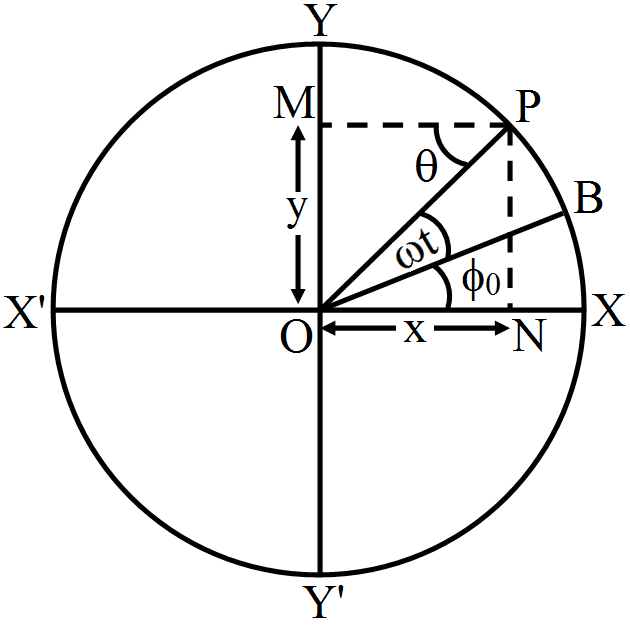
$\text{y = A}\sin(\omega\text{t}+\phi_0)$
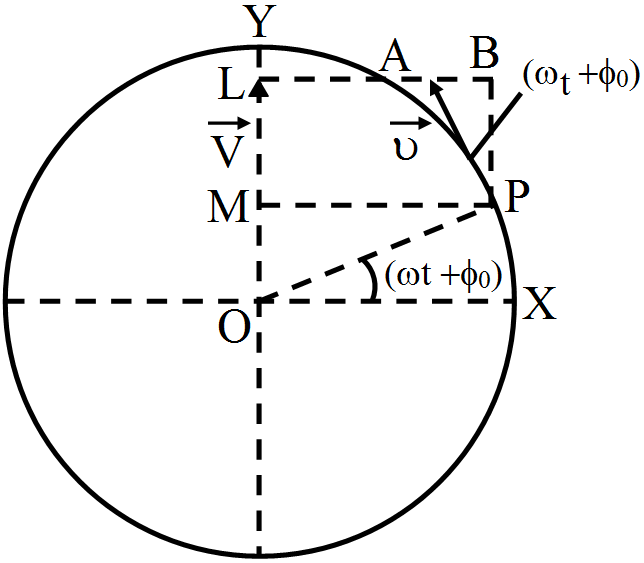
velocity $\text{v}=\omega\text{A}\cos(\omega\text{t}+\phi_0)$
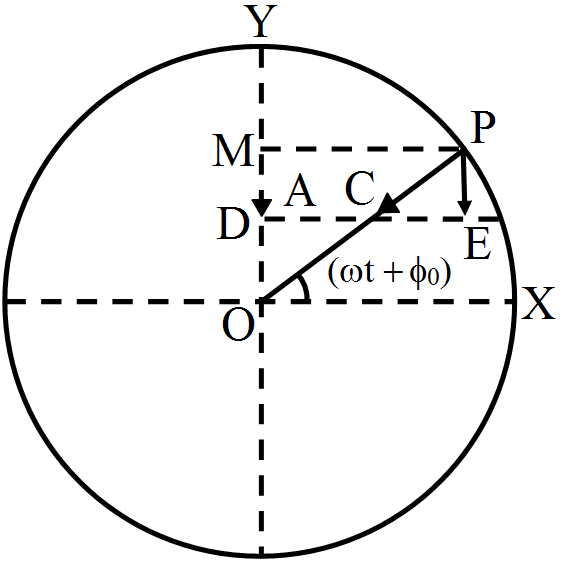
acceleration $\text{a}=-\omega^2\text{A}\sin(\omega\text{t}+\phi_0)$
x and v differ in phase by $\frac{\pi}{2}.$ v and a differ in phase by $\frac{\pi}{2}.$
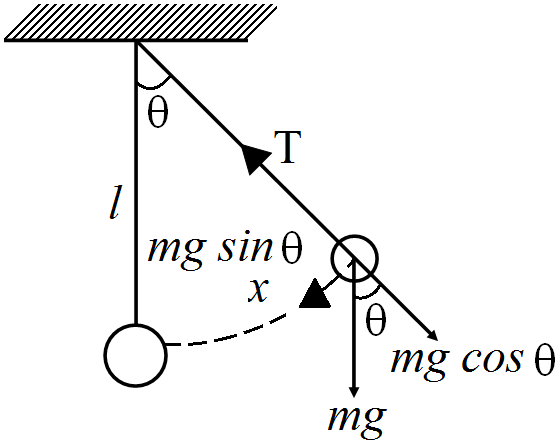
The restoring force = F $=\text{mg}\sin\theta$ If $\theta$ is small then $\sin\theta=\theta=\frac{\text{arc}}{\text{radius}}=\frac{\text{x}}{\text{l}}$ $\therefore\text{F}=-\text{mg}\frac{\text{x}}{1}\ \text{or}\ \text{F}\propto(-\text{x})$
$(\because\text{m}_2\text{g},1\text{are constant})$
Hence, the motion of simple pendulam will be smile harmonic for small angle $\theta.$


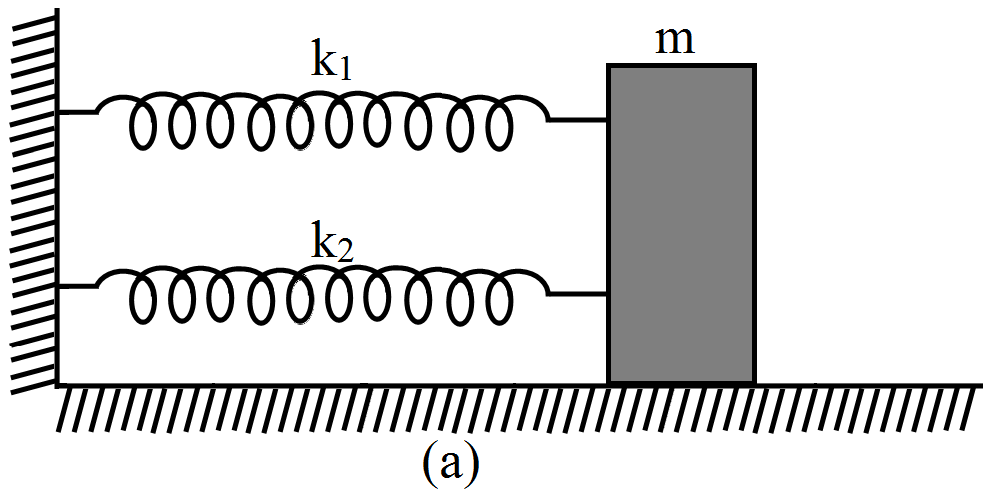
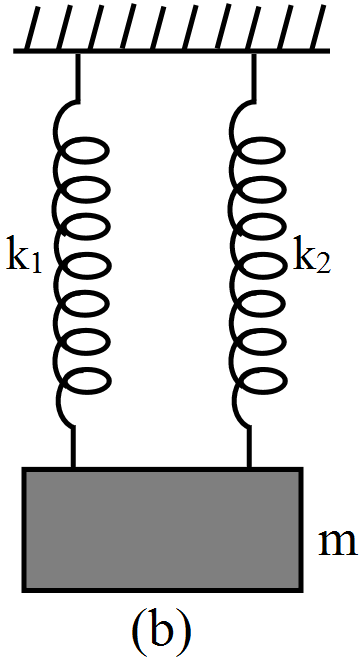
$\therefore\text{f}=\frac{1}2\pi{}\sqrt{\frac{\text{k}_1+\text{k}_2}{\text{m}}}$
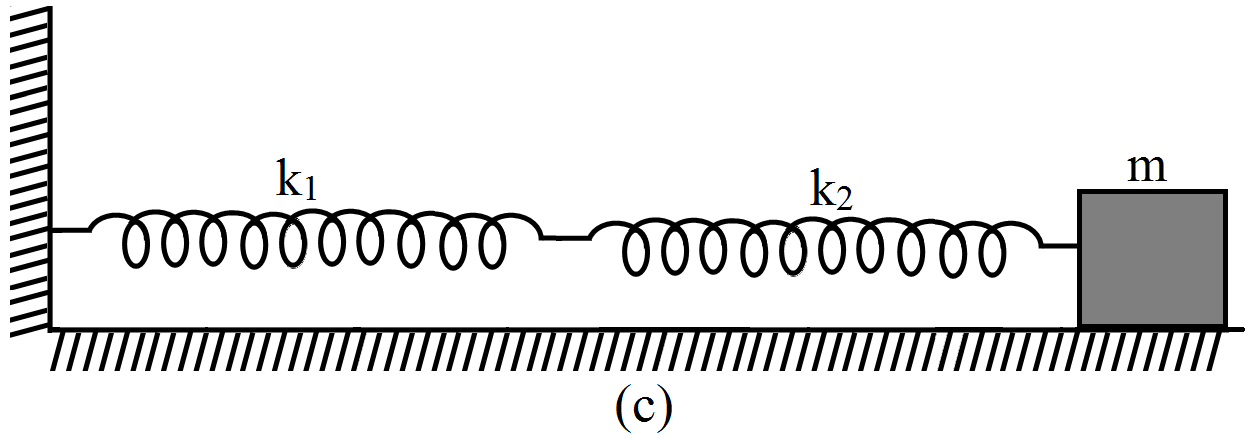
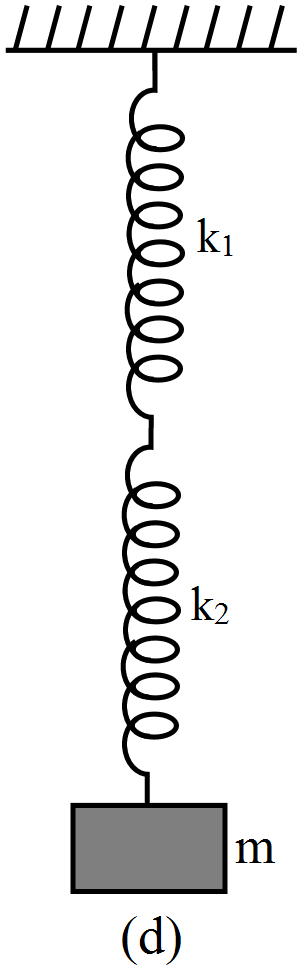
(c), (d) In series equivalent $\text{k}=\frac{\text{k}_1\text{k}_2}{\text{k}_1+\text{k}_2}$$\therefore\text{f}=\frac{1}{2\pi}\sqrt{\frac{\text{k}_1\text{k}_2}{(\text{k}_1+\text{k}_2)\text{m}}}$
$\text{K}=\frac{0.02\times10}{7\times10^{-2}}=\frac{20}{7}=2.86\text{N/m}$
Time period $=\text{T}=2\pi\sqrt{\frac{\text{m}}{\text{K}}}$$=2\pi\sqrt{\frac{0.2}{2.86}}=1.66\sec.$
$\text{g}'=\sqrt{\text{g}^2+\frac{\upsilon^4}{\text{R}^2}}$
$\therefore$ Time period, $\text{T}=2\pi\sqrt{\frac{\text{l}}{\text{g}'}}$
$=2\pi\frac{\text{l}}{\text{g}^2+\frac{\upsilon^4}{\text{R}^2}}$
$\text{k}=\frac{\text{Force}}{\text{Displacement}}=\frac{10}{0.1}$
$=100\text{Nm}^{-1}$
$=\frac{\text{Force}}{\text{k}}=\frac{4\times10}{100}=0.4\text{m}$
$\text{T}=2\pi\sqrt{\frac{\text{m}}{\text{k}}}=2\pi\sqrt{\frac{4}{100}}=\frac{2\pi}{5}\text{s}$
$=-\text{}\omega^2\text{y}=-\text{ky}$
where, $\text{k = spring constant = m}\omega^2$ Work done for an additional displacement dy against restoring force is$\text{dW}=-\text{F dy}$
$=-(-\text{ky})\text{dy = ky dy}$
Total work done$\text{W}=\int\limits^{\text{y}}_0\text{ky dy}=\frac{1}{2}\text{ky}^2$
This work done appears as a PE. 'U' of the particle.$\text{U}=\frac{1}2{}\text{ky}^2=\frac{1}{2}\text{m}\omega^2\text{y}^2$
$=\frac{1}{2}\text{m}\omega^2\text{a}^2\sin^2\omega\text{t}$
$\text{a}=\frac{\text{g}}{6}.$
$\therefore\text{Using}\text{ T}=2\pi\sqrt{\frac{\text{l}}{\text{g}}},$
We have $\text{l}=\frac{4\text{g}}{6\times4\pi^2}=\frac{1}{6}\text{m}$$(\text{K.E.)}_{\text{avg}}=\frac{1}{\text{T}}\int\limits^{\text{T}}_0(\text{K.E.)dt}$
$=\frac{1}{\text{T}}\int\limits^{\text{T}}_{0}\frac{1}{2}\text{m}\omega^2\text{A}^2\cos^2\omega\text{t dt}$
$=\frac{1}{2\text{T}}\text{m}\omega^2\text{A}^2\int\limits^\text{T}_0\cos^2\omega\text{t dt}$
$=\frac{\text{m}\omega^2\text{A}^2}{2\text{T}}.\frac{\text{T}}{2}=\frac{1}{4}\text{m}\omega^2\text{A}^2$
Similarly, $\text{P.E.}=\frac{1}{2}\text{m}\omega^2\text{A}^2$$\text{x}=-2\sin\Big(3\text{t}+\frac{\pi}{3}\Big)$
$=2\cos\Big(3\text{t}+\frac{5\pi}{6}\Big)$
If this equation is compared with the standard SHM equation
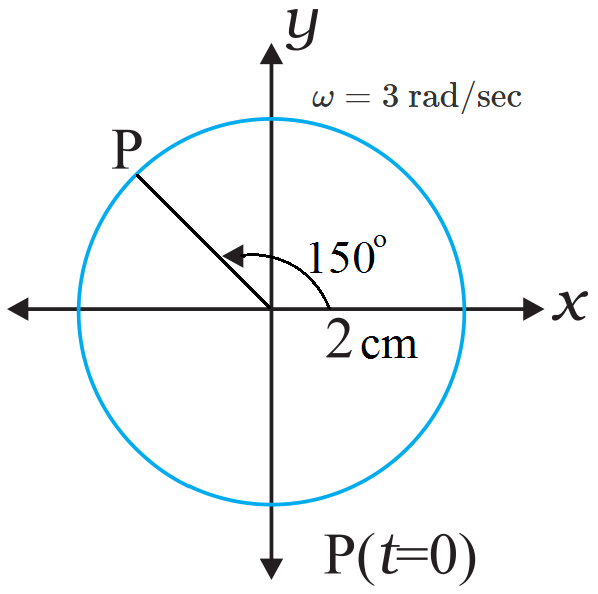
$\text{x}=\text{A}\cos\bigg(\Big(\frac{2\pi}{\text{T}}\Big)\text{t}+\phi\bigg),$ then we get:Amplitude, A = 2cm
Phase angle, $\phi=\frac{5\pi}{6}=150^\circ$
Angular velocity, $\omega=\frac{2\pi}{\text{T}}=3\text{rad/sec.}$
The motion of the particle can be plotted as shown in the following figure.

$\text{x(t)}=5\cos\Big(2\pi\text{t}+\frac{\pi}{4}\Big)$
where x is in meters and t is in seconds. Calculate the following:$\text{x}(0)=5\cos\Big(0+\frac{\pi}{4}\Big)=5\times\frac{1}{\sqrt{2}}\text{m}=\frac{5}{\sqrt{2}}\text{m}$
Angular frequency
Maximum velocity
$=-\frac{\text{d}}{\text{dx}}[4(1-\cos2\text{x})]-8\sin2\text{x}$
$\text{F}=-8\times2\text{x}$
[When x is small, $\sin2\text{x}=2\text{x}$]
$\text{F}=-16\text{x}$
As $\text{F}\propto\text{x}$ and -ve sign shows that x is directed towards equilibrium position hence the particle will execute SHM.
Here spring factor, k = 16N/ m
Inertia factor m = 1kg
$\therefore$ Time period $\text{T}=32\pi\sqrt{\frac{\text{m}}{\text{k}}}$
$=2\pi\sqrt{\frac{1}{16}}=\frac{\pi}{2}\text{s}$
$\therefore\text{T}=\pi\sqrt{\frac{\text{l}}{\text{g}}}$
$\therefore\text{T}=2\pi\sqrt{\frac{\text{l}}{\text{g + a}}}$
$\therefore\text{T}=2\pi\sqrt{\frac{\text{l}}{\text{g}-\text{a}}}$
$\therefore\text{T}'=2\pi\sqrt{\frac{\text{l}}{\text{g}+\text{a}}}$
Clearly, $\text{T}'<\text{T}$.
$\text{T}'=2\pi\sqrt{\frac{\text{l}}{\text{g}+\text{a}}}$
Clearly,$\text{T}'<\text{T}$.