Questions · Page 2 of 2

M.C.Q (1 Marks)

MCQ 511 Mark
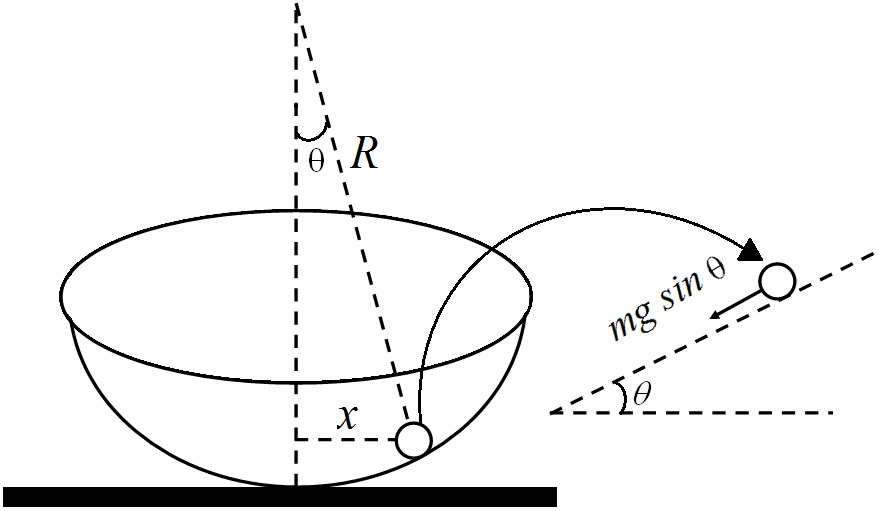
Motion of a ball bearing inside a smooth curved bowl, when released from a point slightly above the lower point is:
  • A
    Simple harmonic motion.
  • B
    Non-periodic motion.
  • C
    Periodic motion.
  • D
    Periodic but not S.H.M.
Answer
  1. Simple harmonic motion.
  1. Periodic motion.

Explanation:

For small angular displacement, the situation is shown in the figure. Only one restoring force creates.

motion in ball inside bowl.

Only one restoring force creates motion in ball inside bowl.

$\text{F}=-\text{mg}\sin\theta$

As $\theta\ \text{is small},\sin\theta=\theta$

So, $\text{ma}=-\text{mg}\frac{\text{x}}{\text{R}}$

Or, $\text{a}=-\Big(\frac{\text{g}}{\text{R}}\Big)\text{x}\Rightarrow\text{a}\propto-\text{x}$

So, motion of the ball is S.H.M and periodic.
View full question & answer
MCQ 531 Mark
The periodic function $\text{f(t)}=\text{A}\sin(\omega\text{t})$ repeats itself with periodic function of:
Answer
  1. $2\pi$

Explanation:

A periodic function repeats itself after a time period T. and f(t) = f(t + T) As $\sin(\omega\text{t}+2\omega\pi)$ 

$\therefore$ Period of function is

View full question & answer
MCQ 541 Mark
A particle executing S.H.M. has a maximum speed of 30cm/ s and a maximum acceleration of 60cm/ s2.The period of oscillation is:
Answer
  1. $\pi\text{s}.$

Explanation:

Key concept: Let equation of an SHM is represented by $\text{y}=\text{a}\sin\omega\text{t}$

$\text{v}=\frac{\text{dy}}{\text{dt}}=\text{a}\omega\cos\omega\text{t}$

Hence $(\text{v})_{\text{max}}=\text{a}\omega$

Acceleration $(\text{A})=\frac{\text{dx}^2}{\text{dt}^2}=-\text{a}\omega^2\sin\omega\text{t}$

Hence $\text{A}_{\text{max}}=\omega^2\text{a}$

Maximum speed, $\text{v}_\text{max}=\omega\text{A}$

Maximum acceleration, $\text{a}_{\text{max}}=\omega^2\text{A}$

Divide eqn. (ii) by eqn. (i), we get

$\frac{\text{a}_\text{max}}{\text{v}_\text{max}}=\frac{\omega^2\text{A}}{\omega\text{A}}=\omega$

$\therefore\frac{\text{a}_\text{max}}{\text{v}_\text{max}}=\frac{2\pi}{\text{T}}$

Here, $\text{v}_\text{max}=30\text{cms}^{-1},\text{a}_\text{max}=60\text{cms}^2$

$\therefore\text{T}=2\pi\Big(\frac{30\text{cms}^{-1}}{60\text{cms}^{-2}}\Big)=\pi\text{s}$

View full question & answer
MCQ 551 Mark
Natural length of the spring is 40cm and its spring constant is 4000Nm-1. A mass of 20kg is hung from it.The extension produced in the spring is (g = 9.8ms-2)
  • A
    4.9cm
  • B
    0.49cm
  • C
    9.4cm
  • D
    0.94cm
Answer
  1. 4.9cm

Explanation:

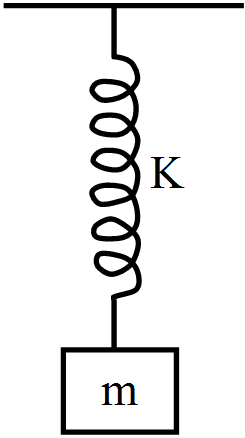
In equilibrium kx = mg

$\therefore$ Extension, $\text{x}=\frac{\text{mg}}{\text{k}}$

$\text{x}=\frac{20\times9.8}{4000}$

$\text{x}=0.049\text{m}$

$\text{x}=4.9\text{cm}$

View full question & answer
MCQ 561 Mark
A simple pendulum has time period T. The bob is given charge and surface below it is given positive charge. The new time period will be:
  • A
    Less than T
  • B
    Greater than T
  • C
    Equal to T
  • D
    Infinite
Answer
  1. Less than T

Explanation:

$\text{g}'=\text{g}+\frac{\text{F}_{\text{e}}}{\text{m}},\text{g}'>\text{g}$

Since, $\text{T}=\sqrt{\frac{\text{l}}{\text{g}}}$

So $\text{T}\propto\frac{1}{\sqrt{\text{g}}}$ and $\text{T}'\propto\frac{1}{\sqrt{\text{g}'}}$

$\therefore\text{T}'<\text{T}$

View full question & answer
MCQ 571 Mark
A 1.00 × 10⁻²⁰kg particle is vibrating with SHM with a period of 1.00 × 10⁻⁵ second, and with maximum velocity 1.00 × 10m/s, then the maximum displacement from mean position is:
  • A
    10mm
  • B
    1.59mm
  • C
    1mm
  • D
    none of these
Answer
  1. 10mm

Explanation:

$\text{v}_{\text{max}}=\text{r}\omega=\frac{\text{r}2\pi}{\text{T}}$

$\text{r}=\frac{\text{v}_{\text{max}}\text{T}}{2\pi}=\frac{10^3\times10^-5}{{2\times}\Big(\frac{22}{7}\Big)}=1.59\times10^{-3}\text{m}$

View full question & answer
MCQ 581 Mark
The displacement of a particle is represented by the equation:

$\text{y}=3\cos\Big(\frac{\pi}{4}-2\omega\text{t}\Big)$

The motion of the particle is:

  • A
    Simple harmonic with period $2\frac{\text{P}}{\text{w}}.$
  • B
    Simple harmonic with period $\frac{\pi}{\omega}.$
  • C
    Periodic but not simple harmonic.
  • D
    Non-periodic.
Answer
  1. Simple harmonic with period $\frac{\pi}{\omega}.$

Explanation:

A simple harmonic motion is produced when a force (called restoring force) proportional to the displacement acts on a particle.

All sine and cosine functions of t are simple harmonic in nature.

Hence the motion is simple harmonic motion.

A simple harmonic motion is always periodic.

the motion is simple harmonic with time period $\frac{\pi}{\omega}.$

View full question & answer
MCQ 591 Mark
A heavy brass sphere is hung from a spring and it executes vertical vibrations with period T. The sphere is now immersed in a non-viscous liquid with a density $(\frac{1}{10})\text{th}$ that of brass. When set into vertical vibrations with the sphere remaining inside liquid all the time, the time period will be:
Answer
  1. $\sqrt{\frac{10}{9\text{T}}}$
View full question & answer
MCQ 611 Mark
Answer
  1. $\text{A = x}_0\omega^2,\delta=\frac{3\pi}{4}$

Explanation:

Acceleration, $\text{a}=\frac{\text{dv}}{\text{dt}}$

$=\text{x}_0\omega^2\cos\Big[\omega\text{t}+\frac{3\pi}{4}\Big]$

View full question & answer
MCQ 621 Mark
A particle doing simple harmonic motion, amplitude = 4cm, time period = 12sec. Ratio of time taken by it in going from its mean position to 2cm and from 2cm to extreme position is:
Answer
  1. $\frac{1}{2}$

Explanation:

Here, a = 4cm; T = 12s. If t is the time takeo by particle in going fiom mean position to 2cm, then using

$\text{y}=\text{a}\sin\omega\text{t},$ we have $2=4\sin\frac{2\pi}{\text{T}}\text{t}$

$\sin\frac{2\pi}{\text{T}}\text{t}=\frac{2}{4}=\frac{1}{2}=\sin\frac{\pi}{6}$

$\text{t}=1\text{sec}.$

Time taken by particle to go from mean position to extreme position $=\frac{\text{T}}{4}=\frac{12}{4}=3\text{s}$

Therefore, time taken by Particle in going from 2cm to 4cm (i.e., extreme position)

$\text{t}'=3-1=2\text{s}$

$\therefore$ So $\frac{\text{t}}{\text{t}'}=\frac{1}{2}$

View full question & answer
MCQ 631 Mark
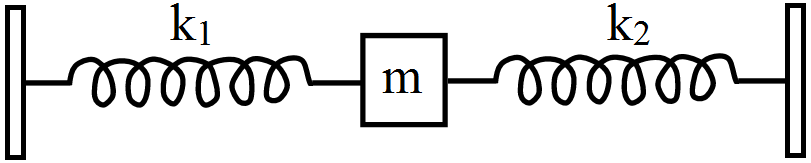
Two spring of force constants k1 and k2 are connected to a mass m as shown in figure. The frequency of oscillation of the mass is f. If both k1 and k2 are made four times their original values, the frequency of oscillation becomes

Answer
  1. 2f

Exlanation:

Frequency of oscillation,

$\text{f}=\frac{1}{2\pi}\sqrt{\frac{\text{k}_1+\text{k}_2}{\text{m}}}$

$\text{f}'=\frac{1}{2\pi}.2\sqrt{\frac{\text{k}_1+\text{k}_2}{\text{m}}}=2\text{f}$

View full question & answer
MCQ 641 Mark
  • A
    0.62cm-s-1
  • B
    1.81cm-s-1
  • C
    3.62cm-s-1.
  • D
    5.2cm-s-2
Answer
  1. 0.62cm-s-1

Explanation:

Equating the given equation with the equation of S.H.M.; $\text{y = r}\sin(\omega\text{t}+\theta)$

we have r = 1cm and $\theta=\frac{\pi}{4}$

$\therefore\text{Max. acceleration}=\omega^2\text{r}=\Big(\frac{\pi}{4}\Big)^2\times1=0.62\text{cm-s}^{-1}$ 

View full question & answer
MCQ 651 Mark
A simple pendulum has time period T1. The point of suspension is now moved upwards according to relation, y=kt2. (k = 1ms-2), where y is the vertical displacement. The time period now becomes T2. The ratio of $\frac{\text{T}^2_1}{\text{T}^2_2}$ is (g = 10ms2)
Answer
  1. $\frac{6}{5}$

Explanation:

Given, $\text{y = kt}^2;\frac{\text{dy}}{\text{dt}}=2\text{kt}$ and

$\frac{\text{d}^2\text{y}}{\text{dt}^2}=2\text{k}=2\times1=2\text{ms}^{-2}$

So point of suspension is moving upwards with acceleration a = 2ms-2. The effective acceleration due to gravity on pendulum is

$\text{g}'=\text{g + a}=10+2=12\text{ms}^{-2}$

$\text{T}_1=2\pi\sqrt{\frac{\text{l}}{\text{g}}}$ and $\text{T}_2=2\pi\sqrt{\frac{\text{l}}{\text{g}'}}$

$\therefore\frac{\text{T}^2_1}{\text{T}^2_2}=\frac{\text{g}'}{\text{g}}=\frac{12}{10}=\frac{6}{5}$

View full question & answer
MCQ 661 Mark
A mass of 1kg attached to the bottom of a spring has a certain frequency of vibration. The following mass has to be added to it in order to reduce the frequency by half:
  • A
    1kg
  • B
    2kg
  • C
    3kg
  • D
    4kg
Answer
  1. 3kg

Explanation:

$\text{v}=\frac{1}{2\pi}\sqrt{\frac{\text{k}}{\text{m}}}$ and $\frac{\text{v}}{2}=\frac{1}{2\pi}\sqrt{\frac{\text{k}}{\text{m}_1}}$

$\therefore2=\sqrt{\frac{\text{m}_1}{\text{m}_2}}$

$\text{m}_1=4\text{m}=4\times1=4\text{kg}$

Hence mass added $=\text{m}_1-\text{m}=4-1=3\text{kg}$

View full question & answer
MCQ 671 Mark
The total energy of particle performing S.H.M. is depends on:
  • A
    k, A, m
  • B
    k, A
  • C
    k, A, x
  • D
    k, x
Answer
  1. k, A

Explanation:

Total energy of a particle performing S.H.M. is

$\text{E}=\frac{1}{2}\text{kA}^2$​​​​​​​

View full question & answer
MCQ 681 Mark
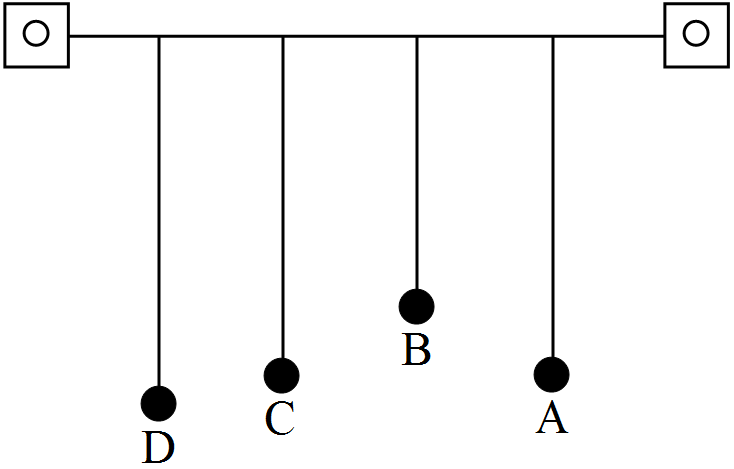
Four pendulums A, B, C and D are suspended from the same elastic support as shown in Fig A and C are of the same length, while B is smaller than A and D is larger than A. If A is given a transverse displacement,

  • A
    D will vibrate with maximum amplitude.
  • B
    C will vibrate with maximum amplitude.
  • C
    B will vibrate with maximum amplitude.
  • D
    All the four will oscillate with equal amplitude.
Answer
  1. C will vibrate with maximum amplitude.

Explanation:

Here A is given a transverse displacement. Through the elastic support the disturbance is transferred to all the pendulums.

A and C are having same length, hence they will be in resonance, because of their time period of oscillation. Since length of pendulums A and C is same and $\text{T}=2\pi\sqrt{\frac{\text{L}}{\text{g}}}$ hence their time period is same and they will have frequency of vibration. Due to it, a resonance will take place and the pendulum C will vibrate with maximum amplitude.

View full question & answer
MCQ 691 Mark
The displacement of a particle in SHM varies according to the relation $\text{x}=4(\cos\pi\text{t}+\sin\pi\text{t})$ The amplitude of the particle is:
Answer
  1. $4\sqrt{2}$

Exlanation:

Given equation $\text{x(t)}=4(\cos\pi\text{t}+\sin\pi\text{t})$

Now comparing cbove equation with general form $\text{x(t)}=\text{A}\cos\omega\text{t}+\text{B}\sin\omega\text{t}$

We get A = 4 and B = 4

As, the resultant amplitude for such a equation is

$=\sqrt{\text{A}^2+\text{B}^2}$

$\therefore$ Amplitude $=\sqrt{4^2+4^2}=4\sqrt{2}$

View full question & answer
MCQ 701 Mark
The rotation of earth about its axis is:
  • A
    Periodic motion.
  • B
    Simple harmonic motion.
  • C
    Periodic but not simple harmonic motion.
  • D
    Non-periodic motion.
Answer
  1. Periodic motion.
  1. Periodic but not simple harmonic motion.

Explanation:

Rotation of earth about its axis repeats its motion after a fixed interval of lime, so its motion is periodic.

The rotation of earth is obviously not a to and fro type of motion about a fixed point, hence its motion is not an oscillation. Also this motion does not follow S.H.M equation, $\text{a}\propto-\text{x}$

Hence, this motion is not a S.H.M.

View full question & answer
MCQ 711 Mark
Two masses m1 and m2 are suspended together by a massless spring of spring constant k. When the masses are in equilibrium m1 is removed without disturbing the system, then the angular velocity of oscillation of m2 is:
Answer
  1. $\sqrt{\frac{\text{k}}{\text{m}_2}}$

Explanation:

When mass m1, is removd there is only mass m2 attached to the spring of spring constant k. Then spring factor = k and inertia factor = m2.

Angular frequency, $\omega=\sqrt{\frac{\text{Spring factor}}{\text{Inertia factor}}}=\sqrt{\frac{\text{k}}{\text{m}_2}}$

View full question & answer
MCQ 721 Mark
Two simple pendulums of length 5m and 10m respectively are given small linear displacement in one direction at the same time. They will be again in the phase when the pendulum of shorter length has completed oscillations:
  • A
    1
  • B
    2
  • C
    3
  • D
    5
Answer
  1. 2

Explanation:

In case of simple pendulum,

$\text{T}=2\pi\sqrt{\frac{5}{\text{g}}}$ and $\text{T}'=2\pi\sqrt{\frac{10}{\text{g}}}$

$\therefore\text{T}'=2\text{T}$

Let the two pendulums are in same phase for first time when shorter one has completed n oscillations. Then

$\text{nT = (n}-1)\text{T}'$

$\frac{\text{n}}{\text{n}-1}=\frac{\text{T}'}{\text{T}}=\frac{2\text{T}'}{\text{T}}=2$

$\text{n = 2n}-2$

$\text{n}=2$

View full question & answer
MCQ 731 Mark
A horizontal platform with an object placed on it is executing S.H.M. in the vertical direction.
The amplitude of oscillation is 3.92 × 10⁻³m. At what time the object is not detached from the platform?
  • A
    0.1256 sec.
  • B
    0.1356 sec.
  • C
    0.1456 sec.
  • D
    0.156 sec.
Answer
  1. 0.1256 sec.

Explanation:

The object is not detached from the platform if

$\text{mg = mr}\omega^2=\text{mr}\frac{4\pi\text{r}^2}{\text{T}^2}$

$\text{T}=2\pi\sqrt{\frac{\text{r}}{\text{g}}}=2\times\frac{22}{7}\sqrt{\frac{3.29\times10^{-3}}{9.8}}$

$=0.1256\text{ sec}$

View full question & answer
MCQ 741 Mark
A particle performs harmonic oscillations along a straight line with a period of 6s and amplitude 4cm. The mean velocity of the particle averaged over the time interval during which it travels a distance of 2cm starting from the extreme position is:
  • A
    1cms s-1
  • B
    2cm s-1
  • C
    4 cos s-1
  • D
    8cm s-1
Answer
  1. 2cm s-1

Explanation:

Here; f = 6s; r : 4cm; Displacement from the mean position when the panicle travels 2cm from the extreme position is, x = 4 - 2 = 2.0cm. If t is the time taken then,

$\text{x = r}\cos\omega\text{t = r}\cos\frac{2\pi}{\text{T}}\text{t}$

$\therefore2=4\cos\frac{2\pi}{6}\text{t}$

$\cos\frac{\pi\text{t}}{3}=\frac{2}{4}=\frac{1}{2}=\cos\frac{\pi}{3}$

$\text{t}=1\text{s}$

$\therefore$ Average velocity $=\frac{\text{Distance}}{\text{Time}}=\frac{2}{\text{T}}=2\text{cm s}^{-1}$

View full question & answer
MCQ 771 Mark
 A body is performing S.H.M. Then its:
  • A
    Average total energy per cycle is equal to its maximum kinetic energy.
  • B
    Average kinetic energy per cycle is equal to half of its maximum kinetic energy.
  • C
    Mean velocity over a complete cycle is equal to $\frac{2}{\pi}$ times of its maximum velocity.
  • D
    Root mean square velocity is $\frac{1}{\sqrt{2}}$ times of its maximum velocity.
Answer
  1. Average total energy per cycle is equal to its maximum kinetic energy.
  1. Average kinetic energy per cycle is equal to half of its maximum kinetic energy.
  1. Root mean square velocity is $\frac{1}{\sqrt{2}}$ times of its maximum velocity.

Explanation:

In case of S.H.M, average total energy per cycle

= Maximum kinetic energy (K0)

= Maximum potential energy (U0)

Average KE per cycle $=\frac{0+\text{K}_0}{2}=\frac{\text{K}_0}{2}$

Let us write the equation for the SHM $\text{x}=\text{a}\sin\omega\text{t}.$

Clearly, it is a periodic motion as it involves sine function.

Let us find velocity of the particle, $\text{v}=\frac{\text{dx}}{\text{dt}}=\frac{\text{d}}{\text{dt}}(\text{a}\sin\omega\text{t})=\text{a}\omega\cos\omega\text{t}$

Mean velocity over a complete cycle,

$\text{v}_\text{mean}=\frac{\int_{0}^{2\pi}\omega\text{a}\cos\theta\text{d}\theta}{2\pi}=\frac{\omega\text{a}[\sin\theta]^2_0}{2\pi}=0$

So, $\text{v}_\text{mean}\neq\frac{2}{\pi}\text{v}_\text{max}$

Root mean square speed,

$\text{v}_\text{ms}=\sqrt{\frac{\text{v}^2_\text{min}+\text{v}^2_\text{max}}{2}}=\sqrt{\frac{0+\text{v}^2-\text{max}}{2}}$

$\text{v}_\text{ms}=\frac{1}{\sqrt{2}}\text{v}_\text{max}$

View full question & answer
MCQ 781 Mark
The displacement of a particle varies with time according to the relation:

$\text{y}=\text{a}\sin\omega\text{t}+\text{b}\cos\omega\text{t}$

  • A
    The motion is oscillatory but not S.H.M.
  • B
    The motion is S.H.M. with amplitude a + b.
  • C
    The motion is S.H.M. with amplitude a2 + b2
  • D
    The motion is S.H.M. with amplitude $\sqrt{\text{a}^2+\text{b}^2}.$
Answer
  1. The motion is S.H.M. with amplitude $\sqrt{\text{a}^2+\text{b}^2}.$

Explanation:

key concept: The sum of two S.H.Ms of same frequencies is a S.H.M.

According to the question, the displacement

$\text{y}=\text{a}\sin\omega\text{t}+\text{b}\cos\omega\text{t}$

Given $\text{x}=\text{a}\sin\omega\text{t}+\text{b}\cos\omega\text{t}$

Let $\text{a}=\text{A}\cos\phi$

And $\text{b}=\text{A}\sin\phi$

Squaring and adding (ii) and (iii), we get

$\text{a}^2+\text{b}^2=\text{A}^2\cos^2\phi+\text{A}^2\sin^2\phi=\text{A}^2$

$=\text{A}^2\Rightarrow\text{A}=\sqrt{\text{a}^2+\text{b}^2}$

$\text{y}=\text{A}\sin\phi.\sin\omega\text{t}+\text{A}\cos\phi.\cos\omega\text{t}$

$=\text{A}\sin(\omega\text{t}+\phi)$

$\frac{\text{dy}}{\text{dt}}=\text{A}\omega\cos(\omega\text{t}+\phi)$

$\frac{\text{d}^2\text{y}}{\text{dt}^2}=-\text{A}\omega^2\sin(\omega\text{t}+\phi)$

$=-\text{A}\text{y}\omega^2=(-\text{A}\omega^2)\text{y}$

$\Rightarrow\frac{\text{d}^2\text{y}}{\text{dt}^2}\propto(-\text{y})$

Hence, it is an equation of SHM with amplitude

$\text{A}=\sqrt{\text{a}^2+\text{b}^2}$

View full question & answer
MCQ 791 Mark
The displacement time graph of a particle executing S.H.M. is shown in Fig.Which of the following statement is/ are true?
  • A
    The force is zero at $\text{t}=\frac{3\text{T}}{4}.$
  • B
    The acceleration is maximum at $\text{t}=\frac{4\text{T}}{4}.$
  • C
    The velocity is maximum at $\text{t}=\frac{\text{T}}{4}.$
  • D
    The P.E. is equal to K.E. of oscillation at $\text{t}=\frac{\text{T}}{4}.$
Answer
  1. The force is zero at $\text{t}=\frac{3\text{T}}{4}.$
  1. The acceleration is maximum at $\text{t}=\frac{4\text{T}}{4}.$
  1. The velocity is maximum at $\text{t}=\frac{\text{T}}{4}.$

Explanation:

  1. At $\text{t}=\frac{3\text{T}}{4}$Particle is at it's mean position so force acting on it is zero, but it continue the motion due to inertia of mass, here a = 0, so F = 0.

  2. At $\text{t}=\frac{4\text{T}}{4}=\text{T},$particle's velocity changes increasing to decreases so maximum change in velocity at T. As Acceleration$=\frac{\text{change in velocity}}{\text{Time}},$so acceleration is maximum here.

  3. $\text{t}=\frac{\text{T}}{2}=\frac{2\text{T}}{4},$the particles has K.E = 0. So $\text{KE}\neq\text{PE}.$

View full question & answer
MCQ 801 Mark
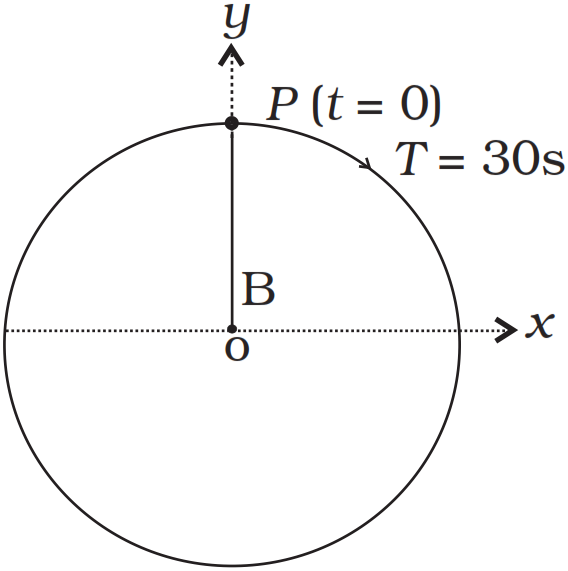
Answer
  1. $\text{x}(\text{t})=\text{B}\sin\Big(\frac{2\pi\text{t}}{30}\Big).$

Explanation:

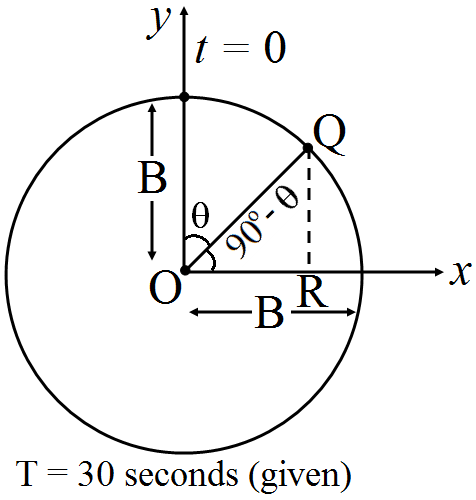
As the particle P is executing circular motion with radius B. let particle P is at Q at instant t, foot of perpendicular on x-axis is at R vector OQ makes $<\theta$ with its zero position not p displacement for O to R.

$\text{x}=\text{OQ}\cos(90^\circ-\theta) $

$\text{x}=\text{OQ}\sin\theta=\text{B}\sin\omega\text{t}\therefore\theta=\omega\text{t}$

$\text{x}=\text{B}\sin\frac{2\pi}{\text{T}}\text{t}$

$\therefore\text{x}=\text{B}\sin\Big(\frac{2\pi}{30}\text{t}\Big)$

View full question & answer
MCQ 811 Mark
The density $\rho$ of a liquid varies with depth h from the free surface as $\rho=\text{kh.}$ A small body of density $\rho_1$ is released from the surface of liquid. The body will:
  • A
    Come to a momentary rest at a depth $\frac{2\rho_1}{\text{k}}$ from the free surface.
  • B
    Execute S.H.M. about a point at a depth $\frac{\rho_1}{\text{k}}$ from the surface.
  • C
    Execute S.H.M. of amplitude $\frac{\rho_1}{\text{k}}.$
  • D
    All of these.
Answer
  1. All of these.
View full question & answer
M.C.Q (1 Marks) - Page 2 - Physics STD 11 Science Questions - Vidyadip