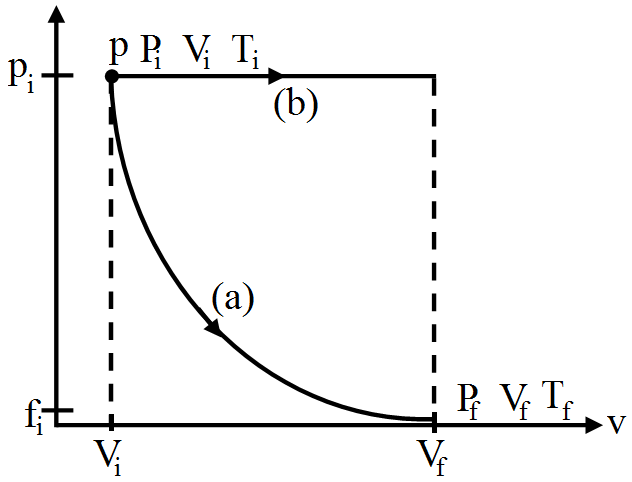
$\therefore\text{dQ}=\text{dU}+\text{dW}=0$
$\text{dU}=-\text{dW}=-(-200\text{J})=200\text{J}$
Internal energy increases by 200J. Heat absorbed is zero.
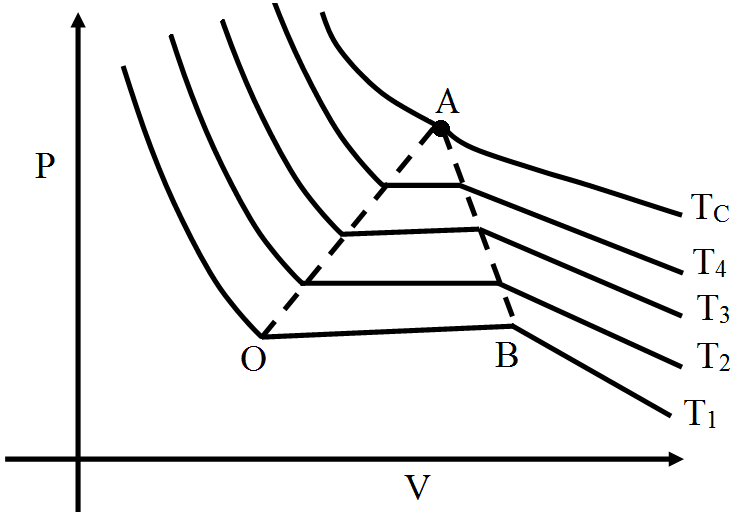
$\eta_1=\frac{1873-773}{1873}=\frac{1100}{1873}$
$=\frac{1100\times100}{1873}=58.73\%$
$\eta_2=\frac{1773-673}{1773}=\frac{1100}{1773}$
$=\frac{1100\times100}{1773}=62.04\%$
Thus, $\eta_2>\eta_1$ Hence efficiency will be increased if T2 is decreased from 500°C to 400°C.$\Rightarrow\frac{\text{x}-1}{\text{x}}=\frac{250}{300}$
$\Rightarrow\text{Q}_1=\text{x}=6\text{J}$
$\beta=\frac{\text{T}_2}{\text{T}_1-\text{T}_2}=\frac{250}{300-250}=5$

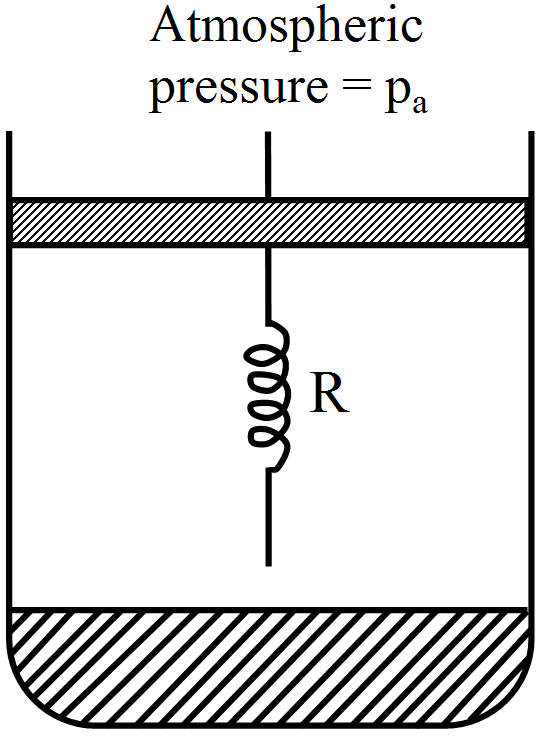
$\Delta\text{Q}=\Delta\text{U}+\Delta\text{W}$ Where,
$\Delta\text{U}=\text{C}_\text{V}(\text{T}-\text{T}_0),$ $\Delta\text{W}=\text{p}_\text{a}(\text{V}-\text{V}_0)+\frac12\text{k}(\text{V}-\text{V}_0)^2$
$\Delta\text{Q}=\text{p}_\text{a}(\text{V}-\text{V}_0)+\frac12\text{k}(\text{V}-\text{V}_0)^2+\text{C}_\text{V}(\text{T}-\text{T}_0)$
Where, $\text{T}_0=\text{p}_\text{a}\frac{\text{V}_0}{\text{R}},$
$\Rightarrow\text{T}=\Big[\text{p}_\text{a}+\Big(\frac{\text{K}}{\text{A}}\Big)\times(\text{V}-\text{V}_0)\Big]\frac{\text{V}}{\text{R}}$

On striking the ground, some part of potential energy converts into heat and (sound not possible that heat and the sound). In nature, it automatically convert the kinetic energy and potential energy so that the water will rise back so waterfall is not a reversible process.
Differentiating, VdP + PDV = 0
$\therefore\frac{\text{dP}}{\text{dV}}=-\frac{\text{P}}{\text{V}}$
For adiabatic process,
$\text{PV}^{\gamma}=$ constant.Differentiating,
$\text{V}^{\gamma}\text{dP}+\gamma\text{PV}^{\gamma-1}\text{dV}=0$
$\therefore\frac{\text{dP}}{\text{dV}}=-\frac{\gamma\text{P}}{\text{V}}$
Comparing the two ratios, we can say, slope of adiabatic process is
$\gamma$ times the slope of isothermal process.Where, T2 = sink temperature
T1 = source temperature
$1-\frac{\text{T}_2-100}{\text{T}_1}\dots\text{(i)}$
$1-\Big(\frac{\text{T}_2-100}{\text{T}_1}\Big)=\frac23\dots\text{(ii)}$
From equation (i), $\frac{\text{T}_2}{\text{T}_1}=\frac{1}{2}$ and equation (ii),
${\text{T}_2-100\over\text{T}_1}=\frac32$
$\Rightarrow\text{T}_2=300\text{K}$
$\therefore$ It equals to 1 only when $\frac{\text{T}_2}{\text{T}_1}=0$ or $\text{T}_2=0\text{K}$
But absolute zero is not possible.