- A242Hz
- B258Hz
- C282Hz
- D262Hz
- 258Hz
Explanation:
When source approaches the observer, apparent wavelength of sound decreases.
Exaplanation:
Here, $\text{y}=10^{-4}\sin\Big(600\text{t}-2\text{x}+\frac{\pi}{3}\Big)$
Compare it with the standard equation of a travalling wave
$\text{y}=\text{r}\Big(\frac{2\pi\text{t}}{\text{T}}-\frac{2\pi\text{x}}{\lambda}\neq\phi\Big)$
$\frac{2\pi}{\text{T}}=600,\text{T}=\frac{2\pi}{600}=\frac{\pi}{300}\text{s}$
$\frac{2\pi}{\lambda}=+2\lambda =\frac{2\pi}{2}=\pi\text{m}$
$\nu=\frac{\lambda}{\text{T}}=\frac{\pi}{\frac{\pi}{300}}=300\text{m/s}$

Explanation:
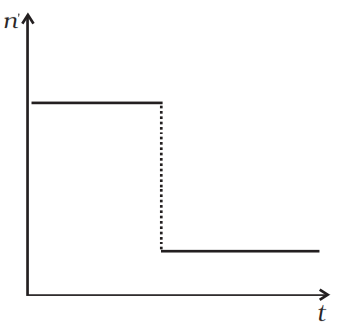
When qbserver is at rest and source of sound id moving towards observer then observed frequency n'.
$\text{n}'=\Big(\frac{\text{v}}{\text{V}-\text{v}_\text{s}}\Big)\text{n}_0$
Where n0 original frequency of source of sound
v = speed of sound in medium
$\therefore\text{n}'>\text{n}_0\ \ \text{v}_\text{s}=$ speed of source
When source is moving away from observer
$\text{n}'=\frac{\text{v}}{(\text{v}+\text{v}_\text{s})}\text{n}_0\ \text{n}''<\text{n}_0$
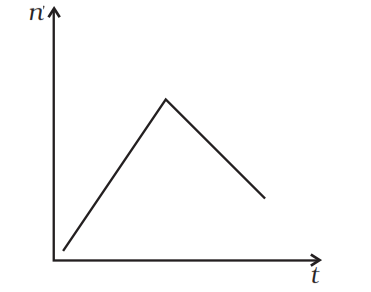
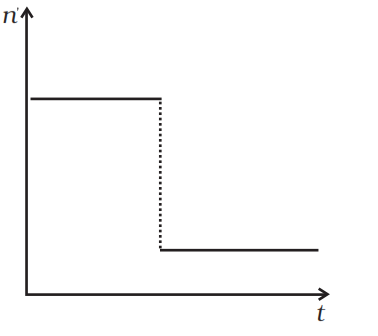
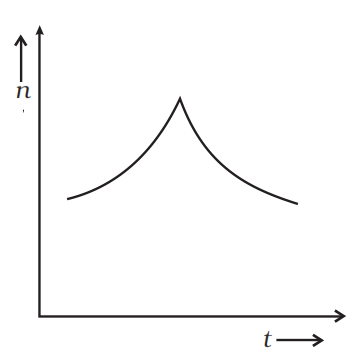
Hence, the frequencies in both cases are same and $\text{n}'>\text{n}''.$ so graph (c) verifies the answer.
Explanation:
M = mass string 2.5kg, l = 20m
M = mas per unit length $=\frac{\text{M}}{\text{l}}=\frac{2.5}{20}=0.125\text{kg/ m}$
$\text{v}=\sqrt{\frac{\text{T}}{\mu}}=\sqrt{\frac{200}{0.125}}=\sqrt{1600}=40\text{m/ s}$
time $= \frac{\text{distance}}{\text{speed}}=\frac{20\text{m}}{40\text{m/ s}}=\frac{1}{2}\sec=0.5\sec.$
Explanation:
As fundamental frequency of vibration is:
$\nu=\frac{1}{2\text{l}}\sqrt{\frac{\text{T}}{\text{m}}}$
$\therefore \nu\propto \frac{1}{\text{l}\sqrt{\text{m}}}$ $(\because $ T is constant$)$
$\text{m}=\pi\text{r}^2\rho$
$\therefore \text{m}\propto \text{r}^2$
$\nu=\frac{1}{\text{l}\sqrt{\text{m}}}\propto \frac{1}{\text{lr}}$
$\frac{\nu_1}{\nu_2}=\frac{\text{l}_2\text{r}_2}{\text{l}_1\text{r}_1}$
$=\Big(\frac{2\text{L}}{\text{L}}\Big)\Big(\frac{\text{r}}{2\text{r}}\Big)=1$
Explanation:
Explanation:
Beat frequency $=\text{f}_2-\text{f}_1=\frac{\omega_2-\omega_1}{2\pi}$
$=\frac{2008\pi-2000\pi}{2\pi}=4\text{Hz}$