Question
Answer the following questions:
How will you bring about the following conversions?
  1. Ethanamine into methanamine.
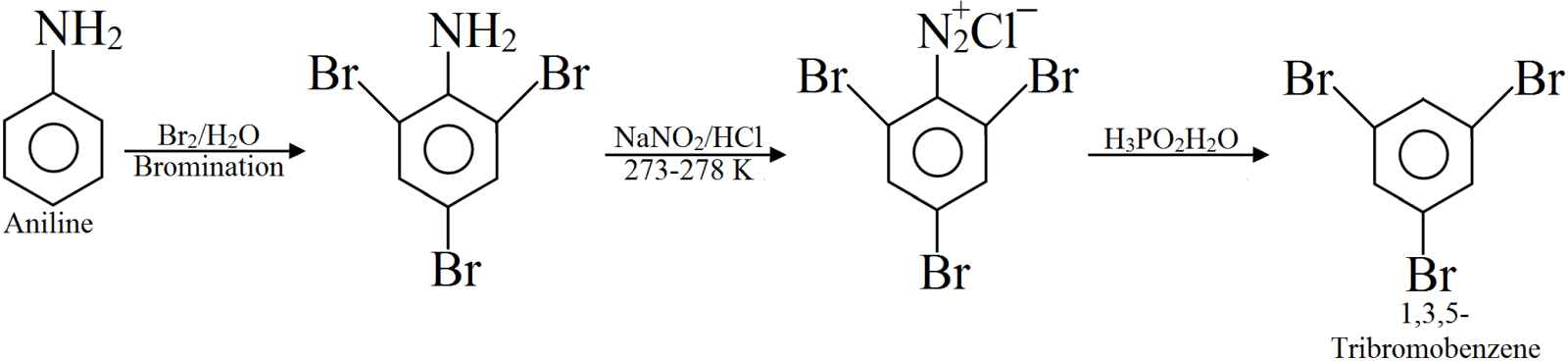
  2. Aniline into 1, 3, 5-tribromobenzene.
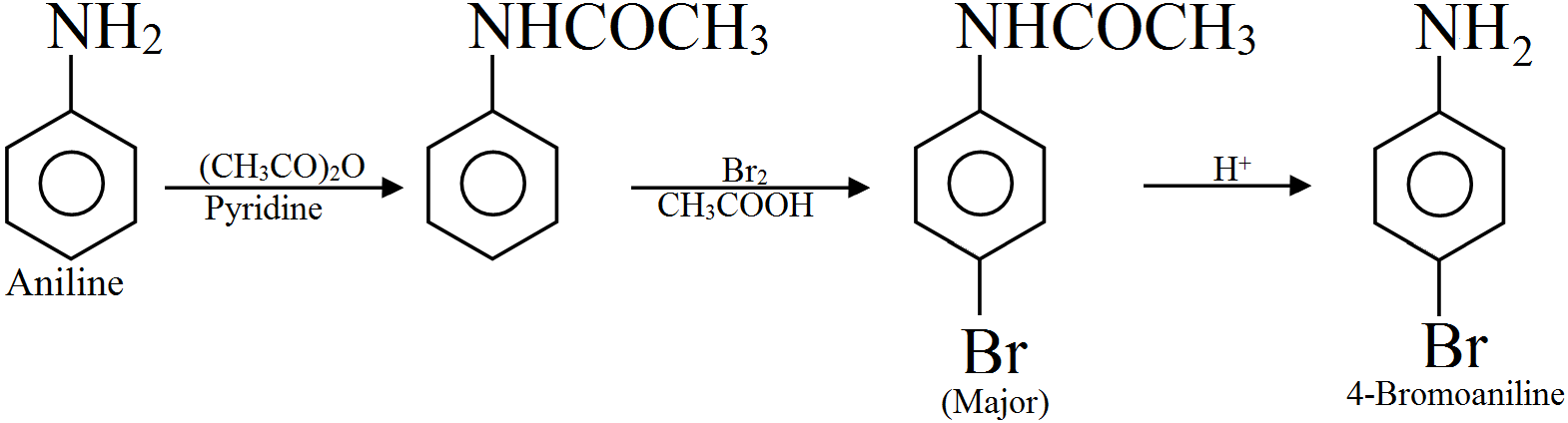
  3. Aniline into 4-bromoaniline.

Answer

  1.  
  1.  
  1.  

Need a full question paper?

Generate a complete, print-ready paper with questions like this in minutes — across 16+ boards, with answer keys.

Start Generating Free

Similar questions

Two elements A and B form compounds having formula AB2 and AB4. When dissolved in 20 g of benzene $\left( C _6 H _6\right), 1 g$ of $AB _2$ lowers the freezing point by 2.3 K whereas 1.0 g of AB4 lowers it by 1.3 K. The molar depression constant for benzene is 5.1 K kg mol-1. Calculate atomic masses of A and B.
Find the expression for first order reaction###How will you know that a reaction is of first order.
State Werner's co-ordination theory.
State the reactions and reaction conditions for the following conversions:
i. Benzene diazonium chloride to nitrobenzene.
ii. Aniline to benzene diazonium chloride.
iii. Ethylamine to methylamine.
Describe the physical and chemical properties of potassium permanganate.
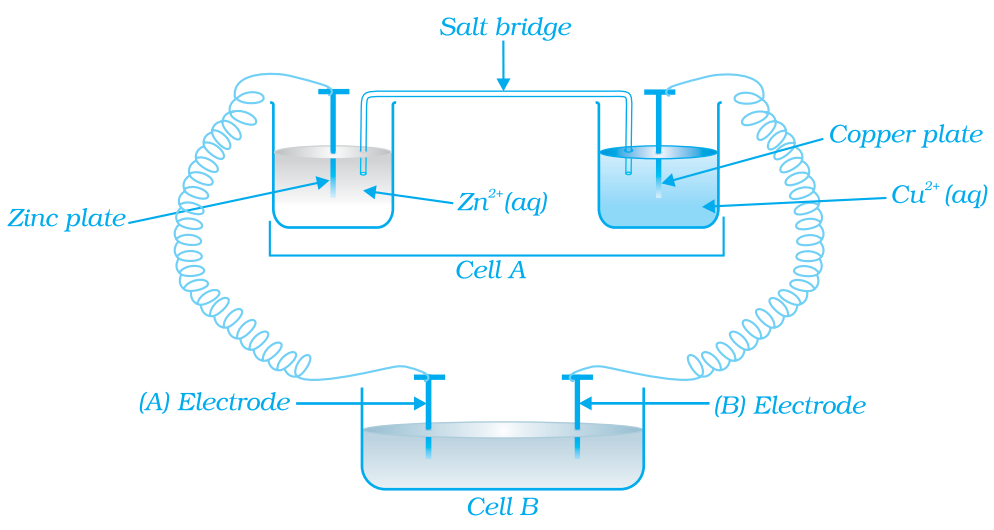
Consider the and answer the following questions.
  1. Cell $'A\ ’$ has $E_{Cell}= 2V$ and Cell $'B\ ’$ has $E_{Cell} = 1.1V$ which of the two cells $'A\ ’$ or $'B\ ’$ will act as an electrolytic cell. Which electrode reactions will occur in this cell?
  2. If cell $'A\ ’$ has $E_{Cell}= 0.5V$ and cell $'B\ ’$ has $E_{Cell}= 1.1V$ then what will be the reactions at anode and cathode?
Why the reactivity of chlorobenzene towards nucleophilic substitution increase when electron withdrawing group ( $- NO _2$ ) is attached to the ortho and para positions? Explain.
A hydrocarbon $'A', (C_4H_8)$ on reaction with $HCl$ gives a compound $'B', (C_4H_9Cl)$, which on reaction with $1 \ mol$ of $NH_3$ gives compound $'C', (C_4H_{11}N)$. On reacting with $NaNO_2$ and $HCl$ followed by treatment with water, compound $'C\ '$ yields an optically active alcohol,$'D\ '$. Ozonolysis of $'A\ '$ gives $2$ mols of acetaldehyde. Identify compounds $'A\ '$ to $'D\ '$. Explain the reactions involved.
Explain Kohlrausch's law of independent migration of ions. Mention the application of Kohlrausch's law.
Define enzymes. How do enzymes differ from ordinary chemical catalysts?