MCQ 511 Mark
Which of the following is an essential condition in a situation for linear programming to be useful?
- ✓
- B
Bottlenecks in the objective function
- C
- D
AnswerFor linear programming, the constraints must be linear.
View full question & answer→MCQ 521 Mark
Corner points of the feasible region determined by the system of linear constraints are (0, 3), (1, 1) and (3, 0). Let Z = px + qy, where p, q > 0. Condition on p and q so that the minimum of Z occurs at (3, 0) and (1, 1) is:
AnswerCorrect option: B. $\text{p}=\frac{\text{q}}{2}$
$\text{p}=\frac{\text{q}}{2}$
View full question & answer→MCQ 531 Mark
A set of values of decision variables that satisfies the linear constraints and non - negativity conditions of an L.P.P. is called its:
MCQ 541 Mark
If A = {1, 2, 3}; B = {3, 4, 5}; C = {4, 6}, then $\text{A}\times(\text{B}\cap\text{C})=?$
AnswerGiven,
A = {1, 2, 3}
B = {3, 4, 5}
C = {4, 6}
Now, $\text{B}\cap\text{C}=\{{4\}}$
$\therefore\text{A}\times(\text{B}\cap\text{C})=\{(1,4),(2,4),(3,4)\}$
View full question & answer→MCQ 551 Mark
The optimal value of the objective function is attained at the points
- A
given by intersection of inequations with the axes only
- B
given by intersection of inequations with x-axis only
- ✓
given by corner points of the feasible region
- D
AnswerCorrect option: C. given by corner points of the feasible region
It is known that the optimal value of the objective function is attained at any of the corner point.
Thus, the potimal value of the objective function is attined at the points given by corner points of the feasible region.
View full question & answer→MCQ 561 Mark
The feasible solution of a LPP belongs to:
- A
First and second quadrants
- B
First and third quadrants.
- C
- ✓
View full question & answer→MCQ 571 Mark
The given table shows the number of cars manufactured in four different colours on a particular day. Study it carefully and answer the question.
|
|
Number of cars manufactured
|
|
Colour
|
Vento
|
Creta
|
WagonR
|
|
Red
|
65
|
88
|
93
|
|
White
|
54
|
42
|
80
|
|
Black
|
66
|
52
|
88
|
|
Sliver
|
37
|
49
|
74
|
What was the total number of black cars manufactured?
AnswerThe number of Black cars manufactured.
= no. of black V ento + no. of black Creta + no. of black W agon R.
= 66 + 52 + 88 = 206
View full question & answer→MCQ 581 Mark
Minimize $Z = 20x_1 + 9x_2$, subject to $\text{x}_{1}\geq0,\text{x}_{2}\geq0,2\text{x}_{1}+2\text{x}_{2}\geq36,6\text{x}_{1}+\text{x}_{2}\geq60.$
- A
$360$ at $(18, 0)$
- ✓
$336$ at $(6, 4)$
- C
$540$ at $(0, 60)$
- D
$0$ at $(0, 0)$
AnswerCorrect option: B. $336$ at $(6, 4)$
View full question & answer→MCQ 591 Mark
The linear inequalities or equations or restrictions on the variables of a linear programming problem are called:
MCQ 601 Mark
While plotting constraints on a graph paper, terminal points on both the axes are connected by a straight line because:
- A
The resources are limited in supply.
- B
The objective function as a linear function.
- ✓
The constraints are linear equations or inequalities.
- D
AnswerCorrect option: C. The constraints are linear equations or inequalities.
The graph of the linear equation is a straight line.
If the terminal points are connected by a straight line then the given constraints are linear equations which may include inequalities.
View full question & answer→MCQ 611 Mark
Choose the correct answer from the given four options.
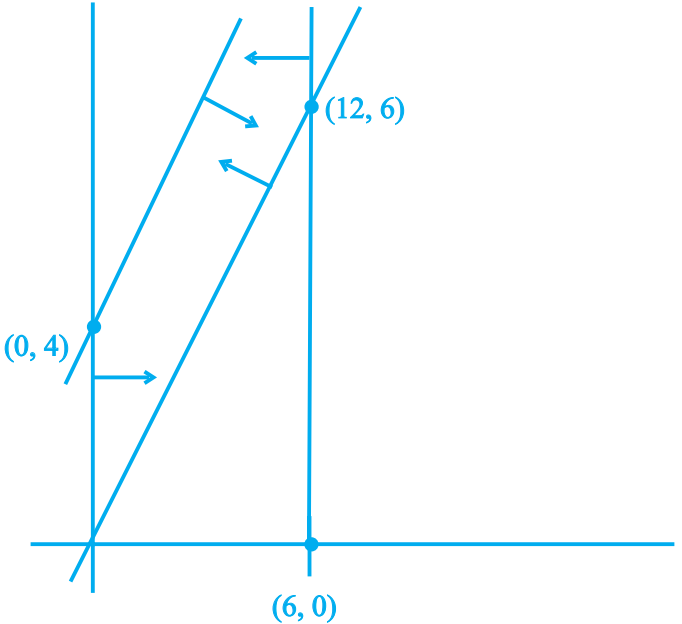
Let F = 3x - 4y be the objective function. Maximum value of F is:
AnswerThe feasible region as shown in the figure, has objective function F = 3x - 4y
|
Corner points
|
Corresponding value of Z = 3x - 4y
|
|
(0, 0)
(12, 6)
(0, 4)
|
0
12 (maximum)
-16 (minimum)
|
Hence, the maximum value of F is 12.
View full question & answer→MCQ 621 Mark
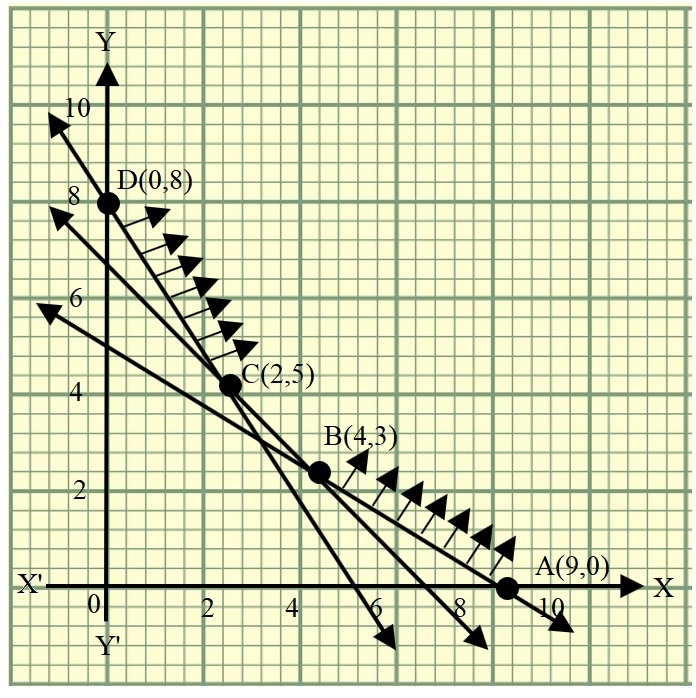
Feasible region (shaded) for a LPP is shown in the given figure. Minimum of z = 4x + 3y occurs at the point.
MCQ 631 Mark
The corner points of the feasible region determined by the system of linear constraints are (0, 10), (5, 5), (25, 20) and (0, 30). Let Z = px + qy, where p, q > 0. Condition on p and q so that the maximum of Z occurs at both the points (25, 20) and (0, 30) is _______.
AnswerMaximum of Z occurs at (25, 20) and at (0, 30).
Hence, equating the vales of Z at these points, we get 25p + 20q = 30q
$\therefore$ 5p = 2q
This is the required relation.
Also as p, q > 0, the value of Z is always positive and hence, is greater at (25, 20) and at (0, 30) than at (0,10) and (5, 5).
View full question & answer→MCQ 641 Mark
Choose the most correct of the following statements relating to primal - dual linear programming problems:
- A
Shadow prices of resources in the primal are optimal values of the dual variables.
- B
The optimal values of the objective functions of primal and dual are the same.
- C
If the primal problem has unbounded solution, the dual problem would have infeasibility.
- ✓
AnswerFrom the primal - dual relationship, The shadow prices of resources in the primal are optimal values of the dual variables.
If one of the problems has an optimal feasible solution then the other problem also has an optimal feasible solution.
The optimal objective function value is same for both primal and dual problems.
If one problem has an unbounded solution then the other problem is infeasible.
View full question & answer→MCQ 651 Mark
Linear programming used to optimize mathematical procedure and is:
- ✓
Subset of mathematical programming
- B
Dimension of mathematical programming
- C
Linear mathematical programming
- D
AnswerCorrect option: A. Subset of mathematical programming
Linear programming is an extremely powerful tool for addressing a wide range of applied optimization problems.
A short list of application areas is resource allocation, production scheduling, warehousing, layout, transportation scheduling, facility location, flight crew scheduling, portfolio optimization, parameter estimation.
So, linear programming is used to subset mathematical programming.
View full question & answer→MCQ 661 Mark
The maximum value of $Z = 3x + 2y,$ subjected to $\text{x}+2\text{y}\leq2,\text{x}+2\text{y}\geq8;\text{x},\text{y}\geq0 $ is:
View full question & answer→MCQ 671 Mark
If $\text{x}+\text{y}\leq2,$ $\text{x}\leq0,$ $\text{y}\leq0$ the point at which maximum value of 3x + 2y attained will be.
AnswerCorrect option: A. $(0,0)$
$\text{x}\leq0$ and $\text{y}\leq0$ represents third Quadrant $\text{x}+\text{y}\leq2$ represents the region below the line $\text{x}+\text{y}\leq2$ (the region which contains origin)
The common region of given set of equations is third quadrant (including negative x axis and negative y axis)
Since x and y values are $\leq0$ in the third quadrant, the maximum value of 3x + 2y occurs at x = 0 and y = 0 and the maximum value is 0.
View full question & answer→MCQ 681 Mark
The region represented by the inequalities $\text{x}\geq6,\text{y}\geq2,2\text{x}+\text{y}\leq0,\text{x}\geq0,\text{y}\geq{0}$ is:
View full question & answer→MCQ 691 Mark
The objective function Z = 4x + 3y can be maximised subjected to the constraints $ 3\text{x}+4\text{y}\leq24,$ $8\text{x}+6\text{y}\leq48,$ $\text{x}\leq5,\text{y}\leq6;\text{x},\text{y}\leq0.$
- A
- B
- ✓
At an infinite number of points.
- D
AnswerCorrect option: C. At an infinite number of points.
At an infinite number of points.
View full question & answer→MCQ 701 Mark
The corner points of the feasible region determined by the system of linear constraints are (0, 10), (5, 5), (15, 15), (0, 20). Let Z = px + qy, where p, q > 0. Condition on p and q so that the maximum of Z occurs at both the points (15, 15) and (0, 20) is Maximum of Z occurs at:
MCQ 711 Mark
Which of the following is a type of Linear programming problem?
MCQ 721 Mark
The corner points of the feasible region are A(0, 0), B(16, 0), C(8, 16) and D(0, 24). The minimum value of the objective function z = 300x + 190y is _______:
AnswerWe know that, for a cartesian polygon , the maximum value occurs at the corner points or vertices of the polygon.
Given z = 300x + 190y
By substituting A(0, 0) in the equation we get z = 0
By substituting B(16, 0) in the equation we get z = 4800
By substituting C(8, 16) in the equation we get z = 5440
By substituting D(0, 24) in the equation we get z = 4560
Hence the minimum value of Z occured at C(0, 0) with z = 0
View full question & answer→MCQ 731 Mark
In solving the LPP: “minimize f = 6x + 10y subect to constraints $\text{x}\geq6,\text{y}\geq2,2\text{x}+\text{y}\geq10,\text{x}\geq0,\text{y}\geq0$” redundant constraints are:
- A
$\text{x}\geq6,\text{y}\geq2$
- ✓
$2\text{x}+\text{y}\geq10,\text{x}\geq0,\text{y}\geq0$
- C
$\text{x}\geq6$
- D
$\text{None of these}$
AnswerCorrect option: B. $2\text{x}+\text{y}\geq10,\text{x}\geq0,\text{y}\geq0$
$2\text{x}+\text{y}\geq10,\text{x}\geq0,\text{y}\geq0$
View full question & answer→MCQ 741 Mark
The optimal value of the objective function is attained at the points:
- A
- B
- ✓
Which are corner points of the feasible region
- D
AnswerCorrect option: C. Which are corner points of the feasible region
Which are corner points of the feasible region
View full question & answer→MCQ 751 Mark
Consider the objective function Z = 40x + 50y The minimum number of constraints that are required to maximize Z are:
AnswerSince in the given function Z = 40x + 50y, two variables are used.
So, the two constraints will be $\text{x}\geq0,\text{y}\geq0$ and the third one will be of the type
$\text{ax}+\text{by}\geq\text{c}.$
Hence, at least 3 constraints are required.
View full question & answer→MCQ 761 Mark
Z = 7x + y, subject to $ 5\text{x}+\text{y}\geq5,\text{x}+\text{y}\geq3,\text{x}\geq0, y\geq0.$ The minimum value of Z occurs at:
AnswerCorrect option: D. $(0,5)$
$(0,5)$
View full question & answer→MCQ 771 Mark
The optimal value of the objective function is attained at the points:
- A
- B
- ✓
Corner points of the feasible region
- D
AnswerCorrect option: C. Corner points of the feasible region
Any point in the feasible region that gives the optimal value (maximum or minimum) of the objective function is called an optimal solution.
View full question & answer→MCQ 781 Mark
An iso-profit line represents:
- ✓
An infinite number of solutions all of which yield the same profit.
- B
An infinite number of solution all of which yield the same cost.
- C
An infinite number of optimal solutions.
- D
A boundary of the feasible region.
AnswerCorrect option: A. An infinite number of solutions all of which yield the same profit.
The graph of the profit function is called an iso profit line. It is called this because iso means same or equal and the profit anywhere on the line is the same.
So, an iso-profit lines represents an infinite number of solutions all of which yield the same profit.
View full question & answer→MCQ 791 Mark
Maximize Z = 7x + 11y, subject to $3\text{x}+5\text{y}\leq26,5\text{x}+3\text{y}\leq30,\text{x}\geq0,\text{y}\geq0.$
AnswerCorrect option: A. 59 at$\Big(\frac{9}{2},\frac{5}{2}\Big)$
59 at$\Big(\frac{9}{2},\frac{5}{2}\Big)$
View full question & answer→MCQ 801 Mark
Choose the correct answer from the given four options.
The corner points of the feasible region determined by the system of linear constraints are (0, 0), (0, 40), (20, 40), (60, 20), (60, 0). The objective function is Z = 4x + 3y.
Compare the quantity in Column A and Column B.
|
Column A
|
Column B
|
|
Maximum of Z
|
325
|
- A
The quantity in column A is greater .
- ✓
The quantity in column B is greater.
- C
The two quantities are equal.
- D
The relationship can not be determined on the basis of the information supplied.
AnswerCorrect option: B. The quantity in column B is greater.
|
Corner points
|
Corresponding value of Z = 4x + 3y
|
|
(0, 0)
|
0
|
|
(0, 40)
|
120
|
|
(20, 40)
|
200
|
|
(60, 20)
|
300 (Maximum)
|
|
(60, 0)
|
240
|
Hence, maxmimum value of Z = 300 < 325
So, the quantity in column B is greater.
View full question & answer→MCQ 811 Mark
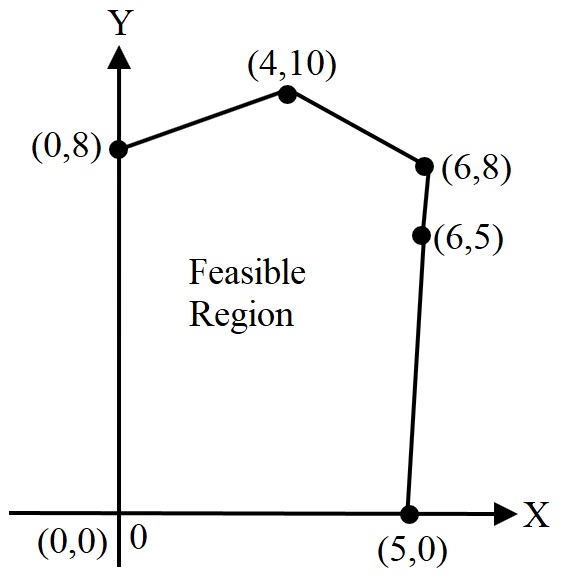
The feasible, region for an LPP is shown shaded in the figure. Let Z = 3x - 4y be the objective function. A minimum of Z occurs at:
MCQ 821 Mark
The solution set of the inequation 3x + 2y > 3 is:
- ✓
Half plane not containing the origin
- B
Half plane containing the origin
- C
The point being on the line 3x + 2y = 3
- D
AnswerCorrect option: A. Half plane not containing the origin
Half plane not containing the origin
View full question & answer→MCQ 831 Mark
Consider a LPP given by
Minimum Z = 6x + 10y
Subjected to x ≥ 6, y ≥ 2, 2x + y ≥ 10, x ≥ 0, y ≥ 0
Redundant constraints in this LPP are
AnswerConsider, x = 6
and y = 2
Now 2x + y = 10
|
x
|
y
|
(x, y)
|
|
0
|
10
|
(0, 10)
|
|
5
|
0
|
(5, 0)
|
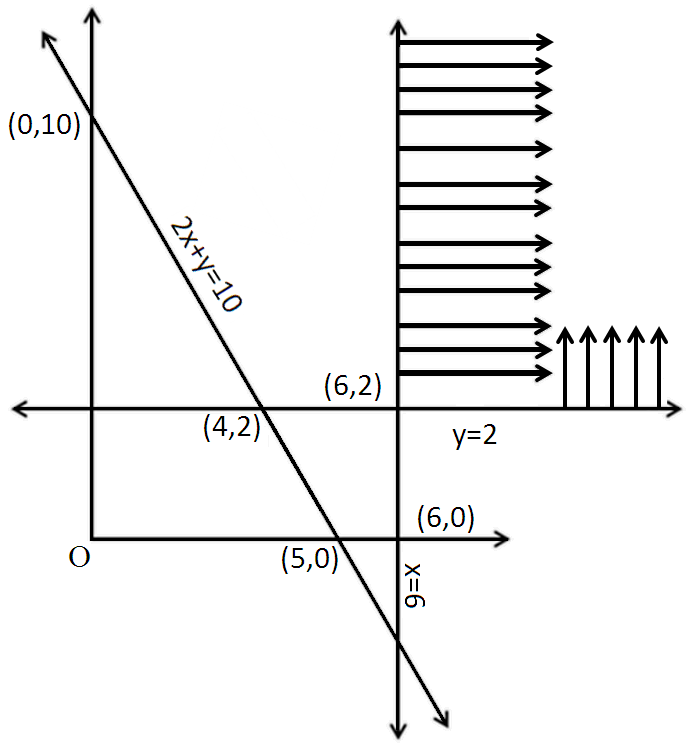
Minimum Z will be at 2x + y ≥ 10.
View full question & answer→MCQ 841 Mark
If $x + y = 3$ and $xy = 2$, then the value of $x^3 - y^3$ is equal to.
AnswerFormula used:
$\text{x}^3-\text{y}^3=(\text{x}-\text{y})(\text{x}^2+\text{xy}+\text{y}^2)$
$=(\sqrt{(\text{x}+\text{y})^{2}-4\text{xy}})[(\text{x}+\text{y})^{2}-\text{xy}]$
$=(\sqrt{(3)^{2}-4(2})[(3)^{2}-2]$
$=(\sqrt{1})(7)=7$
View full question & answer→MCQ 851 Mark
The maximum value of Z = 3x + 4y subjected to contraints $\text{x}+\text{y}\leq40,\text{x}+2\text{y}\leq60,\text{x}\geq0$ and $\text{y}\geq0$ is:
View full question & answer→MCQ 861 Mark
Conclude from the following$:\ n^2 > 10$, and n is a positive integer. $A:\ n^3 B:\ 50$.
AnswerCorrect option: A. The quantity $A$ is may be greater or smaller than $B.$
given, $n^2 > 10$ and $n > 0$ multiplying both equations we get $n^3 > 0$
so, it may be greater than or less than $50.$
Hence, quantity $A$ is may be greater or smaller than $B$
View full question & answer→MCQ 871 Mark
Solving an integer programming problem by rounding off answers obtained by solving it as a linear programming problem (using simplex), we find that.
- A
The values of decision variables obtained by rounding off are always very close to the optimal values.
- ✓
The value of the objective function for a maximization problem will likely be less than that for the simplex solution.
- C
The value of the objective function for a minimization problem will likely be less than that for the simplex solution.
- D
All constraints are satisfied exactly.
AnswerCorrect option: B. The value of the objective function for a maximization problem will likely be less than that for the simplex solution.
Solving an integer programming problem by rounding off answers obtained by solving it as a linear programming problem, we find that the value of the objective function for a maximization problem will likely be less than that for the simplex solution.
View full question & answer→MCQ 881 Mark
Mark the wrong statement:
- ✓
The primal and dual have equal number of variables.
- B
The shadow price indicates the change in the value of the objective function, per unit increase in the value of the RHS.
- C
The shadow price of a non - binding constraint is always equal to zero.
- D
The information about shadow price of a constraint is important since it may be possible to purchase or, otherwise, acquire additional units of the concerned resource.
AnswerCorrect option: A. The primal and dual have equal number of variables.
The number of variables in dual is equal to the number of constraints in the primal and the number of variables in primal is equal to the number of constraints in the dual.
Therefore, the primal and dual doesnt have equal number of variables.
View full question & answer→MCQ 891 Mark
In linear programming context, sensitivity analysis is a technique to:
- A
Allocate resources optimally.
- B
Minimize cost of operations.
- C
Spell out relation between primal and dual.
- ✓
Determine how optimal solution to LPP changes in response to problem inputs.
AnswerCorrect option: D. Determine how optimal solution to LPP changes in response to problem inputs.
A sensitivity analysis is performed to determine the sensitivity of the solution to changes in parameters.
View full question & answer→MCQ 901 Mark
Choose the correct answer from the given four options.
The feasible solution for a LPP is shown in. Let Z = 3x - 4y be the objective function.
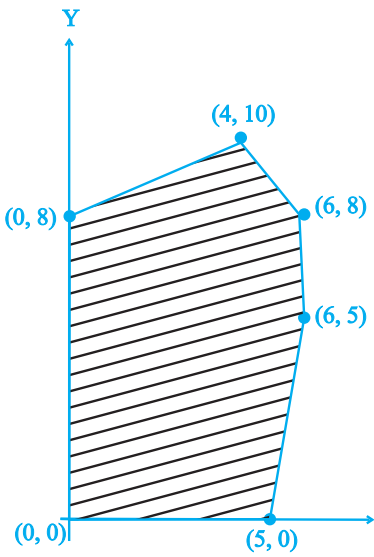
Minimum of Z occurs at:
Answer
|
Corner points
|
Corresponding value of Z = 3x - 4y
|
|
(0, 0)
(5, 0)
(6, 5)
(6, 8)
(4, 10)
(0, 8)
|
0
15 - 2
-14
-28
-32 (Minimum)
|
Hence, the minimum of Z occurs at (0, 8) and its minimum value is (-32).
View full question & answer→MCQ 911 Mark
An article manufactured by a company consists of two parts X and Y. In the process of manufacture of the part X. 9 out of 100 parts may be defective. Similarly 5 out of 100 are likely to be defective in part Y. Calculate the probability that the assembled product will not be defective.
AnswerLet A = Part X is not defective
Probability of A is $\text{P}(\text{A})=\frac{91}{100}$
B = Part Y is not defective.
Probability of B is $\text{P}(\text{B})=\frac{95}{100}$
Required probability
$=\text{P}(\text{A}\cap\text{B})=\text{P}(\text{A})\text{P}(\text{B})=\frac{91}{100}\times\frac{95}{100}=\frac{8645}{10000}$
View full question & answer→MCQ 921 Mark
The maximum value of the object function Z = 5x + 10y subject to the constraints $\text{x}+2\text{y}\leq120,\text{x}+\text{y}\geq60,\text{x}-2\text{y}\geq0,\text{x}\geq0,\text{y}\geq0$ is:
View full question & answer→MCQ 931 Mark
Vikas printing company takes fee of Rs. 28 to print a oversized poster and Rs. 7 for each colour of ink used. Raaj printing company does the same work and charges poster for Rs. 34 and Rs. 5.50 for each colour of ink used. If z is the colours of ink used, find the values of z such that Vikas printing company would charge more to print a poster than Raaj printing company.
- A
$\text{z}<4$
- B
$2\leq\text{z}\leq4$
- C
$4\leq\text{z}\leq7$
- ✓
$\text{z}>4$
AnswerCorrect option: D. $\text{z}>4$
$28+7\text{z}>34+5.50\text{z}$
$\rightarrow1.50\text{z}>6$
$\rightarrow\text{z}>\frac{6}{1.5}\text{z}>4$
View full question & answer→MCQ 941 Mark
Which of the following statement is correct?
- A
Every LPP admits an optimal solution.
- ✓
Every LPP admits unique optimal solution.
- C
If a LPP gives two optimal solutions it has infinite number of solutions.
- D
AnswerCorrect option: B. Every LPP admits unique optimal solution.
Every LPP admits unique optimal solution.
View full question & answer→MCQ 951 Mark
The corner points of the feasible region determined by the following system of linear inequalities: $2\text{x}+\text{y}\leq10,\text{x}+3\text{y}\leq15, \text{x},\text{y}\geq0$ are (0, 0), (5, 0), (3, 4) and (0, 5). Let Z = px + qy, where p, q > 0. Conditions on p and q so that the maximum of Z occurs at both (3, 4) and (0, 5) is:
View full question & answer→MCQ 961 Mark
Maximize Z = 6x + 4y, subject to $\text{x}\leq2,\text{x}+\text{y}\leq3,-2\text{x}+\text{y}\leq1,\text{x}\geq0,\text{y}\geq0.$
AnswerCorrect option: C. $\frac{140}{3}$ at $\Big(\frac{2}{3},\frac{1}{3}\Big)$
$\frac{140}{3}$ at $\Big(\frac{2}{3},\frac{1}{3}\Big)$
View full question & answer→MCQ 971 Mark
Region represented by $\text{x}\geq0, \text{y}\geq0$ is:
AnswerAll the positive values of x and y will lie in the first quadrant.
View full question & answer→MCQ 981 Mark
Which of the following is not true about feasibility?
- ✓
It cannot be determined in a graphical solution of an LPP.
- B
It is independent of the objective function.
- C
It implies that there must be a convex region satisfying all the constraints.
- D
Extreme points of the convex region gives the optimum solution.
AnswerCorrect option: A. It cannot be determined in a graphical solution of an LPP.
There are various methods to solve the linear programming problems namely simplex method, ellipsoid method, graphical method, interior points method, etc.
Therefore a linear programming problem can be solved using the graphical method.
Hence, the feasibility of the linear programming problem can be determined by the graphical method.
View full question & answer→MCQ 991 Mark
The maximum value of Z = 4x + 3y subjected to the constraints $2\text{x}+3\text{y}\leq18,$ $\text{x}+\text{y}\geq10;\text{x},\text{y}\geq0$ is:
View full question & answer→MCQ 1001 Mark
Refer to Question 18 (Maximum value of Z+ Minimum value of Z) is equal to: