Questions · Page 3 of 4

M.C.Q (1 Marks)

MCQ 1011 Mark
Z = 8x + 10y, subject to $2\text{x}+\text{y}\geq1,2\text{x}+3\text{y}\geq15,\text{y}\geq2,\text{x}\geq0,\text{y}\geq0.$ The minimum value of Z occurs at.
  • A
    (4.5, 2)
  • (1.5, 4)
  • C
    (0, 7)
  • D
    (7, 0)
Answer
Correct option: B.
(1.5, 4)
(1.5, 4)
View full question & answer
MCQ 1021 Mark
For a linear programming equations, convex set of equations is included in region of:
  • Feasible solutions
  • B
    Disposed solutions
  • C
    Profit solutions
  • D
    Loss solutions
Answer
Correct option: A.
Feasible solutions
In order for a linear programming problem to have a unique solution, the solution must exist at the intersection of two or more constraints.
Then the problem becomes convex and has a single optimum(maximum or minimum) solution.
Therefore the convex set of equations is included in the feasible region.
View full question & answer
MCQ 1031 Mark
Which of the following is a property of all linear programming problems?  
  • Alternate courses of action to choose from.
  • B
    Minimization of some objective.
  • C
    A computer program.
  • D
    Usage of graphs in the solution.
Answer
Correct option: A.
Alternate courses of action to choose from.
According to Robbins, the resources(capital, land, labour, materials, ...) are always limited.
Every resource have multiple uses.
The problem before any organisation or manager is to choose the best alternatives which can maximize the profit or minimize the cost of production.
Linear programming is the method which is used to select the best possible alternatives from the all alternatives.
According to William M. Fox, "Linear programming is a planning technique that permits some objective function to be maximized or minimized within the framework of given situational restrictions"
Therefore, the linear programming is the process of selecting best courses of action to choose from various alternatives.
View full question & answer
MCQ 1041 Mark
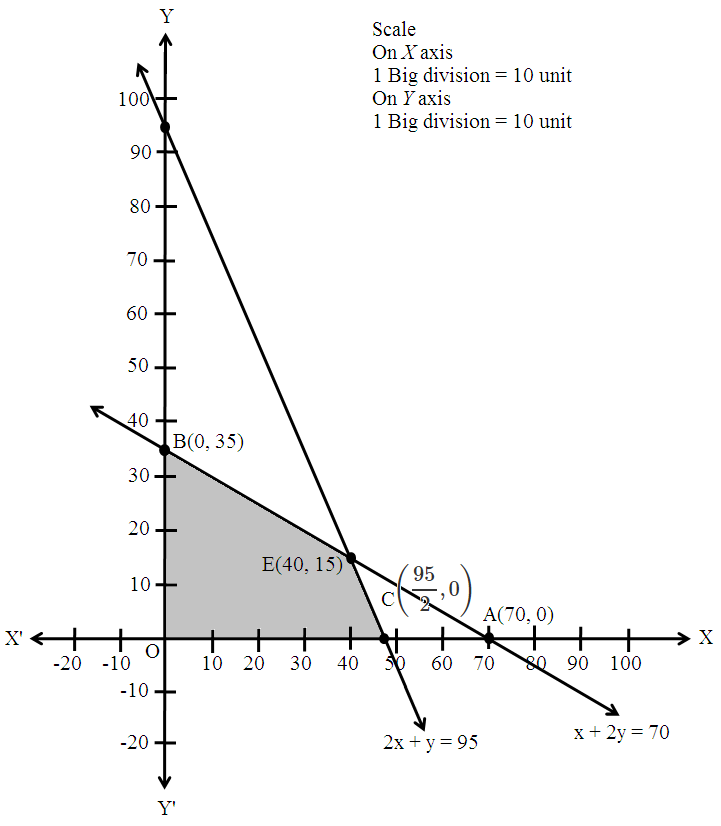
The point at which the maximum value of x + y, subject to the constraints x + 2y ≤ 70, 2x + y ≤ 95, x, y ≥ 0 isobtained, is:
  • A
    (30, 25)
  • B
    (20, 35)
  • C
    (35, 20)
  • (40, 15)
Answer
Correct option: D.
(40, 15)
We need to maximize the function
Z = x + y
Converting the given inequations into equations, we obtain x + 2y = 70, 2x + y = 95, x = 0 and y = 0
Region represented by x + 2y ≤ 70:
The line x + 2y = 70 meets the coordinate axes at A(70, 0) and B(0, 35) respectively.
By joining these points we obtain the line x + 2y = 70.
Clearly (0, 0) satisfies the inequation x + 2y ≤ 70.
So, the region containing the origin represents the solution set of the inequation x + 2y ≤ 70.
Region represented by 2x + y ≤ 95:
The line 2x + y = 95 meets the coordinate axes at $\text{C}\Big(\frac{95}{2},0\Big)$ and D(0, 95) respectively.
By joining these points we obtain the line 2x + y = 95.
Clearly (0, 0) satisfies the inequation 2x + y ≤ 95.
So, the region containing the origin represents the solution set of the inequation 2x + y ≤ 95.
Region represented by x ≥ 0 and y ≥ 0:
Since, every point in the first quadrant satisfies these inequations.
So, the first quadrant is the region represented by the inequations x ≥ 0, and y ≥ 0.
The feasible region determined by the system of constraints x + 2y ≤ 70, 2x + y ≤ 95, x ≥ 0, and y ≥ 0, are as follows.

The corner points of the feasible region are O(0, 0), $\text{C}\Big(\frac{95}{2},0\Big)$, E(40, 15) and B(0, 35).
The values of Z at these corner points are as follows.
$\text{Corner point}$ $\text{Z} = \text{x} + \text{y}$
$\text{O}(0, 0)$ $0 + 0 = 0$
$\text{C}\Big(\frac{95}{2},0\Big)$ $\frac{95}{2}+0,2=\frac{95}{2}$
$\text{E}(40, 1)$ $40 + 15 = 55$
$\text{B}(0, 35)$ $0 + 35 = 35$
We see that the maximum value of the objective function Z is 55 which is at (40, 15).
View full question & answer
MCQ 1051 Mark
Maximize Z = 11 x + 8y subject to $\text{x}\leq4,\text{y}\leq6,\text{x}+\text{y}\leq6,\text{x}\geq0,\text{y}\geq0.$
  • A
    44 at (4, 2)
  • 60 at (4, 2)
  • C
    62 at (4, 0)
  • D
    48 at (4, 2)
Answer
Correct option: B.
60 at (4, 2)
60 at (4, 2)
View full question & answer
MCQ 1061 Mark
To write the dual; it should be ensured that
  1. All the primal variables are non $-$ negative.
  2. All the bi values are non $-$ negative.
  3. All the constraints are $\leq$ type if it is maximization problem and $\geq$ type if it is a minimization problem.
  • A
    $I$ and $II$
     
  • B
    $II$ and $\text{III}$
     
  • $I$ and $\text{III}$
  • D
    $\text{I, II}$ and $\text{IIl}$
Answer
Correct option: C.
$I$ and $\text{III}$
To write the dual, then all the primal variables must be non$-$negative.
All the constraints are $\leq$ type if it ia maximization problem and $\geq$ type if it is a minimization problem.
View full question & answer
MCQ 1071 Mark
If two constraints do not intersect in the positive quadrant of the graph, then.
  • The problem is infeasible
  • B
    The solution is unbounded
  • C
    One of the constraints is redundant
  • D
    None of the above
Answer
Correct option: A.
The problem is infeasible
Any linear programming problem must have the following properties:-1.
The relationship between variables and constraints must be linear2.
The constraints must be non - negative.3.. objective function must be linear.
Non - negativity conditions are used because the variables cannot take negative values.
i.e., it is not possible to have negative resources (land, capital, labour cannot be negative).
Because of the non - negativity condition, the feasible region exists only in I quadrant.
View full question & answer
MCQ 1081 Mark
The value of objective function is maximum under linear constraints
  • A
    at the centre of feasible region
  • B
    at (0, 0)
  • at any vertex of feasible region
  • D
    the vertex which is maximum distance from (0, 0)
Answer
Correct option: C.
at any vertex of feasible region
In linear programming problem we substitute the coordinates of vertices of feasible region in the objective function and then we obtain the maximum or minimum value.
Therefore, the value of objective function is maximum under linear constraints at any vertex of feasible region.
View full question & answer
MCQ 1091 Mark
Let $X_1$ and $X_2$ are optimal solutions of a $\ce{LPP},$ then:
  • A
    $\text{X}=\lambda\ \text{X}_1+(1-\lambda)\text{X}_2,\lambda\in R$ is also an optimal solution
  • $\text{X}=\lambda\ \text{X}_1+(1-\lambda)\text{X}_2,0\leq\lambda\leq1$ given an optimal solution
  • C
    $\text{X}=\lambda\ \text{X}_1+(1+\lambda)\text{X}_2,0\leq\lambda\leq1$ given an optimal solution
  • D
    $\text{X}=\lambda\ \text{X}_1+(1+\lambda)\text{X}_2,\lambda\in R$ given an optimal solution
Answer
Correct option: B.
$\text{X}=\lambda\ \text{X}_1+(1-\lambda)\text{X}_2,0\leq\lambda\leq1$ given an optimal solution
A set $A$ is convex if, for any two points $X_1, X_2 \in\text{A}$ and $\lambda\in0,1$ imply that $\lambda\times1+1-\lambda\times2\in\text{A}$.
Since, here $X_1$ and $X_2$ are optimal solution
Therefore, their convex combination will also be an optimal solution
Thus, $\text{X}=\lambda\ \text{X}_1+(1-\lambda)\text{X}_2,0\leq\lambda\leq1$ gives an optimal solution.
View full question & answer
MCQ 1101 Mark
Apply linear programming to this problem. A firm wants to determine how many units of each of two products (products D and E) they should produce to make the most money. The profit in the manufacture of a unit of product D is 100 and the profit in the manufacture of a unit of product E is100 and the profit in the manufacture of aunit of product E is 87. The firm is limited by its total available labor hours and total available machine hours. The total labor hours per week are 4,000. Product D takes 5 hours per unit of labor and product E takes 7 hours per unit. The total machine hours are 5,000 per week. Product D takes 9 hours per unit of machine time and product E takes 3 hours per unit. Which of the following is one of the constraints for this linear program?
  • A
    $5\text{D}+7\text{E}\leq5,000$
  • B
    $9\text{D}+3\text{E}\geq4,000$
  • C
    $5\text{D}+7\text{E}=4,000$
  • $9\text{D}+3\text{E}\leq5,000$
Answer
Correct option: D.
$9\text{D}+3\text{E}\leq5,000$
Given, product D takes 5 hours per unit of labour, and product E takes 7 hours per unit of labour.
Therefore, to produce D units of product D takes 5D hours andto produce E units of product E takes 7E hours Given, total labour hours per week are 4000 hours.
Hence, $5\text{D}+7\text{E}\leq4,000$
Given, product D takes 9 hours per unit of machine time, andproduct E takes 3 hours per unit of machine time.
Therefore, to produce D units of product D takes 9D hours andto produce E units of product E takes 3E hours Given, total machine hours per week are 5000 hours.
Hence, $9\text{D}+3\text{E}\leq5,000$
View full question & answer
MCQ 1111 Mark
Unboundedness is usually a sign that the LP problem.  
  • A
    Has finite multiple solutions.
  • B
    Is degenerate.
  • C
    Contains too many redundant constraints.
  • Has been formulated improperly.
Answer
Correct option: D.
Has been formulated improperly.
A linear programming problem is said to have unbounded solution if it has infinite number of solutions.
I.e., the problem has been formulated improperly.
View full question & answer
MCQ 1121 Mark
$Z = 4x_1 + 5x_2$, subject to $2\text{x}_{1}+\text{x}_{2}\geq7,2\text{x}_{1}+3\text{x}2\leq15,\text{x}_{2}\leq3,\text{x}_{1},\text{x}_{2}\geq0.$ The minimum value of $Z$ occurs at:
  • $(3.5, 0)$
  • B
    $(3, 3)$
  • C
    $(7.5, 0)$
  • D
    $(2, 3)$
Answer
Correct option: A.
$(3.5, 0)$
View full question & answer
MCQ 1131 Mark
In equation $3\text{x}-\text{y}\geq3$ and 4x - 4y > 4.
  • Have solution for positive x and y.
  • B
    Have no solution for positive x and y.
  • C
    Have solution for all x.
  • D
    Have solution for all y.
Answer
Correct option: A.
Have solution for positive x and y.
View full question & answer
MCQ 1141 Mark
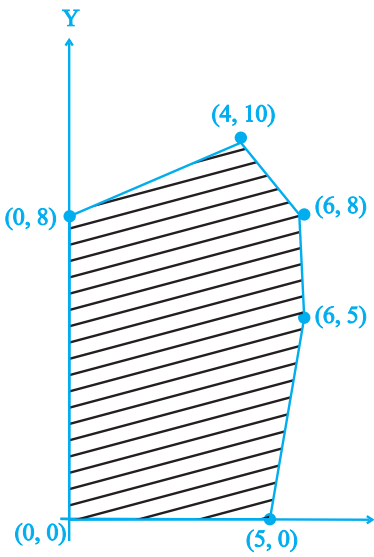
Refer to Question 18 maximum of Z occurs at:
  • (5, 0)
  • B
    (6, 5)
  • C
    (6, 8)
  • D
    (4, 10)
Answer
Correct option: A.
(5, 0)
(5, 0)
View full question & answer
MCQ 1151 Mark
If the feasible region for a solution of linear inequations is bounded, it is called as:
  • A
    Concave Polygon
  • B
    Finite Region
  • Convex Polygon
  • D
    None of the above
Answer
Correct option: C.
Convex Polygon
A bounded feasible region will have both a maximum value and a minimum value for the objective function. It is bounded if it can be enclosed in any shape.
A convex polygon is a simple not self-intersecting closed shape in which no line segment between two points on the boundary ever goes outside the polygon.
Hence, the answer is convex polygon.
View full question & answer
MCQ 1161 Mark
Choose the correct answer from the given four options.
Let F = 3x - 4y be the objective function.
Minimum value of F is:
  • A
    0.
  • -16.
  • C
    12.
  • D
    Does not exist.
Answer
Correct option: B.
-16.

the feasible region as show in the figure, has objective function F= 3x - 4y

Corner points
Corresponding value of z = 3x - 4y
(0, 0)
0
(12, 6)
12 (masimum)
(0, 4)
-16 (miminum)
We have minimum value of F is -16at (0, 4).
View full question & answer
MCQ 1171 Mark
Z = 6x + 21y, subject to $ \text{x}+2\text{y}\geq3,\text{x}+4\text{y}\geq4,3\text{x}+\text{y}\geq3,\text{x}\geq0,\text{y}\geq0.$ The minimum value of Z occurs at.
  • A
    $(4,0)$
  • B
    $(28,8)$
  • $\Big(2,\frac{7}{2}\Big)$
  • D
    $(0,3)$
Answer
Correct option: C.
$\Big(2,\frac{7}{2}\Big)$
View full question & answer
MCQ 1181 Mark
The optimal value of the objective function is attained at the points.
  • A
    Given by intersection of inequation with y - axis only.
  • B
    Given by intersection of inequation with x - axis only.
  • Given by corner points of the feasible region.
  • D
    None of these
Answer
Correct option: C.
Given by corner points of the feasible region.
View full question & answer
MCQ 1191 Mark
In linear programming, lack of points for a solution set is said to:
  • Have no feasible solution
  • B
    Have a feasible solution
  • C
    Have single point method
  • D
    Have infinte point method
Answer
Correct option: A.
Have no feasible solution
If there is no point in the feasible set, there is no feasible solution of the linear programming model.
In linear programming, lack of points for a solution set is said to have no feasible solution.
View full question & answer
MCQ 1201 Mark
The taxi fare in a city is as follows. For the first km the fare is Rs.10 and subsequent distance is Rs.6/ km.Taking the distance covered as x km and fare as Rs y, write a linear equation.
  • y = 4 + 6x
  • B
    y = 4 + 5x
  • C
    y = 3 + 6x
  • D
    y = 3 + 5x
Answer
Correct option: A.
y = 4 + 6x
First kmkm fare = Rs.10 Subsequent distance fare = Rs 6/ km
Then fare x km of distance y = (x - 1) × 6 + 10y = 6x - 6 + 10y = 6x + 4
View full question & answer
MCQ 1211 Mark
In graphical solutions of linear inequalities, solution can be divided into.
  • A
    One subset
  • Two subsets
  • C
    Three subsets
  • D
    Four subsets
Answer
Correct option: B.
Two subsets
In graphical solutions of linear inequalities, solution can be divided into two subsets.
for example, $2\text{x}+\text{y}\leq4$
One subset includes all values (x, y) that satisfy the equation 2x + y = 4 and the other subset includes all the values (x, y) that satisfy 2x + y < 4.
View full question & answer
MCQ 1221 Mark
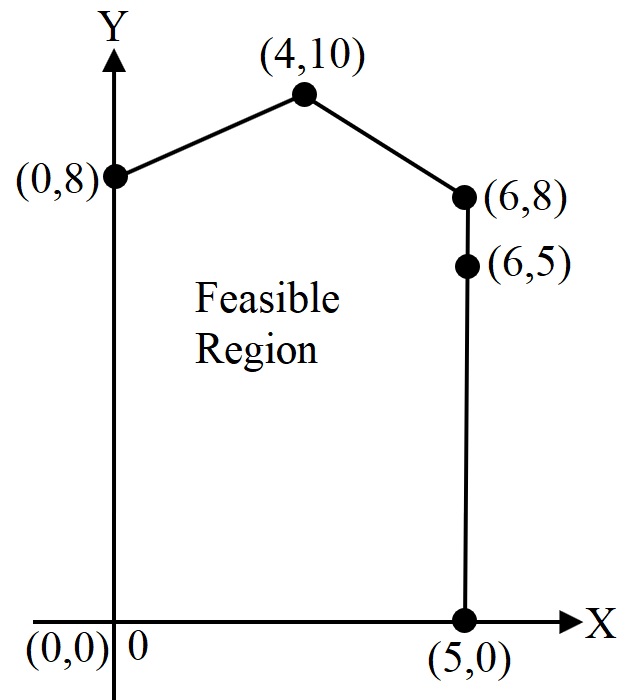
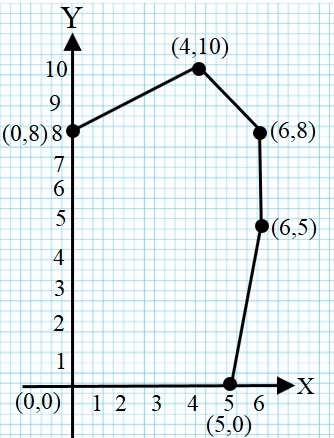
The feasible region for a LPP is shown shaded in the figure. Let Z = 3x - 4y be the objective function. Minimum of Z occurs at.
  • A
    (0, 0)
  • (0, 8)
  • C
    (5, 0)
  • D
    (4, 10)
Answer
Correct option: B.
(0, 8)
(0, 8)
View full question & answer
MCQ 1231 Mark
In Graphical solution the feasible solution is any solution to a LPP which satisfies.
  • A
    Only objective function.
  • Non - negativity restriction.
  • C
    Only constraint.
  • D
    All the three
Answer
Correct option: B.
Non - negativity restriction.
The feasible region is the set of all the points that satisfy all the given constraints.
The variables of the linear programs must always take the non - negative values (i.e., $\text{x}\geq0$ and $\text{y}\geq0$).
These are used because x and y are usually the number of items produced and we cannot produce the negative number of items.
The least possible number of items could be zero.
Therefore, the feasible solution should satisfy the non - negativity restriction.
View full question & answer
MCQ 1241 Mark
If $\text{a},\text{b},\text{c}\in+\text{R}$ such that $\lambda\text{ abc}$ is the minimum value of $a(b^2 + c^2) + b(c^2 + a^2) + c(a^2 + b^2)$, then $\lambda=$
  • A
    $1$
  • B
    $3$
  • C
    $4$
  • None of the above.
Answer
Correct option: D.
None of the above.
We know that $ \text{A}.\text{M}.\geq\text{G}.\text{M}.$
Therefore, $ \frac{{\text{b}^2+\text{c}^2}​}{2}\geq\sqrt{\text{b}^2\text{c}^2}​$
$\Rightarrow\text{b}^{2}+\text{c}^{2}\geq2\text{bc}$
Multiplying a on both sides doesn’t change the inequality.
Since, given that a is positive.
$\Rightarrow\text{a}(\text{b}^{2}+\text{c}^{2})\geq2\text{abc}\ ...(1)$
Similarly, $\text{b}(\text{a}^{2}+\text{c}^{2})\geq2\text{abc}\ ...(2)$
and $\text{c}(\text{a}^{2}+\text{c}^{2})\geq2\text{abc}\ ...(3)$
adding $(1), (2)$ and $(3)$ we get
$\text{a}(\text{b}^{2}+\text{c}^{2})+\text{b}(\text{a}^{2}+\text{c}^{2})+\text{c}(\text{a}^{2}+\text{b}^{2})\geq2\text{abc}+2\text{abc}+2\text{abc}$
$\Rightarrow\text{a}(\text{b}^{2}+\text{c}^{2})+\text{b}(\text{a}^{2}+\text{b}^{2})+\text{c}(\text{a}^{2}+\text{b}^{2})\geq6\text{abc}$
Therefore $\lambda$ is $6$
View full question & answer
MCQ 1251 Mark
If an iso-profit line yielding the optimal solution coincides with a constaint line, then:
  • A
    The solution is unbounded
  • B
    The solution is infeasible
  • C
    The constraint which coincides is redundant
  • None of the above
Answer
Correct option: D.
None of the above
If an iso profit line which is yielding the optimal solution coincide with a constant line; then
→ the solution will b bounded, i.e there will be a definite bounded area where the solution would be optional.
→ Since the area is bounded,the solution is feasible
→ And the constant which coincides is not a redundant
Hence None of above is the answer.
View full question & answer
MCQ 1261 Mark
The objective function of a linear programming problem is:
  • A
    A constraint
  • Function to be optimised
  • C
    A relation between the variables
  • D
    None of these
Answer
Correct option: B.
Function to be optimised
View full question & answer
MCQ 1271 Mark
The Convex Polygon Theorem states that the optimum (maximum or minimum) solution of a LPP is attained at atleastone of the ______ of the convex set over which the solution is feasible.
  • A
    Origin
  • Corner points
  • C
    Centre
  • D
    Edge
Answer
Correct option: B.
Corner points
The fundamental theorem of programming (i.e., Convex Polygon Theorem) states that the optimum value(maximum or minimum) of a linear programming problem over a convex region occur at the corner points.
View full question & answer
MCQ 1281 Mark
The solution of the set of constraints of a linear programming problem is a convex (open or closed) is called ______ region.
  • Feasible
  • B
    Active
  • C
    Linear
  • D
    None of these
Answer
Correct option: A.
Feasible
Our experts are building a solution for this.
View full question & answer
MCQ 1291 Mark
Given a system of inequation: $2\text{y}-\text{x}\leq4$ $-2\text{x}+\text{y}\geq-4$Find the value of s, which is the greatest possible sum of the x and y co - ordinates of the point which satisfies the following inequalities as graphed in the xy plane.
  • 8
  • B
    12
  • C
    2
  • D
    4
Answer
Correct option: A.
8
First, rewrite each equation, so that it is in the slope - intercept form of a line, which is y = mx + b, where mm is the slope and b is the y - intercept of the line.
The first equation becomes 2y < x + 4 or $\text{y}\leq\frac{1}{2}\text{x}+2.$
The second equation becomes $\text{y}\geq2\text{x}-4.$
The greatest x + y is the point at which the two lines intersect.
Set the equations of the two lines, $\text{y}=\frac{1}{2}\text{x}+2$ and y = 2x - 4, equal to each other and solve for x.
The resulting equation is $\text{y}=\frac{1}{2}\text{x}+2$
and y = 2x - 4.
Solve for x to get $\text{y}=\frac{3}{-2}\text{x}+2=-4$ or $\frac{3}{-2}\text{x}=-6,$
$\Rightarrow\text{x}=4$
Next, plug 4 into one of the two equations to solve for y.
Therefore, y = 2(4) - 4 = 4 and x + y = 4 + 4 = 8.
View full question & answer
MCQ 1301 Mark
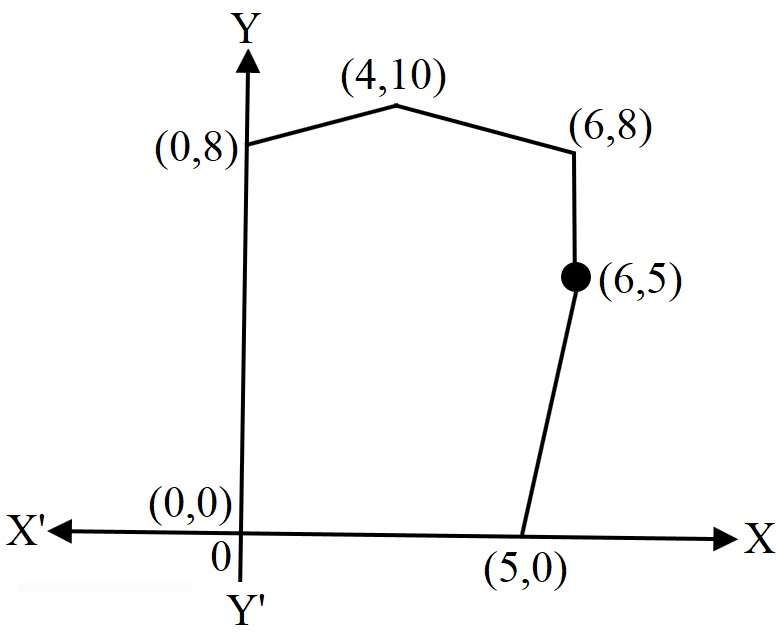
The feasible region for an LPP is shown below:

Let Z = 3x - 4y be the objective function. Minimum of Z occurs at
  • A
    (0, 0)
  • (0, 8)
  • C
    (5, 0)
  • D
    (4, 10)
Answer
Correct option: B.
(0, 8)
(0, 8)
View full question & answer
MCQ 1311 Mark
Directions: In the following questions, the Assertions (A) and Reason(s) (R) have been put forward. Read both the statements carefully and choose the correct alternative from the following:
Assertion (A): Assertion (A):For an objective function Z= 15x + 20y, corner points are (0, 0), (10, 0), (0, 15) and (5, 5). Then optimal values are 300 and 0 respectively.
Reason (R): The maximum or minimum value of an objective function is known as optimal value of LPP. These values are obtained at corner points.
  • Both A and R are true and R is the correct explanation of A
  • B
    Both A and R are true but R is NOT the correct explanation of A
  • C
    A is true but R is false.
  • D
    A is false but R is true.
Answer
Correct option: A.
Both A and R are true and R is the correct explanation of A
View full question & answer
MCQ 1321 Mark
Which of the following is not a convex set?
  • A
    $\{(x, y) ; 2x + 5y ≤ 7\}$
  • B
    $\{(x, y) : x^{_2} + y^2 \leq 4\}$
  • $\{x : |x| = 5\}$
  • D
    $\{(x, y) : 3x^2 + 2y^2 \leq 6\}$
Answer
Correct option: C.
$\{x : |x| = 5\}$
$|x| = 5$ is not a convex set as any two points from negative and positive $x-$axis if are joined will not lie in set.
View full question & answer
MCQ 1331 Mark
If the constraints in a linear programming problem are changed:
  • Solution is not defined.
  • B
    The objective function has to be modified.
  • C
    The problems is to be re - evaluated.
  • D
    None of these.
Answer
Correct option: A.
Solution is not defined.
The problems is to be re - evaluated.
View full question & answer
MCQ 1341 Mark
The maximum value of f = 4x + 3y subject to constraints $\text{x}\geq0,$ $\text{y}\geq0,$ $2\text{x}+3\text{y}\leq18;\text{x}+\text{y}\geq10$ is:
  • A
    35
  • B
    36
  • C
    34
  • None of these
Answer
Correct option: D.
None of these
None of these
View full question & answer
MCQ 1351 Mark
The point which does not lie in the half - plane 2x + 3y -12 < 0 is:
  • A
    (2, 1)
  • B
    (1, 2)
  • C
    (-2, 3)
  • (2, 3)
Answer
Correct option: D.
(2, 3)
By putting the value of point (2, 3) in 2x + 3y - 12, we get;
2(2) + 3(3) = -12
= 4 + 9 - 12
= 13 - 12
= 1 which is greater than 0.
View full question & answer
MCQ 1361 Mark
z = 10x + 25y subject to $0\leq\text{X}\leq3$ and $0\leq\text{X}\leq3,$ $\text{x}+\text{y}\leq5$ then the maximum value of z is:
  • A
    80
  • 95
  • C
    30
  • D
    75
Answer
Correct option: B.
95
The end points of the figure which forms as per the given condition are (0, 0), (3, 0), (0, 3), (3, 2), (2, 3) We check the value of z at these points.
At (0, 3), z = 0 + 75 = 75 At (3, 0), z = 30 + 0 = 30 At (0, 0), z = 0 At (3, 2), z = 30 + 50 = 80 At (2, 3), z = 20 + 75 = 95
Therefore, the maximum value of z turns out to be 95.
View full question & answer
MCQ 1371 Mark
For the $\text{LPP};$ maximise $z = x + 4y$ subject to the constraints $\text{x}+2\text{y}\leq2, \text{x}+2\text{y}\geq8,\text{x},\text{y}\geq0.$
  • A
    $z_{max} ​= 4$
  • B
    $z_{max​} = 8$
  • C
    $z_{max}​ = 16$
  • Has no feasible solution
Answer
Correct option: D.
Has no feasible solution
$\text{x}+2\text{y}\leq2$
$\text{x}+2\text{y}\geq8$
$\text{x},\text{y}\geq0.$
View full question & answer
MCQ 1381 Mark
In Graphical solution the redundant constraint is:
  • A
    Which forms the boundary of feasible region.
  • B
    Which do not optimizes the objective function.
  • Which does not form boundary of feasible region.
  • D
    Which optimizes the objective function.
Answer
Correct option: C.
Which does not form boundary of feasible region.
A constraint in an LP model becomes redundant when the feasible region doesnt change by the removing the constraint.
For example, $2\text{x}+\text{y}\geq10$ and $6\text{x}+3\text{y}\geq30$ are constraints.
$6\text{x}+3\text{y}\geq30$
$\Rightarrow3\times(2\text{x}+\text{y})\geq3\times10$
$\Rightarrow2\text{x}+\text{y}\geq10$
which is same as the first constraint.
Therefore, $6\text{x}+3\text{y}\geq30$ can be removed.
By removing this constraint the feasible region doesnt change.
If the boundary of the feasible region is removed then feasible solution set changes.
Hence, redundant constraint cannot be the boundary of the feasible region.
View full question & answer
MCQ 1391 Mark
Which of the following sets are convex?
  • A
    $\{(\text{x},\text{y}):\text{x}^2+\text{y}^2\geq1\}$
  • B
    $\{(\text{x},\text{y}):\text{y}^2\geq\text{x}\}$
  • C
    $\{(\text{x},\text{y}):3\text{x}^2+4\text{y}^2\geq5\}$
  • $\{(\text{x},\text{y}):\text{y}\geq2,\text{y}\leq4\}$
Answer
Correct option: D.
$\{(\text{x},\text{y}):\text{y}\geq2,\text{y}\leq4\}$
is the region between two parallel lines, so any line segment joining any two points in it lies in it.
Hence, it is a convex set.
View full question & answer
MCQ 1401 Mark
Choose the correct answer from the given four options.
Corner points of the feasible region determined by the system of linear constraints are (0, 3), (1, 1) and (3, 0). Let Z = px + qy, where p, q > 0. Condition on p and q so that the minimum of Z occurs at (3, 0) and (1, 1) is:
  • A
    p = 2q
  • $\text{p}=\frac{\text{q}}{2}$
  • C
    p = 3q
  • D
    p = q
Answer
Correct option: B.
$\text{p}=\frac{\text{q}}{2}$
 
Corner point
Corresponding value of X = px + qy; p,q > 0
(0, 3)
3q
(1, 1)
p + q
(3, 0)
3p
So, condition of p and q, so that the minimum of Z occurs at (3, 0) and (1, 1) is,
p + q = 3p
⇒ 2p = q
$\therefore\text{p}=\frac{\text{q}}{2}$
View full question & answer
MCQ 1411 Mark
Choose the correct answer from the given four options.
Corner points of the feasible region for an LPP are (0, 2), (3, 0), (6, 0), (6, 8) and (0, 5)
Let F = 4x + 6y be the objective function Find the
Maximum of F - Minimum of F =
  • 60.
  • B
    48.
  • C
    42.
  • D
    18.
Answer
Correct option: A.
60.
 
Corner points
Corresponding value of F = 4x + 6y
(0, 2)
12 (Minimum)
(3, 0)
12 (minimum)
(6, 0)
24
(6, 8)
72 (maxmimum)
(0, 5)
30
Maximum of F - Minimum of F = 72 - 12 = 60.
View full question & answer
MCQ 1421 Mark
If the constraints in linear programming problem are changed.
  • The problem is to be re - evaluated
  • B
    Solution is not defined
  • C
    The objective function has to be modified
  • D
    The change in constraints is ignored
Answer
Correct option: A.
The problem is to be re - evaluated
The above question asks for the impact of change in constraints on the Linear programming problem.
In this scenario, when there is a change in constraint, the solution will change definitely.
Whether the solution exists or not, we can only find once the problem is re - evaluated.
In an LPP, the objective function is related to the main objective of any problem, either we have to maximize or minimize the function based on the situation whereas the constraints is related to physical restrictions in achieving the defined objective function.
In real life problems, there might be situations when the constraints change, but objective function does not changes to accommodate the change in constraints.
Thus, if constraints in linear programming problem is changed, the problem has to be re - evaluated for the same objective function and after solving we can find whether the solution exists or not.
View full question & answer
MCQ 1431 Mark
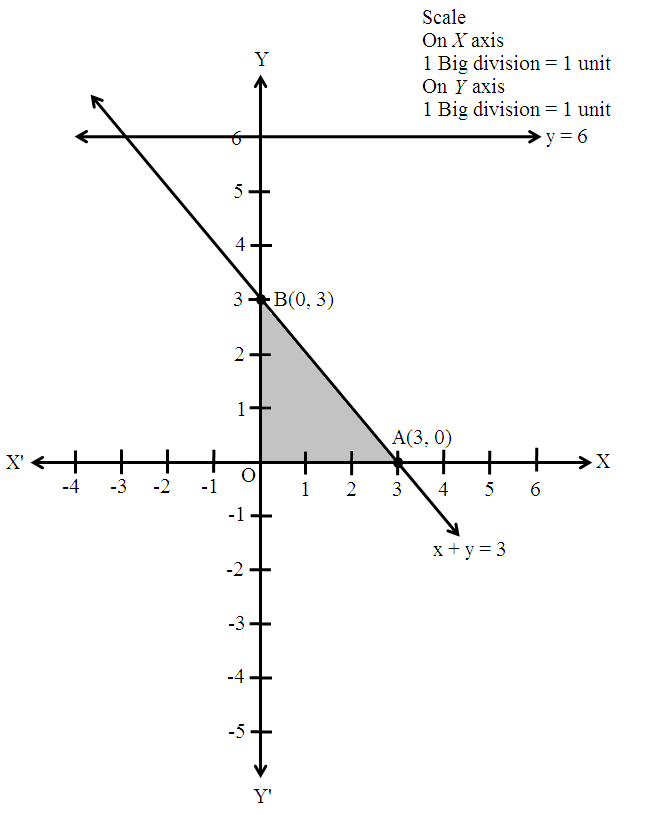
The region represented by the inequation system x, y ≥ 0, y ≤ 6, x + y ≤ 3 is:
  • A
    unbounded in first quadrant
  • B
    unbounded in first and second quadrants
  • bounded in first quadrant
  • D
    none of these
Answer
Correct option: C.
bounded in first quadrant
Converting the given inequations into equations, we obtain
y = 6, x + y = 3, x = 0 and y = 0
y = 6 is the line passing through (0, 6) and parallel to the X axis.
The region below the line y = 6 will satisfy the given inequation.
The line x + y = 3 meets the coordinate axis at A(3, 0) and B(0, 3).
Join these points to obtain the line x + y = 3
Clearly, (0, 0) satisfies the inequation x + y ≤ 3.
So, the region in xy-plane that contains the origin represents the solution set of the given equation.
Region represented by x ≥ 0 and y ≥ 0:
Since, every point in the first quadrant satisfies these inequations.
So, the first quadrant is the region represented by the inequations.
These lines are drawn using a suitable scale.

The shaded region represents the feasible region of the given LPP, which is bounded in the first quadrant.
View full question & answer
MCQ 1441 Mark
The corner points of the feasible region determined by the system of linear constraints are (0, 10), (5, 5), (15, 15), (0, 20). Let z = px + qy where p, q > 0. Condition on p and q so that the maximum of z occurs at both the points (15, 15) and (0, 20) is __________.
  • A
    q = 2p
  • B
    p = 2p
  • C
    p = q
  • q = 3p
Answer
Correct option: D.
q = 3p
Since Z occurs maximum at (15, 15) and (0, 20)
Therefore, 15p + 15q = 0.p + 20q
⇒ q = 3p.
View full question & answer
MCQ 1451 Mark
The feasible solution for a LPP is shown in the following figure. Let Z = 3x - 4y be the objective function.

Minimum of Z occurs at:


  • A
    (0, 0)
  • (0, 8)
  • C
    (5, 0)
  • D
    (4, 10)
Answer
Correct option: B.
(0, 8)
(0, 8)
View full question & answer
MCQ 1461 Mark
The objective function of LPP defined over the convex set attains its optimum value at.
  • A
    Atleast two of the corner points.
  • B
    All the corner points.
  • Atleast one of the corner points.
  • D
    None of the corner points.
Answer
Correct option: C.
Atleast one of the corner points.
Let Z = ax + by be the objective function
When Z has optimum value(maximum or minimum), where the variables
x and y are subject to constraints described by linear inequalities, this optimum value must occur at a corner points of the feasible region.
Thus, the function attains its optimum value at one of the corner points.
View full question & answer
MCQ 1471 Mark
Choose the correct answer from the given four options. The feasible solution for a LPP is shown in. Let Z = 3x - 4y be the objective function.
Maximum of Z occurs at:
  • (5, 0)
  • B
    (6, 5)
  • C
    (6, 8)
  • D
    (4, 10)
Answer
Correct option: A.
(5, 0)
 
Corner points
Corresponding value of Z = 3x - 4y
(0, 0)
(5, 0)
(6, 5)
(6, 8)
(4, 10)
(0, 8)
0
15 (Maxmimum)
-2
-14
-28
-32
Hence, maximum of Z occurs at (5, 0) and its maximum value is 27.
View full question & answer
MCQ 1481 Mark
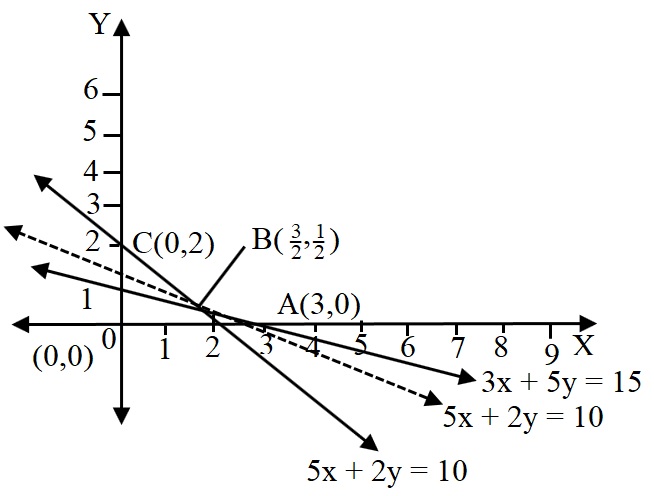
The minimum value of Z = 3x + 5y subjected to constraints $\text{x}+3\text{y}\geq3,\text{x}+\text{y}\geq2,\text{x},\text{y}\geq0$ is:
  • A
    5
  • 7
  • C
    10
  • D
    11
Answer
Correct option: B.
7
The feasible region determined by the system of constraints, $\text{x}+3\text{y}\geq3,\text{x}+\text{y}\geq2,$ and $\text{x},\text{y}\geq0$ is given below

It can be seen that the feasible region is unbounded.
The corner points of the feasible region are A(3, 0), $ \text{B}\Big(\frac{3}{2},\frac{1}{2}\Big)$ and C(0, 2)
The values of Z at these corner points are given below
Corner point
z = 3x + 5y
 
A (3, 0)
9
 
$ \text{B}\Big(\frac{3}{2},\frac{1}{2}\Big)$
7
Smallest
C (0, 2)
10
 
7 may or may not be the minimum value of Z because the feasible region is unbounded
For this purpose, we draw the graph of the inequality, 3x + 5y < 7 and check the resulting half - plane have common points with the feasible region or not.
Hence, it can be seen that the feasible region has no common point with 3x + 5y < 7.
Thus, the minimum value of Z is 7 at point $ \text{B}\Big(\frac{3}{2},\frac{1}{2}\Big).$
View full question & answer
MCQ 1491 Mark
The number of points in $(-\infty,\infty)$ for which $\text{x}^{2}-\text{x}\sin\text{x}-\cos\text{x}=0,$ is:
  • A
    6
  • B
    4
  • 2
  • D
    None of the above
Answer
Correct option: C.
2
Better approch is with graphs.Considering graphs in eqaution we get
$\text{x}^{2}-\text{x}\sin\text{x}-\cos\text{x}=0$
$\text{x}^{2}=\text{x}\sin\text{x}+\cos\text{x}$
Let $\text{f}(\text{x})=\text{x}^{2},\text{g}(\text{x})=\text{x}\sin\text{x}+\cos\text{x}$
Using graphical methods,we can do the graph of f(x) and g(x)
The graph f(x) and g(x) intersects at two points between $(-\infty,\infty)$
View full question & answer
MCQ 1501 Mark
In linear programming, objective function and objective constraints are:
  • A
    Solved
  • Linear
  • C
    Quadratic
  • D
    Adjacent
Answer
Correct option: B.
Linear
In linear programming, objective function and objective constraints are linear.
Any linear programming problem must have the following properties:-1.
The relationship between variables and constraints must be linear 2.
The constraints must be non - negative.3.. objective function must be linear.
View full question & answer
M.C.Q (1 Marks) - Page 3 - MATHS STD 12 Science Questions - Vidyadip