Question 515 Marks
Show that the points $\text{A}\big(2\hat{\text{i}}-\hat{\text{j}}+\hat{\text{k}}\big),\ \text{B}\big(\hat{\text{i}}-3\hat{\text{j}}-5\hat{\text{k}}\big),$ $\text{C}\big(3\hat{\text{i}}-4\hat{\text{j}}-4\hat{\text{k}}\big)$ are the vertices of a right angled triangle.
AnswerGiven the points $\text{A}\big(2\hat{\text{i}}-\hat{\text{j}}+\hat{\text{k}}\big),\ \text{B}\big(\hat{\text{i}}-3\hat{\text{j}}-5\hat{\text{k}}\big)$and $\text{C}\big(3\hat{\text{i}}-4\hat{\text{j}}-4\hat{\text{k}}\big)$. Then, $\overrightarrow{\text{AB}}=$ Position vector of B - Position vector of A $=\hat{\text{i}}-3\hat{\text{j}}-5\hat{\text{k}}-\big(2\hat{\text{i}}-\hat{\text{j}}+\hat{\text{k}}\big)$ $=\hat{\text{i}}-3\hat{\text{j}}-5\hat{\text{k}}-2\hat{\text{i}}+\hat{\text{j}}-\hat{\text{k}}$ $=-\hat{\text{i}}-2\hat{\text{j}}-6\hat{\text{k}}$ $\overrightarrow{\text{BC}}=$ Position vector of C - Position vector of B $=3\hat{\text{i}}-4\hat{\text{j}}-4\hat{\text{k}}-\big(\hat{\text{i}}-3\hat{\text{j}}-5\hat{\text{k}}\big)$ $=3\hat{\text{i}}-4\hat{\text{j}}-4\hat{\text{k}}-\hat{\text{i}}+3\hat{\text{j}}+5\hat{\text{k}}$$=2\hat{\text{i}}-\hat{\text{j}}+\hat{\text{k}}$
$\overrightarrow{\text{CA}}=$ Position vector of A - Position vector of C $=2\hat{\text{i}}-\hat{\text{j}}+\hat{\text{k}}-\big(3\hat{\text{i}}-4\hat{\text{j}}-4\hat{\text{k}}\big)$ $=2\hat{\text{i}}-\hat{\text{j}}+\hat{\text{k}}-3\hat{\text{i}}+4\hat{\text{j}}+4\hat{\text{k}}$ $=-\hat{\text{i}}+3\hat{\text{j}}+5\hat{\text{k}}$ Clearly, $\overrightarrow{\text{AB}}+\overrightarrow{\text{BC}}+\overrightarrow{\text{CA}}=\vec0$Now, $\Big|\overrightarrow{\text{AB}}\Big|=\sqrt{(-1)^2+(-2)^2+(-6)^2}$
$=\sqrt{1+4+36}$ $=\sqrt{41}$ $\Big|\overrightarrow{\text{BC}}\Big|=\sqrt{(2)^2+(-1)^2+(1)^2}$ $=\sqrt{4+1+1}$ $=\sqrt{6}$ $\Big|\overrightarrow{\text{CA}}\Big|=\sqrt{(-1)^2+(3)^2+(5)^2}$ $=\sqrt{1+9+25}$ $=\sqrt{35}$ Clearly, $\Big|\overrightarrow{\text{AB}}\Big|^2=\Big|\overrightarrow{\text{BC}}\Big|^2+\Big|\overrightarrow{\text{CA}}\Big|^2$$\Rightarrow\text{AB}^2=\text{BC}^2+\text{CA}^2$
So, A, B, C forms a right angled triangle.
View full question & answer→Question 525 Marks
If $\hat{\text{a}}$ and $\hat{\text{b}}$ are unit vectors inclined at an angle $\theta$, prove that$\tan\frac{\theta}{2}=\frac{\big|\hat{\text{a}}-\hat{\text{b}}\big|}{\big|\hat{\text{a}}+\hat{\text{b}}\big|}$
AnswerHere, $\hat{\text{a}}$ and $\hat{\text{b}}$ are unit vectors
$\big|\hat{\text{a}}\big|=\big|\hat{\text{b}}\big|=1$
$\frac{\big|\hat{\text{a}}-\hat{\text{b}}\big|^2}{\big|\hat{\text{a}}+\hat{\text{b}}\big|^2}=\frac{(\hat{\text{a}}-\hat{\text{b}})^2}{(\hat{\text{a}}+\hat{\text{b}})^2}$
$=\frac{(\hat{\text{a}})^2+(\hat{\text{b}})^2-2\hat{\text{a}}.\hat{\text{b}}}{(\hat{\text{a}})^2+(\hat{\text{b}})^2+2\hat{\text{a}}.\hat{\text{b}}}$
$=\frac{\big|\hat{\text{a}}\big|^2+\big|\hat{\text{b}}\big|^2-2\hat{\text{a}}.\hat{\text{b}}}{\big|\hat{\text{a}}\big|^2+\big|\hat{\text{b}}\big|^2+2\hat{\text{a}}.\hat{\text{b}}}$
$\frac{\big|\hat{\text{a}}-\hat{\text{b}}\big|^2}{\big|\hat{\text{a}}+\hat{\text{b}}\big|^2}=\frac{(1)^2+(1)^2-2\big|\vec{\text{a}}\big|\big|\vec{\text{b}}\big|\cos\theta}{(1)^2+(1)^2+2\big|\vec{\text{a}}\big|\big|\vec{\text{b}}\big|\cos\theta}$ $\big[\text{since }\vec{\text{a}}.\vec{\text{b}}=\big|\vec{\text{a}}\big|\big|\vec{\text{b}}\big|\cos\theta\big]$
$\frac{\big|\hat{\text{a}}-\hat{\text{b}}\big|^2}{\big|\hat{\text{a}}+\hat{\text{b}}\big|^2}=\frac{1+1-2(1)(1)\cos\theta}{1+1+2(1)(1)\cos\theta}$
$=\frac{2-2\cos\theta}{2+2\cos\theta}$
$=\frac{2(1-\cos\theta)}{2(1+\cos\theta)}$
$=\frac{2\times\sin^2\frac{\theta}{2}}{2\times\cos^2\frac{\theta}{2}}$ $\Big[\text{Since}1-\cos\theta=2\sin^2\frac{\theta}{2},1+\cos\theta=2\cos^2\frac{\theta}{2}\Big]$
$\frac{\big|\hat{\text{a}}-\hat{\text{b}}\big|^2}{\big|\hat{\text{a}}+\hat{\text{b}}\big|^2}=\tan^2\frac{\theta}{2}$
$\tan\frac{\theta}{2}=\frac{\big|\hat{\text{a}}-\hat{\text{b}}\big|^2}{\big|\hat{\text{a}}+\hat{\text{b}}\big|^2}$
View full question & answer→Question 535 Marks
The two vectors $\hat{\text{j}}+\hat{\text{k}}$ and $3\hat{\text{i}}-\hat{\text{j}}+4\hat{\text{k}}$ represents the sides $\overrightarrow{\text{AB}}$ and $\overrightarrow{\text{AC}}$ respectively of a triangle ABC. Find the length of the median through A.
AnswerDisclaimer: The question has been solved by taking the vector $\overrightarrow{\text{AB}}$ as $\hat{\text{j}}+\hat{\text{k}}$.In $\triangle\text{ABC},\ \overrightarrow{\text{AB}}=\hat{\text{j}}+\hat{\text{k}}$ and $\overrightarrow{\text{AC}}=3\hat{\text{i}}-\hat{\text{j}}+4\hat{\text{k}}$
Let the position vector of A be (0, 0, 0). Then, the position vectors of B and C are (0, 1, 1) and (3, -1, 4), respectively.
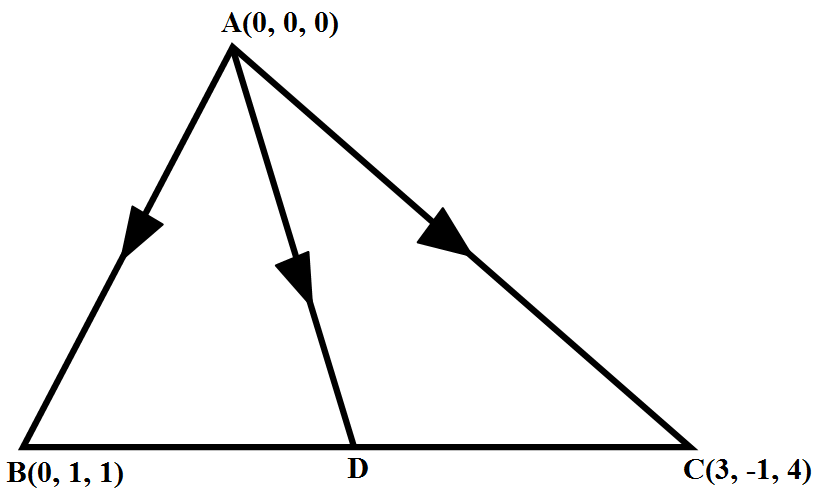
Suppose D be the mid-point of the line segment joining the points B(0, 1, 1) and C(3, -1, 4).
$\therefore$ position vector of D $=\frac{\big(\hat{\text{j}}+\hat{\text{k}}\big)+\big(3\hat{\text{i}}-\hat{\text{j}}+4\hat{\text{k}}\big)}{2}=\frac{3\hat{\text{i}}+5\hat{\text{k}}}{2}=\frac{3}2\hat{\text{i}}+\frac{5}2\hat{\text{k}}$
Now,
Length of the median, AD =
$\Big|\overrightarrow{\text{AD}}\Big|=\Big|\Big(\frac{3}2\hat{\text{i}}+\frac{5}2\hat{\text{k}}\Big)-\big(0\hat{\text{i}}+0\hat{\text{j}}+0\hat{\text{k}}\big)\Big|$
$=\Big|\frac{3}2\hat{\text{i}}+\frac{5}2\hat{\text{k}}\Big|$
$=\sqrt{\Big(\frac{3}{2}\Big)^2+0^2+\Big(\frac{5}2\Big)^2}$
$=\sqrt{\frac{34}{4}}$
$=\sqrt{\frac{17}2}\text{units}$ View full question & answer→Question 545 Marks
If $\vec{\text{a}},\vec{\text{b}}$ are the position vectors of A, B respectively, find the position vector of a point C in AB produced such that AC = 3AB and that a point D in BA produced such that BD = 2BA.
Answer
 Let the position vectors of C and D are $\vec{\text{c}}\text{ and }\vec{\text{d}}$ respectively. We have,
AC = 3AB
⇒ AC = 3(AC - BC)
⇒ 2AC = 3BC
$\Rightarrow\frac{\text{AC}}{\text{BC}}=\frac{3}{2}$
So, C divides AB in the ratio of 3 : 2 externally.
$\vec{\text{c}}=\frac{2\vec{\text{a}}-3\vec{\text{b}}}{2-3}=3\vec{\text{b}}-2\vec{\text{a}}$
Position vector of point C is $3\vec{\text{b}}-2\vec{\text{a}}$
Moreover,
BD = 2BA
⇒ BD = 2(BD - AD)
⇒ BD = 2 AD
$\Rightarrow\frac{\text{BD}}{\text{AD}}=\frac{2}1$
$\therefore\ \vec{\text{d}}=\frac{\vec{\text{b}}-2\vec{\text{a}}}{1-2}=2\vec{\text{a}}-\vec{\text{b}}$
Position vector of point D is $2\vec{\text{a}}-\vec{\text{b}}$ View full question & answer→Question 555 Marks
Show that the four points A, B, C, D with position vectors $\vec{\text{a}},\ \vec{\text{b}},\ \vec{\text{c}},\ \vec{\text{d}}$ respectively such that $3\vec{\text{a}}-2\vec{\text{b}}+5\vec{\text{c}}-6\vec{\text{d}}=0$, are coplanar. Also, find the position vector of the point of intersection of the line segments AC and BD.
AnswerLet AC and BD intersects at a point P. We have, $3\vec{\text{a}}-2\vec{\text{b}}+5\vec{\text{c}}-6\vec{\text{d}}=0$ $\Rightarrow3\vec{\text{a}}+5\vec{\text{c}}=2\vec{\text{b}}+6\vec{\text{d}}$ Since sum of co-efficients on both sides of the above equation is 8. so we divide the equation on both sides by 8. $\Rightarrow\frac{3\vec{\text{a}}+5\vec{\text{c}}}8=\frac{2\vec{\text{b}}+6\vec{\text{d}}}8$ $\Rightarrow\frac{3\vec{\text{a}}+5\vec{\text{c}}}{3+5}=\frac{2\vec{\text{b}}+6\vec{\text{d}}}{2+6}$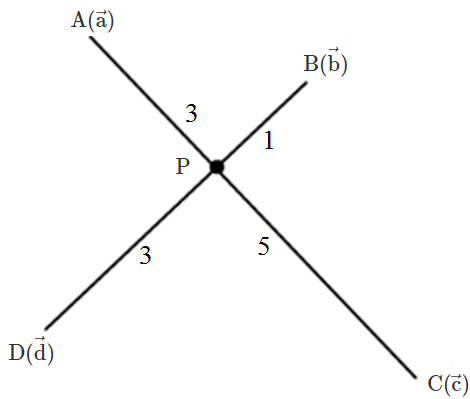
Therefore, P divides AC in the ratio of 3 : 5 and P divides BD in the ratio of 2 : 6. Therefore, position vector of the point of intersection of AC and BD will be $\Rightarrow\frac{3\vec{\text{a}}+5\vec{\text{c}}}8=\frac{2\vec{\text{b}}+6\vec{\text{d}}}8$ View full question & answer→Question 565 Marks
Prove that a necessary and sufficient condition for three vectors $\vec{\text{a}},\ \vec{\text{b}}$ and $\vec{\text{c}}$ to be coplanar is that there exist scalars l, m, n not all zero simultaneously such that $\text{l}\vec{\text{a}}+\text{m}\vec{\text{b}}+\text{n}\vec{\text{c}}=\vec0$.
AnswerNecessary Condition: Let $\vec{\text{a}},\ \vec{\text{b}},\ \vec{\text{c}}$ are three coplanar vectors. Then one of them can be expressed as the linear combination of other two vectors. Let, $\vec{\text{c}}=\text{x}\vec{\text{a}}+\text{y}\vec{\text{b}}$ $\text{x}\vec{\text{a}}+\text{y}\vec{\text{b}}-\vec{\text{c}}=0$ Put $\text{x}=1,\ \text{y}=\text{m},\ (-1)=\text{n}$$\text{l}\vec{\text{a}}+\text{m}\vec{\text{b}}+\text{n}\vec{\text{c}}=0$
Thus, if $\vec{\text{a}},\ \vec{\text{b}},\ \vec{\text{c}}$ are coplanar vectors, then there exist scalars l, m, n $\text{l}\vec{\text{a}}+\text{m}\vec{\text{b}}+\text{n}\vec{\text{c}}=0$ Such that l, m, n are not all zero simultaneously. Sufficient Condition: Let $\vec{\text{a}},\ \vec{\text{b}},\ \vec{\text{c}}$ be three vectors such that there exist scalars l, m, n not all zero simultaneously satisfying $\text{l}\vec{\text{a}}+\text{m}\vec{\text{b}}+\text{n}\vec{\text{c}}=0$ $\text{l}\vec{\text{a}}+\text{m}\vec{\text{b}}+\text{n}\vec{\text{c}}=0$ $\text{n}\vec{\text{c}}=-\text{l}\vec{\text{a}}-\text{m}\vec{\text{b}}$ Dividing by n, both the sides $\frac{\text{n}\vec{\text{c}}}{\text{n}}=\frac{-\text{l}\vec{\text{a}}}{\text{n}}-\frac{\text{m}\vec{\text{b}}}{\text{n}}$ $\vec{\text{c}}=\Big(-\frac{\text{l}}{\text{n}}\Big)\vec{\text{a}}+\Big(-\frac{\text{m}}{\text{n}}\Big)\vec{\text{b}}$ $\vec{\text{c}}$ is a linear combination of $\vec{\text{a}} \text{ and }\vec{\text{b}}$ Hence, $\vec{\text{a}},\ \vec{\text{b}},\ \vec{\text{c}}$ are coplanar vectors.
View full question & answer→Question 575 Marks
ABCD are four points in a plane and Q is the point of intersection of the lines joining the mid-points of AB and CD, BC and AD. Show that $\overrightarrow{\text{PA}}+\overrightarrow{\text{PB}}+\overrightarrow{\text{PC}}+\overrightarrow{\text{PD}}=4\ \overrightarrow{\text{PQ}}$, where P ia any point.
Answer
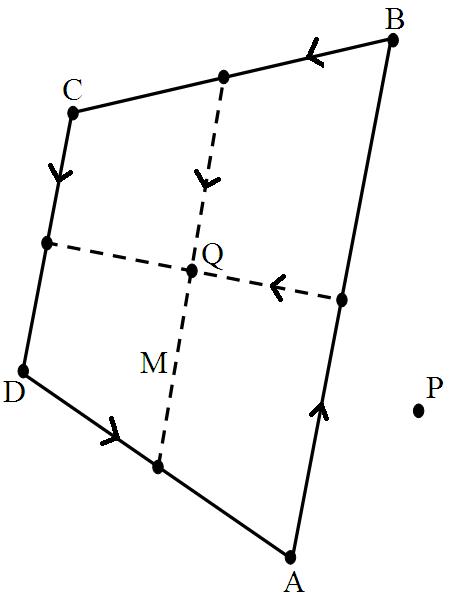 Let $\vec{\text{a}},\ \vec{\text{b}},\ \vec{\text{c}},\ \vec{\text{d}}$ be the position vectors of the points A, B, C and D respectively.
Then, position vector of
mid-point of $\text{AB}=\frac{\vec{\text{a}}+\vec{\text{b}}}2$
mid-point of $\text{BC}=\frac{\vec{\text{b}}+\vec{\text{c}}}2$
mid-point of $\text{CD}=\frac{\vec{\text{c}}+\vec{\text{d}}}2$
mid-point of $\text{DA}=\frac{\vec{\text{a}}+\vec{\text{d}}}2$
Q is the mid-point of the line joining the mid-points of AB and CD
$\therefore\ \text{Q}=\frac{\frac{\vec{\text{a}}+\vec{\text{a}}}2+\frac{\vec{\text{c}}+\vec{\text{d}}}2}{2}$
$=\frac{\vec{\text{a}}+\vec{\text{b}}+\vec{\text{c}}+\vec{\text{d}}}4$
Let $\vec{\text{p}}$ be the position vector of P.
Then,
$\overrightarrow{\text{PA}}+\overrightarrow{\text{PB}}+\overrightarrow{\text{PC}}+\overrightarrow{\text{PD}}$
$=\vec{\text{a}}-\vec{\text{p}}+\vec{\text{b}}-\vec{\text{p}}+\vec{\text{c}}-\vec{\text{p}}+\vec{\text{d}}-\vec{\text{p}}$
$=\big(\vec{\text{a}}+\vec{\text{p}}+\vec{\text{c}}+\vec{\text{d}}\big)-4\vec{\text{p}}$
$=4\bigg(\frac{\vec{\text{a}}+\vec{\text{p}}+\vec{\text{c}}+\vec{\text{d}}}{4}-\vec{\text{p}}\bigg)$
$=4\ \overrightarrow{\text{PQ}}$ View full question & answer→Question 585 Marks
Show that the vector $\hat{\text{i}}+\hat{\text{j}}+\hat{\text{k}}$ is equally inclined to the coordinate axes.
AnswerLet $\theta_1$ be the angle between $\vec{\text{a}}$ and x-axis.
$|\vec{\text{a}}|=\sqrt{(1)^2+(1)^2+(1)^2}=\sqrt{3}$
$\vec{\text{b}}=\hat{\text{i}}$ (Because $\hat{\text{i}}$ is the unit vector along x-axis)
$\big|\vec{\text{b}}\big|=\sqrt{(1)^2}=\sqrt{1}=1$
$\vec{\text{a}}.\vec{\text{b}}=1+0+0=1$
$\cos\theta_{1}=\frac{\vec{\text{a}}.\vec{\text{b}}}{|\vec{a}|\big|\vec{\text{b}}\big|}=\frac{1}{(\sqrt{3})(1)}=\frac{1}{\sqrt{3}}$
$\Rightarrow\theta_{1}=\cos^{-1}\Big(\frac{1}{\sqrt{3}}\Big)\dots(1)$
Let $\theta_{2}$ be the angle between $\vec{\text{a}}$ and y-axis.
$|\vec{\text{a}}|=\sqrt{(1)^2+(1)^2+(1)^2}=\sqrt{3}$
$\vec{\text{b}}=\hat{\text{j}}$ (Because $\hat{\text{j}}$ is the unit vector along y-axis)
$\big|\vec{\text{b}}\big|=\sqrt{(1)^2}=\sqrt{1}=1$
$\vec{\text{a}}.\vec{\text{b}}=0+1+0=1$
$\cos\theta_{2}=\frac{\vec{\text{a}}.\vec{\text{b}}}{|\vec{a}|\big|\vec{\text{b}}\big|}=\frac{1}{(\sqrt{3})(1)}=\frac{1}{\sqrt{3}}$
$\Rightarrow\theta_{2}=\cos^{-1}\Big(\frac{1}{\sqrt{3}}\Big)\dots(2)$
Let $\theta_{3}$ be the angle between $\vec{\text{a}}$ and z-axis.
$|\vec{\text{a}}|=\sqrt{(1)^2+(1)^2+(1)^2}=\sqrt{3}$
$\vec{\text{b}}=\hat{\text{k}}$ (Because $\hat{\text{k}}$ is the unit vector along z-axis)
$\big|\vec{\text{b}}\big|=\sqrt{(1)^2}=\sqrt{1}=1$
$\vec{\text{a}}.\vec{\text{b}}=0+0+1=1$
$\cos\theta=\frac{\vec{\text{a}}.\vec{\text{b}}}{|\vec{a}|\big|\vec{\text{b}}\big|}=\frac{1}{(\sqrt{3})(1)}=\frac{1}{\sqrt{3}}$
$\Rightarrow\theta=\cos^{-1}\Big(\frac{1}{\sqrt{3}}\Big)\dots(3)$
From (1), (2) and (3), the given vector is equally inclined to the coordinate axes.
View full question & answer→Question 595 Marks
Given $\vec{\text{a}}=\frac{1}{7}\big(2\hat{\text{i}}+3\hat{\text{j}}+6\hat{\text{k}}\big),\vec{\text{b}}=\frac{1}{7}\big(3\hat{\text{i}}-6\hat{\text{j}}+2\hat{\text{k}}\big),$$\vec{\text{c}}=\frac{1}{7}\big(6\hat{\text{i}}+2\hat{\text{j}}-3\hat{\text{k}}\big),\hat{\text{i}},\hat{\text{j}},\hat{\text{k}}$
being a right handed orthogonal system of unit vector in spece, show that $\vec{\text{a}},\vec{\text{b}},\vec{\text{c}}$ is also another system.
AnswerGiven:
$\vec{\text{a}}=\frac{1}{7}\big(2\hat{\text{i}}+3\hat{\text{j}}+6\hat{\text{k}}\big)$
$\vec{\text{b}}=\frac{1}{7}\big(3\hat{\text{i}}-6\hat{\text{j}}+2\hat{\text{k}}\big)$
$\vec{\text{c}}=\frac{1}{7}\big(6\hat{\text{i}}+2\hat{\text{j}}-3\hat{\text{k}}\big)$
$\vec{\text{a}}\times\vec{\text{b}}=\Big(\frac{1}{7}\Big)\Big(\frac{1}{7}\Big)\begin{vmatrix}\hat{\text{i}}&\hat{\text{j}}&\hat{\text{k}}\\2&3&6\\3&-6&2 \end{vmatrix}$
$=\frac{1}{49}\big(42\hat{\text{i}}+14\hat{\text{j}}-21\hat{\text{k}}\big)$
$=\frac{1}{49}\big[7\big(6\hat{\text{i}}+2\hat{\text{j}}-3\hat{\text{k}}\big)\big]$
$=\frac{1}{7}\big(6\hat{\text{i}}+2\hat{\text{j}}-3\hat{\text{k}}\big)$
$=\vec{\text{c}}$
$\vec{\text{b}}\times\vec{\text{c}}=\Big(\frac{1}{7}\Big)\Big(\frac{1}{7}\Big)\begin{vmatrix}\hat{\text{i}}&\hat{\text{j}}&\hat{\text{k}}\\3&-6&2\\6&2&-3 \end{vmatrix}$
$=\frac{1}{49}\big(14\hat{\text{i}}+21\hat{\text{j}}+42\hat{\text{k}}\big)$
$=\frac{1}{49}\big[7\big(2\hat{\text{i}}+3\hat{\text{j}}+6\hat{\text{k}}\big)\big]$
$=\frac{1}{7}\big(2\hat{\text{i}}+3\hat{\text{j}}+6\hat{\text{k}}\big)$
$=\vec{\text{a}}$
$\vec{\text{c}}\times\vec{\text{a}}=\Big(\frac{1}{7}\Big)\Big(\frac{1}{7}\Big)\begin{vmatrix}\hat{\text{i}}&\hat{\text{j}}&\hat{\text{k}}\\6&2&-3\\2&3&6 \end{vmatrix}$
$=\frac{1}{49}\big(21\hat{\text{i}}-42\hat{\text{j}}+14\hat{\text{k}}\big)$
$=\frac{1}{49}\big[7\big(3\hat{\text{i}}-6\hat{\text{j}}+2\hat{\text{k}}\big)\big]$
$=\frac{1}{7}\big(3\hat{\text{i}}-6\hat{\text{j}}+2\hat{\text{k}}\big)$
$=\vec{\text{b}}$
$|\vec{\text{a}}|=\frac{1}{7}\sqrt{4+9+36}$
$=\frac{7}{7}$
$=1$
$\big|\vec{\text{b}}\big|=\frac{1}{7}\sqrt{9+36+4}$
$=\frac{7}{7}$
$=1$
$|\vec{\text{c}}|=\frac{1}{7}\sqrt{36+4+9}$
$=\frac{7}{7}$
$=1$
Thus, $\vec{\text{a}},\vec{\text{b}}$ and $\vec{\text{c}}$ from a right handed orthogonal system of unit vectors.
View full question & answer→Question 605 Marks
Let $\vec{\text{a}}=\hat{\text{i}}+4\hat{\text{j}}+2\hat{\text{k}},\vec{\text{b}}=3\hat{\text{i}}-2\hat{\text{j}}+7\hat{\text{k}}$ and $\vec{\text{c}}=2\hat{\text{i}}-\hat{\text{j}}+4\hat{\text{k}}.$Find a vector $\vec{\text{d}}$ which is perpendicular to both $\vec{\text{a}}$ and $\vec{\text{d}}$ and $\vec{\text{c}}.\vec{\text{d}}=15.$
AnswerGiven
$\vec{\text{a}}=\hat{\text{i}}+4\hat{\text{j}}+2\hat{\text{k}}$
$\vec{\text{b}}=3\hat{\text{i}}-2\hat{\text{j}}+7\hat{\text{k}}$
$\vec{\text{c}}=2\hat{\text{i}}-\hat{\text{j}}+4\hat{\text{k}}$
Since d is perpendicular to both a and b, it is parallel to $\vec{\text{a}}\times\vec{\text{b}}.$
Suppose $\text{d}=\lambda\big(\vec{\text{a}}\times\vec{\text{b}}\big)$ for some scalar $\lambda.$
$\text{d}=\lambda\begin{vmatrix}\hat{\text{i}}&\hat{\text{j}}&\hat{\text{k}}\\1&4&2\\3&-2&7 \end{vmatrix}$
$=\lambda\big[(28+4)\hat{\text{i}}-(7-6)\hat{\text{j}}+(-2-12)\hat{\text{k}}\big]$
$\vec{\text{c}}.\vec{\text{d}}=15$ (Given)
$\Rightarrow\big(2\hat{\text{i}}-\hat{\text{j}}+4\hat{\text{k}}\big).\lambda\big(32\hat{\text{i}}-\hat{\text{j}}-14\hat{\text{k}}\big)=15$
$\Rightarrow\lambda(64+1-56)=15$
$\Rightarrow\lambda=\frac{5}{3}$
$\therefore\vec{\text{d}}=\frac{5}{3}\big(32\hat{\text{i}}-\hat{\text{j}}-14\hat{\text{k}}\big)$
$\Rightarrow\vec{\text{d}}=\frac{1}{3}\big(160\hat{\text{i}}-5\hat{\text{j}}-70\hat{\text{k}}\big)$
Disclaimer: The question should contain "Which is perpendicular to both $\vec{\text{a}}$ and $\vec{\text{b}}$ " instead of "Which is perpendicular to both $\vec{\text{a}}$ and $\vec{\text{d}}$ "
View full question & answer→Question 615 Marks
Let $\vec{\text{a}}=\text{x}^2\hat{\text{i}}+2\hat{\text{j}}-2\hat{\text{k}},\vec{\text{b}}=\hat{\text{i}}-\hat{\text{j}}+\hat{\text{k}}$ and $\vec{\text{c}}=\text{x}^2\hat{\text{i}}+5\hat{\text{j}}-4\hat{\text{k}}$ be three vectors. Find the valuse of x for which the angle between $\vec{\text{a}}$ and $\vec{\text{b}}$ is acute and the angle between $\vec{\text{b}}$ and $\vec{\text{c}}$ is obtuse.
AnswerWe have
$\vec{\text{a}}=\text{x}^2\hat{\text{i}}+2\hat{\text{j}}-2\hat{\text{k}},\vec{\text{b}}=\hat{\text{i}}-\hat{\text{j}}+\hat{\text{k}}$ and $\vec{\text{c}}=\text{x}^2\hat{\text{i}}+5\hat{\text{j}}-4\hat{\text{k}}$
Let $\theta_1$ be the angle between $\vec{\text{a}}$ and $\vec{\text{b}}$ and $\theta_2$ be the angle between $\vec{\text{b}}$ and $\vec{\text{c}}.$
Given that $\theta_1$ is acute and $\theta_2$ is obtuse.
$\Rightarrow\cos\theta_1>0$ and $\cos\theta_2<0$
$\Rightarrow\frac{\vec{\text{a}}.\vec{\text{b}}}{|\vec{\text{a}}|.\big|\vec{\text{b}}\big|}>0$ and $\frac{\vec{\text{b}}.\vec{\text{c}}}{\big|\vec{\text{b}}\big|.|\vec{\text{c}}|}<0$
$\Rightarrow\frac{\text{x}^2-4}{\sqrt{\text{x}^2+4+4}\sqrt{\text{1+1+1}}}>0$ and $\frac{\text{x}^2-9}{\sqrt{\text{1+1+1}}\sqrt{\text{x}^4}+25+16}<0$
$\Rightarrow\text{x}^2-4>0$ and $\text{x}^2-9<0$
$\Rightarrow\text{x}\in(-\infty,-2)\cup(2,\infty)$ and $\text{x}\in(-3,3)$
$\Rightarrow\text{x}\in(-3,-2)\cup(2,3)$
View full question & answer→Question 625 Marks
Show that the points whose position vectors are$\vec{\text{a}}=4\hat{\text{i}}-3\hat{\text{j}}+\hat{\text{k}}, \vec{\text{b}}=2\hat{\text{i}}-4\hat{\text{j}}+5\hat{\text{k}},\vec{\text{c}}=\hat{\text{i}}-\hat{\text{j}}$ from a right triangle.
AnswerGiven
$\vec{\text{a}}=4\hat{\text{i}}-3\hat{\text{j}}+\hat{\text{k}}$
$\vec{\text{b}}=2\hat{\text{i}}-4\hat{\text{j}}+5\hat{\text{k}}$
$\vec{\text{c}}=\hat{\text{i}}-\hat{\text{j}}$
$\overrightarrow{\text{AB}}$ = position vector of B - position vector of A
$=\big(2\hat{\text{i}}-4\hat{\text{j}}+5\hat{\text{k}}\big)-\big(4\hat{\text{i}}-3\hat{\text{j}}+\hat{\text{k}}\big)$
$=2\hat{\text{i}}-4\hat{\text{j}}+5\hat{\text{k}}-4\hat{\text{i}}+3\hat{\text{j}}-\hat{\text{k}}$
$\overrightarrow{\text{AB}}=-2\hat{\text{i}}-\hat{\text{j}}+4\hat{\text{k}}$
$\overrightarrow{\text{BC}}$ = position vector of C - position vector of B
$=\big(\hat{\text{i}}-\hat{\text{j}}\big)-\big(2\hat{\text{i}}-4\hat{\text{j}}+5\hat{\text{k}}\big)$
$=\hat{\text{i}}-\hat{\text{j}}-2\hat{\text{i}}+4\hat{\text{j}}-5\hat{\text{k}}$
$=-\hat{\text{i}}+3\hat{\text{j}}-5\hat{\text{k}}$
$\overrightarrow{\text{CA}}$ = position vector of A - position vector of C
$=\big(4\hat{\text{i}}-3\hat{\text{j}}+\hat{\text{k}}\big)-\big(\hat{\text{i}}-\hat{\text{j}}\big)$
$=4\hat{\text{i}}-3\hat{\text{j}}+\hat{\text{k}}-\hat{\text{i}}+\hat{\text{j}}$
$=3\hat{\text{i}}-2\hat{\text{j}}+\hat{\text{k}}$
View full question & answer→Question 635 Marks
Prove that the points $\hat{\text{i}}-\hat{\text{j}},\ 4\hat{\text{i}}+3\hat{\text{j}}+\hat{\text{k}}$ and $2\hat{\text{i}}-4\hat{\text{j}}+5\hat{\text{k}}$ are the vertices of a right-angled triangle.
AnswerLet $\vec{\text{A}}=\hat{\text{i}}-\hat{\text{j}}$
$\vec{\text{B}}=4\hat{\text{i}}+3\hat{\text{j}}+\hat{\text{k}}$
$\vec{\text{C}}=2\hat{\text{i}}-4\hat{\text{j}}+5\hat{\text{k}}$
$\overrightarrow{\text{AB}}=\vec{\text{B}}-\vec{\text{A}}$
$=\big(4\hat{\text{i}}+3\hat{\text{j}}+\hat{\text{k}}\big)-\big(\hat{\text{i}}-\hat{\text{j}}\big)$
$=4\hat{\text{i}}+3\hat{\text{j}}+\hat{\text{k}}-\hat{\text{i}}-\hat{\text{j}}$
$=3\hat{\text{i}}+4\hat{\text{j}}+\hat{\text{k}}$
$\Big|\overrightarrow{\text{AB}}\Big|=\sqrt{(3^2)+(4)^2+(1)^2}$
$=\sqrt{9+16+1}$
$=\sqrt{26}$
$\overrightarrow{\text{BC}}=\vec{\text{C}}-\vec{\text{B}}$
$=\big(\hat{2\text{i}}-4\hat{\text{j}}+5\hat{\text{k}}\big)-\big(4\hat{\text{i}}+3\hat{\text{j}}+\hat{\text{k}}\big)$
$=2\hat{\text{i}}-4\hat{\text{j}}+5\hat{\text{k}}-4\hat{\text{i}}-3\hat{\text{j}}-\hat{\text{k}}$
$=-2\hat{\text{i}}-7\hat{\text{j}}+4\hat{\text{k}}$
$\Big|\overrightarrow{\text{BC}}\Big|=\sqrt{(2)^2+(-7)^2+(4)^2}$
$=\sqrt{4+49+16}$
$=\sqrt{69}$
$\overrightarrow{\text{CA}}=\vec{\text{A}}-\vec{\text{C}}$
$=\hat{\text{i}}-\hat{\text{j}}-\big(2\hat{\text{i}}-4\hat{\text{j}}+5\hat{\text{k}}\big)$
$=\hat{\text{i}}-\hat{\text{j}}-2\hat{\text{i}}+4\hat{\text{j}}-5\hat{\text{k}}$
$=-\hat{\text{i}}+3\hat{\text{j}}-5\hat{\text{k}}$
$\Big|\overrightarrow{\text{CA}}\Big|=\sqrt{(-1)^2+(3)^2+(-5)^2}$
$=\sqrt{1+9+25}$
$=\sqrt{35}$
Here, $\Big|\overrightarrow{\text{AB}}\Big|^2+\Big|\overrightarrow{\text{CA}}\Big|^2=\Big|\overrightarrow{\text{BC}}\Big|^2$
$26+35=69$
$61\neq69$
$\text{LHS}\neq\text{RHS}$
Since sum of square of two sides is not equal to the square of third sides. So, $\triangle\text{ABC}$ is not a right triangle.
View full question & answer→Question 645 Marks
If $\vec{\text{a}}$ be the position vector whose tip is (5, -3), find the coordinates of a point B such that $\overrightarrow{\text{AB}}=\vec{\text{a}}$, the coordinates of A being (4, -1).
AnswerLet O be the origin and let P(5, -3) be the tip of the position vector $\vec{\text{a}}$. Then,
$\vec{\text{a}}=\overrightarrow{\text{OP}}=5\hat{\text{i}}-3\hat{\text{j}}$. Let the coordinate of B be (x, y) and A has coordinates (4, -1).
Therefore,
$\overrightarrow{\text{AB}}$ = Position vector of B - Position vector of A
$=\big(\text{x}\hat{\text{i}}+\text{y}\hat{\text{j}}\big)-\big(4\hat{\text{i}}-\hat{\text{j}}\big)$
$=(\text{x}-4)\hat{\text{i}}+(\text{y}+1)\hat{\text{j}}$
Now,
$\overrightarrow{\text{AB}}=\vec{\text{a}}$
$\Rightarrow(\text{x}-4)\hat{\text{i}}+(\text{y}+1)\hat{\text{j}}=5\hat{\text{i}}-3\hat{\text{j}}$
$\Rightarrow\text{x}-4=5\text{ and }\text{y}+1=-3$
$\Rightarrow\text{x}=9 \text{ and }\text{y}=-4$
Hence, the coordinates of B are (9, -4).
View full question & answer→Question 655 Marks
Using vectors find the area of the triangle with vertices, A(2, 3, 5), B(3, 5, 8) and C(2, 7, 8).
AnswerLet $\vec{\text{a}},\vec{\text{b}},$ and $\vec{\text{c}}$ be the position vectors of A, B and C, respectively. then,
$\vec{\text{a}}=2\hat{\text{i}}+3\hat{\text{j}}+5\hat{\text{k}}$
$\vec{\text{b}}=3\hat{\text{i}}+5\hat{\text{j}}+8\hat{\text{k}}$
$\vec{\text{c}}=2\hat{\text{i}}+7\hat{\text{j}}+8\hat{\text{k}}$
Now,
$\overrightarrow{\text{AB}}=\vec{\text{b}}-\vec{\text{a}}$
$=\hat{\text{i}}+2\hat{\text{j}}+3\hat{\text{k}}$
$\overrightarrow{\text{AC}}=\vec{\text{c}}=\vec{\text{a}}$
$=0\hat{\text{i}}+4\hat{\text{j}}+3\hat{\text{k}}$
$\therefore\overrightarrow{\text{AB}}\times\overrightarrow{\text{AC}}=\begin{vmatrix}\hat{\text{i}}&\hat{\text{j}}&\hat{\text{k}}\\1&2&3\\0&4&3 \end{vmatrix}$
$=-6\hat{\text{i}}-3\hat{\text{j}}+4\hat{\text{k}}$
$\Rightarrow\big|\overrightarrow{\text{AB}}\times\overrightarrow{\text{AC}}\big|=\sqrt{36+9+16}$
$=\sqrt{61}$
Area of triangle ABC $=\frac{1}{2}\big|\overrightarrow{\text{AB}}\times\overrightarrow{\text{AC}}\big|$
$=\frac{\sqrt{61}}{2}\text{ sq. units}$
View full question & answer→Question 665 Marks
The two adjacent sides of a parallelogram are $2\hat{\text{i}}-4\hat{\text{j}}-5\hat{\text{k}}$ and $2\hat{\text{i}}+2\hat{\text{j}}+3\hat{\text{k}}.$ Find the two unit vectors parallel to its diagonals. Using the diagonal vectors, find the area of the parallelogram.
AnswerThe two adjacent sides of a parallelogram are $2\hat{\text{i}}-4\hat{\text{j}}-5\hat{\text{k}}$ and $2\hat{\text{i}}+2\hat{\text{j}}+3\hat{\text{k}}.$ suppose $\vec{\text{a}}=2\hat{\text{i}}-4\hat{\text{j}}-5\hat{\text{k}}$ and $\vec{\text{b}}=2\hat{\text{i}}+2\hat{\text{j}}+3\hat{\text{k}}$
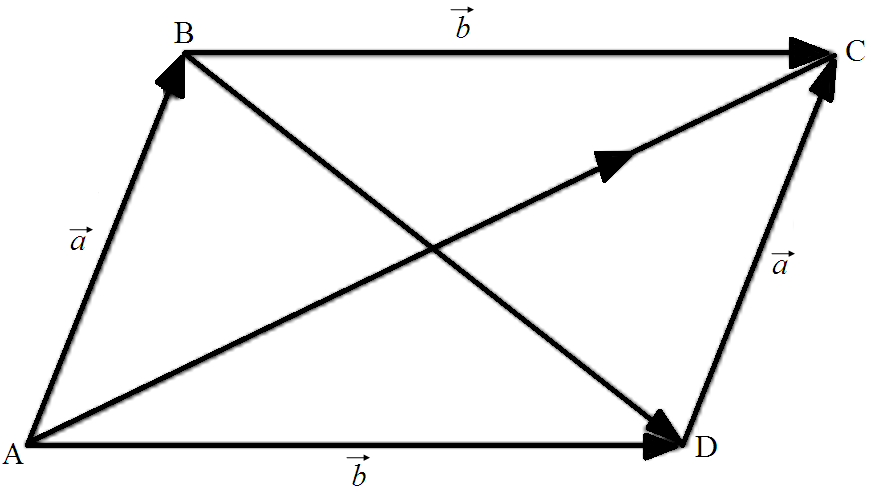
Then any one diagonal of a parallelogram is $\vec{\text{P}}=\vec{\text{a}}+\vec{\text{b}}.$
$\vec{\text{P}}=\vec{\text{a}}+\vec{\text{b}}$
$=2\hat{\text{i}}-4\hat{\text{j}}-5\hat{\text{k}}+2\hat{\text{i}}+2\hat{\text{j}}+3\hat{\text{k}}$
$=4\hat{\text{i}}-2\hat{\text{j}}-2\hat{\text{k}}$
Therefore, unit vector along the diagonal is $\frac{\vec{\text{P}}}{\big|\vec{\text{P}}\big|}=\frac{4\hat{\text{i}}-2\hat{\text{j}}-2\hat{\text{k}}}{\sqrt{16+4+4}}=\frac{2\hat{\text{i}}-\hat{\text{j}}-\hat{\text{k}}}{\sqrt{6}}.$
Another diagonal of a parallelogram is $\vec{\text{P}}'=\vec{\text{b}}-\vec{\text{a}}.$
$\vec{\text{P}}'=\vec{\text{b}}-\vec{\text{a}}$
$=2\hat{\text{i}}+2\hat{\text{j}}+3\hat{\text{k}}-2\hat{\text{i}}+4\hat{\text{j}}+5\hat{\text{k}}$
$=6\hat{\text{j}}+8\hat{\text{k}}$
Therefore, unit vector along the diagonal is $\frac{\vec{\text{P}}}{\big|\vec{\text{P}}\big|}=\frac{6\hat{\text{j}}+8\hat{\text{k}}}{\sqrt{36+64}}=\frac{6\hat{\text{j}}+8\hat{\text{k}}}{10}=\frac{3\hat{\text{j}}+4\hat{\text{k}}}{5}.$
Now,
$\vec{\text{P}}\times\vec{\text{P}}'=\begin{vmatrix}\hat{\text{i}}&\hat{\text{j}}&\hat{\text{k}}\\4&-2&-2\\0&6&8\end{vmatrix}$
$=\hat{\text{i}}(-16+12)-\hat{\text{j}}(32-0)+\hat{\text{k}}(24-0)$
$=-4\hat{\text{i}}-32\hat{\text{j}}+24\hat{\text{k}}$
Area of parallelogram $\frac{\big|\vec{\text{p}}\times\vec{\text{p}'}\big|}{2}=\frac{\sqrt{16+1024+576}}{2}=\frac{\sqrt{1616}}{2}$
$=\frac{4\sqrt{101}}{2}=2\sqrt{101}\text{ square units}$ View full question & answer→Question 675 Marks
If $\big|\vec{\text{a}}+\vec{\text{b}}\big|=60,\big|\vec{\text{a}}-\vec{\text{b}}\big|=40$ and $\big|\vec{\text{b}}\big|=46,$ find $|\vec{\text{a}}|$
AnswerHere, $\big|\vec{\text{a}}+\vec{\text{b}}\big|=60$
Squaring both the sides,
$\big|\vec{\text{a}}+\vec{\text{b}}\big|^2=(60)^2$
$(\vec{\text{a}}+\vec{\text{b}})=(60)^2$
$(\vec{\text{a}})^2+(\vec{\text{b}})^2+2\vec{\text{a}}\vec{\text{b}}=3600$
$|\vec{\text{a}}|^2+\big|\vec{\text{b}}\big|^2+2\vec{\text{a}}\vec{\text{b}}=3600\dots(1)$
Now, $\big|\vec{\text{a}}-\vec{\text{b}}\big|=40$
Squaring both the sides,
$\big|\vec{\text{a}}-\vec{\text{b}}\big|^2=(40)^2$
$|\vec{\text{a}}|^2+\big|\vec{\text{b}}\big|^2-2\vec{\text{a}}\vec{\text{b}}=1600\dots(2)$
Adding (1) and (2),
$2|\vec{\text{a}}|^2+2\big|\vec{\text{b}}\big|^2+2\vec{\text{a}}\vec{\text{b}}-2\vec{\text{a}}\vec{\text{b}}=3600-1600$
$2|\vec{\text{a}}|^2+2(46)^2=5200$
$2|\vec{\text{a}}|^2=5200-4232$
$2|\vec{\text{a}}|^2=968$
$|\vec{\text{a}}|^2=\frac{968}{2}$
$|\vec{\text{a}}|^2=484$
$|\vec{\text{a}}|=\sqrt{484}$
$|\vec{\text{a}}|=22$
View full question & answer→Question 685 Marks
Prove that the diagonals of a rectangle are perpendicular if and only if the rectangle is a square.
Answer
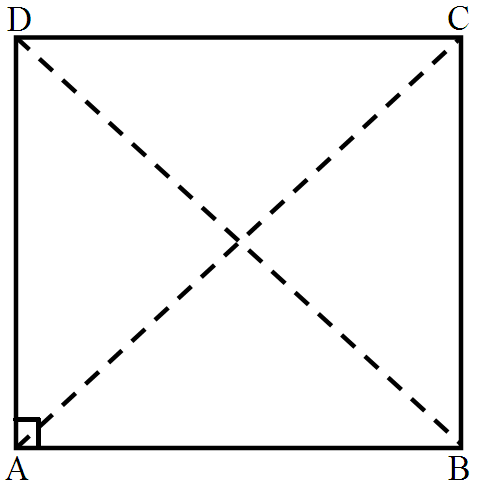 Let ABCD be a rectangle.Take A as origion.
Let position vectors of point B, D be $\vec{\text{a}}$ and $\vec{\text{b}}$ respectively.
By parallelogram law,
$\vec{\text{AC}} = \vec{\text{a}} + \vec{\text{b}}$ and $\vec{\text{BD}} = \vec{\text{a}} - \vec{\text{b}}$
As ABCD is a rectangle, $\text {AB}\perp{\text{AD}}$
$\Rightarrow \vec{\text{a}}. \vec{\text{b}} = 0\dots(\text{i})$
Now, diagonals AC and BD are perpendicular iff $\vec{\text{AC}} . \vec{\text{BD}} = 0$
$\Rightarrow \big(\vec{\text{a}} + \vec{\text{b}}\big)\big(\vec{\text{a}} - \vec{\text{b}}\big) = 0$
$\Rightarrow (\vec{\text{a}})^{2} - (\vec{\text{b}})^{2} = 0$
$\Rightarrow\big|\vec{\text{AB}}\big|^{2} = \big|\vec{\text{AD}}\big|^{2}$
$\Rightarrow \big|\vec{\text{AB}}\big|^{2} = \big|\vec{\text{AD}}\big|$
Hence ABCD is a square. View full question & answer→Question 695 Marks
Show that the four points A, B, C and D with the position vectors $\vec{\text{a}},\ \vec{\text{b}},\ \vec{\text{c}}$ and $\vec{\text{d}}$ respectively are coplanar if and only if $3\vec{\text{a}}-2\vec{\text{b}}+\vec{\text{c}}-2\vec{\text{d}}=\vec0$.
AnswerNecessary Condition: Firstly, let $\vec{\text{a}},\ \vec{\text{b}},\ \vec{\text{c}}$ are coplanar vectors. Then, one of them is expressible as a linear combination of the other two.Let $\vec{\text{c}}=\text{x}\vec{\text{a}}+\text{y}\vec{\text{b}}$ for some scalars x, y. Then,
$\Rightarrow\ \text{l}\vec{\text{a}}+\text{m}\vec{\text{b}}+\text{n}\vec{\text{c}}=\vec0$, where l = x, m = y, n = -1.
Thus, if $\vec{\text{a}},\ \vec{\text{b}},\ \vec{\text{c}}$ are coplanar vectors, then there exists a scalars l, m, n not all zero simultaneously satisfying $\text{l}\vec{\text{a}}+\text{m}\vec{\text{b}}+\text{n}\vec{\text{c}}=\vec0$ where l, m, n are not all zero simultaneously.
Sufficient Condition: Let $\vec{\text{a}},\ \vec{\text{b}},\ \vec{\text{c}}$ are three scalars such that there exists scalars l, m, n not all zero simultaneously satisfying $\text{l}\vec{\text{a}}+\text{m}\vec{\text{b}}+\text{n}\vec{\text{c}}=\vec0$. We have to prove that $\vec{\text{a}},\ \vec{\text{b}},\ \vec{\text{c}}$ are coplanar vectors.
Now,
$\text{l}\vec{\text{a}}+\text{m}\vec{\text{b}}+\text{n}\vec{\text{c}}=\vec0$
$\Rightarrow\text{n}\vec{\text{c}}=-\text{l}\vec{\text{a}}-\text{m}\vec{\text{b}}$
$\Rightarrow\ \vec{\text{c}}=\Big(\frac{-\text{l}}{\text{n}}\Big)\vec{\text{a}}+\Big(\frac{-\text{m}}{\text{n}}\Big)\vec{\text{b}}$
$\vec{\text{c}}$ is a linear combination of $\vec{\text{a}}\text{ and }\vec{\text{b}}$.
$\vec{\text{c}}$ lies in a plane $\vec{\text{a}}\text{ and }\vec{\text{b}}$.
Hence, $\vec{\text{a}},\ \vec{\text{b}},\ \vec{\text{c}}$ are coplanar vectors.
View full question & answer→Question 705 Marks
Using vectors, find the area of the triangle with vertices:
- A(1, 1, 2), B(2, 3, 5) and C(1, 5, 5)
- A(1, 2, 3), B(2, -1, 4) and C(4,5, -1)
AnswerGiven that
A = (1, 1, 2)
B = (2, 3, 5)
C = (1, 5, 5)
Position vector of $\text{A}=\hat{\text{i}}+\hat{\text{j}}+2\hat{\text{k}}$
Position vector of $\text{B}=2\hat{\text{i}}+3\hat{\text{j}}+5\hat{\text{k}}$
Position vector of $\text{C}=\hat{\text{i}}+5\hat{\text{j}}+5\hat{\text{k}}$
$\overrightarrow{\text{AB}}=$ Position vector of B-position vector of A
$=2\hat{\text{i}}+3\hat{\text{j}}+5\hat{\text{k}}-\big(\hat{\text{i}}+\hat{\text{j}}+2\hat{\text{k}}\big)$
$=\hat{\text{i}}+2\hat{\text{j}}+3\hat{\text{k}}$
$\overrightarrow{\text{AC}}-$ Position vector of C-position vector of A
$=\hat{\text{i}}+5\hat{\text{j}}+5\hat{\text{k}}-\big(\hat{\text{i}}+\hat{\text{j}}+2\hat{\text{k}}\big)$
$=4\hat{\text{j}}+3\hat{\text{k}}$
Area of triangle $=\frac{1}{2}\big|\overrightarrow{\text{AB}}\times\overrightarrow{\text{AC}}\big|$
$\overrightarrow{\text{AB}}\times\overrightarrow{\text{AC}}\begin{bmatrix}\hat{\text{i}}&\hat{\text{j}}&\hat{\text{k}}\\1&2&3\\0&4&3 \end{bmatrix}$
$=\hat{\text{i}}(6-12)-\hat{\text{j}}(3-0)+\hat{\text{k}}(4-0)$
$=-6\hat{\text{i}}-3\hat{\text{j}}+4\hat{\text{k}}$
$\overrightarrow{\text{AB}}\times\overrightarrow{\text{AC}}=\sqrt{(-6)^2+(-3)^2+4^2}$
$-\sqrt{36+9+16}$
$=\sqrt{61}$
Area of the teiangle $=\frac{1}{2}\sqrt{61}$ Sq. unit
View full question & answer→Question 715 Marks
If O is a point in space, ABC is a triangle and D, E, F are the mid-points of the sides BC, CA and AB respectively of the triangle, prove that $\overrightarrow{\text{OA}}+\overrightarrow{\text{OB}}+\overrightarrow{\text{OC}}=\overrightarrow{\text{OD}}+\overrightarrow{\text{OE}}+\overrightarrow{\text{OF}}$.
Answer
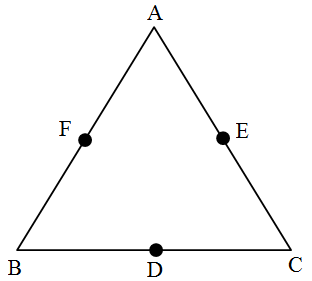 Let D, E and F are the midpoints of BC, CA and AB respectively.
Therefore,
$\frac{\overrightarrow{\text{OB}}+\overrightarrow{\text{OC}}}{2}=\overrightarrow{\text{OD}}$
$\overrightarrow{\text{OB}}+\overrightarrow{\text{OC}}=2\ \overrightarrow{\text{OD}}\ \dots(1)$
Similarly
$\overrightarrow{\text{OC}}+\overrightarrow{\text{OA}}=2\ \overrightarrow{\text{OE}}\ \dots(2)$
$\overrightarrow{\text{OA}}+\overrightarrow{\text{OB}}=2\ \overrightarrow{\text{OF}}\ \dots(3)$
Adding (1), (2) and (3). We get,
$2\Big(\overrightarrow{\text{OA}}+\overrightarrow{\text{OB}}+\overrightarrow{\text{OC}}\Big)=2\Big(\overrightarrow{\text{OD}}+\overrightarrow{\text{OE}}+\overrightarrow{\text{OF}}\Big)$
$\Rightarrow\overrightarrow{\text{OA}}+\overrightarrow{\text{OB}}+\overrightarrow{\text{OC}}=\overrightarrow{\text{OD}}+\overrightarrow{\text{OE}}+\overrightarrow{\text{OF}}$
Hence Proved. View full question & answer→Question 725 Marks
If $AD$ is the median of $\triangle\text{ABC},$ using vectors, prove that $\text{AB}^2+\text{AC}^2=2\big(\text{AD}^2+\text{CD}^2\big).$
Answer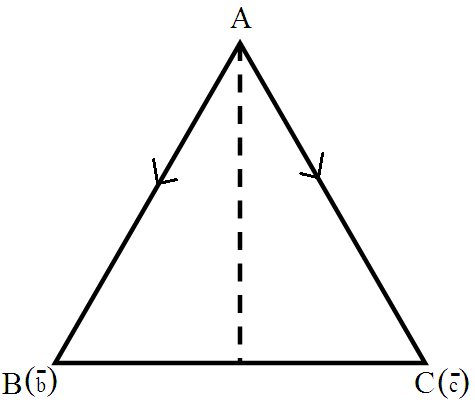
Take $A$ as origin, let the position vectors of $B$ and $C$ are $\vec{\text{b}}$ and $\vec{\text{c}}$ respectively. position vector of $\text{D} = \frac{\vec{\text{b}} + \vec{\text{c}}}{2},\vec{\text{AB}} = \vec{\text{b}}$ and $\vec{\text{AC}} = \vec{\text{c}.}$
$\vec{\text{AD}} = \frac{\vec{\text{b}} + \vec{\text{c}}}{2} - 0 = \frac{\vec{\text{b}} +\vec{\text{c}}}{2}$
consider, $2 (AD^2 + CD^2)$
$= 2\Big[\Big(\frac{\vec{\text{b}}+ \vec{\text{c}}}{2}\Big)^{2} + \Big(\frac{\vec{\text{b}} + \vec{\text{c}}}{2}-\vec{\text{c}}\Big)^{2}\Big]$
$=2\Big[\Big(\frac{\vec{\text{b}} + \vec{\text{c}}}{2}\Big)^{2}\Big(\frac{\vec{\text{b}} - \vec{\text{c}}}{2}\Big)^{2}\Big]$
$=\frac{1}{2}\big[\big(\vec{\text{b}} + \vec{\text{c}}\big)^{2} + \big(\vec{\text{b}} - \vec{\text{c}}\big)^{2}\big]$
$= (\vec{\text{b}})^{2} + (\vec{\text{c}})^{2}$
$= \big(\vec{\text{AB}}\big)^{2} + \big(\vec{\text{AC}}\big)^{2}$
$= \text{AB}^2 + \text{AC}^2$
Hence proved. View full question & answer→Question 735 Marks
Show that the vectors $2\hat{\text{i}}-3\hat{\text{j}}+4\hat{\text{k}}$ and $-4\hat{\text{i}}+6\hat{\text{j}}-8\hat{\text{k}}$ are collinear.
AnswerGiven the position vectors $2\hat{\text{i}}-3\hat{\text{j}}+4\hat{\text{k}}$ and $-4\hat{\text{i}}+6\hat{\text{j}}-8\hat{\text{k}}$Let $\vec{\text{a}}=2\hat{\text{i}}-3\hat{\text{j}}+4\hat{\text{k}}$ and $\vec{\text{b}}=-4\hat{\text{i}}+6\hat{\text{j}}-8\hat{\text{k}}$
Then,
$\vec{\text{b}}=-4\hat{\text{i}}+6\hat{\text{j}}-8\hat{\text{k}}$
$=-2\big(2\hat{\text{i}}-3\hat{\text{j}}+4\hat{\text{k}}\big)$
$=-2\vec{\text{a}}$
Hence, $\vec{\text{a}},\vec{\text{b}}$ are collinear.
View full question & answer→Question 745 Marks
The two adjecent sides of a parallelogram are $2\hat{\text{i}}-4\hat{\text{j}}+5\hat{\text{k}}$ and $\hat{\text{i}}-2\hat{\text{j}}-3\hat{\text{k}}.$ Find the unit vector parallel to one of its diagonals. Also, find its area.
AnswerSuppose $\Box\text{ ABCD}$ is the given parallelogram and AC is its diagonal.
Let:
$\overrightarrow{\text{AB}}=2\hat{\text{i}}-4\hat{\text{j}}+5\hat{\text{k}}$
$\overrightarrow{\text{BC}}=\hat{\text{i}}-2\hat{\text{j}}-3\hat{\text{k}}$
$\therefore$ Diagonal $\overrightarrow{\text{AC}}=\overrightarrow{\text{AB}}+\overrightarrow{\text{BC}}$
$=3\hat{\text{i}}-6\hat{\text{j}}+2\hat{\text{k}}$
$\Rightarrow\big|\overrightarrow{\text{AC}}\big|=\sqrt{9+36+4}$
$=7$
Unit vector parallel to $\overrightarrow{\text{AC}}=\frac{\overrightarrow{\text{AC}}}{\big|\overrightarrow{\text{AC}}\big|}$
$=\frac{3\hat{\text{i}}-6\hat{\text{j}}+2\hat{\text{k}}}{7}$
Now,
$\Rightarrow\overrightarrow{\text{AB}}\times\overrightarrow{\text{BC}}=\begin{vmatrix}\hat{\text{i}}&\hat{\text{j}}&\hat{\text{k}}\\2&-4&5\\1&-2&-3 \end{vmatrix}$
$=22\hat{\text{i}}+11\hat{\text{j}}+0\hat{\text{k}}$
$\Rightarrow\big|\overrightarrow{\text{AB}}\times\overrightarrow{\text{AC}}\big|=\sqrt{484+121}$
$=\sqrt{605}$
$=11\sqrt{5}$
Area of triangle ABC $=\frac{1}{2}\big|\overrightarrow{\text{AB}}\times\overrightarrow{\text{AC}}\big|$
$=\frac{11\sqrt{5}}{2}\text{ sq. units}$
View full question & answer→Question 755 Marks
Prove that: If the diagonals of a quadrilateral bisect each other at right angles, then it is a rhombus.
Answer

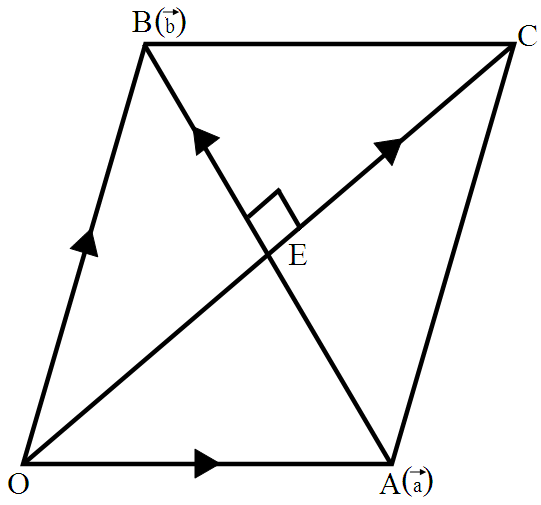 Let OACB be a quadrilateral such that diagonals OC and AB bisect each other at 90°.
Taking O as the origin, let the position vectors of A and B be $\vec{\text{a}}$ and $\vec{\text{b}},$respectively. Then,
$\vec{\text{OA}}=\vec{\text{a}}$ and $\vec{\text{OB}}=\vec{\text{b}}$
position vector of mid-point of AB, $\vec{\text{OE}}=\frac{\vec{\text{a}}+\vec{\text{b}}}{2}$
$\therefore$ position vector of c, $\vec{\text{OC}}=\vec{\text{a}}+\vec{\text{b}}$
By the triangle law of vector addition, we have
$\vec{\text{OA}}+\vec{\text{AB}}=\vec{\text{OB}}$
$\Rightarrow\vec{\text{AB}}=\vec{\text{OB}}-\vec{\text{OA}}=\vec{\text{b}}-\vec{\text{a}}$
Since $\vec{\text{AB}}\perp\vec{\text{OC}},$
$\Rightarrow \vec{\text{AB}}.\vec{\text{OC}}=0$
$\Rightarrow\big(\vec{\text{b}}-\vec{\text{a}}\big).\big(\vec{\text{a}}+\vec{\text{b}}\big)=0$
$\Rightarrow\big|\vec{\text{b}}\big|^{2}-|\vec{\text{a}}|^{2}=0$
$\Rightarrow|\vec{\text{a}}|^{2}=\big|\vec{\text{b}}\big|^{2}$
$\Rightarrow|\vec{\text{a}}|=\big|\vec{\text{b}}\big|$
$\Rightarrow \text{OA = OB}$
In a quadrilateral if diagonals bisects each other at right angle and adjacent sides are equal, then it is a rhombus. View full question & answer→Question 765 Marks
Find the angles of a triangle whose vertices are A (0, -1 ,-2), B(3, 1 ,4) and C(5 ,7 ,1).
Answer$\vec{\text{A}}=0.\hat{\text{i}}-\hat{\text{j}}-2\hat{\text{k}}$
$\vec{\text{B}}=3\hat{\text{i}}+\hat{\text{j}}+4\hat{\text{k}}$
$\vec{\text{C}}=5\hat{\text{i}}+7\hat{\text{j}}+\hat{\text{k}}$
$\overrightarrow{\text{AB}}=\vec{\text{B}}-\vec{\text{A}}$
$=\big(3\hat{\text{i}}+\hat{\text{j}}+4\hat{\text{k}}\big)-\big(0.\hat{\text{i}}-\hat{\text{j}}-2\hat{\text{k}}\big)$
$=3\hat{\text{i}}+\hat{\text{j}}+4\hat{\text{k}}-0.\hat{\text{i}}+\hat{\text{j}}+2\hat{\text{k}}$
$\overrightarrow{\text{AB}}=3\hat{\text{i}}+2\hat{\text{j}}+6\hat{\text{k}}$
$\overrightarrow{\text{BC}}=\vec{\text{C}}-\vec{\text{B}}$
$=\big(5\hat{\text{i}}+7\hat{\text{j}}+\hat{\text{k}}\big)-\big(3\hat{\text{i}}+\hat{\text{j}}+4\hat{\text{k}}\big)$
$=5\hat{\text{i}}+7\hat{\text{j}}+\hat{\text{k}}-3\hat{\text{i}}-\hat{\text{j}}-4\hat{\text{k}}$
$\overrightarrow{\text{BC}}=2\hat{\text{i}}+6\hat{\text{j}}-3\hat{\text{k}}$
$\overrightarrow{\text{AC}}=\vec{\text{C}}-\vec{\text{A}}$
$=\big(5\hat{\text{i}}+7\hat{\text{j}}+\hat{\text{k}}\big)-\big(-\hat{\text{j}}-2\hat{\text{k}}\big)$
$=5\hat{\text{i}}+7\hat{\text{j}}+\hat{\text{k}}+\hat{\text{j}}+2\hat{\text{k}}$
$\overrightarrow{\text{AC}}=5\hat{\text{i}}+8\hat{\text{j}}+3\hat{\text{k}}$
Angle between $\overrightarrow{\text{AB}}$ and $\overrightarrow{\text{AC}},$
$\cos\text{A}=\frac{\overrightarrow{\text{AB}}.\overrightarrow{\text{AC}}}{\big|\overrightarrow{\text{AB}}\big|\big|\overrightarrow{\text{AC}}\big|}$
$=\frac{\big(3\hat{\text{i}}+2\hat{\text{j}}+6\hat{\text{k}}\big)\big(5\hat{\text{i}}+8\hat{\text{j}}+3\hat{\text{k}}\big)}{\sqrt{(3)^2+(2)^2+(6)^2}\sqrt{(5)^2+(8)^2+(3)^2}}$
$=\frac{(3)(5)+(2)(8)+(6)(3)}{\sqrt{9+4+36}\sqrt{25+64+9}}$
$=\frac{15+16+18}{\sqrt{49}\sqrt{98}}$
$=\frac{49}{\sqrt{49}\sqrt{49\times2}}$
$\cos\text{A}=\frac{49}{49\sqrt{2}}$
$\cos\text{A}=\frac{1}{\sqrt{2}}$
$\text{A}=\cos^{-1}\Big(\frac{1}{\sqrt{2}}\Big)$
$=\frac{\pi}{4}$
$\angle\text{A}=\frac{\pi}{4}$
Angle between $\overrightarrow{\text{BC}}$ and $\overrightarrow{\text{BA}}$
$\cos\text{B}=\frac{\overrightarrow{\text{BC}}.\overrightarrow{\text{BA}}}{\big|\overrightarrow{\text{BC}\big|}\big|\overrightarrow{\text{BA}\big|}}$
$=\frac{\big(2\hat{\text{i}}+6\hat{\text{j}}-3\hat{\text{k}}\big)\big(-3\hat{\text{i}}-2\hat{\text{j}}-6\hat{\text{k}}\big)}{\sqrt{(2)^2+(6)^2+(-3)^2\sqrt{(-3)^2+(-2)^2+(-6)^2}}}$
$=\frac{(2)(-3)+(6)(-2)+(-3)(-6)}{\sqrt{4+36+9}\sqrt{9+4+36}}$
$=\frac{-6-12+18}{\sqrt{49}\sqrt{98}}$
$\cos\text{B}=\frac{-18+18}{49}$
$=\frac{0}{49}$
$\cos\text{B}=0$
$\text{B}=\cos^{-1}(0)$
$\angle\text{B}=\frac{\pi}{2}$
We know that,
$\angle\text{A}+\angle\text{B}+\angle\text{C}=\pi$
$\frac{\pi}{4}+\frac{\pi}{2}+\angle\text{C}=\pi$
$\frac{3\pi}{4}+\angle\text{C}=\pi$
$\angle\text{C}=\frac{\pi}{1}-\frac{3\pi}{4}$
$\angle\text{C}=\frac{4\pi-3\pi}{4}$
$\angle\text{C}=\frac{\pi}{4}$
$\angle\text{A}=\frac{\pi}{4}$
$\angle\text{B}=\frac{\pi}{2}$
View full question & answer→Question 775 Marks
If $\vec{\text{p}}=5\hat{\text{i}}+\lambda\hat{\text{j}}-3\hat{\text{k}}$ and $\vec{\text{q}}=\hat{\text{i}}+3\hat{\text{j}}-5\hat{\text{k}},$ then find the value of $\lambda,$ so that $\vec{\text{p}}+\vec{\text{q}}$ and $\vec{\text{p}}-\vec{\text{q}}$ are perpendicular vectora.
AnswerGiven that
$\vec{\text{p}}=5\hat{\text{i}}+\lambda\hat{\text{j}}-3\hat{\text{k}}$
and $\vec{\text{q}}=\hat{\text{i}}+3\hat{\text{j}}-5\hat{\text{k}},$
$\vec{\text{p}}+\vec{\text{q}}=\big(5\hat{\text{i}}+\lambda\hat{\text{j}}-3\hat{\text{k}}\big)+(\hat{\text{i}}+3\hat{\text{j}}-5\hat{\text{k}})\\=6\hat{\text{i}}+(\lambda+3)\hat{\text{j}}-8\hat{\text{k}}$
$\vec{\text{p}}-\vec{\text{q}}=\big(5\hat{\text{i}}+\lambda\hat{\text{j}}-3\hat{\text{k}}\big)-(\hat{\text{i}}+3\vec{\text{j}}-5\hat{\text{k}})\\=4\hat{\text{i}}+(\lambda-3)\hat{\text{j}}+2\hat{\text{k}}$
Given that $\vec{\text{p}}+\vec{\text{q}}$ is orthogonal to $\vec{\text{p}}-\vec{\text{q}}.$
$\Rightarrow\big(\vec{\text{p}}+\vec{\text{q}}\big).\big(\vec{\text{p}}-\vec{\text{q}}\big)=0$
$\Rightarrow\Big[6\hat{\text{i}}+(\lambda+3)\hat{\text{j}}-8\hat{\text{k}}\Big].\Big[4\hat{\text{i}}+(\lambda-3)\hat{\text{j}}+2\hat{\text{k}}\Big]=0$
$\Rightarrow24+\lambda^2-9-16=0$
$\Rightarrow\lambda^2=1$
$\therefore\lambda=\pm1$
View full question & answer→Question 785 Marks
If the vectors $\vec{\text{a}}=2\hat{\text{i}}-3\hat{\text{j}}$ and $\vec{\text{b}}=-6\hat{\text{i}}+\text{m}\hat{\text{j}}$ are collinear, find tghe value of m.
AnswerHere, it is given that vectors $\vec{\text{a}}=2\hat{\text{i}}-3\hat{\text{j}}$ and $\vec{\text{b}}=-6\hat{\text{i}}+\text{m}\hat{\text{j}}$ are collinear. So, $\text{a}=\lambda\text{b}$, for a scalar $\lambda$$2\hat{\text{i}}-3\hat{\text{j}}=\lambda\big(-6\hat{\text{i}}+\text{m}\hat{\text{j}}\big)$
$2\hat{\text{i}}-3\hat{\text{j}}=-6\lambda\hat{\text{i}}+\text{m}\lambda\hat{\text{j}}\big)$ Comparing the coefficients of LHS and RHS, $2=-6\lambda$ $\lambda=\frac{2}{-6}$ $\lambda=\frac{-1}3\ \dots(\text{i})$ $-3=\lambda\text{m}$ $\lambda=\frac{-3}{\text{m}}\ \dots(\text{ii})$ From (i) and (ii), $\frac{-1}3=\frac{-3}{\text{m}}$ $\text{m}=3\times3$ $=9$ $\therefore\ \text{m}=9$
View full question & answer→Question 795 Marks
If a, b, c are the langths of sides, BC, CA and AB of a triangle ABC, prove that $\overrightarrow{\text{BC}}+\overrightarrow{\text{CA}}+\overrightarrow{\text{AB}}=\vec{\text{0}}$ and deduce that $\frac{\text{a}}{\sin\text{A}}=\frac{\text{b}}{\sin\text{B}}=\frac{\text{c}}{\sin\text{C}}.$
AnswerWe have
$\overrightarrow{\text{BC}}=\vec{\text{a}}$
$\overrightarrow{\text{CA}}=\vec{\text{b}}$
$\overrightarrow{\text{AB}}=\vec{\text{c}}$
$|\vec{\text{a}}|=\text{a}$
$\big|\vec{\text{b}}\big|=\text{b}$ ($\because$ Length is alwys positive)
$\vec{\text{c}}=\text{c}$
Now,
$\overrightarrow{\text{BC}}+\overrightarrow{\text{CA}}+\overrightarrow{\text{AB}}=\vec{0}$ (Given)
$\Rightarrow\vec{\text{a}}+\vec{\text{b}}+\vec{\text{c}}=\vec{0}$
$\Rightarrow\vec{\text{a}}\times\big(\vec{\text{a}}+\vec{\text{b}}+\vec{\text{c}}\big)=\vec{\text{a}}\times\vec{0}$
$\Rightarrow\vec{\text{a}}\times\vec{\text{a}}+\vec{\text{a}}\times\vec{\text{b}}+\vec{\text{a}}\times\vec{\text{c}}=\vec{\text{0}}$
$\Rightarrow\vec{0}+\vec{\text{a}}\times\vec{\text{b}}-\vec{\text{c}}\times\vec{\text{a}}=\vec{\text{0}}$
$\Rightarrow\vec{\text{a}}\times\vec{\text{b}}=\vec{\text{c}}\times\vec{\text{a}}$
$\Rightarrow|\vec{\text{a}}|\big|\vec{\text{b}}\big|\sin\text{C}=|\vec{\text{c}}||\vec{\text{a}}|\sin\text{B}$
$\Rightarrow\text{ab}\sin\text{C}=\text{ca}\sin\text{B}$
Dividing both sides by abc, we get
$\Rightarrow\frac{\sin\text{C}}{\text{c}}=\frac{\sin\text{B}}{\text{b}}\dots(1)$
Again,
$\overrightarrow{\text{BC}}+\overrightarrow{\text{CA}}+\overrightarrow{\text{AB}}=\vec{0}$
$\Rightarrow\vec{\text{a}}+\vec{\text{b}}+\vec{\text{c}}=\vec{0}$
$\Rightarrow\vec{\text{b}}\times\big(\vec{\text{a}}+\vec{\text{b}}+\vec{\text{c}}\big)=\vec{\text{b}}\times\vec{0}$
$\Rightarrow\vec{\text{b}}\times\vec{\text{a}}+\vec{\text{b}}\times\vec{\text{b}}+\vec{\text{b}}\times\vec{\text{c}}=\vec{0}$
$\Rightarrow-\vec{\text{a}}\times\vec{\text{b}}+\vec{0}+\vec{\text{b}}\times\vec{\text{c}}=\vec{0}$
$\Rightarrow\vec{\text{a}}\times\vec{\text{b}}=\vec{\text{b}}\times\vec{\text{c}}$
$\Rightarrow|\vec{\text{a}}|\big|\vec{\text{b}}\big|\sin\text{C}=\big|\vec{\text{b}}\big||\vec{\text{c}}|\sin\text{A}$
$\Rightarrow\text{ab}\sin\text{C}=\text{bc}\sin\text{A}$
Dividing both sides by abc, we get
$\Rightarrow\frac{\sin\text{C}}{\text{c}}=\frac{\sin\text{A}}{\text{a}}\dots(2)$
From (1) and (2), we get
$\frac{\sin\text{A}}{\text{a}}=\frac{\sin\text{B}}{\text{b}}=\frac{\sin\text{C}}{\text{c}}$
$\Rightarrow\frac{\text{a}}{\sin\text{A}}=\frac{\text{b}}{\sin\text{B}}=\frac{\text{c}}{\sin\text{C}}$
View full question & answer→Question 805 Marks
Show that the points $2\hat{\text{i}},-\hat{\text{i}}-4\hat{\text{j}}\text{ and }-\hat{\text{i}}+4\hat{\text{j}}$ form an isosceles triangle.
AnswerGiven:- The points A, B, C with position vectors $\vec{\text{a}},\ \vec{\text{b}},\ \vec{\text{c}}$ respectively.
Also, $\vec{\text{a}}=2\hat{\text{i}}$
$\vec{\text{b}}=-\hat{\text{i}}-4\hat{\text{j}}$
$\vec{\text{c}}=-\hat{\text{i}}+4\hat{\text{j}}$
Then,
$\overrightarrow{\text{AB}}=\vec{\text{b}}-\vec{\text{a}}$
$\Rightarrow\overrightarrow{\text{AB}}=\big(-\hat{\text{i}}-4\hat{\text{j}}\big)-2\hat{\text{i}}$
$\Rightarrow\overrightarrow{\text{AB}}=-3\hat{\text{i}}-4\hat{\text{j}}$
Now, $\Big|\overrightarrow{\text{AB}}\Big|=\sqrt{(-3)^2+(-4)^2}$
$=\sqrt{9+16}$
$=\sqrt{25}$
$=5$
$\overrightarrow{\text{BC}}=\vec{\text{c}}-\vec{\text{b}}$
$\Rightarrow\overrightarrow{\text{BC}}=\big(-\hat{\text{i}}+4\hat{\text{j}}\big)-\big(-\hat{\text{i}}-4\hat{\text{j}}\big)$
$\Rightarrow\overrightarrow{\text{BC}}=-\hat{\text{i}}+4\hat{\text{j}}+\hat{\text{i}}+4\hat{\text{j}}$
$\Rightarrow\overrightarrow{\text{BC}}=8\hat{\text{j}}$
View full question & answer→Question 815 Marks
If $\vec{\text{a}}=2\hat{\text{i}}-3\hat{\text{j}}+\hat{\text{k}},\vec{\text{b}}=-\hat{\text{i}}+\hat{\text{k}},\vec{\text{c}}=2\hat{\text{j}}-\hat{\text{k}}$are three vectors, find the aera of the parallelogram having diagonals $\big(\vec{\text{a}}+\vec{\text{b}}\big)$ and $\big(\vec{\text{b}}+\vec{\text{c}}\big).$
AnswerIt is given that $\vec{\text{a}}=2\hat{\text{i}}-3\hat{\text{j}}+\hat{\text{k}},\vec{\text{b}}=-\hat{\text{i}}+\hat{\text{k}},\vec{\text{c}}=2\hat{\text{j}}-\hat{\text{k}}$
$\vec{\text{a}}+\vec{\text{b}}=\big(2\hat{\text{i}}-3\hat{\text{j}}+\hat{\text{k}}\big)+\big(-\hat{\text{i}}+\hat{\text{k}}\big)=\hat{\text{i}}-3\hat{\text{j}}+2\hat{\text{k}}$
$\vec{\text{b}}+\vec{\text{c}}=\big(-\hat{\text{i}}+\hat{\text{k}}\big)+\big(2\hat{\text{j}}-\hat{\text{k}}\big)=-\hat{\text{i}}+2\hat{\text{j}}$
WE know that the area of parallelogram $\frac{1}{2}\big|\vec{\text{d}}_1\times\vec{\text{d}}_2\big|$ where $\vec{\text{d}}_1$ and $\vec{\text{d}}_2$ are the diagonal vectors.
Now,
$\big(\vec{\text{a}}+\vec{\text{b}}\big)\times\big(\vec{\text{b}}+\vec{\text{c}}\big)=\begin{vmatrix}\hat{\text{i}}&\hat{\text{j}}&\hat{\text{k}}\\1&-3&2\\-1&2&0 \end{vmatrix}=-4\hat{\text{i}}-2\hat{\text{j}}-\hat {\text{k}}$
$\therefore$ Area of the parallelogram having diagonals $\big(\vec{\text{a}}+\vec{\text{b}}\big)$ and $\big(\vec{\text{b}}+\vec{\text{c}}\big)$
$=\frac{1}{2}\big|\big(\vec{\text{a}}+\vec{\text{b}}\big)\times\big(\vec{\text{b}}+\vec{\text{c}}\big)\big|=\frac{1}{2}\big|-4\hat{\text{i}}-2\hat{\text{j}}-\hat{\text{k}}\big|$
$=\frac{1}{2}\sqrt{(-4)^2+(-2)^2+(-1)^2}$
$=\frac{\sqrt{21}}{2}\text{square units}$
View full question & answer→Question 825 Marks
If $\hat{\text{a}}$ and $\hat{\text{b}}$ are unit vectors inclined at an angle $\theta$, prove that$\cos\frac{\theta}{2}=\frac{1}{2}\big|\hat{\text{a}}+\hat{\text{b}}\big|$
AnswerHere, $\hat{\text{a}}$ and $\hat{\text{b}}$ are unit vectors, then
$\big|\hat{\text{a}}\big|=\big|\hat{\text{b}}\big|=1$
$\big|\hat{\text{a}}+\hat{\text{b}}\big|^2=\big(\hat{\text{a}}+\hat{\text{b}}\big)^2$
$=(\hat{\text{a}})^2+(\hat{\text{b}})^2+2\hat{\text{a}}.\hat{\text{b}}$
$=\big|\hat{\text{a}}\big|^2+\big|\hat{\text{b}}\big|^2+2\hat{\text{a}}.\hat{\text{b}}$
$=(1)^2+(1)^2+2\hat{\text{a}}.\hat{\text{b}}$
$\big|\hat{\text{a}}+\hat{\text{b}}\big|^2=2+2\hat{\text{a}}\times\hat{\text{b}}$
$\big|\hat{\text{a}}+\hat{\text{b}}\big|^2=2+2\times\big|\hat{\text{a}}\big|\big|\hat{\text{b}}\big|\cos\theta$ $\big[\text{since }\vec{\text{a}} .\vec{\text{b}}=\big|\hat{\text{a}}\big|\big|\hat{\text{b}}\big|\cos\theta\big]$
$\big|\hat{\text{a}}+\hat{\text{b}}\big|^2=2+2\times1\times1\times\cos\theta$
$=2+2\cos\theta$
$\big|\hat{\text{a}}+\hat{\text{b}}\big|^2=2(1+\cos\theta)$
$\big|\hat{\text{a}}+\hat{\text{b}}\big|^2=2\big(2\cos^2\frac{\theta}{2}\big)$ $\Big[\text{since}1+\cos\theta=2\cos^2\frac{\theta}{2}\Big]$
$\big|\hat{\text{a}}+\hat{\text{b}}\big|^2=4\cos^2\frac{\theta}{2}$
$\big|\hat{\text{a}}+\hat{\text{b}}\big|=\sqrt{4\cos^2\frac{\theta}{2}}$
$\big|\hat{\text{a}}+\hat{\text{b}}\big|=2\cos\frac{\theta}{2}$
$\cos\frac{\theta}{2}=\frac{1}{2}\big|\hat{\text{a}}+\hat{\text{b}}\big|$
View full question & answer→Question 835 Marks
If $\vec{\text{a}},\ \vec{\text{b}},\ \vec{\text{c}}$ are non-coplanar vectors, prove that the point having the following position vectors is collinear:$\vec{\text{a}},\ \vec{\text{b}},\ 3\vec{\text{a}}-2\vec{\text{b}}$
AnswerLet the points be A, B, C
Position vector of $\text{A}=\vec{\text{a}}$
Position vector of $\text{B}=\vec{\text{b}}$
Position vector of $\text{C}=3\vec{\text{a}}-2\vec{\text{b}}$
$\overrightarrow{\text{AB}}=$Position vector of B - Postion vector of A
$=\vec{\text{b}}+\vec{\text{a}}$
$\overrightarrow{\text{BC}}=$Position vector of C - Postion vector of B
$=3\vec{\text{a}}-2\vec{\text{b}}-\vec{\text{b}}$
$=3\vec{\text{a}}-3\vec{\text{b}}$
Using $\overrightarrow{\text{AB}}$ and $\overrightarrow{\text{BC}}$
Let $\overrightarrow{\text{BC}}=\lambda\Big(\overrightarrow{\text{AB}}\Big)$ [where $\lambda$ is and scalar]
$3\vec{\text{a}}-3\vec{\text{b}}=\lambda\big(\vec{\text{b}}-\vec{\text{a}}\big)$
$3\vec{\text{a}}-3\vec{\text{b}}=\lambda\vec{\text{b}}-\lambda\vec{\text{a}}$
$3\vec{\text{a}}-3\vec{\text{b}}=\lambda\vec{\text{a}}+\lambda\vec{\text{b}}$
Comparing the coefficients of LHS and RHS, we get,
$-\lambda=3$
$\lambda=3$
$\lambda=-3$
Since the value of $\lambda$ are different.
Therefore,
A, B, C are not collinear.
View full question & answer→Question 845 Marks
Find a unit vector perpendicular to each of the vectors $\vec{\text{a}}+\vec{\text{b}}$ and $\vec{\text{a}}-\vec{\text{b}},$ where $\vec{\text{a}}=3\hat{\text{i}}+2\hat{\text{j}}+2\hat{\text{k}}$ and $\vec{\text{b}}=\hat{\text{i}}+2\hat{\text{j}}-2\hat{\text{k}}.$
AnswerGiven, $\vec{\text{a}}=3\hat{\text{i}}+2\hat{\text{j}}+2\hat{\text{k}}$
$\vec{\text{b}}=\hat{\text{i}}+2\hat{\text{j}}-2\hat{\text{k}}$
Let, $\vec{\text{d}}=\vec{\text{a}}+\vec{\text{b}}$
$=\big(3\hat{\text{i}}+2\hat{\text{j}}+2\hat{\text{k}}\big)+\big(\hat{\text{i}}+2\hat{\text{j}}-2\hat{\text{k}}\big)$
$\vec{\text{d}}=4\hat{\text{i}}+4\hat{\text{j}}-0\hat{\text{k}}$
And, $\vec{\text{e}}=\vec{\text{a}}-\vec{\text{b}}$
$=\big(3\hat{\text{i}}+2\hat{\text{j}}+2\hat{\text{k}}\big)-\big(\hat{\text{i}}+2\hat{\text{j}}-2\hat{\text{k}}\big)$
$\vec{\text{e}}=2\hat{\text{i}}+4\hat{\text{k}}$
Let, $\vec{\text{f}}$ be any vector perpendicular to both $\vec{\text{d}}$ and $\vec{\text{e}}$
$\vec{\text{f}}=\begin{vmatrix}\hat{\text{i}}&\hat{\text{j}}&\hat{\text{k}}\\4&4&0\\2&0&4 \end{vmatrix}$
$=\hat{\text{i}}(16-0)-\hat{\text{j}}(16-0)+\hat{\text{k}}(0-8)$
$\vec{\text{f}}=16\hat{\text{i}}-16\hat{\text{j}}-8\hat{\text{k}}$
$=8(2\hat{\text{i}}-2\hat{\text{j}}-\hat{\text{k}})$
Let $\vec{\text{g}}$ be the required vector, then
$\vec{\text{g}}=\lambda\vec{\text{f}}$ and $|\vec{\text{g}}|=1$
$\vec{\text{g}}=8\lambda\big(2\hat{\text{i}}-2\hat{\text{j}}-\hat{\text{k}}\big)\dots(1)$
$|\vec{\text{g}}|=1$
$8\lambda\sqrt{(2)^2+(-2)^2+(-1)^2}=1$
$8\lambda\sqrt{4+4+1}=1$
$8\lambda\sqrt{9}=1$
$24\lambda=1$
$\lambda=\frac{1}{24}$
put $\lambda$ in (1)
$\vec{\text{g}}=8\Big(\frac{1}{24}\Big)\big(2\hat{\text{i}}-2\hat{\text{j}}-\hat{\text{k}}\big)$
$\vec{\text{g}}=\frac{1}{2}\big(2\hat{\text{i}}-2\hat{\text{j}}-\hat{\text{k}}\big)$
Thus,
Unit vector perpendicular to $\big(\vec{\text{a}}+\vec{\text{b}}\big)$ and $\big(\vec{\text{a}}-\vec{\text{b}}\big)=\frac{1}{3}\big(2\hat{\text{i}}-2\hat{\text{j}}-\hat{\text{k}}\big)$
View full question & answer→Question 855 Marks
If P is a point and ABCD is a quadrilateral and $\overrightarrow{\text{AP}}+\overrightarrow{\text{PB}}+\overrightarrow{\text{PD}}=\overrightarrow{\text{PC}}$, show that ABCD is a parallelogram.
AnswerGiven: ABCD is a quadrilateral such that $\overrightarrow{\text{AP}}+\overrightarrow{\text{PB}}+\overrightarrow{\text{PD}}=\overrightarrow{\text{PC}}$.To show: ABCD is a parallelogram.
Proof: Consider,
$\overrightarrow{\text{AP}}+\overrightarrow{\text{PB}}+\overrightarrow{\text{PD}}=\overrightarrow{\text{PC}}$
$\Rightarrow\overrightarrow{\text{AP}}+\overrightarrow{\text{PB}}=\overrightarrow{\text{PC}}-\overrightarrow{\text{PD}}$
$\Rightarrow\overrightarrow{\text{AB}}=\overrightarrow{\text{DC}}$ $\Big[\because\ \overrightarrow{\text{AP}}+\overrightarrow{\text{PB}}=\overrightarrow{\text{AB}}\text{ and }\overrightarrow{\text{PD}}+\overrightarrow{\text{DC}}=\overrightarrow{\text{PC}}\Big]$
Again,
$\overrightarrow{\text{AP}}+\overrightarrow{\text{PB}}+\overrightarrow{\text{PD}}=\overrightarrow{\text{PC}}$
$\Rightarrow\overrightarrow{\text{AP}}+\overrightarrow{\text{PD}}=\overrightarrow{\text{PC}}-\overrightarrow{\text{PB}}$
$\Rightarrow\overrightarrow{\text{AD}}=\overrightarrow{\text{BC}}$ $\Big[\because\ \overrightarrow{\text{AP}}+\overrightarrow{\text{PD}}=\overrightarrow{\text{AD}}\text{ and }\overrightarrow{\text{PB}}+\overrightarrow{\text{BC}}=\overrightarrow{\text{PC}}\Big]$
Since, opposite sides of the quadrilateral are equal and parallel.
Hence, ABCD is a parallelogram.
View full question & answer→Question 865 Marks
Find a unit vector perpendicular to the plane A B C, where the coordinates of A, B and C are A (3, -1, 2), B (1, -1, -3) and C (4, -3, 1).
AnswerHere, position vector of $\text{A}=\big(3\hat{\text{i}}-\hat{\text{j}}+2\hat{\text{k}}\big)$
position vector of $\text{B}=\big(\hat{\text{i}}-\hat{\text{j}}-3\hat{\text{k}}\big)$
position vector of $\text{C}=\big(4\hat{\text{i}}-3\hat{\text{j}}+\hat{\text{k}}\big)$
$\overrightarrow{\text{AB}}=\vec{\text{B}}-\vec{\text{A}}$
$=\big(\hat{\text{i}}-\hat{\text{j}}-3\hat{\text{k}}\big)-\big(3\hat{\text{i}}-\hat{\text{j}}+2\hat{\text{k}}\big)$
$=\hat{\text{i}}-\hat{\text{j}}-3\hat{\text{k}}-3\hat{\text{i}}+\hat{\text{j}}-2\hat{\text{k}}$
$=-2\hat{\text{i}}-5\hat{\text{k}}$
$\overrightarrow{\text{AC}}=\vec{\text{C}}-\vec{\text{A}}$
$=\big(4\hat{\text{i}}-3\hat{\text{j}}+\hat{\text{k}}\big)-\big(3\hat{\text{i}}-\hat{\text{j}}+2\hat{\text{k}}\big)$
$=4\hat{\text{i}}-3\hat{\text{j}}+\hat{\text{k}}-3\hat{\text{i}}+\hat{\text{j}}-2\hat{\text{k}}$
$=\hat{\text{i}}-2\hat{\text{j}}-\hat{\text{k}}$
vector perpendicular to the plane ABC
$=\overrightarrow{\text{AC}}\times\overrightarrow{\text{AB}}=\begin{vmatrix}\hat{\text{i}}&\hat{\text{j}}&\hat{\text{k}}\\1&-2&-1\\-2&0&-5 \end{vmatrix}$
$\overrightarrow{\text{AC}}\times\overrightarrow{\text{AB}}=\hat{\text{i}}(10-0)-\hat{\text{j}}(-5-2)+\hat{\text{k}}(0-4)$
$=10\hat{\text{i}}+7\hat{\text{j}}-4\hat{\text{k}}$
$\overrightarrow{\text{AC}}\times\overrightarrow{\text{AB}}=\sqrt{(10)^2+(7)^2+(-4)^2}$
$=\sqrt{100+49+16}$
$=\sqrt{165}$
Therefore, unit vector perpendicular to the plane ABC $=\frac{\overrightarrow{\text{AC}}\times\overrightarrow{\text{AB}}}{\big|\overrightarrow{\text{AC}}\times\overrightarrow{\text{AB}}\big|}$
$=\frac{1}{\sqrt{165}}\big(10\hat{\text{i}}+7\hat{\text{j}}-4\hat{\text{k}}\big)$
unit vectore perpendicular to the plane ABC $=\frac{1}{\sqrt{165}}\big(10\hat{\text{i}}+7\hat{\text{j}}-4\hat{\text{k}}\big)$
View full question & answer→Question 875 Marks
Prove by vector method that the sum of the squares of the diagonals of a parallelogram is equal to the sum squares of its sides.
Answer
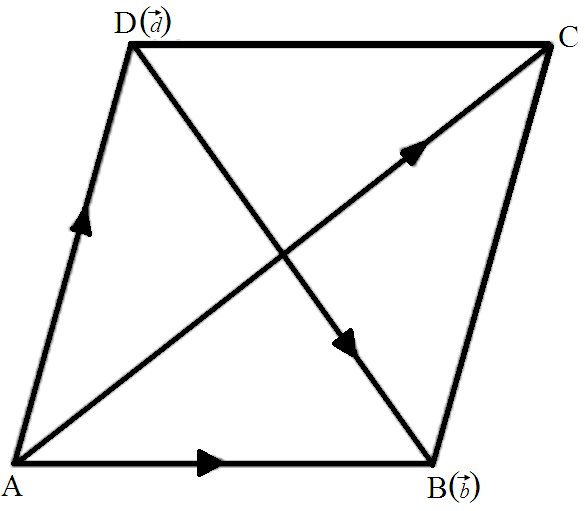 Let ABCD be a parallelogram such that AC and BD are its two diagonals.Taking A as the origin, let the position vectors of B and D be $\vec{\text{b}}$ and $\vec{\text{d}},$ respectively.Then,$\vec{\text{AB}} = \vec{\text{b}}$ and $\vec{\text{AD}} = \vec{\text{d}}$
Using triangle law of vector addition, we have
$\vec{\text{AD}} + \vec{\text{DB}} = \vec{\text{AB}}$
$\Rightarrow \vec{\text{DB}} = \vec{\text{b}} - \vec{\text{d}}$
In $\triangle\text{ ABC,}$
$\vec{\text{AC}} = \vec{\text{AB}} + \vec{\text{BC}} = \vec{\text{AB}} + \vec{\text{AD}} = \vec{\text{b}} + \vec{\text{d}}$
Now,
$\big|\vec{\text{AB}}\big|^{2} + \big|\vec{\text{BC}}\big|^{2}+\big|\vec{\text{CD}}\big|^2+ \big|\vec{\text{DA}}\big|^{2}$
$=\big|\vec{\text{AB}}\big|^{2} + \big|\vec{\text{AD}}\big|^{2} + \big|-\vec{\text{AB}}\big|^{2} + \big|-\vec{\text{AD}}\big|^{2}$
$=2\big|\vec{\text{AB}}\big|^{2} + 2\big|\vec{\text{AD}}\big|^{2}$
$=2\big|\vec{\text{b}}\big|^{2} + 2\big|\vec{\text{d}}\big|^{2}\dots(1)$
Also,
$\big|\vec{\text{DB}}\big|^{2} + \big|\vec{\text{AC}}\big|^{2}$
$=\big|\vec{\text{b}}-\vec{\text{d}}\big|^{2} + \big|\vec{\text{b}} + \vec{\text{d}}\big|^{2}$
$=\big(\vec{\text{b}} - \vec{\text{d}}\big).\big(\vec{\text{b}} - \vec{\text{d}}\big) + \big(\vec{\text{b}} + \vec{\text{d}}\big).\big(\vec{\text{b}} + \vec{\text{d}}\big)$
$=\big|\vec{\text{b}}\big| ^ 2 - 2\vec{\text{b}}.\vec{\text{d}} + \big|\vec{\text{d}}\big|^{2} + \big|\vec{\text{b}}\big|^{2}+2\vec{\text{b}}.\vec{\text{d}} + \big|\vec{\text{d}}\big|^{2}$
$=2\big|\vec{\text{b}}\big|^{2} + 2\big|\vec{\text{d}}\big|^{2}\dots(2)$
From (1) and (2), we have
$\big|\vec{\text{AB}}\big|^{2} + \big|\vec{\text{BC}}\big|^{2} + \big|\vec{\text{CD}}\big|^{2} + \big|\vec{\text{DA}}\big|^{2}=\big|\vec{\text{DB}}\big|^{2} = \big|\vec{\text{AC}}\big|^{2}$ View full question & answer→Question 885 Marks
Find the values of x and y if the vectors $\vec{\text{a}}=3\hat{\text{i}}+\text{x}\hat{\text{j}}-\hat{\text{k}}$ and $\vec{\text{b}}=2\hat{\text{i}}+\hat{\text{j}}+\text{y}\hat{\text{k}}$ are mutually perpendicular vectors of equal magnitude.
AnswerWe have
$\vec{\text{a}}=3\hat{\text{i}}+\text{x}\hat{\text{j}}-\hat{\text{k}}$ and $\vec{\text{b}}=2\hat{\text{i}}+\hat{\text{j}}+\text{y}\hat{\text{k}}$
It is given that the vectors are perpendicular.
$\Rightarrow\vec{\text{a}}.\vec{\text{b}}=0$
$\Rightarrow6+\text{x}-\text{y}=0$
$\Rightarrow\text{x}-\text{y}=-6\dots(1)$
Also, it is given that
$|\vec{\text{a}}|=\big|\vec{\text{b}}\big|$
$\Rightarrow\sqrt{9+\text{x}^2+1}=\sqrt{4+1+\text{y}^2}$
$\Rightarrow\sqrt{10+\text{x}^2}=\sqrt{5+\text{y}^2}$
$\Rightarrow10+\text{x}^2=5+\text{y}^2$
$\Rightarrow\text{x}^2-\text{y}^2=-5$
View full question & answer→Question 895 Marks
Express $2\hat{\text{i}}-\hat{\text{j}}+3\hat{\text{k}}$ as the sum of a vector parallel and a vector perpendicular to $2\hat{\text{i}}+4\hat{\text{j}}-2\hat{\text{k}}.$
AnswerLet $\big(2\hat{\text{i}}-\hat{\text{j}}+3\hat{\text{k}}\big)=\vec{\text{a}}+\vec{\text{b}}\dots(1)$
such that $\vec{\text{a}}$ is a vector parallel to vector $\big(2\hat{\text{i}}+4\hat{\text{j}}-2\hat{\text{k}}\big)$ and $\vec{\text{b}}$ is a vector perpendicular to the vector $\big(2\hat{\text{i}}+4\hat{\text{j}}-2\hat{\text{k}}\big).$
since, $\vec{\text{a}}$ is parallel to $\big(2\hat{\text{i}}+4\hat{\text{j}}-2\hat{\text{k}}\big)$
$\vec{\text{a}}=\lambda\big(2\hat{\text{i}}+4\hat{\text{j}}-2\hat{\text{k}}\big)$
$\vec{\text{a}}=2\lambda\hat{\text{i}}+4\lambda\hat{\text{j}}-2\lambda\hat{\text{k}}\dots(2)$
Put value of $\vec{\text{a}}$ in equation (1),
$\big(2\hat{\text{i}}-\hat{\text{j}}+3\hat{\text{k}}\big)=\big(2\lambda\hat{\text{i}}+4\lambda\hat{\text{j}}-2\lambda\hat{\text{k}}\big)+\vec{\text{b}}$
$\vec{\text{b}}=2\hat{\text{i}}-\hat{\text{j}}+3\hat{\text{k}}-2\lambda\hat{\text{j}}-4\lambda\hat{\text{j}}+2\lambda\hat{\text{k}}$
$\vec{\text{b}}=(2-2\lambda)\hat{\text{i}}+(-1-4\lambda)\hat{\text{j}}+(3+2\lambda)\hat{\text{k}}$
$\vec{\text{b}}$ is a vector perpendicuar to the vector $\big(2\hat{\text{i}}+4\hat{\text{j}}-2\hat{\text{k}}\big),$ then
$\vec{\text{b}}.\big(2\hat{\text{i}}+4\hat{\text{j}}-2\hat{\text{k}}\big)=0$
$\big[(2-2\lambda)\hat{\text{i}}+(-1-4\lambda)\hat{\text{j}}+(3+2\lambda)\hat{\text{k}}\big]\big(2\hat{\text{i}}+4\hat{\text{j}}-2\hat{\text{k}}\big)=0$
$(2-2\lambda)(2)+(-1-4\lambda)(4)+(3+2\lambda)(-2)=0$
$4-4\lambda-4-16\lambda-6-4\lambda=0$
$-6-24\lambda=0$
$-24\lambda=6$
$\lambda=-\frac{1}{4}$
Put $\lambda$ in equation (2),
$\vec{\text{a}}=2\lambda\hat{\text{i}}+4\lambda\hat{\text{j}}-2\lambda\hat{\text{k}}$
$=2\Big(-\frac{1}{4}\Big)\hat{\text{i}}+4\Big(-\frac{1}{4}\Big)\hat{\text{j}}-2\Big(-\frac{1}{4}\Big)\hat{\text{k}}$
$\vec{\text{a}}=-\frac{1}2{}\hat{\text{i}}-\hat{\text{j}}+\frac{1}2{}\hat{\text{k}}$
Put the value of $\vec{\text{a}}$ in equation (1),
$\big(2\hat{\text{i}}-\hat{\text{j}}+3\hat{\text{k}}\big)=\Big(-\frac{1}{2}\hat{\text{i}}-\hat{\text{j}}+\frac{1}{2}\hat{\text{k}}\Big)+\vec{\text{b}}$
$\vec{\text{b}}=2\hat{\text{i}}-\hat{\text{j}}+3\hat{\text{k}}+\frac{1}{2}\hat{\text{i}}+\hat{\text{j}}-\frac{1}{2}\hat{\text{k}}$
$=\frac{4\hat{\text{i}}-2\hat{\text{j}}+6\hat{\text{k}}+\hat{\text{i}}+2\hat{\text{j}}-\hat{\text{k}}}{2}$
$=\frac{5\hat{\text{i}}+5\hat{\text{k}}}{2}$
$\vec{\text{b}}=\frac{5}{2}\big(\hat{\text{i}}+\hat{\text{k}}\big)$
$\big(2\hat{\text{i}}-\hat{\text{j}}+3\hat{\text{k}}\big)=\Big(-\frac{1}{2}\hat{\text{i}}-\hat{\text{j}}+\frac{1}{2}\hat{\text{k}}\Big)+\frac{5}{2}\big(\hat{\text{i}}+\hat{\text{k}}\big)$
View full question & answer→Question 905 Marks
Five forces $\overrightarrow{\text{AB}},\ \overrightarrow{\text{AC}},\ \overrightarrow{\text{AD}},\ \overrightarrow{\text{AE}}\text{ and }\overrightarrow{\text{AF}}$ act at the vertex of a regular hexagon ABCDEF. Prove that the resultant is:$6\ \overrightarrow{\text{AO}}$, where o is the center of hexagon.
Answer
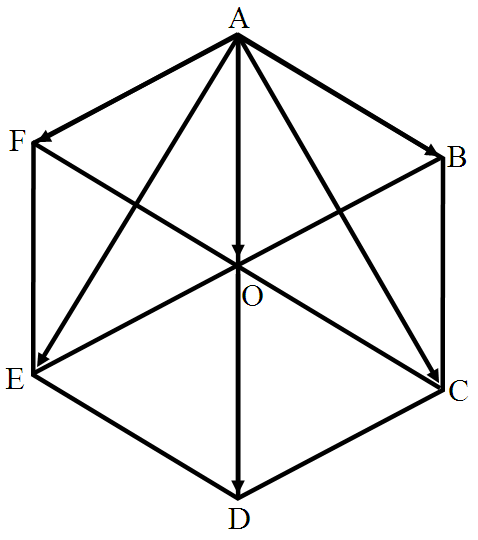 $\overrightarrow{\text{AB}}+\overrightarrow{\text{AC}}+\overrightarrow{\text{AD}}+\overrightarrow{\text{AE}}+\overrightarrow{\text{AF}}$
Consider $\triangle\text{ADE}$,
$\overrightarrow{\text{AD}}+\overrightarrow{\text{DE}}+\overrightarrow{\text{EA}}=0$
$\overrightarrow{\text{AD}}+\overrightarrow{\text{DE}}=\overrightarrow{\text{AE}}$
$2\ \overrightarrow{\text{AO}}+\Big(-\overrightarrow{\text{AB}}\Big)=\overrightarrow{\text{AE}}$ $\Big[\overrightarrow{\text{AD}}=2\ \overrightarrow{\text{AO}}\text{ and }\overrightarrow{\text{ED}}\ \Big|\Big|\ \overrightarrow{\text{AB}}+\overrightarrow{\text{DE}}=-\overrightarrow{\text{AB}}\Big]$
$\therefore\ \overrightarrow{\text{AE}}+\overrightarrow{\text{AB}}=2\ \overrightarrow{\text{AO}}\ \dots(1)$
Now, consider $\triangle\text{ADC}$,
$\overrightarrow{\text{AC}}+\overrightarrow{\text{CD}}+\overrightarrow{\text{DA}}=0$
$\overrightarrow{\text{AC}}+\overrightarrow{\text{CD}}=\overrightarrow{\text{AD}}$ $\Big[\because\ \overrightarrow{\text{CD}}=\overrightarrow{\text{AF}}\Big]$
$\overrightarrow{\text{AC}}+\overrightarrow{\text{AF}}=2\ \overrightarrow{\text{AO}}\ \dots(2)$
Using (1) and (2),
$\overrightarrow{\text{AB}}+\overrightarrow{\text{AE}}+\overrightarrow{\text{AC}}+\overrightarrow{\text{AF}}+\overrightarrow{\text{AD}}$
$2\ \overrightarrow{\text{AO}}+2\ \overrightarrow{\text{AO}}+2\ \overrightarrow{\text{AO}}$
$=6\ \overrightarrow{\text{AO}}$ View full question & answer→Question 915 Marks
If $\vec{\text{a}}\text{ and }\vec{\text{b}}$ are two non-collinear vectors having the same initial point. What are the vectors represented by $\vec{\text{a}}+\vec{\text{b}}\text{ and }\vec{\text{a}}-\vec{\text{b}}$.
AnswerHere, it is given that $\vec{\text{a}}\text{ and }\vec{\text{b}}$ are two non-collinear vectors having the same initial point.Let $\vec{\text{a}}=\overrightarrow{\text{AB}}\text{ and }\vec{\text{b}}=\overrightarrow{\text{AD}}$, So we can draw a parallelogram ABCD as above.
By the properties of parallelogram
$\overrightarrow{\text{BC}}=\vec{\text{b}}\text{ and }\overrightarrow{\text{DC}}=\vec{\text{a}}$
In $\triangle\text{ABC}$,
Using triangle law,
$\overrightarrow{\text{AB}}+\overrightarrow{\text{BC}}=\overrightarrow{\text{AC}}$
$\vec{\text{a}}+\vec{\text{b}}=\overrightarrow{\text{AC}}\ \dots(\text{i})$
In $\triangle\text{ABD}$
$\overrightarrow{\text{AD}}+\overrightarrow{\text{DB}}=\overrightarrow{\text{AB}}$
$\vec{\text{b}}+\overrightarrow{\text{DB}}=\vec{\text{a}}$
$\overrightarrow{\text{DB}}=\vec{\text{a}}-\vec{\text{b}}\ \dots(\text{ii})$
From (i) and (ii), we get that
$\vec{\text{a}}+\vec{\text{b}}\text{ and }\vec{\text{a}}-\vec{\text{b}}$ are diagonals of a parallelogram whose adjacent sides are $\vec{\text{a}}\text{ and }\vec{\text{b}}$
View full question & answer→Question 925 Marks
If a unit vector $\vec{\text{a}}$ makes an angle $\frac{\pi}3$ with $\hat{\text{i}}$, $\frac{\pi}4$ with $\hat{\text{j}}$ and an acute angle $\theta$ with $\hat{\text{k}}$, then find $\theta$ and hence, the components of $\vec{\text{a}}$.
AnswerLet unit vector $\vec{\text{a}}$ have $(a_1, a_2, a_3)$ components.
$\Rightarrow\vec{\text{a}}=\text{a}_1\hat{\text{i}}+\text{a}_2\hat{\text{j}}+\text{a}_3\hat{\text{k}}$
Since $\vec{\text{a}}$ is a unit vector, $|\vec{\text{a}}|=1$
Also it is given that $\vec{\text{a}}$ makes angles $\frac{\pi}3$ with $\hat{\text{i}}$, $\frac{\pi}4$ with $\hat{\text{j}}$, and an acute angle $\theta$ with $\hat{\text{k}}$.
Then, we have:
$\cos\frac{\pi}3=\frac{\text{a}_1}{|\vec{\text{a}}|}$
$\Rightarrow\ \frac{1}2=\text{a}_1$ $[|\vec{\text{a}}|=1]$
$\cos\frac{\pi}4=\frac{\text{a}_2}{|\vec{\text{a}}|}$
$\Rightarrow\ \frac{1}{\sqrt2}=\text{a}_2$ $[|\vec{\text{a}}|=1]$
Also, $\cos\theta=\frac{\text{a}_3}{|\vec{\text{a}}|}$
$\Rightarrow\ \text{a}_3=\cos\theta$
Now,
$|\text{a}|=1$
$\Rightarrow\ \sqrt{\text{a}_1^2+\text{a}_2^2+\text{a}_3^2}=1$
$\Rightarrow\Big(\frac{1}2\Big)^2+\Big(\frac{1}{\sqrt{2}}\Big)^2+\cos^2\theta=1$
$\Rightarrow\ \frac{1}4+\frac{1}2+\cos^2\theta=1$
$\Rightarrow\ \frac{3}4+\cos^2\theta=1$
$\Rightarrow\ \cos^2\theta=1-\frac{3}4=\frac{1}4$
$\Rightarrow\ \cos\theta=\frac{1}2$
$\Rightarrow\ \theta=\frac{\pi}3$
$\therefore\ \text{a}_3=\cos\frac{\pi}3=\frac{1}2$
Hence, $\theta=\frac{\pi}3$ and the components of $\vec{\text{a}}$ are $\Big(\frac{1}2,\frac{1}{\sqrt2},\frac{1}{\sqrt2}\Big)$.
View full question & answer→Question 935 Marks
In a quadrilateral $\ce{ABCD}, $ prove that $\ce{AB^{2 }+ BC^{2 }+ CD^{2 }+ DA^{2 }= AC^{2 }+ BD^{2 }+ 4PQ^2},$ where $P$ and $Q$ are middle points of diagonals $\ce{AC}$ and $\ce{BD}.$
Answer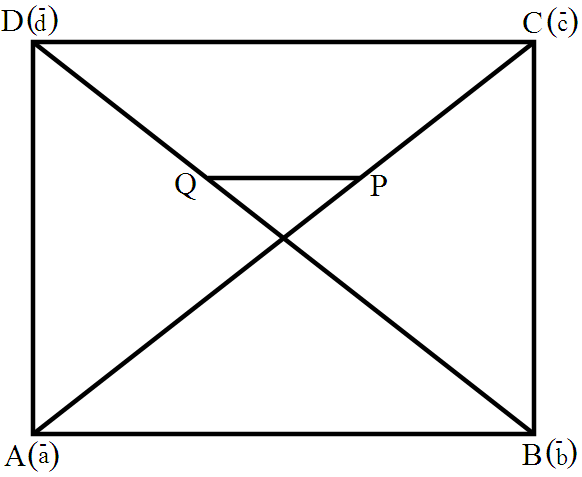
Take $O$ as origin, let the position vectors of $\ce{A, B C}$ and $D$ are $\vec{\text{a}},\vec{\text{b}},\vec{\text{c}}$ and $\vec{\text{d}}$ respectively.
position vector of $\text{p} = \frac{\vec{\text{a}}+ \vec{\text{c}}}{2}$position vector of $\text{Q} = \frac{\vec{\text{a}}+\vec{\text{d}}}{2}$
$\ce{LHS = AB^2 + BC^2 + CD^2 + DA^2}$
$ = (\vec{\text{b}} - \vec{\text{a}})^{2} + (\vec{\text{c}}-\vec{\text{b}})^{2}+(\vec{\text{d}}-\vec{\text{c}})^{2}+(\vec{\text{d}}-\vec{\text{a}})^{2}$
$= 2\big[(\vec{\text{a}})^{2}+(\vec{\text{b}})^{2}+(\vec{\text{c}})^{2}+(\vec{\text{d}})^{2}-\vec{\text{a}}\vec{\text{b}}\cos\theta_1-\vec{\text{b}}\vec{\text{c}}\cos\theta_2-\vec{\text{d}}\vec{\text{c}}\cos\theta_1-\vec{\text{c}}\vec{{\text{a}}}\cos\theta_4\big]$
$\ce{RHS = AC^2 + BD^2 + 4PQ^2}$
$ = (\vec{\text{c}}-\vec{\text{a}})^{2} + (\vec{\text{d}}-\vec{\text{b}})^{2} + 4\Big(\frac{\vec{\text{a}} + \vec{\text{b}}}{2}-\frac{\vec{\text{a}}+\vec{\text{c}}}{2}\Big)^{2}$
$= 2 \big[(\vec{\text{a}})^{2} +(\vec{\text{b}})^{2} + (\vec{\text{c}})^{2}+ (\vec{\text{d}})^{2}-\vec{\text{a}}\vec{\text{b}}\cos\theta_1-\vec{\text{b}}\vec{\text{c}}\cos\theta_2-\vec{\text{d}}\vec{\text{c}}\cos\theta_1-\vec{\text{c}}\vec{\text{a}}\cos\theta_4\big]$
$= \ce{LHS}$
Hence proved. View full question & answer→Question 945 Marks
Prove that the diagonals of a rhombus are perpendicular bisectors of each other.
Answer
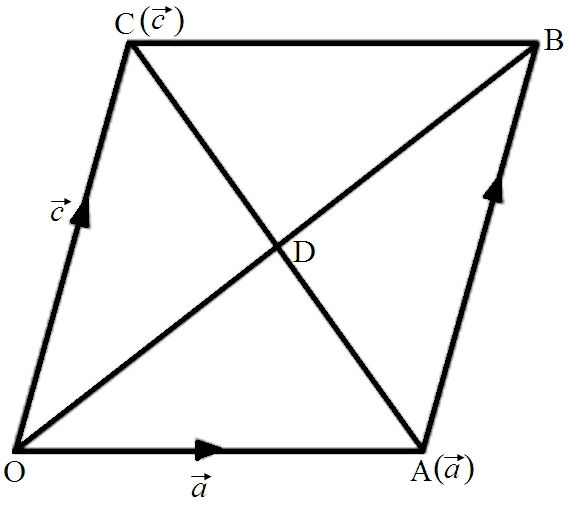 Let OABC be a rhombus, whose diagonals OB and AC intersect at D. suppose O is origin.Let the position vector of A and C be $\vec{\text{a}}$ and $\vec{\text{c}},$ respectively. Then,
$\vec{\text{OA}} = \vec{\text{a}}$ and $\vec{\text{OC}} =\vec { \text{c}}$
In $\triangle \text{OAB,}$
$\vec{\text{OB}} = \vec{\text{OA}} + \vec{\text{AB}} = \vec{\text{OA}} + \vec{\text{OC}} = \vec{\text{a}} + \vec{\text{c}}$ $\big(\vec{\text{AB}} = \vec{\text{OC}}\big)$
Position vector of mid-point of $\vec{\text{OB}} = \frac{1}{2}\big(\vec{\text{a}} + \vec{\text{c}}\big)$
position vector of mid-point of $\vec{\text{AC}} = \frac{1}{2}\big(\vec{\text{a}} + \vec{\text{c}}\big)$ (mid-point formula)
So, the mid-points of OB and AC coincide. Thus, the diagonals OB and AC bisect each other.
Now,
$\vec{\text{OB}}.\vec{\text{AC}} = \big(\vec{\text{a}} + \vec{\text{c}}\big).\big(\vec{\text{c}}-\vec{\text{a}}\big)$
$= \big(\vec{\text{c}} + \vec{\text{a}}\big).\big(\vec{\text{c}} - \vec{\text{a}}\big)$
$= \big|\vec{\text{c}}\big|^{2} - \big|\vec{\text{a}}\big|^{2}$
$= \big|\vec{\text{OC}}\big|^{2} - \big|\vec{\text{OA}}\big|^{2}$
$= 0 $ $\big(\big|\vec{\text{OC}}\big| = \big|\vec{\text{OA}}\big|\big)$
$\Rightarrow \vec{\text{OB}} \perp \vec{\text{AC}}$
Hence, the diagonals OB and AC are perpendicular to each other.
Thus, the diagonals of a rhombus are perpendicular bisectors of each other. View full question & answer→Question 955 Marks
Find all vectors of magnitude $10\sqrt{3}$ that are perpendicular to the plane of $\hat{\text{i}}+2\hat{\text{j}}+\hat{\text{k}}$ and $-\hat{\text{i}}+3\hat{\text{i}}+4\hat{\text{k}}.$
AnswerLet $\vec{\text{a}}=\hat{\text{i}}+2\hat{\text{j}}+\hat{\text{k}}$ and $\vec{\text{b}}=-\hat{\text{i}}+3\hat{\text{j}}+4\hat{\text{k}}$
Unit vectors perpendicular to both $\vec{\text{a}}$ and $\vec{\text{b}}=\pm\frac{\vec{\text{a}}\times\vec{\text{b}}}{\big|\vec{\text{a}}\times\vec{\text{b}}\big|}$
$\vec{\text{a}}\times\vec{\text{b}}=\begin{vmatrix}\hat{\text{i}}&\hat{\text{j}}&\hat{\text{k}}\\1&2&1\\-1&3&4\end{vmatrix}$
$=5\hat{\text{i}}-5\hat{\text{j}}+5\hat{\text{k}}$
$\therefore\big|\vec{\text{a}}\times\vec{\text{b}}\big|=\big|5\hat{\text{i}}-5\hat{\text{j}}+5\hat{\text{k}}\big|$
$=\sqrt{5^2+(-5)^2+5^2}$
$\sqrt{75}$
$=5\sqrt{3}$
Unit vectors perpendicular to both $\vec{\text{a}}$ and $\vec{\text{b}}=\pm\frac{5\hat{\text{i}}-5\hat{\text{j}}+5\hat{\text{k}}}{5\sqrt{3}}=\pm\frac{\hat{\text{i}}-\hat{\text{j}}+\hat{\text{k}}}{\sqrt{3}}$
Required vectors $=10\sqrt{3}\Big(\pm\frac{\hat{\text{i}}-\hat{\text{j}}+\hat{\text{k}}}{\sqrt{3}}\Big)=\pm10\big(\hat{\text{i}}-\hat{\text{j}}+\hat{\text{k}}\big)$
Thus, the vectors of magnitude $10\sqrt{3}$ that are perpendicular to the plane of $\hat{\text{i}}+2\hat{\text{j}}+\hat{\text{k}}$ and $-\hat{\text{i}}+3\hat{\text{j}}+4\hat{\text{k}}$ are $\pm10\big(\hat{\text{i}}-\hat{\text{j}}+\hat{\text{k}}\big)$
View full question & answer→Question 965 Marks
If either $\vec{a}=\vec{0}\ \ \text{or}\ \ \vec{b}=\vec{0},\ \ \text{then}\ \ \vec{a}\times\vec{b}=\vec{0}.$ Is the converse true? Justify your answer with an example.
Answer$\text{Given:}\ \ \text{Either}\ \vec{a}=\vec{0}\ \ \ \text{or}\ \ \ \vec{b}=\vec{0}$ $\therefore\ \ \Big|\vec{a}\Big|=\Big|\vec{0}\Big|=0\ \ \text{or}\ \ \ \Big|\vec{b}\Big|=\Big|\vec{0}\Big|=0\ \ \ ........\text{(i)}$ $\therefore\ \Big|\vec{a}\times\vec{b}\Big|=\Big|\vec{a}\Big|\Big|\vec{b}\Big|\sin\theta=0\ $ $\Rightarrow\ \ 0.\sin\theta=0\ \ \big[\text{Using eq.(i)}\big]$ $\therefore\ \vec{a}\times\vec{b}=\vec{0}\ \ \ \ \text{[By definition of zero vector]}$ But the converse is not true. $\text{Let}\ \ \ \vec{a}=\hat{i}+\hat{j}+\hat{k}\ $ $\Rightarrow\ \ \big|\vec{a}\big|=\sqrt{1+1+1}=\sqrt{3}\neq0$ $\therefore\ \ \ \ \ \ \vec{a}\ \text{is a non-zero vector.}$ $\text{Let}\ \ \ \vec{b}=2\Big(\hat{i}+\hat{j}+\hat{k}\Big)=2\hat{i}+2\hat{j}+2\hat{k}\ $ $\Rightarrow\ \ \Big|\vec{b}\Big|=\sqrt{4+4+4}=\sqrt{12}=2\sqrt{3}\neq0$ $\therefore\ \ \ \ \ \vec{b}\ \text{is a non-zero vector.}$ $\text{But}\ \ \ \ \ \ \vec{a}\times\ \vec{b}=\begin{vmatrix}\hat{i}&\hat{j}&\hat{k}\\1&1&1\\2&2&2\end{vmatrix}$ $\text{Taking 2 common from R}_{3}=\vec{a}\times\ \vec{b}=\begin{vmatrix}\hat{i}&\hat{j}&\hat{k}\\1&1&1\\1&1&1\end{vmatrix}=\vec{0}\ \ \ $ $\big[\because\text{R}_2\ \text{and R}_{3}\ \text{are identical}\big]$
View full question & answer→Question 975 Marks
The vertices A, B, C of triangle ABC have respectively position vector $\vec{\text{a}},\ \vec{\text{b}},\ \vec{\text{c}}$ with respect to given origin O. Show that the point D where the bisector of $\angle{\text{A}}$ meets BC has position Vector $\vec{\text{d}}=\frac{\beta\vec{\text{b}}+\gamma\vec{\text{c}}}{\beta+\gamma}$, where $\beta=\big|\vec{\text{c}}-\vec{\text{a}}\big|$ and, $\gamma=\big|\vec{\text{a}}-\vec{\text{b}}\big|$.
AnswerLet the position vectors of A, B and C with respect to same origin, O be $\vec{\text{a}},\ \vec{\text{b}}\text{ and }\vec{\text{c}}$ respectively.
Let D be the point on BC where bisectors of $\angle\text{A}$ meets.
Let $\vec{\text{d}}$ be the position vector of D which divides CB internally in the ratio $\beta \text{ and } \gamma$, where
$\beta=\Big|\overrightarrow{\text{AC}}\Big|\text{ and }\gamma=\Big|\overrightarrow{\text{AB}}\Big|$
By section formula, the position vector of D is given by
$\overrightarrow{\text{OD}}=\frac{\beta\vec{\text{b}}+\gamma\vec{\text{c}}}{\beta+\gamma}$
Let $\alpha=\big|\vec{\text{b}}-\vec{\text{c}}\big|$
In center is the concurent point of angle bisectors an in center divides the line AD in the ratio $\alpha : \beta +\gamma$.
So, the position vector of in center is given as,
$\frac{\alpha\vec{\text{a}}+\Big(\frac{\beta\vec{\text{b}}+\gamma\vec{\text{c}}}{\beta+\gamma}\Big)(\beta+\gamma)}{\alpha+\beta+\gamma}=\frac{\alpha\vec{\text{a}}+\beta\vec{\text{b}}+\gamma\vec{\text{c}}}{\alpha+\beta+\gamma}$
View full question & answer→Question 985 Marks
Find $\lambda$ for which the points A(3, 2, 1), B(4, $\lambda$, 5), C(4, 2, -2) and D(6, 5, -1) are coplanar.
AnswerThe points A, B, C and D will be coplanar if will be coplanar of any one of the following traces of vectors are coplanar:
$\vec{\text{AB}},\vec{\text{AC}},\vec{\text{AD}};\vec{\text{AB}},\vec{\text{BC}},\vec{\text{CD}};\vec{\text{BC}},\vec{\text{BA}},\vec{\text{BD}},$ etc.
It is given that $\vec{\text{AB}},\vec{\text{AC}},\vec{\text{AD}}$ are coplanar.
Thus, their scaler triple product $\big[\vec{\text{AB }}\vec{\text{AC }}\vec{\text{AD}}\big]$ is equal to zero.
Now,
Direction ratios of the $\vec{\text{PQ}}$ =(Direction ratios of vector Q) - (Direction ratios of the vector P)
Direction ratios of vector $\vec{\text{AB}}=(4-3),(\lambda-2),(5-1),\text{i. e. 1},\lambda, -2, 4$
Direction ratios of vector $\vec{\text{AC}}=(4-3),(2-2),(-2 -1),\text{i. e. } 3, 3, -2$
Direction ratios of vector $\vec{\text{AD}}=(6-3),(5-2),(-1-1),\text{i. e}. 3, 3, -2$
$\therefore\big[\vec{\text{AB}}\vec{\text{ AC }}\vec{\text{AD}}\big]=\begin{vmatrix}1&\lambda-2&4\\1&0&-3\\3&3&-2\end{vmatrix}$
$=1[0-(-9)]-(\lambda-2)[-2-(-9)]+4(3-0)=0$
$\Rightarrow7\lambda=35$
$\Rightarrow\lambda=5$
View full question & answer→Question 995 Marks
Prove that the given vectors are non-coplanar:
$3\hat{\text{i}}+\hat{\text{j}}-\hat{\text{k}},\ 2\hat{\text{i}}-\hat{\text{j}}+7\hat{\text{k}}$ and $7\hat{\text{i}}-\hat{\text{j}}+23\hat{\text{k}}$
AnswerWe know that, Three vectors are coplanar if one of them vector can be expressed as the linear combination of the other two. Let, $\big(3\hat{\text{i}}+\hat{\text{j}}-\hat{\text{k}}\big)\\=\text{x}\big(2\hat{\text{i}}-\hat{\text{j}}+7\hat{\text{k}}\big)+\text{y}\big(7\hat{\text{i}}-\hat{\text{j}}+23\hat{\text{k}}\big)$ $=2\text{x}\hat{\text{i}}-\text{x}\hat{\text{j}}+7\text{x}\hat{\text{k}}+7\text{y}\hat{\text{i}}-\text{y}\hat{\text{j}}+23\text{y}\hat{\text{k}}$ $\big(3\hat{\text{i}}+\hat{\text{j}}-\hat{\text{k}}\big)\\=\big(2\text{x}+7\text{y}\big)\hat{\text{i}}+\big(-\text{x}-\text{y}\big)\hat{\text{j}}+\big(7\text{x}+23\text{y}\big)\hat{\text{k}}$ Equating the coefficient of LHS and RHS, 2x + 7y = 3 .....(i) -x - y = 1 .....(ii) 7x + 23y = -1 .....(iii) For solving (i) and (ii), Add (i) and 2 × (ii),
$\text{y}=\frac{5}5$ $\text{y}=1$ Put the value of y in equation (i), $2\text{x}+7\text{y}=3$ $2\text{x}+7(1)=3$ $2\text{x}+7=3$ $2\text{x}=3-7$ $2\text{x}=-4$ $\text{x}=\frac{-4}2$ $\text{x}=-2$ Put the value of x and y in equation (iii), $7\text{x}+23\text{y}=-1$ $7(2)+23(1)=-1$ $14+23=-1$ $37=-1$ $\text{LHS}\neq\text{RHS}$ The value of x and y do not satisfy the equation (iii), Hence, vectors are non-coplanar. View full question & answer→Question 1005 Marks
If $\vec{\text{a}}=2\hat{\text{i}}+5\hat{\text{j}}-7\hat{\text{k}},\vec{\text{b}}=-3\hat{\text{i}}+4\hat{\text{j}}+\hat{\text{k}}$ and $\vec{\text{c}}=\hat{\text{i}}-2\hat{\text{j}}-3\hat{\text{k}},$ compute $\big(\vec{\text{a}}\times\vec{\text{b}}\big)\times\vec{\text{c}}$ and $\vec{\text{a}}\times\big(\vec{\text{b}}\times\vec{\text{c}}\big)$ and verify that these are not equal.
AnswerGiven:
$\vec{\text{a}}=2\hat{\text{i}}+5\hat{\text{j}}-7\hat{\text{k}}$
$\vec{\text{b}}=-3\hat{\text{i}}+4\hat{\text{j}}+\hat{\text{k}}$
$\vec{\text{c}}=\hat{\text{i}}-2\hat{\text{j}}-3\hat{\text{k}}$
$\therefore\vec{\text{a}}\times\vec{\text{b}}=\begin{vmatrix}\hat{\text{i}}&\hat{\text{j}}&\hat{\text{k}}\\2&5&-7\\-3&4&1 \end{vmatrix}$
$=(5+28)\hat{\text{i}}-(2-21)\hat{\text{j}}+(8+15)\hat{\text{k}}$
$=33\hat{\text{i}}+19\hat{\text{j}}+23\hat{\text{k}}$
$\Rightarrow\big(\vec{\text{a}}\times\vec{\text{b}}\big)\times\vec{\text{c}}=\begin{vmatrix}\hat{\text{i}}&\hat{\text{j}}&\hat{\text{k}}\\33&19&23\\1&-2&-3 \end{vmatrix}$
$=(-57+46)\hat{\text{i}}-(-99-23)\hat{\text{j}}+(-66-19)\hat{\text{k}}$
$\Rightarrow\big(\vec{\text{a}}\times\vec{\text{b}}\big)\times\vec{\text{c}}=-11\hat{\text{i}}+122\hat{\text{j}}-85\hat{\text{k}}\dots(1)$
$\therefore\vec{\text{b}}\times\vec{\text{c}}=\begin{vmatrix}\hat{\text{i}}&\hat{\text{j}}&\hat{\text{k}}\\-3&4&1\\1&-2&-3 \end{vmatrix}$
$=(-12+2)\hat{\text{i}}-(9-1)\hat{\text{j}}+(6-4)\hat{\text{k}}$
$=-10\hat{\text{i}}-8\hat{\text{j}}+2\hat{\text{k}}$
$\Rightarrow\vec{\text{a}}\times\big(\vec{\text{b}}\times\vec{\text{c}}\big)=\begin{vmatrix}\hat{\text{i}}&\hat{\text{j}}&\hat{\text{k}}\\2&5&-7\\-10&-8&2 \end{vmatrix}$
$=(10-56)\hat{\text{i}}-(4-70)\hat{\text{j}}+(-16+50)\hat{\text{k}}$
$\Rightarrow\vec{\text{a}}\times\big(\vec{\text{b}}\times\vec{\text{c}}\big)=-46\hat{\text{i}}+66\hat{\text{j}}+34\hat{\text{k}}\dots(2)$
From (1) and (2), we get
$\big(\vec{\text{a}}\times\vec{\text{b}}\big)\times\vec{\text{c}}\neq\vec{\text{a}}\times\big(\vec{\text{b}}\times\vec{\text{c}}\big)$
View full question & answer→