Question 1015 Marks
If $\vec{\text{a}},\vec{\text{b}},\vec{\text{c}}$ are non-zero, non-coplanar vectors, prove that the vector is coplanar:
$\vec{\text{a}}-2\vec{\text{b}}+3\vec{\text{c}},\ -3\vec{\text{b}}+5\vec{\text{c}}$ and $-2\vec{\text{a}}+3\vec{\text{b}}-4\vec{\text{c}}$
AnswerWe know that, Three vectors are coplanar if one of them can be expressed as the linear combination of other two. Let, $\vec{\text{a}}-2\vec{\text{b}}+3\vec{\text{c}}\\=\text{x}\big(-3\vec{\text{b}}+5\vec{\text{c}}\big)+\text{y}\big(-2\vec{\text{a}}+3\vec{\text{b}}-4\vec{\text{c}}\big)$ $\vec{\text{a}}-2\vec{\text{b}}+3\vec{\text{c}}\\=-3\vec{\text{b}}\text{x}+5\vec{\text{c}}\text{x}+2\vec{\text{a}}\text{y}+3\vec{\text{b}}\text{y}-4\vec{\text{c}}\text{y}$ $\vec{\text{a}}-2\vec{\text{b}}+3\vec{\text{c}}\\=\big(-2\text{y}\big)\vec{\text{a}}+\big(-3\text{x}+3\text{y}\big)\vec{\text{b}}+\big(5\text{x}-4\text{y}\big)\vec{\text{c}}$ Comparing the LHS and RHS, -2y = 1 .....(i) -3x + 3y = -2 .....(ii) 5x - 4y = 3 .....(iii) For solving (i) and $\text{y}=-\frac{1}2$ Put value of y in equation (ii), $-3\text{x}+3\text{y}=-2$ $-3\text{x}+3\Big(-\frac{1}2\Big)=-2$ $-3\text{x}-\frac{3}{2}=-2$ $-3\text{x}=\frac{-2}1+\frac{3}2$ $-3\text{x}=\frac{-4+3}2$ $-3\text{x}=\frac{-1}2$ $\text{x}=\frac{-1}{-6}$ $\text{x}=\frac{1}6$ Now, put the value of x and y in equation (iii), $5\text{x}-4\text{y}=3$ $5\Big(\frac{1}6\Big)-4\Big(-\frac{1}2\Big)=3$ $\frac{5}6+\frac{4}2=3$ $\frac{5+12}6=3$ $\frac{17}6=3$ $\text{LHS}\neq\text{RHS}$So, value of x and y do not satisfy the equation (iii).
So, vectors $\vec{\text{a}}-2\vec{\text{b}}+3\vec{\text{c}},\ -3\vec{\text{b}}+5\vec{\text{c}},\ -2\vec{\text{a}}+3\vec{\text{b}}-4\vec{\text{c}}$ are not coplanar.
View full question & answer→Question 1025 Marks
Find the value of $\lambda$ for which the four points with position vectors
$-\hat{\text{j}}-\hat{\text{k}},4\hat{\text{i}}+5\hat{\text{j}}+\lambda\hat{\text{k}},3\hat{\text{i}}+9\hat{\text{j}}+4\hat{\text{k}}$ and $-4\hat{\text{i}}+4\hat{\text{j}}+4\hat{\text{k}}$ are co planar.
AnswerLet
position vector of $\text{A}=-\hat{\text{j}}-\hat{\text{k}}$
position vector of $\text{B}=4\hat{\text{i}}+5\hat{\text{j}}+\lambda\hat{\text{k}}$
position vector of $\text{C}=3\hat{\text{i}}+9\hat{\text{j}}+4\hat{\text{k}}$
position vector of $\text{D}=-4\hat{\text{i}}+4\hat{\text{j}}+4\hat{\text{k}}$
The four points are coplanar if the vectors $\vec{\text{AB}},\vec{\text{AC}},\vec{\text{AD}}$ are coplanar.
$\vec{\text{AB}}=4\hat{\text{i}}+6\hat{\text{j}}+(\lambda+1)\hat{\text{k}}$
$\vec{\text{AC}}=3\hat{\text{i}}+10\hat{\text{j}}+5\hat{\text{k}}$
$\vec{\text{AD}}=4\hat{\text{i}}+5\hat{\text{j}}+5\hat{\text{k}}$
$\begin{vmatrix}4&6&(\lambda+1)\\3&10&5\\-4&5&5 \end{vmatrix}=0$
$4(50-25)-6(15+20)+(\lambda+1)(15+40)=0$
$100-210+55+55\lambda=0$
$55\lambda=55$
$\lambda=1$
View full question & answer→Question 1035 Marks
Prove that: $\big(\vec{\text{a}}-\vec{\text{b}}\big).\big\{\big(\vec{\text{b}}-\vec{\text{c}}\big)\big\}=0$
AnswerWe have
$\big(\vec{\text{a}}-\vec{\text{b}}\big).\big\{\big(\vec{\text{b}}-\vec{\text{c}}\big)\times\big(\vec{\text{c}}-\vec{\text{a}}\big)\big\}$
$=\big(\vec{\text{a}}-\vec{\text{b}}\big).\big(\vec{\text{b}}\times\vec{\text{c}}-\vec{\text{b}}\times\vec{\text{a}}-\vec{\text{c}}\times\vec{\text{c}}+\vec{\text{c}}\times\vec{\text{a}}\big)$ (By distributive law)
$=\big(\vec{\text{a}}-\vec{\text{b}}\big).\big(\vec{\text{b}}\times\vec{\text{c}}-\vec{\text{b}}\times\vec{\text{a}}+\vec{\text{c}}\times\vec{\text{a}}\big)$
$\big(\therefore\vec{\text{c}}\times\vec{\text{c}}=0\big)$
$=\big(\vec{\text{a}}-\vec{\text{b}}\big).\big(\vec{\text{b}}\times\vec{\text{c}}+\vec{\text{a}}\times\vec{\text{b}}+\vec{\text{c}}\times\vec{\text{a}}\big)$
$=\vec{\text{a}}.\big(\vec{\text{b}}\times\vec{\text{c}}\big)+\vec{\text{a}}.\big(\vec{\text{a}}\times\vec{\text{b}}\big)+\vec{\text{a}}\big(\vec{\text{c}}\times\vec{\text{a}}\big)-\vec{\text{b}}\big(\vec{\text{b}}\times\vec{\text{c}}\big)-\vec{\text{b}}\big(\vec{\text{a}}\times\vec{\text{b}}\big)-\vec{\text{b}}\big(\vec{\text{c}}\times\vec{\text{a}}\big)$ (By distributive 1)
$=\big[\vec{\text{a}}\ \vec{\text{b}}\ \vec{\text{c}}\big]+\big[\vec{\text{a}}\ \vec{\text{a}}\ \vec{\text{b}}\big]+\big[\vec{\text{a}}\ \vec{\text{c}}\ \vec{\text{a}}\big]-\big[\vec{\text{b}}\ \vec{\text{b}}\ \vec{\text{c}}\big]-\big[\vec{\text{b}}\ \vec{\text{a}}\ \vec{\text{b}}\big]-\big[\vec{\text{b}}\ \vec{\text{c}}\ \vec{\text{a}}\big]$
$=\big[\vec{\text{a}}\ \vec{\text{b}}\ \vec{\text{c}}\big]+0+0-0-0-\big[\vec{\text{a}}\ \vec{\text{b}}\ \vec{\text{c}}\big]$
$\big(\therefore\big[\vec{\text{a}}\ \vec{\text{b}}\ \vec{\text{c}}\big]=\big[\vec{\text{b}}\ \vec{\text{c}}\ \vec{\text{a}}\big]\big)$
$=0$
View full question & answer→Question 1045 Marks
Show that four points whose position vectors are
$6\hat{\text{i}}-7\hat{\text{j}},16\hat{\text{i}}-19\hat{\text{j}}-4\hat{\text{k}},3\hat{\text{i}}-6\hat{\text{k}},2\hat{\text{i}}-5\hat{\text{j}}+10\hat{\text{k}}$ are coplanar.
AnswerDISCLAIMER: Given points are not coplaner.
Let A, B, C, D be the given points. The given points will be coplanar iff any one of the follewing triads of vectors are coplanar:
$\vec{\text{AB}},\vec{\text{AC}},\vec{\text{AD}};\vec{\text{AB}},\vec{\text{BC}},\vec{\text{CD}};\vec{\text{BC}},\vec{\text{BA}},\vec{\text{BD}}$ etc.
In order to show that $\vec{\text{AB}},\vec{\text{AC}},\vec{\text{AD}}$ are coplanar, we will have to show that their scaler triple
product i.e. $\Big[\vec{\text{AB}}\vec{\text{ AC }}\vec{\text{AD}}\Big]=0$
Using, $\vec{\text{PQ}}$ = Position vector of Q - position vector of P, we obtain
Now,
$\vec{\text{AB}}=(16\hat{\text{i}}-19\hat{\text{j}}-4\hat{\text{k}})-(6\hat{\text{i}}-7\hat{\text{j}})\\=10\hat{\text{i}}-12\hat{\text{j}}-4\hat{\text{k}}$
$\vec{\text{AC}}=(3\hat{\text{i}}-6\hat{\text{k}})-(6\hat{\text{i}}-7\hat{\text{j}})\\=-3\hat{\text{i}}+7\hat{\text{j}}-6\hat{\text{k}}$
and, $\vec{\text{AD}}=(2\hat{\text{i}}-5\hat{\text{j}}+10\vec{\text{k}})-(6\hat{\text{i}}-7\hat{\text{j}})\\=-4\hat{\text{i}}+2\hat{\text{j}}+10\hat{\text{k}}$
$\therefore\Big[\vec{\text{AC}}\vec{\text{ AC }}\vec{\text{AD}}\Big]=\begin{vmatrix}10&-12&-4\\-3&7&-6\\-4&2&10 \end{vmatrix}$
$=10(70+12)+12(-30-24)-4(-6+28)=84$
Thus, the given points are not coplanar.
View full question & answer→Question 1055 Marks
Prove that the points having position vectors $\hat{\text{i}}+2\hat{\text{j}}+3\hat{\text{k}},\ 3\hat{\text{i}}+4\hat{\text{j}}+7\hat{\text{k}}$ and $-3\hat{\text{i}}-2\hat{\text{j}}-5\hat{\text{k}}$ are collinear.
AnswerLet A, B, C be the points with position vectors $\hat{\text{i}}+2\hat{\text{j}}+3\hat{\text{k}},\ 3\hat{\text{i}}+4\hat{\text{j}}+7\hat{\text{k}}$ and $-3\hat{\text{i}}-2\hat{\text{j}}-5\hat{\text{k}}$
Then,
$\overrightarrow{\text{AB}}=$ Position vector of B - Position vector of A
$=3\hat{\text{i}}+4\hat{\text{j}}+7\hat{\text{k}}-\hat{\text{i}}-2\hat{\text{j}}-3\hat{\text{k}}$
$=2\hat{\text{i}}+2\hat{\text{j}}+4\hat{\text{k}}$
$\overrightarrow{\text{BC}}=$ Position vector of C - Position vector of B
$=-3\hat{\text{i}}-2\hat{\text{j}}-5\hat{\text{k}}-3\hat{\text{i}}-4\hat{\text{j}}-7\hat{\text{k}}$
$=-6\hat{\text{i}}-6\hat{\text{j}}-12\hat{\text{k}}$
$=-3\big(2\hat{\text{i}}+2\hat{\text{j}}+4\hat{\text{k}}\big)$
$\therefore\ \overrightarrow{\text{BC}}=-3\overrightarrow{\text{AB}}$
So, $\overrightarrow{\text{AB}}$ and $\overrightarrow{\text{BC}}$ are parallel vectors.
But B is a point common to them.
So, $\overrightarrow{\text{AB}}$ and $\overrightarrow{\text{BC}}$ are collinear.
Hence, A, B, C are collinear.
View full question & answer→Question 1065 Marks
A unit vector $\vec{\text{a}}$ makes angles $\frac{\pi}{4}$ and $\frac{\pi}{3}$ with $\hat{\text{i}}$ and $\hat{\text{j}}$ respectively and an acute angle $\theta$ with $\hat{\text{k}}$. find the angle $\theta$ and components of $\vec{\text{a}}$ .
AnswerLet $\vec{\text{a}}=\text{a}_{1}\hat{\text{i}}+\text{a}_2\hat{\text{j}}+\text{a}_3\hat{\text{k}},$ where $\text{a}_1,\text{a}_2$ and $\text{a}_3$ are components of $\vec{\text{a}.}$
$\Rightarrow{\text{a}_1}^2+{\text{a}_2}^2+{\text{a}_3}^2=1$ (Because $\vec{\text{a}}$ is a unit vector) ...(1)
Now,
$\vec{\text{a}}.\hat{\text{i}}=\text{a}_1$
$\Rightarrow|\vec{\text{a}}||\hat{\text{i}}|\cos\frac{\pi}{4}=\text{a}_1$ (Because the angle between $\vec{\text{a}}$ and $\hat{\text{i}}$ is $\frac{\pi}{4}$)
$\Rightarrow(1)(1)\frac{1}{\sqrt{2}}=\text{a}_1$ (Because $\vec{\text{a}}$ and $\hat{\text{i}}$ are unit vectors)
$\Rightarrow \text{a}_1=\frac{1}{\sqrt{2}}$
Again,
$\vec{\text{a}}.\hat{\text{j}}=\text{a}_2$
$\Rightarrow|\vec{\text{a}}||\hat{\text{i}}|\cos\frac{\pi}{3}=\text{a}_2$ (Becasue the angle between $\vec{\text{a}}$ and $\hat{\text{i}}$ is $\frac{\pi}{3}$)
$\Rightarrow(1)(1)\frac{1}{2}=\text{a}_2$ (Because $\vec{\text{a}}$ and $\hat{\text{i}}$ are unite vectors)
$\Rightarrow{\text{a}}_2=\frac{1}{2}$
Now from (1),
$\Big(\frac{1}{\sqrt{2}}\Big)^2+\big(\frac{1}{2}\big)^2+{\text{a}_3}^2=1$
View full question & answer→Question 1075 Marks
If $\vec{\alpha}=3\hat{\text{i}}+4\hat{\text{j}}+5\hat{\text{k}}$ and $\vec{\beta}=2\hat{\text{i}}+\hat{\text{j}}-4\hat{\text{k}},$ then express $\vec{\beta}$ in the form of $\vec{\beta}=\vec{\beta}_1+\vec{\beta}_2,$ where $\vec{\beta}_1$ is parallel to $\vec{\alpha}$ and $\vec{\beta}_2$ is perpendicular to $\vec{\alpha}$.
AnswerGiven that $\vec{\alpha}=3\hat{\text{i}}+4\hat{\text{j}}+5\hat{\text{k}}$ and $\vec{\beta}=2\hat{\text{i}}+\hat{\text{j}}-4\hat{\text{k}}$
Also,
$\vec{\beta}=\vec{\beta}_1+\vec{\beta}_2,$
$\Rightarrow\vec{\beta}_2=\vec{\beta}+\vec{\beta}_1\dots(1)$
Since $\vec{\beta}_1$ is parallel to $\vec{\alpha},$
$\vec{\beta}_1=\text{t}\vec{\alpha}$
$\Rightarrow\vec{\beta}_1=\text{t}\big(3\hat{\text{i}}+4\hat{\text{j}}+5\hat{\text{k}}\big)=3\text{t}\hat{\text{i}}+4\text{t}\hat{\text{j}}+5\text{t}\hat{\text{k}}\dots(2)$
Substituting the values of $\vec{\beta}_1$ and $\vec{\alpha}$ in (1),we get
$\vec{\beta}_2=2\hat{\text{i}}+\hat{\text{j}}-4\hat{\text{k}}-\big(3\text{t}\hat{\text{i}}+4\text{t}\hat{\text{j}}+5\text{t}\hat{\text{k}}\big)\\=(2-3\text{t})\hat{\text{i}}+(1-4\text{t})\hat{\text{j}}+(-4-5\text{t})\hat{\text{k}}\dots(3)$Since $\vec{\beta}_2$ is perpendicular to $\vec{\alpha},$
$\vec{\beta}_2.\vec{\alpha}=0$
$\Rightarrow\Big[(2-3\text{t})\hat{\text{i}}+(1-4\text{t})\hat{\text{j}}+(-4-5\text{t})\hat{\text{k}}\Big].\big(3\hat{\text{i}}+4\hat{\text{j}}+5\hat{\text{k}}\big)=0$
$\Rightarrow3(2-3\text{t})+4(1-4\text{t})+5(-4-5\text{t})=0$
$\Rightarrow6-9\text{t}+4-16\text{t}-20-25\text{t}=0$
$\Rightarrow-50\text{t}=10$
$\Rightarrow\text{t}=\frac{-1}{5}$
From (2) and (3), we get
$\vec{\beta}_1=\frac{-1}{5}\big(3\hat{\text{i}}+4\hat{\text{j}}+5\hat{\text{k}}\big)$
$\vec{\beta}_2=\frac{13}{5}\hat{\text{i}}+\frac{9}{5}\hat{\text{j}}-3\hat{\text{k}}=\frac{1}{5}\big(13\hat{\text{i}}+9\hat{\text{j}}-15\hat{\text{k}}\big)$
View full question & answer→Question 1085 Marks
In a triangle OAB, $\angle\text{AOB}=90^\circ.$ If P and Q are points of trisection of AB, prove that $\text{OP}^2+\text{OQ}^2=\frac{5}{9}\text{AB}^2.$
AnswerLet $\vec{\text{o}},\vec{\text{a}}$ and $\vec{\text{b}}$ be the position vector of the O,A and B.
P and Q are points of trisection of AB.
Position vector of point $\text{P}= \frac{2\vec{\text{a}}+\vec{\text{b}}}{3}$
Position vector of point $\text{Q}= \frac{\vec{\text{a}}+2\vec{\text{b}}}{3}$
$\text{OP}=\frac{2\vec{\text{a}}+\vec{\text{b}}}{3}-\vec{\text{O}}=\frac{2\vec{\text{a}}+\vec{\text{b}}-3\vec{\text{o}}}{3}=\frac{20\text{A+OB}}{3}$
$\text{OQ}=\frac{\vec{\text{a}}+2\vec{\text{b}}}{3}-\vec{\text{O}}=\frac{\vec{\text{a}}+2\vec{\text{b}}-3\vec{\text{o}}}{3}=\frac{\text{OA+2OB}}{3}$
$\text{OP}^2+\text{OQ}^2=\Big(\frac{2\text{OA}+\text{OB}}3\Big)^{2}+\Big(\frac{\text{OA}+2\text{OB}}{3}\Big)^{2}$
$\frac{5(\text{OA}^{2}+\text{OB}^{2})+8(\text{OA})(\text{OB})\cos90^{\circ}}{9}$
$=\frac{5}{9}\text{AB}^{2}\dots \big[\because \text{OA}^{2}+\text{OB}^{2}=\text{AB}^{2} \text{and}\cos90^{\circ}=0\big]$
View full question & answer→Question 1095 Marks
If $|\vec{\text{a}}|=13,\big|\vec{\text{b}}\big|=5$ and $\vec{\text{a}}.\vec{\text{b}}=60,$ then find $\big|\vec{\text{a}}\times\vec{\text{b}}\big|.$
AnswerWe know that, if $\theta$ is angle between $\vec{\text{a}}$ and $\vec{\text{b}},$
$\vec{\text{a}}.\vec{\text{b}}=|\vec{\text{a}}||\vec{\text{b}}|\cos\theta$
$60=13.5.\cos\theta$
$\cos\theta=\frac{60}{65}$
$\cos\theta=\frac{12}{13}$
$\sin^2\theta=1-\cos^2\theta$
$=1-\Big(\frac{12}{13}\Big)^2$
$=1-\frac{144}{169}$
$=\frac{169-144}{169}$
$=\frac{25}{169}$
$\sin\theta=\pm\sqrt{\frac{25}{169}}$
$=\pm\frac{5}{13}$
$|\sin\theta|=\frac{5}{13}$
We know that,
$\vec{\text{a}}\times\vec{\text{b}}=|\vec{\text{a}}|.\big|\vec{\text{b}}\big|.\sin\theta.\hat{\text{n}}$
$\big|\vec{\text{a}}\times\vec{\text{b}}\big|=|\vec{\text{a}}|.\big|\vec{\text{b}}\big|.|\sin\theta|.|\hat{\text{n}}|$
$=13.5.\frac{5}{13}.1$ [Since, $\hat{\text{n}}$ is aunit vector]
$\big|\vec{\text{a}}\times\vec{\text{b}}\big|=25$
View full question & answer→Question 1105 Marks
Show that the points A(1, -2, -8), B(5, 0, -2) and C(11, 3, 7) are collinear, and find the ratio in which B divides AC.
AnswerThe given points are A(1, -2, -8), B(5, 0, -2), and C(11, 3, 7).
$\therefore\overrightarrow{\text{AB}}=(5-1)\hat{\text{i}}+(0+2)\hat{\text{j}}+(-2+8)\hat{\text{k}}$ $=4\hat{\text{i}}+2\hat{\text{j}}+6\hat{\text{k}}$
$\overrightarrow{\text{BC}}=(11-5)\hat{\text{i}}+(3-0)\hat{\text{j}}+(7+2)\hat{\text{k}}$ $=6\hat{\text{i}}+3\hat{\text{j}}+9\hat{\text{k}}$
$\overrightarrow{\text{AC}}=(11-1)\hat{\text{i}}+(3+2)\hat{\text{j}}+(7+8)\hat{\text{k}}$ $=10\hat{\text{i}}+5\hat{\text{j}}+15\hat{\text{k}}$
$\Big|\overrightarrow{\text{AB}}\Big|=\sqrt{4^2+2^2+6^2}=\sqrt{16+4+36}$ $=\sqrt{56}=2\sqrt{14}$
$\Big|\overrightarrow{\text{BC}}\Big|=\sqrt{6^2+3^2+9^2}=\sqrt{36+9+81}$ $=\sqrt{126}=3\sqrt{14}$
$\Big|\overrightarrow{\text{AC}}\Big|=\sqrt{10^2+5^2+15^2}=\sqrt{100+25+225}$ $=\sqrt{350}=5\sqrt{14}$
$\therefore\Big|\overrightarrow{\text{AC}}\Big|=\Big|\overrightarrow{\text{AB}}\Big|+\Big|\overrightarrow{\text{BC}}\Big|$
Thus, the given points A, B, and C are collinear.
Now, let point B divide AC in the ratio $\lambda:1.$ Then we have:
$\overrightarrow{\text{OB}}=\frac{\lambda\overrightarrow{\text{OC}}+\overrightarrow{\text{OA}}}{(\lambda+1)}$
$\Rightarrow5\hat{\text{i}}-2\hat{\text{k}}=\frac{\lambda\big(11\hat{\text{i}}+3\hat{\text{j}}+7\hat{\text{k}}\big)+\big(\hat{\text{i}-2\hat{\text{j}}-8\hat{\text{k}}}\big)}{\lambda+1}$
$\Rightarrow{(\lambda+1)}\big(5\hat{\text{i}}-2\hat{\text{k}}\big)$ $=11\lambda\hat{\text{i}}+3\lambda\hat{\text{j}}+\hat{\text{i}}-2\hat{\text{j}}-8\hat{\text{k}}$
$\Rightarrow5{(\lambda+1)}\hat{\text{i}}-2(\lambda+1)\hat{\text{k}}$ $=(11\lambda+1)\hat{\text{i}}+(3\lambda-2)\hat{\text{j}}+(7\lambda-8)\hat{\text{k}}$
On equating the corresponding components, we get:
$5(\lambda+1)=11\lambda+1$
$\Rightarrow5{\lambda+5}=11\lambda+1$
$\Rightarrow6{\lambda}=4$
$\Rightarrow{\lambda}=\frac{4}{6}=\frac{2}{3}$
Hence, point B divides AC in the ratio 2 : 3
View full question & answer→Question 1115 Marks
Prove that in any triangle ABC, $\cos\text{A}=\frac{\text{b}^2+\text{c}^2-\text{a}^2}{2\text{bc}},$ where a, b, c are the magnitudes of the sides opposite to the vertices A, B, C, respectively.
AnswerLet, $\overrightarrow{\text{AB}}=\text{c},\overrightarrow{\text{BC}}=\text{a}$ and $\overrightarrow{\text{AC}}=\text{b}$
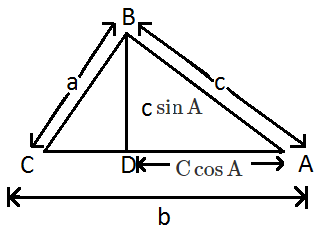
Hare, components of c are ccos A and csin A is drawn.
Since, $\overrightarrow{\text{CD}}=\text{b}-\text{c}\cos\text{A}$
In $\triangle\text{BDC},$
$\text{a}^2=(\text{b}-\text{c}\cos\text{A})^2+(\text{c}\sin\text{A})^2$
$\Rightarrow\text{a}^2=\text{b}^2+\text{c}^2\cos^2\text{A}-2\text{bc}\cos\text{A}+\text{c}^2\sin^2\text{A}$
$\Rightarrow2\text{b}\text{c}\cos\text{A}=\text{b}^2-\text{a}^2+\text{c}^2(\cos^2\text{A}+\sin^2\text{A})$
$\therefore\cos\text{A}=\frac{\text{b}^2+\text{c}^2-\text{a}^2}{2\text{bc}}$ View full question & answer→Question 1125 Marks
Let $\vec{\text{u}},\vec{\text{v}}$ and $\vec{\text{w}}$ be vectors such $\vec{\text{u}}+\vec{\text{v}}+\vec{\text{w}}=\vec{0}.$ If $|\vec{\text{u}}|=3,|\vec{\text{v}}|=4$ and $|\vec{\text{w}}|=5,$ then find $\vec{\text{u}}.\vec{\text{v}}+\vec{\text{v}}.\vec{\text{w}}+\vec{\text{w}}.\vec{\text{u}}.$
AnswerHere, $\vec{\text{u}}+\vec{\text{v}}+\vec{\text{w}}=0$
Squaring both the sides,
$\big(\vec{\text{u}}+\vec{\text{v}}+\vec{\text{w}}\big)^2=(0)^2$
$|\vec{\text{u}}|^2+|\vec{\text{v}}|^2+|\vec{\text{w}}|^2+2\vec{\text{u}}\vec{\text{v}}+2\vec{\text{v}}\vec{\text{w}}+2\vec{\text{w}}\vec{\text{u}}=0$
$(3)^2+(4)^2+(5)^2+2\big(\vec{\text{u}}.\vec{\text{v}}+\vec{\text{v}}.\vec{\text{w}}+\vec{\text{w}}.\vec{\text{u}}\big)=0$
$9+16+25+2\big(\vec{\text{u}}\vec{\text{v}}+\vec{\text{v}}\vec{\text{w}}+\vec{\text{w}}\vec{\text{u}}\big)=0$
$2\big(\vec{\text{u}}\vec{\text{v}}+\vec{\text{v}}\vec{\text{w}}+\vec{\text{w}}\vec{\text{u}}\big)=-50$
$\vec{\text{u}}\vec{\text{v}}+\vec{\text{v}}\vec{\text{w}}+\vec{\text{w}}\vec{\text{u}}=\frac{-50}{2}$
$\vec{\text{u}}\vec{\text{v}}+\vec{\text{v}}\vec{\text{w}}+\vec{\text{w}}\vec{\text{u}}=-25$
View full question & answer→Question 1135 Marks
If $\vec{\text{a}}=\text{a}_1\hat{\text{i}}+\text{a}_2\hat{\text{j}}+\text{a}_3\hat{\text{k}},\vec{\text{b}}=\text{b}_1\hat{\text{i}}+\text{b}_2\hat{\text{j}}+\text{b}_3\hat{\text{k}}$ and $\vec{\text{c}}=\text{c}_1\hat{\text{i}}+\text{c}_2\hat{\text{j}}+\text{c}_3\hat{\text{k}},$ then verify that $\vec{\text{a}}\times\big(\vec{\text{b}}+\vec{\text{c}}\big)=\vec{\text{a}}\times\vec{\text{b}}+\vec{\text{a}}\times\vec{\text{c}}.$
AnswerWe have,
$\vec{\text{a}}=\text{a}_1\hat{\text{i}}+\text{a}_2\hat{\text{j}}+\text{a}_3\hat{\text{k}}$
$\vec{\text{b}}=\text{b}_1\hat{\text{i}}+\text{b}_2\hat{\text{j}}+\text{b}_3\hat{\text{k}}$
$\vec{\text{c}}=\text{c}_1\hat{\text{i}}+\text{c}_2\hat{\text{j}}+\text{c}_3\hat{\text{k}},$
$\big(\vec{\text{b}}+\vec{\text{c}}\big)=(\text{b}_1+\text{c}_1)\hat{\text{i}}+(\text{b}_2+\text{c}_2)\hat{\text{j}}+(\text{b}_3+\text{c}_3)\hat{\text{k}}$
Now, $\vec{\text{a}}\times\big(\vec{\text{b}}+\vec{\text{c}}\big)=\begin{vmatrix}\hat{\text{i}}&\hat{\text{j}}&\hat{\text{k}}\\\text{a}_1&\text{a}_2&\text{a}_3\\\text{b}_1+\text{c}_{1}&\text{b}_2+\text{c}_2&\text{b}_3+\text{c}_3 \end{vmatrix}$
$=\hat{\text{i}}\big[\text{a}_2(\text{b}_3+\text{c}_3)-\text{a}_3(\text{b}_2+\text{c}_2)\big]-\hat{\text{j}}\big[\text{a}_1(\text{b}_3+\text{c}_3)-\text{a}_3(\text{b}_1+\text{c}_1)\big]\\+\hat{\text{k}\big[\text{a}}_1(\text{b}_2+\text{c}_2)-\text{a}_2(\text{b}_1+\text{c}_1)\big]$
$=\hat{\text{i}}\big[\text{a}_2\text{b}_3+\text{a}_2\text{c}_3-\text{a}_3\text{b}_2-\text{a}_3\text{c}_2\big]+\hat{\text{j}}\big[-\text{a}_1\text{b}_3-\text{a}_1\text{c}_3+\text{a}_3\text{b}_1+\text{a}_3\text{c}_1\big]\\+\hat{\text{k}}\big[\text{a}_1\text{b}_2+\text{a}_1\text{c}_2-\text{a}_2\text{b}_1-\text{a}_2\text{c}_1\big]\dots(1)$
$$$\vec{\text{a}}\times\vec{\text{b}}=\begin{vmatrix}\hat{\text{i}}&\hat{\text{j}}&\hat{\text{k}}\\\text{a}_1&\text{a}_2&\text{a}_3\\\text{b}_1&\text{b}_2&\text{b}_3 \end{vmatrix}$
$=\hat{\text{i}}\big[\text{a}_2\text{b}_3-\text{a}_3\text{b}_2\big]+\hat{\text{j}}\big[\text{b}_1\text{a}_3-\text{a}_1\text{b}_3\big]+\hat{\text{k}}\big[\text{a}_1\text{b}_2-\text{a}_2\text{b}_1\big]\ \dots(2)$
$\vec{\text{a}}\times\vec{\text{c}}=\begin{vmatrix}\hat{\text{i}}&\hat{\text{j}}&\hat{\text{k}}\\\text{a}_1&\text{a}_2&\text{a}_3\\\text{c}_1&\text{c}_2&\text{c}_3 \end{vmatrix}$
$=\hat{\text{i}}\big[\text{a}_2\text{c}_3-\text{a}_3\text{c}_2\big]+\hat{\text{j}}\big[\text{a}_3\text{c}_1-\text{a}_1\text{c}_3\big]+\hat{\text{k}}\big[\text{a}_1\text{c}_2-\text{a}_3\text{c}_1\big]\ \dots(3)$
View full question & answer→Question 1145 Marks
The position vectors of points A, B and C are $\lambda\hat{\text{i}}+3\hat{\text{j}},12\hat{\text{i}}+\mu\hat{\text{j}}\text{ and }11\hat{\text{i}}-3\hat{\text{j}}$ respectively. If C divides the line segment joining A and B in the ratio 3:1, find the value of $\lambda\text{ and }\mu$
AnswerThe position vectors of points A, B and C are $\lambda\hat{\text{i}}+3\hat{\text{j}},12\hat{\text{i}}+\mu\hat{\text{j}}\text{ and }11\hat{\text{i}}-3\hat{\text{j}}$, respectively.
It is given that, C divides the line segment joining A and B in the ratio 3 : 1.
$11\hat{\text{i}}-3\hat{\text{j}}=\frac{3\times\big(12\hat{\text{i}}+\mu\hat{\text{j}}\big)+1\times\big(\lambda\hat{\text{i}}+3\hat{\text{j}}\big)}{3+1}$
$\Rightarrow11\hat{\text{i}}-3\hat{\text{j}}=\frac{(36+\lambda)\hat{\text{i}}+(3\mu+3)\hat{\text{j}}}{4}$
$\Rightarrow44\hat{\text{i}}-12\hat{\text{j}}=(36+\lambda)\hat{\text{i}}+(3\mu+3)\hat{\text{j}}$
Equating the corresponding components, we get
$36+\lambda=44$
$\Rightarrow\lambda=44-36=8$
and
$3\mu+3=-12$
$\Rightarrow3\mu=-12-3$
$\Rightarrow\mu=-5$
Thus the values of $\lambda\text{ and }\mu$ are 8 and -5, respectively.
View full question & answer→Question 1155 Marks
Show that the vectors
$\vec{\text{a}}=\frac{1}{7}(2\hat{\text{i}}+3\hat{\text{j}}+6\hat{\text{k}}),\vec{\text{b}}=\frac{1}{7}(3\hat{\text{i}}-6\hat{\text{j}}+2\hat{\text{k}}),\vec{\text{c}}=\frac{1}{7}(6\hat{\text{i}}+2\hat{\text{j}}-3\hat{\text{k}})$ are mutually perpendicular unit vectors.
AnswerWe have
$|\vec{\text{a}}|=\frac{1}{7}\sqrt{2^2+3^2+6^2}=\frac{1}{7}\sqrt{49}=\frac{7}{7}=1$
$\big|\vec{\text{b}}\big|=\frac{1}{7}\sqrt{3^2+(-6)^2+2^2}=\frac{1}{7}\sqrt{49}=\frac{7}{7}=1$
$|\vec{\text{c}}|=\frac{1}{7}\sqrt{6^2+2^2+(-3)^2}=\frac{1}{7}\sqrt{49}=\frac{7}{7}=1$
And
$\vec{\text{a}}.\vec{\text{b}}$
$=\frac{1}{7}(2\hat{\text{i}}+3\hat{\text{j}}+6\hat{\text{k}}).\frac{1}{7}(3\hat{\text{i}}-6\hat{\text{j}}+2\hat{\text{k}})$
$=\frac{1}{49}(6-18+12)$
$=0$
$\vec{\text{b}}.\vec{\text{c}}$
$=\frac{1}{7}(3\hat{\text{i}}-6\hat{\text{j}}+2\hat{\text{k}}).\frac{1}7{}(6\hat{\text{i}}+2\hat{\text{j}}-3\hat{\text{k}})$
$=\frac{1}{49}(18-12-6)$
$=0$
$\vec{\text{c}}.\vec{\text{a}}$
$=\frac{1}{7}(6\hat{\text{i}}+2\hat{\text{j}}-3\hat{\text{k}}).\frac{1}7{}(2\hat{\text{i}}+3\hat{\text{j}}+6\hat{\text{k}})$
$=\frac{1}{49}(12+6-18)$
$=0$
So, $|\vec{\text{a}}|=\big|\vec{\text{b}}\big|=|\vec{\text{c}}|=1$ and $\vec{\text{a}}.\vec{\text{b}}=\vec{\text{b}}.\vec{\text{c}}=\vec{\text{c}}.\vec{\text{a}}=0$
So, the given vectors are mutuaiiy perpendicular unit vectors.
View full question & answer→Question 1165 Marks
If four points A, B, C and D with position vectors $4\hat{\text{i}}+3\hat{\text{j}},5\hat{\text{i}}+\text{x}\hat{\text{j}}+7\hat{\text{k}},5\hat{\text{i}}+3\hat{\text{j}}$ and $7\hat{\text{i}}+6\hat{\text{j}}+\hat{\text{k}}$ respectively are coplanar, then find the value of x.
AnswerLet $\vec{\text{OA}}=4\vec{\text{i}}+3\vec{\text{j}}+3\vec{\text{k}},\vec{\text{OB}}=5\hat{\text{i}}+\text{x}\hat{\text{j}}+7\hat{\text{k}},\vec{\text{OC}}=5\hat{\text{i}}+3\hat{\text{j}}$ and $7\hat{\text{i}}+6\hat{\text{j}}+\hat{\text{k}}.$
$\therefore\vec{\text{AB}}=(5\hat{\text{i}}+\text{x}\hat{\text{j}}+7\hat{\text{k}})-(4\hat{\text{i}}+3\hat{\text{j}}+3\hat{\text{k}})\\=\hat{\text{i}}+(\text{x}-3)\hat{\text{j}}+4\hat{\text{k}}$
$\vec{\text{AC}}=(5\hat{\text{i}}+3\hat{\text{j}})-(4\hat{\text{i}}+3\hat{\text{j}}+3\hat{\text{k}})\\=\hat{\text{i}}-3\hat{\text{k}}$
$\vec{\text{AD}}=(7\hat{\text{i}}+6\hat{\text{j}}+\hat{\text{k}})-(4\hat{\text{i}}+3\hat{\text{j}}+3\hat{\text{k}})\\=3\hat{\text{i}}+3\hat{\text{j}}-2\hat{\text{k}}$
Since the given four points are coplanar, so the vectors $\vec{\text{AB}},\vec{\text{AC}}$ and $\vec{\text{AD}}$ are also coplanar.
$\therefore\big[\vec{\text{AB}}\vec{\text{ AC }}\vec{\text{AD}}\big]=0$
$\begin{vmatrix}1&\text{x}-3&4\\1&0&-3\\3&3&-2 \end{vmatrix}=0$
$\Rightarrow 1(0+9)-(\text{x}-3)(-2+9)+4(3-0)=0$
$\Rightarrow 9-7\text{x}+21+12=0$
$\Rightarrow7\text{x}=42$
$\Rightarrow \text{x}=6$
Thus, the value of x is 6.
View full question & answer→Question 1175 Marks
Show that the vectors $2\hat{i}-\hat{j}+\hat{k},\ \hat{i}-3\hat{j}-5\hat{k}\ \text{and}\ 3\hat{i}-4\hat{j}-4\hat{k}$ form the vertices of a right angled triangle.
AnswerLet $\vec{a}=2\hat{i}-\hat{j}+\hat{k},\ \vec{b}=\hat{i}-3\hat{j}-5\hat{k},\ \vec{c}=3\hat{i}-4\hat{j}-4\hat{k}$be the position vectors of A, B, C respectively.
$\therefore\ \overrightarrow{\text{AB}}=\text{P.V. of B - P.V. of A}=\vec{b}-\vec{a}$$=(\hat{i}-3\hat{j}-5\hat{k})-(2\hat{i}-\hat{j}+\hat{k})=-\hat{i}-2\hat{j}-6\hat{k}$
$\overrightarrow{\text{BC}}=\text{P.V. of C - P.V. of B}=\vec{c}-\vec{b}$$=(3\hat{i}-4\hat{j}-4\hat{k})-(\hat{i}-3\hat{j}-5\hat{k})=2\hat{i}-\hat{j}+\hat{k}$
$\overrightarrow{\text{CA}}=\text{P.V. of A - P.V. of C}=\vec{a}-\vec{c}$ $=(2\hat{i}-\hat{j}+\hat{k})-(3\hat{i}-4\hat{j}-4\hat{k})=-\hat{i}+3\hat{j}+5\hat{k}$
$\therefore\ \ \overrightarrow{\text{AB}}+\overrightarrow{\text{BC}}=\hat{i}-3\hat{j}-5\hat{k}=-\overrightarrow{\text{CA}}$ $\therefore\ \ \overrightarrow{\text{AB}}+\overrightarrow{\text{BC}}=\overrightarrow{\text{CA}}+\vec{0}$ $\text{Again},\ \overrightarrow{\text{BC}}.\overrightarrow{\text{CA}}=(2)(-1)+(-1)(3)+(1)(5)$ $=-2-3+5=0$ $\therefore\ \ \overrightarrow{\text{BC}}\ \text{and}\ \overrightarrow{\text{CA}}$ are perpendicular $\therefore\ \ \triangle\text{ABC}$ is right angled $\therefore$ given position vectors $\vec{a}, \vec{b}, \vec{c}$ form the vertices of a right angled triangle.
View full question & answer→Question 1185 Marks
Show that the vectors $\vec{\text{a}},\ \vec{\text{b}},\ \vec{\text{c}}$ given by $\vec{\text{a}}=\hat{\text{i}}+2\hat{\text{j}}+3\hat{\text{k}},\ \vec{\text{b}}=2\hat{\text{i}}+\hat{\text{j}}+3\hat{\text{k}}$ and $\vec{\text{c}}=\hat{\text{i}}+\hat{\text{j}}+\hat{\text{k}}$ are non-coplanar. Express vector $\vec{\text{d}}=2\hat{\text{i}}-\hat{\text{j}}-3\hat{\text{k}}$ as a linear combination of the vectors $\vec{\text{a}},\ \vec{\text{b}}\text{ and }\vec{\text{c}}$.
AnswerLet the given vectors $\vec{\text{a}}=\hat{\text{i}}+2\hat{\text{j}}+3\hat{\text{k}},\ \vec{\text{b}}=2\hat{\text{i}}+\hat{\text{j}}+3\hat{\text{k}}$ and $\vec{\text{c}}=\hat{\text{i}}+\hat{\text{j}}+\hat{\text{k}}$ are coplanar. Then one of the vector is expressible as a linear combination of the other two. Let,
$\hat{\text{i}}+2\hat{\text{j}}+3\hat{\text{k}}=\text{x}\big(2\hat{\text{i}}+\hat{\text{j}}+3\hat{\text{k}}\big)+\text{y}\big(\hat{\text{i}}+\hat{\text{j}}+\hat{\text{k}}\big)$
$=\hat{\text{i}}(2\text{x + y})+\hat{\text{j}}(\text{x + y})+\hat{\text{k}}(3\text{x + y})$
$\Rightarrow2\text{x + y}=1,\ \text{x + y}=2,\ 3\text{x + y}=3$
On solving the first two equations we get x = -1, y = 3. Clearly the values of x and y does not satisfy the third equation.
Hence the given vector are non-coplanar.
Now, $\vec{\text{d}}=2\hat{\text{i}}-\hat{\text{j}}-3\hat{\text{k}}$ which can be expressed as
$2\hat{\text{i}}-\hat{\text{j}}-3\hat{\text{k}}=\text{x}\big(\hat{\text{i}}+2\hat{\text{j}}+3\hat{\text{k}}\big)\\+\text{y}\big(2\text{i}+\hat{\text{j}}+3\hat{\text{k}}\big)+\text{z}\big(\text{i}+\hat{\text{j}}+\hat{\text{k}}\big)$
$=\text{i}(\text{x}+2\text{y}+\text{z})+\hat{\text{j}}(2\text{x + y + z})+\hat{\text{k}}(3\text{x}+3\text{y + z})$
$\Rightarrow\ \text{x}+2\text{y}+\text{z}=2,\\2\text{x + y + z}=-1,\ 3\text{x}+3\text{y + z}=-3$
$\Rightarrow\ \text{x}=-\frac{8}3,\ \text{y}=\frac{1}3,\ \text{z}=4$
Hence $\vec{\text{d}}$ is expressible as the linear combination of $\vec{\text{a}},\ \vec{\text{b}}\text{ and }\vec{\text{c}}$.
View full question & answer→Question 1195 Marks
If $\vec{\text{p}}$ and $\vec{\text{q}}$ are unit vectors forming an angle of 30°; find the area of the parallelogram having $\vec{\text{a}}=\vec{\text{p}}+2\vec{\text{q}}$ and $\vec{\text{b}}=2\vec{\text{p}}+\vec{\text{q}}$ as its diagonals.
AnswerGiven $\vec{\text{p}}$ and $\vec{\text{q}}$ be unit vector with angle 30° between then
$|\vec{\text{p}}|=|\vec{\text{q}}|=1$
$\vec{\text{p}}\times\vec{\text{q}}=|\vec{\text{p}}|\vec{\text{q}}|\sin30^{\circ}\hat{\text{n}}$
$=1.1\big(\frac{1}{2}\big)\hat{\text{n}}$
$|\vec{\text{p}}\times\vec{\text{q}}|=\big|\frac{\hat{\text{n}}}{2}\big|$
$\big|\vec{\text{p}}\times\vec{\text{q}}\big|=\frac{1}{2}\dots(1)$ [since, $\hat{\text{n}}$ is a unit vector]
Area of parallelogram $=\frac{1}{2}\big|\vec{\text{a}}\times\vec{\text{b}}\big|$
$=\frac{1}{2}\big|\big(\vec{\text{p}}+2\vec{\text{q}}\big)\times\big(2\vec{\text{p}}+\vec{\text{q}}\big)\big|$
$=\frac{1}{2}|\vec{\text{p}}\times2\vec{\text{p}}+\vec{\text{p}}\times\vec{\text{q}}+2\vec{\text{q}}\times2\vec{\text{p}}+2\vec{\text{q}}\times\vec{\text{q}}|$
$=\frac{1}{2}|\vec{0}+\vec{\text{p}}\times\vec{\text{q}}+2\vec{\text{q}}\times2\vec{\text{p}}+\vec{0}|$ $\big[\text{Since, }\vec{\text{p}}\times2\vec{\text{q}}=\vec{0}\text{ and }2\vec{\text{q}}\times\vec{\text{q}}=\vec{0}\big]$
$=\frac{1}{2}|\vec{\text{p}}\times\vec{\text{q}}+4\big(\vec{\text{q}}\times\vec{\text{p}}\big)|$
$=\frac{1}{2}|\big(\vec{\text{p}}\times\vec{\text{q}}\big)-4\big(\vec{\text{p}}\times\vec{\text{q}}\big)|$ $\big[\text{Since, }\vec{\text{q}}\times\vec{\text{p}}=-\vec{\text{p}}\times\vec{\text{q}}\big]$
$=\frac{1}{2}|-3\big(\vec{\text{p}}\times\vec{\text{q}}\big)|$
$=\frac{3}{2}|\vec{\text{p}}\times\vec{\text{q}}|$
$=\frac{3}{2}\times\frac{1}{2}$ [using (1)]
$=\frac{3}{4}$
Area of parallelogram $=\frac{3}{4}\text{ sq. unit}$
View full question & answer→Question 1205 Marks
Show that the four points P, Q, R, S with position vectors $\vec{\text{p}},\ \vec{\text{q}},\ \vec{\text{r}},\ \vec{\text{s}}$ respectively such that $5\vec{\text{p}}-2\vec{\text{q}}+6\vec{\text{r}}-9\vec{\text{s}}=0$, are coplanar. Also, find the position vector of the point of intersection of the line segments PR and QS.
AnswerWe have given that,
$5\vec{\text{p}}-2\vec{\text{q}}+6\vec{\text{r}}-9\vec{\text{s}}=0$
Where $\vec{\text{p}},\ \vec{\text{q}},\ \vec{\text{r}}\text{ and }\vec{\text{s}}$ are the position vectors of point P, Q, R and S.
$5\vec{\text{p}}+6\vec{\text{r}}=2\vec{\text{q}}+9\vec{\text{s}}\ \dots(\text{i})$
Sum of the co-efficients on both sides of the equation (i) is 11. So. divide equation (i) by 11 on both the sides.
$\frac{5\vec{\text{p}}+6\vec{\text{r}}}{11}=\frac{2\vec{\text{q}}+9\vec{\text{s}}}{11}$
$\frac{5\vec{\text{p}}+6\vec{\text{r}}}{5+6}=\frac{2\vec{\text{q}}+9\vec{\text{s}}}{2+9}$
It shows that position vector of a point A dividing PR in the ratio of 6 : 5 and QS in the ratio of 9 : 2. Thus, A is the common point to PR and QS and it is also point of intersection of PQ and QS.
So,
P, Q, R and S are coplanar.
Position vector of point A is given by
$\frac{5\text{p}+6\text{q}}{11}\text{ or }\frac{2\vec{\text{q}}+9\vec{\text{s}}}{11}$
View full question & answer→Question 1215 Marks
$\text{If}\ \ \vec{a},\ \vec{b},\vec{c}$ are unit vectors such that $\vec{a}+\vec{b}+\vec{c}=\vec{0},$ find the value of $\vec{a}\cdot\vec{b}+\vec{b}\cdot\vec{c}+\vec{c}\cdot\vec {a}.$
AnswerHere
$\vec{a}+\vec{b}+\vec{c}=\vec{0}$
$\therefore\ \ \vec{a}+\vec{b}=-\vec{c}\ \ \ \ .....(1)$
$\therefore\ \ \vec{a}.(\vec{a}+\vec{b})=-\vec{a}.\vec{c}$
$\Rightarrow\ \ \vec{a}.\vec{a}+\vec{a}.\vec{b}=-\vec{a}.\vec{c}$
$\Rightarrow\ \big|\vec{a}\big|^2 +\ \vec{a}.\vec{b}+\vec{a}.\vec{c}=0$
$\therefore \ \ 1+\vec{a}.\vec{b}+\vec{a}.\vec{c}=0 $ $\ [\because\ \vec{a}\ \text{is a unit vector}]$
$\text{From}(1),\ \vec{b}.(\vec{a}+\vec{b})=-\vec{b}.\vec{c}\ \Rightarrow\ \ \vec{b}.\vec{a}+\vec{b}.\vec{b}=-\vec{b}.\vec{c}$
$\Rightarrow\ \vec{b}.\vec{a}+\big|\vec{b}\big|^2+\vec{b}.\vec{c}=0$
$\Rightarrow\ \ \vec{b}.\vec{a}+1+\vec{b}.\vec{c}=0$ $\ [\because\ \vec{b}\ \text{is a unit vector}]$
$\therefore\ \ \vec{b}.\vec{a}+\vec{b}.\vec{c}=-1\ \ ....(3)$
$\text{Again form(1)},\ \vec{c}.(\vec{a}+\vec{b})=-\vec{c}.\vec{c}$
$\therefore\ \vec{c}.\vec{a}+\vec{c}.\vec{b}=-\big|\vec{c}\big|^2 \ $ $\Rightarrow\ \ \vec{c}.\vec{a}+\vec{c}.\vec{b}+\big|\vec{c}\big|^2=0$
$\Rightarrow\ \ \vec{c}.\vec{a}+\vec{c}.\vec{b}+1=0$ $\ \ \ \ \ \ [\because\ \vec{c}\ \text{is a unit vector}]$
$\Rightarrow\ \ \vec{c}.\vec{a}+\vec{c}.\vec{b}=-1$
Adding (2), (3) and (4), we get
$2(\vec{a}.\vec{b}+\vec{b}.\vec{c}+\vec{c}.\vec{a})=-3$ $\ \ \ \ \ [\because\ \vec{a}.\vec{b}=\vec{b}.\vec{a}\ \text{etc.}]$
$\therefore\ \vec{a}.\vec{b}+\vec{b}.\vec{c}+\vec{c}.\vec{a}=-\frac{3}{2}$
View full question & answer→Question 1225 Marks
Show that the points whose position vectors are as given below are collinear:
$2\hat{\text{i}}+\hat{\text{j}}-\hat{\text{k}},\ 3\hat{\text{i}}-2\hat{\text{j}}+\hat{\text{k}}$ and $\hat{\text{i}}+4\hat{\text{j}}-3\hat{\text{k}}$
AnswerLet the points be A, B and C with position vectors $2\hat{\text{i}}+\hat{\text{j}}-\hat{\text{k}},\ 3\hat{\text{i}}-2\hat{\text{j}}+\hat{\text{k}}$ and $\hat{\text{i}}+4\hat{\text{j}}-3\hat{\text{k}}$. Then, $\overrightarrow{\text{AB}}=$ Position vector of B - Position vector of A$=3\hat{\text{i}}-2\hat{\text{j}}+\hat{\text{k}}-2\hat{\text{i}}-\hat{\text{j}}+\hat{\text{k}}$
$=\hat{\text{i}}-3\hat{\text{j}}+2\hat{\text{k}}$
$\overrightarrow{\text{BC}}=$ Position vector of C - Position vector of B
$=\hat{\text{i}}+4\hat{\text{j}}-3\hat{\text{k}}-3\hat{\text{i}}+2\hat{\text{j}}-\hat{\text{k}}$
$=-2\hat{\text{i}}+6\hat{\text{j}}-4\hat{\text{k}}$
$=-2\big(\hat{\text{i}}-3\hat{\text{j}}+2\hat{\text{k}}\big)$$\therefore\ \overrightarrow{\text{AB}}=-2\overrightarrow{\text{BC}}$
So, $\overrightarrow{\text{AB}}$ and $\overrightarrow{\text{BC}}$ are parallel vectors. But B is a point common to them. Hence, A, B, and C are collinear.
View full question & answer→Question 1235 Marks
If $\vec{\text{a}}=\hat{\text{i}}+\hat{\text{j}}+2\hat{\text{k}}$ and $\vec{\text{b}}=2\hat{\text{i}}+\hat{\text{j}}-2\hat{\text{k}},$ find the unit vector in the direction of:
- $6\vec{\text{b}}$
- $2\vec{\text{a}}-\vec{\text{b}}$
AnswerHere, $\vec{\text{a}}=\hat{\text{i}}+\hat{\text{j}}+2\hat{\text{k}}$ and $\vec{\text{b}}=2\vec{\text{i}}+\vec{\text{j}}-2\vec{\text{k}}$
- $6\vec{\text{b}}=12\hat{\text{i}}+6\hat{\text{j}}-12\hat{\text{k}}$
$\therefore$ Unit vectors in the direction of $6\vec{\text{b}}=\frac{6\vec{\text{b}}}{|6\vec{\text{b}}|}$
$=\frac{12\hat{\text{i}}+6\hat{\text{j}}-12\hat{\text{k}}}{\sqrt{12^2+6^2+12^2}}$
$=\frac{6(12\hat{\text{i}}+\hat{\text{j}}-2\hat{\text{k}})}{\sqrt{324}}$
$=\frac{6(2\hat{\text{i}}+\hat{\text{j}}-2\hat{\text{k}})}{18}$
$=\frac{2\hat{\text{i}}+\hat{\text{j}}-2\hat{\text{k}}}{3}$
- $2\vec{\text{a}}-\vec{\text{b}}=2(\hat{\text{i}}+\hat{\text{j}}+2\hat{\text{k}})$
$=\hat{\text{j}}+6\hat{\text{k}}$
$\therefore$ Unit vectors in the direction of $2\vec{\text{a}}-\vec{\text{b}}$
$=\frac{2\vec{\text{a}}-\vec{\text{b}}}{|2\vec{\text{a}}-\vec{\text{b}}|}=\frac{\hat{\text{j}}+6\hat{\text{k}}}{\sqrt{1^2+6^2}}$
$=\frac{\hat{\text{j}}+6\hat{\text{k}}}{\sqrt{37}}$ View full question & answer→Question 1245 Marks
Show that the points (3, 4), (-5, 16) and (5, 1) are collinear.
AnswerHere, let A = (3, 4)
B = (-5, 16)
C = (5, 1)
$\overrightarrow{\text{AB}}=$ Position vector of B - Position vector of A
$=\big(-5\hat{\text{i}}+16\hat{\text{j}}\big)-\big(3\hat{\text{i}}+4\hat{\text{j}}\big)$
$=-5\hat{\text{i}}+16\hat{\text{j}}-3\hat{\text{i}}-4\hat{\text{j}}$
$\overrightarrow{\text{AB}}=-8\hat{\text{i}}+12\hat{\text{j}}$
$\overrightarrow{\text{BC}}=$ Position vector of C - Position vector of B
$=\big(5\hat{\text{i}}+\hat{\text{j}}\big)-\big(-5\hat{\text{i}}+16\hat{\text{j}}\big)$
$=5\hat{\text{i}}+\hat{\text{j}}+5\hat{\text{i}}-16\hat{\text{j}}$
$\overrightarrow{\text{BC}}=10\hat{\text{i}}-15\hat{\text{j}} $
So, $4\Big(\overrightarrow{\text{AB}}\Big)=-5\Big(\overrightarrow{\text{BC}}\Big)$
$\overrightarrow{\text{AB}}$ is parallel to $\overrightarrow{\text{BC}}$ but B is a common point.
Hence, A, B, C are collinear.
View full question & answer→Question 1255 Marks
Find the value of $\lambda$ so that the following vectors are coplanar:
$\vec{\text{a}}=\hat{\text{i}}+3\hat{\text{j}},\vec{\text{b}}=5\hat{\text{k}},\vec{\text{c}}=\lambda\hat{\text{i}}-\hat{\text{j}}$
AnswerGiven:
$\vec{\text{a}}=\hat{\text{i}}+3\hat{\text{j}}$
$\vec{\text{b}}=5\hat{\text{k}}$
$\vec{\text{c}}=\lambda\hat{\text{i}}-\hat{\text{j}}$
We know that vectors $\vec{\text{a}},\vec{\text{b}},\vec{\text{c}}$ are coplanar iff $\Big[\vec{\text{a}}\ \vec{\text{b}}\ \vec{\text{c}}\Big]=0.$
It is given that $\vec{\text{a}},\vec{\text{b}},\vec{\text{c}}$ are coplanar.
$\therefore\Big[\vec{\text{a}}\ \vec{\text{b}}\ \vec{\text{c}}\Big]=0$
$\Rightarrow\begin{vmatrix}1&3&0\\0&0&5\\\lambda&-1&0 \end{vmatrix}=0$
$\Rightarrow1(0+5)-3(0-5\lambda)+0(0-0)=0$
$\Rightarrow5+15\lambda=0$
$\Rightarrow \lambda=-\frac{1}{3}$
View full question & answer→Question 1265 Marks
Show that the following triads of vectors are coplanar:
$\vec{\text{a}}=\hat{\text{i}}-2\hat{\text{j}}+3\hat{\text{k}},\vec{\text{b}}=-2\hat{\text{i}}+3\hat{\text{j}}-4\hat{\text{k}},\vec{\text{c}}=\hat{\text{i}}-3\hat{\text{j}}+5\hat{\text{k}}$
AnswerWe know that three vectors $\vec{\text{a}}\ \vec{\text{b}}\ \vec{\text{c}}$ are coplanar iff their scalar triple product is zero i.e. $\Big[\vec{\text{a}}\ \vec{\text{b}}\ \vec{\text{c}}\Big]=0.$
Here,
$\Big[\vec{\text{a}}\ \vec{\text{b}}\ \vec{\text{c}}\Big]=\begin{vmatrix}1&-2&3\\-2&3&-4\\1&-3&5 \end{vmatrix}$
$=1(15-12)+2(-10+4)+3(6-3)$
$=3-12+9$
$=0$
Hence, the given vectors are coplanar.
View full question & answer→Question 1275 Marks
Prove that the given vectors are non-coplanar:
$\hat{\text{i}}+2\hat{\text{j}}+3\hat{\text{k}},\ 2\hat{\text{i}}+\hat{\text{j}}+3\hat{\text{k}}$ and $\hat{\text{i}}+\hat{\text{j}}+\hat{\text{k}}$
AnswerWe know that, Three vectors are coplanar if any one of them vector can be expressed as the linear combination of the other two. Let, $\hat{\text{i}}+2\hat{\text{j}}+3\hat{\text{k}}\\=\text{x}\big(2\hat{\text{i}}+\hat{\text{j}}+3\hat{\text{k}}\big)+\text{y}\big(\hat{\text{i}}+\hat{\text{j}}+\hat{\text{k}}\big)$ $=2\text{x}\hat{\text{i}}+\text{x}\hat{\text{j}}+3\text{x}\hat{\text{k}}+\text{y}\hat{\text{i}}+\text{y}\hat{\text{j}}+\text{y}\hat{\text{k}}$ $\therefore\ \hat{\text{i}}+2\hat{\text{j}}+3\hat{\text{k}}\big)\\=\big(2\text{x}+\text{y}\big)\hat{\text{i}}+\big(\text{x}+2\text{y}\big)\hat{\text{j}}+\big(3\text{x}+\text{y}\big)\hat{\text{k}}$ comparing the coefficient of LHS and RHS, 2x + y = 1 .....(i) x + 2y = 2 .....(ii) 3x + y = 3 .....(iii) subtracting 2 × (ii) from equation (i),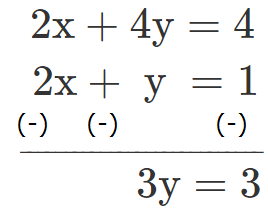
$\text{y}=\frac{3}3$ $\text{y}=1$ Put the value of y in equation (i), $2\text{x}+\text{y}=1$ $2\text{x}+1=1$ $2\text{x}=1-1$ $2\text{x}=0$ $\text{x}=\frac{0}2$ $\text{x}=0$ Put the value of x and y in equation (iii), $3\text{x}+\text{y}=3$ $3(0)+1=3$ $0+1=3$ $1=3$ $\text{LHS}\neq\text{RHS}$ The value of x and y do not satisfy the equation (iii), Hence, vectors are non-coplanar. View full question & answer→Question 1285 Marks
Show that the points A(-1, 4, -3), B(3, 2, -5), C(-3, 8, -5) and D(-3, 2, 1) are coplanar.
AnswerThe points A, B, C and D will be coplanar off any one of the following triads of vectors are coplanar:
$\vec{\text{AB}},\vec{\text{AC}},\vec{\text{AD}};\vec{\text{AB}},\vec{\text{BC}},\vec{\text{CD}};\vec{\text{BC}},\vec{\text{BA}},\vec{\text{BD}},$ etc.
To show that $\vec{\text{AB}},\vec{\text{AC}},\vec{\text{AD}}$ are coplaner, we have to prove that their scaler triple product,
i.e., $\Big[\vec{\text{AB}}\vec{\text{ AC}}\vec{\text{ AD}}\Big]=0$
Now,
$\vec{\text{AB}}=\big[3-(-1)\big]\hat{\text{i}}+(2-4)\hat{\text{j}}+[-5-(-3)]\hat{\text{k}}\\=4\hat{\text{i}}-2\hat{\text{j}}-2\hat{\text{k}}$
$\vec{\text{AC}}=[-3-1)]\hat{\text{i}}+(8-4)\hat{\text{j}}+[-5-(3)]\hat{\text{k}}\\=-2\hat{\text{i}}+4\hat{\text{j}}-2\hat{\text{k}}$
$\vec{\text{AD}}=[-3-(-1)]\hat{\text{i}}+(2-4)\hat{\text{j}}+[1-(3)]\hat{\text{k}}\\=-2\hat{\text{i}}-2\hat{\text{j}}+4\hat{\text{k}}$
$\therefore\Big[\vec{\text{AC}}\vec{\text{ AC}}\vec{\text{ AD}}\Big]=\begin{vmatrix}4&-2&-2\\-2&4&-2\\-2&-2&4 \end{vmatrix}$
$=4(16-4)+2(-8-4)-2(4+8)=0$
Thus, the given points are coplanar.
View full question & answer→Question 1295 Marks
If the points with position vectors $10\hat{\text{i}}+3\hat{\text{j}},\ 12\hat{\text{i}}-5\hat{\text{j}}$ and $\text{a}\hat{\text{i}}+11\hat{\text{j}}$ are collinear, find the value of a.
AnswerLet A, B, C be the points with position vectors $10\hat{\text{i}}+3\hat{\text{j}},\ 12\hat{\text{i}}-5\hat{\text{j}}$ and $\text{a}\hat{\text{i}}+11\hat{\text{j}}$. Then, $\overrightarrow{\text{AB}}=$ Position vector of B - Position vector of A $=12\hat{\text{i}}-5\hat{\text{j}}-10\hat{\text{i}}-3\hat{\text{j}}$ $=2\hat{\text{i}}-8\hat{\text{j}}$ $\overrightarrow{\text{BC}}=$ Position vector of C - Position vector of B $=\text{a}\hat{\text{i}}+11\hat{\text{j}}-12\hat{\text{i}}+5\hat{\text{j}}$ $=(\text{a}-12)\hat{\text{i}}+16\hat{\text{j}}$ Since, A, B, and C are collinear.
$\therefore\ \overrightarrow{\text{AB}}=\lambda\overrightarrow{\text{BC}}$ $\Rightarrow2\hat{\text{i}}-8\hat{\text{j}}=\lambda(\text{a}-12)\hat{\text{i}}+\lambda16\hat{\text{j}}$ $\Rightarrow2=\lambda(\text{a}-12),\ -8=\lambda16$ $\Rightarrow2=\lambda(\text{a}-12),\ \lambda=-\frac{1}2$ $\Rightarrow2=-\frac{1}2(\text{a}-12)$ $\Rightarrow-\text{a}+12=4$ $\Rightarrow\text{a}=8$
View full question & answer→Question 1305 Marks
Find a vector of magnitude 6, which is perpendicular to both the vectors $2\hat{\text{i}}-\hat{\text{j}}+2\hat{\text{k}}$ and $4\hat{\text{i}}-\hat{\text{j}}+3\hat{\text{k}}.$
AnswerLet $\vec{\text{a}}=2\hat{\text{i}}-\hat{\text{j}}+2\hat{\text{k}}$ and $\vec{\text{b}}=4\hat{\text{i}}-\hat{\text{j}}+3\hat{\text{k}}$
So, any vector perpendicular to both the vectors $\vec{\text{a}}$ and $\vec{\text{b}}$ is given by
$\vec{\text{a}}\times\vec{\text{b}}=\begin{vmatrix}\hat{\text{i}}&\hat{\text{j}}&\hat{\text{k}} \\2&-1&2\\4&-1&3 \end{vmatrix}$
$=\hat{\text{i}}(-3+2)-\hat{\text{j}}(6-8)+\hat{\text{k}(-2+4)}$
$=\hat{\text{i}}+2\hat{\text{j}}+2\hat{\text{k}}=\vec{\text{r}}$
A vector of magnitude 6 in the direction of $\vec{\text{r}}$
$=\frac{\vec{\text{r}}}{|\vec{\text{r}}|}.6\frac{-\hat{\text{i}}+2\hat{\text{j}}+2\hat{\text{k}}}{\sqrt{1^2+2^2+2^2}}.6$
$=-\frac{-6}{3}\hat{\text{i}}+\frac{12}{3}\hat{\text{j}}+\frac{12}{3}\hat{\text{k}}$
$=-2\hat{\text{i}}+4\hat{\text{j}}+4\hat{\text{k}}$
View full question & answer→Question 1315 Marks
$\vec{\text{a}},\vec{\text{b}}$ and $\vec{\text{c}}$ are the position vectors of points A, B and C respectively, prove that:
$\vec{\text{a}}\times\vec{\text{b}}+\vec{\text{b}}\times\vec{\text{c}}+\vec{\text{c}}\times\vec{\text{a}}$ is a vector perpendicular to the plane of triangle ABC.
AnswerWe know that if any vector is perpendicular to all three sides of $\triangle\text{ABC},$ it must be perpendicular to the plane of $\triangle \text{ABC}.$
Now,
$\vec{\text{AB}}=\vec{\text{b}}-\vec{\text{a}},\vec{\text{BC}}=\vec{\text{c}}-\vec{\text{b}},\vec{\text{CA}}=\vec{\text{a}}-\vec{\text{c}}$
$\big($position vectors of A, B and C are $\vec{\text{a}},\vec{\text{b}},\vec{\text{c}}\big)$
We have
$\vec{\text{AB}}.\big(\vec{\text{a}}\times\vec{\text{b}}+\vec{\text{b}}\times\vec{\text{c}}+\vec{\text{c}}\times\vec{\text{a}}\big)$
$=\big(\vec{\text{b}}-\vec{\text{a}}\big).\big(\vec{\text{a}}\times\vec{\text{b}}+\vec{\text{b}}\times\vec{\text{c}}+\vec{\text{c}}\times\vec{\text{a}}\big)$
$=\vec{\text{b}}.\big(\vec{\text{a}}\times\vec{\text{b}}\big)+\vec{\text{b}}\big(\vec{\text{b}}\times\vec{\text{c}}\big)+\vec{\text{b}}\big(\vec{\text{c}}\times\vec{\text{a}}\big)\\-\vec{\text{a}}.\big(\vec{\text{a}}\times\vec{\text{b}}\big)-\vec{\text{a}}\big(\vec{\text{b}}\times\vec{\text{c}}\big)-\vec{\text{a}}.\big(\vec{\text{c}}\times\vec{\text{a}}\big)$ (By distributive law)
$=\big[\vec{\text{b}}\ \vec{\text{a}}\ \vec{\text{b}}\big]+\big[\vec{\text{b}}\ \vec{\text{b}}\ \vec{\text{c}}\big]+\big[\vec{\text{b}}\ \vec{\text{c}}\ \vec{\text{a}}\big]-\big[\vec{\text{a}}\ \vec{\text{a}}\ \vec{\text{b}}\big]-\big[\vec{\text{a}}\ \vec{\text{b}}\ \vec{\text{c}}\big]-\big[\vec{\text{a}}\ \vec{\text{c}}\ \vec{\text{a}}\big]$
$=0+0+\big[\vec{\text{b}}\ \vec{\text{c}}\ \vec{\text{a}}\big]-0-\big[\vec{\text{a}}\ \vec{\text{b}}\ \vec{\text{c}}\big]-0$
$=0\ \big(\therefore\big[\vec{\text{b}}\ \vec{\text{c}}\ \vec{\text{a}}\big]=\big[\vec{\text{a}}\ \vec{\text{b}}\ \vec{\text{c}}\big]\big)$
$\vec{\text{BC}}\big(\vec{\text{a}}\times\vec{\text{b}}+\vec{\text{b}}\times\vec{\text{c}}+\vec{\text{c}}\times\vec{\text{a}}\big)$
$=\big(\vec{\text{c}}-\vec{\text{b}}\big).\big(\vec{\text{a}}\times\vec{\text{b}}+\vec{\text{b}}\times\vec{\text{c}}+\vec{\text{c}}\times\vec{\text{a}}\big)$
$=\vec{\text{c}}.\big(\vec{\text{a}}\times\vec{\text{b}}\big)+\vec{\text{c}}.\big(\vec{\text{b}}\times\vec{\text{c}}\big)+\vec{\text{c}}.\big(\vec{\text{c}}\times\vec{\text{a}}\big)\\-\vec{\text{b}}\big(\vec{\text{a}}\times\vec{\text{b}}\big)-\vec{\text{b}}.\big(\vec{\text{b}}\times\vec{\text{c}}\big)-\vec{\text{b}}.\big(\vec{\text{c}}\times\vec{\text{a}}\big)$ (By distributive law)
$=\big[\vec{\text{c}}\ \vec{\text{a}}\ \vec{\text{b}}\big]+\big[\vec{\text{c}}\ \vec{\text{b}}\ \vec{\text{c}}\big]+\big[\vec{\text{c}}\ \vec{\text{c}}\ \vec{\text{a}}\big]-\big[\vec{\text{b}}\ \vec{\text{a}}\ \vec{\text{b}}\big]-\big[\vec{\text{b}}\ \vec{\text{b}}\ \vec{\text{c}}\big]-\big[\vec{\text{b}}\ \vec{\text{c}}\ \vec{\text{a}}\big]$
$=\big[\vec{\text{c}}\ \vec{\text{a}}\ \vec{\text{b}}\big]+0+0-0-0-\big[\vec{\text{b}}\ \vec{\text{c}}\ \vec{\text{a}}\big]$
$=0$ $=0 \ \big(\therefore\big[\vec{\text{c}}\ \vec{\text{a}}\ \vec{\text{b}}=\big[\vec{\text{b}}\ \vec{\text{c}}\ \vec{\text{a}}\big]\big)$
Similarly,
$\vec{\text{CA}}.\big(\vec{\text{a}}\times\vec{\text{b}}+\vec{\text{b}}\times\vec{\text{c}}+\vec{\text{c}}\times\vec{\text{a}}\big)$
$=\big(\vec{\text{a}}-\vec{\text{c}}\big).\big(\vec{\text{a}}\times\vec{\text{b}}+\vec{\text{b}}\times\vec{\text{c}}+\vec{\text{c}}\times\vec{\text{a}}\big)$
$=\vec{\text{a}}.\big(\vec{\text{a}}\times\vec{\text{b}}\big)+\vec{\text{a}}.\big(\vec{\text{b}}\times\vec{\text{c}}\big)+\vec{\text{a}}\big(\vec{\text{c}}\times\vec{\text{a}}\big)\\-\vec{\text{c}}.\big(\vec{\text{a}}\times\vec{\text{b}}\big)-\vec{\text{c}}.\big(\vec{\text{b}}\times\vec{\text{c}}\big)-\vec{\text{c}}.\big(\vec{\text{c}}\times{\vec{\text{a}}}\big)$ (By distributive law)
$=\big[\vec{\text{a}}\vec{\text{a}}\vec{\text{b}}\big]+\big[\vec{\text{a}}\vec{\text{b}}\vec{\text{c}}\big]+\big[\vec{\text{a}}\vec{\text{c}}\vec{\text{a}}\big]-\big[\vec{\text{c}}\vec{\text{a}}\vec{\text{b}}\big]-\big[\vec{\text{c}}\vec{\text{b}}\vec{\text{c}}\big]-\big[\vec{\text{c}}\vec{\text{c}}\vec{\text{a}}\big]$
$=0\ \big(\therefore\big[\vec{\text{c}}\vec{\text{a}}\vec{\text{b}}\big]=\big[\vec{\text{a}}\vec{\text{b}}\vec{\text{c}}\big]\big)$
Hence, vector $\vec{\text{a}}\times\vec{\text{b}}+\vec{\text{b}}\times\vec{\text{c}}+\vec{\text{c}}\times\vec{\text{a}}$ is
perpendicular to all sides of $\triangle\text{ABC}$ and also perpendicular to the plane of $\triangle\text{ABC}.$
View full question & answer→Question 1325 Marks
Find the position vector of a point R which divides the line joining two points P and Q whose position vectors are $\hat{i}+2\hat{j}-\hat{k}\ \text{and}\ -\hat{i}+\hat{j}+\hat{k}$ respectively, in the ratio 2 : 1
- Internally.
- Externally.
AnswerThe position vector of point R dividing the line segment joining two points P and Q in the ratio m : n is given by:
- Internally:
$\frac{\text{m}\vec{b}+\text{n}\vec{a}}{\text{m}+\text{n}}$
- Externally:
$\frac{\text{m}\vec{b}-\text{n}\vec{a}}{\text{m}-\text{n}}$
Position vectors of P and Q are given as:
$\overrightarrow{\text{OP}}=\hat{i}+2\hat{j}-\hat{k}\ \text{and}\ \overrightarrow{\text{OQ}}=-\hat{i}+\hat{j}+\hat{k}$
- The position vector of point R which divides the line joining two points P and Q internally in the ratio 2 : 1 is given by,
$\overrightarrow{\text{OR}}=\frac{2\big(-\hat{i}+\hat{j}+\hat{k}\big)+1\big(\hat{i}+2\hat{j}-\hat{k}\big)}{2+1}$ $=\frac{\big(-2\hat{i}+2\hat{j}+2\hat{k}\big)+\big(\hat{i}+2\hat{j}-\hat{k}\big)}{3}$
$=\frac{-\hat{i}+4\hat{j}+\hat{k}}{3}=-\frac{1}{3}\hat{i}+\frac{4}{3}\hat{j}+\frac{1}{3}\hat{k}$
- The position vector of point R which divides the line joining two points P and Q externally in the ratio 2 : 1 is given by,
$\overrightarrow{\text{OR}}=\frac{2\big(-\hat{i}+\hat{j}+\hat{k}\big)-1\big(\hat{i}+2\hat{j}-\hat{k}\big)}{2-1}$ $=\big(-2\hat{i}+2\hat{j}+2\hat{k}\big)-\big(\hat{i}+2\hat{j}-\hat{k}\big)$
$=-3\hat{i}+3\hat{k}$ View full question & answer→Question 1335 Marks
If the points A(m, -1), B(2, 1) and C(4, 5) are collinear, find the value of m.
AnswerHere, A = (m, -1)
B = (2, 1)
C = (4, 5)
$\overrightarrow{\text{AB}}=$ Position vector of B - Position vector of A
$=\big(2\hat{\text{i}}+\hat{\text{j}}\big)-\big(\text{m}\hat{\text{i}}-\hat{\text{j}}\big)$
$=2\hat{\text{i}}+\hat{\text{j}}-\text{m}\hat{\text{i}}+\hat{\text{j}}$
$=(2-\text{m})\hat{\text{i}}+2\hat{\text{j}}$
$\overrightarrow{\text{BC}}=$ Position vector of C - Position vector of B
$=\big(4\hat{\text{i}}+5\hat{\text{j}}\big)-\big(2\hat{\text{i}}+\hat{\text{j}}\big)$
$=4\hat{\text{i}}+5\hat{\text{j}}-2\hat{\text{i}}-\hat{\text{j}}$
$\overrightarrow{\text{BC}}=2\hat{\text{i}}+4\hat{\text{j}} $
A, B, C are collinear. So, $\overrightarrow{\text{AB}}$ and $\overrightarrow{\text{BC}}$ are collinear.
So, $\overrightarrow{\text{AB}}=\lambda\Big(\overrightarrow{\text{BC}}\Big)$
$\big(2-\text{m})\hat{\text{i}}+2\hat{\text{j}}=\lambda\big(2\hat{\text{i}}+4\hat{\text{j}}\big)$, for $\lambda$ scalar
$\big(2-\text{m})\hat{\text{i}}+2\hat{\text{j}}=2\lambda\hat{\text{i}}+4\lambda\hat{\text{j}}$
Comparing the coefficient of LHS and RHS.
$2-\text{m}=2\lambda$
$\frac{2-\text{m}}2=\lambda\ \dots(\text{i})$
$2=4\lambda$
$\frac{2}4=\lambda$
$\frac{1}2=\lambda\ \dots(\text{ii})$
Using (i) and (ii)
$\frac{2-\text{m}}2=\frac{1}2$
$4-2\text{m}=2$
$-2\text{m}=2$
$-2\text{m}=2-4$
$-2\text{m}=-2$
$\text{m}=\frac{-2}{-2}$
$\text{m}=1$
View full question & answer→Question 1345 Marks
Show that the points A, B, C with position vectors $\vec{\text{a}}-2\vec{\text{b}}+3\vec{\text{c}},\ 2\vec{\text{a}}+3\vec{\text{b}}-4\vec{\text{c}}$ and $-7\vec{\text{b}}+10\vec{\text{c}}$ are collinear.
AnswerWe have, A, B, C with position vectors $\vec{\text{a}}-2\vec{\text{b}}+3\vec{\text{c}},\ 2\vec{\text{a}}+3\vec{\text{b}}-4\vec{\text{c}}$ and $-7\vec{\text{b}}+10\vec{\text{c}}$ Then,
$\overrightarrow{\text{AB}}=$ Position vector of B - Position vector of A
$=2\vec{\text{a}}+3\vec{\text{b}}-4\vec{\text{c}}-\vec{\text{a}}+2\vec{\text{b}}-3\vec{\text{c}}$
$=\vec{\text{a}}+5\vec{\text{b}}-7\vec{\text{c}}$
$\overrightarrow{\text{BC}}=$ Position vector of C - Position vector of B
$=-7\vec{\text{b}}+10\vec{\text{c}}-2\vec{\text{a}}-3\vec{\text{b}}+4\vec{\text{c}}$
$=-2\vec{\text{a}}-10\vec{\text{b}}+14\vec{\text{c}}$
$=-2\big(\vec{\text{a}}+5\vec{\text{b}}-7\vec{\text{c}}\big)$
$\therefore\ \overrightarrow{\text{BC}}=-2\overrightarrow{\text{AB}}$
Hence, $\overrightarrow{\text{AB}}$ and $\overrightarrow{\text{BC}}$ are parallel vectors.
But B is a point common to them.
So, $\overrightarrow{\text{AB}}$ and $\overrightarrow{\text{BC}}$ are collinear.
Hence, points A, B and C are collinear.
View full question & answer→Question 1355 Marks
If $\vec{\text{a}},\vec{\text{b}}$ are two non-collinear vectors, prove that the points with position vectors $\vec{\text{a}}+\vec{\text{b}},\ \vec{\text{a}}-\vec{\text{b}}$ and $\vec{\text{a}}+\lambda\vec{\text{b}}$ are collinear for all real values of $\lambda$.
AnswerLet A, B, C be the points then, Position vector of $\text{A}=\vec{\text{a}}+\vec{\text{b}}$ Position vector of $\text{B}=\vec{\text{a}}-\vec{\text{b}}$ Position vector of $\text{C}=\vec{\text{a}}+\lambda\vec{\text{b}}$ $\overrightarrow{\text{AB}}=$ Position vector of B - Position vector of A $=\big(\vec{\text{a}}-\vec{\text{b}}\big)-\big(\vec{\text{a}}+\vec{\text{b}}\big)$ $=\vec{\text{a}}-\vec{\text{b}}-\vec{\text{a}}-\vec{\text{b}}$ $\overrightarrow{\text{AB}}=-2\vec{\text{b}}$ $\overrightarrow{\text{BC}}=$ Position vector of C - Position vector of B $=\big(\vec{\text{a}}+\lambda\vec{\text{b}}\big)-\big(\vec{\text{a}}-\vec{\text{b}}\big)$ $=\vec{\text{a}}+\lambda\vec{\text{b}}-\vec{\text{a}}+\vec{\text{b}}$ $\overrightarrow{\text{BC}}=(\lambda+1)\vec{\text{b}}$ Using $\overrightarrow{\text{AB}}$ and $\overrightarrow{\text{BC}}$, we get $\overrightarrow{\text{AB}}=\Big[\frac{(\lambda+1)}{2}\Big]\Big(\overrightarrow{\text{BC}}\Big)$ Let $\Big(\frac{\lambda+1}{2}\Big)=\mu$Since $\lambda$ is a real number. So,
$\mu$ is also a real number. So, $\overrightarrow{\text{AB}}$ is parallel to $\overrightarrow{\text{BC}}$, but $\vec{\text{B}}$ is a common vector. Hence, A, B, C are collinear.
View full question & answer→Question 1365 Marks
Using vector method, prove that the point is collinear:
A(-3, -2, -5), B(1, 2, 3) and C(3, 4, 7)
AnswerGiven the points A(-3, -2, -5), B(1, 2, 3) and C(3, 4, 7). Then, $\overrightarrow{\text{AB}}=$ Position vector of B - Position vector of A$=\hat{\text{i}}+2\hat{\text{j}}+3\hat{\text{k}}+3\hat{\text{i}}+2\hat{\text{j}}+5\hat{\text{k}}$
$=4\hat{\text{i}}+4\hat{\text{j}}+8\hat{\text{k}}$
$=2\big(2\hat{\text{i}}+2\hat{\text{j}}+4\hat{\text{k}}\big)$$\overrightarrow{\text{BC}}=$ Position vector of C - Position vector of B
$=3\hat{\text{i}}+4\hat{\text{j}}+7\hat{\text{k}}-\hat{\text{i}}-2\hat{\text{j}}-3\hat{\text{k}}$
$=2\hat{\text{i}}+2\hat{\text{j}}+4\hat{\text{k}}$
$\therefore\ \overrightarrow{\text{AB}}=2\overrightarrow{\text{BC}}$
So, $\overrightarrow{\text{AB}}$ and $\overrightarrow{\text{BC}}$ are parallel vectors. But B is a point common to them. Hence, the given points A, B, and C are collinear.
View full question & answer→Question 1375 Marks
Show that the points A(1, -2, -8), B(5, 0, -2) and C(11, 3, 7) are collinear, and find the ratio in which B divides AC.
AnswerGiven points A(1, -2, -8), B(5, 0, -2), C(11, 3, 7).
Therefore, $\overrightarrow{\text{AB}}=5\hat{\text{i}}+0\hat{\text{j}}-2\hat{\text{k}}-\hat{\text{i}}+2\hat{\text{j}}+8\hat{\text{k}}=4\hat{\text{i}}+2\hat{\text{j}}+6\hat{\text{k}}$
$\overrightarrow{\text{BC}}=11\hat{\text{i}}+3\hat{\text{j}}+7\hat{\text{k}}-5\hat{\text{i}}+2\hat{\text{k}}=6\hat{\text{i}}+3\hat{\text{j}}+9\hat{\text{k}}$
and, $\overrightarrow{\text{AC}}=11\hat{\text{i}}+3\hat{\text{j}}+7\hat{\text{k}}-\hat{\text{i}}+2\hat{\text{j}}+8\hat{\text{k}}=10\hat{\text{i}}+5\hat{\text{j}}+15\hat{\text{k}}$
Clearly, $\overrightarrow{\text{AB}}+\overrightarrow{\text{BC}}=\overrightarrow{\text{AC}}$
Hence A, B, C are collinear.
Suppose B divides AC in the ratio $\lambda:1$. Then the position vector B is
$\Big(\frac{11\lambda+1}{\lambda+1}\Big)\hat{\text{i}}+\Big(\frac{3\lambda-2}{\lambda+1}\Big)\hat{\text{j}}+\Big(\frac{7\lambda-8}{\lambda+1}\Big)\hat{\text{k}}$
But the position vector of B is $5\hat{\text{i}}+0\hat{\text{j}}-2\hat{\text{k}}$.
$\Big(\frac{11\lambda+1}{\lambda+1}\Big)=5,\Big(\frac{3\lambda-2}{\lambda+1}\Big)=0,\Big(\frac{7\lambda-8}{\lambda+1}\Big)=-2$
$\Rightarrow11\lambda+1=5\lambda+5,\ 3\lambda-2=0,\ 7\lambda-8=-2\lambda-2$
$\Rightarrow6\lambda=4,\ 3\lambda=2,\ 9\lambda=6$
$\Rightarrow\lambda=\frac{2}3,\ \lambda=\frac{2}3,\ \lambda=\frac{2}3$
View full question & answer→Question 1385 Marks
The scalar product of the vector $\hat{\text{l}}+\hat{\text{j}}+\hat{\text{k}}$ with a unit a vector along the sum of vectors $2\hat{\text{l}}+4\hat{\text{j}}-5\hat{\text{k}}\ \text{and}\ \lambda\hat{\text{l}}+2\hat{\text{j}}+3\hat{\text{k}}$ is equal to one. Find the value of $\lambda.$
Answer$\Big(2\hat{\text{i}}+4\hat{\text{j}}-5\hat{\text{k}}\Big)+\Big(\lambda\hat{\text{i}}+2\hat{\text{j}}+3\hat{\text{k}}\Big) $
$=(2+\lambda)\hat{\text{i}}+6\hat{\text{j}}-2\hat{\text{k}}$
Therefore, unit vector along $\Big(2\hat{\text{i}}+4\hat{\text{j}}-5\hat{\text{k}}\Big)+\Big(\lambda\hat{\text{i}}+2\hat{\text{j}}+3\hat{\text{k}}\Big) $ is given as:
$\frac{(2+\lambda)\hat{\text{i}}+6\hat{\text{j}}-2\hat{\text{k}}}{\sqrt{(2+\lambda)^{2}+6^{2}+(-2)^{2}}}=\frac{(2+\lambda)\hat{\text{i}}+6\hat{\text{j}}-2\hat{\text{k}}}{\sqrt{4+4\lambda+\lambda^{2}+36+4}}$ $=\frac{(2+\lambda)\hat{\text{i}}+6\hat{\text{j}}-2\hat{\text{k}}}{\sqrt{\lambda^{2}+4\lambda+44}}$
Scalar product of $\Big(\hat{\text{l}}+\hat{\text{j}}+\hat{\text{k}}\Big)$ with this unit vector is 1.
$\Rightarrow\Big(\hat{\text{l}}+\hat{\text{j}}+\hat{\text{k}}\Big) \cdot\frac{(2+\lambda)\hat{\text{i}}+6\hat{\text{j}}-2\hat{\text{k}}}{\sqrt{\lambda^{2}+4\lambda+44}}=1$
$\Rightarrow\frac{(2+\lambda)+6-2}{\sqrt{\lambda^{2}+4\lambda+44}}=1$
$\Rightarrow {\sqrt{\lambda^{2}+4\lambda+44}}=\lambda+6$
$\Rightarrow{\lambda^{2}+4\lambda+44}=\big(\lambda+6\big)^{2}$
$\Rightarrow{\lambda^{2}+4\lambda+44}=\lambda^{2}+12\lambda+36$
$\Rightarrow{8\lambda=8}$
$\Rightarrow{\lambda=1}$
Hence, the value of $\lambda$ is 1.
View full question & answer→Question 1395 Marks
A girl walks 4 km towards west, then she walks 3 km in a direction 30° east of north and stops. Determine the girl's displacement from her initial point of departure.
AnswerLet O and B be the initial and final position of the girl respectively Then, the girl's position can be shown as: 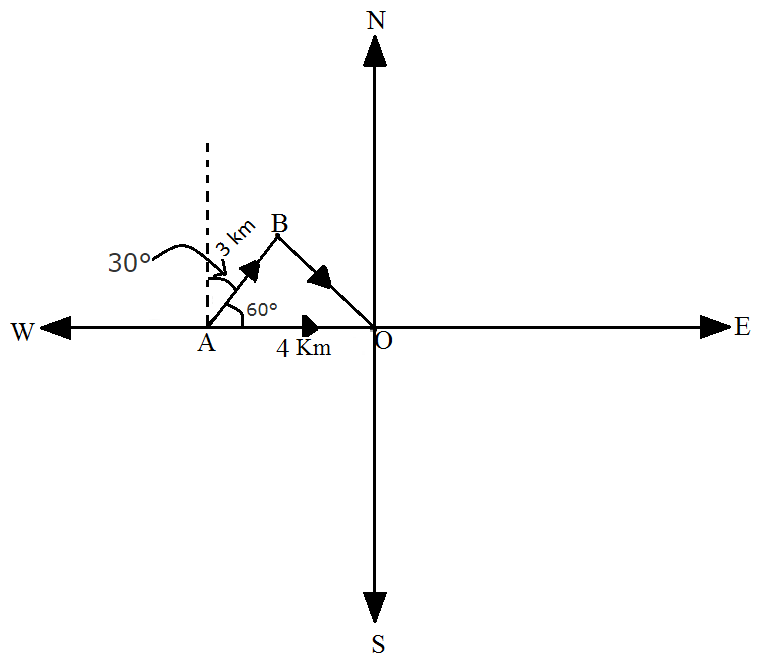 Now, we have: $\overrightarrow{\text{OA}}=-4\hat{\text{i}}$ $\overrightarrow{\text{AB}}=\hat{\text{i}}\bigg|\overrightarrow{\text{AB}}\bigg|\cos60^{\circ}+\hat{\text{j}}\bigg|\overrightarrow{\text{AB}}\bigg|\sin60^{\circ}$$=\hat{\text{i}}3\times\frac{1}{2}+\hat{\text{j}}3\times\frac{\sqrt{3}}{2} $
$=\frac{3}{2}\hat{\text{i}}+\frac{3\sqrt{3}}{2}\hat{\text{j}}$
By the triangle law vector addition, we have: $\overrightarrow{\text{OB}}=\overrightarrow{\text{OA}}+\overrightarrow{\text{AB}}$ $=(-4\hat{\text{i}})+\bigg(\frac{3}{2}\hat{\text{i}}+\frac{3\sqrt{3}}{2}\hat{\text{j}}\bigg)$ $=\bigg(-4+\frac{3}{2}\bigg)\hat{\text{i}}+\frac{3\sqrt{3}}{2}\hat{\text{j}}$ $=\bigg(\frac{-8+3}{2}\bigg)\hat{\text{i}}+\frac{3\sqrt{3}}{2}\hat{\text{j}}$ $=\frac{-5}{2}\hat{\text{i}}+\frac{3\sqrt{3}}{2}\hat{\text{j}}$Hence, the girl's displacement form her initial point of departure is
$\frac{-5}{2}\hat{\text{i}}+\frac{3\sqrt{3}}{2}\hat{\text{j}}$ View full question & answer→Question 1405 Marks
Using vector method, prove that the point is collinear:
A(6, -7, -1), B(2, -3, 1) and C(4, -5, 0)
AnswerGiven the points A(6, -7, -1), B(2, -3, 1) and C(4, -5, 0). Then, $\overrightarrow{\text{AB}}=$ Position vector of B - Position vector of A$=2\hat{\text{i}}-3\hat{\text{j}}+\hat{\text{k}}-6\hat{\text{i}}+7\hat{\text{j}}+\hat{\text{k}}$
$=-4\hat{\text{i}}+4\hat{\text{j}}+2\hat{\text{k}}$
$=-2\big(2\hat{\text{i}}-2\hat{\text{j}}-\hat{\text{k}}\big)$$\overrightarrow{\text{BC}}=$ Position vector of C - Position vector of B
$=4\hat{\text{i}}-5\hat{\text{j}}-2\hat{\text{k}}+3\hat{\text{j}}-\hat{\text{k}}$
$=2\hat{\text{i}}-2\hat{\text{j}}-\hat{\text{k}}$
$\therefore\ \overrightarrow{\text{AB}}=-2\overrightarrow{\text{BC}}$
So, $\overrightarrow{\text{AB}}$ and $\overrightarrow{\text{BC}}$ are parallel vectors. But B is a point common to them. Hence, the given points A, B, and C are collinear.
View full question & answer→Question 1415 Marks
A vector $\vec{\text{r}}$ has magnitude 14 and direction ratios 2, 3, -6. Find the direction cosines and components of $\vec{\text{r}},$ given that $\vec{\text{r}}$ makes an acute angle with x-axis.
AnswerLet vector $\vec{\text{r}}=\text{a}\hat{\text{i}}+\text{b}\hat{\text{j}}+\text{c}\hat{\text{k}}$
Given $|\vec{\text{r}}|=14$
and $\frac{\text{a}}{2}=\frac{\text{b}}{3}=\frac{\text{c}}{-6}=\lambda\ (\text{say})$
$\therefore\vec{\text{r}}=\lambda(2\hat{\text{i}}+3\hat{\text{j}}-6\hat{\text{k}})$
$|\vec{\text{r}}|=14$
$\therefore\ 4\lambda^2+9\lambda^2+36\lambda^2=196$
$\Rightarrow49\lambda^2=196$
$\Rightarrow\lambda^2=4$
$\Rightarrow\lambda=2$ (as it is given taht $\vec{\text{r}}$ makes an acutw angle withj x-axis)
$\Rightarrow\vec{\text{r}}=4\hat{\text{i}}+6\hat{\text{j}}-12\hat{\text{k}}$
$\Rightarrow\hat{\text{r}}=\frac{\vec{\text{r}}}{|\vec{\text{r}}|}$
$=\frac{4\hat{\text{i}}+6\hat{\text{j}}-12\hat{\text{k}}}{14}$
$=\frac{2\hat{\text{i}}+3\hat{\text{j}}-6\hat{\text{k}}}{7}$
$\therefore$ direction cosines are $\frac{2}{7},\frac{3}{7},\frac{-6}{7}.$
View full question & answer→Question 1425 Marks
If $\vec{\text{a}}=\hat{\text{i}}+\hat{\text{j}}+\hat{\text{k}}$ and $=\vec{\text{b}}=\hat{\text{j}}-\hat{\text{k}},$ then find a vector $\vec{\text{c}}$ such that $\vec{\text{a}}\times\vec{\text{c}}=\vec{\text{b}}$ and $\vec{\text{a}}\cdot\vec{\text{c}}=3.$
AnswerLet $\vec{\text{c}}=\text{x}\hat{\text{i}}+\text{y}\hat{\text{j}}+\text{z}\hat{\text{k}}$
Also, $\vec{\text{a}}=\hat{\text{i}}+\hat{\text{j}}+\hat{\text{k}}$ and $=\vec{\text{b}}=\hat{\text{j}}-\hat{\text{k}}$
For $\vec{\text{a}}\times\vec{\text{c}}=\vec{\text{b}},$
$\begin{vmatrix}\hat{\text{i}}&\hat{\text{j}}&\hat{\text{k}} \\1&1&1\\\text{x}&\text{y}&\text{z} \end{vmatrix}=\hat{\text{j}}-\hat{\text{k}}$
$\Rightarrow\hat{\text{i}}(\text{z}-\text{y})-\hat{\text{j}}(\text{z}-\text{z})+\hat{\text{k}}(\text{y}-\text{x})=\hat{\text{j}}-\hat{\text{k}}$
$\therefore\text{z}-\text{y}=0\ ...(\text{i})$
$\text{x}-\text{z}=1\ .....(\text{ii})$
$\text{x}-\text{y}=1\ ....(\text{iii})$
Also, $\vec{\text{a}}\cdot\vec{\text{c}}=3$
$\Rightarrow(\hat{\text{i}}+\hat{\text{j}}+\hat{\text{k}})\cdot(\text{x}\hat{\text{i}}+\text{y}\hat{\text{j}}+\text{z}\hat{\text{k}})=3$
$\Rightarrow\text{x}+\text{y}+\text{z}=3\ .....(\text{iv})$
On solving equations (ii) and (iii), we get
$\Rightarrow2\text{x}-\text{y}-\text{z}=2\ .....(\text{v})$
On solving equations (iv) and (v), we get
$\text{x}=\frac{5}{3}$
$\therefore\text{y}=\frac{5}{3}-1=\frac{2}{3}$ and $\text{z}=\frac{2}{3}$
Now, $\vec{\text{c}}=\frac{5}{3}\hat{\text{i}}+\frac{2}{3}\hat{\text{j}}+\frac{2}{3}\hat{\text{k}}$
$=\frac{1}{3}(5\hat{\text{i}}+2\hat{\text{j}}+2\hat{\text{k}})$
View full question & answer→Question 1435 Marks
If $\vec{\text{a}},\vec{\text{ b}}$ and $\vec{\text{c}}$ determine the vertices of a triangle, show that $\frac{1}{2}[\vec{\text{b}}\times\vec{\text{c}}+\vec{\text{c}}\times\vec{\text{a}}+\vec{\text{a}}\times\vec{\text{b}}]$ gives the vector area of the triangle. Hence, deduce the condition that the three points $\vec{\text{a}},\vec{\text{ b}}$ and $\vec{\text{c}}$ are collinear. Also, find the unit vector normal to the plane of the triangle.
AnswerLet $\vec{\text{a}},\vec{\text{ b}}$ and $\vec{\text{c}}$ be the vertices of a $\triangle\text{ABC}.$
Now, area $\triangle\text{ABC}=\frac{1}{2}|\overrightarrow{\text{AB}}\times\overrightarrow{\text{AC}}|$
Here, $\overrightarrow{\text{AB}}=\vec{\text{b}}-\vec{\text{a}}$ and $\overrightarrow{\text{AC}}=\vec{\text{c}}-\vec{\text{a}}$
$\therefore$ Area of $\triangle\text{ABC}=\frac{1}{2}|\vec{\text{b}}-\vec{\text{a}}\times\vec{\text{c}}-\vec{\text{a}}|$
$=\frac{1}{2}|\vec{\text{b}}\times\vec{\text{c}}-\vec{\text{b}}\times\vec{\text{a}}-\vec{\text{a}}\times\vec{\text{c}}+\vec{\text{a}}\times\vec{\text{a}}|$
$=\frac{1}{2}|\vec{\text{b}}\times\vec{\text{c}}+\vec{\text{a}}\times\vec{\text{b}}+\vec{\text{c}}\times\vec{\text{a}}+\vec{0}|$
$=\frac{1}{2}|\vec{\text{b}}\times\vec{\text{c}}+\vec{\text{a}}\times\vec{\text{b}}+\vec{\text{c}}\times\vec{\text{a}}|\ .....(\text{i})$
For $\vec{\text{a}},\vec{\text{ b}}$ and $\vec{\text{c}}$ to be collinear, area of the $\triangle\text{ABC}$ should be equal to zero.
$\Rightarrow\frac{1}{2}|\vec{\text{b}}\times\vec{\text{c}}+\vec{\text{c}}\times\vec{\text{a}}+\vec{\text{a}}\times\vec{\text{b}}|=0$
$\Rightarrow\vec{\text{b}}\times\vec{\text{c}}+\vec{\text{c}}\times\vec{\text{a}}+\vec{\text{a}}\times\vec{\text{b}}=0\ .....(\text{ii})$
This is the required condition for collinearity of three points $\vec{\text{a}},\vec{\text{ b}}$ and $\vec{\text{c}}$
Let $\hat{\text{n}}$ be the unit vector normal to the plane of the $\triangle\text{ABC}.$
$\hat{\text{n}}=\frac{\overrightarrow{\text{AB}}\times\overrightarrow{\text{AC}}}{|\overrightarrow{\text{AB}}\times\overrightarrow{\text{AC}}|}$
$\hat{\text{n}}=\frac{\vec{\text{a}}\times\vec{\text{b}}+\vec{\text{b}}\times\vec{\text{c}}+\vec{\text{c}}\times\vec{\text{a}}}{|\vec{\text{a}}\times\vec{\text{b}}+\vec{\text{b}}\times\vec{\text{c}}+\vec{\text{c}}\times\vec{\text{a}}|}$
View full question & answer→Question 1445 Marks
The adjacent sides of a parallelogram are represented by the vectors $\vec{\text{a}}=\hat{\text{i}}+\hat{\text{j}}-\hat{\text{k}}$ and $\vec{\text{b}}=-2\hat{\text{i}}+\hat{\text{j}}+2\hat{\text{k}}$. Find the unit vectors parallel to the diagonals of the parallelogram.
AnswerLet PQRS be a parallelogram such that $\text{PQ}=\vec{\text{a}}=\hat{\text{i}}+\hat{\text{j}}-\hat{\text{k}}$and $\text{QR}=\vec{\text{b}}=-2\hat{\text{i}}+\hat{\text{j}}+2\hat{\text{k}}$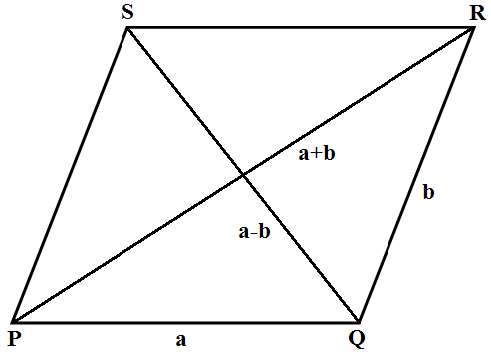
In $\triangle\text{PQR}$ $\overrightarrow{\text{PQ}}+\overrightarrow{\text{QR}}=\overrightarrow{\text{PR}}$ $\overrightarrow{\text{PR}}=\vec{\text{a}}+\vec{\text{b}}=\hat{\text{i}}+\hat{\text{j}}-\hat{\text{k}}+\big(-2\hat{\text{i}}+\hat{\text{j}}+2\hat{\text{k}}\big)$ $\overrightarrow{\text{PR}}=-\hat{\text{i}}+2\hat{\text{j}}+\hat{\text{k}}$ In $\triangle{\text{PQS}}$ $\overrightarrow{\text{PS}}+\overrightarrow{\text{SQ}}=\overrightarrow{\text{PQ}}$ $\overrightarrow{\text{SQ}}=\vec{\text{a}}-\vec{\text{b}}=\hat{\text{i}}+\hat{\text{j}}-\hat{\text{k}}-\big(-2\hat{\text{i}}+\hat{\text{j}}+2\hat{\text{k}}\big)$ $\overrightarrow{\text{SQ}}=3\hat{\text{i}}+0\hat{\text{j}}-3\hat{\text{k}}$ The unit vector along $\overrightarrow{\text{PR}}=\frac{\overrightarrow{\text{PR}}}{\big|\overrightarrow{\text{PR}}\big|}=\frac{-\hat{\text{i}}+2\hat{\text{j}}+\hat{\text{k}}}{\sqrt{1+4+1}}$ $=\frac{1}{\sqrt6}\big(-\hat{\text{i}}+2\hat{\text{j}}+\hat{\text{k}}\big)$ The unit vector along $\overrightarrow{\text{SQ}}=\frac{\overrightarrow{\text{SQ}}}{\big|\overrightarrow{\text{SQ}}\big|}=\frac{3\hat{\text{i}}+0\hat{\text{j}}-3\hat{\text{k}}}{\sqrt{9+0+9}}$ $=\frac{1}{\sqrt2}\big(\hat{\text{i}}-\hat{\text{k}}\big)$ View full question & answer→Question 1455 Marks
Find the angles which the vector $\vec{\text{a}}=\hat{\text{i}}-\hat{\text{j}}+\sqrt{2}\hat{\text{k}}$ makes with the coordinate axes.
AnswerLet $\theta_{1}$ be the angle between $\vec{\text{a}}$ and x-axis.
$\big|\vec{\text{a}}\big|=\sqrt{(1)^2+(-1)^2+(\sqrt{2})^2}=\sqrt{4}=2$
$\vec{\text{b}}=\hat{\text{i}}$ (Because $\hat{\text{i}}$ is the unit vector along x-axis)
$\big|\vec{\text{b}}\big|=\sqrt{(1)^2}=\sqrt{1}=1$
$\vec{\text{a}}.\vec{\text{b}}=1+0+0=1$
$\cos\theta_{1}=\frac{\vec{\text{a}} .\vec{\text{b}}}{\big|\vec{a}\big|\big|\vec{b}\big|}=\frac{1}{(2)(1)}=\frac{1}{2}$
$\Rightarrow\theta_{1}=\cos^{-1}\big(\frac{1}{2}\big)=\frac{\pi}{3}$
Let $\theta_{2}$ be the angle between $\vec{\text{a}}$ and y-axis.
$\big|\vec{\text{a}}\big|=\sqrt{(1)^2+(-1)^2+(\sqrt{2})^2}=\sqrt{4}=2$
$\vec{\text{b}}=\hat{\text{j}}$(Because $\hat{\text{j}}$ is the unit vector along y-axis)
$\big|\vec{\text{b}}\big|=\sqrt{(1)^2}=\sqrt{1}=1$
$\vec{\text{a}}.\vec{\text{b}}=0-1+0=-1$
$\cos\theta_{2}=\frac{\vec{\text{a}} .\vec{\text{b}}}{\big|\vec{a}\big|\big|\vec{b}\big|}=\frac{-1}{(2)(1)}=\frac{-1}{2}$
$\Rightarrow\theta_{2}=\cos^{-1}\big(\frac{-1}{2}\big)=\frac{2\pi}{3}$
Let $\theta_{3}$ be the angle between $\vec{\text{a}}$ and z-axis.
$\big|\vec{\text{a}}\big|=\sqrt{(1)^2+(-1)^2+(\sqrt{2})^2}=\sqrt{4}=2$
$\vec{\text{b}}=\hat{\text{k}}$ (Because $\hat{\text{k}}$ is the unit vector along z-axis)
$\big|\vec{\text{b}}\big|=\sqrt{(1)^2}=\sqrt{1}=1$
$\vec{\text{a}}.\vec{\text{b}}=0+0+\sqrt{2}=\sqrt{2}$
$\cos\theta=\frac{\vec{\text{a}} .\vec{\text{b}}}{\big|\vec{a}\big|\big|\vec{b}\big|}=\frac{\sqrt{2}}{(2)(1)}=\frac{1}{\sqrt2}$
$\Rightarrow\theta=\cos^{-1}\big(\frac{1}{\sqrt2}\big)=\frac{\pi}{4}$
View full question & answer→Question 1465 Marks
If $\vec{\text{a}},\vec{\text{b}},\vec{\text{c}}$ are non-zero, non-coplanar vectors, prove that the vector is coplanar:
$5\vec{\text{a}}+6\vec{\text{b}}+7\vec{\text{c}},\ 7\vec{\text{a}}-8\vec{\text{b}}+9\vec{\text{c}}$ and $3\vec{\text{a}}+20\vec{\text{b}}+5\vec{\text{c}}$
AnswerWe know that, Three vectors are coplanar if one of the vector can be expressed as the linear combination of other two. Let, $5\vec{\text{a}}+6\vec{\text{b}}+7\vec{\text{c}}\\=\text{x}\big(7\vec{\text{a}}-8\vec{\text{b}}+9\vec{\text{c}}\big)+\text{y}\big(3\vec{\text{a}}+20\vec{\text{b}}+5\vec{\text{c}}\big)$ $5\vec{\text{a}}+6\vec{\text{b}}+7\vec{\text{c}}\\=7\vec{\text{a}}\text{x}-8\vec{\text{b}}\text{x}+9\vec{\text{c}}\text{x}+3\vec{\text{a}}\text{y}+20\vec{\text{b}}\text{y}+5\vec{\text{c}}\text{y}$ $5\vec{\text{a}}+6\vec{\text{b}}+7\vec{\text{c}}\\=\big(7\text{x}+3\text{y}\big)\vec{\text{a}}+\big(-8\text{x}+20\text{y}\big)\vec{\text{b}}+\big(9\text{x}+5\text{y}\big)\vec{\text{c}}$ Comparing the LHS and RHS, 7x + 3y = 5 .....(i) -8x + 20y = 6 .....(ii) 9x + 5y = 7 .....(iii) For solving (i) and (ii), Subtract -8 × (i) from 7 × (ii),
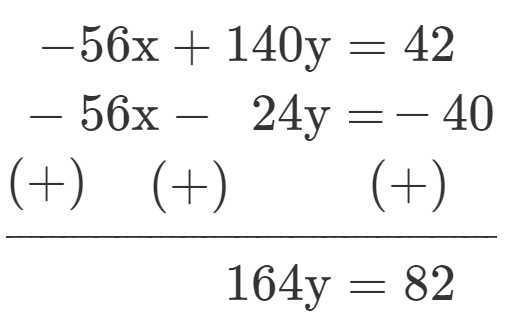
$\text{y}=\frac{82}{164}$ $\text{y}=\frac{1}2$ Put $\text{y}=\frac{1}2$ in equation (i), $7\text{x}+3\text{y}=5$ $7\text{x}+3\Big(\frac{1}2\Big)=5$ $7\text{x}+\frac{3}2=5$ $7\text{x}=\frac{5}1-\frac{3}2$ $7\text{x}=\frac{10-3}2$ $7\text{x}=\frac{7}2$ $\text{x}=\frac{7}{14}$ $\text{x}=\frac{1}{2}$ Now, put $\text{x}=\frac{1}{2}$ and $\text{y}=\frac{1}2$ in equation (iii), $9\text{x}+5\text{y}=7$ $9\Big(\frac{1}2\Big)+5\Big(\frac{1}2\Big)=7$ $\frac{9}2+\frac{5}2=7$ $\frac{14}2=7$ $7=7$LHS = RHS
$\therefore$ The value of x, y satisfy equation (iii).
So, $5\vec{\text{a}}+6\vec{\text{b}}+7\vec{\text{c}},\ 7\vec{\text{a}}-8\vec{\text{b}}+9\vec{\text{c}},\ 3\vec{\text{a}}+20\vec{\text{b}}+5\vec{\text{c}}$ are coplanar. View full question & answer→Question 1475 Marks
If the vectors $\big(\sec^2\text{A}\big)\hat{\text{i}}+\hat{\text{j}}+\hat{\text{k}},\hat{\text{i}}+\big(\sec^2\text{B}\big)+\hat{\text{k}},\hat{\text{i}}+\hat{\text{j}}+\big(\sec^2\text{C}\big)\hat{\text{k}}$ are coplanar, then find the value of $\text{cosec}^2\text{A}+\text{cosec}^2\text{B}+\text{cosec}^2\text{C}.$
AnswerLet: $\vec{\text{a}}=\big(\sec^2\text{A}\big)\hat{\text{i}}+\hat{\text{j}},\vec{\text{b}}=\hat{\text{i}}+(\sec^2\text{B})\hat{\text{j}}+\hat{\text{k}}$ and $\vec{\text{c}}=\hat{\text{i}}+\hat{\text{j}}+(\sec^2\text{C})\hat{\text{k}}$
We know that three vectors are coplanar if their scaler triple product is zero i.e., $\big[\vec{\text{a}}\vec{\text{b}}\vec{\text{c}}\big]=0$
Here, $\big[\vec{\text{a}}\vec{\text{b}}\vec{\text{c}}\big]=0$
$\begin{vmatrix}\sec^2\text{A}&1&1\\1&\sec^2\text{B}&1\\1&1&\sec^2\text{C} \end{vmatrix}=0$
$\Rightarrow\sec^2\text{A}\big[\big(\sec^2\text{B}\times\sec^2\text{C}\big)\\-1\big]-1\big(\sec^2\text{C}-1\big)+1\big(1-\sec^2\text{B}\big)=0$
$\Rightarrow\sec^2\text{A}\sec^2\text{B}\sec^2\text{C}-\sec^2\text{A}-\sec^2\text{C}+1+1-\sec^2\text{B}=0$
$\Rightarrow\big(1+\tan^2\text{A}\big)\big(1+\tan^2\text{B}\big)\big(1+\tan^2\text{C}\big)\\-\big(1+\tan^2\text{A}\big)-\big(1+\tan^2\text{C}\big)+1=1-\big(1+\tan^2\text{B}\big)=0$
$\Rightarrow1+\tan^2\text{A}+\tan^2\text{B}+\tan^2\text{C}+\tan^2\text{A}\tan^2\text{B}\\+\tan^\text{B}\tan^2\text{C}+\tan^2\text{C}\tan^2\text{A}+\tan^2\text{A}\tan^2\text{B}\tan^\text{C}1\\-\tan^2\text{A}-1-\tan^2\text{C}$
$\tan^2\text{A}\tan^2\text{B}+\tan^2\text{B}\tan^2\text{C}+\tan^2\text{C}\tan^2\text{A}\\+\tan^2\text{A}\tan^2\text{B}\tan^2\text{C}=0$
$\Rightarrow\tan^2\text{A}\tan^2\text{B}+\tan^2\text{B}\tan^2\text{C}+\tan^2\text{C}\tan^2\text{A}\\=-\tan^2\text{A}\tan^2\text{B}\tan^2\text{C}$
$\Rightarrow\frac{\tan^2\text{A}\tan^2\text{B}\tan^2\text{C}+\tan^2\text{C}\tan^2\text{A}}{\tan^2\text{A}\tan^2\text{B}\tan^2\text{C}}=-1$
$\Rightarrow\cot^2\text{C}+\cot^2\text{A}+\cot^2\text{B}=-1$
$\Rightarrow\text{cosec}^2\text{C}-1+\text{cosec}^2\text{A}-1+\text{cosec}^2\text{B}-1=-1$
$\therefore\text{cosec}^2\text{A}+\text{cosec}^2\text{B}+\text{cosec}^2\text{C}=2$
View full question & answer→Question 1485 Marks
A vector $\vec{\text{r}}$ is inclined at equal angles to the three axes. If the magnitude of $\vec{\text{r}}$ is $2\sqrt{3}$ units, find $\vec{\text{r}}.$
AnswerWe have, $|\vec{\text{r}}|=2\sqrt{3}$
Since $\vec{\text{r}}$ is equally inclined to the three axes, $\vec{\text{r}}$ so direction cosines of the unit vector $\vec{\text{r}}$ will be same i.e., $\text{l}=\text{m}=\text{n}.$
We know that,
$\text{l}^2+\text{m}^2+\text{n}^2=1$
$\Rightarrow\text{l}^2+\text{l}^2+\text{l}^2=1$
$\Rightarrow\text{l}^2=\frac{1}{3}$
$\Rightarrow\text{l}=\pm\Big(\frac{1}{\sqrt{3}}\Big)$
So, $\hat{\text{r}}=\pm\frac{1}{\sqrt{3}}\hat{\text{i}}\pm\frac{1}{\sqrt{3}}\hat{\text{j}}\pm\frac{1}{\sqrt{3}}\hat{\text{k}}$
$\therefore\vec{\text{r}}=\hat{\text{r}}|\hat{\text{r}}|\ \Big[\because\hat{\text{r}}=\frac{\vec{\text{r}}}{|\vec{\text{r}}|}\Big]$
$=\Big[\pm\frac{1}{\sqrt{3}}\hat{\text{i}}\pm\frac{1}{\sqrt{3}}\hat{\text{j}}\pm\frac{1}{\sqrt{3}}\hat{\text{k}}\Big]2\sqrt{3}$ $\big[\because|\text{r}|=2\sqrt{3}\big]$
$=\pm2\hat{\text{i}}+\pm2\hat{\text{j}}+\pm2\hat{\text{k}}$
$=\pm2(\hat{\text{i}}+\hat{\text{j}}+\hat{\text{k}})$
View full question & answer→Question 1495 Marks
Using vectors, prove that the parallelogram on the same base and between the same parallels are equal in area.
AnswerLet ABCD and ABFE are parallelograms on the same base AB and between the same parallel line AB and DF.
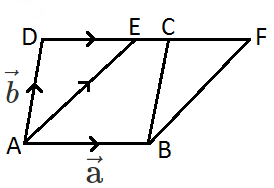
Let $\overrightarrow{\text{AB}}=\vec{\text{a}}$ and $\overrightarrow{\text{AD}}=\vec{\text{b}}$
$\therefore$ Area of parallelogram $\overrightarrow{\text{ABCD}}=\vec{\text{a}}\times\vec{\text{b}}$
Now, area of parallelogram of $\overrightarrow{\text{ABFE}}=\overrightarrow{\text{AB}}\times\overrightarrow{\text{AE}}$
$=\overrightarrow{\text{AB}}\times(\overrightarrow{\text{AD}}+\overrightarrow{\text{DE}})$
$=\overrightarrow{\text{AB}}\times(\vec{\text{b}}+\text{k}\vec{\text{a}})$ $[\text{let}\overrightarrow{\text{ DE}}=\text{k}\vec{\text{a}},\text{where k is a scalar}]$
$=\vec{\text{a}}\times(\vec{\text{b}}+\text{k}\vec{\text{a}})$
$=(\vec{\text{a}}\times\vec{\text{b}})+(\vec{\text{a}}\times\text{k}\vec{\text{a}})$
$=(\vec{\text{a}}\times\vec{\text{b}})+\text{k}(\vec{\text{a}}\times\vec{\text{a}})$
$=(\vec{\text{a}}\times\vec{\text{b}})\ [\because\vec{\text{a}}\times\vec{\text{a}}=0]$
Area of parallelogram ABCD.
Hence proved. View full question & answer→Question 1505 Marks
Show that each of the given three vectors is a unit vector:$\frac{1}{7}(2\hat{i}+3\hat{j}+6\hat{k}),\ \frac{1}{7}(3\hat{i}-6\hat{j}+2\hat{k}),\ \frac{1}{7}(6\hat{ i}+2\hat{j}-3\hat{k})$
Also, show that they are mutually perpendicular to each other.
Answer$\text{Let}\ \ \vec{a}=\frac{1}{7}\Big(2\hat{i}+3\hat{j}+6\hat{k}\Big)$ $=\frac{2} {7}\hat{i}+\frac{3}{7}\hat{j}+\frac{6}{7}\hat{k}\ \ \ \ \ .......\text{(i)}$$\vec{b}=\frac{1}{7}\Big(3\hat{i}-6\hat{j}+2\hat{k}\Big)$ $=\frac{3} {7}\hat{i}-\frac{6}{7}\hat{j}+\frac{2}{7}\hat{k}\ \ \ \ \ .......\text{(ii)}$
$\vec{c}=\frac{1}{7}\Big(6\hat{i}+2\hat{j}-3\hat{k}\Big)$ $=\frac{6} {7}\hat{i}+\frac{2}{7}\hat{j}-\frac{3}{7}\hat{k}\ \ .......\text{(iii)}$
$\Rightarrow\ \ \ \Big|\vec{a}\Big|=\sqrt{\Big(\frac{2}{7}\Big)^2+\Big(\frac{3}{7}\Big)^2+\Big(\frac{6}{7}\Big)^2}$ $=\sqrt{\frac{4}{49}+\frac{9}{49}+\frac{36}{49}}=\sqrt{\frac{49}{49}}=\sqrt{1}=1$$\Big|\vec{b}\Big|=\sqrt{\Big(\frac{3}{7}\Big)^2+\Big(\frac{-6}{7}\Big)^2+\Big(\frac{2}{7}\Big)^2}$ $=\sqrt{\frac{9}{49}+\frac{36}{49}+\frac{4}{49}}=\sqrt{\frac{49}{49}}=\sqrt{1}=1$
$\big|\vec{c}\big|=\sqrt{\Big(\frac{6}{7}\Big)^2+\Big(\frac{2}{7}\Big)^2+\Big(\frac{-3}{7}\Big)^2}$ $=\sqrt{\frac{36}{49}+\frac{4}{49}+\frac{9}{49}}=\sqrt{\frac{49}{49}}=\sqrt{1}=1$
$\therefore$ Each of the three given vectors $\vec{a},\vec{b},\vec{c}$ is a unit vector.From eq. (i) and (ii),
$\vec{a}.\vec{b}=\Big(\frac{2}{7}\Big).\Big(\frac{3}{7}\Big)+\Big(\frac{3}{7}\Big).\Big(\frac{-6}{7}\Big)+\Big(\frac{6}{7}\Big).\Big(\frac{2}{7}\Big)$ $\Big[\because\vec{a}.\vec{b}=a_1b_1+a_2b_2+a_3b_3\Big]$
$=\frac{6}{49}-\frac{18}{49}+\frac{12}{49}=\frac{6-18+12}{49}=\frac{0}{49}=0$
$\therefore\ \ \vec{a}\ \text{and}\ \vec{b}$ are perpendicular to each other. From eq. (ii) and eq. (iii),$\vec{b}.\vec{c}=\Big(\frac{3}{7}\Big).\Big(\frac{6}{7}\Big)+\Big(\frac{-6}{7}\Big).\Big(\frac{2}{7}\Big).\Big(\frac{2}{7}\Big).\Big(\frac{-3}{7}\Big)$$\Big[\because\vec{a}.\vec{b}=a_1b_1+a_2b_2+a_3b_3\Big]$
$=\frac{18}{49}-\frac{12}{49}-\frac{6}{49}=\frac{18-12-6}{49}=\frac{0}{49}=0 $
$\therefore\ \ \vec{a}\ \text{and}\ \vec{b}$ are perpendicular to each other. From eq. (i) and (iii),$\vec{a}.\vec{c}=\Big(\frac{2}{7}\Big).\Big(\frac{6}{7}\Big)+\Big(\frac{3}{7}\Big).\Big(\frac{2}{7}\Big)+\Big(\frac{6}{7}\Big).\Big(\frac{-3}{7}\Big)$ $\Big[\because\vec{a}.\vec{b}=a_1b_1+a_2b_2+a_3b_3\Big]$
$=\frac{12}{49}+\frac{6}{49}-\frac{18}{49}=\frac{12+6-18}{49}=\frac{0}{49}=0 $
$\therefore\ \ \vec{a}\ \text{and}\ \vec{b}$ are perpendicular to each other. Hence, $\vec{a},\vec{b},\vec{c}$ are mutually perpendicular vectors.
View full question & answer→