Questions · Page 4 of 4

5 Marks Questions

Question 1515 Marks
$\text{If}\ \vec{\text{a},}\ \vec{\text{b}},\ \vec{\text{c}}$ are mutually perpendicular vectors of equal magnitudes, show that the vector $\vec{\text{a}}+ \vec{\text{b}}+ \vec{\text{c}}$ is equally inclined to $\vec{\text{a},}\ \vec{\text{b}},\text{and}\ \vec{\text{c}}.$
Answer
Since $\vec{\text{a},}\ \vec{\text{b}},\text{and}\ \vec{\text{c}}$ are mutually perpendicular vectors, we have $\vec{\text{a}}\cdot\vec{\text{b}}=\vec{\text{b}}\cdot\vec{\text{c}}=\vec{\text{c}}\cdot\vec{\text{a}}=0.$ It is given that: $\big|\vec{\text{a}}\big|=\Big|\vec{\text{b}}\Big|=\big|\vec{\text{c}}\big|$ Let vector $\vec{\text{a}}+\vec{\text{b}}+\vec{\text{c}}$ be inclined to $\vec{\text{a}},\vec{\text{b}},\ \text{and}\ \vec{\text{c}}$ at angles $\theta_{1},\ \theta_{2},\ \text{and}\ \theta_{3}$ respectively. Then, we have: $\cos\theta_{1}=\frac{\big(\vec{\text{a}}+\vec{\text{b}}+\vec{\text{c}}\big)\cdot\vec{\text{a}}}{\big|\vec{\text{a}}+\vec{\text{b}}+\vec{\text{c}}\big|\big|\vec{\text{a}}\big|}=\frac{\vec{\text{a}}\cdot\vec{\text{a}}+\vec{\text{b}}\cdot\vec{\text{a}}+\vec{\text{c}}\cdot\vec{\text{a}}}{\big|\vec{\text{a}}+\vec{\text{b}}+\vec{\text{c}}\big|\big|\vec{\text{a}}\big|}$ $=\frac{\big|\vec{\text{a}}\big|^2}{\Big|\vec{\text{a}}+\vec{\text{b}}+\vec{\text{c}}\Big|\big|\vec{\text{a}}\big|}\ \ \Big[\vec{\text{b}}\cdot\vec{\text{a}}=\vec{\text{c}}\cdot\vec{\text{a}}=0\Big]$ $=\frac{\big|\vec{\text{a}}\big|}{\Big|\vec{\text{a}}+\vec{\text{b}}+\vec{\text{c}}\Big|}$ $\cos\theta_{2}=\frac{\Big(\vec{\text{a}}+\vec{\text{b}}+\vec{\text{c}}\Big)\cdot\vec{\text{b}}}{\Big|\vec{\text{a}}+\vec{\text{b}}+\vec{\text{c}}\Big|\Big|\vec{\text{b}}\Big|}=\frac{\vec{\text{a}}\cdot\vec{\text{b}}+\vec{\text{b}}\cdot\vec{\text{b}}+\vec{\text{c}}\cdot\vec{\text{b}}}{\Big|\vec{\text{a}}+\vec{\text{b}}+\vec{\text{c}}\Big|\cdot\Big|\vec{\text{b}}\Big|}$ $=\frac{\Big|\vec{\text{b}}\Big|^2}{\Big|\vec{\text{a}}+\vec{\text{b}}+\vec{\text{c}}\Big|\cdot\Big|\vec{\text{b}}\Big|}\ \ \Big[\vec{\text{a}}\cdot\vec{\text{b}}=\vec{\text{c}}\cdot\vec{\text{b}}=0\Big]$ $=\frac{\Big|\vec{\text{b}}\Big|}{\Big|\vec{\text{a}}+\vec{\text{b}}+\vec{\text{c}}\Big|}$ $ \cos\theta_{3}=\frac{\Big(\vec{\text{a}}+\vec{\text{b}}+\vec{\text{c}}\Big)\cdot\vec{\text{c}}}{\Big|\vec{\text{a}}+\vec{\text{b}}+\vec{\text{c}}\Big|\big|\vec{\text{c}}\big|}=\frac{\vec{\text{a}}\cdot\vec{\text{c}}+\vec{\text{b}}\cdot\vec{\text{c}}+\vec{\text{c}}\cdot\vec{\text{c}}}{\Big|\vec{\text{a}}+\vec{\text{b}}+\vec{\text{c}}\Big|\big|\vec{\text{c}}\big|}$$=\frac{\big|\vec{\text{c}}\big|^2}{\Big|\vec{\text{a}}+\vec{\text{b}}+\vec{\text{c}}\Big|\big|\vec{\text{c}}\big|}\ \ \Big[\vec{\text{a}}\cdot\vec{\text{c}}=\vec{\text{b}}\cdot\vec{\text{c}}=0\Big]$
$=\frac{\big|\vec{\text{c}}\big|}{\Big|\vec{\text{a}}+\vec{\text{b}}+\vec{\text{c}}\Big|}$
$\text{Now, as}|\vec{\text{a}}|=\Big|\vec{\text{b}}\Big|=|\vec{\text{c}}|,\ \cos\theta_1=\cos\theta_2=\cos\theta_3.$ $\therefore\ \theta_1=\theta_2=\ \theta_3$ Hence, the vector $\Big(\vec{\text{a}}+\vec{\text{b}}+\vec{\text{c}}\Big)$ is equally inclined to $\vec{\text{a}},\vec{\text{b}}\ \text{and}\ \vec{\text{c}}.$
View full question & answer
Question 1525 Marks
Express the vector $\vec{\text{a}}=5\hat{\text{i}}-2\hat{\text{j}}+5\hat{\text{k}}$ as the sum of two vectors such that one is parallel to the vector $\vec{\text{b}}=3\hat{\text{i}}+\hat{\text{k}}$ and other is perpendicular to $\vec{\text{b}}.$
Answer
Given that $\vec{\text{a}}=5\hat{\text{i}}-2\hat{\text{j}}+5\hat{\text{k}}$ and $\vec{\text{b}}=3\hat{\text{i}}+\hat{\text{k}}$
Let $\vec{\text{x}}$ and $\vec{\text{y}} $ be such that
$\vec{\text{a}} =\vec{\text{x}} +\vec{\text{y}} $
$\Rightarrow\vec{\text{y}} =\vec{\text{a}} -\vec{\text{x}} \dots(1)$
Since $\vec{\text{x}}$ is parallei to $\vec{\text{b}},$
$\Rightarrow\vec{\text{x}}=\text{t}\vec{\text{b}}$ (t is constant)
$\Rightarrow\vec{\text{x}}=\text{t}\big(3\hat{\text{i}}+\vec{\text{k}}\big)=3\text{t}\hat{\text{i}}+\text{t}\hat{\text{k}}$
Substituting the values of $\vec{\text{x}}$ and $\vec{\text{a}}$ in (1), we get 
$\vec{\text{y}}=5\hat{\text{i}}-2\hat{\text{j}}+5\hat{\text{k}}-\big(3\text{t}\hat{\text{i}}+\text{t}\hat{\text{k}}\big)=(5-3\text{t})\hat{\text{i}}-2\hat{\text{j}}+(5-\text{t})\hat{\text{k}}\dots(2)$
Since $\vec{\text{y}} $ is perpendicular to $\vec{\text{b}},$
$\vec{\text{y}}.\vec{\text{b}}=0$
$\Rightarrow\big[(5-3\text{t})\hat{\text{i}}-2\hat{\text{j}}+(5-\text{t})\hat{\text{k}}\big].\big(3\hat{\text{i}}+\hat{\text{k}}\big)=0$
$\Rightarrow3(5-3\text{t})+0+(5-\text{t})=0$
$\Rightarrow15-9\text{t}+5-\text{t}=0$
$\Rightarrow20-10\text{t}=0$
$\Rightarrow\text{t}=2$
From (1) and (2),we get
$\vec{\text{x}}=6\hat{\text{i}}+2\hat{\text{k}}$
$\vec{\text{y}}=-\hat{\text{i}}-2\hat{\text{j}}+3\hat{\text{k}}$
View full question & answer
Question 1535 Marks
Show that area of the parallelogram whose diagonals ate given by $\vec{\text{a}}$ and $\vec{\text{b}}$ is $\frac{|\vec{\text{a}}\times\vec{\text{b}}|}{2}.$ Also, find the area of the parallelogram, whose diagonals are $2\hat{\text{i}}-\hat{\text{j}}+\hat{\text{k}}$ and $\hat{\text{i}}+3\hat{\text{j}}-\hat{\text{k}}.$
Answer

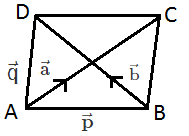
Let ABCD be a parallelogram swuch that
$\overrightarrow{\text{AB}}=\vec{\text{p}},\overrightarrow{\text{AD}}=\vec{\text{q}}\Rightarrow\overrightarrow{\text{BC}}=\vec{\text{q}}$
$\therefore\overrightarrow{\text{AC}}=\overrightarrow{\text{AB}}+\overrightarrow{\text{BC}}=\vec{\text{p}}+\vec{\text{q}}=\vec{\text{a}}\ ....(\text{i})$
And $\therefore\overrightarrow{\text{BD}}=\overrightarrow{\text{BA}}+\overrightarrow{\text{AD}}=-\vec{\text{p}}+\vec{\text{q}}=\vec{\text{b}}\ ....(\text{ii})$
Adding (i) and (ii), we get
$\vec{\text{a}}+\vec{\text{b}}=2\vec{\text{q}}$
Subbtracting (ii) from Eq. (i), we get
$\vec{\text{a}}-\vec{\text{b}}=2\vec{\text{p}}$
$\Rightarrow\vec{\text{p}}=\frac{1}{2}(\vec{\text{a}}-\vec{\text{b}})$
Now, $\vec{\text{p}}\times\vec{\text{q}}=\frac{1}{4}(\vec{\text{a}}-\vec{\text{b}})\times(\vec{\text{a}}+\vec{\text{b}})$
$=\frac{1}{4}(\vec{\text{a}}\times\vec{\text{a}}+\vec{\text{a}}\times\vec{\text{b}}-\vec{\text{b}}\times\vec{\text{a}}-\vec{\text{b}}\times\vec{\text{b}})$
$=\frac{1}{4}[\vec{\text{a}}\times\vec{\text{b}}+\vec{\text{a}}\times\vec{\text{b}}]$
$=\frac{1}{2}(\vec{\text{a}}\times\vec{\text{b}})$
So area of a parallelogram $\text{ABCD}=|\vec{\text{p}}\times\vec{\text{q}}|=\frac{1}{2}|\vec{\text{a}}\times\vec{\text{b}}|$
So, area of a parallelogram, whose diagonals are $2\hat{\text{i}}-\hat{\text{j}}+\hat{\text{k}}$ and $\hat{\text{i}}+3\hat{\text{j}}-\hat{\text{k}}$
 $=\frac{1}{2}|(2\hat{\text{i}}-\hat{\text{j}}+\hat{\text{k}})\times(\hat{\text{i}}+3\hat{\text{j}}-\hat{\text{k}})|$
$=\frac{1}{2}\begin{vmatrix}\hat{\text{i}}&\hat{\text{j}}&\hat{\text{k}} \\2&-1&1\\1&3&-1 \end{vmatrix}$
$=\frac{1}{2}|[\vec{\text{i}}(1-3)-\vec{\text{j}}(-2-1)+\vec{\text{k}}(6+1)]|$
$=\frac{1}{2}|-2\vec{\text{i}}+3\vec{\text{j}}+7\vec{\text{k}}|$
$=\frac{1}{2}\sqrt{4+9+49}$
$=\frac{1}{2}\sqrt{62}\text{ sq. units}$
View full question & answer
Question 1545 Marks
If $\vec{\text{a}}+\vec{\text{b}}+\vec{\text{c}}=0,$ then show that $\vec{\text{a}}\times\vec{\text{b}}=\vec{\text{b}}\times\vec{\text{c}}=\vec{\text{c}}\times\vec{\text{a}}.$ Interpret the result geometrically?
Answer
Since, $\vec{\text{a}}+\vec{\text{b}}+\vec{\text{c}}=0$
$\vec{\text{b}}=-\vec{\text{c}}-\vec{\text{a}}$
Now, $\vec{\text{a}}\times\vec{\text{b}}=\vec{\text{a}}\times(\vec{\text{c}}\times\vec{\text{a}})$
$=\vec{\text{a}}\times(-\vec{\text{c}})=\vec{\text{a}}\times(\vec{\text{c}}-\vec{\text{a}})=-\vec{\text{a}}\times\vec{\text{c}}$
$\Rightarrow\vec{\text{a}}\times\vec{\text{b}}=\vec{\text{c}}\times\vec{\text{a}}\ .....(\text{i})$
Also, $\vec{\text{b}}\times\vec{\text{c}}=(-\vec{\text{c}}-\vec{\text{a}})\times\vec{\text{c}}$
$=(-\vec{\text{c}}\times\vec{\text{c}})+(-\vec{\text{a}}\times\vec{\text{c}})=-\vec{\text{a}}\times\vec{\text{c}}$
$\Rightarrow\vec{\text{b}}\times\vec{\text{c}}=\vec{\text{c}}\times\vec{\text{a}}\ .....(\text{ii})$
From equations (i) and (ii), we have
$\vec{\text{a}}\times\vec{\text{b}}=\vec{\text{b}}\times\vec{\text{c}}=\vec{\text{c}}\times\vec{\text{a}}$
Geometrical interpretation of the result
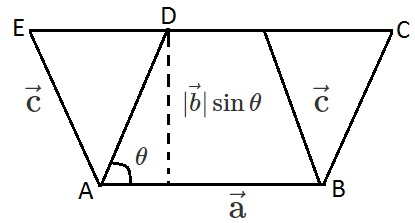
If ABCD is a parallelogram such that $\overrightarrow{\text{AB}}=\vec{\text{a}}$ and $\overrightarrow{\text{AD}}=\vec{\text{b}}$ and these adjacent sides are making angle $\theta$ between each orther, then
Area of parallelogram $\text{ABCD}=|\vec{\text{a}}||\vec{\text{b}}||\sin\theta|=|\vec{\text{a}}\times\vec{\text{b}}|$

Since, parallelograms on the same base and between the same parallels are equal in area, so we have,
$|\vec{\text{a}}\times\vec{\text{b}}|=|\vec{\text{b}}\times\vec{\text{c}}|=|\vec{\text{b}}\times\vec{\text{a}}|$
This also implies that $\vec{\text{a}}\times\vec{\text{b}}=\vec{\text{a}}\times\vec{\text{c}}=\vec{\text{b}}\times\vec{\text{c}}$
So, area of the parallelograms formed by making any two sides represented by $\vec{\text{a}},\vec{\text{b}}$ and $\vec{\text{c}}$ as adjacent sides are equal.
View full question & answer
Question 1555 Marks
Show that the line segments joining the mid-points of opposite sides of a quadrilateral bisects each other.
Answer
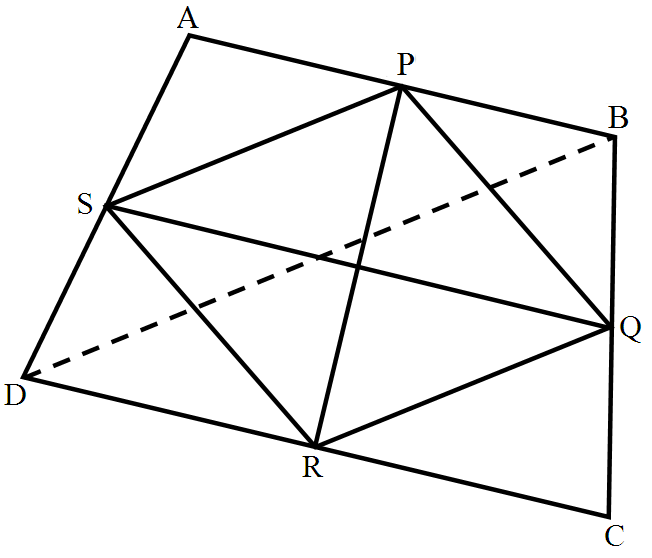
Let ABCD is the quadrilateral and P, Q, R, S are mid points of the sides AB, BC, CD, DA respectively.
Join DB to form triangle ABD. $\frac{\text{AS}}{\text{SD}}=\frac{\text{AP}}{\text{PB}}$ $\Rightarrow\text{SP}||\text{DB}\text{ and }\text{SP}=\frac{1}2\text{DB}$ In triangle BCD $\frac{\text{CR}}{\text{RD}}=\frac{\text{CQ}}{\text{QB}}$ $\Rightarrow\text{RQ}||\text{DB}\text{ and }\text{RQ}=\frac{1}2\text{DB}$ In quadrilateral PQRS, SP = RQ and SP || RQ $\therefore$ PQRS is a parallelogram. Diagonals of a parallelogram bisect each other. $\therefore$ PR and QS bisect each other.
View full question & answer
Question 1565 Marks
Show that the sum of three vectors determined by the medians of a triangle directed from the vertices is zero.
Answer
Let $\vec{\text{a}}, \vec{\text{b}}\text{ and }\vec{\text{c}}$ are the position vectors of the vertices A, B and C respectively.Then we know that the position vector of the centroid O of the triangle is $\frac{\vec{\text{a}}+\vec{\text{b}}+\vec{\text{c}}}{3}$.
Therefore sum of the three vectors $\overrightarrow{\text{OA}},\ \overrightarrow{\text{OB}}\text{ and }\overrightarrow{\text{OC}}$ is $\overrightarrow{\text{OA}}+\overrightarrow{\text{OB}}+\overrightarrow{\text{OC}}=\vec{\text{a}}-\bigg(\frac{\vec{\text{a}}+\vec{\text{b}}+\vec{\text{c}}}{3}\bigg)+\vec{\text{b}}-\bigg(\frac{\vec{\text{a}}+\vec{\text{b}}+\vec{\text{c}}}{3}\bigg)+\vec{\text{c}}-\bigg(\frac{\vec{\text{a}}+\vec{\text{b}}+\vec{\text{c}}}{3}\bigg)$ $=\big(\vec{\text{a}}+\vec{\text{b}}+\vec{\text{c}}\big)-3\Big(\frac{\vec{\text{a}}+\vec{\text{b}}+\vec{\text{c}}}3\Big)$$=\vec0$
Hence, Sum of the three vectors determined by the medians of a triangle directed from the vertices is zero.
View full question & answer
Question 1575 Marks
Using vectors, find the area of the triangle ABC with vertices A(1, 2, 3), B(2, –1, 4) and C(4, 5, –1).
Answer
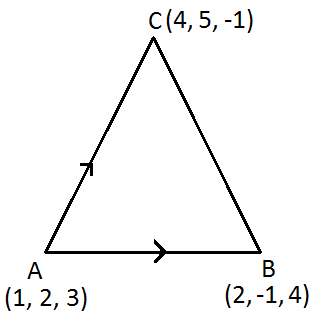
Here, $\overrightarrow{\text{AB}}=(2-1)\hat{\text{i}}+(-1-2)\hat{\text{j}}+(4-3)\hat{\text{k}}$
$=\hat{\text{i}}-3\hat{\text{j}}+\hat{\text{k}}$
and $\overrightarrow{\text{AC}}=(4-1)\hat{\text{i}}+(5-2)\hat{\text{j}}+(-1-3)\hat{\text{k}}$
$=3\hat{\text{i}}+3\hat{\text{j}}-4\hat{\text{k}}$

$\therefore\overrightarrow{\text{AB}}\times\overrightarrow{\text{AC}}=\begin{vmatrix}\hat{\text{i}}&\hat{\text{j}}&\hat{\text{k}} \\1&-3&1\\3&3&-4 \end{vmatrix}$
$=\hat{\text{i}}(12-3)-\hat{\text{j}}(-4-3)+\hat{\text{k}}(3+9)$
$=9\hat{\text{i}}+7\hat{\text{j}}+12\hat{\text{k}}$
and $|\overrightarrow{\text{AB}}\times\overrightarrow{\text{AC}}|=\sqrt{9^2+7^2+12^2}$
$=\sqrt{81+49+144}$
$=\sqrt{274}$
$\therefore\text{Area of }\triangle\text{ABC}=\frac{1}{2}|\overrightarrow{\text{AB}}\times\overrightarrow{\text{AC}}|$
$=\frac{1}{2}\sqrt{274}\text{ sq units}$
View full question & answer
Question 1585 Marks
Prove by vector method that the internal bisectors of the angles of a triangle are concurrent.
Answer

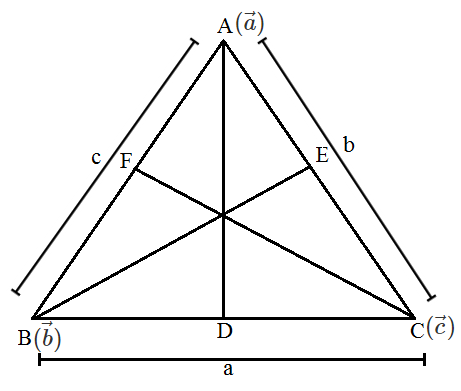
Let ABC be a triangle and $\vec\alpha,\ \vec\beta,\ \vec\gamma$ be the position vectors of the vertices A, B and C respectively. Let AD, BE and CF be the internal bisectors of $\angle\text{A},\angle\text{B}\text{ and } \angle\text{C}$ respectively.
We know that D divides BC in the ratio of AB : AC that is c : b.
Then,
P.V. of D is $\frac{\text{c}\vec\gamma+\text{b}\vec\beta}{\text{c}+\text{b}}$.
P.V. of E is $\frac{\text{c}\vec\gamma+\text{a}\vec\alpha}{\text{c}+\text{a}}$.
and P.V. of F is $\frac{\text{a}\vec\alpha+\text{b}\vec\beta}{\text{a}+\text{b}}$.
The point dividing AD in the ratio b + c : a is $\frac{\text{a}\vec\alpha+\text{b}\vec\beta+\text{c}\vec\gamma}{\text{a}+\text{b}+\text{c}}$.
The point dividing BE in the ratio of a + c : b is $\frac{\text{a}\vec\alpha+\text{b}\vec\beta+\text{c}\vec\gamma}{\text{a}+\text{b}+\text{c}}$.
The point dividing CF in the ratio of a + b : c is $\frac{\text{a}\vec\alpha+\text{b}\vec\beta+\text{c}\vec\gamma}{\text{a}+\text{b}+\text{c}}$.
Since the point $\frac{\text{a}\vec\alpha+\text{b}\vec\beta+\text{c}\vec\gamma}{\text{a}+\text{b}+\text{c}}$ lies on all the three internal bisectors AD, BE and CF.
Hence the internal bisectors are concurrent.
View full question & answer
Question 1595 Marks
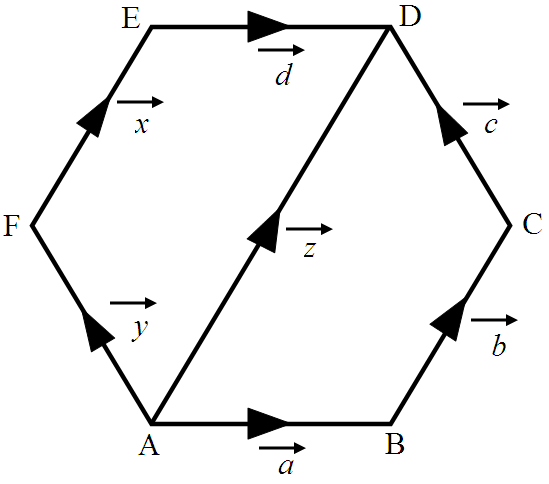
In Figure ABCD is a regular hexagon, which vectors are:
  1. Collinear.
  2. Equal.
  3. Co-initial.
  4. Collinear but not equal.
Answer
  1. Vectors having the same or parallel supports are called collinear vector. In the given figure the collinear vectors are,
$\vec{\text{a}},\ \vec{\text{d}};\ \vec{\text{x}},\ \vec{\text{z}},\ \vec{\text{b}};\ \vec{\text{c}},\ \vec{\text{y}}$
  1. vectors having the same magnitude and direction are called equal vector. In the given figure the equal vectors are,
$\vec{\text{b}},\ \vec{\text{x}};\ \vec{\text{c}},\ \vec{\text{y}};\ \vec{\text{a}},\ \vec{\text{d}}$
  1. Vectors having the same initial point are called co-initial vector. In the given figure the co-initial vectors are,
$\vec{\text{a}},\ \vec{\text{y}},\ \vec{\text{z}}$
  1. The vectors which are collinear but not equal are $\vec{\text{b}},\ \vec{\text{z}};\ \vec{\text{x}},\ \vec{\text{z}}$
View full question & answer
5 Marks Questions - Page 4 - MATHS STD 12 Science Questions - Vidyadip