Choose the correct answer from the given four options.
The vector in the direction of the vector $\hat{\text{i}}-2\hat{\text{j}}+2\hat{\text{k}}$ that has magnitude 9 is:
Solution:
Let $\vec{\text{a}}=\hat{\text{i}}-2\hat{\text{j}}+2\hat{\text{k}}$
Any vector in the direction of a vector is given by $\frac{\vec{\text{a}}}{|\vec{\text{a}}|}$
$=\frac{\hat{\text{i}}-2\hat{\text{j}}+2\hat{\text{k}}}{\sqrt{1^2+2^2+2^2}}=\frac{\hat{\text{i}}-2\hat{\text{j}}+2\hat{\text{k}}}{3}$
$\therefore$ Vector in the direction of with magnitude 9 is $9\cdot\frac{\vec{\text{a}}}{|\vec{\text{a}}|}=9\cdot\frac{\hat{\text{i}}-2\hat{\text{j}}+2\hat{\text{k}}}{3}$
$=3(\hat{\text{i}}-2\hat{\text{j}}+2\hat{\text{k}})$
If $\vec{\text{a}}$ and $\vec{\text{b}}$ are unit vectors inclined at an angle $\theta,$ then the value of $\big|\vec{\text{a}}-\vec{\text{b}}\big|$ is:
$2\sin\frac{\theta}{2}$
$2\sin\theta$
$2\cos\frac{\theta}{2}$
$2\cos\theta$
Answer
$2\sin\frac{\theta}{2}$
Solution:
$\vec{\text{a}}.\vec{\text{b}}=|\vec{\text{a}}|\big|\vec{\text{b}}\big|\cos\theta$
$=1\times1\cos\theta$ (Because $\vec{\text{a}}$ and $\vec{\text{b}}$ are unit vectors)
$=\cos\theta\dots(1)$
$\big|\vec{\text{a}}-\vec{\text{b}}\big|^2=|\vec{\text{a}}|^2+\big|\vec{\text{b}}\big|^2-2\vec{\text{a}}.\vec{\text{b}}$
$=1+1-2\cos\theta$ [using (1)]
$=2-2\cos\theta$
$=2(1-\cos)$
$=2\big(2\sin^2\frac{\theta}{2}\big)$
$=4\sin^2\frac{\theta}{2}$
$\therefore\big|\vec{\text{a}}-\vec{\text{b}}\big|=2\sin\frac{\theta}{2}$
If $|\vec{\text{a}}|=\big|\vec{\text{b}}\big|,$ then $\big(\vec{\text{a}}+\vec{\text{b}}\big).\big(\vec{\text{a}}-\vec{\text{b}}\big)=$
Positive
Negetive
0
None of these
Answer
0
Solution:
Given that
$|\vec{\text{a}}|=|\vec{\text{a}}|$
$\Rightarrow\big(\vec{\text{a}}+\vec{\text{b}}\big).\big(\vec{\text{a}}-\vec{\text{b}}\big)=|\vec{\text{a}}|^2-\big|\vec{\text{b}}\big|^2$
$|\vec{\text{a}}^2-|\vec{\text{a}}|^2$
$=0$
If $\vec{\text{a}}$ be the position vector whose tip is (5, -3) find the coordinates of a point B such that $\vec{\text{AB}}=\vec{\text{a}}$ the coordinates of A being (4, -1):
Let $\vec{\text{a}}=\text{a}_1\hat{\text{i}}+\text{a}_2\hat{\text{j}}+\text{a}_3\hat{\text{k}},\vec{\text{b}}=\text{b}_1\hat{\text{i}}+\text{b}_2\hat{\text{j}}+\text{b}_3\hat{\text{k}}$ and $\vec{\text{c}}=\text{c}_1\hat{\text{i}}+\text{c}_2\hat{\text{j}}+\text{c}_3\hat{\text{k}}$ be three zero vectors such that $\vec{\text{c}}$ is a unit vector perpendicular to both $\vec{\text{a}}$ and $\vec{\text{b}}.$ If the angle between $\vec{\text{a}}$ and $\vec{\text{b}}$ is $\frac{\pi}{6},$ then $\begin{vmatrix}\text{a}_1&\text{a}_2&\text{a}_3\\\text{b}_1&\text{b}_2&\text{b}_3\\\text{c}_1&\text{c}_2&\text{c}_3 \end{vmatrix}^2$ is equal to:
Solution:
We have
$\begin{vmatrix}\text{a}_1&\text{a}_2&\text{a}_3\\\text{b}_1&\text{b}_2&\text{b}_3\\\text{c}_1&\text{c}_2&\text{c}_3 \end{vmatrix}^2$
$=\big[\big(\vec{\text{a}}\times\vec{\text{b}}\big).\vec{\text{c}}\big]^2$ (By definition of scalar triple product)
$=\big[\big|\big(\vec{\text{a}}\times\vec{\text{b}}\big)\big|\big|\vec{\text{c}}\big|\cos0^\circ\big]^2$ $\big(\therefore\vec{\text{a}}\times\vec{\text{b}}$ is parallel to vector $\vec{\text{c}}$ as $\vec{\text{c}}$ is perpendicular to both $\vec{\text{a}}$ and $\vec{\text{b}}\big)$
$=\big(\big|\vec{\text{a}}\big|\big|\vec{\text{b}}\big|\sin\frac{\pi}{6}\big)^2$ $\big(\therefore\big|\vec{\text{c}}\big|=1$ and angle between $\vec{\text{a}}$ and $\vec{\text{b}}$ is $\frac{\pi}{6}\big)$
$=\big|\vec{\text{a}}\big|^2\big|\vec{\text{b}}\big|^2\big(\frac{1}{2}\big)^2$
$=\frac{1}{4}\big|\vec{\text{a}}\big|^2\big|\vec{\text{b}}\big|^2$
Choose the correct answer from the given four options.If $\vec{\text{a}},\vec{\text{b}},\vec{\text{c}}$ are three vectors such that $\vec{\text{a}}+\vec{\text{b}}+\vec{\text{c}}=\vec{0}$ and $|\vec{\text{a}}|=2,|\vec{\text{b}}|=3$ and $|\vec{\text{c}}|=5,$ then the value of $\vec{\text{a}}\cdot\vec{\text{b}}+\vec{\text{b}}\cdot\vec{\text{c}}+\vec{\text{c}}\cdot\vec{\text{a}}$ is:
If $ \overrightarrow {\text{ a }}$ is vector of magnitude x, m is non-zero scalar and $\text{m}\overrightarrow { \text{a} }$ is a unit vector then x in terms of m is:
$\text{m}=\text{x}$
$\text{x}=\mid{\text{m}}\mid$
$\text{x}=\frac{1}{\mid\text{m}\mid}$
$\text{x}=\frac{\text{m}}{2}$
Answer
$\text{x}=\frac{1}{\mid\text{m}\mid}$
Solution:
Given, $\mid\text{m}\vec{\text{a}}\mid=1$
$\Rightarrow\mid\text{m}\mid\mid\vec{\text{a}}\mid=1$
$\Rightarrow\mid\text{m}\mid\text{x}=1$
$\Rightarrow\text{x}=\frac{1}{\mid\text{m}\mid}$
Remember, modulus can never be negative.
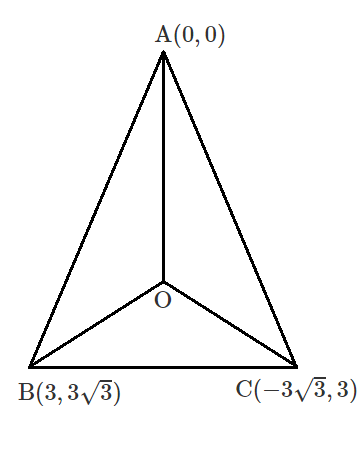
If in a $\triangle\text{ABC}$, $\text{A}=(0,0),\ \text{B}=(3,3\sqrt3),\ \text{C}=(-3\sqrt3,3)$, then the vecctor of magnitude $2\sqrt2$ units directed along AO, where O is the circumcenter of $\triangle\text{ABC}$ is,
Solution: $\Big|\overrightarrow{\text{AO}}\Big|=2\sqrt2$ $\Big|\overrightarrow{\text{AO}}\Big|=\Big|\overrightarrow{\text{BO}}\Big|=\Big|\overrightarrow{\text{CO}}\Big|=2\sqrt2=\text{R}$
Let the position vector of O be $\text{x}\hat{\text{i}}+\text{y}\hat{\text{j}}$
$\Big|\overrightarrow{\text{AO}}\Big|=\sqrt{\text{x}^2+\text{y}^2}$
$\therefore\ \text{x}^2+\text{y}^2=8\ \dots(1)$
Also, $\Big|\overrightarrow{\text{BO}}\Big|=\Big|\overrightarrow{\text{CO}}\Big|$
$\sqrt{(\text{x}-3)^2+(\text{y}-3\sqrt3)^2}\\=\sqrt{(\text{x}+3\sqrt3)^2+(\text{y}-3)^2}$
$\text{x}^2-6\text{x}+9+\text{y}^2-6\sqrt3\text{y}+27\\=\text{x}^2+6\sqrt3\text{x}+27+\text{y}^2-6\text{y}+9$
$\text{y}(6-6\sqrt3)=\text{x}(6\sqrt3+6)$
$\text{y}=\frac{\text{x}(1+\sqrt3)}{(1-\sqrt3)}\ \dots(2)$
Substituting y from (2) in (1) we get,
$(1-\sqrt3)^2\text{x}^2+(1+\sqrt3)^2\text{x}^2=8(1-\sqrt3)^2$
$\text{x}^2\times8=8(1-\sqrt3)^2$
$\text{x}=1-\sqrt3$
$\text{y}=1+\sqrt3$
$\therefore$ The position vector of O is $(1-\sqrt3)\hat{\text{i}}+(1+\sqrt3)\hat{\text{j}}$
$\overrightarrow{\text{AO}}=(1-\sqrt3)\hat{\text{i}}+(1+\sqrt3)\hat{\text{j}}$
If the angle between the vectors $\text{x}\hat{\text{i}}+3\hat{\text{j}}-7\hat{\text{k}}$ and $\text{x}\hat{\text{i}}-\text{x}\hat{\text{j}}+4\hat{\text{k}}$ is acute, then x lies in the interval:
(-4, 7)
[-4, 7]
R - [-4, 7]
R - (4, 7)
Answer
R - [-4, 7]
Solution:
Let $\theta$ be the angle between $\vec{\text{a}}$ and $\vec{\text{b}}.$
$\cos\theta=\frac{\vec{\text{a}}.\vec{\text{b}}}{|\vec{\text{a}}|\big|\vec{\text{b}}\big|}=\frac{\text{x}^2-3\text{x}-28}{\sqrt{\text{x}^2+3^2+49}\sqrt{\text{x}^2+\text{x}^2+4^2}}$
For $\theta$ to be acute,
$\cos\theta>0$
$\Rightarrow\text{x}^2-3\text{x}-28>0$
$\Rightarrow(\text{x}-7)(\text{x}+4)>0$
$\Rightarrow\text{x}\in(-\infty,-4)\cup(7,\infty)$
$\Rightarrow\text{x}\in\text{R}-[-4,7]$
Solution:
The orthogonal projection of $\vec{\text{a}}$ on $\vec{\text{b}}$ is
$\frac{\big(\vec{\text{a}}.\vec{\text{b}}\big)\vec{\text{b}}}{\big|\vec{\text{b}}\big|^2}$
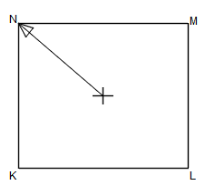
Namita walks 14 metres towards west, then turns to her right and walks 14 metres and then turns to her left and walks 10 metres.Again turning to her left she walks 14 metres.What is the shortest distance (in metres) between her starting point and the present position?
Four persons P, Q, R and S are initially at the four corners of a square side d. Each person now moves with a constant speed v in such a way that P always moves directly towards Q, Q towards R, R towards S, and S towards P. The four persons will meet after time.
$\frac{\text{d}}{2\text{v}}$
$\frac{\text{d}}{\text{v}}$
$\frac{\text{3d}}{2\text{v}}$
They will never meet
Answer
$\frac{\text{d}}{\text{v}}$
Solution:
Here, velocity components will be vcos $45=\frac{\text{v}}{\sqrt{2}}$
And, displacement will be $\frac{\text{d}}{\sqrt{2}}$
So time taken will be
$\text{t}=\frac{\text{d}}{\text{v}}$
$=\frac{\frac{\text{d}}{\sqrt{2}}}{\frac{\text{v}}{\sqrt{2}}}=\frac{\text{d}}{\text{v}}$
If the vectors $4\hat{\text{i}}+11\hat{\text{j}}+\text{m}\hat{\text{k}},7\hat{\text{i}}+2\hat{\text{j}}+6\hat{\text{k}}$ and $\hat{\text{i}}+5\hat{\text{j}}+4\hat{\text{k}}$ are coplanar, then $m =$
A
$0$
B
$38$
C
$-10$
✓
$10$
Answer
Correct option: D.
$10$
Let
$\vec{\text{a}}=4\hat{\text{i}}+11\hat{\text{j}}+{\text{m}}\hat{\text{k}}$
$\vec{\text{b}}=7\hat{\text{i}}+2\hat{\text{j}}+6\hat{\text{k}}$
$\vec{\text{c}}=\hat{\text{i}}+5\hat{\text{j}}+4\hat{\text{k}}$
We know that vectors $\vec{\text{a}},\vec{\text{b}}$ and $\vec{\text{c}}$ are coplanar if their scalar triple product is zero, i.e. $\big[\vec{\text{a}}\vec{\text{ b }}\vec{\text{c}}\big]=0$
$\Rightarrow\begin{vmatrix}4&11&\text{m}\\7&2&6\\1&5&4 \end{vmatrix}=0$
$\Rightarrow 4(8-30)-11(28-6)+\text{m}(35-2)=0$
$\Rightarrow-88-242+33\text{m}=0$
$\Rightarrow33\text{m}=330$
$\therefore\text{m}=10$
If $\vec{\text{x}}$ is a vector in the direction of (2, -2, 1) of magnitude 6 and $\vec{\text{y}}$ is a vector in the direction of (1, 1, -1) of magnitude $\sqrt{3}$ then $\mid\vec{\text{x}}+2\vec{\text{y}}\mid=$
$40$
$\sqrt{35}$
$\sqrt{17}$
$2\sqrt{10}$
Answer
$2\sqrt{10}$
Solution:
They given x directionwe need to find unit vector in that direction and multiply with the magnitude of x they given y directionwe need to find unit vector in that direction and multiply with the magnitude of $\vec{\text{x}}\text{y}$
$\frac{{6}\Big(2\hat{\text{i}}-2\hat{\text{j}}+\hat{\text{k}}\Big)}{3},\vec{\text{y}}=\frac{{\sqrt{3}}\Big(\hat{\text{i}}+\hat{\text{j}}-\hat{\text{k}}\Big)}{\sqrt{3}},$
so $\mid\vec{\text{x}}+2\vec{\text{y}}\mid=\mid6\hat{\text{i}}-2\hat{\text{j}}\mid=\sqrt{40}=2\sqrt{10}$
The vectors $\vec{\text{a}}$ and $\vec{\text{b}}$ satisfy the equation $2\vec{\text{a}}+\vec{\text{b}}=\vec{\text{p}}$ and $\vec{\text{a}}+2\vec{\text{b}}=\vec{\text{q}},$ where $\vec{\text{p}}=\hat{\text{i}}+\hat{\text{j}}$ and $\vec{\text{q}}=\hat{\text{i}}-\hat{\text{j}}.$ If $\theta$ is the angle between $\vec{\text{a}}$ and $\vec{\text{b}},$ then:
$\cos \theta = \frac{4}{5}$
$\sin \theta = \frac{1}{\sqrt{2}}$
$\cos \theta = -\frac{4}{5}$
$\cos \theta = -\frac{3}{5}$
Answer
$\cos \theta = -\frac{4}{5}$
Solution:
Given that
$2\vec{\text{a}}+\vec{\text{b}}=\vec{\text{p}}\dots(1)$
$\vec{\text{a}}+2\vec{\text{b}}=\vec{\text{q}}\dots(2)$
Solving these two we get
$\vec{\text{a}}=\frac{2\vec{\text{p}}-\vec{\text{q}}}{3},\vec{\text{b}}=\frac{2\vec{\text{q}}-\vec{\text{p}}}{3}$
And we have
$\vec{\text{p}}=\hat{\text{i}}+\hat{\text{j}}$ and $\vec{\text{q}}=\hat{\text{i}}-\hat{\text{j}}$
Substituting the values of $\vec{\text{p}}$ and $\vec{\text{q}},$ we get
$\vec{\text{a}}=\frac{2\vec{\text{p}}-\vec{\text{q}}}{3}=\frac{2\big(\hat{\text{i}}+\hat{\text{j}}\big)-\big(\hat{\text{i}}-\hat{\text{j}}\big)}{3}=\frac{\hat{\text{i}}+3\hat{\text{j}}}{3}$
$\Rightarrow|\vec{\text{a}}|=\frac{1}{3}\sqrt{1+9}=\frac{\sqrt{10}}{3}$
$\vec{\text{b}}=\frac{2\vec{\text{q}}-\vec{\text{p}}}{3}=\frac{2\big(\hat{\text{i}}-\hat{\text{j}}\big)-\big(\hat{\text{i}}+\hat{\text{j}}\big)}{3}=\frac{\hat{\text{i}}-3\hat{\text{j}}}{3}$
$\Rightarrow\big|\vec{\text{b}}\big|=\frac{1}{3}\sqrt{1+9}=\frac{\sqrt{10}}{3}$
$\vec{\text{a}}.\vec{\text{b}}=\frac{1}{9}(1-9)=\frac{-8}{9}$
We know that
$\vec{\text{a}}.\vec{\text{b}}=|\vec{\text{a}}|\big|\vec{\text{b}}\big|\cos\theta$
$\Rightarrow\frac{-8}{9}=\frac{\sqrt{10}}{3}\times\frac{\sqrt{10}}{3}\cos\theta$
$\Rightarrow\frac{-8}{9}=\frac{10}{9}\cos\theta$
$\Rightarrow\cos\theta=\frac{-8}{9}\times\frac{9}{10}=\frac{-4}{5}$
Solution:
$\big(\vec{\text{a}}.\vec{\text{b}}\big)^2+\big|\vec{\text{a}}\times\vec{\text{b}}\big|^2$
$=\big(|\vec{\text{a}}|\big|\vec{\text{b}}\big|\cos\theta\big)^2+\big(|\vec{\text{a}}|\big|\vec{\text{b}}\big|\sin\theta\big)^2$
$=|\vec{\text{a}}|^2\big|\vec{\text{b}}\big|^2(\cos^2\theta+\sin^2\theta)$
$=|\vec{\text{a}}|^2\big|\vec{\text{b}}\big|^2$ (1)
$=|\vec{\text{a}}|^2\big|\vec{\text{b}}\big|^2$
$\therefore\big|\vec{\text{a}}\times\vec{\text{b}}\big|^2=|\vec{\text{a}}|^2\big|\vec{\text{b}}\big|^2-\big(\vec{\text{a}}.\vec{\text{b}}\big)^2$
Thus, the value of $\big(\vec{\text{a}}\times\vec{\text{b}}\big)^2$ is $|\vec{\text{a}}|^2\big|\vec{\text{b}}\big|^2-\big(\vec{\text{a}}.\vec{\text{b}}\big)^2.$
Solution:
We know that the diagonals in a rhombus $\vec{\text{a}}$ and $\vec{\text{b}}$ are perpendicular.
Therefore, their dot product is zero.
$\Rightarrow\vec{\text{a}}.\vec{\text{b}}=0$
Solution:
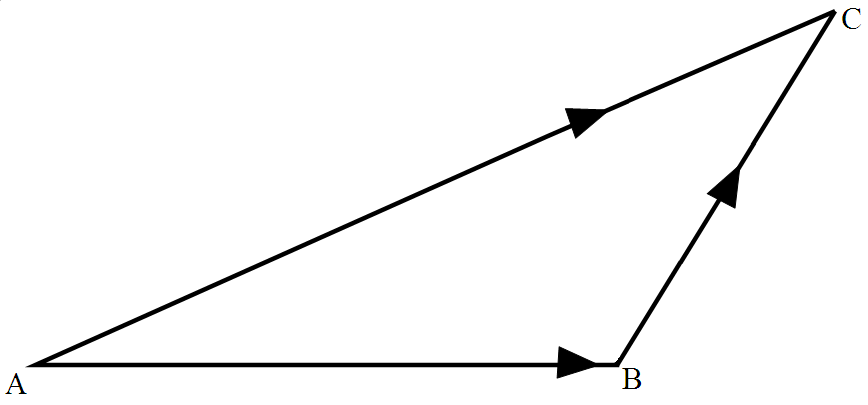
We have, LHS = $\overrightarrow{\text{AB}}+\overrightarrow{\text{BC}}-\overrightarrow{\text{AC}}=\overrightarrow{\text{AC}}-\overrightarrow{\text{CA}}$ $\Big[\because\overrightarrow{\text{AB}}+\overrightarrow{\text{BC}}=\overrightarrow{\text{AC}}\Big]$
$=-\overrightarrow{\text{CA}}-\overrightarrow{\text{CA}}$
$=-2\overrightarrow{\text{CA}}$
So, $\text{LHS}\neq\text{RHS}$
Hence, It is not true.
If $\vec{\text{a}},\ \vec{\text{b}}$ are the vectors forming consecutive sides of a regular hexagon ABCDEF, then the vector representing side CD is,
$\vec{\text{a}}+\vec{\text{b}}$
$\vec{\text{a}}-\vec{\text{b}}$
$\vec{\text{b}}-\vec{\text{a}}$
$-\big(\vec{\text{a}}+\vec{\text{b}}\big)$
Answer
$\vec{\text{b}}-\vec{\text{a}}$
Solution:
Let ABCDEF be a regular hexagon such that $\overrightarrow{\text{AB}}=\vec{\text{a}}$ and $\overrightarrow{\text{BC}}=\vec{\text{b}}$. We know, AD is parallel to BC such that AD = 2BC.
$\therefore\ \overrightarrow{\text{AD}}=2\overrightarrow{\text{BC}}=2\vec{\text{b}}$
In $\triangle{\text{ABC}}$, we have
$\overrightarrow{\text{AB}}+\overrightarrow{\text{BC}}=\overrightarrow{\text{AC}}$
$\Rightarrow\ \vec{\text{a}}+\vec{\text{b}}=\overrightarrow{\text{AC}}$
In $\triangle{\text{ACD}}$, we have
$\overrightarrow{\text{AC}}+\overrightarrow{\text{CD}}=\overrightarrow{\text{AD}}$
$\Rightarrow\overrightarrow{\text{CD}}=\overrightarrow{\text{AD}}-\overrightarrow{\text{AC}}$
$\Rightarrow\overrightarrow{\text{CD}}=2\vec{\text{b}}-\big(\vec{\text{a}}+\vec{\text{b}}\big)$
$\Rightarrow\overrightarrow{\text{CD}}=\vec{\text{b}}-\vec{\text{a}}$
A person travels 12km in the southward direction and then travels 5km to the right and then travels 15km toward the right and finally travels 5km towards the east, how far is he from his starting place?
The vector equation of the plane passing through $\vec{\text{a}},\ \vec{\text{b}},\ \vec{\text{c}},$ is $\vec{\text{r}}=\alpha\vec{\text{a}}+\beta\vec{\text{b}}+\gamma\vec{\text{c}}$, provided that,
$\alpha+\beta+\gamma=0$
$\alpha+\beta+\gamma=1$
$\alpha+\beta=\gamma$
$\alpha^2+\beta^2+\gamma^2=1$
Answer
$\alpha+\beta+\gamma=1$
Solution:
Given: A plane passing through $\vec{\text{a}},\ \vec{\text{b}},\ \vec{\text{c}}$.
⇒ Lines $\vec{\text{a}}-\vec{\text{b}}$ and $\vec{\text{c}}-\vec{\text{a}}$ lie on the plane.
The parmetric equation of the plane can be written as:
$\vec{\text{r}}=\vec{\text{a}}+\lambda_1\big(\vec{\text{a}}-\vec{\text{b}}\big)+\lambda_2\big(\vec{\text{c}}-\vec{\text{a}}\big)$
$\vec{\text{r}}=\vec{\text{a}}(1+\lambda_1+\lambda_2)-\lambda_1\vec{\text{b}}+\lambda_2\vec{\text{c}}$
Given that $\vec{\text{r}}=\alpha\vec{\text{a}}+\beta\vec{\text{b}}+\gamma\vec{\text{c}}$
$\therefore\alpha+\beta+\gamma=1+\lambda_1-\lambda_2-\lambda_1+\lambda_2$
$\alpha+\beta+\gamma=1$
Choose the correct answer from the given four options.
The vectors from origin to the points A and B are $\vec{\text{a}}=2\hat{\text{i}}-3\hat{\text{j}}+2\hat{\text{k}}$ and $\vec{\text{b}}=2\hat{\text{i}}+3\hat{\text{j}}+\hat{\text{k}},$ respectively, then the area of the triangle OAB is:
$340$
$\sqrt{25}$
$\sqrt{229}$
$\frac{1}{2}\sqrt{229}$
Answer
$\frac{1}{2}\sqrt{229}$
Solution:
$\therefore$ Area of $\triangle\text{OAB}=\frac{1}{2}|\overrightarrow{\text{OA}}\times\overrightarrow{\text{OB}}|$
$=\frac{1}{2}|(2\hat{\text{i}}-3\hat{\text{j}}+2\hat{\text{k}})\times(2\hat{\text{i}}+3\hat{\text{j}}+\hat{\text{k}})|$
$=\frac{1}{2}\begin{vmatrix}\hat{\text{i}}&\hat{\text{j}}&\hat{\text{k}} \\2&-3&2\\2&3&1 \end{vmatrix}$
$=\frac{1}{2}|[\hat{\text{i}}(-3-6)-\hat{\text{j}}(2-4)+\hat{\text{k}}(6+6)]|$
$=\frac{1}{2}|-9\hat{\text{i}}+2\hat{\text{j}}+12\hat{\text{k}}|$
$\therefore$ Area of $\triangle\text{OAB}=\frac{1}{2}\sqrt{81+4+144}$
$=\frac{1}{2}\sqrt{229}$
Solution:
Given points are (2, 5, 0) and (–3, 7, 4).
Thus, the required vector $=(-3-2)\hat{\text{i}}+(7-5)\hat{\text{j}}+(4-0)\hat{\text{k}}$
$=-5\hat{\text{i}}+2\hat{\text{j}}+4\hat{\text{k}}$
What is the length of the longer diagonal of the parallelogram constructed on $5\vec{\text{a}}+2\vec{\text{b}}$ and $\vec{\text{a}}-3\vec{\text{b}}$ if it is given that $|\vec{\text{a}}|=2\sqrt{2},\big|\vec{\text{b}}\big|=3$ and the angle between $\vec{\text{a}}$ and $\vec{\text{b}}$ is $\frac{\pi}{4}$?
$15$
$\sqrt{113}$
$\sqrt{593}$
$\sqrt{369}$
Answer
$\sqrt{593}$
Solution:
Let ABCD be a parallelogram in which
side $\overrightarrow{\text{AB}}=\overrightarrow{\text{DC}}=5\vec{\text{a}}+2\vec{\text{b}}$
and $\overrightarrow{\text{AD}}=\overrightarrow{\text{BC}}=\vec{\text{a}}-3\vec{\text{b}}$
and diagonals are AC and BD.
Now, $\overrightarrow{\text{AC}}=\overrightarrow{\text{AB}}+\overrightarrow{\text{BC}}$
$=\big(5\vec{\text{a}}+2\vec{\text{b}\big)}+\big(\vec{\text{a}}-3\vec{\text{b}}\big)$
$=6\vec{\text{a}}-\vec{\text{b}}$
$\therefore\big|\overrightarrow{\text{AC}}\big|=\big|6\vec{\text{a}}-\vec{\text{b}\big|}$
$=\sqrt{|6\vec{\text{a}}|^2+\big|\vec{\text{b}}\big|^2-2\times|6\vec{\text{a}}|\times\big|\vec{\text{b}}\big|\cos\theta}$
$=\sqrt{36|\vec{\text{a}}|^2+\big|\vec{\text{b}}\big|^2-12\times|\vec{\text{a}}|\times\big|\vec{\text{b}}\big|\cos\frac{\pi}{4}}$
$=\sqrt{36|2\sqrt{2}|^2+|3|^2-12\times|2\sqrt{2}|\times|3|\times\frac{1}{\sqrt{2}}}$
$=\sqrt{288+9-72}$
$=\sqrt{225}=15\text{ units}$
$\overrightarrow{\text{BD}}=\overrightarrow{\text{BA}}+\overrightarrow{\text{BD}}$
$=-\overrightarrow{\text{AB}}+\overrightarrow{\text{BD}}$
$=-\big(5\vec{\text{a}}+2\vec{\text{b}}\big)+\big(\vec{\text{a}}-3\vec{\text{b}}\big)$
$=-4\vec{\text{a}}-5\vec{\text{b}}$
$\therefore|\overrightarrow{\text{BD}}|=\big|-4\vec{\text{a}}-5\vec{\text{b}}\big|$
$=\big|4\vec{\text{a}}+5\vec{\text{b}}\big|$
$=\sqrt{|4\vec{\text{a}}|^2+|5\vec{\text{b}}|^2+2|4\vec{\text{a}}|\times|5\vec{\text{b}|}\cos\theta}$
$=\sqrt{16|\vec{\text{a}}|^2+25\big|\vec{\text{b}}\big|^2+40\times|\vec{\text{a}}|\times\big|\vec{\text{b}}\big|\cos\frac{\pi}{4}}$
$=\sqrt{16|2\sqrt{2}|^2+25|3|^2+40\times|2\sqrt{2}|\times|3|\times\frac{1}{\sqrt{2}}}$
$=\sqrt{128+25+240}$
$=\sqrt{593}\text{ units}$
Therefore, the larger diagonal $=\sqrt{593}$
If $\vec{\text{a}},\vec{\text{b}},\vec{\text{c}}$ are any three mutualy perpendicular vectors of equal magnitude a, then $\big|\vec{\text{a}}+\vec{\text{b}}+\vec{\text{c}}\big|$ is equal to
$\text{a}$
$\sqrt{2}\text{a}$
$\sqrt{3}\text{a}$
$2\text{a}$
$\text{None of these}$
Answer
$\sqrt{3}\text{a}$
Solution:
Given that
So, $|\vec{\text{a}}|=\big|\vec{\text{b}}\big|=|\vec{\text{c}}|=\text{a}\dots(1)$
Since they are mutually perpendicular,
$\vec{\text{a}}.\vec{\text{b}}=\vec{\text{b}}.\vec{\text{c}}=\vec{\text{c}}.\vec{\text{a}}=0\dots(2)$
Now,
$\big|\vec{\text{a}}+\vec{\text{b}}+\vec{\text{c}}\big|^2=|\vec{\text{a}}|^2+\big|\vec{\text{b}}\big|^2+|\vec{\text{c}}|^2+2\vec{\text{a}}.\vec{\text{b}}+2\vec{\text{b}}.\vec{\text{c}}+2\vec{\text{c}}.\vec{\text{a}}$
$=\text{a}^2+\text{a}^2+\text{a}^2+0+0+0$ [using (1) and (2)]
$=3\text{a}^2$
$\therefore\big|\vec{\text{a}}+\vec{\text{b}}+\vec{\text{c}}\big|=\sqrt{3}\text{a}$
If $\vec{\text{r}}.\vec{\text{a}}=\vec{\text{r}}.\vec{\text{b}}=\vec{\text{r}}.\vec{\text{c}}=0$ for some non-zero vector $\vec{\text{r}},$ then the value of $\big[\vec{\text{a}}\vec{\text{ b }}\vec{\text{c}}\big],$ is:
2
3
0
None of these
Answer
0
Solution:
If $\vec{\text{r}}.\vec{\text{a}}=0$ for some non-zero vector $\vec{\text{r}},$ then either $\vec{\text{a}}$ is a zero - vector or it is perpendicular to $\vec{\text{r}}.$
If one of $\vec{\text{a}},\vec{\text{b}},\vec{\text{c}}$ is zero, then $\big[\vec{\text{a}}\vec{\text{b}}\vec{\text{c}}\big]=0$
If all $\vec{\text{a}},\vec{\text{b}}$ and $\vec{\text{c}}$ are non - zero, then they must be coplanar as they are perpendicular to vector $\vec{\text{r}}.$
$\therefore\big[\vec{\text{a}}\vec{\text{b}}\vec{\text{c}}\big]=0$
If OACB is a parallelogram with $\overrightarrow{\text{OC}}=\vec{\text{a}}$ and $\overrightarrow{\text{AB}}=\vec{\text{b}}$, then $\overrightarrow{\text{OA}}=$
What is direction of vector $\vec{\text{a}}$ if it is multiplied with $-\lambda$:
Downwards
Upwards
Same
Opposite
Answer
Opposite
Solution:
If the vector is multiplied with $-\lambda$ then its direction become opposite as the direction in which it was previous may be positive or negative. After it is multiplied with a negative value then its direction becomes exactly opposite to the previous direction.
Choose the correct answer:$\text{Let}\ \vec{\text{a}}\ \text{and}\ \vec{\text{b}}$ be two unit vectors and $\theta$ is the angle between them. Then $\vec{\text{a}}+\vec{\text{b}}$ is a unit vector if,
$\theta=\frac{\pi}{4}$
$\theta=\frac{\pi}{3}$
$\theta=\frac{\pi}{2}$
$\theta=\frac{2\pi}{3}$
Answer
$\text{Let}\ \vec{\text{a}}\ \text{and}\ \vec{\text{b}}$ be two unit vectors and $\theta$ be the angle between them.
$\text{Then},\ \big|\vec{\text{a}}\big|=\Big|\vec{\text{b}}\Big|=1.$
$\text{Now},\ \vec{\text{a}}+\vec{\text{b}}$ is a unit vector if $\Big|\vec{\text{a}}+\vec{\text{b}}\Big|=1.$
$\Big|\vec{\text{a}}+\vec{\text{b}}\Big|=1$
$\Rightarrow\Big(\vec{\text{a}}+\vec{\text{b}}\Big)^2=1$
$\Rightarrow\Big(\vec{\text{a}}+\vec{\text{b}}\Big)\cdot\Big(\vec{\text{a}}+\vec{\text{b}}\Big)=1$
$\Rightarrow\vec{\text{a}}.\vec{\text{a}}+\vec{\text{a}}.\vec{\text{b}}+\vec{\text{b}}.\vec{\text{a}}+\vec{\text{b}}.\vec{\text{b}}=1$
$\Rightarrow\Big|\vec{\text{a}}\Big|^2+2\vec{\text{a}}.\vec{\text{b}}+\Big|\vec{\text{b}}\Big|^2=1$
$\Rightarrow1^2+2\Big|\vec{\text{a}}\Big|\Big|\vec{\text{b}}\Big|\cos\theta+1^2=1$
$\Rightarrow1+2.1.1\cos\theta+1=1$
$\Rightarrow\cos\theta=-\frac{1}{2}$
$\Rightarrow\theta=-\frac{2\pi}{3}$
Hence, $\vec{\text{a}}+\vec{\text{b}}$ is a unit vector if $\theta=\frac{2\pi}{3}.$
The correct answer is D.
If $\overline{\text{a}},\overline{\text{b}},\overline{\text{c}}$ are unit vectors such that $\overline{\text{a}}+\overline{\text{b}}+\overline{\text{c}}+\overline{\text{c.a}}=$
The value of $\hat{\text{i}}.\big(\hat{\text{j}}\times\hat{\text{k}}\big)+\hat{\text{j}}.\big(\hat{\text{i}}\times\hat{\text{k}}\big)+\hat{\text{k}}.\big(\hat{\text{i}}\times\hat{\text{j}}\big),$ is:
Area of a rectangle having vertices A, B, C and D with position vectors $-\hat{i}+\frac{1}{2}\hat{j}+4\hat{k},\ \hat{i}+\frac{1}{2}\hat{j}+4\hat{k},$ $\hat{i}-\frac{1}{2}\hat{j}+4\hat{k}\ \text{and} \ -\hat{i}-\frac{1}{2}\hat{j}+4\hat{k},$
$\frac{1}{2}$
1
2
4
Answer
$\text{Given:}\ \text{ABCD is a rectangle}$ $ \text{Now} \ \ \overrightarrow{\text{AB}}\ $ = Position vector of point B - Position vector of point A$=\hat{i}+\frac{1}{2}\hat{j}+4\hat{k}-\bigg(-\hat{i}+\frac{1}{2}\hat{j}+4\hat{k}\bigg)$ $=\hat{i}+\frac{1}{2}\hat{j}+4\hat{k}+\hat{i}-\frac{1}{2}\hat{j}-4\hat{k}$
$=2\hat{i}+0\hat{j}+0\hat{k}$
$\therefore \ \text{AB}=\bigg|{\overrightarrow{\text{AB}}\bigg|}\ \ =\sqrt{4+0+0}=\sqrt{4}=2$ $\text{And}\ \ \overrightarrow{\text{AD}}$ = Position vector of point D - Position vector of point A $=-\hat{i}-\frac{1}{2}\hat{j}+4\hat{k}-\bigg(-\hat{i}+\frac{1}{2}\hat{j}+4\hat{k}\bigg)$ $=-\hat{i}-\frac{1}{2}\hat{j}+4\hat{k}+\hat{i}-\frac{1}{2}\hat{j}-4\hat{k}$
$=0\hat{i}-\hat{j}+0\hat{k}$
$\therefore\ \text{AD}=\bigg|\overrightarrow{\text{AD}}\bigg|=\sqrt{0+1+0}=\sqrt{1}=1$ $\therefore\ $ Area of rectangle ABCD = Length x Breadth = AB × AD = 2 × 1 = 2 eq. units Therefore, option (C) is correct.
Solution:
If $\vec{\text{a}}$ lies in the plane of vectors $\vec{\text{b}}$ and $\vec{\text{c}},$ then $\vec{\text{a}},\vec{\text{b}},\vec{\text{c}}$ will lie in the same plane, i.e. they will be coplanar.
$\therefore \big[\vec{\text{a}}\vec{\text{b}}\vec{\text{c}}\big]=0$
Four forces act on a point object. The object will be in equilibrium, if:
All of them are in the same plane
They are opposite to each other in pairs
The sum of x, y and z-components of forces zero separately
They form a closed figure of 4 sides when added as Polygon law
Answer
They form a closed figure of 4 sides when added as Polygon law
Solution:
The equilibrium condition is obtained when the net force acting on the body is zero.
and a closed polygon of 4 sides will give the resultant force as zero and forcing acting will be in the same plane.
The unit vector perpendicular to the plane passing through points $\text{P}\big(\hat{\text{i}}-\hat{\text{j}}+2\hat{\text{k}}\big),\text{Q}\big(2\hat{\text{i}}-\hat{\text{k}}\big)$ and $\text{R}\big(2\hat{\text{j}}+\hat{\text{k}}\big)$ is:
Solution:
The vector $\overrightarrow{\text{PQ}}\times\overrightarrow{\text{PR}}$ is perpendicular to the vectors $\overrightarrow{\text{PQ}}$ and $\overrightarrow{\text{PR}}.$
$\therefore$ Required unit vector $=\frac{\overrightarrow{\text{PQ}}\times\overrightarrow{\text{PR}}}{\big|\overrightarrow{\text{PQ}}\times\overrightarrow{\text{PR}}\big|}$
Now,
$\overrightarrow{\text{PQ}}=\text{P.V}\text{ of }\text{Q}-\text{P.V}.\text{ of P}$
$=\hat{\text{i}}+\hat{\text{j}}-3\hat{\text{k}}$
$\overrightarrow{\text{PR}}=\text{P.V}\text{ of }\text{R}-\text{P.V}.\text{ of P}$
$=-\hat{\text{i}}+3\hat{\text{j}}-\hat{\text{k}}$
$\therefore\overrightarrow{\text{PQ}}\times\overrightarrow{\text{PR}}=\begin{vmatrix}\hat{\text{i}}&\hat{\text{j}}&\hat{\text{k}}\\1&1&-3\\-1&3&-1 \end{vmatrix}$
$=8\hat{\text{i}}+4\hat{\text{j}}+4\hat{\text{k}}$
$=4\big(2\hat{\text{i}}+\hat{\text{j}}+\hat{\text{k}}\big)$
$\Rightarrow\big|\overrightarrow{\text{PQ}}\times\overrightarrow{\text{PR}}\big|=\sqrt{64+16+16}$
$=\sqrt{96}$
$=4\sqrt{6}$
Required unit vector $=\frac{\overrightarrow{\text{PQ}}\times\overrightarrow{\text{PR}}}{\big|\overrightarrow{\text{PQ}}\times\overrightarrow{\text{PR}}\big|}$
$=\frac{4\big(2\hat{\text{i}}+\hat{\text{j}}+\hat{\text{k}}\big)}{4\sqrt{6}}$
$=\frac{1}{\sqrt{6}}\big(2\hat{\text{i}}+\hat{\text{j}}+\hat{\text{k}}\big)$
Choose the correct answer
If $\theta$ is the angle between two vectors $\vec{\text{a}}\ \text{and}\ \vec{\text{b}},\ \text{then}\ \vec{\text{a}}\cdot\vec{\text{b}}\geq0$ only when,
$0<\theta<\frac{\pi}{2}$
$0\leq\theta\leq\frac{\pi}{2}$
$0<\theta<\pi$
$0\leq\theta\leq\pi$
Answer
Let $\theta$ be the angle between two vectors $\vec{\text{a}}\ \text{and}\ \vec{\text{b}}.$Then, without loss of generality, $\vec{\text{a}}\ \text{and}\ \vec{\text{b}}$ are non-zero vectors so that $|\vec{\text{a}}|\ \text{and}\ \Big|\vec{\text{b}}\Big|$ are positive
It is known that $\vec{\text{a}}\cdot\vec{\text{b}}=|\vec{\text{a}}| \Big|\vec{\text{b}}\Big|\cos\theta.$
$\therefore\vec{\text{a}}\cdot\vec{\text{b}}\geq0$
$\Rightarrow|\vec{\text{a}}| \Big|\vec{\text{b}}\Big|\cos\theta\geq0$
$\Rightarrow\cos\theta\geq0\ \ \ \Big[\big|\vec{\text{a}}\big|\ \text{and}\ \Big|\vec{\text{b}}\Big|\ \text{are positive}\Big]$
$\Rightarrow0\leq\theta\leq\frac{\pi}{2}$
Hence, $\vec{\text{a}}.\vec{\text{b}}\geq0\ \text{when}\ 0\leq\theta\leq\frac{\pi}{2}.$
The correct answer is B.