MCQ 1011 Mark
The peak voltage in a $220V\ AC$ source is:
- A
$220V.$
- B
About $160V.$
- ✓
About $310V.$
- D
$440V.$
AnswerCorrect option: C. About $310V.$
$\text{V}_\text{rms}=220\text{V}$
$\text{V}_\text{p}=\sqrt{2}\times\text{V}_\text{rms}$
$=220\times1.414=311\text{volt}$
View full question & answer→MCQ 1021 Mark
An amplitude modulated $(AM)$ radio operates at $550\ kHz$ to $1650\ kHz$. If $L$ is fixed and $C$ is varied for tuning then minimum and maximum value of $C$ is.
- A
$C, 3C$
- B
$C, 6C$
- ✓
$C, 9C$
- D
$C, 12C$
AnswerCorrect option: C. $C, 9C$
$\frac{\text{f}_\text{max}}{\text{f}_\text{max}}=3$
$\therefore\frac{\sqrt{\text{LC}_\text{max}}}{\sqrt{\text{LC}_\text{min}}}=3$
$\frac{\text{C}_\text{max}}{\text{C}_\text{min}}=9$
${\text{C}_\text{min}}=\text{C}$
$\therefore{\text{C}_\text{max}}=\text{9C}$
View full question & answer→MCQ 1031 Mark
When the frequency of the source voltage decreases, the impedance of a parallel $RC$ circuit.
AnswerWhen the frequency of the source voltage decreases, the impedance of a parallel $RC$ circuit will increase.
View full question & answer→MCQ 1041 Mark
The angular frequency of an $AC$ source is $\frac{10\text{radian}}{\text{sec}}$ The reactance of $1\mu\text{F}$ capacitor will be.
- A
$10^4\Omega$
- B
$10^2\Omega$
- C
$10^1\Omega$
- ✓
$10^5\Omega$
AnswerCorrect option: D. $10^5\Omega$
$\text{Reactance}=\frac{1}{\text{C}\omega}\Omega$
$=\frac{1}{10^{-6}\times10}=\frac{1}{10^{-5}}$
$=10^5\Omega$
View full question & answer→MCQ 1051 Mark
In an $A.C.$ circuit the potential difference across an inductance and resistance joined in series are respectively $16V$ and $20V.$ The total potential difference across the circuit is.
- A
$20.0V$
- ✓
$25.6V$
- C
$31.9V$
- D
$53.5V$
AnswerCorrect option: B. $25.6V$
Potential difference across the circuit
$\text{V}=\sqrt{\text{V}^2_\text{R}+\text{V}^2_\text{L}}=\sqrt{20^2+16^2}=\sqrt{656}=25.6\text{V}$
View full question & answer→MCQ 1061 Mark
AnswerCorrect option: B. In $AC$ circuits only.
Transformers are used in $AC$ circuits only.
View full question & answer→MCQ 1071 Mark
In a series $\text{RLC}$ circuit that is operating above the resonant frequency, the current.
- ✓
- B
leads the applied voltage
- C
is in phase with the applied voltage
- D
AnswerCapacitive reactance is given by. $\text{X}_\text{C}=\frac{1}{\text{wC}}$
Inductive reactance is given by $\text{X}_\text{L}={\text{wL}}$
At resonance, $\text{X}_\text{L}={\text{X}_\text{C}}\Rightarrow \text{w}\text{L}=\frac{1}{\text{wC}}$
But a frequency higher than resonance frequency, $X_L>X_C$
So the circuit behaves as a inductive circuit at a frequency higher that resonant frequency and the current lags behind the voltage in an inductive circuit.
View full question & answer→MCQ 1081 Mark
The natural frequency of an $LC -$ circuit is $1,25,000$ cycles per second. Then the capacitor $C$ is replaced by another capacitor with a dielectric medium of dielectric constant $k$. In this case, the frequency decreases by $25kHz$. The value of $k$ is:
- A
$3.0$
- B
$2.1$
- ✓
$1.56$
- D
$1.7$
AnswerCorrect option: C. $1.56$
View full question & answer→MCQ 1091 Mark
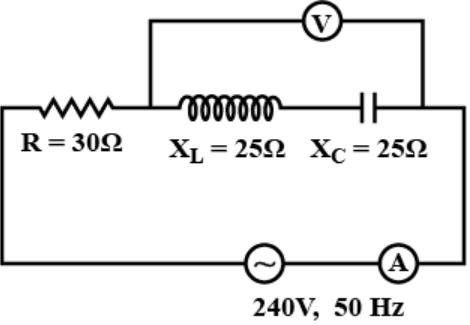
In the circuit shown in the figure, $($neglecting source resistance$)$ the voltmeter and ammeter readings will respectively be.
- ✓
$0 V, 8 A$
- B
$150 V, 8 A$
- C
$150 V, 3 A$
- D
$0 V, 3 A$
AnswerCorrect option: A. $0 V, 8 A$
Voltmeter reading is zero since voltage in both Capacitor and inductor is same in magnitude but opposite in sign because current in series is same and both have same reactance.
So, $\text{i}=\frac{\text{V}}{\text{R}}$
$=\frac{240}{30}$
$=8\text{A}$
View full question & answer→MCQ 1101 Mark
In a pure capacitive $A.C$ circuit current and voltage differ in phase by.
- A
$0^\circ $
- B
$45^\circ$
- ✓
$90^\circ$
- D
$180^\circ$
AnswerCorrect option: C. $90^\circ$
$\text{i}=\text{i}_\text{o}\sin(\omega\text{t}+\frac{\pi}{2})$
current leads voltage by $\frac{\pi}{2}$ i.e., current and voltage differ in phase by $90^\circ $
View full question & answer→MCQ 1111 Mark
Voltage across each elements of a series $\text{LCR}$ circuit are given by $V_L=60 V, VC =20 V, V _{ R }=30 V$ Find out source voltage.
- ✓
$50V$
- B
$100V$
- C
$150V$
- D
$200V$
Answer$\text{V}=\sqrt{\text{V}_\text{R}^2+(\text{V}_\text{L}-\text{V}_\text{C})^2}=\sqrt{30^2+(60-20)^2}=50\text{V}$
View full question & answer→MCQ 1121 Mark
The power loss is less in transmission lines, when:
- A
Voltage is less but current is more
- B
Both voltage and current are more
- ✓
Voltage is more but current is less
- D
Both voltage and current are less
AnswerCorrect option: C. Voltage is more but current is less
The power cables have some resistance.
Power lost in the wires can be calculated as $P=I^2 R$ with $R$ as the resistance of the wires and $I$ as the current that passes through them.
Power at the load is $P = VI$.
From this one can see that if voltage is increased by say $n$ times, then only $\frac{1}{n}$ the current is required to deliver the same power. However, if $\frac{1}{ n }$ current is passed
on the same wires, only $\frac{1}{ n ^2}$ of the power will be lost.
View full question & answer→MCQ 1131 Mark
In the given circuit what is the potential drop across resistance?
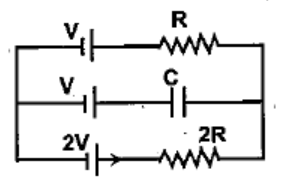
AnswerCorrect option: C. $120 V$
At resonance the voltage across $L$ and $C$ are same but opposite.
So, at resonance $\mid\text{V}_\text{L}\mid=\mid\text{V}_\text{C}\mid$
$\therefore\text{V}_\text{R}=\text{V}_\text{app}=120\text{V}$
View full question & answer→MCQ 1141 Mark
The reactance of a circuit is zero. It is possible that the circuit contains:
- ✓
An inductor and a capacitor.
- B
An inductor but no capacitor.
- C
A capacitor but no inductor.
- D
Neither an inductor nor a capacitor.
AnswerCorrect option: A. An inductor and a capacitor.
$\text{X}=0 ($Given$)$
$\text{X}=\text{X}_\text{L}+\text{X}_\text{C}$
$=\omega\text{L}-\frac{1}{\omega\text{C}}=0$
It is possible that the circuit contains an inductor and a capacitor.
View full question & answer→MCQ 1151 Mark
An inductor, a resistance and a capacitor are joined in series with an $AC$ source. As the frequency of the source is slightly increased from a very low value, the reactance:
- ✓
Of the inductor increases.
- B
Of the resistor increases.
- C
Of the capacitor increases.
- D
Of the circuit increases.
AnswerCorrect option: A. Of the inductor increases.
$\text{X}_\text{L}=\omega\text{L}$
$\text{X}_\text{C}=\frac{1}{\omega\text{C}}$
If frequency increases that causes '$X_L$' raction of inductor increases and $'X_C'$ reactance of capacitor decreses.
View full question & answer→MCQ 1161 Mark
An inductance of $0.2 H$ and a resistance of $100\Omega$ are connected in series to an $A.C. 180 V, 50 Hz$ supply. The apparent current flowing in the circuit will be.
- A
$0.525 A$
- B
$5.25 A$
- ✓
$1.525 A$
- D
$15.25 A$
AnswerCorrect option: C. $1.525 A$
View full question & answer→MCQ 1171 Mark
In a series $\text{LCR}$ circuit the voltage across resistance, capacitance and inductance is $10V$ each. If the capacitance is short circuited, the voltage across the inductance will be.
AnswerCorrect option: B. $\big(\frac{10}{\sqrt{2\text{V}}}\big)$
View full question & answer→MCQ 1181 Mark
A capacitor is connected to an $A.C.$ circuit, then the phase difference between current and the voltage is:
- A
$\pi$
- ✓
$\frac{\pi}{2}$
- C
$\frac{-\pi}{2}$
- D
$\text{Zero}$
AnswerCorrect option: B. $\frac{\pi}{2}$
Current leads voltage by $\frac{\pi}{2}$
$\therefore$ phase difference is $=\frac{\pi}{2}$
View full question & answer→MCQ 1191 Mark
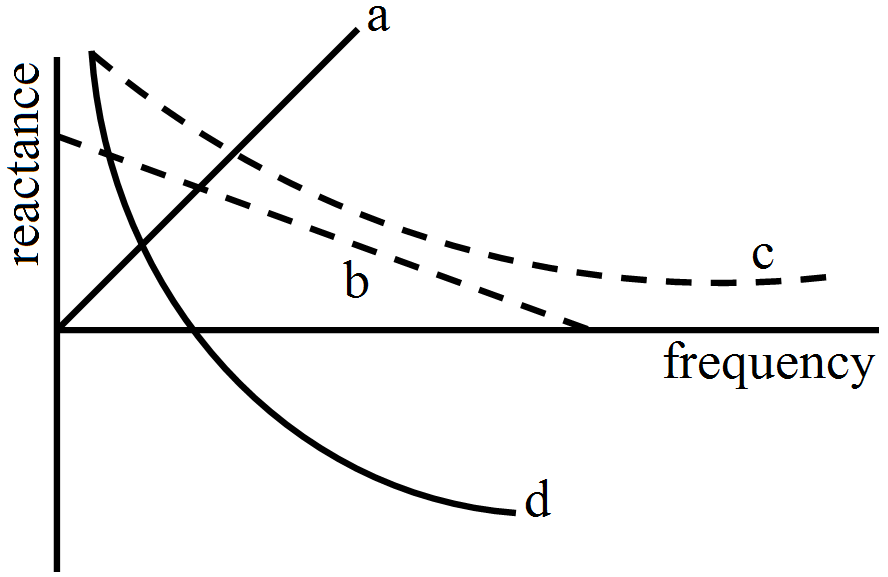
Which of the following plots may represent the reactance of a series $LC$ combination?
Answer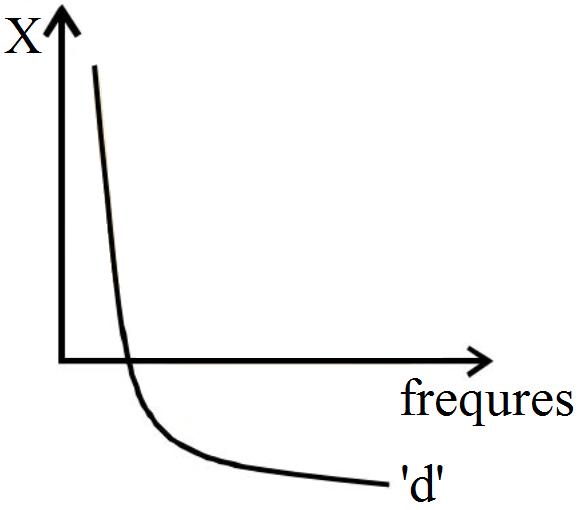
$\text{X}=\text{X}_\text{L}-\text{X}_\text{C}$
$=\omega\text{L}-\frac{1}{\omega\text{C}}$
$=2\pi\text{fL}-\frac{1}{2\pi\text{fC}}$ View full question & answer→MCQ 1201 Mark
A light bulb is rated at $100W$ for a $220V$ supply. Find the peak voltage of the source:
- A
$111V$
- B
$211V$
- ✓
$311V$
- D
$411V$
AnswerCorrect option: C. $311V$
The rated voltage in bulb is rms voltage.
$\text{V}_\text{rms}=\frac{\text{V}_0}{\sqrt{2}}$
$\text{V}_0=\sqrt{2}\times220=311.08\text{V}$
View full question & answer→MCQ 1211 Mark
An alternating current having peak value $14A$ is used to heat a metal wire. To produce the same heating effect, a constant current i can be used where i is:
- A
$14A$
- B
About $20A.$
- C
$7A.$
- ✓
About $10A.$
AnswerCorrect option: D. About $10A.$
$\text{I}_\text{p}=14\text{Amp}$
$\text{I}_\text{rms}=\frac{\text{IP}}{\sqrt{2}}=\frac{14}{\sqrt{2}}$
$=9.9=10\text{Amp}.$
View full question & answer→MCQ 1221 Mark
Of the following about capacitive reactance which is correct?
AnswerCorrect option: B. Capacitive reactance is inversely proportional to the frequency of the current
Capacitative reactance is an opposition to the change of voltage across an element.
It is denoted by $XC$ and is inversely proportional to the signal frequency $(f)$ and the capacitance $C$
$\text{X}_\text{c}=\frac{1}{2\pi\text{fc}}$
View full question & answer→MCQ 1231 Mark
A current source sends a current $\text{I}-\text{i}_0\cos(\omega\text{t}).$ when connected across an unknown load, it gives a voltage output of $\text{v}=\text{v}_0\sin[\omega\text{t}+(\frac{\pi}{4})]$across that load. then the voltage across the current source may be brought in phase with the current through it by.
- ✓
Connecting an inductor in series with the load
- B
Connecting a capacitor in series with the load
- C
Connecting an inductor in parallel with the load
- D
Connecting a capacitor in parallel with the load
AnswerCorrect option: A. Connecting an inductor in series with the load
View full question & answer→MCQ 1241 Mark
In an $\text{LCR}$ circuit inductance is changed from $L$ to $\frac{\text{L}}{2}.$ To keep the same resonance frequency, $C$ should be changed to.
- ✓
$2\text{C}$
- B
$\frac{\text{C}}{2}$
- C
$4\text{C}$
- D
$\frac{\text{C}}{4}$
AnswerCorrect option: A. $2\text{C}$
Resonance frequency, $(\text{f})=\frac{1}{2\pi\sqrt{\text{LC}}}$
For f to be constant the product $LC$ must be constant.
So, if we half the value of inductance then the value of capacitance must be doubled.
$C$ should be changed to $2C.$
View full question & answer→MCQ 1251 Mark
The inductance of a resistanceless coil is $0.5$ henry. In the coil, the value of alternating current is $0.2$ A, whose frequency is $50 Hz$. The reactance of circuit is.
- A
$15.7\Omega$
- ✓
$157\Omega$
- C
$1.57\Omega$
- D
$757\Omega$
AnswerCorrect option: B. $157\Omega$
$\text{Reactance }=\omega\text{L}$
$=2\pi\text{fL}$
$=2\pi\times50\times0.5$
$157\Omega$
View full question & answer→MCQ 1261 Mark
Reciprocal of Impedance is:
AnswerImpedance is the opposition a circuit presents to a current when a voltage is applied.
Admittance is a measure of how easily a circuit or device will allow a current to flow.
Admittance is defined as $\text{Y}=\frac{1}{\text{Z}}$
where $Z$ is the impedance of the circuit.
View full question & answer→MCQ 1271 Mark
In a $\text{L - C - R}$ circuit, as the frequency of an alternating current increases the impedance of the circuit.
AnswerImpedance first decreases then increases. At resonance frequency $Z$ is minimum.
View full question & answer→MCQ 1281 Mark
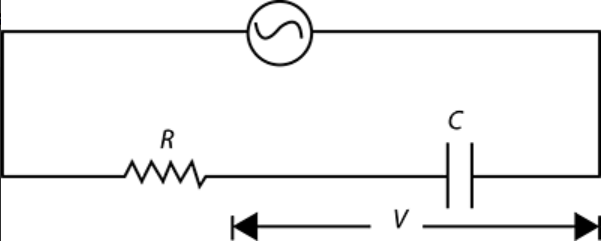
A resistance $R$ and a capacitor $C$ are joined to a source of $AC$ of constant e.m.f and variable frequency. The potential difference across $C$ is $V$. If the frequency of $AC$ is gradually increased, $V$ will
- A
- ✓
- C
- D
first increase and then decrease
AnswerIn complex plane $\text{V}=\frac{\text{V}_\text{AC}}{1+\text{jRC}\omega}$
Therefore as $\omega($frequency$)$ increases, $V$ decreases.
View full question & answer→MCQ 1291 Mark
An alternating current generator has an internal resistance $R_g$ and an internal reactance $X_g$. It is used to supply power to a passive load consisting of a resistance $R _{ g }$ and a reactance $X _{ L }$. For maximum power to be delivered from the generator to the load, the value of $X_L$ is equal to:
AnswerCorrect option: C. $-X_g$
For maximum power to be delivered from the generator $($or internal reactance $X_g )$ to the load $($of reactance, $X_{\text {}} ),$ $\Rightarrow X_L+X_g=0 ($the total reactance must vanish$)$
$\Rightarrow X_L=-X_g$
View full question & answer→MCQ 1301 Mark
In an $A.C.$ circuit, the current flowing in inductance is $\text{I}=5\sin\Big(\frac{100-\text{t}-\pi}{2}\Big)$ ampers and the potential difference is $\text{V}=200\sin(100\text{t})$ volts. The power consumption is equal to.
- A
$1000$ watt
- B
$40$ watt
- C
$20$ watt
- ✓
AnswerPower, $\text{P}=\text{I}_\text{rms}\times\text{V}_\text{rms}\times\cos\phi$
In the given problem, the phase difference between voltage and current is $\frac{\text{P}}{2}$ Hence
$\text{P}=\text{I}_\text{rms}\times\text{V}_\text{rms}\times\cos\big(\frac{\pi}{2}\big)=0$
View full question & answer→MCQ 1311 Mark
- A
The direction of current is always positive
- B
The direction of current is always negative
- ✓
The direction of current changes constantly
- D
The direction of current is either positive or negative
AnswerCorrect option: C. The direction of current changes constantly
Electric charge in alternating current $(AC)$ changes direction periodically. The voltage in $AC$ circuits also periodically reverses because the current changes direction.
View full question & answer→MCQ 1321 Mark
In series $L - C - R$ circuit voltage drop across resistance is $8V$, across inductor is $6V$ and across capacitor is $12V$. Then.
Answer$\text{V}=\sqrt{\text{V}_\text{R}^2+(\text{V}_\text{C}-\text{V}_\text{L})^2}=10\text{V}$
$V_C > V_L$, hence current leads the voltage.
Power factor $=\cos\phi=\frac{8}{10}=0.8$
View full question & answer→MCQ 1331 Mark
In series $\text{L - C - R}$ resonant circuit, to increase the resonant frequency:
- A
$L$ will have to be increased
- B
$C$ will have to be increased
- ✓
$LC$ will have to be decreased
- D
$LC$ will have to be increased
AnswerCorrect option: C. $LC$ will have to be decreased
$\text{Resonant frequency}=\frac{1}{\sqrt{\text{LC}}}$
$\text{LC}\downarrow\text{if }\omega_\text{r}\uparrow$
View full question & answer→MCQ 1341 Mark
A capacitor acts as an infinite resistance for:
- ✓
$DC.$
- B
$AC.$
- C
$DC$ as well as $AC.$
- D
Neither $AC$ nor $DC.$
Answer$\text{X}_\text{C}\frac{1}{\omega\text{C}}=\frac{1}{0\times\text{C}}$ $\bigg\{\text{in}\stackrel{{\text{DC}}}{{\omega = 0 }}\bigg\}$
$=\infty$
View full question & answer→MCQ 1351 Mark
A series $\text{LCR}$ circuit is tuned to resonance. If the angular frequency of the applied $AC$ voltage at resonance is $\omega$ the impedance of the circuit then is:
- A
$\text{R}+\omega\text{L}+(\frac{1}{\omega\text{C}})$
- ✓
$\text{R}$
- C
$\sqrt{\text{R}^2+\omega\text{L}+(\frac{1}{\omega\text{C}})^2}$
- D
$\sqrt{\text{R}^2+(\omega\text{L}-\frac{1}{\omega\text{C}})^2}$
AnswerCorrect option: B. $\text{R}$
At resonance $\frac{1}{\omega\text{C}}=\omega\text{L}$
$\therefore$ impedance $= R$
View full question & answer→MCQ 1361 Mark
A capacitor has capacitance $0.5nF.$ A choke of $5\mu\text{H}$ is connected in series. An electromagnetic wave of wavelength $\lambda$ is found to resonate with it. Find $\lambda ($in meter$).$
- A
$10\pi$
- B
$20\pi$
- ✓
$30\pi$
- D
$5\pi$
AnswerCorrect option: C. $30\pi$
View full question & answer→MCQ 1371 Mark
If the inductance and capacitance are both doubled in $\text{L - C - R}$ circuit, the resonant frequency of the circuit will:
AnswerCorrect option: A. Decrease to one$-$half of the original value
Resonant frequency in series $\text{LCR}$ circuit: $\omega=\sqrt{\frac{1}{\text{LC}}}$
Resonant frequency in series $\text{LCR}$ circuit, $\omega=\sqrt{\frac{1}{\text{LC}}}=\sqrt{\frac{1}{\text{2L}\times\text{2C}}}=\frac{\omega}{2}$
View full question & answer→MCQ 1381 Mark
In a purely inductive circuit, the current:
AnswerCorrect option: D. lags behind the voltage by $\frac{\pi}{2}$
In a purely inductive circuit $($an $AC$ circuit containing inductance only$)$ the current lags behind the voltage by $\frac{\pi}{2}$
View full question & answer→MCQ 1391 Mark
The power loss in an $AC$ circuit is $E _{ rms } I _{ rms }$, when in the circuit there is only.
- A
$C$
- B
$L$
- ✓
$R$
- D
$L, C$, and $R$
AnswerInductors and capacitors bring a phase difference between the voltage and current in the circuit, hence changing the $p.f.$ When only a resistance is present, Poer factor $= 1.$
The power loss in an $AC$ circuit $= E _{ rms } I _{ rms }$ Power factor.
View full question & answer→MCQ 1401 Mark
A series $R-C$ circuit is connected to an alternating voltage source. Consider two situation:
$(a)$ When capacitor is filled
$(b)$ When capacitor is mica filled
Current through resister is i and voltage across capacitor is $V$ then:
- A
$V_a=V_b$
- B
$V_a < V_b$
- ✓
$V_a > V_b$
- D
$i_a=i_b$
AnswerCorrect option: C. $V_a > V_b$
For series $C - R$ circuit, the impedance $\text{Z}=\sqrt{\text{R}^2+\text{X}^2_\text{C}}$ where $\text{X}_\text{C}=\frac{\text{i}}{\omega\text{C}}$ and current $\text{I}=\frac{\text{V}}{\text{Z}}$
When the capacitor is filled by mica, the capacitance will be increased. If $C$ increases, $X_C$ decreases, so the current will increase and
hence voltage across resistance increases and voltage across capacitor decreases. thus, $V_a > V_b$
View full question & answer→MCQ 1411 Mark
For a series $\text{LCR}$ circuit the power loss at resonance is : -
- A
$\frac{\text{V}^2}{\Big[\omega\text{L}-\frac{1}{\omega\text{C}}\Big]}$
- B
$\text{I}^2\text{L}\omega$
- ✓
$\text{I}^2\text{R}$
- D
$\frac{\text{V}^2}{\text{C}\omega}$
AnswerCorrect option: C. $\text{I}^2\text{R}$
View full question & answer→MCQ 1421 Mark
In an ideal parallel $LC$ circuit, the capacitor is charged by connecting it to a $D.C.$ source which is then disconnected. The current in the circuit.
- A
Becomes zero instantaneously
- B
- C
- ✓
Oscillates instantaneously
AnswerCorrect option: D. Oscillates instantaneously
In an $LC$ circuit current oscillates between, maximum and minimum value. So, $LC$ circuit needs oscillations $($electrical$)$. It occurs due to discharging and charging of capacitor and magnetisation and demagnetisation of inductor
View full question & answer→MCQ 1431 Mark
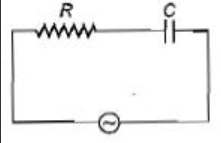
A $50 Hz, 20 V AC$ source is connected across $R$ series circuit as shown in Figure If the voltage across $R$ is $12V$ then voltage across capacitor is.
AnswerCorrect option: B. $16 V$
$\text{V}^2={\text{V}^2_\text{R}}+{\text{V}^2_\text{c}}$
$20^2=12^2+\text{V}^2_\text{c}$
$\text{V}_\text{c}=\sqrt{20^2-12^2}$
$\text{V}_\text{c}=16\text{ V}$
View full question & answer→MCQ 1441 Mark
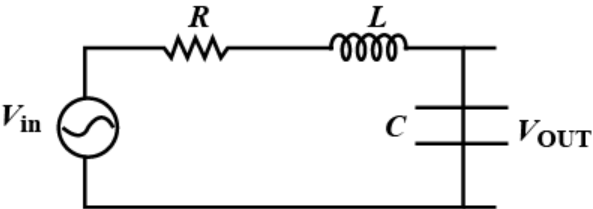
If the output is taken across a capacitor in a series $\text{RLC}$ circuit then it acts as.
- A
band$-$pass filter
- B
high$-$pass filter
- ✓
low$-$pass filter
- D
AnswerCorrect option: C. low$-$pass filter
Given circuit is one simple low$-$pass filter circuit consists of a resistor in series with a load, and a capacitor in parallel with the load. The capacitor exhibits reactance, and blocks low$-$frequency signals, forcing them through the load instead. At higher frequencies the reactance drops, and the capacitor effectively functions as a short circuit.
View full question & answer→MCQ 1451 Mark
The resonant frequency of an $L - C$ circuit is.
- ✓
$\frac{1}{2\pi\sqrt{\text{LC}}}$
- B
$\frac{1}{2\pi}\sqrt\frac{\text{L}}{\text{C}}$
- C
$\frac{1}{4\pi}\sqrt\frac{\text{L}}{\text{C}}$
- D
$\frac{1}{2\pi}\sqrt\frac{\text{C}}{\text{L}}$
AnswerCorrect option: A. $\frac{1}{2\pi\sqrt{\text{LC}}}$
Resonance frequency f of an $L - C$ circuit can be written as
Resonance frequency $\text{f}=\frac{1}{2\pi\sqrt{\text{LC}}}$ where $L =$ inductance and $C$ is capacitance.
View full question & answer→MCQ 1461 Mark
In an $LCR$ circuit, capacitance is changed from $C$ to $2C$. For the resonant frequency to remain unchanged, the inductance should be changed from $L$ to:
- A
$4L$
- B
$2L$
- ✓
$\frac{\text{L}}{2}$
- D
$\frac{\text{L}}{4}$
AnswerCorrect option: C. $\frac{\text{L}}{2}$
Resonant frequency, $\text{f}_\text{r}=\frac{1}{2\pi\sqrt{\text{LC}}}$
As the frequency is unchanged so $f_r=f_r{ }^{\prime}$
$LC = L ^{\prime} C ^{\prime}= L ^{\prime}(2 C )$
$L =\frac{ L }{2}$
View full question & answer→MCQ 1471 Mark
Alternating current is flowing in inductance $L$ and resistance $R$. The frequency of source is $\frac{\omega}{2\pi}$ Which of the following statement in correct:
- ✓
For low frequency the limiting value of impedance is $L.$
- B
For high frequency the limiting value of impedance is $\omega\text{L}.$.
- C
For high frequency the limiting value of impedance is $R.$
- D
For low frequency the limiting value of impedance is $\omega\text{L}.$
AnswerCorrect option: A. For low frequency the limiting value of impedance is $L.$
View full question & answer→MCQ 1481 Mark
The simplest type of $AC$ voltage or current is the one which.
Answer$AC$ voltage or current can be of any form, but the simplest type is a sine wave because any periodic wave can be represented as a combination of sine waves.
View full question & answer→MCQ 1491 Mark
$'Z\ '$ is not.
Answer$Z-$ Atomic number we study in modern physics
$Z-$ impedance we study in alternating current
$Z-$ zeta potential
View full question & answer→MCQ 1501 Mark
An alternating current is given by $\text{i}=\text{i}_1\cos\omega\text{t}+\text{i}_2\sin\omega\text{t}.$ The rms current is given by:
- A
$\frac{\text{i}_1+\text{i}_2}{\sqrt{2}}$
- B
$\frac{|\text{i}_1+\text{i}_2|}{\sqrt{2}}$
- ✓
$\sqrt{\frac{\text{i}_1^2+\text{i}_2^2}{2}}$
- D
$\sqrt{\frac{\text{i}_1^2+\text{i}_2^2}{\sqrt{2}}}$
AnswerCorrect option: C. $\sqrt{\frac{\text{i}_1^2+\text{i}_2^2}{2}}$
$\text{i}=\text{i}_1\cos\omega\text{t}+\text{i}_2\sin\omega\text{t}$
$\text{I}_\text{rms}=\frac{\int\limits_0^\text{T}\text{I}^2\text{dt}}{\int\limits_0^\text{T}\text{dt}}$
if $\text{I}=\cos\omega\text{t}$
$\text{I}_\text{rms}^2=\frac{\text{I}_0^2}{2}$
$\text{i}=\text{i}_1\cos\omega\text{t}+\text{i}_2\sin\omega\text{t}$
Than $\text{i}_\text{rms}^2=\frac{\text{i}_1^2}{2}+\frac{\text{i}_2^2}{2}$
$\text{i}_\text{rms}=\sqrt{\frac{\text{i}_1^2+\text{i}_2^2}{2}}$
View full question & answer→