Question 512 Marks
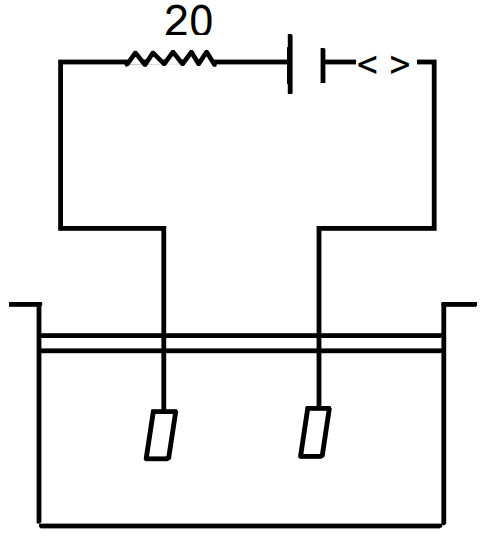
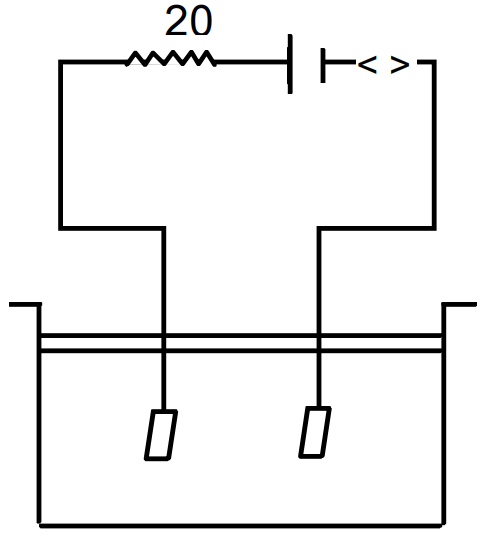
Figure shows an electrolyte of AgCl through which a current is passed. It is observed that 2.68g of silver is deposited in 10 minutes on the cathode. Find the heat developed in the $20\Omega$ resistor during this period. Atomic weight of silver is 107.9g/mole.
Answer
 $\text{W}=\text{Zit}$
$2.68=\frac{107.9}{96500}\times\text{i}\times10\times60$
$\Rightarrow\text{l}=\frac{2.68\times965}{107.9\times6}=3.99\approx4\text{Amp}$
Heat developed in the $20\Omega$ resister$=(4)^2\times20\times10\times60=192000\text{J}=192\text{KJ}$ View full question & answer→Question 522 Marks
A wire has a length of 2.0m and a resistance of $5.0\Omega.$ Find the electric field existing inside the wire if it carries a current of 10A.
Answer$\text{l}=2\text{m},\text{R}=5\Omega,\text{i}=10\text{A},\text{E}=?$
$\text{V}=\text{iR}=10\times5=50\text{V}$
$\text{E}=\frac{\text{V}}{\text{l}}=\frac{50}{2}=25\text{V}/\text{m}$
View full question & answer→Question 532 Marks
If a constant potential difference is applied across a bulb, the current slightly decreases as time passes and then becomes constant. Explain.
AnswerAs current passes through wire of bulb it heats up and thus the resistance of wire (element) increase as its metal so current decreases as resistance increases after element is heated well the resistance stops increasing thus current stops decreases.
View full question & answer→Question 542 Marks
A non-ideal battery is connected to a resistor. Is work done by the battery equal to the thermal energy developed in the resistor? Will your answer change if the battery is ideal?
AnswerYes, the answer will change if the battery is ideal. An ideal battery has no internal resistance. Hence, the work done by an ideal battery will be equal to the thermal energy developed in the resistor, assuming that the resistance of the wires used for connection is negligible.
View full question & answer→Question 552 Marks
Power P is to be delivered to a device via transmission cables having resistance $R_C$. If V is the voltage across R and I the current through it, find the power wasted and how can it be reduced.
AnswerPower wasted $P_C=I^2 R_C$ where, $R_C$is the resistance of the connecting wires.
$\Rightarrow\ \text{P}_\text{C}=\Big(\frac{\text{P}^2}{\text{V}^2}\Big)\text{R}_\text{C} [$as,$ P = VI]$
In order to reduce $P_C$, power should be transmitted at high voltage.
View full question & answer→Question 562 Marks
The electric current existing in a discharge tube is $2.0\mu\text{A}.$ How much charge is transferred across a cross-section of the tube in 5 minutes?
Answer$\text{i}'=2\mu\text{A},\text{t}=5\text{min}=5\times60\text{sec}$
$\text{q}=\text{i t}$
$=2\times10^{-6}\times5\times60$
$=10\times60\times10^{-6}\text{c}=6\times10^{-4}\text{c}$
View full question & answer→Question 572 Marks
The potential difference between the terminals of a 6.0V battery is 7.2V when it is being charged by a current of 2.0A. What is the internal resistance of the battery?
Answer
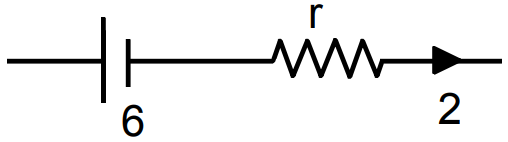 $\text{V}=\in+\text{ir}$
$\Rightarrow7.2=6+2\times\text{r}$
$\Rightarrow1.2=2\text{r}\Rightarrow\text{r}=0.6\Omega.$ View full question & answer→Question 582 Marks
An electroplating unit plates 3.0 g of silver on a brass plate in 3.0 minutes. Find the current used by the unit. The electrochemical equivalent of silver is $1.12 \times 10^{-6} \mathrm{~kg} \mathrm{C}^{-1}$.
Answer$t = 3min = 180sec\ w = 2g\ E.C.E = 1.12 × 10^{-6}kg/c$ $\Rightarrow3\times10^{-3}=1.12\times10^{-6}\times\text{i}\times180$$\Rightarrow\text{i}=\frac{3\times10^{-3}}{1.12\times10^{-6}\times180}$
$=\frac{1}{6.72}\times10^2\approx15\text{Amp}$
View full question & answer→Question 592 Marks
If the radius of a copper wire is doubled, will its specific resistance increase, decrease or remain same?
AnswerThe specific resistance of a wire depends only on the material (at a given temperature).
Therefore by changing the radius, the specific resistance of copper remains unchanged.
View full question & answer→Question 602 Marks
The potential difference across the terminals of a battery of emf 12V and internal resistance $2\Omega$ drops to 10V when it is connected to a silver voltameter. Find the silver deposited at the cathode in half an hour. Atomic weight of silver is 107.9g/mole.
AnswerFor potential drop, t = 30min = 180sec
$\text{V}_\text{i}=\text{V}_\text{f}+\text{iR}$
$\Rightarrow12=10+2\text{i}\Rightarrow\text{i}=1\text{Amp}$
$\text{m}=\text{Zit}=\frac{107.9}{96500}\times1\times30\times60$
$=2.01\text{g}\approx2\text{g}$
View full question & answer→Question 612 Marks
Why is Wheatstone bridge (Metre Bridge) method not suitable for measurement of very low and very high resistances?
AnswerBecause, in order to ensure sensitivity of the bridge, all other resistances used should either have low value or very high value. This also requires a galvanometer of very low resistance or very high resistance and introduces error in the results.
View full question & answer→Question 622 Marks
A voltmeter consists of a $25\Omega$ coil connected in series with a $575\Omega$ resistor. The coil takes 10mA for full scale deflection. What maximum potential difference can be measured by this voltmeter?
Answer
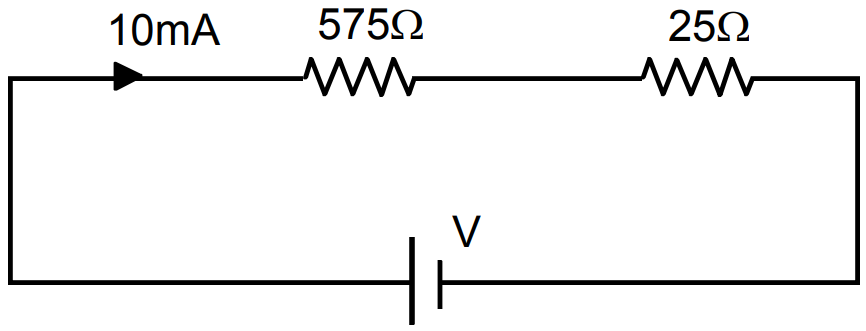 Full deflection current $=10\text{mA}=(10\times10^{-3})\text{A}$
$\text{R}_\text{eff}=(575+25)\Omega=600\Omega$
$\text{V}=\text{R}_\text{eff}\times\text{i}=600\times10\times10^{-3}=6\text{V}.$ View full question & answer→Question 632 Marks
Find the amount of silver liberated at cathode if 0.500A of current is passed through $AgNO_3$ electrolyte for 1 hour. Atomic weight of silver a 107.9 g/mole.
AnswerAt Wt. At = 107.9 g/mole
$I = 0.500A$
$E_{Ag}= 107.9g [$As Ag is monoatomic$].$
$\text{Z}_{\text{Ag}}=\frac{E}{\text{f}}=\frac{107.9}{96500}=0.001118$
$\text{M}=\text{Zit}=0.001118\times0.5\times3600=2.01$
View full question & answer→Question 642 Marks
Two cells of emf 10V and 2V and internal resistance $10\Omega$ and $5\Omega$ respectively, are connected in parallel as shown. Find the effective voltage across R.
AnswerThe effective voltage across R is geven by $\varepsilon_\text{eq}=\frac{\Big(\frac{\varepsilon_1}{\text{r}_1}+\frac{\varepsilon_2}{\text{r}_2}\Big)} {\Big(\frac{2}{\text{r}_1}+\frac{1}{\text{r}_2}\Big)}=\frac{\Big(\frac{10}{10}-\frac25\Big)}{\Big(\frac{1}{10}+\frac15\Big)}$
$\Rightarrow\varepsilon_\text{eq}=2\text{V}$
View full question & answer→Question 652 Marks
A bulb is made using two filaments. A switch selects whether the filaments are used individually or in parallel. When used with a 15V battery, the bulb can be operated at 5W, 10W or 15W. What should be the resistances of the filaments?
AnswerThe various resistances of the bulbs $=\frac{\text{V}^2}{\text{P}}$
Resistances are $\frac{(15)^2}{10},\frac{(15)^2}{10},\frac{(15)^2}{15},=45,22.5,15.$
Since two resistances when used in parallel have resistances less than both.
The resistances are 45 and 22.5.
View full question & answer→Question 662 Marks
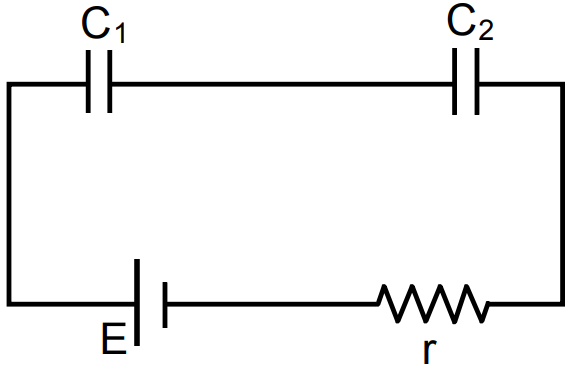
Consider the situation shown in figure. The switch is closed at t = 0 when the capacitors are uncharged. Find the charge on the capacitor $C_1$ as a function of time t.
Answer
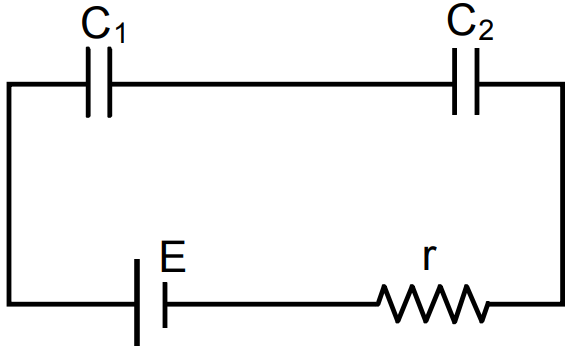
$\text{C}_\text{eff}=\frac{\text{C}_1\text{C}_2}{\text{C}_1+\text{C}_2}$
$\text{Q}=\text{C}_\text{eff}\text{E}\Big(1-\text{e}^{\frac{-\text{t}}{\text{RC}}}\Big)=\frac{\text{C}_1\text{C}_2}{\text{C}_1+\text{C}_2}\text{E}\Big(1-\text{e}^\frac{-\text{t}}{\text{RC}}\Big)$ View full question & answer→Question 672 Marks
Find the thermo-emf developed in a copper-silver thermocouple when the junctions are kept at $0^\circ$C and $40^\circ$C. Use the data in table.
|
Metal with
|
a
|
b
|
|
lead (Pb)
|
$\mu\text{V}/^\circ\text{C}$
|
$\mu\text{V}/^\circ(\text{C})^2$
|
|
|
Aluminium
|
-0.47
|
0.003
|
|
Bismuth
|
-43.7
|
-0·47
|
|
Copper
|
2.76
|
0·012
|
|
Gold
|
2.90
|
0.0093
|
|
Iron
|
16.6
|
-0.030
|
|
Nickel
|
19.1
|
-0.030
|
|
Platinum
|
-1.79
|
-0.035
|
|
Silver
|
2.50
|
0.012
|
|
Steel
|
10.8
|
-0.016
|
|
Answer$\text{E}=\text{a}_{\text{AB}}\theta+\text{b}_{\text{AB}}\theta^2$
$\text{a}_{\text{CuAg}}=\text{a}_{\text{CuPb}}-\text{b}_{\text{AgPb}}$
$=2.76-2.5=0.26\mu\text{v}/^\circ\text{C}$
$\text{b}_{\text{CuAg}}=\text{b}_{\text{CuPb}}-\text{b}_{\text{AgPb}}$
$=0.012-0.012\mu\text{vc}=0$
$\text{E}=\text{a}_{\text{AB}}\theta=(0.26\times40)\mu\text{V}$
$=1.04\times10^{-5}\text{V}$
View full question & answer→Question 682 Marks
An electric current of 2.0A passes through a wire of resistance $25\Omega$. How much heat will be developed in 1minute?
Answer$\text{i}=2\text{A},$
$\text{r}=25\Omega,$
$\text{t}=1\text{min}=60\text{sec}$
Heat developed $=\text{i}^2\text{RT}=2\times2\times25\times60=6000\text{J}$
View full question & answer→Question 692 Marks
Two heating coils, one of fine wire and other of thick wire, made of the same material and of the same length are connected one by one to a source of electricity. Which coil will produce heat at a greater rate?
Answer$\text{Q}\propto\frac{1}{\text{R}}$ and $\text{R}=\frac{\rho\text{l}}{\pi\text{r}^2}$
$\therefore\text{Q}\propto\frac{\pi\text{r}^2}{\rho\text{l}}$
Clearly, thick wire will produce heat at a greater rate.
View full question & answer→Question 702 Marks
In a Wheatstone’s bridge experiment, a student by mistake, connects key (K) in place of galvanometer and galvanometer (G) in place of key (K). What will be the test for the balance of the bridge?
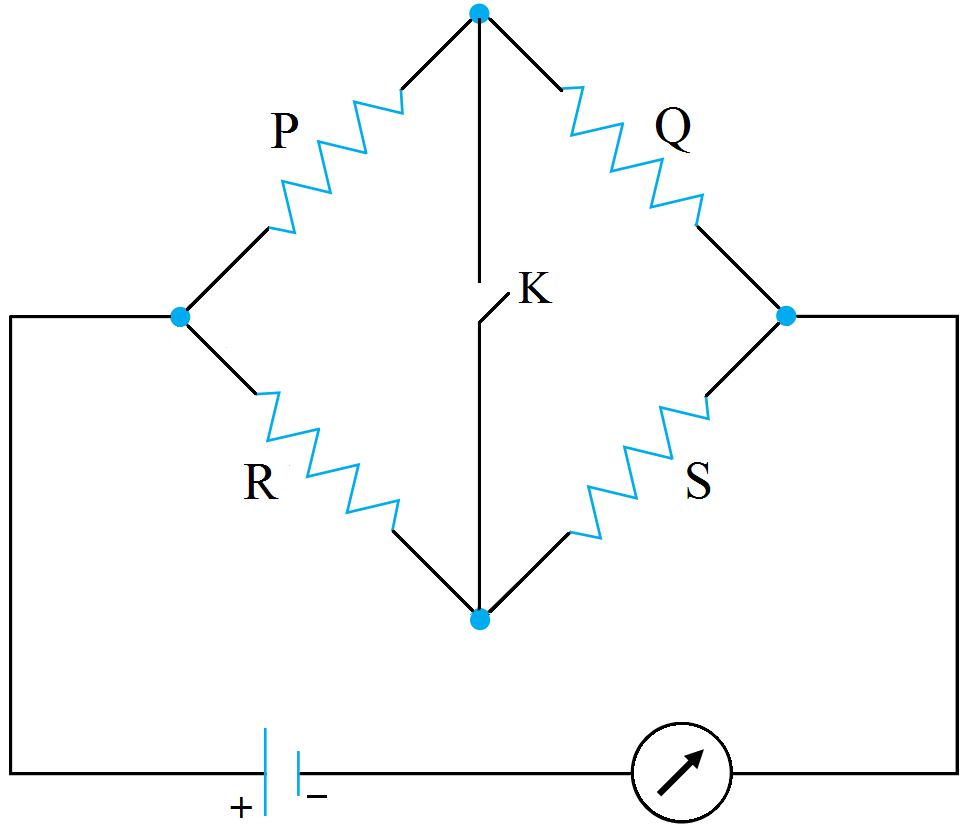
AnswerWhen the bridge is balanced, there will be no current in key, therefore a constant current will flow in the galvanometer. In balanced position, there will be a constant deflection in galvanometer and hence no change in its deflection on pressing the key.
View full question & answer→Question 712 Marks
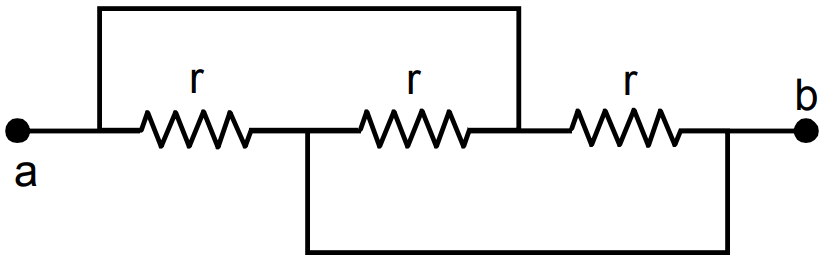
Find the equivalent resistance of the network shown in figure. between the points a and b.
Answer
 Eq. Resistance $=\frac{\text{r}}{3}$
 View full question & answer→Question 722 Marks
Find the neutral temperature and inversion temperature of a copper-iron thermocouple if the reference junction is kept at $0^\circ$C. Use the data in the table.
|
Metal with
|
a
|
b
|
|
lead (Pb)
|
$\mu\text{V}/^\circ\text{C}$
|
$\mu\text{V}/^\circ(\text{C})^2$
|
|
|
Aluminium
|
-0.47
|
0.003
|
|
Bismuth
|
-43.7
|
-0·47
|
|
Copper
|
2.76
|
0·012
|
|
Gold
|
2.90
|
0.0093
|
|
Iron
|
16.6
|
-0.030
|
|
Nickel
|
19.1
|
-0.030
|
|
Platinum
|
-1.79
|
-0.035
|
|
Silver
|
2.50
|
0.012
|
|
Steel
|
10.8
|
-0.016
|
|
AnswerNeutral temperature
$\theta_\text{n}=-\frac{\text{a}}{\text{b}}$
$\text{a}_{\text{CuFe}}=\text{a}_{\text{CuPb}}-\text{a}_{\text{FePb}}$
$=2.76-16.6=13.84\mu\text{V}^\circ\text{C}^{-1}$
$\text{b}_{\text{CuFe}}=\text{b}_{\text{CuPb}}-\text{b}_{\text{FePb}}$
$=0.12+0.030=0.042\mu\text{V}^\circ\text{C}^{-2}$
Thus, the neutral temperature,
$\theta_\text{n}=\frac{-\text{a}_{\text{CuFe}}}{\text{b}_{\text{CuFe}}}=\frac{13.84}{0.042}=329.52\ ^\circ\text{C}$
$=330^\circ\text{C}$
The inversion temperature is double the neutral temperature, i.e. $659^\circC$.
View full question & answer→Question 732 Marks
An immersion heater rated $1000 \mathrm{~W}, 220 \mathrm{~V}$ is used to heat $0.01 \mathrm{~m}^3$ of water. Assuming that the power is supplied at 220 V and $60 \%$ of the power supplied is used to heat the water, how long will it take to increase the temperature of the water from $15^{\circ} \mathrm{C}$ to $40^{\circ} \mathrm{C}$ ?
Answer$\text{P}=1000$
$\text{V}=220\text{v}$
$\text{R}\frac{\text{V}^2}{\text{P}}=\frac{48400}{1000}=48.4\Omega$
Mass of water $=\frac{1}{100}\times1000=10\text{kg}$
Heat required to raise the temp. of given amount of water $=\text{ms}\Delta\text{t}$
$=10\times4200\times25=1050000$
Now heat liberated is only 60%.
So, $\frac{\text{V}^2}{\text{R}}\times\text{T}\times60\%=1050000$
$\Rightarrow\frac{(220)^2}{48.4}\times\frac{60}{100}\times\text{T}=1050000$
$\Rightarrow\text{T}=\frac{10500}{6}\times\frac{1}{60}\text{nub}=29.16\text{min}$
View full question & answer→Question 742 Marks
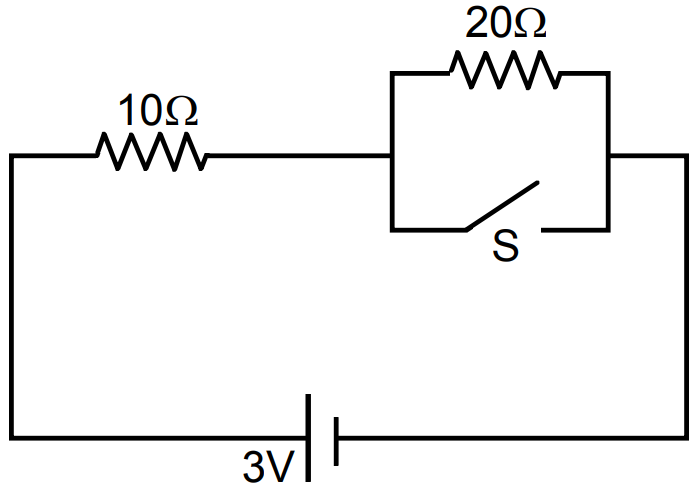
Consider the circuit shown in figure. Find the current through the $10\Omega$ resistor when the switch S is (a) Open (b) Closed.
Answer
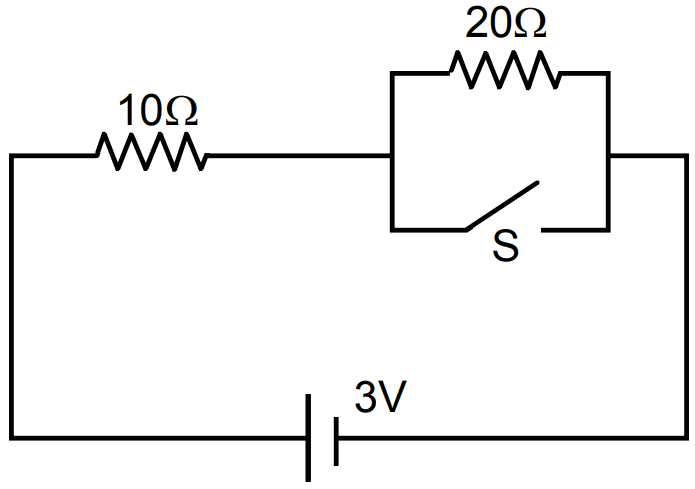
- When S is open,
$\text{R}_\text{eq}=(10+20)\Omega=30\Omega$
- i = When S is closed,
$\text{R}_\text{eq}=10\Omega$
$\text{i}=\Big(\frac{3}{10}\Big)\Omega=0.3\Omega.$ View full question & answer→Question 752 Marks
What is the effect of heating of a conductor on the drift velocity of free electrons?
Answer$\upsilon_\text{d}=\frac{\text{eE}}{\text{m}}\tau$
By heating a conductor, the collisions of electrons occur more frequently; so relaxation time decreases and hence drift velocity decreases.
View full question & answer→Question 762 Marks
In an electrolyte, the positive ions move from left to right and the negative ions from right to left. Is there a net current? If yes, in what direction?
AnswerAs positive current moves from left to right and negative current moves from right to left in both cases as explained in previous question the current would be flowing from left to right.
View full question & answer→Question 772 Marks
Two unequal resistances $\mathrm{R}_1$ and $\mathrm{R}_2$ are connected across two identical batteries of emf \$ivarepsilon\$ and internal resistance r . Can the thermal energies developed in $R_1$ and $R_2$ be equal in a given time. If yes, what will be the condition?
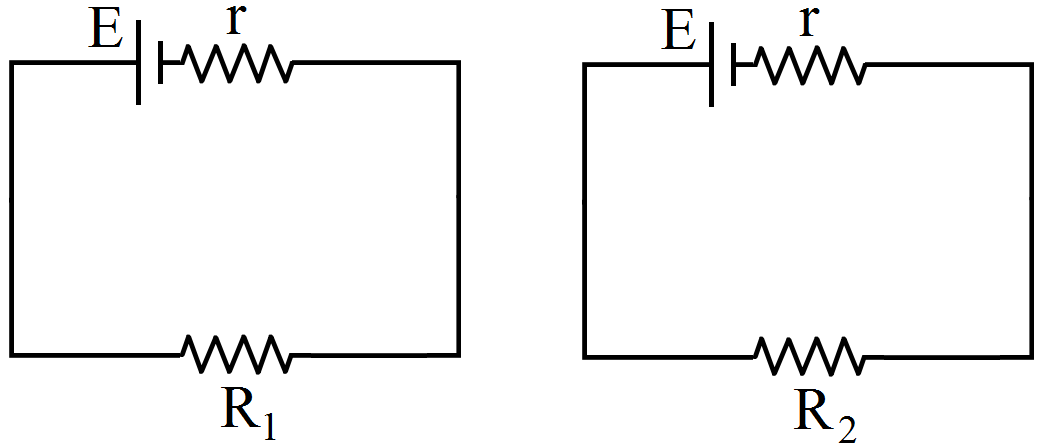
AnswerAs, $Q = i^2Rt$
EMF is identical thus change in R would result into different thermal energies at given time A all the other components are same but $R_1$ and $R_2$ are different.
View full question & answer→Question 782 Marks
The temperatures of the junctions of a bismuth-silver thermocouple are maintained at $0^{\circ} \mathrm{C}$ and $0.001^{\circ} \mathrm{C}$. Find the thermo-emf (Seebeck emf) developed. For bismuth-silver, $a=-46 \times 10^{-6} \mathrm{~V}^{\circ} \mathrm{C} ^{-1}$ and $\mathrm{b}=-0.48 \times 10^{-6} \mathrm{~V}^{\circ} \mathrm{C}^{-2}$.
Answer$\theta=0.001^\circ\text{C}$
$\text{a}=-46\times10^{-6}\text{v/deg},$
$\text{b}=-0.48\times10^{-6}\text{v/deg}^2$
$\text{Emf}=\text{a}_{\text{BlAg}}\theta+\Big(\frac{1}{2}\Big)\text{b}_{\text{BlAg}}\theta^2$
$=-46\times10^{-6}\times0.001-\Big(\frac{1}{2}\Big)\times0.48\times10^{-6}(0.001)^2$
$=-46\times10^{-9}-0.24\times10^{-12}$
$=-46.00024\times10^{-9}$
$=-4.6\times10^{-8}\text{V}$
View full question & answer→Question 792 Marks
The amount of electric charge passing through a cross-section of wire in time t is $\mathrm{Q}(\mathrm{t})=\mathrm{At}^2+\mathrm{Bt}+\mathrm{C}$
Where $\mathrm{A}, \mathrm{B}$ and C are constants having values 5,4 and 1 respectively.
Calculate the value of electric current at $t=4 \mathrm{~s}$.
AnswerWe have, $\text{Q}(\text{t})=\text{At}^2+\text{Bt}+\text{C}$
$\frac{\text{dQ}}{\text{dt}}=2\text{At}+\text{B}$
$=2\times5\times4+4(\text{at t}=4\text{s})$
$\text{I}=44\text{A}$
View full question & answer→Question 802 Marks
Current is allowed to flow in a metallic wire at a constant potential difference. When the wire becomes hot, cold water is poured on half of its portion. By doing so, its other half portion becomes still more hot. Explain its reason.
AnswerWhen cold water is poured on half the wire, the resistance of this portion decreases, and hence the current $\text{I}=\frac{\text{V}}{\text{R}}$ in whole wire increases and so the other half portion becomes still more hot.
View full question & answer→Question 812 Marks
On increasing the current drawn from a cell, the net potential difference across its terminals is lowered, why?
AnswerThe terminal potential difference V = E - Ir.
Clearly if I is increased, the terminal potential difference falls.
View full question & answer→Question 822 Marks
Two 120V light bulbs, one of 25W and the other of 200W were connected in series across a 240V line. One bulb burnt out almost instantaneously. Which one was burnt and why?
AnswerResistance of bulb $\text{R}=\frac{\text{V}^2}{\text{P}}\propto\frac{1}{\text{P}};$ so 25W bulb has higher resistance. In series current remains the same; so pd across 25W bulb will be more than that across 200W bulb; so 25W bulb was burnt out immediately.
View full question & answer→Question 832 Marks
Define the term resistivity and write the SI unit.
AnswerThe resistivity of a material of a conductor is defined as the resistance offered by a conductor of length 1 m and area of cross-section $1 \mathrm{~m}^2$. Its SI unit is ohm $\times$ metre $(\Omega \mathrm{m})$.
View full question & answer→Question 842 Marks
Two voltameters, one having a solution of silver salt and the other of a trivalent-metal salt, are connected in series and a current of 2A is maintained for 1.50 hours. It is found that 1.00g of the trivalent-metal is deposited.
- What is the atomic weight of the trivalent metal?
- How much silver is deposited during this period? Atomic weight of silver is 107.9 g/mole.
Answer$\text{w}_1=\text{Zit}$
$\Rightarrow1=\frac{\text{mm}}{3\times96500}\times2\times2.5\times3600$
$\Rightarrow\text{mm}=\frac{3\times96500}{2\times1.5\times3600}=26.8\text{g/mole}$
$\frac{\text{E}_1}{\text{E}_2}=\frac{\text{W}_1}{\text{W}_2}$
$\Rightarrow\frac{107.9}{\Big(\frac{\text{mm}}{3}\Big)}=\frac{\text{W}_1}{1}$
$\Rightarrow\text{W}_1=\frac{107.9\times3}{26.8}=12.1\text{gm}$
View full question & answer→Question 852 Marks
A proton beam is going from east to west. Is there an electric current? If yes, in what direction?
AnswerA proton beam means positive charge moving in west direction that means current flowing from east to west. As electric current is in direction of positive charge flowing or opposite to negative charge flowing.
View full question & answer→Question 862 Marks
By evaluating $\int\text{i}^2\text{Rdt},$ show that when a capacitor is charged by connecting it to a battery through a resistor, the energy dissipated as heat equals the energy stored in the capacitor.
Answer$\int\text{i}^2\text{Rdt}=\int\text{i}_0^2\text{Re}^{\frac{-2\text{t}}{\text{RC}}}\text{dt}=\text{i}_0^2\text{R}\int\text{e}^{\frac{-2\text{t}}{\text{RC}}}\text{dt}$
$=\text{i}^2_0\text{R}\Big(\frac{-\text{RC}}{2}\Big)\text{e}^{\frac{-2\text{t}}{\text{RC}}}=\frac{1}{2}\text{Ci}_0^2\text{R}^2\text{e}^{\frac{-2\text{t}}{\text{RC}}}=\frac{1}{2}\text{CV}^2$ (Proved).
View full question & answer→Question 872 Marks
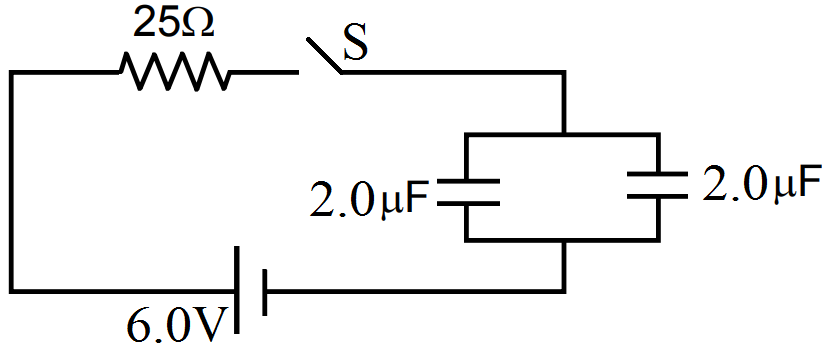
Find the charge on each of the capacitors 0.20ms after the switch S is closed in the figure.
Answer
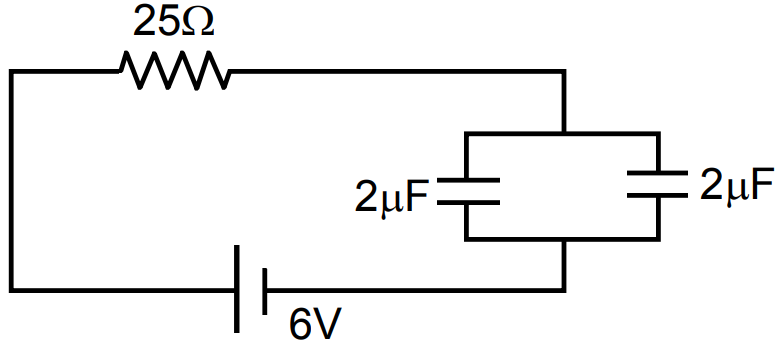 $\text{q}=\text{q}_0\Big(1-\text{e}^{\frac{-\text{t}}{\text{RC}}}\Big)$
$=25(2+2)\times10^{-6}\bigg(1-\text{e}^\frac{-0.2\times10^{-3}}{25\times4\times10^{-6}}\bigg)$
$=24\times10^{-6}(1-\text{e}^2)=20.75$
Charge on each capacitor $=\frac{20.75}{2}=10.3$ View full question & answer→Question 882 Marks
Suppose you have three resistors of $20\Omega,50\Omega$ and $100\Omega.$ What minimum and maximum resistance can you obtain from these resistors?
Answer$\text{R}_{\text{max}}=(20+50+100)\Omega=170\Omega$
$\text{R}_{\text{min}}=\frac{1}{\Big(\frac{1}{20}+\frac{1}{50}+\frac{1}{100}\Big)}=\frac{100}{8}=12.5\Omega.$
View full question & answer→Question 892 Marks
A capacitor of capacitance C is given a charge Q. At t = 0, it is connected to an ideal battery of emf $\in$ through a resistance R. Find the charge on the capacitor at time t.
AnswerThe capacitor is given a charge Q. It will discharge and the capacitor will be charged up when connected with battery.
Net charge at time $\text{t}=\text{Qe}^\frac{-\text{t}}{\text{RC}}+\text{Q}\Big(1-\text{e}^\frac{-\text{t}}{\text{RC}}\Big).$
View full question & answer→Question 902 Marks
The internal resistance of an accumulator battery of emf 6V is $10\Omega$ when it is fully discharged. As the battery gets charged up, its internal resistance decreases to $1\Omega.$
The battery in its completely discharged state is connected to a charger that maintains a constant potential difference of 9V. Find the current through the battery (a) just after the connections are made and (b) after a long time when it is completely charged.
Answer
- Net emf while charging
$9-6=3\text{V}$
Current $=\frac{3}{10}=0.3\text{A}$
- When completely charged
Internal resistance $'\text{r}'=1\Omega$
Current $=\frac{3}{1}=3\text{A}$ View full question & answer→Question 912 Marks
Find the time required to liberate 1.0 litre of hydrogen at STP in an electrolytic cell by a current of 5.0A.
Answer$\frac{\text{H}_2}{22.4\text{L}}\rightarrow2\text{g}$
$1\text{L}\rightarrow\frac{2}{22.4}$
$\text{m}=\text{Zit}$
$\frac{2}{22.4}=\frac{1}{96500}\times5\times\text{T}$
$\Rightarrow\text{T}=\frac{2}{22.4}\times\frac{96500}{5}$
$=1732.21\text{sec}\approx28.7\text{min}\approx29\text{min}$
View full question & answer→Question 922 Marks
Why do we prefer a potentiometer to measure the emf of a cell rather than a voltmeter?
AnswerA voltmeter has a finite resistance and draws current from a cell, therefore voltmeter measures terminal potential difference rather than emf, while a potentiometer at balance condition, does not draw any current from the cell; so the cell remains in open circuit. Hence potentiometer reads the actual value of emf.
View full question & answer→Question 932 Marks
An electric bulb marked 220V, 100W will get fused if it is made to consume 150W or more. What voltage fluctuation will the bulb withstand?
Answer$\text{V}=220\text{v}$
$\text{P}=100\text{w}$
$\text{R}=\frac{\text{V}^2}{\text{P}}$
$=\frac{220\times220}{100}=484\Omega$
$\text{P}=150\text{w}$
$\text{V}=\sqrt{\text{PR}}=\sqrt{150\times22\times22}$
$=22\sqrt{150}=269.4\approx270\text{v}$
View full question & answer→