Questions · Page 2 of 4

M.C.Q (1 Marks)

Question 511 Mark
What is the phase difference between electric and magnetic fields in an electromagnetic wave?
Answer
  1. $\pi$
Explanation: 
The phase difference between electric and magnetic fields in an electromagnetic wave is$\pi$.
View full question & answer
Question 521 Mark
Which of the following has/have zero average value in a plane electromagnetic wave?
Answer
  1. Both magnetic and electric field
View full question & answer
Question 531 Mark
A plane electromagnetic wave with a single frequency moves in vacuum in the positive x direction. Its amplitude is uniform over the yz plane its wavelength:
Answer
  1. Same
Explanation:
The same amount of energy passes through equal areas parallel to the yz plane as the wave travels in the +x direction, so the amplitude and the intensity, which is proportional to the square of the amplitude, do not change.
View full question & answer
Question 541 Mark
Choose the correct answer from the alternatives given.
Displacement current goes through the gap between the plates of a capacitor when the charge of the capacitor.
Answer
  1. increases or decreases
Explanation:
Displacement current inside a capacitor is given by:-
$\text{i}_\text{d}=\epsilon_0\frac{\phi\text{E}}{\text{dt}}$
where $\phi_\text{E}$​ is the electric flux inside the capacitor
The displacement current is developed inside a capacitor when there is a change in the electric flux linked with the capacitor.
The change in electric flux can occur in both the cases either the charge increases or decreases on the capacitor. This will lead to a change in flux linked with the coil.
View full question & answer
Question 551 Mark
In the propagation of light waves, the angle between the plane of vibration & plane of polarisation is:
Answer
  1. 90°
Explanation:
The plane of polarisations is that plane in which there is no vibration. While a plane including the direction of light propagation and the direction of electric field is called the plane of vibration. The angle between them is 90°.
View full question & answer
Question 561 Mark
Who first proposed the light as an electromagnetic wave?
Answer
  1. James Clerk Maxwell
Explanation:
In 1864, Maxwell predicted the existence of electromagnetic waves, the existence of which had not been confirmed before that time, and out of his prediction came the concept of light being a wave, or more specifically, a type of electromagnetic wave. It is a wide intuition that Albert Einstein proposed the dual nature theory but is not correct.
View full question & answer
Question 571 Mark
A magnetic field can be produced by:
Answer
  1. Both of them.
Explanation:
According to Ampere-Maxwell's Law, a magnetic field is produced due to the conduction current in a conductor and the displacement current. The conduction current is actually the motion of the charge. The displacement current is due to the changing electric field. The displacement current is given by,
$\text{i}_\text{d}=\epsilon_0\frac{\text{d}\phi_\text{E}}{\text{dt}}$ $\big(\because\phi_\text{E}$ is the electric flux$\big)$
Thus, the magnetic field is produced by the moving charge as well as the electric field.
View full question & answer
Question 581 Mark
The wavelength of the wave is.
Answer
  1. 7.5m
Explanation
Using $\text{v}=\text{v}\lambda$ where v is the speed of EM wave.
As $\text{V}=\text{c}=3\times\frac{10\text{m}}{\text{s}}$
$\Rightarrow3\times10^8=40\times10^6\lambda$
$\Rightarrow\lambda=7.5\text{m}$
View full question & answer
Question 591 Mark
A linearly polarized electromagnetic wave given as $\text{E}=\text{E}_0\hat{\text{i}}\cos(\text{kz}-\omega\text{t})$ is incident normally on a perfectly reflecting infinite wall at z = a. Assuming that the material of the wall is optically inactive, the reflected wave will be given as:
Answer
  1. $\text{E}_\text{r}=\text{E}_0\hat{\text{i}}\cos(\text{kz}+\omega\text{t})$
Solution:
Key concept: When a wave is reflected from a denser medium or perfectly reflecting wall made with optically inactive material, then the type of wave doesn't change but only its phase changes by 180º or $\hat{\text{I}}€$ radian.
View full question & answer
Question 601 Mark
In case of the electromagnetic waves the angle between the electric and magnetic field vectors is.
Answer
  1. ​​​​$\frac{\pi}{2}$
Explanation:
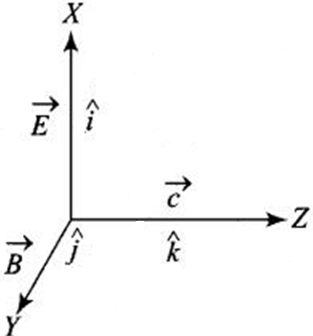
Electromagnetic waves are formed when an electric field couples with a magnetic field. The magnetic and electric fields of an electromagnetic wave are perpendicular to each other and to the direction of the wave, as shown in figure.
View full question & answer
Question 611 Mark
In an electromagnetic wave, the direction of the magnetic induction B is
Answer
  1. perpendicular to the electric field $\overrightarrow{\text{S}}$
Explanation:
The electric field is always perpendicular to the magnetic field, and both fields are directed at right-angles to the direction of propagation of the wave. In fact, the wave propagates in the direction $\overrightarrow{\text{E}}\times\overrightarrow{\text{B}}$ Electromagnetic waves are clearly a type of transverse wave.
View full question & answer
Question 621 Mark
Electromagnetic waves are produced by:
Answer
  1. An accelerating charge.
Explanation:
A static charge produces an electrostatic field. A moving charge produces a magnetic field. Electromagnetic waves are produced by an accelerating charge.
View full question & answer
Question 631 Mark
According to Maxwell’s Hypothesis, a changing electric field gives rise to?
Answer
  1. Magnetic Field
Explanation:
 A changing electric field gives rise to a magnetic field.
View full question & answer
Question 641 Mark
 Pick out the correct increasing order of energy of electromagnetic waves from the following:
Answer
The energy of electromagnetic waves is directly proportional to the frequency of the electromagnetic waves.
So the order of frequency is given as:
$v_{micro }< v_{infrared} < v_{visible }< v_{ultraviolet} < v_{gamma}$
Since $E = hv$
$➔ \text{E} \propto\text{v}$
The order of energy is as follows:
$E_{micro} < E_{infrared} < E_{visible} < E_{ultraviolet} < E_{gamma}$
View full question & answer
Question 651 Mark
An electromognetic wave travels in vacuum along z direction: $\text{E}=\big(\text{E}_1\hat{\text{i}}+\text{E}_2\hat{\text{j}}\big)\cos(\text{kz}-\omega\text{t})$. Choose the correct options from the following:
Answer
  1. The associated magnetic field is given as $\text{B}=\frac{1}{\text{c}}\big(\text{E}_1\hat{\text{i}}+\text{E}_2\hat{\text{j}}\big)\cos(\text{kz}-\omega\text{t})$.
  1. ​​​​​​​The given electromagnetic wave is plane polarised.
Solution:
We are given that the electric field vector of an electromagnetic wave travels in a vacuum along z-direction as,
$\vec{\text{E}}=\big(\text{E}_2\hat{\text{i}}+\text{E}_2\hat{\text{j}}\big)\cos(\text{kz}-\omega\text{t})$
The magnitude of the electric and the magnetic fields in an electronagnetic wave are related as
$\text{B}_0=\frac{\text{E}_0}{\text{c}}$
$\vec{\text{B}}=\frac{\vec{\text{E}}}{\text{c}}=\frac{\text{E}_1\text{i}+\text{E}_2\text{i}}{\text{c}}\cos(\text{kz}-\omega\text{t})$
Also, $\vec{\text{E}}$ and $\vec{\text{B}}$ are perpendicular to each other and the propagation of electromagnetic wave is perpendicular to $\vec{\text{E}}$ as well as $\vec{\text{B}}$, so the given electromagnetic wave is plane polarized.
View full question & answer
Question 661 Mark
Unpolarized light falls first on polarizer (P) and then on analyzer (A). If the intensity of the transmitted light from the analyser is $\frac{1}{8}\text{th}$ of the incident unpolarized light. What will be the angle between optic axes of P and A?
Answer
  1. 60°
Explanation:
Given,
$\text{I}=\frac{\text{I}_\text{0}}{2}....(\text{i})$
$\text{I}=\text{I}\cos^2\theta$ $\Big(\because\text{I}=\frac{\text{I}_0}{8}\Big)$
$\therefore\frac{\text{I}_0}{8}=\frac{\text{I}_0}{2}\cos^2\theta$
From the equation (i), we have
$\frac{1}{4}=\cos^2\theta$
$\Rightarrow\cos\theta=\frac{1}{2}$
$\Rightarrow\cos\theta=\cos60^\circ$
$\Rightarrow\theta=60^\circ$
View full question & answer
Question 671 Mark
Radiations of intensity $\frac{0.5\text{W}}{\text{m}^2}$ are striking a metal plate. The pressure on the plate is.
Answer
  1. $\frac{0.166\times10^{-8}\text{N}}{\text{m}^2}$
Explanation:
Intensity or power per unit area of the radiations,
P = pv
$\Rightarrow\text{P}=\frac{\text{P}}{\text{v}}=\frac{0.5}{3\times10^8}=\frac{0.166\times10^{-8}\text{N}}{\text{m}^2}$
View full question & answer
Question 681 Mark
A parallel plate capacitor consists of two circular plates each of radius 12cm and separated by 5.0mm. The capacitor is being charged by an external source. The charging current is constant and is equal to 0.15A.The displacement current is:
Answer
  1. 0.15A
Explanation:
According to Maxwell's hypothesis, a displacement current will flow through a capacitor when the potential difference across its plates is varying.
Thus a varying electric field will exist between the plates and this displacement current is same in magnitude to the current flowing in outer circuit. 
Here, the current in the outer circuit is 0.15 A. Thus 0.15A will be the displacement current. 
View full question & answer
Question 691 Mark
Infrared radiation are detected by:
Answer
  1. Photometre
Explanation:
Infrared radiation is detected by photometer.
View full question & answer
Question 701 Mark
According to the electromagnetic wave theory, light consists of electric and magnetic fields which are_____________.
Answer
  1. perpendicular to each other
Explanation:
Light consists of electric and magnetic field that are perpendicular 90° to each other.
APPOACH by example
Electric field inside plates. The magnetic field this given rise to via the displacement current is along the perimeter of the circle parallel to capauatates plates.
So B and E are perpendicular in this case.
View full question & answer
Question 711 Mark
A charged particle oscillates about its mean equilibrium position with a frequency of $10^9 \ Hz.$ The electromagnetic waves produced$:$
Answer
Here we are given the frequency by which the charged particles oscillates about its mean equilibrium position, it is equal to $10^9 \ Hz.$ The frequency of electromagnetic waves produced by a charged particle is equal to the frequency by which it oscillates about its mean equilibrium position.
So, frequency of electromagnetic waves produced by the charged particle is $v = 10^9 \ Hz.$
Wavelength $\lambda=\frac{\text{c}}{\text{v}}=\frac{3\times10^8}{10^9}=0.3\text{m}$
The frequency of $10^9 \ Hz$ falls in the region of radiowaves.
View full question & answer
Question 721 Mark
An electromagnetic wave is propagating along Y-axis. Then.
Answer
  1. oscillating electric field is along Z-axis and oscillating magnetic field is along X-axis
Explanation:
electromagnetic radiation consists of electromagnetic waves, which are synchronized oscillations of electric and magnetic fields that propagate at the speed of light through a vaccum. The oscillations of the two fields are perpendicular to each other and perpendicular to the direction of energy and wave propagation, forming a transverse wave. so if propogation is along Y-direction ,Electric field will be along X or Z, if it is along Z -direction than Magnetic field has to be in X -direction.
View full question & answer
Question 731 Mark
The electric field intensity produced by the radiations coming from 100W bulb at a 3 m distance is E. The electric field intensity produced by the radiations coming from 50W bulb at the same distance is:
Answer
  1. $\sqrt{2}\text{E}.$
Solution:
We know the electric field intensity on a surface due to incident rediation is,
$\text{I}_\text{av}\propto\text{E}_0^2$
$\frac{\text{P}_\text{av}}{\text{A}}\propto\text{E}_0^2$
Here $\text{P}_\text{av}\propto\text{E}_0^2$ [$\because$ A is same in both cases]
We know that, $\text{E}_0\propto\sqrt{\text{P}_\text{av}}$
$\therefore\ \frac{(\text{E}_0)_1}{(\text{E}_0)_1}=\sqrt{\frac{(\text{P}_\text{av})_1}{(\text{P}_\text{av})_2}}\ .....(\text{i})$
$\Rightarrow\ \frac{\text{E}}{(\text{E}_0)_2}=\sqrt{\frac{1000}{5}}$
$(\text{E}_0)_2=\frac{\text{E}}{\sqrt{2}}$
Nowa according to question, P' = 50W, P = 100W
$\therefore$ Putting these value in Eq. (i), we get
$\frac{\text{E}'}{\text{E}}=\frac{50}{100}\Rightarrow\ \frac{\text{E}'}{\text{E}}=\frac{1}{2}\Rightarrow\ \text{E}'=\frac{\text{E}}{2}$
View full question & answer
Question 741 Mark
 Which among the following is an application of microwaves?
Answer
  1. Ovens
Explanation:
Microwave ovens are an application of microwaves. In microwave ovens, the frequency of microwave produced is matched with the natural frequency of water molecules so that resonance occurs and water molecules in the material vibrate at the higher amplitude and transfer energy to nearby food molecules, results in heating the food.
View full question & answer
Question 751 Mark
Generation, propagation and detection of electromagnetic waves is the basis of:
Answer
  1. Radio and television
Explanation:
The communication and broadcasting following the base on generation, propagation, and detection of electromagnetic waves.
The electromagnetic spectrum describes a different range of electromagnetic waves. These EM waves are a special type of wave that can travel without a medium.
Electromagnetic waves are named like this due to the fact that they have both an electric and a magnetic component. In a vacuum, EM waves always travel at the same speed i.e. the speed of light. So, other EM waves besides light are infrared, ultraviolet, radio waves, and microwaves.
Therefore radio and television both are based on EM wave properties. Other options like lasers, reactors, and computers are not guided by EM waves.
View full question & answer
Question 761 Mark
Which of the following is used to investigate the structure of solids?
Answer
  1. X-Rays
Explanation: 
X-Rays are used to investigate the structure of solids.
View full question & answer
Question 771 Mark
If a source is transmitting electro$-$magnetic waves of frequency $8.196\times 10^6 \ Hz,$ then the wavelength of the electro$-$magnetic waves transmitted from the source will be$:$
Answer
Given, frequency of $EM$ waves
$v = 8.196 \times 10^6Hz$
velocity of $EM$ waves $(v) = 3 \times 10^8m/s$
Wavelength of $EM$ waves $\lambda=\frac{\text{v}}{\text{v}}$
$=\frac{3 \times 10^8​}{8.196 \times 10^6}$
$= 36.60m$
$= 3660\ cm.$
View full question & answer
Question 781 Mark
When light propagates in vacuum there is an electric field and a magnetic field. These fields:
Answer
  1. Have zero average value.
  2. Are perpendicular to the direction of propagation of light.
  3. Are mutually perpendicular.
Explanation:
Light is an electromagnetic wave that propagates through its electric and magnetic field vectors, which are mutually perpendicular to each other, as well as to the direction of propagation of light. The average value of both the fields is zero.
View full question & answer
Question 791 Mark
An electromagnetic wave propagating along north has its electric field vector upwards. Its magnetic field vector point towards.
Answer
  1. East
Explanation:
Electric field and magnetic field vectors for an electromagnetic wave are cross - field vectors.
So, the direction of an electromagnetic wave is given by the product of electric field vector and magnetic field vector.
According to the question, electric field vector is directed upwards and EM wave is directed towards North. So, according to the right - hand thumb rule, the magnetic field vector points towards the East.
View full question & answer
Question 801 Mark
The part of the spectrum of the electromagnetic radiation used to cook food is then:
Answer
  1. microwaves
Explanation:
Microwaves are used to cook food. Microwave oven is a domestic application of these waves.
View full question & answer
Question 811 Mark
The propagation constant of a photon of wavelength $6284 \ A^\circ .$
Answer
The propagation constant can be written as
$\text{K}=\frac{2pi}{\lambda}$
$=\frac{60284}{6284\times10^{-8}}$
$=10^5\text{cm}^{-1}$
View full question & answer
Question 821 Mark
The oscillating electric and magnetic vectors of an electromagnetic wave are oriented along:
Answer
  1. Mutually perpendicular directions and are in phase
Explanation:
$\overrightarrow{E}$ and $\overrightarrow{B}$ are mutually perpendicular to each other and are in phase i.e., they become zero and minimum at the same place and at the same time.
View full question & answer
Question 831 Mark
When light propagates in vaccum there is an electric field and a magnetic field. Which of the following is not true about these field?
Answer
  1. They are constant in time
Explanation:
They vary with time following a wave function (sinuosoidal) and average value of these function is zero and also we can see in figure they are mutually perpendicular and also perpendicular to direction of propagation.
View full question & answer
Question 841 Mark
In electromagnetic spectrum, the frequencies $\gamma-$rays$, X-$rays and ultraviolet rays are denoted by $n_1, n_2$ and $n_3$ respectively then$:$
Answer
From electromagnetic spectrum, frequencies of $\gamma-$rays is greater than frequency of $X-$rays. Frequency of Xrays is greater than frequency of ultraviolet rays.
View full question & answer
Question 851 Mark
A metal block is exposed to beams of X-ray of different wavelength. X-rays of which wavelength penetrate most?
Answer
  1. $2\mathring{\text{A}}$
Explanation:
Penetrating power is greater for lower wavelength.
View full question & answer
Question 861 Mark
 If the wavelength of electromagnetic radiation is doubled, what will happen to the energy of photons?
Answer
  1. Halved
Explanation:
Energy of a photon,
$\text{E} = \text{hv} = \frac {\text{hc}}{\lambda}.$
$\text{E}\propto\frac{1}{\lambda}.$
When the wavelength of electromagnetic radiation is doubled, the energy of the photons is halved.
View full question & answer
Question 871 Mark
A plane electromagnetic wave is incident on a material surface. The wave delivers momentum p and energy E.
Answer
  1. $\text{p}\neq0,\text{ E}\neq0$
Explanation:
When an electromagnetic wave strikes a material surface, it transports the momentum, as well as the energy, to the surface. The striking electromagnetic wave exerts pressure on the surface. The total energy transferred to the surface by the electromagnetic wave is given by $\text{E}=\text{pc}$ Therefore, $\text{p}\neq0,\text{ E}\neq0$
View full question & answer
Question 891 Mark
The frequency of electromagnetic wave in free space is 2 MHz. When it passes through a region of relative permittivity $\epsilon_\text{r}=4.0,$ then its wave length __________ & frequency ______________
Answer
  1. Becomes half, remains constant
View full question & answer
Question 901 Mark
In electromagnetic wave, according to Maxwell, changing electric field gives.
Answer
By Maxwell
$\text{I}_\text{d}=\frac{\epsilon\text{dE}}{\text{dt}}$
$dE$ is electric field
$I_d$​ is displacement current per unit area.
Hence changing electric field gives displacement current.
View full question & answer
Question 911 Mark
The ratio of contributions made by the magnetic field and electric field components to the intensity of an EM wave is:
Answer
  1.  1:1
Explanation:
The ratio of contributions made by the magnetic field and electric field components to the intensity of an EM wave is 1:1.
View full question & answer
Question 921 Mark
Which of the following has zero average value in a plane electromagnetic wave?
Answer
  1. Both (b) and (©)
Explanation:
The average of $\sin\theta$ and $\cos\theta$ for whole cycle is is zero.
Step 1: Analyzing the average value of Kinetic energy.
Kinetic Energy is always a positive quantity, therefore its average will also be a positive quantity.
Step 2: Finding the average of electric and the magnetic field.
The equations for the electric field and the magnetic field are given as
View full question & answer
Question 931 Mark
An electromagnetic wave travelling along z-axis is given as: $\text{E}=\text{E}_0\cos(\text{kz}-\omega\text{t})$. Choose the correct options from the following;
Answer
  1. The associated magnetic field is given as $\text{B}=\frac{1}{\text{c}}\text{k}\times\text{E}=\frac{1}{\omega}(\hat{\text{k}}\times\text{E})$.
  2. The electromagnetic field can be written in terms of the associated magnetic field as $\text{E}=\text{c}(\text{B}\times\hat{\text{k}})$.
  3. $\hat{\text{k}}.\text{E}=0,\hat{\text{k}}.\text{B}=0.$
Solution:
  1. The direction of propagation of an eletromagnetic wave is always along the direction of vector product $\vec{\text{E}}\times\vec{\text{B}}$. Refer to Figure.
$\vec{\text{B}}=\text{B}\hat{\text{j}}=\text{B}(\hat{\text{k}}\times\hat{\text{i}})=\frac{\text{E}}{\text{C}}(\hat{\text{k}}\times\hat{\text{i}})$
$=\frac{1}{\text{c}}[\text{k}\times\text{E}\hat{\text{i}}]=\frac{1}{\text{c}}[\hat{\text{k}}\times\vec{\text{E}}]\bigg(\text{as}\frac{\text{E}}{\text{B}}=\text{c}\bigg)$
  1. $\vec{\text{E}}=\text{E}\hat{\text{i}}=\text{cB}(\hat{\text{j}}\times\hat{\text{k}})=\text{c}(\text{B}\hat{\text{j}}\times\text{k})=\text{c}(\vec{\text{B}}\times\hat{\text{k}})$
  2. $\hat{\text{k}}.\vec{\text{E}}=\hat{\text{k}}.(\text{E}\hat{\text{i}})=0,\vec{\text{k}}.\vec{\text{B}}=\vec{\text{k}}.(\text{B}\hat{\text{j}})=0$
  3. $\hat{\text{k}}\times\vec{\text{E}}=\hat{\text{k}}\times(\text{E}\hat{\text{i}})=\text{E}(\hat{\text{k}}\times\hat{\text{i}})=\text{E}\hat{\text{j}}$ and $\hat{\text{k}}\times\vec{\text{B}}=\hat{\text{k}}\times(\text{B}\hat{\text{j}})=\text{B}(\hat{\text{k}}\times\hat{\text{j}})=-\text{B}\hat{\text{i}}$.
View full question & answer
Question 941 Mark
An electromagnetic wave going through vacuum is described by $\text{E}=\text{E}_0\sin(\text{kx}-\omega\text{t}),\text{ B}=\text{B}_0\sin(\text{kx}-\omega\text{t})$ Then:
Answer
The relation between $E_0$ and $B_0$ id given by $\frac{\text{E}_0}{\text{B}_0}=\text{c}\ ....(\text{i})$
Here, $c =$ Speed of the electromagnetic wave,
The relation between $\omega ($the angular frequency$)$ and $k($wave number$),$
$\frac{\omega}{\text{k}}=\text{c}\ ...(ii)$
Therefore, from $(i)$ and $(ii),$ we get
$\frac{\text{E}_0}{\text{B}_0}=\frac{\omega}{\text{k}}=\text{c}$
$\text{E}_0\text{k}=\text{B}_0\omega$
View full question & answer
Question 951 Mark
The electric field intensity at a point in vacuum is equal to:
Answer
  1. Force a unit positive charge would experience there.
Explanation:
The electric field intensity at a point in a vacuum is equal to force experienced by a unit positive charge placed at that point.
View full question & answer
Question 961 Mark
An electromagnetic wave radiates outwards from a dipole antenna, with $E_0$​ as the amplitude of its electric field vector. The electric field $B_0$​ which transports significant energy from the source falls off as$:$
Answer
An antenna that produces the Electromagnetic wave are radiated outwards. The amplitude of electric field vector $(E_0​).$ This electric field vector transports the energy from the source through the medium.
The electric field intensity of the wave from the source at a distance is inversely proportional to the distance between the source and the point. $\text{E}_0=\frac{1}{\text{r}}$
View full question & answer
Question 971 Mark
Huygens' principle of secondary wavelets may be used to:
Answer
  1. Find the new position of a wavefront.
  2. Explain Snell's law.
Explanation:
Huygen's wave theory explains the origin of points for the new wavefront proceeding successively. It also explains the variation in speed of light on moving from one medium to another, i.e. it proves Snell's Law.
View full question & answer
Question 981 Mark
A charged particle oscillates about its mean equilibrium position with a frequency of $10^9\ Hz.$ The frequency of electromagnetic waves produced by the oscillator is$:$
Answer
The frequency of the electromagnetic wave is same as that of oscillating charged particle about its equilibrium position, which is $10^9\ Hz.$
View full question & answer
Question 991 Mark
According to Maxwell's hypothesis, changing of electric filed give rise to.
Answer
  1. magnetic field
Explanation:
According to Maxwell's hypothesis, changing of electric field gives rise to Magnetic field.
We know that F = qE,, where F is force and E is electric field.
We can relate magnetic field and force by F = qvB, where v is velocity and B is the magnetic field.
Therefore we can obtain magnetic field by changing electric field.
View full question & answer
Question 1001 Mark
Two waves having same velocity enter electric and magnetic fields respectively. If $\lambda_1$​ and $\lambda_2$​ are their wavelengths as they move in the fields, then.
Answer
  1. $\lambda_1$ and $\lambda_2$ are variable
Explanation:
Velocity of a wave is given by:
$\text{v}=\frac{\text{E}}{\text{B}}$
Hence wave velocity change in both the cases.
Frequency of the wave remains the same.
Using $\text{v}=\text{f}\lambda,$ it can be concluded that both $\lambda_1$ and $\lambda_2$ are variable.
View full question & answer
M.C.Q (1 Marks) - Page 2 - Physics STD 12 Science Questions - Vidyadip