Questions

5 Marks Questions

Take a timed test

38 questions · self-marked practice — reveal the answer and mark yourself.

Question 15 Marks
A paperweight in the form of a hemisphere of radius 3.0cm is used to hold down a printed page. An observer looks at the page vertically through the paperweight. At what height above the page will the printed letters near the centre appear to the observer?
View full question & answer
Question 25 Marks
A convex lens of focal length 20cm and a concave lens of focal length 10cm are placed 10cm apart with their principal axes coinciding. A beam of light travelling parallel to the principal axis and having a beam diameter 5.0mm, is incident on the combination. Show that the emergent beam is parallel to the incident one. Find the beam diameter of the emergent beam.
Answer
Let, the parallel beam is first incident on convex lens. d = diameter of the beam = 5mm Now, the image due to the convex lens should be formed on its focus (point B) So, for the concave lens, u = +10cm (since, the virtual object is on the right of concave lens) f = -10cm So, $\frac{1}{\text{v}}-\frac{1}{\text{u}}=\frac{1}{\text{f}}\Rightarrow\frac{1}{\text{v}}=\frac{1}{-10}+\frac{1}{10}=0\Rightarrow\text{v}=\infty$ So, the emergent beam becomes parallel after refraction in concave lens. As shown from the triangles XYB and PQB,$\frac{\text{PQ}}{\text{XY}}=\frac{\text{RB}}{\text{ZB}}=\frac{10}{20}=\frac{1}{2}$
So, $\text{PQ}=\frac{1}{2}\times5=2.5\text{mm}$ So, the beam diameter becomes 2.5mm. Similarly, it can be proved that if the light is incident of the concave side, the beam diameter will be 1cm.
View full question & answer
Question 35 Marks
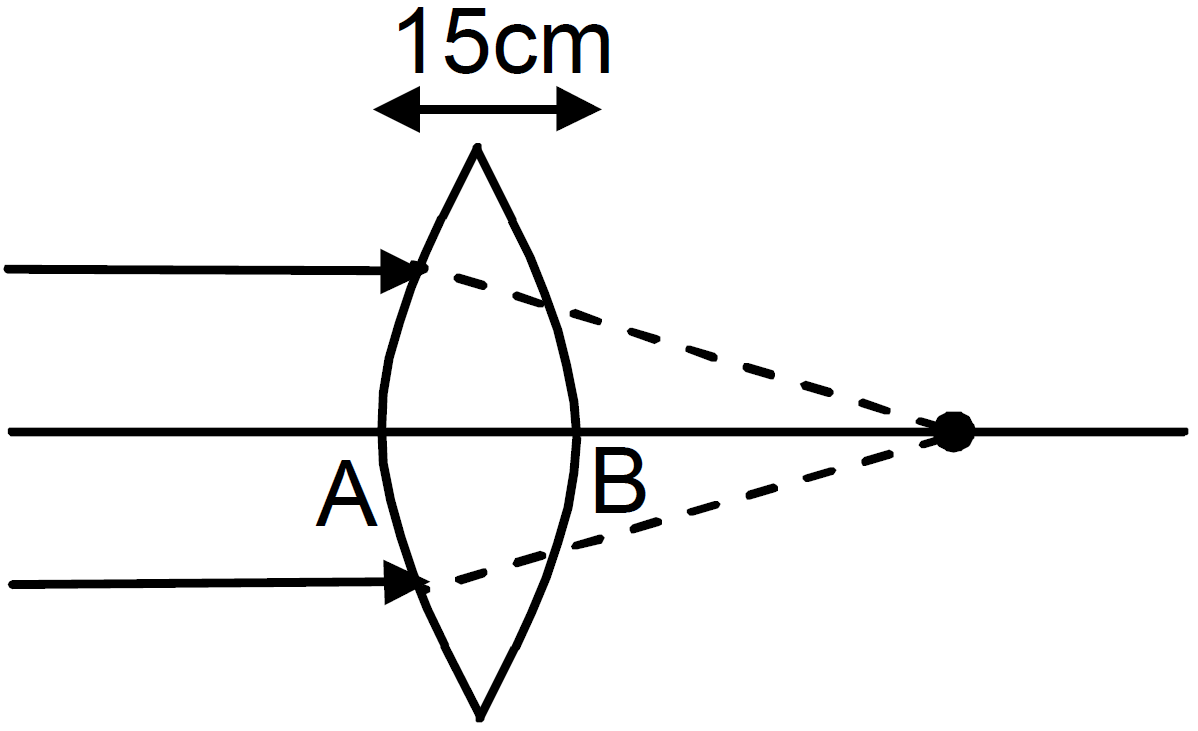
A biconvex thick lens is constructed with glass $(\mu=1.50)$ Each of the surfaces has a radius of 10cm and the thickness at the middle is 5cm. Locate the image of an object placed far away from the lens.
Answer

$\text{R}_1=\text{R}_2=10\text{cm}, \ \text{t}=5\text{cm}, \ \text{u}=-\infty$
For the first refraction, (at A)$\frac{\mu_{\text{g}}}{\text{v}}-\frac{\mu_{\text{a}}}{\text{u}}=\frac{\mu_{\text{g}}-\mu_{\text{a}}}{\text{R}_1}$
$\Rightarrow \frac{1.5}{\text{v}}-\Big(-\frac{1}{\infty}\Big)=\frac{1.5-1}{10}$
$\Rightarrow \frac{1.5}{\text{v}}=\frac{0.5}{10}$
$\Rightarrow\text{v}=30\text{cm}$
Again, for $2^{nd}$ surface, u = (30 - 5) = 25cm (virtual object) $R_2 = -10cm$
So, $\frac{1}{\text{v}}-\frac{15}{25}=\frac{-0.5}{-10}\Rightarrow\text{v}=9.1\text{cm.}$ So, the image is formed 9.1cm further from the $2^{nd}$ surface of the lens.
View full question & answer
Question 45 Marks
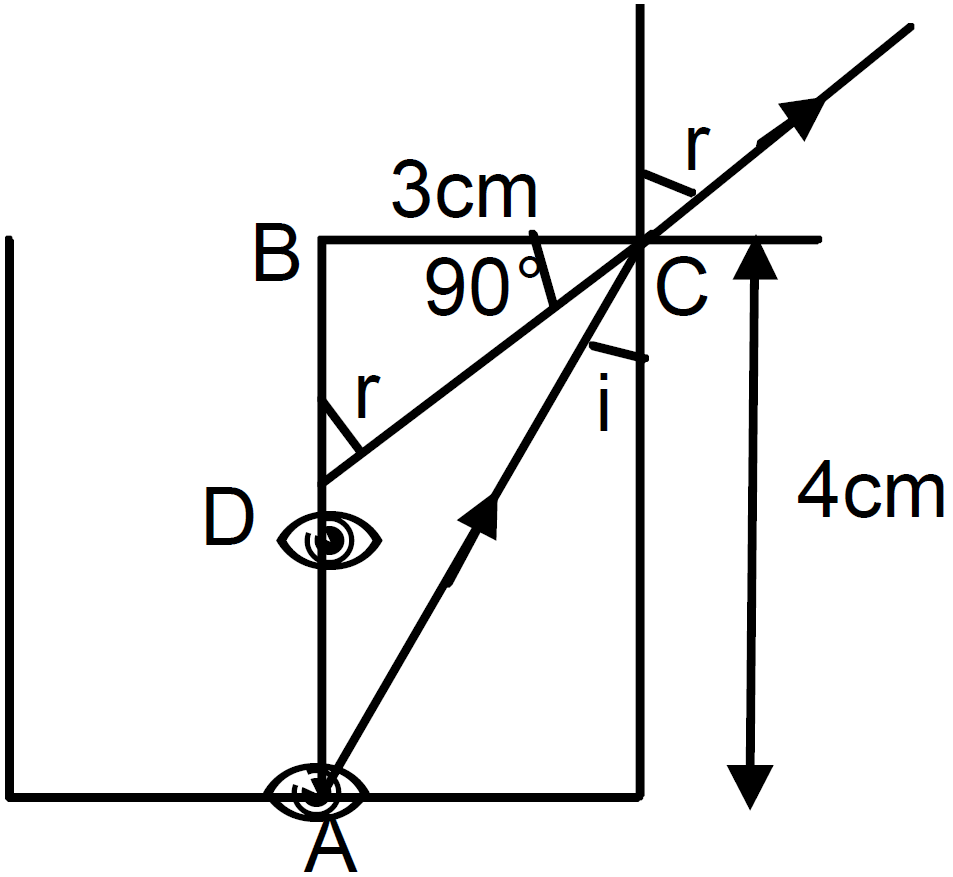
A small object is placed at the centre of the bottom of a cylindrical vessel of radius 3cm and height 4cm filled completely with water. Consider the ray leaving the vessel through a corner. Suppose this ray and the ray along the axis of the vessel are used to trace the image. Find the apparent depth of the image and the ratio of real depth to the apparent depth under the assumptions taken. Refractive index of water = 1.33
Answer
According to the figure, $\frac{\text{x}}{3}=\cot\text{r} \ ...(1)$ Again, $\frac{\sin\text{i}}{\sin\text{r}}=\frac{1}{1.33}=\frac{3}{4}$$\Rightarrow\sin\text{r}=\frac{4}{3}\sin\text{i}=\frac{4}{3}\times\frac{3}{5}=\frac{4}{5} \ \Big(\text{because}\sin\text{i}=\frac{\text{BC}}{\text{AC}}=\frac{3}{5}\Big)$
$\Rightarrow\cot\text{r}=\frac{3}{4} \ ...(2)$
From (1) and (2)$\Rightarrow\frac{\text{x}}{3}=\frac{3}{4}$
$\Rightarrow\text{x}=\frac{9}{4}=2.25\text{cm}.$
$\therefore \ $ Ratio of real and apparent depth = 4 : (2.25) = 1.78
View full question & answer
Question 55 Marks
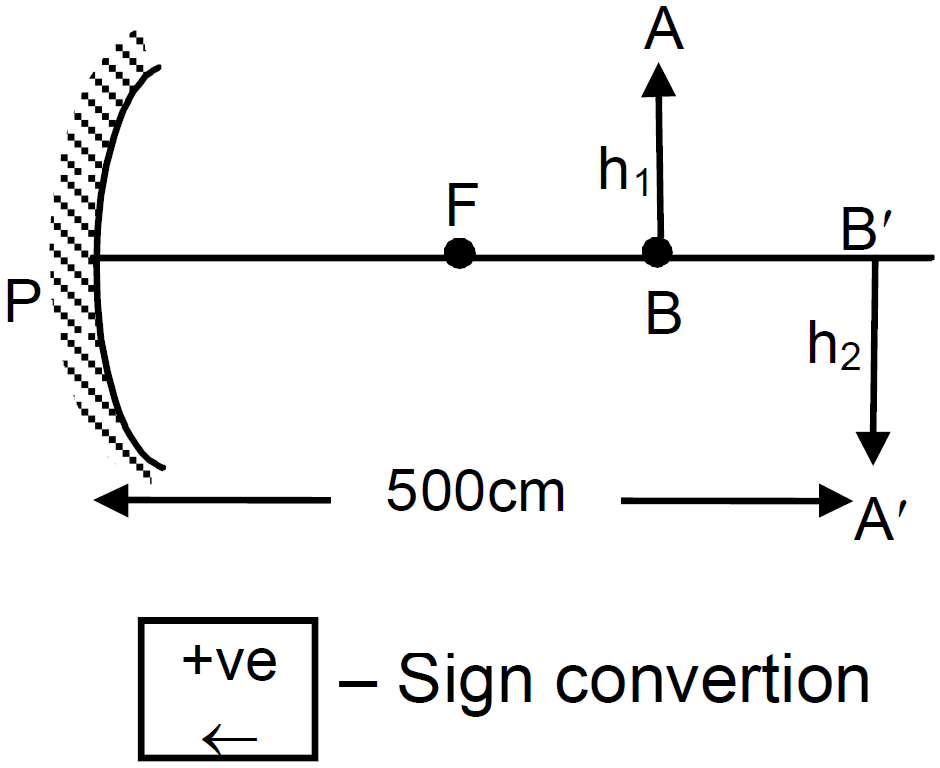
A concave mirror forms an image of 20cm high object on a screen placed 5.0m away from the mirror. The height of the image is 50cm. Find the focal length of the mirror and the distance between the mirror and the object.
Answer

Given that, $H_1 = 20cm, v = -5m = -500cm, h_2 = 50cm$
Since, $\frac{-\text{v}}{\text{u}}=\frac{\text{h}_2}{\text{h}_1}$ or
$\frac{500}{\text{u}}=-\frac{50}{20}$ (because the image in inverted) or
$\text{u}=-\frac{500\times2}{5}=-200\text{cm}=-2\text{m}$$\frac{1}{\text{v}}+\frac{1}{\text{u}}=\frac{1}{\text{f}}$ or $\frac{1}{-5}+\frac{1}{-2}=\frac{1}{\text{f}}$
or $\text{f}=\frac{-10}{7}=-1.44\text{m}$ So, the focal length is 1.44m.
View full question & answer
Question 65 Marks
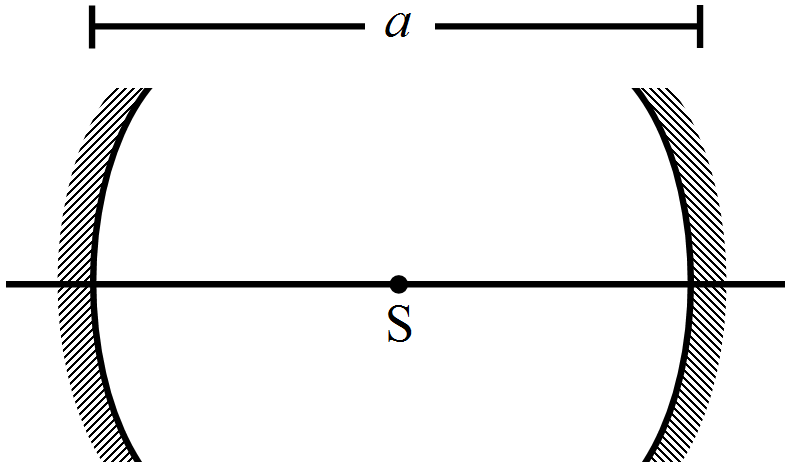
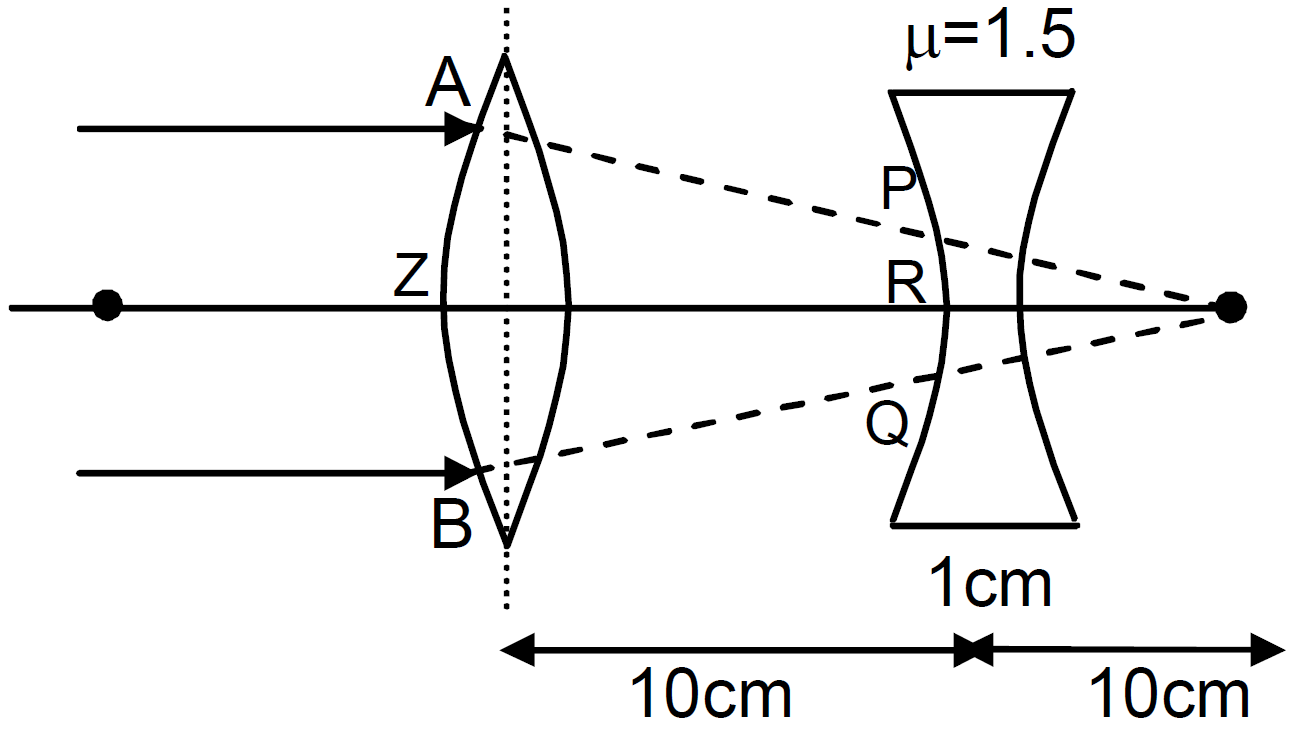
A point source S is placed midway between two converging mirrors having equal focal length f. Find the values of d for which only one image is formed.
Answer

Both the mirrors have equal focal length f.
They will produce one image under two conditions.
Case I: When the source is at distance ‘2f’ from each mirror i.e. the source is at centre of curvature of the mirrors, the image will be produced at the same point S. So, d = 2f + 2f = 4f.
Case II: When the source S is at distance ‘f’ from each mirror, the rays from the source after reflecting from one mirror will become parallel and so these parallel rays after the reflection from the other mirror the object itself. So, only sine image is formed.
Here, d = f + f = 2f
View full question & answer
Question 75 Marks
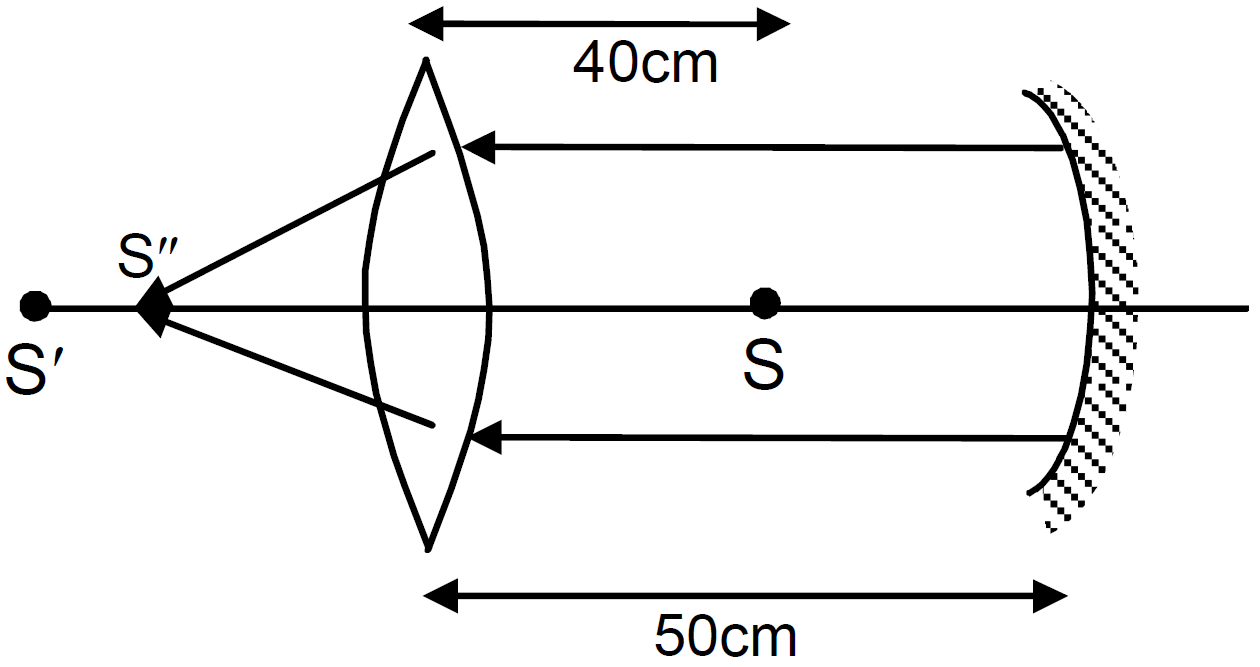
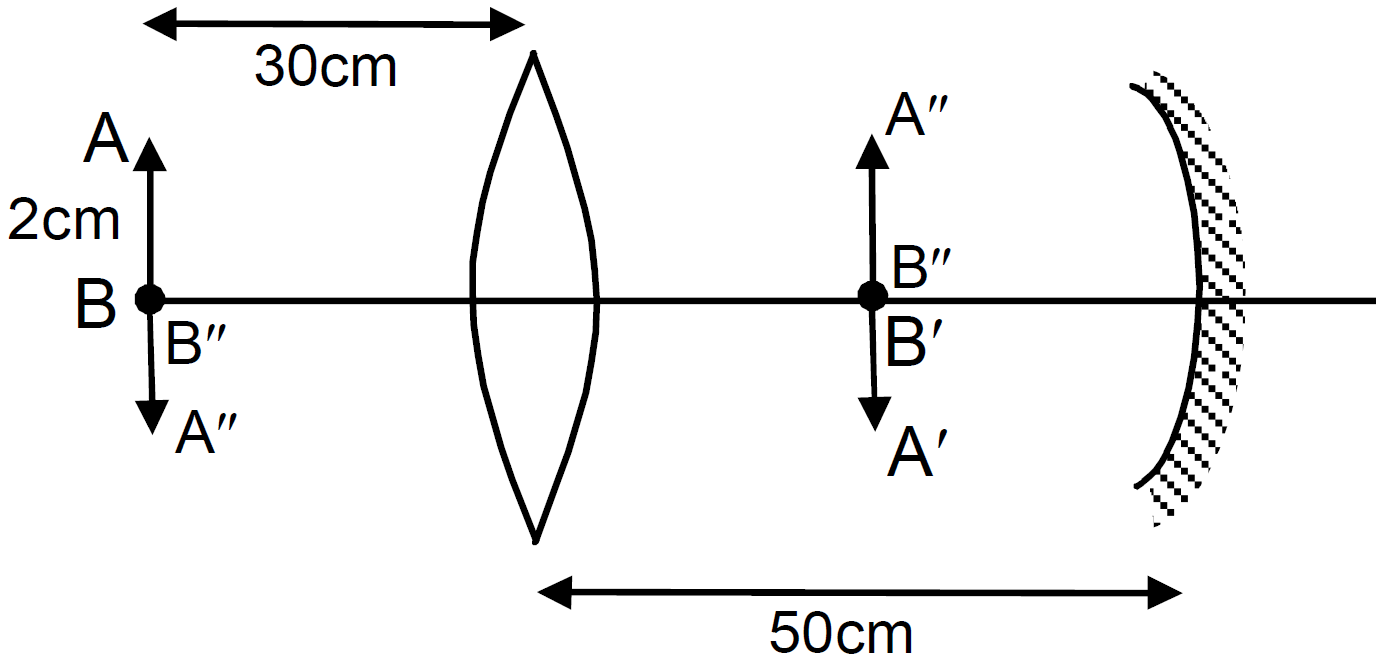
A converging lens of focal length 15cm and a converging mirror of focal length 10cm are placed 50cm apart with common principal axis. A point source is placed in between the lens and the mirror at a distance of 40cm from the lens. Find the locations of the two images formed.
Answer
The object is placed in the focus of the converging mirror. There will be two images.
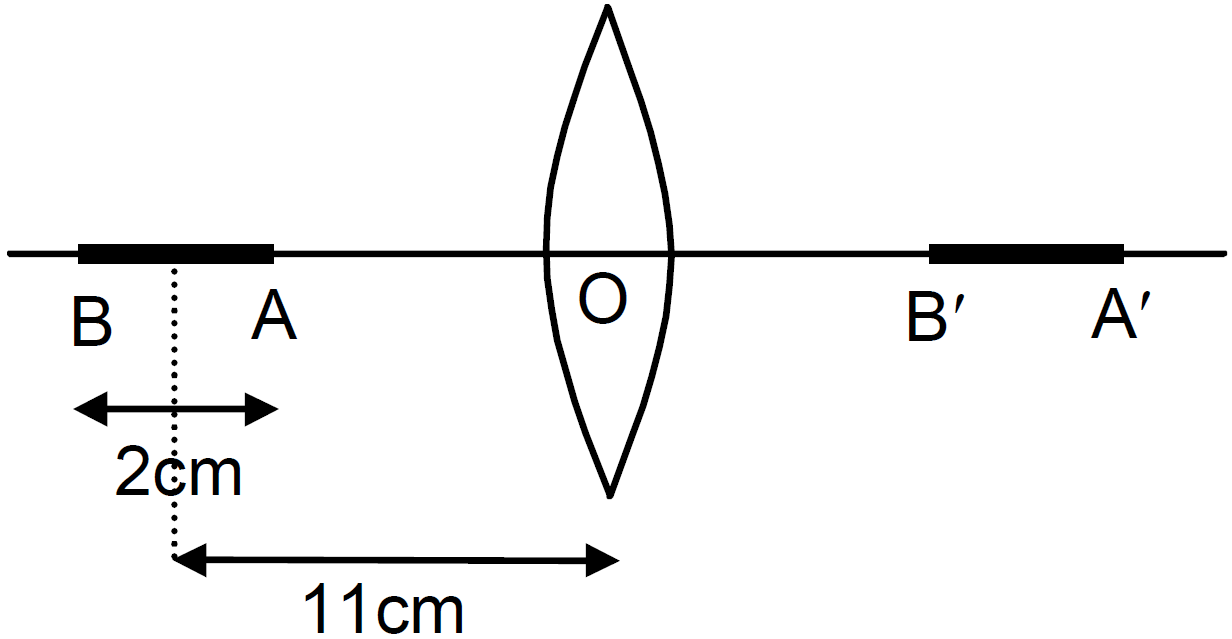
  1. One due to direct transmission of light through lens.
  2. One due to reflection and then transmission of the rays through lens.
Case I: (S') For the image by direct transmission, u = -40cm, f = 15cm$\Rightarrow\frac{1}{\text{v}}-\frac{1}{\text{u}}=\frac{1}{\text{f}}\Rightarrow\frac{1}{\text{v}}=\frac{1}{15}+\frac{1}{-40}$
$\Rightarrow\text{v}=24\text{cm}$ (left of lens)
Case II: (S'') Since, the object is placed on the focus of mirror, after reflection the rays become parallel for the lens. So, $\text{u}=\infty$$\Rightarrow\text{f}=15\text{cm}$
$\Rightarrow\frac{1}{\text{v}}-\frac{1}{\text{u}}=\frac{1}{\text{f}}\Rightarrow \text{v}=15\text{cm}$ (left of lens).
View full question & answer
Question 85 Marks
A pin of length 2.0cm lies along the principal axis of a converging lens, the centre being at a distance of 11cm from the lens. The focal length of the lens is 6cm. Find the size of the image.
Answer
Now we have to calculate the image of A and B. Let the images be A',B'. So, length of A'B' = size of image. For A, u = -10cm, f = 6cm Since, $\frac{1}{\text{v}}-\frac{1}{\text{u}}=\frac{1}{\text{f}}​​\Rightarrow\frac{1}{\text{v}}-\frac{1}{-10}=\frac{1}{6}$ ⇒ v = 15cm = OA' For B, u = -12cm, f = 6cm Again, $\Rightarrow\frac{1}{\text{v}}-\frac{1}{\text{u}}=\frac{1}{\text{f}}​​\Rightarrow\frac{1}{\text{v}}=\frac{1}{6}-\frac{1}{12}$ ⇒ v = 12cm = OB'$\therefore$ A'B' = OA' - OB' = 15 - 12 = 3cm.
So, size of image = 3cm.
View full question & answer
Question 95 Marks
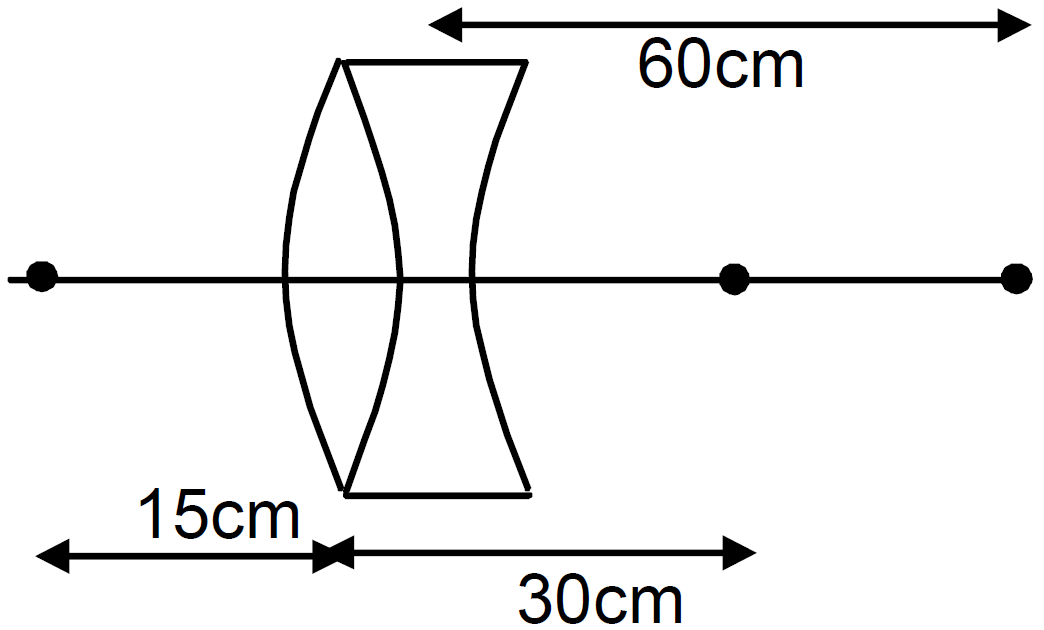
A diverging lens of focal length 20cm and a converging lens of focal length 30cm are placed 15cm apart with their principal axes coinciding. Where should an object be placed on the principal axis so that its image is formed at infinity?
Answer
Given that, $f_1 =$ focal length of converging lens = 30cm
$f_2 =$ focal length of diverging lens = -20cm and
$d =$ distance between them = 15cm
Let, $F =$ equivalent focal length So,
$\therefore \ \frac{1}{\text{F}}=\frac{1}{\text{f}_1}+\frac{1}{\text{f}_2}-\frac{\text{d}}{\text{f}_1\text{f}_2}$
$\Rightarrow\frac{1}{30}+\Big(-\frac{1}{20}\Big)-\Big(\frac{15}{30(-200)}\Big)=\frac{1}{120}$
$\Rightarrow\text{F}=120\text{cm}$
$⇒$ The equivalent lens is a converging one.
Distance from diverging lens so that emergent beam is parallel (image at infinity),
$\text{d}_1=\frac{\text{dF}}{\text{f}_1}=\frac{15\times120}{30}=60\text{cm}$
It should be placed 60cm left to diverging lens.
$⇒$ Object should be placed (120 - 60) = 60cm from diverging lens.
Similarly, $\text{d}_2=\frac{\text{dF}}{\text{f}_2}=\frac{15\times120}{20}=90\text{cm}$
So, it should be placed 90cm right to converging lens.
$⇒$ Object should be placed $(120 + 90) = 210$cm right to converging lens.
View full question & answer
Question 105 Marks
A particle executes a simple harmonic motion of amplitude 1.0cm along the principal axis of a convex lens of focal length 12cm. The mean position of oscillation is at 20cm from the lens. Find the amplitude of oscillation of the image of the particle.
Answer

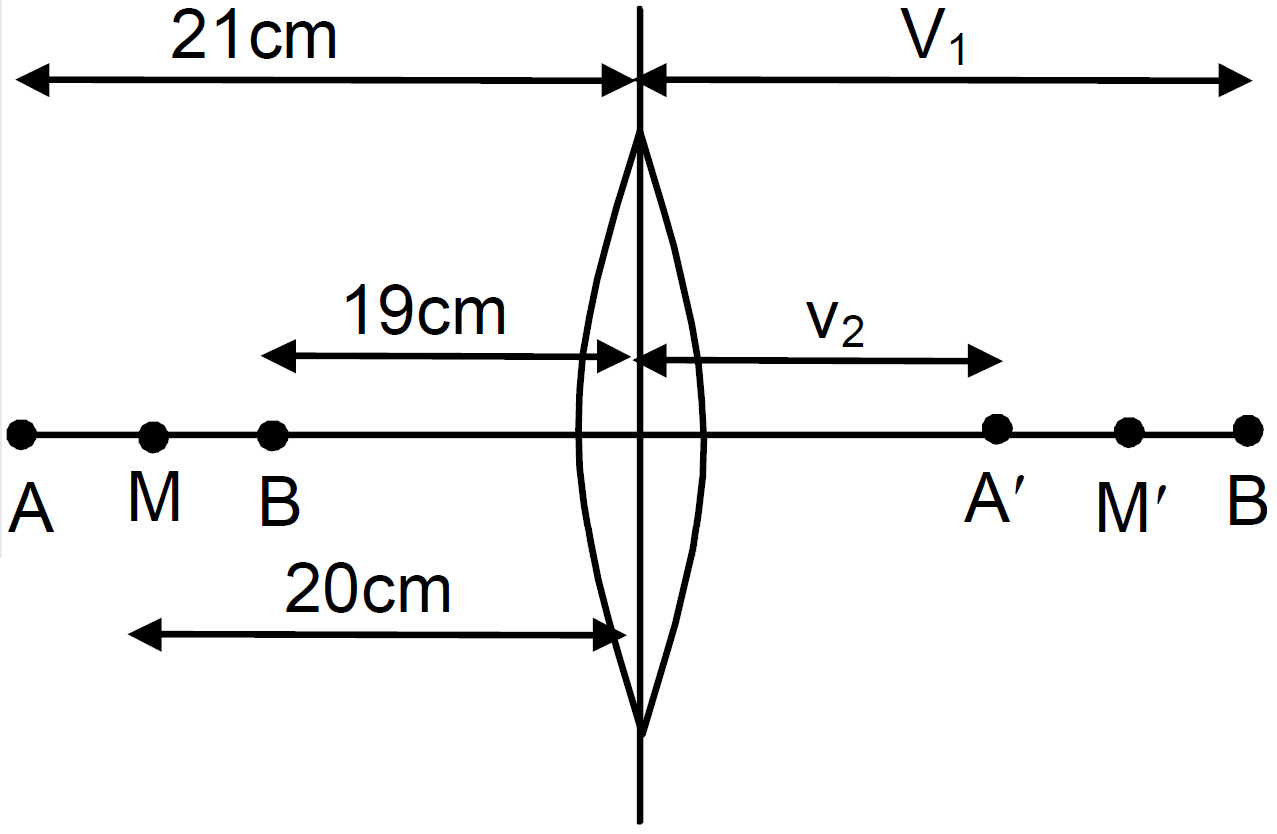
When the object is at 19cm from the lens, let the image will be at, $v_1.$
$\Rightarrow\frac{1}{\text{v}_1}-\frac{1}{\text{u}_1}=\frac{1}{\text{f}}​​\Rightarrow\frac{1}{\text{v}_1}-\frac{1}{-19}=\frac{1}{12}$
$\Rightarrow\text{v}_1=32.57\text{cm}$
Again, when the object is at 21cm from the lens, let the image will be at, $v_2.$
$\Rightarrow\frac{1}{\text{v}_2}-\frac{1}{\text{u}_2}=\frac{1}{\text{f}}​​\Rightarrow\frac{1}{\text{v}_2}-\frac{1}{21}=\frac{1}{12}$
$\Rightarrow\text{v}_2=28\text{cm}$
$\therefore$ Amplitude of vibration of the image is A $=\frac{\text{A}'\text{B}'}{2}=\frac{\text{v}_1-\text{v}_2}{2}$
$\Rightarrow\text{A}=\frac{32.57}{2}=2.285\text{cm}$
View full question & answer
Question 115 Marks
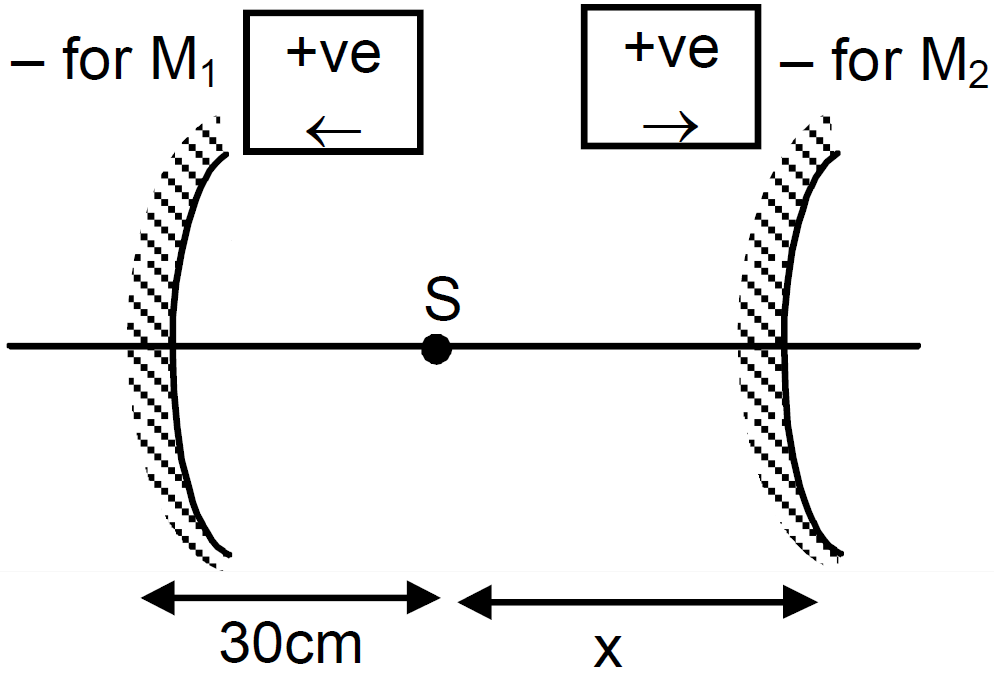
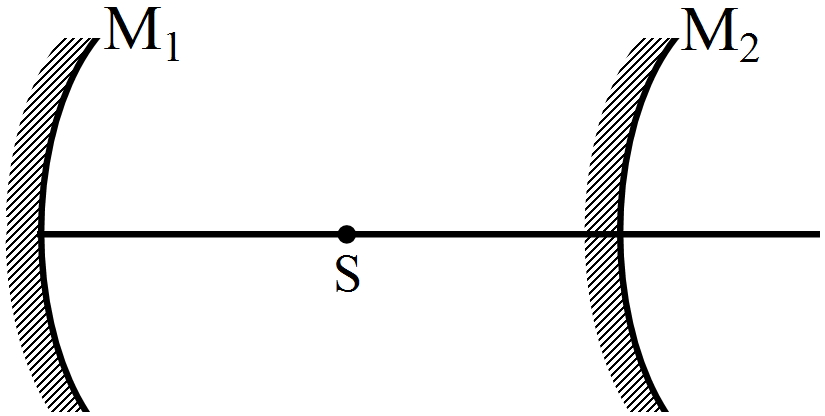
A converging mirror $M_1,$ a point source S and a diverging mirror $M_2$ are arranged as shown in figure. The source is placed at a distance of 30cm from $M_1$. The focal length of each of the mirrors is 20cm. Consider only the images formed by a maximum of two reflections. It is found that one image is formed on the source itself.
  1. Find the distance between the two mirrors.
  2. Find the location of the image formed by the single reflection from $M_2.$
Answer

  1. As shown in figure, for $1^{st}$ reflection in $M_1, u = -30cm, f = -20cm$
$\Rightarrow\frac{1}{\text{v}}+\frac{1}{-30}=-\frac{1}{20}\Rightarrow\text{v}=-60\text{cm}.$
So, for $2^{nd}$ reflection in $M_2$
$u = 60 - (30 + x) = 30 - x$
$v = -x; f = 20cm$
$\Rightarrow\frac{1}{30-\text{x}}-\frac{1}{\text{x}}=\frac{1}{20}$
$\Rightarrow \frac{\text{x}-30+\text{x}}{\text{x}(30-\text{x})}=\frac{1}{20}$
$\Rightarrow40\text{x}-600=30\text{x}-\text{x}^2$
$\Rightarrow\text{x}^2+10\text{x}-600=0$
$\Rightarrow\text{x}=\frac{10\pm50}{2}=\frac{40}{2}=20\text{cm}$ or $-30\text{cm}$
$\therefore$ Total distance between the two lines is 20 + 30 = 50cm.
View full question & answer
Question 125 Marks
A double convex lens has focal length 25cm. The radius of curvature of one of the surfaces is double of the other. Find the radii, if the refractive index of the material of the lens is 1.5.
Answer

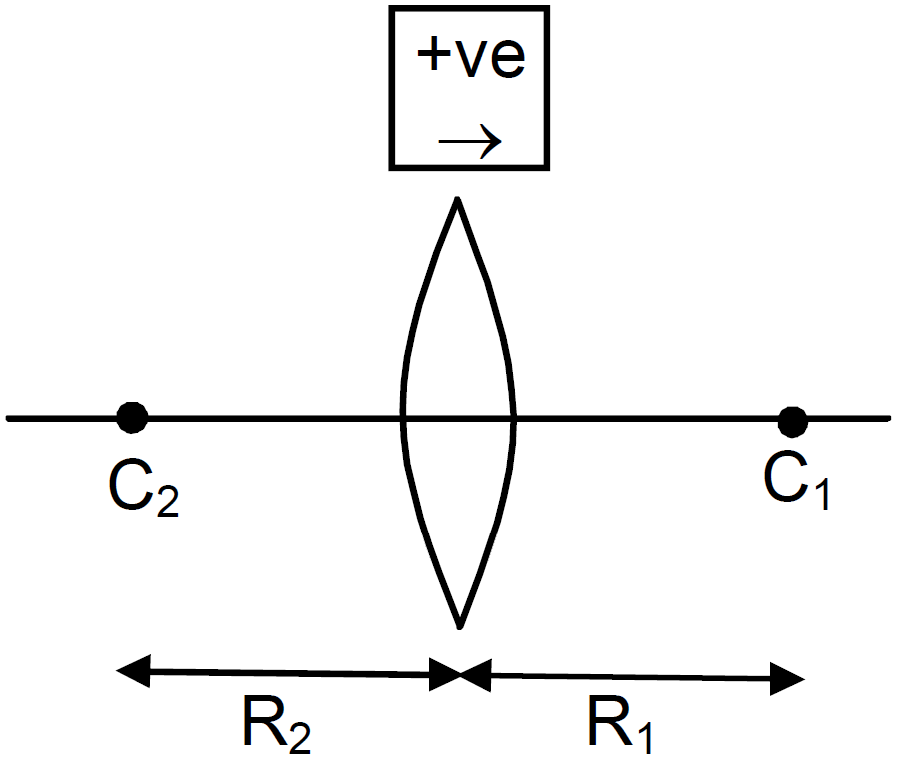
For the double convex lens $f = 25cm, R_1= R and R_2 = -2R$ (sign convention)$\frac{1}{\text{f}}=(\mu-1)\Big(\frac{1}{\text{R}_1}-\frac{1}{\text{R}_2}\Big)$
$\Rightarrow\frac{1}{25}=(15-1)\Big(\frac{1}{\text{R}_1}-\frac{1}{-2\text{R}}\Big)=0.5\Big(\frac{3\text{R}}{2}\Big)$
$\Rightarrow\frac{1}{25}=\frac{3}{4}\frac{1}{\text{R}}\Rightarrow\text{R}=18.75\text{cm}$
$R_1= 18.75cm, R_2 = 2R = 37.5cm.$
View full question & answer
Question 135 Marks
A point object is placed at a distance of 15cm from a convex lens. The image is formed on the other side at a distance of 30cm from the lens. When a concave lens is placed in contact with the convex lens, the image shifts away further by 30cm. Calculate the focal lengths of the two lenses.
Answer

Let u = object distance from convex lens = -15cm
$v_1 =$ image distance from convex lens when alone = 30cm
$f_1 =$ focal length of convex lens.
Now, $\therefore \ \frac{1}{\text{v}_1}+\frac{1}{\text{u}}=\frac{1}{\text{f}_1}$
or, $\frac{1}{\text{f}_1}=\frac{1}{30}-\frac{1}{-15}=\frac{1}{30}+\frac{1}{15}$
or, $\text{f}_1=10\text{cm}$
Again, Let v = image (final) distance from concave lens $= +(30 + 30) = 60cm$
$v_1 =$ object distance from concave lens = +30m
$f_2 =$ focal length of concave lens
Now, $\therefore \ \frac{1}{\text{v}}-\frac{1}{\text{v}_1}=\frac{1}{\text{f}_1}$
Or, $=\frac{1}{\text{f}_1}=\frac{1}{60}-\frac{1}{30}\Rightarrow\text{f}_2=-60\text{cm}.$
So, the focal length of convex lens is 10cm and that of concave lens is 60cm.
View full question & answer
Question 145 Marks
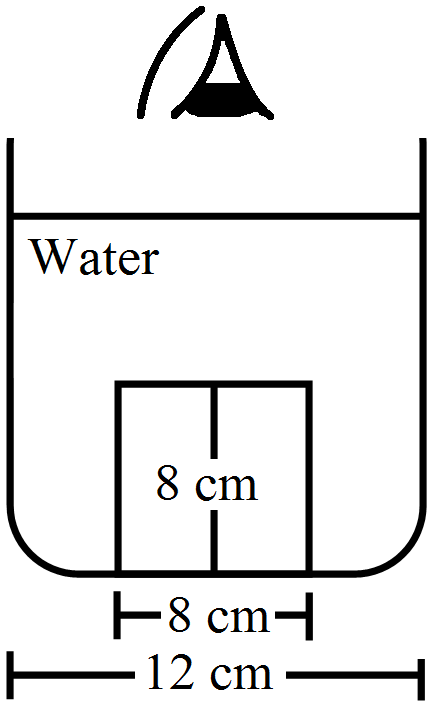
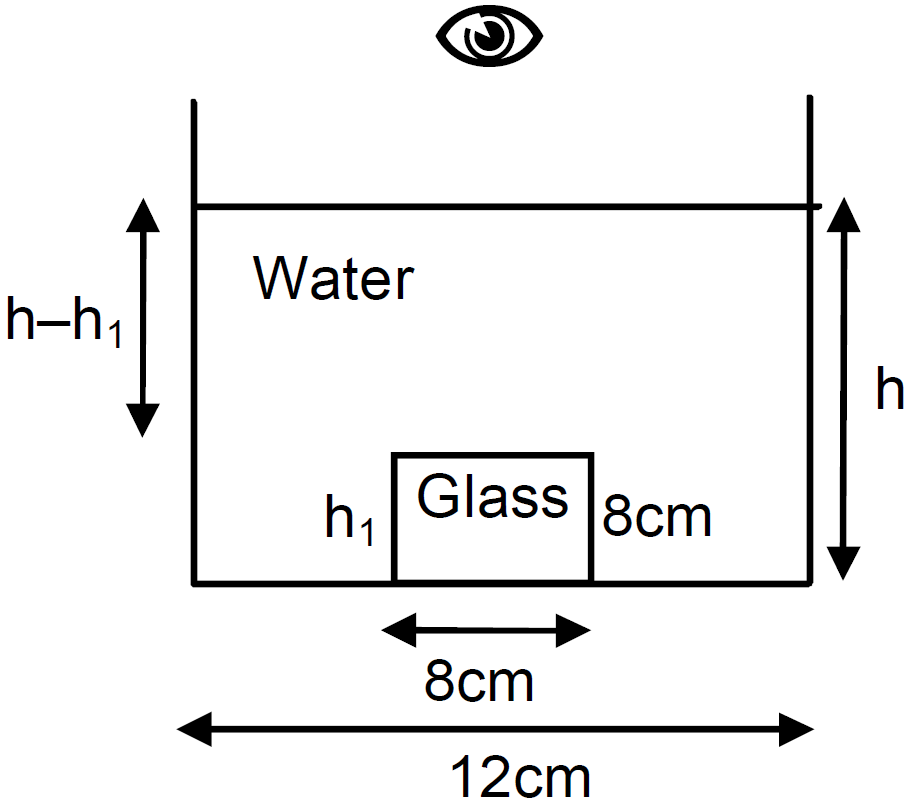
A cylindrical vessel of diameter 12cm contains $800\pi\text{cm}^3$ of water. A cylindrical glass piece of diameter 8.0 cm and height 8.0cm is placed in the vessel. If the bottom of the vessel under the glass piece is seen by the paraxial rays, locate its image. The index of refraction of glass is 1.50 and that of water is 1.33.
Answer

Given $r = 6 cm, r_1 = 4cm, h_1 = 8cm$ Let, h = final height of water column.
The volume of the cylindrical water column after the glass piece is put will be,$\pi\text{r}^2\text{h}=800\pi+\pi\text{r}_1{^2\text{h}_1}$
or $\text{r}^2\text{h}=800+\text{r}_1{^2\text{h}_1}$ or $6^2\text{h}=800+4^2\times8$$\text{h}=\frac{800+128}{36}=\frac{928}{36}$
$=25.7\text{cm}$
There are two shifts due to glass block as well as water. So, $\Delta\text{t}_1=\Big(1-\frac{1}{\mu_0}\Big)\text{t}_0=\bigg(1-\frac{1}{\frac{3}{2}}\bigg)8=2.26\text{cm}$ And, $\Delta\text{t}_2=\Big(1-\frac{1}{\mu_{\text{w}}}\Big)\text{t}_{\text{w}}=\bigg(1-\frac{1}{\frac{4}{3}}\bigg)(25.7-8)=4.44\text{cm}$ Total shift = (2.66 + 4.44)cm = 7.1cm above the bottom.
View full question & answer
Question 155 Marks
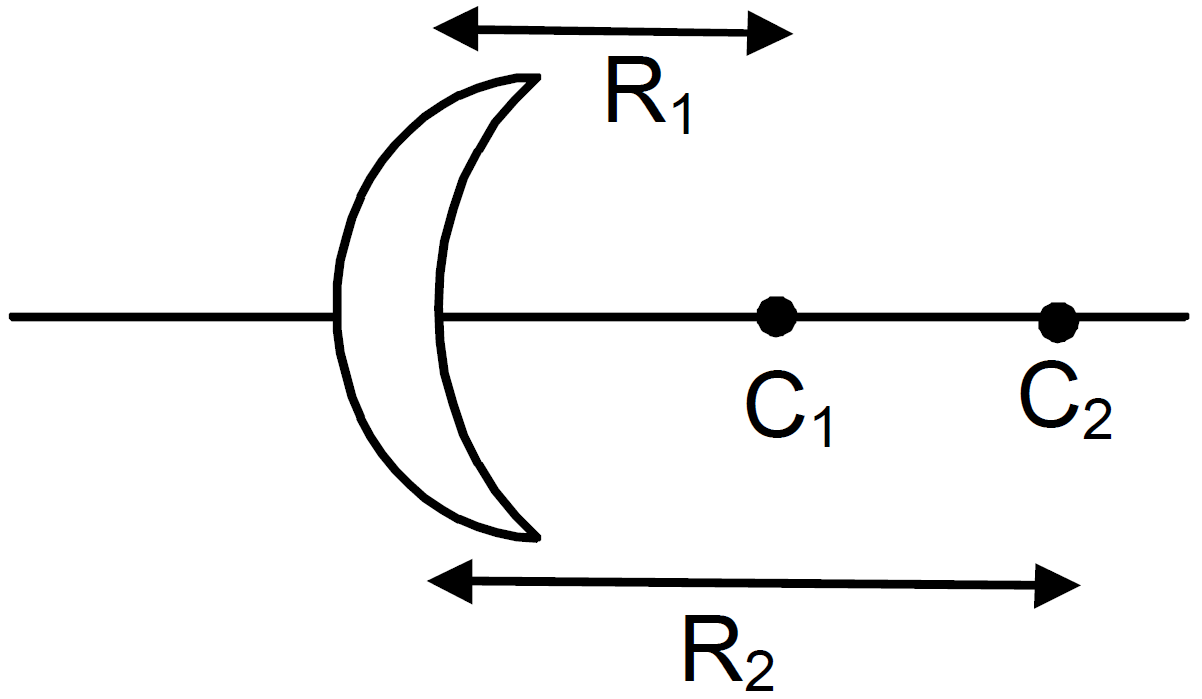
The radii of curvature of a lens are +20cm and +30cm. The material of the lens has a refracting index 1.6. Find the focal length of the lens.
  1. If it is placed in air.
  2. If it is placed in water $(\mu=1.33).$
Answer
$\text{R}_1=+20\text{cm}; \ \text{R}_2=+30\text{cm}; \ \mu=1.6$
  1. If placed in air:
$\frac{1}{\text{f}}=(\mu_{\text{g}}-1)\Big(\frac{1}{\text{R}_1}-\frac{1}{\text{R}_2}\Big)=\Big(\frac{1.6}{1}-1\Big)\Big(\frac{1}{20}-\frac{1}{30}\Big)$
$\Rightarrow\text{f}=\frac{60}{6}=100\text{cm}$
  1. If placed in water:
$\frac{1}{\text{f}}=(\mu_{\text{w}}-1)\Big(\frac{1}{\text{R}_1}-\frac{1}{\text{R}_2}\Big)$
$\Rightarrow \Big(\frac{1.6}{1.33}-1\Big)\Big(\frac{1}{20}-\frac{1}{30}\Big)$
$\Rightarrow \Big(\frac{1.60}{1.33}-1\Big)\Big[\frac{1}{6}\Big]$
$=\frac{28}{133\times60}\simeq\frac{1}{300}$
$\Rightarrow\text{f}=300\text{cm}$
View full question & answer
Question 165 Marks
A ball is kept at a height h above the surface of a heavy transparent sphere made of a material of refractive index $\mu.$ The radius of the sphere is R. At t = 0, the ball is dropped to fall normally on the sphere. Find the speed of the image formed as a function of time for $\text{t}<\sqrt{\frac{2\text{h}}{\text{g}}}.$ Consider only the image by a single refraction.
Answer
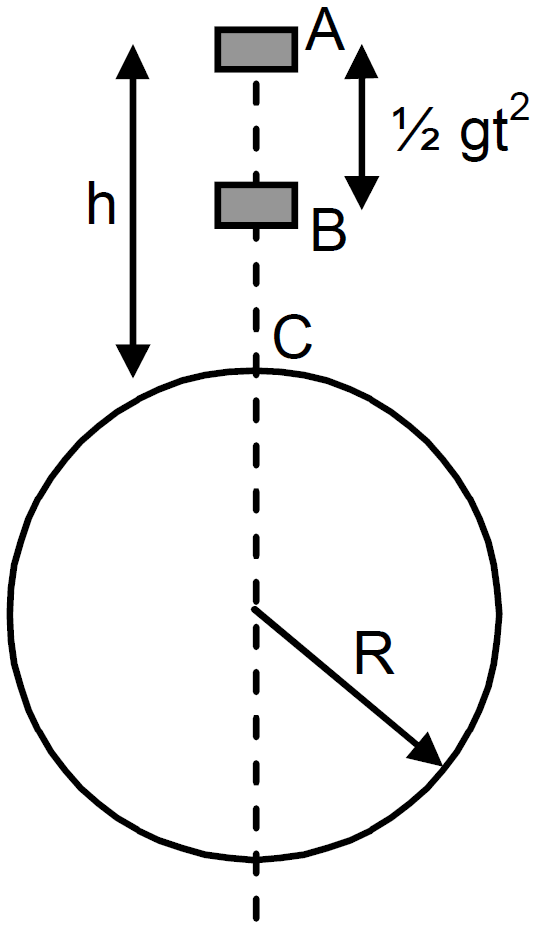
Let us assume that it has taken time ‘t’ from A to B.$\therefore \ \text{AB}=\frac{1}{2}\text{gt}^2$
$\therefore \ \text{BC}= \text{h}-\frac{1}{2}\text{gt}^2$
This is the distance of the object from the lens at any time ‘t’. Here, $\text{u}=-\Big(\text{h}-\frac{1}{2}\text{gt}^2\Big)$$\mu_2=\mu$ (given) and $\mu_1=\text{i}$ (air)
So, $\Rightarrow\frac{\mu}{\text{v}}=\frac{1}{-\Big(\text{h}-\frac{1}{2}\text{gt}^2\Big)}=\frac{\mu-1}{\text{R}}$$\Rightarrow\frac{\mu}{\text{v}}=\frac{\mu-1}{\text{R}}=\frac{1}{\Big(\text{h}-\frac{1}{2}\text{gt}^2\Big)}=\frac{(\mu-1)\Big(\text{h}-\frac{1}{2}\text{gt}^2\Big)-\text{R}}{\text{R}\Big(\text{h}-\frac{1}{2}\text{gt}^2\Big)}$
So, v = image distance at any time ‘t $=\frac{\mu\text{R}\Big(\text{h}-\frac{1}{2}\text{gt}^2\Big)}{(\mu-1)\Big(\text{h}-\frac{1}{2}\text{gt}^2\Big)-\text{R}}$ So, velocity of the image $=\text{V}=\frac{\text{dv}}{\text{dt}}=\frac{\text{d}}{\text{dt}}\begin{bmatrix}\frac{\mu\text{R}\Big(\text{h}-\frac{1}{2}\text{gt}^2\Big)}{(\mu-1)\Big(\text{h}-\frac{1}{2}\text{gt}^2\Big)-\text{R}} \end{bmatrix}=\frac{\mu\text{R}^2\text{gt}}{(\mu-1)\Big(\text{h}-\frac{1}{2}\text{gt}^2\Big)-\text{R}}$ (can be found out).
View full question & answer
Question 175 Marks
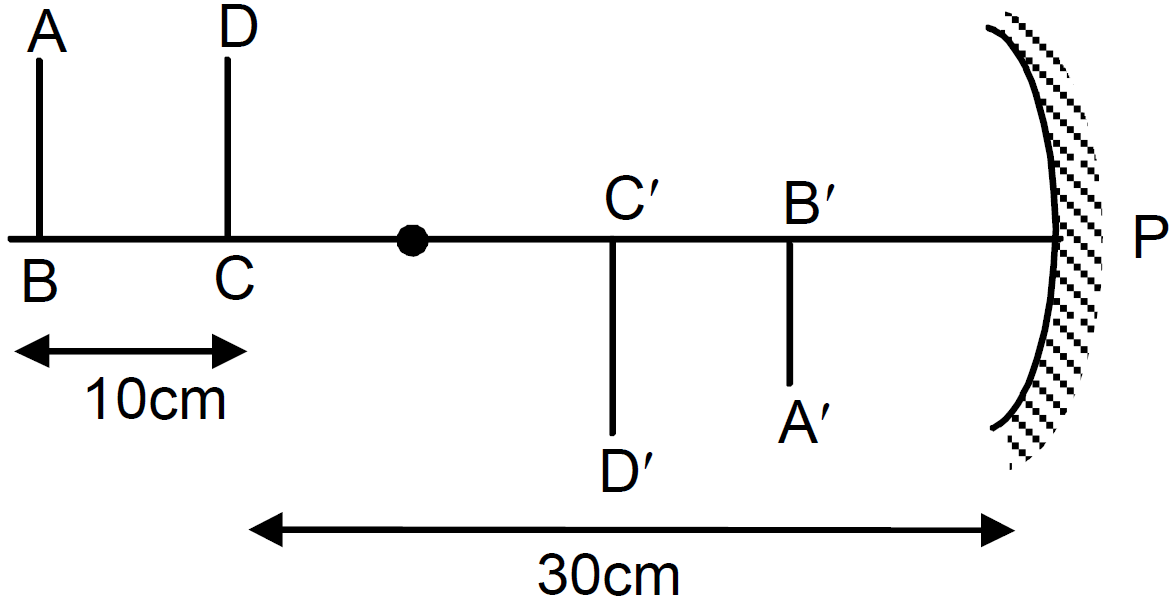
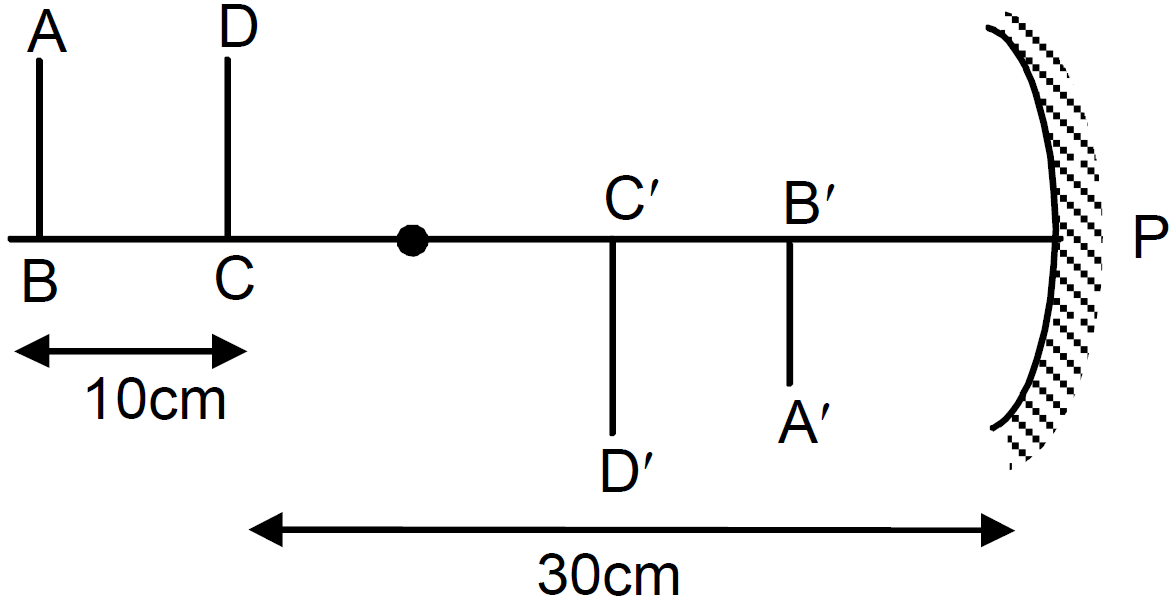
A U-shaped wire is placed before a concave mirror having radius of curvature 20cm. Find the total length of the image.
Answer
$\text{R}=20\text{cm}, \ \text{f}=\frac{\text{R}}{2}=-10\text{cm}$
For part AB, PB = 30 + 10 = 40cm So, $\text{u}=-40\text{cm}$$\Rightarrow\frac{1}{\text{v}}=\frac{1}{\text{f}}-\frac{1}{\text{u}}=-\frac{1}{10}-\Big(\frac{1}{-40}\Big)=-\frac{3}{40}$
$\Rightarrow\text{v}=-\frac{40}{3}=-13.3\text{cm}$
So, PB' = 13.3cm$\text{m}=\frac{\text{A}'\text{B}'}{\text{AB}}=-\Big(\frac{\text{v}}{\text{u}}\Big)=-\Big(\frac{-13.3}{-40}\Big)=-\frac{1}{3}$
$\Rightarrow\text{A}'\text{B}'=-\frac{10}{3}=-3.33\text{cm}$
For part CD, PC = 30, So, u = -30cm$\frac{1}{\text{v}}=\frac{1}{\text{f}}-\frac{1}{\text{u}}=-\frac{1}{10}+\frac{1}{-30}=-\frac{1}{15}$
$\Rightarrow\text{v}=-15\text{cm}=\text{PC}'$
So, $\text{m}=\frac{\text{C}'\text{D}'}{\text{CD}}=-\frac{\text{v}}{\text{u}}=-\Big(\frac{-15}{-30}\Big)=-\frac{1}{2}$$\Rightarrow\text{C}'\text{D}'=5\text{cm}$
B'C' = PC' - PB' = 15 - 13.3 = 17cm So, total length A'B' + B'C' + C'D' = 3.3 + 1.7 + 5 = 10cm.
View full question & answer
Question 185 Marks
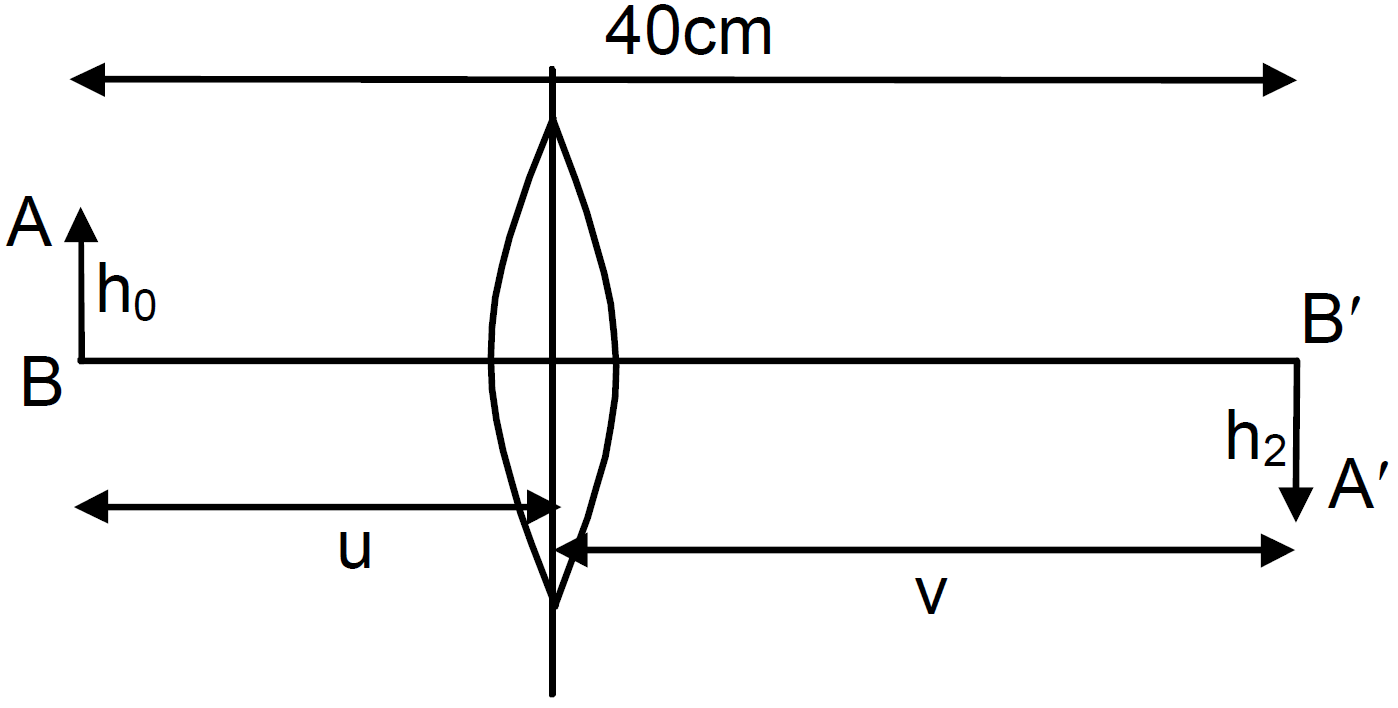
A pin of length 2.00cm is placed perpendicular to the principal axis of a converging lens. An inverted image of size 1.00cm is formed at a distance of 40.0cm from the pin. Find the focal length of the lens and its distance from the pin.
Answer

Given that, (-u) + v = 40cm = distance between object and image $h_0 = 2cm, h_i = 1cm$ Since $\frac{\text{h}_\text{i}}{\text{h}_0}=\frac{\text{v}}{-\text{u}}=$ magnification$\Rightarrow \frac{1}{2}=\frac{\text{v}}{-\text{u}}\Rightarrow\text{u}=-2\text{v} \ ...(1)$
Now, $\Rightarrow\frac{1}{\text{v}}-\frac{1}{\text{u}}=\frac{1}{\text{f}}​​\Rightarrow\frac{1}{\text{v}}+\frac{1}{2\text{v}}=\frac{1}{\text{f}}$$\Rightarrow\frac{3}{2\text{v}}=\frac{1}{\text{f}}\Rightarrow\text{f}=\frac{2\text{v}}{3} \ ...(2)$
Again, $(-\text{u})+\text{v}=40$$\Rightarrow3\text{v}=40\Rightarrow\text{v}=\frac{40}{3}\text{cm}$
$\therefore \ \text{f}=\frac{2\times40}{3\times3}=8.89\text{cm}=$ focal length
From eqn. (1) and (2) $u = -2v = -3f = -3(8.89) = 26.7cm =$ object distance.
View full question & answer
Question 195 Marks
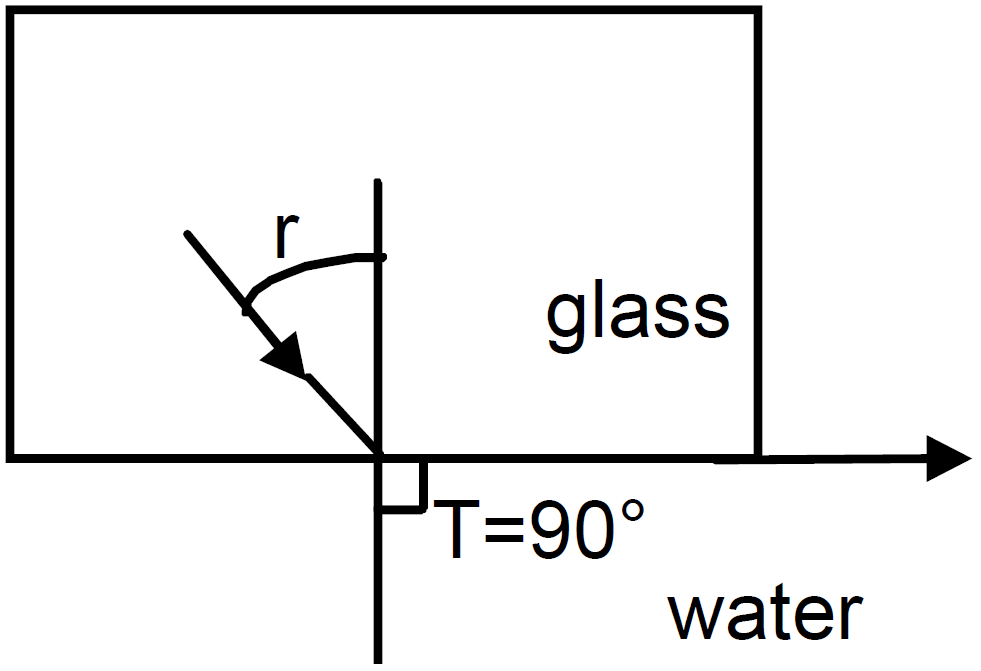
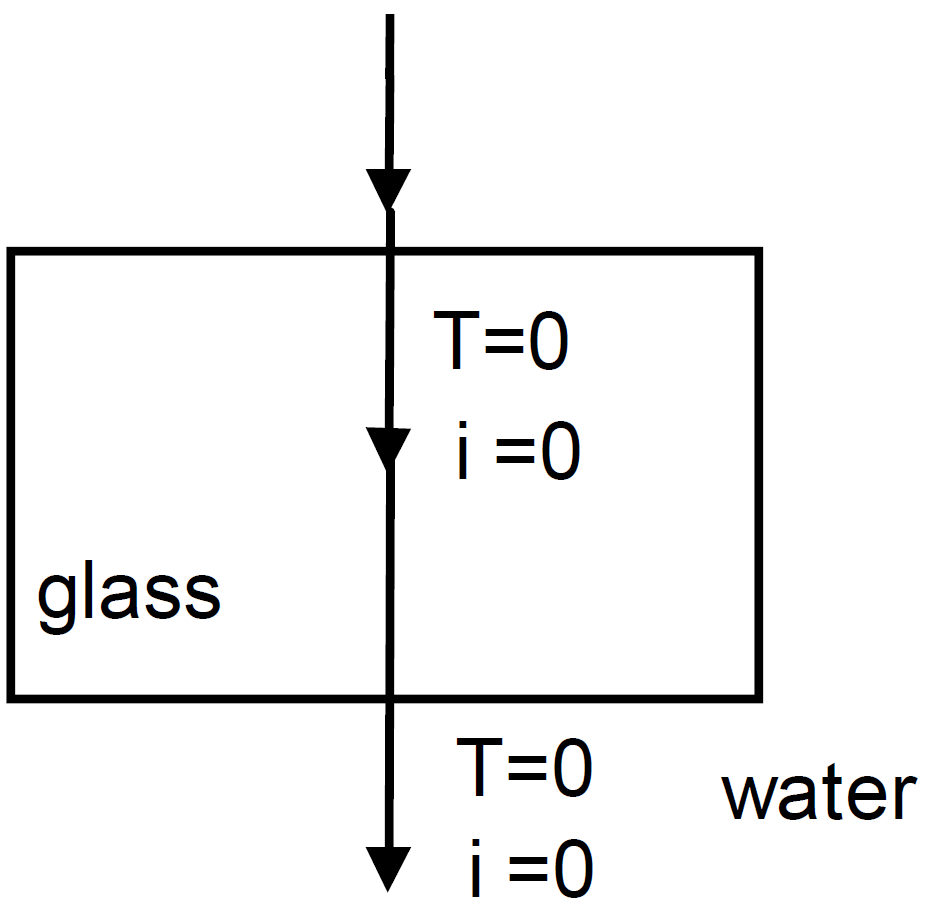
Light is incident from glass $(\mu=1.50)$ to water $(\mu=1.33).$ Find the range of the angle of deviation for which there are two angles of incidence.
Answer
$\mu_\text{g}=1.5=\frac{3}{2}; \ \mu_\text{w}=1.33=\frac{4}{3}$For two angles of incidence,
  1. When light passes straight through normal,
⇒ Angle of incidence = 0°, angle of refraction = 0°, angle of deviation = 0
  1. When light is incident at critical angle,
$\frac{\sin\theta_\text{C}}{\sin\text{r}}=\frac{\mu_{\text{w}}}{\mu_{\text{g}}}$ (since light passing from glass to water)
$\Rightarrow\sin\theta_\text{C}=\frac{8}{9}$
$\Rightarrow\sin^{-1}\Big(\frac{8}{9}\Big)=62.73^{\circ}$
$\therefore$ Angle of deviation $= 90^{\circ} - \theta_\text{C} = 90^{\circ}=\sin^{-1}\Big(\frac{8}{9}\Big)=\cos^{-1}\Big(\frac{8}{9}\Big)=37.27^{\circ}$
Here, if the angle of incidence is increased beyond critical angle, total internal reflection occurs and deviation decreases. So, the range of deviation is 0 to $\cos^{-1}\Big(\frac{8}{9}\Big).$
View full question & answer
Question 205 Marks
A particle is moving at a constant speed V from a large distance towards a concave mirror of radius R along its principal axis. Find the speed of the image formed by the mirror as a function of the distance x of the particle from the mirror.
Answer
Given that, u = distance of the object = -x f = focal length $=-\frac{\text{R}}{2}$ and, V = velocity of object $=\frac{\text{dx}}{\text{dt}}$ From mirror equation, $\frac{1}{-\text{x}}+\frac{1}{\text{v}}=-\frac{2}{\text{R}}$$\frac{1}{\text{v}}=-\frac{2}{\text{R}}+\frac{1}{\text{x}}=\frac{\text{R}-2\text{x}}{\text{R}\text{x}}\Rightarrow\text{v}=\frac{\text{Rx}}{\text{R}-2\text{x}}=$ Image distance
So, velocity of the image is given by,$\text{V}_1=\frac{\text{dv}}{\text{dt}}=\frac{\Big[\frac{\text{d}}{\text{dt}}(\text{xR})(\text{R}-2\text{x})\Big]-\Big[\frac{\text{d}}{\text{dt}}(\text{R}-2\text{x})(\text{xR})\Big]}{(\text{R}-2\text{x})^2}$
$=\frac{\text{R}\Big[\frac{\text{dx}}{\text{dt}}(\text{R}-2\text{x})\Big]-\Big[-2\frac{\text{d}}{\text{dt}}\text{x}\Big]}{(\text{R}-2\text{x})^2}=\frac{\text{R}[\text{v}(\text{R}-2\text{x})+2\text{vx}0}{(\text{R}-2\text{x})^2}$
$=\frac{\text{VR}^2}{(2\text{x}-\text{R})^2}=\frac{\text{R}\big[\text{VR}-2\text{xV}\big)+2\text{xV}}{(\text{R}-2\text{x})^2}$
View full question & answer
Question 215 Marks
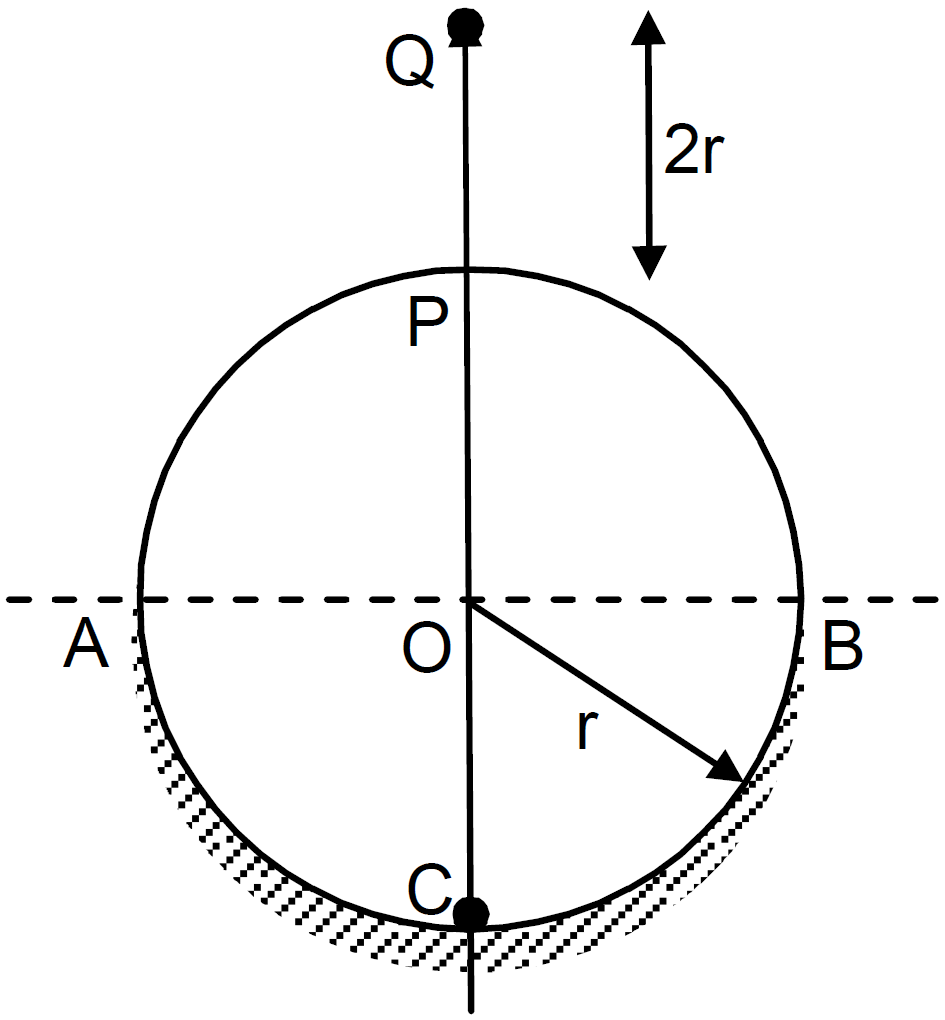
A hemispherical portion of the surface of a solid glass sphere $(\mu=1.5)$ of radius r is silvered to make the inner side reflecting. An object is placed on the axis of the hemisphere at a distance 3r from the centre of the sphere. The light from the object is refracted at the unsilvered part, then reflected from the silvered part and again refracted at the unsilvered part. Locate the final image formed.
Answer
As shown in the figure, OQ = 3r, OP = r So, PQ = 2r For refraction at APB We know, $\frac{\mu_2}{\text{v}}-\frac{\mu_1}{\text{u}}=\frac{\mu_2-\mu_1}{\text{R}}$$\Rightarrow\frac{1.5}{\text{v}}-\Big(\frac{1}{-2\text{r}}\Big)=\frac{0.5}{\text{r}}=\frac{1}{2\text{r}}$ [because u = -2r]
$\Rightarrow\text{v}=\infty$
For the reflection in concave mirror$\text{u}=\infty$
So, v = focal length of mirror $=\frac{\text{r}}{2}$ For the refraction of APB of the reflected image. Here, $\text{u}=\frac{-3\text{r}}{2}$$\frac{1}{\text{v}}-\frac{1.5}{\frac{-3\text{r}}{2}}=\frac{-0.5}{-\text{r}}$ $\big[\text{Here}, \ \mu_1=1.5 \ \text{and} \ \text{R}=-\text{r}\big]$
$\Rightarrow\text{v}=-2\text{r}$ As, negative sign indicates images are formed inside APB. So, image should be at C. So, the final image is formed on the reflecting surface of the sphere.
View full question & answer
Question 225 Marks
A converging lens of focal length 15cm and a converging mirror of focal length 10cm are placed 50cm apart. If a pin of length 2.0cm is placed 30cm from the lens farther away from the mirror, where will the final image form and what will be the size of the final image?
Answer

Given that, $f_1 = 15cm, F_m = 10cm, h_o = 2cm$
The object is placed 30cm from lens $\frac{1}{\text{v}}-\frac{1}{\text{u}}=\frac{1}{\text{f}}.$$\Rightarrow\text{v}=\frac{\text{uf}}{\text{u}+\text{f}}$
Since, u = -30cm and f = 15cm So, v = 30cm So, real and inverted image (A'B') will be formed at 30cm from the lens and it will be of same size as the object. Now, this real image is at a distance 20cm from the concave mirror. Since, $f_m = 10\ cm$, this real image is at the centre of curvature of the mirror. So, the mirror will form an inverted image A''B'' at the same place of same size. Again, due to refraction in the lens the final image will be formed at AB and will be of same size as that of object. (A''B'').
View full question & answer
Question 235 Marks
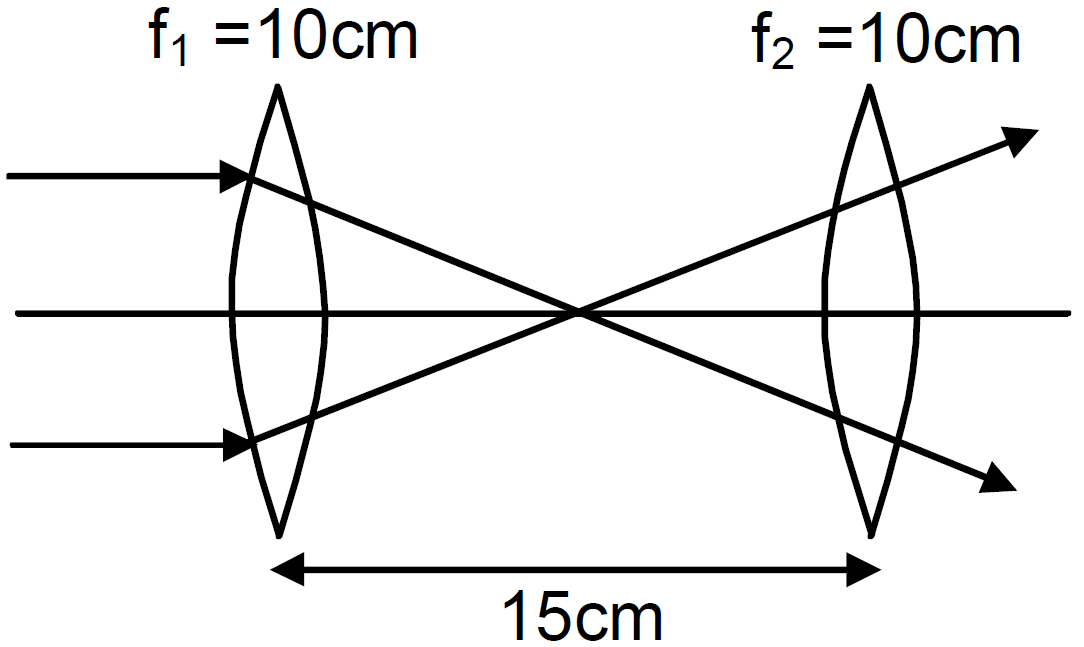
Two convex lenses, each of focal length 10cm, are placed at a separation of 15cm with their principal axes coinciding,
  1. Show that a light beam coming parallel to the principal axis diverges as it comes out of the lens system.
  2. Find the location of the virtual image formed by the lens system of an object placed far away.
  3. Find the focal length of the equivalent lens.
(Note that the sign of the focal length is positive although the lens system actually diverges a parallel beam incident on it).
Answer
  1. The beam will diverge after coming out of the two convex lens system because, the image formed by the first lens lies within the focal length of the second lens.
  2. For $1^{st}$ convex lens, $\frac{1}{\text{v}}-\frac{1}{\text{u}}=\frac{1}{\text{f}}\Rightarrow\frac{1}{\text{v}}=\frac{1}{10} \ (\text{since, u}=-\infty)$
or, $\text{v}=10\text{cm}$
for $2^{nd}$ convex lens, $\frac{1}{\text{v}'}=\frac{1}{\text{f}}+\frac{1}{\text{u}}$
or, $\frac{1}{\text{v}'}=\frac{1}{10}+\frac{1}{-(15-10)}=\frac{-1}{10}$
or, $\text{v}'=-10\text{cm}$
So, the virtual image will be at 5cm from $1^{st}$ convex lens.
  1. If, F be the focal length of equivalent lens,
Then, $\frac{1}{\text{F}}=\frac{1}{\text{f}_1}+\frac{1}{\text{f}_2}-\frac{\text{d}}{\text{f}_1\text{f}_2}\Rightarrow\frac{1}{10}+\frac{1}{10}-\frac{15}{100}=\frac{1}{20}$
$\Rightarrow\text{F}=20\text{cm}.$
View full question & answer
Question 245 Marks
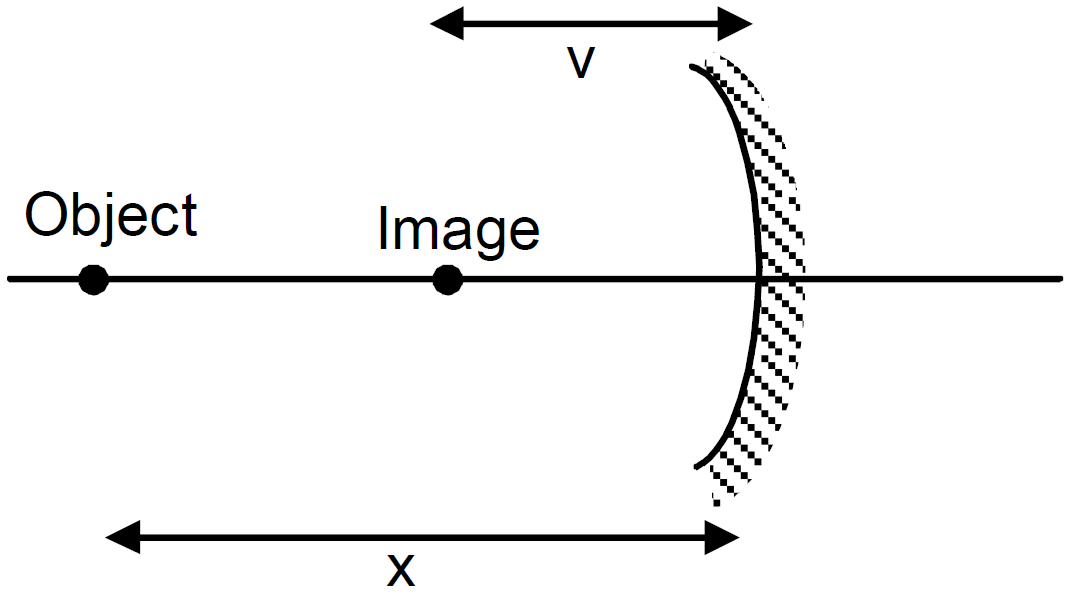
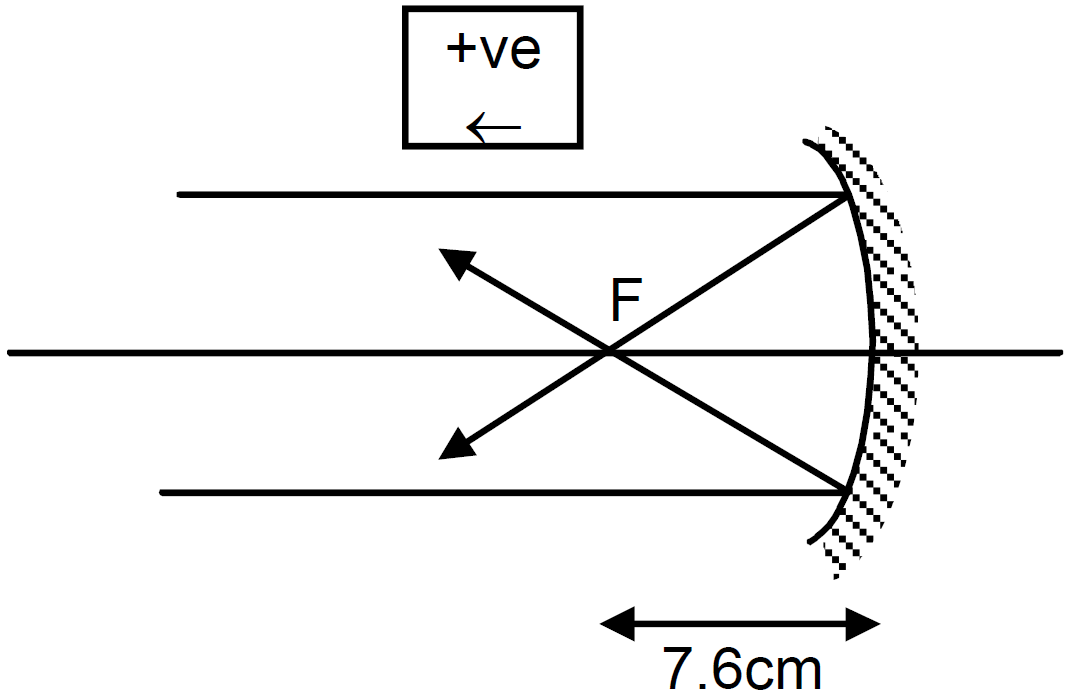
Find the diameter of the image of the moon formed by a spherical concave mirror of focal length 7.6m. The diameter of the moon is 3450km and the distance between the earth and the moon is $3.8 \times 10^5km.$
Answer

$u = -3.8 \times 10^5km$ diameter of moon $= 3450km ;f = -7.6m$
$ \therefore \ \frac{1}{\text{v}}+\frac{1}{\text{u}}=\frac{1}{\text{f}}$
$\Rightarrow\frac{1}{\text{v}}+\Big(-\frac{1}{3.8\times10^5}\Big)=\Big(-\frac{1}{7.6}\Big)$
Since, distance of moon from earth is very large as compared to focal length it can be taken as $\infty.$
 ⇒ Image will be formed at focus, which is inverted.
$\Rightarrow\frac{1}{\text{v}}=-\Big(\frac{1}{7.6}\Big)\Rightarrow\text{v}=-7.6\text{m}$
$\text{m}=-\frac{\text{v}}{\text{u}}=\frac{\text{d}_{\text{image}}}{\text{d}_{\text{object}}}\Rightarrow\frac{-(-7.6)}{(-3.8\times10^8)}=\frac{\text{d}_{\text{image}}}{3450\times10^3}$
$\text{d}_{\text{image}}=\frac{3450\times7.6\times10^3}{3.8\times10^8}=0.069\text{m}=6.9\text{cm}.$
View full question & answer
Question 255 Marks
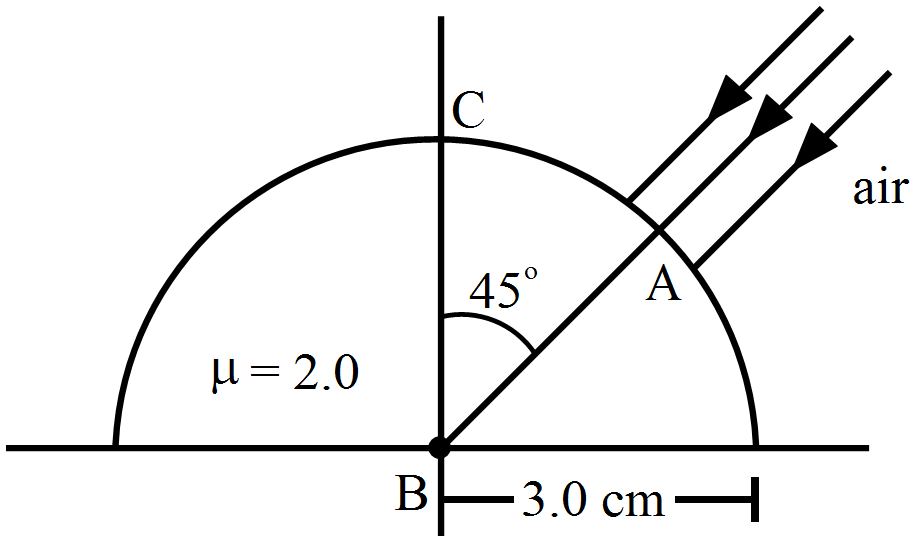
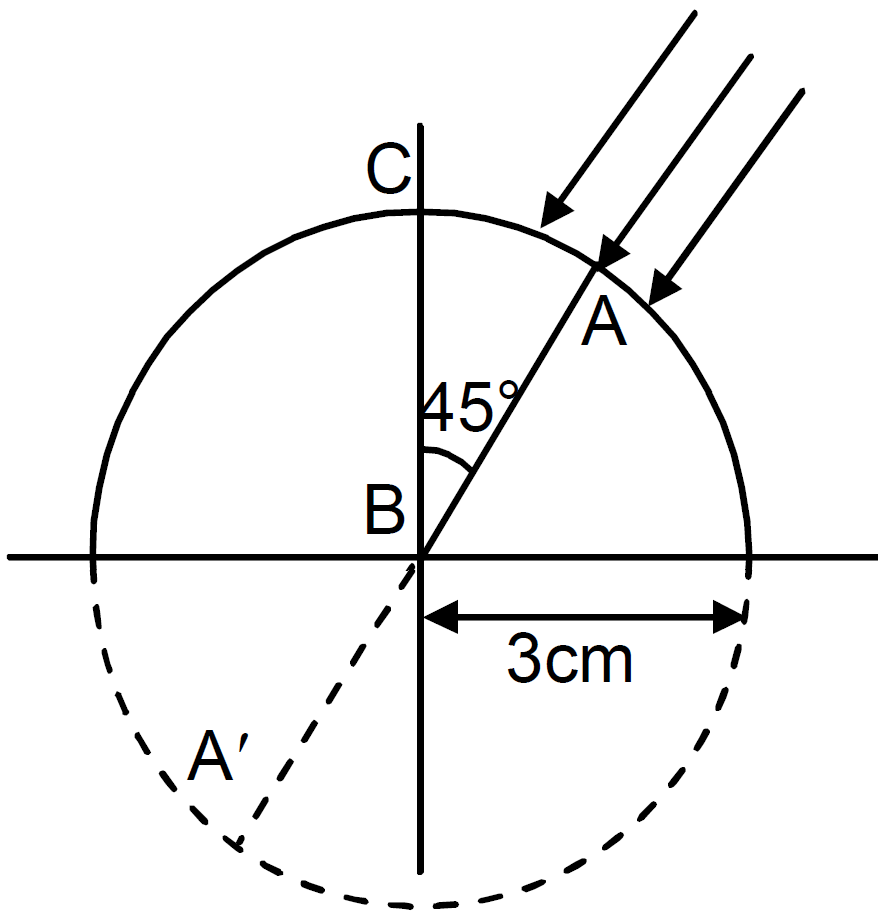
Figure shows a transparent hemisphere of radius 3.0cm made of a material of refractive index 2.0.
  1. A narrow beam of parallel rays is incident on the hemisphere as shown in the figure. Are the rays totally reflected at the plane surface?
  2. Find the image formed by the refraction at the first surface.
  3. Find the image formed by the reflection or by the refraction at the plane surface.
  4. Trace qualitatively the final rays as they come out of the hemisphere.
Answer

Given, $\mu_2=2.0$
So, critical angle $=\sin^{-1}\Big(\frac{1}{\mu_2}\Big)=\sin^{-1}\Big(\frac{1}{2}\Big)=30^{\circ}$
  1. As angle of incidence is greater than the critical angle, the rays are totally reflected internally.
  2. Here, $\frac{\mu_2}{\text{v}}-\frac{\mu_1}{\text{u}}=\frac{\mu_2-\mu_1}{\text{R}}$
$\Rightarrow \ \frac{2}{\text{v}}-\Big(-\frac{1}{\infty}\Big)=\frac{2-1}{3}$ $\big[$ For parallel rays, $\text{u}=\infty\big]$

$\Rightarrow \ \frac{2}{\text{v}}=\frac{1}{3}\Rightarrow \text{v}=6\text{cm}$

$\Rightarrow$ If the sphere is completed, image is formed diametrically opposite of A.
  1. Image is formed at the mirror in front of A by internal reflection.
View full question & answer
Question 265 Marks
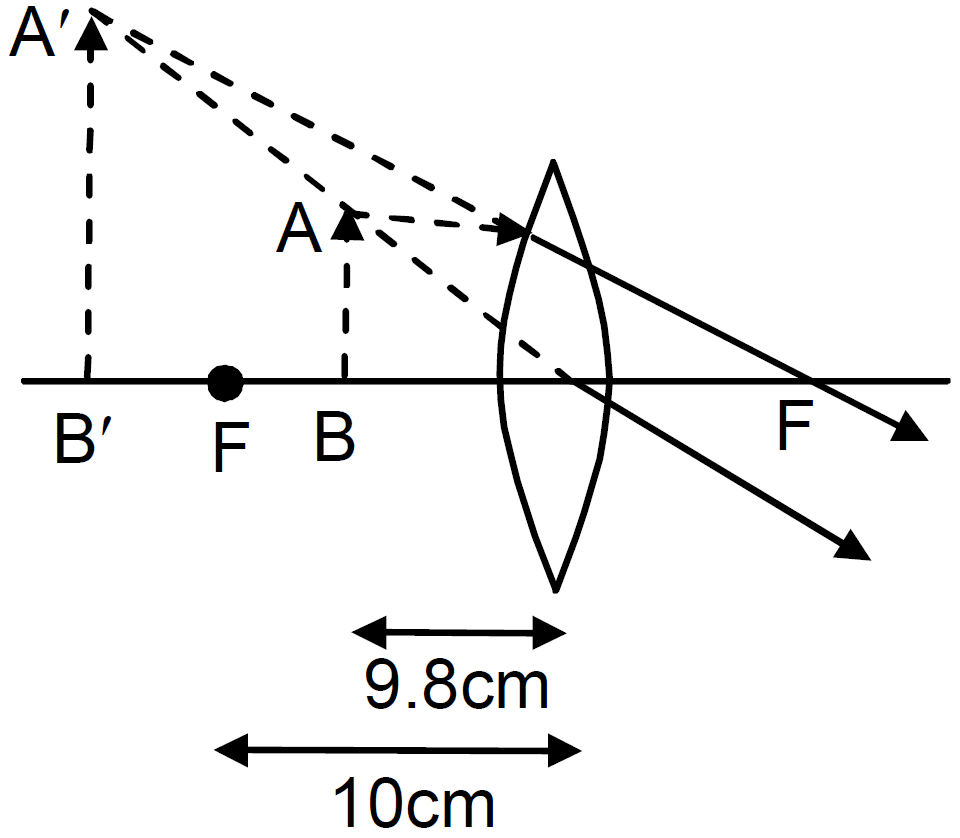
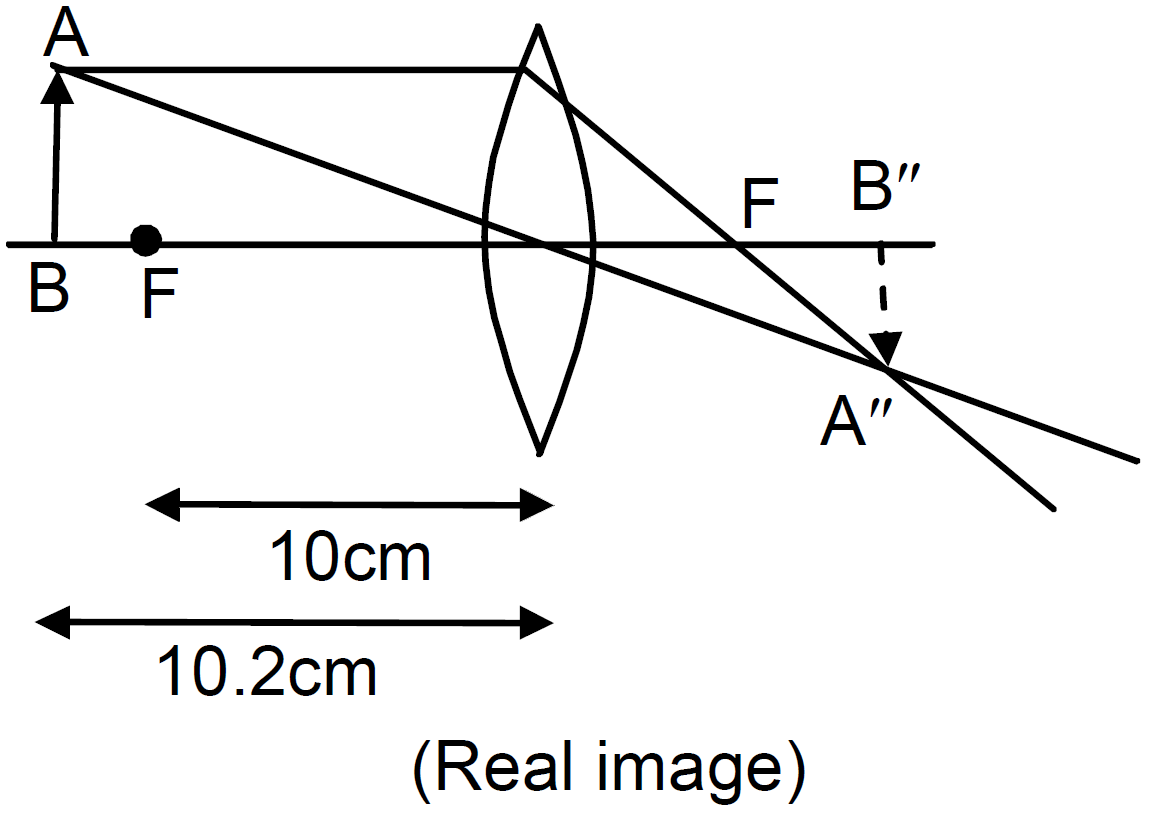
A convex lens has a focal length of 10cm. Find the location and nature of the image if a point object is placed on the principal axis at a distance of:
  1. 9.8cm
  2. 10.2cm from the lens.
Answer
Given that, f = 10cm
  1. When u = -9.5cm
$\frac{1}{\text{v}}-\frac{1}{\text{u}}=\frac{1}{\text{F}}\Rightarrow\frac{1}{\text{v}}=\frac{1}{10}-\frac{1}{9.8}=\frac{-0.2}{98}$

$\Rightarrow\text{v}=-490\text{cm}$

So, $\text{m}=\frac{\text{v}}{\text{u}}=\frac{-490}{-9.8}=50\text{cm}$

So, the image is erect and virtual.
  1. When u = -10.2cm
$\frac{1}{\text{v}}-\frac{1}{\text{u}}=\frac{1}{\text{F}}\Rightarrow\frac{1}{\text{v}}=\frac{1}{10}-\frac{1}{-10.2}=\frac{102}{0.2}$

$\Rightarrow\text{v}=510\text{cm}$

So, $\text{m}=\frac{\text{v}}{\text{u}}=\frac{510}{-9.8}$

The image is real and inverted.
View full question & answer
Question 275 Marks
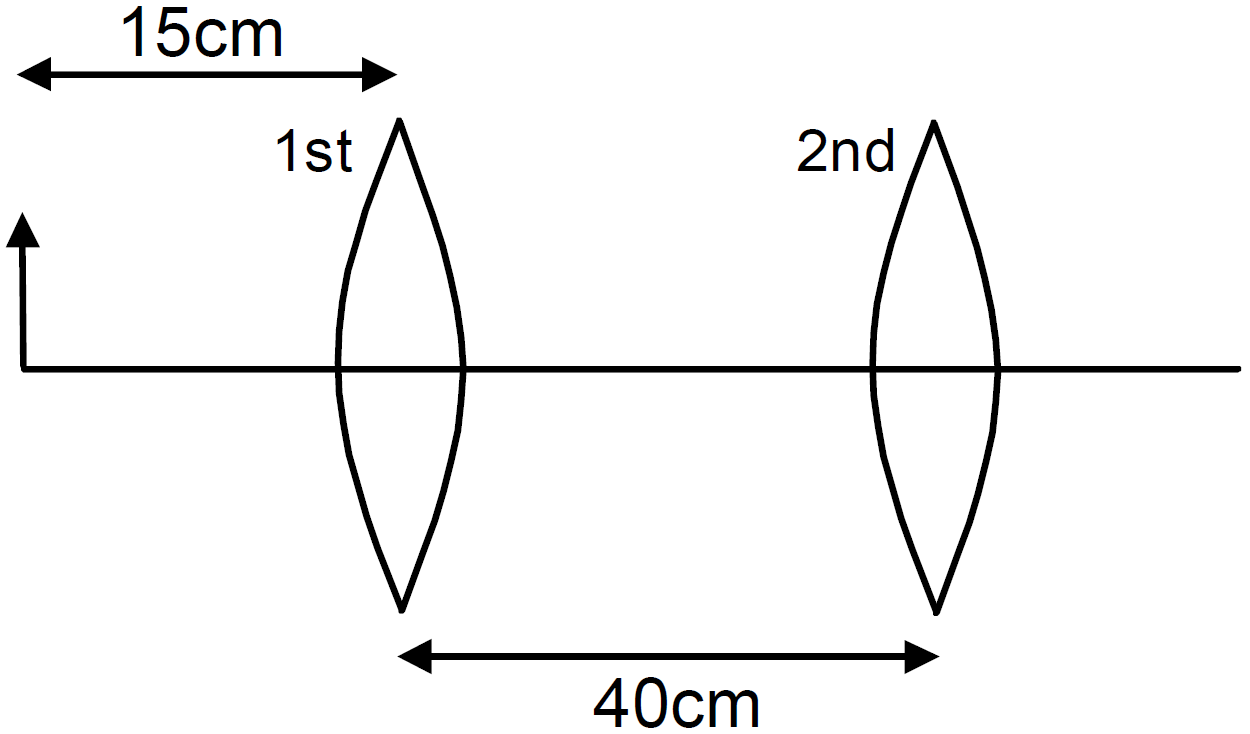
A 5mm high pin is placed at a distance of 15cm from a convex lens of focal length 10cm. A second lens of focal length 5cm is placed 40cm from the first lens and 55cm from the pin. Find
  1. The position of the final image.
  2. Its nature.
  3. Its size.
Answer
  1. First lens:
u = -15cm, f = 10cm
$\frac{1}{\text{v}}-\frac{1}{\text{u}}=\frac{1}{\text{f}}\Rightarrow\frac{1}{\text{v}}-\Big(-\frac{1}{15}\Big)=-\frac{1}{10}$
$\Rightarrow\text{v}=30\text{cm}$
So, the final image is formed 10cm right of second lens.
  1. m for $1^{st}$ lens:
$\frac{\text{v}}{\text{u}}=\frac{\text{h}_{\text{image}}}{\text{h}_{\text{object}}}\Rightarrow\Big(\frac{30}{-15}\Big)=\frac{\text{h}_{\text{image}}}{5{\text{mm}}}$
$\Rightarrow\text{h}_{\text{image}}=-10\text{mm}$ (inverted)
Second lens:
$u = -(40 - 30) = -10cm; f = 5cm$
[since, the image of $1^{st}$ lens becomes the object for the second lens]
$\frac{1}{\text{v}}-\frac{1}{\text{u}}=\frac{1}{\text{f}}\Rightarrow\frac{1}{\text{v}}-\Big(-\frac{1}{10}\Big)=\frac{1}{5}$
$\Rightarrow\text{v}=10\text{cm}$
m for $2^{nd}$​​​​​​​ lens:
$\frac{\text{v}}{\text{u}}=\frac{\text{h}_{\text{image}}}{\text{h}_{\text{object}}}\Rightarrow\Big(\frac{10}{10}\Big)=\frac{\text{h}_{\text{image}}}{{-10}}$
$\Rightarrow\text{h}_{\text{image}}=10\text{mm}$ (erect, real).
  1. So, size of final image = 10mm
View full question & answer
Question 285 Marks
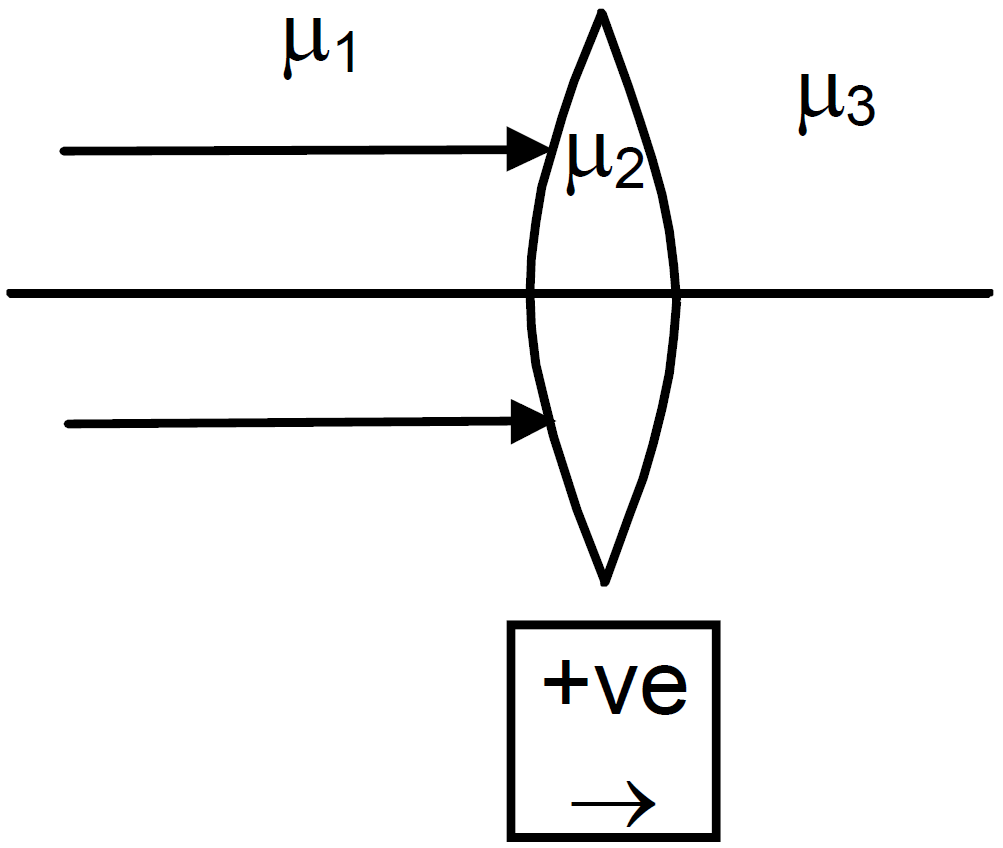
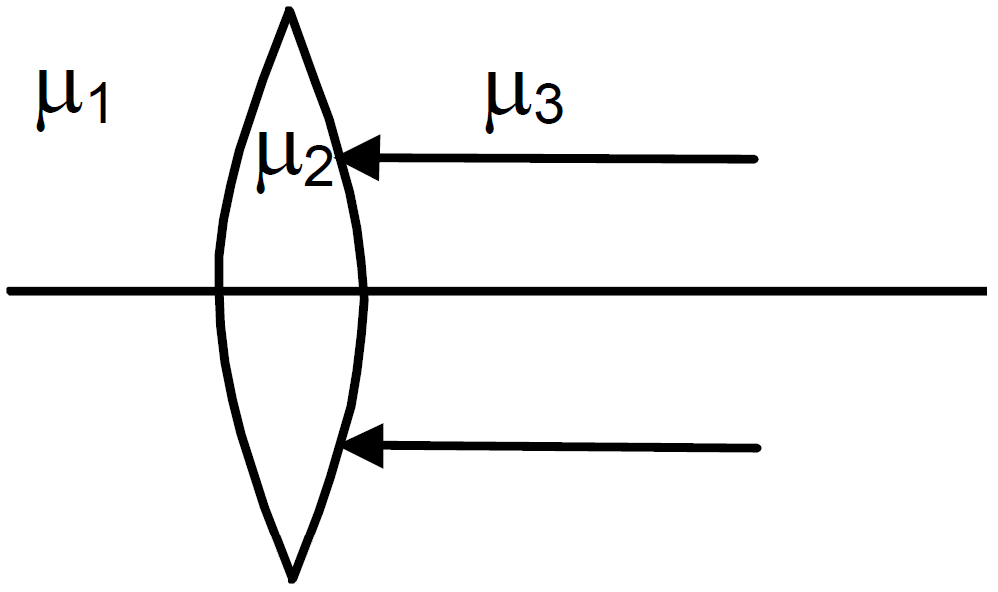
A thin lens made of a material of refractive index $\mu_2$ has a medium of refractive index $\mu_1$ on one side and a medium of refractive index $\mu_3$ on the other side. The lens is biconvex and the two radii of curvature have equal magnitude R. A beam of light travelling parallel to the principal axis is incident on the lens. Where will the image be formed if the beam is incident from:
  1. The medium $\mu_1$
  2. From the medium $\mu_3?$
Answer
  1. When the beam is incident on the lens from medium $\mu_{3}$
Then $\frac{\mu_2}{\text{v}}-\frac{\mu_1}{\text{u}}=\frac{\mu_2-\mu_1}{\text{R}}$ or $\frac{\mu_2}{\text{v}}-\frac{\mu_1}{(-\infty)}=\frac{\mu_2-\mu_1}{\text{R}}$
or $\frac{1}{\text{v}}=\frac{\mu_2-\mu_1}{\mu_2\text{R}}$ or $\text{v}=\frac{\mu_2\text{R}}{\mu_2-\mu_1}$
Again, for $2^{nd}$ refraction, $\frac{\mu_3}{\text{v}}-\frac{\mu_2}{\text{u}}=\frac{\mu_3-\mu_2}{\text{R}}$
or, $\frac{\mu_3}{\text{v}}=-\Big[\frac{\mu_3-\mu_2}{\text{R}}-\frac{\mu_2}{\mu_2\text{R}}(\mu_2-\mu_1)\Big]\Rightarrow-\Big[\frac{\mu_3-\mu_2-\mu_2+\mu_1}{\text{R}}\Big]$
or, $\text{v}=-\Big[\frac{\mu_3\text{R}}{\mu_3-2\mu_2+\mu_1}\Big]$
So, the image will be formed at $=\frac{\mu_3\text{R}}{2\mu_2-\mu_1-\mu_3}$
  1. Similarly for the beam from $\mu_3$ medium the image is formed at $\frac{\mu_3\text{R}}{2\mu_2-\mu_1-\mu_3}$
View full question & answer
Question 295 Marks
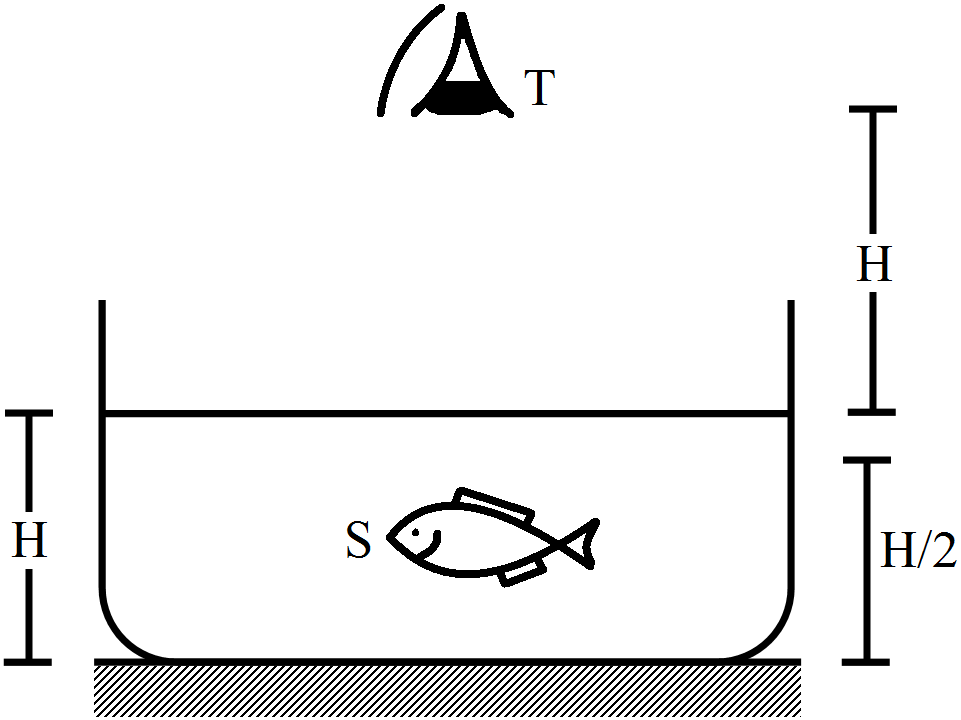
Consider the situation in figure. The bottom of the pot is a reflecting plane mirror, S is a small fish and T is a human eye. Refractive index of water is.
  1. At what distance(s) from itself will the fish see the image(s) of the eye?
  2. At what distance(s) from itself will the eye see the image(s) of the fish.
Answer
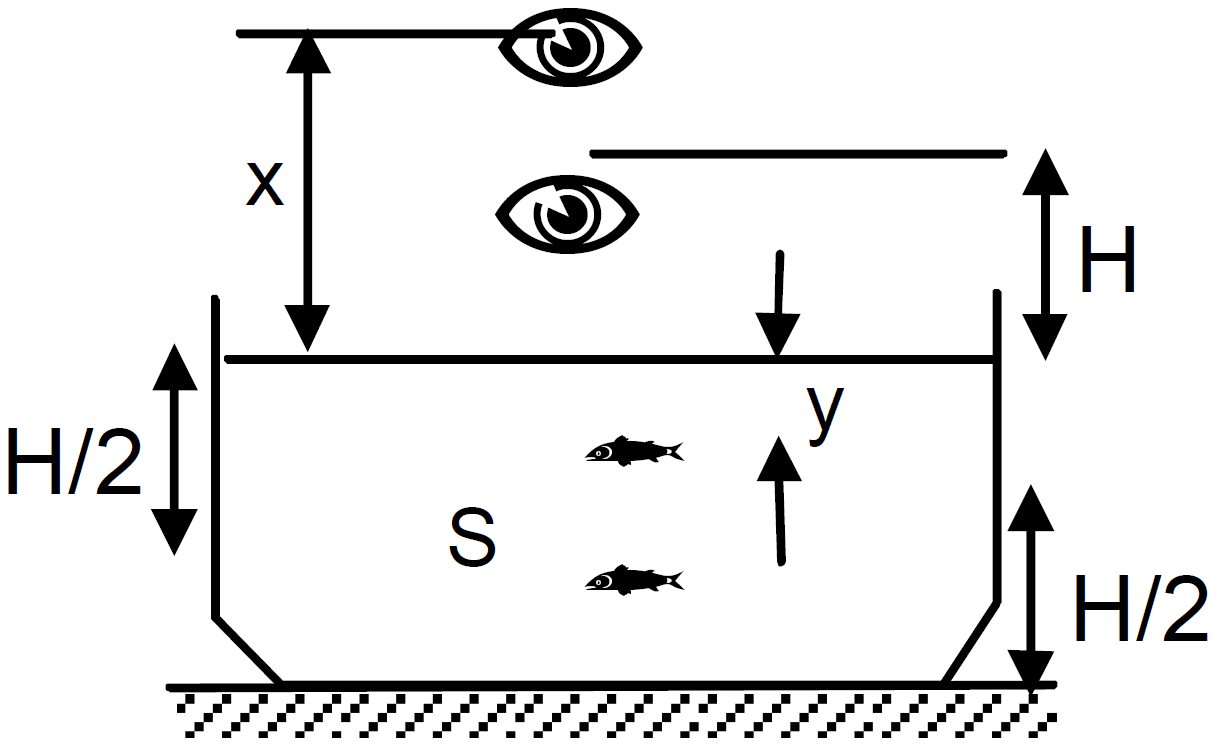
  1. Let x = distance of the image of the eye formed above the surface as seen by the fish
So, $\frac{\text{H}}{\text{x}}=\frac{\text{Real depth}}{\text{Apparent depth}}=\frac{1}{\mu}$ or $\text{x}=\mu\text{H}$

So, distance of the direct image $=\frac{\text{H}}{2}+\mu\text{H}=\text{H}\Big(\mu+\frac{1}{2}\Big)$

Similarly, image through mirror $=\frac{\text{H}}{2}+(\text{H}\times\text{x})=\frac{3\text{H}}{2}+\mu\text{H}=\text{H}\Big(\mu+\frac{3}{2}\Big)$
  1. Here, $\frac{\frac{\text{H}}{2}}{\text{y}}=\mu,$ So, $\text{y}=\frac{\text{H}}{2\mu}$
Where, y = distance of the image of fish below the surface as seen by eye.

So, Direct image $=\text{H}+\text{y}=\text{H}+\frac{\text{H}}{2\mu}=\text{H}\Big(1+\frac{1}{2\mu}\Big)$

Again another image of fish will be formed $\frac{\text{H}}{2}$ below the mirror.

So, the real depth for that image of fish becomes $\text{H}+\frac{\text{H}}{2}=\frac{3\text{H}}{2}$

So, Apparent depth from the surface of water $=\frac{3\text{H}}{2\mu}$

So, distance of the image from the eye $=\text{H}+\frac{3\text{H}}{2\mu}=\text{H}\Big(1+\frac{3}{2\mu}\Big).$
View full question & answer
Question 305 Marks
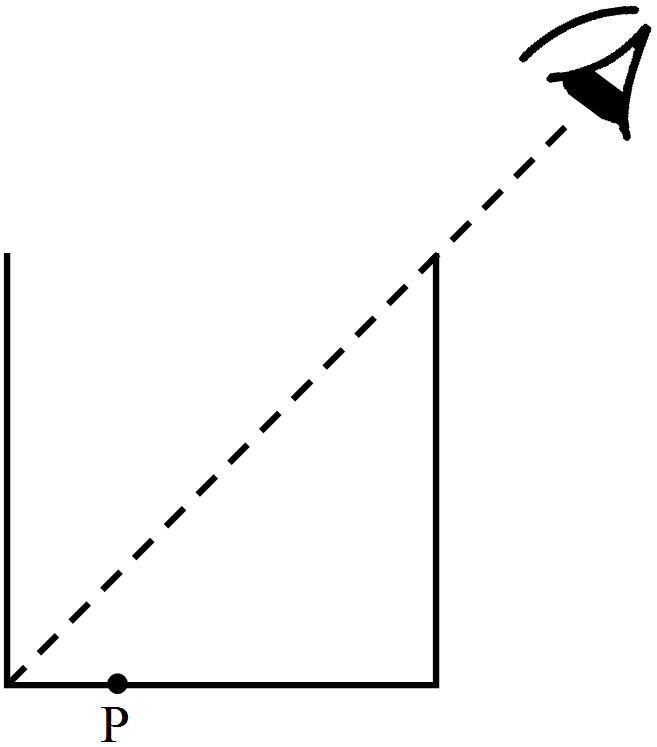
A cylindrical vessel, whose diameter and height both are equal to 30cm, is placed on a horizontal surface and a small particle P is placed in it at a distance of 5.0cm from the centre. An eye is placed at a position such that the edge of the bottom is just visible. The particle P is in the plane of drawing. Up to what minimum height should water be poured in the vessel to make the particle P visible?
Answer
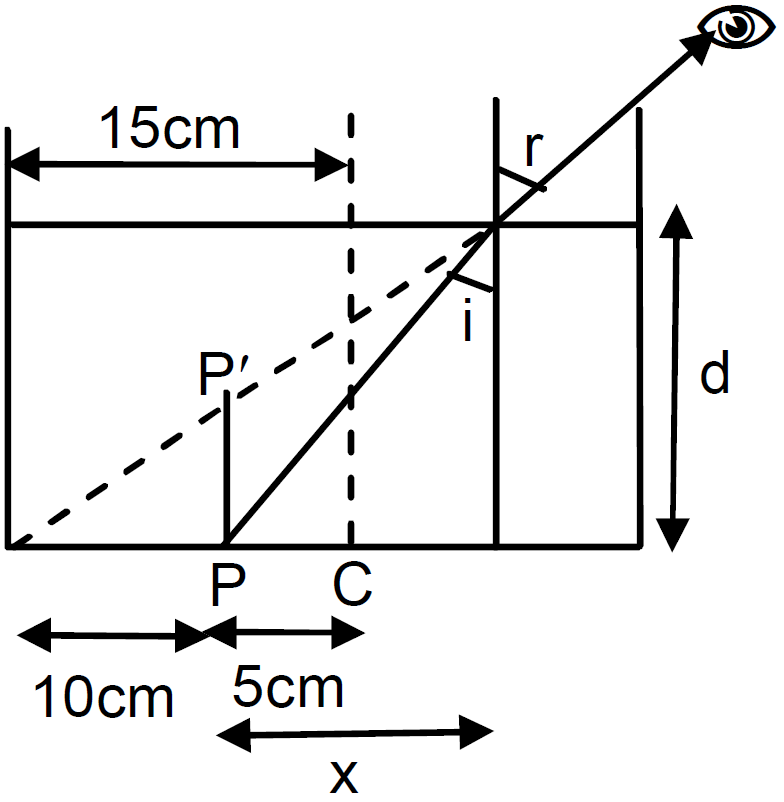
For the given cylindrical vessel, dimetre = 30cm ⇒ r = 15cm and h = 30cm Now, $\frac{\sin\text{i}}{\sin\text{r}}=\frac{3}{4}\Big[\mu_{\text{w}}=1.33=\frac{4}{3}\Big]$$\Rightarrow\sin\text{i}=\frac{3}{4\sqrt{2}} \ \big[\because \text{r}=45^{\circ}\big]$
The point P will be visible when the refracted ray makes angle 45° at point of refraction. Let x = distance of point P from X. Now, $\tan45^{\circ}=\frac{\text{x}+10}{\text{d}}$$\Rightarrow\text{d}=\text{x}+10 \ ...(1)$
Again, $\tan\text{i}=\frac{\text{x}}{\text{d}}$$\Rightarrow\frac{3}{\sqrt{23}}=\frac{\text{d}-10}{\text{d}} \ \Big[\text{Since,} \ \sin\text{i}=\frac{3}{4\sqrt{2}}\Rightarrow\tan\text{i}=\frac{3}{4\sqrt{2}}\Big]$
$\Rightarrow\frac{3}{\sqrt{23}}-1=-\frac{10}{\text{d}}\Rightarrow\text{d}=\frac{\sqrt{23}\times10}{\sqrt{23}-3}=26.7\text{cm}$
View full question & answer
Question 315 Marks
Lenses are constructed by a material of refractive index 1.50. The magnitude of the radii of curvature are 20cm and 30cm. Find the focal lengths of the possible lenses with the above specifications.
Answer
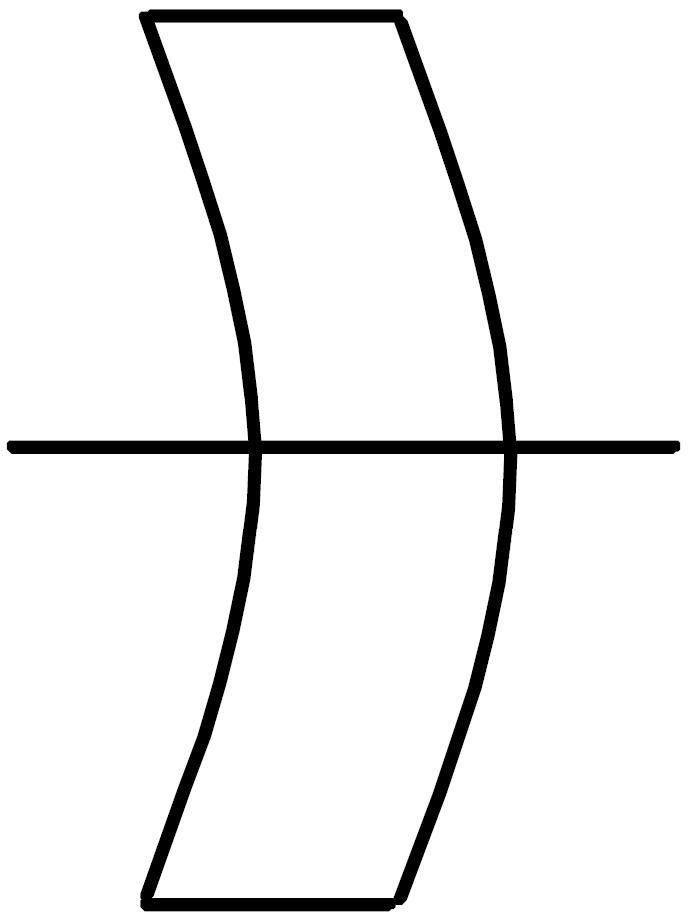
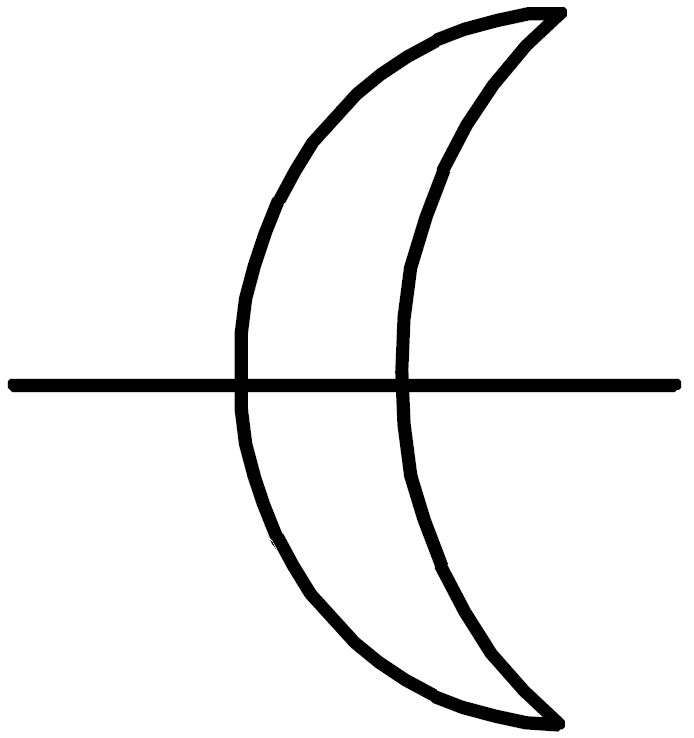
Given $\mu=1.5$ Magnitude of radii of curvatures = 20cm and 30cm The 4types of possible lens are as below.$\frac{1}{\text{f}}=(\mu-1)\Big(\frac{1}{\text{R}_1}-\frac{1}{\text{R}_2}\Big)$
Case (1): (Double convex) $[R_1 = +ve, R_2 = -ve]$
$\frac{1}{\text{f}}=(15-1)\Big(\frac{1}{20}-\frac{1}{30}\Big)\Rightarrow\text{f}=24\text{cm}$

Case (2): (Double concave) $[R_1 = -ve, R_2 = +ve]$
$\frac{1}{\text{f}}=(15-1)\Big(\frac{-1}{20}-\frac{1}{30}\Big)\Rightarrow\text{f}=-24\text{cm}$

Case (3): (Concave concave) $[R_1 = -ve, R_2 = -ve]$
$\frac{1}{\text{f}}=(15-1)\Big(\frac{1}{-20}-\frac{1}{-30}\Big)\Rightarrow\text{f}=-120\text{cm}$

Case (4): (Concave convex) $[R_1 = +ve, R_2 = +ve]$
$\frac{1}{\text{f}}=(15-1)\Big(\frac{1}{20}-\frac{1}{30}\Big)\Rightarrow\text{f}=+120\text{cm}$
View full question & answer
Question 325 Marks
k transparent slabs are arranged one over another. The refractive indices of the slabs are $\mu_1,\mu_2,\mu_3, \ ...\mu_{\text{k}}$ and the thicknesses are $t_1, t_2, t_3, ... t_k .$ An object is seen through this combination with nearly perpendicular light. Find the equivalent refractive index of the system which will allow the image to be formed at the same place.
Answer
Total no. of slabs = k, thickness $= t_1, t_2, t_3, ... t_{k }$
​​​​​​​ Refractive index $=\mu_1,\mu_2,\mu_3, \ ...\mu_{\text{k}}$
$\therefore$ The shift $\Delta\text{t}=\Big(1-\frac{1}{\mu_1}\Big)\text{t}_1+\Big(1-\frac{1}{\mu_2}\Big)\text{t}_2+ \ ... \ \Big(1-\frac{1}{\mu_{\text{k }}}\Big)\text{t}_{\text{k}} \ ...(1)$
If, $\mu\rightarrow$ refractive index of combination of slabs and image is formed at same place,
$\Delta\text{t}=\Big(1-\frac{1}{\mu}\Big)(\text{t}_1+\text{t}_2+...+\text{t}_{\text{k}}) \ ...(2)$
Equation (1) and (2), we get,
$\Big(1-\frac{1}{\mu}\Big)(\text{t}_1+\text{t}_2+...+\text{t}_{\text{k}})$
$=\Big(1-\frac{1}{\mu_1}\Big)\text{t}_1+\Big(1-\frac{1}{\mu_2}\Big)\text{t}_2+ ...+\Big(1-\frac{1}{\mu_{\text{k}}}\Big)\text{t}_{\text{k}}$
$=(\text{t}_1+\text{t}_2+...+\text{t}_{\text{k}})-\Big(\frac{\text{t}_1}{\mu_1}+\frac{\text{t}_2}{\mu_2}+...+\frac{\text{t}_{\text{k}}}{\mu_{\text{k}}}\Big)$
$=-\frac{1}{\mu}\sum\limits_{\text{i}=1}^\text{k}\text{t}_1=-\sum\limits_{\text{i}=1}^\text{k}\Big(\frac{\text{t}_1}{\mu_1}\Big)\Rightarrow\mu=\frac{\sum\limits_{\text{i}=1}^\text{k}\text{t}_1}{\sum\limits_{\text{i}=1}^\text{k}\big(\frac{\text{t}_1}{\mu_1}\big)}.$
View full question & answer
Question 335 Marks
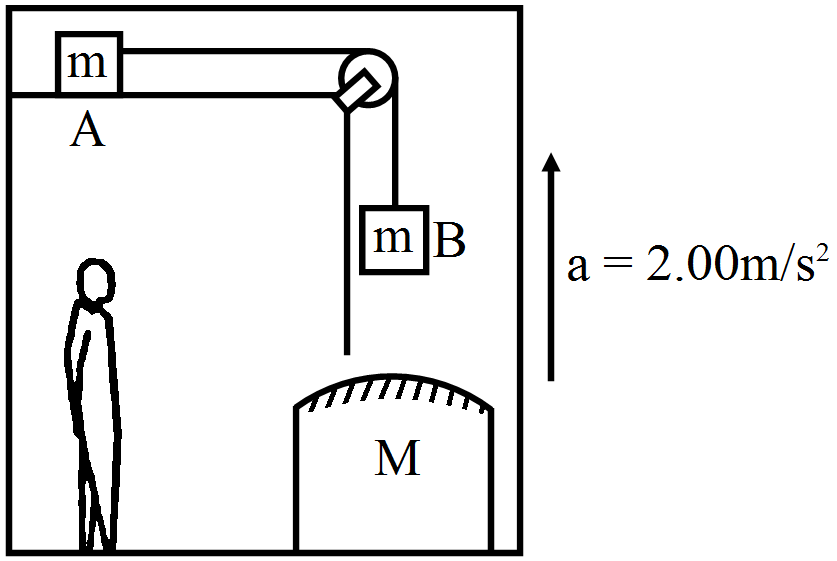
Consider the situation shown in figure. The elevator is going up with an acceleration of $2.00m/s^2$ and the focal length of the mirror is 12.0cm. All the surfaces are smooth and the pulley is light. The mass-pulley system is released from rest (with respect to the elevator) at t = 0 when the distance of B from the mirror is 42.0cm. Find the distance between the image of the block B and the mirror at t = 0.200s. Take $g = 10m/s^2.$​​​​​​​
Answer


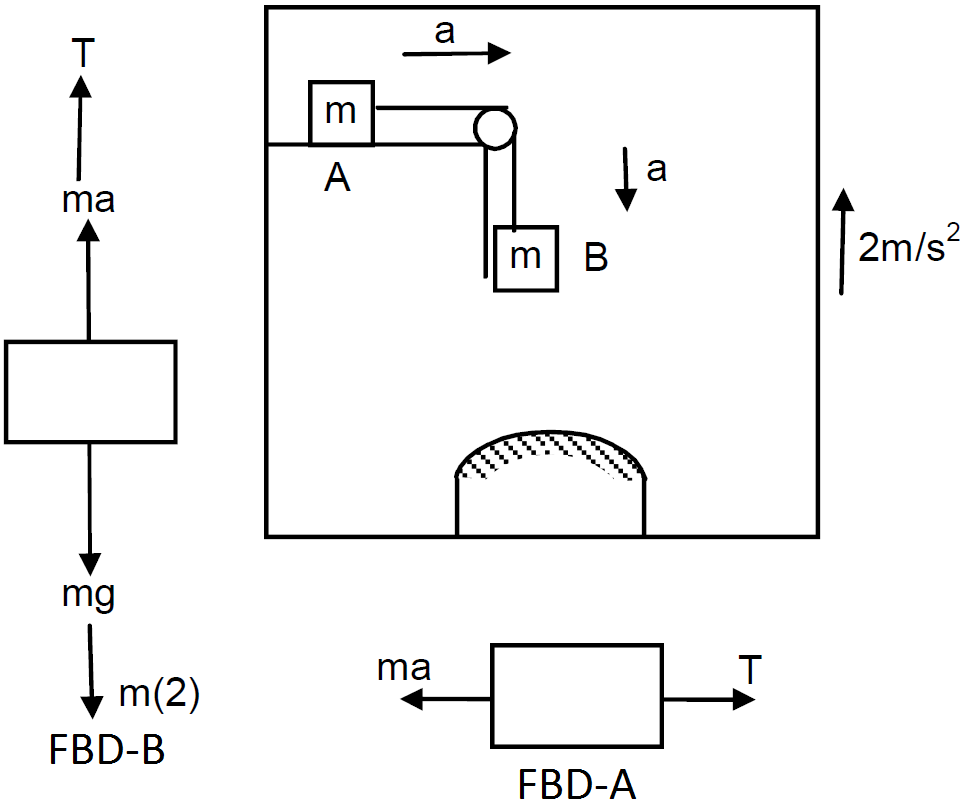
Let a = acceleration of the masses A and B (w.r.t. elevator). From the freebody diagrams,
$T - mg + ma - 2m = 0 …(1)$
Similarly, $T - ma = 0 …(2)$
From (1) and (2),
$2ma - mg - 2m = 0$
$\Rightarrow2\text{ma}=\text{m}(\text{g}+2)$
$\Rightarrow\text{a}=\frac{10+2}{2}=\frac{12}{2}=6$
so, distance travelled by B in t = 0.2 sec is,
$\text{s}=\frac{1}{2}\text{at}^2=\frac{1}{2}\times6\times(0.2)^2=0.12\text{m}=12\text{cm}$
So, Distance from mirror, $\text{u}=-(42-12)=-30\text{cm};\text{f}=+12\text{cm}$
From mirror equation, $\frac{1}{\text{v}}+\frac{1}{\text{u}}=\frac{1}{\text{f}}\Rightarrow\frac{1}{\text{v}}+\Big(-\frac{1}{30}\Big)=\frac{1}{12}$
$\Rightarrow\text{v}=8.57\text{cm}$
Distance between image of block B and mirror = 8.57cm.
View full question & answer
Question 345 Marks
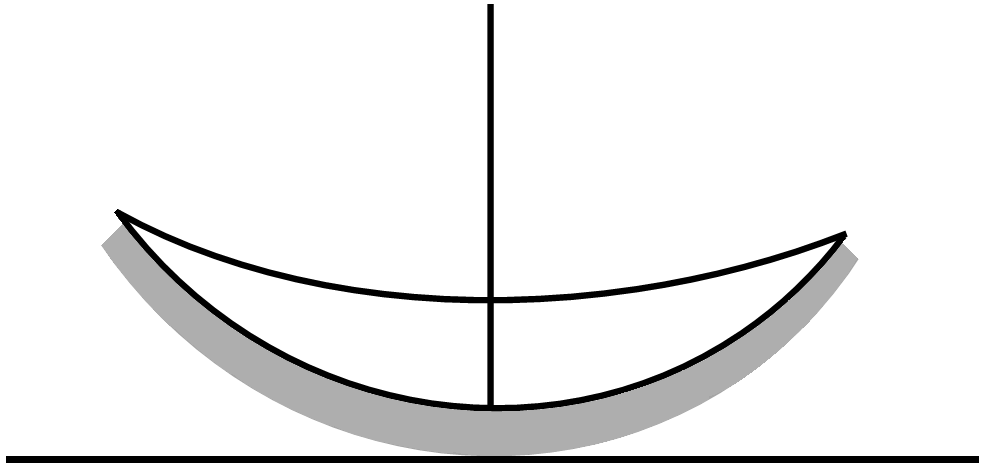
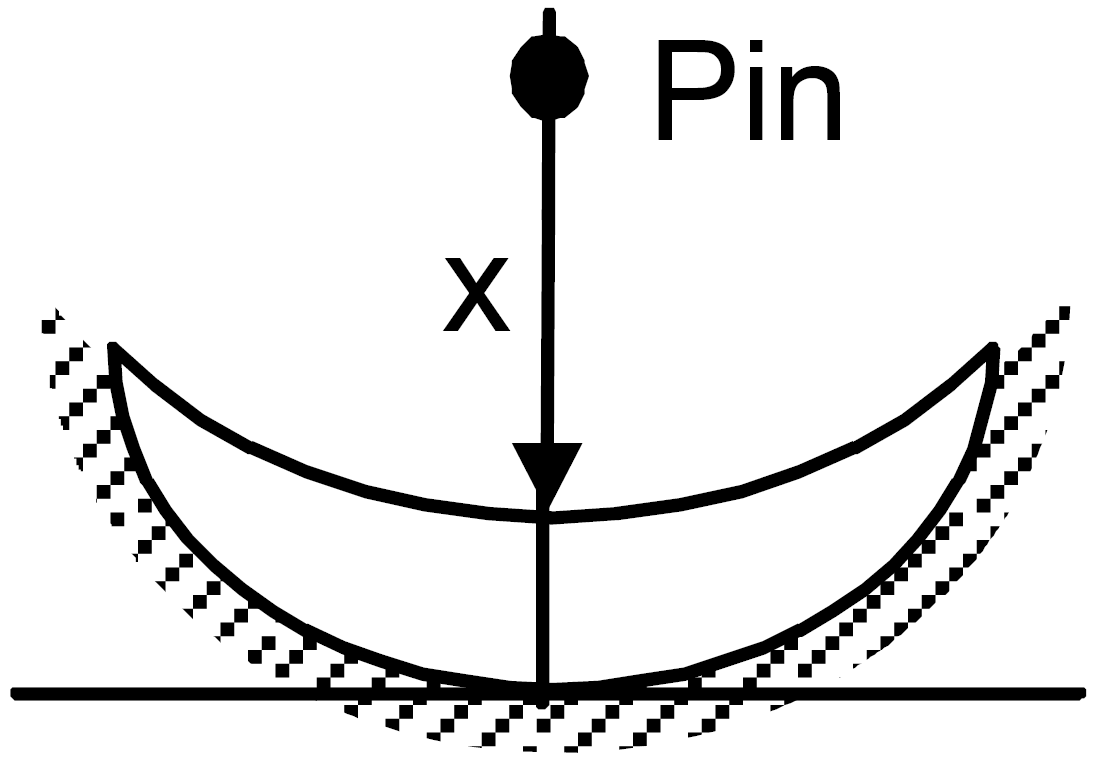
The convex surface of a thin concavo-convex lens of glass of refractive index 1.5 has a radius of curvature 20cm. The concave surface has a radius of curvature 60cm. The convex side is silvered and placed on a horizontal surface as shown in figure.
  1. Where should a pin be placed on the axis so that its image is formed at the same place?
  2. If the concave part is filled with water $\Big(\mu=\frac{4}{3}\Big),$ find the distance through which the pin should be moved so that the image of the pin again coincides with the pin.
Answer

 Let the pin is at a distance of x from the lens. Then for $1^{st}$ refraction, $\frac{\mu_2}{\text{v}}-\frac{\mu_1}{\text{u}}=\frac{\mu_2-\mu_1}{\text{R}}$ Here, $\mu_2=1.5, \ \mu_1=1, \ \text{u}=-\text{x}, \ \text{R}=-60\text{cm}$$\therefore \ \frac{1.5}{\text{v}}-\frac{1}{-\text{x}}=\frac{0.5}{-60}$
$\Rightarrow120(1.5\text{x}+\text{v})=-\text{vx} \ ...(1)$
$\Rightarrow\text{v}(120+\text{x})=-180\text{x}$
$\Rightarrow\text{v}=\frac{-180\text{x}}{120+\text{x}}$
This image distance is again object distance for the concave mirror.$\text{u}=\frac{-180\text{x}}{120+\text{x}}, \ \text{f}=-10\text{cm} \ \Big(\therefore \ \text{f}=\frac{\text{R}}{2}\Big)$
$\therefore \ \frac{1}{\text{v}}+\frac{1}{\text{u}}=\frac{1}{\text{f}}\Rightarrow\frac{1}{\text{v}_1}=\frac{1}{-10}-\frac{-(120+\text{x})}{180\text{x}}$
$\Rightarrow\frac{1}{\text{v}_1}=\frac{120+\text{x}-18\text{x}}{180\text{x}}\Rightarrow\text{v}_1=\frac{180\text{x}}{120-17\text{x}}$
Again the image formed is refracted through the lens so that the image is formed on the object taken in the $1^{st}$ refraction.
So, for $2^{nd}$ refraction. According to sign conversion $\text{v}=-\text{x}, \ \mu_2=1, \ \mu_1=1.5, \ \text{R}=-60$ Now, $\frac{\mu_2}{\text{v}}-\frac{\mu_1}{\text{u}}=\frac{\mu_2-\mu_1}{\text{R}} \ \Big[\text{u}=\frac{180\text{x}}{120-17\text{x}}\Big]$$\Rightarrow\frac{1}{-\text{x}}-\frac{1.5}{180\text{x}}(120-17\text{x})=\frac{-0.5}{-60}$
$\Rightarrow\frac{1}{\text{x}}+\frac{120-17\text{x}}{120\text{x}}=\frac{-1}{120}$
Multiplying both sides with 120m, we get
$120 + 120 - 17x = -x$
$\Rightarrow 16x = 240$
$ \Rightarrow x = 15cm$
$\therefore$ Object should be placed at 15cm from the lens on the axis.
View full question & answer
Question 355 Marks
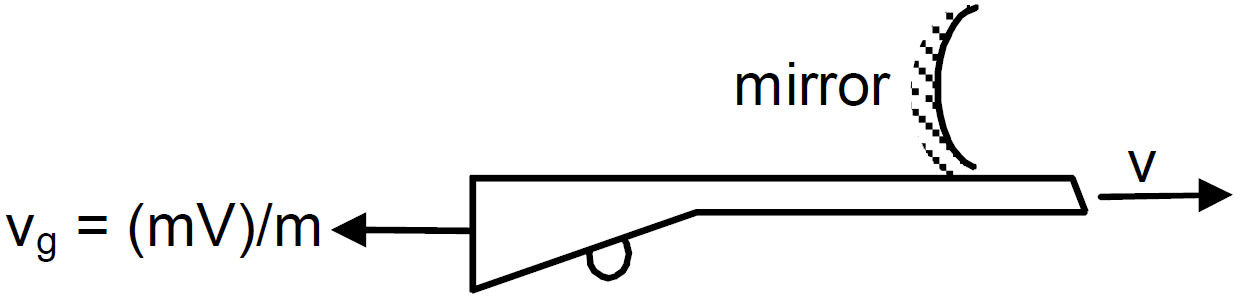
A gun of mass M fires a bullet of mass m with a horizontal speed V. The gun is fitted with a concave mirror of focal length f facing tpwards the receding bullet. Find the speed of separation of the bullet and the image just after the gun was fired.
Answer
Recoil velocity of gun $=\text{V}_{\text{g}}=\frac{\text{mV}}{\text{M}}$ At any time ‘t’, position of the bullet w.r.t. mirror $=\text{V}_{\text{t}}=\frac{\text{mV}}{\text{M}}{\text{t}}=\Big(1+\frac{\text{m}}{\text{M}}\Big)\text{Vt}$ For the mirror, $=\text{u}=-\Big(1+\frac{\text{m}}{\text{M}}\Big)\text{Vt}=\text{kVt}$ v = position of the image From lens formula,$\frac{1}{\text{v}}=\frac{1}{\text{f}}-\frac{1}{\text{u}}\Rightarrow\frac{1}{\text{v}}=\frac{1}{-\text{f}}+\frac{1}{\text{kVt}}=\frac{1}{\text{kVt}}-\frac{1}{\text{f}}=\frac{\text{f}-\text{kVt}}{\text{kVtf}}$
Let $\Big(1+\frac{\text{m}}{\text{M}}=\text{k}\Big),$ So, $\text{v}=\frac{\text{kVtf}}{-\text{kVt}+\text{f}}=\Big(\frac{\text{kVtf}}{\text{f}-\text{kVt}}\Big)$ So, velocity of the image with respect to mirror will be,$\text{v}_1=\frac{\text{dv}}{\text{dt}}=\frac{\text{v}}{\text{dt}}\Big[\frac{\text{kVtf}}{\text{f}-\text{kVt}}\Big]=\frac{(\text{f}-\text{kVt})\text{kVf}-\text{kVtf}(-\text{kV})}{(\text{f}-\text{kVt})^2}=\frac{\text{kVt}^2}{(\text{f}-\text{kVt})^2}$
Since, the mirror itself is moving at a speed of $\text{m}\frac{\text{V}}{\text{M}}$ and the object is moving at ‘V’, the velocity of separation between the image and object at any time ‘t’ will be,$\text{v}_{\text{s}}=\text{V}+\frac{\text{mV}}{\text{M}}+\frac{\text{kVf}^2}{(\text{f}-\text{kVt})^2}$
When, t = 0 (just after the gun is fired),$\text{v}_{\text{s}}=\text{V}+\frac{\text{mV}}{\text{M}}+\text{kV}=\text{V}+\frac{\text{m}}{\text{M}}\text{V}+\Big(1+\frac{\text{m}}{\text{M}}\Big)\text{V}=2\Big(1+\frac{\text{m}}{\text{M}}\Big)\text{V}$
View full question & answer
Question 365 Marks
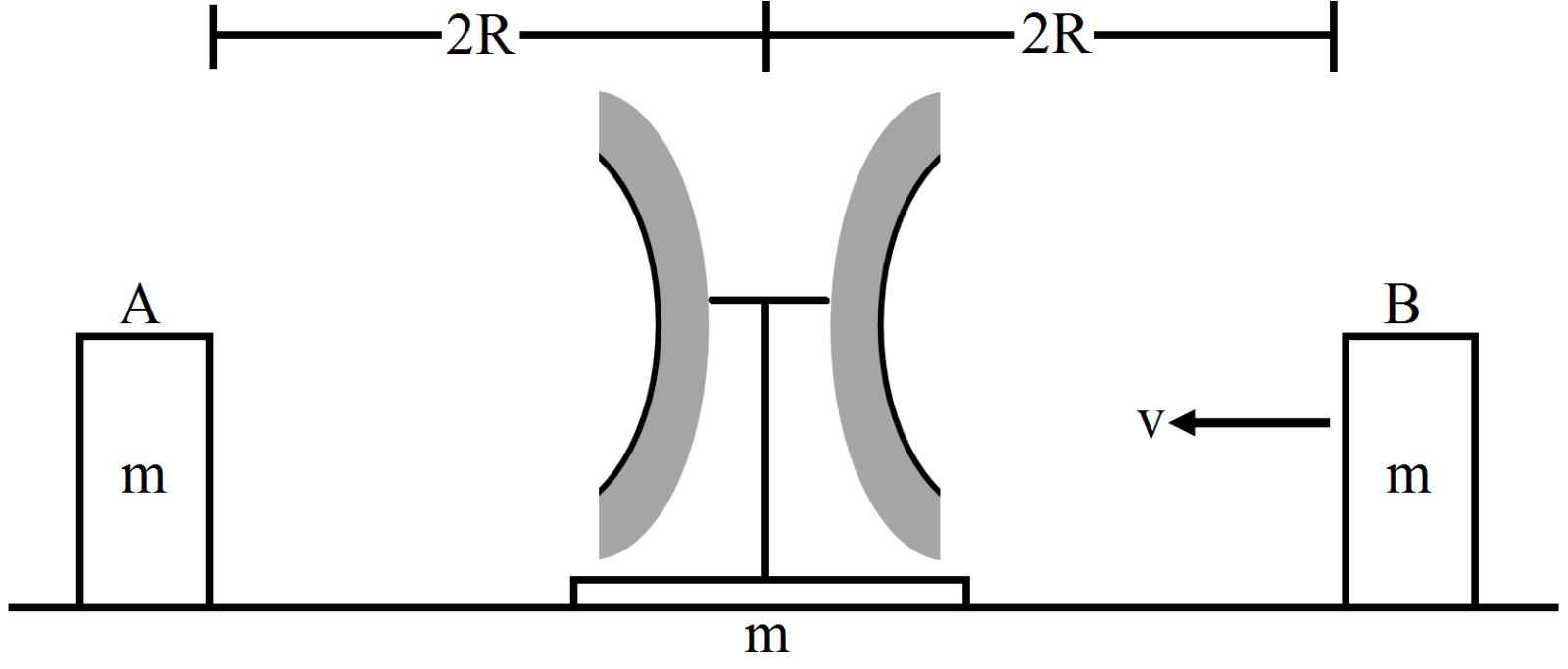
Two concave mirrors of equal radii of curvature R are fixed on a stand facing opposite directions. The whole system has a mass m and is kept on a frictionless horizontal table. Two blocks A and B, each of mass m, are placed on the two sides of the stand. At t = 0, the separation between A and the mirrors is 2 R and also the separation between B and the mirrors is 2 R. The block B moves towards the mirror at a speed v. All collisions which take place are elastic. Taking the original position of the mirrors-stand system to be x = 0 and X-axis along AB, find the position of the images of A and B at t =
  1. $\frac{\text{R}}{\text{v}}$
  2. $\frac{3\text{R}}{\text{v}}$
  3. $\frac{5\text{R}}{\text{v}}$
View full question & answer
Question 375 Marks
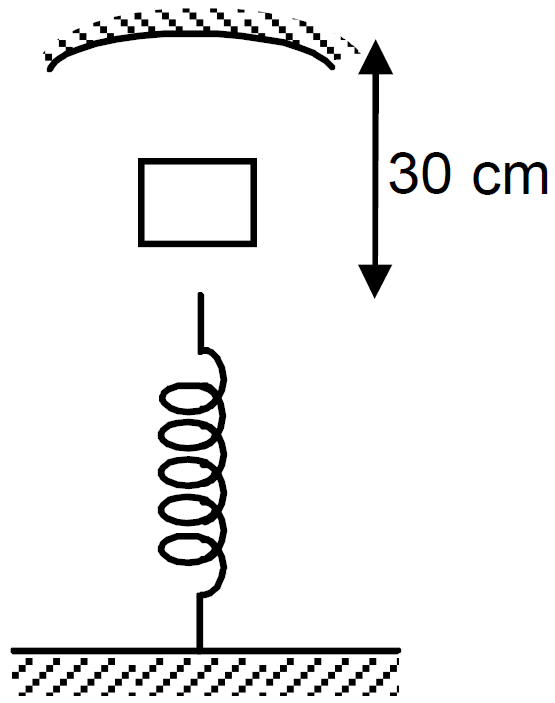
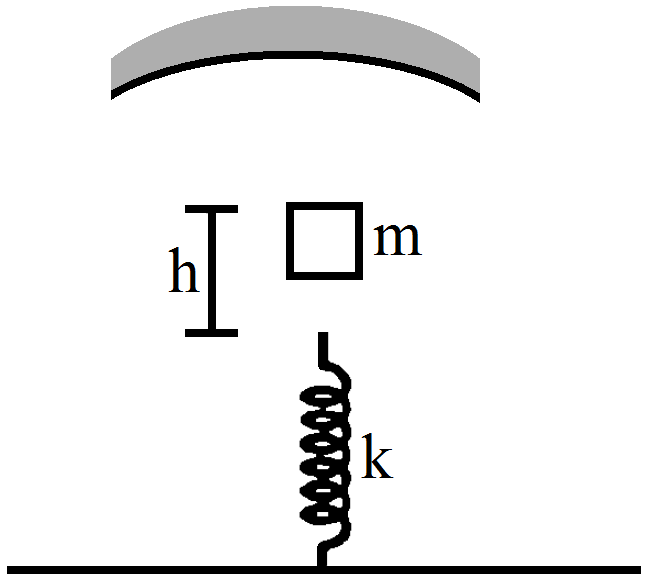
A mass m = 50g is dropped on a vertical spring of spring constant 500N/m from a height h = 10cm as shown in figure. The mass sticks to the spring and executes simple harmonic oscillations after that. A concave mirror of focal length 12cm facing the mass is fixed with its principal axis coinciding with the line of motion of the mass, its pole being at a distance of 30cm from the free end of the spring. Find the length in which the image of the mass oscillates.
Answer

Due to weight of the body suppose the spring is compressed by which is the mean position of oscillation.
$m = 50 \times 10^{-3}kg, $
$g = 10ms^{-2}, $
$k = 500Nm^{-2}, $
$h = 10cm = 0.1m$
For equilibrium, $\text{mg}=\text{kx}$
$\Rightarrow\text{x}=\frac{\text{mg}}{\text{k}}=10^{-3}\text{m}=0.1\text{cm}$
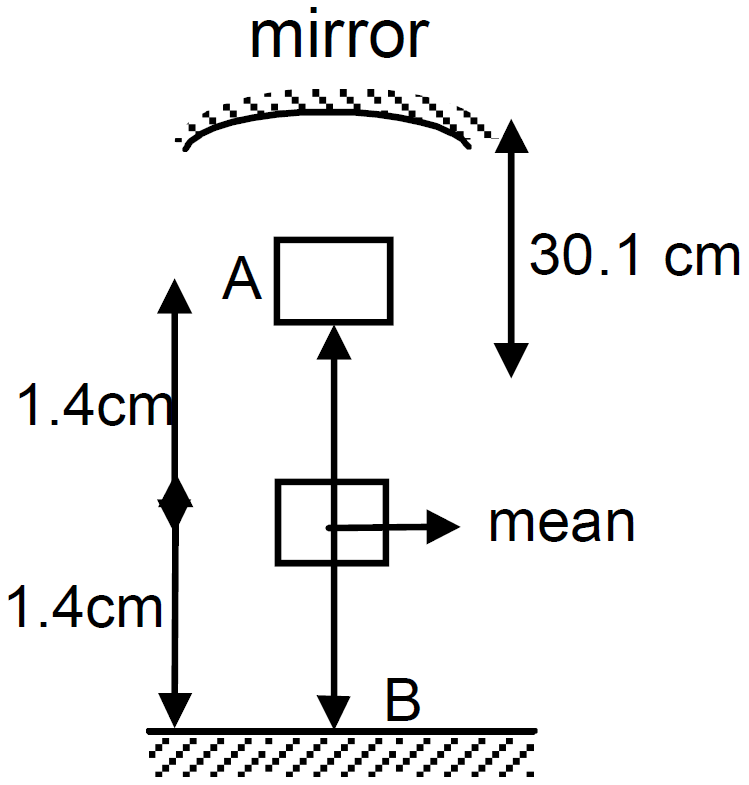
So, the mean position is at 30 + 0.1 = 30.1cm from P (mirror).
Suppose, maximum compression in spring is $\delta.$
Since, E.K.E. - I.K.E. = Work done$\Rightarrow0-0=\text{mg}(\text{h}+\delta)-\frac{1}{2}\text{k}\delta^2$
(work energy principle)
$\Rightarrow\text{mg}(\text{h}+\delta)-\frac{1}{2}\text{k}\delta^2$
$\Rightarrow50\times10^{-3}\times10(0.1+\delta)-\frac{1}{2}500\delta^2$
So, $\delta=\frac{0.5\pm\sqrt{0.25+50}}{2\times250}=0.015\text{m}=1.5\text{cm}$

Amplitude of the vibration = 31.5 - 30.1 - 1.4. Position A is 30.1 - 1.4 = 28.7cm from pole.
For A u = -31.5, f = -12cm
$\therefore \ \frac{1}{\text{v}}=\frac{1}{\text{f}}-\frac{1}{\text{u}}=-\frac{1}{12}+\frac{1}{31.5}$
$\Rightarrow\text{V}_{\text{A}}=-19.38\text{cm}$
For B f = -12cm, u = -28.7cm$\frac{1}{\text{v}}=\frac{1}{\text{f}}-\frac{1}{\text{u}}=-\frac{1}{12}+\frac{1}{28.7}$
$\Rightarrow \ \text{V}_\text{B}=-20.62\text{cm}$
The image vibrates in length (20.62 - 19.38) = 1.24cm.
View full question & answer
Question 385 Marks
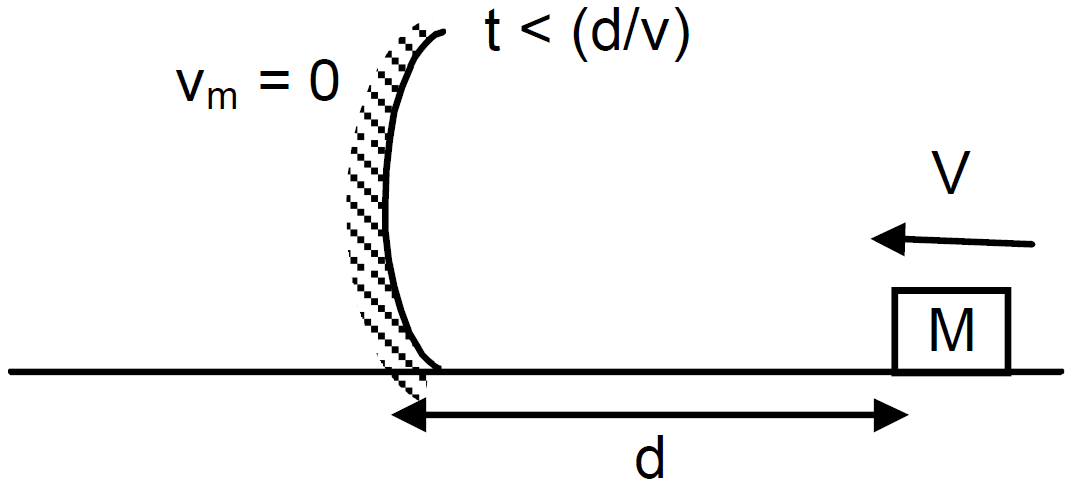
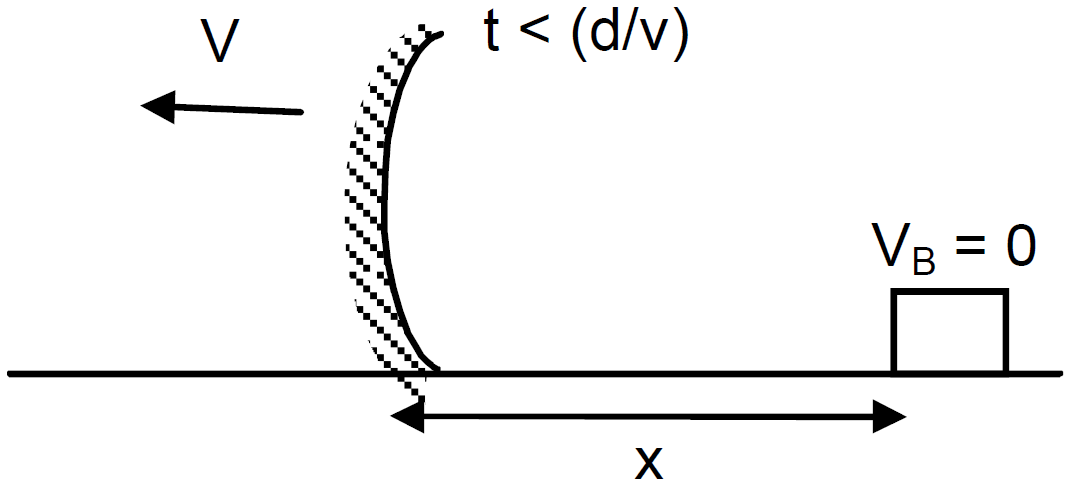
A small block of mass m and a concave mirror of radius R fitted with a stand lie on a smooth horizontal table with a separation d between them. The mirror together with its stand has a mass m. The block is pushed at t = 0 towards the mirror so that it starts moving towards the mirror at a constant speed V and collides with it. The collision is perfectly elastic. Find the velocity of the image:
  1. At a time $\text{t}<\frac{\text{d}}{\text{V}}$
  2. At a time $\text{t}>\frac{\text{d}}{\text{V}}.$
Answer
  1. When $\text{t}<\frac{\text{d}}{\text{V}},$ the object is approaching the mirror
As derived in the previous question,
$\text{V}_{\text{image}}=\frac{\text{Velocity of object}\times\text{R}^2}{\big[2\times\text{distance between them}-\text{R}\big]^2}$
$\Rightarrow\text{V}_{\text{image}}=\frac{\text{V}\text{R}^2}{\big[2\big(\text{d}-\text{Vt}\big)-\text{R}\big]^2}$ [At any time, x = d - Vt]
  1. After a time $\text{t}<\frac{\text{d}}{\text{V}},$ there will be a collision between the mirror and the mass.
As the collision is perfectly elastic, the object (mass) will come to rest and the mirror starts to move away with same velocity V.
At any time $\text{t}>\frac{\text{d}}{\text{V}},$ the distance of the mirror from the mass will be
$\text{x}=\text{V}\Big(\text{t}-\frac{\text{d}}{\text{V}}\Big)=\text{Vt}-\text{d}$
Here, $\text{u}=-\big(\text{Vt}-\text{d}\big)=\text{d}-\text{Vt}; \ \text{f}=-\frac{\text{R}}{2}$
So, $\frac{1}{\text{v}}+\frac{1}{\text{u}}=\frac{1}{\text{f}}\Rightarrow\frac{1}{\text{v}}=\frac{1}{\text{d}-\text{Vt}}+\frac{1}{\big(-\frac{\text{R}}{2}\big)}=-\Big[\frac{\text{R}+2(\text{d}-\text{Vt})}{\text{R}(\text{d}-\text{Vt})}\Big]$
$\Rightarrow\text{v}=-\Big[\frac{\text{R}(\text{d}-\text{Vt})}{\text{R}-2(\text{d}-\text{Vt})}\Big]= $ Image distance
So, Velocity of the image will be,
$\text{V}_{\text{image}}=\frac{\text{d}}{\text{dt}}$ (Image distance)
$=\frac{\text{d}}{\text{dt}}\Big[\frac{\text{R}(\text{d}-\text{Vt})}{\text{R}+2(\text{d}-\text{Vt})}\Big]$
Let, $y = (d - Vt)$
$\Rightarrow\frac{\text{dy}}{\text{dt}}=-\text{V}$
So, $\text{V}_{\text{image}}=\frac{\text{d}}{\text{dt}}\Big[\frac{\text{Ry}}{\text{R}+2\text{y}}\Big]=\frac{(\text{R}+2\text{y})\text{R}(-\text{V})-\text{Ry}(+2)(-\text{V})}{(\text{R}+2\text{y})^2}$
$=-\text{Vr}\Big[\frac{\text{R}+2\text{y}-2\text{y}}{(\text{R}+2\text{y})^2}\Big]=\frac{-\text{VR}^2}{(\text{R}+2\text{y})^2}$
Since, the mirror itself moving with velocity V,
Absolute velocity of image $=\text{V}\Big[1-\frac{\text{R}^2}{(\text{R}+2\text{y})^2}\Big]$ $($since, $V = V_{mirror}+ V_{image})$
$=\text{V}\Big[1-\frac{\text{R}^2}{[2(\text{Vt}-\text{d})-\text{R}^2}\Big]$
View full question & answer