Question
In a diffraction pattern due to a single slit, how will the angular width of central maximum change, if
a. Orange light is used in place of green light,
b. the screen is moved closer to the slit,
c. the slit width is decreased?
Justify your answer in each case.
Answer

angular width of central maxima of a single slit diffraction is given as $2 \theta=\frac{2 \lambda}{a}$
a. As $\lambda$ increases (orange light has greater wave length) diffraction angle $2 \theta$ will also increase.
b. Increasing or decreasing closeness of screen and slit does not affect angular width.
c. If a (slit width) decreases, $2 \theta$ will increase as $2 \theta \propto \frac{1}{a}$

Need a full question paper?

Generate a complete, print-ready paper with questions like this in minutes — across 16+ boards, with answer keys.

Start Generating Free

Similar questions

What is nuclear binding energy?
What are permanent magnets? What is an efficient way of preparing a permanent magnet? Write two characteristic properties of materials which are required to select them for making permanent magnets.
Calculate the ratio of the angular momentum of the earth about its axis due to its spinning motion to that about the sun due to its orbital motion. Radius of the earth $= 6400\ km$ and radius of the orbit of the earth about the sun $= 1.5 \times 10^8\ km.$
In Young’s double slit experiment, monochromatic light of wavelength 630 nm illuminates the pair of slits and produces an interference pattern in which two consecutive bright fringes are separated by 8.1 mm. Another source of monochromatic light produces the interference pattern in which the two consecutive bright fringes are separated by 7.2 mm. Find the wavelength of light from the second source.
What is the effect on the interference fringes if the monochromatic source is replaced by a source of white light?
Define resolving power of a microscope. Write its formula. How will it be affected when
(i) the wavelength of incident light decreases and
(ii) the aperture of the objective decreases ?
  1. Derive the expression for the torque acting on a current carrying loop placed in a magnetic field.
  2. Explain the significance of a radial magnetic field when a current carrying coil is kept in it.
Draw the intensity distributions for (i) the fringes produced in interference, and (ii) the diffraction bands produced due to single slit. Write two points of difference between the phenomena of interference and diffraction.
How is the mutual inductance of a pair of coils affected when:
i. separation between the coils is increased?
ii. the number of turns of each coil is increased?
iii. A thin iron sheet is placed between the two coils, other factors remaining the same?
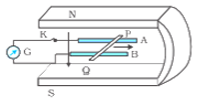
Figure shows a metallic rod PQ of length l, resting on the smooth horizontal rails AB positioned between the poles of a permanent magnet. The rails, the rod, and the magnetic field are in three mutually perpendicular directions. A galvanometer G connects the rails through a switch K. Assume the magnetic field to be uniform. Given the resistance of the closed-loop containing the rod is R.
Image

i. Suppose K is open and the rod is moved with a speed v in the direction shown. Find the polarity and magnitude of induced emf.
ii. With K open and the rod moving uniformly, there is no net force on the electrons in the rod PQ even though they do experience a magnetic force due to the motion of the rod. Explain.
iii. What is the induced emf in the moving rod if the magnetic field is parallel to the rails instead of being perpendicular?
Use the mirror equation to show that.
  1. An object placed between f and 2f of a concave mirror produces a real image beyond 2f.
  2. A convex mirror always produces a virtual image independent of the location of the object.
  3. An object placed between the pole and focus of a concave mirror produces a virtual and enlarged image.