Questions

5 Marks Questions

Take a timed test

6 questions · self-marked practice — reveal the answer and mark yourself.

Question 15 Marks
$a$. Derive an expression for the energy stored in a parallel plate capacitor of capacitance $C$ when charged up to voltage $V$. How is this energy stored in the capacitor?
$b.$  A capacitor of capacitance $1 \mu F$ is charged by connecting a battery of negligible internal resistance and emf $10 V$ across it. Calculate the amount of charge supplied by the battery in charging the capacitor fully.
Answer
$a$. Work done in adding a charge $dq = dW$
$= Vdq$
$=\frac{q}{c} d q$
$\therefore$ Total Amount of work $(W)$ in charging a capacitor
$ W =\int d W=\frac{1}{C} \int_0^Q q d q$
$W=\frac{Q^2}{2 C}$
$=\frac{(C V)^2}{2 C}=\frac{1}{2} C V^2$
The electrostatic Energy/ potential energy is stored in the electric field between the plates.
$b. C =1 \mu F=1 \times 10^{-6} F ; V =10$ volt
$Q=C V$
$=1 \times 10^{-6} \times 10$
$=10^{-5}$ coulomb
hence, the amount of charge supplied by the battery in charging the capacitor fully is $10^{-5}$ coulomb.
View full question & answer
Question 25 Marks
A circuit containing a $80\ mH$ inductor and a $60 \mu\  F$ capacitor in series is connected to a $230\ V, 50 \ Hz$ supply. The resistance of the circuit is negligible.
$a.$ Obtain the current amplitude and rms values.
$b.$ Obtain the rms values of potential drops across each element.
$c.$ What is the average power transferred to the inductor?
$d.$ What is the average power transferred to the capacitor?
$e.$ What is the total average power absorbed by the circuit? $[$‘Average’ implies ‘averaged over one cycle’.$]$
Answer
Inductance, $L =80\ mH =80 \times 10^{-3} H$
Capacitance, $C =60\  \mu F=60 \times 10^{-6} F$
Supply voltage$, V = 230 V$
Frequency, $\nu=50\ Hz$
Angular frequency, $\omega=2 \pi \nu=100 \pi rad / s$
Peak voltage, $V_0=V \sqrt{2}=230 \sqrt{2} V$
$a.$ Maximum current is given as:
$I_0=\frac{V_0}{\left(\omega L-\frac{1}{\omega C}\right)}$
$=\frac{230 \sqrt{2}}{\left(100 \pi \times 80 \times 10^{-3}-\frac{1}{100 \pi \times 60 \times 10^{-6}}\right)}$
$=\frac{230 \sqrt{2}}{\left(8 \pi-\frac{1000}{6 \pi}\right)}=-11.63 A$
The negative sign appears because $\omega L<\frac{1}{\omega C}$
Amplitude of maximum current, $\left|I_0\right|=11.63 A$
Hence, rms value of current. $I=\frac{I_0}{\sqrt{2}}=\frac{-11.63}{\sqrt{2}}=-8.22 A$
$b.$ Potential difference across the inductor.
$ v _{ L }=I \times \omega L$
$=8.22 \times 100 \pi \times 80 \times 10^{-3}$
$=206.61 V$
Potential difference across the capacitor,
$V_c=I \times \frac{1}{\omega C}$
$=8.22 \times \frac{1}{100 \pi \times 60 \times 10^{-6}}=436.84 V$
$c.$ Average power consumed over a complete cycle by the source to the inductor is zero as actual voltage leads the current by $\frac{\pi}{2}$
$d.$ Average power consumed over a complete cycle by the source to the capacitor is zero as voltage lags current by $\frac{\pi}{2}$.
$e.$ The total power absorbed $($averaged over one cycle$)$ is zero.
View full question & answer
Question 35 Marks
An emf $\varepsilon=100 \sin 314 t$ is applied across a pure capacitor of $637\ \mu F$. Find
$i.$ the instantaneous current $I$
$ii.$ instantaneous power $P$
$ii.$ the frequency of power and
$iii.$ the frequency of power and
$iv.$ the maximum energy stored in the capacitor.
Answer
Given $\varepsilon = 100 \sin 314 t$ volt
As the current in a capacitor leads the voltage by $90^{\circ}$, so the instantaneous current is given by
$I =I_0 \sin \left(314 t+90^{\circ}\right)=I_0 \cos 314 t$
where $I_0=\frac{\varepsilon_0}{X_C}=\frac{\varepsilon_0}{1 / \omega C}=\varepsilon_0 \omega C$
But $\varepsilon_0=100 V, \omega=314\ rads ^{-1}, C =637 \times 10^{-6} F$
$\therefore I_0=100 \times 314 \times 637 \times 10^{-6}=20 A$
Where $I_0=\frac{\varepsilon_0}{X_C}=\frac{\varepsilon_0}{1 / \omega C}=\varepsilon_0 \omega C$
But $\varepsilon_0=100 V, \omega=314 rad s^{-1}, C=637 \times 10^{-6} F$
$\therefore I_0=100 \times 314 \times 637 \times 10^{-6}=20 A$
Hence $I = 20 \cos 314 t$ ampere
$ii.$ Instantaneous power,
$ P =\varepsilon I=100 \sin 314 t \times 20 \cos 314 t$
$=1000 \sin 628 t$ watt
$iii.$ Angular frequency of power, $\omega_p=628$ rads $^{-1}$
$\therefore$ Frequency of power, $f_p=\frac{\omega_p}{2 \pi}=\frac{628}{2 \pi}=100\ Hz$
$iv.$ The maximum energy stored in the capacitor is
$U _0=\frac{1}{2} C E_0^2=\frac{1}{2} \times 637 \times 10^{-6} \times(100)^2=3.185 J$
 
View full question & answer
Question 45 Marks
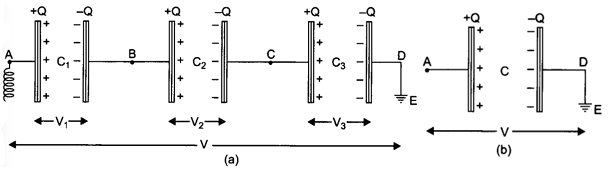
Derive an expression for equivalent capacitance of three capacitors when connected
i. in series and
ii. in parallel.
Answer
i. In fig. (a) three capacitors of capacitances $C_1, C_2, C_3$ are connected in series between points $A$ and $D$.
Image

In series first plate of each capacitor has charge +Q and second plate of each capacitor has charge -Q i.e., charge on each capacitor is Q.
Let the potential differences across the capacitors $C_1, C_2, C_3$ be $V_1, V_2, V_3$ respectively. As the second plate of first capacitor $C _1$ and first plate of second capacitor $C _2$ are connected together, their potentials are equal. Let this common potential be $V _{ B }$ Similarly the common potential of second plate of $C _2$ and first plate of $C _3$ is $V _{ C }$. The second plate of capacitor $C _3$ is connected to earth, therefore its potential $V_D=0$. As charge flows from higher potential to lower potential, therefore $V_A>V_B$ $> V _{ C }> V _{ D }$.
For the first capacitor, $V _1= V _{ A }- V _{ B }=\frac{Q}{C_1} \ldots$ (i)
For the second capacitor, $V _2= V _{ B }- V _{ C }=\frac{Q}{C_2} \ldots$ (ii)
For the third capacitor, $V _3= V _{ C }- V _{ D }=\frac{q}{c_3} \ldots$ (iii)
Adding (i), (ii) and (iii), we get
$V _1+ V _2+ V _3= V _{ A }- V _{ D }=Q\left[\frac{1}{C_1}+\frac{1}{C_2}+\frac{1}{C_3}\right] \ldots$ (iv)
If V be the potential difference between A and D, then
$V _{ A }- V _{ D }= V$
$\therefore$ From (iv), we get
$V =\left( V _1+ V _2+ V _3\right)=Q\left[\frac{1}{C_1}+\frac{1}{C_2}+\frac{1}{C_3}\right] \ldots( v )$
If in place of all the three capacitors, only one capacitor is placed between A and D such that on giving it charge Q, the potential difference between its plates become V, then it will be called equivalent capacitor. If its capacitance is C, then
$V =\frac{Q}{C} \ldots( vi )$
Comparing (v) and (vi), we get
$\frac{Q}{C}=Q\left[\frac{1}{C_1}+\frac{1}{C_2}+\frac{1}{C_3}\right]$ or $\frac{1}{C}=\frac{1}{C_1}+\frac{1}{C_2}+\frac{1}{C_3} \ldots$ (vii)
Thus in series arrangement, "The reciprocal of equivalent capacitance is equal to the sum of the reciprocals of the individual capacitors."

View full question & answer
Question 55 Marks
Give the shape of interference fringes observed
a. in a Young's double-slit experiment
b. in the air wedge experiment
c. in the Lloyd's mirror experiment
d. when a small lamp is placed before a thin mica sheet and light waves reflected from the front and back surfaces of the sheet combine to produce interference pattern on a screen behind the lamp. (Pohl's experiment)
e. from a thin air film formed by placing a convex lens on top of a flat glass plate (Newton's arrangement).
Answer
a. Interference fringes are straight lines parallel to the two slits.
b. Interference fringes are straight lines parallel to the edge of the wedge.
c. Interference fringes are straight lines parallel to the slit sources.
d. Here the two coherent sources are the point images of the small lamp formed due to the reflection of light waves from the front and back surfaces of the sheet. They form circular fringes.
e. Due to circular symmetry, the loci of points of equal thickness are concentric circles. Hence the fringes are concentric circles with the centre at the point of contact of the lens and the plate.
View full question & answer
Question 65 Marks
Determine the 'effective focal length' of the combination of the two lenses having focal lengths $30 \ cm$ and $-20\ cm$ if they are placed $8.0 \ cm$ apart with their principal axes coincident. Does the answer depend on which side of the combination a beam of parallel light is incident? Is the notion of effective focal length of this system useful at all?
Answer
Here, $f _1=30 \ cm, f _2=-20 \ cm, d =8.0 \ cm$
Let a parallel beam be incident on the convex lens first. If second lens were absent, then
$\therefore u_1=\infty$ and $f _1=30 \ cm$
$\text { As } \frac{1}{v_1}-\frac{1}{u_1}=\frac{1}{f_1}$
$\therefore \frac{1}{v_1}-\frac{1}{\infty}=\frac{1}{30}$
or $ v_1=30 \ cm$
This image would now act as virtual object for second lens.
$\therefore u _2=+(30-8)=+22 \ cm$
$f _2=-20 \ cm$
Since $, \frac{1}{v_2}=\frac{1}{f_2}+\frac{1}{w_2}$
$\therefore \frac{1}{v_2}=\frac{1}{-20}+\frac{1}{22}$
$=\frac{-11+10}{220}=\frac{-1}{220}$
$v_2=-220 \ cm$
$\therefore$ Parallel incident beam would appear to diverge from a point $220-4=216 \ cm$ from the centre of the two lens system.
Assume that a parallel beam of light from the left is incident first on the concave lens.
$\therefore u_1=-\infty, f _1=-20 \ cm$
$\text { As } \frac{1}{v_1}-\frac{1}{u_1}=\frac{1}{f_1}$
$\therefore \frac{1}{v_1}=\frac{1}{f_1}+\frac{1}{u_1}$
$=\frac{1}{-20}+\frac{1}{-\infty}=-\frac{1}{20}$
$v_1=-20 \ cm$
This image acts as a real object for the second lens
$u _2=-(20+8)=-28 \ cm, f _2=30 \ cm$
Since, $\frac{1}{v_2}-\frac{1}{u_2}=\frac{1}{f_2}$
$\therefore \frac{1}{v_2}=\frac{1}{f_2}+\frac{1}{u_2}$
$=\frac{1}{30}-\frac{1}{28}$
$=\frac{14-15}{420}$
$v_2=-420 \ cm$
The parallel beam appears to diverge from a point $420 - 4 = 416 \ cm,$ on the left of the centre of the two lens system.
We finally conclude that the answer depends on the side of the lens system where the parallel beam is incident.
Therefore, the notion of effective focal length does not seem to be meaningful here.
View full question & answer