Questions

1 Marks Question

Take a timed test

47 questions · self-marked practice — reveal the answer and mark yourself.

Question 11 Mark
Answer the following question:
An electron travelling west to east enters a chamber having a uniform electrostatic field in north to south direction. Specify the direction in which a uniform magnetic field should be set up to prevent the electron from deflecting from its straight line path.
Answer
An electron travelling from West to East enters a chamber having a uniform electrostatic field in the North-South direction. This moving electron can remain undeflected if the electric force acting on it is equal and opposite of magnetic field. Magnetic force is directed towards the South. According to Fleming's left hand rule, magnetic field should be applied in a vertically downward direction.
View full question & answer
Question 21 Mark
Answer the following question:
A charged particle enters an environment of a strong and non-uniform magnetic field varying from point to point both in magnitude and direction, and comes out of it following a complicated trajectory. Would its final speed equal the initial speed if it suffered no collisions with the environment?
Answer
Yes, the final speed of the charged particle will be equal to its initial speed. This is because magnetic force can change the direction of velocity, but not its magnitude.
View full question & answer
Question 31 Mark
A straight horizontal conducting rod of length 0.45 m and mass 60 g is suspended by two vertical wires at its ends. A current of 5.0 A is set up in the rod through the wires.
  1. What magnetic field should be set up normal to the conductor in order that the tension in the wires is zero?
  2. What will be the total tension in the wires if the direction of current is reversed keeping the magnetic field same as before? (Ignore the mass of the wires.) $g = 9.8 m s^{-2}$.
Answer
Length of the rod, $l = 0.45\ m$
Mass suspended by the wires, $m = 60 g = 60 × 10^{-3}\ kg$
Acceleration due to gravity, $g = 9.8 m/s^2$
current in the rod flowing through the wire, $I = 5A$
  1. Magnetic field (B) is equal and opposite to the weight of the wire i.e.,
BIl = mg

$\therefore\text{B}=\frac{\text{mg}}{\text{Il}}$

$=\frac{60\times10^{-3}\times9.8}{5\times0.45}=0.26\ \text{T}$
  1. A horizontal magnetic field of 0.26 T normal to the length of the conductor should be set,
$=0.26\times5\times0.45+(60\times10^{-3})\times9.8$

$=1.176\ \text{N}$
View full question & answer
Question 41 Mark
Answer the following question:
A magnetic field that varies in magnitude from point to point but has a constant direction (east to west) is set up in a chamber. A charged particle enters the chamber and travels undeflected along a straight path with constant speed. What can you say about the initial velocity of the particle?
Answer
The initial velocity of the particle is either parallel or anti-parallel to the magnetic field. Hence, it travels along a straight path without suffering any deflection in the field.
View full question & answer
Question 51 Mark
A planar loop of rectangular shape is moved within the region of a uniform magnetic field acting perpendicular to its plane. What is the direction and magnitude of the current induced in it?
Answer
No induced current hence no direction.
View full question & answer
Question 61 Mark
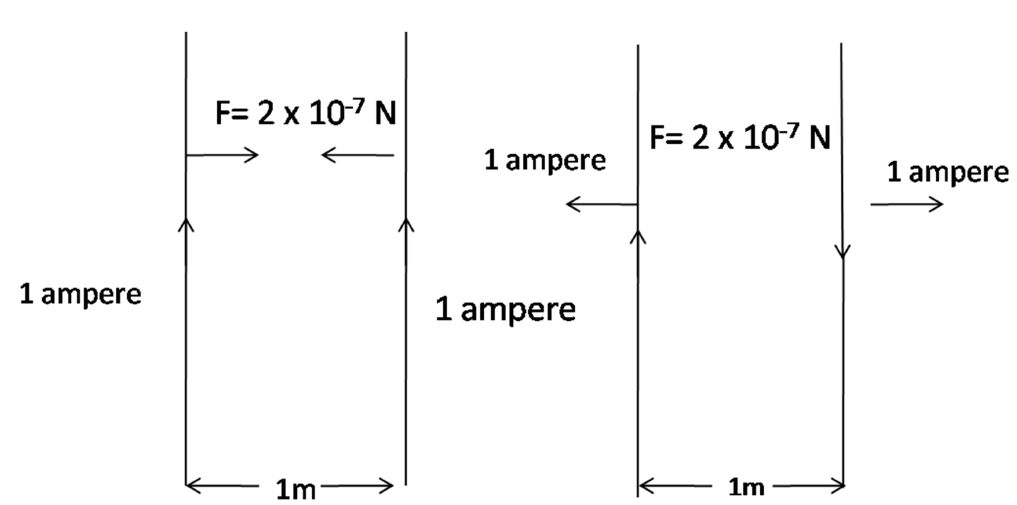
Using the concept of force between two infinitely long parallel current carrying conductors, define one ampere of current.
Answer
Definition: One ampere is the value of steady current which when maintained in each of the two very long, straight, parallel conductors of negligible cross-section and placed one metre apart in vaccum, would produce on each of these conductors a force equal of 2 x 10⁻⁷ N/m of its length.
Alternate Answer
If the student writes $\text{F} = \frac{\mu_{o}}{2\pi}\frac{\text{I}_{1}\text{I}_{2}}{\text{R}}\text{L}$
and says that when $I_1= I_2= 1$ ampere
$R = 1$ meter and $L = 1$ meter, then
$F= 2 x 10^{-7}\ N$

Alternate Answer
View full question & answer
Question 71 Mark
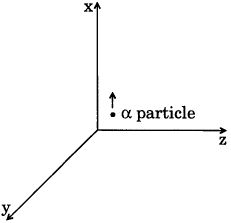
A beam of a particles projected along + x-axis, experiences a force due to a magnetic field along the + y-axis. What is the direction of the magnetic field?
Answer
Negative Z direction ​​​​​​$(-\hat{\text{k}}).$
View full question & answer
Question 81 Mark
An electron does not suffer any deflection while passing through a region of uniform magnetic field. What is the direction of the magnetic field?
Answer
Magnetic field and motion of electron should be/parallel/anti parallel.
View full question & answer
Question 91 Mark
Why should the spring/suspension wire in a moving coil galvanometer have low torsional constant?
Answer
$\frac{\phi}{\text{I}}$
To increase current sensitivity.
Alternate Answer
$\text{ Current Sensitivity}= \frac{\text{NBA}}{\text{k}}$
To increase deflection.
View full question & answer
Question 101 Mark
An electron is moving a along +ve x-axis in the presence of uniform magnetic field along +ve y-axis. What is the direction of the force acting on it?
Answer
along –ve z axis$ - \hat {\text{k}}$.
View full question & answer
Question 111 Mark
Write the expression, in a vector form, for the Lorentz magnetic force$\overrightarrow{\text{F}}$ due to a charge moving with velocity $\overrightarrow{\text{V}}$in a magnetic field $\overrightarrow{\text{B}}.$ What is the direction of the magnetic force?
Answer
$\overrightarrow{\text{F}} = \text{q}( \overrightarrow{\text{v}}\times\overrightarrow{\text{B}})$
Perpendicular to the plane formed by$\overrightarrow{\text{v}}$and $\overrightarrow{\text{B}}/\overrightarrow{\text{F}}\bot\overrightarrow{\text{v}}\text{and }\overrightarrow{\text{F}}\bot \overrightarrow{\text{B}}.$
View full question & answer
Question 121 Mark
Write the underlying principle of a moving coil galvanometer.
Answer
A current carrying coil, in the presence of magnetic field, experiences a torque, which produces proportionate deflection.
Alternate Answer
[(deflection) $\theta \alpha\tau$ (Torque)]
View full question & answer
Question 131 Mark
Why should electrostatic field be zero inside a conductor?
Answer
In the static situation, there is no current inside, or on the surface, of the conductor. Hence the electric field is zero everywhere inside the conductor.
Alternate Answer
since the charge inside the conductor is zero, the electric field is also zero.

Alternate Answer
since the conductor is uncharged so the electric field inside it is zero.
View full question & answer
Question 141 Mark
Magnetic field lines can be entirely confined within the core of a toroid, but not within a straight solenoid. Why?
Answer
The magnetic fields lines get confined within a toroid because it has ‘no ends.'
View full question & answer
Question 151 Mark
What is the direction of the force acting on a charged particle q, moving with a velocity $\overrightarrow{v}$ in a uniform magnetic field $\overrightarrow{B}$?
Answer
Perpendicular to the plane of $\overrightarrow{v}$ and $\overrightarrow{\text{B}}$Alternate Answer
Direction of $f= q\big(\overrightarrow{v}\times\overrightarrow{B}\big)$
View full question & answer
Question 161 Mark
A proton and an electron travelling along parallel paths enter a region of uniform magnetic field, acting perpendicular to their paths. Which of them will move in a circular path with higher frequency?
Answer
Proton.Reason:
Frequency of charge revolving in circular orbit is given by: $\text{f}=\frac{2\pi\text{m}}{\text{qB}}$ For proton, $\text{f}_{\text{p}}=\frac{2\pi\text{m}_{\text{p}}}{\text{eB}}$ For electron, $\text{f}_{\text{e}}=\frac{2\pi\text{m}_{\text{e}}}{\text{eB}}$ but $m_p>m_p S o, f_p>f_e$ Hence, proton will move in a circular path with higher frequency.
View full question & answer
Question 171 Mark
What is Bohr magneton?
Answer
Bohr magenton is a unit of atomic dipole moment. Its value is eh
$\frac{\text{eh}}{4\pi\text{m}}=9.27\times10^{-24}\text{Am}^2$.
View full question & answer
Question 181 Mark
Which types of fields are produced by a moving electron? If electron is at rest, then what type of field is produced?
Answer
A moving electron produces electric and magnetic fields both. A stationary electron produces electric field only.
View full question & answer
Question 191 Mark
What is the nature of magnetic field in a moving coil galvanometer?
Answer
The nature of magnetic field in a moving coil galvanometer is radial.
View full question & answer
Question 201 Mark
Equal currents are flowing through two infinitely long parallel wires. What will be the magnetic field at a point midway when the currents are flowing in the same direction?
Answer
Magnetic field at mid-point due to two wires will be equal and opposite, hence the net magnetic field at this point will be zero.
View full question & answer
Question 211 Mark
In what condition does a charged particle moving through a magnetic field follow a circular path?
Answer
The charged particle follows a circular path, when it moves perpendicular to the direction of a magnetic field.
View full question & answer
Question 221 Mark
Give two factors by which the voltage sensitivity of a moving coil galvanometer can be increased.
Answer
The voltage sensitivity of a moving coil galvanometer is given by $\text{S}_\text{v}=\frac{\text{NBA}}{\text{GC}} $
Clearly, it can be increased by increasing the number of turns (N) and decreasing the torsional rigidity C of suspension wire.
View full question & answer
Question 231 Mark
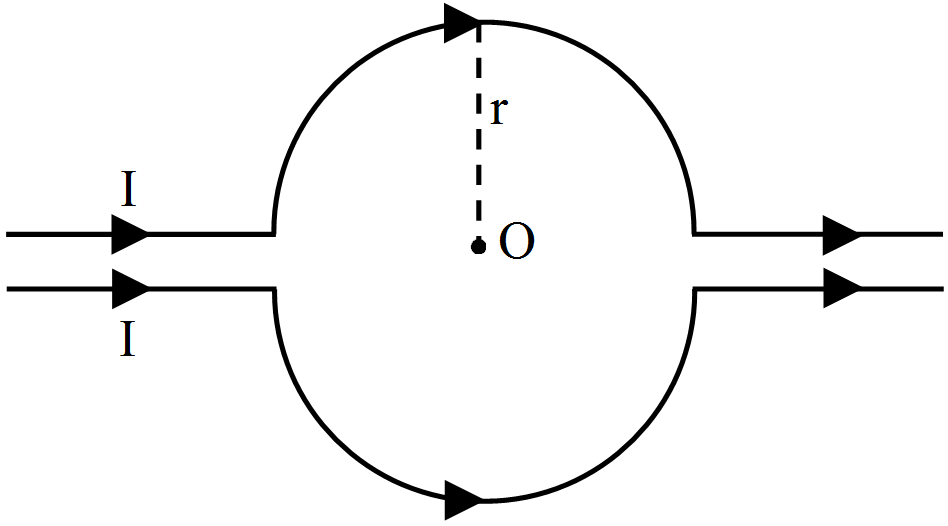
What is the value of magnetic field at point O due to current flowing in the wires?
Answer
Zero, because the upper and lower current carrying conductors are identical and so the magnetic fields caused by them at the centre O will be equal and opposite.
View full question & answer
Question 241 Mark
A charged particle moving with a uniform velocity enters a magnetic field directed perpendicular to it, what will be the path of electron? How will its speed be affected?
Answer
In a perpendicular magnetic field a charged particle traverses a circular path. There will be no change in speed of particle.
View full question & answer
Question 251 Mark
Under what condition the force acting on a charge moving through a uniform magnetic field is minimum?
Answer
$\text{F}_\text{m}=\text{qvB}\sin\theta$; for minimum force $\sin\theta=0$.
i.e., force is minimum when charged particle moves parallel or antiparallel to the field.
View full question & answer
Question 261 Mark
An electron, passing through a region is not deflected. Are you sure that there is no magnetic field in that region?
Answer
No, if an electron enters parallel to a magnetic field, no force acts and the electron remains undeflected.
View full question & answer
Question 271 Mark
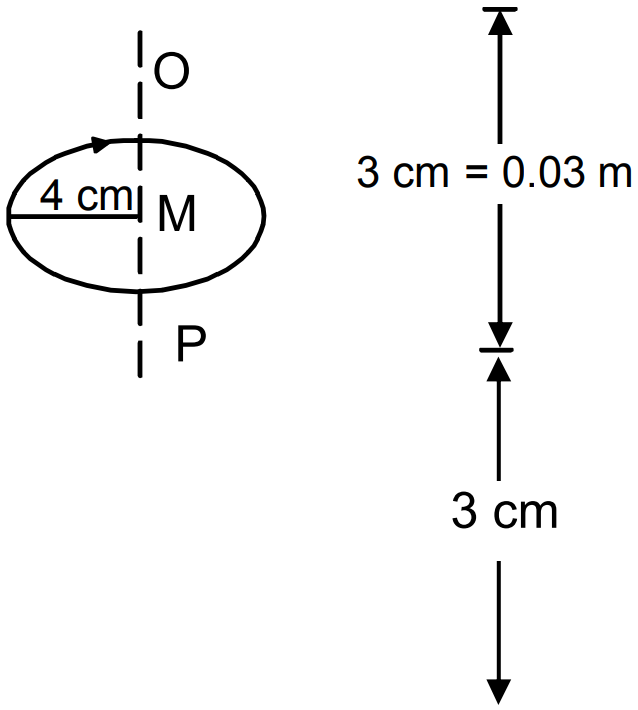
A circular loop of radius 4.0cm is placed in a horizontal plane and carries an electric current of 5.0A in the clockwise direction as seen from above. Find the magnetic field:
  1. At a point 3.0cm above the centre of the loop.
  2. At a point 3.0cm below the centre of the loop.
Answer
At O P the $\overrightarrow{\text{B}}$ must be directed downwards
We Know,
B at the axial line at O & P

$=\frac{\mu_0\text{ia}^2}{2(\text{a}^2+\text{d}^2)^\frac{3}{2}}$ a = 4cm = 0.04m
$=\frac{4\pi\times10^{-7}\times5\times0.0016}{2(0.0025)^\frac{3}{2}}$ d = 3cm = 0.0m
$=40\times10^{-6}=\times10^{-5}\text{T}$ downwards in both the cases.
View full question & answer
Question 281 Mark
Under what condition an electron moving through a magnetic field experiences the maximum force?
Answer
$\text{F}_\text{m}=\text{qvB} \ \sin\theta$
Force is maximum when $\sin\theta=1\ \text{or}\ \theta=90^\circ$,that is, when electron is moving perpendicular to the direction of magnetic field.
View full question & answer
Question 291 Mark
What will be the path of a charged particle moving along the direction of a uniform magnetic field?
Answer
The path of particle will remain unchanged $($since magnetic force $\text{F}_\text{m}=\text{qvB} \ \sin\theta=0)$.
View full question & answer
Question 301 Mark
Will a current loop placed in a magnetic field always experience a zero force?
Answer
If the magnetic field is uniform in space. If it is non-uniform net force will not be always zero.
View full question & answer
Question 311 Mark
Can a charged particle be accelerated by a magnetic field? Can its speed be increased?
Answer
Yes (in circular path), No since magnetic field does no work.
View full question & answer
Question 321 Mark
Why should a voltmeter have high resistance?
Answer
A voltmeter is connected in parallel. When connected in parallel, it should draw least current otherwise, the potential difference which it has to measure, will change.
View full question & answer
Question 331 Mark
When a charged particle moves in a magnetic field normally; what quantity changes the particle’s speed, particle’s energy, path of motion of the particle?
Answer
Path of motion changes.
View full question & answer
Question 341 Mark
A charged particle enters along the axis of a current carrying a long solenoid. How is its velocity affected? Will the particle be accelerated or decelerated?
Answer
The magnetic field due to a current in solenoid is along the axis, so when a charged particle enters along the axis $(\theta=0)$, the magnetic force on particle is $\text{qvB}\sin0^\circ=0$; so the particle’s velocity remains unchanged i.e., the particle remains unaccelerated.
View full question & answer
Question 351 Mark
Suppose a charged particle moves with a velocity v near a wire carrying an electric current. A magnetic force, therefore, acts on it. If the same particle is seen from a frame moving with velocity v in the same direction, the charge will be found at rest. Will the magnetic force become zero in this frame? Will the magnetic field become zero in this frame?
Answer
Current doesn't depend on reference frame as if electron comes to rest, protons moves in oppositive direction therefore the magnetic field will not become zero.
Since, the charged particle appears to be at rest therefore the force due to magnetic field becomes zero.
View full question & answer
Question 361 Mark
What pre-information would you require to convert a galvanometer into ammeter or voltmeter?
Answer
Two information’s are required:
  1. Resistance of galvanometer.
  2. Current in galvanometer for full scale deflection.
View full question & answer
Question 371 Mark
Which physical quantity has the unit $\mathrm{Wb} / \mathrm{m}^2$ ? Is it a scalar or a vector quantity?
Answer
Magnetic field induction has the unit $\mathrm{Wb} / \mathrm{m}^2$. It is a vector quantity.
View full question & answer
Question 381 Mark
Why should an ammeter have a low resistance?
Answer
An ammeter is connected in series with the circuit to read the current. If it had large resistance, it will change the current in circuit which it has to measure correctly; hence ammeter reading will have significant error; so for correct reading an ammeter should have a very low resistance.
View full question & answer
Question 391 Mark
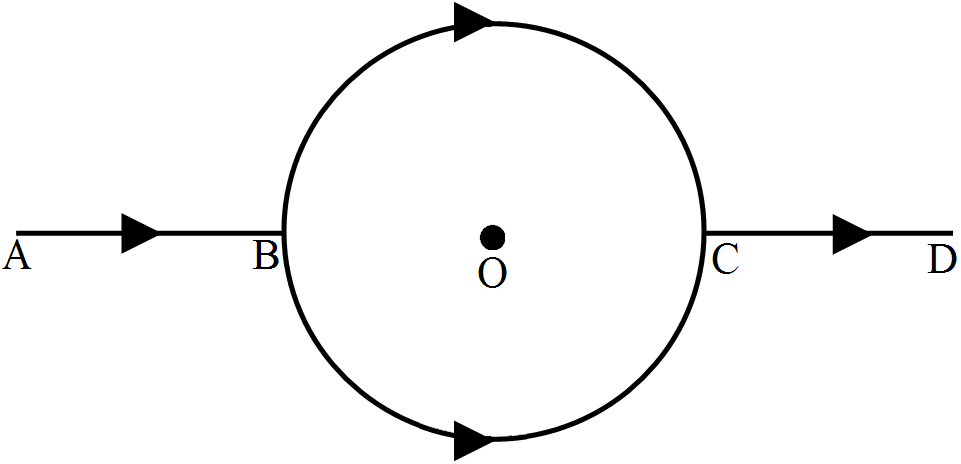
What is the magnetic field at point O due to current carrying wires shown in figure?
Answer
The magnetic field due to straight wires AB and CD is zero since either $\theta=0\ \text{or}\ 180^\circ$ and that due to a semi-circular arc are equal and opposite; hence net field at O is zero.
View full question & answer
Question 401 Mark
Two proton beams going in the same direction repel each other whereas two wires carrying currents in the same direction attract each other. Explain.
Answer
Two proton beams going in the same direction repel each other, as they are like charges and we know that like charges repel each other.
When a charge is in motion then a magnetic field is associated with it. Two wires carrying currents in the same direction produce their fields (acting on each other) in opposite directions so the resulting magnetic force acting on them is attractive. Due to the magnetic force, these two wires attract each other.
But when a charge is at rest then only an electric field is associated with it and no magnetic fiels is produced by it. So at rest, it repels a like charge by exerting a electric force on it. Charge in motion can produce both electric field and magnetic field.
The attractive force between two current carrying wires is due to the magnetic field and repulsive force is due to the electric field.
View full question & answer
Question 411 Mark
The free electrons in a conducting wire are in constant thermal motion. If such a wire, carrying no current, is placed in a magnetic field, is there a magnetic force on each free electron? On the wire?
Answer
Yes, each electron experiences a force. But since the motion is random the net force on collective electrons is zero.
View full question & answer
Question 421 Mark
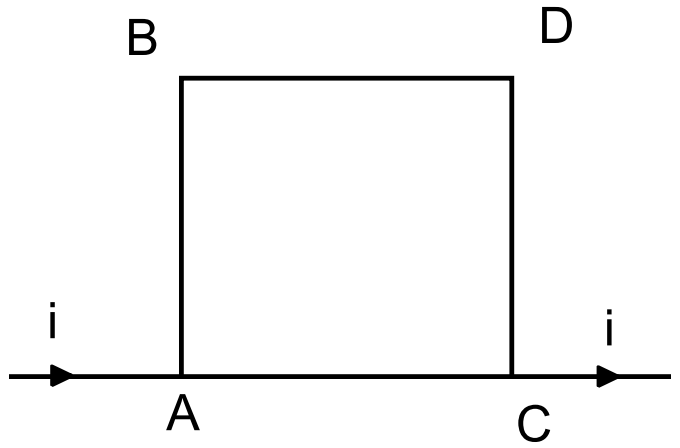
Consider the situation described in the previous problem. Suppose the current i enters the loop at the point A and leaves it at the point B. Find the magnetic field at the centre of the loop.
Answer

$\overrightarrow{\text{B}}$ due t BC
$\overrightarrow{\text{B}}$ due to AD at Pt ‘P’ are equal ore Opposite
Hence net $\overrightarrow{\text{B}}=0$
Similarly, due to AB & CD at P = 0 
$\therefore$ The net B  at the Centre of the square loop = zero
View full question & answer
Question 431 Mark
Two identical charged particles moving with the same speed enter a region of uniform magnetic field. If one of these enters normal to the field direction and the other enters along a direction at 30° with the field, what would be the ratio of their angular frequencies?
Answer
$\omega=\frac{\text{qB}}{\text{m}}$ independent of angle of entrance with the magnetic field.Ratio $\omega_1:\omega_2=1:1$
View full question & answer
Question 441 Mark
Two wires of equal length are bent in the form of two loops. One of the loops is square shaped whereas the other loop is circular. These are suspended in a uniform magnetic field and the same current is passed through them. Which loop will experience greater torque? Give reasons.
Answer
Torque $\tau=\text{IAB}\sin\theta\propto\text{A}$. For given perimeter the area of circular loop is maximum, so a circular loop will experience greater torque.
View full question & answer
Question 451 Mark
Consider a tightly wound 100 turn coil of radius $10 cm$, carrying a current of $1 A$. What is the magnitude of the magnetic field at the centre of the coil?
Answer
Since the coil is tightly wound, we may take each circular element to have the same radius $R=10 cm =0.1 m$. The number of turns $N=100$. The magnitude of the magnetic field is,
$
B=\frac{\mu_0 N I}{2 R}=\frac{4 \pi \times 10^{-7} \times 10^2 \times 1}{2 \times 10^{-1}}=2 \pi \times 10^{-4}=6.28 \times 10^{-4} T
$
View full question & answer
Question 461 Mark
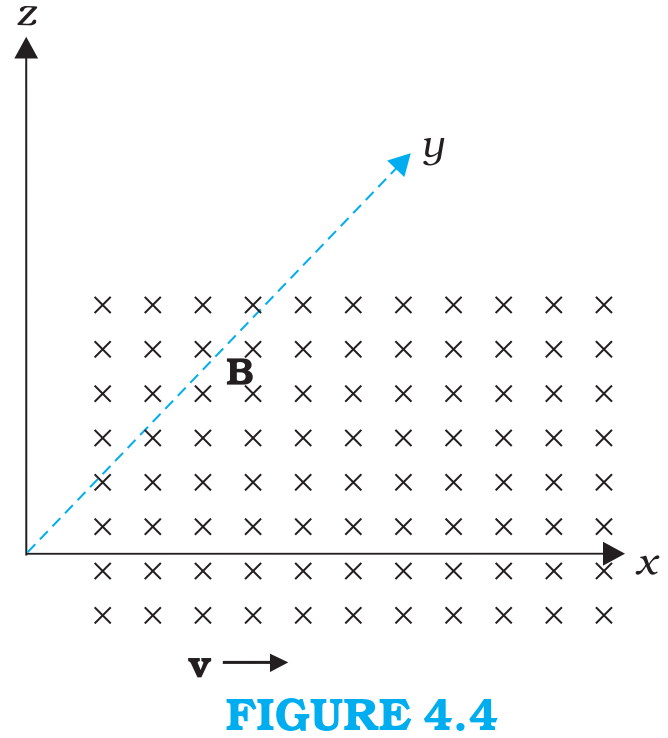
If the magnetic field is parallel to the positive $y$-axis and the charged particle is moving along the positive $x$-axis (Fig. 4.4), which way would the Lorentz force be for (a) an electron (negative charge), (b) a proton (positive charge).
Image
Answer
The velocity $v$ of particle is along the $x$-axis, while $B$, the magnetic field is along the $y$-axis, so $v \times B$ is along the $z$-axis (screw rule or right-hand thumb rule). So, (a) for electron it will be along $-Z$ axis. (b) for a positive charge (proton) the force is along $+z$ axis.
View full question & answer
Question 471 Mark
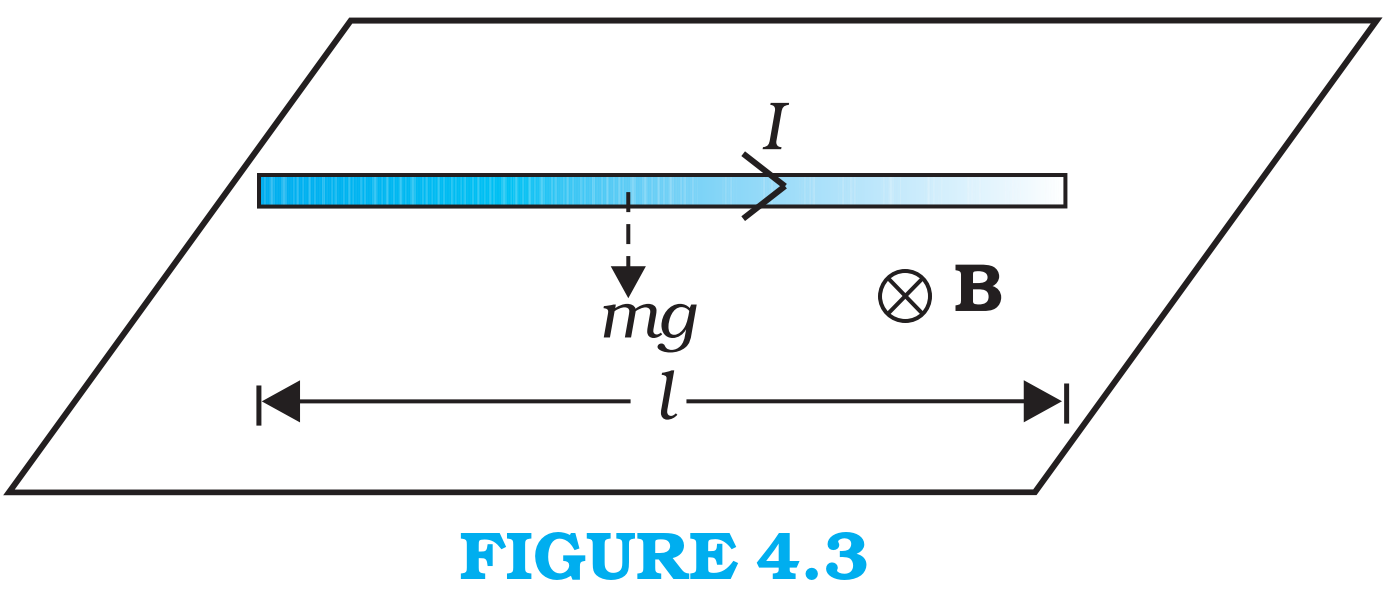
A straight wire of mass $200 g$ and length $1.5 m$ carries a current of $2 A$. It is suspended in mid-air by a uniform horizontal magnetic field B (Fig. 4.3). What is the magnitude of the magnetic field?
Image
Answer
From Eq. (4.4), we find that there is an upward force $F$, of magnitude $I l B$,. For mid-air suspension, this must be balanced by the force due to gravity:
$
\begin{aligned}
m g & =I l B \\
B & =\frac{m g}{I l} \\
& =\frac{0.2 \times 9.8}{2 \times 1.5}=0.65 T
\end{aligned}
$
Note that it would have been sufficient to specify $m / l$, the mass per unit length of the wire. The earth's magnetic field is approximately $4 \times 10^{-5} T$ and we have ignored it.
View full question & answer