Questions

Case study (4 Marks)

Take a timed test

23 questions · self-marked practice — reveal the answer and mark yourself.

Question 14 Marks
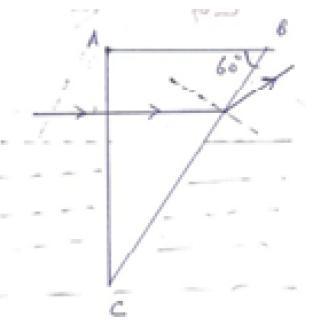
  1. A ray of light is incident normally on the face AB of a right-angled glass prism of refractive index $_{a}\mu_{g} =1.5$The prism is partly immersed in a liquid of unknown refractive index. Find the value of refractive index of the liquid so that the ray grazes along the face BC after refraction through the prism.
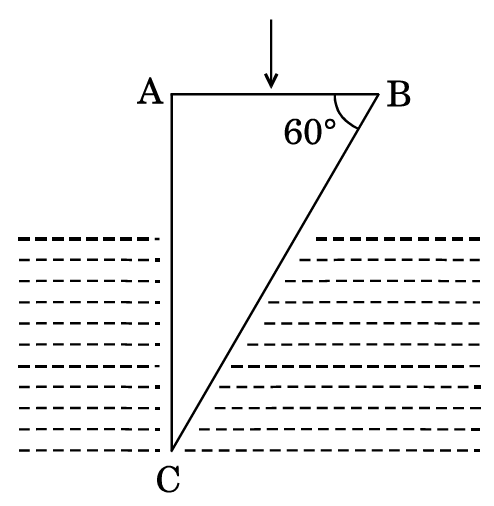
  1. Trace the path of the rays if it were incident normally on the face AC.
Answer
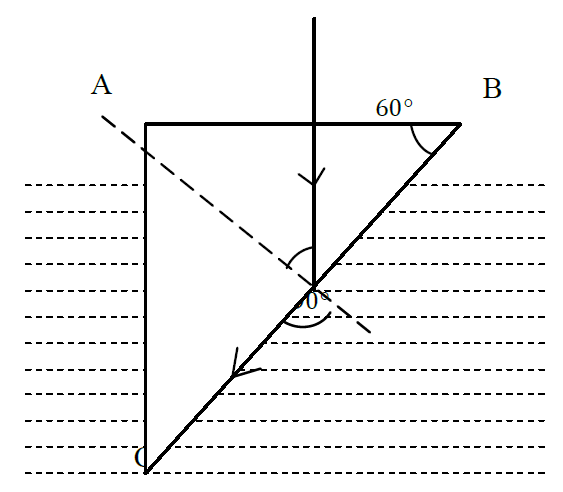
$\sin\text{i}_{c} = \frac{1}{\mu}_{mg} = \frac{\mu_m}{\mu_{g}}$
$\Rightarrow \mu_{m} = \mu_{g}\sin\text{i}_{c}$
$=1.5\times \frac{\sqrt{3}}{2}(\text{i}_{c} = 60^{\circ})$
$ = 1.299 \simeq1.3$
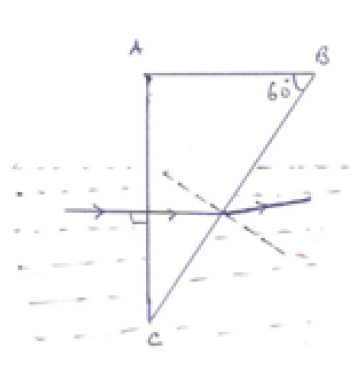
Alternate Answer
View full question & answer
Question 24 Marks
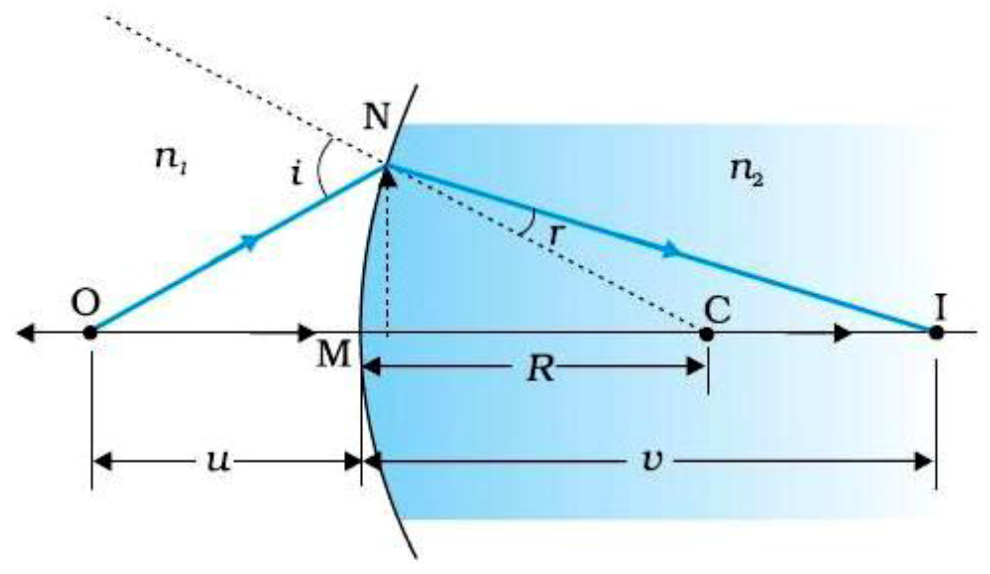
  1. A point-object is placed on the principal axis of a convex spherical surface of radius of curvature R, which separates the two media of refractive indices $n_1$ and $n_2 (n_2 > n_1).$ Draw the ray diagram and deduce the relation between the distance of the object (u),distance of the image (v) and the radius of curvature (R) for refraction to take place at the convex spherical surface from rarer to denser medium.
  2. Use the above relation to obtain the condition on the position of the object and the radius of curvature in terms of $n_1$ and $n_2$ when the real image is formed.
Answer
  1.  
​​​​​​
From the diagram:
$\angle\text{i} = \angle\text{???} +\angle\text{ ???}$
$\angle\text{?} = \angle \text{???} − \angle \text{ ???}$
By Snell‟s law, $\text{?}_{1} \sin\text{ ?} = \text{?}2 \sin\text{ ?}$
Substituting for i and r. and simplifying, we get
$\frac{\text{?}_{1}}{\text{??}}+\frac{\text{?}_{2}}{\text{??}}=\frac{\text{?}_{2} − \text{?}_{1}}{\text{MC}} $
Substituting values of OM , MI and MC
$\frac{\text{?}_{2}}{\text{?}}−\frac{\text{?}_{1}}{\text{?}}=\frac{\text{?}_{2}−\text{n}_{1}}{\text{R}}$
  1. Condition for real image: ν is positive
$\therefore\frac{\text{n}_{2}}{\text{v}} > 0$
From the derived relation , we have
$\frac{\text{n}_{1}}{|\text{u}|}<\frac{\text{n}_{2}-\text{n}_{1}}{\text{R}}$
$\therefore|\text{u|} > \frac{\text{n}_{1}\text{R}}{\text{n}_{2} - \text{n}_{1}}$.
View full question & answer
Question 34 Marks
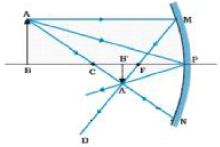
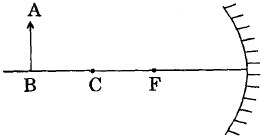
An object AB is kept in front of a concave mirror as shown in the figure.
  1. Complete the ray diagram showing the image formation of the object.
  2. How will the position and intensity of the image be affected if the lower half of the mirror's reflecting surface is painted black?
Answer

  1. Position of image will remain same/unchanged.
  2. Intensity of image will decrease.
View full question & answer
Question 44 Marks
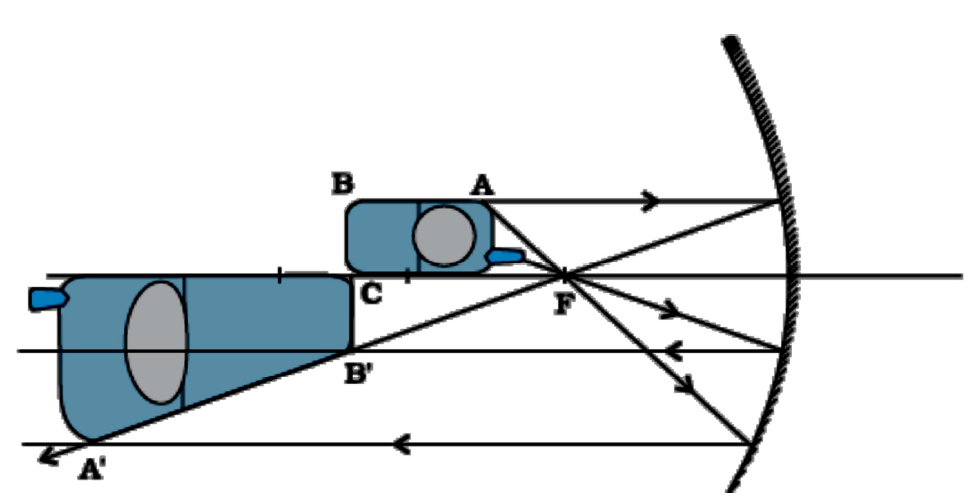
  1. A mobile phone lies along the principal axis of a concave mirror. Show, with the help of a suitable diagram, the formation of its image. Explain why magnification is not uniform.
  2. Suppose the lower half of the concave mirror's reflecting surface is covered with an opaque material. What effect this will have on the image of the object? Explain.
Answer
  1.  


Magnification is non-uniform because the position of the image of different parts of the phone, depends on their location with respect to the mirror. From the figure it can be observed that whereas BC = B’ C, the images of the other parts of the phone, are getting magnified in accordance with their ‘object distance’ from the mirror.
  1. By covering the mirror with an opaque material, the area of the reflecting surface has been reduced (i.e. halved). Therefore, the intensity of the image is reduced to half.
View full question & answer
Question 54 Marks
Total internal reflection is the phenomenon of reflection of light into denser medium at the interface of denser medium with a rarer medium. For this phenomenon to occur necessary condition is that light must travel from denser to rarer and angle of incidence in denser medium must be greater than critical angle (C) for the pair of media in contact. Critical angle depends on nature of medium and wavelength of tight. We can show that $\mu=\frac{1}{\sin\text{C}}.$
  1. Critical angle for glass air interface, where ft of glass is $\frac{3}{2}$ is,
  1. 41.8
  2. 60º
  3. 30º
  4. 15º
  1. Critical angle for water air interface is 48.6º. What is the refractive index of water?
  1. $1$
  2. $\frac{3}{2}$
  3. $\frac{4}{3}$
  4. $\frac{3}{4}$
  1. Critical angle for air water interface for violet colour is 49º. Its value for red colour would be:
  1. 49º
  2. 50º
  3. 48º
  4. Cannot say.
  1. Which of the following is not due to total internal reflection?
  1. Working of optical fibre.
  2. Difference between apparent and real depth of a pond.
  3. Mirage on hot summer days.
  4. Brilliance of diamond.
  1. Critical angle of glass is $\theta_1$ and that of water is $\theta_2$The critical angle for water and glass surface would be $(\mu_\text{g}=\frac{3}{2},\ \mu_\text{w}=\frac{4}{3})$
  1. Less than $\theta_2$
  2. Between $\theta_1$ and $\theta_2$
  3. Greater than $\theta_2$
  4. Less than $\theta_1$
Answer
  1. (a) 41.8
Explanation:

$\sin\text{C}=\frac{1}{\mu}=\frac{1}{\frac{3}{2}}=\frac{2}{3}=0.6667$

$\text{C}=\sin^{-1}(0.6667)=41.8^{\circ}$
  1. (c) $\frac{4}{3}$
Explanation:

$\text{C}\mu=\frac{1}{\sin\text{C}}=\frac{1}{\sin48.6}=\frac{1}{0.75}=\frac{4}{3}$
  1. (c) 48º
Explanation:

From $\mu=\frac{1}{\sin\text{C}},\sin\text{C}=\frac{1}{\mu}$

As, $\mu_\text{v}>\mu_\text{r}\therefore\text{C}_\text{v}<\text{C}_\text{r}$

The correct alternative may be (c).
  1. (b) Difference between apparent and real depth of a pond.
Explanation:

Difference between apparent and real depth of a pond is due to refraction. Other three are due to total internal reflection.
  1. (c) Greater than $\theta_2$
Explanation:

As, $^\text{w}{\mu}_\text{g}<\ ^\text{a}\mu_\text{w}<\ ^\text{a}\mu_\text{g};\ \therefore\theta>\theta_2>\theta_1$
View full question & answer
Question 64 Marks
A child has near point at 10cm. What is the maximum angular magnification the child can have with a convex lens of focal length 10cm?
Answer
The child has D = 10cm and f = 10cm.
The maximum angular magnification is obtained when the image is formed at near point.
$\text{m}=1+\frac{\text{D}}{\text{f}}=1+\frac{10}{10}=1+1=2$
View full question & answer
Question 74 Marks
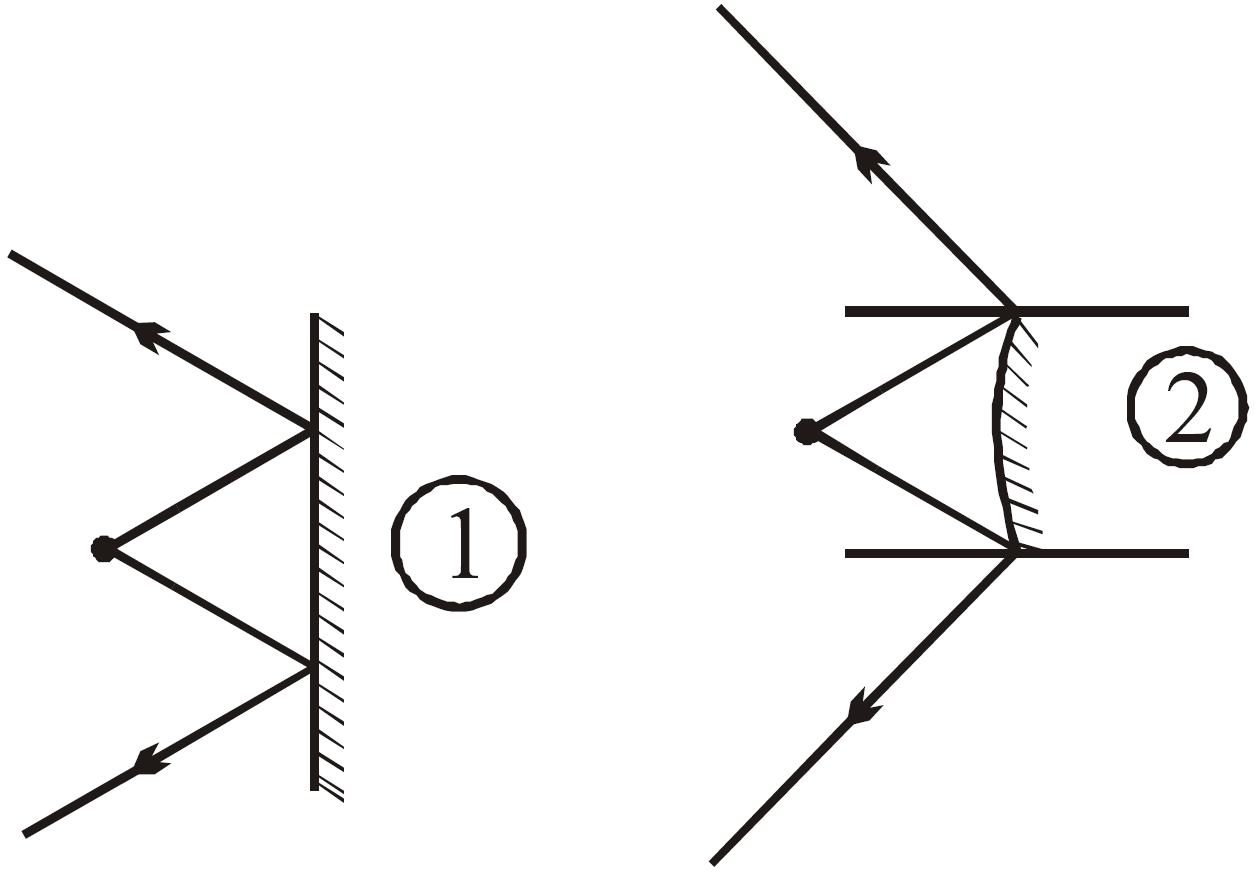
In motor vehicles, a convex mirror is attached near the driver's seat to give him the view of the traffic behind. What is the special function of this convex mirror which a plane mirror can not do?
Answer
Field of view is large.
Field of view is more for mirror 2
View full question & answer
Question 84 Marks
Suppose you are inside the water in a swimming pool near an edge. A friend is standing on the edge. Do you find your friend taller or shorter than his usual height?
Answer
Taller, When view from outside water, the height is $x_2 - x_1;$ but when viewed from inside water, the height is $\mu(\text{x}_2-\text{x}_1).$
View full question & answer
Question 94 Marks
By mistake, an eye surgeon puts a concave lens in place of the lens in the eye after a cataract operation. Will the patient be able to see clearly any object placed at any distance?
Answer
The image formed by a concave lens is virtual and upright. It is smaller than the object and is formed between the object and the lens, irrespective of the position of the object. If, by mistake, an eye surgeon puts a concave lens in place of eye lens in a patient's eye, then the image will not be focused on the retina; this will lead to unclear vision.
View full question & answer
Question 104 Marks
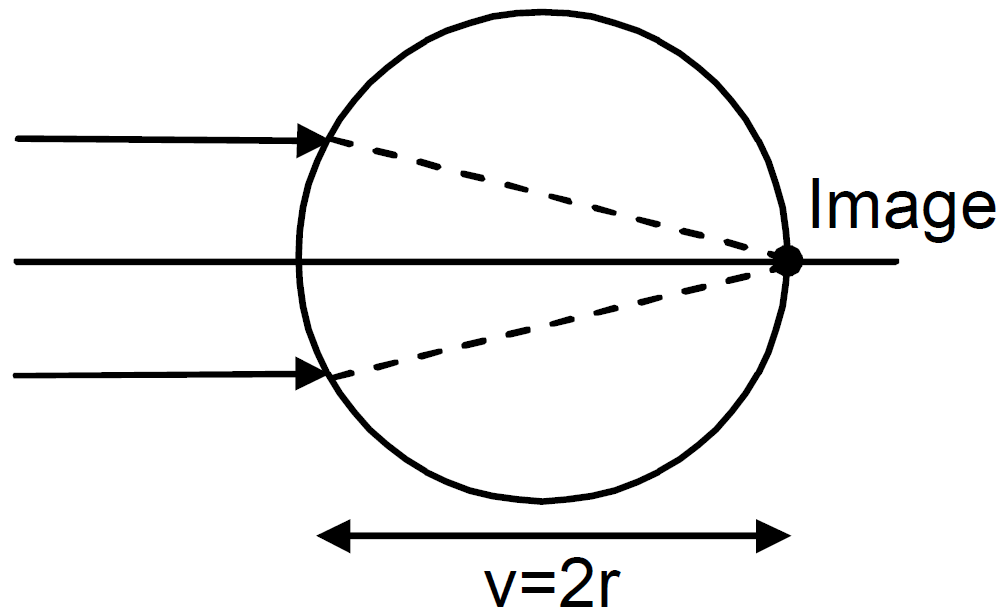
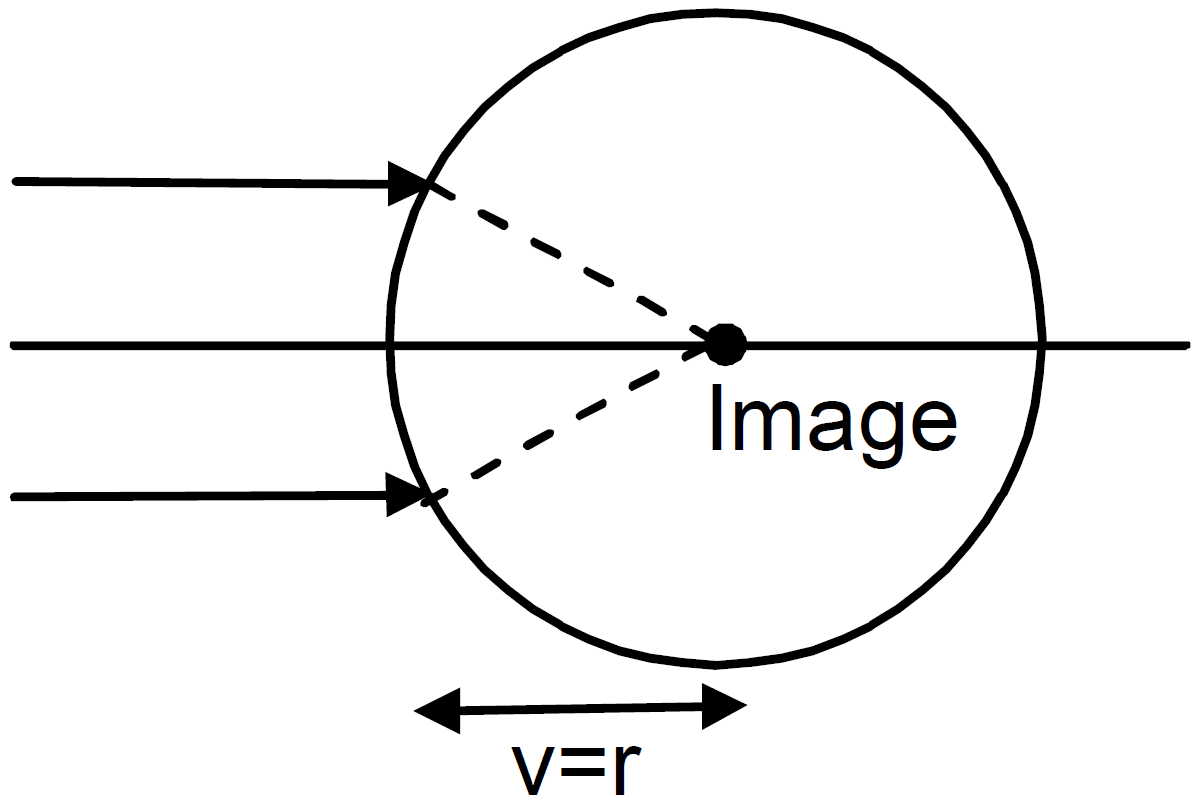
A narrow pencil of parallel light is incident normally on a solid transparent sphere of radius r. What should be the refractive index if the pencil is to he focused.
  1. At the surface of the sphere.
  2. At the centre of the sphere.
Answer
For the refraction at convex surface A.
$\mu=-\infty, \ \mu_1=1, \ \mu_2=?$
  1. When focused on the surface, v = 2r, R = r
So, $\frac{\mu_2}{\text{v}}-\frac{\mu_1}{\text{u}}=\frac{\mu_2-\mu_1}{\text{R}}$
$\Rightarrow\frac{\mu_2}{2\text{r}}=\frac{\mu_2-1}{\text{r}}$
$\Rightarrow \frac{\mu_2}{2\text{r}}-\Big(\frac{1}{-\infty}\Big)=\frac{\mu_2-1}{\text{r}}$
$\Rightarrow\mu_2=2\mu_2-2\Rightarrow\mu_2=2$

  1. When focused at centre, $u = r_1, R = r$
So, $\frac{\mu_2}{\text{v}}-\frac{\mu_1}{\text{u}}=\frac{\mu_2-\mu_1}{\text{R}}$
$\Rightarrow\frac{\mu_2}{\text{R}}=\frac{\mu_2-1}{\text{r}}\Rightarrow\mu_2=\mu_2-1.$
This is not possible.
So, it cannot focus at the centre
View full question & answer
Question 114 Marks
A slide projector has to project a 35mm slide (35mm × 23mm) on a 2m × 2m screen at a distance of 10m from the lens. What should be the focal length of the lens in the projector?
Answer
For the projector the magnification required is given by
$\text{m}=\frac{\text{v}}{\text{u}}=\frac{200}{3.5}\Rightarrow\text{u}=17.5\text{cm}$
[35 mm > 23mm, so the magnification is calculated taking object size 35mm]
Now, from lens formula,
$\Rightarrow\frac{1}{\text{v}}-\frac{1}{\text{u}}=\frac{1}{\text{f}}​​$
$\Rightarrow\frac{1}{\text{v}}-\frac{1}{-\text{u}}=\frac{1}{\text{f}}​​\Rightarrow \frac{1}{1000}+\frac{1}{17.5}=\frac{1}{\text{f}}$
$\Rightarrow\text{f}=17.19\text{cm}.$
View full question & answer
Question 124 Marks
A lady cannot see objects closer than 40cm from the left eye and closer than 100cm from the right eye. While on a mountaineering trip, she is lost from her team. She tries to make an astronomical telscope from her reading glasses to look for her teammates.
  1. Which glass should she use as the eyepiece?
  2. What magnification can she get with relaxed eye?
Answer
The lady can not see objects closer than 40cm from the left eye and 100cm from the right eye.For the left glass lens,
v = -40cm,
u = -25cm
$\therefore \frac{1}{\text{f}}=\frac{1}{\text{v}}-\frac{1}{\text{u}}=\frac{1}{-40}-\frac{1}{-25}=\frac{1}{25}-\frac{1}{40}=\frac{3}{200}$
$\Rightarrow \text{f}=\frac{200}{3}\text{cm}$
For the right glass lens,
v = -100cm,
u = -25cm
$\frac{1}{\text{f}}=\frac{1}{\text{v}}-\frac{1}{\text{u}}=\frac{1}{-100}-\frac{1}{-25}=\frac{1}{100}=\frac{3}{100}$
$\Rightarrow\text{f}=\frac{100}{3}\text{cm}$
  1. For an astronomical telescope, the eye piece lens should have smaller focal length. So, she should
use the right lens $\big(\text{f}=\frac{100}{3}\text{cm}\big)$ as the eye piece lens.
  1. With relaxed eye, (normal adjustment)
$\text{f}_0=\frac{200}{3}\text{cm}$
$\text{f}_\text{e}=\frac{100}{3}\text{cm}$
magnification $=\text{m}=\frac{\text{f}_0}{\text{f}_\text{e}}=\frac{\big(\frac{200}{3}\big)}{\big( \frac{100}{3}\big)}=2$
View full question & answer
Question 134 Marks
A convex or converging lens is thicker at the centre than at the edges. It converges a parallel beam of light on refraction through it. It has a real focus. Convex lens is of three types: (i) Double convex lens (ii) Plano-convex lens (iii) Concavo-convex lens. Concave lens is thinner at the centre than at the edges. It diverges a parallel beam of light on refraction th rough it. It has a virtual focus.
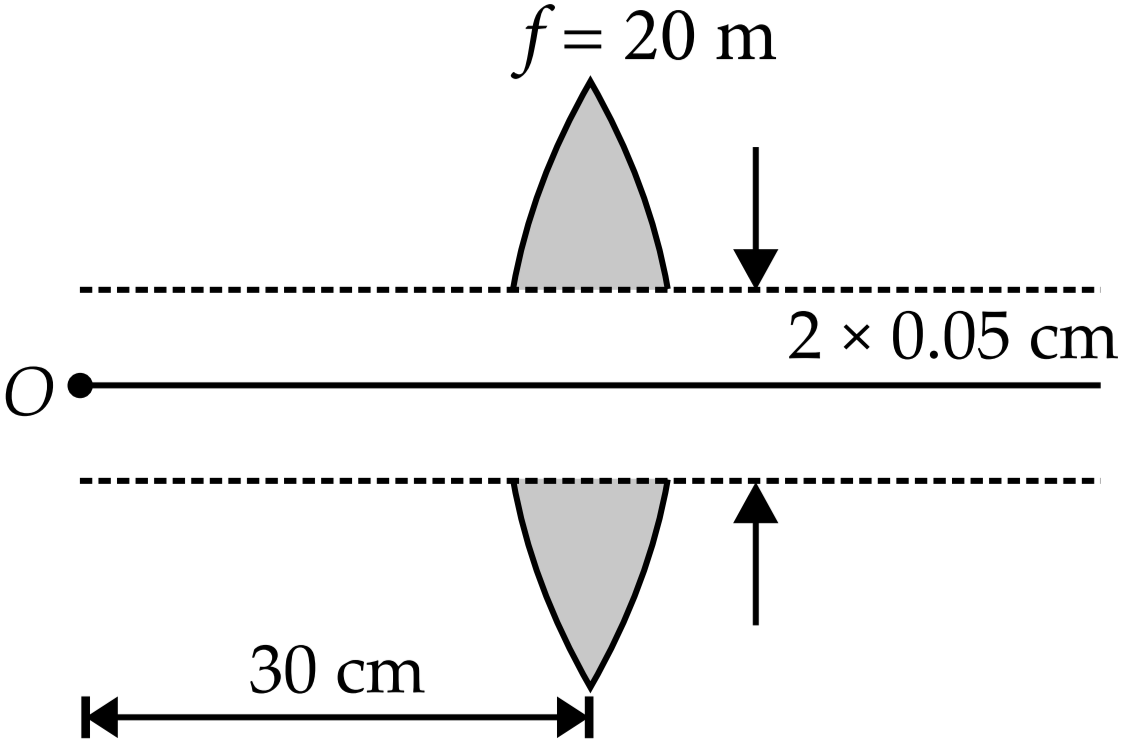
  1. A point object O is placed at a distance of 0.3m from a convex lens (focal length 0.2m) cut into two halves each of which is displaced by 0.0005 mas shown in figure.


What will be the location of the image?
  1. 30cm right of lens.
  2. 60cm right of lens.
  3. 70cm left of lens.
  4. 40cm left of lens.
  1. Two thin lenses are in contact and the focal length of the combination is 80cm. If the focal length of one lens is 20cm, the focal length of the other would be.
  1. 26.7cm
  2. 60cm
  3. 80cm
  4. 20cm
  1. A spherical air bubble is embedded in a piece of glass. For a ray of light passing through the bubble, it behaves tike a.
  1. Converging lens.
  2. Diverging lens.
  3. Piano-converging lens.
  4. Piano-diverging lens.
  1. Lens used in magnifying glass is:
  1. Concave lens.
  2. Convex lens.
  3. Both (a) and (b).
  4. None of the above.
  1. The magnification of an image by a convex lens is positive only when the object is placed.
  1. At its focus F.
  2. Between F and 2F.
  3. At 2F.
  4. Between F and optical centre.
Answer
  1. (b) 60cm right of lens.
Explanation:
Each half lens will from an image in the same plane. The optic axes of the lenses are displaced,
$\frac{1}{\text{v}}-\frac{1}{(-30)}=\frac{1}{20};\text{v}=60\text{cm}$
  1. (a) 26.7cm
Explanation:
Here $f_1 = 20cm; f_2 = ?$
F = 80cm
As, $\frac{1}{\text{f}_1}+\frac{1}{\text{f}_2}=\frac{1}{\text{F}}\Rightarrow\frac{1}{\text{f}_2}=\frac{1}{\text{F}}-\frac{1}{\text{f}_1}$
$\frac{1}{\text{f}_2}=\frac{1}{80}-\frac{1}{20}=\frac{-3}{80}$
$\text{f}_2=\frac{-80}{3}=-26.7\text{cm}$
  1. (b) Diverging lens.
Explanation:
The bubble behaves libe a diverging lens.
  1. (b) Convex lens.
Explanation:
Convex lens is used in magnifying glass.
  1. (d) Between F and optical centre.
View full question & answer
Question 144 Marks
An astronomical telescope is an optical instrument which is used for observing distinct images of heavenly bodies libe stars, planets etc. It consists of two lenses. In normal adjustment of telescope, the final image is formed at infinity. Magnifying power of an astronomical telescope in normal adjustment is defined as the ratio of the angle subtended at the eye by the angle subtended at the eye by the final image to the angle subtended at the eye, by the object directly, when the final image and the object both lie at infinite distance from the eye. It is given by, $\text{m}=\frac{\text{f}_0}{\text{f}_\text{g}}.$ To increase magnifying power of an astronomical telescope in normal adjustment, focal length of objective lens should be large and focal length of eye lens should be small.
  1. An astronomical telescope of magnifying power 7 consists of the two thin lenses 40cm apart, in normal adjustment. The focal lengths of the lenses are
  1. 5cm, 35cm
  2. 7cm, 35cm
  3. 17cm, 35cm
  4. 5cm, 30cm
  1. An astronomical telescope has a magnifying power of 10. In normal adjustment, distance between the objective and eye piece is 22cm. The focal length of objective lens is:
  1. 25cm
  2. 10cm
  3. 15cm
  4. 20cm
  1. In astronomical telescope compare to eye piece, objective lens has:
  1. Negative focal length.
  2. Zero focal length.
  3. Small focal length.
  4. Large focal length.
  1. To see stars, use:
  1. Simple microscope.
  2. Compound microscope.
  3. Endoscope.
  4. Astronomical telescope.
  1. For large magnifying power of astronomical telescope.
  1. $f_0 << f_e$
  2. $f_0 << f_e$
  3. $f_0 << f_e$
  4. None of these.
Answer
  1. (a) 5cm, 35cm
Explanation:
$\text{m}=\frac{\text{f}_0}{\text{f}_\text{e}}=7$
$\text{f}_0=7\text{f}_e$
In normal adjustment, distance between the lenses,
$\text{f}_0+\text{f}_\text{e}=40$
$7\text{f}_0+\text{f}_\text{e}=40\Rightarrow\text{f}_\text{e}=\frac{40}{8}=5\text{cm}$
$\text{f}_0=7\text{f}_\text{e}=7\times5=35\text{cm}$
  1. (d) 20cm
Explanation:
$\text{m}=-10;\text{L}=22\text{cm}$
As, $\text{m}=\frac{-\text{f}_0}{\text{f}_e}\Rightarrow-10=-\frac{\text{f}_0}{\text{f}_\text{e}}$
$\text{f}_0=10\text{f}_\text{e}$
As, $\text{L}=\text{f}_0+\text{f}_\text{e}$
$22=10\text{f}_\text{e}+\text{f}_e=11\text{f}_\text{e}$
or $\text{f}_\text{e}=\frac{22}{11}=2\text{cm}$
$\text{f}_0=10\text{f}_\text{e}=20\text{cm}$
  1. (d) Large focal length.
Explanation:
Objective lens has larger focal length than eye-piece.
  1. (d) Astronomical telescope.
Explanation:
Astronomial telescope is used to see stars, sun etc.
  1. (c) $f_0 << f_e$
View full question & answer
Question 154 Marks
A prism is a portion of a transparent medium bounded by two plane faces inclined to each other at a suitable angle. A ray of light suffers two refractions on passing through a prism and hence deviates through a certain angle from its original path. The angle of deviation of a prism is, $\delta=(\mu-1)\text{A},$ through which a ray deviates on passing through a thin prism of small refracting angle A.
If $\mu$ is refractive index of the material of the prism, then prism formula is, $\mu=\frac{\frac{\sin(\text{A}\delta_\text{m})}{2}}{\frac{\sin\text{A}}{2}}$
  1. For which colour, angle of deviation is minimum?
  1. Red
  2. Yellow
  3. Violet
  4. Blue
  1. When white light moves th rough vacuum:
  1. All colours have same speed.
  2. Different colours have different speeds.
  3. Violet has more speed than red.
  4. Red has more speed than violet.
  1. The deviation through a prism is maximum when angle of incidence is:
  1. 45º
  2. 70º
  3. 90º
  4. 60c
  1. What is the deviation produced by a prism of angle 6º? (Refractive index of the material of the prism is 1.644).
  1. 3.864º
  2. 4.595º
  3. 7.259º
  4. 1.252º
  1. A ray of light falling at an angle of 50º is refracted through a prism and suffers minimum deviation. If the angle of prism is 60º, then the angle of minimum deviation is:
  1. 45º
  2. 75º
  3. 50º
  4. 40º
Answer
  1. (a) Red
Explanation:

Angle of deviation is minimum for the red colour.
  1. (a) All colours have same speed.
Explanation:

In vacuum all colours have same speed, because there is no dispersion of light in vacuum.
  1. (c) 90º
Explanation:

The deviation is maximum when angle is 90º.
  1. (a) 3.864º
Explanation:

$\text{A}=6^\circ;\mu=1.644$

$\text{f}(\mu-1)\text{A}$

$\text{f}=(1.644-1)6=0.644\times6$

$\delta=3.864^\circ$
  1. (d) 40º
Explanation:

$\text{i}_1=50^\circ;\text{A}=60^\circ,\delta^\text{m}=?$

$\text{A}+\delta_\text{m}=\text{i}_1+\text{i}_2=50^\circ+50^\circ=100^\circ$

$\delta_\text{m}=100^\circ=\text{A}=100-60^\circ=40^\circ$
View full question & answer
Question 164 Marks
The lens maker's formula relates the focallength of a lens to the refractive index of the lens material and the radii of curvature of its two surfaces. This formula is called so because it is used by manufacturers to design lenses of required focal length from a glass of given refractive index.
If the object is placed at infinity, the image will be fanned at focus for both double convex lens and double concave lens.
Therefore, lens maker's formula is, $\frac{1}{\text{f}}=[\frac{\mu_2-\mu_1}{\mu_1}][\frac{1}{\text{R}_1}-\frac{1}{\text{R}_2}]$
When lens is placed in air, $\mu_1=1$ and $\mu_2=\mu.$ The lens maker formula takes the form, $\frac{1}{\text{f}}=(\mu-1)[\frac{1}{\text{R}_1}-\frac{1}{\text{R}_2}]$
  1. The radius of curvature of each face of biconcave lens with refractive index 1.5 is 30cm. The focal length of the lens in air is:
  1. 12cm
  2. 10cm
  3. 20cm
  4. 30cm
  1. The radii of curvature of the faces of a double convex lens are 10cm and 15cm. If focal length is 12cm, then refractive index of glass is:
  1. 1.5
  2. 1.78
  3. 2.0
  4. 2.52
  1. An under-water swinuner cannot see very clearly even in absolutely clear water because of:
  1. Absorption of light in water.
  2. Scattering of light in water.
  3. Reduction of speed of light in water.
  4. Change in the focal length of eye-lens.
  1. A thin lens of glass $(\mu=1.5)$ of focal length 10cm is immersed in water $(\mu=1.33).$ The new focal length is:
  1. 20cm
  2. 40cm
  3. 48cm
  4. 12cm
  1. An object is immersed in a fluid. In order that the object becomes invisible, it should,
  1. Behave as a perfect reflector.
  2. Absorb all light falling on it.
  3. I have refractive index one.
  4. Have refractive index exactly matching with that of the surrounding fluid.
Answer
  1. (d) 30cm
Explanation:

Here, $\mu=1.5;\text{R}_1=30\text{cm},\ \text{R}_2=-30\text{cm}$

As, $\frac{1}{\text{f}}=(\mu-1)[\frac{1}{\text{R}_1}-\frac{1}{\text{R}_2}]$

$=(1.5-1)[\frac{1}{30}-\frac{1}{-30}]=-0.5\times\frac{2}{30}=\frac{-1}{30}$

$\text{f}=-30\text{cm}$
  1. (a) 1.5
Explanation:

Here, $\text{f}=12;\text{R}_1=10\text{cm},\ \text{R}_2=-15\text{cm}$

As,$\frac{1}{\text{f}}=(\mu-1)[\frac{1}{\text{R}_1}-\frac{1}{\text{R}_2}]$

$\frac{1}{12}=(\mu-1)[\frac{1}{10}+\frac{1}{15}]$

$\mu=1.5$
  1. (d) Change in the focal length of eye-lens.
Explanation:

The eye-lens is surrounded by a different medium than air. This will change the focal length of the eye-lens. The eye cannot accommodate all images as it would do in air.
  1. (b) 40cm
Explanation:

$\frac{1}{\text{f}}=(1.5-1)(\frac{1}{\text{R}_1}-\frac{1}{\text{R}_2})$

and $\frac{1}{\text{f}_\text{w}}=(\frac{1.5}{1.33}-1)(\frac{1}{\text{R}_1}-\frac{1}{\text{R}_2})$

$\frac{\text{f}_\text{w}}{\text{f}}=\frac{0.5\times1.33}{0.17}=4$

$\text{f}_\text{w}=4\text{f}=4\times10=40\text{cm}$
  1. (d) Have refractive index exactly matching with that of the surrounding fluid.
Explanation:

If the refractive index of two media are same, the surface of separation does not produce refraction or reflection which helps in visibility.
View full question & answer
Question 174 Marks
Refraction of light is the change in the path of light as it passes obliquely from one transparent medium to another medium. According to law of refraction $\frac{\sin\text{i}}{\sin\text{r}}=\ ^1\mu_2,$ where $^1\mu_2$ is called refractive index of second medium with respect to first medium. From refraction at a convex spherical surface, we have $\frac{\mu_2}{\text{v}}=\frac{\mu_1}{\text{u}}=\frac{\mu_2-\mu_1}{\text{R}}.$ Similarly from refraction at a concave spherical surface when object lies in the rarer medium, we have $\frac{\mu_2}{\text{v}}-\frac{\mu_1}{\text{u}}=\frac{\mu_2-\mu_1}{\text{R}}$ and when object lies in the denser medium, we have $\frac{\mu_1}{\text{v}}-\frac{\mu_2}{\text{u}}=\frac{\mu_1-\mu_2}{\text{R}}.$
  1. Refractive index of a medium depends upon:
  1. Nature of the medium.
  2. Wavelength of the tight used.
  3. Temperature.
  4. All of these.
  1. A ray of light of frequency $5 \times 10^{14}Hz$ is passed through a liquid. The wavelength of light measured inside the liquid is found to be $450 \times 10^{-9}m.$ The refractive index of the liquid is:
  1. 1.33
  2. 2.52
  3. 2.22
  4. 0.75
  1. A ray of light is incident at an angle of 60º on one face of a rectangular glass slab of refractive index 1.5. The angle of refraction is:
  1. $\sin^-1 (0.95)$
  2. $\sin^-1 (0.58)$
  3. $\sin^-1 (0.79)$
  4. $\sin^-1 (0.86)$
  1. A point object is placed at the centre of a glass sphere of radius 6 cm and refractive index 1.5. The distance of the virtual image from the surface of sphere is:
  1. 2cm
  2. 4cm
  3. 6cm
  4. 12cm
  1. In refraction, light waves are bent on passing from one medium to the second medium because in the second medium:
  1. The frequency is different.
  2. The co-efficient of elasticity is different.
  3. The speed is different.
  4. The amplitude is smaller.
Answer
  1. (d) All of these.
Explanation:

Refractive indexofa medium depends upon nature and temperature of the medium, wavelength of light.
  1. (a) 1.33
Explanation:

Here, $\text{v}=5\times10^{14}\text{Hz};\lambda=450\times10^{-9}\text{m}$

$\text{c}=3\times10^8\text{ms}^{-1}$

Refractive index of the liquid,

$\mu=\frac{\text{c}}{\text{v}}=\frac{\text{c}}{\text{v}\lambda}=\frac{3\times10^8}{5\times10^{14}\times450\times10^{-9}}$

$\mu=1.33$
  1. (b) $\sin^-1 (0.58)$
Explanation:

Here, $\text{i}=60^\circ;\mu=1.5$

By snell's law, $\mu=\frac{\sin\text{i}}{\sin\text{r}}$

$\sin\text{r}=\frac{\sin\text{i}}{\mu}=\frac{\sin60^\circ}{1.5}=\frac{0.866}{1.5}$

$\sin\text{r}=0.5773$ or $\text{r}=\sin^{-1}(0.58)$
  1. (c) 6cm
Explanation:

As object is at the centre of the sphere, the image must be at the centre only.

$\therefore$ Distance of virtual image from centre of sphere = 6cm.
  1. (c) The speed is different.
Explanation:

Speed of light in second medium is different than that in first medium.
View full question & answer
Question 184 Marks
A compound microscope is an optical instrument used for observing highly magnified images of tiny objects. Magnifying power of a compound microscope is defined as the ratio of the angle subtended at the eye by the final image to the angle subtended at the eye by the object, when both the final image and the object are situated at the least distance of distinct vision from the eye. It can be given that: $m = m_e \times m_0,$ where $m_e$ is magnification produced by eye lens and m0 is magnification produced by objective lens.
Consider a compound microscope that consists of an objective lens of focal length 2.0cm and an eyepiece of focal length 6.25cm separated by a distance of 15cm.
  1. The object distance for eye-piece, so that final image is formed at the least distance of distinct vision, will be:
  1. 3.45cm
  2. 5cm
  3. 1.29cm
  4. 2.59cm
  1. How far from the objective should an object be placed in order to obtain the condition described in part (i)?
  1. 4.5cm
  2. 2.5cm
  3. 1.5cm
  4. 3.0cm
  1. What is the magnifying power of the microscope in case of least distinct vision?
  1. 20
  2. 30
  3. 40
  4. 10
  1. The intermediate image formed by the objective of a compound microscope is:
  1. Real, inverted and magnified.
  2. Real, erect, and magnified.
  3. Virtual, erect and magnified.
  4. Virtual, inverted and magnified.
  1. The magnifying power of a compound microscope increases with:
  1. The focal length of objective lens is increased and that of eye lens is decreased.
  2. The focal length of eye lens is increased and that of objective lens is decreased.
  3. Focal lengths of both objects and eye-piece are increased.
  4. Focal lengths of both objects and eye-piece are decreased.
Answer
  1. (b) 5cm
Explanation:
Here, $f_0 = 2.0, f_e = 6.25cm, u_0 = ?$
When the final image is obtained at the least distance of distinct vision:
$v_e = -25cm$
As $\frac{1}{\text{v}_\text{e}}-\frac{1}{\text{}_\text{e}}=\frac{1}{\text{f}_\text{e}}$
$\therefore\frac{1}{\text{u}_\text{e}}\frac{1}{\text{v}_\text{e}}\frac{1}{\text{f}_\text{e}}=\frac{1}{-25}-\frac{1}{6.25}$
$=\frac{-1-4}{25}=\frac{-5}{25}=-\frac{1}{5}$
or $\text{u}_\text{e}=-5\text{cm}$
  1. (b) 2.5cm
Explanation:
Distance between objective and eye-piece = 15cm
$\therefore$ Distance of the image from objective is $\text{v}_0=15-5=10\text{cm}$
$\therefore\frac{1}{\text{u}_0}=\frac{1}{\text{v}_0}-\frac{1}{\text{f}_0}=\frac{1}{\text{10}}-\frac{1}{\text{2}}=\frac{1-5}{\text{10}}=-\frac{2}{5}$
or $\text{u}_0=-\frac{5}{2}=-2.5\text{cm}$
$\therefore$ Distance of object from objective = 2.5cm
  1. (a) 20
Explanation:
Magnifying power,
$\text{m}=\text{m}_0\times\text{m}_\text{e}=\frac{\text{v}_0}{\text{u}_0}(1+\frac{\text{D}}{\text{fe}})=\frac{10}{2.5}(1+\frac{25}{6.25})=20$
  1. (a) Real, inverted and magnified.
Explanation:
The intermediate image formed by the objective of a compound microscope is real, inverted and magnified.
  1. (d) Focal lengths of both objects and eye-piece are decreased.
View full question & answer
Question 194 Marks
Power (P) of a lens is given by reciprocal of focal length (f) of the lens i.e. $\text{p}=\frac{1}{\text{f}},$ where f is in metre and P is in dioptre. For a convex lens, power is positive and for a concave lens, power is negative. When a number of thin lenses of powers $P_1, P_2, P_3, ...... $ are held in contact with one another, the power of the combination is given by algebraic sum of the powers of all the lenses i.e., $P = P_1 + P_2 + P_3 +......$
  1. A convex and a concave lens separated by distance d are then put in contact. The focal length of the combination.
  1. Becomes 0.
  2. Remains the same.
  3. Decreases.
  4. Increases.
  1. If two lenses of power +1.5D and +1.0D are placed in contact, then the effective power of combination will be.
  1. 2.5D
  2. 1.5D
  3. 0.5D
  4. 3.25D
  1. If the power of a lens is +5 dioptre, what is the focal length of the lens?
  1. 10cm
  2. 20cm
  3. 15cm
  4. 5cm
  1. Two thin lenses of focal lengths +10cm and -5cm are kept in contact. The power of the combination is:
  1. -10D
  2. -20D
  3. 10D
  4. 15D
  1. A convex lens of focal length 25cm is placed coaxially in contact with a concave lens of focal length 20cm. The system will be.
  1. Converging in nature.
  2. Diverging in nature.
  3. Can be converging or divergin.
  4. None of the above.
Answer
  1. (d) Increases.
  2. (a) 2.5D
Explanation:
$P = P_1+ P_2 = 1.5 + 1.0 = 2.5D$
  1. (b) 20cm
Explanation:
$\text{p}=\frac{1}{\text{p}}=\frac{1}{5}\text{m}=+20\text{cm}$
  1. (a) -10D
Explanation:
$\text{p}=\text{p}_1+\text{p}_2=\frac{1}{\text{f}_1}+\frac{1}{\text{f}_2}$
$\frac{100}{10}+\frac{100}{-5}=-10\text{D}$
  1. (b) Diverging in nature.
Explanation:
$\text{p}=\text{p}_1+\text{p}_2=\frac{100}{\text{f}_1}+\frac{100}{\text{f}_2}$
$\frac{100}{25}+\frac{100}{-25}=-1\text{D}$
View full question & answer
Question 204 Marks
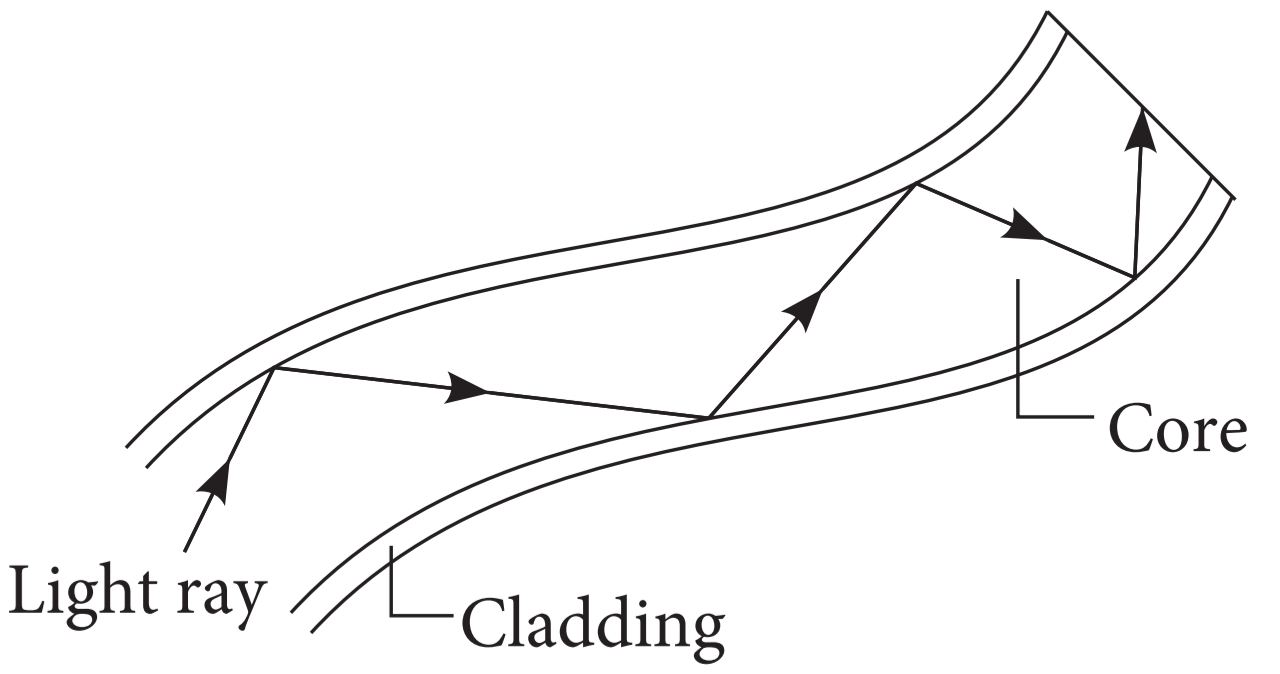
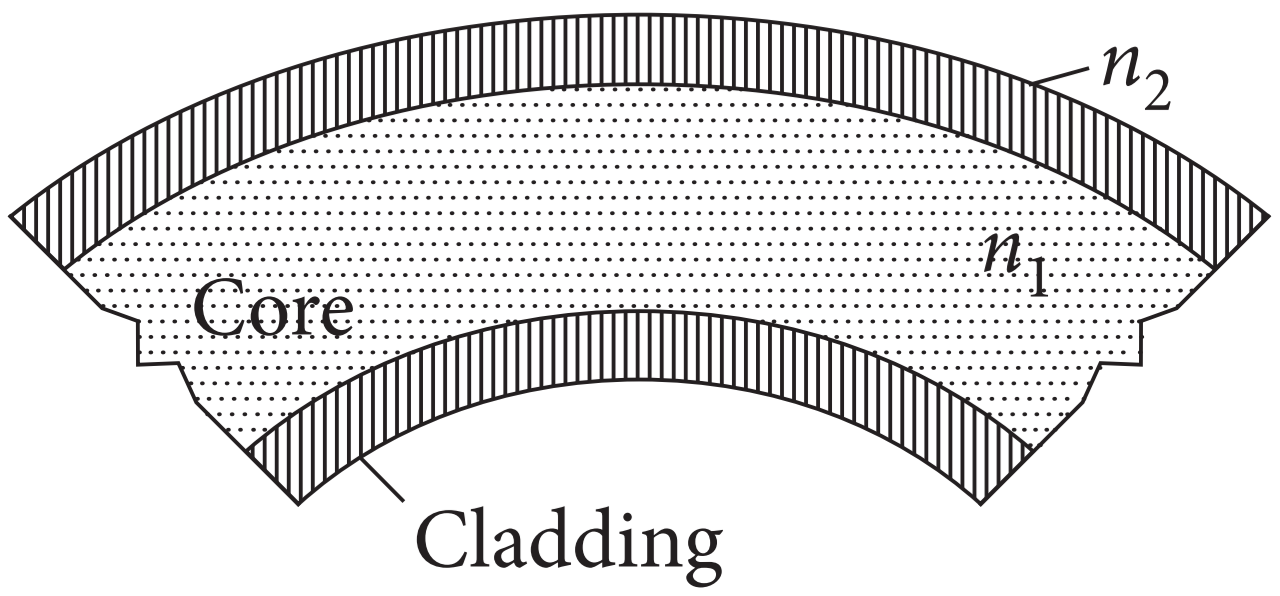
An optical fibre is a thin tube of transparent material that allows light to pass through, without being refracted into the air or another external medium. It make use of total internal reflection. These fibres are fabricated in such a way that light reflected at one side of the inner surface strikes the other at an angle larger than critical angle. Even, if fibre is bent, light can easily travel along the length.
  1. Which of the following is based on the phenomenon of total internal reflection of light?
  1. Sparkling of diamond.
  2. Optical fibre communication.
  3. Instrument used by doctors for endoscopy.
  4. All of these.
  1. A ray of light will undergo total internal reflection inside the optical fibre, if it.
  1. Goes from rarer medium to denser medium.
  2. Is incident at an angle less than the critical angle.
  3. Strikes the interface normally.
  4. Is incident at an angle greater than the critical angle.
  1. If in core, angle of incidence is equal to critical angle, then angle of refraction will be.
  1. $0^\circ$
  2. $45^\circ$
  3. $90^\circ$
  4. $180^\circ$
  1. In an optical fibre (shown), correct relation for refractive indices of core and cladding is:
  1. $n_1 = n_2$
  2. $n_1 > n_2$
  3. $n_1 < n_2$
  4. $n_1 + n_2 = 2$
  1. If the value of critical angle is 300 for total internal reflection from given optical fibre, then speed of light in that fibre is:
  1. $3 \times 10^8ms^{-1}$
  2. $1.5 \times 10^8ms^{-1}$
  3. $6 \times 10^8ms^{-1}$
  4. $4.5 \times 10^8ms^{-1}$
Answer
  1. (d) All of these.
Explanation:
Total internal reflection is the basis for following phenomenon:
  1. Sparkling of diamond.
  2. Optical fibre communication.
  3. Instrument used by doctors for endoscopy.
  1. (d) Is incident at an angle greater than the critical angle.
Explanation:
Total internal reflection (TlR) is the phenomenon that involves the reflection of all the incident light off the boundary. TlR only takes place when both of the following two conditions are met: The light is in the more denser medium and approaching the less denser medium.
The angle of incidence is greater than the critical angle.
  1. (c) $90^\circ$
Explanation:
If incidence of angle, i = critical angle C, then angle of refraction, $r = 90^\circ$
  1. (b) $n_1 > n_2$
Explanation:
In optical fibres, core is surrounded by cladding, where the refractive index of the material of the core is higher than that of cladding to bound the light rays inside the core.
  1. (b) $1.5 \times 10^8ms^{-1}$​​​​​​​
Explanation:
From Snell's law, $\sin\text{C}=\ _1\text{n}_2=\frac{\text{v}_1}{\text{v}_2}$
Where, C = critical angle $= 30^\circ$ and $v_1$ and $v_2$ are speed of light in medium and vacuum, respectively. We know that, $v_2 = 3 \times 10^8ms^{-1}​​​​​​​$​​​​​​​
$\therefore\sin30^\circ=\frac{\text{v}_1}{3\times10^8}$
$\Rightarrow\text{v}_1=3\times10^8\times\frac{1}{2}$
$\Rightarrow\text{v}_1=1.5\times10^8\text{ms}^{-1}$
View full question & answer
Question 214 Marks
The lens maker's formula is a relation that connects focal length of a lens to radii of curvature of two surfaces of the lens and refractive index of the material of the lens. It is $\frac{1}{\text{f}}=(\mu-1)(\frac{1}{\text{R}_1}-\frac{1}{\text{R}_2}),$ where $\mu$ is refractive index of lens material w.r.t. the medium in which lens is held. As $\mu_\text{v}>\mu_\text{r}$ therefore $\text{f}_\text{r}>\text{f}_\text{v}.$ Mean focal length of lens for yellow colour is $\text{F}=\sqrt{\text{f}_\text{r}\times\text{f}_\text{v}}.$
  1. Focal length of a equiconvex lens of glass $\mu=\frac{3}{2}$ in air is 20cm. The radius of curvature of each surface is:
  1. 10cm
  2. -10cm
  3. 20cm
  4. -20cm
  1. A substance is behaving as convex lens in air and concave in water, then its refractive index is:
  1. Greater than air but less than water.
  2. Greater than both air and water.
  3. Smaller than air.
  4. Almost equal to water.
  1. For a thin lens with radii of curvatures $R_1$ and $R_2$, refractive index n and focal length f, the factor $(\frac{1}{\text{R}_1}-\frac{1}{\text{R}_2})$ is equal to:
  1. $\frac{1}{\text{f}(\text{n}-1)}$
  2. $\text{f}(\text{n}-1)$
  3. $\frac{(\text{n}-1)}{\text{f}}$
  4. $\frac{\text{n}}{\text{f}(\text{n}-1)}$
  1. A given convex lens of glass $(\mu=\frac{3}{2})$ can behave as concave when it is held in a medium of $\mu$ equal to:
  1. $1$
  2. $\frac{3}{2}$
  3. $\frac{2}{3}$
  4. $\frac{7}{4}$
  1. The radii of curvature of the surfaces of a double convex lens are 20cm and 40cm respectively, and its focal length is 20cm. What is the refractive index of the material of the lens?
  1. $\frac{5}{2}$
  2. $\frac{4}{3}$
  3. $\frac{5}{3}$
  4. $\frac{4}{5}$
Answer
  1. (c) 20cm
Explanation:
$\frac{1}{\text{f}}=(\mu-1)(\frac{1}{\text{R}_1}-\frac{1}{\text{R}_2})$
For equiconvex lens, $R_1 = R, R_2 = -R$
$\frac{1}{20}=(\frac{3}{2}-1)(\frac{2}{\text{R}})=\frac{1}{\text{R}}$
$R = 20cm$
  1. (a) Greater than air but less than water.
Explanation:
When a lens is immersed in a medium whose refractive index is greater than that of the lens, its nature changes. Here the lens changes its nature when immersed in water it means its refractive index is less than th at of water.
  1. (a) $\frac{1}{\text{f}(\text{n}-1)}$
Explanation:
According to lens maker's formula
$\frac{1}{\text{f}}=(\text{n}-1)(\frac{1}{\text{R}_1}-\frac{1}{\text{R}_2})\therefore(\frac{1}{\text{R}_1}-\frac{1}{\text{R}_2})=\frac{1}{\text{f}(\text{n}-1)}$
  1. (d) $\frac{7}{4}$
Explanation:
$\frac{1}{\text{f}_\text{m}}=(\frac{\mu_\text{g}}{\mu_\text{m}}-1)(\frac{1}{\text{R}_1}-\frac{1}{\text{R}_2})$
The given lens would behave as concave when $f_m$ becomes negative, for which $\mu_\text{m}>\mu_\text{g}.$
  1. (c) $\frac{5}{3}$
Explanation:
Here, $R_1 = 20cm, R_2 = -40cm, = 20cm$
Using lens maker's formula we get,
$\frac{1}{20}=(\mu-1)(\frac{1}{20}+\frac{1}{40});\frac{1}{20}=(\mu-1)\frac{3}{40}\Rightarrow\mu=\frac{5}{3}$
View full question & answer
Question 224 Marks
A small object is embedded in a glass sphere $(\mu=1.5)$ of radius 5.0cm at a distance 1.5cm left to the centre. Locate the image of the object as seen by an observer standing.
  1. To the left of the sphere.
  2. To the right of the sphere.
Answer

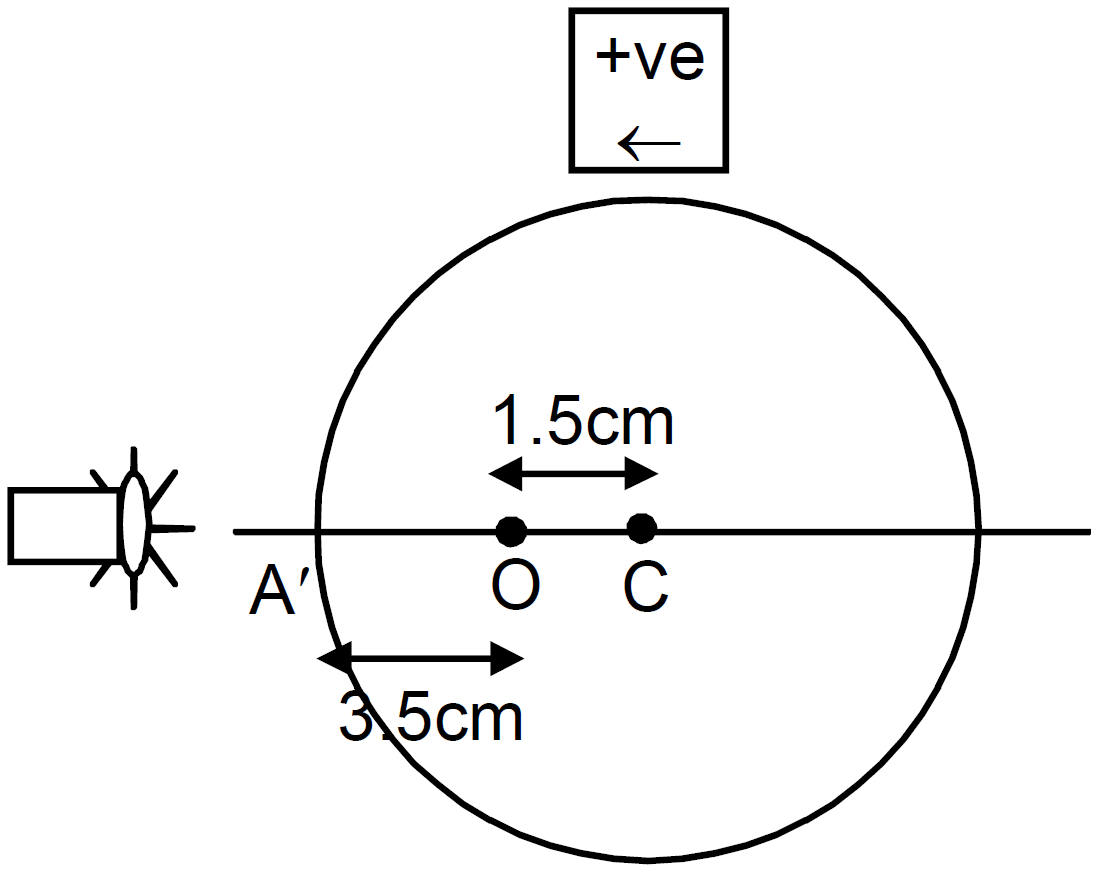
  1. Image seen from left:
u = (5 - 15) = -3.5cm

R = -5cm

$\therefore \ \frac{\mu_2}{\text{v}}-\frac{\mu_1}{\text{u}}=\frac{\mu_2-\mu_1}{\text{R}}$

$\Rightarrow\frac{1}{\text{v}}+\frac{1.5}{3.5}=-\frac{1-1.5}{5}$

$\Rightarrow\frac{1}{\text{v}}=\frac{1}{10}-\frac{3}{7}\Rightarrow\text{v}=\frac{-70}{23}=-3\text{cm}$ (inside the sphere).

$\Rightarrow$ Image will be formed, 2cm left to centre.

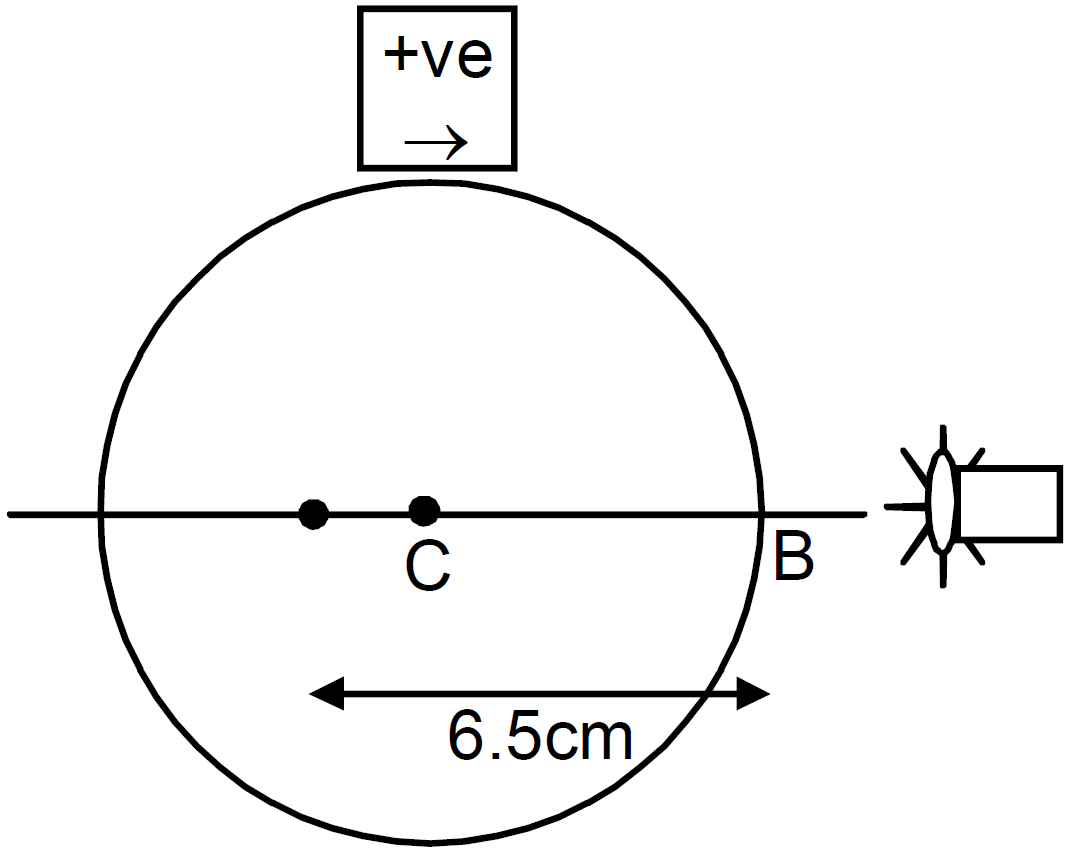
  1. Image seen from right:
u = -(5 + 1.5) = -6.5cm

R = -5cm

$\therefore \ \frac{\mu_2}{\text{v}}-\frac{\mu_1}{\text{u}}=\frac{\mu_2-\mu_1}{\text{R}}$

$\Rightarrow\frac{1}{\text{v}}+\frac{1.5}{6.5}=\frac{1-1.5}{-5}$

$\Rightarrow\frac{1}{\text{v}}=\frac{1}{10}-\frac{3}{13}$

$\Rightarrow \frac{13-30}{130}$

$\Rightarrow\text{v}=\frac{-130}{17}=-7.65\text{cm}$ (inside the sphere).

$\Rightarrow$ Image will be formed, 2.65cm left to centre.
View full question & answer
Question 234 Marks
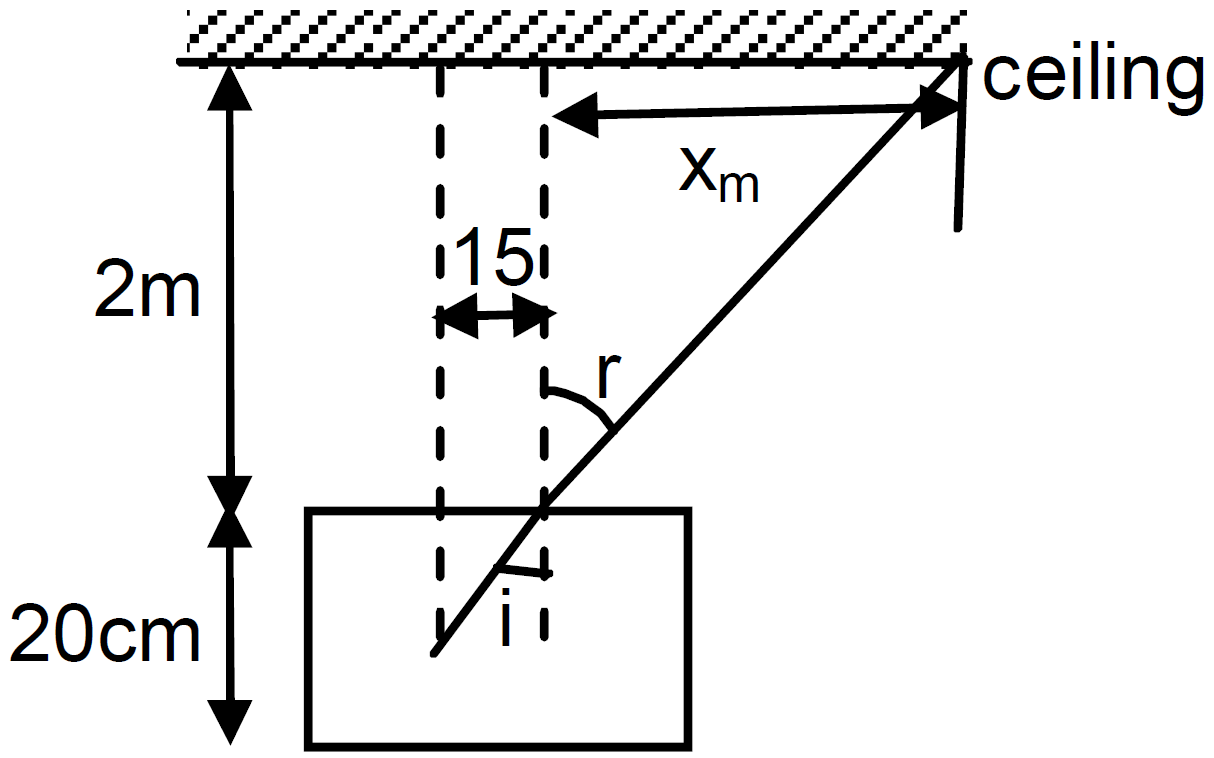
A container contains water upto a height of 20cm and there is a point source at the centre of the bottom of the container. A rubber ring of radius r floats centrally on the water. The ceiling of the room is 2.0m above the water surface.
  1. Find the radius of the shadow of the ring formed on the ceiling if r = 15cm.
  2. Find the maximum value of r for which the shadow of the ring is formed on the ceiling. Refractive index of water $\frac{4}{3}.$
Answer
  1. As shown in the figure, $\sin\text{i}=\frac{15}{25}$
So, $\frac{\sin\text{i}}{\sin\text{r}}=\frac{1}{\mu}=\frac{3}{4}$

$\Rightarrow\sin\text{r}=\frac{4}{5}$

Again, $\frac{\text{x}}{2}=\tan\text{r}$ (from figure)

So, $\sin\text{r}=\frac{\tan\text{r}}{\sqrt{1+\tan^2\text{r}}}=\frac{\frac{\text{x}}{2}}{\sqrt{1+\frac{\text{x}^2}{4}}}$

$\Rightarrow\frac{\text{x}}{\sqrt{{4}+\text{x}^2}}=\frac{4}{5}$

$\Rightarrow25\text{x}^2=16(4+\text{x}^2)\Rightarrow9\text{x}^2=64\Rightarrow\text{x}=\frac{8}{3}\text{m}$

$\therefore$ Total radius of shadow $=\frac{8}{3}+0.15=2.81\text{m}$
  1. For maximum size of the ring, i = critical angle = C
Let, R = maximum radius

$\Rightarrow\sin\theta_\text{C}=\frac{\sin\theta_\text{C}}{\sin\text{r}}=\frac{\sin\text{R}}{\sqrt{20^2+\sin\text{R}^2}}=\frac{3}{4}$(since, sin r = 1)

$\Rightarrow16\text{R}^2=9\text{R}^2+9\times400$

$\Rightarrow7\text{R}^2=9\times400$

$\Rightarrow\text{R}=22.67\text{cm.}$
View full question & answer