MCQ 511 Mark
In the ideal double-slit experiment, when a glass-plate (refractive index 1.5) of thickness t is introduced in the path of one of the interfering beams (wavelength l), the intensity at the position where the central maximum occurred previously remains unchanged. The minimum thickness of the glass-plate is
- ✓
- B
$\frac{2\lambda}{3}$
- C
$\frac{\lambda}{3}$
- D
$\lambda$
View full question & answer→MCQ 521 Mark
A Young's double slit experiment uses a monochromatic source. The shape of the interference fringes formed on a screen is
MCQ 531 Mark
In a Young's double slit experiment the source S and the two slits A and B are vertical with slit A above slit B. The fringes are observed on a vertical screen K. The optical path length from S to B is increased very slightly (by introducing a transparent material of higher refractive index) and the optical path length from S to A is not changed, as a result the fringe system on K moves
- ✓
Vertically downwards slightly
- B
Vertically upwards slightly
- C
Horizontally, slightly to the left
- D
Horizontally, slightly to the right
AnswerCorrect option: A. Vertically downwards slightly
Vertically downwards slightly
View full question & answer→MCQ 541 Mark
The maximum number of possible interference maxima for slit-separation equal to twice the wavelength in Young’s double-slit experiment is
MCQ 551 Mark
In a YDSE bi-chromatic light of wavelengths 400 nm and 560 nm are used. The distance between the slits is 0.1 mm and the distance between the plane of the slits and the screen is 1m. The minimum distance between two successive regions of complete darkness is
MCQ 561 Mark
A beam of plane polarized light falls normally on a polarizer of cross sectional area $3\times 10^{-4}m^2$. Flux of energy of incident ray in $10^{-3} \mathrm{~W}$. The polarizer rotates with an angular frequency of 31.4 rad/sec. The energy of light passing through the polarizer per revolution will be
- ✓
$10^{-4}$ Joule
- B
$10^{-3}$ Joule
- C
$10^{-2}$ Joule
- D
$10^{-1}$ Joule
AnswerCorrect option: A. $10^{-4}$ Joule
(a) $10^{-4}$ Joule
View full question & answer→MCQ 571 Mark
In Young's double slit experiment, white light is used. The separation between the slits is b. The screen is at a distance $d(d>>b)$ from the slits. Some wavelengths are missing exactly in front of one slit. These wavelengths are
AnswerCorrect option: D. $a, b$
$a, b$
View full question & answer→MCQ 581 Mark
A 20 cm length of a certain solution causes right-handed rotation of 38°. A 30cm length of another solution causes left-handed rotation of 24°. The optical rotation caused by 30cm length of a mixture of the above solutions in the volume ratio 1 : 2 is
- A
Left handed rotation of 14°
- B
Right handed rotation of 14°
- C
Left handed rotation of 3°
- ✓
Right handed rotation of 3°
AnswerCorrect option: D. Right handed rotation of 3°
Right handed rotation of 3°
View full question & answer→MCQ 591 Mark
Specific rotation of sugar solution is 0.01 SI units. 200 kgm$^{-3}$ of impure sugar solution is taken in a polarimeter tube of length 0.25m and an optical rotation of 0.4rad is observed. The percentage of purity of sugar is the sample is
View full question & answer→MCQ 601 Mark
A wave is propagating in a medium of electric dielectric constant 2 and relative magnetic permeability 50. The wave impedance of such a medium is
MCQ 611 Mark
A point source of electromagnetic radiation has an average power output of 800 W. The maximum value of electric field at a distance 4.0 m from the source is
MCQ 621 Mark
A lamp emits monochromatic green light uniformly in all directions. The lamp is 3% efficient in converting electrical power to electromagnetic waves and consumes 100W of power. The amplitude of the electric field associated with the electromagnetic radiation at a distance of 10m from the lamp will be
MCQ 631 Mark
In Young's double slit experiment, if the two slits are illuminated with separate sources, no interference pattern is observed because
- ✓
There will be no constant phase difference between the two waves
- B
The wavelengths are not equal
- C
The amplitudes are not equal
- D
AnswerCorrect option: A. There will be no constant phase difference between the two waves
There will be no constant phase difference between the two waves
View full question & answer→MCQ 641 Mark
In an apparatus, the electric field was found to oscillate with an amplitude of 18 V/m. The magnitude of the oscillating magnetic field will be
- A
$4 \times 10^{-6} T$
- ✓
$6 \times 10^{-8}T$
- C
$9 \times 10^{-9} T$
- D
$9 \times 10^{-11} T$
AnswerCorrect option: B. $6 \times 10^{-8}T$
(b)$6 \times 10^{-8}T$
View full question & answer→MCQ 651 Mark
Which of the following is electromagnetic wave
- ✓
- B
Cosmic rays and sound waves
- C
Beta rays and sound waves
- D
Alpha rays and sound waves
View full question & answer→MCQ 661 Mark
The intensity of gamma radiation from a given source is I. On passing through 36 mm of lead, it is reduced to $\frac{I}{8}$ . The thickness of lead which will reduce the intensity to $\frac{I}{2}$ will be
View full question & answer→MCQ 671 Mark
Radiations of intensity $0.5 W / m ^2$ are striking a metal plate. The pressure on the plate is
- ✓
$0.166 \times 10^{-8} N / m ^2$
- B
$0.332 \times 10^{-8} N / m ^2$
- C
$0.111 \times 10^{-8} N / m ^2$
- D
$0.083 \times 10^{-8} N / m ^2$
AnswerCorrect option: A. $0.166 \times 10^{-8} N / m ^2$
$0.166 \times 10^{-8} N / m ^2$
View full question & answer→MCQ 681 Mark
Which one of the following have minimum wavelength
MCQ 691 Mark
Which of the following electromagnetic waves have minimum frequency
MCQ 701 Mark
Frequency of a wave is $6 \times 10^{15} \mathrm{~Hz}$. The wave is
View full question & answer→MCQ 711 Mark
Angular width of central maxima in the Fraunhoffer diffraction pattern of a slit is measured. The slit is illuminated by light of wavelength 6000 Å. When the slit is illuminated by light of another wavelength, the angular width decreases by 30%. The wavelength of this light will be
MCQ 721 Mark
A TV tower has a height of 100 m. The average population density around the tower is $1000\ per\ km^2$. The radius of the earth is $6.4 \times 10^6 $ m. the population covered by the tower is
- A
$2 \times 10^6 $
- B
$3 \times 10^6 $
- ✓
$4 \times 10^6 $
- D
$6 \times 10^6 $
AnswerCorrect option: C. $4 \times 10^6 $
(c) $4 \times 10^6 $
View full question & answer→MCQ 731 Mark
A wavefront presents one, two and three HPZ at points A, B and C respectively. If the ratio of consecutive amplitudes of HPZ is 4 : 3, then the ratio of resultant intensities at these point will be
MCQ 741 Mark
A radio receiver antenna that is 2 m long is oriented along the direction of the electromagnetic wave and receives a signal of intensity $5 \times 10^{-16}\ W/m^2$. The maximum instantaneous potential difference across the two ends of the antenna is
- ✓
$1.23\ \mu V$
- B
$1.23 \ mV$
- C
$1.23\ V$
- D
$12.3\ mV$
AnswerCorrect option: A. $1.23\ \mu V$
$1.23\ \mu V$
View full question & answer→MCQ 751 Mark
An LC resonant circuit contains a 400 pF capacitor and a 100 mH inductor. It is set into oscillation coupled to an antenna. The wavelength of the radiated electromagnetic waves is
MCQ 761 Mark
An electromagnetic wave, going through vacuum is described by$E=E_0 \sin (k x-\omega t)$. Which of the following is independent of wavelength
View full question & answer→MCQ 771 Mark
A beam with wavelength $\lambda$ falls on a stack of partially reflecting planes with separation d . The angle q that the beam should make with the planes so that the beams reflected from successive planes may interfere constructively is (where $n =1,2, \ldots \ldots$ )
- A
$\sin ^{-1}\left(\frac{n \lambda}{d}\right)$
- B
$\tan ^{-1}\left(\frac{ n \lambda}{ d }\right)$
- ✓
$\sin ^{-1}\left(\frac{ n \lambda}{2 d}\right)$
- D
$\cos ^{-1}\left(\frac{ n \lambda}{2 d}\right)$
AnswerCorrect option: C. $\sin ^{-1}\left(\frac{ n \lambda}{2 d}\right)$
$\sin ^{-1}\left(\frac{ n \lambda}{2 d}\right)$
View full question & answer→MCQ 781 Mark
A plane electromagnetic wave is incident on a material surface. If the wave delivers momentum p and energy E, then
MCQ 791 Mark
The electromagnetic waves do not transport
MCQ 801 Mark
Approximate height of ozone layer above the ground is
MCQ 811 Mark
A flake of glass (refractive index 1.5) is placed over one of the openings of a double slit apparatus. The interference pattern displaces itself through seven successive maxima towards the side where the flake is placed. if wavelength of the diffracted light is λ = 600nm, then the thickness of the flake is
MCQ 821 Mark
In a Young's double slit experiment, the slits are 2 mm apart and are illuminated with a mixture of two wavelength $\lambda_0=750 \mathrm{~nm}$ and λ = 900 nm. The minimum distance from the common central bright fringe on a screen 2m from the slits where a bright fringe from one interference pattern coincides with a bright fringe from the other is
View full question & answer→MCQ 831 Mark
In Young's double slit experiment how many maximas can be obtained on a screen (including the central maximum) on both sides of the central fringe if λ = 2000 $A^0$ and d = 7000 $A^0$
View full question & answer→MCQ 841 Mark
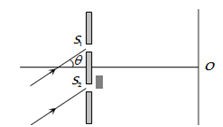
A monochromatic beam of light falls on YDSE apparatus at some angle (say q) as shown in figure. A thin sheet of glass is inserted in front of the lower slit $S_2$. The central bright fringe (path difference = 0) will be obtained
- A
- B
- C
- ✓
Anywhere depending on angle q, thickness of plate t and refractive index of glass m
AnswerCorrect option: D. Anywhere depending on angle q, thickness of plate t and refractive index of glass m
(d) Anywhere depending on angle q, thickness of plate t and refractive index of glass m
View full question & answer→MCQ 851 Mark
The maximum intensity in Young's double slit experiment is $I _0$. Distance between the slits is $d =5 I$, where I is the wavelength of monochromatic light used in the experiment. What will be the intensity of light in front of one of the slits on a screen at a distance $D=10 d$
- ✓
$\frac{ I _0}{2}$
- B
$\frac{3}{4} I _0$
- C
$I _0$
- D
$\frac{I_0}{4}$
AnswerCorrect option: A. $\frac{ I _0}{2}$
$\frac{ I _0}{2}$
View full question & answer→MCQ 861 Mark
A signal emitted by an antenna from a certain point can be received at another point of the surface in the form of
MCQ 871 Mark
Which of the following rays has the maximum frequency
MCQ 881 Mark
An electromagnetic wave travels along z-axis. Which of the following pairs of space and time varying fields would generate such a wave
- ✓
$E_x, B_y$
- B
$E _{ y }, B _{ x }$
- C
$E _z, B_{ x }$
- D
$E_y, B_z$
AnswerCorrect option: A. $E_x, B_y$
$E_x, B_y$
View full question & answer→MCQ 891 Mark
In a two slit experiment with monochromatic light fringes are obtained on a screen placed at some distance from the sits. If the screen is moved by $5 \times 10^{-2} m$ towards the slits, the change in fringe width is $3 \times 10^{-5} m$. If separation between the slits is $10^{-3} m$, the wavelength of light used is
- ✓
$6000 \mathring A$
- B
$5000 \mathring A$
- C
$3000 \mathring A$
- D
$4500 \mathring A$
AnswerCorrect option: A. $6000 \mathring A$
$6000 \mathring A$
View full question & answer→MCQ 901 Mark
In which one of the following regions of the electromagnetic spectrum will the vibrational motion of molecules give rise to absorption
MCQ 911 Mark
A rocket is going towards moon with a speed $v$. The astronaut in the rocket sends signals of frequency $v$ towards the moon and receives them back on reflection from the moon. What will be the frequency of the signal received by the astronaut (Take $v << c$ )
- A
$\frac{ c }{ c - v } v$
- ✓
$\frac{c}{c-2 v} v$
- C
$\frac{2 v }{ c } v$
- D
$\frac{2 c }{ v } v$
AnswerCorrect option: B. $\frac{c}{c-2 v} v$
$\frac{c}{c-2 v} v$
View full question & answer→MCQ 921 Mark
The oscillating electric and magnetic vectors of an electromagnetic wave are oriented along
- A
The same direction but differ in phase by 90°
- B
The same direction and are in phase
- ✓
Mutually perpendicular directions and are in phase
- D
Mutually perpendicular directions and differ in phase by 90°
AnswerCorrect option: C. Mutually perpendicular directions and are in phase
Mutually perpendicular directions and are in phase
View full question & answer→MCQ 931 Mark
The time period of rotation of the sun is 25 days and its radius is $7\times 10^8$ m. The Doppler shift for the light of wavelength 6000 Å emitted from the surface of the sun will be
View full question & answer→MCQ 941 Mark
Maxwell’s equations describe the fundamental laws of
MCQ 951 Mark
When one of the slits of Young’s experiment is covered with a transparent sheet of thickness $4.8\ mm,$ the central fringe shifts to a position originally occupied by the $30^{th}$ bright fringe. What should be the thickness of the sheet if the central fringe has to shift to the position occupied by $20^{th}$ bright fringe
- A
$3.8\ mm$
- B
$1.6\ mm$
- C
$7.6 \ mm$
- ✓
$3.2\ mm$
AnswerCorrect option: D. $3.2\ mm$
$3.2 \ mm$
View full question & answer→MCQ 961 Mark
In Young's double slit experiment, the intensity on the screen at a point where path difference is l is K. What will be the intensity at the point where path difference is λ/4
- A
$\frac{K}{4}$
- ✓
$\frac{K}{2}$
- C
- D
AnswerCorrect option: B. $\frac{K}{2}$
(b) $\frac{K}{2}$
View full question & answer→MCQ 971 Mark
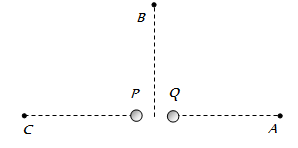
Figure here shows P and Q as two equally intense coherent sources emitting radiations of wavelength 20 m. The separation PQ is 5.0 m and phase of P is ahead of the phase of Q by $90^{\circ}$. A, B and C are three distant points of observation equidistant from the mid-point of PQ. The intensity of radiations at A, B, C will bear the ratio
View full question & answer→MCQ 981 Mark
In the Young's double slit experiment, if the phase difference between the two waves interfering at a point is $\varnothing$, the intensity at that point can be expressed by the expression (Where $A$ and $B$ depend upon the amplitudes of the two waves)
- A
$I=\sqrt{A^2+B^2 \cos ^2 \emptyset}$
- B
$I=\frac{A}{B} \cos \emptyset$
- C
$I=A+B \cos \frac{\emptyset}{2}$
- ✓
$I=A+B \operatorname{Cos} \varnothing$
AnswerCorrect option: D. $I=A+B \operatorname{Cos} \varnothing$
$I=A+B \operatorname{Cos} \varnothing$
View full question & answer→MCQ 991 Mark
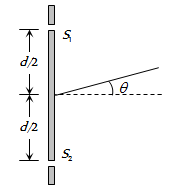
In an interference arrangement similar to Young's double slit experiment, the slits $\mathrm{S}_1$ and $\mathrm{S}_2$ are illuminated with coherent microwave sources each of frequency $10^6 \mathrm{~Hz}$. The sources are synchronized to have zero phase difference. The slits are separated by distance $\mathrm{d}=150 \mathrm{~m}$. The intensity I (?) is measured as a function of q , where q is defined as shown. If $\mathrm{I}_0$ is maximum intensity, then $\mathrm{I}(\theta)$ for $0 \leq \theta \leq 90^{\circ}$ is given by
View full question & answer→MCQ 1001 Mark
TV waves have a wavelength range of 1-10 meter. Their frequency range in MHz is