Questions

प्रश्नों के उत्तर लिखिए। (प्रत्येक प्रश्न 1 अंक का हे)

Take a timed test

12 questions · self-marked practice — reveal the answer and mark yourself.

Question 11 Mark
2 sin $\theta$ का मान a + $\frac{1}{a}$ हो सकता है, जहाँ a एक धनात्मक संख्या है और a $\neq$ 1 है।
Answer
दिया गया है: 'a' एक धनात्मक संख्या है और a $\ne$ 1 के रूप में, AM $\ge$ गैर-ऋणात्मक वास्तविक संख्याओं की सूची का जीएम (अंकगणित माध्य (एएम) उसी सूची के ज्यामितीय माध्य (जीएम) से अधिक या बराबर है) यदि a और b ऐसी संख्याएं हैं, तो
AM = $\frac{a+b}{2}$ और GM = $\sqrt{a b}$
यह मानकर $a+\frac{1}{2}=2 \sin \theta$ कथन सत्य होगा।
इसी तरह, a और $\frac{1}{a}$ के AM और GM हैं $\frac{a+\frac{1}{a}}{2}$ तथा $\sqrt{\frac{a .1}{a}}$ क्रमशः।
$\Rightarrow$ $\frac{a+\frac{1}{a}}{2}>\sqrt{\frac{a .1}{a}}$
$\Rightarrow$ $a+\frac{1}{a}>2$
$\Rightarrow$ 2 sin $\theta$ > 2
$\Rightarrow$ sin $\theta$ > 1
But $-1 \leq \sin \theta \leq 1$
$\therefore$ हमारी धारणा गलत है और वह 2 sin के बराबर नहीं हो सकता।
View full question & answer
Question 21 Mark
$(\tan \theta+2)(2 \tan \theta+1)=5 \tan \theta+\sec ^2 \theta$ है।
Answer
$\text { LHS }=(\tan \theta+2)(2 \tan \theta+1) $
$=2 \tan ^2 \theta+\tan \theta+4 \tan \theta+2 $
$=2 \tan ^2 \theta+5 \tan +2 $
$=2\left(\sec ^2 \theta-1\right)+5 \tan \theta+2\left(\because \sec ^2 \theta-\tan ^2 \theta=1 \tan ^2 \theta=\sec ^2 \theta-1\right) $
$=2 \sec ^2 \theta-2+5 \tan \theta+2 $
$=5 \tan \theta+2 \sec ^2 \theta \neq \text { R.H.S } $
$\therefore \text { L.H.S. } \neq \text { R.H.S }$
View full question & answer
Question 31 Mark
यदि $\cos A+\cos ^2 A=1$ है, तो $\sin ^2 A+\sin ^4 A=1$ है।
Answer
दिया गया है: $\cos A +\cos ^2 A=1$
$\cos A=1-\cos ^2 A$
$\Rightarrow \cos A=\sin ^2 A \ldots \text { (i) }$
दोनों पक्षों का वर्ग करने पर, हमें $\cos ^2 A=\sin ^4 A \ldots$ (ii) प्राप्त होता है eq (i) और eq (ii), से हमें
$\sin ^2 A+\sin ^4 A=\cos A+\cos ^2 A$ प्राप्त होता है
$\therefore \sin ^2 A+\sin ^4 A=1$
View full question & answer
Question 41 Mark
$\sqrt{\left(1-\cos ^{2} \theta\right) \sec ^{2} \theta}$ = tan $\theta$
Answer
LHS = $\left.\sqrt{\left(\left(1-\cos ^{2} \theta\right) \sec ^{2} \theta\right.}\right)$
$=\sqrt{\sin ^2 \theta \sec ^2 \theta} \ldots\left(\because \sin ^2 \theta+\cos ^2 \theta=1 \Rightarrow \sin ^2 \theta=1-\cos ^2 \theta\right)$= $\sqrt{\frac{\sin ^{2} \theta}{\cos ^{2} \theta}}$ ...($\sec ^{2} \theta=\frac{1}{\cos ^{2} \theta}$)
= $\frac{\sin \theta}{\cos \theta}$
= tan $\theta$
= R.H.S
View full question & answer
Question 51 Mark
व्यंजक $\left(\sin 80^{\circ}-\cos 80^{\circ}\right)$ का मान ऋणात्मक है।
Answer
हम जानते हैं
$\sin \theta$ बढ़ जाता है जब $0^{\circ} \leq \theta \leq 90^{\circ}$
$\cos \theta$ घट जाती है जब $0^{\circ} \leq \theta \leq 90^{\circ}$ और $\left(\sin 80^{\circ}-\cos 80^{\circ}\right)=$ (बढ़ता मान - घटता मान) जो हमेशा एक धनात्मक मान के बराबर होता है। $\because\left(\sin 80^{\circ}-\cos 80^{\circ}\right)>0$, जो धनात्मक है (ऋणात्मक नहीं)।
View full question & answer
Question 61 Mark
व्यंजक $\left(\cos ^2 23^{\circ}-\sin ^2 67^{\circ}\right)$ का मान धनात्मक है।
Answer
$\cos ^2 23^{\circ}-\sin ^2 67^{\circ}=\left(\cos 23^{\circ}+\sin 67^{\circ}\right)\left(\cos 23^{\circ}-\sin 67^{\circ}\right) \ldots\left(\because\left(a^2-b^2\right)=(a+b)(a-b)\right)$ $=\left[\cos 23^{\circ}+\sin \left(90^{\circ}-23^{\circ}\right)\right]\left[\cos 23^{\circ}-\sin \left(90^{\circ}-23^{\circ}\right)\right]$
$=\left(\cos 23^{\circ}+\cos 23^{\circ}\right)\left(\cos 23^{\circ}-\cos 23^{\circ}\right) \ldots\left(\because \sin \left(90^{\circ}-\theta\right)=\cos \theta\right)$
$=\left(\cos 23^{\circ}+\cos 23^{\circ}\right) \cdot 0$
$=0$ जो न तो धनात्मक है और न ही ऋणात्मक।
View full question & answer
Question 71 Mark
cos $\theta$ = $\frac{a^{2}+b^{2}}{2 a b}$ है, जहाँ a और b ऐसी दो भिन्न संख्याएँ हैं कि ab > 0 है।
Answer
$\cos \theta=\frac{a^2+b^2}{2 a b}$
चूँकि, $(a-b)^2=a^2+b^2-2 a b>0\left[(a-b)^2>0, a\right.$ और $b$ अलग-अलग संख्याएं हैं]
$\Rightarrow a^2+b^2>2 a b$
$\Rightarrow \frac{a^2+b^2}{0}>1$
$\Rightarrow \cos \theta>1$
परंतु, $-1 \leq \cos \theta \leq 1$
अतः दिया गया कथन असत्य है।
View full question & answer
Question 81 Mark
$\frac{\tan 47^{\circ}}{\cot 43^{\circ}}$ = 1 है।
Answer
$\frac{\tan 47^{\circ}}{\cot 43^{\circ}}=\frac{\tan \left(90^{\circ}-43^{\circ}\right)}{\cot 43^{\circ}}$
$\Rightarrow \frac{\tan 47^{\circ}}{\cot 43^{\circ}}=\frac{\cot 43^{\circ}}{\cot 43^{\circ}}$ ...[$\because$ tan ($90^o$- $\theta$) = cot $\theta$]
$\Rightarrow \frac{\tan 47^{\circ}}{\cot 43^{\circ}}=1$
View full question & answer
Question 91 Mark
sin $\theta$ का मान a + $\frac{1}{a}$ है, जहाँ a एक धनात्मक संख्या है।
Answer
हम जानते हैं कि $\sqrt{a}-\frac{1}{\sqrt{a}}^{2} \geq 0$ अर्थात्, $a+\frac{1}{a} \geq 2$ है, परंतु sin $\theta$ का मान 1 से बड़ा नहीं होता है।
वैकल्पिक रूप से, यहाँ तीन संभावनाएँ हैं:
स्थिति 1. यदि a < 1 है, तो a + $\frac{1}{a}$ > 1
स्थिति 2. यदि a = 1 है, तो a + $\frac{1}{a}$ > 1
स्थिति 3. यदि a > 1 है, तो a + $\frac{1}{a}$ > 1
परंतु sin $\theta$ का मान 1 से बड़ा नहीं हो सकता।
View full question & answer
Question 101 Mark
जब $\theta$ बढ़ता जाता है, sin $\theta$ की तुलना में tan $\theta$ तीव्र गति से बढ़ता है।
Answer
हम जानते हैं कि जब $\theta$ बढता है तो sin $\theta$ बढता है, परंतु cos $\theta$ घटता जाता है।
हमें प्राप्त है: tan $\theta$ = $\frac{\sin \theta}{\cos \theta}$
अब जब $\theta$ बढ़ता है, तो sin $\theta$ बढ़ता है परंतु cos $\theta$ घटता जाता है। अतः tan $\theta$ की स्थिति में अंश बढ़ता जाता है, परंतु हर घटता जाता है। परंतु sin $\theta$ की स्थिति में, जिसे $\frac{\sin \theta}{1}$ के रूप में लिखा जा सकता है, अर्थात् 1 रहता है। अतः जब $\theta$ बढ़ता है, तो sin $\theta$ की तुलना में tan $\theta$ तीव्र गति से बढ़ता है।
View full question & answer
Question 111 Mark
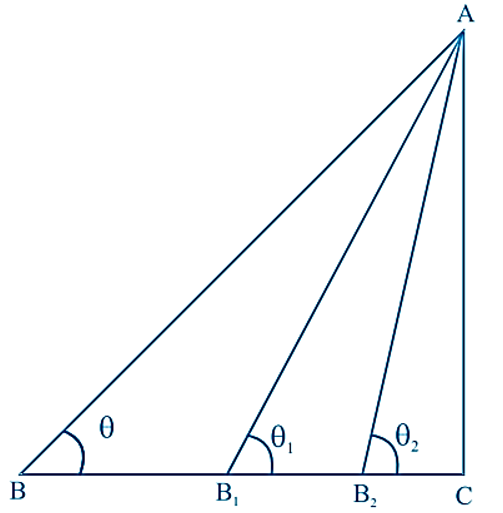
tan $\theta$ का मान ($\theta$ < $90^o$) बढ़ता है, जब $\theta$ बढ़ता है।
Answer
आकृति में, जैसे-जैसे बिंदु B भुजा BC के अनुदिश C के निकट आता जाता है, वैसे-वैसे
  1. $\theta$ बढ़ता जाता है $\left(\theta_{1}>\theta, \theta_{2}>\theta_{1}, \ldots\right)$ तथा
  2. . BC घटता जाता है $\left( B _1 C < BC , B _2 C < B _1 C , \ldots\right)$
इस प्रकार, लंब AC स्थिर रहता है तथा आधार BC घटता जाता है। अतः tan $\theta$ बढ़ता जाता है, जब $\theta$ बढ़ता जाता है।
View full question & answer
Question 121 Mark
sin $\theta$ + cos $\theta$ का मान सदैव 1 से बड़ा होता है।
Answer
$\theta=0^{\circ}$ के लिए $(\sin \theta+\cos \theta)$ का मान 1 है।
View full question & answer