Question 13 Marks
The general term of a sequence is give by $a_n=-4 n+15$. Is the sequence an A.P.? If so, find its $15^{\text {th }}$ term and the common difference.
AnswerGeneral term of a sequence
$a_n = -4n + 15$
Let n = 1, 2, 3, 4, 5, ....., then
$a_1 = -4 \times 1 + 15 = -4 + 15 = 11$
$a_2 = -4 \times 2 + 15 = -8 + 15 = 7$
$a_3 = -4 \times 3 + 15 = -12 + 15 = 3$
$a_4 = -4 \times 4 + 15 = -16 + 15 = -1$
$a_5 = -4 \times 5 + 15 = -20 + 15 = -5$
We see that first term is 11 and common difference is -4
$a_2 - a_1 = 7 - 11 = -4$
$a_3 - a_2 = 3 - 7 = -4$
$a_4 - a_3 = -1 - 3 = -4$
$a_5 - a_4 = -5 - (-1) = -5 + 1 = -4$
$\therefore$ Yes, it is an A.P.
Now $15^{th}$ term =$ a_{15} = -4 \times 15 + 15$
$= -60 + 15 = -45.$
View full question & answer→Question 23 Marks
Find:$9^{th}$ term of the A.P. $\frac{3}{4},\frac{5}{4},\frac{7}{4},\frac{9}{4}, .....$
AnswerGiven $A.P.$ is
$\frac{3}{4},\frac{5}{4},\frac{7}{4},\frac{9}{4}, .....$
First term $(\text{a})=\frac{3}{4}$
Common difference (d) = Second - First term
$=\frac{5}{4}-\frac{3}{4}$
$=\frac{2}{4}$
$n^{th} term a_n = a + (n - 1)d$
$9^{th} term a_9 = a + (9 - 1)d$
$=\frac{3}{4}+8.\frac{2}{4}$
$=\frac{3}{4}+\frac{16}{4}$
$=\frac{19}{4}$
View full question & answer→Question 33 Marks
Sum of 13 terms of the A.P. -6, 0, 6, 12, .....
AnswerGiven,
A.P. is -6, 0, 6, 12, .....
Here,
First term a = -6
Difference, d = 0 - (-6) = 6
We know, $\text{S}_\text{n}=\frac{\text{n}}{2}[2\text{a}+(\text{n}-1)\text{d}]$
$\Rightarrow\ \text{S}_{13}=\frac{13}{2}[2(-6)+(13-1)6]$
$\Rightarrow\ \text{S}_{13}=\frac{13}{2}[-12+12\times6]$
$\Rightarrow\ \text{S}_{13}=\frac{13}{2}\times60$
$\Rightarrow\ \text{S}_{13}=390$
Hence, Sum of 13 terms is 390.
View full question & answer→Question 43 Marks
Find the sum of the first 15 terms of each of the following sequences having $n ^{\text {th }}$ term as:
$b_{n}=5+2 n$
AnswerGiven,
$b_n = 5 + 2n$
Put $n = 1, b_1 = 5 + 2(1) = 7$
Put $n = 15, b_{15} = 5 + 2(15) = 35 = l$
Sum of 15 terms $\text{S}_{15}=\frac{15}{2}(7+35)\ \Big(\therefore\text{S}_\text{n}=\frac{\text{n}}{2}(\text{a}+\text{l})\Big)$
$=\frac{15}{2}\times42$
$=315$
$\therefore\text{S}_{15}=315$
View full question & answer→Question 53 Marks
Find the sum of the first 15 terms of each of the following sequences having $n^{th} $term as:
$y_n = 9 - 5n.$
Answer$y_n = 9 - 5n$ and number of terms$ = 15$
$y_1 = 9 - 5 \times 1 = 9 - 5 = 4$
$y_2 = 9 - 5 \times 2 = 9 - 10 = -1$
$\therefore$ First term (a) = 4
Common dofference $(d) = y_2 - y_1 = -1 - 4 = -5$
$\therefore\ \text{S}_\text{n}=\frac{\text{n}}{2}[2\text{a}+(\text{n}-1)\text{d}]$
$\text{S}_{15}=\frac{15}{2}[2\text{a}+(15 - 1)\text{d}]$
$=\frac{15}{2}[2\times4+(15 - 1)(-5)]$
$=\frac{15}{2}[8+14(-5)]=\frac{15}{2}[8-70]$
$=\frac{15}{2}(-62)=15\times(-31)=-465$
View full question & answer→Question 63 Marks
Find the indicated terms in the following sequences whose $n ^{\text {th }}$ terms are:
$a_n=(-1)^n n ; a_3, a_5, a_8 .$
Answer$a_n = (-1)^nn.$
We need to find $a_3, a_5$_ and $a_8$_
Now, to find $a_3$_ term we use $n = 3$, we get,
$a_3 = (-1)^3 3$
$= (-1) 3$
$= -3$
Also, to find $a_5$_ term we use $n = 5$, we get,
$a_5 = (-1)^5 5$
$= (-1) 5$
$= -5$
Similarly, to find $a_8$_ term we use $n = 8$, we get,
$a_8 = (-1)^8 8$
$= (1) 8$
$= 8$
Thus, $a_3 = -3, a_5 = -5$ and $a_8 = 8.$
View full question & answer→Question 73 Marks
Find the common difference of the$ A.P$. and write the next two terms:
$119, 136, 153, 170, .....$
Answer$119, 136, 153, 170, .....$
Here,
$a_1 = 119$
$a_2 = 136$
So, common difference of the $A.P. (d) = a_2 - a_1$
$= 136 - 119$
$= 17$
Also, we need to find the next two terms of A.P., which means we have to find the $5^{th}$ and $6^{th}$^ terms.
So, for fifth term,
$a_5 = a_1 + 4d$
$= 119 + 4(17)$
$= 119 + 68$
$= 187$
Similarly, we find the sixth term,
$a_6 = a_1 + 5d$
$= 119 + 5(17)$
$= 119 + 85$
$= 204$
Therefore, the common difference is d = 17 and the next two terms of the A.P. are $a_5 = 187, a_6 = 204.$
View full question & answer→Question 83 Marks
Write the first five terms of the following sequences whose $n^{th}$ terms are:
$\text{a}_\text{n}=\frac{\text{n}(\text{n}-2)}{2}$
Answer$\text{a}_\text{n}=\frac{\text{n}(\text{n}-2)}{2}$
Let n = 1, 2, 3, 4, 5, then
$\text{a}_1=\frac{1(1-2)}{2}=\frac{1\times(-1)}{2}=\frac{-1}{2}$
$\text{a}_2=\frac{1(2-2)}{2}=\frac{2\times0}{2}=0$
$\text{a}_3=\frac{1(3-2)}{2}=\frac{3\times1}{2}=\frac{3}{2}$
$\text{a}_4=\frac{4(4-2)}{2}=\frac{4\times2}{2}=4$
$\text{a}_5=\frac{5(5-2)}{2}=\frac{5\times3}{2}=\frac{15}{2}$
View full question & answer→Question 93 Marks
The sum of four consecutive numbers in A.P. is 32 and the ratio of the product of the first and last terms to the product of two middle terms is 7 : 15. Find the number.
AnswerLet the four consecutive numbers in A.P. be
a - 3d, a - d, a + d, a + 3d
So, a - 3d + a - d + a + d + a + 3d = 32
or 4a = 32
or a = 8
Also, $\frac{(\text{a}-3\text{d})(\text{a}+3\text{d})}{(\text{a}-\text{d})(\text{a}+\text{d})}=\frac{7}{15}$
$\frac{\text{a}^2-9\text{d}^2}{\text{a}^2-\text{d}^2}=\frac{7}{15}$
$15\text{a}^2-135\text{d}^2=7\text{a}^2-7\text{d}^2$
$8\text{a}^2-128\text{d}^2=0$
$\text{d}^2=\frac{8\times8\times8}{128}=4$
$\text{d}=\pm2$
So, when a = 8, d = 2
The numbers are 2, 6, 10, 14.
View full question & answer→Question 103 Marks
Two arithmetic progression have the same common difference. The difference between their $100^{\text {th }}$ terms is 100 , What is the difference between their $1000^{\text {th }}$ terms?
AnswerLet the two A.P. is be $a _1, a _2, a _3, \ldots .$. and $b _1, b_2, b_3, \ldots .$.
$a_n=a_1+(n-1) d \text { and } b_n=b_1+(n-1) d$
Since common difference of two equations is same given difference between $100^{\text {th }}$ terms is $100$
$a_{100} - b_{100} = 100$
$a_1 + (99) d - b_1 - 99d = 100$
$a_1 - b_1 = 100 .....(i)$
Difference between. 1000th terms is
$a_{1000} - b_{1000} = a_1 + (1000 - 1)d - (b_1 + (1000 - 1)d)$
$= a_1 + 999d - b_1 - 999d$
$= a_1 - b_1$
$= 100$ (from (1))
$\therefore$ Hence difference between $1000^{\text {th }}$ terms of two $A.P$. is $100.$
View full question & answer→Question 113 Marks
In a certain A.P. the $24^{\text {th }}$ term is twice the $10^{\text {th }}$ term. Prove that the $72^{\text {nd }}$ term is twice the $34^{\text {th }}$ term.
AnswerGiven,
$24^{\text {th }}$ term is twice the $10^{\text {th }}$ term
$a_{24}=2 a_{10}$
Let, first term of a square $= a$
Common difference $= d$
$n^{th} term a_n = a + (n - 1)d$
$a + (24 - 1)d = (a + (10 - 1)d)2$
$a + 23d = 2(a + 9d)$
$(23 - 18) d = a$
$a = 5d$
We have to prove
$72^{nd}$ term is twise the $34^{th}$ term
$a_{72} = 2a_{34}$
$a + (72 - 1)d = 2[a + (34 - 1)d]$
$a + 71d = 2a = 66d$
Substitute $a = 5d$
$5d + 71d = 2(5d) + 66d$
$76d = 10d + 66d$
$76d = 76d$
Hence proved.
View full question & answer→Question 123 Marks
If the seventh term of an A.P. is $\frac{1}{9}$ and its ninth term is $\frac{1}{7}$, find its $(63)^{rd}$ term.
Answer
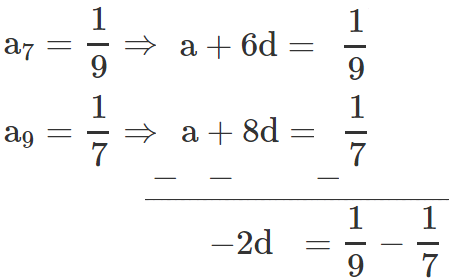 $-2\text{d}=\frac{7-9}{63}$
$-2\text{d}=\frac{-2}{63}\ \therefore\ \text{d}=\frac{1}{63}$
$\text{a}+6\Big(\frac{1}{63}\Big)=\frac{1}{9}$
$\text{a}=\frac{1}{9}-\frac{6}{63}=\frac{7-6}{63}=\frac{1}{63}$
$\text{a}_{63}=\text{a}+62\text{d}$
$=\frac{1}{63}+62\Big(\frac{1}{63}\Big)=\frac{1+ 62}{63}=\frac{63}{63}=1$ View full question & answer→Question 133 Marks
Find:
Is $-150$ a term of the$ A.P. 11, 8, 5, 2, .....?$
AnswerIn the given problem, we are given an A.P. and the Value of one of its term.
We need to find whether it is a term of the A.P. or not so here we will use the formula $a_n = a + (n - 1)d.$
Here,
A.P. is $11, 8, 5, 2, .....$
$a_n = -150, a = 11$ and $d = 8 - 11 = -3$
Thus, using the above mentioned formula, we get
$- 150 = 11 + (n - 1)(-3)$
$\Rightarrow -150 - 11 = -3n + 3$
$\Rightarrow -161 = -3n + 3$
$\Rightarrow -161 - 3 = -3n$
$\Rightarrow -3n = -164$
$\Rightarrow\ \text{n}=\frac{164}{3}$
Since, the value of n is a fraction. Thus, $-150$ is not the term of the given $A.P.$
View full question & answer→Question 143 Marks
Find the sum of the first 15 terms of each of the following sequences having $n^{th}$ term as:
$x_n = 6 - n.$
AnswerHere, we are given an A.P. whose $n^{\text {th }}$ term is given bt the following expression, $x_n=6-x$, We need to find the sum of first 15 terms.
So, here we can find the sum of the $n$ term of the given A.P., using the formula,
$S_{n}=\left(\frac{n}{2}\right)(a+l)$
Where, $a=$ the first term
I = the last term
So, for the given A.P,
The firest term (a) will be calculated using $n =1$ in the given equation for $n ^{\text {th }}$ term of A.p.
$x=6-1$
$=5$
Now, the last term (I) or the $n ^{\text {th }}$ term is given
$I=a_{15}=6-15$
So, on substituting the values in the formula for the sum of $n$ terms of an A.P., we get,
$\text{S}_{15}=\Big(\frac{15}{2}\Big)[(5)+6-15]$
$=\Big(\frac{15}{2}\Big)[11-15]$
$=\Big(\frac{15}{2}\Big)(-4)$
$=(15)(-2)$
$=-30$
Therefore, the sum of the $15$ terms of the given $A.P.$ is $S_{15} = -30.$
View full question & answer→Question 153 Marks
Find the number of natural numbers between $101$ and $999$ which are divisible by both $2$ and $5 $.
AnswerSince, the number is divisible by both 2 and 5 , means it must be divisible by 10 .
In the given numbers, first number that is divisible by 10 is 110 .
Next number is $110+10=120$.
The last number that is divisible by 10 is 990 .
Thus, the progression will be $110,120, \ldots . . ., 990$.
All the terms are divisible by 10, and thus forms an A.P. having first term as 110 and the common difference as 10 .
We know that, $n^{\text {th }}$ term $=a_n=a+(n-1) d$
According to the question,
$990 = 110 + (n - 1)10$
$\Rightarrow 990 = 110 + 10n - 10$
$\Rightarrow 10n = 990 - 100$
$\Rightarrow 10n = 890$
$\Rightarrow n = 89$
Thus, the number of natural numbers 101 and 999 which are divisible by both 2 and 5 is 89.
View full question & answer→Question 163 Marks
Find the sum of the following arithmetic progressions:
$(x - y)^2, (x^2 + y^2), (x + y)^2, ......,$ to n terms.
AnswerIn an A.P. let first term = a, common difference = d, and there are n terms. Then, sum of n terms is,
$\text{S}_\text{n}=\frac{\text{n}}{2}\{2\text{a} + (\text{n} - 1)\text{d}\}$
A.P. is $(x - y)^2, (x^2 + y^2), (x + y)^2, .....,$ to n terms
Here,
$a = (x - y)^2, d =x^2 + y^2 - (x - y)^2 = x^2 + y^2 - x^2 - y^2 + 2xy$
$\Rightarrow d = 2xy$
$\text{S}_\text{n}=\frac{\text{n}}{2}\{2\text{a} + (\text{n} - 1)\text{d}\}$
$=\frac{\text{n}}{2}[2(\text{x}-\text{y})^2+(\text{n}-1)(-2\text{xy})]$
$=\frac{\text{n}}{2}[2(\text{x}-\text{y})^2-2(\text{n}-1)\text{xy}]$
$=\frac{\text{n}}{2}\times2[(\text{x}-\text{y})^2-(\text{x}-1)\text{xy}]$
$=\text{n}[(\text{x}-\text{y})^2-(\text{x}-1)\text{xy}]$
View full question & answer→Question 173 Marks
Write the first five terms of the following sequences whose $n^{th}$ terms are:
$\text{a}_\text{n}=\frac{\text{n}-3}{3}$
Answer$\text{a}_\text{n}=\frac{\text{n}-3}{3}$
Here, the $n^{th}$ term is given by the above expression. So, to find the first term we use, $n = 1$, we get,
$\text{a}_1=\frac{(1)-2}{3}$
$=\frac{-1}{3}$
Similarly, we find the other four terms,
Second term (n = 2),
$\text{a}_1=\frac{(2)-2}{3}$
$=\frac{0}{3}$
$=0$
Third term (n = 3),
$\text{a}_3=\frac{(3)-2}{3}$
$=\frac{1}{3}$
Fourh terms (n = 4),
$\text{a}_4=\frac{(4)-2}{3}$
$=\frac{2}{3}$
Fifth term (n = 5),
$\text{a}_5=\frac{(5)-2}{3}$
$=\frac{3}{3}$
$=1$
Therefore, the first five terms for the given sequence are $\text{a}_1=\frac{-1}{3},\ \text{a}_2=0,\ \text{a}_3=\frac{1}{3},\ \text{a}_4=\frac{2}{3},\ \text{a}_5=1.$
View full question & answer→Question 183 Marks
Which term of the $A.P. -2, -7, -12, …$ will be -$77?$ Find the sum of this $A.P$. up to the term $-77.$
AnswerGiven,
$A.P. -2, -7, -12, .....$
Let the $n^{th}$ term of an A.P. is $-77.$
Then, first term $(a) = -2$
Common difference $(d) = -7 - (-2) = -7 + 2 = -5$
$\because$ n^{th} term of an A.P., $T_n = a + (n - 1)d$
$\Rightarrow -77 = -2 + (n - 1)(-5)$
$\Rightarrow -75 = -(n - 1) \times 5$
$\Rightarrow (n - 1) = 15 $
$\Rightarrow n = 16$
So, the $16^{th}$ term of the given A.P. will be $-77$
Now, the sum of n terms of an A.P. is
$\text{S}_\text{n}=\frac{\text{n}}{2}[2\text{a}+(\text{n}-1)\text{d}]$
So, sum of 16 terms i.e. upto the term $-77$
i.e., $\text{S}_{16}=\frac{16}{2}[2\times(-2)+(\text{n}-1)(-5)]$
$= 8[-4 + (16 - 1)(-5)] = 8(-4 - 75)$
$= 8 \times -79 = -632$
Hence, the sum of this A.P. upto the term $-77$ is $-632.$
View full question & answer→Question 193 Marks
If the sum of first p term of an A.P. is $ap^2 + bp$, find its common difference.
AnswerGiven,
Sum of $p$ terms,$ S_p = ap^2 + bp$
Putting $p = 1, 2, 3, 4, .....$
$S_1 = a(1)^2 + b(1) = a \times 1 + b = a + b$
$S_2 = a(2)^2 + b(2) = a \times 4 + 2b = 4a + 2b$
$S_3 = a(3)^3 + b(3) = a \times 9 + 3b = 9a + 3b$
And $S_4 = a(4)^2 + b(4) = a \times 16 + 4b = 16a + 4b$
We know $a_n = S_n - S_{n-1}$
$2^{nd}$ term, $a_2 = S_2 - S_1$
$\Rightarrow a_2 = 4a + 2b - (a + b)$
$\Rightarrow a_2 = 4a + 2b - a - b$
$\Rightarrow a_2 = 3a + b$
$3^{rd}$ term, $a_3 = S_3 - S_2$
$\Rightarrow a_3 = 9a + 3b - (4a - 2b)$
$\Rightarrow a_3 = 9a + 3b - (4a + 2b)$
$\Rightarrow a_3 = 5a + b$
$4^{th}$ term, $a_4 = S_4 - S_3$
$\Rightarrow a_4 = 16a + 4b - (9a + 3b)$
$\Rightarrow a_4 = 16a + 4b - 9a - 3b$
$\Rightarrow a_4 = 7a + b$
Now difference between two terms,
$d_1 = a_3 - a_2 = 5a + b - (3a + b)$
$= 5a + b - 3a - b$
$\Rightarrow d_1 = 2a$
$d_2 = a_4 - a_3 = 7a + b - (5a + b)$
$= 7a + b - 5a - b$
$\Rightarrow d_2 = 2a$
Hence, common difference is $2a.$
View full question & answer→Question 203 Marks
How many numbers lie between $10$ and $300$, which when divided by $4$ leave a remainder $3$?
AnswerHere, the first number is 11, which divided by 4 leave remainder 3 between 10 and 300.
Last term before 300 is 299, which divided by 4 leave remainder 3.
$11, 15, 19, 23, ...., 299.$
Here, first term $(a) = 11,$
Common differnce $(d) = 15 - 11 = 4$
$n^{th}$ term, $a_n = a + (n - 1)d =$ l[last term]
$\Rightarrow 299 = 11 + (n - 1)4$
$\Rightarrow 299 - 11 = (n - 1)4$
$\Rightarrow 4(n - 1) = 288$
$\Rightarrow (n - 1) = 72$
$n = 73.$
View full question & answer→Question 213 Marks
Find:$n^{th}$ term of the $A.P. 13, 8, 3, -2, ....$
AnswerGiven $A.P., 13, 8, 3, -2, .....$
Here,
First term,$ a = 13$
Difference,$ d = (8 - 13) = -5$
We have to find $n^{th}$ term,
So putting$ n = n$
We know, $n^{th}$ term of $A.P.$
$a_n = a + (n - 1)d$
$\Rightarrow a_n = 13 + (n - 1)(-5)$
$\Rightarrow a_n = 13 + (-5n + 5)$
$\Rightarrow a_n = 13 - 5n + 5$
$\Rightarrow a_n = 18 - 5n$
Hence,$ n^{th}$ term of given A.P. is $18 - 5n.$
View full question & answer→Question 223 Marks
Which of the following sequences are arithmetic progressions. For those which are arithmetic progressions, find out the common difference.
$1^2, 3^2, 5^2, 7^2, .....$
AnswerIn the given problem, we are given various sequences.
We need to find out that the given sequences are an A.P. of not and then find its common difference (d),
Given,
$1^2, 3^2, 5^2, 7^2, .....$
Here, $a_1 = 1^2, a_2 = 3^2, a_3 = 5^2, a_4 = 7^2$
Difference between terms,
$d_1 = a_2 - a_1 = 3^2 - 1^2 = 9 - 1 = 8,$
$d_2 = a_3 - a_2 = 5^2 - 3^2 = 25 - 9 = 16,$
and $d_3 = a_4 - a_3 = 7^2 - 5^2 = 49 - 25 = 24$
Hence, difference $d_1, d_2$ and $d_3$ are not equal, trem sequence not in an $A.P.$
View full question & answer→Question 233 Marks
Show that the sequence defined by $a_n = 3n^2 - 5$ is not an $A.P.$
AnswerGiven sequence is,
$a_n = 3n^2 - 5.$
$n^{th}$ term of given sequence $(a_n) = 3n^2 - 5.$
$(n + 1)^{th}$ term of given sequence $(a_n + 1) = 3(n + 1)^2 - 5$
$= 3(n^2 + 1^2 + 2n.1) - 5$
$= 3n^2 + 6n - 2$
$\therefore$ The common difference $(d) = a_n + 1 - an$
$d = (3n^2 + 6n - 2) - (3n^2 - 5)$
$= 3a^2 + 6n - 2 - 3n^2 + 5$
$= 6n + 3$
Common difference (d) depends on 'n' value
$\therefore$ Given sequence is not in A.P.
View full question & answer→Question 243 Marks
The $9^{\text {th }}$ term of an A.P. is equal to 6 times its second term. If its $5^{\text {th }}$ term is 22 , find the A.P.?
AnswerLet a be the first term and be the common difference and
$T_n = a + (n - 1)d$
$\therefore$ $T_9 = a + (9 - 1)d = a + 8d$
$T_2 = a + (2 - 1)d = a + d$
According to question
$T_9 = 6T_2$
$a + 8d = 6(a + d)$
$a + 8d = 6a + 6d$
$\Rightarrow 8d - 6d = 6a - a$
$\Rightarrow 5a = 2d$
$\Rightarrow\ \text{a}=\frac{2}{5}\text{d}\ .....(\text{i})$
and $\text{T}_5=\text{a}+(5-1)\text{d}=\text{a}+4\text{d}$
$\therefore\ \text{a}+4\text{d}=22$
$\Rightarrow\ \frac{2}{5}\text{d}+4\text{d}=22\ [\text{From (i)}]$
$\Rightarrow\ 2\text{d}+20\text{d}=22\times5\Rightarrow\ 22\text{d}=22\times5$
$\Rightarrow\ \text{d}=\frac{22\times5}{22}=5$
$\therefore\ \text{a}=\frac{2}{5}\text{d}=\frac{2}{5}\times5=2$
$\therefore\ \text{A.P.}=2,7,12,17, .....$
View full question & answer→Question 253 Marks
Find the common difference and write the next four terms of the following arithmetic progressions:
$1, -2, -5, -8, .....$
AnswerHere, $a_1 = 1, a_2 = -2, a_3 = -5, a_4 = -8, .....$
Now $a_2 - a_1 = -2 -1 = -3$
$a_3 - a_2 = -5 - (-2) = -5 + 2 = -3$
$a_4 - a_3 = -8 - (-5) = -8 + 5 = -3$
$\therefore$ It is an A.P. whose common difference is = -3
Now next four terms will be
$-8 - 3 = -11$
$-11 - 3 = -14$
$-14 - 3 = -17$
$-17 - 3 = -20$
$\therefore$ $-11, -14, -17, -20$ are four term next to these.
View full question & answer→Question 263 Marks
The sum of the first $n$ terms of an A.P. is $3 n^2+6 n$. Find the $n^{\text {th }}$ term of this A.P.
AnswerSum of $n$ terms $\left(S_n\right)=3 n^2+6 n$
Let $T_n$ of $a_n$ be the $n^{\text {th }}$ term, then
$a_n = S_n - S_{n-1}$
$= (3n^2 + 6n) - {3(n - 1)^2 + 6(n - 1)}$
$= (3n^2 + 6n) - {3(n^2 - 2n + 1 + 6n - 6)}$
$= (3n^2 + 6n) - (3n^2 - 6n + 3 + 6n - 6)$
$= 3n^2 + 6n - 3n^2 + 6n - 3 - 6n + 6$
$= 6n + 3$
View full question & answer→Question 273 Marks
Justify whether it is true to say that the sequence, having following $n ^{\text {th }}$ term is an A.P. $a_n=2 n-1$.
AnswerYes, here $a_n=2 n-1$
Put $n =1, a _1=2(1)-1=1$
Put $n =2, a _2=2(2)-1=3$
Put $n =3, a _3=2(3)-1=5$
Put $n=4, a_4=2(8)-1=7$
List of numbers becomes $1,3,5,7, \ldots .$.
Here,
$a_2 - a_1 = 3 - 1 = 2$
$a_3 - a_2 = 5 - 3 = 2$
$a_4 - a_3 = 7 - 5 = 2$
$a_2 - a_1 = a_3 - a_2 = a_4 - a_3 = .....$
Hence, $2n - 1$ is the $n^{th}$ term of A.P.
View full question & answer→Question 283 Marks
An A.P. consists of $60$ terms. If the first and the last terms be $7$ and $125$ respectively, find the $32^{nd}$ term.
AnswerGiven
No of terms $= n = 60$
First term $(a) = 7$
Last term $a_{60} = 125$
$a_{60} = a + (60 - 1) \times d$ ($\therefore$ $a_n = a + (n - 1)d)$
$125 = 7 + 59 \times d$
$118 = 59d$
$\text{d}=\frac{118}{59}=2$
$32^{nd} term a_{32} = a + (32 - 1)d$
$= 7 + 31 \times 2$
$= 7 + 62$
$= 69$
View full question & answer→Question 293 Marks
The sum of first $n$ terms of an A.P. is $5 n-n^2$. Find the $n^{\text {th }}$ term of this A.P.
AnswerLet a be the first term and $d$ be the common difference.
We know that, sum of first n terms $= S _{ n }=\frac{ n }{2}[2 a +( n -1) d ]$
It is given that sum of the first $n$ terms of an A.P. is $5 n-n^2$.
$\therefore$ First term $= a = S _1=5(1)-(1)^2=4$.
Sum of first two terms $=S_2=5(2)-(2)_2=6$.
$\therefore$ Second term $= S _2- S _1=6-4=2$.
$\therefore$ Common difference $= d =$ Second term - First term
$=2-4=-2$
Also, $n^{\text {th }}$ term $=a_n=a+(n-1) d$
$\Rightarrow a_n=a+(n-1)(-2)$
$\Rightarrow a_n=4-2 n+2$
$\Rightarrow a_n=6-2 n$
Thus, $n ^{\text {th }}$ term of this A.P. is $6-2 n$.
View full question & answer→Question 303 Marks
Solve the question: $(-4) + (-1) + 2 + 5 + ..... + x = 437.$
AnswerSuppose x is $n^{th}$ term of the given A.P.
$a_n = x$
Here, $a = -4, d = 3.$
It is given that, $S_n = 437$.
$\Rightarrow\ \frac{\text{n}}{2}[2(-4)+(\text{n}-1)3]=437$
$\Rightarrow\ 3\text{n}^2-11\text{n}-874=0$
$\Rightarrow\ 3\text{n}^2-57\text{n}+46\text{n}-874=0$
$\Rightarrow\ 3\text{n}(\text{n}-19)+46(\text{n}-19)=0$
$\Rightarrow\ \text{n}=-\frac{46}{3}, 19$
Since, n cannot be in fraction so n = 19.
Now $a_n = x$
$\Rightarrow (-4) + (19 - 1)3 = x$
$\Rightarrow -4 + 54 = x$
$\Rightarrow x = 50.$
View full question & answer→Question 313 Marks
Divide 56 in four parts in A.P. such that the ratio of the product of their extremes to the product of their means is 5 : 6.
Question 323 Marks
Which of the following sequences are arithmetic progressions. For those which are arithmetic progressions, find out the common difference.
$1^2, 5^2, 7^2, 73, .....$
AnswerIn the given problem, we are given various sequences.
We need to find out that the given sequences are an A.P. of not and then find its common difference (d),
Here,
First term $(a) = 1^2$
$a_1 = 5^2$
$a_2 = 7^2$
Now, for the given to sequence to be an A.P.
Common difference $(d) = a_1 - a = a_2 - a_1$
Here,
$a_2 - a_1 = 5^2 - 1^2$
$= 25 - 1$
$= 24$
Also,
$a_3 - a_2 = 7^2 - 5^2 = 49 - 25 = 24$
Since $a_1 - a = a_2 - a_1$
Hence, the given sequence is an $A.P$. with the common difference $d = 24.$
View full question & answer→Question 333 Marks
How many numbers of two digit are divisible by $3$?
AnswerTwo digit numbers divisible by $3$
are, $12, 15, 18, ....., 99$
Hence, First term $a = 12$
Difference $d = 15 - 12 = 3$
and Last term $a_n = 99$
We know $n^{th}$ term of an $A.P.$
$a_n = a + (n - 1)d$
$\Rightarrow 99 = 12 + (n - 1)3$
$\Rightarrow 99 = 12 + 3n - 3$
$\Rightarrow 99 = 9 + 3n$
$\Rightarrow 90 = 3n$
$\Rightarrow n = 30$
Hence, Total number of two digit which one divisible by 3 is $30.$
View full question & answer→Question 343 Marks
All integers from $1$ to $500$ which are multiplies $2$ as well as of $5$.
AnswerSince, multiples of $2$ as well as of $5 = LCM$
of $(2, 5) = 10$
Multiples of 2 as wekk as of 5 from $1$ to $500$ is $10, 20, 30, ....., 500$
$\therefore$ $a = 10, d = 10, a_n = l = 500$
$\because$ $a_n = a + (n - 1)d = l$
$\Rightarrow 500 =10 + (n - 1)10$
$\Rightarrow 490 = (n - 1)10$
$\Rightarrow n - 1 = 49$
$\Rightarrow n = 50$
$\therefore\ \text{S}_\text{n}=\frac{\text{n}}{2}(\text{a}+\text{l})$
$\Rightarrow\ \text{S}_{50}=\frac{50}{2}(10 + 500)=\frac{50}{2}\times510$
$=50\times255=12750$
View full question & answer→Question 353 Marks
If $9^{\text {th }}$ term of an A.P is zero, prove that its $29^{\text {th }}$ term is double the $19^{\text {th }}$ term.
AnswerGiven
$9^{th}$ term of an $A.P. a_9 = 0 a_n = a + (n - 1)d$
$a + (9 - 1)d = 0$
$a + 8d = 0$
$a = -8d$
We have to prove
$29^{\text {th }}$ term is double the $19^{\text {th }}$ term $a_{29}=2 . a_{19}$
$a + 28d = 2[a + 18a]$
Put $a = -8d$
$-8d + 28d = 2[-8d + 18d]$
$20d = 2 \times 10d$
$20d = 20d$
Hence proved.
View full question & answer→Question 363 Marks
In an $A.P$., the first term is $2$, the last term is $29$ and the sum of the terms is $155$. Find the common difference of the $A.P$.
AnswerIn the given problem, we have the first and the last term of an $A.P$. along with the sum of all the terms of $A.P$. Here, we need to find the common difference of the $A.P$.
Here,
The first term of the $A.P (a) = 2$
The last term of the $A.P (l) = 29$
Sum of all the terms $(S_n) = 155$
Let the common difference of the A.P. be d.
So, let us first find the number of the terms (n) using the formula,
$155=\Big(\frac{\text{n}}{2}\Big)(2+29)$
$155=\Big(\frac{\text{n}}{2}\Big)(31)$
$155(2)=\text{(n)}(31)$
$\text{n}=\frac{310}{31}$
$\text{n}=10$
Now, to find the common difference of the A.P. we use the following formula,
$l = a + (n - 1)d$
We get
$29 = 2 + (10 - 1)d$
$29 = 2 + (9)d$
$29 - 2 = 9d$
$\text{d}=\frac{27}{9}$
$d = 3$
Therefore, the common difference of the $A.P$. is $d = 3.$
View full question & answer→Question 373 Marks
Find the indicated terms in the following sequences whose $n^{th}$ terms are:$a_n = (n - 1)(2 - n)(3 + n); a_1, a_2, a_3.$
Answer$a_n = (n - 1)(2 - n)(3 + n)$
We need to find $a_1, a_2$ and $a_3$
Now, to find $a_1$ term we use $n = 1$, we get,
$a_1 = (1 - 1)(2 - 1)(3 + 1)$
$= (0)(1)(4)$
$= 0$
Also, to find $a_2$ term we use $n = 2$, we get
$a_2 = (2 - 1)(2 - 2)(3 - 2)$
$= (1)(0)(5)$
$= 0$
Similarly, to find $a_3$ term we use $n = 3$, we get,
$a_3 = (3 - 1)(2 - 3)(3 + 3)$
$= (2)(-1)(6)$
$= -12$
Thus, $a_1= 0, a_2 = 0$ and $a_3 = -12.$
View full question & answer→Question 383 Marks
How many terms are there in the $A.P.?$
$7, 13, 19, ....., 205.$
AnswerGiven,$A.P. 7, 13, 19, ....., 205$
Here,
First term, $a = 7,$
Difference $d = 13 - 7 = 6$
Last $n^{th}$ term $a_n = 205$
We know, $n^{th}$ term of $A.P.$
$a_n = a + (n - 1)d$
$\Rightarrow 205 = 7 + (n - 1)6$
$\Rightarrow 205 = 7 + 6n - 6$
$\Rightarrow 205 = 1 + 6n$
$\Rightarrow 6n = 204$
$\Rightarrow\ \text{n}=\frac{204}{6}$
$\Rightarrow n = 34$
Hence, Total $34$ terms in given $A.P.$
View full question & answer→Question 393 Marks
For the following arithmetic progressions write the first term a and the common difference d:
$-5, -1, 3, 7, ....$
AnswerA.P. is, $-5, -1, 3, 7, .......$
Here,
First term $a = -5$
Common difference,
$a_1 - a = -1 - (-5) = 4$
$a_2 - a_1 = 3 - (-1) = 4$
$d = 4$
Therefore $a = -5$ and $d = 4.$
View full question & answer→Question 403 Marks
Write the sum of first n odd natural numbers.
AnswerLet,
Odd numbers are $1, 3, 5, 7, ....., n$
Here,
First term $a = 1$
Difference $d = 3 - 1 = 2$
We know, Sum of n terms
$\text{S}_\text{n}=\frac{\text{n}}{2}[2\text{a}+(\text{n}-1)\text{d}]$
$\Rightarrow\ \text{S}_\text{n}=\frac{\text{n}}{2}[2(1)+(\text{n}-1)2]$
$\Rightarrow\ \text{S}_\text{n}=\frac{\text{n}}{2}[2+2\text{n}-2]$
$\Rightarrow\ \text{S}_\text{n}=\frac{\text{n}}{2}\times2\text{n}$
$\Rightarrow\ \text{S}_\text{n}=\text{n}^2$
Hence, Sum of first n odd numbers is $n^2.$
View full question & answer→Question 413 Marks
Justify whether it is true to say that the sequence, having following $n^{th}$ term is an $A.P.$
$a_n = 3n^2 + 5.$
AnswerNo, here $a_n = 3n^2 + 5$
Put $n = 1, a_1 = 3(1)^2 + 5 = 8$
Put $n = 2, a_2 = 3(2)^2 + 5 = 3(4) + 5 = 17$
Put $n = 3, a_3 = 3(3)^2 + 5 = 3(9) + 5 = 27 + 5 = 32$
So, the list of number becomes $8, 17, 32, .....$
Here,
$a_2 - a_1 = 17 - 8 = 9$
$a_3 - a_2 = 32 - 17 = 15$
$\therefore\ \text{a}_2-\text{a}_1\neq\text{a}_3-\text{a}_2$
Since, the successive difference of the list is not same. So, it does not from an A.P.
View full question & answer→Question 423 Marks
How many three digit numbers are divisible by 7?
AnswerThe three digit numbers are 100, ..... 999, 105 is the first 3 digit number which is divisible by 7 when we divide 999 with 7 remainder is 5. So, 999 - 5 = 994 is the last three digits divisible by 7 so, the sequence is
105, ....., 994
First term (a) = 105
Last term (1) = 994
Common difference (d) = 7
Let there are n numbers in the sequence
an = 994
a + (n - 1)d = 994
a + (n - 1)d = 994
105 + (n - 1)7 = 994
(n - 1)7 = 889
$\text{n}-1=\frac{889}{7}=127$
n = 128
$\therefore$ There are 128 numbers between 105, 994 which are divisible by 7.
View full question & answer→Question 433 Marks
Let there be an A.P. with first term ' $a$ ', common difference ' $d$ '. If $a_n$ denotes in $n^{\text {th }}$ term and $S_n$ the sum of first $n$ terms, find. $S _{22}$, if $d =22$ and $a _{22}=149$
AnswerGiven $d = 22, a_{22} = 149, n = 22$
We know that
$a_n = a + (n - 1)d$
$149 = a + (22 - 1)22$
$149 = a + 462$
$a = -313$
Now, Sum is given by
$\text{S}_\text{n}=\frac{\text{n}}{2}[2\text{a}(\text{n}-1)\text{d}]$
Where; a = first term for the given A.P.
d = common difference of the given A.P.
n = number of terms
So, using the formula for n = 22, we get
$\text{S}_{22}=\frac{22}{2}\{2\times(-313)+(22-1)\times22)\}$
$\text{S}_{22}=11\{-626+462\}$
$\text{S}_{22}=-1804$
Hence, the sum of 22 terms is -$1804$.
View full question & answer→Question 443 Marks
Find the next five terms of the following sequences given:
$\text{a}_1=1,\text{a}_\text{n}=\text{a}_{\text{n}-1}+2,\text{n}\geq2.$
Answer$a_1 = 1, a_n - a_{n-1} + 2$
Let $n = 2, 3, 4, 5, 6$
$\therefore$ $a_2 = a_{2-1} + 2 = a_1 + 2$
$= 1 + 2 = 3$ ($\because$ $a_1 = 1)$
$a_3 = a_{3-1} + 2 = a_2 + 2$
$= 3 + 2 = 5$
$a_4 = a_{4-1} + 2 = a_3 + 2$
$= 5 + 2 = 7$
$a_5 = a_{5-1} + 2 = a_4 + 2$
$= 7 + 2 = 9$
$a_6 = a_{6-1} + 2 = a_5 + 2$
$= 9 + 2 = 11.$
View full question & answer→Question 453 Marks
Find the common difference and write the next four terms of the following arithmetic progressions:
$0, -3, -6, -9, .....$
AnswerHere, first term $(a_1) = 0$
Common difference $(d) = a_2 - a_1$
$= -3 - 0$
$= -3$
Now, we need to find the next four terms of the given A.P.
That is we need to find $a_5, a_6, a_7, a_8$
So, using the formula $a_n = a + (n - 1)d$
Substituting n = 5, 6, 7, 8 in the above formula
Substituting n = 5, we get
$a_5 = 0 + (5 - 1)(-3)$
$a_5 = 0 - 12$
$a_5 = -12$
Substituting n = 6, we get
$a_6 = 0 + (6 - 1)(-3)$
$a_6 = 0 - 15$
$a_6 = -15$
Substituting n = 7, we get
$a_7 = 0 + (7 - 1)(-3)$
$a_7 = 0 - 18$
$a_7 = -18$
Substituting n = 8, we get
$a_8 = 0 + (8 - 1)(-3)$
$a_8 = 0 - 21$
$a_8 = -21$
Therefore, the common difference is d = -3 and the next four terms are $-12, -15, -18, -21.$
View full question & answer→Question 463 Marks
Find the sum of first $51$ terms of an $A.P$. whose second and third terms are $14$ and $18$ respectively.
AnswerGiven, $a_2 = 14$
$\Rightarrow a + d = 14 .....(i) a_3 = 18$
$\Rightarrow a + 2d = 18 .....(ii)$
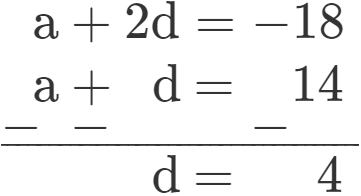
Put d = 4 is (i) $a + 4 = 14 a = 10$
$\therefore\ \text{S}_{51}=\frac{51}{2}\{2\times10+(51-1)\times4\}$ $\Big(\text{S}_\text{n}=\frac{\text{n}}{2}\{2\text{a}+(\text{n}-1)\text{d}\}\Big)$
$=\frac{51}{2}\{20+200\}$
$=\frac{51}{2}\times220$
$=5610$ $\therefore\ \text{S}_{51}=5610$ View full question & answer→Question 473 Marks
The sum of the first $n$ terms of an A.P. is $4 n^2+2 n$. Find the $n^{\text {th }}$ term of this A.P.
Answer$S_n = 4n^2 + 2n$
$\therefore$ $a_n = S_n - S_{n-1}$
$= (4n^2 + 2n) - [4(n - 1)^2 + 2(n - 1)]$
$= (4n^2 + 2n) - [4(n^2 - 2n + 1) + 2n - 2]$
$= (4n^2 + 2n) - [4n^2 - 8n + 4 + 2n - 2]$
$= 4n^2 + 2n - 4n^2 + 8n - 4 - 2n + 2$
$= 8n - 2 = 2(4n - 1)$
View full question & answer→Question 483 Marks
Ramkali would need Rs. 1800 for admission fee and books etc., for her daughter to start going to school from next year. She saved Rs. 50 in the first month of this year and increased her monthly saving by Rs. 20. After a year, how much money will she save? Will she be able to fulfil her dream of sending her daughter to school?
AnswerAdmission fee and books etc. = Rs. 1800
First month's savings = Rs. 50
Increase in monthly savings = Rs. 20
Period = 1 year = 12 months
Here a = 50, d = 20 and n = 12
$\text{S}_{12}=\frac{\text{n}}{2}[2\text{a}+(\text{n}-1)\text{d}]$
$=\frac{12}{2}[2\times50+(12-1)\times20]$
= 6[100 + 11 × 20]
= 6[100 + 220]
= 6 × 320 = Rs. 1920
Savings = Rs. 1920
Yes, she will be able to send her daughter.
View full question & answer→Question 493 Marks
If $\frac{4}{5}$, a, $2$ are three consecutive terms of an $A.P$.?
AnswerHere, we are given three consecutive terms of an A.P.
First term $\left(a_1\right)=\frac{4}{5}$
Second term $\left(a_2\right)=a$
Third term $\left(a_3\right)=2$
We need to find the value of $a$. So, in an A.P. the difference of two adjacent terms is always constant. So, we get,
$d = a_2 - a_1$
$\text{d}=\text{a}-\frac{4}{5}\ ....\text{(i)}$
Also,
$d = a_3 - a_2$
$d = 2 - a$
Now, on equating (i) and (ii), we get,
$\text{a}-\frac{4}{5}=2-\text{a}$
$\text{a}+\text{a}=2+\frac{4}{5}$
$2\text{a}=\frac{10+4}{5}$
$\text{a}=\frac{14}{10}$
$\text{a}=\frac{7}{5}$
Therefore, $\text{a}=\frac{7}{5}$.
View full question & answer→Question 503 Marks
Find the common difference of the $A.P$. and write the next two terms:
$51, 59, 67, 75, .....$
Answer$51, 59, 67, 75, .....$
Here,
$a_1 = 51$
$a_2 = 59$
So, common difference of the A.P. $(d) = a_2 - a_1$
$= 59 - 51$
$= 8$
Also, we need to find the next two terms of A.P., which means we have to find the $5^{th}$ and $6^{th}$ term.
So, for fifth term,
$a_5 = a_1 + 4d$
$= 51 + 4(8)$
$= 51 + 32$
$= 83$
Similarly, we find the sixth term,
$a_6 = a_1 + 5d$
$= 51 + 5(8)$
$= 51 + 40$
$= 91$
Therefore, the common difference is $d = 8$ and the next two terms of the $A.P$. are $a_5 = 83, a_6 = 91.$
View full question & answer→