Question 15 Marks
Solve for x and y:
$x + y = a + b,$
$ax - by = a^2 - b^2$
Answerx + y = a + b ...(i)
ax - by = a^2 - b^2...(ii)
Multiplying (i) by b adding it to (ii), we get
$\Rightarrow bx + ax = ab + b^2 + a^2- b^2$
$\Rightarrow x(a + b) = a(a + b)$
$\Rightarrow x = a$
Substitute x = a in (i), we get y = b.
So, x = a and y = b
View full question & answer→Question 25 Marks
Solve the following systems of equations by using the method of cross multiplication:
$x + 2y + 1 = 0$
$2x - 3y - 12 = 0$
AnswerThe given equations are:
$x+2 y+1=0 \ldots \text { (i) }$
$2 x-3 y-12=0 \ldots \text { (it }$
Here, $a_1=1, b_1=2, c_1=1, a_2=2, b_2=-3$ and $c_2=-12$
By cross multiplication, we have
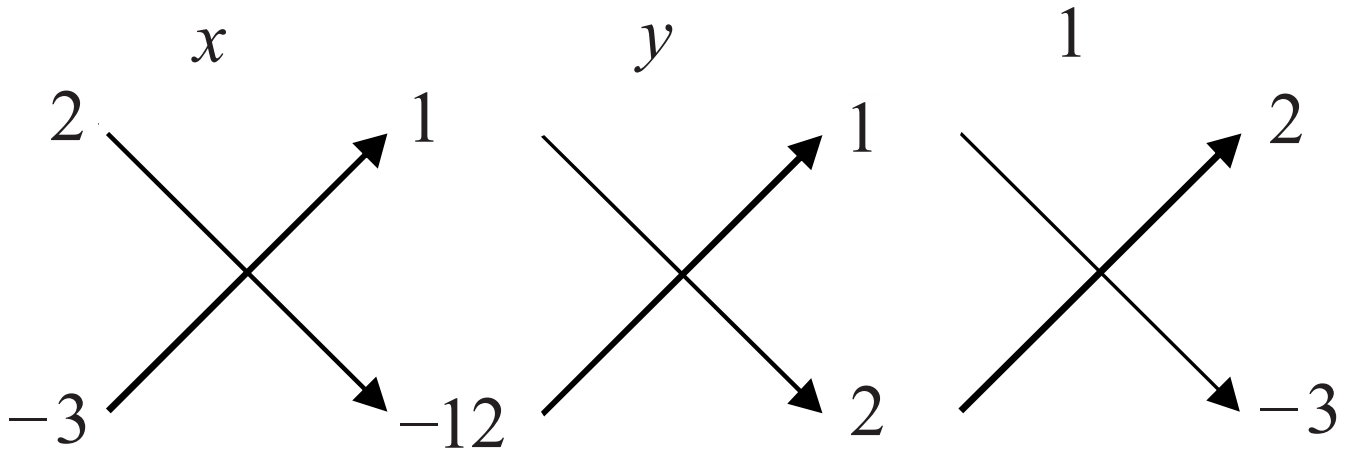
$\therefore\frac{\text{x}}{[2\times(-12)-1\times(-3)]}=\frac{{\text{y}}}{[1\times2-1\times(-12)]}=\frac{1}{[1\times(-3)-2\times2]}$
$\Rightarrow\frac{\text{x}}{(-24+3)}=\frac{\text{y}}{(2+12)}=\frac{1}{(-3-4)}$
$\Rightarrow\frac{\text{x}}{(-21)}=\frac{\text{y}}{(14)}=\frac{1}{(-7)}$
$\Rightarrow\text{x}=\frac{-21}{-7}=3,\ \text{y}=\frac{14}{-7}=-2$
Hence, x = 3 and y = -2 is the required solution. View full question & answer→Question 35 Marks
Solve for x and y:
7(y + 3) - 2(x + 2) = 14,
4(y - 2) + 3(x - 3) = 2
AnswerThe given equations are: 7(y + 3) - 2(x + 2) = 14 4(y - 2) + 3(x - 3) = 2 7(y + 3) - 2(x + 2) = 14⇒ 7y + 21 - 2x - 4 = 14
⇒ 7y - 2x = 14 + 4 - 21
⇒ -2x + 7y = -3 ...(1)
4(y - 2) + 3(x - 3) = 2⇒ 4y - 8 + 3x - 9 = 2
⇒ 4y + 3x = 2 + 8 + 9
⇒ 3x + 4y = 19 ...(2)
Multiply (1) by 4 and (2) by 7, we get
-8x + 28y = -12 ...(3)
21x + 28y = 133 ...(4)
Subtracting (3) and (4), we get
29x = 145
x = 5
Substituting x = 5 in (1), we get
-2 × 5 + 7y = -3
⇒ 7y = -3 + 10
⇒ 7y = 7
⇒ y = 1
$\therefore$ Solution is x = 5 and y = 1
View full question & answer→Question 45 Marks
Solve for x and y:
3(2x + y) = 7xy,
3(x + 3y) = 11xy $(\text{x}\neq0\ \text{and}\ \text{y}\neq0)$
Answer3(2x + y) = 7xy and 3(x + 3y) = 11xy
Divide each equation by xy.
$\Rightarrow\frac{3}{\text{x}}+\frac{6}{\text{y}}=7\ \dots(\text{i})$ and $\frac{9}{\text{x}}+\frac{3}{\text{y}}=11\ \dots({\text{ii}})$
Multiply (i) by 3 and subtract from (ii).
$\frac{18}{\text{y}}-\frac{3}{\text{y}}=10$
$\Rightarrow\text{y}=\frac{15}{10}=\frac{3}{2}$
Substituting $\text{y}=\frac{3}{2}$ in (i), we have
$\frac{3}{\text{x}}+\frac{6}{\frac{3}{2}}=7$
$\Rightarrow\frac{3}{\text{x}}+4=7$
$\Rightarrow\frac{3}{\text{x}}=3$
$\Rightarrow\text{x}=1$
So, x = 1 and $\text{y}=\frac{3}{2}$
View full question & answer→Question 55 Marks
Solve the following systems of equations by using the method of cross multiplication:
$3x - 2y + 3 = 0$
$4x + 3y - 47 = 0$
AnswerThe given equations are: $3 x-2 y+3=0 \ldots$...i) $4 x+3 y-47=0 \ldots$...(ii) Here, $a_1=3, b_1=-2, c_1=3, a_2=4, b_2=3$ and $c_2=$ -47 By cross multiplication, we have:
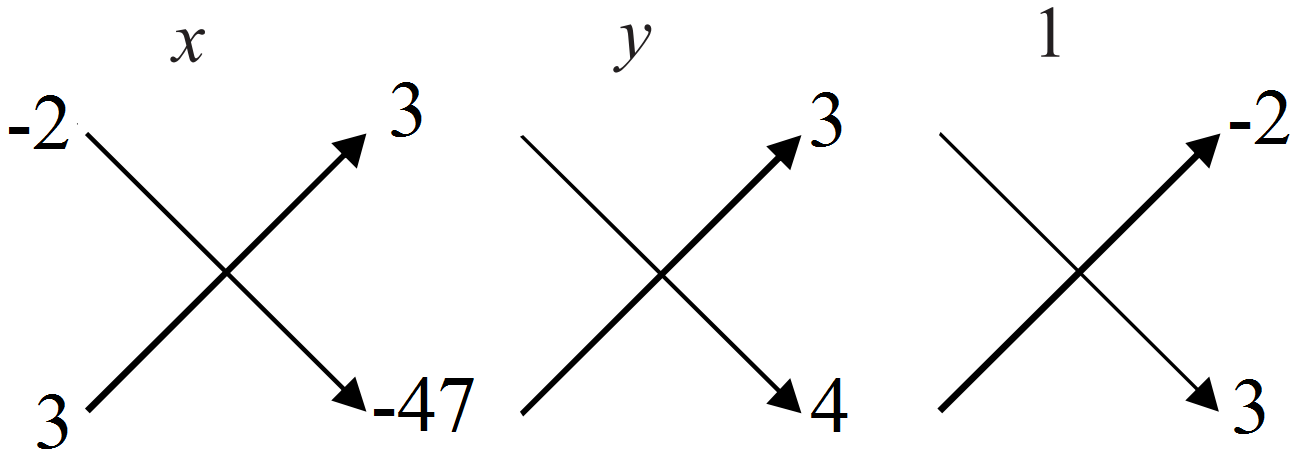
$\therefore\frac{\text{x}}{[(-2)\times(-47)-3\times3]}=\frac{{\text{y}}}{[3\times4-(-47)\times3]}=\frac{1}{[3\times3-(-2)\times4]}$ $\Rightarrow\frac{\text{x}}{(94-9)}=\frac{\text{y}}{(12+141)}=\frac{1}{(9+8)}$ $\Rightarrow\frac{\text{x}}{85}=\frac{\text{y}}{153}=\frac{1}{17}$ $\Rightarrow\text{x}=\frac{85}{17}=5,\ \text{y}=\frac{153}{17}=9$ Hence, x = 5 and y = 9 is the required solution. View full question & answer→Question 65 Marks
Solve for x and y:
$\frac{1}{(3\text{x}+\text{y)}}+\frac{1}{(3\text{x}-\text{y)}}=\frac{3}{4},$
$\frac{1}{2(3\text{x}+\text{y)}}-\frac{1}{2(3\text{x}-\text{y)}}=\frac{-1}{8}$
Answer$\frac{1}{(3\text{x}+\text{y)}}+\frac{1}{(3\text{x}-\text{y)}}=\frac{3}{4},$
$\frac{1}{2(3\text{x}+\text{y)}}-\frac{1}{2(3\text{x}-\text{y)}}=\frac{-1}{8}$
$\Rightarrow\frac{1}{(3\text{x}+\text{y)}}-\frac{1}{(3\text{x}-\text{y)}}=\frac{-1}{4}$
Put $\frac{1}{\text{3x}+\text{y}}=\text{u}$ and $\frac{1}{\text{3x}-\text{y}}=\text{v}$
So, we get
$\text{u}+\text{v}=\frac{3}{4}\ \dots(\text{i})$ and $\text{u}-\text{v}=\frac{-1}{4}\ \dots(\text{ii})$
Adding (i) and (ii), we get
$\Rightarrow\text{2u}=\frac{1}{2}$
$\Rightarrow\text{u}=\frac{1}{4}$
Substituting $\text{u}=\frac{1}{4}$ in (i), we get $\text{v}=\frac{1}{2}$
$\Rightarrow\frac{1}{\text{3x}+\text{y}}=\frac{1}{4}$ and $\frac{1}{\text{3x}-\text{y}}=\frac{1}{2}$
3x + y = 4 ...(iii) and 3x - y = 2 ...(iv)
Adding (iii) and (iv), we get
6x = 6
x = 1
Substituting x = 1 in (iii), we get y = 1
Hence, x = 1 and y = 1
View full question & answer→Question 75 Marks
The sum of the numerator and denominator of a fraction is 4 more than twice the numerator. If the numerator and denominator are increased by 3, they are in the ratio 2 : 3. Determine the fraction.
AnswerLet the fraction be $\frac{\text{x}}{\text{y}}$
According to the first condition,
x + y - 2x + 4
⇒ x - y = -4 ...(i)
According to the second condition,
$\frac{\text{x}+3}{\text{y}+3}=\frac{2}{3}$
⇒ 3x + 9 = 2y + 6
⇒ 3x - 2y = -3 ...(ii)
Multiply (i) by -2 and adding it to (ii).
-2x + 2y - 8 and 3x - 2y = -3
⇒ x = 5
Substituting x = 5 in (i), we get
y = 9
So, the fraction is $\frac{5}{9}$
View full question & answer→Question 85 Marks
A two-digit number is 3 more than 4 times the sum of its digits. If 18 is added to the number, the digits are reversed. Find the number.
AnswerLet the ten's and unit's of required number be x and y respectively.
Then required number = 10x + y
According to the given question:
10x + y = 4(x + y) + 3
⇒ 10x + y = 4x + 4y +3
⇒ 6x - 3y = 3
⇒ 2x - y = 1 ...(1)
And
⇒ 10x + y + 18 = 10y + x
⇒ 9x - 9y = -18
⇒ 9(x - y) = -18
$\Rightarrow(\text{x}-\text{y})=\frac{-18}{9}$
⇒ x - y = -2 ...(2)
Subtracting (2) from (1), we get
$\therefore$ x = 3
Putting x = 3 in (1), we get
2 × 3 - y = 1
y = 6 - 1 = 5
$\therefore$ x = 3, y = 5
Required number = 10x + y
= 10 × 3 + 5
= 30 + 5
= 35
Hence, required number is 35.
View full question & answer→Question 95 Marks
Solve for x and y:
$\frac{\text{x}}{\text{a}}+\frac{\text{y}}{\text{b}}=2,$
$\text{ax}-\text{by}=\text{a}^2-\text{b}^2$
Answer$\frac{x}{a}+\frac{y}{b}=2$
$\frac{b x+a y}{a b}=2 b x+a y=2 a b \ldots$
$a x-b y=\left(a^2-b^2\right) \ldots(2)$
Multiplying (1) by b and (2) by a
$\Rightarrow b^2 x+\text { bay }=2 a b^2 \ldots(3)$
$\Rightarrow a^2 x-b a y=a\left(a^2-b^2\right) \ldots(4) \text { Adding (3)and (4), we get } b^2 x+a^2 x=2 a b^2+a\left(a^2-b^2\right) x\left(b^2+a^2\right)=2 a b^2+a^3-a b^2 x\left(b^2\right.$
$\left.+a^2\right)=a b^2+a^3 x\left(b^2+a^2\right)=a\left(b^2+a^2\right)$
$x=\frac{a\left(b^2+a^2\right)}{\left(b^2+a^2\right)}=a \text { Putting } x=a \text { in (1), we get } b \times a+a y=2 a b a y=2 a b-a b a$ $y=a b \text { or } y=b$
$\therefore$ Solution is $x=a, y=b$
View full question & answer→Question 105 Marks
Solve the following systems of equations by using the method of cross multiplication:
$2x + y = 35,$
$3x + 4y = 65$
AnswerThe given equations may be written as: $2 x+y-35=0$
.(i) $3 x+4 y-65=0$ Here, $a_1=2, b_1=1, c_1=-35, a_2=3, b_2=4$ and $c_2=-65$ By cross multiplication, we have: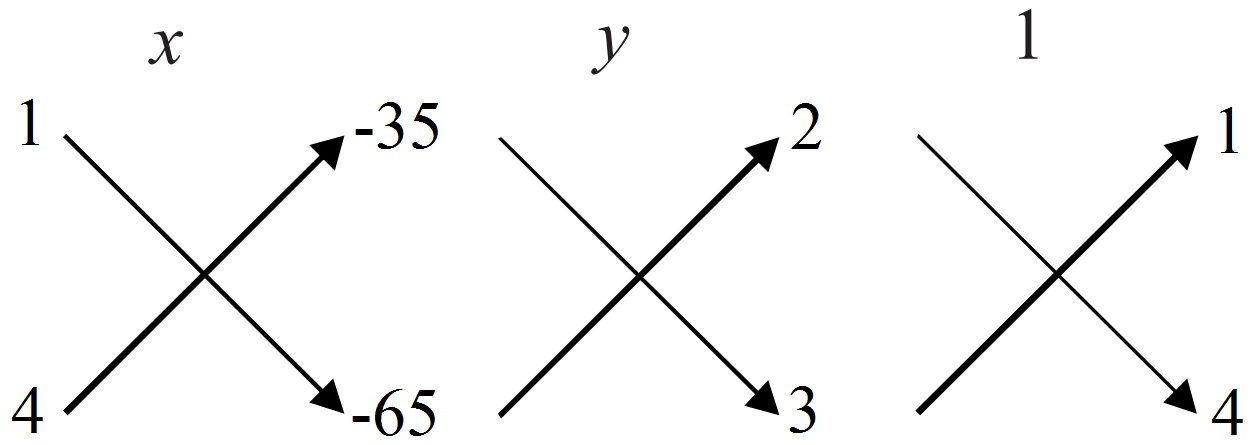
$\therefore\frac{\text{x}}{[1\times(-65)-4\times(-35)]}=\frac{{\text{y}}}{[(-35)\times3-(-65)\times2]}=\frac{1}{[2\times4-3\times1]}$ $\Rightarrow\frac{\text{x}}{(-65+140)}=\frac{\text{y}}{(-105+130)}=\frac{1}{(8-3)}$ $\Rightarrow\frac{\text{x}}{75}=\frac{\text{y}}{25}=\frac{1}{5}$ $\Rightarrow\text{x}=\frac{75}{5}=15,\ \text{y}=\frac{25}{5}=5$ Hence, x = 15 and y = 5 is the required solution. View full question & answer→Question 115 Marks
Solve the following systems of equations by using the method of cross multiplication:
$\frac{1}{\text{x}}+\frac{1}{\text{y}}=7,$
$\frac{2}{\text{x}}-\frac{3}{\text{y}}=17 $ $(\text{x}\neq0,\ \text{y}\neq0).$
AnswerTaking $\frac{1}{ x }= u$ and $\frac{1}{ y }= v$, the given equations become: $u + v =72 u +3 v =17$ The given equations may be written as: $u+v-7=0 \ldots$ (i) $2 u+3 v-17=0 \ldots$ (ii) Here, $a_1=1, b_1=1, c_1=-7, a_2=2, b_2=3$ and $c_2=-17$ By cross multiplication, we have:
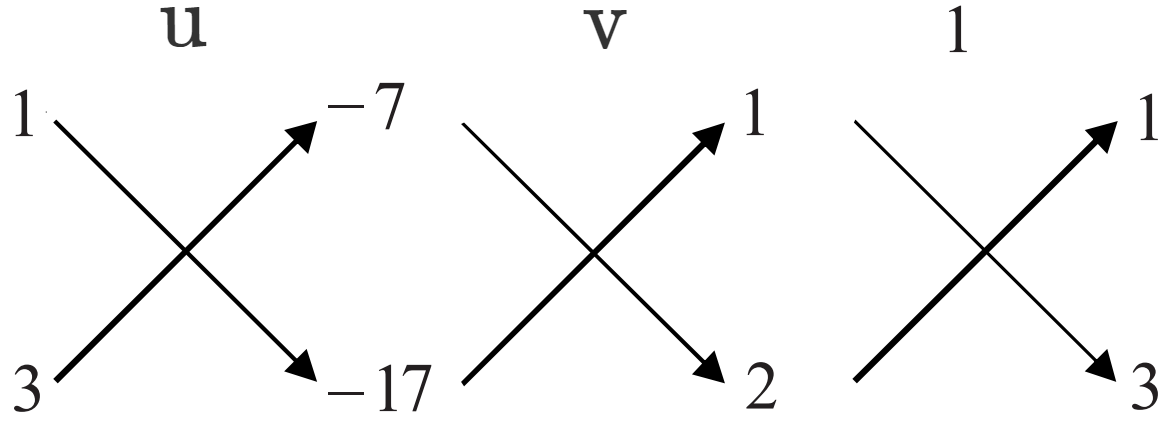
$\therefore\frac{\text{u}}{[1\times(-17)-3\times(-7)]}=\frac{\text{v}}{[(-7)\times2-1\times(-17)]}=\frac{1}{[3-2]}$ $\Rightarrow\frac{\text{u}}{-17+21}=\frac{\text{v}}{-14+17}=\frac{1}{1}$ $\Rightarrow\frac{\text{u}}{4}=\frac{\text{v}}3{}=\frac{1}{1}$ $\Rightarrow\text{u}=\frac{4}{1}=4,\ \text{v}=\frac{3}1{}=3$ $\Rightarrow\frac{1}{\text{x}}=4,\ \frac{1}{\text{y}}=3$ $\Rightarrow\text{x}=\frac{1}4{},\ \text{y}=\frac{1}3{}$ Hence, $\text{x}=\frac{1}4{}$ and $\text{y}=\frac{1}{3}$ is the required solution. View full question & answer→Question 125 Marks
A railway half ticket costs half the full fare and the reservation charge is the same on half ticket as on full ticket. One reserved first class ticket from Mumbai to Delhi costs ₹4,150 while one full and one half reserved first class
tickets cost ₹6,255. What is the basic first class full fare and what is the reservation charge?
AnswerLet the full fare be Rs. x and the reservation charge be Rs. y.
Since one full ticket cost ₹ 4150,
x + y = 4150 ...(i)
Since one full and one half reserved ticket cost ₹ 6255,
$(\text{x}+\text{y})+\Big(\frac{1}{2}\text{x}+\text{y}\Big)=6255$
$\Rightarrow\frac{3}{2}\text{x}+\text{2y}=6255$
$\Rightarrow\text{3x}+\text{4y}=12510\ \dots(\text{ii})$
Multiplying (i) by 3 and subtracting the resultant from (ii), we get
3x + 3y - 12450
and 3x + 4y - 12510
⇒ y = 60
Substituting y = 60 in (i), we get
⇒ x = 4090
Hence, the full fare is ₹ 4090 and the reservation charge is ₹ 60.
View full question & answer→Question 135 Marks
The sum of the numerator and denominator of a fraction is 8. If 3 is added to both of the numerator and the denominator, the fraction becomes $\frac{3}{4}.$ Find the fraction.
AnswerLet the numerator and denominator of fraction be x and y respectively.
According to the question:
x + y = 8 ...(1)
And
$\therefore\frac{\text{x}+3}{\text{y}+3}=\frac{3}{4}$
⇒ 4x + 12 - 3y + 9
⇒ 4x - 3y = -3 ...(2)
Multiplying (1) be 3 and (2) by 1
3x + 3y = 24 ...(3)
4x - 3y = -3 ...(4)
Add (3) and (4), we get
7x = 21
$\Rightarrow\text{x}=\frac{21}{7}=3$
Putting x = 3 in (1), we get
3 + y = 8
⇒ y = 8 - 3
⇒ y = 5
$\therefore$ x = 3, y = 5
Hence, the fraction is $\frac{\text{x}}{\text{y}}=\frac{3}{5}$
View full question & answer→Question 145 Marks
The sum of a two-digit number and the number obtained by reversing the order of its digits is 121, and the two digits differ by 3. Find the number.
AnswerLet the two-digit number be xy.
The given number = 10x + y
The number obtained by interchanging the digits is yx.
According to the first condition,
⇒ 10x + y + 10y + x = 121
⇒ 11x + 11y - 121
⇒ x + y = 11 ...(i)
According to the second condition,
x - y = 3 ...(ii)
Adding (i) and (ii), we get
2x - 14
⇒ x - 7
Substituting x = 7 in (i), we get
y = 4
So, the given number is xy - 74 or 47.
View full question & answer→Question 155 Marks
If 2 is added to the numerator of a fraction, it reduces to $\Big(\frac{1}{2}\Big)$ and if 1 is subtracted from the denominator, it reduces to $\Big(\frac{1}{3}\Big).$ Find the fraction.
AnswerLet the numerator and denominator be x and y respectively.
Then the fraction is $\frac{\text{x}}{\text{y}}.$
$\therefore\frac{\text{x}+2}{\text{y}}=\frac{1}{2}$
⇒ 2x + 4 = y
⇒ 2x - y = -4 ...(1)
and $\frac{\text{x}}{\text{y}-1}=\frac{1}{3}$
⇒ 3x = y - 1
⇒ 3x - y = -1 ...(2)
Subtracting (1) from (2), we get
x = 3
Putting x = 3 in (1), we get
2 × 3 - 4
⇒ y = -4 - 6
⇒ y = 10
$\therefore$ x = 3 and y = 10
Hence the fraction is $\frac{3}{10}$
View full question & answer→Question 165 Marks
Solve for x and y:
$\frac{10}{\text{x}+\text{y}}+\frac{2}{\text{x}-\text{y}}=4,$
$\frac{15}{\text{x}+\text{y}}-\frac{9}{\text{x}-\text{y}}=-2$
Answer$\frac{10}{\text{x}+\text{y}}+\frac{2}{\text{x}-\text{y}}=4,$
$\frac{15}{\text{x}+\text{y}}-\frac{9}{\text{x}-\text{y}}=-2$
Put $\frac{1}{\text{x}+\text{y}}=\text{u}$ and $\frac{1}{\text{x}-\text{y}}=\text{v}$ in the equation, we get
10u + 2v = 4 ...(i)
15u - 9v = -2 ...(ii)
Multiply (i) by 9 and (ii) by 2, we get
⇒ 90u + 18v = 36 and 30u - 18v = -4
⇒ 120u = 32
$\Rightarrow\text{u}=\frac{4}{15}$
Substituting $\text{u}=\frac{4}{15},$ in (i), we get $\text{v}=\frac{2}{3}$
$\Rightarrow\frac{1}{\text{x}+\text{y}}=\frac{4}{15}$
and $\frac{1}{\text{x}-\text{y}}=\frac{2}{3}$
$\Rightarrow\text{x}+\text{y}=\frac{15}{4}\ \dots(\text{iii})$
and $\text{x}-\text{y}=\frac{3}{2}\ \dots(\text{iv})$
Adding (iii) and (iv), we get
$\text{2x}=\frac{21}{4}$
$\Rightarrow\text{x}= \frac{21}{8}$
Substituing $\text{x}=\frac{21}{2}$ in (iii), we get $\text{y}=\frac{9}{8}$
So, $\text{x}=\frac{21}{2}$ and $\text{v}=\frac{9}{8}$
View full question & answer→Question 175 Marks
Solve for x and y:
71x + 37y = 253,
37x + 71y = 287
AnswerThe given equations are: 71x + 37y = 253 ...(1) 37x + 71y = 287 ...(2) Adding (1) and (2) 108x + 108y = 540 108(x + y) = 540 $\therefore\text{x}+\text{y}=\frac{540}{108}=5\ \dots(3)$ Subtracting (2) from (1) 34x - 34y = 253 - 287 = -34 34(x - y) = -34$\therefore\text{x}-\text{y}=- \frac{34}{34}=-1\ \dots(4)$
Adding (3) and (4) 2x = 5 - 1 = 4 ⇒ x = 2 Subtracting (4) from (3) 2y = 5 + 1 = 6 ⇒ y = 3 $\therefore$ The solution is x = 2, y = 3
View full question & answer→Question 185 Marks
Solve for x and y:
6x + 5y = 7x + 3y + 1 = 2(x + 6y - 1)
AnswerThe given equations are: 6x + 5y = 7x + 3y + 1 = 2(x + 6y - 1) Therefore, we have 6x + 5y = 2(x + 6y - 1)⇒ 6x + 5y = 2x + 12y - 2
⇒ 6x - 2x + 5y - 12y = -2
4x - 7y = -2 ...(1) 7x + 3y + 1 = 2(x + 6y - 1)⇒ 7x + 3y + 1 = 2x + 12y - 2
⇒ 7x - 2x + 13y - 12y = -2 - 1
5x - 9y = -3 ...(2)Multiply (1) by 9 and (2) by 7, we get
36x - 63y = -18 ...(3)
35x - 63y = -21 ...(4)
Subtracting (4) from (3), we get
x = 3
Substituting x = 3 in (1), we get
4 × 3 - 7y = -2
⇒ -7y = -2 - 12
⇒ -7y = -14
⇒ y = 2
$\therefore$ Solution is x = 3 and y = 2
View full question & answer→Question 195 Marks
Find a fraction which becomes $\Big(\frac{1}{2}\Big)$ when 1 is subtracted from the numerator and 2 is added to the denominator, and the fraction becomes $\Big(\frac{1}{3}\Big)$ when 7 is subtracted from the numerator and 2 is subtracted from the denominator.
AnswerLet the numerator and denominator be x and y respectively.
Then the fraction is $\frac{\text{x}}{\text{y}}.$
$\therefore\frac{\text{x}-1}{\text{y}+2}=\frac{1}{2}$
⇒ 2x - 2 = y + 2
⇒ 2x - y =4 ...(1)
and $\therefore\frac{\text{x}-7}{\text{y}-2}=\frac{1}{3}$
⇒ 3x - 21 = y - 2
⇒ 3x - y = 19 ...(2)
Subtracting (1) from (2), we get
x = 15
Putting x = 15 in (1), we get
2 × 15 - y = 4
⇒ 30 - y = 4
⇒ y = 26
$\therefore$ x = 15 and y = 26
Hence the given fraction is $\frac{15}{26}$
View full question & answer→Question 205 Marks
The denominator of a fraction is greater than its numerator by 11. If 8 is added to both its numerator and denominator, it becomes $\frac{3}{4}.$ Find the fraction.
AnswerLet the numerator and denominator be x and y respectively.
Then the fraction is $\frac{\text{x}}{\text{y}}.$
y = x + 11
y - x = 11 ...(1)
and
$\frac{\text{x}+8}{\text{y}+8}=\frac{3}{4}$
⇒ 4x + 32 = 3y + 24
⇒ 4x - 3y = -8
⇒ -3y + 4x = -8 ...(2)
Multiplying (1) by 4 and (2) by 1
4y - 4x = 44 ...(3)
-3y + 4x = -8 ...(4)
Adding (3) and (4), we get
y = 36
Putting y = 36 in (1), we get
y - x = 11
⇒ 36 - x = 11
⇒ x = 25
$\therefore$ x = 25, y = 36
Hence the fraction is $\frac{25}{36}$
View full question & answer→Question 215 Marks
A number consists of two digits. When it is divided by the sum of its digits, the quotient is 6 with no remainder. When the number is diminished by 9, the digits are reversed. Find the number.
AnswerLet the ten's and unit's digits of the required number be x and y respectively.
Then, xy = 35
Required number = 10x + y
Also,
$(10x + y) + 18 = 10y + x$
$⇒ 9x - 9y = -18$
$⇒ 9(y - x) = 18 ...(1)$
$⇒ y - x = 2$
Now,
$(y + x)^2- (y - x)^2 = 4xy$
$\Rightarrow\text{y}+\text{x}=\sqrt{(\text{y}-\text{x})^2+\text{4xy}}$
$=\sqrt{4+4\times35}$
$=\sqrt{144}$
$=12$
y + x = 12 ...(2)
Adding (1) and (2),
2y = 12 + 2 = 14
⇒ y = 7
Putting y = 7 in (1),
7 - x = 2
⇒ x = 5
Hence, the required number = 5 x 10 + 7 = 57
View full question & answer→Question 225 Marks
Solve the following systems of equations by using the method of cross multiplication:
$2x + 5y = 1,$
$2x + 3y = 3$
AnswerThe given equations are: $2 x+5 y=1 \ldots$ (i) $2 x+3 y=3 \ldots$ (ii) Here, $a_1=2, b_1=5, c_1=-1, a_2=2, b_2=3$ and $c_2=-3$ By cross multiplication, we have:
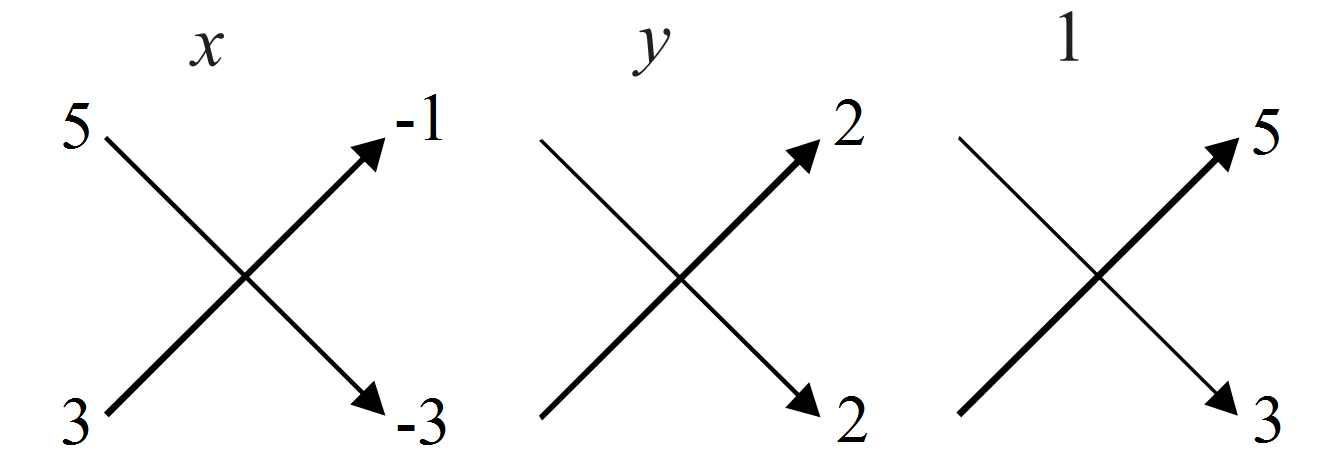
$\therefore\frac{\text{x}}{[5\times(-3)-3\times(-1)]}=\frac{{\text{y}}}{[(-1)\times2-(-3)\times2]}=\frac{1}{[2\times3-2\times5]}$ $\Rightarrow\frac{\text{x}}{(-15+3)}=\frac{\text{y}}{(-2+6)}=\frac{1}{(6-10)}$ $\Rightarrow\frac{\text{x}}{-12}=\frac{\text{y}}{4}=\frac{1}{-4}$ $\Rightarrow\text{x}=\frac{-12}{-4}=3,\ \text{y}=\frac{4}{-4}=-1$ Hence, x = 3 and y = -1 is the required solution. View full question & answer→Question 235 Marks
A number consists of two digits. When it is divided by the sum of its digits, the quotient is 6 with no remainder. When the number is diminished by 9, the digits are reversed. Find the number.
AnswerLet the ten's digit and unit's digit of required number be x and y respectively.
We know,
Dividend = (divisor × quotient) + remainder
According to the given question:
10x + y = 6 x (x + y) +0
⇒ 10x - 6x + y-by = 0
⇒ 4x - 5y = 0 ...(1)
Number obtained by reversing the digits is 10y + x
10x + y - 9 = 10y + x
⇒ 9x - 94 = 9
⇒ 9(x - y) = 9
⇒ (x - y) = 1 ...(2)
Multiplying (1) by 1 and (2) by 5, we get
4x - 5y = 0 ...(3)
5x - 5y = 5 ...(4)
Subtracting (3) from (4), we get
$\therefore$ x = 5
Putting x = 5 in (1), we get
4 × 5 - 5y = 0
⇒ -5y = -20
$\Rightarrow\text{y}=\frac{-20}{-5}=4$
$\therefore$ x = 5 and y = 4
Hence, required number is 54
View full question & answer→Question 245 Marks
Solve for x and y:
$\frac{\text{2x}+\text{5y}}{\text{xy}}=6,$
$\frac{\text{4x}-\text{5y}}{\text{xy}}=-3$
AnswerThe given equations are: $\frac{\text{2x}+\text{5y}}{\text{xy}}=6$ $\Rightarrow\frac{2}{\text{y}}+\frac{5}{\text{x}}=6\ \dots(\text{i})$ $\frac{\text{4x}-\text{5y}}{\text{xy}}=-3$ $\Rightarrow\frac{4}{\text{y}}-\frac{5}{\text{x}}=-3\ \dots(\text{ii})$ Adding (i) and (ii), we get $\frac{6}{\text{y}}=3$ $\Rightarrow\text{y}=2$ Substituting y = 2 in (i), we get x = 1Hence, x = 1 and y = 2
View full question & answer→Question 255 Marks
Solve for x and y:
$6(ax + by) = 3a + 2b,$
$6(bx - ay) = 3b - 2a$
Answer$6(ax + by) = 3a + 2b$
$6ax + 6bx = 3a + 2b ...(1)$
$6(bx - ay) = 3b - 2a$
$6bx - 6ay = 3b - 2a ...(2)$
$6ax + 6bx = 3a + 2b ...(1)$
$6bx - 6ay = 3b - 2a ...(2)$
Multiplying (1) by by a and (2) by b
$6a^2x + 6b^2x = 3a^2 + 2ab ...(3)$
$6a^2x - 6b^2x = 3b^2- 2ab ...(4)$
Adding (3) and (4), we get
$6a^2x + 6b^2x = 3a^2 + 3b^2$
$6(a^2 + b^2)x = 3(a^2 + b^2)$
$\text{x}=\frac{3\big(\text{a}^2+\text{b}^2\big)}{6\big(\text{a}^2+\text{b}^2\big)}=\frac{3}{6}=\frac{1}{2}$
Substituting $\text{x}=\frac{1}{2}$ in (1), we get
$\text{6a}\times\frac{1}{2}+\text{6by}=\text{3a}+\text{2b}$
$\text{3a}+\text{6by}=\text{3a}+\text{2b}$
$\text{6by}=\text{3a}+\text{2b}-\text{3a}$
$\text{6by}=\text{2b}$
$\text{y}=\frac{\text{2b}}{\text{6b}}=\frac{1}{3}$
Hence, the solution is $\text{x}=\frac{1}{2},\ \text{y}=\frac{1}{3}$
View full question & answer→Question 265 Marks
Solve for x and y:
$\frac{5}{\text{x}}+\text{6y}=13,$
$\frac{3}{\text{x}}+\text{4y}=7\ (\text{x}\neq0).$
AnswerPutting $\frac{1}{\text{x}}=\text{u}$ the given equations become 5u + 6y = 13 ...(1) 3u + 4y = 7 ...(2)Multiplying (1) by 4 and (2) by 6, we get
20u + 24y = 52 ...(3)
18u + 24y = 42 ...(4)
Subtracting (4) from (3), we get
2u = 10
⇒ x = 5
Substituting u = 5 in (1), we get
5 × 5 + 6y = 13
⇒ 6y = 13 - 25
⇒ 6y = -12
⇒ y = -2
u = 5
$\Rightarrow\frac{1}{\text{x}}=5$ $\Rightarrow\text{5x}=1$ $\Rightarrow\text{x}=\frac{1}{5}$$\therefore$ The solution is $\text{x}=\frac{1}{5}$ and y = -2
View full question & answer→Question 275 Marks
The sum of the digits of a two-digit number is 15. The number obtained by interchanging the digits exceeds the given number by 9. Find the number.
AnswerLet the ten's digit and unit's digits of required number be x and y respectively.
x + y = 15 ...(1)
Required number = 10x + y
Number obtained by interchanging the digits = 10y + x
$\therefore$ 10y + x - (10x + y) = 9
10y + x - 10x - y = 9
9y - 9x = 9
9(y - x) = 9
$\Rightarrow\text{y}-\text{x}=\frac{9}{9}$
⇒ y - x = 1
-x + y = 1 ...(2)
Add (1) and (2), we get
$\text{2y}=16$
$\Rightarrow\text{y}=\frac{16}{2}=8$
Putting y = 8 in (1), we get
x + 8 = 15
x = 15 - 8 = 7
Required number = 10x + y
= 10 x 7 + 8
= 70 + 8
= 78
Hence the required number is 78.
View full question & answer→Question 285 Marks
Solve for x and y:$\frac{\text{bx}}{\text{a}}+\frac{\text{ay}}{\text{b}}=\text{a}^2+\text{b}^2,$
$\text{x}+\text{y}=\text{2ab}$
Answer$\frac{\text{bx}}{\text{a}}-\frac{\text{ax}}{\text{b}}+\text{a}^2+\text{b}^2$
By taking L.C.M., we get
$\frac{\text{b}^2\text{x}+\text{a}^2\text{y}}{\text{ab}}=\text{a}^2+\text{b}^2$
$b^2x + a^2y = ab(a^2 + b^2) ...(1)$
$x + y = 2ab ...(2)$
Multiplying (1) by 1 and (2) by $a^2$
$b^2x + a^2y = a^3b + ab^3 ...(3)$
$a^2x + a^2y = 2a^3b ...(4)$
Subtracting (4) from (3), we get
$b^2x - a^2x = a^3b + ab^3 - 2a^3b$
$x(b^2- a^2) = ab^3- a^3b$
$x(b^2 - a^2) = ab(b^2 - a^2)$
$\therefore\ \text{x}=\frac{\text{ab}(\text{b}^2-\text{a}^2)}{(\text{b}^2-\text{a}^2)}=\text{ab}$
Substituting x = ab, in (3), we get
$b^2(ab) + a^2y = a^3b + ab^3$
$b^3a + a^2y = a^3b + ab^3$
$a^2y = a^3b + ab^3 - b^3a$
$a^2y = a^3b$
$\Rightarrow\text{y}=\frac{\text{a}^3\text{b}}{\text{a}^3}=\text{ab}$
$\therefore$ solution is x = ab, y = ab
View full question & answer→Question 295 Marks
Solve for x and y:
$\frac{\text{x}}{\text{a}}+\frac{\text{y}}{\text{b}}=\frac{\text{a}+\text{b}}{\text{b}}$
$\frac{\text{x}}{\text{a}^2}+\frac{\text{y}}{\text{b}^2}=2$
Answer$\frac{\text{x}}{\text{a}}+\frac{\text{y}}{\text{b}}=\frac{\text{a}+\text{b}}{\text{b}}\dots(\text{i})$
$\frac{\text{x}}{\text{a}^2}+\frac{\text{y}}{\text{b}^2}=2\ \dots(\text{ii})$
Multiplying (i) by band (ii) by $b^2 $and subtract, we get
$\Rightarrow\frac{\text{bx}}{\text{a}}-\frac{\text{b}^2\text{x}}{\text{a}^2}=\text{ab}+\text{b}^2-\text{2b}^2$
$\Rightarrow\text{x}=\frac{\big(\text{a}\text{b}-\text{b}^2\big)\text{a}^2}{\big(\text{ab}-\text{b}^2\big)}$
$\Rightarrow\text{x}=\text{a}^2$
Substituting x = $a^2$in (i), we get
$\text{a}+\frac{\text{y}}{\text{b}}=\frac{\text{a}+\text{b}}{\text{b}}$
$\Rightarrow\frac{\text{y}}{\text{b}}=\frac{\text{a}+\text{b}}{\text{b}}-\text{a}$
$\Rightarrow\text{y}=\text{b}^2$
$So, x = a^2 and y = b^2$
View full question & answer→Question 305 Marks
A two-digit number is such that the product of its digit is 18. When 63 is subtracted from the number, the digits interchange their places. Find the number.
AnswerLet the ten's and unit's digits of the required number be x and y respectively.
Then, xy = 18
Required number = 10x + y
Number obtained on reversing its digits = 10y + x
$\therefore$ (10x + y) - 63 = (10y + x)
⇒ 9x - 9y = 63
⇒ x - y = 7 ...(1)
Now,
$\Rightarrow (x + y)^2 - (x - y)^2 = 4xy$
$\Rightarrow(\text{x}+\text{y})=\sqrt{(\text{x}-\text{y})^2+\text{4xy}}$
$\Rightarrow\text{x}+\text{y}=\sqrt{(7)^2+4\times18}$
$=\sqrt{49+72}$
$=\sqrt{121}$
x + y = 11 ...(2)
Adding (1) and (2), we get
$\text{2x}=18$
$\Rightarrow\text{x}=\frac{18}{2}=9$
Putting x = 9 in (1), we get
9 - y = 7
⇒ y = 9 - 7
⇒ y = 2
$\therefore$ x = 9, y = 2
Hence, the required number = 9 x 10 + 2
= 92.
View full question & answer→Question 315 Marks
Solve for x and y:
$\frac{3}{\text{x}+\text{y}}+\frac{2}{\text{x}-\text{y}}=2,$
$\frac{9}{\text{x}+\text{y}}-\frac{4}{\text{x}-\text{y}}=1$
AnswerPutting $\frac{1}{\text{x}+\text{y}}=\text{u}$ and $\frac{1}{\text{x}-\text{y}}=\text{v}$
3u + 2v = 2 ...(1)
9u - 4v = 1 ...(2)
Multiply (1) by 2 and (2) by 1, we get
6u + 4v = 4 ...(3)
9u - 4v = 1 ...(4)
Adding (3) and (4), we get
$\text{15u}=5,$
$\text{u}=\frac{5}{15}=\frac{1}{3}$
Putting $\text{u}=\frac{1}{3}$ in (i), we get
$3\times\frac{1}{3}+\text{2v}=2$
$\Rightarrow1+\text{2v}=2$
$\Rightarrow\text{2v}=1$
$\text{v}=\frac{1}{2}$
Now, $\text{u}=\frac{1}{3}$
$\Rightarrow\frac{1}{\text{x}+\text{y}}=\frac{1}{3}$
$\Rightarrow\text{x}+\text{y}=3\ \dots(5)$
and $\text{v}=\frac{1}{2}$
$\Rightarrow\frac{1}{\text{x}-\text{y}}=\frac{1}{2}$
$\Rightarrow\text{x}-\text{y}=2\ \dots(6)$
Adding (5) and (6), we get
$\text{2x}=5$
$\Rightarrow\text{x}= \frac{5}{2}$
Putting $\text{x}=\frac{5}{2}$ in (5), we get
$\frac{5}{2}+\text{y}=3$
$\Rightarrow\text{y}=3-\frac{5}{2}=\frac{6-5}{2}=\frac{1}{2}$
$\therefore$ the solution is $\text{x}=\frac{5}{2}$ and $\text{y}=\frac{1}2{}$
View full question & answer→Question 325 Marks
Solve for x and y:
$a^2x + b^2y = c^2,$
$b^2x + a^2y = d^2$
Answer$a^2x + b^2y = c^2...(i)$
$b^2x + a^2y = d^2...(ii)$
Multiplying (i) by $a ^2$ and (ii) by $b ^2$ and subtracting, we get
$\Rightarrow\text{a}^4\text{x} - \text{b}^4\text{x} = \text{a}^2\text{b}^2 - \text{b}^2\text{d}^2$
$\Rightarrow\text{x}=\frac{\text{a}^2\text{c}^2-\text{b}^2\text{d}^2}{\text{a}^4-\text{b}^4}$
Multiplying (i) by $a ^2$ and (ii) by $b ^2$ and subtracting, we get
$\Rightarrow\text{b}^4\text{y} - \text{a}^4\text{y} = \text{b}^2\text{c}^2 - \text{a}^2\text{d}^2$
$\Rightarrow\text{y}=\frac{\text{b}^2\text{c}^2-\text{a}^2\text{d}^2}{\text{b}^4-\text{a}^4}$
So, $\text{x}=\frac{\text{a}^2\text{c}^2-\text{b}^2\text{d}^2}{\text{a}^4-\text{b}^4}$ and $\text{y}=\frac{\text{b}^2\text{c}^2-\text{a}^2\text{d}^2}{\text{b}^4-\text{a}^4}$
View full question & answer→Question 335 Marks
Solve for x and y:
$x + y = a + b,$
$ax - by = a^2 - b^2$
Answer$x + y = a + b ...(i)$
$ax - by = a^2 - b^2 ...(ii)$
Multiplying (i) by b adding it to (ii), we get
$\Rightarrow bx + ax = ab + b^2 + a^2 - b^2$
$\Rightarrow x(a + b) = a(a + b)$
$\Rightarrow x = a$
Substitute x = a in (i), we get y = b.
So, x = a and y = b.
View full question & answer→Question 345 Marks
A lending library has a fixed charge for the first three days and an additional charge for each day thereafter. Mona paid ₹ 27 for a book kept for 7 days, while Tanvy paid ₹ 21 for the book she kept for 5 days. Find the fixed charge and the charge for each extra day.
AnswerLet the fixed charge be ₹ x and the extra charge per day be ₹ y.
Given that,
Mona paid ₹ 27 for a book kept for 7 days,
⇒ x + 4y = 27 ...(i)
Given that,
Tanvy paid ₹ 21 for a book kept for 5 days,
⇒ x + 2y = 21 ...(ii)
Subtracting (ii) from (i), we get
⇒ 2y = 6
⇒ y = 3
Substituting y = 3 in (ii), we get
⇒ x = 15.
Hence, the fixed charge is ₹ 15 and the charge per day is ₹ 3.
View full question & answer→Question 355 Marks
The larger of the two supplementary angles exceeds the smaller by 18°. Find them.
AnswerLet the two supplementary angles be x and y,
where x is the larger angle.
Accroding to the given condition,
x = y + 18°
⇒ x - y = 18° ...(i)
Since the angles are supplementary,
⇒ x + y = 180° ...(ii)
Adding (i) and (ii), we get
⇒ 2x = 198
⇒ x = 99
Substituting x = 99 in (i), we get
⇒ y = 81.
Hence, the angles are 99° and 81°
View full question & answer→Question 365 Marks
Solve the following system of equations graphically:
2x - 3y + 13 = 0,
3x - 2y + 12 = 0
Answer$\text{2x}-\text{3y}+13=0$ $\Rightarrow\text{y}=\frac{13+\text{2x}}{3}$
$\text{3x}-\text{2y}+12=0$ $\Rightarrow\text{y}=\frac{\text{12}+\text{3x}}{2}$
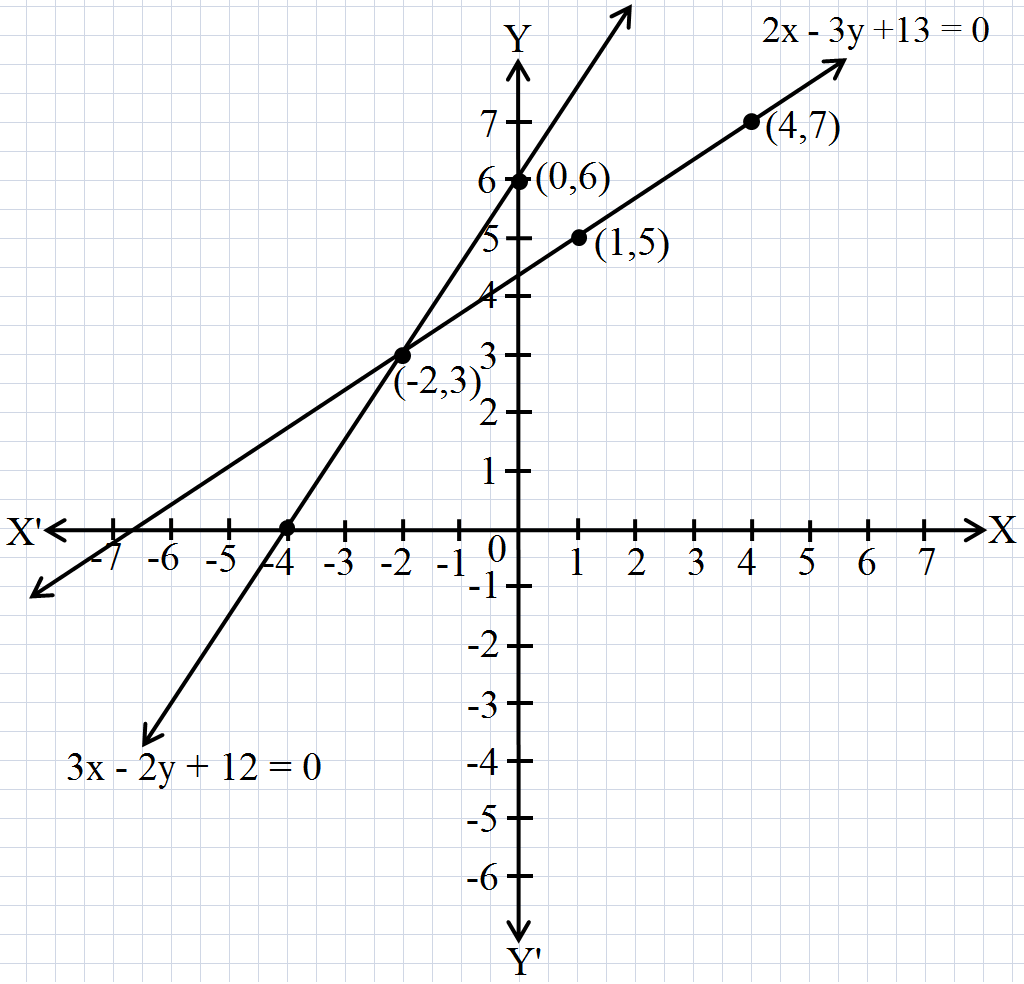
Since the two graph intersect at (-2, 3), x = -2 and y = 3 View full question & answer→Question 375 Marks
A man sold a chair and a table together for ₹1520, thereby making a profit of 25% on chair and 10% on table. By selling them together for ₹1535, he would would have made a profit of 10% on the chair and 25% on the table. Find the cost of each.
AnswerLet the CP of the chair and the table be Rs. x and Rs. y respectively.
Then, selling price of the chair + selling price of the table = 1520
$\Rightarrow\frac{100+25}{100}\text{x}+\frac{100+10}{100}\text{y}=1520$
$\Rightarrow\frac{125}{100}\text{x}+\frac{110}{100}\text{y}=1520$
$\Rightarrow\text{25x}+\text{22y}=30400\ \dots(\text{i})$
Given that by selling them together for Rs. 1535, he would have made a profit of 10% on the chair and 25% on the table.
$\Rightarrow\frac{100+10}{100}\text{x}+\frac{100+25}{100}\text{y}=1535$
$\Rightarrow\frac{110}{100}\text{x}+\frac{125}{100}\text{y}=1535$
$\Rightarrow\text{22x}+\text{25y}=30700\ \dots(\text{ii})$
Adding (i) and (ii), we get
47x + 47y = 61100
⇒ x + y = 1300 ...(iii)
Subtracting (ii) from (i), we get
3x - 3y = -300
x - y = -100 ...(iv)
Adding (iii) and (iv), we get
⇒ 2x = 1200
⇒ x = 600
Substituting x = 600 in (iii), we get y = 700
Hence, cost of the chair is Rs. 600 and cost of the table is Rs. 700
View full question & answer→Question 385 Marks
Show graphically that each of the following given systems of equations is inconsistent, i.e., has no solutions:
2x + 3y = 4, 4x + 6y = 12
Answer$2\text{x}+\text{3y}=4$ $\Rightarrow\text{y}=\frac{-2\text{x}+\text{4}}{3}$
$\text{4x}+\text{6y}=12$ $\Rightarrow\text{y}=\frac{-4\text{x}+12}{6}$
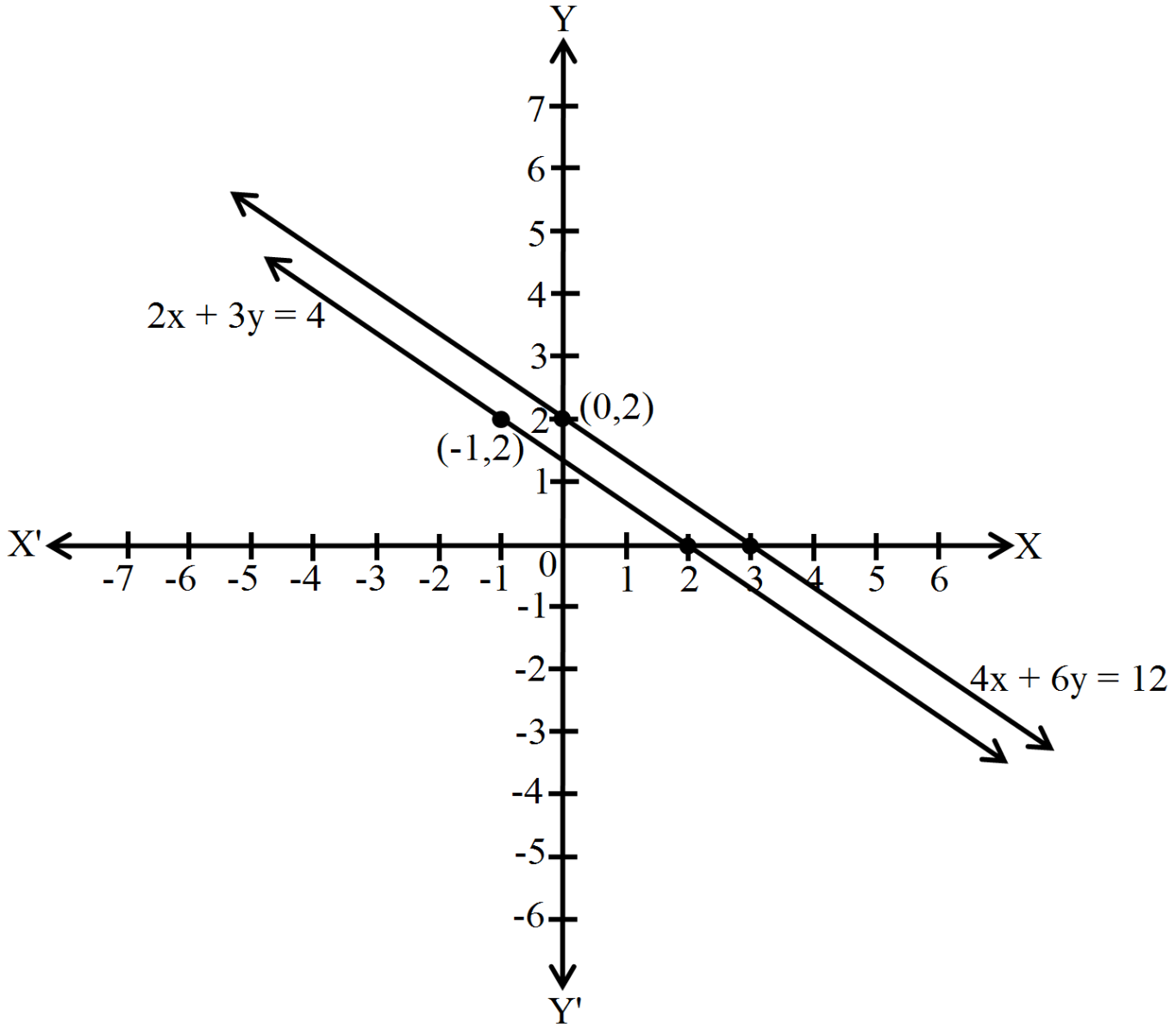
Since the two graph of the system of equations is parallel lines, the system has no solution and hence is inconsistent. View full question & answer→Question 395 Marks
A train covered a certain distance at a uniform speed. If the train had been 5 kmph faster, it would have taken 3 hours less than the scheduled time. And, If the train were slower by 4 kmph, it would have taken 3 hours more than the scheduled time. Find the length of the journey.
AnswerLet the original speed be x km/h and time taken be y hours Then, length of journey = xy kmCase I:
Speed = (x + 5)km/h and time taken = (y - 3)hour Distance covered = (x + 5)(y - 3)km $\therefore$ (x + 5)(y - 3) = xy ⇒ xy + 5y - 3x - 15 = xy ⇒ 5y - 3x = 15 ...(1)Case II:
Speed (x - 4)km/hr and time taken = (y + 3)hours Distance covered = (x - 4)(y + 3)km $\therefore$ (x - 4)(y + 3) = xy ⇒ xy - 4y + 3x - 12 = xy ⇒ 3x - 4y = 12 ...(2) Multiplying (1) by 4 and (2) by 5, we get 20y - 12x = 60 ...(3) -20y + 15x = 60 ...(4) Adding (3) and (4), we get 3x = 120 or x = 40 Putting x = 40 in (1), we get 5y - 3 × 40 = 15 ⇒ 5y = 135 ⇒ y = 27 Hence, length of the journey is (40 × 27)km = 1080km.
View full question & answer→Question 405 Marks
Solve the following system of equations graphically:
3x + y + 1 = 0,
2x - 3y + 8 = 0
AnswerOn a graph paper, draw a horizontal line X'OX and a vertical line YOY' representing the x-axis and y-axis, respectively. Given equations are 3x + y + 1 = 0 and 2x - 3y + 8 = 0 Graph of 3x + y + 1 = 0: 3x + y + 1 = 0 ⇒ y = -3x - 1 ...(1) Thus, we have the following table for 3x + y + 1 = 0
On the graph paper plot the points A(0, -1), B(-1, 2) and C(1, -4). Join AB and AC to get the graph line BC. Thus, the line BC is the graph of the equation of 3x + y + 1 = 0. Graph of 2x - 3y + 8 = 0: For graph of 2x - 3y + 8 = 0 $\Rightarrow\text{y}=\frac{\text{2x}+8}{3}\ \dots(2)$ Thus, we have the following table for equation (2)
Now, on the same graph paper plot the points P(2, 4) and Q(-4, 0). The point B(-1, 2) has already been plotted. Join PB and BQ to get the line PQ. Thus, line PQ is the graph of the equation 2x - 3y + 8 = 0.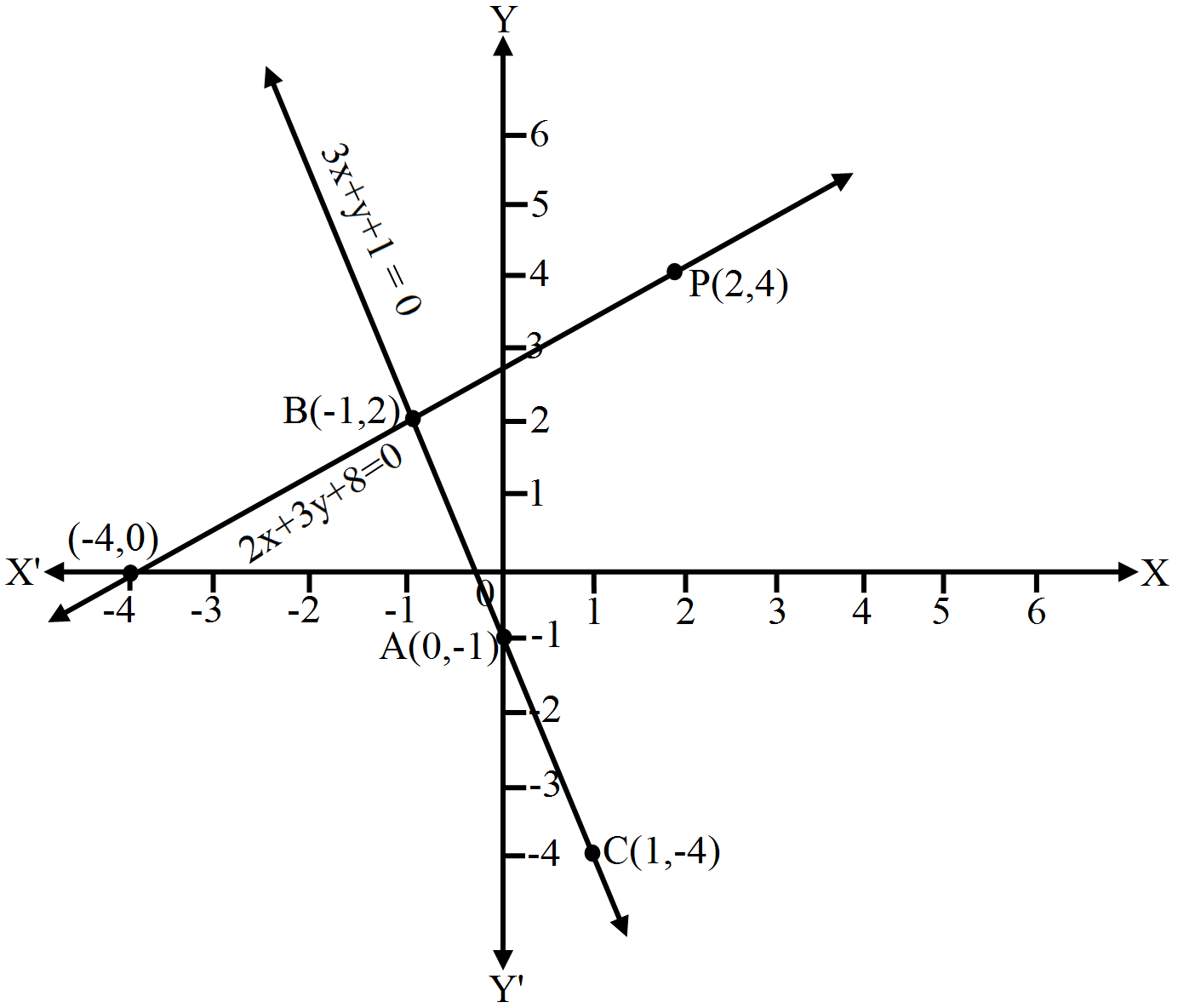
The two graph lines intersect at B(-1, 2). $\therefore$ x = -1, y = 2 is the solution of the given system of equations. View full question & answer→Question 415 Marks
Solve each of the following given systems of equations graphically and find the vertices and area of the triangle formed by these lines and the y-axis:
4x - y - 4 = 0, 3x + 2y - 14 = 0
Answer$4\text{x}-\text{y}-4 = 0$ $\Rightarrow\text{y}=\text{4x}-4$
$3\text{x} + 2\text{y} -14 = 0$ $\Rightarrow\text{y}=\frac{14-\text{3x}}{2}$
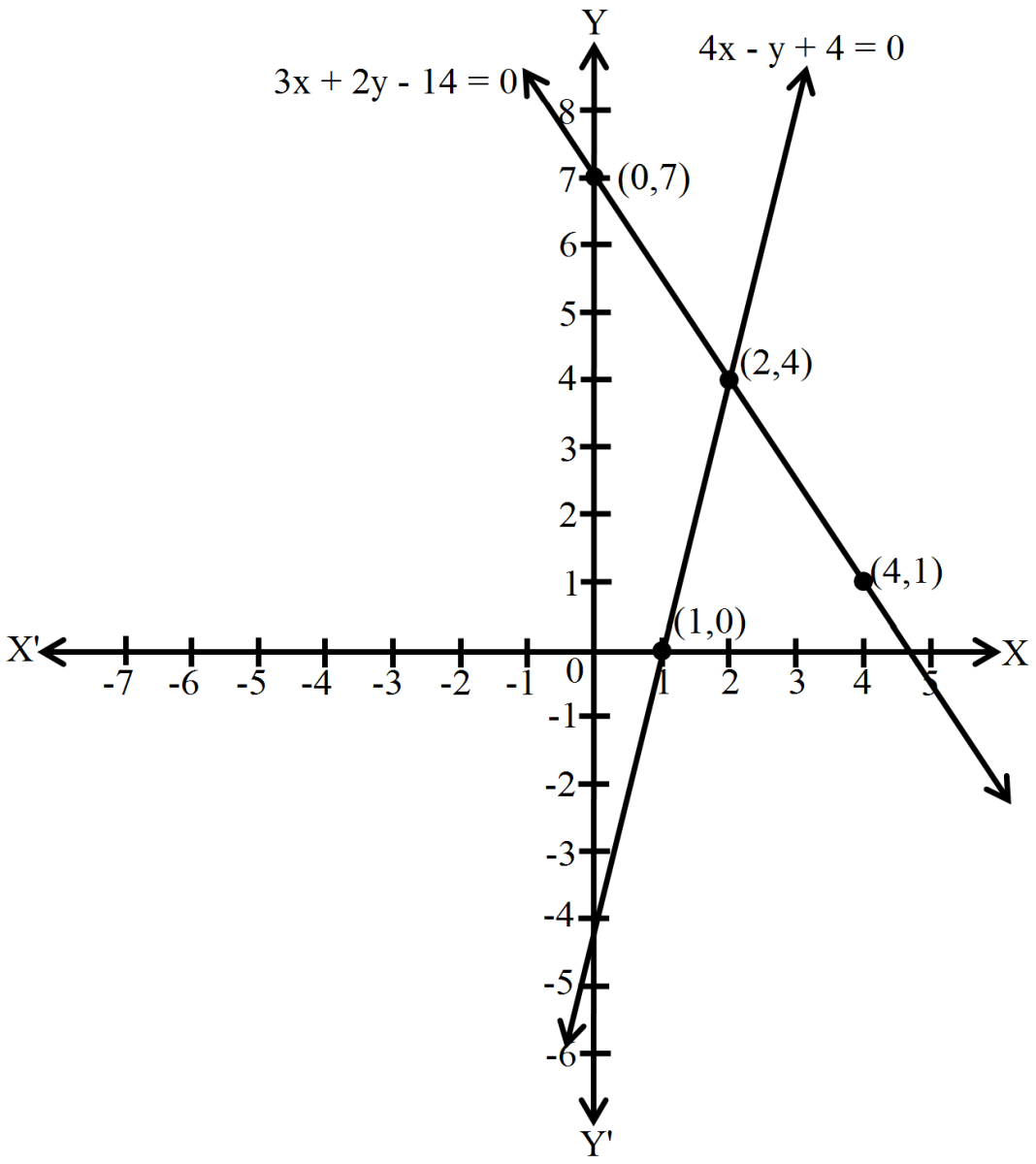
Since the two graph intersect at (2, 4), x = 2 and y = 4 The vertices of the triangle formed by these lines and the y-axis are (2, 4), (0, 7) and (0, -4). So, height of the triangle = distance from (2, 4) to y-axis = 2 units Base = 11 units Area of triangle $=\frac{1}{2}\times$ base × height $=\frac{1}{2}\times11\times2$ $=11\ \text{sq. units}$ View full question & answer→Question 425 Marks
Solve for x and y:
4x + 6y = 3xy,
8x + 9y = 5xy $(\text{x}\neq0,\ \text{y}\neq0).$
Answer$\text{4x}+\text{6y}=\text{3xy}$ $\Rightarrow\frac{\text{4x}+\text{6y}}{\text{xy}}=3$ $\frac{4}{\text{y}}+\frac{6}{\text{x}}=3\ \dots(1)$ $\Rightarrow\frac{\text{8x}+\text{9y}}{\text{xy}}=5$ $\frac{8}{\text{y}}+\frac{9}{\text{x}}=4\ \dots(2)$ Putting $\frac{1}{\text{x}}=\text{u}$ and $\frac{1}{\text{y}}=\text{v}$ in (1) and (2), we get 4v + 6u = 3 ...(3) 8v + 9u = 5 ...(4)Multiplying (3) by 9 and (4) by 6, we get
36v + 54u = 27 ...(5)
48v + 54u = 30 ...(6)
Subtracting (3) from (4), we get
$\text{12v}=3$ $ \text{v}=\frac{3}{12}=\frac{1}{4}$Putting $\text{v}=\frac{1}{4}$ in (3), we get
$4\times\frac{1}{4}+\text{6u}=3$ $1+\text{6u}=3 $ $\text{6u}=3-1=2$ $\text{u}=\frac{2}{6}=\frac{1}{3}$Now, $\text{u}=\frac{1}{\text{x}}$
$\Rightarrow\frac{1}{\text{x}}=\frac{1}{3}$ $\Rightarrow\text{x}=3$and $\text{v}=\frac{1}{\text{y}}$
$\Rightarrow\frac{1}{\text{y}}=\frac{1}{4}$ $\Rightarrow\text{y}=4$$\therefore$ the solution is x = 3, y = 4
View full question & answer→Question 435 Marks
Solve each of the following given systems of equations graphically and find the vertices and area of the triangle formed by these lines and the y-axis:
5x - y - 7 = 0, x - y + 1 = 0
Answer5x - y - 7 = 0 ⇒ y = 5x - 7
x - y + 1 = 0 ⇒ y = x + 1
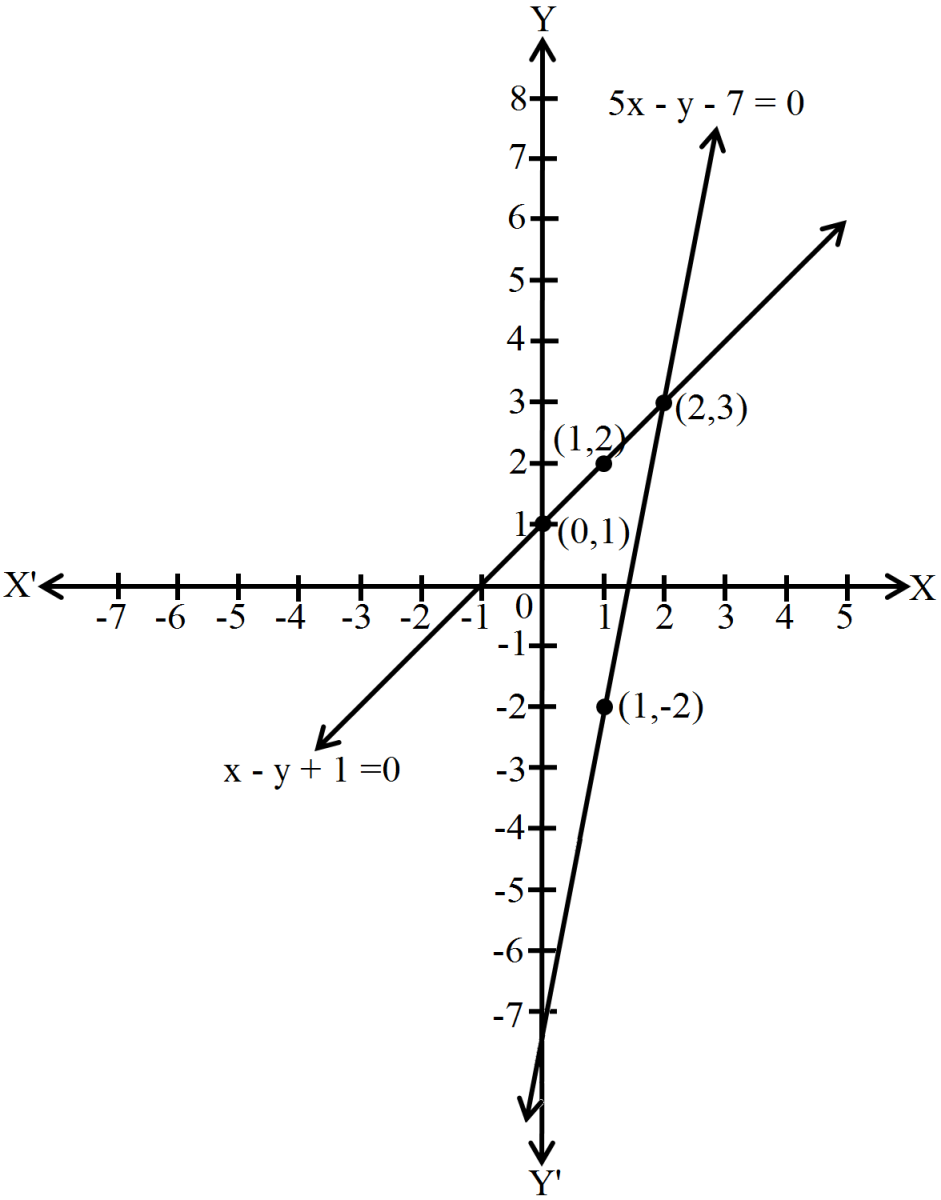
Since the two graph intersect at (2, 3), x = 2 and y = 3 The vertices of the triangle formed by these lines and the y-axis are (2, 3), (0, 1) and (0, -7). So, height of the triangle = distance from (2, 3) to y-axis = 2 units Base = 8 units Area of triangle $=\frac{1}{2}\times$ base × height $=\frac{1}{2}\times8\times2$ $=8\ \text{sq. units}$ View full question & answer→Question 445 Marks
2 men and 5 boys can finish a piece of work in 4 days, while 3 men and 6 boys can finish it in 3 days. Find the time taken by one man alone to finish the work and that taken by one boy alone to finish the work.
AnswerLet man's 1 day's work be $\frac{1}{\text{x}}$ and 1 boy's day's work be $\frac{1}{\text{y}}$ Also let $\frac{1}{\text{x}}=\text{u}$ and $\frac{1}{\text{y}}=\text{v}$ Then, $\frac{2}{\text{x}}+\frac{5}{\text{y}}=\frac{1}{4}$ $\Rightarrow\text{2u}+\text{5v}=\frac{1}{4}\ \dots(1)$ and $\frac{3}{\text{x}}+\frac{6}{\text{y}}=\frac{1}{3}$ $\Rightarrow\text{3u}+\text{6v}=\frac{1}{3}\ \dots(2)$ Multiplying (1) by 6 and (2) by 5, we get $12\text{u}+\text{30v}=\frac{6}{4}\ \dots(3)$ $15\text{u}+\text{30v}=\frac{5}{3}\ \dots(4)$ Subtracting (3) from (4), we get $\text{3u}=\frac{5}{3}-\frac{6}{4}$ $\Rightarrow\text{3u}=\frac{20-18}{12}$ $\Rightarrow\text{3u}=\frac{2}{12}$ $\Rightarrow\text{3u}=\frac{1}{6}$ $\Rightarrow\text{u}=\frac{1}{18}$ Putting $\text{u}=\frac{1}{18}$ in (1), we get $2\times\frac{1}{18}+\text{5v}=\frac{1}{4}$ $\Rightarrow\frac{1}{9}+\text{5v}=\frac{1}{4}$ $\Rightarrow\text{5v}=\frac{1}{4}-\frac{1}{9}$ $\Rightarrow\text{5v}=\frac{5}{36}$ $\Rightarrow\text{v}=\frac{1}{36}$Now, $\text{u}=\frac{1}{18}$
$\Rightarrow\text{x}=\frac{1}{\text{u}}=18$and $\text{v}=\frac{1}{36}$
$\Rightarrow\text{y}=\frac{1}{\text{v}}=36$$\therefore$ x = 18, y = 36
The man will finish the work in 18 days and the boy will finish the work in 36 days when they work alone.
View full question & answer→Question 455 Marks
Solve each of the following given systems of equations graphically and find the vertices and area of the triangle formed by these lines and the x-axis:
x - y + 1 = 0, 3x + 2y - 12 = 0
AnswerOn a graph paper, draw a horizontal line X'OX and a vertical line YOY' representing the x-axis and y-axis, respectively. The given system equations is x - y + 1 = 0, 3x + 2y - 12 = 0 Graph of x - y + 1 = 0: x - y + 1 = 0 y = x + 1 ...(1) Thus, we have the following table for equation (1)
On the graph paper plot the points A(-1, 0), B(1, 2) and C(2, 3). Join AB and BC to get the graph line AC. Thus, the line AC is the graph of the equation of x - y + 1 = 0. Graph of 3x + 2y - 12 = 0: For graph of 3x + 2y - 12 = 0 $\Rightarrow\text{y}=\frac{-\text{3x}+12}{2}\ \dots(2)$ Thus, we have the following table for equation (2)
Now, on the same graph paper plot the points P(0, 6) and Q(4, 0). The third point C(2, 3) has already been plotted. Join PC and CQ to get the line PQ. Thus, line PQ is the graph of the equation 3x + 2y - 12 = 0.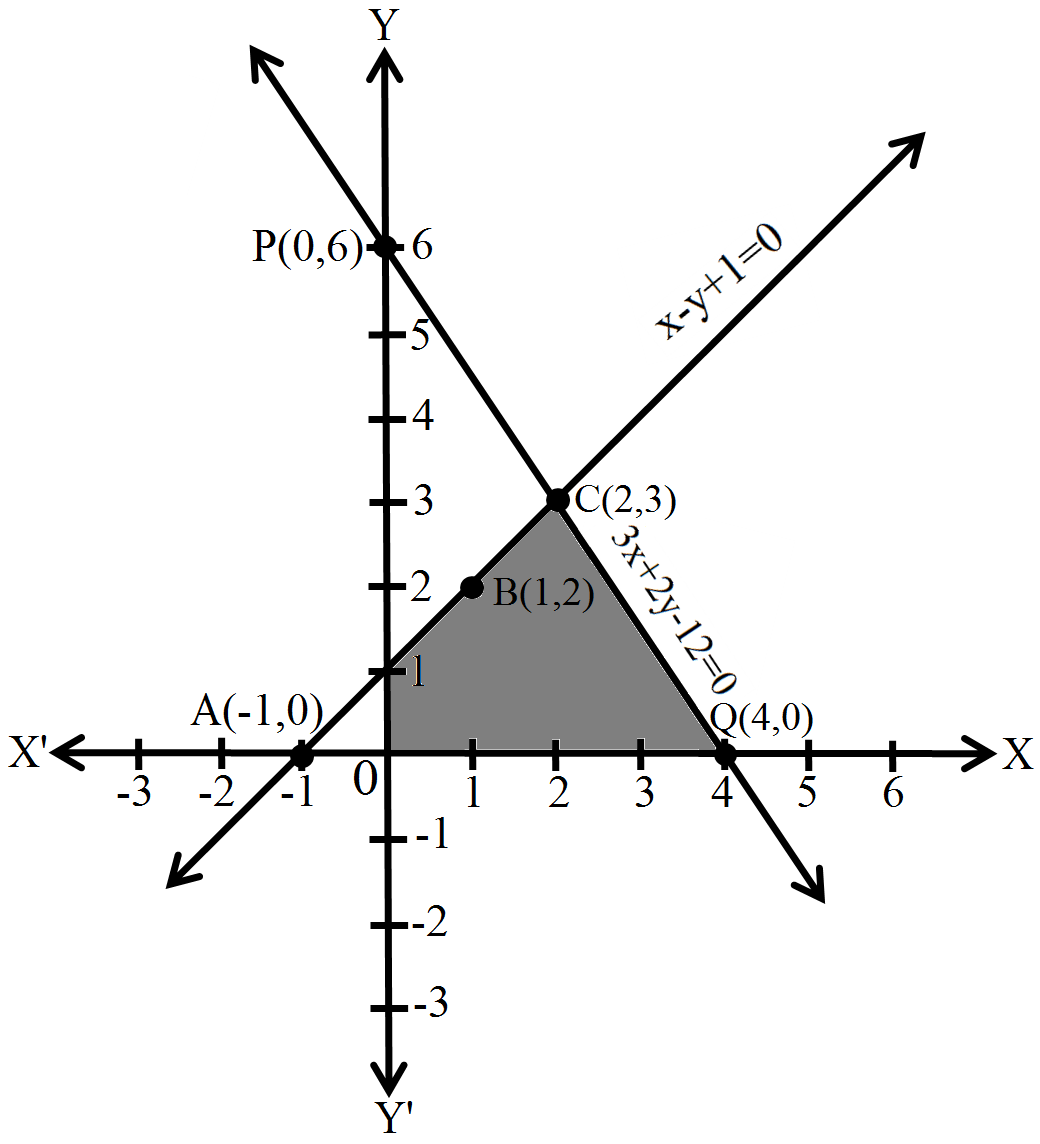
The two graph lines intersect at C(2, 3). $\therefore$ x = 2, y = 3 is the solution of the given system of equations. Clearly, the vertices of $\triangle\text{ACQ}$ formed by these lines and the x-axis are A(-1, 0), C(2, 3) and Q(4, 0) Consider the triangle $\triangle\text{ACQ}:$ Height of the triangle = 3 units and base (AQ) = 5 units Area of triangle $\triangle\text{ACQ}:$ Area of $\triangle\text{ACQ}=\Big(\frac{1}{2}\times\text{Base}\times\text{height}\Big)$ $$ $=\Big(\frac{1}{2}\times3\times5\Big)\text{sq. units}$ Area of $\triangle\text{ACQ}=7.5\text{sq. }\text{units}$ View full question & answer→Question 465 Marks
The sum of the digits of a two-digit number is 12. The number obtained by interchanging its digits exceeds the given number by 18. Find the number.
AnswerLet the ten's digit be x and units digit be y respectively.
Then,
x + y = 12 ...(1)
$\therefore$ Required number = 10x + y
$\therefore$ Number obtained on reversing digits = 10y + x
According to the question:
10y + x - (10x + y) = 18
10y + x - 10x - y = 18
9y - 9x = 18
y - x = 2 ...(2)
Adding (1) and (2), we get
2y = 14
$\text{y}=\frac{14}{2}$
y = 7
Putting y = 7 in (1), we get
⇒ x + 7 = 12
⇒ x = 5
$\therefore$ Number = 10x + y
= 10 × 5 + 7
= 50 + 7
= 57
Hence, the number is 57.
View full question & answer→Question 475 Marks
Solve for x and y:
23x - 29y = 98,
29x - 23y = 110
AnswerThe given equations are: 23x - 29y = 98 ...(i) 29x - 23y = 110 ...(ii) Adding (i) and (ii), we get 52x + 52y = 208 ⇒ x + y = 4 ...(iii) Subtract (i) from (ii), we get 6x - 6y = 12 ⇒ x - y = 2 ...(iv) Adding (iii) and (iv), we get 2x = 6 ⇒ x = 3 Substituting x = 3 in (iii), we get y = 1Hence, x = 3 and y = 1
View full question & answer→Question 485 Marks
Show graphically that each of the following given systems of equations is inconsistent, i.e., has no solutions:
2x + y = 6, 6x + 3y = 20
Answer$2\text{x}+\text{y}=6$ $\Rightarrow\text{y}=6-\text{2x}$
$\text{6x}+\text{3y}=20$ $\Rightarrow\text{y}=\frac{20-\text{6x}}{3}$
| x: |
0 |
$\frac{10}{3}$ |
| y: |
$\frac{20}{3}$ |
0 |
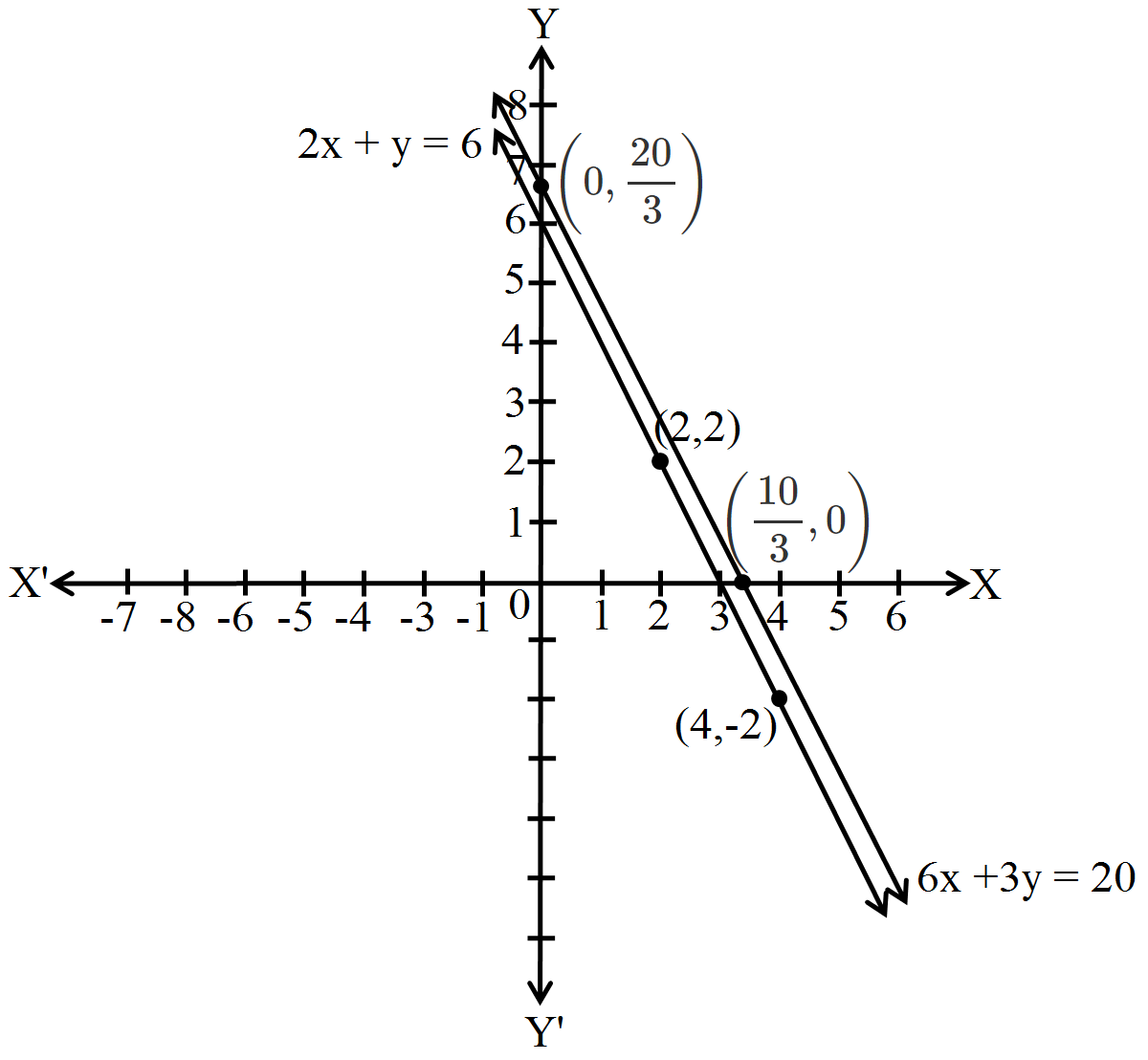
Since the two graph of the system of equations is parallel lines, the system has no solution and hence is inconsistent. View full question & answer→Question 495 Marks
Solve each of the following given systems of equations graphically and find the vertices and area of the triangle formed by these lines and the x-axis:
2x - 3y + 4 = 0, x + 2y - 5 = 0
Answer$2\text{x}-3\text{y}+ 4 = 0$ $\Rightarrow\text{y}=\frac{\text{2x}+4}{3}$
$\text{x} + 2\text{y} - 5 = 0$ $\Rightarrow\text{y}=\frac{4-\text{2x}}{3}$
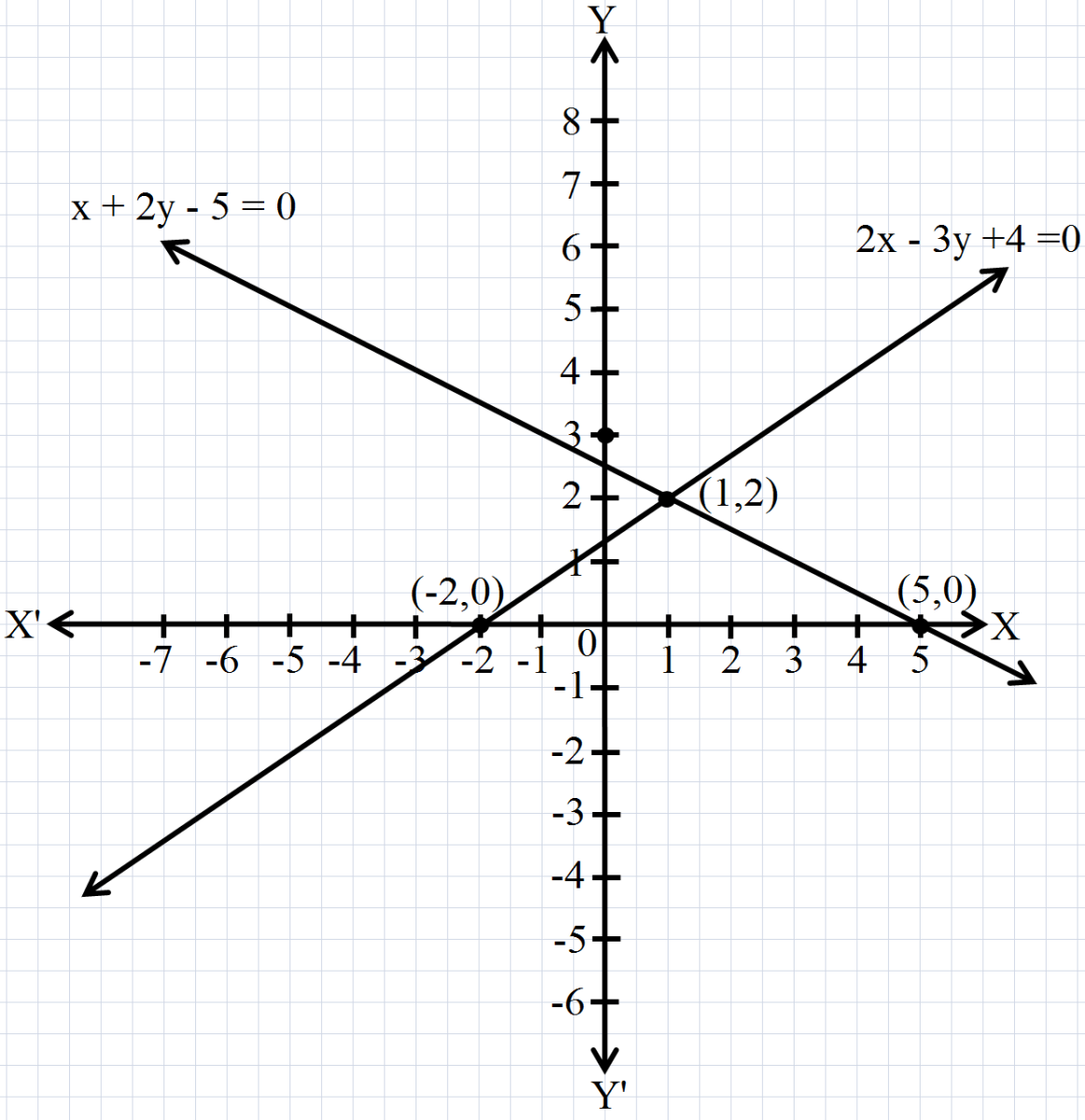
Since the two graph intersect at (1, 2), x = 1 and y = 2 The vertices of the triangle formed by these lines and the x-axis are (-2, 0), (1, 2) and (5, 0). So, height of the triangle = distance from (1, 2) to x-axis = 2 units Base = 7 units Area of triangle $=\frac{1}{2}\times$ base × height $=\frac{1}{2}\times7\times2$ $=7\ \text{sq. units}$ View full question & answer→Question 505 Marks
The sum of two numbers is 137 and their difference is 43. Find the numbers.
AnswerLet the two numbers be x and y respectively.
Given:
x + y = 137 ...(i)
x - y = 43 ...(ii)
Adding (i) and (ii), we get
2x = 180
$\text{x}=\frac{180}{2}=90$
Putting x = 90 in (i), we get
90 + y = 137
y = 137 - 90
y = 47
Hence, the two numbers are 90 and 47.
View full question & answer→