Question 515 Marks
Solve for x and y:
$\frac{1}{\text{2x}}+\frac{1}{\text{3y}}=2,$
$\frac{1}{\text{3x}}+\frac{1}{\text{2y}}=\frac{13}{6}$ $(\text{x}\neq0,\ \text{y}\neq0).$
Answer$\frac{1}{\text{2x}}+\frac{1}{\text{3y}}=2,$ $\frac{1}{\text{3x}}+\frac{1}{\text{2y}}=\frac{13}{6}$ Putting $\frac{1}{\text{x}}=\text{u}$ and $\frac{1}{\text{y}}=\text{v}$ the given equations become $\frac{1}{2}\text{u}+\frac{1}{3}\text{v}=2$ and $\frac{1}{3}\text{u}+\frac{1}{2}\text{v}=\frac{13}{6}$ $\Rightarrow\text{3u}+\text{2v}=12\ \dots(\text{i})$ and $\text{2u}+\text{3v}=13\ \dots(\text{ii})$Multiplying (i) by 3 and (ii) by 2, we get
v = 3
$\Rightarrow\frac{1}{\text{x}}=2$ and $\Rightarrow\frac{1}{\text{y}}=3$ $\Rightarrow\text{x}=\frac{1}{2}$ and $\Rightarrow\text{y}=\frac{1}{3}$
View full question & answer→Question 525 Marks
If 2 is added to each of two given numbers, their ratio becomes 1 : 2. However, if 4 is subtracted from each of the given numbers, the ratio becomes 5 : 11. Find the numbers.
AnswerLet the required numbers be x and y respectively.
Then,
$\frac{\text{x}+2}{\text{y}+2}=\frac{1}{2}$
$\Rightarrow2\text{x}+4=\text{y}+2$
$\Rightarrow2\text{x}-\text{y}=-2$
$\frac{\text{x}-4}{\text{y}-4}=\frac{5}{11}$
$\Rightarrow11\text{x}-44=5\text{y}-20$
$\Rightarrow11\text{x}-5\text{y}=24$
Therefore,
2x - y = 2 ...(1)
11x - 5y = 24 ...(2)
Multiplying (1) by 5 and (2) by 1
10x - 5y = -10 ...(3)
11x - 5y = 24 ...(4)
Subtracting (3) and (4),
We get:
x = 34
Putting x = 34 in (1), we get
2 × 34 - y = -2
⇒ 68 - y = -2
⇒ -y = -2 - 68
⇒ y = 70
Hence, the required numbers are 34 and 70.
View full question & answer→Question 535 Marks
There are two classrooms A and B. If 10 students are sent from A to B, the number of students in each room becomes the same. If 20 students are sent from B to A, the number of students in A becomes double the number of students in B. Find the number of students in each room.
AnswerLet the number of student in class room A and B be x and y respectively.
When 10 students are transferred from A to B:
x - 10 = y + 10
x - y = 20 ...(1)
When 20 students are transferred from B to A:
2(y - 20) = x + 20
⇒ 2y - 40 = x + 20
⇒ -x + 2y = 60 ...(2)
Adding (1) and (2), we get
⇒ y = 80
Putting y = 80 in (1), we get
⇒ x - 80 = 20
⇒ x = 100
Hence, number of students of A and B are 100 and 80 respectively.
View full question & answer→Question 545 Marks
Solve the following system of equations graphically:
2x + 3y = 8,
x - 2y + 3 = 0
AnswerOn a graph paper, draw a horizontal line X'OX and a vertical line YOY' representing the x-axis and y-axis, respectively. Given equations are 2x + 3y = 8 and x - 2y + 3 = 0 Graph of 2x + 3y = 8: 2x + 3y = 8 $\Rightarrow\text{y}=\frac{8-\text{2x}}{3}\ \dots(1)$ Thus we have the following table for 2x + 3y = 8
On the graph paper plot the points A(1, 2), B(-5, 6) and C(7, -2). Join AB and AC to get the graph line BC. Thus, the line AC is the equation of 2x + 3y = 8. Graph of x - 2y + 3 = 0: For graph of x - 2y + 3 = 0 $\Rightarrow\text{y}=\frac{\text{x}+3}{2}\ \dots(2)$ Thus, we have the following table for x - 2y + 3 = 0
Now, on the same graph paper plot the points P(3, 3) and Q(-3, 0). The point A(1, 2) has already been plotted. Join PA and QA to get the line PQ. Thus, line PQ is the graph of the equation x - 2y + 3 = 0.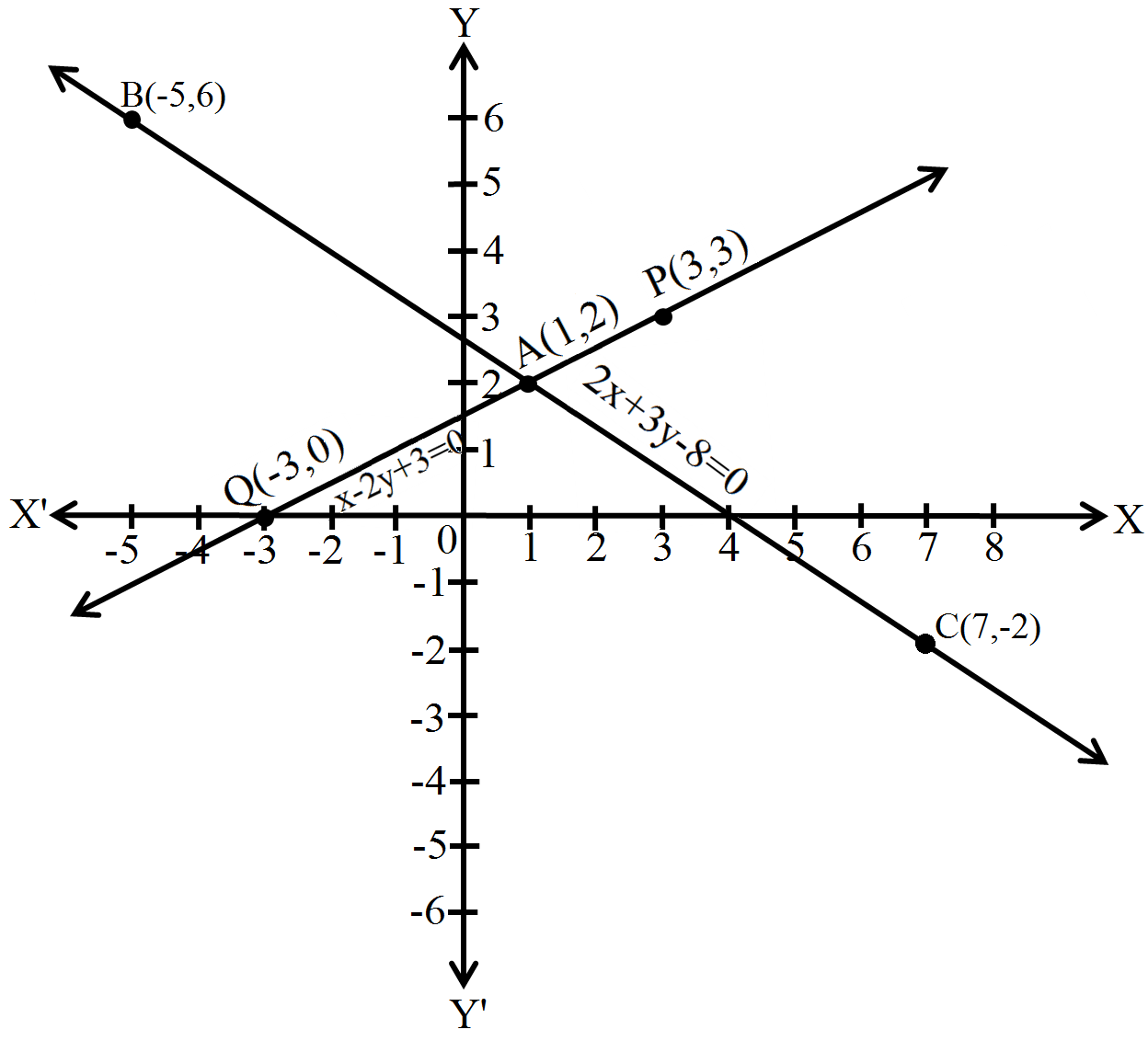
The two graph lines intersect at A(1, 2). $\therefore$ x = 1, y = -2 is the solution of the given system of equations. View full question & answer→Question 555 Marks
Solve for x and y:
$\frac{5}{\text{x}+\text{1}}-\frac{2}{\text{x}-\text{1}}=\frac{1}{2}$
$\frac{10}{\text{x}+\text{1}}+\frac{2}{\text{y}-\text{1}}=\frac{5}{2}$
AnswerThe given equations are: $\frac{5}{\text{x}+\text{1}}-\frac{2}{\text{x}-\text{1}}=\frac{1}{2}$ and $\frac{10}{\text{x}+\text{1}}+\frac{2}{\text{y}-\text{1}}=\frac{5}{2}$ Putting $\frac{1}{\text{x}+\text{1}}=\text{u}$ and $\frac{1}{\text{y}-\text{1}}=\text{v}$ $\text{5u}-\text{2v}=\frac{1}{2}\ \dots(1)$ $\text{10u}+\text{2v}=\frac{5}2{}\ \dots(2)$ Adding (1) and (2)$\text{15u}=\frac{1}{2}+\frac{5}{2}=\frac{5+1}{2}=3$
$\therefore\text{u}=\frac{3}{15}=\frac{1}{5}=\frac{1}{\text{x}+1}$
$\therefore\text{x}+1=5$ or $\text{x}=4$
Putting value of u in (1)$5\times\frac{1}{5}-\text{2v}=\frac{1}{2}$ or $-\text{2v}=\frac{1}{2}-1=-\frac{1}2{}$
$\therefore\text{v}=\frac{1}{4}=\frac{1}{\text{y}-1}$ or y - 1 = 4 or y = 5
Hence the required solution is x = 4 and y = 5
View full question & answer→Question 565 Marks
Solve the following system of equations graphically:
2x + 3y = 2,
x - 2y = 8
AnswerOn a graph paper, draw a horizontal line X'OX and a vertical line YOY' representing the x-axis and y-axis, respectively.
Graph of 2x + 3y = 2:
$\text{y}=\frac{2(1-\text{x})}{3}$
Putting x = 1, we get y = 0
Putting x = -2, we get y = 2
Putting x = 4, we get y = -2
$\therefore$ Table for 2x + 3y = 2 is
Plot the points A(1, 0), B(-2, 2) and C(4, -2) on the graph paper.
Join AB and AC to get the graph line BC.
Extend it on both ways.
Thus, the line BC is the graph of x + 3y = 2.
Graph of x - 2y = 8:
$\text{y}=\frac{\text{x}-8}{2}$
Putting x = 2, we get y = -3
Putting x = 4, we get y = -2
Putting x = 0, we get y = -4
Table for x - 2y = 8 is
Now, on the same graph paper plot the points P(0, -4) and Q(2, -3). The point C(4, -2) has already been plotted.
Join PQ and QC and extend it on both ways.
Thus, line PC is the graph of x - 2y = 8.
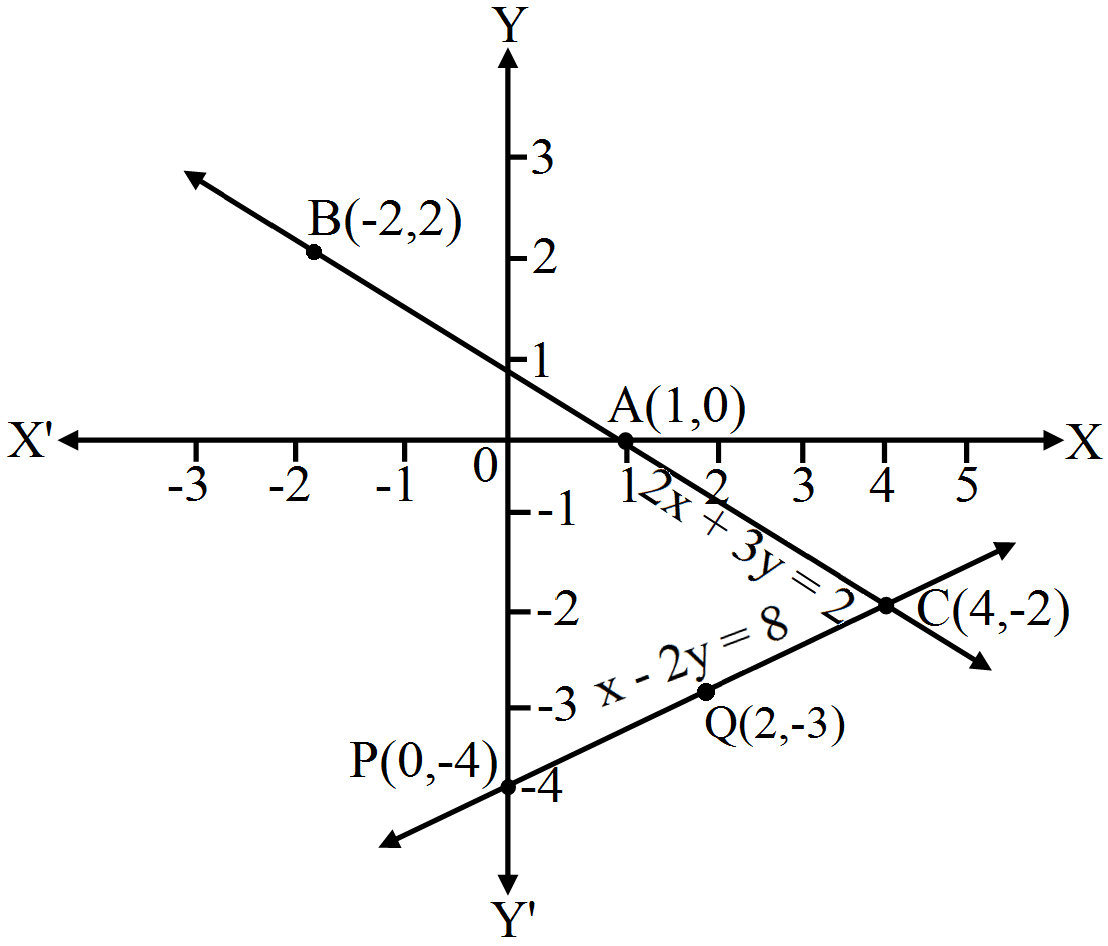
The two graph lines intersect at C(4, -2).
$\therefore$ x = 4, y = -2 is the solution of the given system of equations. View full question & answer→Question 575 Marks
The present age of a woman is 3 years more than three times the ages of her daughter. Three years hence, the woman's age will be 10 years more than twice the age of her daughter. Find their present ages.
AnswerLet the present ages of woman and daughter be x and y respectively.
Then,
Their present ages:
x = 3y + 3
⇒ x - 3y = 3 ...(1)
Three years later:
(x + 3) = 2(y + 3) + 10
⇒ x + 3 = 2y + 6 + 10
⇒ x - 2y = 13 ...(2)
Subtracting (2) from (1), we get
⇒ y = 10
Putting y = 10 in (1), we get
x - 3 × 10 = 3
⇒ x = 33
$\therefore$ x = 33, y = 10
Hence, present ages of woman and daughter are 33 and 10 years.
View full question & answer→Question 585 Marks
Solve the following systems of equations by using the method of cross multiplication:
$\frac{5}{(\text{x}+\text{y})}-\frac{2}{(\text{x}-\text{y})}+1=0,$
$\frac{15}{(\text{x}+\text{y})}+\frac{7}{(\text{x}-\text{y})}-10=0$ $(\text{x}\neq\text{y},\ \text{x}\neq-\text{y}).$
AnswerTaking $\frac{1}{x+y}=u$ and $\frac{1}{x-y}=v$, the given equations become: $5 u-2 v+1=0 \ldots$ (i) $15 u+7 v-10=0 \ldots$ (ii) Here, $a_1=5$, $b_1=-2, c_1=1, a_2=15, b_2=-7$ and $c_2=-10$ By cross multiplication, we have:
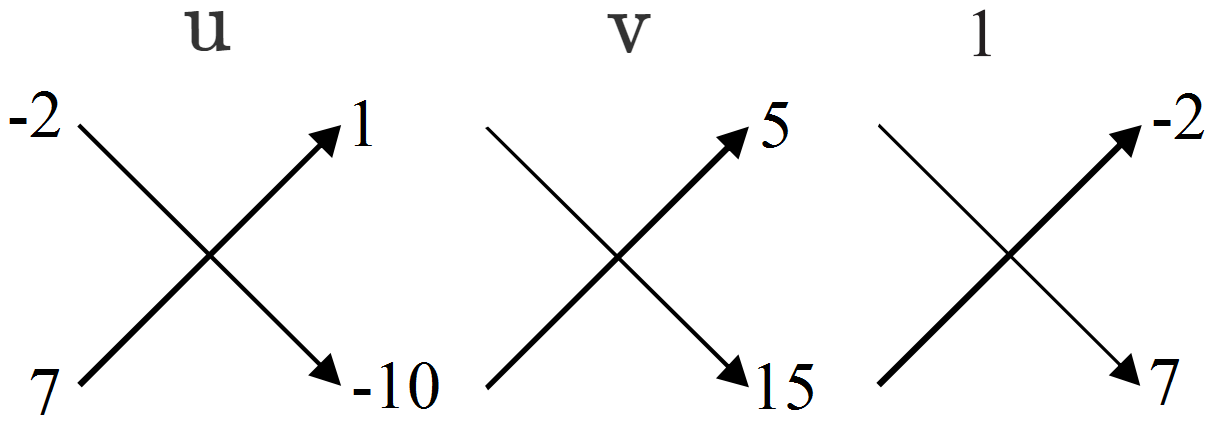
$\therefore\frac{\text{u}}{[-2\times(-10)-1\times7]}=\frac{\text{v}}{[1\times15-(-10)\times5]}=\frac{1}{[35+30]}$ $\Rightarrow\frac{\text{u}}{20-7}=\frac{\text{v}}{15+50}=\frac{1}{65}$
$\Rightarrow\frac{\text{u}}{13}=\frac{\text{v}}{65}=\frac{1}{65}$
$\Rightarrow\text{u}=\frac{13}{65}=\frac{1}{5},\ \text{v}=\frac{65}{65}=1$
$\Rightarrow\frac{1}{\text{x}+\text{y}}=\frac{1}{5},\ \frac{1}{\text{x}-\text{y}}=1$
So, (x + y) = 5 ...(iii) and (x - y) = 1 ...(iv) Again,
the above equations (iii) and (iv) may be written as: x + y - 5 = 0 ...(v) x - y - 1 = 0 ...(vi)
Here, $a_1 = 1, b_1 = 1, c_1 = -5, a_2 = 1, b_2 = -1$ and $c_2 = -1$ By cross multiplication, we have: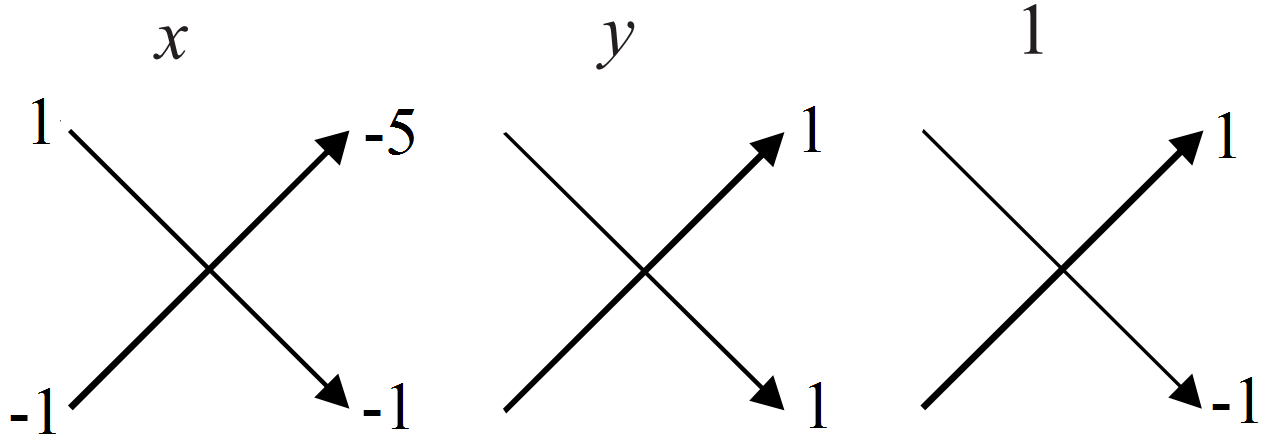
$\therefore\frac{\text{x}}{[1\times(-1)-(-5)\times(-1)]}=\frac{\text{y}}{(-5)\times1-(-1)\times1}=\frac{1}{[1\times(-1)-1\times1]}$ $\Rightarrow\frac{\text{x}}{(-1-5)}=\frac{\text{y}}{(-5+1)}=\frac{1}{(-1-1)}$ $\Rightarrow\frac{\text{x}}{-6}=\frac{\text{y}}{-4}=\frac{1}{-2}$ $\Rightarrow\text{u}=\frac{-6}{-2}=3,\ \text{y}=\frac{-4}{-2}=2$ Hence, x = 3 and y = 2 is the required solution. View full question & answer→Question 595 Marks
Abdul travelled 300km by train and 200km by taxi taking 5 hours 30 minutes. But, if he travels 260km by train and 240km by taxi, he takes 6 minutes longer. Find the speed of the train and that of the taxi.
AnswerLet the speeds of the train and taxi be x km/h and y km/h respectively.
Then, time taken to cover 300km by the train $=\frac{300}{\text{x}}\ \text{hours}$
and time taken to cover 200km by the taxi $=\frac{200}{\text{y}}\ \text{hours}$
Total time taken $=5\frac{30}{60}\ \text{hours}=5\frac{1}{2}\ \text{hours}=\frac{11}{2}\ \text{hours}$
$\therefore\frac{300}{\text{x}}+\frac{200}{\text{y}}=\frac{11}{2}$
$\Rightarrow\frac{600}{\text{x}}+\frac{400}{\text{y}}=11$
Put $\frac{1}{\text{x}}=\text{u}$ and $\frac{1}{\text{y}}=\text{v}$
⇒ 600u + 400v = 11 ...(i)
Again, time taken to cover 260km by the train $=\frac{260}{\text{x}}\ \text{hours}$
and time taken to cover 240km by the taxi $=\frac{240}{\text{y}}\ \text{hours}$
Total time taken $=5\frac{36}{60}\ \text{hours}=5\frac{3}{5}\ \text{hours}=\frac{28}{5}\ \text{hours}$
⇒ 1300u + 1200v = 28 ...(ii)
Multiplying (i) by 3 and subtracting (ii) from it, we get
500u = 5
$\Rightarrow\text{u}=\frac{5}{500}$
$\Rightarrow\text{u}=\frac{1}{100}$
Substituting $\text{u}=\frac{1}{100}$ in (i), we get $\text{v}=\frac{1}{80}$
Now,
$\text{u}=\frac{1}{100}$
$\Rightarrow\frac{1}{\text{x}}=\frac{1}{100}$
$\Rightarrow\text{x}=100$
$\text{v}=\frac{1}{80}$
$\Rightarrow\frac{1}{\text{y}}=\frac{1}{80}$
$\Rightarrow\text{y}=80$
$\therefore$ Speed of the train = 100km/hr
and speed of the taxi = 80km/hr
View full question & answer→Question 605 Marks
A part of monthly hostel charges in a college hostel are fixed and the remaining depends on the number of days one has taken food in the mess. When a student A takes food for 25 days, he has to pay ₹ 4500, whereas a student B who takes food for 30 days, he has to pay ₹ 5200. Find the fixed charges per month and the cost of the food per day.
AnswerLet the fixed charges be ₹ x and other charges be ₹ y per km.
According to the given condition,
x + 25y = 4500 ...(i)
x + 30y = 5200 ...(ii)
Subtracting (i) from (ii), we get
5y = 700
⇒ y = 140
Substituting y = 140 in (i), we get
x = 1000.
Hence, the fixed charges is ₹ 1000 and the cost of food per day is ₹ 140
View full question & answer→Question 615 Marks
Solve for x and y:
$\frac{2}{(3\text{x}+\text{2y)}}+\frac{3}{(3\text{x}-\text{2y)}}=\frac{17}{5},$
$\frac{5}{(3\text{x}+\text{2y)}}+\frac{1}{(3\text{x}-\text{2y)}}=2$
Answer$\frac{2}{(3\text{x}+\text{2y)}}+\frac{3}{(3\text{x}-\text{2y)}}=\frac{17}{5},$ $\frac{5}{(3\text{x}+\text{2y)}}+\frac{1}{(3\text{x}-\text{2y)}}=2$ Putting $\frac{1}{\text{3x}+\text{2y}}=\text{u}$ and $\frac{1}{\text{3x}-\text{2y}}=\text{v}$ so, we get $\text{2u}+\text{3v}=\frac{17}{5}\ \dots(\text{i})$and $\text{5u}+\text{v}=2\ \dots(\text{ii})$ Multiplying (ii) by 3 and subtract it from (i). $\Rightarrow\text{15u}+\text{3v}=6$ and $\text{2u}+\text{3v}=\frac{17}{5}$ $\Rightarrow-13\text{u}=\frac{17}{5}-6$ $\Rightarrow-13\text{u}=-\frac{13}{5}$ $\Rightarrow\text{u}=\frac{1}{5}$ Substituting $\text{u}=\frac{1}{5}$ in (i), we get v = 1 $\Rightarrow\frac{1}{\text{3x}+\text{2y}}=\frac{1}{5}$ and $\frac{1}{\text{3x}-\text{2y}}=1$ $\Rightarrow\text{3x}+\text{2y}=5\ \dots(\text{iii})$ and $\text{3x}-\text{2y}=1\ \dots(\text{iv})$ Adding (iii) and (iv), we get 6x = 6 x = 1 Substituting x = 1 in (iii), we get y = 1Hence, x = 1 and y = 1
View full question & answer→Question 625 Marks
If 45 is subtracted from twice the greater of two numbers, it result in the other number. If 21 is subtracted from twice the smaller number, it results in the greater number. Find the numbers.
AnswerLet the greater number be x and y resoectively.
According to the question:
2x - 45 = y
⇒ 2x - y = 45 ...(1)
and
2y - x = 21
⇒ -x + 2y = 21 ...(2)
Multiplying (1) by 2 and (2) by 1
4x - 2y = 90 ...(3)
-x + 2y = 21 ...(4)
Adding (3) and (4), we get
3x = 111
$\Rightarrow\text{x}=\frac{111}{3}=37$
Putting x = 37 in (1), we get
2 × 37 - y = 45
⇒ 74 - y = 45
⇒ y = 29
Hence, the greater and the smaller numbers are 37 and 29.
View full question & answer→Question 635 Marks
Solve for x and y:$\frac{5}{\text{x}+\text{y}}-\frac{2}{\text{x}-\text{y}}=-1,$
$\frac{15}{\text{x}+\text{y}}+\frac{7}{\text{x}-\text{y}}=10$
Answer$\frac{5}{\text{x}+\text{y}}-\frac{2}{\text{x}-\text{y}}=-1,$$\frac{15}{\text{x}+\text{y}}+\frac{7}{\text{x}-\text{y}}=10$
Put $\frac{1}{\text{x}+\text{y}}=\text{u}$ and $\frac{1}{\text{x}-\text{y}}=\text{v}$
So, we get
5u - 2v = -1 ...(i) and 15u + 7v = 10 ...(ii)
Multiply (i) by 3 and subtract (ii) it from.
⇒ 15u - 6v = -3 and 15u + 7v = 10
⇒ -13v = -13
⇒ v = 1
Substituting v = 1 in (i), we get $\text{u}=\frac{1}{5}$
$\Rightarrow\frac{1}{\text{x}+\text{y}}=\frac{1}{5}$ and $\frac{1}{\text{x}-\text{y}}=1$
⇒ x + y = 5 ...(iii) and x - y = 1 ...(iv)
Adding (iii) and (iv), we get
2x = 6
⇒ x = 3
Substituting x = 3 in (iii), we get y = 2
So, x = 3 and y = 2
View full question & answer→Question 645 Marks
Solve for x and y:
$\frac{\text{bx}}{\text{a}}-\frac{\text{ay}}{\text{b}}+\text{a}+\text{b}=0,$
$\text{bx}-\text{ay}+\text{2ab}=0$
Answer$\frac{b x}{a}-\frac{a x}{b}+a+b=0$
By taking L.C.M., we get
$\frac{b^2 x-a^2 y+a^2 b+b^2 a}{a b}=0$
$b^2 x-a^2 y=-a^2 b-b^2 a $
$b x-a y=-2 a b \ldots . . .(2)$
Multiplying (1) by 1 and (2) by a
$b^2 x-a^2 y=-a^2 b-b^2 a \ldots$
$a b x-a^2 b=-2 a^2 b \ldots(4)$
Subtracting (3) from (4)
$\left(a b-b^2\right) x=-2 a^2 b+a^2 b+a b^2$
$b(a-b) x=-a^2 b+a b^2=-a b(a-b)$
$\therefore x=\frac{-a b(a-b)}{b(a-b)}$
$x=-a$
Putting $x=-a$, in (1), we get
$b^2(-a)-a^2 y=-a^2 b-b^2 a$
$-a b^2-a^2 y=-a^2 b-b^2 a$
$-a^2 y=-a^2 b-b^2 a+a b^2$
$-a^2 y=-a^2 b$
$\Rightarrow y=\frac{-a^2 b}{-a^2}=b$
$\therefore$ solution is $x =- a , y = b$
View full question & answer→Question 655 Marks
Solve the following systems of equations by using the method of cross multiplication:
$6x - 5y - 16 = 0,$
$7x - 13y + 10 = 0$
AnswerThe given equations are: $6x - 5y - 16 = 0 ...(i) 7x - 13y + 10 = 0 ...(ii)$
Here, $a_1 = 6, b_1 = -5, c_1 = -16, a_2 = 7, b_2 = -13$ and $c_2 = 10$ By cross multiplication,
we have:
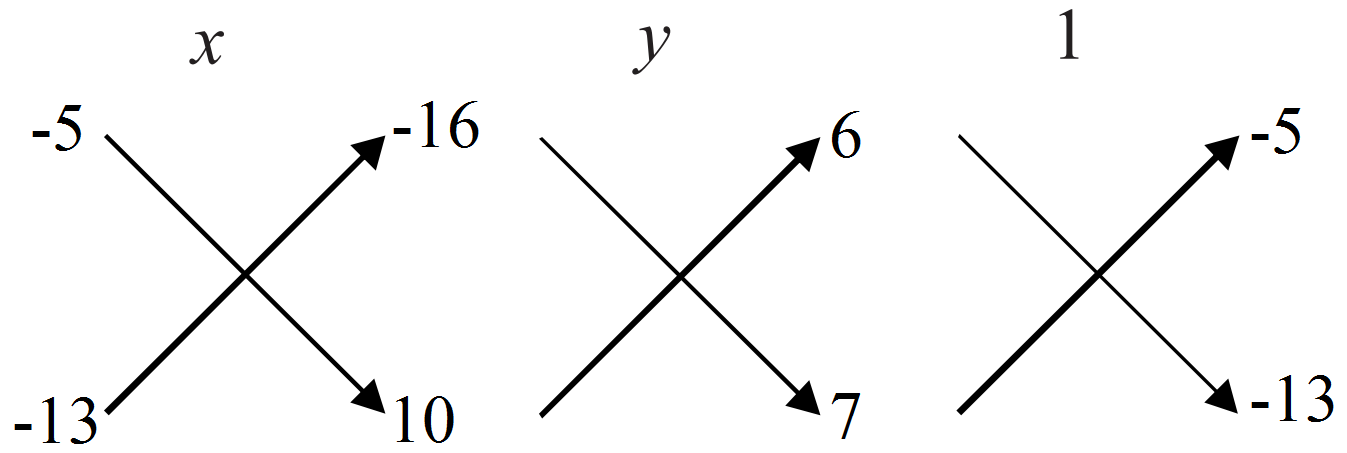
$\therefore\frac{\text{x}}{[(-5)\times10-(-16)\times(-13)]}=\frac{{\text{y}}}{[(-16)\times7-10\times6]}=\frac{1}{[6\times(-13)-(-5)\times7]}$
$\Rightarrow\frac{\text{x}}{(-50-208)}=\frac{\text{y}}{(-112-60)}=\frac{1}{(-78+35)}$
$\Rightarrow\frac{\text{x}}{(-258)}=\frac{\text{y}}{(-172)}=\frac{1}{(-43)}$
$\Rightarrow\text{x}=\frac{-258}{-43}=6,\ \text{y}=\frac{-172}{-43}=4$
Hence, x = 6 and y = 4 is the required solution. View full question & answer→Question 665 Marks
Find two numbers such that the sum of twice the first and thrice the second is 92, and four times the first exceeds seven times the second by 2
AnswerLet the first and second number be x and y respectively.
According to the question:
2x + 3y = 90 ...(i)
4x - 7y = 2 ...(ii)
Multiplying (i) by 7 and (ii) by 3, we get
14x + 21y = 644 ...(iii)
12x + 21y = 6 ...(iv)
Adding (3) and (4), we get
26x = 650
$\Rightarrow\text{x}=\frac{650}{26}=25$
Putting x = 25 in (i),
We get:
2 × 25 + 3y = 92
50 + 3y = 92
⇒ 3y = 92 - 50
$\Rightarrow\text{y}=\frac{42}{3}= 14$
⇒ y = 14
Hence, the first number is 25 and second is 14
View full question & answer→Question 675 Marks
Solve the following systems of equations by using the method of cross multiplication:
$\frac{\text{ax}}{\text{b}}-\frac{\text{by}}{\text{a}}=\text{a}+\text{b},$
$\text{ax}-\text{by}=\text{2ab}$
AnswerThe given equations may be written as: $\frac{\text{ax}}{\text{b}}-\frac{\text{by}}{\text{a}}-(\text{a}+\text{b})=0\ \dots(\text{i})$ $\text{ax}-\text{by}-\text{2ab}=0\ \dots(\text{ii})$
Here, $\text{a}_1=\frac{\text{a}}{\text{b}},\ \text{b}_1=\frac{-\text{b}}{\text{a}},$ $c_1 = -(a + b), a_2 = a, b_2 = -b and c_2 = -2$ab By cross multiplication, we have:
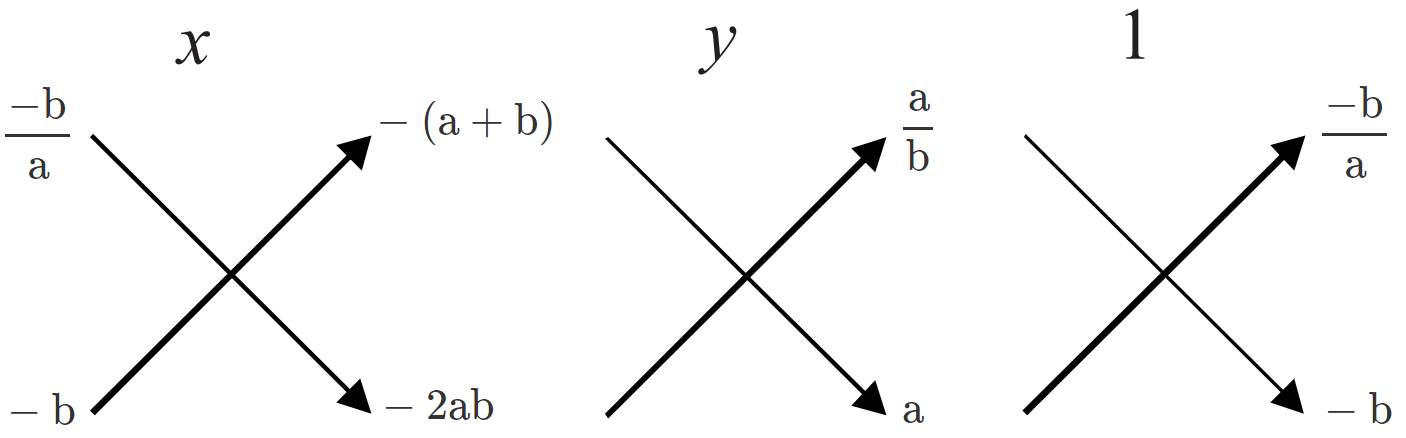
$\therefore\frac{\text{x}}{\big(-\frac{\text{b}}{\text{a}}\big)\times(-\text{2ab})-(-\text{b})\times(-(\text{a}+\text{b}))}=\frac{\text{y}}{-(\text{a}+\text{b})\times\text{a}-(-\text{2ab})\times\frac{\text{a}}{\text{b}}}=\frac{1}{\frac{\text{a}}{\text{b}}\times(-\text{b})-\text{a}\times\big(-\frac{\text{b}}{\text{a}}\big)}$
$\Rightarrow\frac{\text{x}}{\text{2b}^2-\text{b}(\text{a}+\text{b})}=\frac{\text{y}}{-\text{a}(\text{a}+\text{b})+\text{2a}^2}=\frac{1}{-\text{a}+\text{b}}$
$\Rightarrow\frac{\text{x}}{\text{2b}^2-\text{ab}+\text{b}^2}=\frac{\text{y}}{-\text{a}^2-\text{ab}+\text{2a}^2}=\frac{1}{-\text{a}+\text{b}}$ $\Rightarrow\frac{\text{x}}{(\text{b}^2-\text{ab})}=\frac{\text{y}}{(\text{a}^2-\text{ab})}=\frac{1}{-(\text{a}-\text{b})}$
$\Rightarrow\frac{\text{x}}{-\text{b}(\text{a}-\text{b})}=\frac{\text{y}}{\text{a}(\text{a}-\text{b})}=\frac{1}{-(\text{a}-\text{b})}$
$\Rightarrow\text{x}=\frac{-\text{b}(\text{a}-\text{b})}{-(\text{a}-\text{b})}=\text{b},\ \text{y}=\frac{\text{a}(\text{a}-\text{b})}{-(\text{a}-\text{b})}=-\text{a}$
Hence, x = b and y = -a is the required solution. View full question & answer→Question 685 Marks
A lady has only 25-paisa and 50-paisa coins in her purse. If she has 50 coins in all totalling ₹ 19.50, how many coins of each kind does she have?
AnswerLet the number of 25-paisa coins be × and the number of 50-paisa coins be y.
Then, x + y = 50 ...(i)
Since she has a total of ₹ 19.50,
25x + 50y = 19.50(100)
⇒ 25x + 50y = 1950
⇒ x + 2y = 78 ...(ii)
Subracting (i) from (ii), we get
y = 28
Substituting y = 28 in (i), we get
x = 22
So, the number of 25-paisa coins is 22 and the number of 50-paisa coins is 28.
View full question & answer→Question 695 Marks
Solve the following system of equations graphically:
2x + 3y + 5 = 0,
3x - 2y - 12 = 0
Answer$\text{2x}+\text{3y}+5=0$ $\Rightarrow\text{y}=\frac{-5-\text{2x}}{3}$
$\text{3x}-\text{2y}-12=0$ $\Rightarrow\text{y}=\frac{\text{3x}-12}{2}$
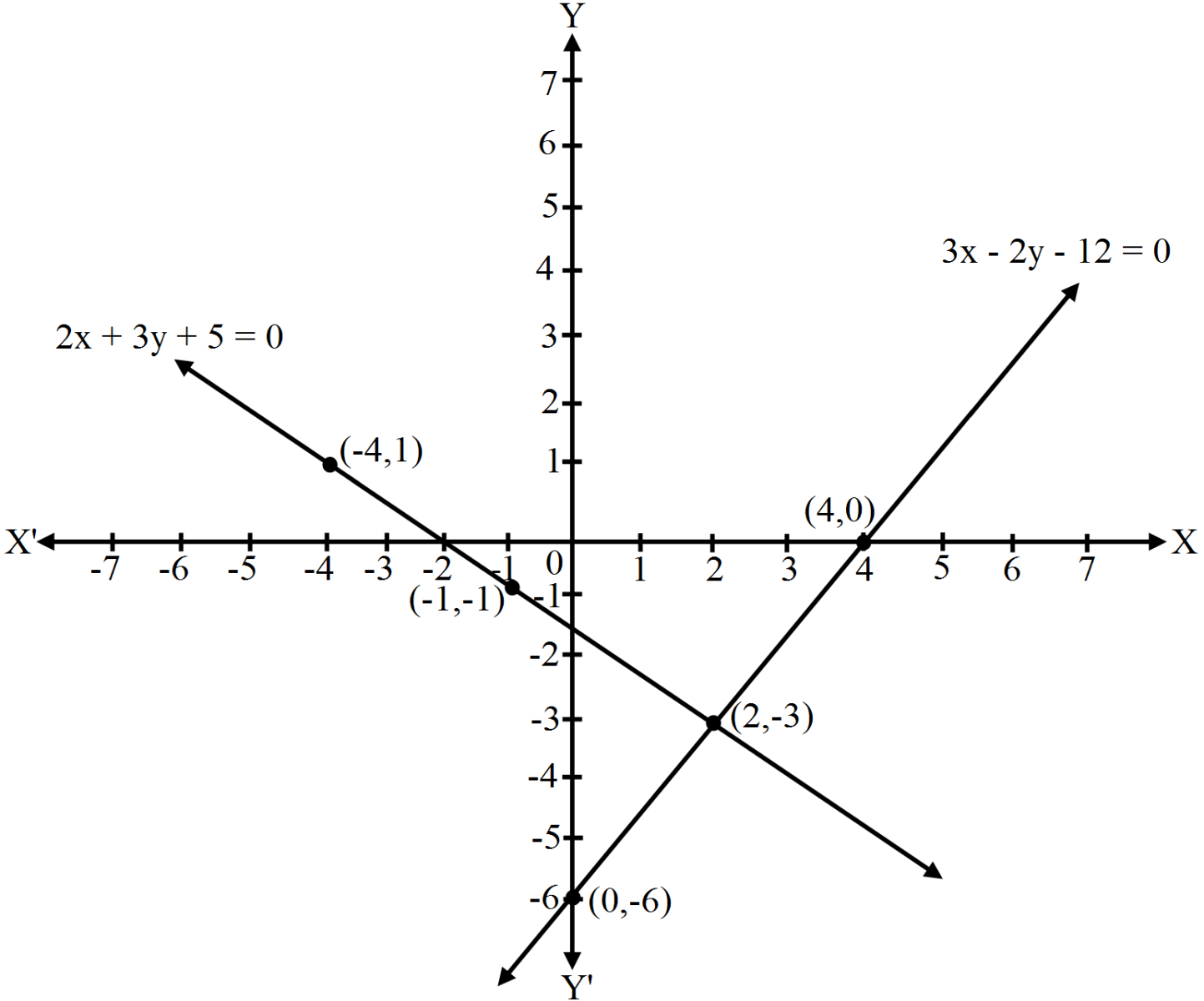
Since the two graph intersect at (2, -3), x = 2 and y = -3 View full question & answer→Question 705 Marks
Solve each of the following given systems of equations graphically and find the vertices and area of the triangle formed by these lines and the y-axis:
2x - 3y = 12, x + 3y = 6
Answer$\text{2x}-\text{3y}=12,$ $\Rightarrow\text{y}=\frac{\text{2x}-12}{3}$
$\text{x}+\text{3y}=6$ $\Rightarrow\text{y}=\frac{6-\text{x}}{3}$
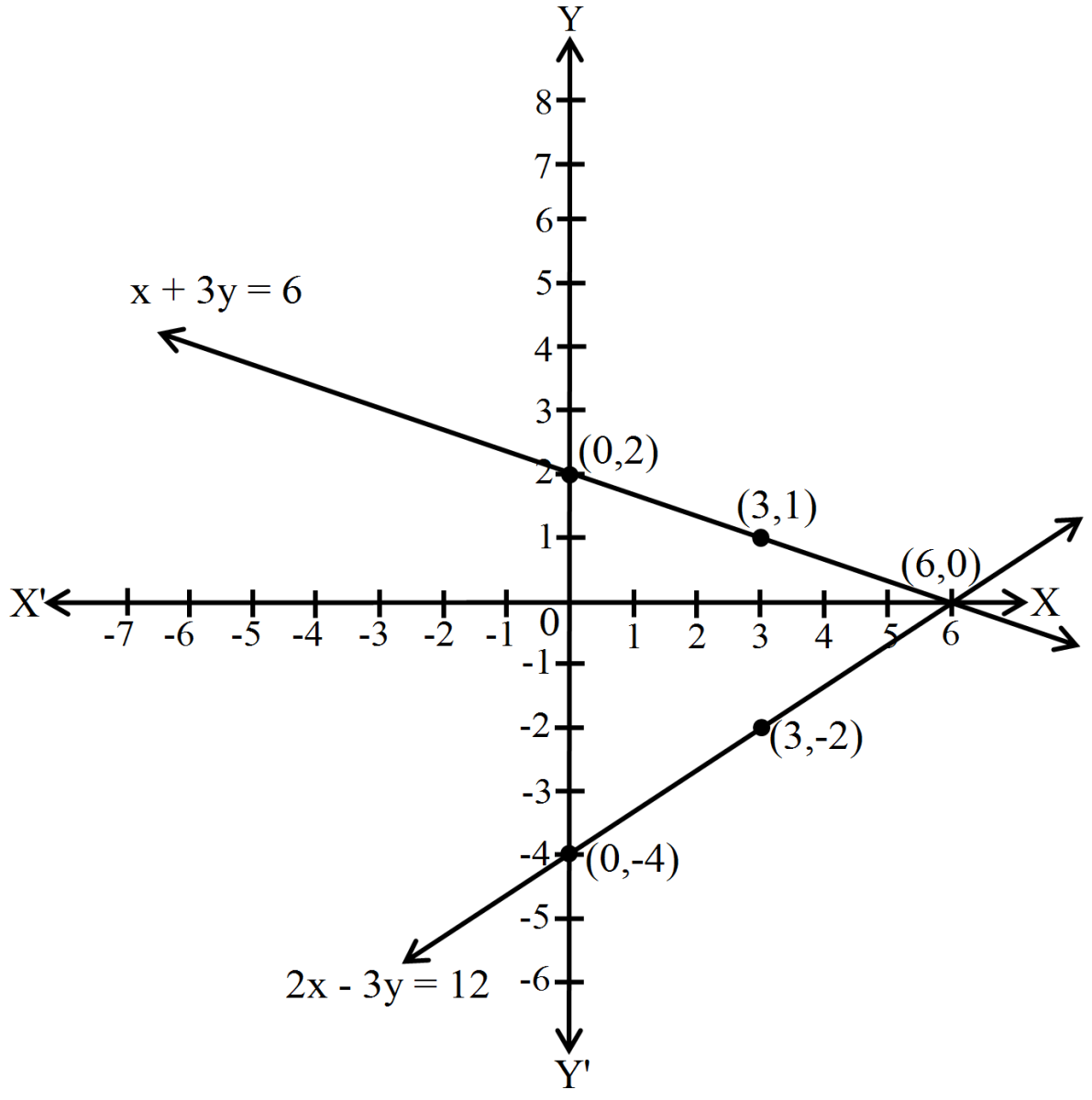
Since the two graph intersect at (6, 0), x = 6 and y = 0 The vertices of the triangle formed by these lines and the y-axis are (6, 0), (0, -4) and (0, 2). So, height of the triangle = distance from (6, 0) to y-axis = 6 units Base = 6 units Area of triangle $=\frac{1}{2}\times$ base × height $=\frac{1}{2}\times6\times6$ $=18\ \text{sq. units}$ View full question & answer→Question 715 Marks
Two years ago, a man was five times as old as his son. Two years later, his age will be 8 more than three times the ago of the son. Find their present ages.
AnswerLet the present ages of the man and his son be x years and y years respectively.
Then,
Two years ago:
(x - 2) = 5(y - 2)
⇒ x - 2 = 5y - 10
⇒ x - 5y = -8 ...(1)
Two years later:
(x + 2) = 3(y + 2) + 8
⇒ x + 2 = 3y + 6 + 8
⇒ x - 3y = 12 ...(2)
Subtracting (2) from (1), we get
-2y = -20
⇒ y = 10
Putting y = 10 in (1), we get
x - 5 × 10 = -8
⇒ x - 50 = -8
⇒ x = 42
Hence the present ages of the man and the son are 42 years and 10 respectively.
View full question & answer→Question 725 Marks
Solve the following systems of equations by using the method of cross multiplication:
$2ax + 3by = (a + 2b),$
$3ax + 2by = (2a + b).$
AnswerThe given equations may be written as: $2ax + 3by = (a + 2b) ...(i) 3ax + 2by = (2a + b) ...(ii)$
Here, $a_1 = 2a, b_1 = 3b, c_1 = -(a + 2b),$
$a_2 = 3a, b_2 = 2b$ and $c_2 = -(2a + b) $By cross multiplication, we have:
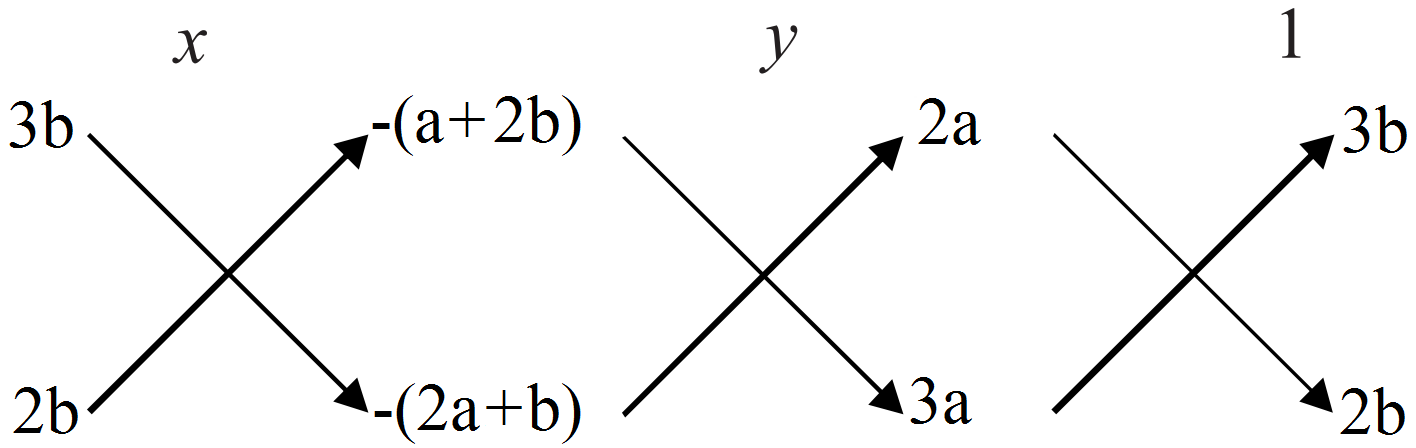
$\therefore\frac{\text{x}}{[\text{3b}\times(-(\text{2a}+\text{b}))-2\text{b}\times(-(\text{a}+2\text{b}))]}=\frac{\text{y}}{[-(\text{a}+2\text{b})\times3\text{a}-\text{2a}\times(-(\text{2a}+\text{b}))]}=\frac{1}{[\text{2a}\times2\text{b}-3\text{a}\times\text{3b}]}$ $\Rightarrow\frac{\text{x}}{\big(-\text{6ab}-\text{3b}^2+\text{2ab}+\text{4b}^2\big)}=\frac{\text{x}}{\big(-\text{3a}^2-\text{6ab}+\text{4a}^2+\text{2ab}\big)}=\frac{1}{\text{4ab}-\text{9ab}}$
$\Rightarrow\frac{\text{x}}{\text{b}^2-\text{4ab}}=\frac{\text{y}}{\text{a}^2-\text{4ab}}=\frac{1}{-\text{5ab}}$
$\Rightarrow\frac{\text{x}}{-\text{b}(\text{4a}-\text{b})}=\frac{\text{y}}{-\text{a}(4\text{b}-\text{a})}=\frac{1}{-5\text{ab}}$
$\Rightarrow\text{x}=\frac{-\text{b}(\text{4a}-\text{b})}{-5\text{ab}}=\frac{(\text{4a}-\text{b})}{\text{5a}},$ $\text{y}=\frac{-\text{a}(\text{4b}-\text{a})}{-\text{5ab}}=\frac{(\text{4b}-\text{a})}{\text{5b}}$
Hence, $\text{x}=\frac{(\text{4a}-\text{b})}{\text{5a}}$ and $\text{y}=\frac{(\text{4a}-\text{b})}{\text{5b}}$ is the required solution. View full question & answer→Question 735 Marks
A number consisting of two digits is seven times the sum of its digits. When 27 is subtracted from the number, the digits are reversed. Find the number.
AnswerLet the ten's digit of required number be x and its unit's be y respectively
Required number = 10x + y
$\therefore$ 10x + y = 7(x + y)
10x + y = 7x + 7y
3x - 6y = 0 ...(1)
Number found on reversing the digits = 10y + x
$\therefore$ (10x + y) - 27 = 10y + x
⇒ 10x - x + y - 10y = 27
⇒ 9x - 9y = 27
⇒ (x - y) = 27
x - y = 3 ...(2)
Multiplying (1) by 1 and (2) by 6
3x - 6y = 0 ...(3)
6x - 6y = 18 ...(4)
Subracting (3) from (4), We get
⇒ 3x = 18
$\Rightarrow\text{x}=\frac{18}{3}$
⇒ x = 6
Putting x = 6 in (1), we get
⇒ 3 × 6 - 6y = 0
⇒ 18 - 6y = 0
⇒ -6y = -18
$\Rightarrow\text{y}=\frac{-18}{-6}$
⇒ y = 3
Number = 10x + y
= 10 × 6 + 3
= 60 + 3
= 63
Hence, the number is 63.
View full question & answer→Question 745 Marks
Solve: $\frac{\text{ax}}{\text{b}}-\frac{\text{by}}{\text{a}}=\text{a}+\text{b},$ $\text{ax}-\text{by}=\text{2ab}.$
AnswerThe given equation may be written as follows: $\frac{\text{ax}}{\text{b}}-\frac{\text{by}}{\text{a}}-(\text{a+b})=0\ ...(\text{i})$ ax - by - 2ab = 0 ...(ii) Here, $\text{a}_1=\frac{\text{a}}{\text{b}},\ \text{b}_1=\frac{\text{b}_1}{\text{a}},$ $\text{c}_1=-(\text{a+b}),\ \text{a}_2=\text{a},$ $\text{b}_2= -\text{b},\ \text{c}_2=-2\text{ab}$ By cross multiplying, we have: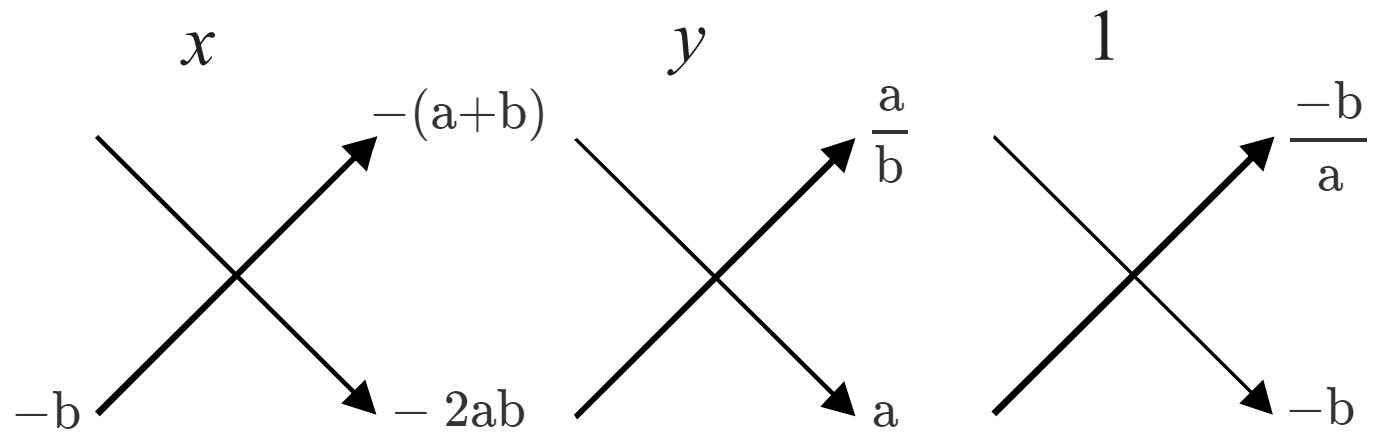
$\therefore\frac{\text{x}}{\big(-\frac{\text{b}}{\text{a}}\big)\times(-2\text{ab})-(-\text{b})\times(-(\text{a+b}))}\\\ \ \ =\frac{\text{y}}{-(\text{a+b})\times\text{a}-(-2\text{ab})\times\frac{\text{a}}{\text{b}}}\\\ \ \ =\frac{1}{\frac{\text{a}}{\text{b}}\times(-\text{b})-\text{a}\times\big(-\frac{\text{b}}{\text{a}}\big)}$ $\Rightarrow\frac{\text{x}}{2\text{b}^2-\text{b}(\text{a+b})}=\frac{\text{y}}{-(\text{a+b})+2\text{a}^2}=\frac{1}{-\text{a+b}}$ $\Rightarrow\frac{\text{x}}{2\text{b}^2-\text{ab}-\text{b}^2}=\frac{\text{y}}{-\text{a}^2-\text{ab}+2\text{a}^2}=\frac{1}{-\text{a+b}}$ $\Rightarrow\frac{\text{x}}{\text{b}^2-\text{ab}}=\frac{\text{y}}{\text{a}^2-\text{ab}}=\frac{1}{-(\text{a}-\text{b})}$ $\Rightarrow\frac{\text{x}}{-\text{b}(-\text{a}-\text{b})}=\frac{\text{y}}{\text{a}(\text{a}-\text{b})}=\frac{1}{-(\text{a}-\text{b})}$ $\Rightarrow\text{x}=\frac{-\text{b}(\text{a}-\text{b})}{-(\text{a}-\text{b})}=\text{b},\ \text{y}=\frac{\text{a}(\text{a}-\text{b})}{-(\text{a}-\text{b})}=-\text{a}$ Hence, x = b and y = -a is the required solution. View full question & answer→Question 755 Marks
On selling a tea at 5% loss and a lemon set at 15% gain, a crockery seller gains ₹7. If he sells the tea set at 5% gain and the lemon set at 10% gain, he gains ₹13. Find the actual price of each of the tea set and the lemon set.
AnswerLet the CP of the tea-set and the lemon-set be ₹ x and ₹ y respectively.
Then, loss on the tea-set $=₹\ \frac{\text{5x}}{100}$
$=₹\ \frac{\text{x}}{20}$
and gain on the lemon-set $=₹\ \frac{15\text{y}}{100}$
$=₹\ \frac{\text{3y}}{20}$
$\therefore$ Net gain $=₹\ \Big(\frac{\text{3y}}{20}-\frac{\text{x}}{20}\Big)$
$\therefore\frac{\text{3y}}{20}-\frac{\text{x}}{20}=7$
$\Rightarrow\text{3y}-\text{x}=140\ \dots(\text{i})$
Again, gain on the tea-set $=₹\ \frac{\text{5x}}{100}$
$=₹\ \frac{\text{x}}{20}$
and loss on the lemon-set $=₹\ \frac{\text{10y}}{100}$
$=₹\ \frac{\text{y}}{10}$
Total gain $=₹\ \Big(\frac{\text{x}}{20}+\frac{\text{y}}{10}\Big)$
$\therefore\frac{\text{x}}{20}+\frac{\text{y}}{10}=13$
$\text{x}+\text{2y}=260\ \dots(\text{ii})$
Adding (1) and (ii), we get
5y = 400
⇒ y = 80
Substituting y = 80 in (ii), we get
⇒ x = 100
Hence, actual price of the tea-set is ₹ 100 and that of the lemon-set is ₹ 80
View full question & answer→Question 765 Marks
23 spoons and 17 forks together cost ₹ 1770, while 17 spoons and 23 forks together cost ₹ 1830. Find the cost of a spoon and that of a fork.
AnswerLet each spoon cost ₹ x and each fork cost ₹ y
According to the first condition,
23x + 17y = 1770 ...(i)
According to the second condition,
17x + 23y = 1830 ...(ii)
Adding (i) and (ii), we get
40x + 40y = 3600
⇒ x + y = 90 ...(iii)
Subract (ii) from (i), we get
6x - 6y = -60
⇒ x - y = -10 ...(iv)
Adding (iii) and (iv), we get
2x = 80
⇒ x = 40
Substituting x = 40 in (iii), we get
y = 50
Hence, the cost of each spoon is ₹ 40 and the cost of each fork is ₹ 50.
View full question & answer→Question 775 Marks
Solve the following system of equations graphically:
3x + 2y = 4,
2x - 3y = 7
AnswerOn a graph paper, draw a horizontal line X'OX and a vertical line YOY' representing the x-axis and y-axis, respectively. Graph of 3x + 2y = 4: 3x + 2y = 4 $\Rightarrow\text{y}=\frac{4-\text{3x}}{2}$ Thus we have the following table for 3x + 2y = 4
Plot the points A(0, 2), B(2, -1) and C(-2, 5) on the graph paper. Join AB and AC to get the graph line BC. Extend it on both ways. Thus, the line BC is the graph of 3x + 2y = 4. Graph of 2x - 3y = 7: $\Rightarrow\text{y}=\frac{\text{2x}-7}{3}$ Thus, we have the following table for 2x - 3y = 7 is
Now, on the same graph paper plot the points P(-1, -3) and Q(5, 1). The point B(2, -1) has already been plotted. Join PB and QB and extend it on both ways. Thus, line PQ is the graph of 2x - 3y = 7.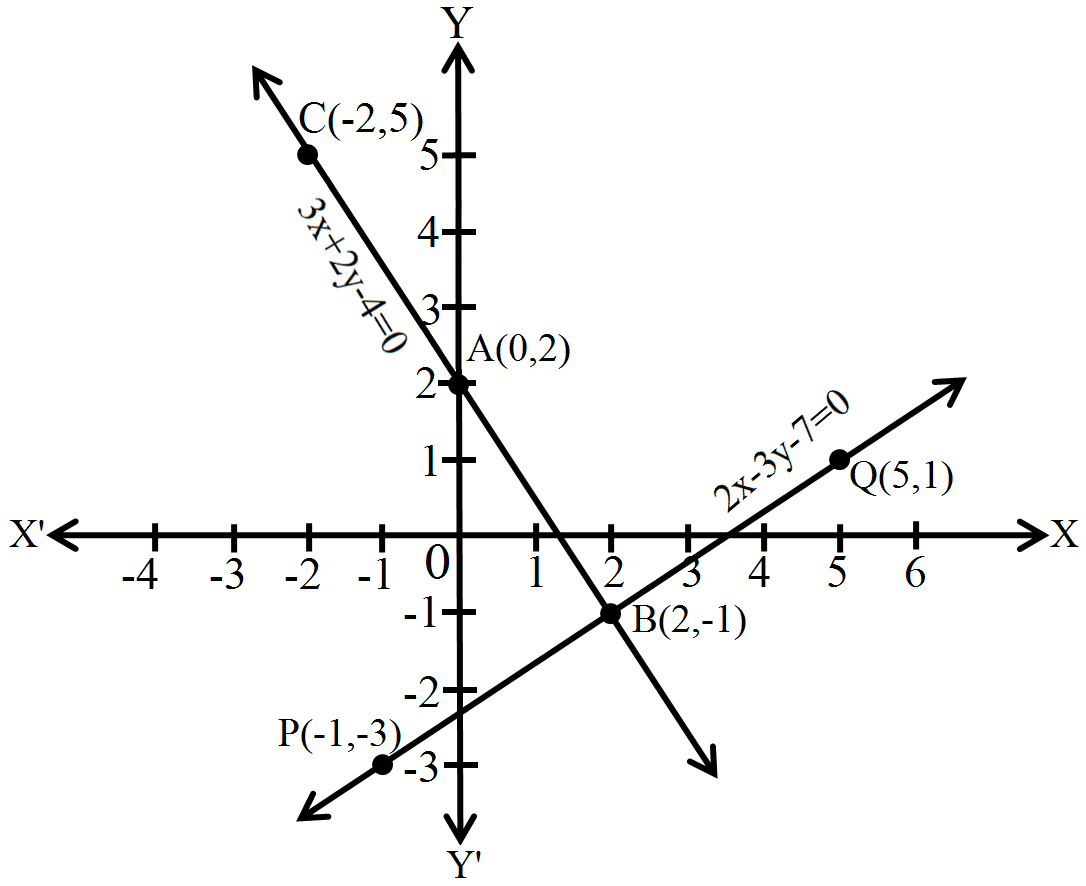
The two graph lines intersect at B(2, -1). $\therefore$ x = 2, y = -1 is the solution of the given system of equations. View full question & answer→Question 785 Marks
A chemist has one solution containing 50% acid and a second one containing 25% acid. How much of each should be used to make 10 litres of a 40% acid solution?
AnswerLet x litres of 50% solution be mixed with y litres of 25% solution.
Accroding to the given condition,
50% of x + 25% of y = 40% of 10
$\Rightarrow\frac{50}{100}\text{x}+\frac{25}{100}\text{y}=\frac{40}{100}(10)$
50x + 25y = 40(10)
2x + y = 16 ...(i)
Since the amount of each solutions adds to 10 litres,
x + y = 10 ...(ii)
Subtract (ii) from (i).
x = 6
Substituting x = 6 in (ii), we get
y = 4.
Hence, 6 liters of 50% solution is to be mixed with 4 litres of 25% solution.
View full question & answer→Question 795 Marks
The length of a room exceeds its breadth by 3 metres. If the length in increased by 3 metres and the breadth is decreased by 2 metres, the area remains the same. Find the length and the breadth of the room.
AnswerLet the length = x meters and breadth = y meters Then, x = y + 3 ⇒ x - y = 3 ...(1)Also
(x + 3)(y - 2) = xy
⇒ 3y - 2x = 6 ...(2) Multiplying (1) by 2 and (2) by 1 ⇒ -2y + 2x = 6 ...(3) ⇒ 3y - 2x = 6 ...(4) Adding (3) and (4), we get ⇒ y = 12 Putting y = 12 in (1), we get x - 12 = 3 ⇒ x= 15 $\therefore$ x = 15, y = 12 Hence length = 15 metres and breadth = 12 metres
View full question & answer→Question 805 Marks
The area of a rectangle gets reduced by $8 m^2$, when its length is reduced by 5 m and its breadth is increased by 3 m . If we increase the length by 3 m and breadth by 2 m , the area is increased by $74 m^2$. Find the length and the breadth of the rectangle.
AnswerLet the length of a rectangle be x meters and breadth be y meters.
Then, area = xy sq.m
Now,
$xy - (x - 5)(y + 3) = 8$
$\Rightarrow xy - [xy - 5y + 3x - 15] = 8$
$\Rightarrow xy - xy + 5y - 3x + 15 = 8$
$\Rightarrow 3x - 5y = 7 ...(1)$
And
$(x + 3)(y + 2) - xy = 74$
$\Rightarrow xy + 3y +2x + 6 - xy = 74$
$\Rightarrow 2x + 3y = 68 ...(2)$
Multiplying (1) by 3 and (2) by 5, we get
$9x - 15y = 21 ...(3)$
$10x + 15y = 340 ...(4)$
Adding (3) and (4), we get
$\text{19x}=361$
$\Rightarrow\text{x}=\frac{361}{19}=19$
Putting x = 19 in (3), we get
$9 \times 19 - 15y = 21$
$\Rightarrow 171 - 15y = 21$
$\Rightarrow\text{y}=\frac{150}{15}=10$
$\therefore$ x = 19 meters, y = 10 meters
Hence, length = 19m and breadth = 10m
View full question & answer→Question 815 Marks
Show graphically that each of the following given systems of equations has infinitely many solutions:
2x + y = 6, 6x + 3y = 18
AnswerOn a graph paper, draw a horizontal line X'OX and a vertical line YOY' representing the x-axis and y-axis, respectively. The given system equations is 2x + y = 6, 6x + 3y = 18 Graph of 2x + y = 6: 2x + y = 6 ⇒ y = -2x + 6 ...(1) Thus, we have the following table for equation (1)
On the graph paper plot the points A(3, 0), B(1, 4) and C(2, 2). Join AC and BC to get the graph line AB. Thus, the line AB is the graph of the equation of 2x + y = 6. Graph of 6x - 2y = 10: For graph of 6x + 3y = 18 $\Rightarrow\text{y}=\frac{-\text{6x}+18}{3}\ \dots(2)$ Thus, we have the following table for equation (2)
These points, A(3, 0), B(1, 4) and C(2, 2) are the same as obtained above.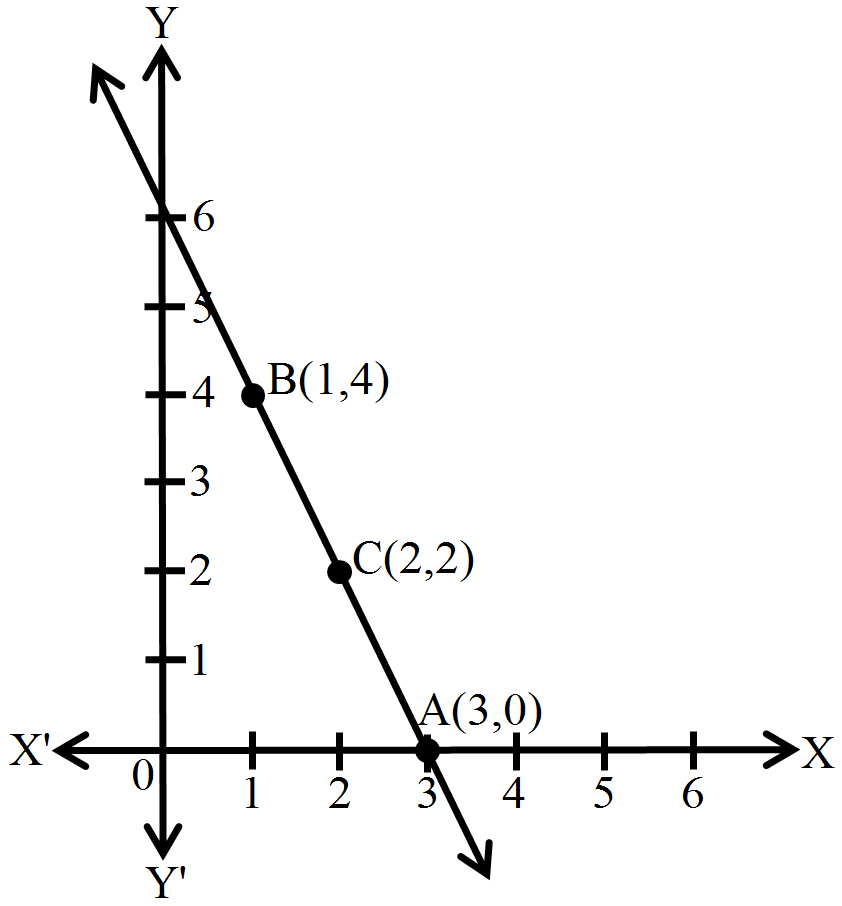
Thus, we find that the two line graphs coincide. Hence the given system of equations has infinitely many solutions. View full question & answer→Question 825 Marks
Find two numbers such that the sum of thrice the first and the second is 142, and four times the first exceeds the second by 138.
AnswerLet the first and second numbers be x and y resoectively.
According to the question:
3x + y = 142 ...(i)
4x - y = 138 ...(ii)
Adding (i) and (ii), we get
7x = 280
$\Rightarrow\text{x}=\frac{280}{7}=40$
Putting x = 40 in (i), we get
3 × 40 + y = 142
y = 142 - 120
y = 22
Hence, the first second numbers are 40 and 22
View full question & answer→Question 835 Marks
Solve for x and y:
$\frac{\text{x}-\text{y}-8}{2}=\frac{\text{x}+\text{2y}-14}{3}=\frac{\text{3x}+\text{y}-12}{11}$
Hint: a = b = c ⇒ a = b and b = c.
AnswerThe given equations are: $\frac{\text{x}-\text{y}-8}{2}=\frac{\text{x}+\text{2y}-14}{3}=\frac{\text{3x}+\text{y}-12}{11}$ Therefore, we have $\frac{\text{x}-\text{y}-8}{2}=\frac{\text{3x}+\text{y}-12}{11}$By cross multiplication, we get
11x + 11y - 88 = 6x + 2y - 24
11x - 6x + 11y - 2y = -24 + 88
5x + 9y = 64 ...(1)
$\frac{\text{x}+\text{2y}-14}{3}=\frac{\text{3x}+\text{y}-12}{11}$
By cross multiplication, we get
11x + 22y - 154 = 9x + 3y - 36
11x - 9x + 22y - 3y = -36 + 154
2x + 19y = 118 ...(2)
By Multiplication (1) by 19 and (2) by 9
95x + 171y = 1216 ...(3)
18x + 171y = 1062 ...(4)
Subtracting (4) from (3), we get
77x = 154
⇒ x = 2
Substituting x = 2 in (1), we get
5 × 2 + 9y = 64
⇒ 9y = 54
⇒ y = 6
$\therefore$ Solution is x = 2 and y = 6
View full question & answer→Question 845 Marks
Solve each of the following given systems of equations graphically and find the vertices and area of the triangle formed by these lines and the x-axis:
4x - 3y + 4 = 0, 4x + 3y - 20 = 0
AnswerOn a graph paper, draw a horizontal line X'OX and a vertical line YOY' representing the x-axis and y-axis, respectively. The given system equations is 4x - 3y + 4 = 0, 4x + 3y - 20 = 0 Graph of 4x - 3y + 4 = 0: 4x - 3y + 4 = 0 $\Rightarrow\text{y}=\frac{4\text{x}+4}{3}\ \dots(1)$ Thus, we have the following table for equation (1)
On the graph paper plot the points A(-1, 0), B(2, 4) and C(5, 8). Join AB and BC to get the graph line AC. Thus, the line AC is the graph of the equation of 4x - 3y + 4 = 0. Graph of 4x + 3y - 20 = 0: For graph of 4x + 3y - 20 = 0 $\Rightarrow\text{y}=\frac{-\text{4x}+20}{3}\ \dots(2)$ Thus, we have the following table for equation (2)
Now, on the same graph paper plot the points P(-1, 8) and Q(5, 0). The third point B(2, 4) has already been plotted. Join PB and QB to get the line PQ. Thus, line PQ is the graph of the equation 4x + 3y - 20 = 0.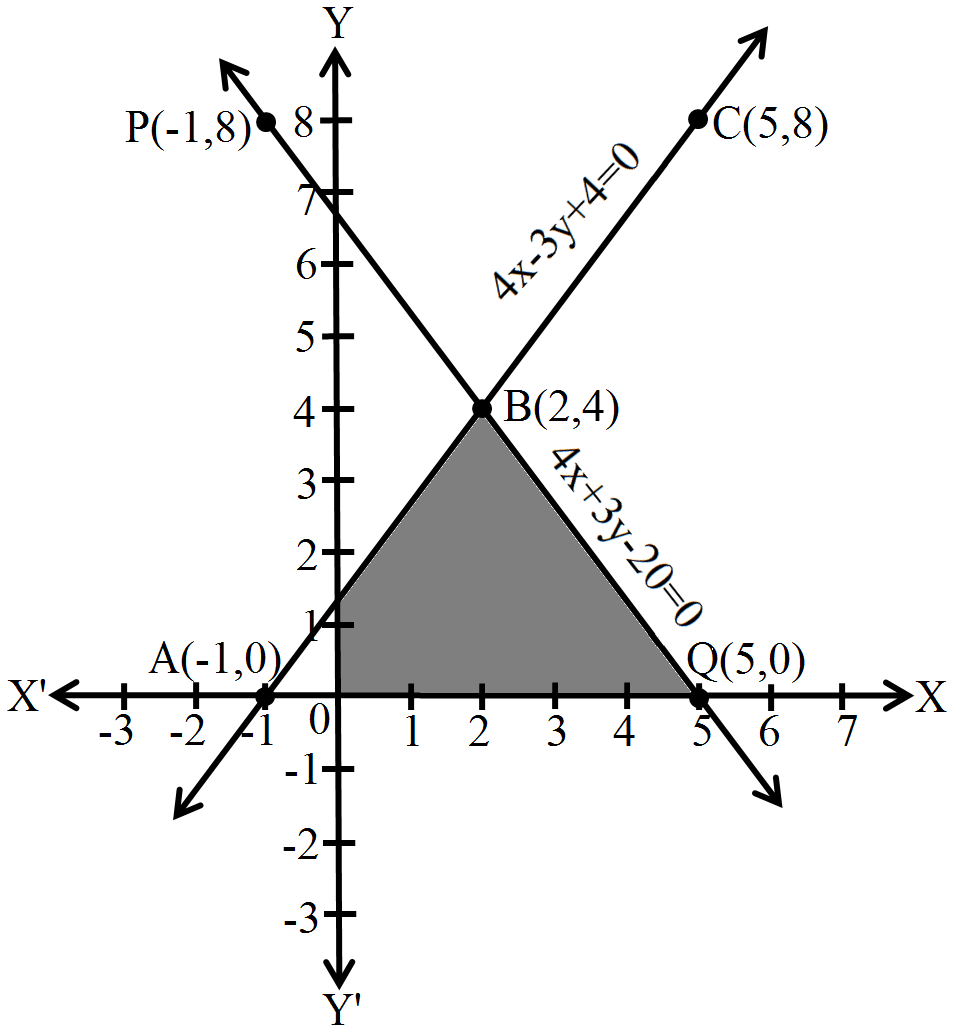
The two graph lines intersect at B(2, 4). $\therefore$ x = 2, y = 4 is the solution of the given system of equations. Clearly, the vertices of $\triangle\text{ABQ}$ formed by these lines and the x-axis are A(-1, 0), B(2, 4) and Q(5, 0) Consider the triangle $\triangle\text{ABQ}:$ Height of the triangle = 4 units and base (AQ) = 6 units Area of triangle Area $=\Big(\frac{1}{2}\times\text{Base}\times\text{height}\Big)\text{sq. units}$ $=\Big(\frac{1}{2}\times4\times6\Big)\text{sq. units}$ Area of $\triangle\text{ABQ}=12\text{sq. }\text{units}$ View full question & answer→Question 855 Marks
Solve for x and y:
$\frac{1}{2(\text{x}+\text{2y)}}+\frac{5}{3(3\text{x}-\text{2y)}}=\frac{-3}{2},$
$\frac{5}{4(\text{x}+\text{2y)}}-\frac{3}{5(3\text{x}-\text{2y)}}=\frac{61}{60}$
Answer$\frac{1}{2(\text{x}+\text{2y)}}+\frac{5}{3(3\text{x}-\text{2y)}}=\frac{-3}{2},$ and $\frac{5}{4(\text{x}+\text{2y)}}-\frac{3}{5(3\text{x}-\text{2y)}}=\frac{61}{60}$ Putting $\frac{1}{\text{x}+\text{2y}}=\text{u},\ \frac{1}{\text{3x}-\text{2y}}=\text{v,}$ we get $\frac{1}{2}\text{u}+\frac{5}{3}\text{v}=-\frac{3}{2}\ \dots(1)$ $\frac{5}{4}\text{u}-\frac{3}{5}\text{v}=\frac{61}{60}\ \dots(2)$ Multiplying (1) by 6 and (2) by 20, we get $\text{3u}+\text{10v}=-9\ \dots(3)$ $\text{25u}-12\text{v}=\frac{61}{3}\ \dots(4)$ Multiplying (3) by 6 and (4) by 5, we get $\text{18u}+\text{60v}=-54\ \dots(5)$ $\text{125u}-60\text{v}=\frac{305}{3}\ \dots(6)$ Adding (5) and (6), we get$\text{143u}=\frac{305}{3}-54=\frac{305-162}{2}=\frac{143}{3}$
$\therefore\text{u}=\frac{1}{3}=\frac{1}{\text{x}+\text{2y}}$
$\therefore\text{x}+\text{2y}=3\ \dots(7)$
Putting value of u in (3), we get 1 + 10v = -9 10v = -10 or v = -1 $\Rightarrow-1=\frac{1}{\text{3x}-\text{2y}}$ 3x - 2y = -1 ...(8) Adding (7) and (8), we get $\text{4x}=2$ $\therefore\text{x}=\frac{1}{2}$ Putting value of x in (7) $\frac{1}2{}+\text{2y}=3$ or $\text{2y}=3-\frac{1}{2}=\frac{5}2{}$ $\therefore\ \text{y}=\frac{5}{4}$ Thus required solution is $\text{x}=\frac{1}{2},\ \text{y}=\frac{5}{4}$
View full question & answer→Question 865 Marks
Solve for x and y:
$\frac{\text{x}}{\text{a}}-\frac{\text{y}}{\text{b}}=0,$
$\text{ax}+\text{by}=(\text{a}^2+\text{b}^2)$
Answer$\frac{\text{x}}{\text{a}}-\frac{\text{y}}{\text{b}}=0$
$\Rightarrow\text{x}=\frac{\text{ay}}{\text{b}}\ \dots(\text{i})$
$\text{ax}+\text{by}=(\text{a}^2+\text{b}^2)\ \dots(\text{ii})$
Substituting (i) in (ii), we get
$\text{a}\Big(\frac{\text{ay}}{\text{b}}\Big)+\text{by}=(\text{a}^2+\text{b}^2)$
$\Rightarrow\Big(\frac{\text{a}^2\text{y}}{\text{b}}\Big)+\text{by}=(\text{a}^2+\text{b}^2)$
$\Rightarrow\text{a}^2\text{y}+\text{b}^2\text{y}=(\text{a}^2\text{b}+\text{b}^3)$
$\Rightarrow\text{y}(\text{a}^2+\text{b}^2)=\text{b}(\text{a}^2+\text{b}^2)$
$\Rightarrow\text{y}=\text{b}$
Substituting in (i), we get x = a
So, x = a and y = b.
View full question & answer→Question 875 Marks
Places A and B are 160km apart on a highway. One car starts from A and another car from B at the same time. If they travel in the same direction, they meet in 8 hours. But, if they travel towards each other, they meet in 2 hours. Find the speed of each car.
AnswerLet X and Y be the cars starting from A and B respectively and let their speeds be x km/hr and y km/hr respectively.
Then, AB = 160km.
Case 1: When the two cars move in the same direction In this case, let the two cars meet at a point M.

Distance covered by X in 8 hours = 8x km
Distance covered by Y in 8 hours = 8y km
$\therefore$ AM = (8x)km and BM = (8y)km
⇒ AM - BM = AB
⇒ (8x - 8y) = 160
⇒ x - y = 20 ...(i)
Case 2: When the two cars move in the opposite direction.
In this case, let the two cars meet at a point P.

Distance covered by X in 2 hours = 2x km
Distance covered by Y in 2 hours - 2y km
AP = (2x)km and BP = (2y)km
⇒ AP + BP = AB
⇒ (2x + 2y) = 160
⇒ x + y = 80 .....(ii)
Adding (i) and (ii), we get
2x - 100
⇒ x = 50
Substituting x = 50 in (ii), we get
⇒ y = 30.
Hence, the speed of the car starting from A is 50km/h
and that of the one starting from B is 30km/h. View full question & answer→Question 885 Marks
Solve for x and y:
$\frac{3}{\text{x}}-\frac{1}{\text{y}}+\text{9}=0,$
$\frac{2}{\text{x}}+\frac{3}{\text{y}}=\text{5}$ $(\text{x}\neq0,\ \text{y}\neq0).$
AnswerPutting $\frac{1}{\text{x}}=\text{u}$ and $\frac{1}{\text{y}}=\text{v}$ the given equations become 3u - v = 9 ...(1) 2u + 3v = 5 ...(2)Multiplying (1) by 3 and (2) by 1, we get
9u - 3v = -27 ...(3)
2u + 3v = 5 ...(4)
Adding (3) and (4), we get
11u = -22
$\Rightarrow\text{u}=\frac{-22}{11}=-2$Putting u = -2 in (1), we get
3 × (-2) - v = -9
⇒ -6 - v = -9
⇒ -v = -9 + 6
⇒ -v = -3
⇒ v = 3
Now, u = -2
$\Rightarrow\frac{1}{\text{x}}=-2$ $\Rightarrow\text{x}=\frac{-1}{2}$ and, v = 3 $\Rightarrow\frac{1}{\text{y}}=3$ $\Rightarrow\text{y}=\frac{1}{3}$$\therefore$ The solution is $\text{x}=\frac{-1}{2}$ and $\text{y}=\frac{1}{3}$
View full question & answer→Question 895 Marks
Solve the following system of equations graphically:
2x + 3y - 4 = 0,
3x - y + 5 = 0
Answer$\text{2x}+\text{3y}-4=0$ $\Rightarrow\text{y}=\frac{4-\text{2x}}{3}$
$\text{3x}-\text{y}+5=0$ $\Rightarrow\text{y}=\text{3x}+5$
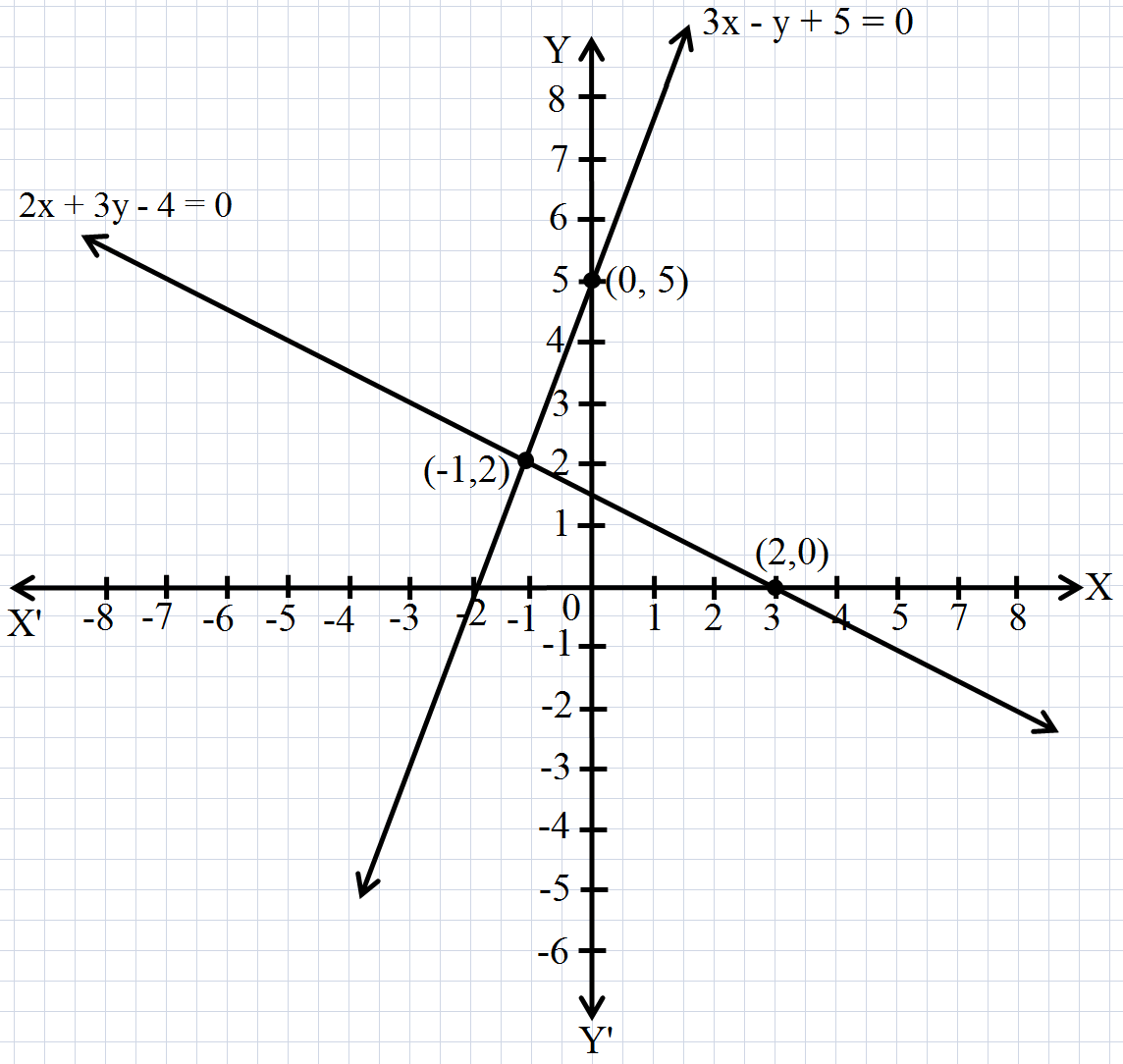
Since the two graph intersect at (-1, 2), x = -1 and y = 2 View full question & answer→Question 905 Marks
The area of a rectangle gets reduced by 67 square metres, when its length is increased by 3 m and breadth is decreased by 4 m. If the length is reduced by 1 m and breadth is increased by 4 m, the area is increased by 89 square metres. Find the dimensions of the rectangle.
AnswerLet the length of the rectangle be x and the breadth be y.
So, the area of the rectangle = xy
According to the first condition,
(x + 3)(y - 4) = xy - 67
⇒ xy - 4x + 3y - 12 - xy - 67
⇒ 4x + 3y = -55 ...(i)
According to the second condition,
(x - 1)(y + 4) = xy + 89
⇒ xy + 4x - y - 4 = xy + 89
⇒ 4x - y = 93 ...(ii)
Adding (i) and (ii), we get
2y = 38
⇒ y = 19
Substituting y = 19 in (ii), we get x = 28.
Hence, the dimensions of the rectangle are 28m and 19m.
View full question & answer→Question 915 Marks
Draw the graphs of the following equations on the same graph paper:
2x + y = 2, 2x + y = 6
Find the coordinates of the vertices of the trapezium formed by these lines. Also, find the area of the trapezium so formed.
Hint: The line 2x + y = 2 cuts the x-axis at A(1, 0) and the y-axis at B(0, 2).
The line 2x + y = 6 cuts the x-axis at C(3, 0) and the y-axis at D(0, 6).
Area of trap. ABCD $=\text{ar}(\triangle\text{OCD})-\text{ar}(\triangle\text{OAB})$
$=\Big(\frac{1}{2}\times3\times6\Big)-\Big(\frac{1}{2}\times1\times2\Big)$
$=8\ \text{sq. units}$
Answer$2\text{x}+\text{y}=2$ $\Rightarrow\text{y}=2-\text{2x}$
$\text{2x}+\text{y}=6$ $\Rightarrow\text{y}=6-\text{2x}$
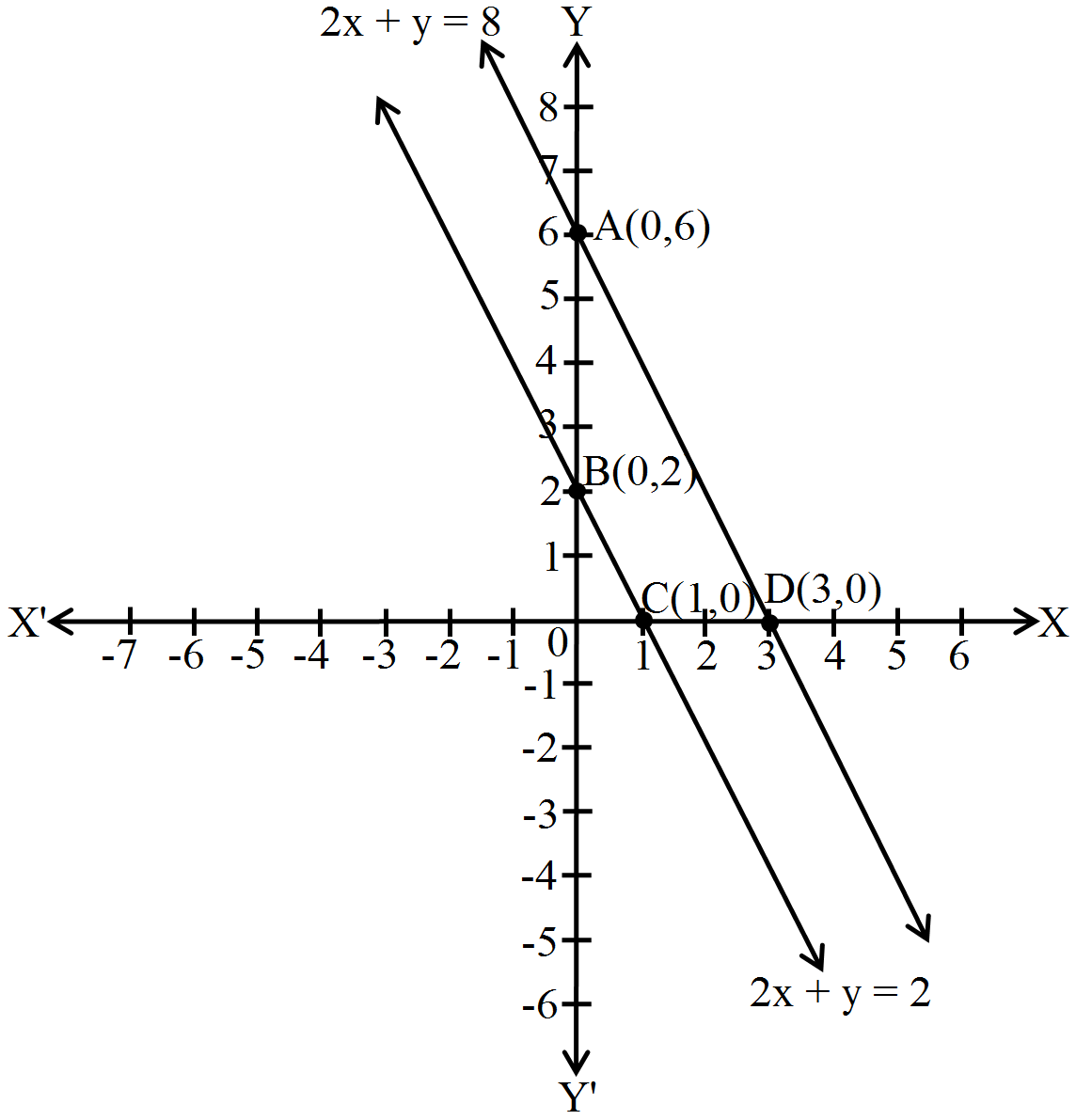
Since the two graph of the system of equations is parallel lines, the system has no solution and hence is inconsistent. View full question & answer→Question 925 Marks
Taxi charges in a city consist of fixed charges and the remaining depending upon the distance travelled in kilometres. If a man travels 80km, he pays ₹ 1,330, and travelling 90km, he pays ₹ 1,490. Find the fixed charges and rate per km.
AnswerLet the fixed charges be ₹ x and other charges be ₹ y per km.
According to the given condition,
x + 80y - 1330 ...(i)
x + 90y = 1490 ...(ii)
Subtracting (i) from (ii), we get
10y = 160
⇒ y = 16
Substituting y - 16 in (i), we get
x = 50.
Hence, the fixed charges is ₹ 50 and the other charges is ₹ 16 per km.
View full question & answer→Question 935 Marks
A sailor goes 8km downstream in 40 minutes and returns in 1 hour. Find the speed of the sailor in still water and the speed of the current.
AnswerLet the speed of the sailor in still water be x km/h and the speed of the current be y km/hr.
The upstream speed = (x + y) km/hr
The upstream speed = (x - y) km/hr
We know that, distance = speed × time
When the sail or goes downstream,
$(\text{x}+\text{y})\times\frac{40}{60}=8$
⇒ x + y = 12 ....(i)
When the sailor goes upstream,
(x - y) × 1 = 8
⇒ x - y = 8 ...(ii)
Adding (i) and (ii), we get
2x = 20
⇒ x = 10
Substitutiting in (i), we get
⇒ y = 2.
Hence, the speed of the sailor in still water is 10km/hr
and the speed of the current is 2km/hr.
View full question & answer→Question 945 Marks
The monthly incomes of A and B are in the ratio 5 : 4 and their monthly expenditures are in the ratio 7 : 5. If each saves ₹ 9000 per month, find the monthly income of each.
AnswerLet the monthly incomes of A and B be ₹ 5x and 4x respectively and let their expenditures be ₹ 7y and 5y respectively.
We know that, savings = income - expenditure
Then, A's monthly savings = ₹ (5x - 7y)
and B's monthly savings = ₹ (4x - 5y)
But, the monthly saving of each is ₹ 9000.
$\therefore$ 5x - 7y = 9000 ...(i)
and 4x - 5y = 9000 ...(ii)
Multiply (i) by 5 and (ii) by 7,
25x - 35y - 45000 ...(iii) and
28x - 35y - 63000 ...(iv)
Subtracting (iii) from (iv), we get
3x = 18000
⇒ x = 6000
Substituting x = 6000 in (i), we get
⇒ y = 3000.
So, A's income = 5x = ₹ 30000
and B's income = 4x = ₹ 24000
Hence, the monthly income of A is ₹ 30000
and that of B is ₹ 24000.
View full question & answer→Question 955 Marks
Solve for x and y:
$px + qy = p - q,$
$qx - py = p + q$
Answer$px + qy = p - q ...(i)$
$qx - py = p + q ...(ii)$
Multiplying (i) by p and (ii) by q and adding, we get
$p^2x + q^2x = p^2- pq + pq + q^2$
$\Rightarrow\text{x}=\frac{\text{p}^2+\text{q}^2}{\text{p}^2+\text{q}^2}$
$\Rightarrow x = 1$
Substituting x = 1 in (i), we get
$p + qy = p - q$
$y = -1$
So, x = 1 and y = -1
View full question & answer→Question 965 Marks
5 chairs and 4 tables together cost ₹ 5,600, while 4 chairs and 3 tables together cost ₹ 4,340. Find the cost of a chair and that of a table.
AnswerLet each chair cost ₹ x and each table cost ₹ y
According to the first condition,
5x + 4y = 5600 ...(i)
According to the second condition,
4x + 3y = 4340 ...(ii)
Multiplying (i) by 3 and (ii) by 4,
We get:
15x + 12y = 16800 and 16x + 12y = 17360
Subracting the above equations, we get
x = 560
Substituting x = 560 in (iii), we get
y = 700
Hence, the cost of each chair is ₹ 560 and the cost of each table is ₹ 700.
View full question & answer→Question 975 Marks
The difference between two numbers is 14 and the difference between their squares is 448. Find the numbers.
AnswerLet the numbers be x and y respectively.
According to the question:
$x - y = 14 ...(1)$
$x^2 - y^2 = 448 ...(2)$
From (1), we get:
$x = 14 + y ...(3)$
Putting x = 14 + y in (2), we get
$(14 + y)^2 - y^2 = 448$
$196 + y^2 + 28y - y^2 = 448$
$196 + 28y = 448$
$28y = 448 - 196$
$\text{y}=\frac{252}{28}$
y = 9
Putting y = 9 in (1), we get
x - 9 = 14
⇒ x = 14 + 9
⇒ x = 23
Hence, the required numbers are 23 and 9.
View full question & answer→Question 985 Marks
Solve the following system of equations graphically:
2x - 5y + 4 = 0,
2x + y - 8 = 0
AnswerOn a graph paper, draw a horizontal line X'OX and a vertical line YOY' representing the x-axis and y-axis, respectively. Given equations are 2x - 5y + 4 = 0 and 2x + y - 8 = 0 Graph of 2x - 5y + 4 = 0: 2x - 5y + 4 = 0 $\Rightarrow\text{y}=\frac{\text{2x}+4}{5}\ \dots(1)$ Thus, we have the following table for 2x - 5y + 4 = 0
On the graph paper plot the points A(-2, 0), B(3, 2) and C(8, 4). Join AB and BC to get the graph line AC. Thus, the line AC is the graph of the equation of 2x - 5y + 4 = 0. Graph of 2x + y - 8 = 0: For graph of 2x + y - 8 = 0 ⇒ y = -2x + 8 ...(2) Thus, we have the following table for 2x + y - 8 = 0
Now, on the same graph paper plot the points P(1, 6) and Q(2, 4). The third point B(3, 2) has already been plotted. Join PQ and QB to get the line PB. Thus, line PB is the graph of the equation 2x + y - 8 = 0.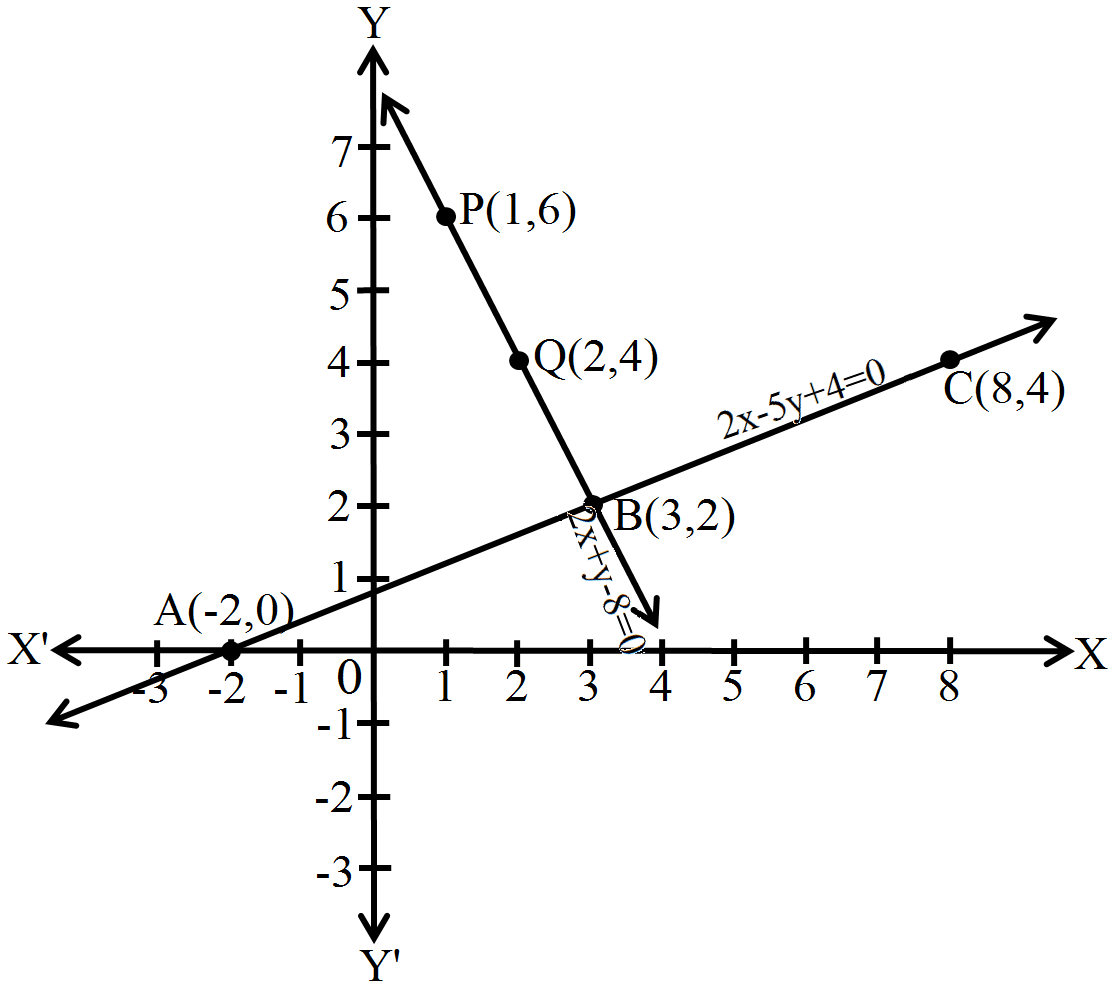
The two graph lines intersect at B(3, 2). $\therefore$ x = 3, y = 2 is the solution of the given system of equations. View full question & answer→Question 995 Marks
A boat goes 12km upstream and 40km downstream in 8 hours. It can go 16km upstream in 8 hours. It can go 16km upstream and 32km downstream in the same time. Find the speed of the boat in still water and the speed of the stream.
AnswerLet the speed of the boat in still water be x km/hr and speed of the stream be y km/hr.
Then,
Speed upstream = (x - y)km/hr
Speed downstream = (x + y) km/hr
Time taken to cover 12km upstream $=\frac{12}{\text{x}-\text{y}}\text{hrs.}$
Time taken to cover 40km downstream $=\frac{40}{\text{x}+\text{y}}\text{hrs.}$
Total time taken = 8hrs.
$\therefore\frac{12}{\text{x}-\text{y}}+\frac{40}{\text{x}+\text{y}}=8$
Again, time taken to cover 16km upstream $=\frac{16}{(\text{x}-\text{y})}$
Time taken to taken to cover 32km downstream $=\frac{32}{(\text{x}+\text{y})}$
Total time taken = 8hrs.
$\therefore\frac{16}{(\text{x}-\text{y})}+\frac{32}{(\text{x}+\text{y})}=8$
Putting $\frac{1}{(\text{x}-\text{y})}=\text{u}$ and $\frac{1}{(\text{x}+\text{y})}=\text{v},$ we get
12u + 40v = 8
3u + 10v = 2 ...(1)
and
16u + 32v = 8
2u + 4y = 1 ...(2)
Multiplying (1) by 4 and (2) by 10, we get
12u + 40v = 8 ...(3)
200 + 40v = 10 ...(4)
Subtracting (3) from (4), we get
$\text{8u}=2$
$\Rightarrow\text{u}=\frac{1}{4}$
Putting $\text{u}=\frac{1}{4}$ in (3), we get
$3\times\frac{1}{4}+\text{10v}=2$
$\Rightarrow\text{10v}=\frac{5}{4}$
$\Rightarrow\text{v}=\frac{1}{8}$
$\text{u}=\frac{1}{4}$
$\Rightarrow\frac{1}{\text{x}-\text{y}}=\frac{1}{4}$
$\Rightarrow\text{x}-\text{y}=4\ \dots(5)$
$\text{v}=\frac{1}{8}$
$\Rightarrow\frac{1}{\text{x}+\text{y}}=\frac{1}{8}$
$\Rightarrow\text{x}+\text{y}=8\ \dots(6)$
On adding (5) and (6), we get
2x = 12
x = 6
Putting x = 6 in (6), we get
6 + y = 8
⇒ y = 8 - 6 = 2
$\therefore$ x = 6, y = 2
Hence, the speed of the boat in still water = 6km/hr and speedot the stream = 2km/hr
View full question & answer→Question 1005 Marks
Show graphically that each of the following given systems of equations is inconsistent, i.e., has no solutions:
x - 2y = 6, 3x - 6y = 0
Answer$\text{x}-\text{2y}=6$ $\Rightarrow\text{y}=\frac{\text{x}-\text{6}}{2}$
$\text{3x}-\text{6y}=0$ $\Rightarrow\text{y}=\frac{1}{2}\text{x}$
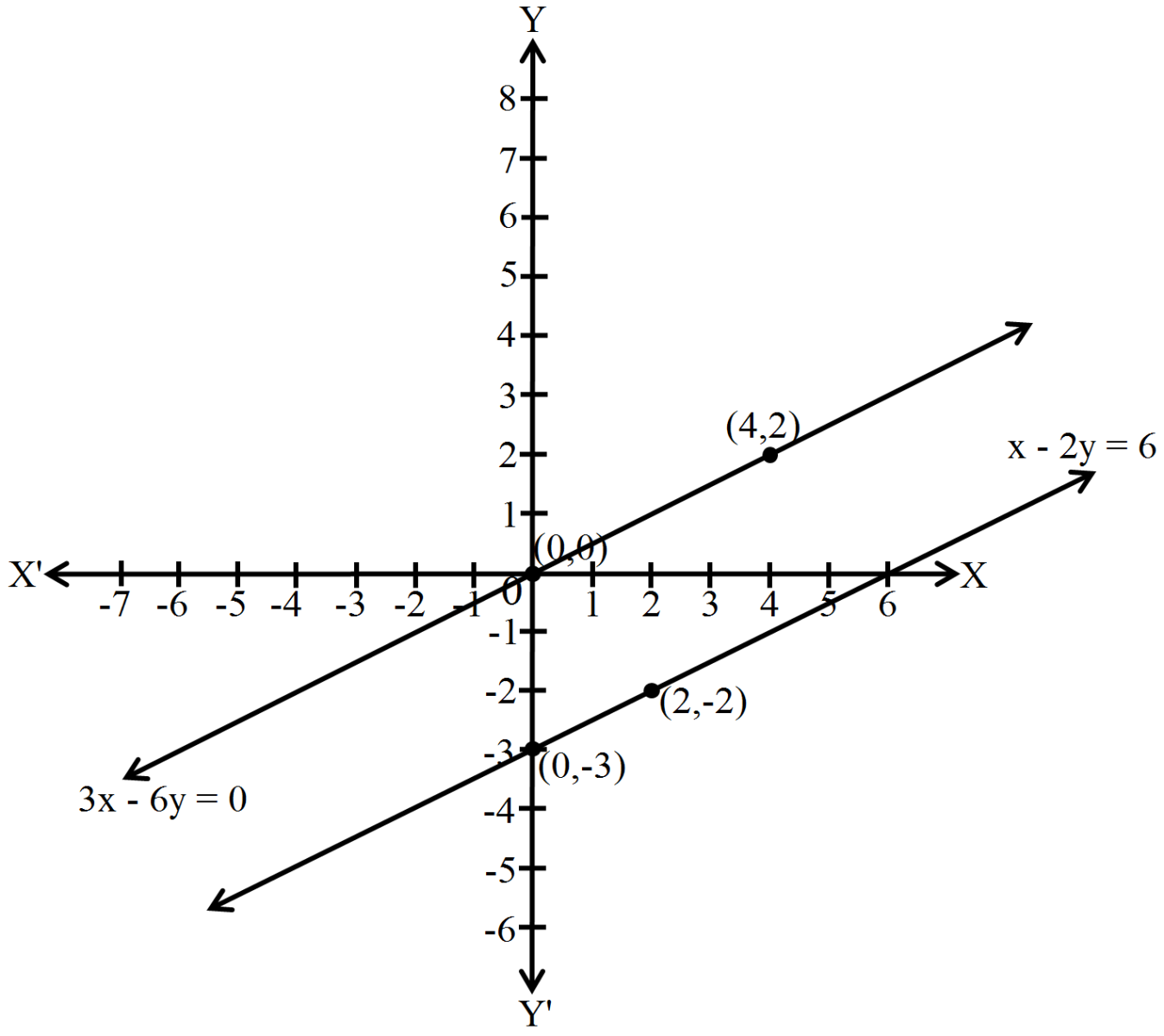
Since the two graph of the system of equations is parallel lines, the system has no solution and hence is inconsistent. View full question & answer→