MCQ 511 Mark
If $\tan \theta=\frac{5}{12}$, then the oalue of $\frac{\sin \theta+\cos \theta}{\sin \theta-\cos \theta}$ is
- ✓
$-\frac{17}{7}$
- B
$\frac{17}{7}$
- C
$\frac{17}{13}$
- D
$-\frac{7}{13}$
AnswerCorrect option: A. $-\frac{17}{7}$
(A)$-\frac{17}{7}$
$
\text { SOLUTION } \frac{\sin \theta+\cos \theta}{\sin \theta-\cos \theta}=\frac{\frac{\sin \theta+\cos \theta}{\cos \theta}}{\frac{\sin \theta-\cos \theta}{\cos \theta}}
$ $\qquad$ [Dividing the numerator and denominator by $\cos \theta$ ]
$=\frac{\frac{\sin \theta}{\cos \theta}+1}{\frac{\sin \theta}{\cos \theta}-1}=\frac{\tan \theta+1}{\tan \theta-1}=\frac{\frac{5}{12}+1}{\frac{5}{12}-1}=\frac{17}{-7}=-\frac{17}{7}$
View full question & answer→MCQ 521 Mark
$\sec \theta$ when expresed in terms of $\cot \theta$, is equal to
- A
$\frac{1+\cot ^2 \theta}{\cot \theta}$
- B
$\sqrt{1+\cot ^2 \theta}$
- ✓
$\frac{\sqrt{1+\cot ^2 \theta}}{\cot \theta}$
- D
$\frac{\sqrt{1-\cot ^2 \theta}}{\cot \theta}$
AnswerCorrect option: C. $\frac{\sqrt{1+\cot ^2 \theta}}{\cot \theta}$
(C)$\frac{\sqrt{1+\cot ^2 \theta}}{\cot \theta}$
$
\begin{array}{l}
\text { } 1+\cot ^2 \theta=\operatorname{cosec}^2 \theta \Rightarrow \sqrt{1+\cot ^2 \theta}=\operatorname{cosec} \theta \\
\qquad \frac{\sqrt{1+\cot ^2 \theta}}{\cot \theta}=\frac{\operatorname{cosec} \theta}{\cot \theta}=\frac{1}{\sin \theta} \times \frac{\sin \theta}{\cos \theta}=\frac{1}{\cos \theta}=\sec \theta
\end{array}
$
View full question & answer→MCQ 531 Mark
If $\sin \theta-\cos \theta=0$, then the value of $\sin ^4 \theta+\cos ^4 \theta$ is
- A
- ✓
$\frac{1}{2}$
- C
$\frac{1}{4}$
- D
$\frac{3}{4}$
AnswerCorrect option: B. $\frac{1}{2}$
(B)$\frac{1}{2}$
We have,
$
\begin{array}{l}
\therefore \quad \sin \theta-\cos \theta=0 \Rightarrow \sin \theta=\cos \theta \Rightarrow \frac{\sin \theta}{\cos \theta}=1 \Rightarrow \tan \theta=1 \Rightarrow \theta=45^{\circ} \\
\therefore \quad \sin ^4 \theta+\cos ^4 \theta=\left(\sin 45^{\circ}\right)^4+\left(\cos 45^{\circ}\right)^4=\left(\frac{1}{\sqrt{2}}\right)^4+\left(\frac{1}{\sqrt{2}}\right)^4=\frac{1}{4}+\frac{1}{4}=\frac{1}{2}
\end{array}
$
View full question & answer→MCQ 541 Mark
In a $\triangle A B C$, right angled at $B$, the value of $\sin (A+C)$ is
- A
$0$
- ✓
- C
$\frac{1}{2}$
- D
$\frac{\sqrt{3}}{2}$
Answer(B)1
In $\triangle A B C$, it is given that $\angle B=90^{\circ}$
$
\therefore \quad A+B+C=180^{\circ} \Rightarrow A+90^{\circ}+C=180^{\circ} \Rightarrow A+C=90^{\circ} \Rightarrow \sin (A+C)=\sin 90^{\circ}=1
$
View full question & answer→MCQ 551 Mark
If $\sin \theta+\cos \theta=\sqrt{2} \cos \theta, \theta \neq 90^{\circ}$, then $\tan \theta=$
- ✓
$\sqrt{2}-1$
- B
$\sqrt{2}+1$
- C
$\sqrt{2}$
- D
$-\sqrt{2}$
AnswerCorrect option: A. $\sqrt{2}-1$
(A)$\sqrt{2}-1$
We have,
$
\sin \theta+\cos \theta=\sqrt{2} \cos \theta \Rightarrow \sin \theta=(\sqrt{2}-1) \cos \theta \Rightarrow \frac{\sin \theta}{\cos \theta}=\sqrt{2}-1 \Rightarrow \tan \theta=\sqrt{2}-1
$
View full question & answer→MCQ 561 Mark
If $\sin \alpha=\frac{\sqrt{3}}{2}$ and $\cos \beta=0$, then the value of $\tan (\beta-\alpha)$ is
- A
- B
$\sqrt{3}$
- ✓
$\frac{1}{\sqrt{3}}$
- D
$\frac{\sqrt{3}}{2}$
AnswerCorrect option: C. $\frac{1}{\sqrt{3}}$
(C)$\frac{1}{\sqrt{3}}$
We have,
$
\begin{array}{ll}
& \sin \alpha=\frac{\sqrt{3}}{2} \text { and } \cos \beta=0 \Rightarrow \sin \alpha=\sin 60^{\circ} \text { and } \cos \beta=\cos 90^{\circ} \Rightarrow \alpha=60^{\circ} \text { and } \beta=90^{\circ} \\
\therefore \quad & \tan (\beta-\alpha)=\tan \left(90^{\circ}-60^{\circ}\right)=\tan 30^{\circ}=1 / \sqrt{3}
\end{array}
$
View full question & answer→MCQ 571 Mark
$\frac{3}{4} \tan ^2 30^{\circ}-\sec ^2 45^{\circ}+\sin ^2 60^{\circ}$ is equal to
- ✓
- B
$\frac{5}{6}$
- C
$-\frac{3}{2}$
- D
$\frac{1}{6}$
Answer(A)-1
$
\begin{aligned}
\text { } & \frac{3}{4} \tan ^2 30^{\circ}-\sec ^2 45^{\circ}+\sin ^2 60^{\circ} \\
= & \frac{3}{4}\left(\frac{1}{\sqrt{3}}\right)^2-(\sqrt{2})^2+\left(\frac{\sqrt{3}}{2}\right)^2=\frac{3}{4} \times \frac{1}{3}-2+\frac{3}{4}=1-2=-1
\end{aligned}
$
View full question & answer→MCQ 581 Mark
Given that $\sin (A+2 B)=\frac{\sqrt{3}}{2}$ and $\cos (A+4 B)=0$, where $A$ and $B$ are acute angles. The value of $A$ is
- ✓
$30^{\circ}$
- B
$45^{\circ}$
- C
$60^{\circ}$
- D
$90^{\circ}$
AnswerCorrect option: A. $30^{\circ}$
(A)$30^{\circ}$
We have, $\sin (A+2 B)=\frac{\sqrt{3}}{2}$ and $\cos (A+4 B)=0$
$
\begin{array}{ll}
\therefore & \sin (A+2 B)=\sin 60^{\circ} \text { and } \cos (A+4 B)=\cos 90^{\circ} \\
\Rightarrow & A+2 B=60^{\circ} \text { and } A+4 B=90^{\circ} \\
\Rightarrow & 2 A+4 B=120^{\circ} \text { and } A+4 B=90^{\circ} \Rightarrow(2 A+4 B)-(A+4 B)=120^{\circ}-90^{\circ} \Rightarrow A=30^{\circ}
\end{array}
$
View full question & answer→MCQ 591 Mark
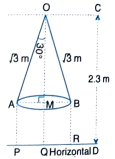
A pendulum of length $\sqrt{3} m$ is attached to a point 2.3 m from the ground. It swings through an angle of $30^{\circ}$ on each side of the vertical. The height above the ground at ends of its path is
Answer(D)0.8m
In right triangle $A M O$, we obtain
$
\begin{array}{ll}
& \cos 30^{\circ}=\frac{O M}{O A} \Rightarrow \frac{\sqrt{3}}{2}=\frac{O M}{\sqrt{3}} \Rightarrow O M=\frac{3}{2} m=1.5 m \\
\therefore & A P=B R=M Q \\
\Rightarrow & A P=B R=O Q-O M=2.3 m-1.5 m=0.8 m
\end{array}
$
View full question & answer→MCQ 601 Mark
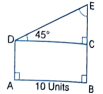
ln Fig. the value of DE is
- A
$5 \sqrt{2}$ units
- B
- ✓
$10 \sqrt{2}$ units
- D
$15 \sqrt{2}$ units
AnswerCorrect option: C. $10 \sqrt{2}$ units
(C)$10 \sqrt{2}$ units
Clearly, $C D=A B=10$ units. In right triangle $D C E$, we obtain
$
\tan 45^{\circ}=\frac{C E}{C D} \Rightarrow 1=\frac{C E}{10} \Rightarrow C E=10 \text { units }
$
Again in $\triangle D C E$, we obtain
$
\sin 45^{\circ}=\frac{C E}{D E} \Rightarrow \frac{1}{\sqrt{2}}=\frac{10}{D E} \Rightarrow D E=10 \sqrt{2} \text { units }
$
View full question & answer→MCQ 611 Mark
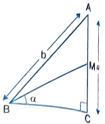
In Fig. $A M=M C$ and $\angle C$ is a right angle, then $\sin ^2 \alpha-\cos ^2 \alpha$ is equal to
- A
$\frac{4 b^2-3 a^2}{5 a^2-4 b^2}$
- ✓
$\frac{5 a^2-4 b^2}{4 b^2-3 a^2}$
- C
$\frac{4 a^2-5 b^2}{3 b^2-4 a^2}$
- D
$\frac{3 b^2-4 a^2}{4 a^2-5 b^2}$
AnswerCorrect option: B. $\frac{5 a^2-4 b^2}{4 b^2-3 a^2}$
(B)$\frac{5 a^2-4 b^2}{4 b^2-3 a^2}$
Applying Pythagoras Theorem in right triangle $A B C$, we obtain
$
A B^2=A C^2+B C^2 \Rightarrow b^2=a^2+B C^2 \Rightarrow B C=\sqrt{b^2-a^2}
$
Thus, in right triangle $B C M$, we obtain: $B C=\sqrt{b^2-a^2}$ and $C M=a / 2$.
Applying Pythagoras Theorem in $\triangle B C M$, we obtain
$
B M^2=B C^2+C M^2 \Rightarrow B M^2=b^2-a^2+\frac{a^2}{4}=\frac{4 b^2-3 a^2}{4} \Rightarrow B M=\frac{\sqrt{4 b^2-3 a^2}}{2}
$
In $\triangle B C M$, we obtain
$
\begin{aligned}
& \sin \alpha=\frac{C M}{B M}=\frac{a / 2}{\frac{\sqrt{4 b^2-3 a^2}}{2}}=\frac{a}{\sqrt{4 b^2-3 a^2}} \text { and } \cos \alpha=\frac{B C}{B M}=\frac{2 \sqrt{b^2-a^2}}{\sqrt{4 b^2-3 a^2}} \\
\therefore \quad & \sin ^2 \alpha-\cos ^2 \alpha=\frac{a^2}{4 b^2-3 a^2}-\frac{4\left(b^2-a^2\right)}{4 b^2-3 a^2}=\frac{5 a^2-4 b^2}{4 b^2-3 a^2}
\end{aligned}
$
View full question & answer→MCQ 621 Mark
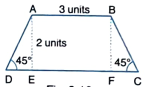
In Fig. ABCD is an isosceles trapezium, its perimeter is
- A
$(8+4 \sqrt{2})$ units
- B
$(10+2 \sqrt{2})$ units
- ✓
$(10+4 \sqrt{2})$ units
- D
$(11+4 \sqrt{2})$ units
AnswerCorrect option: C. $(10+4 \sqrt{2})$ units
(C)$(10+4 \sqrt{2})$ units
In $\triangle A E D$, we obtain
$
\tan 45^{\circ}=\frac{A E}{D E} \Rightarrow 1=\frac{2}{D E} \Rightarrow E D=2 \Rightarrow C F=2
$
Again in $\triangle A E D$, we obtain
$
\sin 45^{\circ}=\frac{A E}{A D} \Rightarrow \frac{1}{\sqrt{2}}=\frac{2}{A D} \Rightarrow A D=2 \sqrt{2}
$
$\begin{array}{l}C D=C l+I l+C D=2+3+2=7 \\ \text { Perimeter }=A B+B C+C D+A D=3+2 \sqrt{2}+7+2 \sqrt{2}=(10+4 \sqrt{2}) \text { units }\end{array}$
View full question & answer→MCQ 631 Mark
If $2 \tan A=3$, then the value of $\frac{4 \sin A+3 \cos A}{4 \sin A-3 \cos A}$ is
- A
$\frac{7}{\sqrt{13}}$
- B
$\frac{1}{\sqrt{13}}$
- ✓
- D
Answer(C)3
We have, $2 \tan A=3 \Rightarrow \tan A=\frac{3}{2}$
$
\therefore \quad \frac{4 \sin A+3 \cos A}{4 \sin A-3 \cos A}=\frac{\frac{4 \sin A+3 \cos A}{\cos A}}{\frac{4 \sin A-3 \cos A}{\cos A}}
$$\qquad$[Dividing numerator and denominator by $\cos A$ ]
$=\frac{4 \tan A+3}{4 \tan A-3}=\frac{4 \times \frac{3}{2}+3}{4 \times \frac{3}{2}-3}=\frac{9}{3}=3$
View full question & answer→MCQ 641 Mark
If $\tan \theta=\frac{4}{5}$, then the value of $\frac{5 \sin \theta-2 \cos \theta}{5 \sin \theta+2 \cos \theta}$ is
- ✓
$\frac{1}{3}$
- B
$\frac{2}{5}$
- C
$\frac{3}{5}$
- D
AnswerCorrect option: A. $\frac{1}{3}$
(A)$\frac{1}{3}$
We have, $\tan \theta=\frac{4}{5}$.
Dividing numerator and denominator by $\cos \theta$, we obtain
$
\frac{5 \sin \theta-2 \cos \theta}{5 \sin \theta+2 \cos \theta}=\frac{\frac{5 \sin \theta}{\cos \theta}-\frac{2 \cos \theta}{\cos \theta}}{\frac{5 \sin \theta}{\cos \theta}+\frac{2 \cos \theta}{\cos \theta}}=\frac{5 \tan \theta-2}{5 \tan \theta+2}=\frac{5 \times \frac{4}{5}-2}{5 \times \frac{4}{5}+2}=\frac{4-2}{4+2}=\frac{1}{3}
$
View full question & answer→MCQ 651 Mark
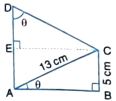
In Fig. if $A D=14 cm$, then the value of $\tan \theta$ is
- A
$\frac{14}{3}$
- ✓
$\frac{4}{3}$
- C
$\frac{5}{3}$
- D
$\frac{13}{3}$
AnswerCorrect option: B. $\frac{4}{3}$
(B)$\frac{4}{3}$
We have, $A E=B C=5 cm$
$
A D=14 cm \Rightarrow A E+D E=14 cm \Rightarrow D E=(14-5) cm=9 cm
$
In right triangle $A B C$, we obtain
$
\begin{aligned}
& A C^2=A B^2+B C^2 \\
\Rightarrow & 13^2=A B^2+5^2 \Rightarrow A B^2=169-25=144 \Rightarrow A B=12 cm \Rightarrow C E=12 cm
\end{aligned}
$
In right triangle $C E D$, we obtain
$
\tan \theta=\frac{C E}{D E}=\frac{12}{9}=\frac{4}{3}
$
View full question & answer→MCQ 661 Mark
If for some angle $\theta, \cot 2 \theta=\frac{1}{\sqrt{3}}$, then the value of $\sin 3 \theta$, where $3 \theta \leq 90^{\circ}$, is
- A
$\frac{1}{\sqrt{2}}$
- ✓
- C
$0$
- D
$\frac{\sqrt{3}}{2}$
Answer(B)1
We have, $\cot 2 \theta=\frac{1}{\sqrt{3}} \Rightarrow 2 \theta=60^{\circ} \Rightarrow \theta=30^{\circ} \Rightarrow 30=90^{\circ} \Rightarrow \sin 3 \theta=\sin 90^{\circ}=1$
View full question & answer→MCQ 671 Mark
In $\triangle A B C$, right-angled at $C$, if $\tan A=1$, then the value of $2 \sin A \cos A$ is

- ✓
- B
$\frac{1}{2}$
- C
- D
$\frac{\sqrt{3}}{2}$
Answer(A)1
In $\triangle A B C$, it is given that $\tan A=1 \Rightarrow \frac{B C}{A C}=1$
So, let $B C=x$ and $A C=x$. Using Pythagoras Theorem in $\triangle A B C$, we obtain
$
\begin{array}{l}
A B^2=A C^2+B C^2 \Rightarrow A B^2=x^2+x^2 \Rightarrow A B=\sqrt{2} x \\
\therefore \quad \sin A=\frac{B C}{A B}=\frac{x}{\sqrt{2} x}=\frac{1}{\sqrt{2}} \text { and } \cos A=\frac{A C}{A B}=\frac{x}{\sqrt{2} x}=\frac{1}{\sqrt{2}}
\end{array}
$
Hence, $2 \sin A \cos A=2 \times \frac{1}{\sqrt{2}} \times \frac{1}{\sqrt{2}}=1$
View full question & answer→MCQ 681 Mark
If $\cos \theta=\frac{2}{3}$, then $2 \sec ^2 \theta+2 \tan ^2 \theta-7$ is equal to
Answer(B)0
We have
$
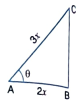
\cos \theta=\frac{2}{3} \Rightarrow \frac{\text { Base }}{\text { Hypotenuse }}=\frac{2}{3}
$
So, consider a right triangle $A B C$ with base $A B=2 t$ and hypotenuse $=A C=3 x$. Using Pythagoras Theorem, we obtain
$
A C^2=A B^2+B C^2 \Rightarrow(3 x)^2=(2 x)^2+B C^2 \Rightarrow B C=\sqrt{5} x
$
In $\triangle A B C$, we obtain
$
\begin{aligned}
& \sec \theta=\frac{3 x}{2 x}=\frac{3}{2}, \tan \theta=\frac{\sqrt{5} x}{2 x}=\frac{\sqrt{5}}{2} \\
\therefore \quad & 2 \sec ^2 \theta+2 \tan ^2 \theta-7=2 \times\left(\frac{3}{2}\right)^2+2\left(\frac{\sqrt{5}}{2}\right)^2-7=\frac{9}{2}+\frac{5}{2}-7=0
\end{aligned}
$
View full question & answer→MCQ 691 Mark
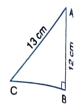
In Fig. $\tan A-\cot C$ is equal to
- ✓
$0$
- B
$\frac{5}{12}$
- C
$\frac{7}{13}$
- D
$-\frac{7}{13}$
Answer(A)0
In right triangle $A B C$, we have $A B=12 cm, A C=13 cm$.
$
\begin{array}{ll}
\therefore & A C^2=A B^2+B C^2 \Rightarrow B C=\sqrt{A C^2-A B^2}=\sqrt{169-144}=5 \\
\therefore & \tan A=\frac{B C}{A B} \text { and } \cot C=\frac{B C}{A B} \\
\Rightarrow & \tan A=\frac{5}{12} \text { and } \cot C=\frac{5}{12} \Rightarrow \tan A-\cot C=0
\end{array}
$
View full question & answer→MCQ 701 Mark
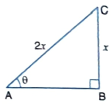
If $\operatorname{cosec} \theta=2$ and $\cot \theta=\sqrt{3} a$, then the value of $a$ is
- ✓
- B
- C
$\sqrt{3}$
- D
$2 / \sqrt{3}$
Answer(A)1
We have, $\operatorname{cosec} \theta=2$ and $\cot \theta=\sqrt{3} a$
$
\begin{array}{ll}
\Rightarrow & \frac{A C}{B C}=2 \text { and } \frac{A B}{B C}=\sqrt{3} a \\
\Rightarrow & B C=\frac{1}{2} A C \text { and } A B=\sqrt{3} a B C \\
\Rightarrow & B C=\frac{1}{2} A C \text { and } A B=\frac{\sqrt{3}}{2} a A C
\end{array}
$
Applying Pythagoras Theorem in $\triangle A B C$, we obtain
$
\begin{array}{ll}
& A B^2+B C^2=A C^2 \\
\Rightarrow \quad & \frac{3}{4} a^2 A C^2+\frac{1}{4} A C^2=A C^2 \\
\Rightarrow \quad & \frac{3}{4} a^2+\frac{1}{4}=1 \Rightarrow \frac{3}{4} a^2=\frac{3}{4} \Rightarrow a^2=1 \Rightarrow a=1
\end{array}
$
ALITER We have, $\operatorname{cosec} \theta=\frac{2}{1}$. So, consider a right triangle $A B C$ with hypotenuse $(=A C)=2 x$ and perpendicular $(=B C)=x$. Applying Pythagoras Theorem in $\triangle A B C$, we obtain
$
\begin{array}{l}
A C^2=A B^2+B C^2 \Rightarrow 4 x^2=A B^2+x^2 \Rightarrow A B=\sqrt{3} x \\
\therefore \quad \cot \theta=\frac{A B}{B C} \Rightarrow \cot \theta=\frac{\sqrt{3} x}{x} \Rightarrow \cot \theta=\sqrt{3} \Rightarrow \sqrt{3} a=\sqrt{3} \Rightarrow x=1
\end{array}
$
View full question & answer→MCQ 711 Mark
If $A$ is an acute angle in a right triangle $A B C$, right angled at $B$, then the value of $\sin A+\cos A$ is
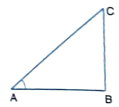
Answer(B)greater than 1
In $\triangle A B C$, we find that
$
\begin{aligned}
& \sin A=\frac{B C}{A C} \text { and } \cos A=\frac{A B}{A C} \\
\Rightarrow \quad & \sin A+\cos A=\frac{B C}{A C}+\frac{A B}{A C}=\frac{A B+B C}{A C}
\end{aligned}
$
In $\triangle A B C$, the sum of any two sides is greater than the third side.
$
\therefore \quad A B+B C>A C \Rightarrow \frac{A B+B C}{A C}>1 \Rightarrow \sin A+\cos A>1
$
View full question & answer→MCQ 721 Mark
In Fig. $\triangle A B C$ is right-angled at $B$ and $\tan A=\frac{4}{3}$. If $A C=5 cm$, then the length of $B C$ is
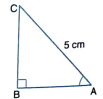
Answer(A)4 cm
We have,
$
\tan A=\frac{4}{3} \Rightarrow \frac{B C}{A B}=\frac{4}{3} \Rightarrow A B=\frac{3}{4} B C
$
Applying Pythagoras Theorem in $\triangle A B C$, we obtain
$
\begin{aligned}
& A B^2+B C^2=A C^2 \\
\Rightarrow & \left(\frac{3}{4} B C\right)^2+B C^2=25 \Rightarrow 9 B C^2+16 B C^2=400 \Rightarrow 25 B C^2=400 \Rightarrow B C^2=16 \Rightarrow B C=4
\end{aligned}
$
View full question & answer→MCQ 731 Mark
If $0 \leq A, B \leq 90^{\circ}$ such that $\sin A=\frac{1}{2}$ and $\cos B=\frac{1}{2}$, then $A+B=$
- A
$0^{\circ}$
- B
$60^{\circ}$
- ✓
$90^{\circ}$
- D
$30^{\circ}$
AnswerCorrect option: C. $90^{\circ}$
(C)$90^{\circ}$
We have, $\sin A=\frac{1}{2}$ and $\cos B=\frac{1}{2} \Rightarrow A=30^{\circ}$ and $B=60^{\circ} \Rightarrow A+B=90^{\circ}$
View full question & answer→MCQ 741 Mark
If $\cos \theta=\frac{1}{2}$, then $\cos \theta-\sec \theta$ is equal to
- A
$\frac{3}{2}$
- ✓
$-\frac{3}{2}$
- C
$\frac{\sqrt{3}}{2}$
- D
$-\frac{\sqrt{3}}{2}$
AnswerCorrect option: B. $-\frac{3}{2}$
(B)$-\frac{3}{2}$
We have, $\cos \theta=\frac{1}{2}$. Therefore, $\sec \theta=\frac{1}{\cos \theta}=2$. Hence, $\cos \theta-\sec \theta=\frac{1}{2}-2=-\frac{3}{2}$
ALITER $\cos \theta=\frac{1}{2} \Rightarrow \theta=60^{\circ} \Rightarrow \sec \theta=\sec 60^{\circ}=2$
Hence, $\quad \cos \theta-\sec \theta=\frac{1}{2}-2=-\frac{3}{2}$
View full question & answer→MCQ 751 Mark
For $0^{\circ} \leq \theta<90^{\circ}$, the maximum value of $\frac{1}{\sec \theta}$ is
- ✓
- B
$0$
- C
- D
$\frac{\sqrt{3}}{2}$
Answer(A)1
We find that $\frac{1}{\sec \theta}=\cos \theta$, which attains all values between 0 and 1 (including 1 but excluding 0 ) as $\theta$ varies between $0^{\circ}$ to $90^{\circ}$. Hence, the maximum value of $\frac{1}{\sec \theta}$ is 1 .
View full question & answer→MCQ 761 Mark
Which of the following is not defined?
- A
$\cos 0^{\circ}$
- B
$\tan 45^{\circ}$
- ✓
$\sec 90^{\circ}$
- D
$\sin 90^{\circ}$
AnswerCorrect option: C. $\sec 90^{\circ}$
(C) $\sec 90^{\circ}$
By using definitions of various trigonometric ratios, we find that $\sec 90^{\circ}$ is undefined.
AUTER $\sec 90^{\circ}=\frac{1}{\cos 90^{\circ}}=\frac{1}{0}$, which is undefined.
View full question & answer→MCQ 771 Mark
In Fig. if $D$ is the mid-point of $B C$, then the value of $\frac{\cot y^{\circ}}{\cot x^{\circ}}$ is
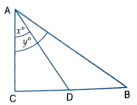
- A
- ✓
$1 / 2$
- C
$1 / 3$
- D
$3 / 4$
AnswerCorrect option: B. $1 / 2$
View full question & answer→MCQ 781 Mark
In Fig. the value of $\cos \phi$ is
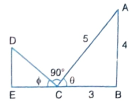
- A
$\frac{5}{4}$
- B
$\frac{5}{3}$
- C
$\frac{3}{5}$
- ✓
$\frac{4}{5}$
AnswerCorrect option: D. $\frac{4}{5}$
View full question & answer→MCQ 791 Mark
If $\cos \theta=\frac{2}{3}$, then $2 \sec ^2 \theta+2 \tan ^2 \theta-7$ is equal to
View full question & answer→MCQ 801 Mark
If $\theta$ is an acute angle such that $\sec ^2 \theta=3$, then the value of $\frac{\tan ^2 \theta-\operatorname{cosec}^2 \theta}{\tan ^2 \theta+\operatorname{cosec}^2 \theta}$ is
- A
$\frac{4}{7}$
- B
$\frac{3}{7}$
- C
$\frac{2}{7}$
- ✓
$\frac{1}{7}$
AnswerCorrect option: D. $\frac{1}{7}$
View full question & answer→MCQ 811 Mark
If angles $A, B, C$ of a $\triangle A B C$ form an increasing $A P$, then $\sin B=$
- A
$\frac{1}{2}$
- ✓
$\frac{\sqrt{3}}{2}$
- C
- D
$\frac{1}{\sqrt{2}}$
AnswerCorrect option: B. $\frac{\sqrt{3}}{2}$
View full question & answer→MCQ 821 Mark
If $x \tan 45^{\circ} \cos 60^{\circ}=\sin 60^{\circ} \cot 60^{\circ}$, then $x$ is equal to
- ✓
- B
$\sqrt{3}$
- C
$\frac{1}{2}$
- D
$\frac{1}{\sqrt{2}}$
View full question & answer→MCQ 831 Mark
If $\frac{x \operatorname{cosec}^2 30^{\circ} \sec ^2 45^{\circ}}{8 \cos ^2 45^{\circ} \sin ^2 60^{\circ}}=\tan ^2 60^{\circ}-\tan ^2 30^{\circ}$, then $x=$
View full question & answer→MCQ 841 Mark
If $\tan ^2 45^{\circ}-\cos ^2 30^{\circ}=x \sin 45^{\circ} \cos 45^{\circ}$, then $x=$
- A
- B
- C
$-\frac{1}{2}$
- ✓
$\frac{1}{2}$
AnswerCorrect option: D. $\frac{1}{2}$
View full question & answer→MCQ 851 Mark
If $3 \cos \theta=5 \sin \theta$, then the value of $\frac{5 \sin \theta-2 \sec ^3 \theta+2 \cos \theta}{5 \sin \theta+2 \sec ^3 \theta-2 \cos \theta}$ is
- ✓
$\frac{271}{979}$
- B
$\frac{316}{2937}$
- C
$\frac{542}{2937}$
- D
AnswerCorrect option: A. $\frac{271}{979}$
View full question & answer→MCQ 861 Mark
If $\theta$ is an acute angle such that $\tan ^2 \theta=\frac{8}{7}$, then the value of $\frac{(1+\sin \theta)(1-\sin \theta)}{(1+\cos \theta)(1-\cos \theta)}$ is
- ✓
$\frac{7}{8}$
- B
$\frac{8}{7}$
- C
$\frac{7}{4}$
- D
$\frac{64}{49}$
AnswerCorrect option: A. $\frac{7}{8}$
View full question & answer→MCQ 871 Mark
If $\tan \theta=\frac{3}{4}$, then $\cos ^2 \theta-\sin ^2 \theta=$
- ✓
$\frac{7}{25}$
- B
- C
$\frac{-7}{25}$
- D
$\frac{4}{25}$
AnswerCorrect option: A. $\frac{7}{25}$
View full question & answer→MCQ 881 Mark
If $\tan \theta=\frac{1}{\sqrt{7}}$, then $\frac{\operatorname{cosec}^2 \theta-\sec ^2 \theta}{\operatorname{cosec}^2 \theta+\sec ^2 \theta}=$
- A
$\frac{5}{7}$
- B
$\frac{3}{7}$
- C
$\frac{1}{12}$
- ✓
$\frac{3}{4}$
AnswerCorrect option: D. $\frac{3}{4}$
View full question & answer→MCQ 891 Mark
If $8 \tan x=15$, then $\sin x-\cos x$ is equal to
- A
$\frac{8}{17}$
- B
$\frac{17}{7}$
- C
$\frac{1}{17}$
- ✓
$\frac{7}{17}$
AnswerCorrect option: D. $\frac{7}{17}$
View full question & answer→MCQ 901 Mark
If $16 \cot x=12$, then $\frac{\sin x-\cos x}{\sin x+\cos x}$ equals
- ✓
$\frac{1}{7}$
- B
$\frac{3}{7}$
- C
$\frac{2}{7}$
- D
$0$
AnswerCorrect option: A. $\frac{1}{7}$
View full question & answer→MCQ 911 Mark
If $5 \tan \theta-4=0$, then the value of $\frac{5 \sin \theta-4 \cos \theta}{5 \sin \theta+4 \cos \theta}$ is
- A
$\frac{5}{3}$
- B
$\frac{5}{6}$
- ✓
$0$
- D
$\frac{1}{6}$
View full question & answer→MCQ 921 Mark
If $\tan \theta=\frac{a}{b}$, then $\frac{a \sin \theta+b \cos \theta}{a \sin \theta-b \cos \theta}$ is equal to
AnswerCorrect option: A. $\frac{a^2+b^2}{a^2-b^2}$
View full question & answer→MCQ 931 Mark
If $\theta$ is an acute angle such that $\cos \theta=\frac{3}{5}$, then $\frac{\sin \theta \tan \theta-1}{2 \tan ^2 \theta}=$
- A
$\frac{16}{625}$
- B
$\frac{1}{36}$
- ✓
$\frac{3}{160}$
- D
$\frac{160}{3}$
AnswerCorrect option: C. $\frac{3}{160}$
View full question & answer→MCQ 941 Mark
If the angle of $\triangle A B C$ are in the ratio $1: 1: 2$ respectively (the largest angle being angle $C$ ), then the value of $\frac{\sec A}{\operatorname{cosec} B}-\frac{\tan A}{\cot B}$ is
- ✓
$0$
- B
$1 / 2$
- C
- D
$\sqrt{3} / 2$
View full question & answer→MCQ 951 Mark
If $\triangle A B C$ right angled at $B$. If $\tan A=\sqrt{3}$, then $\cos A \cos C-\sin A \sin C=0$
View full question & answer→MCQ 961 Mark
If $4 \tan \beta=3$, then $\frac{4 \sin \beta-3 \cos \beta}{4 \sin \beta+3 \cos \beta}=$
- ✓
$0$
- B
$1 / 3$
- C
$2 / 3$
- D
$7 / 25$
View full question & answer→MCQ 971 Mark
If $\sin \theta=x$ and $\sec \theta=y$, then $\tan \theta$ is equal to
- ✓
$x y$
- B
$x / y$
- C
$y / x$
- D
$1 / x y$
View full question & answer→