Question types

Human Eye and Colourful World question types

598 questions across 9 question groups — pick any mix to generate a Science paper with step-by-step answer keys.

598
Questions
9
Question groups
5
Question types
Sample Questions

Human Eye and Colourful World questions

One sample from each question group in this chapter. Select any group above to see the full set with answer keys.

Q 1M.C.Q1 Mark
In the following diagram, the path of a ray of light passing through a glass prism is shown :
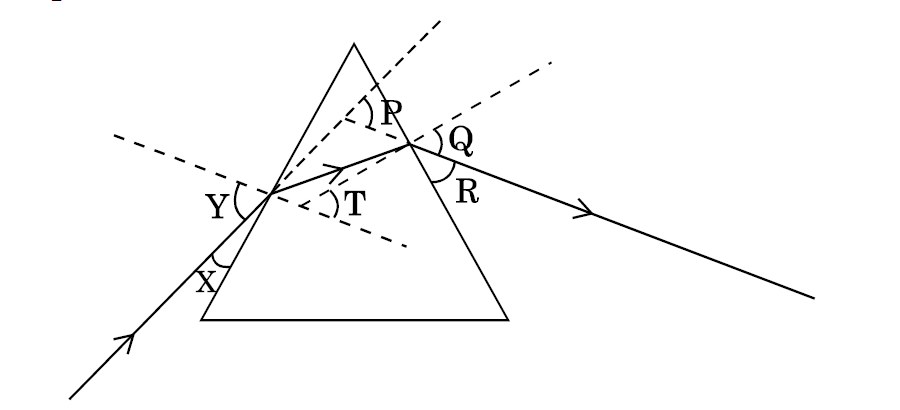
In this diagram the angle of incidence, the angle of emergence and the angle of deviation respectively are $($select the correct option$) :$
  • A
    $X, R$ and $T.$
  • B
    $Y, Q$ and $T.$
  • C
    $X, Q$ and $P.$
  • $Y, Q$ and $P.$

Answer: D.

View full solution
Q 2M.C.Q1 Mark
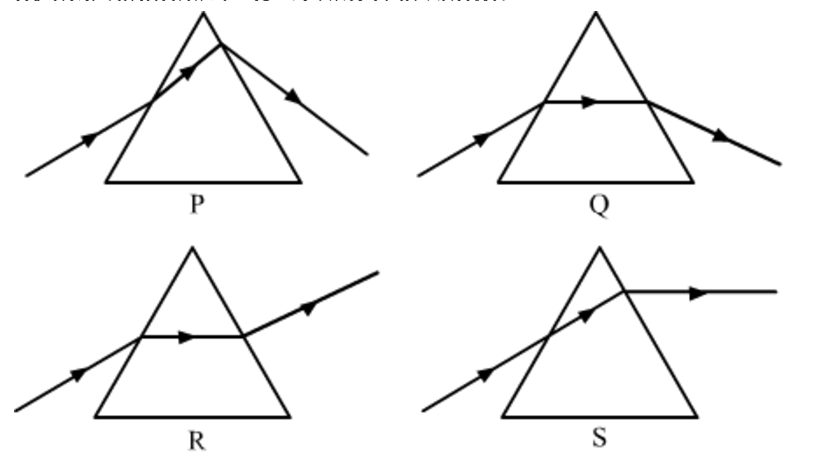
Study the following diagrams in which the path of a ray of light passing through a glass prism as traced by four students $\ce{P, Q, R}$ and $S$ is shown :

The student who has traced the path correctly is
  • A
    $P$
  • $Q$
  • C
    $R$
  • D
    $S$

Answer: B.

View full solution
Q 3M.C.Q1 Mark
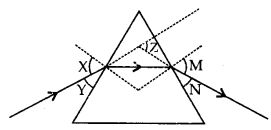
For the refraction of a ray of light through a glass prism, the path of a ray of light is shown below :
The angle of incidence, the angle of emergence and the angle of deviation respectively have been represented by
  • A
    $\ce{Y, N, Z}.$
  • B
    $\ce{X, Z, M}.$
  • C
    $\ce{X, N, Z}.$
  • $\ce{X, M, Z}.$

Answer: D.

View full solution
Q 4M.C.Q1 Mark
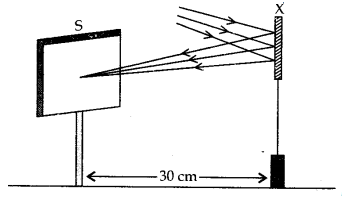
A student focussed the image of a distant object using a device $X$ on a white screen S as shown in the figure. If the distance of the screen from the device is $30 \ cm,$ select the correct statement about the device $X.$​​​​​​​
  • A
    The device $X$ is a concave mirror of focal length $15 \ cm$
  • The device $X$ is a concave mirror of focal length $30 \ cm.$
  • C
    The device $X$ is a concave mirror of radius of curvature $30 \ cm.$
  • D
    The device $X$ is a convex mirror of focal length $30 \ cm.$

Answer: B.

View full solution
Q 5M.C.Q1 Mark
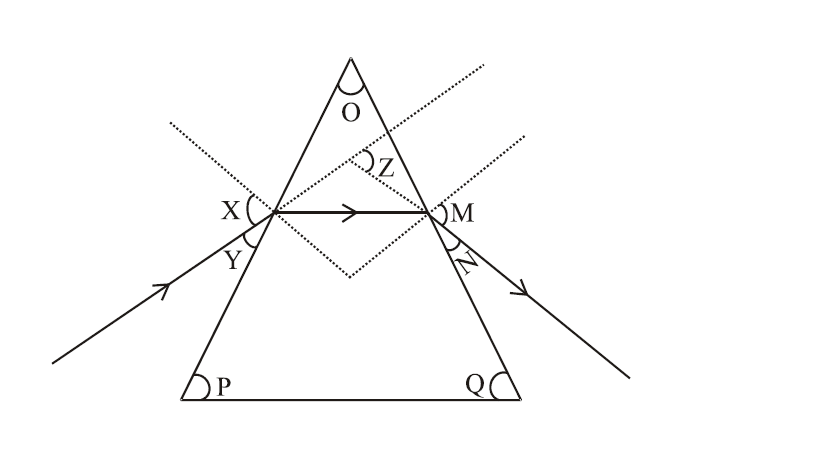
The path of a ray of light passing through a glass prism is shown below : In this diagram the angle of prism, angle of incidence, angle of emergence and angle of deviation respectively have been represented by
  • A
    $\ce{O, Y, Z}$ and $\ce{N}.$
  • B
    $\ce{P, Y, M}$ and $\ce{Z.}$
  • $\ce{O, X, M}$ and $\ce{Z.}$
  • D
    $\ce{P, X, Z}$ and $\ce{N}.$

Answer: C.

View full solution
For two statements are given $-$ one labelled Assertion $(A)$ and the other labelled Reason $(R)$. Select the correct answer to these questions from the codes $\ce{(a), (b), (c)}$ and $(d)$ as given below :
Assertion : The twinkling of stars is due to the fact that refractive index of the earth's atmosphere fluctuates.
Reason : When light propagates from one medium to another its direction of propagation changes.
  • Both $A$ and $R$ are true and $R$ is correct explanation of the assertion.
  • B
    Both $A$ and $R$ are true but $R$ is not the correct explanation of the assertion.
  • C
    $A$ is true but $R$ is false.
  • D
    $A$ is false but $R$ is true.

Answer: A.

View full solution
In the following questions, a statement of Assertion is given by the corresponding statement of Reason. Of the statements, mark the correct answer as :
Assertion : Rainbow is an example of the dispersion of sunlight by the water droplets.
Reason : Light of shorter wavelength is scattered much more than light of larger wavelength.
  • A
    If both Assertion and Reason are true and Reason is the correct explanation of Assertion.
  • If both Assertion and Reason are true, but Reason is not the correct explanation of Assertion.
  • C
    If Assertion is true, but Reason is false.
  • D
    If Assertion is false, but Reason is true.

Answer: B.

View full solution
In the following questions, a statement of Assertion is given by the corresponding statement of Reason. Of the statements, mark the correct answer as :
Assertion : An image formed on retina is real. diminished and inverted in nature.
Reason : The eye lens is convex lens.
  • A
    If both Assertion and Reason are true and Reason is the correct explanation of Assertion.
  • If both Assertion and Reason are true, but Reason is not the correct explanation of Assertion.
  • C
    If Assertion is true, but Reason is false.
  • D
    If Assertion is false, but Reason is true.

Answer: B.

View full solution
For two statements are given $-$ one labelled Assertion $(A)$ and the other labelled Reason $(R).$ Select the correct answer to these questions from the codes $\ce{(a), (b), (c)}$ and $(d)$ as given below :
Assertion : The rainbow is seen when the sun is behind the observer.
Reason : Rainbow is produced due to dispersion of white light by small rain drops hanging in the air after the rain.
  • A
    Both $A$ and $R$ are true and $R$ is correct explanation of the assertion.
  • Both $A$ and $R$ are true but $R$ is not the correct explanation of the assertion.
  • C
    $A$ is true but $R$ is false.
  • D
    $A$ is false but $R$ is true.

Answer: B.

View full solution
For two statements are given $-$ one labelled Assertion $(A)$ and the other labelled Reason $(R)$. Select the correct answer to these questions from the codes $\ce{(a), (b), (c)}$ and $(d)$ as given below :
Assertion : The scattering of longer wavelengths of light increases as the size of the particles increases.
Reason : Large particles scatter lights of all wavelengths equally well.
  • A
    Both $A$ and $R$ are true and $R$ is correct explanation of the assertion.
  • Both $A$ and $R$ are true but $R$ is not the correct explanation of the assertion.
  • C
    $A$ is true but $R$ is false.
  • D
    $A$ is false but $R$ is true.

Answer: B.

View full solution
Q 16True-False1 Mark
State whether the following statements are true or false:
  1. The scattering away of red light makes the sky appear blue during the day time.
  2. The scattering away of blue light makes the sun appear red at sunset.
View full solution
Q 18True-False1 Mark
State whether the following statement is true or false:
The planets twinkle at night due to atmospheric refraction of light.
View full solution
When we place a glass prism in the path of a narrow beam of white light a spectrum is obtained. What happens when a second identical prism is placed in an inverted position with respect to the first prism? Draw a labelled ray diagram to illustrate it.
View full solution
What is ‘‘dispersion of white light’’? Draw a labelled diagram to illustrate the recombination of the spectrum of white light. Why is it essential that the two prisms used for the purpose should be identical and placed in an inverted position with respect to each other?
View full solution
State the cause of dispersion of white light by a glass prism. How did Newton, using two identical glass prisms, show that white light is made of seven colours ? Draw a ray diagram to show the path of a narrow beam of white light, through a combination of two identical prisms arranged together in inverted position with respect to each other, when it is allowed to fall obliquely on one of the faces of the first prism of the combination.
View full solution
  1. List the parts of the human eye that control the amount of light entering into it. Explain how they perform this function.
  2. Write the function of retina in human eye.
  3. Do you know that the corneal-impairment can be cured by replacing the defective cornea with the cornea of the donated eye? How and why should we organise groups to motivate the community members to donate their eyes after death?
View full solution
What is atmospheric refraction? Use this phenomenon to explain the following natural events.
  1. Twinkling of stars.
  2. Advanced sun-rise and delayed sun-set.
Draw diagrams to illustrate your answers.
View full solution
Write the importance of ciliary muscles in the human eye. Name the defect of vision that arises due to gradual weakening of the ciliary muscles in old age. What type of lenses are required by the persons suffering from this defect to see the objects clearly?
Akshay, sitting in the last row in his class, could not see clearly the words written on the blackboard. When the teacher noticed it, he announced if any student sitting in the front row could volunteer to exchange his seat with Akshay. Salman immediately agreed to exchange his seat with Akshay. He could now see the words written on the blackboard clearly. The teacher thought it fit to send the message to Akshay’s parents advising them to get his eyesight checked.
In the context of the above event, answer the following questions:
  1. Which defect of vision is Akshay suffering from? Which type of lens is used to correct this defect?
  2. State the values displayed by the teacher and Salman.
  3. In your opinion, in what way can Akshay express his gratitude towards the teacher and Salman?
View full solution
  1. A student suffering from myopia is not able to see distinctly the objects placed beyond 5 m. List two possible reasons due to which this defect of vision may have arisen. With the help of ray diagrams, explain.
  1. Why the student is unable to see distinctly the objects placed beyond 5 m from his eyes.
  2. The type of the corrective lens used to restore proper vision and how this defect is corrected by the use of this lens.
  1. If, in this case, the numerical value of the focal length of the corrective lens is 5 m, find the power of the lens as per the new Cartesian sign convention.
View full solution
  1. A student cannot see clearly a chart hanging on a wall placed at a distance of 3 m from his eyes. Name the defect of vision he is suffering from. Draw a ray diagram to illustrate this defect. List its two possible causes.
  2. Draw a ray diagram to show how this defect may be corrected using a lens of apropriate focal length.
  3. An eye donation camp is being organised by social workers in your locality. How and why would you help in this cause?
View full solution
The lens of the eye does little of the bending of the light rays. Most of the refraction is done at the front surface of the cornea which also acts as a protective covering. The lens acts as a fine adjustment for focussing at different distances. This is accomplished by the ciliary muscle, which change the curvature of the lens so that its focal length is changed. To focus on a distant object, the muscles are relaxed and the lens is thin and parallel rays focus at the focal point (on the retina). To focus on a nearby object, the muscles contract, causing the centre of the lens to be thicker, thus shortening the focal length so that images of nearby objects can be focused on the retina, behind the focal point. This focusing adjustment is called accommodation.
The closest distance at which the eye can focus clearly is called the near point of the eye. A given person's far point is the farthest distance at which an object can be seen clearly. To check your own near point, place this book close to your eye and slowly move it away until the type is sharp.
A large part of the population have eyes that do not accommodate within the normal range of $25 cm$ to infinity, or have some other defect. Two common defects are near-sightedness and far-sightedness. Both can be corrected to a large extent with lenses-either eyeglasses or contact lenses.
(i) The ciliary muscle muscles of a normal eye are in their (i). most relaxed (ii). most contracted state. In which of the two cases is the focal length of the eye-lens more?
(ii) What is the least distinct of vision of young man?
(iii) What is persistence of vision?
or
(iv) What is meant by power of accommodation of the eye?
View full solution
A near sighted person wears eye glass with power of $-5.0$ D for distant vision. Soon, he started having difficulties in viewing nearby objects also. His doctor prescribes a correction of $+1.5 D$ in near vision section of his bi-focal, which is measured relative to main part of the lens.

(i) Find the focal length of his distant viewing part of lens.
(ii) Find the focal length of near vision section of the lens.
(iii) What type of lens is to be used in this spectacles for near vision?
or
(iv) What is the reason of hypermetropia?

View full solution
The ciliary muscle muscles of eye control the curvature of the lens in the eye and hence can alter the effective focal length of the system. When the muscles are fully relaxed, the focal length is maximum. When the muscles are strained the curvature of lens increases (that means radius of curvature decreases) and focal length decreases. For a clear vision the image must be on retina. The image distance is therefore fixed for clear vision and it equals the distance of retina from eye-lens. It is about $2.5 cm$ for a grown-up person. A person can theoretically have clear vision of objects situated at any large distance from the eye. The smallest distance at which a person can clearly see is related to minimum possible focal length, The ciliary muscles are most strained in this position. For an average grown-up person minimum distance of object should be around 25 cm. A person suffering for eye defects uses spectacles (Eye glass). The function of lens of spectacles is to form the image of the objects within the range in which person can see clearly. The image of the spectacle-lens becomes object for eye-lens and whose image is formed on retina. The number of spectacle-lens used for the remedy of eye defect is decided by the power of the lens required and the number of spectacle-lens is equal to the numerical value of the power of lens with sign. For example power of lens required is $+3 D$ (converging lens of focal length $100 / 3 cm$ ) then number of lens will be $+3$.

For all the calculations required you can use the lens formula and lens maker's formula. Assume that the eye lens is equiconvex lens. Neglect the distance between eye lens and the spectacle lens.
(i) What do you mean by the ciliary muscles?
(ii) What is the minimum focal length of eye lens of a normal person ?
(iii) What is the maximum focal length of eye lens of normal person ?
or
(iv) A near-sighted man can clearly see object only up-to a distance of $100 cm$ and not beyond this. What is the number of the spectacles lens necessary for the remedy of this defect ?

View full solution
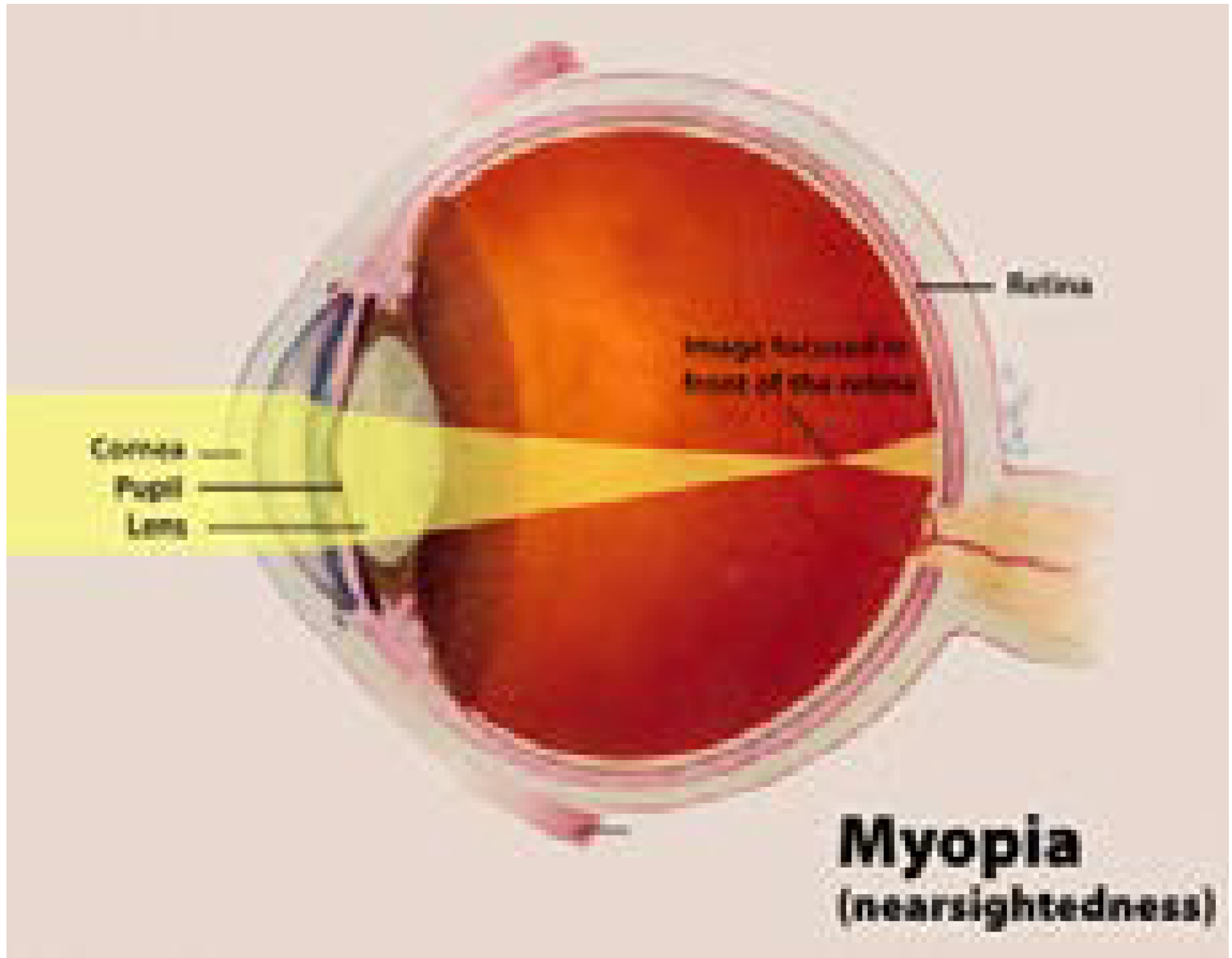
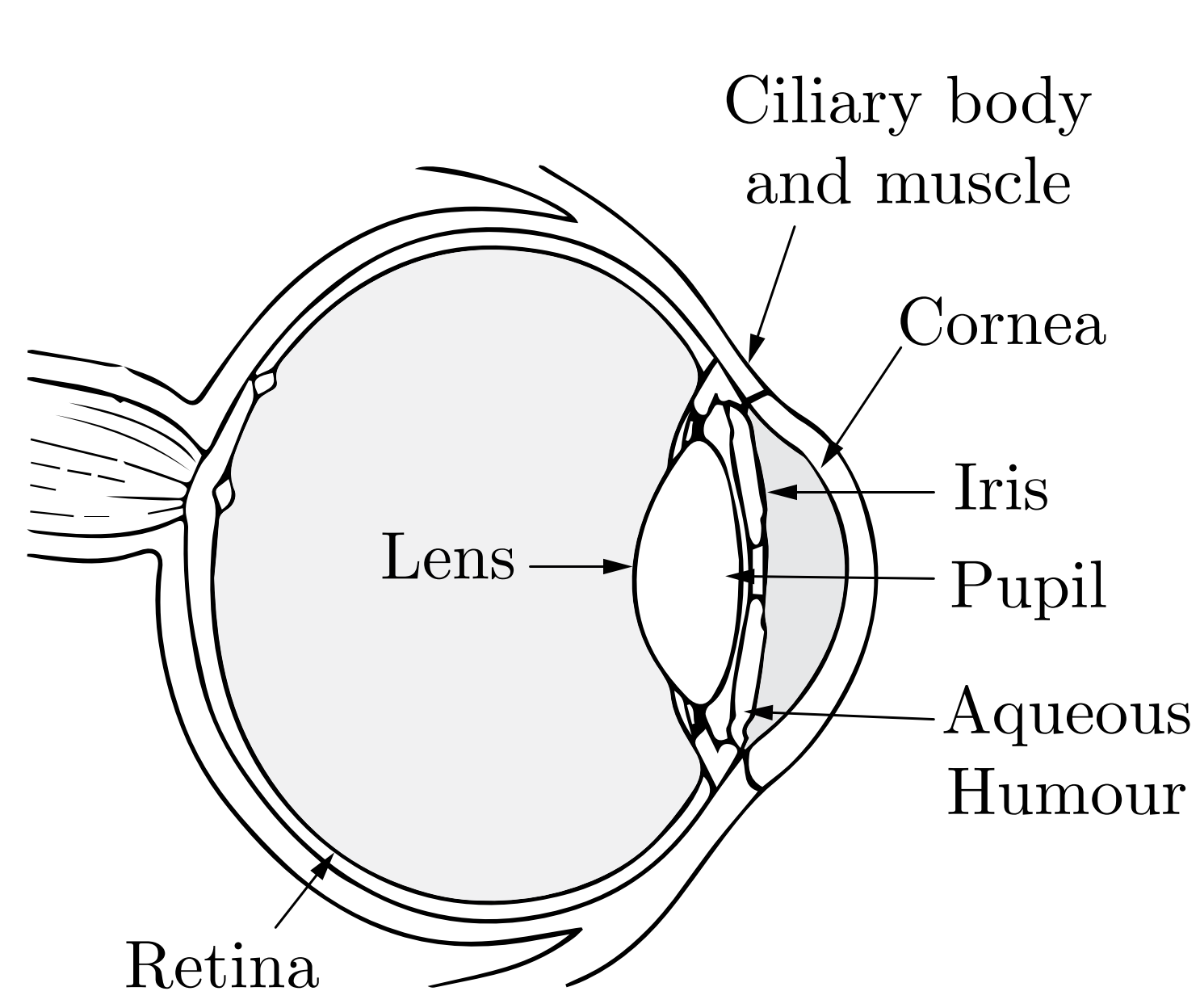
The human eye is like a camera. Its lens system forms an image on a light-sensitive screen called the retina. Light enters the eye through a thin membrane called the cornea. It forms the transparent bulge on the front surface of the eyeball as shown in the figure. The crystalline lens merely provides the finer adjustment of focal length required to focus objects at different distances on the retina. We find a structure called iris behind the cornea. Iris is a dark muscular diaphragm that controls the size of the pupil. The pupil regulates and controls the amount of light entering the eye.

There are mainly three common refractive defects of vision. These are (i) myopia or near-sightedness, (ii) hypermetropia or far-sightedness, and (iii) Presbyopia. These defects can be corrected by the use of suitable spherical lenses.
(i) What is the function of pupil in the human eye ?
(ii) What is the far point and near point of human eye with normal vision?
(iii) A student has difficulty reading the blackboard while sitting in the last row. What could be the defect the child is suffering from?
(iv) What is the function of iris in human eye ?

View full solution
A person is suffering from hypermetropia (long sightedness). It is a defect in which a human eye can see far off object clearly, but is unable to see nearby object distinctly. The near point of the person is $1.5 m$. Assume that the near point of the normal eye is $25 cm$.

(i) What type of lens should be used in his spectacles?
(ii) What should be the focal length of the lens he used?
(iii) What will be the potver of the lens?
or
(iv) Write one possible cause of this defect.

View full solution

Generate a Human Eye and Colourful World paper free

Pick question groups from the list above, set marks and difficulty, and export a branded PDF with step-by-step answer keys. First 3 chapters free — no signup.

Download App