Questions · Page 1 of 2

[3 Mark Questions]

🎯

Test yourself on this topic

50 questions · timed · auto-graded

Question 13 Marks
Write the electronic configuration of two elements X and Y whose atomic numbers are 20 and 17 respectively. Write the molecular formula of the compound formed when element X reacts with element Y. Draw electron-dot structure of the product and also state the nature of the bond formed between both the elements.
Answer
Atomic number of element $X=20$
Electronic configuration of element $X=2,8,8,2$
Atomic number of element $Y=17$
Electronic configuration of element $Y=2,8,7$
When $X$ reacts with $Y$, it loses the two valence electrons (valency 2). These two valence electrons are accepted by two $Y$ atoms (valency 1).
Hence, the molecular formula of the compound formed between $X$ and $Y$ is $X Y_2$.
Electron-dot structure:
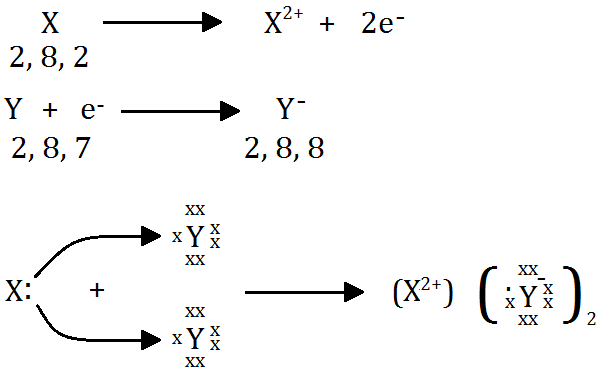
Ionic bond is formed between the elements X and Y in compound $XY _2$.
View full question & answer
Question 23 Marks
What is periodicity in properties of elements with reference to the Modern Periodic Table? Why do all the elements of the same group have similar properties? How does the tendency of elements to gain electrons change as we move from left to right in a period? State the reason of this change.
Answer
Periodicity is the repetition of elements with similar properties when they are arranged according to their atomic no. in the periodic table. All elements of the same group have the similar properties because they have similar outer electronic configuration. For example, in group 17, halogens have the electronic configuration $ns ^2 np ^7$.
As we move from left to right, size decreases, nuclear charge increases and hence the electrons feel more attracted towards the atom and hence the tendency to gain electrons increases.
View full question & answer
Question 33 Marks
An element ' $X$ ' belong to $3^{\text {rd }}$ period and group 13 of the Modern Periodic Table.
  1. Determine the valence electrons and the valency of ‘X’.
  2. Molecular formula of the compound formed when ‘X’ reacts with an element ‘Y’ (atomic number=8).
  3. Write the name and formula of the compound formed when ‘X’ combines with chlorine.
Answer
  1. Since it belongs to group 13, therefore no. of valence electrons-3
The Valency of element X is 3
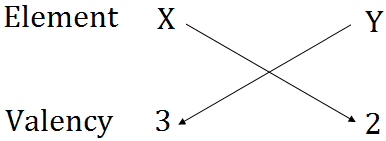
  1. When 'X' reacts with element 'Y', the compound formed will be:

Therefore, the Molecular formula of compound formed is $X_2Y_3$.
  1. When X combines with chlorine:
Atomic no of X = 13
i.e., X is Aluminum Al
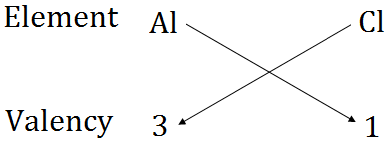
Valency of X is 3 Valency of chlorine is 1
Therefore, the molecular formula will be:
View full question & answer
Question 43 Marks
The position of eight elements in the Modern Periodic Table is given below where atomic numbers of elements are given in the parenthesis.
Period No.    
2 Li (3) Be (4)
3 Na (11) Mg (12)
4 K (19) Ca (20)
5 Rb (37) Sr (38)
  1. Write the electronic configuration of Ga.
  2. Predict the number of valence electrons in Rb.
  3. What is the number of shells in Cr?
  4. Predict whether K is a metal or a non-metal.
  5. Which one of these elements has the largest atom in size?
  6. Arrange Be, Ga, Mg and Rb in the increasing order of the size of their respective atoms.
Answer
  1. Electronic configuration of Ca (20): 2, 8, 8, 2
  2. Rb belongs to Group 1, and all Group 1 elements have one valence electron.
  3. Sr belongs to Period 5, and thus, it has five shells.
  4. K is a metal with electronic configuration 2, 8, 8, 1. Thus, it will donate its one electron to acquire the noble gas configuration.
  5. The atomic size increases down the group and decreases across a period. Rb is the element which has the largest atomic size.
  6. Be < Mg < Ca < Rb.
View full question & answer
Question 53 Marks
Given below are some elements of the modern periodic table. Atomic number of the element is given in the parentheses: $A(4), B(9), C(14), D(19), E(20)$
a. Select the element that has one electron in the outermost shell. Also write the electronic configuration of this element.
b. Which two elements amongst these belong to the same group? Give reason for your answer.
c. Which two elements amongst these belong to the same period? Which one of the two has bigger atomic radius?
Answer
a. ${ }_{19} K$ has one electron in the outermost shell and its electronic configuration is $2,8,8,1$.
b. ${ }_4 Be$ and ${ }_{20} Ca$ belongs to same group i.e., Group 2.
Electronic configuration:
${ }_4 Be-2,2$
${ }_{20} Ca-2,8,8,2$
${ }_4 Be$ and ${ }_{20} Ca$ have same number of valence electrons in outermost shell i.e., 2 so they belong to same group.
C. ${ }_9 F$ and ${ }_4 Be$ belongs to the same period i.e., period 2.
Electronic configuration:
$9 F-2,7$
$4 Be -2,2$
${ }_4$ Be has bigger atomic size than ${ }_9 F$ because the atomic radius decreases as we move from left to right due to an increase in nuclear charge which tends to pull the electrons closer to the nucleus and hence size of atom reduces.
View full question & answer
Question 63 Marks
The elements Be, Mg and Ca each having two electrons in their outermost shells are in periods 2, 3, and 4 respectively of the modern periodic table. Answer the following questions, giving justification in each case:
  1. Write the group to which these elements belong.
  2. Name the least reactive element.
  3. Name the element having largest atomic radius.
Answer
Element Valence electrons Period Electronic configuration
Be
Mg
Ca
2
2
2
2
3
4
2, 2
2, 8, 2
2, 8, 8, 2
  1. All these elements belong to the $2^{\text {nd }}$ group as all have two electrons in their outermost shell.
  2. Be is the least reactive metal because reactivity of metals increases in a period as the tendency to lose electrons in a group increases.
Therefore Be being the smallest in all the given elements of a period has its valence electrons nearest to the nucleus. So the removal of electrons from its valence shell will be difficult.
  1. Ca has the largest atomic radius because it has maximum number of shells, i.e., 4.
View full question & answer
Question 73 Marks
Write the number of periods and groups in the Modern Periodic Table. How does the metallic character of elements vary on moving (i) from left to right in a period, and (ii) down a group ? Give reason to justify your answer.
Answer
In the Modern Periodic Table, there are 18 vertical columns known as Groups and 7 horizontal rows known as Periods.
As we move down the group, the electrostatic attraction between the nucleus and the outer-most electron decreases due to increase in the distance between them. This happens because, on moving down the group, a new shell is added. So the valence electron can be easily lost by the element. As we know, metallic character is characterized by the ease of loss of an electron, thereby, metallic character increases on moving down a group in the Modern Periodic Table.
When we move across a period, the number of electrons in the same shell increases. This leads to greater electrostatic attraction between the nucleus and the outer-most electron. This increased attraction pulls the outer-most electron closer to the nucleus, thereby decreasing the atomic size.
View full question & answer
Question 83 Marks
An element 'X' belong to $3^{rd}$ period and group 16 of the Modern Periodic Table.
  1. Determine the number of valence electrons and the valency of 'X'.
  2. Molecular formule of the compound when 'X' reacts with hydrogen and write its electron dot structure.
  3. Name the element 'X' and state whether it is metallic or non-metallic.
Answer
  1. Given: Element belongs to $3^{rd}$ period and group 16. Since it belongs to period 3, therefore, it has 3 energy shells and as the group number is 16. means that it have 6 electrons present in valence shell. The electronic configuration will be: 2, 8, 6 The valency of element is 2 as it needs only 2 more electrons to attain stable gas configuration.
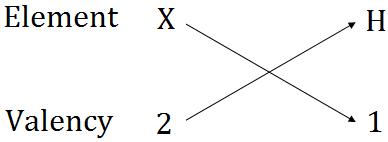
  2. Molecular formula of the compound when it reacts with hydrogen can be calculated by cross multiplication of valencies:


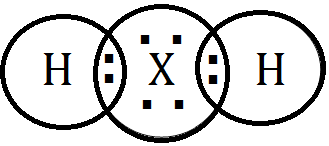
Therefore, the compound will be $H_2X$. The electron dot structure of the compound is as follows:

  1. The name of the element is Sulphur and is non-metallic.
View full question & answer
Question 93 Marks
Three elements ‘X’, ‘Y’ and ‘Z’ have atomic numbers 7, 8 and 9 respectively.
  1. State their positions (Croup number and period number both) in the Modern Periodic Table.
  2. Arrange these elements in the decreasing order of their atomic radii.
  3. Write the formula of the compound formed when ‘X’ combines with ‘Z’.
Answer

The electronic configuration of the elements X, Y and Z can be written as: (X - 2, 5) (Y - 2, 6) (Z - 2, 7)
  1. Since all the elements consists two valence shells, therefore all will belong to period $2^{nd}$ Group to which X belongs = 10 + 5 = 15
Group to which Y belongs = 10 + 6 = 16
Group to which Z belongs = 10 + 7 = 17
  1. The elements can be arranged according to the decreasing order of atomic radii as follows: X > Y > Z this is because size of the atom decreases when moving from left to right in a period.
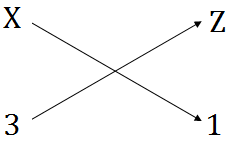
  2. When X combines with Z
Valency of X = 3
Valency of Z = 1
Cross multiplying the valences.

The compound formed is $XZ_3$.
View full question & answer
Question 103 Marks
Taking the example of an element of atomic number 16, explain how the electronic configuration of the atom of an element relates to its position in the modern periodic table and how valency of an element is calculated on the basis of its atomic number.
Answer
Electronic configuration of element with atomic no. 16 is 2, 8, 6.
Since it has 3 shells, the period no. will be 3.
Since the no. of valence electrons is 6, the group no. will be 10 + 6 = 16.
Valency of the element will be 8- valence electrons ie 8 – 6 = 2.
View full question & answer
Question 113 Marks
The elements $4 Be ,{ }_{12} Mg$ and ${ }_{20} Ca$, each having two valence electrons in their valence shells, are in periods 2,3 and 4 respectively of the modern periodic table. Answer the following questions associated with these elements, giving reason in each case:
a. In which group should they be?
b. Which one of them is least reactive?
c. Which one of them has the largest atomic size?
Answer
a. All three elements have valency 2 . Thus, they should be present in group 2 of the periodic table.
b. On going down a group in the periodic table, the reactivity of an element increases because of decrease in the effective nuclear charge and increase in the atomic size; this makes the removal of valence electrons easy. Thus, among the given elements, 4 Be is the least reactive element.
c. On going down a group in the periodic table, the atomic size of elements increases because of the addition of new shells. Thus, among the given elements, 20Ca has the largest atomic size.
View full question & answer
Question 123 Marks
What is meant by ‘group’ in the modern periodic table? How do the following change on moving from top to bottom in a group?
  1. Number of valence electrons.
  2. Number of occupied shells.
  3. Size of atoms.
  4. Metallic character of elements.
  5. Effective nuclear charge experienced by valence electrons.
Answer
Vertical columns of the periodic table are known as groups.
  1. The number of valence electrons remains constant when we move down the group.
  2. The number of occupied shells increases down the group.
  3. The size of atoms increases down the group.
  4. The metallic character of elements increases down the group.
  5. The effective nuclear charge decreases down the group.
View full question & answer
Question 133 Marks
Na, Mg and Al are the elements of the 3rd period of the Modern Periodic Table having group number 1, 2 and 13 respectively. Which one of these elements has the (a) highest valency, (b) largest atomic radius, and (c) maximum chemical reactivity? Justify your answer stating the reason for each.
Answer
  1. Aluminium (Al) has the highest valency. Valency of Na is 1, Mg is 2, and Al is 3.
  2. Sodium (Na) has the largest atomic radius. As we move from left to right in a period, the atomic radius decreases as increase in nuclear charge pulls the electrons closer to the nucleus reducing the atomic size.
  3. Sodium (Na) has the maximum chemical reactivity. Reactivity decreases on moving from left to right in a period.
View full question & answer
Question 143 Marks
An element 'X' has mass number 35 and number of neutrons 18. Write atomic number and electronic configuration of 'X'.Also write group number, period number and valency of 'X'.
Answer
Atomic number of X = Mass number of X – No of neutrons = 35 – 18 = 17.
Therefore Electronic configuration of X = 2,8.7.
Group number =17.
Period no = 3.
Valency = 8-7 = 1.
View full question & answer
Question 153 Marks
Two elements 'P' and 'Q' belong to the same period of the modern periodic table and are in Group-1 and Group-2 respectively. Compare their following characteristics in tabular form:
  1. The number of electrons in their atoms.
  2. The sizes of their atoms.
  3. Their metallic characters.
  4. Their tendencies to lose electrons.
  5. The formula of their oxides.
  6. The formula of their chlorides.
Answer
Characteristic
Comparison
The number of electrons in their atoms.
The number of electrons in Q is more compared to P (Q > P).
The sizes of their atoms.
The size of atom P is more than atom Q (P > Q).
Their metallic character.
P is more metallic than Q (P > Q).
Their tendencies to lose electrons.
P will lose electrons more easily than Q.
The formula of their oxides.
Oxide of P is $P _2 O$. Oxide of Q is QO .
The formula of their chlorides.
Chloride of P is PCl. Chloride of Q is $QCl _2$.
View full question & answer
Question 163 Marks
The electrons in the atoms of four elements A, B, C and D are distributed in three shells having 1, 3, 5 and 7 electrons in the outermost shell respectively. State the period in which these elements can be placed in the modern periodic table. Write the electronic configuration of the atoms of A and D and the molecular formula of the compound formed when A and D combine.
Answer
Element Shells K, L, M Atomic number
A 2, 8, 1 11
B 2, 8, 3 13
C 2, 8, 5 15
D 2, 8, 7 17
All these elements belong to the $3^{\text {rd }}$ period as all these as all these elements have three shells.
Element A:
Electronic Configuration 2, 8, 1
Valence electrons: 1
Element D:
Electronic Configuration 2, 8, 7
Valence electrons: 7
Molecular formula:

Nature of the compound is ionic.
View full question & answer
Question 173 Marks

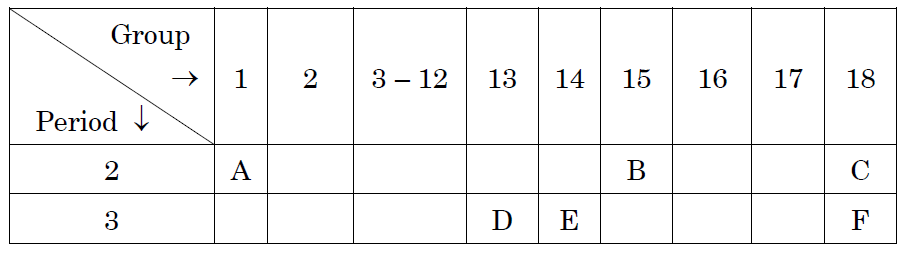
Study the following table in which positions of six elements A, B, C, D, E and F are shown as they are in the modern periodic table:

On the basis of the above table, answer the following questions:
  1. Name the element which forms only covalent compounds.
  2. Name the element which is a metal with valency three.
  3. Name the element which is a non-metal with valency three.
  4. Out of D and E, which is bigger in size and why?
  5. Write the common name for the family to which the elements C and F belong.
Answer
  1. Element, E will form only covalent compounds.
  2. Element D have 2 valency.
  3. B is non-metal, having 3 valency.
  4. D has bigger atomic radius than E. Both belong to third period. In a period, the atomic radius decreases from left to right
  5. C and F belong to noble gas family.
View full question & answer
Question 183 Marks
The electronic configuration of an element ‘X’ is 2, 8, 8, 2. To which (a) period and (b) group of the modern periodic table does ‘X’ belong? State its valency. Justify your answer in each case.
Answer
Electronic configuration of ' $X$ ' is $2,8,8,2$.
a. It belongs to the 4th period because it has four energy shells and period number of an element is equal to the number of energy shells.
b. It belongs to $2^{\text {nd }}$ group because it has 2 valence electrons and the group number of an element having up to two valence electrons is equal to the number of valence electrons.

Its valency is '2'. To acquire inert gas configuration 'X' either loses 2 electrons or gains 6 electrons. Since the shorter route is to lose 2 electrons for obtaining inert gas configuration, hence its valency is 2 .
View full question & answer
Question 193 Marks
Four elements P, Q, R and S have atomic numbers 12,13,14 and 15 respectively.
Answer the following questions giving reasons:
  1. What is the valency of Q?
  2. Classify these elements as metals and non-metals.
  3. Which of these elements will form the most basic oxide?
Answer
Elements Atomic No. Electronic configuration Valence electrons
P 12 2, 8, 2 2
Q 13 2, 8, 3 3
R 14 2, 8, 4 4
S 15 2, 8, 5 5
  1. Valency of Q is 3 as Q loses 3 electrons to obtain inert gas configuration.
  2. P and Q are metals as these elements lose 2 and 3 electrons respectively to obtain inert gas configuration and those elements which lose electrons are metals.
    R and S are non-metals as these elements either share or gain electrons for attaining inert gas configuration and those metals which accept electrons either by sharing or gaining are non-metals.
  3. Element P will form the most basic oxide because P is the most metallic element among the 4 given elements and thus forms the most basic oxide.
View full question & answer
Question 203 Marks
The atomic number of an element is 16. Predict:
  1. The number of valence electrons in its atom.
  2. Its valency.
  3. Its group number.
  4. Whether it is a metal ora non-metal.
  5. The nature of oxide formed by it.
  6. The formula of its chloride.
Answer
The electronic configuration of element (16): 2, 8, 6
  1. The number of valence electrons 6.
  2. Its valency is 8 - 6 = 2.
  3. Its group number is 16.
  4. It is a non-metal.
  5. The nature of oxide is acidic.
  6. The formula is $XCl_2$.
View full question & answer
Question 213 Marks
Atoms of seven elements A, B, C, D, E, F and G have a different number of electronic shells but have the same number of electrons in their outermost shells. The elements A and C combine with chlorine to form an acid and common salt respectively. The oxide of element A is liquid at room temperature and is a neutral substance, while the oxides of the remaining six elements are basic in nature. Based on the above information answer the following questions:
  1. What could the element A be?
  2. Will elements A to G belong to the same period or same group of the periodic table?
  3. Write the formula of the compound formed by the reaction of the element A with oxygen.
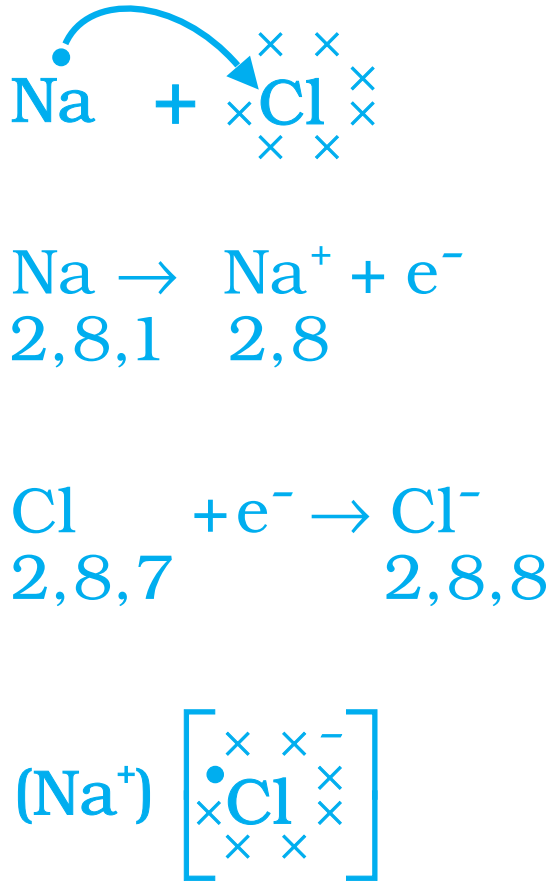
  4. Show the formation of the compound by a combination of element C with chlorine with the help of electronic structure.
  5. What would be the ratio of number of combining atoms in a compound formed by the combination of element A with carbon?
  6. Which one of the given elements is likely to have the smallest atomic radius?
Answer
  1. The element A combines with chlorine is form an acid and its oxide is liquid at room temperature and is neutral also so this element could by hydrogen (H).
  2. The elements as per the given information have the same number of valence shell electrons but have different number of shells so the elements A to G belong to same group. (Group 1)
  3. Element A is hydrogen Formula of oxide of A : $H_2O$
  4. Element C when reacts with chlorine gives common slat i.e. NaCl so element is Na.
  1. Element A is hydrogen with valency 1, Valency of carbon is 4. So the ratio of number of combining atoms in a compound formed by combination of element A with carbon is 4 : 1
  2. Element A as the atomic radius keeps on increasing with an increase in the number of shells.
View full question & answer
Question 223 Marks
  1. What is meant by periodicity in properties of elements with reference to the periodic table?
  2. Why do all the elements of the same group have similar properties?
  3. How will the tendency to gain electrons change as we go from left to right across a period? Why?
Answer
  1. Recurrence of similar properties of elements after certain fixed interval of atomic number is known periodicity.
  2. They have similar properties because:
  1. They all have same number of valence electrons.
  2. They all have same valency.
  1. The tendency to gain electrons increases due to increase in the nuclear charge. Due to this, atomic size decreases and a large number of valence electrons are held towards the nucleus and tendency to gain electrons increases.
View full question & answer
Question 233 Marks
Why is atomic number considered to be a more appropriate parameter than atomic mass for the classification of elements in a periodic table? How does the metallic character of elements vary as we move (i) from left to right in a period, and (ii) top to bottom in a group in the modern periodic table? Give reasons to justify your answers.
Answer
  • Atomic number is more important parameter than atomic mass as atomic number determines the number of valence electrons which decide the chemical properties of an atom of an element.
  • Metallic character decreases from left to right in a period, because the tendency to lose electrons decreases due to increased attraction between nucleus and valence electrons.
  • Metallic character increases down the group, as the tendency to lose electrons increases, due to decreased attraction between nucleus and valence electrons because outermost electrons are farther away.
View full question & answer
Question 243 Marks
How does the tendency of the elements to lose electrons change in the Modern Periodic Table in:
  1. a group,
  2. a period and why?
Answer
  1. On moving down a group, the number of shells increases at each succeeding element. As a result, the valence electrons lie farther away from the nucleus. Therefore, the force of attraction between nucleus and the electrons decreases and tendency to lose electrons increases down the group.
  2. As we move left to right in a period, number of shells remain same but number of valence electrons increases. As a result, effective nuclear charge increases and the tendency to lose electrons decreases.
View full question & answer
Question 253 Marks
The atomic number of an element ‘X’ is 19.
  1. Write its electronic configuration.
  2. To which period of the Modern Periodic Table does it belong and what is its valency?
  3. If ‘X’ burns in oxygen to form its oxide, what will be its nature – acidic, basic or neutral?
  4. Write balanced chemical equation for the reaction when this oxide is dissolved in water.
Answer
  1. Configuration of X (19) = 2,8,8,1
  2. Fourth period , valency =1
  3. Basic oxide$\left( X _2 O \right)$
  4. $\text{X}_{2}\text{O}\text{ }\text{ }+\text{ }\text{ }\text{H}_2\text{O}\xrightarrow{\text{ }\text{ }\text{ }\text{ }\text{ }\text{ }\text{ }\text{ }\text{ }\text{ }\text{ }\text{ }\text{ }\text{ }\text{ }\text{ }\text{ }\text{ }\text{ }\text{ }}2\text{XOH}$
View full question & answer
Question 263 Marks
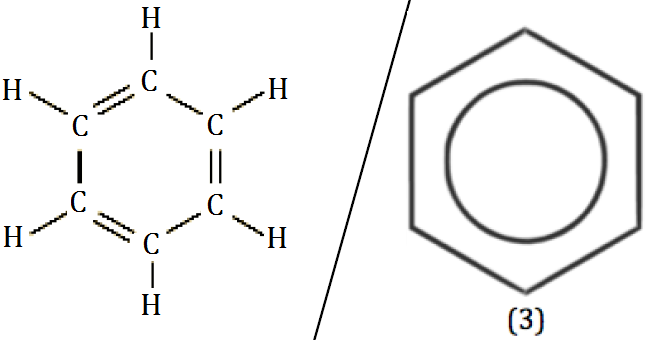
Write the molecular formula of benzene and draw its structure. List in tabular form the two properties in which covalent compounds differ from ionic compounds.
Answer

$C_6H_6$
Difference:
  Covalent Ionic
Electrical conductivity. Do not conduct electricity. Conducts electricity.
Melting point. Low. High.
View full question & answer
Question 273 Marks
An element ‘X’ belongs to third period and second group of the Modern Periodic Table.
  1. Write its electronic configuration.
  2. Is it a metal or non-metal? Why?
  3. Write the formula of the compound formed when ‘X’ reacts with an element,
  1. Y of electronic configuration 2, 6
  2. Z with electronic configuration 2, 8, 7
Answer
  1. The electronic configuration is 2, 8, 2.
  2. It is a metal because it has two valence electrons. That is electropositive in nature.
  3.  
  1. The compound formed when X reacts with Y is XY.
  2. The compound formed when X reacts with Z is XZ 2.
View full question & answer
Question 283 Marks
State the main aim of classifying elements. Which is the more fundamental property of elements that is used in the development of Modern Periodic Table? Name and state the law based on this fundamental property. On which side of the periodic table one can find metals, non-metals and metalloids?
Answer
The main aim of classifying elements is to follow periodicity based on the octet configuration. The elements are arranged in increasing order of their atomic number.Basic property of elements used in the development of modern periodic law:
  1. Same physical and chemical elements.
  2. The extreme left side is metals,
  3. The extreme right side is non-metals.
  4. The between are metalloids probably they seems to be right.
View full question & answer
Question 293 Marks
The atomic number of an element is 20.
  1. Write its electronic configuration and determine its valency.
  2. Is it a metal or a non-metal?
  3. Write the formula of its chloride.
  4. Is it more reactive or less reactive than Mg (atomic number 12)? Give reason for your answer.
Answer
a. $X_{(20)}-2,8,8,2$.
Valence electrons-2.
Hence valency is 2 .
b. It is a metal.
c. $XCl _2$
d. It is more reactive than Mg as reactivity increases down the group.
Mg- III Period.
And $X_{20}( Ca )$ - IV Period.
View full question & answer
Question 303 Marks
Explain, giving reason, why carbon neither forms $C ^{4+}$ cations nor $C ^{4-}$ anions, but forms covalent compounds which are bad conductors of electricity and have low melting point and low boiling point.
Answer
Carbon cannot lose $4 e ^{-}$to form $C ^{+4}$ cations, as very high energy is required to remove $4 e ^{-}$ Carbon cannot gain $4 e ^{-}$to form $C ^{-4}$ anions as nucleus with 6 protons cannot hold 10 electrons. Carbon can share $4 e ^{-}$to form covalent compounds.
Carbon compounds do not conduct electricity being non-polar and do not form ions/charged particles.
Due to weak intermolecular forces of attraction, carbon compounds have low melting points and boiling points.
View full question & answer
Question 313 Marks
An element ‘X’ (Atomic number = 20) burns in the presence of oxygen to form a basic oxide.
  1. Identify the element and write its electronic configuration.
  2. State its group number and period number in the Modern Periodic Table.
  3. Write a balanced chemical equation for the reaction when this oxide is dissolved in water.
Answer
We are given that the element is present in the $2^{\text {nd }}$ group and the $4^{\text {th }}$ period.
i. Therefore this element is Calcium. Its atomic number is 20 and its electronic configuration is 20 .
ii. Its electronic configuration is $2,8,8,2$.
iii. When calcium oxide is dissolved in water, calcium hydroxide is formed. Following is the equation,
$CaO+H_2 O \rightarrow Ca(OH)_2$
View full question & answer
Question 323 Marks
An element P (atomic number 20) reacts with an element Q (atomic number 17) to form a compound. Answer the following questions giving reason: Write the position of P and Q in the Modern Periodic Table and the molecular formula of the compound formed when P reacts with Q.
Answer
Atomic number of element P is 20
electronic configuration = 2, 8, 8, 2
Valence electron =2
Group-2
Atomic number of element Q is 17
electronic configuration Q = 2, 8, 7
Valence electron = 1
Group-3
When P reacts with Q , it loses the two valence electrons (valency 2). These two valence electrons are accepted by two Q atoms (valency 1 ). Hence, the formula of the compound formed between P and Q is $PQ _2$..
View full question & answer
Question 333 Marks
Two elements ‘A’ and ‘B’ belong to the $3^{\text {nd }}$ period of Modern periodic table and are in group 2 and 13 respectively. Compare their following characteristics in tabular form:
  1. Number of electrons in their atoms.
  2. Size of their atoms.
  3. Their tendencies to lose electrons.
  4. The formula of their oxides.
  5. Their metallic character.
  6. The formula of their chlorides.
Answer
 
Characteristics
A
B
(a)
Number of electrons in their atoms.
4 or 12 or 20
5 or 13 or 21
(b)
Size of their atoms.
Bigger
Smaller
(c)
Their tendencies to lose electrons.
More
Less
(d)
The formula of their oxides.
AO
$B_2O_3$
(e)
Their metallic character More metallic.
Less
Metallic
(f)
The formula of their chlorides.
$ACl_2$
$BCl_3$
View full question & answer
Question 343 Marks
From the following elements:$_{4}\text{Be};_{9}\text{F};_{19}\text{K};_{20}\text{Ca};$
  1. Select the element having one electron in the outermost shell.
  2. Two elements of the same group.
Write the formula of and mention the nature of the compound formed by the union of ${ }_{19} K$ and element $X(2,8,7)$.
Answer
  1. 19 K has one electron in its outermost shell.
  2. 4 Be and 9 F r elements belonging to the same group.
X(2, 8, 7) is chlorine and the element formed by 19K and 17Cl is KCl and the nature of the compound is ionic.
View full question & answer
Question 353 Marks
Write the number of periods the Modern Periodic Table has. State the changes in valency and metallic character of elements as we move from left to right in a period. Also state the changes, if any, in the valency and atomic size of elements as we move down a group.
Answer
There are 7 periods in the modern periodic table.
The valency of an element is determined by the number of valence electrons present in the outermost shell of the atom. The valence electrons increases in s and p blocks as one move from left to right. As we move along left to right, valency changes from positive to negative.
As we move from left to right, the nuclear charge on valence shell electron increases. So, tendency to lose electrons decreases. Hence, metallic character decreases.
On moving down the group, the valence shell electrons remain the same. Therefore, valency of the atom does not change in a group.
As we go down the group, a new shell is added. So, the atomic size increases.
View full question & answer
Question 363 Marks
An element P (atomic number 20) reacts with an element Q (atomic number 17) to form a compound. Answer the following questions giving reason:
Write the position of P and Q in the Modern Periodic Table and the molecular formula of the compound formed when P reacts with Q.
Answer
Atomic number of element P is 20
electronic configuration = 2, 8, 8, 2
Valence electron = 2
Group-2
Atomic number of element Q is 17
electronic configuration Q = 2, 8, 7
Valence electron = 1
Group-3
When P reacts with Q, it loses the two valence electrons (valency 2). These two valence electrons are accepted by two Q atoms (valency 1). Hence, the formula of the compound formed between P and Q is $PQ_2$.
View full question & answer
Question 373 Marks
Name any two elements of group one and write their electronic configurations. What similarity do you observe in their electronic configurations? Write the formula of oxide of any of the aforesaid element.
Answer
Two elements that belong to group 1 are lithium and sodium. The electronic configurations of these elements and the formulae of their oxides are mentioned in the table given below.
Element
Symbol
Electronic Configuration
Formula of Oxide
Lithium
Li
2, 1
$Li_2 O$
Sodium
Na
2, 8, 1
$Na_2 O$
View full question & answer
Question 383 Marks
Na, Mg and Al are the elements of the same period of Modem Periodic Table having one, two and three valence electrons respectively. Which of these elements,
  1. Has the largest atomic radius.
  2. Is least reactive? Justify your answer stating reason for each case.
Answer
  1. Na will have the largest atomic radius as atomic size goes on decreasing along a period from left to right. It is due to increase in nuclear charge (number of protons in the nucleus) which pulls the electrons towards it, i.e., a force of attraction between nucleus and valence electrons increases, therefore atomic size decreases.
  2. Al is least reactive because the reactivity of an element depends upon the ability of its atoms to donate or accept electrons. Tendency to lose electrons along a period generally decreases with decrease in atomic size, i.e., the force of attraction between the valence electrons and the nucleus increases, therefore electrons cannot be removed easily.
View full question & answer
Question 393 Marks
  1. Define the following terms:
(i) Valency. (ii) Atomic size.
  1. How do the valency and the atomic size of the element vary going from left to right along a period in the modern periodic table?
Answer
  1.  
  1. Valency: The combining capacity of an element called its valency.
  • The valency an element is determined by the number of valence. Electrons present in the atom of the element.
  • The number of electrons lost or gained or shared by one atom of an element to achieve the nearest inert gas configuration gives the valency of the element.
  1. Atomic size: The atomic size of an atom is the distance between the centre of the nucleus and outermost electron shell of an isolated atom.
  1.  
  • On moving from left to right along a period in the modern periodic table, the valency of element from 1to4 and then decreases to zero.
  • On moving from left to right in a period of the periodic table, the size of the atoms decreases.
View full question & answer
Question 403 Marks
Consider two elements 'A' (Atomic number 17) and 'B' (Atomic number 19):
  1. Write the positions of these elements in the modern periodic table giving justification.
  2. Write the formula of the compound formed when 'A' combines with 'B.'
  3. Draw the electron dot structure of the compound and state the nature of the bond formed between the two elements.
Answer
  1. Position of the elements in the periodic table:
Element Period Group
A 3 17
B 4 1
  1.  
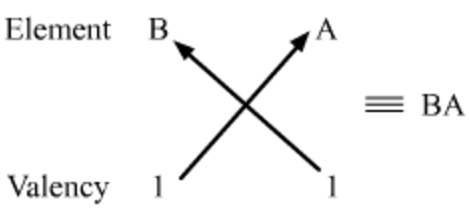
Atomic number of A = 17.
Electronic configuration A = 2, 8, 7.
Number of valence electrons of A = 7.
Valency of A = 8 - 7 = 1.
 
Atomic number of B = 19.
Electronic configuration B = 2, 8, 8, 1.
Number of valence electrons of B = 1.
Valency of A = 1.

So, the formula of the compound formed when elements A and B combine is BA.
  1.  
View full question & answer
Question 413 Marks
Write the names given to the vertical columns and horizontal rows in the Modern Periodic Table. How does the metallic character of elements vary on moving down a vertical column ? How does the size of atomic radius vary on moving left to right in a horizontal row? Give reason in support of your answer in the above two cases.
Answer
In the Modern Periodic Table, there are 18 vertical columns known as Groups and 7 horizontal rows known as Periods.
As we move down the group, the electrostatic attraction between the nucleus and the outer-most electron decreases due to increase in the distance between them. This happens because, on moving down the group, a new shell is added. So the valence electron can be easily lost by the element. As we know, metallic character is characterized by the ease of loss of an electron, thereby, metallic character increases on moving down a group in the Modern Periodic Table.
When we move across a period, the number of electrons in the same shell increases. This leads to greater electrostatic attraction between the nucleus and the outer-most electron. This increased attraction pulls the outer-most electron closer to the nucleus, thereby decreasing the atomic size.
View full question & answer
Question 423 Marks
An element ' M ' with electronic configuration $(2,8,2)$ combines separately with $\left( NO _3\right)^{-},\left( SO _4\right)^{2-}$ and $\left( PO _4\right)^{3-}$ radicals. Write the formula of the three compounds so formed. To which group and period of the Modern Periodic Table does the elements 'M' belong? Will 'M' form covalent or ionic compounds? Give reason to justify your answer.
Answer
- The electronic configuration $(2,8,2)$ of the element ' $M$ ' suggests that it belongs to group 2 and period 3 of the Modern Periodic Table and its valency is 2.
- The chemical formula of the compounds are -
$M\left(NO_3\right)_2 / Mg\left(NO_3\right)_2 ; MSO_4 / MgSO_4 ; M_3\left(PO_4\right)_2 / Mg_3\left(PO_4\right)_2 \text {. }$
- 'M' will form ionic compounds by losing two electrons.
View full question & answer
Question 433 Marks
Calcium is an element with atomic number 20. Stating reason answer each of the following questions:
  1. Is calcium a metal or non-metal?
  2. Will its atomic radius be larger or smaller than that of potassium with atomic number 19?
  3. Write the formula of its oxide.
Answer
  1. The atomic number of calcium is 20. Its electronic configuration is 2, 8, 8, 2. The valency of calcium is +2. Hence it is a metal belong to the group 2.
  2. The radius of calcium is smaller than potassium because both elements lie in the third period of the periodic table. Potassium lies to the left of calcium in the period, and atomic size decreases, going left to right due to increase in the force of attraction by the nucleus.
  3. The oxide of calcium is calcium oxide and its chemical formula is given as CaO.
View full question & answer
Question 443 Marks
How many groups and periods are there in the modern periodic table? How do the atomic size and metallic character of elements vary as we move:
  1. Down a group, and
  2. From left to right in a period.
Answer
The modern periodic table consists of 18 groups and 7 periods.
  1. Down the group, the atomic size and metallic character of elements increase.
  2. On moving from left to right in a period, the atomic size and metallic character of elements decreases.
View full question & answer
Question 453 Marks
Based on the group valency of elephant state the formula for the following giving justification for each:
i. Oxides of $1^{\text {st }}$ group elements,
ii. Halides of the elements of group 13, and
iii. Compounds formed when an element of group 2 combines with an element of group 16 .
Answer
i. Oxides of first group elements are of the form $M _2 O$ since the valency of first group elements is 1 (need to lose one electron only to attain octet) and of oxide ion is 2 .
$2 M^{+}+O^{2-} \rightarrow M_2 O$
ii. Valency of group 13 elements is 3 and they form polar-covalent bonds. Either the size is small (as in Boron) so an ion cannot be formed or the electronegativity difference is not sufficient for ionic bonds.
$M3^{+}+3 X^{-} \rightarrow MX^3$
iii. Group 2 elements have a valency of 2 (need to lose 2 electrons to attain octet) whereas group 16 elements also have a valency of 2 (need 2 electrons).
$M^{2+}+O^{2-} \rightarrow MO$
View full question & answer
Question 463 Marks
Write the number of periods the modern periodic table has. How do the valency and metallic character of elements vary on moving from left to right in a period? How do the valency and atomic size of elements vary down a group?
Answer
In the modern periodic table there are total of 7 periods. The valency of an element is determined by the number of valence electrons present in the outermost shell of its atom. On moving from left to right in a period the valence electrons increase in s and p-blocks. In going from left to right the valency changes from positive to negative.
On moving from left to right in a period metallic character decreases as nuclear charge on valence shell electrons increases so, tendency to lose electrons decreases and hence metallic character decreases.
Down the group, valency remains the same as it depends upon valency shell electrons which remain the same on moving down the group and atomic size increases because a new shell is added.
View full question & answer
Question 473 Marks
Given below are some elements of the modern periodic table:$_4\text{Be, } _9\text{Fe, } _\text{14}\text{Si, } _\text{19}\text{k, } _\text{20}\text{Ca}$
  1. Select the element that has one electron in the outermost shell and write its electronic configuration.
  2. Select two elements that belong to the same group. Give reason for you answer.
  3. Select two elements that belong to the same period. Which one of the two has bigger atomic size?
Answer
  1. $_\text{19} \text{k}$ has one electron in the outermost shell and its electronic configuration is 2 8 8 1.
  2. $_4\text{Be } \text{and } _\text{20}\text{Ca}$ belongs to same group i.e. Group-2. Electronic configuration:
$_4\text{Be } – 2 2$

$_\text{20}\text{Ca } – \text{2 8 8 2.}$

The number of electrons in the outermost shell $ _4\text{Be }\text{and } _\text{20}\text{Ca}$ of is same hence they belong to the same shell.
  1. $_9\text{F} \text{ and } _4\text{Be}$ belongs to the same period, Period 2. Electronic configuration:
$_9\text{F} – 2 7$

$_4\text{Be } – 2 2$

$_4\text{Be}$ has bigger atomic size then $_9\text{F}$ because the atomic radius decreases as we move from left to right due to increase in nuclear charge which tends to pull the electrons closer to the nucleus and hence size of F reduces.
View full question & answer
Question 483 Marks
F, CI and Br are the elements each having seven valence electrons. Which of these,
  1. Has the largest atomic radius.
  2. Is most reactive? Justify your answer stating reason for each.
Answer
  1. The number of valence electrons determines the group of the element. F, Cl and Br have valence electrons 7 and belong to group 17. As we go down the group, new atomic shells are added. So, atomic size increases. Therefore, Br has the largest atomic radius as compared to Cl and F which has 3 and 2 shells respectively.
  2. F is most reactive due to smaller size, high effective nuclear charge and high electro-negativity.
View full question & answer
Question 493 Marks
Two elements X and Y belong to group1 and 2 respectively in the same period of periodic table. Compare them with respect to:
  1. The number of valence electrons in their atoms.
  2. Their valencies.
  3. Metallic character.
  4. The sizes of their atoms.
  5. The formulae of their oxides.
  6. The formulae of their chlorides.
Answer
  1. The number of valence electrons in element X is 1.
The number of valence electrons in element $Y$ is 2 .
ii. The valency of an element is determined by the number of electrons in the outermost shell. Thus, the valency of element X is 1 and that of element Y is 2 .
iii. Element X is more metallic than element Y .
iv. The size of atom $X$ is more than that of atom $Y$.
$v$. The formula of oxide of element X is $X _2 O$ and that of element Y is YO .
vi. The formula of chloride of element X is XCl and that of element Y is $YCl _2$.
View full question & answer
Question 503 Marks
Atoms of eight elements A, B, C, D, E, F, G and H have the same number of electronic shells but different number of electrons in their outermost shell. It was found that elements A and G combine to form an ionic compound. This compound is added in’ a small amount to almost all vegetable dishes during cooking. Oxides of elements A and B are basic in nature while those of E and F are acidic. The oxide of D is almost neutral. Based on the above information answer the following questions:
  1. To which group or period of the periodic table do the listed elements belong?
  2. What would be the nature of compound formed by a combination of elements B and F?
  3. Which two of these elements could definitely be metals?
  4. Which one of the eight elements is most likely to be found in gaseous state at room temperature?
  5. If the number of electrons in the outermost shell of elements C and G be 3 and 7 respectively, write the formula of the compound formed by the combination of C and G.
Answer
i. They all belong to the $3^{\text {rd }}$ period.
ii. The compound between B and F will be ionic in nature.
iii. $A$ and $B$ are metals as they form basic oxides, $E$ and $F$ are non metals as they form acidic oxides.
iv. Element H will be likely to be found in gaseous state at room temperature as it is the 8 th element of the group so it would have 8 electrons in its outermost shell which is the electronic configuration of an Nobel gas.
$\text { v. } CG_3 \text {. }$
View full question & answer