MCQ 11 Mark
If $A = \{1, 2, 3\}, B = \{1, 4, 6, 9\}$ and $R$ is a relation from $A$ to $B$ defined by $'x\ '$ is greater than $y$. The range of $R$ is
- A
$\{1, 4, 6, 9\}$
- B
$\{4, 6, 9\}$
- ✓
$\{1\}$
- D
AnswerCorrect option: C. $\{1\}$
$A = \{1, 2, 3\}$ and $B = \{1, 4, 6, 9\}$
$R$ is a relation from $A$ to $B$ defined by: $x$ is greater than $y.$
Then $R =\{(2, 1), (3, 1)\}$
$\therefore$ Range $(R) = \{1\}$
View full question & answer→MCQ 21 Mark
If $9(x) = 3x^4 - 5x^2 +,$ then value of $f(x - 1)$ is:
- ✓
$3x4 + 12x + 13x + 2x + 7$
- B
$3x4 - 12x - 13x - 2x - 7$
- C
$3x4 - 12x + 13x - 2x + 7$
- D
$3x4 - 12x - 13x + 2x + 7$
AnswerCorrect option: A. $3x4 + 12x + 13x + 2x + 7$
View full question & answer→MCQ 31 Mark
Which of the following are functions?
- A
$\{(\text{x, y}):\text{y}^2=\text{x, x, y}\in\text{R}\}$
- ✓
$\{(\text{x, y}):\text{y}=\text{|x|},\text{x, y}\in\text{R}\}$
- C
$\{(\text{x, y}):\text{x}^2+\text{y}^2=1,\text{x, y}\in\text{R}\}$
- D
$\{(\text{x, y}):\text{x}^2-\text{y}^2=1\text{x, y}\in\text{R}\}$
AnswerCorrect option: B. $\{(\text{x, y}):\text{y}=\text{|x|},\text{x, y}\in\text{R}\}$
For every value of $\text{x}\in\text{R},$ there is a unique value $\text{y} \in\text{R}$
i.e., there is a unique image for all values of $\text{x}\in\text{R},$
Also, values of $x$ occur only once in the ordered pairs.
Thus, it is a function.
View full question & answer→MCQ 41 Mark
The domain of $ \tan^{-1}(2\text{x}+1)$ is:
- ✓
$ \text{R}$
- B
$ \text{R}-\frac{1}{2}$
- C
$ \text{R}-\frac{-1}{2}$
- D
$\text{None of these}$
AnswerCorrect option: A. $ \text{R}$
Since $ \tan^1 x$ exists if $\text{x}\in(-\infty,\infty)$
So, $(2x + 1)$ is defined if
$ -\infty < 2\text{x} + 1 <\infty$
$\Rightarrow-\infty < \times <\infty$
$\Rightarrow \text{x}\in (-\infty,\infty)$
$\Rightarrow \text{x}\in \text{R}$
So, domain of $ \tan^-1(2\text{x}+1)$ is $R.$
View full question & answer→MCQ 51 Mark
If $A$ and $B$ are two sets, then $ \text{A}\times\text{ B }=\text{ B}\times\text{A}$ If and only if:
AnswerCorrect option: C. $\text{A}= \text{ B}$
View full question & answer→MCQ 61 Mark
If $P \times Q$ has $10$ elements then which is not possible?
- A
$n(P) = 1$ and $n(Q ) = 10$
- B
$n(P) = 10$ and $n(Q) = 1$
- C
$n(P) = 2$ and $n(Q) = 5$
- ✓
$n(P) = 5$ and $n(Q) = 4$
AnswerCorrect option: D. $n(P) = 5$ and $n(Q) = 4$
If set $P$ has m elements and set $Q$ has $n$ elements then $P \times Q$ has $m \times n$ elements.
$m \times n = 10$
$\Rightarrow$ if $m = 1$ then $n = 10,$
if $m = 2$ then $n = 5,$
if $m = 5$ then $n = 2$ and if $m = 10$ then $n = 1.$
View full question & answer→MCQ 71 Mark
Consider the following statements:
$I.$ If $\text{A } \cap \text{B}=\phi$ then either $ \text{A}=\phi$ or $ \text{B}=\phi$
$II.$ For $ \text{a} ≠ \text{b}, \ ({\text{a}},\text{b})=(\text{b}, \text{a})$ and $ \text{a} ≠ \text{b}$
$III.$ If $\text{A}\subseteq \text{B}$, then $ \text{A } \times\text{A }\subseteq ( \text{A } \times\text{B })\ \cap ( \text{B} \times\text{A })$
$IV.$ If $\text{A}\subseteq \text{B}$ and $\text{C}\subseteq \text{D}$, then $ \text{A } \times\text{C }\subseteq ( \text{B} \times\text{D }) $ Which of these is/are correct?
- A
Only $(II)$
- ✓
Only $(I)$
- C
Only $(IV)$
- D
$(II), (III)$ and $(IV)$
AnswerCorrect option: B. Only $(I)$
View full question & answer→MCQ 81 Mark
Consider the following statements:
$i.$ If $n(A) = p$ and $n(B) = q$ then $n(A \times B) = pq$
$ii. A \times f = f$
$iii.$ In general, $A \times B^1\ B \times A$
Which of the above statements are true?
- A
only $(i)$
- B
only $(ii)$
- C
only $(iii)$
- ✓
View full question & answer→MCQ 91 Mark
If $A = \{1, 2, 4\}, B = \{2, 4, 5\}, C = \{2, 5\},$ then $\ce{(A - B) \times (B - C)}$ is:
- A
$\{(1, 2), (1, 5), (2, 5)\}$
- ✓
$\{(1, 4)\}$
- C
$(1, 4)$
- D
AnswerCorrect option: B. $\{(1, 4)\}$
$A = \{1, 2, 4\}, B = \{2, 4, 5\}$ and $C = \{2, 5\}$
$\ce{(A - B)} = \{1\}$
$\ce{(B - C)} = \{4\}$
So, $\ce{(A - B) \times (B - C)} = \{(1, 4)\}$
View full question & answer→MCQ 101 Mark
$\text{f}(\text{x})=\sqrt{9-\text{x}^2}$. Find the range of the function:
AnswerSolution: (D) [0, 3]
We know, square root is always non-negative.$\sqrt{9-\text{x}^2}>0$.
So, the range of the function is set of positive real numbers from 0 to 3.
View full question & answer→MCQ 111 Mark
The domain of the function $\text{f(x)}=\sqrt{2-2\text{x}-\text{x}^2}$ is:
- A
$\big[-\sqrt{3},\sqrt{3}\big]$
- ✓
$\big[-1,-\sqrt{3},-1+\sqrt{3}\big]$
- C
$\big[-2,2\big]$
- D
$\big[-2-\sqrt{3},-2+\sqrt{3}\big]$
AnswerCorrect option: B. $\big[-1,-\sqrt{3},-1+\sqrt{3}\big]$
$\text{f(x)}=\sqrt{2-2\text{x}-\text{x}^2}$
Since, $2-2\text{x}-\text{x}^2\geq0$
$\text{x}^2+2\text{x}-2\leq0$
$\Rightarrow\text{x}^2-2\text{x}-2+1-1\leq0$
$\Rightarrow(\text{x}-1)^2-\big(\sqrt{3}\big)^2\leq0$
$\Rightarrow\big[\text{x}-\big(1-\sqrt{3}\big)\big]\big[\text{x}-\big(1+\sqrt{3}\big)\big]\leq0$
$\Rightarrow\big(-1-\sqrt{3}\big)\leq\text{x}\leq(-1+\sqrt{3})$
Thus, domain $(\text{f})=\big[-1-\sqrt{3},-1+\sqrt{3}\big]$
View full question & answer→MCQ 121 Mark
If $A = \{x : x^2 - 5x + 6 = 0\} B = \{2, 4\}, C = \{4, 5\},$ then $ \text{A} \times (\text{B} ∩ \text{C})$ is:
- ✓
$\{(2, 4), (3, 4)\}$
- B
$\{(4, 2), (4, 3)\}$
- C
$\{(2, 4), (3, 4), (4, 4)\}$
- D
$\{(2, 2), (3, 3), (4, 4), (5, 5)\}$
AnswerCorrect option: A. $\{(2, 4), (3, 4)\}$
View full question & answer→MCQ 131 Mark
Let $n(A) = m$ and $n(B) = n,$ Then, the total number of non$-$empty relations that can be defined from $A$ to $B$ is:
- A
$mn$
- B
$-1mn$
- C
$2mn -1$
- ✓
$2mn -1 $
AnswerCorrect option: D. $2mn -1 $
View full question & answer→MCQ 141 Mark
If $P, Q$ and $R$ are subsets of set $A,$ then $\text{R }\times(\text{p}^\text{c} \cup\text{Q}^{\text{c}})^\text{c}=$
- ✓
$(\text{R}\times\text{P}) \cap(\text{R}\times\text{Q})$
- B
$(\text{R}\times\text{Q}) \cap(\text{R}\times\text{P})$
- C
$(\text{R}\times\text{P}) \cup(\text{R}\times\text{Q})$
- D
$\text{ None of these}$
AnswerCorrect option: A. $(\text{R}\times\text{P}) \cap(\text{R}\times\text{Q})$
View full question & answer→MCQ 151 Mark
Choose the correct answers:The domain and range of the function $f$ given by $f(x) = 2 - x - 5|$ is.
- A
Domain $= R+$, Range $= ( –\infty, 1]$
- ✓
Domain $= R,$ Range $= ( –\infty, 2]$
- C
Domain $= R,$ Range $= ( –\infty, 2]$
- D
Domain $= R+ ,$ Range $= ( –\infty, 2]$
AnswerCorrect option: B. Domain $= R,$ Range $= ( –\infty, 2]$
We have, $f(x) = 2 - |x - 5|$
Clearly, $f(x)$ is defined for all $\text{x}\in\text{R}.$
$\therefore$ Domain of $f = R$
Now, $|\text{x}-5|\geq0,\forall\text{x}\in\text{R}$
$\Rightarrow-|\text{x}-5|\leq0$
$\Rightarrow2-|\text{x}-5|\leq2$
$\therefore\text{f(x)}\leq2$
$\therefore$ Range of $\text{f}=(-\infty, 2]$
View full question & answer→MCQ 161 Mark
If $: R \rightarrow R$ is defined by $f(x) = 3x + |x|,$ then $f(2x) - f(-x) -6x = : $
- A
$f(x)$
- B
$2f(x)$
- C
$-f(x)$
- ✓
$f(-x)$
AnswerCorrect option: D. $f(-x)$
View full question & answer→MCQ 171 Mark
The range of $\text{f(x)}=\frac{1}{1-2\cos\text{x}}$ is:
- A
$\Big[\frac{1}{3},1\Big]$
- ✓
$\Big[-1,\frac{1}{3}\Big]$
- C
$\big(-\infty,-1\big)\cup\Big[\frac{1}{3},\infty\Big)$
- D
$\Big[-\frac{1}{3},1\Big]$
AnswerCorrect option: B. $\Big[-1,\frac{1}{3}\Big]$
We know that $-1\leq\cos\text{x}\leq1$ for all $\text{x}\in\text{R}$
Now,
$-1\leq\cos\text{x}\leq1$
$\Rightarrow-1\leq\cos\text{x}\leq1$
$\Rightarrow-2\leq-2\cos\text{x}\leq2$
$\Rightarrow-1\leq1-2\cos\text{x}\leq3 ($Adding $1$ ro each term$)$
But,
$\cos\text{x}\neq\frac{1}{2}$
$\Rightarrow1-2\cos\text{x}\in\big[-1,3\big]-\{0\}$
$\Rightarrow\frac{1}{1-2\cos\text{x}}\in\big(-\infty,-1\big]\cap\Big[\frac{1}{3},\infty\Big)$
$\therefore\ \text{Range of }\text{f(x)}=\big(-\infty,-1\big]\cap\Big[\frac{1}{3},\infty\Big)$
Disclaimer: The range of the function does not matches with either of the given options. The range matches with option $(c)$ if it is given as $\big(-\infty,-1\big]\cap\Big[\frac{1}{3},\infty\Big)$
View full question & answer→MCQ 181 Mark
Domain and range of $ \text{f}(\text{x})=\frac{|\text{x - 3}|}{\text{x - 3}}$ are respectively:
- A
$R, (-1, 1)$
- ✓
$R - (3), (1, -1)$
- C
$\ce{RT, R }$
- D
AnswerCorrect option: B. $R - (3), (1, -1)$
View full question & answer→MCQ 191 Mark
If $\text{f}(\text{x})=\frac{\text{x - 1}^{3}}{\text{x}^3}$ then $\text{f}(\text{x}) +\text{f}\big(\frac{1}{\text{x}}\big)$is equal to:
- A
$2\text{x}^{3}$
- B
$\frac{1}{\text{x}^{3}}$
- ✓
$0$
- D
$1$
View full question & answer→MCQ 201 Mark
If $f : R \rightarrow R$ be given by for all $\text{f(x)}=\frac{4^{\text{x}}}{4^{\text{x}}+2}\text{ x }\in\text{R},$ then:
- A
$f(x) = f(1 - x)$
- B
$f(x) + f(1 - x) = 0$
- ✓
$f(x) + f(1 - x) = 1$
- D
$f(x) + f(x - 1) = 1$
AnswerCorrect option: C. $f(x) + f(1 - x) = 1$
$\text{f(x)}=\frac{4^{\text{x}}}{4^{\text{x}}+2}\text{ x }\in\text{R},$
$\text{f}\big(\text{1}-\text{x}\big)=\frac{4^{1-\text{x}}}{4^{1-\text{x}}+2}$
$=\frac{4}{2\times4^{\text{x}}+4}$
$=\frac{2}{4^{\text{x}}+2}$
$\text{f(x)}+\text{f}(1-\text{x})=\frac{4^{\text{x}}}{4^{\text{x}}+2}+\frac{2}{4^{\text{x}}+2}$
$=\frac{4^{\text{x}}+2}{4^{\text{x}}+2}=1$
View full question & answer→MCQ 211 Mark
If $\text{f(x)}=\frac{\sin^{4}\text{x}+\cos^2\text{x}}{\sin^2\text{x}+\cos^4\text{x}}$ for $\text{x}\in\text{R},$ then $f(2002) =$
AnswerGiven,
$\text{f(x)}=\frac{\sin^{4}\text{x}+\cos^2\text{x}}{\sin^2\text{x}+\cos^4\text{x}}$
On dividing the numerator and denominator by $\cos^4\text{x},$ we get
$\text{f(x)}=\frac{\tan^4\text{x}+\sec^2\text{x}}{1+\tan^2\text{x}\sec^2\text{x}}$
$=\frac{1+\tan^4\text{x}+\tan^2\text{x}}{1+\tan^2\text{x}(1+\tan^2\text{x})}$
$=\frac{1+\tan^{4}\text{x}+\tan^{2}\text{x}}{1+\tan^{4}\text{x}+\tan^{2}\text{x}}=1$
$($For every $x\in\text{R})$
$\text{For x}=2002,$
We have,
$\text{f}(2002)=1$
View full question & answer→MCQ 221 Mark
If $g= \{(1, 1), (2, 3), (3, 5), (4, 7)\}$ is a function described by the formula, $g(x) = ax + b$ then what values should be assigned to $a$ and $b?$
- A
$a = 1, b = 1$
- ✓
$a = 2, b = -1$
- C
$a = 1, b = -2$
- D
$a = -2, b = -1$
AnswerCorrect option: B. $a = 2, b = -1$
View full question & answer→MCQ 231 Mark
Let $f : R \times R$ be a function defined by $ \text{f}(\text{x}) = \cos(2\text{x} + 5)$, then $f$ is:
AnswerGiven, $ \text{f}(\text{x}) = \cos(2\text{x} + 5)$
Period of $\text{f}(\text{x})=\frac{2\pi}{5}$
Since $f(x)$ is a periodic function with period $\text{f}(\text{x})=\frac{2\pi}{5}$
so it is not injective.
The function $f$ is not surjective also as its range $[-1, 1]$ is a proper subset of its co$-$domain $R.$
View full question & answer→MCQ 241 Mark
If $P \times Q$ is an empty set then which of the following is a null set?
- ✓
only $P$
- B
only $Q$
- C
either $P$ or $Q$
- D
both $P$ and $Q$
AnswerCorrect option: A. only $P$
If either set $P$ or set $Q$ is a null set then $\text{P}\times\text{Q}$ is an empty set.
i.e. if $P$ is $\phi$ or $Q$ is $ \phi$ then $ \text{P} ×\text{Q}=\phi $.
View full question & answer→MCQ 251 Mark
Choose the correct answers: Let $\text{f(x)}=\sqrt{1+\text{x}^2}$ then.
- A
$\text{f(xy)} = \text{f(x)}.\text{f(y)}$
- B
$\text{f(xy)} \geq \text{f(x)}.\text{f(y)}$
- ✓
$\text{f(xy)} \leq \text{f(x)}.\text{f(y)}$
- D
AnswerCorrect option: C. $\text{f(xy)} \leq \text{f(x)}.\text{f(y)}$
Given that: $\text{f(x)}=\sqrt{1+\text{x}^2}$
$\Rightarrow\text{f(xy)}=\sqrt{1+\text{x}^2\text{y}^2}$
and $\text{f(x)}.\text{f(y)}=\sqrt{1+\text{x}^2}.\sqrt{1+\text{x}^2}$
$=\sqrt{1+\text{x}^2 +\text{y}^2+\text{x}^2\text{y}^2}$
$\therefore\sqrt{1+\text{x}^2\text{y}^2}\leq\sqrt{1+\text{x}^2 +\text{y}^2+\text{x}^2\text{y}^2}$
$\text{f(xy)} \leq \text{f(x)}.\text{f(y)}$
View full question & answer→MCQ 261 Mark
If $\text{f(x)}=\sin[\pi^2]\text{x}+\sin[-\pi^2]\text{x},$ where $[x]$ denotes the greatest integer less than or equal to $x,$ then:
- ✓
$f(\frac{\pi}{2})=1$
- B
${f}(\pi)=2$
- C
${f}(\frac{\pi}{4})=-1$
- D
AnswerCorrect option: A. $f(\frac{\pi}{2})=1$
$\text{f(x)}=\sin[\pi^2]\text{x}+\sin[-\pi^2]\text{x}$
$\Rightarrow\text{f(x)}=\sin\big[9.8\big]\text{x}+\sin\big[-9.8\big]\text{x}$
$\Rightarrow\text{f(x)}=\sin9\text{x}-\sin10\text{x}$
$\Rightarrow\text{f}\Big(\frac{\pi}{2}\Big)=\sin9\times\frac{\pi}{2}-\sin10\times\frac{\pi}{2}$
$\Rightarrow\text{f}\Big(\frac{\pi}{2}\Big)=1-0=1$
View full question & answer→MCQ 271 Mark
If $\text{f(x)}=\cos(\log_\text{e}),$ then $\text{f}\Big(\frac{1}{\text{x}}\Big)\text{f}\Big(\frac{1}{\text{y}}\Big)-\frac{1}{2}\Big\{\text{f(xy)}+\text{f}\Big(\frac{\text{x}}{\text{y}}\Big)\Big\}$ is equal to:
- A
$\cos(\text{x}-\text{y})$
- B
$\log(\cos(\text{x}-\text{y}))$
- C
$1$
- ✓
$\cos(\text{x}+\text{y})$
AnswerCorrect option: D. $\cos(\text{x}+\text{y})$
$\text{f(x)}=\cos(\log_\text{e}\text{x})$
$\Rightarrow\text{f}\Big(\frac{1}{\text{x}}\Big)=\cos\Big(\log_\text{e}\Big(\frac{1}{\text{x}}\Big)\Big)$
$\Rightarrow\text{f}\Big(\frac{1}{\text{x}}\Big)=\cos\Big(-\log_\text{e}(\text{x})\Big)$
$\Rightarrow\text{f}\Big(\frac{1}{\text{x}}\Big)=\cos\Big(\log_\text{e}(\text{x})\Big)$
Similarly,
$\text{f}\Big(\frac{1}{\text{y}}\Big)=\cos(\log_\text{e}\text{y})$
Now,
$\text{f(xy)}=\cos(\log_\text{e}\text{xy})=\cos\big(\log_\text{e}\text{x}+\log_\text{e}\text{y}\big)$
and
$\text{f}\Big(\frac{\text{x}}{\text{y}}\Big)=\cos\Big(\log_\text{e}\frac{\text{x}}{\text{y}}\Big)=\cos\big(\log_\text{e}\text{x}-\log_\text{e}\text{y}\big)$
$\Rightarrow\text{f}\Big(\frac{\text{x}}{\text{y}}\Big)+\text{f(xy)}=\cos\big(\log_\text{e}\text{x}+\log_\text{e}\text{y}\big)+\cos\big(\log_\text{e}\text{x}-\log_\text{e}\text{y}\big)$
$\Rightarrow\text{f}\Big(\frac{\text{x}}{\text{y}}\Big)+\text{f(xy)}=2\cos\big(\log_\text{e}\text{x}\big)\cos(\log_\text{e}\text{y})$
$\Rightarrow\frac{1}{2}\Big[\text{f}\Big(\frac{\text{x}}{\text{y}}\Big)+\text{f(xy)}\Big]=\cos\big(\log_\text{e}\text{x}\big)\cos\big(\log_\text{e}\text{y}\big)$
$\Rightarrow\text{f}\Big(\frac{1}{\text{x}}\Big)\text{f}\Big(\frac{1}{\text{y}}\Big)-\frac{1}{2}\Big\{\text{f(xy)}+\text{f}\Big(\frac{\text{x}}{\text{y}}\Big)\Big\}=\cos\big(\log_\text{e}\text{x}\big)\cos\big(\log_\text{e}\text{y}\big)\\\ \ -\cos\big(\log_\text{e}\text{x}\big)\cos\big(\log_\text{e}\text{y}\big)=0$
Disclaimer: The question in the book has some error, so none of the options are matching with the solution. The solution is created according to the question given in the book.
View full question & answer→MCQ 281 Mark
Let $f(x) = |x - 1|.$ Then:
- A
$(x^2) = [f(x)]^2$
- B
$f(x + y) = f(x)f(y)$
- C
$f(|x|) = |f(x)|$
- ✓
Answer$\text{f(x)}=|\text{x}-1|$
Since, $|\text{x}^2-1|\neq|\text{x}-1|^2$
$\text{f(x)}^2\neq(\text{f(x)})^2$
Thus, $(i)$ is wrong.
Since, $|\text{x}+\text{y}-1|\neq|\text{x}-1||\text{y}-1|$
$\text{f}(\text{x}+\text{y})\neq\text{f(x)}\text{f(y)}$
Thus, $(ii)$ is wrong.
Since, $|\text{|x|}-1\neq||\text{x}-1||=|\text{x}-1|$
$\text{f(|x|)}\neq|\text{f(x)}|$
Thus, $(iii)$ is wrong.
Hence, none of the given options is the answer.
View full question & answer→MCQ 291 Mark
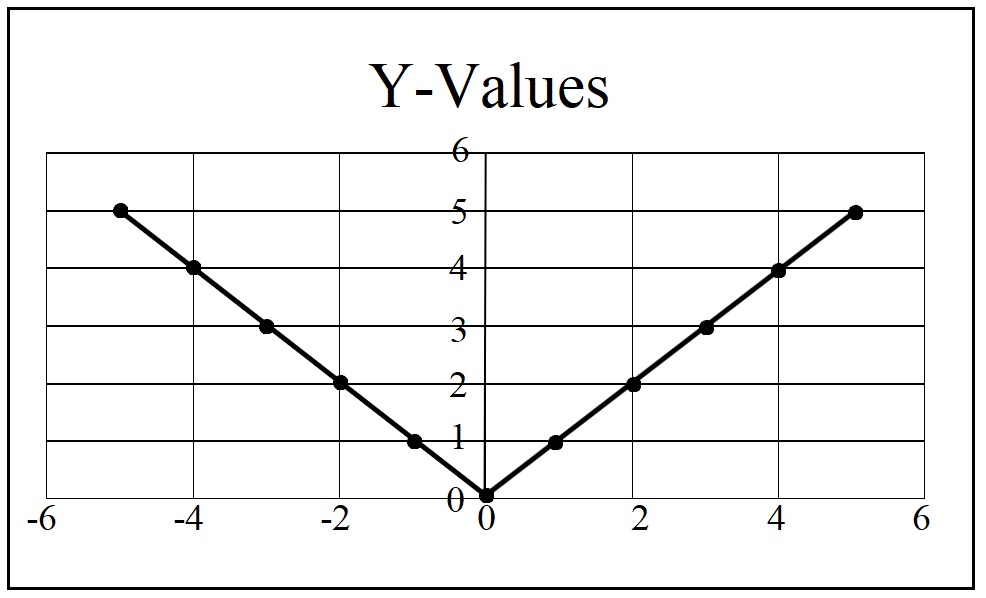
Find domain of function $|x|:$
- ✓
- B
Set of positive real numbers
- C
- D
AnswerSince the above function can have all real values of $x.$
So, domain is set of real numbers.
View full question & answer→MCQ 301 Mark
Let $f : R \rightarrow R$ be a function given by $f(x) = x^2 + 1$ then the value of $f^{-1} (26)$ is:
AnswerLet $\text{y}=\text{f}(\text{x})=\text{x}^{2}+1$
$\Rightarrow \text{y}=\text{x}^{2}+1$
$\Rightarrow \text{y}-1=\text{x}^{2}$
$\Rightarrow \text{x} = ±\sqrt{(\text{y} – 1)}$
$\Rightarrow \text{f}^{-1} \text{x} = ±\sqrt{(\text{x} – 1)}$
Now, $\text{f}^{-1} (26) = ±\sqrt{(\text{26} – 1)}$
$\Rightarrow \text{f}^{-1} (26) = ±\sqrt{(\text{25} )}$
$\Rightarrow \text{f}^{-1} (26) = ± {5 }$
View full question & answer→MCQ 311 Mark
If $f(x) = (x - 1), (x - 3), (x - 4), (x - 6) + 19$ for all real value of $x$ is:
View full question & answer→MCQ 321 Mark
Let $\text{A}=\{\text{x}\in\text{R}:\text{x}\neq0-4\leq\text{x}\leq4\}$ and $\text{f}:\text{A}\in\text{R}$ be defined by $\text{f(x)}=\frac{|\text{x}|}{\text{x}}$ for $\text{x}\in\text{A}$ Then $A:$
AnswerCorrect option: A. $[1,-1]$
As, $\text{|x|}=\begin{cases}\text{x},\ \text{x}\geq0\\-\text{x}<0\end{cases}$
So, $\text{f(x)}=\frac{\text{x}}{|\text{x}|}$
When, $\text{x}<0\text{ i.e.,}\text{ x}\in\big[-4,0\big)$
$\text{f(x)}=\frac{\text{x}}{-\text{x}}=-1$
and when, $\text{x}>0\text{ i.e., x}\in\big(0,4\big]$
$\text{f(x)}=\frac{\text{x}}{\text{x}}=1$
So, range $\text{f}=\{-1,1\}$
View full question & answer→MCQ 331 Mark
$\text{f}(\text{x})=\sqrt{9-\text{x}^2}$. Find the domain of the function:
- A
$(0, 3)$
- B
$(0, 3)$
- ✓
$(-3, 3)$
- D
$(-3, 3)$
AnswerCorrect option: C. $(-3, 3)$
We know radical cannot be negative.
So, $9-\text{x}^2,\geq 0$
$ (3 - \text{x}) (3 + \text{x}) \geq $
$\Rightarrow (\text{x} - 3) (\text{x} + 3) \leq 0$
$ \Rightarrow \text{x} \in [-3,3].$
View full question & answer→MCQ 341 Mark
If set $A$ has $2$ elements and set $B$ has $3$ elements then how many subsets does $A \times B$ have?
AnswerIf set $A$ has m elements and set $B$ has $n$ elements then $A \times B$ has $m \times n$ elements.
We know, a set has $2^r$ subsets if it has $r$ number of elements.
Here, $A \times B$ has $2 \times 3 = 6$ elements.
So, number of subsets of $A \times B$ will be $2^6$
i.e. $64.$
View full question & answer→MCQ 351 Mark
The domain of definition of the function $\text{f(x)}=\log|\text{x}|$ is:
- A
$\text{R}$
- B
$\big(-\infty,0\big)$
- C
$(0,\infty)$
- ✓
$\text{R}-\{0\}$
AnswerCorrect option: D. $\text{R}-\{0\}$
$\text{f(x)}=\log|\text{x}|$
For $f(x)$ to be defined,
$|\text{x}|>0,$ which is always true.
But $|\text{x}|\neq0$
$\Rightarrow\text{x}\neq0$
Thus, $\text{domain(f)}=\text{R}-\{0\}$
View full question & answer→MCQ 361 Mark
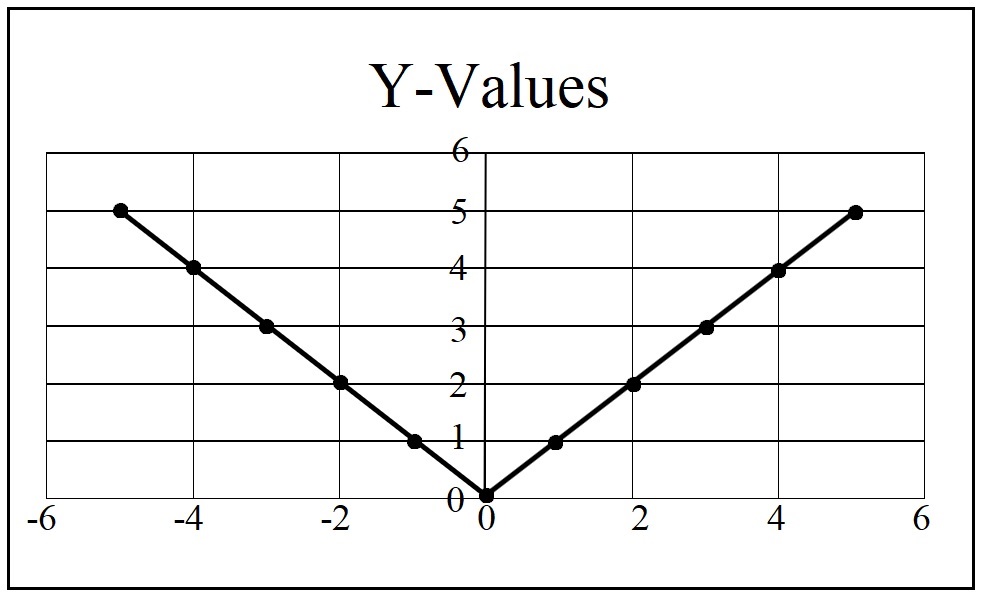
Find range of function $|x|:$
- A
- ✓
Set of positive real numbers
- C
- D
AnswerCorrect option: B. Set of positive real numbers
Since the above function can have positive real value of $y$ for all real values of $x.$
So, range is set of positive real numbers.
View full question & answer→MCQ 371 Mark
If $A = \{1, 4, 8, 9\}$ and $B = \{1, 2, -1, -2, -3, 3, 5\}$ and $R$ is a relation from set $A$ to set $B \{(x, y) : x = y^2\}.$ Find domain of the relation:
- A
$\{1, 4, 9\}$
- B
$\{-1, 1, -2, 2, -3, 3\}$
- ✓
$\{1 , 4, 8, 9\}$
- D
$\{-1, 1, -2, 2, -3, 3, 5\}$
AnswerCorrect option: C. $\{1 , 4, 8, 9\}$
We know, domain of a relation is the set from which relation is defined
i.e. set $A.$
So, domain $= \{1, 4, 8, 9\}.$
View full question & answer→MCQ 381 Mark
If $f : Q \rightarrow Q$ is defined as $f(x) = x^2$, then $f^{-1}(9)$ is equal to:
- A
$3$
- B
$-3$
- ✓
$\{-3, 3\}$
- D
$\phi$
AnswerCorrect option: C. $\{-3, 3\}$
If $f : A \rightarrow B,$ such that $\text{y}\in\text{B},$ then $\text{f}^{-1}(\text{y})=\{\text{x}\in\text{A}:\text{f(x)}=\text{y}\}$
In other words, $f^{-1}{y}$ is the set of pre$-$images of $y.$
Let $\text{f}^{-1}\{9\}=\text{x}$
Then, $\text{f(x)}=9$
$\Rightarrow\text{x}^2=9$
$\Rightarrow\text{x}=\pm3$
$\therefore\ \text{f}^{-1}\{9\}=\{-3,3\}$
View full question & answer→MCQ 391 Mark
Choose the correct answers: The domain for which the functions defined by $f(x) = 3x^2 – 1$ and $g(x) = 3 + x$ are equal is.
- ✓
$\Big\{-1, \frac{4}{3}\Big\}$
- B
$\Big[-1, \frac{4}{3}\Big]$
- C
$\Big(-1, -\frac{4}{3}\Big)$
- D
$\Big[-1, -\frac{4}{3}\Big)$
AnswerCorrect option: A. $\Big\{-1, \frac{4}{3}\Big\}$
We have, $f(x) = 3x^2 – 1$ and $g(x) = 3 + x$
$f(x) = g(x)$
$\Rightarrow 3x^2 – 1 = 3 + x$
$\Rightarrow 3x^2 – x - 4 = 0$
$\Rightarrow (3x - 4)(x + 1) = 0$
$\therefore\text{x}=-1, \frac{4}{3}$
View full question & answer→MCQ 401 Mark
If $\text{f(x)}=\cos(\log\text{x}),$ then the value of $\text{f(x}^2)\text{f}(\text{y}^2)-\frac{1}{2}\Big\{\text{f}\Big(\frac{\text{x}^2}{\text{y}^2}\Big)+\text{f}\big(\text{x}^2\text{y}^2\big)\Big\}$ is:
- A
$-2$
- B
$-1$
- C
$\frac{1}{2}$
- ✓
AnswerGiven,
$\text{f(x)}=\cos(\log\text{x})$
$\Rightarrow\ \text{f(x}^2)=\cos(\log(\text{x}^2))$
$\Rightarrow\ \text{f(x}^2)=\cos(2\log(\text{x}))$
Similarly,
$\text{f}(\text{y}^2)=\cos(2\log(\text{y}))$
Now,
$\text{f}\Big(\frac{\text{x}^2}{\text{y}^2}\Big)=\cos\Big(\log\Big(\frac{\text{x}^2}{\text{y}^2}\Big)\Big)=\cos\big(\log\text{x}^2-\log\text{y}^2\big)$
and $\text{f}(\text{x}^2\text{y}^2)=\cos(\log\text{x}^2\text{y}^2)=\cos\big(\log\text{x}^2+\log\text{y}^2\big)$
$\Rightarrow\ \text{f}\Big(\frac{\text{x}^2}{\text{y}^2}\Big)+\text{f}(\text{x}^2\text{y}^2)=\cos\big((2\log\text{x}-2\log\text{y})\big)+\cos\big((2\log\text{x}-2\log\text{y})\big)$
$\Rightarrow\ \text{f}\Big(\frac{\text{x}^2}{\text{y}^2}\Big)+\text{f}(\text{x}^2\text{y}^2)=2\cos(2\log\text{x})\cos(2\log\text{y})$
$\Rightarrow\frac{1}{2}\bigg[\Big(\text{f}\Big(\frac{\text{x}^2}{\text{y}^2}\Big)+\text{f}(\text{x}^2\text{y}^2)\bigg]=\cos(2\log)\cos(2\log\text{y})$
$\Rightarrow\ \text{f(x}^2)\text{f}(\text{y}^2)-\frac{1}{2}\Big\{\text{f}\Big(\frac{\text{x}^2}{\text{y}^2}\Big)+\text{f}\big(\text{x}^2\text{y}^2\big)\Big\}\\\ =\cos(2\log)\cos(2\log\text{y})-\cos(2\log)\cos(2\log\text{y})=0$
View full question & answer→MCQ 411 Mark
$R$ is a relation from $\{11, 12, 13\}$ to $\{8, 10, 12\}$ defined by $y = x - 3.$ Then, $R^{-1}$ is:
- ✓
$\{(8, 11), (10, 13)\}$
- B
$\{(11, 8), (13, 10)\}$
- C
$\{(10, 13), (8, 11), (12, 10)\}$
- D
AnswerCorrect option: A. $\{(8, 11), (10, 13)\}$
$R$ is a relation from $\{11, 12, 13\}$ to $\{8, 10, 12\},$ defined by $y = x - 3$
Now, we have,
$11 - 3 = 8$
$13 - 3 = 10$
So, $R = \{(13, 10), (11, 8)\}$
$\therefore R^{-1}= \{(10, 13), (8, 11)\}$
View full question & answer→MCQ 421 Mark
The period of the function $\text{f(x)}=\sin \big(\frac{2\pi\text{x}}{3}\big)+\cos\big(\frac{\pi\text{x}}{3}\big)$:
AnswerGiven, function $\text{f}(\text{x})=\sin \big(\frac{2\pi\text{x}}{3}\big)+\cos \big(\frac{\pi\text{x}}{2}\big)$
Now, period of $\text{f}(\text{x})=\big(\frac{2\pi\text{x}\times{3}}{2\pi}\big)=3$
and period of $\cos \Big(\frac{\text{n}\pi}{2}\Big)=\frac{2\text{n}}{\frac{\text{n}}{2}} = \big(\frac{2\pi\text{}\times{2}}{ \pi}\big)= 2 \times 2 = 4$
Now, period of $f(x) = \text{LCM}(3, 4) = 12$
Hence, period of function $\text{f(x)} = \sin\frac{2\pi\text{x}}{3} + \cos \big(\frac{\pi\text{x}}{2}\big) + \cos$ is $12$
View full question & answer→MCQ 431 Mark
Let $\text{f(x)}=\sqrt{\text{x}^2+1}$ Then which of the following is correct?
- A
$\text{f(xy)}=\text{f(x)}\text{f(y)}$
- B
$\text{f(xy)}\geq\text{f(x)}\text{f(y)}$
- ✓
$\text{f(xy)}\leq\text{f(x)}\text{f(y)}$
- D
AnswerCorrect option: C. $\text{f(xy)}\leq\text{f(x)}\text{f(y)}$
Given, $\text{f(x)}=\sqrt{\text{x}^2+1}\ ...(\text{i})$
Replacing $x$ by $y$ in $(i)$, we get
$\text{f(y)}=\sqrt{\text{y}^2+1}$
$\therefore\ \text{f(x)}\text{f(y)}=\sqrt{\text{x}^2+1}\sqrt{\text{y}^2+1}$
$=\sqrt{(\text{x}^2+1)(\text{y}^2+1)}$
$=\sqrt{\text{x}^2\text{y}^2+\text{x}^2+\text{y}^2+1}$
Also, replacing $x$ by $xy$ in $(i),$ we get
$\text{f(xy)}=\sqrt{\text{x}^2\text{y}^2+1}$
Now,
$\text{x}^2\text{y}^2+1\leq\text{x}^2\text{y}^2+\text{x}^2+\text{y}^2+1$
$\Rightarrow\sqrt{\text{x}^2\text{y}^2+1}\leq\sqrt{\text{x}^2\text{y}^2+\text{x}^2+\text{y}^2+1}$
$\Rightarrow\text{f}(\text{xy})\leq\text{f(x)}\text{f(y)}$
View full question & answer→MCQ 441 Mark
The domain of the function $\text{f(x)}=\sqrt{\frac{(\text{x}+1)(\text{x}-3)}{\text{x}-2}}$ is:
- ✓
$[-1,2)\cap[3,\infty)$
- B
$(-1,2)\cap[3,\infty)$
- C
$[-1,2]\cap[3,\infty]$
- D
AnswerCorrect option: A. $[-1,2)\cap[3,\infty)$
$\text{f(x)}=\sqrt{\frac{(\text{x}+1)(\text{x}-3)}{\text{x}-2}}$
For $f(x)$ to be defined,
$(\text{x}-2)\neq0$
$\Rightarrow\text{x}\neq2\ ...(\text{i})$
Also,
$\frac{(\text{x}+1)(\text{x}-3)}{\text{x}-2}\geq0$
$\Rightarrow\frac{(\text{x}+1)(\text{x}-3)(\text{x}-2)}{(\text{x}-2)^2}\geq0$
$\Rightarrow(\text{x}+1)(\text{x}-3)(\text{x}-2)\geq0$
$\Rightarrow\text{x}\in\big[-1,2\big)\cup\big[3,\infty\big)\ ...(\text{ii})$
From $(i)$ and $(ii),$
$\text{x}\in\big[-1,2\big)\cap\big[3,\infty\big)$
View full question & answer→MCQ 451 Mark
The domain of the function $ \text {f} (\text{x}) = \frac{1}{(2 -\cos 3\text{x})}$ is:
- A
$ \Big (\frac{1}{3}, 1\Big)$
- B
$ \Big (\frac{1}{3}, 1\Big)$
- C
$ \Big (\frac{1}{3}, 1\Big)$
- ✓
$ \text{R}$
AnswerCorrect option: D. $ \text{R}$
Given,
function is $ \text{f}(\text{x}) = \frac{1}{(2 -\cos 3\text{x})}$
Since $ -1 \leq \cos \text{3x} \leq1$ for all$\text{ x }\in \text{R}$
So,$ -1 \leq 2 \cos \text{3x} \leq1$for all$\text{ x }\in \text{R}$
$\Rightarrow \text{f}(\text{x})$ is defined for all$\text{ x }\in \text{R}$
So, domain of $f(x)$ is $R.$
View full question & answer→MCQ 461 Mark
Choose the correct answers:
Range of $\text{f(x)}=\frac{1}{1-2\cos\text{x}}$ is.
- A
$\Big[\frac{1}{3}, 1\Big]$
- B
$\Big[-1, \frac{1}{3}\Big]$
- ✓
$(-\infty, -1]\cup\Big[\frac{1}{3},\infty\Big)$
- D
$\Big[-\frac{1}{3}, 1\Big]$
AnswerCorrect option: C. $(-\infty, -1]\cup\Big[\frac{1}{3},\infty\Big)$
We know that, $-1\leq-\cos\text{x}\leq1$
$\Rightarrow-1\leq-\cos\text{x}\leq1$
$\Rightarrow-2\leq-2\cos\text{x}\leq2$
$\Rightarrow-1\leq-2\cos\text{x}\leq3$
Now $\text{f(x)}=\frac{1}{1-2\cos\text{x}}$ is defined if
$-1\leq-2\cos\text{x}\leq0$ or $0<1-2\cos\text{x}\leq3$
$\Rightarrow-1\geq\frac{1}{1-2\cos\text{x}}>-\infty$ or $\infty>\frac{1}{1-2\cos\text{x}}\geq\frac{1}{3}$
$\Rightarrow\frac{1}{1-2\cos\text{x}}\in(-\infty, -1]\cup\Big[\frac{1}{3},\infty\Big)$
View full question & answer→MCQ 471 Mark
If the set $A$ has $3$ elements and the set $B = \{1, 3, 4, 5\},$ then the number of elements in $(A \times B)$ is:
View full question & answer→MCQ 481 Mark
If the function $f : R \rightarrow R$ be given by $f(x) = x^2 + 2$ and $g : R \rightarrow R$ is given by $ \text{g}(\text{x})=\frac{\text{x}}{(\text{x} - 1)}$. The value of $gof(x)$ is:
- ✓
$\frac{\text{ (x}^{2} + 2)}{(\text{x}^{2} + 1)}$
- B
$ \frac{\text{x}^{2}}{(\text{x} - 1)}$
- C
$ \frac{\text{x}^{2}}{(\text{x} +2)}$
- D
$\text{none of these}$
AnswerCorrect option: A. $\frac{\text{ (x}^{2} + 2)}{(\text{x}^{2} + 1)}$
$\frac{\text{ (x}^{2} + \ 2)}{(\text{x}^{2} + \ 1)}$
Given $f(x) = x^2 + 2$ and $ \text{g}(\text{x})=\frac{\text{x}}{(\text{x}\ - \ 1)}$
Now, $\text{gof(x)} = \text{g}(\text{x}^2 + 2)$
$= \text{got}(\text{x})=\text{g}(\text{x}^2 +2)$
$=\frac{\text{ (x}^{2} +\ 2)}{(\text{x}^{2} \ +\ 2\ -\ 1)}$
$=\frac{(\text{x}^2\ +\ 2)}{(\text{x}^2\ +\ 1)}$
View full question & answer→MCQ 491 Mark
$f$ is a real valued function given by $\text{f(x)}=27\text{x}^3+\frac{1}{\text{x}^3}$ and $\alpha,\beta$ are roots of $3\text{x}+\frac{1}{\text{x}}=12$ Then,
Answer$\text{f(x)}=27\text{x}^3+\frac{1}{\text{x}^3}$
$\Rightarrow\text{f(x)}=\Big(3\text{x}+\frac{1}{\text{x}}\Big)\Big(9\text{x}^2+\frac{1}{\text{x}^2}-3\Big)$
$\Rightarrow\text{f(x)}=\Big(3\text{x}+\frac{1}{\text{x}}\Big)\Big(\Big(3\text{x}+\frac{1}{\text{x}}\Big)^2-9\Big)$
$\Rightarrow\text{f}(\alpha)=\Big(3\alpha+\frac{1}{\alpha}\Big)\Big(\Big(3\alpha+\frac{1}{\alpha}\Big)^2-9\Big)$
Since $\alpha$ and $\beta$ are the roots of $3\text{x}+\frac{1}{\text{x}}=12,$
$3\alpha+\frac{1}{\alpha}=12$ and $3\beta+\frac{1}{\beta}=12$
$\Rightarrow\text{f}(\alpha)=12\big((12)^2-9\big)$ and $\text{f}(\beta)=12\big((12)^2-9\big)$
$\Rightarrow\text{f}(\alpha)=\text{f}(\beta)=\big((12)^2-9\big)$
View full question & answer→MCQ 501 Mark
If $A = \{1, 2, 3\}, B = \{3, 4\}, C = \{4, 5, 6\},$ then:
AnswerCorrect option: B. $\{(1, 4)\} \{(3, 4)\}$
View full question & answer→