MCQ 11 Mark
The kinetic energy of the satellite in a circular orbit with speed vis given as:
- A
$\text{KE}=\frac{-\text{GmM}_\text{e}}{2(\text{R}_\text{e}+\text{h})}$
- B
$\text{KE}=\frac{\text{GmM}_\text{e}}{(\text{R}_\text{e}+\text{h})}$
- ✓
$\text{KE}=\frac{\text{GmM}_\text{e}}{2(\text{R}_\text{e}+\text{h})}$
- D
$\text{KE}=-\frac12\text{mv}^2$
AnswerCorrect option: C. $\text{KE}=\frac{\text{GmM}_\text{e}}{2(\text{R}_\text{e}+\text{h})}$
$KE$ of satellite $=\frac12\text{mv}^2{}$
$=\frac12\text{m}\bigg(\sqrt{\frac{\text{Gm}_\text{e}}{(\text{R}_\text{e}+\text{h})}}\bigg)^2$
$=\frac12\frac{\text{GmM}_\text{e}}{(\text{R}_\text{e}+\text{h})}$
View full question & answer→MCQ 21 Mark
A particle of mass $m$ is at the surface of the earth of radius $R.$ It is lifted to a heighth abov the surface of the earth. The gain in gravitational potential energy of the particle is:
- A
$\frac{\text{mgh}}{\big(1-\frac{\text{h}}{\text{R}}\big)}$
- B
$\frac{\text{mgh}}{\big(1+\frac{\text{h}}{\text{R}}\big)}$
- C
$\frac{\text{mghR}}{(\text{R}+\text{h})}$
- ✓
$\text{Both (b) and (c)}$
AnswerCorrect option: D. $\text{Both (b) and (c)}$
View full question & answer→MCQ 31 Mark
As observed from earth, the sun appears to move in an approximate circular orbit. For the motion of another planet like mercury as observed from earth, this would.
- A
- B
Not be true because the force between earth and mercury is not inverse square law.
- ✓
Not be true because the major gravitational force on mercury is due to sun.
- D
Not be true because mercury is influenced by forces other than gravitational forces.
AnswerCorrect option: C. Not be true because the major gravitational force on mercury is due to sun.
Force of attraction between any two objects obeys the inverse square law as its universal law. The relative motion between Earth, Mercury as observed from Earth will not be circular as the force on Mercury due to the sun is very large than due to Earth and due to the relative motion of Sun and Earth with Mercury.
View full question & answer→MCQ 41 Mark
If the gravitation force on body 1 due to 2 is given by $F_2$ and on body 2 due to 1 is given as $F_1$, then
AnswerCorrect option: B. $F_{12}=-F_{21}$
b. $F_{12}=-F_{21}$
Explanation:
Since, gravitational forces are attractive $F_{12}$ is directed opposite to $F_{21}$ and they are also equal in magnitude.
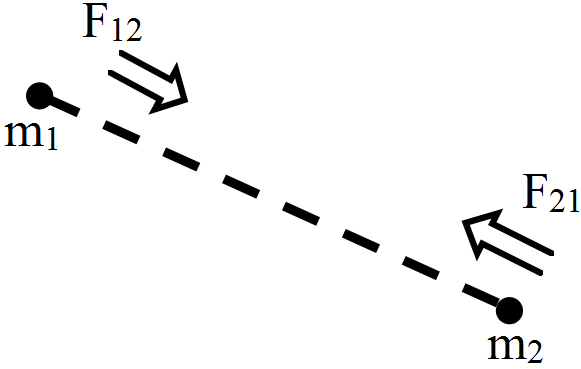
Hence, $F_{21}=-F_{12}$
Or $F_{12}=-F_{21}$ View full question & answer→MCQ 51 Mark
A point mass $m$ is placed outside a hollow spherical shell of mass $M$ and uniform density at a distanced from centre of the big sphere.Gravitational force on point mass mat $P$ is:
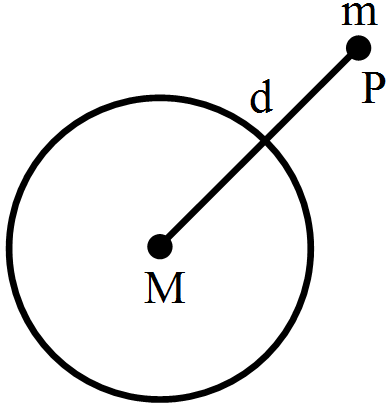
AnswerCorrect option: A. $\frac{\text{GmM}}{\text{d}^2}$
View full question & answer→MCQ 61 Mark
- A
Inertial mass is a measure of difficulty of accelerating a body by an external force whereas the gravitational mass is relevant in determining the gravitational force on it by an external mass.
- B
That the gravitational mass and inertial mass are equal is an experimental result.
- C
That the acceleration due to gravity on earth is the same for all bodies is due to the equality of gravitational mass and inertial mass.
- ✓
Gravitational mass of a particle like proton can depend on the presence of neighouring heavy objects but the inertial mass cannot.
AnswerCorrect option: D. Gravitational mass of a particle like proton can depend on the presence of neighouring heavy objects but the inertial mass cannot.
Key concept:
Inertial mass: It is the mass of the material body, which measures its inertia.
Gravitational Mass: It is the mass of the material body, which determines the gravitational pull acting upon it. According to the principle of equivalence, Gravitational mass of proton is equivalent to its inertial mass and is independent of presence of neighboring heavy objects.
Important point: Comparison between inertial and gravitational mass:
Both are measured in the same units.
Both are scalars.
Both do not depend on the shape and state of the body.
Inertial mass is measured by applying Newton’s second law of motion whereas gravitational mass is measured by applying Newton’s law of gravitation.
Spring balance measures gravitational mass and inertial balance measure inertial mass.
View full question & answer→MCQ 71 Mark
Mars has about $\frac{1}{10}^\text{th}$ as much mass as the earth and half as great a diameter. The acceleration of a falling body on Mars is about:
- A
$9.8\ ms^{-2}$
- B
$1.96\ ms^{-2}$
- ✓
$3.92\ ms^{-2}$
- D
$4.9\ ms^{-2}$
AnswerCorrect option: C. $3.92\ ms^{-2}$
View full question & answer→MCQ 81 Mark
What is the weight of a $700\ gm$ of body on a planet whose mass is $\frac{1}{7}^\text{th}$ of that of earth and radius is $\frac{1}{2}$ of earth:
- ✓
$400gm$
- B
$300gm$
- C
$700gm$
- D
$500gm$
AnswerCorrect option: A. $400gm$
On, earth, $\text{g}=\frac{\text{GM}}{\text{R}^2}$
On planet, $\text{g}'=\frac{\frac{\text{GM}}{7}}{\Big(\frac{\text{R}}{2}\Big)^2}=\frac{4}{7}\text{g}$
$\therefore$ Weight of body on planet,
$=\text{mg}'=700\times\frac{4}{7}\times\text{g}$
$=400\text{mg wt}.$
View full question & answer→MCQ 91 Mark
If $g$ is the acceleration due to gravity on the earth's surface, the gain in the potential energy of an object of mass $m$ raised from the earth's surface to a height equal to the radius $R$ of the earth, is:
AnswerCorrect option: A. $\frac{1}{2}\text{m g R}$
View full question & answer→MCQ 101 Mark
If $M$ is the mass of the earth and $R$ its radius, the ratio of the gravitational acceleration and the gravitational constant is:
- A
$\frac{\text{R}^2}{\text{M}}$
- ✓
$\frac{\text{M}}{\text{R}^2}$
- C
$\text{M}\text{R}^2$
- D
$\frac{\text{M}}{\text{R}}$
AnswerCorrect option: B. $\frac{\text{M}}{\text{R}^2}$
View full question & answer→MCQ 111 Mark
The distance of two planets $($neptune and saturn$)$ from sun are $10^{13}$ and $10^{12}$m respectively. The ratio of time period of the planets is:
- A
$100$
- B
$\frac{1}{\sqrt{10}}$
- C
$\sqrt{10}$
- ✓
$10\sqrt{10}$
AnswerCorrect option: D. $10\sqrt{10}$
$\frac{\text{T}^2_1}{\text{T}^2_2}=\frac{\text{r}^3_1}{\text{R}^3_2}$
$\text{or }\frac{\text{T}_1}{\text{T}_2}=\Big(\frac{\text{r}_1}{\text{r}_2}\big)^{\frac{3}{2}}=(10)^{\frac{3}{2}}$
View full question & answer→MCQ 121 Mark
The largest and shortest distance of earth from the sun are $r_1$ and $r_2$. Its distance from the sun when it is perpendicular to the major axis of the orbit drawn from the sun is:
- A
$\frac{\text{r}_1+\text{r}_2}{4}$
- B
$\frac{\text{r}_1+\text{r}_2}{\text{r}_1-\text{r}_2}$
- ✓
$\frac{2\text{r}_1\text{r}_2}{\text{r}_1+\text{r}_2}$
- D
$\frac{\text{r}_1+\text{r}_2}{2}$
AnswerCorrect option: C. $\frac{2\text{r}_1\text{r}_2}{\text{r}_1+\text{r}_2}$
View full question & answer→MCQ 131 Mark
Both earth and moon are subject to the gravitational force of the sun. As observed from the sun, the orbit of the moon.
- A
- ✓
Will not be strictly elliptical because the total gravitational force on it is not central.
- C
Is not elliptical but will necessarily be a closed curve.
- D
Deviates considerably from being elliptical due to influence of planets other than earth.
AnswerCorrect option: B. Will not be strictly elliptical because the total gravitational force on it is not central.
Moon revolves around the earth in a nearly circular orbit. When it is observed from the sun, two types of forces are acting on the moon one is due to gravitational attraction between the sun and the moon and the other is due to gravitational attraction between the earth and the moon. So moon is moving under the combined gravitational pull acting on it due to the earth and the sun. Hence, total force on the moon is not central.
View full question & answer→MCQ 141 Mark
An artificial earth satellite of mass $m$ is circling round the earth in an orbit of radius $R$. If the mass of the earth is $M,$ then the total energy of the satellite is:
- A
$\frac{3\text{GMm}}{2\text{R}}$
- ✓
$\frac{-\text{GMm}}{2\text{R}}$
- C
$\frac{\text{GMm}}{\text{R}}$
- D
$\frac{-\text{GMm}}{\text{R}}$
AnswerCorrect option: B. $\frac{-\text{GMm}}{2\text{R}}$
Total energy $= \text{P.E. + K.E.}$
$=\frac{\text{GMm}}{\text{R}}+\frac{1}{2}\text{mv}^2$
$=-\frac{\text{GMm}}{\text{R}}+\frac{1}{2}\text{m}\frac{\text{GM}}{\text{R}}$
View full question & answer→MCQ 151 Mark
A ring has a total mass $M$ but non$-$uniformly distributed over its circumference. The radius of the ring is $R.$ A point mass m is placed at the centre of the ring. Work done in taking away this point mass from centre to infinity is:
- A
$-\frac{\text{GMm}}{\text{R}}$
- ✓
$\frac{\text{GMm}}{\text{R}}$
- C
$-\frac{\text{GMm}}{2\text{R}}$
- D
$\frac{\text{GMm}}{\text{R}^2}$
AnswerCorrect option: B. $\frac{\text{GMm}}{\text{R}}$
View full question & answer→MCQ 161 Mark
If the gravitational potential energy at infinity is assumed to be zero, the potential energy at distance $(R_e + h)$ from the centre of the earth:
- A
$\text{PE}=\frac{\text{GmM}_\text{e}}{(\text{R}_\text{e}+\text{h})}$
- ✓
$\text{PE}=\frac{-\text{GmM}_\text{e}}{(\text{R}_\text{e}+\text{h})}$
- C
$\text{PE}=\text{mgh}$
- D
$\text{PE}=\frac{-\text{GmM}_\text{e}}{2(\text{R}_\text{e}+\text{h})}$
AnswerCorrect option: B. $\text{PE}=\frac{-\text{GmM}_\text{e}}{(\text{R}_\text{e}+\text{h})}$
View full question & answer→MCQ 171 Mark
The ratio of the magnitude of potential energy and kinetic energy of a satellite is:
- A
$1 : 2$
- ✓
$2 : 1$
- C
$3 : 1$
- D
$1 : 3$
AnswerCorrect option: B. $2 : 1$
View full question & answer→MCQ 181 Mark
The time period of a second's pendulum in a satellite is:
AnswerInside the satellite the effective value of $g = 0,$ so time period $\text{T}=2\pi\sqrt{\frac{\text{l}}{\text{g}}}$ is infinity.
View full question & answer→MCQ 191 Mark
A satellite orbits around the earth in a circular orbit with a speed $v$ and orbital radius $r.$ If it losses some energy, then $v$ and $r$ changes as:
- A
$V$ decreases and $r$ increases.
- B
Both $v$ and $r$ decreases.
- ✓
$V$ increases and $r$ decreases.
- D
Both $v$ and $r$ increases.
AnswerCorrect option: C. $V$ increases and $r$ decreases.
Orbital velocity, $\text{v}=\sqrt{\frac{\text{GM}}{\text{r}}}$
Total energy $= \text{K.E + P.E.}$
$=\frac{1}{2}\text{mv}^2+\Big(\frac{-\text{GMm}}{\text{r}}\Big)$
$=\frac{1}{2}\text{m}\frac{\text{GM}}{\text{r}}-\frac{\text{GMm}}{\text{r}}$
$=-\frac{\text{GMm}}{2\text{r}}$
If the satellite losses some energy, its total energy will decrease.
It will be so if $r$ decreases. Then from $(i)\ v$ increases.
View full question & answer→MCQ 201 Mark
Escape velocity of a planet is $v.$ If radius of the planet remains same and mass becomes $4$ times, the escape velocity becomes:
AnswerCorrect option: B. $2\text{v}_{\text{e}}$
Escape velocity,
$\text{v}_{\text{e}}=\sqrt{2\text{gR}}$
$=\sqrt{\frac{2\text{GM}}{\text{R}}},\text{v}_{\text{e}}\propto\sqrt{\text{M}}.$
View full question & answer→MCQ 211 Mark
A satellite of mass $m$ revolves around the earth of radius $R$ at a height $x$ from its surface. If $g$ is the acceleration due to gravity on the surface of the earth, the orbital speed of the satellite is:
- A
$\text{gx}$
- B
$\frac{\text{gR}}{\text{R}-\text{x}}$
- C
$\frac{\text{gR}^2}{\text{R}+\text{x}}$
- ✓
$\Big(\frac{\text{gR}^2}{\text{R}+\text{x}}\Big)^\frac{1}{2}$
AnswerCorrect option: D. $\Big(\frac{\text{gR}^2}{\text{R}+\text{x}}\Big)^\frac{1}{2}$
View full question & answer→MCQ 221 Mark
If the mass of the earth is doubled and its radius halved, then new acceleration due to the gravity $g’$ is:
- A
$g’ = 4g$
- ✓
$g’ = 8g$
- C
$g’ = g$
- D
$g’ = 16g$
AnswerCorrect option: B. $g’ = 8g$
View full question & answer→MCQ 231 Mark
Three particles each of mass $m$ are kept at vertices of an equilateral triangle of side $L.$ Th gravitational potential energy possessed by the system is:
- A
$\frac{-\text{Gm}^2}{\text{L}}$
- ✓
$\frac{-3\text{Gm}^2}{\text{L}}$
- C
$-\frac{2\text{Gm}^2}{\text{L}}$
- D
$\frac{+3\text{Gm}^2}{\text{L}}$
AnswerCorrect option: B. $\frac{-3\text{Gm}^2}{\text{L}}$
View full question & answer→MCQ 241 Mark
If two satellites of different masses are revolving in the same orbit, they have same:
AnswerCorrect option: D. $A$ and $C$ both
The speed and time period of revolution of a satellite is independent of mass of the satellite but energy and angular momentum of a satellite depend upon mass of the body.
View full question & answer→MCQ 251 Mark
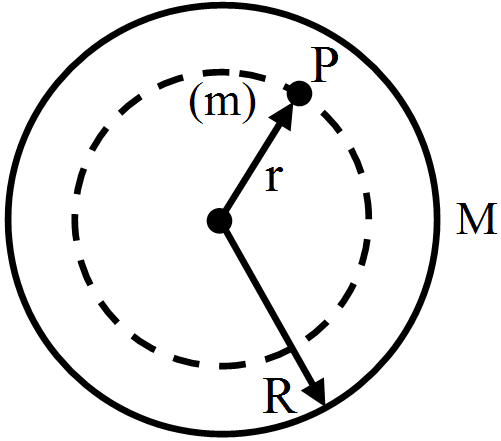
The force of attraction due to a hollow spherical shell of mass $M,$ radius $R$ and uniform density, on a point mass $m$ situated inside it is:
View full question & answer→MCQ 261 Mark
The change in potential energy, when a body of mass m is raised to a height $nR$ from earth's surface is $(R =$ radius of earth$):$
- A
$\text{mgR}\Big(\frac{\text{n}}{\text{n}-1}\Big)$
- B
$\text{nmgR}$
- C
$\text{mgR}\Big(\frac{\text{n}^2}{\text{n}^2+1}\Big)$
- ✓
$\text{mgR}\Big(\frac{\text{n}}{\text{n}+1}\Big)$
AnswerCorrect option: D. $\text{mgR}\Big(\frac{\text{n}}{\text{n}+1}\Big)$
Change in potential energy,
$\Delta\text{E}=\text{GMm}\Big(\frac{1}{\text{R}}-\frac{1}{\text{R}+\text{nR}}\Big)$
$=\frac{\text{GMm}}{\text{R}(\text{R}+\text{nR})}\times\text{nR}$
$=\frac{\text{GMm}}{\text{R}}\Big(\frac{\text{n}}{1+\text{n}}\Big)$
$=\text{gRm}\Big(\frac{\text{n}}{1+\text{n}}\Big)$
View full question & answer→MCQ 271 Mark
A satellite is moving in a circular orbit at a height $100\ km$ above the earth's surface. A person inside the satellite feels weightless because:
- A
Acceleration due to gravity is almost zero at such a height.
- B
The earth does not exert any force on the person.
- ✓
The centripetal force makes the satellite move in a circular orbit.
- D
The forces due to earth and moon are almost compensated at such a height.
AnswerCorrect option: C. The centripetal force makes the satellite move in a circular orbit.
When a satellite is moving in a circular orbit, then centripetal force makes the satellite to move in providing the centripetal force is balanced by centrifugal force. Due to which the person inside the satellite feels weightlessness.
View full question & answer→MCQ 281 Mark
Which of the following statements are true about acceleration due to gravity?
- A
'g' is zero at the centre of earth.
- B
'g' decreases if earth stops rotating on its axis.
- C
'g' decreases in moving away from the centre if r > R.
- ✓
AnswerExplanation:
Inside the earth, g' $=\text{g}\Big(1-\frac{\text{d}}{\text{R}}\Big)$
Where d = R, then g' $=\text{g}\Big(1-\frac{\text{R}}{\text{R}}\Big)=0$
Outside the earth g' $=\text{g}\Big(1-\frac{\text{2h}}{\text{R}}\Big),$ as h increases g' decrease.
View full question & answer→MCQ 291 Mark
If the law of gravitation, instead of being inversesquare law, becomes an inversecube law.
- A
Planets will not have elliptic orbits.
- B
Circular orbits of planets is not possible.
- C
Projectile motion of a stone thrown by hand on the surface of the earth will be approximately parabolic.
- ✓
AnswerExplanation:
If the law of gravitation becomes an inverse cube law instead of inverse square law, then for a planet of mass m revolving around the sun of mass M, we can write
$\text{F}=\frac{\text{GMm}}{\text{R}^3}=\frac{\text{mv}^2}{\text{R}}$ (where R is the radius of orbiting planet)
$\Rightarrow\ \text{Orbital speed}=\frac{\sqrt{\text{GM}}}{\text{R}}\Rightarrow\text{V}\propto\frac{1}{\text{ R}}$
Time period of revolution of a planet
$\text{T}=\frac{2\pi\text{R}}{\text{v}}=\frac{2\pi\text{R}}{\frac{\sqrt{\text{GM}}}{\text{R}}}=\frac{2\pi\text{R}^2}{\sqrt{\text{GM}}}$
$\Rightarrow\ \text{T}^2\propto\text{R}^4$
Hence, orbit will not be elliptical.
$[$For elliptical orbit $\text{T}^2\propto\text{R}^3]$
The circular orbits of the planets is not possible according to new law of gravitation.
As force $\text{F}=\Big(\frac{\text{GM}}{\text{R}^3}\Big)\text{m}$ = g'm
where, g' $=\frac{\text{GM}}{\text{R}^3}$
As g', acceleration due to gravity is constant, hence path followed by a projectile will be approximately parabolic, $(\text{as T}\propto\text{R}^2).$
Also, gravitational force inside a spherical shell of uniform density will have some value. So, only option (d) is incorrect.
View full question & answer→MCQ 301 Mark
- A
Potential is minimum at the centre.
- B
Potential is zero, both at centre and infinity.
- C
Field is zero both at centre and infinity.
- ✓
Potential is same, both at centre and infinity but no zero.
AnswerCorrect option: D. Potential is same, both at centre and infinity but no zero.
View full question & answer→MCQ 311 Mark
Two sphere of masses $m$ and $M$ are situated in air and the gravitational force between them is $F.$ The space around the masses is now filled with a liquid of specific gravity $3.$ The gravitational force will now be:
- ✓
$F.$
- B
$\frac{\text{F}}{3}$
- C
$\frac{\text{F}}{9}$
- D
$3F.$
AnswerGravitational force does not depend on the medium between the masses.
So, it will remain same i.e., $F.$
View full question & answer→MCQ 321 Mark
The escape velocity or earth is $V$. If the mass of a certain planet is $3$ times and radius $3$ times than that of the earth, then the escape velocity from the planet will be:
AnswerCorrect option: D. $\text{V}_{\text{e}}$
$\text{V}_{\text{e}}=\sqrt{\frac{2\text{GM}}{\text{R}}}$
or $\text{V}_{\text{e}}=\sqrt{\frac{2\text{GM}}{\frac{\text{R}}{4}}}$
$=11.2\text{km/s.}$
View full question & answer→MCQ 331 Mark
According to Kepler's law of planetary motion, if $T$ represents time period and $r$ is orbital radius, then for two planets these are related as:
- A
$\Big(\frac{\text{T}_1}{\text{T}_2}\Big)^3=\Big(\frac{\text{r}_1}{\text{r}_2}\Big)^2$
- B
$\Big(\frac{\text{T}_1}{\text{T}_2}\Big)^\frac32=\frac{\text{r}_1}{\text{r}_2}$
- ✓
$\Big(\frac{\text{T}_1}{\text{T}_2}\Big)^2=\Big(\frac{\text{r}_1}{\text{r}_2}\Big)^3$
- D
$\Big(\frac{\text{T}_1}{\text{T}_2}\Big)=\Big(\frac{\text{r}_1}{\text{r}_2}\Big)^\frac23$
AnswerCorrect option: C. $\Big(\frac{\text{T}_1}{\text{T}_2}\Big)^2=\Big(\frac{\text{r}_1}{\text{r}_2}\Big)^3$
View full question & answer→MCQ 341 Mark
The density of a newly discovered planet is twice that of earth. The acceleration due to gravity at the surface of the planet is equal to that at the surface of the earth. If the radius of the earth is surface of the earth. If the radius of the earth is $R,$ the radius of the planet would be:
- A
$2\text{R}$
- B
$4\text{R}$
- C
$\frac{\text{R}}{4}$
- ✓
$\frac{\text{R}}{2}$
AnswerCorrect option: D. $\frac{\text{R}}{2}$
$\text{g}_{\text{e}}=\frac{\text{GM}_{\text{e}}}{\text{R}^2_{\text{e}}}=\frac{\text{G}\times\frac{4}{3}\pi\text{R}^3_{\text{e}}\times\rho_{\text{e}}}{\text{R}^2_{\text{e}}}$
$=\frac{4}{3}\pi\text{GR}_{\text{e}}\rho$
and $g_{\text{p}}=\frac{\text{GM}_{\text{p}}}{\text{R}^2_{\text{p}}}$
$=\frac{\text{G}\times\frac{4}{3}\pi\text{R}^3_{\text{p}}\ \rho_{\text{p}}}{\text{R}^2_{\text{p}}}$
$=\frac{4}{3}\pi\text{GR}_{\text{p}}\ \rho_{\text{p}}$
View full question & answer→MCQ 351 Mark
A planet has twice the density of earth but the acceleration due to gravity on its surface is exactly the same as on the surface of earth. It radius in terms of radius of earth $R$ will be:
- A
$\frac{\text{R}}{4}$
- ✓
$\frac{\text{R}}{2}$
- C
$\frac{\text{R}}{3}$
- D
$\frac{\text{R}}{8}$
AnswerCorrect option: B. $\frac{\text{R}}{2}$
View full question & answer→MCQ 361 Mark
Law of areas is valid only when gravitational force is:
MCQ 371 Mark
A satellite $S$ is moving in an elliptical orbit around the earth. The mass of the satellite is very small compared to the mass of the earth.
- ✓
The acceleration of $S$ is always directed towards the centre of the earth.
- B
The angular momentum of $S$ about the centre of the earth changes in direction but its magnitude remains constant.
- C
The total energy of $S$ varies periodically with time.
- D
The linear momentum of $S$ remains constant in magnitude.
AnswerCorrect option: A. The acceleration of $S$ is always directed towards the centre of the earth.
View full question & answer→MCQ 381 Mark
Which of the following is true for a satellite in an orbit?
- A
It is a freely falling body.
- B
- C
It does not require energy for its motion in the orbit.
- ✓
AnswerExplanation:
A satellite in an orbit is a freely falling body. It does not require any energy for its motion in the orbit and its speed is constant.
View full question & answer→MCQ 391 Mark
The escape velocity of a body from the earth is $ve.$ If the radius of earth contracts to $\frac{1}{4}^\text{th}$ of its value, keeping the mass of the earth constant, escape velocity will be:
AnswerGive, escape speed $\text{v}_\text{e}=\sqrt{\frac{2\text{GM}_\text{e}}{\text{R}_\text{e}}}$
Where, $M_e$ = mass of the earth, $R_e$ = radius of the earth,
Now, radius of earth $=\text{R}'=\frac{\text{R}_\text{e}}{4}$
$\Rightarrow\text{v}'_\text{e}=\sqrt{\frac{\text{GM}}{\text{R}'}}=\sqrt{4\Big(\frac{2\text{GM}}{\text{R}_\text{e}}\Big)}=2\sqrt{\Big(\frac{\text{2GM}}{\text{R}_\text{e}}\Big)}$
$\text{v}'_\text{e}=2\text{v}_\text{e}$
View full question & answer→MCQ 401 Mark
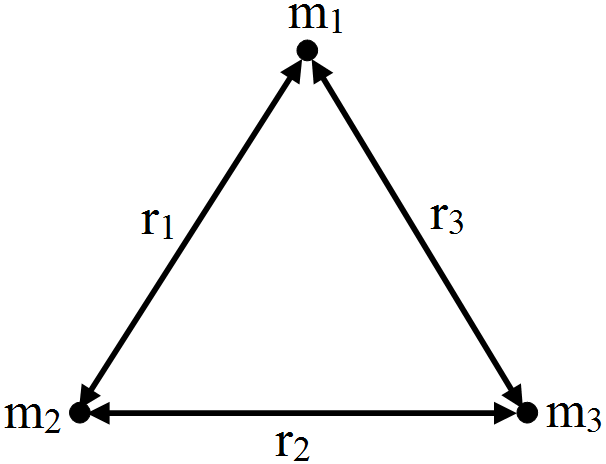
Gravitational potential energy of a system of particles as shown in the figure is:
- A
$\frac{\text{Gm}_1\text{m}_1}{\text{r}_1}+\frac{\text{Gm}_2\text{m}_3}{\text{r}_3}+\frac{\text{Gm}_1\text{m}_3}{\text{r}_3}$
- ✓
$\Big(\frac{-\text{Gm}_1\text{m}_2}{\text{r}_1}\Big)+\Big(\frac{-\text{Gm}_2\text{m}_3}{\text{r}_2}\Big)+\Big(\frac{-\text{Gm}_1\text{m}_3}{\text{r}_3}\Big)$
- C
$\frac{-\text{Gm}_1\text{m}_2}{\text{r}_1}-\frac{\text{Gm}_2\text{m}_3}{\text{r}_2}+\frac{\text{Gm}_1\text{m}_3}{\text{r}_3}$
- D
$\frac{\text{Gm}_1\text{m}_2}{\text{r}_1}+\frac{\text{Gm}_2\text{m}_3}{\text{r}_2}-\frac{\text{Gm}_1\text{m}}{\text{r}_3}$
AnswerCorrect option: B. $\Big(\frac{-\text{Gm}_1\text{m}_2}{\text{r}_1}\Big)+\Big(\frac{-\text{Gm}_2\text{m}_3}{\text{r}_2}\Big)+\Big(\frac{-\text{Gm}_1\text{m}_3}{\text{r}_3}\Big)$
For a system of particles, all possible pairs are taken and total gravitational potential energy is the algebraic sum of the potential energies due to each pair, applying the principle of superposition. Total gravitational potential energy.
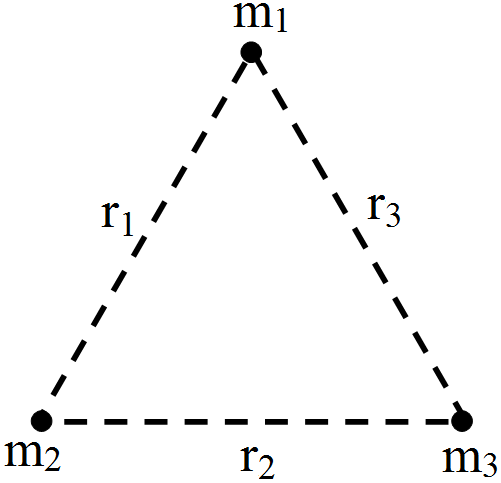
$=\frac{-\text{Gm}_1\text{m}_2}{\text{r}}-\frac{\text{Gm}_2\text{m}_3}{\text{r}_2}-\frac{\text{Gm}_1\text{m}_3}{\text{r}_3}$
$=\Big(\frac{-\text{Gm}_1\text{m}_2}{\text{r}_1}\Big)+\Big(\frac{-\text{Gm}_2\text{m}_3}{\text{r}_2}\Big)+\Big(\frac{-\text{Gm}_1\text{M}_3}{\text{r}_3}\Big)$ View full question & answer→MCQ 411 Mark
If both the mass and the radius of the earth decreases by $1\%$
- A
The escape velocity would increase.
- ✓
The acceleration due to gravity would increases.
- C
The escape velocity would decrease.
- D
The acceleration due to gravity would decrease.
AnswerCorrect option: B. The acceleration due to gravity would increases.
Escape velocity, $\text{v}_{\text{e}}=\sqrt{\frac{2\text{GM}}{\text{R}}}$
$\text{v}_{\text{e}}'=\sqrt{\frac{2\text{G}\big(\frac{99\text{M}}{100}\big)}{\big(\frac{99\text{R}}{100}\big)}}$
$=\sqrt{\frac{2\text{GM}}{\text{R}}}=\text{v}_{\text{e}}$
Also, $\text{g}=\frac{\text{GM}}{\text{R}^2}$
and $\text{g}'=\frac{\text{G}\big(\frac{99\text{M}}{100}\big)}{\big(\frac{99\text{R}}{100}\big)}=\frac{100}{99}\text{g}.$
View full question & answer→MCQ 421 Mark
If the acceleration due to gravity at earth is $'g\ '$ and mass of earth is $80$ times that of moon and radius of earth is $4$ times that of moon, the value of $'g\ '$ at the surface of moon will be:
- A
$\text{g}$
- B
$\frac{\text{g}}{20}$
- ✓
$\frac{\text{g}}{5}$
- D
$\frac{320}{\text{g}}$
AnswerCorrect option: C. $\frac{\text{g}}{5}$
Let $M$ and $R$ be the mass and radius of earth $M'$ and $R'$ are mass and radius of moon.
Then $\text{R}' = \frac{\text{R}}{{4}}$ and $M' = \frac{\text{M}}{80}$
Let $g$ and $g'$ the acceleration due to gravity on the surface of earth and moon respectively.
Then $\text{g}=\frac{\text{GM}}{\text{R}^2}$
and $g'=\frac{\text{GM}'}{\text{R}'^2}=\text{G}\frac{\frac{\text{M}}{80}}{\Big(\frac{\text{R}}{4}\Big)^2}$
$=\frac{1}{5}\frac{\text{GM}}{\text{R}^2}$
$=\frac{1}{5}\text{g}.$
View full question & answer→MCQ 431 Mark
A particle is kept at rest at a distance $R_e ($earth's radius$)$ above the earth's surface. The minimum speed with which it should be projected so that it does not return is $($mass of earth $= M_e)$
- A
$\sqrt{\frac{6\text{M}_\text{e}}{4\text{R}_\text{e}}}$
- B
$\sqrt{\frac{\text{GM}_\text{e}}{2\text{R}_\text{e}}}$
- ✓
$\sqrt{\frac{\text{GM}_\text{e}}{\text{R}_\text{e}}}$
- D
$\sqrt{\frac{2\text{GM}_\text{e}}{\text{R}_\text{e}}}$
AnswerCorrect option: C. $\sqrt{\frac{\text{GM}_\text{e}}{\text{R}_\text{e}}}$
View full question & answer→MCQ 441 Mark
The orbital velocity of a satellite orbiting near the surface of the earth is given by:
- ✓
$\text{v}\sqrt{\text{gR}_\text{e}},$ where $\text{g}=\frac{\text{GM}_\text{e}}{\text{R}^2_\text{e}}$
- B
$\text{v}=\sqrt{\text{gR}_\text{e}},$ where $\text{g}=\frac{\text{GM}_\text{e}}{\text{R}_\text{e}}$
- C
$\text{v}=\sqrt{\frac{\text{gh}}{\text{R}_\text{e}}},$ where $\text{g}=\frac{\text{GM}_\text{e}}{\text{R}^2_\text{e}}$
- D
$\text{v}=\sqrt{\text{gh}},$ where $\text{g}=\frac{\text{GM}_\text{e}}{\text{R}_\text{e}}$
AnswerCorrect option: A. $\text{v}\sqrt{\text{gR}_\text{e}},$ where $\text{g}=\frac{\text{GM}_\text{e}}{\text{R}^2_\text{e}}$
Orbital velocity of satellite, $\text{v}=\sqrt{\frac{\text{GM}_\text{e}}{(\text{R}_\text{e}+\text{h})}}$
If the satellite is close to the surface of the earth, $h = 0$
$\Rightarrow\text{v}=\sqrt{\frac{\text{GM}_\text{e}}{\text{R}_\text{e}}}$
$\Rightarrow\text{v}=\sqrt{\Big(\frac{\text{GM}_\text{e}}{\text{R}^2_\text{e}}\Big)\text{R}_\text{e}}$
$\sqrt{\text{gR}_\text{e}},$ $\Big[\because\text{g}=\frac{\text{GM}_\text{e}}{\text{R}^2_e}\Big]$
View full question & answer→MCQ 451 Mark
Two satellites of masses $m_1$ and $m_2$ $(m_1 > m_2)$ are revolving round the earth in circular orbits of radii $r_1$ and $r_2(r_1 > r_2)$ respectively. Which of the following statements is true regarding their speeds $v_1$ and $v_2$.
AnswerCorrect option: B. $\text{v}_1<\text{v}_2$
For satellite, orbital speed, $\text{v}\propto\frac{1}{\text{r}}$
Therefore, $\frac{\text{v}_1}{\text{v}_2}=\sqrt{\frac{\text{r}_2}{\text{r}_1}}<1$ or $\text{v}_1<\text{v}_2.$
View full question & answer→MCQ 461 Mark
The gravitational field due to a mass distribution is $\text{I}=\frac{\text{K}}{\text{r}^3}$ in the $X-$direction. $(K$ is a constant$)$.Taking the gravitational potential to be zero at infinity, its value at a distance $x$ is:
- A
$\frac{\text{K}}{\text{x}}$
- B
$\frac{\text{K}}{\text{2x}}$
- C
$\frac{\text{K}}{\text{x}^2}$
- ✓
$\frac{\text{K}}{\text{2x}^2}$
AnswerCorrect option: D. $\frac{\text{K}}{\text{2x}^2}$
Since, $\text{I}=\frac{-\text{dV}}{\text{dr}}\text{ or }\text{dV}=-\text{Idr}$
So $, \text{V}=\int^\limits{\text{x}}_\limits{0}-\text{Idr}$
$=\int^\limits{\text{x}}_{0}-\text{Kr}^{-3}\text{dr}$
$=-\text{K}\Big(\frac{\text{r}^{-3+1}}{-3+1}\Big)^{\text{x}}_0$
$=\frac{\text{K}}{2\text{x}^2}$
View full question & answer→MCQ 471 Mark
Which of the following options are correct?
AnswerCorrect option: C. $A$ and $B$
- The acceleration due to gravity at an altitude $($height$), gh =g(1-2).$
- As value of $\cos$ decrease from $0^\circ$ to $90^\circ ($from $1$ to $0).$ The acceleration due to gravity increases from equator $(\lambda=0^0)$ to pole $(\lambda=90^0).$ Option $(c)$ is correct.
- The acceleration due to gravity on surface of earth is $\text{g}=\frac{\text{GM}_\in}{\text{R}^2_\in}$ So $g$ on earth depends on mass of earth. Option $(d)$ is incorrect.
- Increasing depth $(d)$ decreases the value of ga . Option $(b)$ is incorrect.
- If $\lambda$ is latitude on earth then $\text{g}\lambda=\text{g}-\omega^2\text{R}\cos^2\lambda$
- Increasing height $(h)$ decreases the value of $gh$ option $(a)$ is correct.
- Assuming the earth to be a sphere of uniform density, the acceleration due to gravity at a particular depth $(d), \text{gd}=\text{g}\Big(1-\frac{\text{d}}{\text{R}}\Big).$
View full question & answer→MCQ 481 Mark
Particles of masses $2M, m$ and $M$ are respectively at points $A, B$ and $C$ with $AB = 1/2 (BC). m$ is muchmuch smaller than $M$ and at time $t = 0$, they are all at rest. At subsequent times before any collision takes place:

- A
$M$ will remain at rest.
- B
$M$ will move towards $M.$
- ✓
$M$ will move towards $2M.$
- D
$M$ will have oscillatory motion.
AnswerCorrect option: C. $M$ will move towards $2M.$
Let $\text{FBC}$ be the force experienced by mass $m$ at point $B$ due to mass $M$ at point $C$ and $\text{FBA}$ be the force experienced by mass $m$ at point $B$ due to mass $2M$ at point $A.$
$\text{F}_{\text{BC}}=\text{G}\frac{\text{mM}}{(\text{BC})^2}...(1)$
$\text{F}_\text{AB}=\text{G}\frac{\text{m2M}}{(\text{BA})^2}...(2)$
Suppose $AB = x$, then $\text{x}=\frac{1}{2}\text{ (BC)}$ or $\text{(BC)}=2\text{x}$
Substituting the values of $AB$ and $BC$ in the above equations $(1)$ and $(2)$
$\text{F}_{\text{BC}} =\text{G}\frac{\text{mM}}{(\text{2x})^2}$
$\text{F}_\text{BA}=\text{G}\frac{\text{m2M}}{(\text{x})^2}$
As $\text{F}_{\text{BA}}>\text{F}_{\text{BC}}, m$ will move towards point $A ($position of particle with mass $2M).$
View full question & answer→MCQ 491 Mark
The gravitational potential at a plane varies inversely proportional to $\text{x}^2\Big(\text{i.e., V }= \frac{\text{k}}{\text{x}_2}\Big)$ then gravitational field intensity at the place is:
- ✓
$\frac{-\text{k}}{\text{x}}$
- B
$\frac{\text{k}}{\text{x}}$
- C
$\frac{-2\text{k}}{\text{x}^3}$
- D
$\frac{2\text{k}}{\text{x}^3}$
AnswerCorrect option: A. $\frac{-\text{k}}{\text{x}}$
Gravitational intensity,
$\text{I}=-\frac{\text{dV}}{\text{dx}}$
$=-\frac{\text{d}}{\text{dx}}\Big(\frac{\text{k}}{\text{x}^2}\Big)$
$=\frac{-\text{k}}{\text{x}}$
View full question & answer→MCQ 501 Mark
If $g$ is the acceleration due to gravity at the surface of the earth. The force acting on the particle of mass $m$ placed at the surface is:
AnswerCorrect option: D. Both $(a)$ and $(b).$
Force on particle at surface is where,
$F = mg$
Where, $g =$ acceleration due to gravity at the earth's surface
Also,
$\text{g}=\frac{\text{gM}_\text{e}}{\text{R}^2_\text{e}}$
$\text{F}=\text{mg}=\frac{\text{GmM}_\text{e}}{\text{R}^2_\text{e}}$
View full question & answer→MCQ 511 Mark
In our solar system, the interplanetary region has chunks of matter $($much smaller in size compared to planets$)$ called asteroids. They
- A
Will not move around the sun since they have very small masses compared to sun.
- ✓
Will move in an irregular way because of their small masses and will drift away into outer space.
- C
Will move around the sun in closed orbits but not obey Kepler’s laws.
- D
Will move in orbits like planets and obey Kepler’s laws.
AnswerCorrect option: B. Will move in an irregular way because of their small masses and will drift away into outer space.
Asteroids will move in orbits like planets and obey Kepler’s law because they are also being acted upon by central gravitational forces.
View full question & answer→MCQ 521 Mark
Average density of the earth:
- ✓
Is directly proportional to $g.$
- B
Is inversely proportional to $g.$
- C
Is a complex function of $g.$
- D
Does not depend on $g.$
AnswerCorrect option: A. Is directly proportional to $g.$
$\text{g}=\frac{\text{GM}}{\text{R}^2}\times\frac{4}{3}\pi\text{R}^3$
$\rho=\frac{4}{3}\pi\text{GR}\rho$
or $g\propto\rho$
View full question & answer→MCQ 531 Mark
If the mass of sun were ten times smaller and gravitational constant $G$ were ten times larger in magnitudes.
- Walking on ground would became more difficult.
- The acceleration due to gravity on earth will not change.
- Raindrops will fall much faster.
- Airplanes will have to travel much faster.
- A
$A$ and $B$
- B
$A , B$ and $D$
- C
$B$ and $A$
- ✓
$A , C$ and $D$
AnswerCorrect option: D. $A , C$ and $D$
If the gravitational constant $G$ becomes $10$ times larger in magnitude.
$\text{G}'=10\text{G}$
Gravitational field due to the earth
$\text{g}'=\frac{\text{G}'\text{M}_\text{e}}{\text{r}^2}$
$=\frac{10\text{GM}_\text{e}}{\text{r}^2}=10\text{g}$
Weight of a person $=\text{mg}'=\text{m}\times10\text{g}=10\text{mg}$
Force on the man due to sun, $\text{F}=\frac{\text{GM}'_\text{s}\text{m}}{\text{r}^2}$
Mass of the sun $\text{M}'_\text{s}=\frac{1}{10}\text{M}_\text{s}\Rightarrow10\text{M}'_\text{s}=\text{M}_\text{s}$
$\text{F}=\frac{\text{GM}_\text{s}\text{m}}{\text{10r}^2}$
Weight of person becomes $10$ times larger so it will be more difficult to walk. Option $(a)$ is correct.
As $g’ = 10g,$ the acceleration due to gravity changes. Option $(b)$ is incorrect.
The terminal velocity $\text{v}_\text{T}\propto\text{g}$ and $g', g' = 10g,$ the terminal velocity increases $10$ times.
Hence the rain drops falls $10$ times faster. Option $(c)$ is correct.
As the $g’ = 10g,$ to overcome the increase gravitational force and in order to maintain the speed the aeroplane will have to travel much faster. Option $(d)$ is correct.
View full question & answer→MCQ 541 Mark
If $g$ is the acceleration due to gravity on the earth's surface, the gain in the potential energy of an object of mass $m$ raised from the surface of earth to a height equal to the radius $R$ of the earth is:
AnswerCorrect option: A. $\frac{\text{I}}{2}\text{mgR}$
Work done in raising the body
$=\int^\limits{2\text{R}}_\limits{\text{R}}\frac{\text{GMm}}{\text{x}^2}\text{dx}$
$=\int^\limits{2\text{R}}_\limits{\text{R}}\frac{\text{gR}^2}{\text{x}^2}\text{mdx}$
$=\frac{1}{2}\text{mgR}$
View full question & answer→MCQ 551 Mark
A simple pendulum is suspended from the roof of a trolley which moves in a horizontal direction with an acceleration $a,$ then the time period is given by $\text{t}=2\pi\sqrt{\frac{1}{\text{g}}}$ where $g'$ is equal to:
AnswerCorrect option: D. $\sqrt{\text{g}^2+\text{a}^2}$
Bob of the pendulum is under the effect of two forces.
Weight $= mg$ acting ertically downwards.
Horizontal force $= ma.$
Therefore, resultant force $=\sqrt{(\text{gm})^2+(\text{mg})^2}$
Hence, acceleration of the bob
$=\sqrt{\text{g}^2+\text{a}^2}$
View full question & answer→MCQ 561 Mark
The orbital speed of an artificial satellite in a circular orbit just above the earth's surface is $v$. For a satellite orbiting at an altitude of half the earth's radius the orbital speed is:
- A
$\Big(\frac{3}{2}\Big)\text{v}$
- B
$\Big(\sqrt{\frac{3}{2}}\Big)\text{v}$
- ✓
$\Big(\sqrt{\frac{2}{3}}\Big)\text{v}$
- D
$\Big(\frac{2}{3}\Big)\text{v}$
AnswerCorrect option: C. $\Big(\sqrt{\frac{2}{3}}\Big)\text{v}$
Orbital velocity close to earth, $\text{v}=\sqrt{\text{gR}}$ Orbital velocity at height $\frac{\text{R}}{2}$ will be
$\text{v}=\sqrt{\frac{\text{gR}^2}{\text{R}+\frac{\text{R}}{2}}}$
$=\sqrt{\frac{2}{3}\text{gR}}$
$=\Big(\sqrt{\frac{2}{3}}\Big)\text{v}$
View full question & answer→MCQ 571 Mark
Consider a planet moving in an elliptical planet orbit round the sun. The work done on the planet by the gravitational force of the sun:
- A
Is zero in some part of the orbit.
- B
Is zero in no part of the motion.
- C
Is zero in any small part of the orbit.
- ✓
Is zero in one complete revolution.
AnswerCorrect option: D. Is zero in one complete revolution.
View full question & answer→MCQ 581 Mark
A satellite is orbiting the earth. If its distance from the earth is increased, its:
- A
Angular velocity would increase.
- B
Linear velocity would increase.
- C
Angular velocity would decrease.
- ✓
Time period would increase.
AnswerCorrect option: D. Time period would increase.
View full question & answer→MCQ 591 Mark
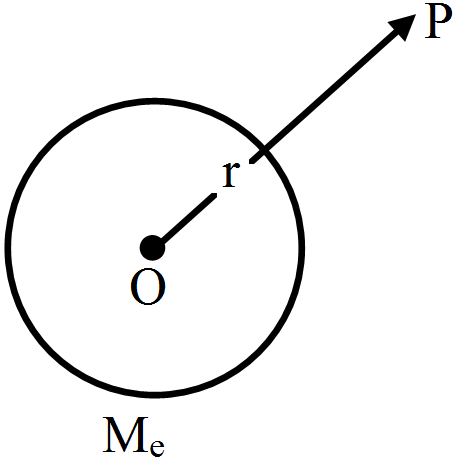
The gravitational potential at a distance $r$ from the centre of the earth $(r > R)$ is given by $($consider, mass of the earth $= M,$ radius of the earth $= R):$
- A
$\frac{-\text{GM}_\text{e}}{\text{R}}$
- B
$\frac{\text{GM}_\text{e}}{\text{R}}$
- ✓
$\frac{-\text{GM}_\text{e}}{\text{r}}$
- D
$\frac{+\text{GM}_\text{e}}{\text{r}}$
AnswerCorrect option: C. $\frac{-\text{GM}_\text{e}}{\text{r}}$
The gravitational potential at a distance from the centre of the earth.
$\text{v(r)}=-\frac{\text{GM}_\text{e}}{\text{r}}$
View full question & answer→MCQ 601 Mark
Two point masses $m_1$ and $m_2$ are separated by a distance $r.$ The gravitational potential energy of the system is $G_1$. When the separation between the particles is doubled, the gravitational potential energy is $G_2$. Then, the ratio of $\frac{\text{G}_1}{\text{G}_2}$ is:
View full question & answer→MCQ 611 Mark
For a satellite in elliptical orbit which of the following quantities does not remain constant?
AnswerIn elliptical orbit, velocity keeps on changing both in magnitude and direction.
Therefore, momentum does not remain constant $(P = mv).$
View full question & answer→MCQ 621 Mark
The period of revolution of a certain planet in an orbit of radius $R$ is $T.$ Its period of revolution in an orbit of radius $4R$ will be:
- A
$2\text{T}$
- B
$\frac{2}{2\text{T}}$
- C
$4\text{T}$
- ✓
$8\text{T}$
AnswerCorrect option: D. $8\text{T}$
$\frac{\text{T}^2_2}{\text{T}^2_1}=\frac{\text{r}^3_2}{\text{r}^2_1}$
or $\text{T}_2=\text{T}_1\Big(\frac{\text{r}_2}{\text{r}_1}\Big)^{\frac{3}{2}}$
$=\text{T}\Big(\frac{4\text{R}}{\text{R}}\Big)^{\frac{3}{2}}$
$=8\text{T}$
View full question & answer→MCQ 631 Mark
Which of the following statements is correct about satellites?
- A
A satellite cannot move in a stable orbit in a plane passing through the earth's centre.
- ✓
Geostationary satellites are launched in the equatorial plane.
- C
We can use just one geostationary satellite for global communication around the globe.
- D
The speed of satellite increases with an increase in the radius of its orbit.
AnswerCorrect option: B. Geostationary satellites are launched in the equatorial plane.
View full question & answer→MCQ 641 Mark
Earth is flattened at the poles and bulges at the equator. This is due to the fact that:
- A
The earth revolves around the sun in an elliptical orbit.
- B
The angular velocity of spinning about its axis is more at the equator.
- ✓
The centrifugal force is more at the equator than at poles.
- D
AnswerCorrect option: C. The centrifugal force is more at the equator than at poles.
Higher centrifugal force causes bulging of earth at equator.
View full question & answer→MCQ 651 Mark
If $g$ denotes the value of acceleration due to gravity at a point distant $r$ from the centre of earth of radius $R.$ If $r < R,$ then:
- A
$\text{g}\propto\text{r}^2$
- ✓
$\text{g}\propto\text{r}$
- C
$\text{g}\propto\frac{1}{\text{r}^2}$
- D
$\text{g}\propto\frac{1}{\text{r}}$
AnswerCorrect option: B. $\text{g}\propto\text{r}$
$\text{g}'=\text{g}\Big(1-\frac{\text{d}}{\text{g}}\Big)=\text{g}\Big(\frac{\text{R}-\text{d}}{\text{R}}\Big)$
$=\text{g}\frac{\text{r}}{\text{g}},$
i.e.$\text{ g}'\propto\text{r}.$
View full question & answer→MCQ 661 Mark
The mean radius of the earth is $R,$ its angular speed about its own axis is $o$ and the acceleration due to gravity at earth surface is $g.$ The cube of radius of orbit of 'geostationary satellite' will be:
- A
$\Big(\frac{\text{R}^2\text{g}}{\omega}\Big)$
- B
$\Big(\frac{\text{R}^2\omega}{\text{g}}\Big)$
- C
$\Big(\frac{\text{R}\text{g}}{\omega^2}\Big)$
- ✓
$\Big(\frac{\text{R}^2\text{g}}{\omega^2}\Big)$
AnswerCorrect option: D. $\Big(\frac{\text{R}^2\text{g}}{\omega^2}\Big)$
$\frac{\text{GMm}}{\text{r}^2}=\text{mr}\omega^2$
or $\text{r}^3=\frac{\text{GM}}{\omega^2}=\frac{\text{gR}^2}{\omega}^2$
$\Big(\because\text{g}=\frac{\text{GM}}{\text{R}^2}\Big)$
View full question & answer→MCQ 671 Mark
Suppose universal gravitational constant starts to decrease, then:
- A
Length of the day, on earth, will decrease.
- B
Kinetic energy of earth will decrease.
- C
Earth will follow a spiral path of increasing radius.
- ✓
View full question & answer→MCQ 681 Mark
The time period of an earth satellite in circular orbit is independent of:
- ✓
The mass of the satellite.
- B
- C
Both the mass of satellite and radius of the orbit.
- D
Neither the mass of satellite nor the radius of the orbit.
AnswerCorrect option: A. The mass of the satellite.
Time period of satellite at height $h$ ground is
$\text{T}=\frac{2\pi}{\text{R}}\sqrt{\frac{(\text{R+h}^3)}{\text{g}}}$
$=\frac{2\pi\big(\text{R+h}\big)^{\frac{3}{2}}}{(\text{GM})^{\frac{1}{2}}}$
It is independent of mass $m$ of the satellite.
View full question & answer→MCQ 691 Mark
If the sun and the planets carried huge amounts of opposite charges,
- All three of Kepler’s laws would still be valid.
- Only the third law will be valid.
- The second law will not change.
- The first law will still be valid.
- A
$A$ and $B$
- ✓
$A , C$ and $D$
- C
$B$ and $D$
- D
AnswerCorrect option: B. $A , C$ and $D$
Due to opposite charges the attractive electrostatic forces of attraction produced will be large, along with the gravitational forces. Both the forces will be added and would be radial in nature. Since both the forces are central forces and obey the inverse square law, all the three kepler's laws will be valid.
View full question & answer→MCQ 701 Mark
The centre of mass of an extended body on the surface of the earth and its centre of gravity.
AnswerCorrect option: D. Is close to each other for objects, say of sizes less than $100m.$
The centre of gravity $\text{(COG)}$ is based on weight of a body. The centre of mass $\text{(COM)}$ is based on mass of a body. The $\text{COG}$ is a point in a body over which the body can be perfectly balanced. The net torque due to gravity at $\text{COG}$ is zero. Whereas the $\text{COM}$ is the average location of the mass distribution of a body or it is a point where the whole mass of the body is supposed to be concentrated. If given some angular momentum the body would spin about the $\text{COM.}$ For small body, say of size less than $100m, << R_e$ when placed in uniform gravitational field, the $\text{COM}$ is very close to $\text{COG.}$ If the size of the body increases i.e., very larger like lake, or mountain, its weight changes, and its $\text{COM}$ and $\text{COG}$ become far from each other. As in case of a spherical ball where the $\text{COM}$ and $\text{COG}$ are same, but in case of a mountain the $\text{COM}$ and the $\text{COG}$ are not aligned, where $\text{COM}$ lies a bit above its $\text{COG}$. Option $(d)$ is justified.
View full question & answer→MCQ 711 Mark
Choose the correct statement/ (s):
- A
Weight of a body is greater on planes and less on hill tops.
- B
Weight of a body is greater at the poles and less at the equator.
- C
Weight of a body on the moon is less than that on the earth.
- ✓
AnswerExplanation:
Weight = Mass × Acceleration due to gravity. The acceleration due to gravity is greater on planes than on hill top. g is greater at poles than at the equator. g is less on moon than on the earth.
View full question & answer→MCQ 721 Mark
Three uniform spheres of mass $M$ and radius $R$ each are kept in such a way that each touches the other two. The magnitude of the gravitational force on any of the spheres due to the other two is:
- ✓
$\frac{\sqrt{3}}{4}\frac{\text{GM}^2}{\text{R}^2}$
- B
$\frac{3}{2}\frac{\text{GM}^2}{\text{R}^2}$
- C
$\frac{\sqrt{3}\text{GM}^2}{\text{R}^2}$
- D
$\frac{\sqrt{3}}{2}\frac{\text{GM}^2}{\text{R}^2}$
AnswerCorrect option: A. $\frac{\sqrt{3}}{4}\frac{\text{GM}^2}{\text{R}^2}$
View full question & answer→MCQ 731 Mark
The gravitational potential energy of a system consisting of two particles separated by a distance $r$ is:
- A
Directly proportional to product of the masses of particles.
- B
Inversely proportional to the separation betweenthem.
- C
- ✓
Both $(a)$ and $(b).$
AnswerCorrect option: D. Both $(a)$ and $(b).$
View full question & answer→MCQ 741 Mark
A body of mass $m$ is placed on earth surface which is taken from earth surface to a height of $h = 3R,$ then change in gravitational potential energy is:
- A
$\frac{1}{4}\text{mgR}$
- B
$\frac{2}{3}\text{mgR}$
- ✓
$\frac{3}{4}\text{mgR}$
- D
$\frac{1}{3}\text{mgR}$
AnswerCorrect option: C. $\frac{3}{4}\text{mgR}$
Change in gravitational potential energy
$=\frac{-\text{GMm}}{(3\text{R}+\text{R})}-\Big(\frac{-\text{GMm}}{\text{R}}\Big)$
$=\frac{3}{4}\frac{\text{GMm}}{\text{R}}$
$=\frac{3}{4}\text{mgR}.$
View full question & answer→MCQ 751 Mark
What is the value of acceleration caused by force of gravity on a stone placed on ground?
MCQ 761 Mark
The radius of the orbit of a satellite is $r$ and its kinetic energy is $K.$ If the radius of the orbit is doubled, then the new kinetic energy $K'$ is:
- A
$2$
- ✓
$\frac{\text{K}}{2}$
- C
$4K$
- D
AnswerCorrect option: B. $\frac{\text{K}}{2}$
View full question & answer→MCQ 771 Mark
Two spheres of masses $m$ and $M$ are situated in air and the gravitational force between them is $F.$ The space around the masses is now filled with liquid of specific gravity $3$. The gravitational force will now be:
- A
$3\text{F}$
- ✓
$\text{F}$
- C
$\frac{\text{F}}{3}$
- D
$\frac{\text{F}}{3}$
AnswerCorrect option: B. $\text{F}$
The gravitational force between two bodies is independent of the presence of other bodies.
View full question & answer→MCQ 781 Mark
The law of areas can be interpreted as:
- ✓
$\frac{\Delta\text{A}}{\Delta\text{t}}=\text{constant}$
- B
$\frac{\Delta\text{A}}{\Delta\text{t}}=\frac{\text{L}}{\text{m}}$
- C
$\frac{\Delta\text{A}}{\Delta\text{t}}=\frac{1}{2}(\text{r}\times\text{P})$
- D
$\frac{\Delta\text{A}}{\Delta\text{t}}=\frac{2\text{L}}{\text{m}}$
AnswerCorrect option: A. $\frac{\Delta\text{A}}{\Delta\text{t}}=\text{constant}$
View full question & answer→MCQ 791 Mark
If three uniform spheres, each having mass $M$ and radius $r,$ are kept in such a way that each touches the other two, the magnitude of the gravitational force on any sphere due to the other two is:
- A
$\frac{\text{GM}^2}{4\text{r}^2}$
- B
$\frac{2\text{GM}^2}{\text{r}^2}$
- C
$\frac{2\text{GM}^2}{4\text{r}^2}$
- ✓
$\frac{\sqrt{3}\text{GM}^2}{4\text{r}^2}$
AnswerCorrect option: D. $\frac{\sqrt{3}\text{GM}^2}{4\text{r}^2}$
View full question & answer→MCQ 801 Mark
A satellite is launched into a circular orbit of radius $R$ around the earth. A second satellite launched into an orbit of radius $1.01R.$ The time period of the second satellite is larger than that of the first one by approximately:
- A
$0.5\%$
- ✓
$1.5\%$
- C
$1\%$
- D
$3.0\%$
AnswerCorrect option: B. $1.5\%$
View full question & answer→MCQ 811 Mark
The radii of two planets are respectively $R_1$ and $R_2$ and their densities are respectively $P_1$ and $P_2$. The ratio of the accelerations due to gravity at their surfaces:
- A
$\text{g}_1:\text{g}_2=\frac{\rho_1}{\text{R}^2_1}:\frac{\rho_2}{\text{R}^2_2}$
- B
$\text{g}_1:\text{g}_2=\text{R}_1\text{R}_2:\rho_1\rho_2$
- C
$\text{g}_1:\text{g}_2=\text{R}_1\rho_2:\text{R}_2\rho_1$
- ✓
$\text{g}_1:\text{g}_2=\text{R}_1\rho_1:\text{R}_2\rho_2$
AnswerCorrect option: D. $\text{g}_1:\text{g}_2=\text{R}_1\rho_1:\text{R}_2\rho_2$
View full question & answer→MCQ 821 Mark
The earth is an approximate sphere. If the interior contained matter which is not of the same density everywhere, then on the surface of the earth, the acceleration due to gravity.
- A
Will be directed towards the centre but not the same everywhere.
- B
Will have the same value everywhere but not directed towards the centre.
- C
Will be same everywhere in magnitude directed towards the centre.
- ✓
Cannot be zero at any point.
AnswerCorrect option: D. Cannot be zero at any point.
Acceleration due to gravity $g = 0,$ at the centre if we assume the earth as a sphere of uniform density, then it can be treated as point mass placed at its centre.
But on surface of the earth the acceleration due to gravity cannot be zero at any point.
View full question & answer→MCQ 831 Mark
If a particle is fired vertically upwards from the surface of earth and reaches a height of $6400\ km,$ the initial velocity of the particle is $($assume $R = 6400\ km$ and $g = 10\ ms^{-2})$
- A
$4\ km/ \sec$
- B
$2\ km/ \sec$
- ✓
$8\ km/ \sec$
- D
$16\ km/ \sec$
AnswerCorrect option: C. $8\ km/ \sec$
View full question & answer→MCQ 841 Mark
A point mass $m$ is placed at the centre of the square $\text{ABCD}$ of side a units as shown below.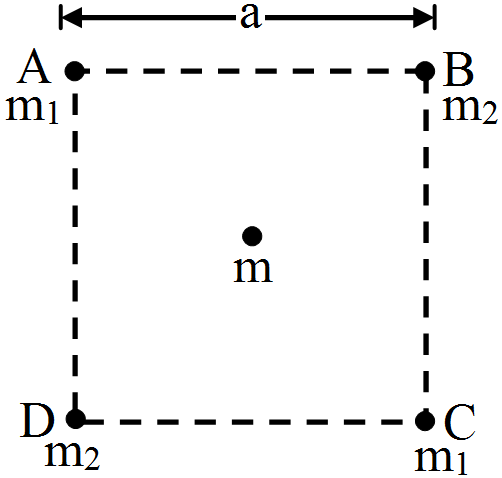
The resultant gravitational force on mass $m$ due to masses $m_1$ and $m_2$ plant on the vertices of square is: - A
$\frac{\text{Gm}_1\text{m}_2}{(\text{a}\sqrt{2})^2}$
- B
$\frac{2\text{Gm(m}_1+\text{m}_2)}{\text{a}^2}$
- ✓
$\text{zero}$
- D
$\frac{\text{Gm(m}_1+\text{m}_2)}{(\text{a}\sqrt{2})^2}$
AnswerCorrect option: C. $\text{zero}$
View full question & answer→MCQ 851 Mark
The radii of circular orbits of two satellites around the earth are in the ratio $1 : 4,$ then ratio of their respective periods of revolution is:
- A
$1 : 4$
- B
$4 : 1$
- ✓
$1 : 8$
- D
$8 : 1$
AnswerCorrect option: C. $1 : 8$
$\text{T}^2\propto\text{R}^3$
View full question & answer→MCQ 861 Mark
Satellites orbiting the earth have finite life and sometimes debris of satellites fall to the earth. This is because,
- A
The solar cells and batteries in satellites run out.
- B
The laws of gravitation predict a trajectory spiralling inwards.
- ✓
Of viscous forces causing the speed of satellite and hence height to gradually decrease.
- D
Of collisions with other satellites.
AnswerCorrect option: C. Of viscous forces causing the speed of satellite and hence height to gradually decrease.
The $P.E.$ of satellite orbiting in orbit of radius $r$ due to earth of mass $M$ is $\Big(\frac{-\text{GM}}{2\text{r}}\Big)$ negative sign shows the force of attraction between satellite and earth. Energy $(P.E.)$ is continuously reduced due to atmospheric friction, the radius of the orbit or height decreases gradually, and ultimately it comes back to earth with increasing speed and burns in the atmosphere.
View full question & answer→MCQ 871 Mark
The velocity of the planet when it is closest to sun is:
AnswerFrom conservation of angular momentum,
Velocity of planet $(v) \propto\frac{1}{\text{Distance of the planet from sun (r)}}$
So, $r_p$ is minimum for perihelion $(P).$
$= V_p$ is maximum.
View full question & answer→MCQ 881 Mark
Supposing Newton’s law of gravitation for gravitation forces $F_1$ and $F_2$ between two masses $m_1$ and $m_2$ at positions $r_1$ and $r_2$ read $\text{F}_1=-\text{F}_2=-\frac{\text{r}^{12}}{\text{r}^3_{12}}\text{GM}_0^2\Big(\frac{\text{m}_1\text{m}_2}{\text{M}^2_0}\Big)^\text{n}$ where $M_0$ is a constant of dimension of mass, $r_{12} = r_1 – r_2$ and $n$ is a number. In such a case,
AnswerAccording to the problem,
$\text{F}_1=-\text{F}_2=-\frac{\text{r}^{12}}{\text{r}^3_{12}}\text{GM}_0^2\Big(\frac{\text{m}_1\text{m}_2}{\text{M}^2_0}\Big)^\text{n}$
$\Rightarrow\ \vec{\text{r}}_{12}=\text{r}_1-\text{r}_2$
$(\text{a})\text{F}=\frac{\text{GM}^{2(1-\text{n})}_0(\text{M})^\text{n}}{\text{r}^2_{12}}(\text{m}_1\text{m}_2)^\text{n}$
Take, $m_1 = M ($mass of earth$), m_2 = m ($mas of the object), $r_{12} R ($radius of earth$)$
Therefore, $\text{F}=\Big(\frac{\text{GM}_0^{(2-2\text{n})}(\text{M})^\text{n}}{\text{R}^2}\Big)\text{m}^\text{n}=\text{Km}^\text{n}$
Where $K$ is the constant or the term in the bracket is regarded as constant.
As $\text{F}=\text{mg},$
so $g=\text{K m}^\text{n-1}$,
hence $g$ depends upon the mass of object.
Since, $g$ depends upon position vector and mass of object,
hence it will be different for different objects. As $g$ is not constant,
hence constant of proportionality will not be constant in Kepler’s third law.
Hence, Kepler’s third law will not be valid.
As the force is of central nature,
$\Big[\because\text{Force}\propto\frac{1}{\text{r}^2}\Big]$
Hence, first two Kepler’s laws will be valid.
Hence option $(b)$ in incorrect and $(c)$ is correct.
$(d)$ When $n$ is negative, $F = K / M^n$ Or we can say that $F$ is inversely proportional to mass. This implies that lighter bodies will experience a greater force than the heavier bodies and vice versa.
Hence, object lighter than water will sink in water.
View full question & answer→MCQ 891 Mark
If the radius of earth were to increase by $1\%$, its mass remaining the same, the acceleration due to gravity on the surface of earth will:
- A
Increase by $1\%$
- ✓
Decrease by $2\%$
- C
Decrease by $1\%$
- D
Increase by $2\%$
AnswerCorrect option: B. Decrease by $2\%$
$\text{g}=\frac{\text{GM}}{\text{R}^2},\frac{\Delta\text{g}}{\text{g}}$
$=-2\frac{\Delta\text{R}}{\text{R}}$
$\therefore$ Percentage change in the value of $g$
$=\frac{\Delta\text{g}}{\text{g}}\times100$
$=-2\frac{\Delta\text{R}}{\text{R}}\times100$
$=-2(1\%)$
$=-2\%$
View full question & answer→MCQ 901 Mark
Which one of the following statements is correct?
- A
The energy required to rocket an orbiting satellite out of earth's gravitational influence is more than the energy required to project a stationary object at the same height $($as the satellite$)$ out of earth's influence.
- B
If the zero of potential energy is at infinity, the total energy of an orbiting satellite is negative of potential energy.
- C
The first artificial satellite sputnik I was launched in the year $2001.$
- ✓
The time period of rotation of the $\text{SYNCOMS.} ($Synchronous communications satellite$)$ is $24$ hours.
AnswerCorrect option: D. The time period of rotation of the $\text{SYNCOMS.} ($Synchronous communications satellite$)$ is $24$ hours.
View full question & answer→MCQ 911 Mark
A satellite is orbiting just above the surface of a planet of average density $\rho$ with period $T.$ If $G$ is the universal gravitational constant, the quantity $\text{T}^2\rho$ is equal to:
AnswerCorrect option: C. $4\frac{\pi}{\text{G}}$
$\text{v}=\sqrt{\text{gR}}$ and $T=\frac{2\pi\text{R}}{\text{v}}=\frac{2\pi\text{R}}{\sqrt{\text{gR}}}$
or $\text{T}=\frac{2\pi\text{R}}{\sqrt{\frac{\text{GM}}{\text{R}}}}=2\pi$
$\sqrt{\frac{\text{R}^3}{\text{G}\frac{4}{3}\pi\text{R}^3\rho}}$
$\text{T}^2\rho=4\pi^2\times\frac{3}{4\text{G}\pi}=\frac{3\pi}{\text{G}}$
View full question & answer→MCQ 921 Mark
There have been suggestions that the value of the gravitational constant $G$ becomes smaller when considered over very large time period $($in billions of years$)$ in the future. If that happens, for our earth,
- A
- B
After sufficiently long time we will leave the solar system.
- C
We will be going around but not strictly in closed orbits.
- ✓
Both $B$ and $C$
AnswerCorrect option: D. Both $B$ and $C$
We know that gravitational force exists between the earth and the sun.
$\text{F}_\text{G}=\frac{\text{G}(\text{M}_\text{S}\times\text{m}_\text{e})}{\text{r}^2}$ Where $M_S$ is mass of the sun and $m_e$ is mass of the earth.
This provides the necessary centripetal force for the circular orbit of the earth around the sun. As $G$ decreases with time, the gravitational force $F_G$ will become weaker with time. As $F_G$ is changing with time due to it, the earth will be going around the sun not strictly in closed orbit and radius also increases, since the attraction force is getting weaker.
Hence, after long time the earth will leave the solar system.
View full question & answer→MCQ 931 Mark
Which of the following are true?
- A
A polar satellite goes around the earth’s pole in northsouth direction.
- B
A geostationary satellite goes around the earth in eastwest direction.
- C
A geostationary satellite goes around the earth in westeast direction.
- ✓
Both $A$ and $C$
AnswerCorrect option: D. Both $A$ and $C$
The satellite which appears stationary relative to earth is called the geostationary satellite. It revolves around the earth in the west$-$east direction with the same angular velocity as done by the earth about its own axis in the west$-$east direction. A polar satellite revolves around the earth's pole in north$-$south direction. It is independent of earth's rotation. Option $(a), (c)$ are correct.
View full question & answer→MCQ 941 Mark
An object is thrown from the surface of the moon. The escape speed for the object is:
- ✓
$\sqrt{2\text{g}'\text{ R}_\text{m}},$ where $g' =$ acceleration due to gravity on the moon and $R_m =$ redius of the moon.
- B
$\sqrt{2\text{g}'\text{ R}_\text{e}},$ where $g' =$ acceleration due to gravity on the moon and $R_e =$ radius of the earth.
- C
$\sqrt{2\text{g}\text{ R}_\text{m}},$ where $g =$ acceleration due to gravity on the earth and $R_m =$ raduis of the moon.
- D
AnswerCorrect option: A. $\sqrt{2\text{g}'\text{ R}_\text{m}},$ where $g' =$ acceleration due to gravity on the moon and $R_m =$ redius of the moon.
Escape speed from the moon $=\sqrt{2\text{g}'\text{ R}_\text{m}}$ where,
$g' =$ acceleration due to gravity on the surface of moon.
$R_m =$ radius of the moon.
View full question & answer→MCQ 951 Mark
The escape speed from the surface of earth is $v_e$. The escape speed from the surface of a planet whose mass and radius are $3$ times those of the earth will be:
- ✓
$v_e$
- B
$3v_e$
- C
$9v_e$
- D
$27v_e$
Answer$\text{v}_{\text{e}}=\sqrt{\text{vgR}}$
$=\sqrt{\frac{2\text{GM}_{\text{p}}}{\text{R}_{\text{p}}}}$
$=\sqrt{\frac{2\text{G}\times3\text{M}}{2\text{R}}}$
$=\sqrt{\frac{2\text{GM}}{\text{R}}}$
$=\text{v}_{\text{e}}.$
View full question & answer→MCQ 961 Mark
Different points in earth are at slightly different distances from the sun and hence experience different forces due to gravitation. For a rigid body, we know that if various forces act at various points in it, the resultant motion is as if a net force acts on the $c.m. ($centre of mass$)$ causing translation and a net torque at the $c.m.$ causing rotation around an axis through the $c.m.$ For the earthsun system $($approximating the earth as a uniform density sphere$).$
- ✓
- B
The torque causes the earth to spin.
- C
The rigid body result is not applicable since the earth is not even approximately a rigid body.
- D
The torque causes the earth to move around the sun.
AnswerAs the earth is revolving around the sun in a circular motion $($approximately in actual the path of earth around the sun is elliptical$)$ due to gravitational attraction.
When we consider the earth$-$sun as a single system and we are taking earth as a sphere of uniform density.
Then the gravitational force $(F)$ will be of radial nature,
i.e. angle between position vector $r$ and force $F$ is zero.
So, torque
$|\vec{\tau}|=|\vec{\text{r}}\times\vec{\text{F}}|=\text{r F}\sin0^0=0.$
View full question & answer→