Question 13 Marks
A piece of copper having a rectangular cross-section of $15.2mm \times 19.1mm$ is pulled in tension with $44,500N$ force, producing only elastic deformation. Calculate the resulting strain?
AnswerLength of the piece of copper, $l = 19.1mm = 19.1 \times 10^{–3}m$
Area of the copper piece: $A = l \times b = 19.1 \times 10^{–3} \times 15.2 \times 10^{–3} = 2.9 \times 10^{–4}m^2$
Tension force applied on the piece of copper, F = 44500N Modulus of elasticity of copper,
$\eta= 42 \times 10^9\text{N/m}^2$ Modulus of elasticity,
$\eta=\frac{\text{Stress}}{\text{Strain}}=\frac{\frac{\text{F}}{\text{A}}}{\text{Strain}}$
$\therefore\ \text{Strain}=\frac{\text{F}}{\text{A}\eta}$
$=\frac{44500}{2.9\times10^{-4}\times42\times10^9}$
$=3.65\times10^{-3}$
View full question & answer→Question 23 Marks
Compute the fractional change in volume of a glass slab, when subjected to a hydraulic pressure of $10$ atm.
AnswerHydraulic pressure exerted on the glass slab, $p=10 \mathrm{~atm}=10 \times 1.013 \times 10^5 \mathrm{~Pa}$ Bulk modulus of glass, $\mathrm{B}=37 \times10^9 \mathrm{Nm}^{-2}$ Bulk modulus, $\mathrm{B}=\frac{\mathrm{p}}{\frac{\Delta \mathrm{V}}{\mathrm{v}}}$ Where, $\frac{\Delta \mathrm{V}}{\mathrm{V}}=$ Fractional change in volume $\therefore \frac{\Delta \mathrm{V}}{\mathrm{V}}=\frac{\mathrm{p}}{\mathrm{B}}=\frac{10 \times 1.013 \times 10^5}{37 \times 10^9}$
$=2.73 \times 10^{-5}$ Hence, the fractional change in the volume of the glass slab is $2.73 \times 10^{-5}$.
View full question & answer→Question 33 Marks
Determine the volume contraction of a solid copper cube, 10cm on an edge, when subjected to a hydraulic pressure of $7.0 \times 10^6$ Pa.
AnswerGiven:$ L = 10cm = 0.1m K =$ bulk modulus of $Cu = 140 \times 10^9Pa P = 7 \times 10^6$
Pa $\Delta\text{V}=$ Volume contraction of solid copper cube = ?
$\therefore V = L^3 = (0.1)^3 = 0.001m^3$
. Using formula, $\text{K}-\frac{\text{P}}{\big(\frac{\Delta\text{V}}{\text{V}}\big)}$
We get $\Delta\text{V}=-\frac{\text{PV}}{\text{K}}=\frac{7\times10^6\times0.001}{140\times10^9}\text{m}^3$
$=-\frac{1}{20}\times10^{-6}\text{m}^3$
$=-0.05\times10^{-6}\text{m}^3$
$=-5\times10^{-2}\text{cm}^3$ Here negative sign shows volume contraction.
View full question & answer→Question 43 Marks
Four identical hollow cylindrical columns of mild steel support a big structure of mass 50,000kg. The inner and outer radii of each column are 30 and 60cm respectively. Assuming the load distribution to be uniform, calculate the compressional strain of each column.
AnswerCross-sectional area of a column $=\pi(\text{r}_2^2-\text{r}_1^2)$ $=\pi[(0.6)^2-(0.3)^2]$ $=0.27\pi\text{m}^2$ Force on one column, $\text{F}=\frac{50000\times9.8}{4}$ $\text{Y}=\frac{\frac{\text{F}}{\text{A}}}{\frac{\Delta\text{l}}{\text{l}}}$ Compressive strain $=\frac{\Delta\text{l}}{\text{l}}=\frac{\text{F}}{\text{AY}}$ $=\frac{50000\times9.8}{4(0.27\pi)(2\times10^{11})}$$=7.21\times10^{-7}.$
View full question & answer→Question 53 Marks
The stress-strain graphs for materials $A$ and $B$ are shown in Fig. 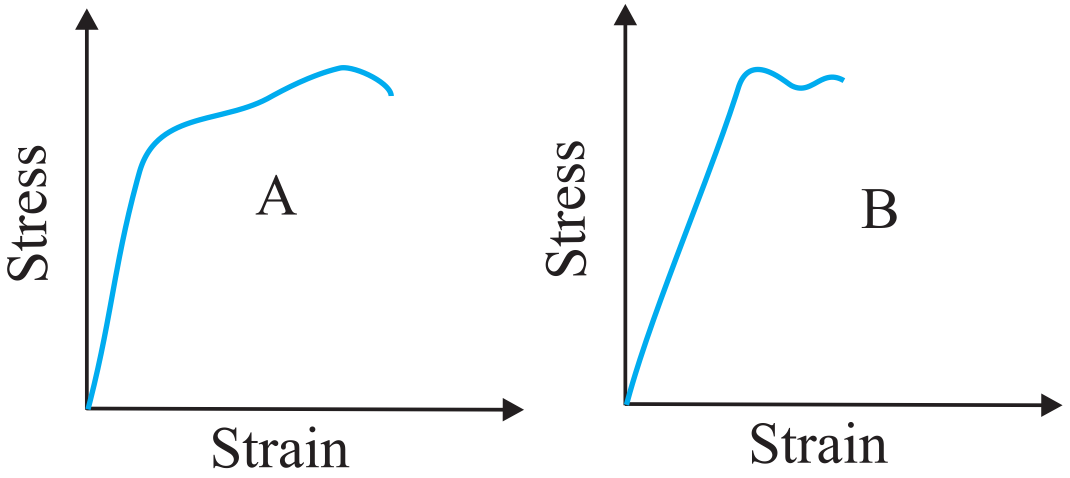 The graphs are drawn to the same scale.
- Which of the materials has the greater Young’s modulus?
- Which of the two is the stronger material?
Answer
- From the two graphs we note that for a given strain, stress for $A$ is more than that of $B$. Hence, Young’s modulus $(=$ stress$/$ strain$)$ is greater for $A$ than that of $B$.
- $A$ is stronger than $B$. Strength of a material is measured by the amount of stress required to cause fracture, corresponding to the point of fracture.
View full question & answer→Question 63 Marks
Anvils made of single crystals of diamond, with the shape as shown in Fig., are used to investigate behaviour of materials under very high pressures. Flat faces at the narrow end of the anvil have a diameter of $0.50mm$, and the wide ends are subjected to a compressional force of $50,000N$. What is the pressure at the tip of the anvil?
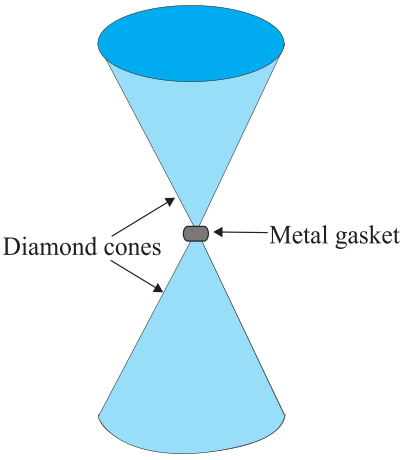
AnswerGiven: Compressional force, $F=5 \times 10^4$ NDiameter, $D=5.0 \times 10^{-4} \mathrm{~m}$
$\text { Area, } \mathrm{A}=\pi \mathrm{r}^2$
$=\frac{22}{7} \times\left(2.5 \times 10^{-4}\right)^2$
$\therefore \text { radius, } \mathrm{r}=\frac{\mathrm{D}}{2}=2.5 \times 10^{-4} \mathrm{~m}$
Pressure at the tip, $\mathrm{P}=$ ?
From the relation
$P=\frac{F}{A},$
$\text { We get, } P=\frac{5 \times 10^4}{\left(2.5 \times 10^{-4}\right)^2}$
$\Rightarrow P=0.255 \times 10^{12} \mathrm{~Pa}$
$\Rightarrow P=2.55 \times 10^{11} \mathrm{~Pa}$.
View full question & answer→Question 73 Marks
Two strips of metal are riveted together at their ends by four rivets, each of diameter 6.0 mm . What is the maximum tension that can be exerted by the riveted strip if the shearing stress on the rivet is not to exceed $6.9 \times 10^7 \mathrm{~Pa}$ ?
Assume that each rivet is to carry one quarter of the load.
AnswerDiameter of the metal strip, $d=6.0 \mathrm{~mm}=6.0 \times 10^{-3} \mathrm{~m}$ Radius, $\mathrm{r}=\mathrm{d} / 2=3 \times 10^{-3} \mathrm{~m}$ Maximum shearing stress $=6.9 \times$ $10^7$ Pa Maximum stress $=$ Manimum load or force/Area Maximum force $=$ Maximum stress $\times$ Area
$=6.9 \times 10^7 \times \pi \times(\mathrm{r})^2$
$=6.9 \times 10^7 \times \pi \times\left(3 \times 10^{-3}\right)^2$
$=1949.94 \mathrm{~N}$ Each rivet carries one quarter of the load.
$\therefore$ Maximum tension on each rivet $=4 \times 1949.94=7799.76 \mathrm{~N}$.
View full question & answer→Question 83 Marks
A steel wire of length 4.7 m and cross-sectional area $3.0 \times 10^{-5} m^2$ stretches by the same amount as a copper wire of length 3.5 m and cross-sectional area of $4.0 \times 10^{-5} m^2$ under a given load. What is the ratio of the Young's modulus of steel to that of copper?
AnswerLength of steel wire = $l_1 = 4.7m$
Area of crossection of the steel wire $= A_1 = 3.0 \times 10^{-5}m^2$
Length of copper wire $l_2 = 3.5m$
Area of crossection of the copper wire $= A_2 = 4 \times 10^{-5}m^2$
Change in length $=\Delta\text{l}_1=\Delta\text{l}_2=\Delta\text{L}$
Force applied in both cases = F Young's modulus of steel wire $\text{Y}_1=\frac{\text{F}_1}{\text{A}_1}\times\frac{\text{l}_1}{\Delta\text{l}}$
$\Rightarrow\ \frac{\text{F}\times4.7}{3\times10^{-5}\times\Delta\text{L}}\ ....(1)$ Young's modulus of copper wire $\text{Y}_2=\frac{\text{F}_2}{\text{A}_2}\times\frac{\text{l}_2}{\Delta\text{l}_2}$
$\Rightarrow\ \frac{\text{F}\times3.5}{4\times10^{-5}\times\Delta\text{L}}\ ....(2)$ Dividing (1) & (2) $\frac{\text{Y}_1}{\text{Y}_2}=\frac{4.7\times4\times10^{-5}}{3\times10^{-5}\times3.5}$
$\Rightarrow\ 1.79:1$
View full question & answer→Question 93 Marks
Figure shows the strain-stress curve for a given material. What are (a) Young’s modulus and (b) approximate yield strength for this material?
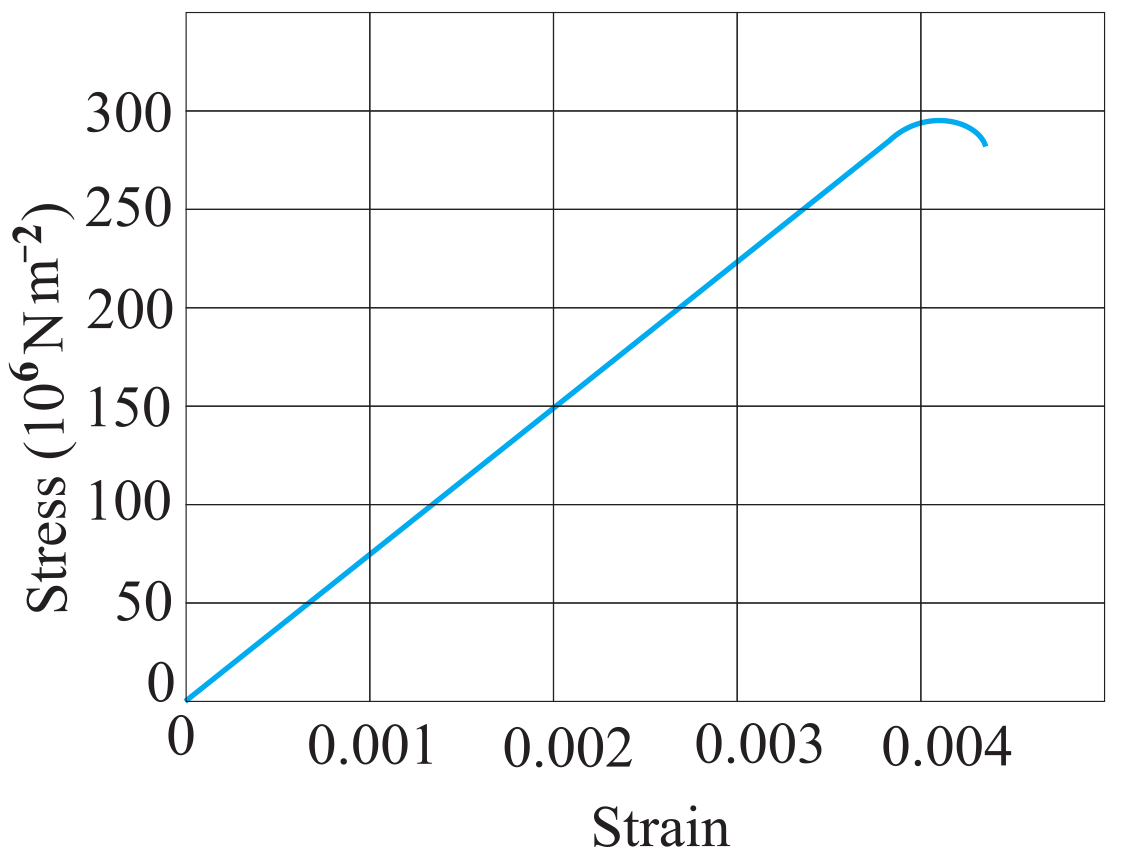
AnswerIt is clear from the given graph that for stress $150 \times 10^6 \mathrm{~N} / \mathrm{m}^2$, strain is 0.002
a. Young's modulus, $Y=\frac{\text { Stress }}{\text { Strain }}$
$=\frac{150 \times 10^6}{0.002}=7.5 \times 10^{10} \mathrm{~N} / \mathrm{m}^2$
Hence, Young's modulus for the given material is $7.5 \times 10^{10} \mathrm{~N} / \mathrm{m}^2$.
b. The yield strength of a material is the maximum stress that the material can sustain without crossing the elastic limit.
It is clear from the given graph that the approximate yield strength of this material is $300 \times 10^6 \mathrm{~N} / \mathrm{m}^2$ or $3 \times$ $10^8 \mathrm{~N} / \mathrm{m}^2$.
View full question & answer→Question 103 Marks
How much should the pressure on a litre of water be changed to compress it by $0.10\%$?
AnswerVolume of water, V = 1L It is given that water is to be compressed by 0.10%.
$\therefore$ Fractional change, $\frac{\Delta\text{V}}{\text{V}}=\frac{0.1}{100\times1}=10^{-3}$
Bulk modulus, $\text{B}=\frac{\rho}{\frac{\Delta\text{V}}{\text{V}}}$ $\rho=\text{B}\times\frac{\Delta\text{V}}{\text{V}}$ Bulk modulus of water, $B = 2.2 \times 10^9Nm^{-2} \rho = 2.2 \times 10^9 \times 10^{-3} = 2.2 \times 10^6Nm^{-2}$
Therefore, the pressure on water should be $2.2 \times 10^6Nm^{–2}$.
View full question & answer→Question 113 Marks
A uniform heavy rod of weight W, cross-sectional area A and length l is hanging from a fixed support. Young's modulus of the material of the rod is Y. Neglecting the lateral contraction, find the elongation produced in the rod.
Answer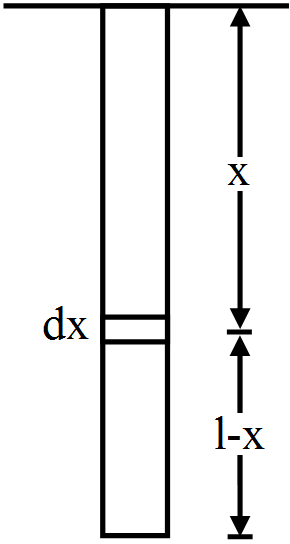 As shown in figure, consider a small element of thickness dx at distance x from the fixed support. Force acting on the element dx is F = Weight of length(l - x) of the rod, $=\frac{\text{W}}{\text{l}}(\text{l}-\text{x})$ Elongation of the element, $=\text{Original length}\times\frac{\text{Stress}}{\text{Y}}$ $=\text{dx}\times\frac{\frac{\text{F}}{\text{A}}}{\text{Y}}=\frac{\text{W}}{\text{l.}\text{Ay}}(\text{l}-\text{x})\text{dx}$ Total elongation produced in the rod, $=\frac{\text{W}}{\text{l}.\text{AY}}\int\limits^\text{l}_0(\text{l}-\text{x})$ $\text{dx}=\frac{\text{W}}{\text{l}.\text{Ay}}\Big[\text{lx}-\frac{\text{x}^2}{2}\Big]^\text{l}_0$ $=\frac{\text{W}}{\text{l}.\text{Ay}}\Big[\text{l}^2-\frac{\text{l}^2}{2}\Big]=\frac{\text{Wl}}{2\text{Ay}}$
 View full question & answer→Question 123 Marks
Explain why steel is more elastic than rubber.
AnswerConsider two pieces of wires, one of steel and the other of rubber.
Suppose both are of equal length (L) and of equal area of cross-section (a).
Let each be stretched by equal forces, each being equal to F.
We find that the change in length of the rubber wire (l_r) is more than that of the steel
$(l_s) i.e. l_r < ls.$ If $Y_s$_ and $Y_r$_ the Young's moduli of steel and rubber respectively,
then from the definition of Young's modulus, $\text{Y}_\text{s}=\frac{\text{F.L}}{\text{a.l}_\text{s}}\text{ and }\text{Y}_\text{r}=\frac{\text{F.L}}{\text{a.l}_\text{r}}$
$\therefore\frac{\text{Y}_\text{s}}{\text{Y}_\text{r}}=\frac{\text{l}_\text{r}}{\text{l}_\text{s}}.$
As $\text{l}_\text{r}>\text{l}_\text{s}\therefore\frac{\text{Y}_\text{s}}{\text{Y}_r}>1\ \text{or }\text{Y}_\text{r}$
i.e., the Young's modulus of steel is more than that of rubber.
Hence steel is more elastic than rubber.OR
Any material which offers more opposition to the deforming force to change its configuration is more elastic.
View full question & answer→Question 133 Marks
A steel wire of length $4 m$ is stretched through $2\ mm$ . The cross$-$section area of the wire is $2.0 \mathrm{~mm}^2$. If Young's modulus of steel is $2.0 \times 10^{11} \mathrm{~N} / \mathrm{m}^2$, find:
i. The energy density of the wire,
ii. The elastic potential energy stored in the wire.
Answer
- Energy density :
$=\frac{1}{2}\Big(\frac{\text{Y}\text{l}}{\text{L}}\Big).\frac{\text{l}}{\text{L}}$
$=\frac{1}{2}\Big[\frac{2\times10^{11}\times2\times10^{-3}}{4}\Big]\times\Big[\frac{2\times10^{-3}}{4}\Big]$
$=\frac{1}{2}\times10^8\times\frac{1}{2}\times10^{-3}$
$=0.25\times10^5=2.5\times10^4\text{J}/\text{m}^3$
- Potential energy stored in the wire :
$\text{u}=\frac{1}{2}\Big(\frac{\text{YAl}}{\text{L}}\Big).\text{l}$
$=\frac{1}{2}\Big[\frac{2\times10^{11}\times2\times10^{-6}\times2\times10^{-3}}{4}\Big]\times2\times10^{-3}$
$=10^2\times2\times10^{-3}=0.2\text{J}$ View full question & answer→Question 143 Marks
A piece of copper having a rectangular cross-section of $15.2mm × 19.1mm$ is pulled in tension with $44,500N$ force, producing only elastic deformation. Calculate the resulting strain?
AnswerLength of the piece of copper,$l = 19.1mm = 19.1 \times 10^{–3}m$ Area of the copper piece: $A = l \times b = 19.1 \times 10^{–3} \times 15.2 \times 10^{–3} = 2.9 \times 10^{–4}m^2$ Tension force applied on the piece of copper, F = 44500N Modulus of elasticity of copper, $\eta= 42 × 10^9\text{N/m}^2$ Modulus of elasticity, $\eta=\frac{\text{Stress}}{\text{Strain}}=\frac{\frac{\text{F}}{\text{A}}}{\text{Strain}}$ $\therefore\ \text{Strain}=\frac{\text{F}}{\text{A}\eta}$ $=\frac{44500}{2.9\times10^{-4}\times42\times10^9}$ $=3.65\times10^{-3}$
View full question & answer→Question 153 Marks
Artificial diamond crystals have been manufactured by subjecting carbon in the form of graphite to a pressure of $1.55 \times 10^{10} \mathrm{Nm}^{-2}$ at a high temperature. Assuming that natural dimonds were formed at similar high pressures within the earth, what must have been the original volume o the Kohinoor diamond, whose mass before cutting was about 175 g ? The density of the diamond $=3.5 \mathrm{~g} / \mathrm{cm}^{-3}$ and its bulk modulus $=62 \times 10^{10} \mathrm{Nm}^{-2}$.
AnswerMass of the diamond $=175 \mathrm{~g}$. Density $-3.5 \mathrm{gcm}^{-3}$ Volume $=\frac{175}{3.5}=50 \mathrm{~cm}^3$ If the original volume of the diamond were V , then $\mathrm{V}=50+\Delta \mathrm{V}$ Where $\Delta \mathrm{V}$ is the increase in volume under the pressure during its formation, Bulk modulus $=B=-\frac{P V}{\Delta V}$ Substituting $(V-50)$ for $A V$ and the values of $P$ and $B$, we have, $\frac{\mathrm{B}}{\mathrm{P}}=\frac{62 \times 10^{10}}{1.55 \times 10^{10}}=\frac{40 \mathrm{~V}}{\mathrm{~V}-50}$ or $\mathrm{V}=40 \mathrm{~V}-200039 \mathrm{~V}=2000 \Rightarrow \mathrm{~V}=51.28 \mathrm{~cm}^3$ Alternatively, one could calculate $(-\Delta \mathrm{V})$ from the equation, $(-\Delta \mathrm{V})=\frac{\mathrm{PV}}{\mathrm{B}}=\frac{1.55 \times 10^{10} \times 50}{62 \times 10^{10}}=1.25 \mathrm{~cm}^3$ And add this value to the present value giving $\mathrm{V}=51.25 \mathrm{~cm}^3$. The difference is only in the second decimal place, i.e., less than $0.06 \%$. Hence the original volume of the diamond must have been equal to $51.3 \mathrm{~cm}^3$.
View full question & answer→Question 163 Marks
The bulk modulus of water is $2.3 \times 10^9Nm^{-2}$. Find its compressibility. How much pressure in atmosphere is needed to compress a sample of water by $0.1%$. Take $1$ atmosphere pressure $= 1.01 \times 10^5Nm^{-2}$.
AnswerHere, $B = 2.3 \times 10^9Nm^{-2} =\frac{2.3\times10^9}{1.01\times10^5}$ atmosphere $= 2.27 \times 10^4$ atmosphere:
- $\therefore$ Compressibility $k =\frac{1}{\text{B}}=\frac{1}{2.27\times10^4}=4.4\times10^{-4}\text{atm}^{-1}$
- As $\frac{\Delta\text{V}}{\text{V}}=-0.1\%=-\frac{0.1}{100}=-0.001$
$\therefore$ Increase in pressure $\text{p}=\text{B}\Big(-\frac{\Delta\text{V}}{\text{V}}\Big)$
$=2.27\times10^4\times0.001=22.7\ \text{atm}.$ View full question & answer→Question 173 Marks
When a wire is stretched by a certain force, its elongation is x. If the second wire of the same material has four times the length and double the radius of the first wire and is stretched by the same force as before, find its elongation.
Answer$\text{Y}=\frac{\text{F}\times\text{l}}{\pi\text{r}^2\times\Delta\text{l}}=\frac{\text{Fl}'}{\pi\text{r}^2\times\Delta\text{l}'}=\frac{4\text{Fl}}{4\pi\text{r}^2\times\Delta\text{l}'}$ So $\Delta\text{l}'=\Delta\text{l}=\text{x},$ the elongation.
View full question & answer→Question 183 Marks
Compute the fractional change in volume of a glass slab, when subjected to a hydraulic pressure of $10$ atm.
AnswerHydraulic pressure exerted on the glass slab, p = 10 atm = $10 \times 1.013 \times 10^5Pa$ Bulk modulus of glass, $B = 37 \times 10^9Nm^{–2}$ Bulk modulus, $\text{B}=\frac{\text{p}}{\frac{\Delta\text{V}}{\text{V}}}$ Where, $\frac{\Delta\text{V}}{\text{V}}=$ Fractional change in volume
$\therefore\ \frac{\Delta\text{V}}{\text{V}}=\frac{\text{p}}{\text{B}}$
$=\frac{10\times1.013\times10^5}{37\times10^9}$
$=2.73\times10^{-5}$ Hence, the fractional change in the volume of the glass slab is $2.73 \times 10^{–5}$.
View full question & answer→Question 193 Marks
To what depth must a rubber ball be taken in deep sea so that its volume is decreased by $0.1 \%$. (The bulk modulus of rubber is $9.8 \times 10^8 \mathrm{~N} \mathrm{~m}^{-2}$, and the density of sea water is $10^3 \mathrm{~kg} \mathrm{~m}^{-3}$.)
AnswerAccording to the problem, Bulk modulus of rubber $(B)=9.8 \times 10^8 \mathrm{~N} / \mathrm{m}^2$ Density of sea water $(p)=10^3 \mathrm{~kg} / \mathrm{m}^3$
Percentage decrease in volume $\frac{\Delta \mathrm{V}}{\mathrm{V}}=0.1 \%=\frac{0.1}{100}=10^{-3} \rho=10^3 \mathrm{~kg} \mathrm{~m}^{-3}, \mathrm{~h}=$ ?
Let the rubber ball be taken up to depth $\mathrm{h} .$
$\therefore$ Change in pressure $(\mathrm{P})=\mathrm{h} \rho \mathrm{g}$
we know, $\mathrm{B}=\frac{\Delta \mathrm{P}}{(\Delta \mathrm{V} / \mathrm{V})} \Rightarrow \Delta \mathrm{P}=\mathrm{B} \times \frac{\Delta \mathrm{V}}{\mathrm{v}}$
$\Rightarrow \Delta \mathrm{P}=9.8 \times 10^8 \times 10^{-3}=9.8 \times 10^5 \mathrm{Nm}^{-2} \text { Also, } \Delta \mathrm{P}=\rho \mathrm{gh} \mathrm{~h}=\frac{\Delta \mathrm{P}}{\rho \mathrm{~g}}=\frac{9.8 \times 10^5}{10^3 \times 9.8} \Rightarrow \mathrm{~h}=10^2 \mathrm{~m}=100 \mathrm{~m}$
View full question & answer→Question 203 Marks
Find the greatest length of steel wire that can hang vertically without breaking. Breaking stress of steel = $8.0 \times 10^8Nm^{-2}$, density of steel = $8.0 \times 10^3kg/ m^{-3} and g = 10ms^{-2}$.
AnswerLet L be the maximum length of steel wire which can hang vertically without breaking. In such a case, the stretching force is equal to the own weight of wire. If A be the cross-section area of wire and \rho its density, then mass of wire M - ALP and stretching force F = Mg = ALPg.
$\therefore\text{Maximum stress},\sigma_\text{max}$
$=\frac{\text{weight}}{\text{A}}=\frac{\text{ALPg}}{\text{A}}=\text{LPg}$
$\Rightarrow\text{L}=\frac{\sigma_\text{max}}{\rho\text{g}}=\frac{8.0\times10^8}{8.0\times10^3\times10}$
$=10^4\text{m}\ \text{or }10\text{km.}$
View full question & answer→Question 213 Marks
Calculate the force required to punch a hole $2cm$ square in a steel sheet $2mm$ thick whose shearing strength is $3.5 \times 10^8Nm^{-2}$.
Answer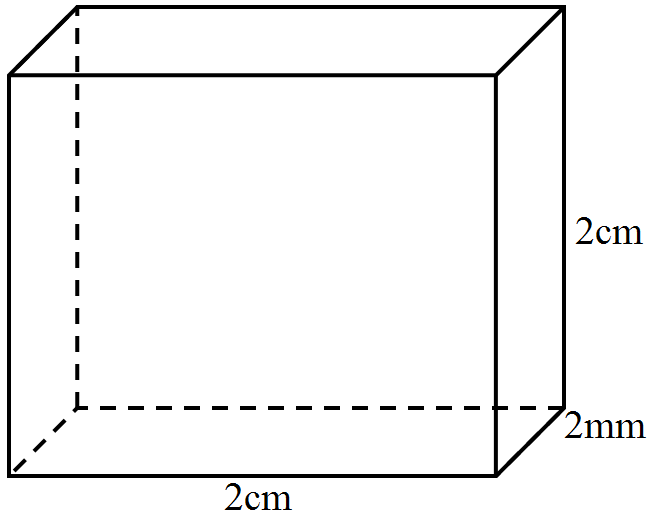
The shearing stress is exerted on the rectangular surface $(2.0 \mathrm{~cm} \times 2.0 \mathrm{~cm} \times 0.2 \mathrm{~cm})$ that is the boundary of the hole. The area of this surface is (see Fig). $\mathrm{A}=2.0 \times 10^{-2} \times 4 \times 0.2 \times 10^{-2} \mathrm{~m}^2=1.6 \times 10^{-4} \mathrm{~m}^2$
Since the minimum shearing stress to rupture the steel is: $\left(\frac{\mathrm{F}}{\mathrm{A}}\right)_{\min }=3.5 \times 10^8 \mathrm{Nm}^{-2}$ The force required is given by, $\mathrm{F}=3.5 \times 10^8 \times 1.6 \times 10^{-4} \mathrm{~N}$
$=5.6 \times 10^4 \mathrm{~N}$ View full question & answer→Question 223 Marks
Two identical solid balls, one of ivory and the other of wet-clay, are dropped from the same height on the floor. Which one will rise to a greater height after striking the floor and why?
AnswerSince the ivory ball is more elastic than the wet clay ball, and both are dropped from same height so their velocities just before striking the floor will be same. Hence the ivory ball tries to regain its original shape quickly and change in shape is negligible for ivory ball as compared to wet clay ball. Hence, more energy is transferred to ivory ball as compared to wet clay ball. So ivory ball rises more than clay ball.
View full question & answer→Question 233 Marks
The length of a metal wire is $l_1$ when the tension in it is $T_1$ and is $l_2$ when the tension is $T_2$. Find the original length of the wire.
AnswerLet I and A be the original length and area of cross-section of the metal wire. Change in length in the first case = $(l_1- l)$ Change in length in the second case = $(l_2 - l)$
$\therefore\text{Y}=\frac{\text{T}_1}{\text{A}}\times\frac{\text{l}}{(\text{l}_1-\text{l)}}=\frac{\text{T}_2}{\text{A}}\times\frac{\text{l}}{(\text{l}_2-\text{l)}}$ or $\text{T}_1\text{l}_2-\text{T}_1\text{l}=\text{T}_2\text{l}_1-\text{T}_2\text{l}$
$\text{l}(\text{T}_2-\text{T}_1)=\text{T}_2\text{l}_1-\text{T}_1\text{l}_2$
$\Rightarrow\text{l}=\frac{\text{T}_2\text{l}_1-\text{T}_1\text{l}_2}{(\text{T}_2-\text{T}_1)}.$
View full question & answer→Question 243 Marks
Determine the volume contraction of a solid copper cube, $10cm$ on an edge, when subjected to a hydraulic pressure of $7.0 \times 10^6 Pa$.
AnswerGiven: L = 10cm = 0.1m K = bulk modulus of $Cu = 140 \times 10^9Pa P = 7 \times 10^6 Pa \Delta\text{V}=$ Volume contraction of solid copper cube = ? $\therefore V = L^3 = (0.1)^3 = 0.001m^3$. Using formula, $\text{K}-\frac{\text{P}}{\big(\frac{\Delta\text{V}}{\text{V}}\big)}$ We get $\Delta\text{V}=-\frac{\text{PV}}{\text{K}}=\frac{7\times10^6\times0.001}{140\times10^9}\text{m}^3$
$=-\frac{1}{20}\times10^{-6}\text{m}^3$
$=-0.05\times10^{-6}\text{m}^3$
$=-5\times10^{-2}\text{cm}^3$ Here negative sign shows volume contraction.
View full question & answer→Question 253 Marks
Two wires A and B of length l, radius r and length 2l, radius 2r having same Young's modulus Y are hung with a weight mg, see fig. What is the net elongation in the two wires?
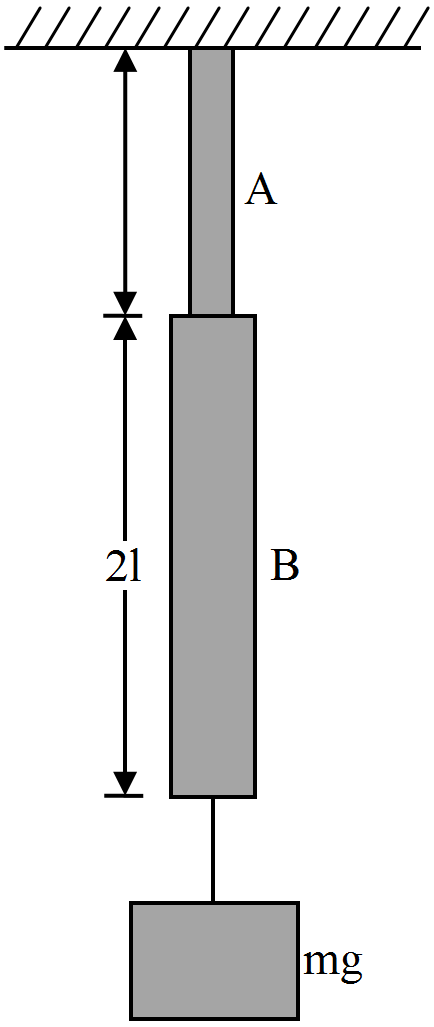
AnswerHere, the pulling force F(= mg) is same on both the wires. Let $\Delta\text{l}_1,\Delta\text{l}_2$_be the elongations in the two wires.
As, $\text{Y}=\frac{\text{Fl}}{\pi\text{r}^2\Delta\text{l}}\ \text{or }\Delta\text{l}=\frac{\text{Fl}}{\text{Y}\pi\text{r}^2}$ For wire 'A' $\Delta\text{l}_1=\frac{\text{mgl}}{\text{Y}\pi\text{r}^2}$ For wire 'B' $\Delta\text{l}_2=\frac{\text{mg}(2\text{l})}{\text{Y}\pi(2\text{r})^2}=\frac{\text{mgl}}{2\text{Y}\pi\text{r}^2}$ Total elongtaion $\Delta\text{l}_1+\Delta\text{l}_2$
$=\frac{\text{mgl}}{\text{Y}\pi\text{r}^2}+\frac{1}{2}\frac{\text{mgl}}{\text{Y}\pi\text{r}^2}=\frac{3}{2}\frac{\text{mgl}}{\text{Y}\pi\text{r}^2}.$
View full question & answer→Question 263 Marks
One end of a nylon rope, of length $4.5 cm$ and diameter $6 mm$, is fixed to a free limb. A monkey, weighing $100 N$ , jumps to catch the free end and stays there. Find the elongation of the rope and the corresponding change in the diameter. Given Young's modulus of nylon $=4.8 \times 10^{11} \mathrm{~N} / \mathrm{m}^2$ and Poisson's ratio of nylon $=0.2$.
AnswerHere, $\text{l}=4.5\text{m};\text{D}=6\text{mm}=6\times10^{-3}\text{m}$
$\text{F}=\text{Mg}=100\text{N},$
$\text{Y}=4.8\times10^{11}\text{N}/\ \text{m}^2;\Delta\text{l}=\ ?\Delta\text{D}=\ ?$
$\text{Y}=\frac{\text{F}}{\big(\frac{\pi\text{D}^2}{4}\big)}\times\frac{\text{l}}{\Delta\text{l}}$ or $\Delta\text{l}=\frac{4\text{Fl}}{\pi\text{D}^2\text{Y}}=\frac{4\times100\times4.5}{3.14\times(6\times10^{-3})\times(4.8\times10^{11})}$
$=3.315\times10^{-5}\text{m}$
$\sigma=\frac{\frac{\Delta\text{D}}{\text{D}}}{\frac{\Delta\text{l}}{\text{l}}}$ (in magnitude) or $\Delta\text{D}=\sigma\frac{\Delta\text{l}}{\text{l}}\times\text{D}$
$=0.2\times\frac{(3.315\times10^{-5})}{4.5}\times(6\times10^{-3})$
$=8.84\times10^{-9}\text{m}$
View full question & answer→Question 273 Marks
Four identical cylindrical columns of steel support a big structure of mass $50,000kg$. The inner and outer radii of each column are $30cm$ and $40cm$ respectively. Assuming the load distribution to be uniform, calculate the compressional strain of each column. The Young's modulus of steel is $2.0 \times 10^{11}Pa$.
AnswerHere, $M = 50,000kg; r_1 = 0.30m$ And $r_2 = 0.40m; Y = 2.0 \times 10^{11}Pa$. Area of cross section of each column; $\text{a}=\pi(\text{r}^2_2-\text{r}^2_1)=\pi[(0.4^2-(0.3)^2]=\pi\times0.07\text{m}^2$ Whole weight of the structure, = Mg = 50000 × 9.8N This weight is equally shared by four columns, $\therefore$ Compressional force on one column, $\text{F}=\frac{50000\times9.8}{4}\text{N}$ Now, $\text{Y}=\frac{\frac{\text{F}}{\text{a}}}{\text{Compressional strain}}$ Compressional strain $=\frac{\text{F}}{\text{a}.\text{Y}}=\frac{\frac{50000\times9.8}{4}}{(\pi\times0.07)\times2.0\times10^{11}}=2.785\times10^{-6}$
View full question & answer→Question 283 Marks
Four identical hollow cylindrical columns of mild steel support a big structure of mass 50,000kg. The inner and outer radii of each column are 30 and 60cm respectively. Assuming the load distribution to be uniform, calculate the compressional strain of each column.
AnswerCross-sectional area of a column $=\pi(\text{r}_2^2-\text{r}_1^2)$ $=\pi[(0.6)^2-(0.3)^2]$ $=0.27\pi\text{m}^2$ Force on one column, $\text{F}=\frac{50000\times9.8}{4}$ $\text{Y}=\frac{\frac{\text{F}}{\text{A}}}{\frac{\Delta\text{l}}{\text{l}}}$ Compressive strain $=\frac{\Delta\text{l}}{\text{l}}=\frac{\text{F}}{\text{AY}}$ $=\frac{50000\times9.8}{4(0.27\pi)(2\times10^{11})}$$=7.21\times10^{-7}.$
View full question & answer→Question 293 Marks
A uniform pressure P is exerted on all sides of a solid cube. It is heated through tºC in order to bring its volume back to the value it had before the application of pressure. Find the value of t.
AnswerLet $\gamma=$ coefficient of cubical expansion of the cube. Let K be bulk modulus of elasticity of its material. V = initial volume, P = pressure applied, $\Delta\text{V}=\text{Decrease in its volume}$ $\therefore$ By definition, $\text{K}=\frac{\text{P}}{\frac{\Delta\text{V}}{\text{V}}}\ \text{or }\Delta\text{V}=\frac{\text{PV}}{\text{K}}\ ...(\text{i})$ Also, $\Delta\text{V}\propto\text{V}$ $\propto\text{t}\ \text{or }\Delta\text{V}=\gamma\text{V}\times\text{t}=\gamma\text{V}\text{t}\ ...(\text{ii)}$ Where, = rise in its temperature so as to increase the volume by $\Delta\text{V}$ s.l. it is brought back to its initial volume. $\therefore$ From (i) and (ii), we get, $\frac{\text{PV}}{\text{K}}=\gamma\text{V}\text{t}\ \text{or}\ \text{t}=\frac{\text{PV}}{\text{K}\gamma\text{V}}=\frac{\text{P}}{\gamma\text{K}}.$
View full question & answer→Question 303 Marks
A force of $10^6 \mathrm{Nm}^{-2}$ is required for breaking a material. If the density of the material is $3 \times 10^3 \mathrm{~kg} / \mathrm{m}^{-3}$, then what should be the length of the wire made of material so that it breaks by its own weight?
AnswerLet, L = Length of the wire; A = Area of cross sectiory; $\sigma=$ Density of the substance, Now, weight of wire = Mg = F, $\text{F}=\text{Volume}\times\text{Density}\times\text{g}=\text{AL}\sigma\text{g}$
$\text{Stress}=\frac{\text{F}}{\text{A}}=\frac{\text{AL}\sigma\text{g}}{\text{A}}=\text{L}\sigma\text{g}$ = Breaking stress, $\therefore\text{L}\sigma\text{g}=10^6$ or $\text{L}=\frac{10^6}{\sigma\text{g}}=\frac{10^6}{3\times10^3\times9.8}=34\text{m}.$
View full question & answer→Question 313 Marks
A solid sphere of radius 10 cm is subjected to a uniform pressure equal to $5 \times 10^8 \mathrm{Nm}^{-2}$. Calculate the change in volume. Bulk modulus of the material of the sphere is $3.14 \times 10^{11} \mathrm{Nm}^{-2}$.
AnswerWe know, $\text{K}=\frac{\text{PV}}{\Delta\text{V}}$ $\therefore\Delta\text{V}=\frac{\text{PV}}{\text{K}}$ Now,
$\text{P}=5\times10^8\text{Nm}^{-2},$ $\text{V}=\frac{4}{3}\pi\text{r}^3=\frac{4}{3}\pi(0.1)^3\text{m}^3=4.19\times10^{-3}\text{m}^3$
$[\because\text{r}=10\text{cm}=0.1\text{m}]$ $\text{K}=3.14\times10^{11}\text{Nm}^{-2}$
$\therefore\Delta\text{V}=\frac{5\times10^8\times4.19\times10^{-3}}{3.14\times10^{11}}=6.67\times10^{-6}\text{m}^3.$
View full question & answer→Question 323 Marks
A wire cable $10m$ long consists of $40$ strands of steel each $5 \times 10^{-6}m^2$ in cross-section. By how much does the cable stretch when it is used to lift a crate weighing $4000N$? Young's modulus of steel = $20 \times 10^{10}Nm^{-2}$.
Answer$\text{Stress}=\frac{4000}{5\times10^{-6}}=8.0\times10^8\text{Nm}^{-2}$ Young's modulus $\text{Y}=\frac{\text{Stress}}{\text{Strain}}$ Strain $=\frac{\text{Stress}}{\text{Y}}=\frac{80.\times10^8}{20\times10^{10}}=4.0\times10^{-3}$ Now, Strain $=\frac{\Delta\text{l}}{\text{l}}\times40,$ where $\Delta\text{l}$ is the increase in length in each, Therefore, $\Delta\text{l}=\text{strain}\times\frac{\text{l}}{40}=\frac{10\times4.0\times10^{-3}}{40}$
$=1\times10^{-3}\text{m}=1\text{mm}$ Since each strand stretches by 1mm, the cable is stretched by 1mm. Alternatively, one could divide the stress by 40 to obtain the stress for each strand, since the load must distribute equally over the entire cross-section of the cable.
View full question & answer→Question 333 Marks
A steel wire is suspended vertically from a rigid support. When loaded with weight in air, it extends by $x_1$. When the weight is completely inside the water, the extension becomes $x_2$. Find the relative density of the material of the weight.
AnswerLet V be the volume of the load attached to lower end of steel wire of Young's modulus Y, area of cross-section A and length of wire L. Let p be the relative density of rod. Then, $\text{Y}=\frac{\text{FL}}{\text{Ax}_1}=\frac{\text{V}\rho\text{g}\text{L}}{\text{Ax}_1}\ ...(\text{i)}$ When load is immersed in liquid, then $\text{Y}=\frac{(\text{V}\rho\text{g}-\text{V}\times1\times\text{g})\text{L}}{\text{Ax}_2}$ From (i) and (ii), $\frac{\rho}{\text{x}_1}=\frac{\rho-1}{\text{x}_2}\ \text{or }\rho\text{x}_2=\rho\text{x}_1-\text{x}_1$ or $\text{x}=\rho(\text{x}_1-\text{x}_2)\ \text{or }\rho=\frac{\text{x}_1}{\text{x}_1-\text{x}_2}$
View full question & answer→Question 343 Marks
The stress-strain graphs for materials $A$ and $B$ are shown in Fig. 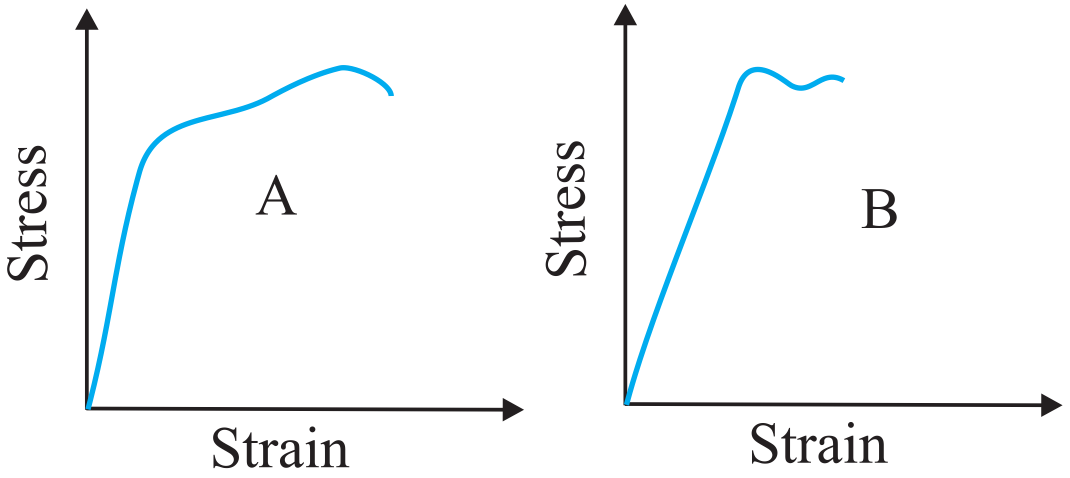 The graphs are drawn to the same scale.
- Which of the materials has the greater Young’s modulus?
- Which of the two is the stronger material?
Answer
- From the two graphs we note that for a given strain, stress for $A$ is more than that of $B$. Hence, Young’s modulus $(=$ stress$/$ strain$)$ is greater for $A$ than that of $B$.
- $A$ is stronger than $B$. Strength of a material is measured by the amount of stress required to cause fracture, corresponding to the point of fracture.
View full question & answer→Question 353 Marks
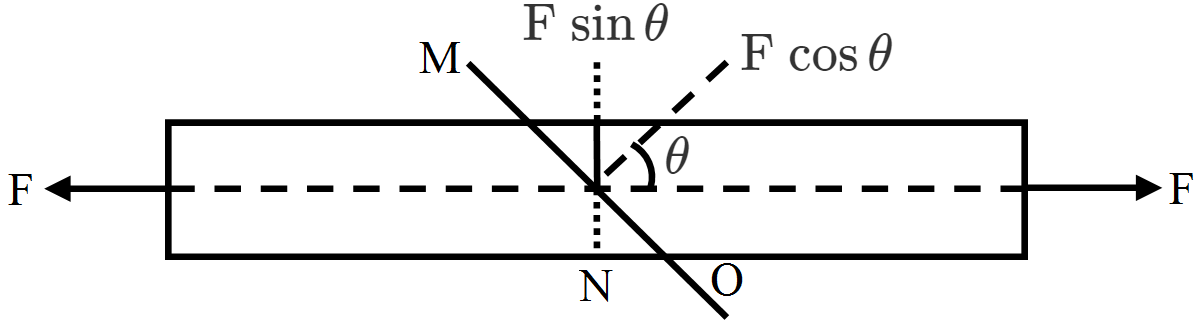
A bar of cross$-$section $A$ is subjected to equal and opposite tensile forces at its ends. Consider a plane section of the bar whose normal makes an angle $q$ with the axis of the bar.
- What is the tensile stress on this plane?
- What is the shearing stress on this plane?
- For what value of $q$ is the tensile stress maximum?
- For what value of $q$ is the shearing stress maximum?
Answer
- The resolved part of $F$ along the normal is the tensile force on this plane and the resolved part parallel to the plane is the shearing force on the plane.
- So, $\text{F}=\text{F}\sin\theta$
Shearing stress $=\frac{\text{Force}}{\text{Area}}=\frac{\text{F}\sin\theta}{\text{A}\sec\theta}=\frac{\text{F}}{\text{A}}\sin\theta\cos\theta$
$=\frac{\text{F}}{2\text{A}}\sin\theta$ $[\because\sin2\theta=2\sin\theta\cos\theta]$
- Tensile stress will be maximum when $\cos^2\theta$ is maximum i.e. $\cos\theta=1$ or $\theta=0^\circ.$
- Shearing stress will be maximum when $\sin2\theta$ is maximum i.e. $\sin2\theta=1$ or $2\theta=90^\circ$ or $\theta=45^\circ.$
- $\because$ Area of $MO$ plane section $=\text{A}\sec\theta$
Tensile stress $=\frac{\text{Force}}{\text{Area}}=\frac{\text{F}\cos\theta}{\text{A}\sec\theta}$
$=\frac{\text{F}}{\text{A}}\cos^2\theta$ $\Big[\because\sec\theta=\frac{1}{\cos\theta}\Big]$
- Shearing stress applied on the top face,
View full question & answer→Question 363 Marks
Anvils made of single crystals of diamond, with the shape as shown in Fig., are used to investigate behaviour of materials under very high pressures. Flat faces at the narrow end of the anvil have a diameter of $0.50mm$, and the wide ends are subjected to a compressional force of $50,000N$. What is the pressure at the tip of the anvil?
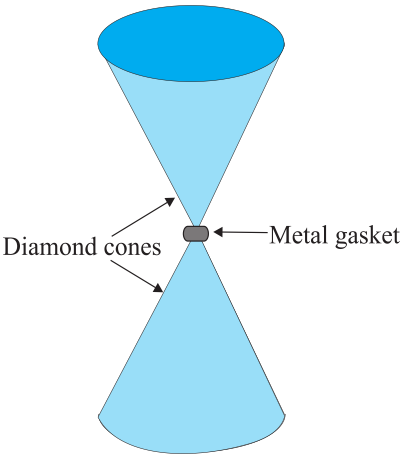
AnswerGiven: Compressional force, $F = 5 \times 10^4N$
Diameter, $D = 5.0 \times 10^{-4}m$
$\therefore$ radius, $\text{r}=\frac{\text{D}}{2}=2.5\times10^{-4}\text{m}$
Area, $\text{A}=\pi\text{r}^2$
$=\frac{22}{7}\times(2.5\times10^{-4})^2$
Pressure at the tip, P = ?
From the relation
$\text{P}=\frac{\text{F}}{\text{A}},$
We get, $\text{P}=\frac{5\times10^4}{(2.5\times10^{-4})^2}$
$\Rightarrow P = 0.255 \times 10^{12} Pa$
$\Rightarrow P = 2.55 \times 10^{11} Pa$.
View full question & answer→Question 373 Marks
The elastic limit of a steel cable is $3.0 \times 10^8 N/ m^2$ and the cross-section area is $4cm$ and the maximum upward acceleration that can be given to a $900kg$ elevator supported by the cable if the stress is not to exceed one-third of the elastic limit.
AnswerHere mass of elevator M = 900kg, elastic limit of steel cable = $3.0 \times 10^8N/ m^2$ and cross-section area $A = 4cm^2 = 4 \times 10^{-4}m^2$. Let elevator is going upward with an acceleration 'a' so that tension in cable. $\text{T}=\text{M}(\text{g}+\text{a})$
$\therefore\text{Stress}\ \sigma=\frac{\text{T}}{\text{A}}\frac{\text{M}(\text{g}+\text{a})}{\text{A}}$
$=\frac{900(9.8+\text{a})}{4\times10^{-4}}\text{N}/\text{ m}^2$ As stress should not exceed one-third of elastic limit of steel cable, hence in limiting case, we have, $\sigma=\frac{3.0\times10^8}{3}=\frac{900(9.8+\text{a})}{4\times10^{-4}}$
$\Rightarrow\text{a}=\frac{10^8\times4\times10^{-4}}{900}-9.8$
$=44.4-9.8=34.6\text{ms}^{-2}.$
View full question & answer→Question 383 Marks
Two strips of metal are riveted together at their ends by four rivets, each of diameter $6.0mm$. What is the maximum tension that can be exerted by the riveted strip if the shearing stress on the rivet is not to exceed $6.9 \times 10^7 Pa$? Assume that each rivet is to carry one quarter of the load.
AnswerDiameter of the metal strip, $d = 6.0mm = 6.0 \times 10^{–3}m$ Radius, $r = d/2 = 3 \times 10^{-3}m$ Maximum shearing stress = $6.9 \times 10^7 Pa$ Maximum stress = Manimum load or force/Area Maximum force = Maximum stress × Area$= 6.9\times10^7\times\pi\times(\text{r})^2$
$= 6.9\times10^7\times\pi\times(3 ×10^{-3})^2$
$= 1949.94N$ Each rivet carries one quarter of the load.
$\therefore$ Maximum tension on each rivet =$4 × 1949.94 = 7799.76N$.
View full question & answer→Question 393 Marks
A steel wire and a copper wire of equal length and equal cross$-$sectional area are joined end to end and the combination is subjected to a tension. Find the ratio of :
- The stresses developed in the two wires,
- The strains developed in two wires. Given that $Y$ of steel $= 2.0 \times 10^{11}N/ m^2$ and $Y$ of copper $= 1.1 \times 10^{11}N/ m^2$.
AnswerHere $L_1 = L_2, A_1 = A_2$ and $F$ is same.
- Stress $\sigma=\frac{\text{F}}{\text{A}}$ and $F$ and $A$ are common, hence stress in steel wire and in copper wire are equal.
- Strain $\varepsilon=\frac{\Delta\text{L}}{\text{L}}=\frac{\text{Stress}}{\text{Y}}$ and stress is equal,
$\therefore\frac{\varepsilon_\text{steel}}{\varepsilon_\text{copper}}=\frac{\text{Y}_\text{ copper}}{\text{Y}_\text{steel}}=\frac{1.1\times10^{11}}{2.0\times10^{11}}=\frac{11}{20}=0.55:1.$ View full question & answer→Question 403 Marks
A steel wire of length $4.7m$ and cross-sectional area $3.0 \times 10^{-5}m^2$ stretches by the same amount as a copper wire of length $3.5m$ and cross-sectional area of $4.0 \times 10^{-5}m^2$ under a given load. What is the ratio of the Young’s modulus of steel to that of copper?
AnswerLength of steel wire = $l_1 = 4.7m$ Area of crossection of the steel wire = $A_1 = 3.0 \times 10^{-5}m^2$ Length of copper wire $l_2 = 3.5m$
Area of crossection of the copper wire = $A_2 = 4 \times 10^{-5}m^2$
Change in length $=\Delta\text{l}_1=\Delta\text{l}_2=\Delta\text{L}$
Force applied in both cases = F Young's modulus of steel wire $\text{Y}_1=\frac{\text{F}_1}{\text{A}_1}\times\frac{\text{l}_1}{\Delta\text{l}}$ $\Rightarrow\ \frac{\text{F}\times4.7}{3\times10^{-5}\times\Delta\text{L}}\ ....(1)$ Young's modulus of copper wire $\text{Y}_2=\frac{\text{F}_2}{\text{A}_2}\times\frac{\text{l}_2}{\Delta\text{l}_2}$ $\Rightarrow\ \frac{\text{F}\times3.5}{4\times10^{-5}\times\Delta\text{L}}\ ....(2)$ Dividing (1) & (2) $\frac{\text{Y}_1}{\text{Y}_2}=\frac{4.7\times4\times10^{-5}}{3\times10^{-5}\times3.5}$ $\Rightarrow\ 1.79:1$
View full question & answer→Question 413 Marks
Prove that the elastic potential energy density of a stretched wire is equal to half the product of stress and strain.
AnswerLet the length of a wire be increased by l by applying a force F. Average internal force $=\frac{\text{F}}{2}.$ Work done $=\Big(\frac{\text{F}}{2}\Big)\text{l}$ This work done is stored as potential energy U, $\therefore\text{U}=\frac{\text{Fl}}{2}=\frac{1}{2}\Big(\frac{\text{F}}{\text{A}}\Big)\Big(\frac{\text{l}}{\text{L}}\Big)(\text{AL}),$ where A = cross-sectional area and L = length. or $\text{U}=\frac{1}{2}$ stress × strain × volume of the wire, energy density, $\text{u}=\frac{\text{u}}{\text{Volume}}=\frac{1}{2}\text{stress}\times\text{strain}$
View full question & answer→Question 423 Marks
Figure shows the strain$-$stress curve for a given material. What are $(a)$ Young’s modulus and $(b)$ approximate yield strength for this material?
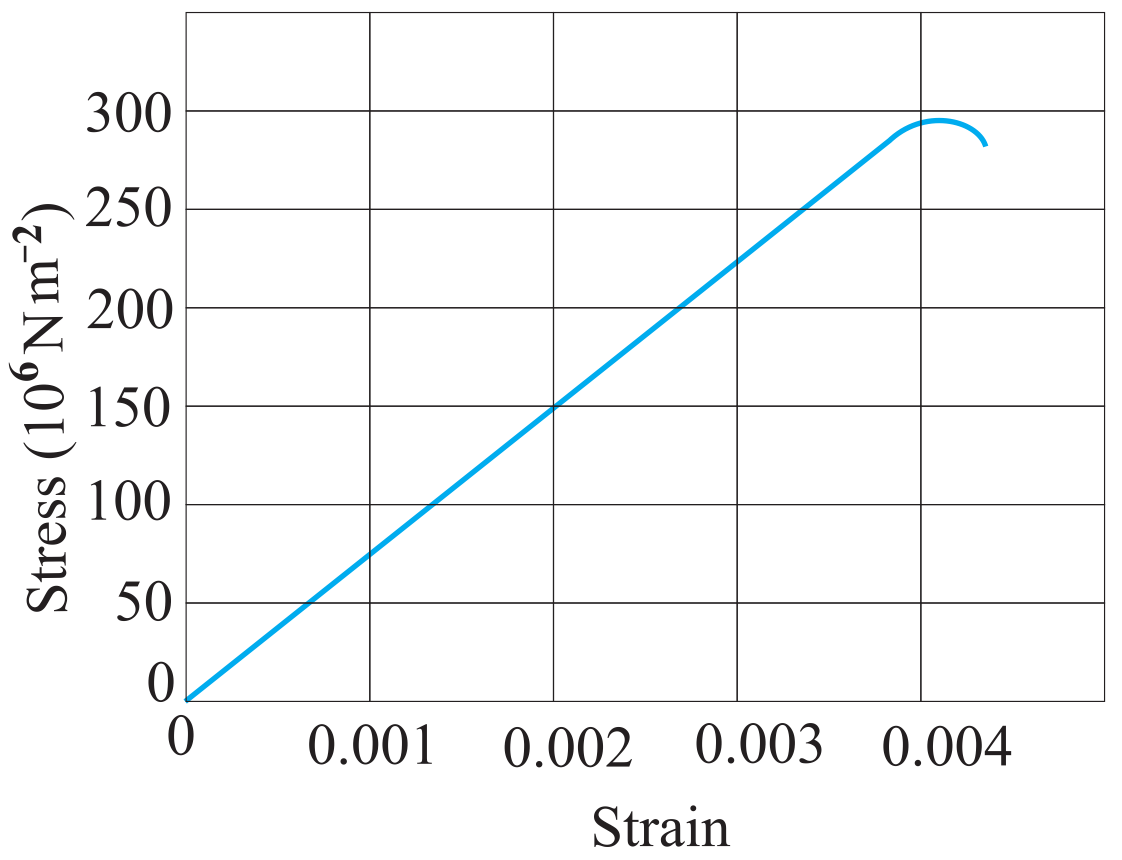
AnswerIt is clear from the given graph that for stress $150 \times 10^6N/m^2$, strain is $0.002$
- Young's modulus, $\text{Y}=\frac{\text{Stress}}{\text{Strain}}$
$=\frac{150\times10^6}{0.002}=7.5\times10^{10}\text{N/m}^2$
Hence, Young’s modulus for the given material is $7.5 \times 10^{10}N/m^2$.
- The yield strength of a material is the maximum stress that the material can sustain without crossing the elastic limit.
It is clear from the given graph that the approximate yield strength of this material is $300 \times 10^6N/m^2$ or $3 \times 10^8N/m^2$. View full question & answer→Question 433 Marks
How much should the pressure on a litre of water be changed to compress it by $0.10\%$?
AnswerVolume of water, V = 1L It is given that water is to be compressed by 0.10%.
$\therefore$ Fractional change, $\frac{\Delta\text{V}}{\text{V}}=\frac{0.1}{100\times1}=10^{-3}$
Bulk modulus, $\text{B}=\frac{\rho}{\frac{\Delta\text{V}}{\text{V}}}$
$\rho=\text{B}\times\frac{\Delta\text{V}}{\text{V}}$
Bulk modulus of water, $\mathrm{B}=2.2 \times 10^9 \mathrm{Nm}^{-2} \rho=2.2 \times 10^9 \times 10^{-3}=2.2 \times 10^6 \mathrm{Nm}^{-2}$ Therefore, the pressure on water should be $2.2 \times 10^6 \mathrm{Nm}^{-2}$.
View full question & answer→Question 443 Marks
A 4 m long aluminium wire whose diameter is $3 mm$ is used to support a mass of $50 kg$ . What will be the elongation of the wire? Y for aluminium is $7 \times 10^{10} \mathrm{Nm}^{-2}$. Given: $\mathrm{g}=9.8 \mathrm{~ms}^{-2}$.
Answer$\text{l}=4\text{m},\text{r}=1.5\text{mm}=1.5\times10^{-3}\text{m},$
$\text{M}=50\text{kg},$
$\text{Y}=7\times10^{10}\text{Nm}^{-2},\text{F}$
$=50\times9.8\text{N}=490\text{N},\Delta\text{l}=\ ?$
$\therefore\text{Y}=\frac{\text{F}\times\text{l}}{\text{A}\times\Delta\text{l}}$ or $\Delta\text{l}=\frac{\text{F}\times\text{l}}{\pi\text{r}^2\times\text{Y}}=\frac{490\times4\times7}{22\times(1.5\times10^{-3})^2\times7\times10^{10}}\text{m}$
$=39.6\times10^{-4}\text{m}=39.6\times10^{-4}\times10^3\text{mm}$
$=3.96\text{mm}$
View full question & answer→Question 453 Marks
A square lead slab of side $50\ cm$ and thickness $10 \ cm$ is subject to a shearing force $($on its narrow face$)$ of $9.0 \times10^4 N$. The lower edge is riveted to the floor. How much will the upper edge be displaced?
AnswerThe lead slab is fixed and the force is applied parallel to the narrow face as shown in Fig. $8.6.$ The area of the face parallel to which this force is applied is
$A =50 \ cm \times 10 \ cm$
$ =0.5 m \times 0.1 m$
$ =0.05 m ^2$
Therefore, the stress applied is
$=\left(9.4 \times 10^4 N / 0.05 m ^2\right)$
$=1.80 \times 10^6 N \cdot m ^{-2}$
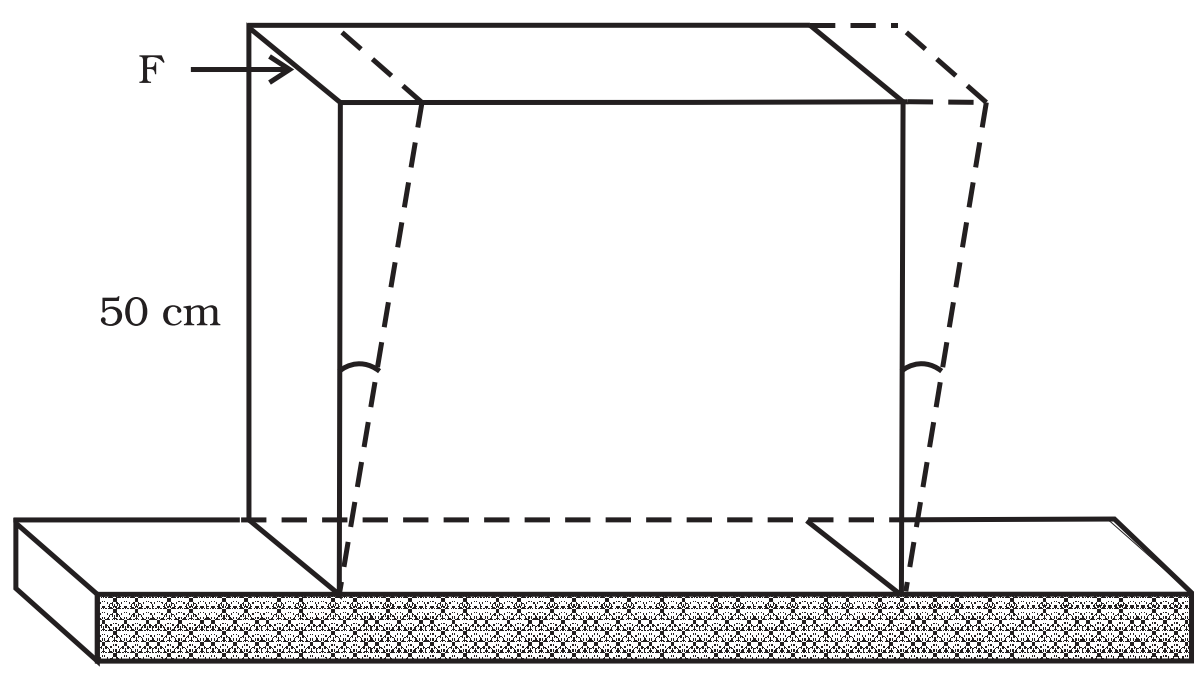
We know that shearing strain $=(\Delta x / L)=\text { Stress } / G \text {. }$
Therefore the displacement $\Delta x=(\text { Stress } \times L) / G$
$=\left(1.8 \times 10^6 N m ^{-2} \times 0.5 m \right) /\left(5.6 \times 10^9 N m ^{-2}\right)$
$=1.6 \times 10^{-4} m$
$=0.16\ mm $ View full question & answer→Question 463 Marks
In a human pyramid in a circus, the entire weight of the balanced group is supported by the legs of a performer who is lying on his back (as shown in Fig. 8.4). The combined mass of all the persons performing the act, and the tables, plaques etc. involved is 280 kg. The mass of the performer lying on his back at the bottom of the pyramid is 60 kg. Each thighbone (femur) of this performer has a length of 50 cm and an effective radius of 2.0 cm. Determine the amount by which each thighbone gets compressed under the extra load.
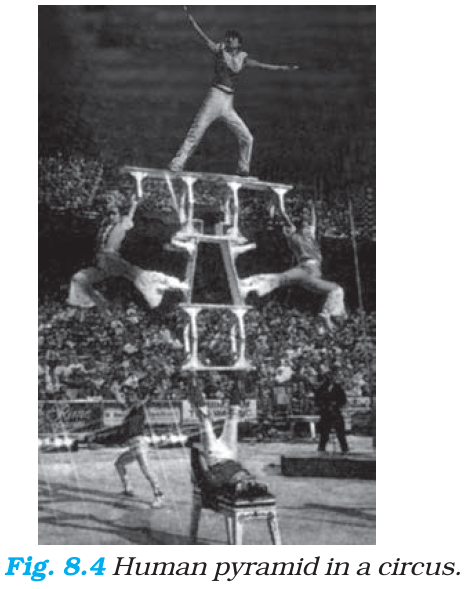
AnswerTotal mass of all the performers, tables, plaques etc. $\quad=280 kg$
Mass of the performer $=60 kg$
Mass supported by the legs of the performer at the bottom of the pyramid
$
=280-60=220 kg
$
Weight of this supported mass
$
=220 kg \text { wt. }=220 \times 9.8 N =2156 N \text {. }
$
Weight supported by each thighbone of the performer $=1 / 2(2156) N =1078 N$.
From Table 9.1, the Young's modulus for bone is given by
$Y=9.4 \times 10^9 N m ^{-2}$.
Length of each thighbone $L=0.5 m$
the radius of thighbone $=2.0 cm$
Thus the cross-sectional area of the thighbone $A=\pi \times\left(2 \times 10^{-2}\right)^2 m ^2=1.26 \times 10^{-3} m ^2$.
Using Eq. (9.8), the compression in each thighbone $(\Delta L)$ can be computed as
$
\begin{aligned}
\Delta L & =[(F \times L) /(Y \times A)] \\
& =\left[(1078 \times 0.5) /\left(9.4 \times 10^9 \times 1.26 \times 10^{-3}\right)\right] \\
& =4.55 \times 10^{-5} m \text { or } 4.55 \times 10^{-3} cm .
\end{aligned}
$
This is a very small change! The fractional decrease in the thighbone is $\Delta L / L=0.000091$ or $0.0091 \%$
View full question & answer→Question 473 Marks
A copper wire of length $2.2 m$ and a steel wire of length $1.6 m$, both of diameter $3.0 \ mm$, are connected end to end. When stretched by a load, the net elongation is found to be $0.70 \ mm$. Obtain the load applied.
AnswerThe copper and steel wires are under a tensile stress because they have the same tension $($equal to the load $W )$ and the same area of cross-section A. From Eq. $(8.7)$ we have stress $=$ strain $\times$ Young's modulus. Therefore
$W / A=Y_c \times\left(\Delta L_c / L_c\right)=Y_s \times\left(\Delta L_s / L_s\right)$
where the subscripts $c$ and $s$ refer to copper and stainless steel respectively. Or,
$\Delta L_c / \Delta L_s=\left(Y_s / Y_c\right) \times\left(L_c / L_s\right)$
$\text { Given } L_c=2.2 m , L_s=1.6 m ,$
$\text { From Table } 9.1 Y_c=1.1 \times 10^{11} N ^{-2} \text {, and }$
$Y_s=2.0 \times 10^{11} N ^{-2} .$
$\Delta L_c / \Delta L_s=\left(2.0 \times 10^{11} / 1.1 \times 10^{11}\right) \times(2.2 / 1.6)=2.5 \text {. }$
The total elongation is given to be
$\Delta L_c+\Delta L_s=7.0 \times 10^{-4} m$
Solving the above equations,
$\Delta L_c=5.0 \times 10^{-4} m \text {, and } \Delta L_s=2.0 \times 10^{-4} m \text {. }$
Therefore
$W =\left(A \times Y_c \times \Delta L\right) / L_c$
$ =\pi\left(1.5 \times 10^{-3}\right)^2 \times\left[\left(5.0 \times 10^{-4} \times 1.1 \times 10^{11}\right) / 2.2\right]$
$ =1.8 \times 10^2 N$
View full question & answer→Question 483 Marks
A structural steel rod has a radius of $10 mm$ and a length of $1.0 m$. A $100 kN$ force stretches it along its length. Calculate (a) stress, (b) elongation, and (c) strain on the rod. Young's modulus, of structural steel is $2.0 \times 10^{11} N m ^{-2}$.
AnswerWe assume that the rod is held by a clamp at one end, and the force $F$ is applied at the other end, parallel to the length of the rod. Then the stress on the rod is given by
$
\begin{aligned}
\text { Stress } & =\frac{F}{A}=\frac{F}{\pi r^2} \\
& =\frac{100 \times 10^3 N }{3.14 \times\left(10^{-2} m ^2\right.} \\
& =3.18 \times 10^8 N m ^{-2}
\end{aligned}
$
The elongation,
$
\begin{aligned}
\Delta L & =\frac{(F / A) L}{Y} \\
& =\frac{\left(3.18 \times 10^8 N m ^{-2}\right)(1 m )}{2 \times 10^{11} N m ^{-2}} \\
& =1.59 \times 10^{-3} m \\
& =1.59 mm
\end{aligned}
$
The strain is given by
$
\begin{aligned}
\text { Strain } & =\Delta L / L \\
& =\left(1.59 \times 10^{-3} m \right) /(1 m ) \\
& =1.59 \times 10^{-3} \\
& =0.16 \%
\end{aligned}
$
View full question & answer→