Question types

Thermodynamics question types

29 questions across 5 question groups — pick any mix to generate a Physics paper with step-by-step answer keys.

29
Questions
5
Question groups
5
Question types
Sample Questions

Thermodynamics questions

One sample from each question group in this chapter. Select any group above to see the full set with answer keys.

Consider $P-V$ diagram for an ideal gas shown in:
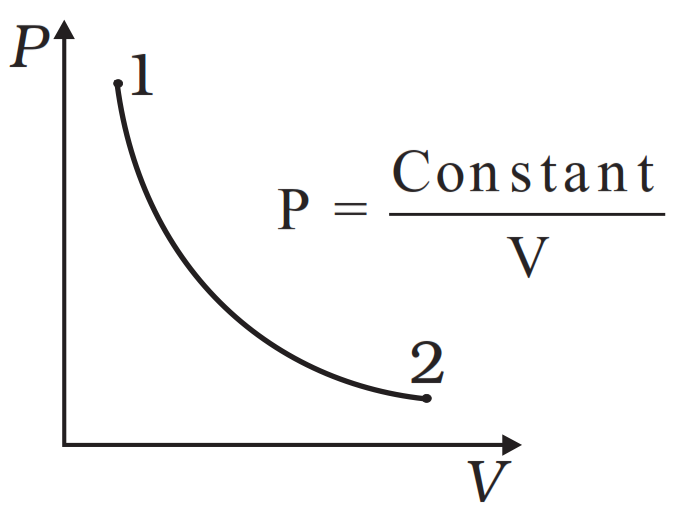
Out of the following diagrams which represents the $T-P$ diagram?
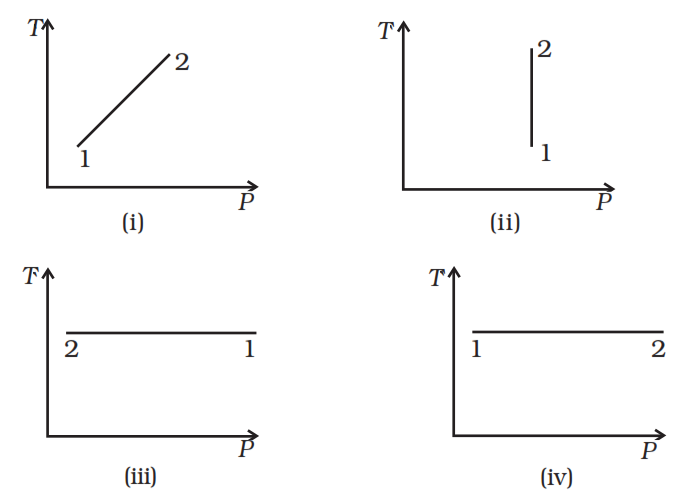
  • A
    $(iv)$
  • B
    $(ii)$
  • $(iii)$
  • D
    $(i)$

Answer: C.

View full solution
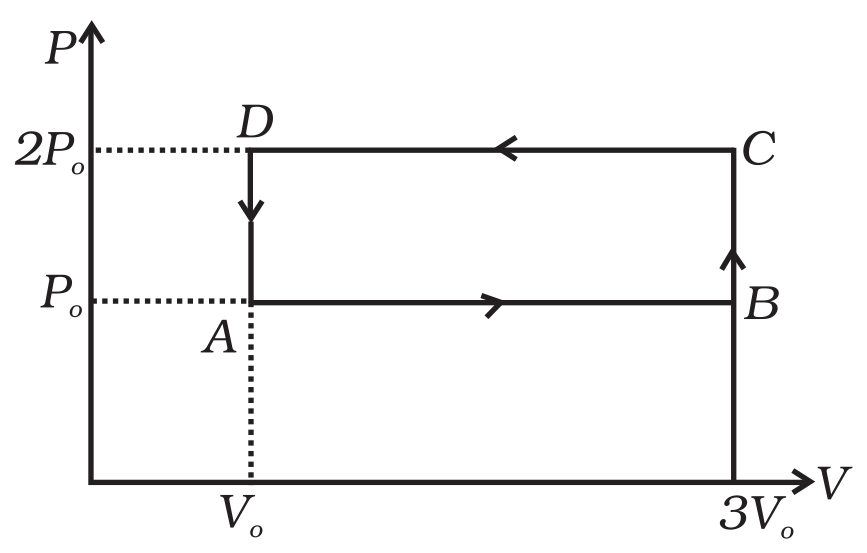
An ideal gas undergoes cyclic process ABCDA as shown in given PV diagram. The amount of work done by the gas is:
  • A
    $6\text{P}_0\text{V}_0$
  • B
    $-2\text{P}_0\text{V}_0$
  • C
    $+2\text{P}_0\text{V}_0$
  • $+4\text{P}_0\text{V}_0$

Answer: D.

View full solution
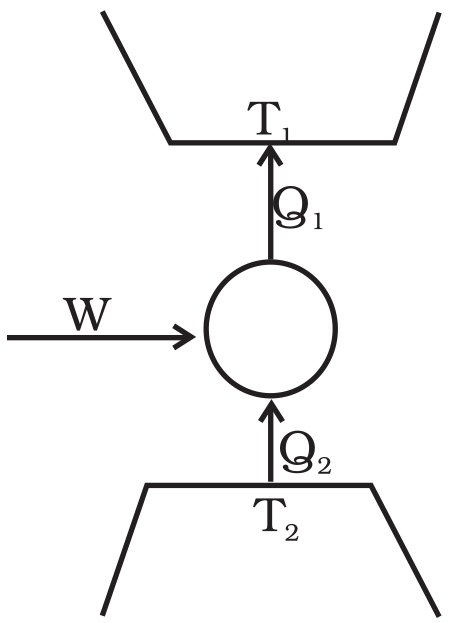
Consider a heat engine as shown in $Q_1$ and $Q_2$ are heat added to heat bath $T_1$ and heat taken from $T_2$ in one cycle of engine. W is the mechanical work done on the engine. If $\mathrm{W}>0$, then possibilities are:
  • $\text{Q}_1>\text{Q}_2>0$
  • B
    $\text{Q}_2>\text{Q}_1>0$
  • C
    $\text{Q}_2<\text{Q}_1<0$
  • D
    $\text{Q}_1<0,\text{Q}_2>0$

Answer: A.

View full solution
An ideal gas undergoes isothermal process from some initial state $i$ to final state $f.$ Choose the correct alternatives.
  1. $\text{dU = 0}$
  2. $\text{dQ= 0}$
  3. $\text{dQ = dU}$
  4. $\text{dQ = dW}$
  • $b$ and $d$
  • B
    $b$ and $c$
  • C
    $a$ and $d$
  • D
    $c$ and $d$

Answer: A.

View full solution
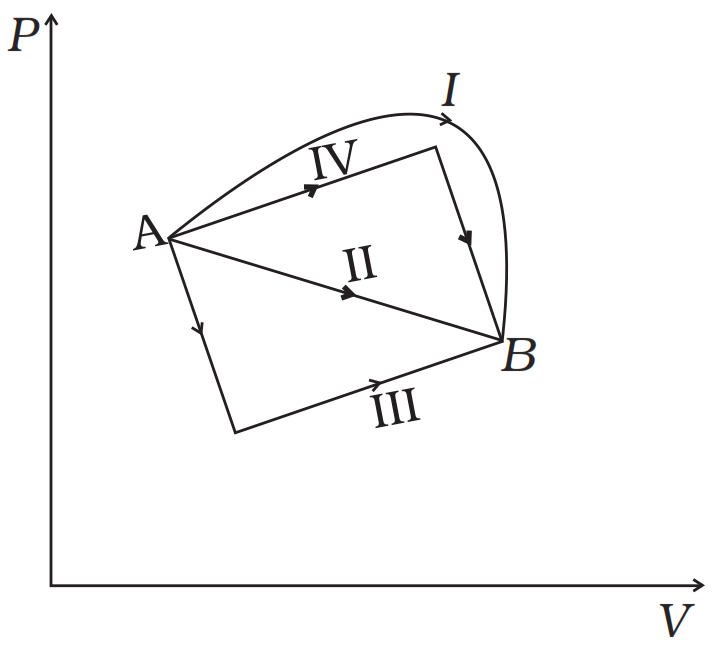
Figure. shows the $\text{P-V}$ diagram of an ideal gas undergoing a change of state from $A$ to $B$. Four different parts $\text{I, II, III}$ and $\text{IV}$ as shown in the figure may lead to the same change of state.
  1. Change in internal energy is same in $\text{IV}$ and $\text{III}$ cases, but not in $\text{I}$ and $\text{II.}$
  2. Change in internal energy is same in all the four cases.
  3. Work done is maximum in case $\text{I}$
  4. Work done is minimum in case $\text{II.}$
  • A
    $1$ and $2$
  • $1$ and $3$
  • C
    $1$ and $4$
  • D
    $2$ and $3$

Answer: B.

View full solution
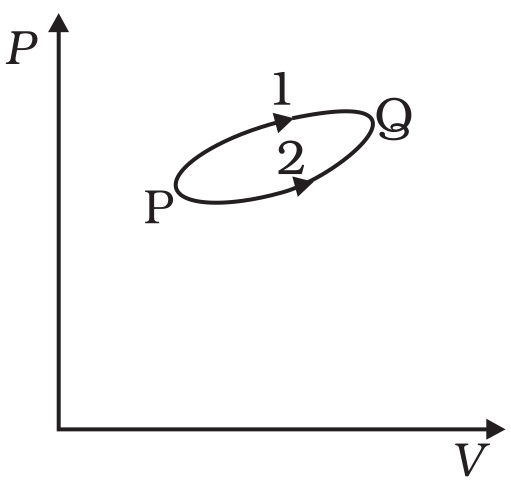
A system goes from P to Q by two different paths in the P-V diagram as shown in Fig. Heat given to the system in path 1 is 1000J. The work done by the system along path 1 is more than path 2 by 100J. What is the heat exchanged by the system in path 2?
View full solution
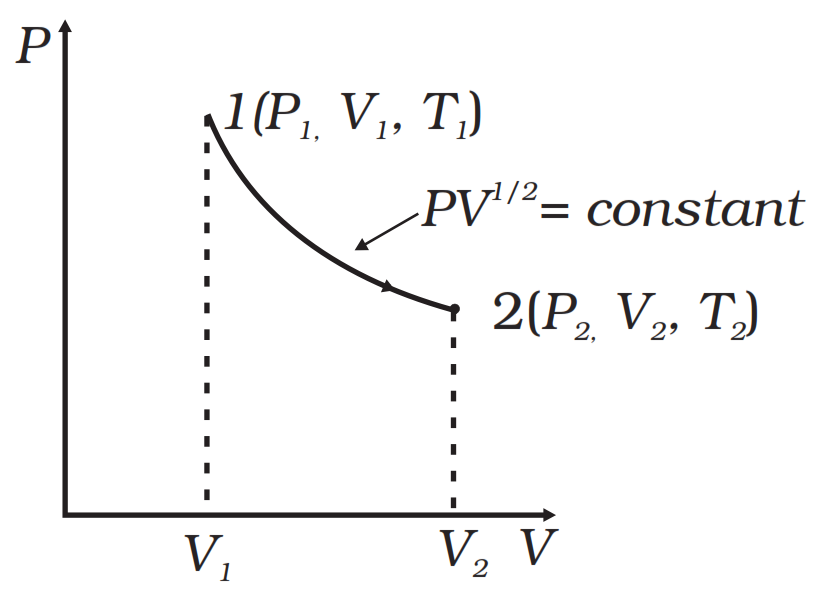
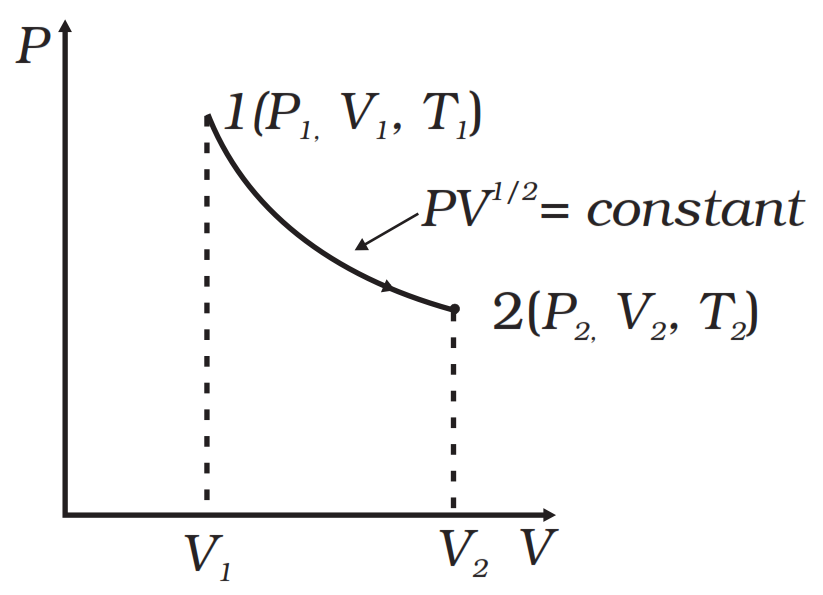
Consider a P-V diagram in which the path followed by one mole of perfect gas in a cylindrical container is shown in Fig.
What is the ratio of temperature $\frac{\text{T}_1}{\text{T}_2},\text{if}\text{V}_2=2\text{V}_1?$
View full solution
If the co-efficient of performance of a refrigerator is 5 and operates at the room temperature (27°C), find the temperature inside the refrigerator.
View full solution
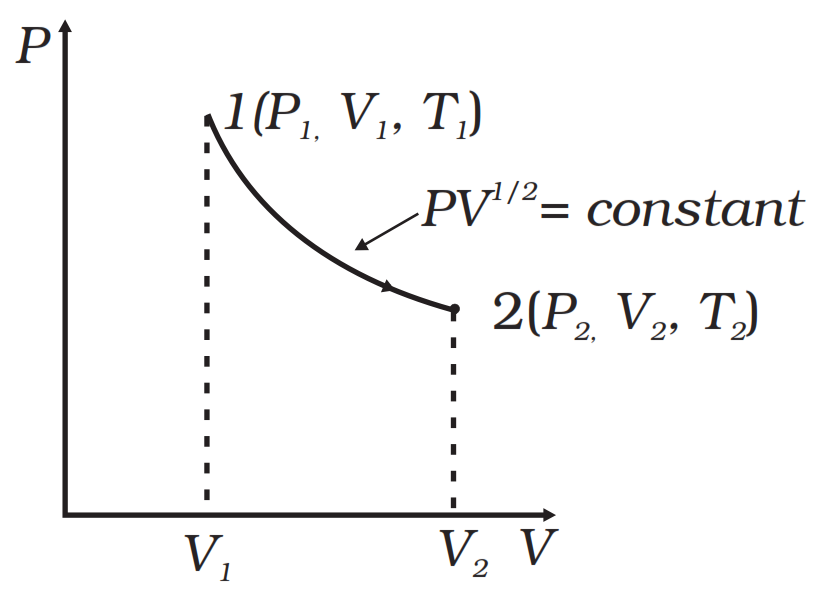
Consider a P-V diagram in which the path followed by one mole of perfect gas in a cylindrical container is shown in Fig.

Find the work done when the gas is taken from state 1 to state 2.
View full solution
Q 123 Marks Question3 Marks
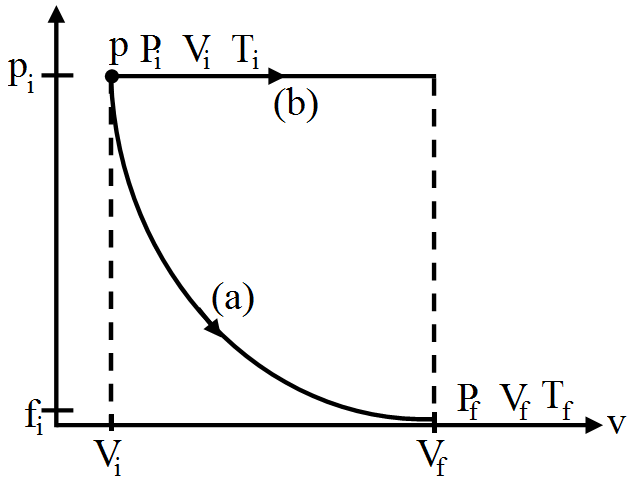
The initial state of a certain gas is $(P_i , V_i , T_i )$. It undergoes expansion till its volume becoms $V_f$ . Consider the following two cases:
  1. The expansion takes place at constant temperature.
  2. The expansion takes place at constant pressure.
Plot the $P-V$ diagram for each case. In which of the two cases, is the work done by the gas more?
View full solution
Q 143 Marks Question3 Marks
Consider a P-V diagram in which the path followed by one mole of perfect gas in a cylindrical container is shown in Fig.

Given the internal energy for one mole of gas at temperature T is (3/2) RT, find the heat supplied to the gas when it is taken from state (1) to (2) with $V_2 = 2V_{1.}$​​​​​​​
View full solution
Q 153 Marks Question3 Marks
Consider a Carnot's cycle operating between $T_1=500 K$ and $T_2=300 K$ producing 1 kJ of mechanical work per cycle. Find the heat transferred to the engine by the reservoirs.
View full solution
In a refrigerator one removes heat from a lower temperature and deposits to the surroundings at a higher temperature. In this process, mechanical work has to be done which is provided by an electric motor. If the motor is of $1KW$ power, and heat is transferred from $–3^\circ C to 27^\circ C$, find the heat taken out of the refrigerator per second assuming its efficiency is 50% of a perfect engine.
View full solution
Consider a cycle tyre being filled with air by a pump. Let V be the volume of the tyre (fixed) and at each stroke of the pump $\Delta\text{V}(<<\text{V})$ of air is transferred to the tube adiabatically. What is the work done when the pressure in the tube is increased from $P_1$ to $P_2$?
View full solution
A person of mass $60kg$ wants to lose $5kg$ by going up and down a $10m$ high stairs. Assume he burns twice as much fat while going up than coming down. If $1kg$ of fat is burnt on expending $7000$ kilo calories, how many times must he go up and down to reduce his weight by $5kg$?
View full solution
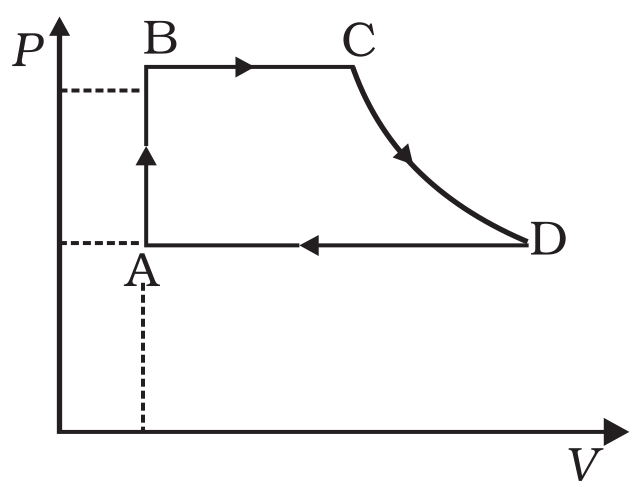
A cycle followed by an engine (made of one mole of an ideal gas in a cylinder with a piston) is shown in Fig. Find heat exchanged by the engine, with the surroundings for each section of the cycle. $(C_v = (3/2) R)$

AB : constant volume
BC : constant pressur CD : adiabati DA : constant pressure
View full solution
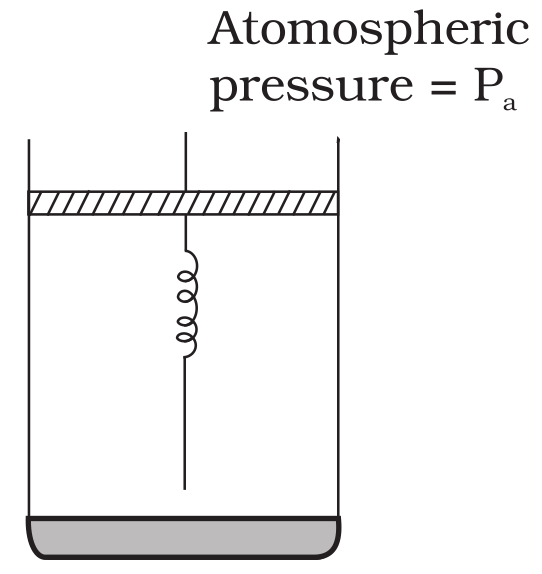
Consider one mole of perfect gas in a cylinder of unit cross section with a piston attached (Fig.) A spring (spring constant k) is attached (unstretched length L) to the piston and to the bottom of the cylinder. Initially the spring is unstretched and the gas is in equilibrium. A certain amount of heat Q is supplied to the gas causing an increase of volume from $V_o$ to $V_1$.
  1. What is the initial pressure of the system.
  2. What is the final pressure of the system.
  3. Uing the first law of thermodynamics, write down a relation between $Q, P_a, V, V_o$ and $k$.
View full solution

Generate a Thermodynamics paper free

Pick question groups from the list above, set marks and difficulty, and export a branded PDF with step-by-step answer keys. First 3 chapters free — no signup.

Download App