Questions

Case study (4 Marks)

Take a timed test

16 questions · self-marked practice — reveal the answer and mark yourself.

Question 14 Marks
Read the passage given below and answer the following questions from 1 to 5.
 Kinetic Energy The energy possessed by a body by virtue of its motion is called kinetic energy. In other words, the amount of work done, a moving object can do before coming to rest is equal to its kinetic energy. $\therefore\text{Kinetic energy}, \text{KE}=\frac{1}{2}\text{mv}^2$ where, m is a mass andv is the velocity of a body. The units and dimensions of KE are Joule (inSI) and $[ML^2 T ^{-2} ],$ respectively. Kinetic energy of a body is always positive. It can never be negative.
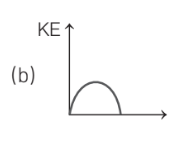
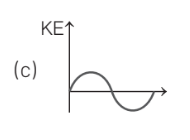
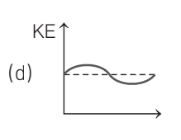
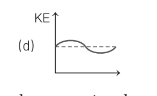
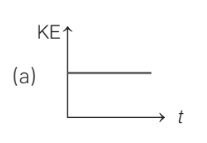
  1. Which of the diagrams shown in figure most closely shows the variation in kinetic energy of the earth as it moves once around the sun in its elliptical orbit?
  1. A force which is inversely proportional to the speed is acting on a body. The kinetic energy of the body starting from rest is:
  1. a constant
  2. inversely proportional to time
  3. directly proportional to time
  4. directly proportional to square of time
  1. The kinetic energy of an air molecule $(10 ^{-21} J)$ in eV is:
  1. 6.2 meV
  2. 4.2 meV
  3. 10.4 meV
  4. 9.7 meV
  1. Two masses of 1 g and 4 g are moving with equal kinetic energy. The ratio of the magnitudes of their momentum is:
  1. $4 : 1$
  2. $\sqrt{2}:1$
  3. $1 : 2$
  4. $1 : 16$
  1. An object of mass 10 kg is moving with velocity of $10\ ms ^{-1}.$ Due to a force, its velocity become $20\ ms^{-1}$ Percentage increase in its KE is:
  1. 25%
  2. 50%
  3. 75%
  4. 300%
Answer
Explanation:
When the earth is closest to the sun, speed of the earth is maximum, hence KE is maximum. When the earth is farthest from the sun, speed is minimum, hence KE is minimum but never zero and negative.
  1. (c) directly proportional to time
Explanation:
$\text{F}=\frac{\text{k}}{\text{v}}$
$\text{m}\frac{\text{dv}}{\text{dt}}=\frac{\text{K}}{\text{v}}$
$\Rightarrow\int\text{mv dv}=\int\text{K}\text{ dt}$
$\Rightarrow\text{m}\frac{\text{v}^2}{2}=\text{Kt}$
$\Rightarrow\text{Ke } \infty\text{ t}$
  1. (a) 6.2 meV
Explanation:
The kinetic energy of an air molecule is
$\frac{10^{-21}\text{J}}{1.6\times10^{-19}\frac{\text{J}}{\text{eV}}}=0.0062\text{ eV}$
This is the same as 6.2 meV.
  1. (c) 1 : 2
Explanation:
As we know that, linear momentum, p
$=\sqrt{2\text{mK}}$
$\bigg(\because\text{K}=\frac{\text{p}^2}{2\text{m}}\bigg)$
For same kinetic energy, $\text{P}\infty\sqrt{\text{m}}$
$\frac{\text{P}_1}{\text{P}_2}=\sqrt\frac{\text{m}_1}{\text{m}_2}=\sqrt\frac{1}{4}=\frac{1}{2}=1:2$
  1. (d) 300%
Explanation:
Initial velocity $= 10\ ms^{-1}$
Final velocity $= 20\ ms^{-1}$
Final KE $=\frac{1}{2}\times10\times20\times20=20\times10^2\text{J}$
% incrase $=\frac{(20-5)\times10^2}{5\times10^2}\times100=300\%$
View full question & answer
Question 24 Marks
In one of the exercises to strengthen the wrist and fingers, a person squeezes and releases a soft rubber ball. Is the work done on the ball positive, negative or zero during compression? During expansion?
Answer
  1. During compression, the work done on the ball is positive as the direction of the force applied by the fingers is along the compression of the ball.
  2. During expansion, the work done is negative as expansion takes place against the force applied by the fingers on the ball.
View full question & answer
Question 34 Marks
A collision experiment is done on a horizontal table kept in an elevator. Do you expect a change in the results if the elevator is accelerated up or down because of the noninertial character of the frame?
Answer
Velocity and mass are only two components that affect collision between two bodies so in this change in acceleration due to gravity will not affect the collision between two bodies. (if kept horizontally)
View full question & answer
Question 44 Marks
When you push your bicycle up on an incline the potential energy of the bicyle and yourself increases. Where does this energy come from?
Answer
When a person pushes his bicycle up on an inclined plane, the potential energies of the bicycle and the person increase because moving up on the inclined plane the kinetic energy decreases. and as mechanical energy is sum of kinetic energy and potential energy, and remains constant for a conservative system. Therefore, potential energy must increase in this case.
View full question & answer
Question 54 Marks
The US athlete Florence Griffith-Joyner won the $100m$ sprint gold medal at Seol Olympic 1988 setting a new Olympic record of $10.54s$. Assume that she achieved her maximum speed in a very short-time and then ran the race with that speed till she crossed the line. Take her mass to be 50kg.
  1. Calculate the kinetic energy of Griffith-Joyner at her full speed.
  2. Assuming that the track, the wind etc. offered an average resistance of one tenth of her weight, calculate the work done by the resistance during the run.
  3. What power GriffithJoyner had to exert to maintain uniform speed?
Answer
$S = 100m, t = 10.54sec, m = 50kg$
The motion can be assumed to be uniform because the time taken for acceleration is minimum.
Speed $\text{v}=\frac{\text{s}}{\text{t}}=9.487\text{m}/\text{s}$
So, K.E. $=\frac{1}{2}\text{mv}^2=2250\text{J}$ Weight = mg = 490J given $\text{R}=\frac{\text{mg}}{10}=49\text{J}$
so, work done against resistance $W_F= -RS = -49 \times 100 = -4900J$
To maintain her uniform speed, she has to exert $4900J$ of energy to over come friction,
$\text{P}=\frac{\text{W}}{\text{t}}$
$=\frac{4900}{10.54}=465\text{W}$
View full question & answer
Question 64 Marks
Read the passage given below and answer the following questions from 1 to 5. The scalar product or dot product of any two vectors A and B, denoted as A.B (read A dot B) is defined as $\text{A}\cdot\text{B}=\text{AB}\cos\theta$ Where q is the angle between the two vectors. Since A, B and $\cos\theta$ are scalars, the dot product of A and B is a scalar quantity. Each vector, A and B, has a direction but their scalar product does not have a direction. Following are properties of dot product
  • the scalar product follows the commutative law: A.B = B.A
  • Scalar product obeys the distributive law: (B + C) = A.B + A.C Further, A. $(\lambda\text{B})=\lambda(\text{A}\cdot\text{B})$ where $\lambda$ is a real number.
  • For unit vectors i, j, k we have
i × i = j × j = k × k = 1 and i × j = j × k = k × i = 0 $\text{A}\times\text{A}=\mid\text{A}\parallel\text{A}\mid\cos\theta=\text{A}^2.$ B = 0, if A and B are perpendicular. The work done by the force is defined to be the product of component of the force in the direction of the displacement and the magnitude of this displacement. Thus $\text{W}=(\text{F}\cos\theta)\text{d}=\text{F}\cdot\text{d}$ (We see that if there is no displacement, there is no work done even if the force is large. Work has only magnitude and no direction. Its SI unit is (N m) or joule (J). Thus, When you push hard against a rigid brick wall, the force you exert on the wall does not work. No work is done if:
  • The displacement is zero.
  • The force is zero. A block moving on a smooth horizontal table is not acted upon by Horizontal force (since there is no friction), but may undergo a large displacement.
  • The force and displacement are mutually perpendicular. This is so since, for $\theta=\frac{\pi}{2}$ rad
  • $\cos\big(\frac{\pi}{2}\big)=\theta.$ For the block moving on a smooth horizontal table, the gravitational force mg does no work since it acts at right angles to the displacement. If we assume that the moon’s orbits around the earth are perfectly circular then the earth’s gravitational force does no work. The moon’s instantaneous displacement is tangential while the earth’s force is radially inwards and $\theta=\frac{\pi}{2}.$
  1. Scalar product A.B = B.A is:
  1. Commutative law
  2. Distributive law
  3. Both a and b
  4. None of these
  1. When force acts in the direction of displacement then work done will be:
  1. Positive
  2. Negative
  3. Both a and b can possible
  4. None of these
  1. Define scalar product. give its properties:
  1. Define work done. Give its SI unit
  1. Write down the conditions for which work done is zero
Answer
  1. (a) Commutative law
  1. (a) Positive
  1. The scalar product or dot product of any two vectors A and B, denoted as A.B (read A dot B) is defined as
$\text{A}\cdot\text{B}=\text{AB}\cos\text{q}.$ where q is the angle between the two vectors. Since A, B and $\cos\theta$ are scalars, the dot product of A and B is a scalar quantity.
Each vector, A and B, has a direction but their scalar product does not have a direction. Following are properties of dot product
the scalar product follows the commutative law :
A.B = B.A
Scalar product obeys the distributive law:
(B + C) = A.B + A.C
Further, A. $(\lambda\text{B})=\lambda(\text{A}\cdot\text{B})$ where $\lambda$ is a real number.
For unit vectors i, j, k we have
i × i = j × j = k × k = 1 and i × j = j × k = k × i = 0
  • $\text{A}\times\text{A}=\mid\text{A}\parallel\text{A}\mid\cos\theta=\text{A}^2.$
  • B = 0, if A and B are perpendicular.
  1. The work done by the force is defined to be the product of component of the force in the direction of the displacement and the magnitude of this displacement. Thus
$\text{W}=(\text{F}\cos\theta)\text{d}=\text{F}\cdot\text{d}$
Work has only magnitude and no direction. Its SI unit is (N m) or joule (J).
  1. No work is done if:
The displacement is zero.
The force is zero. A block moving on a smooth horizontal table is not acted upon by a Horizontal force (since there is no friction), but may undergo a large displacement.
The force and displacement are mutually perpendicular. This is so since, for $\theta=\frac{\pi}{2}$rad $\cos\big(\frac{\pi}{2}\big)=\theta.$
View full question & answer
Question 74 Marks
Read the passage given below and answer the following questions from 1 to 5. The kinetic energy possessed by an object of mass, m and moving with a uniform velocity, v is $\text{K}=\frac{1}{2}\times\text{mv}^2=\frac{1}{2}\text{v}.\text{v}$ Kinetic energy is a scalar quantity. The kinetic energy of an object is a measure of the work and The energy possessed by an object is thus measured in terms of its capacity of doing work. The unit of energy is, therefore, the same as that of work, that is, joule (J). Work energy theorem: The change in kinetic energy of a particle is equal to the work done on it by the net force. Mathematically $K_f - K_i = W$ Where Ki and Kf are respectively the initial and final kinetic energies of the object. Work refers to the force and the displacement over which it acts. Work is done by a force on the body over a certain displacement.
  1. Kinetic energy is:
  1. Scalar quantity
  2. Vector quantity
  3. None of these
  1. Which of the following has same unit?
  1. Potential energy and work
  2. Kinetic energy and work
  3. Force and weight
  4. All of the above
  1. What is work energy theorem?
  1. Kinetic energy is scalar quantity. Justify the statement.
  1. Give formula for kinetic energy of body.
Answer
  1. (a) Scalar quantity
  1. (d) All of the above
  1. Work energy theorem: The change in kinetic energy of a particle is equal to the work done on it by the net force. Mathematically
$K_f - K_i = W$
Where Ki and Kf are respectively the initial and final kinetic energies of the object. Work refers to the force and the displacement over which it acts. Work is done by a force on the body over a certain displacement. Energy possessed by object due to its motion is called as kinetic energy. Its SI unit is N-m or Joule (J).
  1. Kinetic energy is scalar quantity as it is a work done and work done is scalar quantity hence kinetic energy is also scalar quantity and doesn’t have any direction.
  1. The kinetic energy possessed by an object of mass, m and moving with a uniform velocity, v is
$\text{K}=\frac{1}{2}\times\text{mv}^2=\frac{1}{2}\text{v}.\text{v}$
Kinetic energy is a scalar quantity. Having unit the same as that of work, that is, joule (J).
View full question & answer
Question 84 Marks
Read the passage given below and answer the following questions from 1 to 5. Work
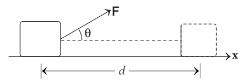
A farmer ploughing the field, a construction worker carrying bricks, a student studying for a competitive examination, an artist painting a beautiful landscape, all are said to be working. In physics, however, the word ‘Work’ covers a definite and precise meaning. Work refers to the force and the displacement over which it acts. Consider a constant force F acting on an object of mass m. The object undergoes a displacement d in the positive x-direction as shown in figure.

 The work done by the force is defined to be the product of component of the force in the direction of the displacement and the magnitude of this displacement, thus
$\text{W}=(\text{F}\cos\theta) \text{ D}=\text{F}.\text{D}.$
  1. The earth is moving around the sun in a circular orbit, is acted upon by a force and hence work done on the earth by the force is:
  1. zero
  2. positive
  3. negative
  4. None of the above
  1. In which case, work done will be zero?
  1. A weight-lifter while holding a weight of 100 kg on his shoulders for 1 min
  2. A locomotive against gravity is running on a level plane with a speed of 60 kmh - 1
  3. A person holding a suitcase on his head and standing at a bus terminal
  4. All of the above
  1. Find the angle between force $\text{F}=(3\hat{\text{i}}+4\hat{\text{j}}-5\hat{\text{k}})$ unit and displacement $\text{d}=(5\hat{\text{i}}+4\hat{\text{j}}+3\hat{\text{k}})$ unit.
  1. $\cos ^{-1}(0.49)$
  2. $\cos ^{-1}(0.32)$
  3. $\cos^{-1}(0.60)$
  4. $\cos^{-1}(0.90)$
  1. Which of the following statement(s) is/ are correct for work done to be zero?
  1. I. If the displacement is zero.
  2. II. If force applied is zero.
  3. III. If force and displacement are mutually perpendicular to each other.
(a) Only I (b) I and II
(c) Only II (d) I, II and III
  1. A proton is kept at rest. A positively charged particle is released from rest at a distance d in its field. Consider two experiments; one in which the charged particle is also a proton and in another, a positron. In same time t, the work done on the two moving charged particles is:
  1. same as the same force law is involved in the two experiments
  2. less for the case of a positron, as the positron moves away more rapidly and the force on it weakens
  3. more for the case of a positron, as the positron moves away a larger distance
  4. same as the work is done by charged particle on the stationary proton
Answer
  1. (a) zero
Explanation:
When earth is moving around the sun in a circular orbit, then gravitational attraction on earth due to the sun provides required centripetal force, which is in radially inward direction, i. e. in a direction perpendicular to the direction of motion of the earth in its circular orbit around the sun. As a result, the work done on the earth by the force will be zero. i.e. W Fd = $\cos 90^\circ$
  1. (d) All of the above
Explanation:
Work done by weight-lifter is zero, because there is no displacement. In a locomotive, work done is zero because force due to gravity and displacement are mutually perpendicular to each other. In case of a person holding a suitcase on his head and standing at a bus terminal, work done is zero because there is no displacement.
  1. (b) $\cos^{-1} (0.32)$
Explanation:
Given, $\text{F}=(3\hat{\text{i}}+4\hat{\text{j}}-5\hat{\text{k}})\text{unit.}$
and $\text{d}=(5\hat{\text{i}}+4\hat{\text{j}}+3\hat{\text{k}})\text{unit.}$
$\therefore\text{ f.d}=\text{F}_\text{x}\text{d}_\text{x}+\text{f}_\text{y}\text{d}_\text{y}+\text{f}_\text{z}\text{d}_\text{z}$
= 9 + 16 + 25
= 50 units
$\Rightarrow\text{d}=\sqrt{50} \text{units}$
$\text{ d.d}=\text{d}^2=\text{d}^2_\text{x}+\text{d}^2_\text{y}+\text{d}^2_\text{z}$
= 25 + 16 + 9
= 50 units.
$\Rightarrow\text{d}=\sqrt{50}\text{units}$
$\Rightarrow\cos\theta=\frac{16}{\sqrt{50}\sqrt{50}}$
$=\frac{16}{50}=0.32\big(\because\cos\theta=\frac{\text{F.d}}{\text{FD}}\big)$
  1. (d) I, II and III
Explanation:
The work done in displacing an object by applying force F is given by W = F . s = F s cos $\theta$ So, work done will be zero, when
(i) either applied force F or displacement s is zero.
(ii) the force and displacement are mutually perpendicular to each other. i.e. $\theta = 90^\circ$
  1. (c) more for the case of a positron, as the positron moves away a larger distance
Explanation:
Force between two protons is same as that of between proton and a positron. As positron is much lighter than proton, it moves away through much larger distance compared to proton. We know that, work done = force × distance. As, forces are same in case of proton and positron but distance moved by positron is larger, hence work done will be more in case of positron.
View full question & answer
Question 94 Marks
Read the passage given below and answer the following questions from 1 to 5. The gravitational potential energy of an object at a point above the ground is defined as the work done in raising it from the ground by height h to that point against gravity. Let the work done on the object against gravity be W. That is, work done, W = force × displacement = mg × h Therefore potential energy (PE) = mg*h. The dimensions of potential energy are $[ML^2T^{-2}]$ and the unit is joule (J), the same as kinetic energy or work. To reiterate, the change in potential energy, for a conservative force, $\triangle\text{V}$ is equal to the negative of the work done by the force $\triangle\text{v}=−\text{F}(\text{x})\triangle\text{x}.$ Conservation of mechanical energy: Suppose that a body undergoes displacement $\triangle\text{x}$ under the action of a conservative force F. Then from the WE theorem we have, $ \triangle\text{K}=\text{F}(\text{x})\triangle\text{x}$ If the force is conservative, the potential energy function V(x) can be defined such that $-\triangle\text{V}=\text{F}(\text{x})\triangle\text{x}$ The above equations imply that $\triangle\text{K}+\triangle\text{V}=0$ or $\triangle(\text{K}+\text{V})=0.$ Which means that K + V, the sum of the kinetic and potential energies of the body is a constant? Over the whole path, $x_i$ to $x_f$, this means that $K_i + V(x_i ) = Kf + V(x_f )$. The quantity K +V(x), is called the total mechanical energy of the system. Individually the kinetic energy K and the potential energy V(x) may vary from point to point, but the sum is a constant. The aptness of the term ‘conservative force’ is now clear. Let us consider some of the definitions of a conservative force.
  • A force F(x) is conservative if it can be derived from a scalar quantity V(x).
  • The work done by the conservative force depends only on the end points. This can be seen from the relation, W = Kf – Ki = V (xi ) – V(xf ) which depends on the end points.
  • A third definition states that the work done by this force in a closed path is zero. This is once again apparent since xi = xf .
Thus, the principle of conservation of total mechanical energy can be stated as the total mechanical energy of a system is conserved if the forces, doing work on it, are conservative.
  1. Dimensions of potential energy is given by:
  1. $[ML^2T^{-2}]$
  2. $[M^2 L^2T^{-2}]$
  3. $[ML^3T^{-3}]$
  4. None of the above
  1. SI unit of potential energy is:
  1. Joule(J)
  2. Newton meter(N-m)
  3. Both a and b
  4. None of these
  1. Define the gravitational potential energy.
  1. Define conservative force.
  1. State conservation of mechanical energy.
Answer
  1. (a) $[ML^2T^{-2}]$
  1. (c) Both a and b
  1. The gravitational potential energy of an object at a point above the ground is defined as the work done in raising it from the ground by height h to that point against gravity. Let the work done on the object against gravity be W. That is, work done,
W = force × displacement
= mg × h
Therefore potential energy (PE) = mg*h. The dimensions of potential energy are $[ML^2T^{-2}]$ and the unit is joule (J), the same as kinetic energy or work.
  1. Let us consider some of the definitions of a conservative force.
  • A force F(x) is conservative if it can be derived from a scalar quantity V(x).
  • The work done by the conservative force depends only on the end points. This can be seen from the relation, W = Kf – Ki = V (xi ) – V(xf ) which depends on the end points.
  • A third definition states that the work done by this force in a closed path is zero. This is once again apparent since xi = xf.
  1. Conservation of mechanical energy:
Suppose that a body undergoes displacement Δx under the action of a conservative force F. Then from the WE theorem we have,
$ \triangle\text{K}=\text{F}(\text{x})\triangle\text{x}.$ If the force is conservative, the potential energy function V(x) can be defined such that $\triangle\text{v}=−\text{F}(\text{x})\triangle\text{x}.$ The above equations imply that
$\triangle\text{K}+\triangle\text{V}=0$ or $\triangle(\text{K}+\text{V})=0.$
Which means that K + V, Over the whole path, xi to xf, this means that
Ki + V(xi ) = Kf + V(xf ). The quantity K +V(x), is called the total mechanical energy of the system. Individually the kinetic energy K and the potential energy V(x) may vary from point to point, but the sum is a constant.
View full question & answer
Question 104 Marks
Read the case study given below and answer any four subparts:
Potential energy is the energy stored within an object, due to the object's position, arrangement or state. Potential energy is one of the two main forms of energy, along with kinetic energy. Potential energy depends on the force acting on the two objects.
  1. A body is falling freely under the action of gravity alone in vacuum. Which of the following quantities remain constant during the fall?
    1. kinetic energy
    2. potential energy
    3. mechanical energy
    4. none of these
  2. Work done by a conservative force is positive, if
    1. potential energy decreases
    2. potential energy increases
    3. kinetic energy decreases
    4. kinetic energy increases
  3. When does the potential energy of a spring increases?
    1. only when spring is stretched
    2. only when spring is compressed
    3. both a and b
    4. none of these
  4. Dimension of k/m is, here k is force constant
    1. $T^2$
    2. $T^{-2}$
    3. $T^1$
    4. $T^{-1}$
  5. A vehicle of mass 5000kg climbs up a hill of 10 m. The potential energy gained by it
    1. 5J
    2. 500J
    3. $5 \times 10^4J$
    4. $5 \times 10^5J$
Answer
  1. (c) mechanical energy
  2. (a) potential energy decreases
  3. (c) both a and b
  4. (b) $T^{-2}$
  5. (d) $5 \times 10^5J$
View full question & answer
Question 114 Marks
Read the passage given below and answer the following questions from 1 to 5. The impact and deformation during collision may generate heat and sound. Part of the initial kinetic energy is transformed into other forms of energy. A useful way to visualize the deformation during collision is in terms of a ‘compressed spring’. If the ‘spring’ connecting the two masses regains its original shape without loss in energy, then the initial kinetic energy is equal to the final kinetic energy but the kinetic energy during the collision time Δt is not constant. Such a collision is called an elastic collision. On the other hand the deformation may not be relieved and the two bodies could move together after the collision. A collision in which the two particles move together after the collision is called a completely inelastic collision. The intermediate case where the deformation is partly relieved and some of the initial kinetic energy is lost is more common and is appropriately called an inelastic collision. If the initial velocities and final velocities of both the bodies are along the same straight line, then it is called a one-dimensional collision, or head-on collision. When two equal masses undergo a glancing elastic collision with one of them at rest, after the collision, they will move at right angles to each other.
  1. After collision when two particles moves together then collision is:
  1. Elastic collision
  2. Completely inelastic collision
  3. Both a and b
  4. None of these
  1. In elastic collision, loss in kinetic energy is:
  1. Zero
  2. Positive
  3. Negative
  4. None of these
  1. What is head on collision?
  1. What is elastic collision?
  1. What is inelastic collision?
Answer
  1. (b) Completely inelastic collision
  1. (a) Zero
  1. If the initial velocities and final velocities of both the bodies are along the same straight line, then it is called a one-dimensional collision, or head-on collision. In the case of small spherical bodies, this is possible if the direction of travel of body 1 passes through the centre of body 2 which is at rest. In general, the collision is two dimensional, where the initial velocities and the final velocities lie in a plane.
  1. Elastic collision is the type of collision in which initial kinetic energy and final kinetic energy of system remains same that is net loss in kinetic energy is zero.
  1. Inelastic collision is the type of collision in which initial kinetic energy and final kinetic energy of system does not remain same that is there is net loss in kinetic energy.
View full question & answer
Question 124 Marks
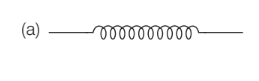
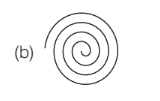
Read the passage given below and answer the following questions from 1 to 5. PE of Spring There are many types of spring. Important among these are helical and spiral springs as shown in figure.


Usually, we assume that the springs are massless. Therefore, work done is stored in the spring in the form of elastic potential energy of the spring. Thus, potential energy of a spring is the energy associated with the state of compression or expansion of an elastic spring.
  1. The potential energy of a body is increases in which of the following cases?
  1. If work is done by conservative force
  2. If work is done against conservative force
  3. If work is done by non-conservative force
  4. If work is done against non- conservative force
  1. The potential energy, i.e. U (x) can be assumed zero when:
  1. x = 0
  2. gravitational force is constant
  3. infinite distance from the gravitational source
  4. All of the above
  1. The ratio of spring constants of two springs is 2 : 3. What is the ratio of their potential energy, if they are stretched by the same force?
  1. 2 : 3
  2. 3 : 2
  3. 4 : 9
  4. 9 : 4
  1. The potential energy of a spring increases by 15 J when stretched by 3cm. If it is stretched by 4cm, the increase in potential energy is:
  1. 27 J
  2. 30 J
  3. 33 J
  4. 36 J
  1. The potential energy of a spring when stretched through a distance x is 10 J. What is the amount of work done on the same spring to stretch it through an additional distance x?
  1. 10 J
  2. 20 J
  3. 30 J
  4. 40 J
Answer
  1. (b) If work is done against conservative force.
Explanation:
Potential energy of a body increases when work is done against a conservative force, e.g. if we raise the height of an object, its potential energy increases because work is done against gravitational force which is a conservative force.
  1. (d) All of the above
Explanation:
The zero of the potential energy is arbitrary. It is set according to convenience. For the spring force, we took U (x), = 0, at x = 0, i.e. the unstretched spring had zero potential energy. For the constant gravitational force mg, we took U = 0 on the earth’s surface. Also, for the force due to the universal law of gravitation, the zero is best defined at an infinite distance from the gravitational source.
  1. (b) 3 : 2
Explanation:
$F = k_1 x_1 1, F = k_2 x_2$
$\text{K}_1\text{x}_1=\text{K}_2\text{x}_2\Rightarrow\frac{\text{K}_1}{\text{K}_2}=\frac{\text{x}_1}{\text{x}_2}$
$\frac{\text{PE} \ (1)}{\text{PE}\ (2)}=\frac{\text{k}_1 \text{x}^2_1}{\text{k}_2\text{ x}^2_2}$
$=\frac{\text{k}_1}{\text{k}_2}\times\Big(\frac{\text{k}_2}{\text{k}_1}\Big)=\frac{\text{k}_2}{\text{k}_1}=\frac{3}{2}$
  1. (a) 27 J
Explanation:
PE of spring $=\frac{1}{2}\text{kx}^2\Rightarrow\text{PE} \infty\text{x}^2$
$\therefore\text{PE}=15\times\frac{(4)^2}{(3)^2}=15\times\frac{16}{9}\simeq27\text{ J}$
  1. (c) 30 J
Explanation:
Potential energy of the spring when stretched through a distance x,
$\text{U}=\frac{1}{2}\text{kx}^2=10\text{ J}$
When x becomes 2x, the potential energy will be
$\text{U}=\frac{1}{2}\text{k}(2\text{x})^2=4\times\frac{1}{2}\text{kx}^2$
$= 4 × 10 = 40 \text{ J}$
$\therefore\text{Work done}=\text{U}'-\text{U}=40-10=30\text{ J}$
View full question & answer
Question 134 Marks
Read the passage given below and answer the following questions from 1 to 5. Power is defined as the time rate at which work is done or energy is transferred. The average power of a force is defined as the ratio of the work, W, to the total time t taken $P_{av}= W/t$ The instantaneous power is defined as the limiting value of the average power as time interval approaches zero. P = dw/dt The work dW done by a force F for a displacement dr is dW = F.dr. The instantaneous power can also be expressed as P = F.dr/dt P = F.v Where v is the instantaneous velocity when the force is F. Power, like work and energy, is a scalar quantity. Its dimensions are $[ML^2 T^{-3}]$. In the SI, its unit is called a watt (W). The watt is $1 J s^{-1}$. The unit of power is named after James Watt, one of the innovators of the steam engine in the eighteenth century. There is another unit of power, namely the horse-power (hp) 1 hp = 746W This unit is still used to describe the output of automobiles, motorbikes.
  1. The time rate at which work is done or energy is transferred is called as:
  1. Energy
  2. Force
  3. Power
  4. None of these
  1. Limiting value of power as time interval approaches zero is called as:
  1. Average power
  2. Instantaneous power
  3. Both a and b
  4. None of these
  1. Power is directly proportional to:
  1. Force
  2. Velocity
  3. Both
  4. None of these
  1. Define instantaneous power. Give its SI unit and dimensions.
  1. 1 horse power is equal to how many watt?
Answer
  1. (c) Energy
  1. (b) Instantaneous power
  1. (c) Both
  1. The instantaneous power is defined as the limiting value of the average power as time interval approaches zero.
P = dw/dt
The work dW done by a force F for a displacement dr is dW = F.dr. The instantaneous power can also be expressed as
P = F.dr/dt
P = F.v
Where v is the instantaneous velocity when the force is F. Power, like work and energy, is a scalar quantity. Its dimensions are $[ML^2 T^{-3}]$. In the SI, its unit is called a watt (W).
  1. 1 horse power is equal to 746 watt.
View full question & answer
Question 144 Marks
Read the passage given below and answer the following questions from 1 to 5. Principle of Conservation of Energy: Total energy of an isolated system always remains constant. Since, the universe as a whole may be viewed as an isolated system, total energy of the universe is constant. If one part of the universe loses energy, then other part must gain an equal amount of energy. The principle of conservation of energy cannot be proved as such. However, no violation of this principle has been observed.
  1. When we rub two flint stones together, got them to heat up and to ignite a heap of dry leaves in the form of:
  1. chemical energy
  2. sound energy
  3. heat energy
  4. electrical energy
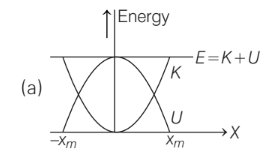
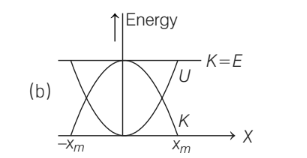
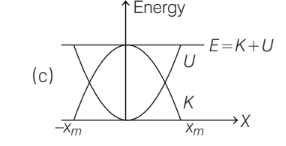
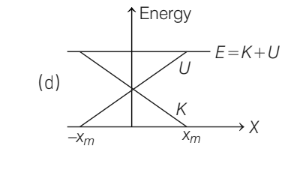
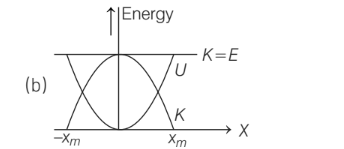
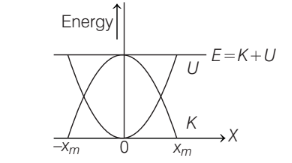
  1. Which graph represents conservation of total mechanical energy?
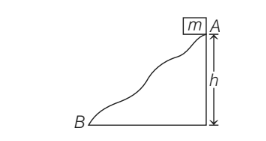
  1. In the given curved road, if particle is released from A, then:
  1. kinetic energy atB must be mgh
  2. kinetic energy atB must be zero
  3. kinetic energy atB must be less than mgh
  4. kinetic energy atB must not be equal to potential energy
  1. U is the potential energy, K is the kinetic energy and E is the mechanical energy. Which of the following is not possible for a stable system?
  1. U > E
  2. U < E
  3. E > K
  4. K > E
  1. A body of mass 5kg is thrown vertically up with a kinetic energy of 490 J. The height at which the kinetic energy of the body becomes half of the original value is
  1. 12.5m
  2. 10
  3. 2.5m
  4. 5m
Answer
  1. (a) chemical energy
Explanation:
One of the greatest technical achievements of human kind occurred when we discovered how to ignite and control fire. We learnt to rub two flint stones together (mechanical energy), got them to heat up and to ignite a heap of dry leaves (chemical energy), which then provided sustained warmth.
Explanation:
Parabolic plots of the potential energy U and kinetic energy K of a block attached to a spring obey in a Hooke’s law. The two plots are complementary, one decreasing as the other increases. The total mechanical energy E = K + U remains constant.
  1. (a) kinetic energy atB must be mgh:
Explanation:
In a conservative field loss of PE or gain of
KE depends only on initial and final point
and not on path covered, i.e. at B, KE = mgh.
  1. (a) U > E
Explanation:
We know that, PE + KE = Mechanical energy
U + K = E
⇒ U = E - K
Now, K can never be negative, so
U < E
K = E - U
Now, U can be negative, so K > E is possible.
  1. (d) 5m
Explanation:
According to the law of conservation of energy,
$\frac{1}{2}\text{mu}^2=\frac{1}{2}\big(\frac{1}{2}\text{mu}^2\big)+\text{mgh}$
$\Rightarrow490=245+5\times9.8\times\text{h}$
$\text{h}=\frac{245}{49}=5\text{m}$
View full question & answer
Question 154 Marks
In tug of war, the team that exerts a larger tangential force on the ground wins. Consider the period in which a team is dragging the opposite team by applying a larger tangential force on the ground. List which of the following works are positive, which are negative and which are zero?
  1. Work by the winning team on the losing team.
  2. Work by the losing team on the winning team.
  3. Work by the ground on the winning team.
  4. Work by the ground on the losing team.
  5. Total external work on the two teams.
Answer
  1. Work by the winning team on the losing team is positive, as the displacement of the losing team is along the force applied by the winning team.
  2. Work by the losing team on the winning team is negative, as the displacement of the winning team is opposite to the force applied by losing team.
  3. Work by the ground on the winning team is positive.
  4. Work by the ground on the losing team is negative.
  5. Total external work on the two teams is positive.
View full question & answer
Question 164 Marks
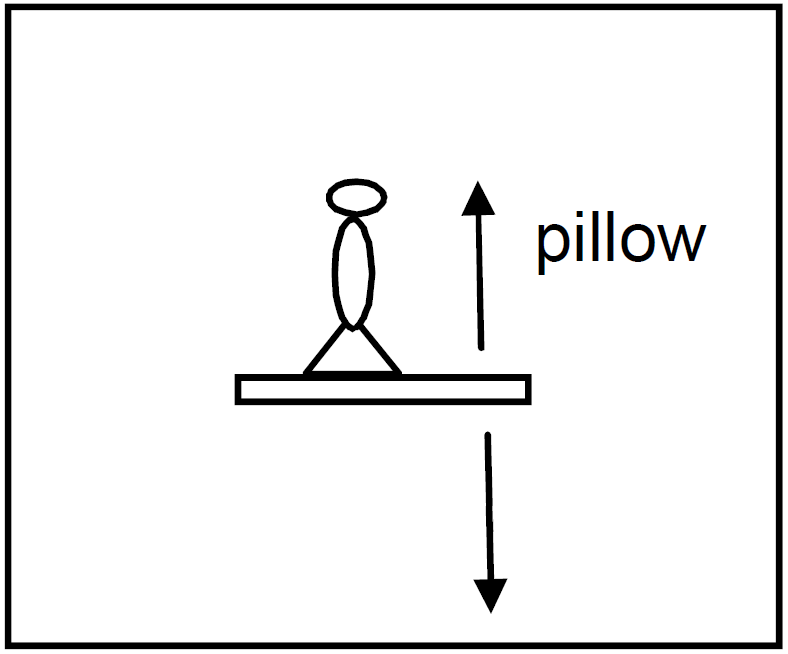
Consider a gravity-free hall in which an experimenter of mass $50kg$ is resting on a $5kg$ pillow, 8ft above the floor of the hall. He pushes the pillow down so that it starts falling at a speed of $8ft/s$. The pillow makes a perfectly elastic collision with the floor, rebounds and reaches the experimenter's head. Find the time elapsed in the process.
Answer
Mass of the man $(M_m)$ is $50kg$. Mass of the pillow $(M_p)$ is $5kg$.

 When the pillow is pushed by the man, the pillow will go down while the man goes up. It becomes the external force on the system which is zero. \Rightarrow Acceleration of centre of mass is zero \Rightarrow Velocity of centre of mass is constant $\therefore$ As the initial velocity of the system is zero. $\therefore\text{M}_{\text{m}}\times\text{V}_{\text{m}}=\text{M}_{\text{p}}\times\text{V}_{\text{p}}\ \dots(1)$ Given the velocity of pillow is 80ft/s. Which is relative velocity of pillow w.r.t. man. $\overrightarrow{\text{V}}_{\frac{\text{p}}{\text{m}}}=\overrightarrow{\text{V}}_{\text{p}}-\overrightarrow{\text{V}}_{\text{m}}$
$={\text{V}}_{\text{p}}-(-{\text{V}}_{\text{m}})={\text{V}}_{\text{p}}+{\text{V}}_{\text{m}}$
$\Rightarrow{\text{V}}_{\text{p}}=\text{V}_{\frac{\text{p}}{\text{m}}}-\text{V}_\text{m}$ Putting in equation (1) $\text{M}_{\text{m}}\times\text{V}_{\text{m}}=\text{M}_{\text{p}}\Big(\text{V}_{\frac{\text{p}}{\text{m}}}-\text{V}_{\text{m}}\Big)$
$\Rightarrow50\times\text{V}_{\text{m}}=5\times(8-\text{V}_{\text{m}})$
$\Rightarrow10\times\text{V}_{\text{m}}=8-\text{V}_{\text{m}}$
$\Rightarrow\text{V}_{\text{m}}=\frac{8}{11}=0.727\text{m/s}$
$\therefore$ Absolute velocity of pillow = 8 - 0.727 = 7.2ft/sec $\therefore$ Time taken to reach the floor $=\frac{\text{S}}{\text{v}}=\frac{8}{7.2}=1.1\text{sec}.$ As the mass of wall >>> then pillow The velocity of block before the collision = velocity after the collision. \Rightarrow Times of ascent = 1.11sec. $\therefore$ Total time taken = 1.11 + 1.11 = 2.22sec
View full question & answer