Question types

Work, Energy, and Power question types

666 questions across 7 question groups — pick any mix to generate a Physics paper with step-by-step answer keys.

666
Questions
7
Question groups
5
Question types
Sample Questions

Work, Energy, and Power questions

One sample from each question group in this chapter. Select any group above to see the full set with answer keys.

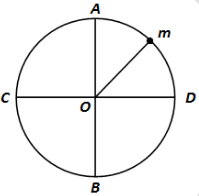
A body of mass $m$ is rotating in a vertical circle of radius $'r\ '$ with critical speed. The difference in its $K.E.$ at the top and the bottom is $.............$
  • $\text{2mgr}$
  • B
    $\text{4mgr}$
  • C
    $\text{6mgr}$
  • D
    $\text{3mgr}$

Answer: A.

View full solution
A small sphere is attached to a cord and rotates in a vertical circle about a point Or. If the average speed of the sphere is increased, the cord is most likely to break at the orientation when the mass is at:
  • Bottom point $B$
  • B
    Top point $A$
  • C
    Point $D$
  • D
    Point $C$

Answer: A.

View full solution
A stationary particle explodes into two particles of masses $m_1$ and $m_2$, which move in opposite directions with velocities $v_1$ and $v_2$. The ratio of their kinetic energies $\frac{\text{E}_1}{\text{E}_2}$ is:
  • $\frac{\text{m}_2}{\text{m}_1}$
  • B
    $\frac{\text{m}_1}{\text{m}_2}$
  • C
    $1$
  • D
    $\frac{\text{m}_1\text{v}_2}{\text{m}_2\text{v}_1}$

Answer: A.

View full solution
The work done by all the forces $($external and internal$)$ on a system equals the change in:
  • A
    Total energy.
  • Kinetic energy.
  • C
    Potential energy.
  • D
    None of these.

Answer: B.

View full solution
The sign of work done by a force on a body is important to understand. State carefully if the following quantities are positive or negative: Work done by the resistive force of air on a vibrating pendulum in bringing it to rest.
View full solution
Underline the correct alternative: In an inelastic collision of two bodies, the quantities which do not change after the collision are the total kinetic energy/ total linear momentum/ total energy of the system of two bodies.
View full solution
Answer carefully, with reasons: If the potential energy of two billiard balls depends only on the separation distance between their centres, is the collision elastic or inelastic? (Note: we are talking here of potential energy corresponding to the force during collision, not gravitational potential energy).
View full solution
Underline the correct alternative: The rate of change of total momentum of a many-particle system is proportional to the external force/ sum of the internal forces on the system.
View full solution
A body is moving unidirectionally under the influence of a source of constant power. Its displacement in time $t$ is proportional to:
  • A
    $\text{t}^{\frac{1}{2}}$
  • B
    $\text{t}$
  • $\text{t}^\frac{3}{2}$
  • D
    $\text{t}^2$

Answer: C.

View full solution
A body constrained to move along the z-axis of a coordinate system is subject to a constant force F given by $\text{F}=-\hat{\text{i}}+2\hat{\text{j}}+3\hat{\text{k}}\text{N}$ where $\hat{\text{i}},\hat{\text{j}},\hat{\text{k}}$ are unit vectors along the x, y and z-axis of the system respectively. What is the work done by this force in moving the body a distance of 4m along the z-axis?
View full solution
A heavy box is kept on a smooth inclined plane and is pushed up by a force $F$ acting parallel to the plane. Does the work done by the force $F$ as the box goes from $A$ to $B$ depend on how fast the box was moving at $A$ and $B\ ?$ Does the work by the force of gravity depend on this?
View full solution
Calculate the work done by a car against gravity in moving along a straight horizontal road. The mass of the car is 400kg and the distance moved is 2m.
View full solution
Q 163 Marks Question3 Marks
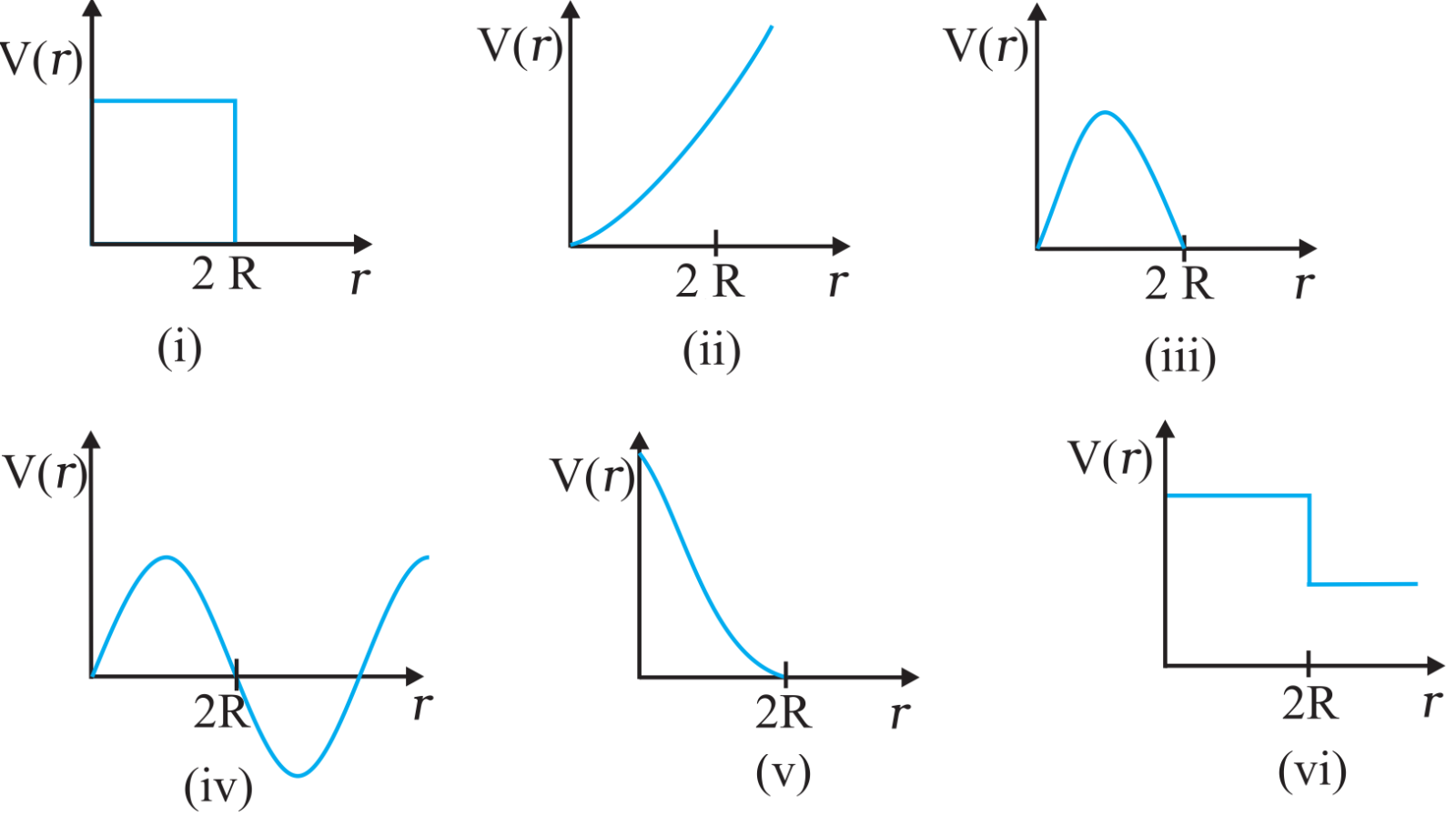
Which of the following potential energy curves in cannot possibly describe the elastic collision of two billiard balls? Here r is the distance between centres of the balls.
View full solution
Q 173 Marks Question3 Marks
A body of mass 0.5kg travels in a straight line with velocity $\text{v}=\text{ax}^{3/2}$ where $\text{a}=5\text{m}^{-1/2}\text{s}^{-1}.$ What is the work done by the net force during its displacement from x = 0 to x = 2m?
View full solution
Q 183 Marks Question3 Marks
A trolley of mass $300kg$ carrying a sandbag of $25kg$ is moving uniformly with a speed of $27km/h$ on a frictionless track. After a while, sand starts leaking out of a hole on the floor of the trolley at the rate of $0.05 kgs^{-1}$. What is the speed of the trolley after the entire sand bag is empty?
View full solution
Q 193 Marks Question3 Marks
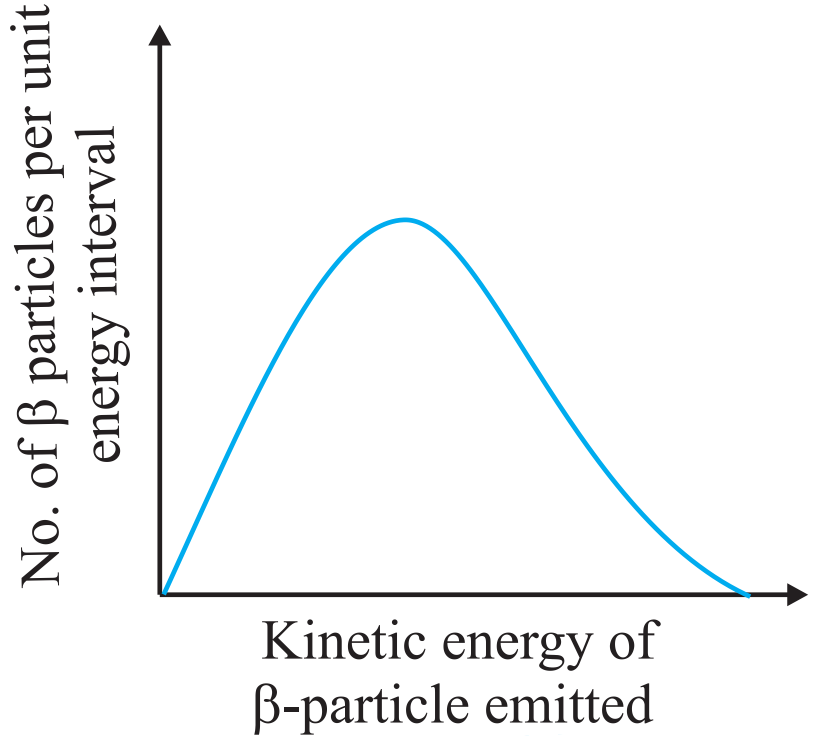
Consider the decay of a free neutron at rest: $n → p + e^-$ Show that the two-body decay of this type must necessarily give an electron of fixed energy and, therefore, cannot account for the observed continuous energy distribution in the β-decay of a neutron or a nucleus.

 [Note: The simple result of this exercise was one among the several arguments advanced by W. Pauli to predict the existence of a third particle in the decay products of β-decay. This particle is known as neutrino. We now know that it is a particle of intrinsic spin ½ (like $e^-$, p or n), but is neutral, and either massless or having an extremely small mass (compared to the mass of electron) and which interacts very weakly with matter. The correct decay process of neutron is: $n → p + e^- + v]$
View full solution
Q 203 Marks Question3 Marks
A molecule in a gas container hits a horizontal wall with speed $200ms^{-1}$ and angle 30° with the normal, and rebounds with the same speed. Is momentum conserved in the collision? Is the collision elastic or inelastic?
View full solution
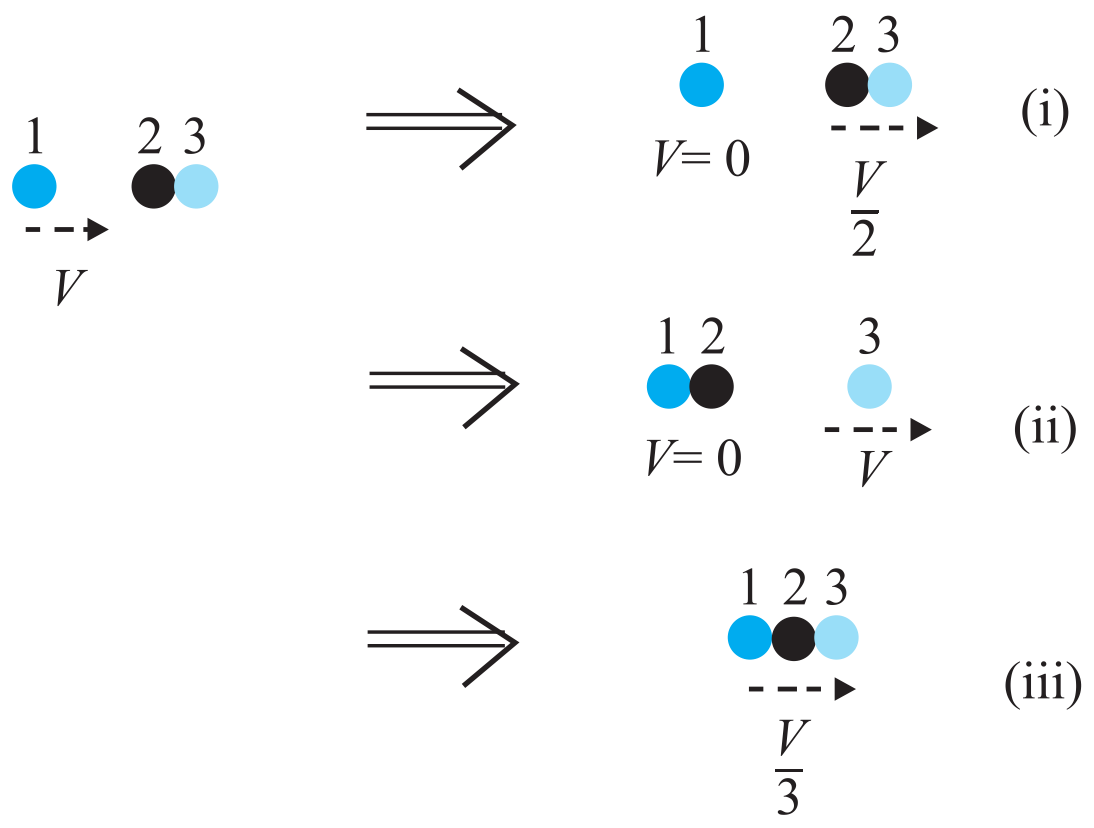
Two identical ball bearings in contact with each other and resting on a frictionless table are hit head-on by another ball bearing of the same mass moving initially with a speed V. If the collision is elastic, which of the following is a possible result after collision?
View full solution
A person trying to lose weight (dieter) lifts a $10kg$ mass, one thousand times, to a height of $0.5m$ each time. Assume that the potential energy lost each time she lowers the mass is dissipated.
  1. How much work does she do against the gravitational force?
  2. Fat supplies $3.8 \times 107J$ of energy per kilogram which is converted to mechanical energy with a $20\%$ efficiency rate. How much fat will the dieter use up?
View full solution
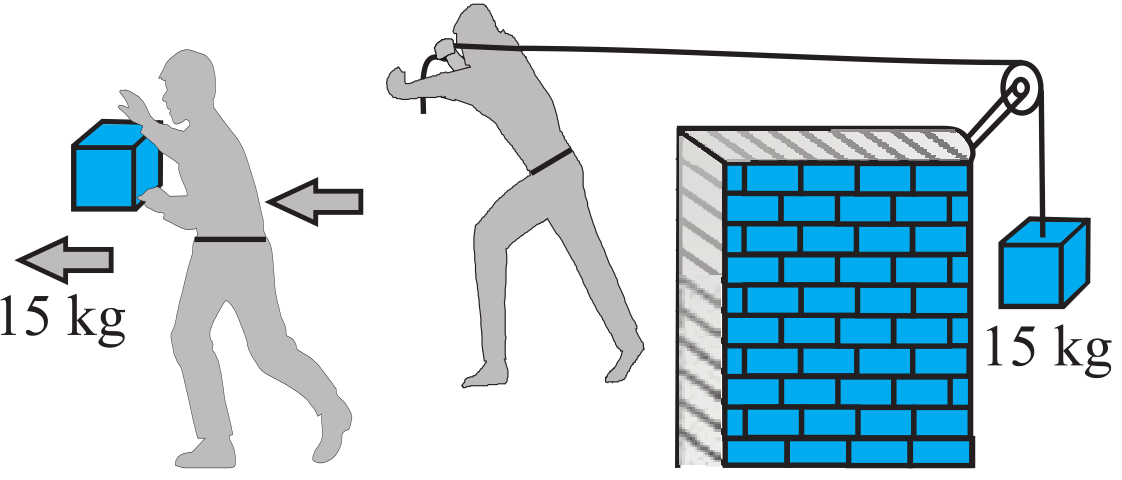
Answer the following: In the man walks $2m$ carrying a mass of $15kg$ on his hands. In he walks the same distance pulling the rope behind him. The rope goes over a pulley, and a mass of $15kg$ hangs at its other end. In which case is the work done greater?
View full solution
A pump on the ground floor of a building can pump up water to fill a tank of volume $30m^3$ in $15min$. If the tank is $40m$ above the ground, and the efficiency of the pump is $30\%$, how much electric power is consumed by the pump?
View full solution
A family uses $8kW$ of power.
  1. Direct solar energy is incident on the horizontal surface at an average rate of $200W$ per square meter. If $20\%$ of this energy can be converted to useful electrical energy, how large an area is needed to supply $8kW$?
  2. Compare this area to that of the roof of a typical house.
View full solution
Read the passage given below and answer the following questions from 1 to 5.
 Kinetic Energy The energy possessed by a body by virtue of its motion is called kinetic energy. In other words, the amount of work done, a moving object can do before coming to rest is equal to its kinetic energy. $\therefore\text{Kinetic energy}, \text{KE}=\frac{1}{2}\text{mv}^2$ where, m is a mass andv is the velocity of a body. The units and dimensions of KE are Joule (inSI) and $[ML^2 T ^{-2} ],$ respectively. Kinetic energy of a body is always positive. It can never be negative.
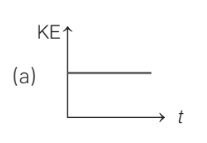
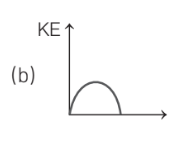
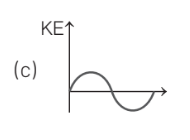
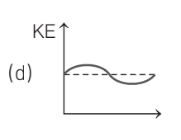
  1. Which of the diagrams shown in figure most closely shows the variation in kinetic energy of the earth as it moves once around the sun in its elliptical orbit?
  1. A force which is inversely proportional to the speed is acting on a body. The kinetic energy of the body starting from rest is:
  1. a constant
  2. inversely proportional to time
  3. directly proportional to time
  4. directly proportional to square of time
  1. The kinetic energy of an air molecule $(10 ^{-21} J)$ in eV is:
  1. 6.2 meV
  2. 4.2 meV
  3. 10.4 meV
  4. 9.7 meV
  1. Two masses of 1 g and 4 g are moving with equal kinetic energy. The ratio of the magnitudes of their momentum is:
  1. $4 : 1$
  2. $\sqrt{2}:1$
  3. $1 : 2$
  4. $1 : 16$
  1. An object of mass 10 kg is moving with velocity of $10\ ms ^{-1}.$ Due to a force, its velocity become $20\ ms^{-1}$ Percentage increase in its KE is:
  1. 25%
  2. 50%
  3. 75%
  4. 300%
View full solution
In one of the exercises to strengthen the wrist and fingers, a person squeezes and releases a soft rubber ball. Is the work done on the ball positive, negative or zero during compression? During expansion?
View full solution
A collision experiment is done on a horizontal table kept in an elevator. Do you expect a change in the results if the elevator is accelerated up or down because of the noninertial character of the frame?
View full solution
The US athlete Florence Griffith-Joyner won the $100m$ sprint gold medal at Seol Olympic 1988 setting a new Olympic record of $10.54s$. Assume that she achieved her maximum speed in a very short-time and then ran the race with that speed till she crossed the line. Take her mass to be 50kg.
  1. Calculate the kinetic energy of Griffith-Joyner at her full speed.
  2. Assuming that the track, the wind etc. offered an average resistance of one tenth of her weight, calculate the work done by the resistance during the run.
  3. What power GriffithJoyner had to exert to maintain uniform speed?
View full solution
State if the following statements is true or false. Give reasons for your answer: Total energy of a system is always conserved, no matter what internal and external forces on the body are present.
View full solution
State if the following statements is true or false. Give reasons for your answer: In an inelastic collision, the final kinetic energy is always less than the initial kinetic energy of the system.
View full solution
State if the following statements is true or false. Give reasons for your answer: In an elastic collision of two bodies, the momentum and energy of each body is conserved.
View full solution
State if the following statements is true or false. Give reasons for your answer: Work done in the motion of a body over a closed loop is zero for every force in nature.
View full solution

Generate a Work, Energy, and Power paper free

Pick question groups from the list above, set marks and difficulty, and export a branded PDF with step-by-step answer keys. First 3 chapters free — no signup.

Download App