Questions

5 Marks Questions

Take a timed test

9 questions · self-marked practice — reveal the answer and mark yourself.

Question 15 Marks
Two identical steel cubes (masses $50g$, side $1cm$) collide head-on face to face with a speed of $10cm/ s$ each. Find the maximum compression of each. Young’s modulus for steel = $Y = 2 \times 1011 N/ m^2$.
Answer
When two indentical cubes collide head-on collision. Then KE of cubes converts into PE and compresses the faces of cube by $\Delta\text{l}.$ By Hooks Law stress $\alpha$ strain. Or $\text{Y}=\frac{\text{stress}}{\text{strain}}$$\text{Y}=\frac{\text{F}\cdot\text{L}}{\text{A}\Delta\text{L}}$
Or $\text{F}=\text{AY}\frac{\Delta\text{L}}{\text{L}}$ Or $\text{F}=\text{L}^2\text{Y}\frac{\Delta\text{L}}{\text{L}}=\text{LY}\Delta\text{L}$$\text{WD}=\text{F}\cdot\Delta\text{L}=\text{LY}\Delta\text{L}^2$
KE of both cubes $=2\Big(\frac{1}{2}\text{mv}^2\Big)=0.05\times0.1\times0.1=5\times10^{-4}\text{J}$$\text{W.D.}=\text{K.E.}$
$\text{LY}\Delta\text{L}^2=5\times10^{-4} $
$\Delta\text{L}^2=\frac{5\times10^{-4}}{0.01\times2\times10^{11}}=\frac{5}{2}\times10^{-4-11+2}$
$\Delta\text{L}=\sqrt{25\times10^{-14}}=5\times10^{-7}\text{m}$
View full question & answer
Question 25 Marks
Consider a one-dimensional motion of a particle with total energy E. There are four regions A, B, C and D in which the relation between potential energy V, kinetic energy (K) and total energy E is as given below:
Region A : V > E
Region B : V < E
Region C : K > E
Region D : V > K
State with reason in each case whether a particle can be found in the given region or not.
Answer
For region A : V > E ⇒ E = V + K ⇒ K = E - V V > E. So, K < 0 or KE is negative, Which is not possible.
In region B : V < E ⇒ K= E - V ⇒ K > 0 This case is possible. Both energies are greater than zero.
Region C : K > E ⇒ V = E - K ⇒ v < 0 PE is negative. This is laso possible because PE can be negative. Region D : V > K K = E - V This is also possible as PE for a system can be greater than KE.
View full question & answer
Question 35 Marks
A ball of mass m, moving with a speed $2v_0$, collides inelastically $(e > 0)$ with an identical ball at rest. Show that:
For a general collision, the angle between the two velocities of scattered balls is less than $90°$
Answer
Consider the diagram shows general collision: (image not complet) Let angle between the $p_1$ and $p_2$ is $\theta$ By the law of conservation of momentum.$\vec{\text{p}}=\vec{\text{p}_1}+\vec{\text{p}_2}$
In inelastic collision, some part of KE lost in the from of heat, deshaping etc.$\therefore\ \text{KE}_\text{i}>\text{KE}_1+\text{KE}_2$
$\frac{1}{2}\text{mv}^2+\frac{1}{2}\text{m(0)}^2>\frac{1}{2}\text{mv}^2_1+\frac{1}{2}\text{mv}^2_2$
$\frac{\text{p}^2}{2\text{m}}>\frac{\text{p}^2_1}{2\text{m}}+\frac{\text{p}^2_2}{2\text{m}}$
$\therefore\ \vec{\text{p}}^2>\vec{\text{p}}^2_1+\vec{\text{p}}^2_2\ ....(\text{iii})$
If $\text{p}^2=\text{p}^2_1+\text{p}^2_2$ then angle between $p_1$ and $p_2$ is $90^\circ$ So, equation (iii) is true when angle between $p_1, p_2$ than $90^\circ$ or acute as shown in also.
View full question & answer
Question 45 Marks
The bob A of a pendulum released from horizontal to the vertical hits another bob B of the same mass at rest on a table as shown in.
If the length of the pendulum is 1m, calculate.
  1. The height to which bob A will rise after collision.
  2. The speed with which bob B starts moving. Neglect the size of the bobs and assume the collision to be elastic.
Answer
When a moving bob strike to an indentical bob at rest then one bob transfers its momentum to other and itself become at rest.
  1. When bob A reaches at the position of bob B. The PE of A converts into KE where bob A transfers its momentum to bob B and bob A becomes itself in rest after elastic collision. So there will be no rise in bob A.
  2. For speed of bob B.


$\text{P.E.}_\text{A}=\text{K.E.}_\text{A}=\text{K.E.}_{\text{B}_1}$

$\frac{1}{2}\text{mv}^2_\text{b}=\text{mgh}$

$\text{V}_\text{B}=\sqrt{2\text{g}\times1}$

$=\sqrt{2\times9.8}=\sqrt{\frac{2}{10}\times2\times49}$

$=2\times7\frac{1}{\sqrt{10}}=\frac{4\times\sqrt{10}}{10}$

$=1.4\times3.16$

$\text{v}_\text{B}=4.42\text{m/ s}$
View full question & answer
Question 55 Marks
A block of mass 1kg is pushed up a surface inclined to horizontal at an angle of 30º by a force of 10N parallel to the inclined surface. The coefficient of friction between block and the incline is 0.1. If the block is pushed up by 10m along the incline, calulate.
  1. Work done against gravity.
  2. Work done against force of friction.
  3. Increase in potential energy.
  4. Increase in kinetic energy.
  5. Work done by applied force.
Answer
$\text{M}=1\text{kg},\ \theta=30^\circ$$\text{F}=10\text{N},\ \mu=0.1$
Distance d = 10m (on inclined plane)
  1. Work done against gravity = mgh
$\sin30^\circ=\frac{\text{h}}{10}$
$\text{h}=10\sin30^\circ$
$=10\times\frac{1}{2}=5\text{m}$
$\therefore$ WD against gravity $=1\times10\times5=50\text{J}$
  1. WD against force of friction $(\text{f})=\text{WD}=\text{f}\cdot\text{s}$

WD against force of friction $=\mu\text{f}\cdot\text{s}$
$=\mu\cdot\text{mg}\cos\theta\text{s}$
$=0.1\times1\times10\cos30^\circ\times10$
$=10\times\frac{\sqrt{3}}{2}=5\sqrt{3}\text{J}$
  1. Increase in PE = WD against gravity =50 J [from part (a)]
  2. Increases in $\text{KE}(\Delta\text{K})$ by work energy theorem is equal to the WD by system
$=\Delta\text{K}=\text{WD}(\text{all})$
$\Delta\text{K}=-\text{mgh}-\text{fs}+\text{fs}$
$=-50-5\sqrt{3}+10\times10=50-5\sqrt{3}$
$=5\big[10-1.732]=5\big[8.268\big]$
$\Delta\text{K}=41.340\text{J}$
WD by applied forc $=\text{F}\cdot\text{s}=10\times10=100\text{J}$
View full question & answer
Question 65 Marks
A curved surface is shown in. The portion BCD is free of friction. There are three spherical balls of identical radii and masses. Balls are released from rest one by one from A which is at a slightly greater height than C.
With the surface AB, ball 1 has large enough friction to cause rolling down without slipping, ball 2 has a small friction and ball 3 has a negligible friction.
  1. For which balls is total mechanical energy conserved?
  2. Which ball (s) can reach D?
  3. For balls which do not reach D, which of the balls can reach back A?
Answer
  1. Ball (1) is rolling down without slipping, so zero (0) force of friction acts or no loss of energy, hence, the total mechanical energy is conserved.
Ball 3 has negligible friction hence there is no loss of energy , so total mechanical energy is conserved. Hence, mechanical energy is conserved for ball (1) and (3).
  1. Ball (1) acquires rotational energy (due to friction) ball (2) has small friction, so loses energy by friction. So it cannot reach at C. Ball (1) will slip due to rotation on frictionless surface hence, does not reach at C.
  2. Ball (1) and (2) cannot reach at C as discussed in part (b), so ball (3) having negligible friction and A is above C, so crosses C and can reach at D. Ball (2) loses its energy. Ball 3 crosses C so no ball can reach at A.
View full question & answer
Question 75 Marks
A rocket accelerates straight up by ejecting gas downwards. In a small time interval $\Delta\text{t},$ it ejects a gas of mass $\Delta\text{m}$ at a relative speed u. Calculate KE of the entire system at $\text{t}+\Delta\text{t}$ and t and show that the device that gas does work $=\Big(\frac{1}{2}\Big)\Delta\text{mu}^2$ in this time interval (neglect gravity).
Answer
Let mass of rocket at any time t = M Velocity of rocket at any time t = v$\Delta\text{m}$ is the mass of gas ejected in time interval $\Delta\text{t}$
$(\text{KE})_{\text{t}+\Delta\text{t}}=\frac{1}{2}(\text{M}-\Delta\text{m})(\text{v}+\Delta\text{v})^2+\frac{1}{2}\Delta\text{m}(\text{v}-\text{u})^2$
$=\frac{1}{2}\Big[(\text{M}-\Delta\text{M})(\text{v}+\Delta\text{v})^2+\frac{1}{2}\Delta\text{m}(\text{v}-\text{u})^2\Big]$
$(\text{KE})_{\text{t}+\Delta\text{t}}=\frac{1}{2}\begin{bmatrix}\text{Mv}^2+\text{M}\Delta\text{v}^2+2\text{Mv}\Delta\text{v}-\Delta\text{Mv}^2\\-\Delta\text{m}\Delta\text{v}^2-2\text{v}\Delta\text{m}\Delta\text{v}+\Delta\text{mv}^2+\\\Delta\text{mu}^2-2\text{uv}\Delta\text{m}\end{bmatrix}$
$(\text{KE})_{\text{t}+\Delta\text{t}}=\frac{1}{2}\text{Mv}^2+\text{Mv}\Delta\text{v}+\frac{1}{2}\Delta\text{mu}^2-\text{uu}\Delta\text{m}$
$\big[$neglecting the very small terms $\text{M}\Delta\text{v}^2,\Delta\text{m}\Delta\text{v}^2,2\text{v}\Delta\text{m}\Delta\text{v}$ contains $\Delta\text{v}^2$ and $\Delta\text{m}\Delta\text{v}\big]$
$(\text{KE})_\text{t}=\frac{1}{2}\text{Mv}^2$
$(\text{KE)}_{\text{t}+\Delta\text{t}}-(\text{KE})_\text{t}=\frac{1}{2}\text{Mv}^2+\text{Mv}\Delta\text{v}+\frac{1}{2}\Delta\text{mu}^2-\text{uu}\Delta\text{m}-\frac{1}{2}\text{Mv}^2$
$\Delta\text{K}=\frac{1}{2}\Delta\text{mv}^2+\text{v}(\text{M}\Delta\text{v}-\text{v}\Delta\text{m})$
By Newton’s third law, Reaction force on Rocket (upward) = Action force by burnt gases (downward)$\text{M}\frac{\text{dv}}{\text{dt}}=\frac{\text{dm}}{\text{dt}}|\text{u}|\ (\because\text{ F}=\text{ma})$
Or $\text{M}\Delta\text{v}=\Delta\text{mu}$$\text{M}\Delta\text{v}-\text{u}\Delta\text{m}=0$
Substitute this value in (i)$\text{K}=\frac{1}{2}\text{u}^2\Delta\text{m}$
By work energy theorem $\Delta(\text{KE})=\text{WD}$ Or $\text{W}=\Delta\text{K}=\frac{1}{2}\Delta\text{mu}^2$
View full question & answer
Question 85 Marks
A baloon filled with helium rises against gravity increasing its potential energy. The speed of the baloon also increases as it rises. How do you reconcile this with the law of conservation of mechanical energy? You can neglect viscous drag of air and assume that density of air is constant.
Answer
As the dragging viscous force of air on balloon is neglected so there is Net Buoyant Force = Vpg = Volume of air displaced × net density upward × g$=\text{V}(\text{p}_{\text{air}}-\text{p}_\text{He})\text{g}(\text{upward})$
Let a be the upward acceleration on balloon then,$\text{ma}=\text{V}(\text{p}_{\text{air}}-\text{p}_\text{He})\text{g}\ ...(\text{i})$
V = Volume of air displacement by balloon = Volume of balloon $p_{air}$ = density of air $p_{He}$ = density of helium$\text{m}\frac{\text{dv}}{\text{dt}}=\text{V}(\text{p}_{\text{air}}-\text{p}_\text{He})\text{g}$
$\text{m dv}=\text{V}(\text{p}_{\text{air}}-\text{p}_\text{He})\text{g}\cdot\text{dt}$
Integrating both sides $\text{mv}=\text{V}(\text{p}_{\text{air}}-\text{p}_\text{He})\text{gt}$$\text{v}=\frac{\text{V}}{\text{m}}(\text{p}_{\text{air}}-\text{p}_\text{He})\text{gt}$
KE of balloon $=\frac{1}{2}\text{mv}^2$$\frac{1}{2}\text{mv}^2=\frac{1}{2}\text{m}\frac{\text{v}^2}{\text{m}^2}(\text{p}_{\text{air}}-\text{p}_\text{He})^2\text{g}^2\text{t}^2$
$=\frac{\text{V}^2}{2\text{m}}(\text{p}_{\text{air}}-\text{p}_\text{He})^2\text{g}^2\text{t}^2\ ....(\text{ii})$
If the balloon rises to a height h, from (i)$\text{a}=\frac{\text{V}}{\text{m}}(\text{p}_{\text{air}}-\text{p}_\text{He})\text{g}$
$\text{h}=\text{ut}+\frac{1}{2}\text{at}^2=0\cdot\text{t}+\frac{1}{2}\Big[\frac{\text{V}}{\text{m}}(\text{p}_\text{air}-\text{p}_\text{He})\Big]\text{t}^2$
$\therefore\ \text{h}=\frac{\text{V}}{2\text{m}}(\text{p}_\text{air}-\text{p}_\text{he})\text{gt}^2\ ...(\text{iii})$
From (ii) and (iii) rearranging the terms of (ii) according to h in (iii)$\frac{1}{2}\text{mv}^2=\Big\{\frac{\text{V}}{2\text{m}}(\text{p}_\text{air}-\text{p}_\text{He})\text{gt}^2\Big\}\cdot\text{V}(\text{p}_\text{air}-\text{p}_{\text{He}})\text{g}$
$\frac{1}{2}\text{mv}^2=\{\text{h\}}\cdot\text{V}(\text{p}_\text{air}-\text{p}_{\text{He}})\text{g}$
$\frac{1}{2}\text{mv}^2=\text{V}\cdot(\text{p}_\text{air}-\text{p}_{\text{He}})\text{gh}$
$\frac{1}{2}\text{mv}^2=\text{V}\text{p}_\text{air}\text{gh}-\text{V}\text{p}_{\text{He}}\text{gh}$
$\frac{1}{2}\text{mv}^2+\text{p}_{\text{He}}\text{Vgh}=\text{p}_\text{air}\text{Vgh}$
$\text{KE}_{\text{ballon}}+\text{PE}_{\text{ballon}}=\text{Changein PE of air}$
So, as the balloon goes up, an equal volume of air comes down, increases in PE and KE of the balloon is at cost of PE of air (which comes down).
View full question & answer
Question 95 Marks
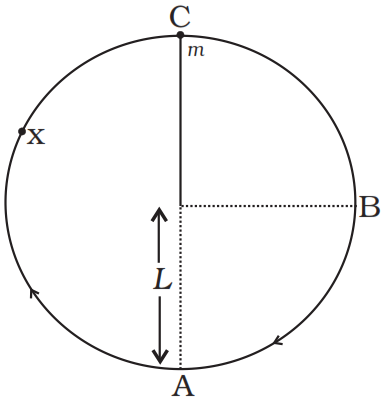
A bob of mass m suspended by a light string of length L is whirled into a vertical circle as shown in what will be the trajectory of the particle if the string is cut at:
  1. Point B?
  2. Point C?P
  3. oint X?
Answer
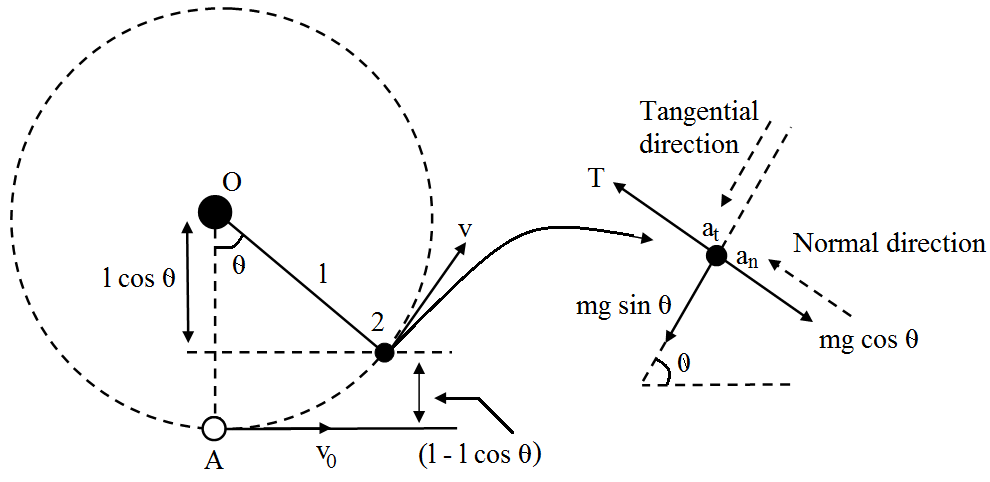
Key concept: According to the situation shown above that a bob of mass m is whirled into a vertical circle, the required centripetal force is obtained from the net force towards center at any point of time in the string. Tension in the string is variable and it is always towards center. But the gravitational force on the bob is always towards center. The speed of the body will be different at different points. So the equations of dynamical equilibrium $(F_c = ma_c, F_t = ma_t)$ must be satisfied at all the points. Let when the string makes an angle 9 with vertical, the speed of mass is v. Apply Newton’s law perpendicular to the string:$\text{Mg}\sin=\text{ma}$
$\Rightarrow\text{a}=\text{g}\sin$
The above equation gives tangential acceleration as a function of angle . At lowest point = 0° and at highest point = 180°. So at both points sin 9 = 0. Hence a, = 0 at both points L and H. At point M, = 90°, then $a_1 = g$. It is the maximum value of $a_t$ Apply Newton’s law along the string:$\text{T}-\text{mg}\cos=\text{ma}$
Or $\text{T}=\text{mg}\cos+\text{m}\frac{\text{v}^2}{\text{r}}\ ...(\text{i})$ As the body goes up, its velocity will go on decreasing and angle $\theta$ will go on increasing. Maximum speed of the body will be at lowest point L and minimum at highest point H. Then from above relation we can find that tension will be maximum at lowest point and minimum at highest point. Tension at lowest point $(\theta=0^\circ,\text{v}=\text{v}_\text{L})$$\text{T}_\text{L}=\text{mg}+\text{m}\frac{\text{v}^2_\text{L}}{\text{r}}\ ...(\text{ii})$
Tension at highest point $(\theta=180^\circ,\text{v}=\text{v}_\text{H})$$\text{T}_\text{H}=-\text{mg}+\text{m}\frac{\text{v}^2_\text{H}}{\text{r}}\ ...(\text{iii})$

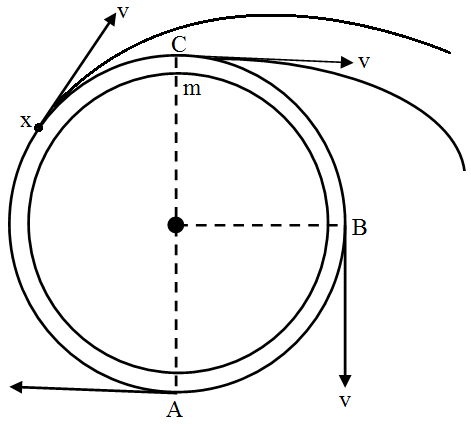
When string is cut, tension in string becomes zero and centripetal force is not provided. Hence, bob tends to move in along the direction of its velocity.
  1. If the string is cut at any point, then velocity of body of mass m is along the tangent to the circle. Tangent at point B is vertically downward so the trajectory of the particle is the straight line.
  2. Tangent at point C is horizontally towards right. So the trajectory of the particle is the parabola.
  3. Tangent at point X makes some angle with the horizontal. Again bob will follow a parabolic path with vertex higher than C.
View full question & answer
5 Marks Questions - Physics STD 11 Science Questions - Vidyadip