Questions

3 Marks Question

🎯

Test yourself on this topic

35 questions · timed · auto-graded

Question 13 Marks
Five square flower beds each of sides $1 m$ are dug on a piece of land $5 m$ long and $4 m$ wide. What is the area of the remaining part of land?
Answer
Area of square flower bed = $\times$ side
$= 1 m$ $\times$ $1 m$
$= 1\ sq\ m$
$\therefore$ Area of $5$ square flower beds $= 5$ $\times$ $1\ sq\ m$
$= 5\ sq\ m$
Length of the piece of land $= 5 m$
Breadth of the piece of land $= 4 m$
$\therefore$ Area of the piece of land = Length $\times$ Breadth
$= 5 m$ $\times$ $4 m$
$= 20 sq m$
$\therefore$ Area of the remaining part of land $= 20\ sq\ m – 5\ sq\ m$
$= 15\ sq\ m$
View full question & answer
Question 23 Marks
A floor is $5 m$ long and $4 m$ wide. A square carpet of sides $3 m$ is laid on the floor. Find the area of the floor that is not carpeted.
Answer
Length of the floor $= 5 m$
Breadth of the floor $= 4 m$
$\therefore$ Area of the floor = Length $\times$ Breadth
$= 5 m$ $\times$ $4 m$
$= 20\ sq\ m$
Area of the square carpet = side $\times$ side
$= 3 m$ $\times$ $3 m$
$= 9 sq m$
$\therefore$ Area of the floor that is not carpeted $= 20\ sq\ m – 9\ sq\ m$
$= 11\ sq\ m.$
View full question & answer
Question 33 Marks
What is the cost of tiling a rectangular piece of land $500 m$ long and $200 m$ wide at the rate of $Rs\ 8$ per hundred sq m?
Answer
Length of the rectangular piece of land $= 500 m$
Breadth of the rectangular piece of land $= 200 m$
$\therefore$ Area of the rectangular piece of land = Length $\times$ Breadth
$= 500 m$ $\times$ $200 m$
$= 100000\ sq\ m$
$\because$ Cost of tilling $100\ sq\ m = Rs 8$
$\therefore$ Cost of tilling $1\ sq\ m = Rs$ $\frac{8}{100}$
$\therefore$ Cost of tilling $100000\ sq\ m = Rs$ $\frac{8}{100} \times 100000$
$= Rs\ 8,000$
View full question & answer
Question 43 Marks
. The length and breadth of the three rectangles are as given below:
$i.\ 9 m$ and $6 m$
$ii.\ 3 m$ and $17 m$
$iii.\ 4 m$ and $14 m$
Which one has the largest area and which one has the smallest?
Answer
$i.\ $Area of the rectangle = Length $\times$ Breadth
$= 9 m$ $\times$ $6 m$ $= 54\ sq\ m$
$ii.\ $Length of the rectangle = Length $\times$ Breadth
$= 3 m$ $\times$ $17 m$ $= 51\ sq\ m$
$iii.\ $Length of the rectangle = Length $\times$ Breadth
$= 4 m$ $\times$ $14 m$ $= 56\ sq\ m$
The rectangle $(iii)$ has the largest area and the rectangle $(ii)$ has the smallest area.
View full question & answer
Question 53 Marks
How many tiles whose length and breadth are $12 \ cm$ and $5 \ cm$ respectively will be needed to fit in a rectangular region whose length and breadth are $70 \ cm$ and $36 \ cm$ respectively.
Answer
Length of the region $= 70 \ cm$
Breadth of the region $= 36 \ cm$
$\therefore$ Area of the rectangular region $= 70 \ cm$ $\times$ $36 \ cm$
$= 2520\ sq \ cm$
Area of a tile $= 12 \ cm$ $\times$ $5 \ cm = 60\ sq \ cm$
$\therefore$ Number if tiles needed to fit the region
$=\frac{\text { Area of the region }}{\text { Area of a tile }}$
$=\frac{2520}{60}$
$= 42$
View full question & answer
Question 63 Marks
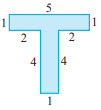
Split the shape into a rectangle and find its area. (The measures are given in centimetres)
Answer
We know that,
Area of rectangle = Length $\times$ Breadth
Therefore,
From the figure, we have,
Area of $1^{\text {st }}$ recatngle $=5 \times 1=5 \mathrm{~cm}^2$
Also,
Area of $2^{\text {nd }}$ rectangle $=4 \times 1=4 \mathrm{~cm}^2$
Therefore,
Total area $=5+4=9 \mathrm{~cm}^2$
View full question & answer
Question 73 Marks
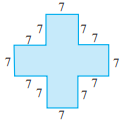
Split the shape into a rectangle and find its area. (The measures are given in centimetres)
Answer
We know that,
Area of rectangle = Length $\times $ Breadth
Also,
Area of square $=(\text { Side })^2$
Therefore,
Area of one square $=7 \times 7=49 \mathrm{~cm}^2$
As there are $5$ squares in a total of equal size.
Therefore,
Area of $5$ squares $=5 \times 49 \mathrm{~cm}^2=245 \mathrm{~cm}^2$
View full question & answer
Question 83 Marks
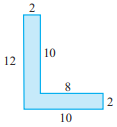
Split the shape into a rectangle and find its area. (The measures are given in centimetres)
Answer
We know that,
Area of rectangle = Length $\times$ Breadth
Hence, from the figure,
Area of $1^{\text {st }}$ rectangle $=12 \times 2=24 \mathrm{~cm}^2$
Also,
Area of $2^{\text {nd }}$ rectangle $=8 \times 2=16 \mathrm{~cm}^2$
Thereore,
Total area $=24+16 \mathrm{~cm}^2=40 \mathrm{~cm}^2$
View full question & answer
Question 93 Marks
Find the area of the figure by counting squares:
Answer
By observing the figure, we get
Covered Area Total Numbers Area
Fully filled squares $9$ $1$ $\times$ $9 = 9$
Half filled squares $0$ $\frac{1}{2} \times 0=0$
More than half-filled squares $9$ $1$ $\times$ $9 = 9$
Less than half-filled squares $7$ $0$ $\times$ $7 = 0$
Area $=9(1)+0\left(\frac{1}{2}\right)+9(1)+7(0)$
$= 9 + 0 + 9 + 0$
$= 18$ square units
View full question & answer
Question 103 Marks
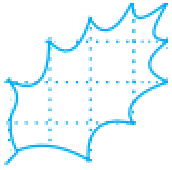
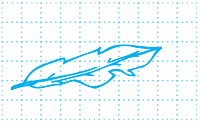
Find the area of the figure by counting squares:
Answer
From the given figure of leaf, we find that there are variations in the filling of the squares.
Thus, we form a table to organise the data by observing the above figure.
Covered Area Total Numbers Area
Fully filled squares $5$ $5$
Half filled squares $0$ $0$
More than half-filled squares $9$ $9$
Less than half-filled squares $12$ $0$
Hence,
Total Area $= 5 + 9 = 14$ square units
View full question & answer
Question 113 Marks
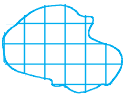
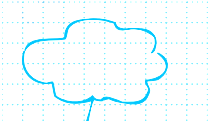
Find the area of the figure by counting squares:
Answer
We form a table to organize the data by observing the above figure.
Covered Area Total Numbers Area
Fully filled squares $2$ $2$
Half filled squares $0$ $0$
More than half-filled squares $6$ $6$
Less than half-filled squares $6$ $0$
Therefore,
Total Area $= 2 + 6 = 8$ square units
View full question & answer
Question 123 Marks
What is the length of the wooden strip required to frame a photograph of length and breadth $32 \ cm$ and $21 \ cm$, respectively?
Answer
Length of the wooden strip required
$= 2 \times $ (Length + Breadth)
$= 2 \times (32 \ cm + 21 \ cm) = 2 \times (53 \ cm)$
$= 106 \ cm = 1.06 m$
View full question & answer
Question 133 Marks
Table-Top measures $2 m\ 25 cm$ by $1 m\ 50 \ cm$. What is the perimeter of the table-top?
Answer
Perimeter of the table-top
$= 2 \times $ (Length + Breadth)
$= 2 \times (2 m 25 \ cm + 1 m 50 \ cm)$
$= 2 \times (2.25 m + 1.50 m) = 2 \times (3.75 m)$
$= 7.50 m$
View full question & answer
Question 143 Marks
The lid of a rectangular box of sides $40 \ cm$ by $10 \ cm$ is sealed all round with tape. What is the length of the tape required?
Answer
Length of the tape required = Perimeter of the rectangular box
$= 2 \times $ (Length + Breadth)
$= 2 \times (40 \ cm + 10 \ cm) = 2 \times (50 \ cm)$
$= 100 \ cm = 1 m$
View full question & answer
Question 153 Marks
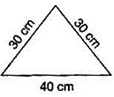
What is the perimeter of the figure? What do you infer from the figure?
Answer
Perimeter
= Sum of the lengths of all the sides
$= 30 \ cm + 40 \ cm + 30 \ cm$
$= 100 \ cm$
This is a triangle because it has three sides.
View full question & answer
Question 163 Marks
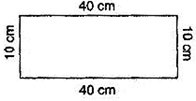
What is the perimeter of the figure given below? What do you infer from the figure?
Answer
Perimeter
= Sum of the lengths of all the sides
$= 40 \ cm + 10 \ cm + 40 \ cm + 10 \ cm$
$= 100 \ cm$
This is a rectangle because its opposite sides are equal.
View full question & answer
Question 173 Marks
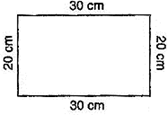
What is the perimeter of the figure? What do you infer from the answer?
Answer
Perimeter
= Sum of the lengths of all the sides
$= 30 \ cm + 20 \ cm + 30 \ cm + 20 \ cm$
$= 100 \ cm$
This is a rectangle because its opposite sides are of equal length.
View full question & answer
Question 183 Marks
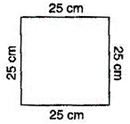
What is the perimeter of the figure? What do you infer from the answer:
Answer
Perimeter
= Sum of the length of all the sides
$= 25 \ cm + 25 \ cm + 25 \ cm + 25 \ cm$
$= 100 \ cm$
This shows that it is a square because all sides of a square are equal.
View full question & answer
Question 193 Marks
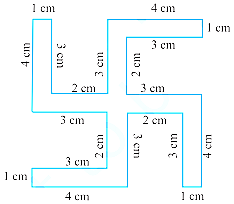
Find the perimeter of the figure:
Answer
We know that,
The perimeter of a polygon = Sum of the lengths of all sides of that polygon
In this question, we have:
Perimeter $= 4 (1 + 4 + 3 + 2 + 3) \ cm$
$= 52 \ cm$
View full question & answer
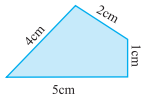
Question 203 Marks
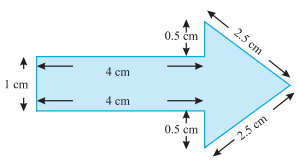
Find the perimeter of the figure:
Answer
We know that,
The perimeter of a polygon = Sum of the lengths of all sides of that polygon
In this question, we have:
Perimeter $= 2(1 + 4 + 0.5 + 2.5) cm$
$= 16 \ cm$
View full question & answer
Question 213 Marks
Find the cost of fencing a rectangular park of length $175 m$ and breadth $125 m$ at the rate of $₹ 12$ per metre.
Answer
Perimeter of the rectangular park
$= 2$ $\times$ $($Length + Breadth$)$
$= 2$ $\times$ $(175 m + 125m)$
$= 2$ $\times$ $(300 m)$
$= 600 m$
$\therefore$ Cost of fencing the rectangular park at the rate of $Rs\ 12$ per meter
$= Rs\ 600$ $\times$ $12$
$= Rs\ 7200$
View full question & answer
Question 223 Marks
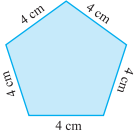
Find the perimeter of the figure:
Answer
We know that,
Perimeter of a polygon = Sum of the lengths of all sides of that polygon
Here, we have:
Perimeter $= (4 + 4 + 4 + 4 + 4) cm$
$= 20 \ cm$
View full question & answer
Question 233 Marks
Find the coast of fencing a square park of side $250 m$ at the rate of $Rs\ 20$ per metre.
Answer
Perimeter of the square park
$= 4$ $\times$ Length of a side
$= 4$ $\times$ $(250 m)$
$= 1000 m$
$\therefore$ Cost of fencing the square park at the rate of $Rs 20$ per metre
$= Rs 1000$ $\times$ $20$
$= Rs. 20000$
View full question & answer
Question 243 Marks
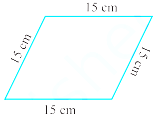
Find the perimeter of the figure:
Answer
We know that,
Perimeter of a polygon = Sum of the lengths of all sides of that polygon
Here, we have:
Perimeter $= (15 + 15 + 15 + 15) cm$
$= 60 \ cm$
View full question & answer
Question 253 Marks
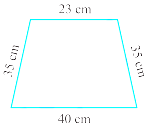
Find the perimeter of the figure:
Answer
We know that,
Perimeter of a polygon = Sum of the lengths of all sides of that polygon
Here, we have:
Perimeter$ = (23 + 35 + 40 + 35) cm$
$= 133 \ cm$
View full question & answer
Question 263 Marks
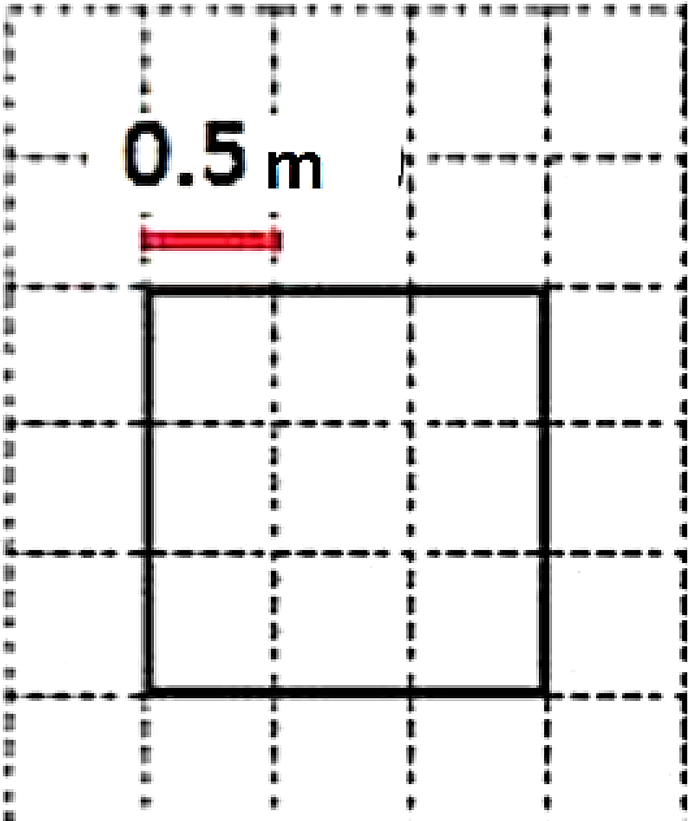
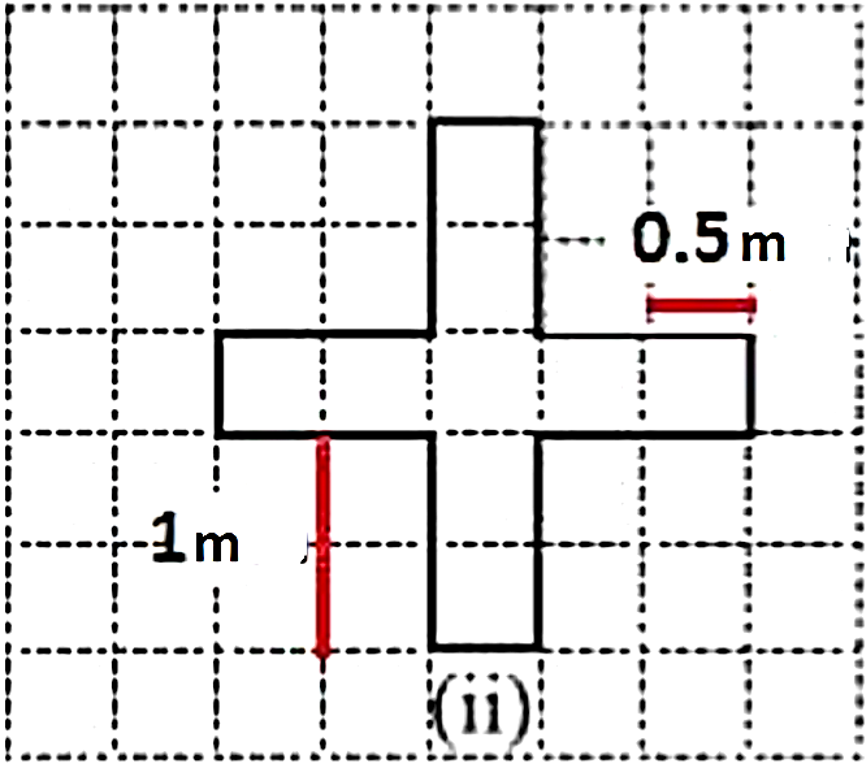
Find the perimeter of the figure:
Answer
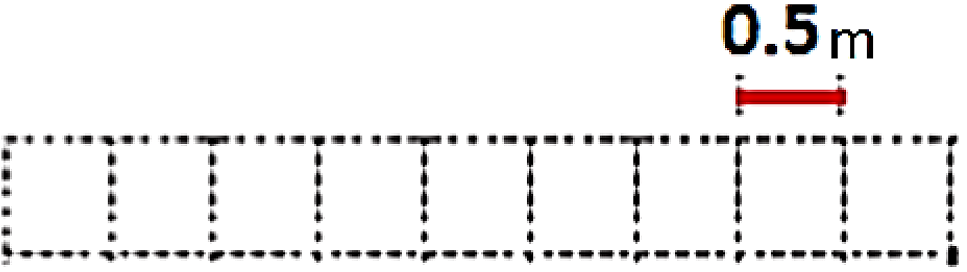
$i.\ $From the given figure, the side of one slab is $\frac{1}{2}$ m

Therefore, the side of the square formed by Avneet $=\left(3 \times \frac{1}{2}\right) m=\frac{3}{2} m$
Now,
We know that the perimeter of a square $= 4 \ \times$ Side $=4 \times \frac{3}{2}=6 \mathrm{m}$
$ii.\ $We know that,
Perimeter $=$ Sum of all sides

Therefore Perimeter of the Shari's arrangement $= 0.5 + 1 + 1 + 0.5 + 1 + 1 + 0.5 + 1 + 1 + 0.5 + 1 + 1 = 10 m$
$iii.\ $The arrangement which is in the shape of the cross has a greater perimeter $($i.e. $10 m)$
$iv.\ $If we put all $9$ slabs in a line then, the perimeter will be $10 m$, as shown below.

Thus, from the given arrangements, arrangements with perimeters greater than $10 m$ cannot be determined.
Hence $10$ is the largest possible value if the perimeter.
View full question & answer
Question 273 Marks
The perimeter of a regular pentagon is $100$ centimeter. How long is its each side?
Answer
Perimeter of the regular pentagon $= 5 \times $ Length of a side
∴ Length of one side =$\frac{\text { Perimeter of the regular pentagon }}{5}$
$=\frac{100}{5} \mathrm{cm}$
$= 20 \ cm$
View full question & answer
Question 283 Marks
Pinky runs around a square field of side $75 m$, Bob runs around a rectangular field with length $160 m$ and breadth $105 m.$ Who covers more distance and by how much?
Answer
Given that, Distance covered by Pinky in one round = Perimeter of the square
$= 4$ $\times$ length of a side
$= 4$ $\times$ $75 m = 300 m$
Distance covered by Bob in one round = Perimeter of the rectangle
$= 2$ $\times$ (length + breadth)
$= 2$ $\times$ $(160 m + 105 m)$
$= 2$ $\times$ $265 m = 530 m$
Difference in the distance covered $= 530 m – 300 m = 230 m.$
Thus, Bob covers more distance by $230 m.$
View full question & answer
Question 293 Marks
Find the cost of fencing a rectangular park of length $250 m$ and breadth $175 m$ at the rate of $₹12$ per metre.
Answer
Given:
Length of the rectangular park $= 250 m$
Breadth of the rectangular park $= 175 m$
To calculate the cost of fencing we require perimeter.
Therefore, Perimeter of the rectangle $= 2$ $\times$ (length + breadth)
$= 2$ $\times$ $(250 m + 175 m)$
$= 2$ $\times$ $(425 m) = 850 m$
Cost of fencing $1m$ of park $= ₹12$
Thus, the total cost of fencing the park
$= ₹12$ $\times$ $850 = ₹10200$
View full question & answer
Question 303 Marks
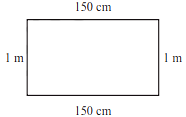
Find the perimeter of a rectangle whose length and breadth are $150 \ cm$ and $1 m$ respectively.
Answer
Given:
Length $= 150 \ cm$
Breadth $= 1m = 100 \ cm$
Therefore, Perimeter of the rectangle
$= 2$ $\times$ (length + breadth)
$= 2$ $\times$ $(150 \ cm + 100 \ cm)$
$= 2$ $\times$ $(250 \ cm)$
$= 500 \ cm = 5 m$
View full question & answer
Question 313 Marks
An athlete takes $10$ rounds of a rectangular park, $50 m$ long and $25 m$ wide. Find the total distance covered by him.
Answer
Length of the rectangular park $= 50 m$
The breadth of the rectangular park $= 25 m$
The total distance covered by the athlete in one round will be the perimeter of the park.
Now, the perimeter of the rectangular park
$= 2$ $\times$ (length + breadth)
$= 2$ $\times$ $(50 m + 25 m)$
$= 2$ $\times$ $75 m = 150 m$
So, the distance covered by the athlete in one round is $150 m.$
Thus, distance covered in $10$ rounds $= 10$ $\times$ $150 m = 1500m$
Therefore, the total distance covered by the athlete is 1500 m.
View full question & answer
Question 323 Marks
Bob wants to cover the floor of a room $3 m$ wide and $4 m$ long by squared tiles. If each square tile is of side $0.5 m$, then find the number of tiles required to cover the floor of the room.
Answer
Given:
Length of the room $= 4 m$
Breadth of the room $= 3 m$
Area of the floor = length $\times$ breadth
$= 4 m$ $\times$ $3 m = 12 sq m$
Area of one square tile = side $\times$ side
$= 0.5 m$ $\times$ $0.5 m$
$= 0.25\ sq\ m$
Number of tiles required = $\frac{Area\ of \ the floor}{Area \ of \ one \ tile}$ = $\frac{12}{0.25}$ = $\frac{1200}{25}$ $= 48$ tiles
View full question & answer
Question 333 Marks
By counting squares, estimate the area of the figure.
Answer
From the given figure, we have,
Covered area Number Area area estimate (sq units)
Fully-filled squares $1$ $1$
Half-filled squares - -
More than half-filled squares $7$ $7$
Less than half-filled squares $9$ $0$
Total area $= 1 + 7 = 8$ sq units.
View full question & answer
Question 343 Marks
By counting squares, estimate the area of the figure.
Answer
From the above figure, we have,
Covered area Number Area estimate (sq units)
$(i)$ Fully-filled squares $11$ $11$
$(ii)$ Half-filled squares $3$ $3 \times \frac{1}{2}$
$(iii)$ More than half-filled squares $7$ $7$
$(iv)$ Less than half-filled squares $5$ $0$
Therefore, Total area $= 11 + 3$ $\times$ $\frac{1}{2}$ $+ 7 = 19$ $\frac{1}{2}$ sq units.
View full question & answer
Question 353 Marks
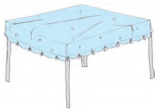
Shabana wants to put a lace border all around a rectangular table cover

$3 m$ long and $2 m$ wide. Find the length of the lace required by Shabana.
Answer
Length of the rectangular table cover $= 3 m$
Breadth of the rectangular table cover $= 2 m$
Therefore, the length of the lace required will be equal to the perimeter of the rectangular table cover.
Now, the perimeter of the rectangular table cover
$= 2$ $\times$ (length + breadth) $= 2$ $\times$ $(3 m + 2 m) = 2$ $\times$ $5 m = 10 m$
So, length of the lace required is $10 m.$
View full question & answer